




Abstract
Presently, sustainable leadership has emerged as an effective leadership style to cope with sustainable challenges. Extent literature has recommended exploring the mechanism and conditional boundaries for the significant effect of sustainable leadership on sustainable performance. Therefore, this study would investigate the mediating mechanism of organizational learning and the psychological empowerment as conditional factor on the sustainable leadership–sustainable performance relationship. The cluster-sampling approach was employed to collect data from 369 small medium enterprises in selected ASEAN countries: Malaysia, Indonesia, and Brunei Darussalam. The response rate is 41%. Structural equation modeling (variance-based) analysis was performed to empirically confirm the proposed hypotheses. By running PROCESS Macro in SPSS, the moderated-mediation analysis was conducted in this study. The research outcomes revealed that higher level of psychological empowerment will result in a higher indirect effect of sustainable leadership on sustainable performance through organizational learning. Based on the present empirical evidences, implications and future research directions have also been added at the end of study. To date, this study has preliminary investigated the interplay of sustainable leadership, organizational learning, empowerment, and sustainable performance.
Introduction
According to the U.S. National Centers for Environmental Information, there was a total of $306.2 billion of damage caused by climate change and extreme weather in 2017 (A. B. Smith, 2018). The environmental information reports of 2017 and 2018 also suggested that climate change has become increasingly intense which call for the execution of relevant measures to cope with this worrying situation (Hallinger & Suriyankietkaew, 2018). The Business for Social Responsibility (BSR) report, namely The Future of Sustainable Business has recently revealed that the impact of climate change will be felt by businesses across the world (James, 2017). Due to this condition, organizations are motivated to amend their traditional business activities to cope with environmental challenges.
Climate change requires organizational leaders to pay close attention to the local and global environment (Boiral et al., 2014). To cater challenge of climate change, the United Nations have developed “sustainable development goals” (SDGs), with applicability to organizations irrespective of any sectors across the globe (Biermann et al., 2017). Sustainable development requires firms to incorporate their economic, social, and environmental objectives into their practice without damaging resources for the use of future generations (Iqbal, Ahmad, Nasim, & Khan, 2020).
Presently, sustainable development has emerged as one of the challenging issues across the globe (P. Smith & Ramirez, 2012). Diverse stakeholders such as government, publics, and nongovernment organizations are forcing businesses to perform sustainably in the highly complex environment (P. Smith & Ramirez, 2012). Sustainability requires leaders who could foster sustainable practices in their society, organizations and ignite economic prosperity (Metcalf & Benn, 2013). In this perspective, sustainable leadership has emerged as effective leadership (Shriberg & MacDonald, 2013). Sustainable leadership stresses on the creation of the present and future profits for an organization, in addition to enhancing the quality of life for all stakeholders (McCann & Holt, 2010). Sustainable leadership promotes sustainability values at the individual, organizational, and social level (Iqbal, Ahmad, Nasim, & Khan, 2020; Peterlin et al., 2015). Furthermore, sustainable leaders focus on capacity building, sustainable change and long-term results (Hallinger & Suriyankietkaew, 2018) which make it imperative to pursue SDGs. Sustainable leadership practices such as valuing employees, shared vision, social responsibility, and amicable labor relations; significantly drive long-term firm performance (Avery & Bergsteiner, 2011). Sustainable leadership is still in the stage of infancy, so there is need to extend the literature in this domain (Burawat, 2019). As sustainable leadership significantly influences the sustainable performance, Burawat (2019) has recommended to explore the intervening variable that mediates or moderates their relationship in the complex model.
Sustainable leadership plays a vibrant part in the growth of organizational learning (Al-Zawahreh et al., 2019). Learning organizations are highly concerned about systematic thinking, extensive collaborative engagement, and the core assumptions of business and its objectives. Being a social process, contextual factors influence organizational learning. Shared vision, systemic thinking, and leadership influence organizational learning. Support from management is essential to enhance learning (Liao, Chen, Hu, Chung, & Liu, 2017).
Extent literature have also emphasized on the importance of organizational learning in the quest for sustainability (SD). Effective and efficient knowledge and insights generated under the umbrella of organizational learning related to sustainable development is conducive to deal with sustainability (P. Smith & Ramirez, 2012). Organizational learning is a source of sustainable competitive advantage (Hosseini et al., 2020). In context of sustainable development, learning organizations deal with challenges of the sustainability in the shape of demands from social, ecological, and environmental perspective in the dynamic complex market where it is imperative to create new approaches, policies, and structures (Naudé, 2012). Learning organization is a strategy to improve performance and retain sustained competitive advantage (Naudé, 2012). Furthermore, higher the inclination toward learning, higher the ability to cope with challenges of triple bottom line approach to sustainability. Therefore, based on the recommendation of Burawat (2019) and regarding resource-based view (RBV) and dynamic theory, the study examines organizational learning as underlying the mechanism of sustainable leadership-sustainable performance relationship.
Contextual factors significantly influence sustainable performance (Burawat, 2019). On the basis of job demands-resources (JD-R) model, the present study investigates the moderating role of psychological empowerment on the organizational learning-sustainable performance relationship. Regarding recommendations of Chen et al. (2019), this study investigates the moderated-mediating role of psychological empowerment on the linkages of sustainable leadership with sustainable performance.
Literature Review
Underpinning Theories
The current research has applied RBV theory to relate sustainable leadership with organizational learning, and dynamic capability theory to link organizational learning with sustainable performance. According to the RBV theory, resources are rare, inimitable, and sustainable (Collis & Montgomery, 1995). Organizational resources consist of financial resources, human capital, and intellectual capital. Organizations use leadership as human capital because they are rare, valuable, nonsubstitutable, and inimitable (Harris & McMahan, 2015). Sustainable leaders matter, spread and last, and do not deplete human or financial resources but care for all stakeholders (Hargreaves & Fink, 2012). Therefore, sustainable leadership, which is deemed as the most suitable form of leadership in the era of sustainable development, has been employed as resource in this study.
Resources enable organizations to develop dynamic capabilities which are useful in responding to changing market requirements (Zollo & Winter, 2002). Furthermore, dynamic capability refers to the ability to develop, reconfigure, and integrate both internal and external competencies to deal with highly dynamic environment (Teece et al., 1997). Organizational learning is a dynamic capability which fosters superior customer value in the long-term as learning allows a continuous adaptation to the rapidly changing market. The RBV-based literature suggests that organizations use resources to obtain competitive edge over their competitors. As, organizational learning is a dynamic capability and a source of sustainable competitive advantage, organizations may use sustainable leadership as a resource to enhance it. This study employs RBV theory to connect the association between sustainable leadership and organizational learning.
Being a source of sustained competitive advantage, dynamic capabilities enables firms to rapidly configure and integrate resources to cope with the changing demands of stakeholders (Chien & Tsai, 2012; Teece et al., 1997). The term “capability” concerns about the adaptation, reconfiguration, and integration of overall organizational resources (internal and external resources) along with varying market environment (Teece et al., 1997). Dynamic capabilities deal with the creation, collection, integration, and application of the knowledge resources. Similarly, knowledge-based dynamic capabilities include knowledge creation, storage, absorption, and application. Organizational learning explores new knowledge resources and converts employee’s experience into organizational memory. Learning organizations develop regular activities, which helps employees to garner and apply knowledge resources. Developing such dynamic capabilities lead to better performance (Chien & Tsai, 2012; Roberts & Grover, 2012). As learning organizations create new knowledge from available organizational resources, so may perform differently in the dynamic environment and deliver optimum performance. Therefore, dynamic capability theory has been used to relate organizational learning with sustainable performance in this study.
Organizations are dealing with challenges of sustainable development in the presence of high uncertainty, complexity, and contested knowledge (P. Smith & Ramirez, 2012). Extent literature have emphasized on the promotion of organizational learning to deal with the goals of triple bottom line as is considered the vital source of long-term and sustainable competitive advantage in highly turbulent market (Anderson, 2019; Naudé, 2012). Highly dynamic nature of the market leads to the high demand of organizational learning (Naudé, 2012) that results into high cognitive demands and demanding interaction with diverse stakeholders (Glaser et al., 2015). Cognitive demands and demanding interaction with stakeholders are considered as job demands (Schaufeli & Taris, 2014). According to the job-demand resource (JD-R) model, the interaction of job demands and resources work effectively to enhance outcomes. Being a job resource (Ugwu et al., 2014), psychological empowerment enables employees to follow their goals (Seibert et al., 2011). Regarding JD-R model (Demerouti et al., 2001), this study undertakes organizational learning as job demand and psychological empowerment as job resource whose interaction has the potential to stimulate sustainable performance. Subsequently, the theoretical landscape of JD-R theory is stretched by revealing the importance of psychological empowerment as a resource and organizational learning as job demand.
Sustainable Performance
Currently, there is shift in measuring the performance among business organizations. Organizations, traditionally, used to measure its performance on the basis of assets, market position, and liabilities in the past (Iqbal, Ahmad, & Halim, 2020). Now, businesses are experiencing a positive change by aligning their financial performance with their social and environmental performance, such phenomenon emerges as sustainable performance (T. A. Chin et al., 2015). Sustainability is viewed as a business strategy which has close association with corporate social responsibility. As the organization, environment, and society are mutually associated so they always drive win–win solution. The effective integration of the ecological, environmental, and social performance provides a robust competitive advantage to the organizations (T. A. Chin et al., 2015; Paulraj, 2011). Organizations endure long-lasting business, provided they reduce the negative impact of their operation on the society and environment (Markard et al., 2012).
Organizations are motivated to employ sustainable practices as a business strategy to reap the long-lasting business (Chabowski et al., 2011). Presently, diverse stakeholders are pressurizing and admiring business organizations to accomplish their voluntary environmental and social goals as a single entity along with their final goals (Iqbal, 2020).
Organizations measure sustainable performance through monitoring performance in relation to economy, society, and environment in parallel. Sustainable performance measures and assesses the performance of the firms from all aspects and for all stakeholders. As organizations consider both upstream and downstream stakeholders while measuring sustainable performance, there are no boundary conditions in this arena (Charter & Tischner, 2017). In similar context, Burawat (2019) claims that sustainable organizations focus on minimum usage of resources, reduced emission of gases, promote environmental initiatives, and create value for diverse stakeholders, along with rise in their financial performance. Furthermore, as sustainable leaders consider long-term aspects, systemic thinking and management development so are crux of the sustainable performance (Avery & Bergsteiner, 2011).
Organizational Learning
Organizational learning is a continuous process to obtain organizational knowledge and experience over time. Many authors have tried to elaborate the constructs and processes of organizational learning such as Argote & Miron-Spektor (2011) and Flores et al. (2012). According to Dixon (1999), organizational learning is a four-step process that comprises of generation, integration, collective interpretation of information, and having authority to apply them into practice. Organizational learning consists of three subprocesses, that is, information acquisition, interpretation, and integration (Flores et al., 2012).
Organizational learning enables organizations to get sustained competitive advantage in the highly dynamic market (Guinot et al., 2016). Knowledge sharing, open communication, and leadership is viewed as the strong antecedents of organizational learning (Sattayaraksa & Boon-itt, 2016). Furthermore, participative decision making, transformational leadership, and openness are viewed as the strong predictors of organizational learning (Park & Kim, 2018). Organizational learning motivates employees to perform beyond the formal requirements in certain aspects such as conservation of resources. Organizational learning also enhances civic virtue among employees where they participate responsibly.
The extent literature has confirmed the positive relationship of organizational learning with conscientiousness, civic virtue, and organizational citizenship behavior (Kim & Park, 2019; Salas-Vallina et al., 2017). Extent literature has contended the positive impact of organizational learning on the organizational performance, service quality, market orientation, innovation, strategic supply chain, and alliance performance (Liu et al., 2010). Organizational learning fosters the active participation of the employees that ultimately contributes to the organizational performance. Furthermore, Bevan et al. (2012) contend that collaborative relationship substantially influences organizational learning. Besides this, Islam et al. (2016) has confirmed the negative impact of organizational learning on the turnover intentions. In addition, transformational leadership indirectly significantly influences citizenship behavior through organizational learning (Kim & Park, 2019).
Sustainable Leadership
The sustainability requires leaders that could devise approaches, policies, and programs to foster sustainable practices at social and organizational level and ignite economic success (Metcalf & Benn, 2013). Sustainability, sustainable leadership, eco-sensitive leadership, green leadership, and sustainability leadership are used interchangeably to link sustainable practices with leadership and/or management (Cosby, 2014). Multiple diverse stakeholders consider sustainable leadership as top priority and standard practice in the green economy (Avery & Bergsteiner, 2011). Furthermore, Riseley (2016) contend that sustainable leadership is viewed as a vital organizational practice to foster organizational learning.
Sustainable leadership comprises of those behaviors and practices that create lasting value for all stakeholders such as the society, environment, and future generations at large (Avery & Bergsteiner, 2011). Sustainable leadership is a source of competitive advantage for organizations. Sustainable leadership brings opportunities to the organizations in the shape of innovation, continuous improvement, sustained competitive advantage, and long-term success (McCann & Holt, 2010). As sustainable leadership creates an environmental vision through cultural changes and create networking with various stakeholders to cope with climate change; therefore, deemed as the crux of green initiatives and ecological performance at organizational level (Al-Zawahreh et al., 2019).
Furthermore, sustainable leadership increases organizational performance by reducing costs and increasing potential revenue. Sustainable leaders have proactive approach where they constantly scan the environment to monitor the external changes in the market (Gerard et al., 2017) where they develop sustained relationship with internal and external stakeholders. Regarding internal activities, sustainable leaders develop a long-term vision, emphasize on the green initiatives, recognize sustainability issues, instill green management systems, and promote incremental and radical innovation (Avery & Bergsteiner, 2011). Yet, out of the organization, sustainable leaders focus on accomplishing optimum performance for both society and environment (Avery & Bergsteiner, 2011). Under sustainable leadership, organizations reap numerous benefits such as protecting the natural resources and efficient usage of resources.
Psychological Empowerment
Empowerment refers to the extent power is given to the employees (Spreitzer, 1995). Empowerment has been studied from two perspectives, that is, mechanistic and organic (Quinn & Spreitzer, 1997). From the mechanistic perspective, empowerment refers to the cascading power down to low-level employees. Whereas, empowerment means growth, risk, change, and trust to employees and bearing their mistakes from the organic perspective (Jena et al., 2019). Under mechanistic approach, empowerment is known as structural, hard, extrinsic, or communicative. From the organic perspective, empowerment is known as soft, motivational, psychological, or intrinsic. Structural empowerment, with its top–down view, focuses on what tools, means, or backgrounds in the physical workplace needs to be provided to enhance empowerment. Psychological empowerment focuses on the intrapersonal aspects of employees.
According to Spreitzer (1995), psychological empowerment is a set of psychological states that focuses on how employees think of their works, gain experience and how much they believe in their job and impact in their organization. According to Spreitzer (1995), psychological empowerment is a second-order construct with four dimensions such as competence, meaning, impact, and self-determination (autonomy). Psychological empowerment is a gestalt construct, and simultaneous presence of all four cognitions is mandatory to avail its optimal benefits (Spreitzer, 1995). Leader driver, structural, and psychological empowerment have a sequential relationship. Yet, psychological empowerment is highly proximal to the employee’s outcomes (Sun et al., 2012). Psychological empowerment is a response to the other two categories of empowerment. Every individual may react differently to the same managerial efforts toward empowerment and are only efficacious, provided they feel personally empowered. Therefore, this study focusses on psychological empowerment.
Psychological empowerment raises self-efficacy among employees by eliminating the causes of powerlessness and inability. Empowerment also raises the employee’s commitment and loyalty that ultimately drives organizational excellence (Cicolini et al., 2014). Psychological empowerment enhances the employee’s confidence level and enables the employees to accomplish their goals (X. Zhang et al., 2018). Psychological empowerment drives higher job satisfaction, innovation, organizational citizenship behavior (OCB), and sustainable performance. Psychological empowerment works as a mediating mechanism by which transformational leadership get their employees to perform above and beyond their call of duty (Barroso Castro et al., 2008).
Hypotheses Development
Sustainable leadership and organizational learning
Leadership is a vital factor that influences employee’s behavior and process of change (Zhou et al., 2015). Leadership inclusiveness, the behavioral integrity and trust in leader foster learning behavior, reduction in errors, and participation in the quality initiative activities (Hirak et al., 2012). Leaders influence organizational learning by creating and sharing vision, communicating openly and inducing, and training new workforce (Ruggieri & Abbate, 2013). Organizations need conducive learning environment and open-communication boundaries to enhance their learning (Seddighi & Mathew, 2020). Sustainable leaders foster psychological safe working environment which is crucial for open interpersonal communication and knowledge sharing (LeRoy, 2012). And, there is high learning in the presence of psychological safe work environment.
Shared values and willingness to collaborate and share information play vital role in the knowledge dissemination (Keyes & Benavides, 2018). Similarly, sharing culture enhances employee’s skills, experience, and knowledge within organizations (Yin et al., 2019). According to Kantabutra and Avery (2013), sustainable leaders exhibit six core practices such as innovation, staff development, long-term perspective, ethical behavior, organizational culture, and social and environmental responsibility. As sustainable leaders share vision and objectives with their employees, they facilitate organizational learning (Sharma & Lenka, 2019). Furthermore, sustainable leaders promote knowledge sharing behavior through provision of the vision information, feedback, and new ideas (Park & Kim, 2018). Therefore, below hypothesis is developed:
Organizational learning and sustainable performance
Presently, learning is the starting point in the highly dynamic market and learning process is a way to cope with environmental changes (Kalantarian et al., 2012). Organizational learning indicates the capacity of the organization to adapt to changes in the market. Learning also brings continuous changes in experience and repetitive actions that result into improved firm performance and efficient operations (Gunsel et al., 2011). Furthermore, organizations develop better management techniques through organizational learning by seeking and exploiting external opportunities and collecting quality information and insights from outside firms (Salas-Vallina et al., 2017) in the presence of high information pollution.
Organizational learning improves firm performance through the quality of financial and strategic decision making (Andreou et al., 2016). By promoting extra-role behaviors and civic virtues, organizational learning enables employees to perform responsibly (Salas-Vallina et al., 2017). Organizational learning develops firm’s ability to recognize opportunities to pursue new ventures effectively and to align continuously with the environment (Santos et al., 2020). As organizational learning enables a firm to modify itself to continue to perform efficiently and effectively in the highly turbulent market so organizational learning is assessed as dynamic capability. Regarding dynamic capability theory, organizational learning forms strategic flexibility and competitive strategy implementation to enhance financial, market, and customer-related performance (Santos-Vijande et al., 2012). As learning activities and practices drive the long-term superior performance, organizational learning is a vital factor to the sustainable performance (Hosseini et al., 2020). Therefore, below hypothesis is developed:
Organizational learning as a mediator
Leaders motivate employees to involve in continuous learning opportunities where they work together to solve organizational problems (Chang et al., 2011). In addition, leadership practices are vital indicators to employee’s believe in the organization’s commitment to sustainability (Macke & Genari, 2019). Furthermore, leadership fosters learning which results into improved performance (Dumdum et al., 2013). Being underlying condition, psychological safety indicates the presence of learning organization (Lyman et al., 2017). Supportive leadership behaviors indirect influence workplace outcomes through psychological safety at the organizational level (Newman et al., 2017). Support from leadership such as team building, motivation, provision of energy, and assistance in the process of change influences organizational learning which enable workforces to grab opportunities lying the arena of sustainable development (Hsiao & Chang, 2011). Compassion positively influences firm performance through organizational learning (Guinot et al., 2020). Employee’s training is a source to improve organizational learning that ultimately enhances firm performance (Milhem et al., 2014). In the presence of sustainable leadership practices such as management development, long-term employment, knowledge sharing, and innovation systems, there is high inclination toward organizational learning, further results into high organizational citizenship behaviors (Kim & Park, 2019). Therefore, following hypothesis is developed:
Psychological empowerment as a moderator
Efficient and effective generation of the knowledge and insights play vital role in the sustainable development (P. Smith & Ramirez, 2012). Organizational learning is a source of competitive advantage in the realm of sustainability (Hosseini et al., 2020). Furthermore, organizational learning significantly influences the organizational sustainability, so there is a need to explore the boundary conditions (Zhou et al., 2015). Learning organizations are contingent to the extra-role behavior of employees (Eldor & Harpaz, 2016) where they constantly interact with colleagues, supervisors, leaders, and other stakeholders with different countries, educational background, ethics, and locations (Van & Nafukho, 2019). Weak relationship among employees also appears as an obstacle to knowledge sharing and insight. Diverse composition of teams and limited personal communication between employees hinders the knowledge sharing and cooperation (Rosendaal & Bijlsma-Frankema, 2015). Therefore, the extra-role nature of the organizational learning creates additional job demands for employees where they may feel overload (Messmann et al., 2017). Job demand concerns about employee’s skill and effort requirements, physical and/or psychological outlays. Therefore, this study investigates organizational learning as job demand here. Regarding the JD-R model, job demands might drive to fatigue and tiredness as a result of expending additional effort (Demerouti & Bakker, 2011; Salas-Vallina et al., 2017). As organizational learning and sustainability are mutually related (Naudé, 2012), high focus on sustainable development links to the high demand of learning organizations.
In this context, the JD-R model (Demerouti & Bakker, 2011) contends that job demands appear as draining or inspiring for workforces based on the available job resources in relation to their work tasks in their workplace. Job resources such as psychological, physical, organizational, and social characteristics of a job spurs positive attitudes among employees (Schaufeli & Taris, 2014). Resources enhance employee’s energy, increase engagement, and fostering performance (Schaufeli & Taris, 2014). The JD-R model elaborates the relationship between job demands and resources (Demerouti & Bakker, 2011). A crucial postulation of the JD-R model is that interaction of the job demand and job resources drives the positive work outcomes, that is, job resources compensate the potential detrimental impact of job demands (Demerouti & Bakker, 2011). While, job resources appear more relevant in the existence of high job demands where demanding situations triggers employees to employ available job resources. Psychological empowerment emerges as a job resource because of its active orientation where employees feel motivated and have the potential to shape their job and environment (Messmann et al., 2017). Furthermore, psychological empowerment works as a bonding force between job characteristics and behavior at work, so it is considered as a job resource.
Psychologically empowered employees treat their job as highly meaningful and recognize themselves as expert and self-governing plentiful to mold their work environment in considerable manners (Spreitzer, 1995). Psychological empowerment is the strong predictor of extra-role behavior which is characteristic of the organizational learning (Messmann et al., 2017). Therefore, this study considers psychological empowerment as job resource. Regarding the JD-R model, this study views that interaction of psychological empowerment and organizational learning enhances the sustainable performance of the firms. Subsequently, below hypothesis is developed:
The moderated-mediating effect of psychological empowerment
Sustainable leaders promote sustainability at the individual, organizational, and social level. Sustainable leader focus on the capacity building, long-term results, and sustainable change (Peterlin et al., 2015). Extent literature has established the significant sustainable leadership-sustainable performance relationship (Burawat, 2019). Support from leadership such as team building, motivation, provision of energy, and assistance in the process of change influences organizational learning which are useful to grab diverse business opportunities (Hsiao & Chang, 2011). Sustainable leadership practices such as management development, long-term employment, knowledge sharing, and innovation systems, develop high inclination toward organizational learning, further results into high organizational citizenship behaviors (Kim & Park, 2019).
According to the JD-R model, the interaction of the job demands and resources drives the positive work outcomes, that is, job resources compensate the potential detrimental impact of job demands (Demerouti et al., 2001). Regarding the JD-R model, this study has already hypothesized that the interaction of organizational learning as job demand and psychological empowerment as job resource enhances the sustainable performance in previous section. Therefore, psychological empowerment controls the association between organizational learning and sustainable performance. The moderated-mediation occurs when strength of an indirect effect is contingent to the level of some other variable (Preacher et al., 2007). Similarly, there is presence of moderated-mediation provided path between mediator and dependent variable changes in the presence of a moderator (Morgan-Lopez & Mackinnon, 2006). Indirect effect is a product of coefficient of two paths, that is, from independent variable to mediator and from mediator to depend variable. Psychological empowerment influences the path from organizational learning (mediator) to sustainable performance (dependent variable). Hence, the indirect effect of sustainable leadership on sustainable performance through organizational learning changes in the presence of different values of psychological empowerment. Therefore, the above discussion concludes that;
Research Methodology
In the Association of Southeast Asian Nations (ASEAN) region, the economic growth of the member states is highly dependent on the manufacturing firms that emit carbon in high quantity, polluting both air and sea at the same scale (Hara, 2018). Despite the strong inclination toward SDGs, their prime reliance on the manufacturing industries hinders sustainable performance in this region. Organizations in the ASEAN region find it hard to transform their businesses to reduce carbon emission and use resources sustainably (Anbumozhi, 2017). ASEAN region consists of 14 countries which are categorized in the domain of lower-middle, upper-middle, and high-income nations. Out of these 14 countries, all three Muslim countries are positioned as lower-middle-income (Indonesia), upper-middle-income (Malaysia), and high-income countries (Brunei Darussalam). Considering convenience and generalization of the results, the present study has collected data from the small medium enterprises (SMEs) of these three Muslim countries in ASEAN region.
The definitions of the SMEs in any country is contingent to its economic and businesses position. Almost 98.50% firms are SMEs in Malaysia, wherein 0.1%, 1.1%, 4.3%, 5.3%, and 89.2% of them operate in the mining, agricultural, construction, manufacturing, and service sector, respectively. Malaysian SMEs are categorized based on total employees and sales turnover. Brunei Darussalam has 98.37% of their total established businesses as SMEs that are categorized with respect to their number of employees. Indonesia, the largest Muslim populated country, owns 99% of total business as SMEs that are classified regarding amount of annual investment, annual sales turnover, and total number of employees. Using cluster-sampling method, this study has collected data from employees working at managerial positions among SMEs in capital cities of these three countries, that is, Brunei, Indonesia, and Malaysia.
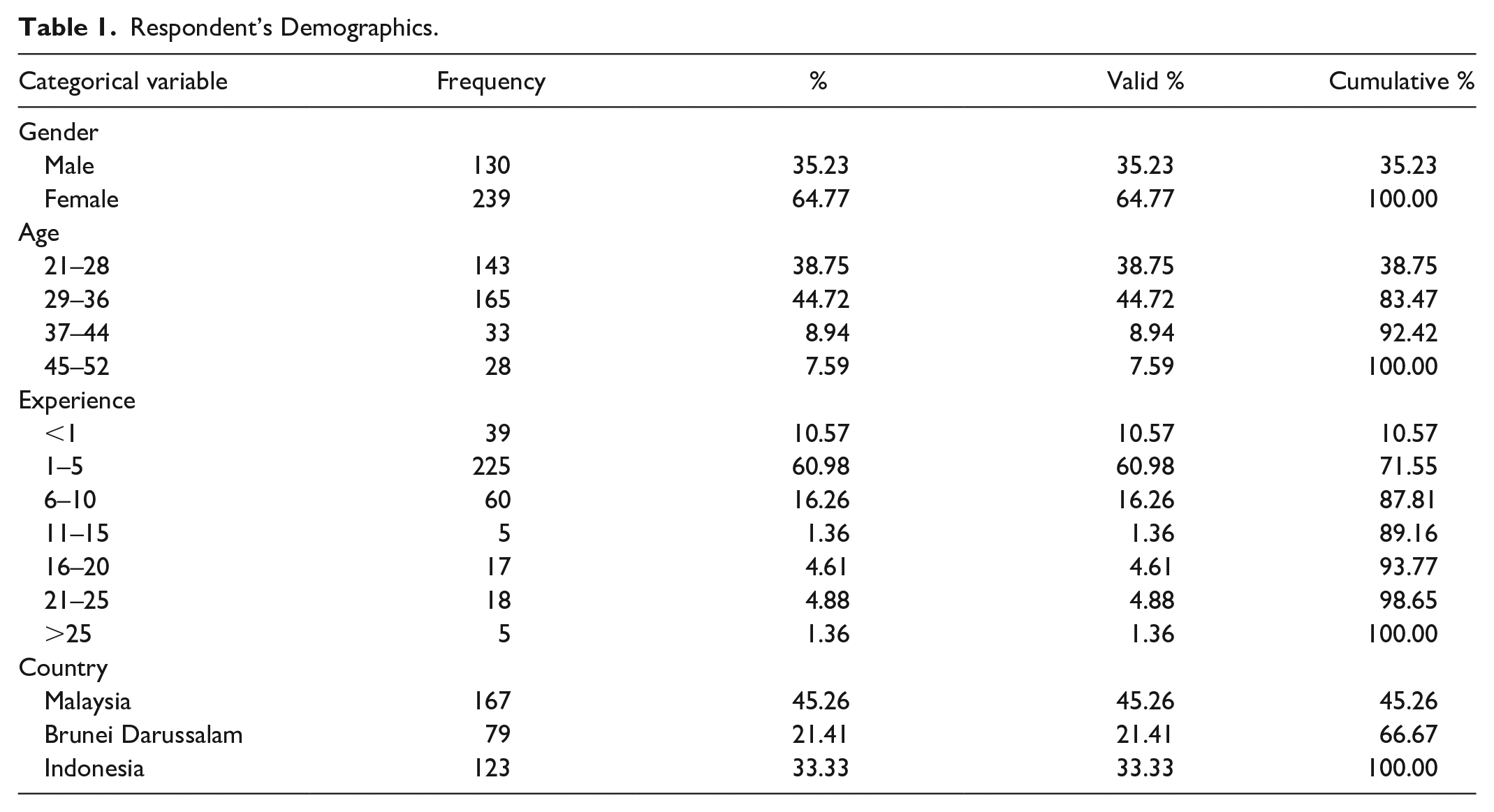
Taking support from the local faculty members in these three cities, 369 completed and valid responses were collected after distribution of 900 questionnaires where response rate is 41.0%. The frequency and descriptive analysis were performed in SPSS at individual level in this study. In this study, there are 35.23% male and 64.77% female respondents. Most of the respondents (44.72%) are 29 to 36 years old, who have 1 to 5 years of working experience. Most respondents are Malaysians, that is, 45.26%, whereas Indonesia has the least number of respondents in this study, that is, 21.41%. Table 1 exhibits the details of respondents in this study.
Respondent’s Demographics.
The survey form comprises of six sections in this study, that is, sustainable leadership, organizational earning, sustainable performance and psychological empowerment, and demographic data of the respondents. Owing to practical consideration, Likert-type scales are popular among researchers. But possible acquiescence bias responses linked to agree–disagree (AD) Likert-type scales result into enhanced cognitive burden and low-quality data (Revilla et al., 2014). Furthermore, higher categories of AD scales worsen the quality of data (Robinson, 2018). Based on the recommendation of Cummins and Gullone (2000) and Revilla et al. (2014), this study has employed a 5-point Likert-type scale ranging from strongly agree (5) to strongly disagree (1) to collect data against adopted measurement scales.
To measure sustainable leadership, this study has adopted a 15-item scale from the study of McCann and Holt (2010), reliability of this scale is 0.93 (Al-Zawahreh et al., 2019). To measure sustainable performance, this study has also adopted 15 measurement items from Khan and Quaddus (2015)’s study. This study has adopted four items to measure organizational learning from the research work of García-Morales et al. (2012). Furthermore, 12-measurement item scale of psychological empowerment was also adopted from Spreitzer’s (1995) research work.
Furthermore, the application of the analysis of variance (ANOVA) test of difference has revealed no significant differences among participants from Brunei, Indonesia, and Malaysia which confirms the freer of this study from response bias issue. The ANOVA test of differences (Table 2) has been shown below.
Test of Differences (ANOVA).

Note: ANOVA = analysis of variance.
Data screening has been conducted to reveal any missing value, outlier, normal distribution, ANOVA values, and common method variance. The enforced marking against all items in online survey form has warranted the nonappearance of missing values. The application of z-score in the SPSS, version 23, ensured the absence of any outliers as its values across all respondents were less than 3.29 (Tabachnick et al., 2007). To cope with common method bias issue, this study has applied procedural remedy, where different scales were used to collect responses for different variables, recommended by Podsakoff et al. (2012). Normality of data was assessed by monitoring the values of skewness and kurtosis (Hair et al., 2017). Data are normally distributed, provided skewness and kurtosis values lies in the range of +3 and −3 (DeCarlo, 1997). As shown in Table 3, data in this study are normally distributed as skewness values extend from 0.414 to 0.637, while values of kurtosis range from 0.198 to 0.210.
Descriptive Statistics.

Regarding 5-point Likert-type scale, mean values are considered low if it is equal to or less than 2.99, moderate if it ranges from 3 to 3.99, and high when it is greater than 4 (Sekaran & Bougie, 2016). As shown in the below Table 3, organizational learning has 3.017 as its mean value, which indicates the moderate perception of employees about its presence in their organization. Moreover, both psychological empowerment and sustainable leadership have also their mean values in the range of 3.00 and 3.99. It means, employees also perceive the fair presence of these constructs in their respective organizations.
Prior to structural analysis, the measurement model in this study has been evaluated. The analysis of measurement model assesses internal consistency and construct validity (convergent validity and discriminant validity). There is sufficient convergent validity in the presence of average variance extracted (AVE) higher than 0.50 and factor loadings values greater than 0.70 (Hair et al., 2017). According to W. W. Chin (1998), values of factor loading in the range of 0.50 to 0.70 are also acceptable. Furthermore, there are suggestions to delete items with factor loadings less than 0.40 (Hair et al., 2017). Therefore, one measurement item of sustainable leadership has been deleted as its loading value was less than 0.40 in the presence of AVE lower than its standard acceptable score. As shown in Table 4, factor loadings of all items are greater than 0.70. Similarly, AVE values of all construct are also higher than their standard criterion which represents acceptable convergent validity. To assess discriminant validity, the current research has applied Fornell–Larcker criterion. As values of square root of AVEs of all constructs against their interconstruct correlations are higher, so there is existence of discriminant validity. Referring to values in Table 5, there is enough discriminant validity.
Convergent Validity.
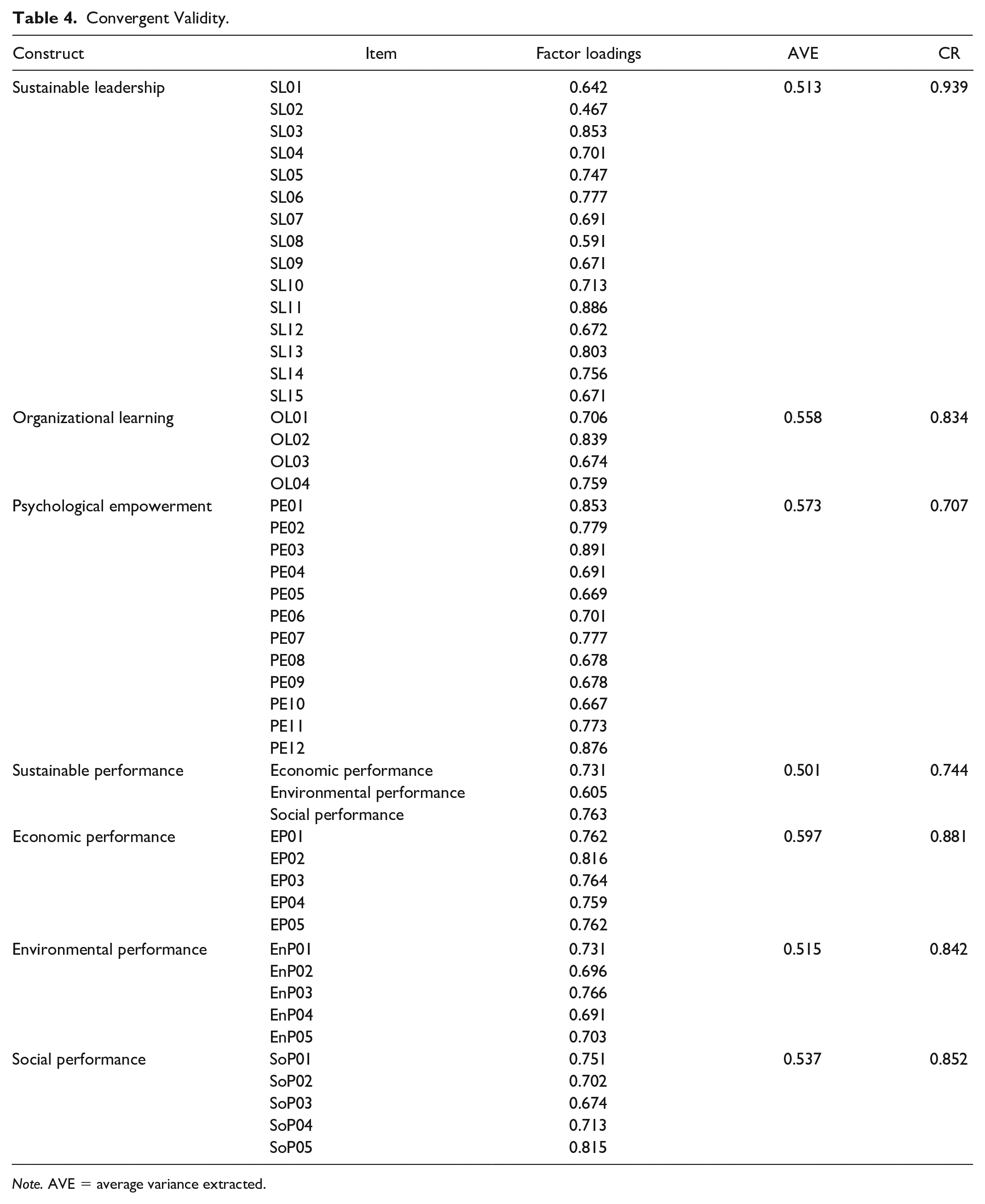
Note. AVE = average variance extracted.
Fornell–Larcker Criterion.

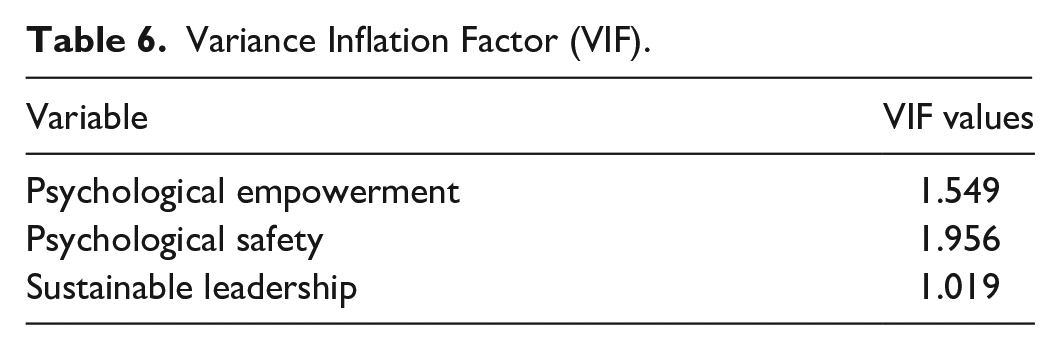
This study has used variance inflation factor (VIF) to assess the presence of multicollinearity. Values of VIF greater than 5.0 indicate the presence of multicollinearity (Hair et al., 2017). Table 6 confirms the absence of multicollinearity in this study where values of VIF against all predictors are less than 5.0.
Variance Inflation Factor (VIF).
The empirical evidence indicates the presence of significant relationship between sustainable leadership and organizational learning
Hypotheses Testing.

Note: LLCI = lower-level confidence interval; ULCI = upper-level confidence interval.
Regarding hypothesis H4a, this study posits that there is higher impact of organizational learning on sustainable performance, provided psychological empowerment is high among employees. As shown in Table 7, the interaction term of psychological empowerment with organizational learning significantly affects the sustainable performance, so there is moderating role of psychological empowerment
In the presence of moderated-mediation, the intensity of the indirect value is contingent to the value of moderation that is known as moderated-mediation (conditional indirect effect; Hayes & Rockwood, 2020). Psychological empowerment is moderating mediation, provided the indirect impact of sustainable leadership on sustainable performances through organizational learning varies with respect to different values of psychological empowerment. By employing PROCESS Macro in SPSS, this study has investigated the moderation-mediating effect of psychological empowerment. The low and high values of psychological empowerment were defined with respect to one standard deviation below and above its mean score. Table 8 presents the values of estimates, standard error, bootstrap confidence intervals (lower level and upper level), for the conditional indirect effect of sustainable leadership on the sustainable performance through organizational learning against low, medium, and high values of psychological empowerment. As there is significant conditional indirect significant impact of sustainable leadership across high (0.022) to low (0.012) values of psychological empowerment, so hypothesis H4b is accepted.
Results of Moderated-Mediation.

Note. Outcome variable: sustainable performance; mediator: organizational learning; independent variable; sustainable leadership.
LLCI = lower level confidence interval; ULCI = upper level confidence interval.
Discussion
By drawing on the RBV theory, dynamic capability theory, and JD-R model, this study theoretically contributes to the literature of sustainability and learning by elaborating how sustainable leadership enhances sustainable performance by promoting and fostering organizational learning for employees to cope with the challenges of sustainable development in the presence of psychological empowerment. This research has contributed to the sphere of RBV by assessing the impact of sustainable leadership on organizational learning. The present research has heightened the literature in the field of dynamic capability theory by linking organizational learning with sustainable performance. Moreover, the JD-R model was employed to reveal psychological empowerment as a conditional factor for the connection between organizational learning and sustainable performance. The present findings contend the strong explanatory power of the RBV, dynamic capability, and the JD-R model. Overall, for all authors known, this study is unique in its nature by preliminary testing the moderated-mediation model of sustainable leadership and sustainable performance where organizational learning is mechanism and psychological empowerment plays its role as conditional factor. This study concludes that organizational learning and psychological empowerment are vital factors that influence the sustainable leadership-sustainable performance relationship. Furthermore, it is of large importance to observe that current findings have supported all five hypotheses in this study.
The acceptance of hypothesis H1 confirms the significant positive impact of sustainable leadership on organizational learning. This result is similar in nature to previous studies, which also contend the same positive relationship (Rogers, 2011; Wolff, 2020). Sustainable leaders develop sustainable thinking, sustainable knowledge base and learning culture (Rogers, 2011). Furthermore, Wolff (2020) has claimed that sustainable leader promote problem-solving orientation and spur learning environment. Regarding the acceptance of hypothesis H1, RBV theory encourages practitioners to develop and encourage sustainable leaders to tackle with the challenges of climate change.
Regarding H2, this study has confirmed the significant relationship between organizational learning and sustainable performance among SMEs. This empirical evidence is similar to the previous studies, which claims the positive association between organizational learning and sustainable performance (Frazier et al., 2017; Ismael & Emeagwali, 2019). Integration of organizational learning and knowledge management process lead to the better sustainable performance. Similarly, interorganizational learning enables organizations to maintain long-term linkage with its stakeholders and deliver optimum sustainable performance (Ismael & Emeagwali, 2019). The present evidence is emphasizing to promote learning culture to deal with the challenges of sustainable development.
The empirical evidences in relation to hypothesis H3 has significance in its own terms by exploring the mechanism of sustainable leadership–sustainable performance relationship. This study claims that sustainable leaders, being human capital, promote learning climate, and develop organizational learning as dynamic capability within firms which results into improved sustainable performance. Prior scholarships have also established the mediating role of organizational learning (Abdi et al., 2018; Jaber & Caglar, 2017; Kim & Park, 2019; Liao, Chen, Hu, Chung, & Yang, 2017; Narayanan & Rajaratnam, 2019; Tran & Choi, 2019). Organizational learning is found mediating the relationship of knowledge management practices with operational performance (Jaber & Caglar, 2017), sustainable competitive advantage (Liao, Chen, Hu, Chung, & Yang, 2017), and innovation (Abdi et al., 2018). Inclusive leadership (Tran & Choi, 2019) and transformational leadership (Kim & Park, 2019) also indirectly influences organizational citizenship behavior through organizational learning.
Empirical findings in relation to H4a and H4b have also confirmed the role of psychological empowerment as conditional factor for the organizational learning-sustainable performance relationship and indirect effect of sustainable leadership on the sustainable performance through organizational learning. Earlier lessons have also claimed the presence of moderators between organizational learning and sustainable performance (Ismael & Emeagwali, 2019; Trunga et al., 2019). Trunga et al. (2019) have conducted a study among fertilizer firms in Vietnam and concluded that environmental dynamism moderates the relationship between organizational learning and market innovation. Similarly, legal framework has been found out as a moderator between interrelation learning and value creation (Ismael & Emeagwali, 2019). At large, this empirical evidence has contributed to the literature in the domain of the JD-R model.
Finally, this research contends that sustainable leaders have high indirect effect on sustainable performance through learning when there is high psychological empowerment. This empirical evidence is similar to the recommendations of Jha (2018). According to Jha (2018), mere the presence of psychological empowerment where employees feel being powerful and meaning is not enough to deliver optimum performance. Employees receive support from top management in the shape of sustainable leadership to foster learning climate within their organizations, which is crux of sustainable performance. This study has elaborated the importance of sustainable leadership (McCann & Holt, 2010), organizational learning (Dixon, 1999), and empowerment (Spreitzer, 1995) in the era of climate change. The presence of empowerment is crucial to intensify the sustainable leadership–organizational learning and sustainable performance relationship. At large, extent evidences have confirmed the strong positive impact of sustainable leadership on sustainable performance (Avery & Bergsteiner, 2011), but this phenomenon does not look so simply and may evolve around several factors.
Implications
This study enriches theoretically and practically. This study has theoretically furnished the literature by testing the proposed moderated-mediation model of sustainable leadership and sustainable performance based on RBV, dynamic capability, and the JD-R model. Practically, the present empirical evidences offer numerous implications to the organizational management(s) to foster sustainable developments in their realm. First, this study emphasizes to nurture sustainable leaders in the employment-settings within organizations. Special training and workshops need to conduct to develop manager’s skills and behaviors so that they could exhibit more sustainable practices. Second, as sustainable leaders promote learning climate within their organizations by sharing ideas and communicating openly so there is need to monitor the performance of top management in relation to the SDGs. Top management of organizations must focus and plan the Mantegna development in the long-term perspective as well as the cognitive demand, knot among employees, departments, and cognitive distance to foster learning environment. Furthermore, management should keep an eye on the low-performing employees with respect to their skills, competence, and capability. Third, as recommended by W. Zhang et al. (2017), there is need to plan training activities relevant to employee’s job descriptions, responsibilities and roles to enhance organizational learning. Employee’s perception about their learning level needs to be investigated to appoint them painstaking tasks of future initiatives.
Fourth, practitioners should keep an eye on perceived the psychological empowerment to spur an optimum learning climate. Fifth, management should monitor different needs of diverse stakeholders who are reporting low empowerment to sharpen the relationship between organizational learning and sustainable performance. Furthermore, sustainable leaders should exhibit exemplary behaviors so that employees could behave religion sustainably. Sustainable leaders are well versed with the challenges of climate change and employee’s needs so such integrations must be embedded into learning climate. Hence, the sustainable leadership practices will intensify the performance effectively and efficiently at the different levels. Within workplace, employees, who are feeling empowered, promote learning practices efficiently and effectively to accomplish a common goal which ultimately enhances sustainable performance.
Limitations and Future Research Directions
A variety of industries, organizational structures, and cultures should be studied so that the research findings related to sustainable performance can be generalized. As data have been collected from only Muslim countries, so forthcoming research is suggested to conduct in the non-Muslim countries to cover the generalization issue. Catalano et al. (2018) have proposed that a similar study which compares different industries with respect to psychological empowerment, organizational learning, and sustainable performance may provide further insights which are not addressed in the present research. Furthermore, the causality of the relationship between variables in cross-sectional studies may not be thoroughly predicted. So, experimental studies are suggested to explore detailed insights.
Footnotes
Declaration of Conflicting Interests
The author(s) declared no potential conflicts of interest with respect to the research, authorship, and/or publication of this article.
Funding
The author(s) disclosed receipt of the following financial support for the research, authorship, and/or publication of this article: We wish to thank Universiti Sains Malaysia for funding this project under Research University Grant Scheme no 1001/PMGT/8016010.
