




Abstract
Recent democratization in the Muslim-majority countries (MMCs) has led to a surge in interest in the Islamist (or Islamic) parties. Research on these parties has, however, been plagued by the lack of agreement on identifying these parties. Analysis of various ways used to identify/define Islamist parties shows shortcomings. This article tries to resolve the conundrum by identifying these parties within a comparative framework, that is, Gunther and Diamond party typology. Two major types of Islamist parties are identified and placed within the Gunther and Diamond typology. This solution has two advantages. First, discussions on Islamist parties can now become more grounded, restricting analysts from labeling any conservative party in the MMCs as Islamist. Second, Islamist parties can be part of the general discussion on political parties in the literature, and inclination to regard them as singular or exceptional, because of their link with Islam, is discouraged.
Introduction
Islamist (sometimes called Islamic) parties are important political players in the Middle East and the wider Muslim world. However, due to the closed political systems of most of the Muslim-majority countries (MMCs), there have been widespread speculations about how popular these parties are and whether they can win elections. Some scholars consider them as one of the many players in the MMC politics, with meager chance of winning elections and forming governments, whereas others expect them to dominate the political system. Arab Spring and subsequent democratization have further intensified the debate about the prospects of the Islamist parties. Analysts, pundits, and scholars, all seem to have an opinion on this issue (Alrajjal, 2013; Kurzman & Naqvi, 2010b; Wright, 2012b). Curiously, however, most of this debate has been going on without a broad agreement on how to distinguish an Islamist party from other political parties. This is especially problematic in the Arab world as old parties are evolving and new parties are being formed because of rapid democratization. Commitment to Islamic laws and Shariah no longer serve as the distinguishing features of the Islamist parties as Islamist parties of the past are toning down their religious rhetoric to broaden their appeal while new parties are touting their allegiance to Islam to entice the religious sections of the society. Unless there is some broad agreement on what an Islamist party is, discussions about prospects of Islamist parties are vacuous and do not add much to our understanding of the politics in the MMCs.
This article intends to anchor the discussion on Islamist parties by elaborating characteristics of two major types of Islamist parties using Gunther and Diamond’s (2003) political parties typology. First, various methods hitherto used at defining an Islamist party are analyzed. Next, regular methods used in the social science literature for distinguishing political parties are used to identify Islamist parties. Both these methods leave much to be desired. This article then tries to place Islamist parties in a comparative framework to make discussions more grounded until a better definition is agreed on. Gunther and Diamond’s typology is used to distinguish two major types of Islamist parties from the other political parties vying for power in the MMCs.
Islamic or Islamist Parties
Understanding the Islamist parties has acquired new significance since the start of the 21st century. The September 11 tragedy reignited an interest in Islam and the MMCs, perhaps not seen since the early days of Iranian Revolution. There is an emphasis on studying everything related to MMCs’ politics, and Islamist parties are no exception to this megatrend in the social sciences. Knowledge of the Islamist parties has also become necessary because the MMCs are becoming democracies and the Islamist parties are usually the only organized political parties in these countries. Finally, understanding the Islamist parties has become important because many MMCs have more than one Islamist party contesting the elections. With only one party committed to the implementation of Shariah, one could label it Islamist, disregarding or ignoring the differences among Muslims on what Shariah is. However, when more than one Islamist party is competing in the political arena, scholars have to understand all the Islamist parties and their “Islamist” programs to differentiate between them. For example, one cannot analyze Egyptian politics without understanding the differences between the Freedom and Justice Party and the Al-Nour party, as both are labeled Islamist and both are committed to Shariah (Fadel, 2011).
Islamist Party: Various Types of Definitions in the Literature
As importance of the Islamist parties has increased, various attempts have been made to define them. A frequently used definition states that an Islamist party is a party that believes and propagates Islam as a solution to community’s problems. This seemingly pithy definition, however, unravels and loses much of its usefulness when one tries to operationalize it and locate a real Islamist party in an MMC. The main problem with this definition is that there is no one monolithic “Islam” but many different “islams.” Islam, like other great religions, defies a single interpretation. As many scholars (Appleby, 2000; Stepan, 2000) have argued, Islamic teachings are multi-vocal and can be used for contrasting purposes. Moreover, as almost all parties in the MMCs acknowledge Islamic principles as the basis of their political programs, it is difficult to distinguish between an Islamist party and other parties only on the basis of a pledge of allegiance to Islam or Islamic principles or Shariah. Generally, four methods have been used to define Islamist parties in the literature.
Political Islam or Islamism
Islamist parties are usually defined as parties that believe in political Islam or Islamism. Many pundits and scholars define Islamist parties in this way and then start discussing them, leaving the reader to figure out what is political Islam or Islamism. Unfortunately, there is no consensus on what political Islam or Islamism means (Ayoob, 2009; Martin & Barzegar, 2010). These two terms have been defined in multiple ways. Some scholars define Islamism/political Islam as the radical Islam, without defining what is meant by “radical” (Sivan, 2003). Others define the Islamists as those who advocate an Islamic state, ruled by Islamic laws (Yilmaz, 2002). Still others define political Islam/Islamism as not the real Islam, with the corollary that Islam is being misused/instrumentalized/reappropriated for some mundane (sometimes sinister) political purposes (Steinberg & Hartung, 2005).
Shariah Connection
Scholars also define the Islamist parties as parties that want to implement Shariah in their countries (Haqqani & Fradkin, 2008; Robbins, 2012; Utvik, 1993). This appears to be a more focused definition based on an important distinguishing feature of the Islamist parties. However, the assumption behind this definition is that there is agreement on what is Shariah. This is unfortunately again not true. There are many Shariahs as there are many Islams. Shariah can be limited to a few precepts/laws given in Quran or can be expanded to include rules about every aspect of life expounded in the past 14 centuries. As one scholar contended, “There are so many varying interpretations of what Shariah actually means that in some places, it can be incorporated into political systems relatively easily” (Johnson & Vriens, 2013). Most Islamist parties and other Muslim groups differ widely on what is Shariah. Even those few groups/parties that agree on Shariah, disagree on how it is to be implemented (Alpert, 2013).
Contrast With Salafis or Global Islamists
As knowledge about different Muslim sects/groups becomes widespread, many scholars have defined Islamist parties as parties that believe in Islamism but are neither Salafis nor are against nation states and working to establish the Khilafah, a global Islamic state (Jung, 2012; Moussali, 2009; Rubin, 2007; Wright, 2012a). Besides the disadvantages associated with identifying the Islamist parties using Islamism discussed above, this type of definition has other shortcomings. Contrast with Salafism is not useful as again there is no agreement on what is Salafism (Duderija, 2012). Although acceptance of nation-state is a useful distinction, it does not help one distinguish between many Islamist parties in one country, all of which believe in some form of Islamism and nation-state.
Contrast With Al-Qaida/Jihadis
Although less so now than in the past, many scholars also identify the Islamist parties by contrasting them with Al-Qaida or jihadis. For some, the differences between Islamist parties and jihadis are quite wide, including those pertaining to principles, organization, and strategies (Deen, 2012). However, others claim that Islamist parties and jihadis are similar (i.e., part of the same Islamism stream), differing only in the acceptability of violence. While jihadis use violence to achieve their objectives, Islamist parties do not think it is kosher to do that (Rubin, 2007). The main weakness of these definitions is that jihadis are fringe groups in most Muslim societies and excluding them still leaves a lot of parties that are different but are all labeled as Islamist parties.
It is obvious that each of the above categories of definitions has its own limitations. Islamist parties cannot be defined using terms such as Islamism, political Islam, Shariah, Salafism, and so on as meanings of these terms are themselves ambiguous and contested. However, defining Islamist parties in contrast to global Islamists or jihadists is not useful as such definitions still label many very different parties as Islamist.
Difficulties in defining an Islamist party have made many scholars take the easy road. They tend to discuss and analyze Islamist parties at length, without defining what they mean by an Islamist party (Ottaway & Muasher, 2012). In 2008, the Journal of Democracy sent invitations to a number of experts of the MMC politics to write articles on the broad theme of Islamist parties and democracy. The editors also sent a set of specific questions to consider. The first question was, “How should we use the term ‘Islamist’ in this context: What justifies calling a political party ‘Islamist?’” (Editors Journal of Democracy, 2008). Interestingly, not one of these experts clearly answered this question.
Defining Islamist Parties Using Standard Criteria
In the previous section, ways to define/identify one specific type of political parties (i.e., Islamist parties) were discussed. However, political scientists have been defining and categorizing political parties for more than 100 years (Becker, 1909; Michels, 1915). Political parties have been identified as liberal, conservative, socialist, and so forth on the basis of their names, programs, leadership, and characteristics of party voters. Can one use these regular criteria to identify an Islamist party? In this section, we will show how such criteria also fall short in clearly identifying the Islamist parties. One of the ways parties identify themselves is by their names such as Social Democratic Party of Germany or Conservative and Unionist Party of the United Kingdom. Some of the parties usually considered Islamist parties have Islam-linked names (e.g., Jordan’s Islamic Action Front or Bangladesh’s Jamaat-e-Islami), but so have many other parties which are not considered Islamist parties (e.g., Pakistan’s many Muslim Leagues). Moreover, in recent times, many parties that are considered Islamist parties have chosen names that do not show any link with Islam. For example, there are many parties, considered Islamist parties by scholars, having “Justice and Development Party” as their name. Ruling parties of both Morocco and Turkey are named as Justice and Development Party and both are considered Islamist parties. Haqqani and Fradkin (2008) tried to identify the Islamist parties on the basis of their names and argued that one should not only look for “Islam” and “Muslim” in their names but also for words such as “justice” and “development” as these words are also linked to Islam. They claimed that the choice of these later words showed that Islamist parties want to distinguish themselves from “purely modern parties” that preferred names having the words such as “freedom” and “progress.” However, authors’ argument lost its strength when prominent Islamist parties were named as Prosperous Justice Party (Indonesia) and Freedom and Justice Party (Egypt).
Another way of defining a political party is focusing on its manifesto. Importance of manifestos/programs for the political parties cannot be over-emphasized. Political parties recruit leadership, run campaigns, and win elections on the basis of their programs. Many social scientists, therefore, identify and distinguish different parties on the basis of their programs. The usual distinction is between parties of the right, which are broadly socially conservative, pro-business, and nationalist, and parties of the left, which generally propagate socially liberal, pro-labor, and pro-minority policies. Until the early 1990s, many of the Islamist parties were identifiable on the basis of their programs which among other things called for the implementation of Shariah, rejection of riba (interest), and a “separate but equal” status for women and religious minorities. However, during the past two decades, parties usually considered Islamist have made their programs more “mainstream.” Now, it is difficult to distinguish an Islamist party’s platform from other party platforms in the MMCs as Islamist parties are also talking more about mainstream issues such as freedom, rights, and development, and less about Shariah, riba, and hududs (Kurzman & Naqvi, 2010a). Leadership of the Islamist parties has similarly become more mainstream, calling for implementation of Islamic principles of social justice and equality instead of Islamic laws.
Another way of identifying a party is by analyzing its voter’s characteristics. However, distinction of Islamist parties on the basis of voter’s characteristics is also difficult as many parties that are considered Islamist (such as Turkey’s Justice and Development Party) regularly get large support from voters who cannot be declared Islamic-oriented, and many conservative voters continuously switch votes between parties considered Islamist and other conservative Muslim parties (Kurzman & Naqvi, 2010a; Taspinar, 2012).
The above discussion shows that standard criterion of identifying parties does not help much in case of Islamist parties. Some social science concepts (such as religion or democracy) defy essentialist and substantive definitions because of the variety of forms in which they occur and because they are constantly evolving. Islamist parties can perhaps be included in the list of such fuzzy concepts. However, it does not mean the end of the road. If Islamist parties cannot be defined essentially, at least they can be made more explicable by distinguishing them from the other party types. This article intends to place the Islamist parties in the Gunther and Diamond party typology. This exercise will have the added benefit of making Islamist parties part of the general political science lexicon and not something that is singular and has to be analyzed differently from other political parties. Before placing the Islamist parties in a typology and analyzing how they differ from other party types, it will be useful to be acquainted with the advantages and disadvantages of using typologies in the social science research.
Typologies in Social Science
According to Collier, LaPorte, and Seawright (2012), typologies improve formation of concepts, draw out hidden dimensions, create groups for measurement and classification, and assist in the sorting of cases. Typologies are thus tools that help increase our understanding of different social science concepts. One of the most important benefits of formation of typologies is parsimony. Social phenomena exist in hundreds of different forms. Typologies help our understanding of these phenomena by grouping them in few clusters. These clusters can be more easily understood and subsequently conveniently used for further research. Moreover, social phenomena have innumerable different properties/characteristics on which typologies can be based. The exercise of typology formation forces the scholars to identify those properties of the phenomenon under consideration that are important for subsequent research. Thus, important properties get identified and prioritized.
Typologies are useful tools; however, one should be wary of excessive focus on the formation of typologies. Sometimes in an effort to build a more systematic typology, researchers ignore theory behind the typology. This leads to focus on unimportant but more distinguishable and measurable characteristics. Second, focus on typology building has sometimes led to typologies that cannot explain even half of the cases of the phenomenon under consideration. As real life social phenomena cannot be put in groups with clear boundaries, it is acceptable for typologies to not to explain all the different scenarios. However, it is important that typologies be able to classify most cases of the phenomenon they are trying to explain. Otherwise, typologies will lead to distortion and misunderstanding, not to better understanding.
Gunther and Diamond’s Typology
Many scholars have formulated political party typologies (Duverger, 1954; Kitschelt, 1989; Wolinetz, 2002). Gunther and Diamond (2003) argued that their party typology is better than previous typologies because they have incorporated the work of other scholars in their framework, have the most recent empirical data, and have consciously included political parties of the developing countries that previous scholars had ignored. A summary of Gunther and Diamond typology is given below.
Gunther and Diamond’s party typology is constructed on three criteria. Their main criterion is the formal organization of the party. Based on this criterion, parties are divided into two broad groups, namely, thin and thick organization parties. Parties with thin organization have small support base and rely on particularistic networks. Their membership can be identified with a specific group in the society, usually based on ethnicity or class. Parties with thick organization have mass membership and are open and universalistic in appeal. Due to the nature of their membership and appeal, they extensively use modern techniques of mass communication. They also have allied or ancillary institutions (such as affiliated labor unions, student groups, etc.) that assist them in spreading their message and in recruitment of members and leadership.
The second criterion divides the parties on the basis of the party’s programmatic commitments. Gunther and Diamond argue that parties have broadly three types of programs. Party programs are sometimes based on a well-articulated ideology, which can be religion, political philosophy, or nationalism. These party programs show a large degree of internal cohesion and present similar philosophical bent across diverse sectors of human existence. Another type of party programs focus on advancing the interests of a particular group in the society. This group can be based on a shared ethnicity, religious denomination, territory, socio-economic status, and so on. The third type of party programs is distinguished because of its eclecticism or pragmatism. These “electoralist” programs are made to win as many votes as possible and, therefore, lack internal consistency. Gunther and Diamond describe these programs as “promiscuously eclectic in their electoral appeals to groups in society.”
The final criterion divides the parties on the basis of whether the strategy and behavioral norms of the party are tolerant and pluralistic or proto-hegemonic. Pluralistic parties accept other parties not only as rivals but also as partners in the democratic set-up and national progress. They usually place no restrictions on which type of parties can run in elections and are ready to form coalitions with a wide range of parties, if it helps their electoral interests. Proto-hegemonic parties are the opposite of pluralist parties. They consider that not only their programmatic objectives are the best for the country but also that other party programs are a recipe for disaster. These parties, therefore, have not much respect and tolerance for other parties and are also ready to circumvent the democratic norms to stop other parties from coming to power. Hence, their commitment to democratic institutions and system is instrumental and qualified. Based on these criteria, Gunther and Diamond have identified different types of political parties and arranged them in various hierarchies as shown in Figure 1 (not all types shown).
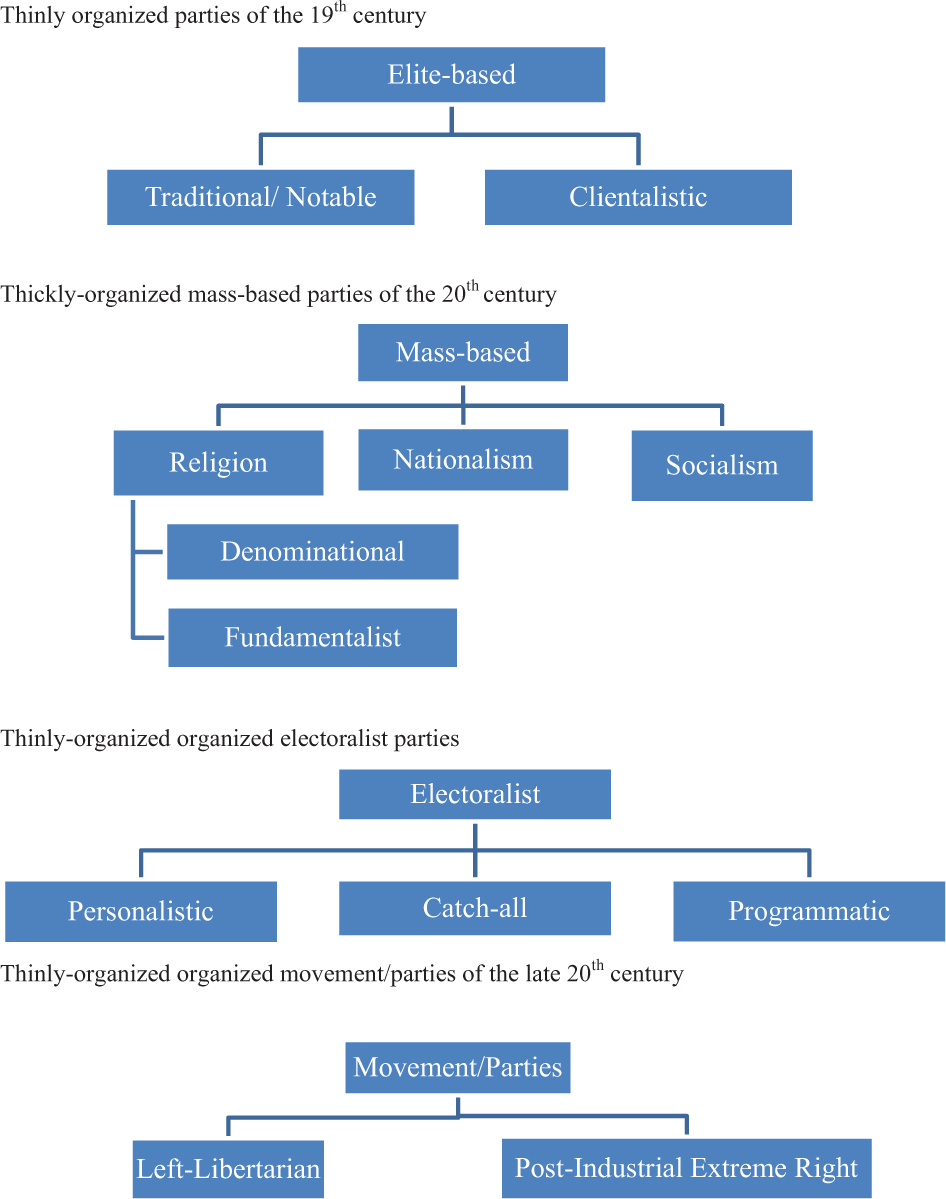
Gunther and Diamond (2003) typology.
As mentioned above, Gunther and Diamond argued that they have decided to reassess and come up with a new and broader typology because previous research has largely ignored the political parties of the developing world. It appears that another reassessment and broadening of the typology are required as whole new regions, Middle East and North Africa, have now joined the democratic game. Arab Spring has changed the regional environment. Even autocracies in the Arab world are facing domestic and international pressures, and formation of political parties in them is not a distant possibility (Editorial The Guardian, 2013; Sager, 2011).
Islamist Parties and Gunther and Diamond’s Party Typology
Hwang (2012) has argued that there are 4 types of parties in the world’s largest Muslim country Indonesia: nationalist-religious, secular-nationalist, pluralist-Islamic and Islamist parties. These types can also be identified in the other MMCs. The nationalist-religious and the secular-nationalist parties are large parties of the right and the left that are also found in other countries and are represented in the Gunther and Diamond typology as mass-based religious/nationalist/socialist parties. It is Hwang’s latter 2 party types, the pluralist-Islamic and Islamist, that do not fit in any of the 15 party types of Gunther and Diamond. The pluralist-Islamic and Islamist party types, although ideologically religious, are not mass-based denominational or fundamentalist religious party types identified by Gunther and Diamond. They also cannot be placed in the movement/parties and elite-based party categories (although they share some characteristics with them) as Gunther and Diamond do not allow any religion-based party sub-types in these two categories.
A description of the characteristics of these two types of Islamist parties is given below to find their place in the Gunther and Diamond typology. First type is referred to as Islamist as Hwang did, but the other one is referred as culturally influenced Islamic party.
The Islamist parties can be called replicas or cousins of the Egyptian Muslim Brotherhood movement. It is this type of party that is often referred to as an “Islamist” party in popular media. These parties are religious parties as their programs are strongly influenced by Islam, but they follow a de-culturalized Islam that generally rejects preference for any specific denomination or tradition. University or college students form a large part of these parties’ cadres. These parties sometimes can even trace their origin from some Islamist student organization. Not surprisingly, their leaders are highly educated, in contrast to the elites of other parties or the general population of the country in which they operate. Most of these parties are organizationally thin now, and their support comes not from the party cadres/members but from the better organized broader Islamist movement. However, these parties do have the potential to become mass-based parties with a religious ideology. As the version of Islam propagated by these parties is less influenced by the local culture/tradition, these parties have closer connections with similar parties in other MMCs.
During the past two decades, many of these parties have transformed in terms of their programs and outlook, without changing their distinguishing features described above. Previously, most of these parties (or the movements to which they belonged) were proto-hegemonic, but now most of them are pluralist. Their programs initially called for Shariah implementation and presented the view that once Islam would be implemented, every problem would be solved. Hence, their slogan generally was “Islam is the solution.” Now, their programs have become more open and broad, and there is more talk of implementing Islamic principles of equality and justice and so on than of specific Islamic rules/regulations (Kurzman & Naqvi, 2010a).
The second type, culturally influenced Islamic party, is also ideologically religious. However, unlike the Islamist parties, the Islamic teachings propagated by these parties are strongly influenced by the local/national culture and/or rooted in a particular tradition. Therefore, these parties show a much more varied pattern. These parties are usually elite-based and organizationally thin parties as they depend on local religious leaders for their support. Most of these parties are pluralist and ready to form coalitions with other parties. As their programs are much influenced by the local culture/tradition, such parties do not have close connections with similar parties in the other MMCs, unless they belong to the same tradition.
Table 1 shows that these two Islamist party types are found in many MMCs and hence can claim to be distinct party types. However, not all Islamist parties are represented by these two types. For example, Egypt’s Al-Noor Party has characteristics that make it difficult to place it in either group.
Major Party Types in the MMCs Missing in the Gunther and Diamond Typology.
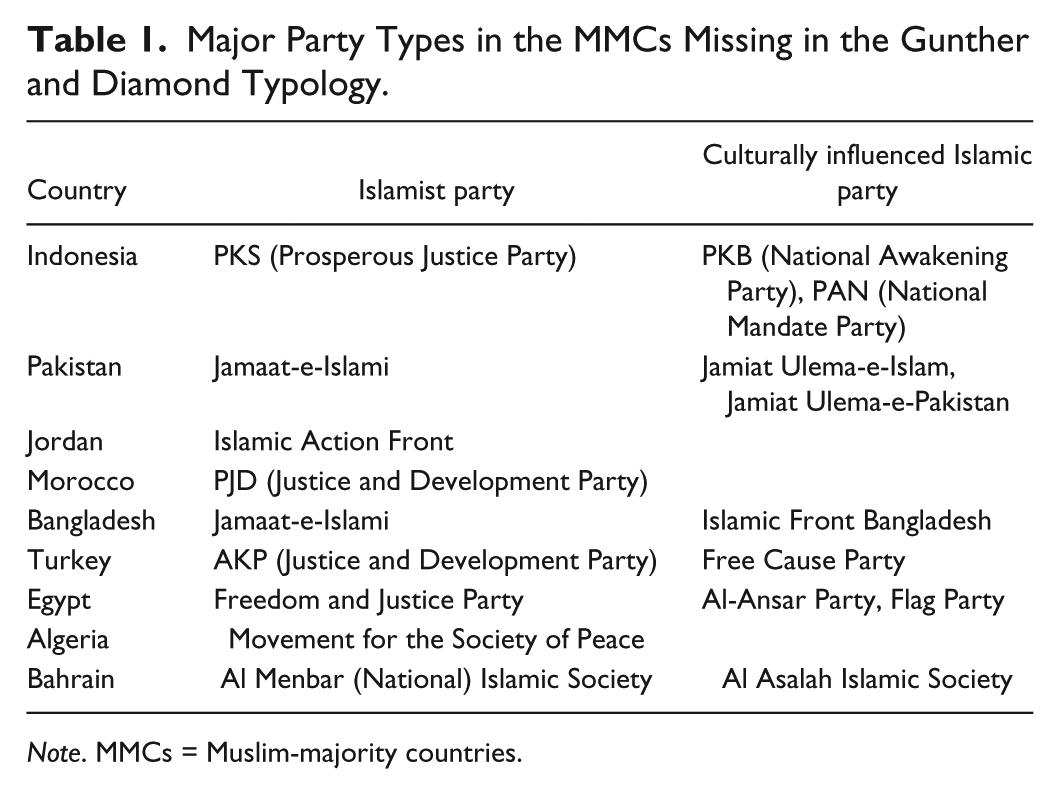
Note. MMCs = Muslim-majority countries.
Looking at the characteristics of these two types of parties and Gunther and Diamond typology, one can see that the Islamist parties can be considered the third sub-type of the movements/parties group. Most of these Islamist parties are still closely linked with their parent movements and are not considered independent. For example, due to the close connection between Freedom and Justice Party and Muslim Brotherhood, there was a debate in Egypt over who was ruling Egypt under former President Morsi. Was it President Morsi or Supreme Guide of the Muslim Brotherhood, Muhammad Badie (Ibrahim, 2012)? Similarly, as the recent crisis in Tunisia showed, power seems to be with Rachid Ghannouchi, the leader of the movement, rather than with the prime minister of the country (Champion, 2013). As these parties move forward, their party organization may strengthen and they may become mass-based parties based on religion. However, these parties will not fall into one of the two sub-types of religious mass-based parties given by Gunther and Diamond, that is, denominational or fundamentalist. These parties will belong to a new separate sub-type, which can be called “Islamist” sub-type.
The other type of Islamic parties, the culturally influenced Islamic parties, are elite-based parties. However, as the basis of power of elites is not land or other economic resources, they cannot be part of the two sub-types of the elite-based parties identified by Gunther and Diamond, that is, traditional/local notable and clientelistic types. Therefore, the elite-based party type also needs to be broadened and to include one more sub-type in which power of leadership is based on religion. Culturally influenced Islamic parties can then be placed under this new sub-type.
Another change proposed in the Gunther and Diamond typology is the elimination of the mass-based fundamentalist party. It is doubtful that such a party ever existed, and certainly, there is no such party in the present times. There are parties that are fundamentalist, but these are thinly organized and never mass-based. After all these changes, Gunther and Diamond typology may look like the party hierarchies illustrated in Figure 2.
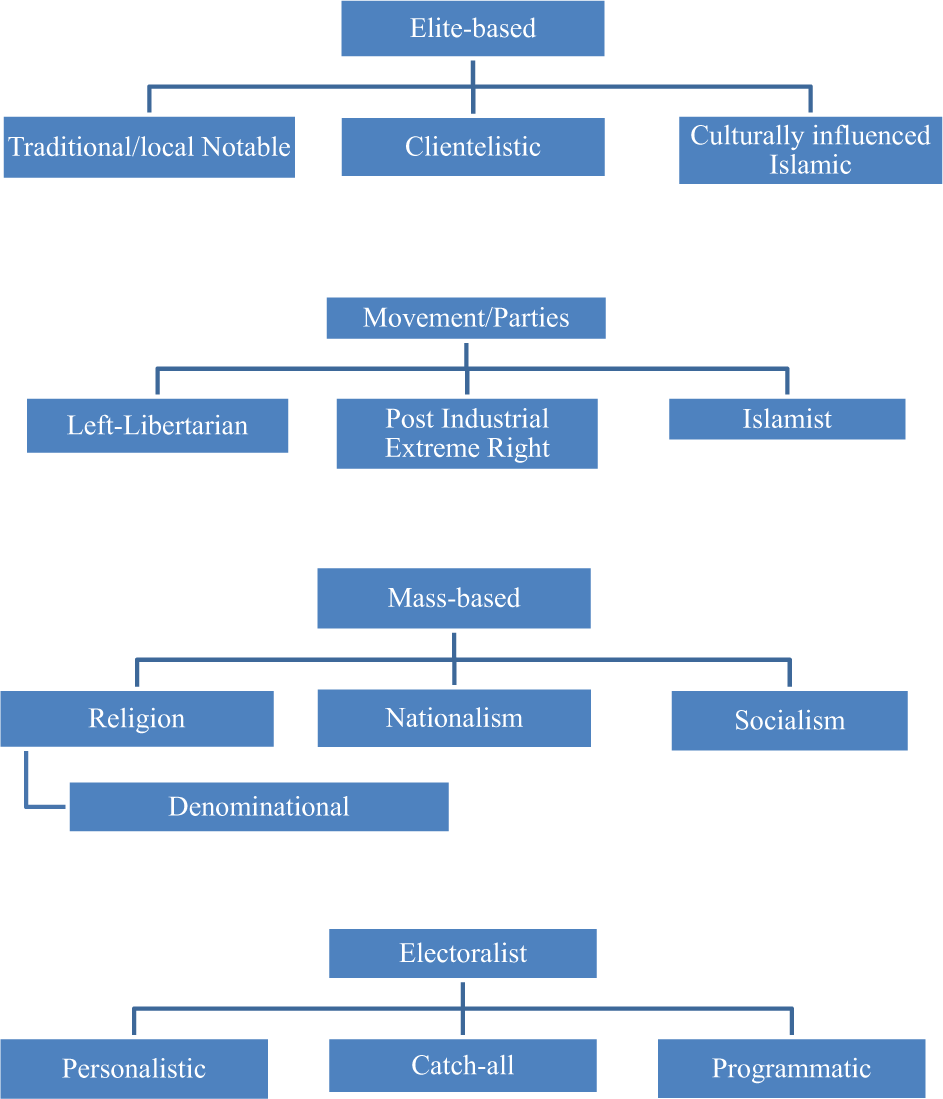
Revised Gunther and Diamond typology.
Later, when, in some cases, Islamist parties are institutionalized and clearly distinguishable from movements, they can become a sub-type of the mass-based party type.
Conclusion
As more MMCs are democratizing and more Islamist parties are contesting elections, it is important to identify the distinguishing features of the Islamist parties. In this article, different endeavors to define an Islamist party were analyzed. After identifying the shortcomings of these attempts at coming up with a definition of an Islamist party, an effort has been made to study Islamist parties using Gunther and Diamond typology. Although two new sub-categories have to be created, major Islamist party types were easily placed within the major categories defined by Gunther and Diamond. One type of Islamist party corresponds to what Gunther and Diamond has termed as movement/party category, and the other type of Islamist party characteristics are similar to those of elite-based parties. This extension of the Gunther and Diamond’s typology is advantageous as it restricts the current freedom commentators have of calling any party in an MMC an Islamist party. Moreover, it also rejects the notion that Islamist parties are different just because they are related to Islam and makes the Islamist parties part of the large sub-field of party politics.
Footnotes
Declaration of Conflicting Interests
The author(s) declared no potential conflicts of interest with respect to the research, authorship, and/or publication of this article.
Funding
The author(s) received no financial support for the research and/or authorship of this article.