




Abstract
Software professionals’ (SPs') performance is often understood narrowly in terms of input–output productivity. This study approaches performance from a broader perspective and examines whether the emotional intelligence competencies (EICs) of SPs, the leadership style of team leaders, social capital among team members, and human resource management (HRM) practices of software firms affect performance of SPs. It also tests whether the value of and opportunities for knowledge sharing moderate such relationships. Data were collected from 441 Indian SPs in a questionnaire survey. Fifty-five team leaders assessed the performance of SPs, and SPs assessed the other constructs. Results revealed that EICs, transformational leadership style, social capital, and HRM practices positively affect performance. EICs are the most important predictors of performance. Under high (low) value of and high (low) opportunities for knowledge sharing, the antecedents influencing performance are strengthened (attenuated or nullified). The value of and opportunities for knowledge sharing are quasi-moderators. These findings have significant implications for organizing effective work teams.
Keywords
Software professionals (SPs) are engineers who write code, design, and test configuration architectures, manage system networks, analyze webs, develop portals, and do software maintenance jobs. The job performance of SPs and the employment in information technology (IT) industry have increased the contribution of the IT sector to India’s gross domestic product (GDP) from 6.4% in 2008 to 7.5% in 2012 (“IT Industry Grows to Rs. 91,800 Crore in FY ’12,” The Economic Times, 2012). Despite this, the antecedents and facilitators of SPs’ performance are hardly examined. The research literature has provided a rich set of variables that affect their performance in the workplace. However, the ways in which those variables affect productivity and performance are not well understood. The purpose of this study is to develop an integrated model of variables that determine SPs’ performance. We begin with an overview of the constructs of productivity and performance described in the research literature. Following that, the known effects of specific variables on performance will be used to motivate the proposed model.
Measuring SPs’ Performance
Assessing the performance of SPs is a difficult task. In some contexts, performance is operationalized as input–output productivity. This approach to assessing performance is rather tenuous, as the inputs and outputs of projects can take a month to a year or even more. In the software industry, SPs simultaneously work on many projects and produce different outputs—graphics, expert systems, web traffic control, and maintenance packages—that are difficult to specify in terms of quantity of inputs and outputs (Kemppila & Lonnqvist, 2003). Objective measures of SPs’ productivity (such as kilo-lines/man-months) are narrow and focus on lower order single constructs. Some indirect factors that influence productivity cannot be easily measured, such as management culture, disturbances at work, and problems in information flow. There is no uniform procedure for assessing software productivity that follows a normal distribution pattern that would afford subsequent calibration. Software firms have synonymously used measures of effectiveness, efficiency, quality, innovation, and profitability (Chilton & Hardgrave, 2004; Koss & Lewis, 1993; Sumanth, 1994; Tangen, 2004; Thomas & Baron, 1994) for measures of productivity, and they have linked these measures to SPs’ performance.
Measures of performance, instead of productivity, are broad and cover higher order behavioral attributes. Performance refers to the degree to which employees have executed their assigned jobs. It includes not only the activities related to accomplishment of core job tasks but also a set of behaviors that employees contribute both directly and indirectly to organizational goals (Rich, LePine, & Crawford, 2010). Performance requires a set of criteria for its evaluation depending on the nature of the job.
Theoretical Framework for a Performance Model
Goleman (1995) has proposed that emotional intelligence competencies (EICs) can alone contribute to four fifths of job performance against one fifth of cognitive/rational intelligence. In support of this assertion, Boyatzis, Goleman, and Rhee (2000) have reported that employees with high levels of EICs are 3 times more effective than those with low levels of EICs. This is a strong assertion. However, there are counterclaims (Antonakis, Ashkanasy, & Dasborough, 2009). A meta-analytic study (Van Rooy & Viswesvaran, 2004) reports only a correlation of .19 between emotional intelligence and performance outcomes. Accordingly, the position in this article is that group and enterprise level constructs may also play a significant role in conjunction with individual level constructs of EICs, to determine workplace performance. Leadership is a predominant factor in influencing performance among group behaviors (Bass, 1985). Fostering social interactions and attributes of trusting, sharing, and reciprocating among SPs incorporated in social capital can build relationships, resolve conflicts, and smooth group processes to improve performance. Enterprise level constructs are those that are regulated by the top management. Among structure, design, and culture of the enterprise, human resource management (HRM) practices can contribute to employees’ welfare, development, and commitment, which can boost up performance as well. Given the meta-analytic findings contrary to Goleman’s (1995) claim, this study will test an integrated model to simultaneously examine the affect of EICs, leadership, social capital, and HRM practices on SPs’ performance and the constructs that boost the antecedent–consequent relations. Furthermore, most of the studies on SPs have been carried out in individualistic Euro-American cultures. This study strives to extend those findings to the collectivist culture of India to gauge whether the findings from different cultural contexts reinforce each other.
Potential Variables Influencing the Performance of SPs
Multi-Factor Performance
A study on Indian SPs revealed six dimensions of performance (Prasad & Suar, 2010): (a) work-efficiency, (b) personal resourcefulness, (c) inter- and intra-personal sensitivity, (d) productivity orientation, (e) timeliness, and (f) business intelligence. Work-efficiency focuses on independent thinking, ability to work on various projects simultaneously, programming skills, and customer orientation. Personal resourcefulness incorporates the abilities of SPs to be innovative and efficient, thereby adding value to the customer through products and services. Inter- and intra-personal sensitivity show not only individuals’ responsibility at work but also cooperativeness with the team members to complete the job. Productivity orientation entails the concern for quantity and quality of software along with overtime work. The timeliness dimension incorporates taking decisions and meeting deadlines in completing the projects. Business intelligence is a personal attribute for business sustenance in a competitive environment through advocating new ideas for improving products, services, and showing concern for profitability. Measures of these six dimensions operationalize the construct of performance in this study.
EICs
Emotional intelligence was developed by Salovey and Mayer (1990) and popularized by Goleman (1995) as a “competency” model. It is the ability of a person to cognitively assess emotions within oneself and recognize them in others, so as to modulate behavior (Salovey & Mayer, 1990). Simply, it is the use of emotions intelligently. EICs incorporate (a) self-awareness, (b) self-management, (c) social-awareness, and (d) relationship management (Boyatzis et al., 2000). The former two entail personal and the latter two inter-personal competencies.
By understanding their own experiences, thoughts, and actions, self-aware persons realistically self-evaluate themselves (Wynekoop & Walz, 2000) and openly express their feelings, viewpoints, and focus on customer requirements (Kaluzniacky, 2004; Phillips & Gully, 1997). Self-management includes self-control, drive for achievement, initiatives, transparency, and personal goal-setting. SPs who have higher self-management competencies can take initiative, exhibit creativity, and improve software quality, thereby facilitating the success of software projects (Baddoo, Hall, & Jagielsk, 2006; Mathew, 2007).
Social-awareness includes empathy, service orientation, and organizational awareness. Empathy is not only reading the subtleties of body language, but also grasping the unheard voice beneath the spoken words (Goleman, 1998). Empathic employees are trained to adopt themselves to a service orientation, treating clients and co-workers as important customers (Witt, 1999). Organizational awareness is the understanding of priorities and work processes. SPs, having greater social-awareness, can interact and communicate with offshore clients, and show sensitivity to cross-cultural etiquettes and different ethnic and religious backgrounds.
Relationship management is a set of competencies that deal with inspiring, influencing, resolving conflicts, collaborating with teams and acting as change agents. Inspiring is a process of communicating, encouraging, and persuading others, and elevating them to a higher plane. Conflict resolution is an ability to tactfully deal with the incompatible demands on or off the job. Change-catalyst competence is necessary to adapt to the changing software specifications of clients. The above discussion suggests that personal and inter-personal competencies in the workplace can positively affect performance.
Leadership Style
The prototype of leadership is transformational leadership. Transformational leaders possess the characteristics of charismatic, ethical, and servant-leaders (Shiva & Suar, 2012), and are found to be universally effective (Atwater & Yammarino, 1992; Barber & Warn, 2005; Bass, 1997; Burns, 1978; Leban & Zulauf, 2004).
Bass and Avolio (1990a) have identified four dimensions of transformational leaders: (a) idealized influence (attribute and behavior), (b) inspirational motivation, (c) intellectual stimulation, and (d) individualized consideration. Leaders, having idealized attributes and behavior, are found to have profound power and extraordinary influence on followers (Bass, 1985). Idealized actions of the leader transcend self-interests for the benefits of the organization. Through communication, the leader aligns the values and goals of the organization to subordinates. Intellectually stimulating leaders encourage followers to view the world from new perspectives, that is, they question old assumptions, paradigms, and beliefs. They appeal to followers’ intellects by instilling “problem awareness and problem-solving capabilities.” Because of intellectual stimulation, followers conceptualize and comprehend the problems they face and solve them. Such a leader (Avolio, Gardner, Walumbwa, Luthans, & May, 2004) through episodes, dialogues, and various actions takes the followers to a higher plane, and they release their efforts accordingly. A leader displaying individualized consideration understands the employees’ needs, aspirations, abilities, and accordingly provides different types of training, coaching, counseling, and opportunities for their participation in goal-setting, decision-making, and problem-solving (Avolio, Bass, Walumbwa, & Zhu, 2004). In the process, subordinates improve their skills. A transformational leader generates positive work attitudes, mobilizes the minds of subordinates, and empowers and enhances their performance (Chi & Pan, 2012). A meta-analytic study of 25 years of research concluded that transformational leaders lead not only their individual subordinates but also their teams and organizations to achieve higher levels of performance (Wang,Oh, Courtright,&Colbert,2011).
Social Capital
Social capital incorporates (a) group characteristics, (b) generalized norms, (c) togetherness, (d) everyday socializing, (e) volunteerism, (f) trust, and (g) reciprocity (Narayan & Cassidy, 2001). Group characteristics facilitate group members to carry out social activities. Generalized norms involve compliance with group standards through which participants of the network improve their performance to match with the standard. During a crisis, togetherness evokes strong social ties in the network and, thus, improves confidence to perform the job better. Everyday socializing strengthens friendships and helps gathering current information about software projects that assist SPs to make and execute decisions. Volunteerism goes with altruism. Volunteers commence their work without seeking help from others. Such activities keep clients happy and build long-term relationships. Trust is an act of agreement about certain conditions and standards (Lemmel, 2001; Putnam, 1993; Welsh & Pringle, 2001) that can improve SPs’ performance. Reciprocity is an attitude of helping when employees are in distress (Portes, 1998) and responding to customers’ needs. Because SPs are clustered into groups according to projects, domain expertise, and customers’ base, they reciprocate within their network.
A software project roughly passes through task definition, design specification, coding, installation, and maintenance. It is less likely to succeed without task-related internal communication (Brodbeck, 2001), cooperation, trust, and reciprocity among team members when standardization of methods and tools is low. Accordingly, the more social capital among SPs, the more effective will be the project success through employees’ performance.
HRM Practices
HRM practices include (a) rewards that drive performance; (b) development of skills, knowledge, and attitudes through continuous training to improve employees’ performance; (c) manpower with requisite skills and competencies to execute jobs; and (d) supportive workplaces (Appelbaum, Bailey, Berg, & Kalleberg, 2001; Huselid, 1995). It is theorized that if the firm closely links rewards to performance, employees are more likely to show high performance (Adams, 1965). Training and development activities for SPs focus on multi-skilling, developing domain expertise, teaching the right ways to do the job, and reducing dysfunctional behavior, all of which are likely to improve their work behavior vis-à-vis performance. Earlier studies affirm that HRM policies and practices have positive effects on firm performance and productivity (Delaney & Huselid, 1996; Huselid, 1995). Firm performance and productivity are outcomes of employees’ performance. Also, as the employees receive and perceive favorably the HRM practices, their performance increases accordingly (Munjuri, 2011).
Software firms focus on obtaining qualified people and rotating them across different jobs to make them multi-skilled. Staffing procedures bring into vacant positions people with the required skills and knowledge to do the job. Promoting employees from within the firm is likely to provide a strong motivation for employees to work harder to be promoted. It signals that the firm considers its employees as long-term assets.
A supportive workplace includes the provisions of employees’ stock-option plans, physical evidence, safety, security, and offshore assignments. Employees can work hard to increase the quality of software products, so that the stock price of the software firm does not decrease. As long as the stock price increases, employees can continue their jobs. Physical evidence improves the decor of the workplace. According to the stimulus–organism–response theory (Mehrabian & Russell, 1974), physical evidence (stimulus) of the software firm can influence employees’ (organism) behavior (response). Physical evidence differentiates between firms’ interior decor through comfortable seating arrangements, pleasant lighting, temperature, and cleanliness. It elicits approach behavior toward places such as desire to stay, explore, work, and affiliate. For example, Google (Inc.) provides opportunities to SPs in architectural design to modify their workplace interiors. After global threats on the health and life of SPs, more and more software firms have focused on improving employees’ safety and security by providing safe drinking water and high value insurance policies. With offshore assignments, SPs get exposed to different cultures, people, and different ways of managing software. Software firms with all such practices can promote employees’ performance (Dechawatanapaisal, 2005).
Facilitators of Performance
In knowledge-intensive software firms, SPs evaluate tasks and seek opportunities to gain useful information from colleagues and group members. Valuing knowledge sharing reinforces SPs to exchange knowledge that will be cognitively and emotionally satisfying to colleagues. Avenues for knowledge sharing provide a platform and equal opportunities to all to learn, grow, and leverage their performance.
Value of Knowledge Sharing
Knowledge sharing enables communication, coding practices, and reuse of software, which contribute to the effectiveness of SPs (McDougall & Beattie, 1998). The value of knowledge sharing includes the feeling and action for sharing knowledge among colleagues (Minbaeva, 2008). When employees value knowledge sharing, it brings more insights to software projects, helps sorting out project complexities, and increases performance (Jarvenpaa & Staples, 2001; Lin, 2007). At times, even negligible pieces of knowledge become highly valued benefactors in R&D projects (Armbrecht, Chapas, Chappelow, & Farris, 2001; Ipe, 2003), intimately connect people (Spinello, 2000), and contribute to the project success. Sharing valuable knowledge with peers and the team leader makes SPs more committed, motivated, and productive (Hislop, 2002). SPs who highly value knowledge sharing improve their performance compared with those who find little value in knowledge sharing.
Opportunities for Knowledge Sharing
Opportunities for knowledge sharing through the Internet, intranet, group discussions, narrative experiences, blogs, and social networking create an environment of mutual trust, cooperation, and goodwill (Cheng, Hailin, & Hongming, 2008). Such opportunities allow employees to collate, store, share, modify, and use relevant knowledge. Employees share knowledge to meet the demands for new knowledge to accomplish project goals. Employees not only share difficulties and hidden pitfalls in software projects, but also their intuitions and hunches based on “experiential learning” (Kolb, 1984). By sharing knowledge, employees learn the nitty-gritty of projects and clients’ requirements from knowledge repositories (Bobbitt & Dabholkar, 2001; Gibbert & Krause, 2002). With positive attitudes, commitment, trust, and reciprocity among employees, knowledge sharing will increase. With more opportunities for knowledge sharing, the EICs of SPs, the transformational style of team leaders, the social capital among SPs, and the HRM practices of firms influencing performance will be strengthened. The reverse will happen with fewer opportunities for knowledge sharing. In the absence of opportunities for knowledge sharing, it is impossible to build knowledge repositories and encourage employees to take initiative to share knowledge, integrate work problems, supervisors’ efforts, and teams’ difficulties and successes.
Hypotheses and Proposed Model
In consideration of the existing research associated with potential variables affecting performance, the following multi-part hypothesis (H) is proposed:
Variables modifying antecedent–consequent relationships are called moderators. It is further proposed that
The model, depicting the hypothesized relations, is illustrated (Figure 1). To sum up, the goal of this research was to assess and model the impact of the EICs of SPs along with the transformational style of team leaders, the social capital among SPs, and the HRM practices of firms on performance of SPs. A related question is whether a high value of knowledge sharing and more opportunities for knowledge sharing boost such relationships.

Conceptual model for investigation.
Method
Participants
Software engineers and senior software engineers were surveyed through questionnaires at three IT hubs: Bangalore, Hyderabad, and Kolkata in India. The lists of employees were procured from the human resource (HR) managers of eight software firms at these places. A total of 1,400 software engineers and senior software engineers who had at least 2 years of experience in the software firm were selected. They were contacted through telephone calls and emails. With their consent, 1,313 persons were personally handed over the questionnaire, and the questionnaire was sent to the remaining 83 persons through emails. They were assured complete anonymity of their responses. They were asked to return the questionnaire after a fortnight. In all, 371 SPs returned the completed questionnaires when the researcher personally approached them and 70 sent the completed questionnaires through emails (effective return rate = 31.5%). An additional 35 incomplete questionnaires received were deleted from the database.
The sociodemographic profiles of the two groups of SPs were compared with F and χ2 tests (Table 1). Senior software engineers were older, F(1, 439) = 146.53, p< .001; had more years of formal education, F(1, 439) = 31.031, p< .001; had more years of experience, F(1, 439) = 124.11, p< .001; and had more annual salary, F(1, 439) = 52.52, p< .001, than the software engineers. By and large, senior software engineers and software engineers had nuclear families and did not differ on family size, F(1, 439) = .94, p> .05. There were proportionally fewer female members compared with male members among the software and senior software engineers, χ2(1) = 113.70, p< .001. While there were equal proportions of married and unmarried senior software engineers, χ2(1) = .03, p> .05, about four fifths of software engineers were unmarried, χ2(1) = 90.45, p< .001.
Sample Profile.
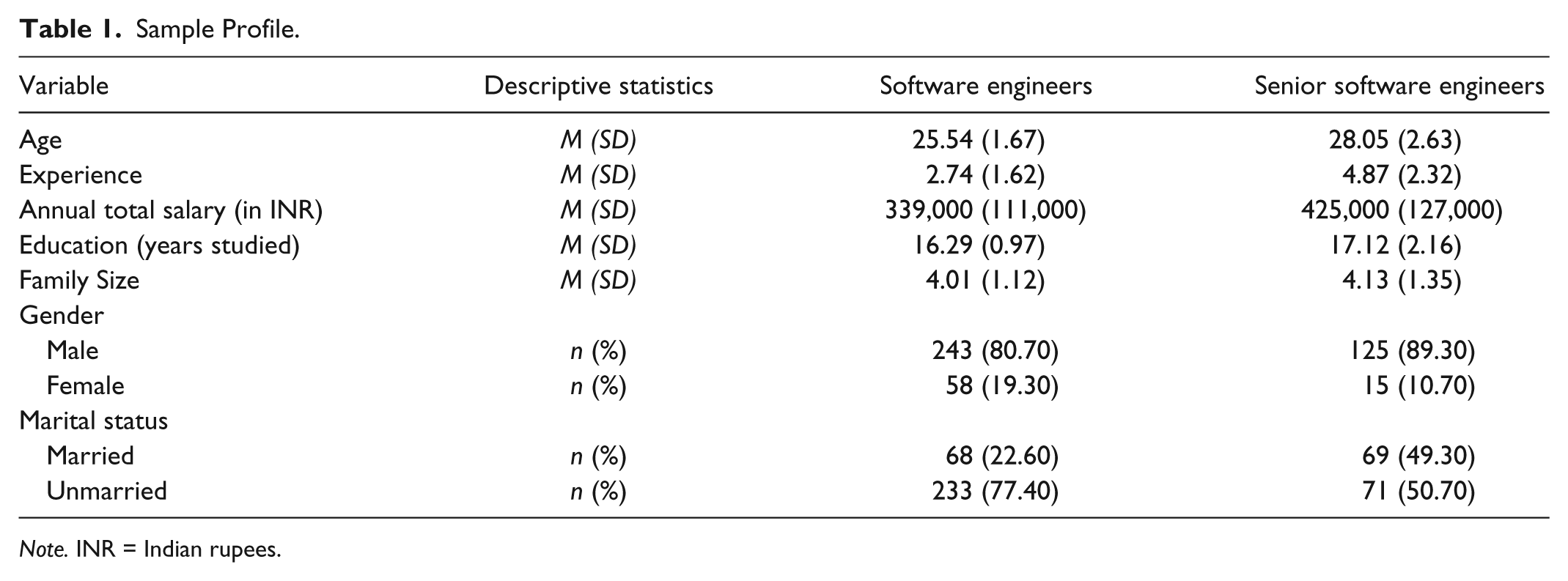
Note. INR = Indian rupees.
Measures
Besides sociodemographic information, data on EICs, leadership style, social capital, HRM practices, and value of and opportunities for knowledge sharing were obtained from each SP through a self-reported questionnaire. Team leaders assessed the performance of SPs through a separate questionnaire.
Performance
The team leader was asked to rate his or her team members on 16 items given in the questionnaire considering the past 1-year performance. SPs reported the name of their team leaders, and accordingly in each questionnaire the name of the SP was included and given to the respective team leader for assessing performance. Response categories were given on a ladder with 10 steps ranging from poor (0) to excellent (9). Validation of the scale to assess performance was reported by Prasad and Suar (2010). In that validation, ratings of SPs by team leaders were subjected to exploratory factor analysis, and six factors were extracted that explained 60.42% of total variance. The first factor loaded significantly on 4 items of “independent thinking,” “handling of multiple projects,” “mastery of skills and techniques,” and “focus on customers.” This factor was termed as “work-efficiency.” The second factor loaded significantly on 3 items of “efficient at work,” “creating value to customers,” and “creativity/innovation” that was named as “personal resourcefulness.” The third factor loaded on 2 items of “responsible at work” and “cooperativeness with team members” that was termed as “inter- and intra-personal sensitivity,” which can be renamed as “personal and group responsibility.” The fourth factor loaded on 3 items of “working overtime to complete projects,” “quantity concerned,” and “quality consciousness,” which was termed as “productivity orientation.” The fifth factor loaded on 2 items of “taking decisions” and “meeting deadlines” that was termed as “timeliness.” The last factor loaded on 2 items of “advocating new ideas for improving product” and “showing concern for profitability” that was termed as “business intelligence.” High additive scores on items of a factor indicated more presence of that factor.
EICs
EICs were assessed with a 110-item scale developed by Boyatzis et al. (2000). The scale had four dimensions: (a) self-awareness, (b) self-management, (c) social-awareness, and (d) relationship management. A sample item on (a) self-awareness includes “I can recognize the situation that arouses my emotion”; (b) self-management includes “I stay composed and positive, even in difficult moments”; (c) social-awareness includes “I can make myself available to customers/clients”; and (d) relationship management includes “I identify and use opportunities to meet new people and develop new contacts.” All items were rated on a Likert-type scale—not at all true (0) to always true (4). High additive scores on items of a dimension indicated more presence of that dimension.
Transformational leadership
The Multifactor Leadership Questionnaire (Bass & Avolio, 1990b) was used to assess the extent of transformational leadership of the team leader. The scale had four dimensions: (a) idealized influence (attitude and behavior), (b) inspirational motivation, (c) intellectual stimulation, and (d) individualized consideration. A sample item on (a) idealized influence includes “My team leader goes beyond self-interest for the good of the group”; (b) inspirational motivation includes “My team leader talks optimistically about the future”; (c) intellectual stimulation includes “My team leader suggests new ways of looking at how to complete assignments”; and (d) individualized consideration includes “My team leader spends time teaching and coaching me.” Response descriptions against each item were given on a Likert-type scale ranging from strongly disagree (0) to strongly agree (4). High additive scores on items of a dimension indicated a more favorable evaluation of that dimension.
Social capital
Social capital was assessed using a 32-item scale developed by Narayan and Cassidy (2001). The scale had seven dimensions: (a) group characteristics, (b) generalized norms, (c) togetherness, (d) everyday socializing, (e) volunteerism, (f) trust, and (g) reciprocity. A sample item on (a) group characteristics includes “I often participate in the activities of the group to which I belong”; (b) generalized norms includes “I always attend frequent meetings arranged by the group”; (c) togetherness includes “I feel I am getting closer to my network”; (d) everyday sociability includes “I talk to my neighbors over the cubicle”; (e) volunteerism includes “I volunteer myself for cultural programmes”; (f) trust includes “I trust members of my sports community”; and (g) reciprocity includes “I reciprocate to the community needs.” Response descriptions against each item were on a Likert-type scale—from a very small extent (0) to a very large extent (4). High additive scores on items of a dimension indicated a more favorable evaluation of that dimension.
HRM practices
HRM practices were assessed using the instrument developed by Dechawatanapaisal (2005). The dimensions of HRM practices were (a) performance-linked incentives, (b) training and development, and (c) staffing. Another dimension added to the construct was (d) quality of work life. A sample item to measure (a) performance-linked incentives includes “Whenever I do a good job, my performance is noticed and rewarded”; (b) training and development includes “Management in my software firm stresses the importance of training and development”; (c) staffing includes “Staffing process in my firm is rigid”; and (d) quality of work life includes “My company has the policy to send employees for offshore projects.” Response descriptions against each item were given on a Likert-type scale—strongly disagree (0) to strongly agree (4). High additive scores of items on a dimension indicated a more favorable evaluation of that dimension.
Value of knowledge sharing
Four items developed to measure “value of knowledge sharing” include (1) “purpose of sharing knowledge,” (2) “content of sharing knowledge,” (3) “clarity of sharing knowledge,” and (4) “utility of knowledge sharing.” Response options for each item used four 10-point bipolar adjectives—unpleasant–pleasant, harmful–beneficial, bad–good, and worthless–valuable, respectively. High additive scores on items indicated more knowledge sharing.
Opportunities for knowledge sharing
This was assessed on eight items developed by Lin (2007). A sample item includes “I take initiation to set up group meetings to exchange relevant information.” All positively keyed items were rated on a 5-point Likert-type scale—highly unpleasant (0) to highly pleasant (4). High additive scores on items indicated greater opportunities for knowledge sharing.
The convergent and discriminant validity of the constructs were tested by confirmatory factor analysis (CFA). The Amos 4.0 software package was used (Arbuckle & Wothke, 1999). We conservatively used the factor loading of an item to be ≥ .3 for retention in a construct. The purpose was to identify and eliminate poorly performing items. Along with descriptive statistics, various fit measures of comparative fit index (CFI), goodness of fit index (GFI), normed fit index (NFI), and root mean square error of approximation (RMSEA) are given in Table 2.
Scale Reliability and Validity.

Note. CFI = comparative fit index; GFI = goodness of fit index; RMSEA = root mean square error of approximation.
Along with the validity of items, the inter-item consistency of each item was reported. Barring a few dimensions on performance (Prasad & Suar, 2010), Cronbach’s alpha reliability was acceptable in all constructs (>.60).
The mean of each variable was estimated considering the additive score of the items on a variable and dividing that by the number of items in that variable to keep the score within the range of the scale. The validity of all the scales was acceptable. CFI and GFI indices were above 0.80, except for the dimensions on EICs. Although the constructs did not reach ideal fit levels (≥0.90), the constructs could not be considered invalid because the minimum fit of the model was achieved and the regression coefficients from the observed variables to the latent construct were significant.
Procedure
A cross-section of 441 SPs responded to a questionnaire survey on sociodemographic variables, EICs, transformational leadership, social capital, HRM practices, value of knowledge sharing, and opportunities for knowledge sharing. Fifty-five team leaders assessed the performance of SPs.
Results
Pearson’s correlations among the studied variables (Table 3) revealed the following relationships:
Six dimensions of performance directly inter-related among themselves significantly suggesting that the increase in one dimension of performance went with the increase in other dimensions of performance.
Barring a few relations, dimensions of EICs including self-awareness, self-management, social-awareness, and relationship management varied positively with the six dimensions of performance.
The transformational leadership dimensions of inspirational motivation and intellectual stimulation frequently and directly increased with the six dimensions of performance. But, idealized influence of the team leader increased with personal resourcefulness, and individualized consideration increased with low productivity orientation of SPs.
The social capital dimensions of group characteristics, group norms, togetherness, trust, and reciprocity consistently and positively related to the varied dimensions of performance.
HRM practices of performance-linked reward, training and development, staffing, and quality of work life frequently and positively related to the varied dimensions of performance.
The proposed moderators, value of knowledge sharing, and opportunities for knowledge sharing related positively and occasionally to the dimensions of performance, EICs, transformational leadership, social capital, and HRM practices. Barring few exceptions, the reported relations supported the hypothesized directions.
Inter-Correlations Among Studied Variables.

Note. WE = work-efficiency; PR = personal resourcefulness; PGR = personal and group responsibility; PO = productivity orientation; BI = business intelligence; SA = self-awareness; SM = self-management; SOA = social-awareness; RM = relationship management; II = idealized influence; IM = inspirational motivation; IS = intellectual stimulation; IC = individualized consideration; GC = group characteristics; GN = group norms; ES = everyday sociability; TO = togetherness; VO = volunteering; TR = trust; RE = reciprocity; PLI = performance-linked incentives; TD = training and development; ST = staffing; QWL = quality of work life; VKS = value of knowledge sharing; OKS = opportunities for knowledge sharing.
p < .05. **p < .01. ***p < .001.
Latent variable structural equation modeling (LVSEM) was adopted to test the hypotheses. LVSEM reveals antecedent–consequent relationships that are unobserved in bidirectional correlations. It incorporates measurement models and structural relationships. It controls measurement errors—(a) random and (b) systematic. Random errors occur due to difficulties in measuring the constructs accurately. The convergent and discriminant validity of each indicator variable was established with its significant loading on the respective latent construct using CFA. Systematic errors occur due to factors such as social desirability, common method bias (e.g., scale type, rater, or context), and response biases (e.g., leniency, yea-saying, or nay-saying). Systematic errors (Podsakoff, MacKenzie, & Podsakoff, 2003) were controlled procedurally, collecting data on job performance of SPs from their team leaders and on other variables from SPs at different time periods using different questionnaires.
In LVSEM, the standardized path coefficients are similar to standardized beta values in multiple regression analysis. The standardized paths from observed variables to latent constructs were significant, suggesting that the observed dimensions of EICs, transformational leadership, social capital, and HRM practices were measuring their latent construct. Supporting four parts of the first hypothesis, an increase in EICs, transformational leadership, social capital, and HRM practices improved the job performance of SPs (Table 4).
LVSEM Results on Antecedents of Performance.
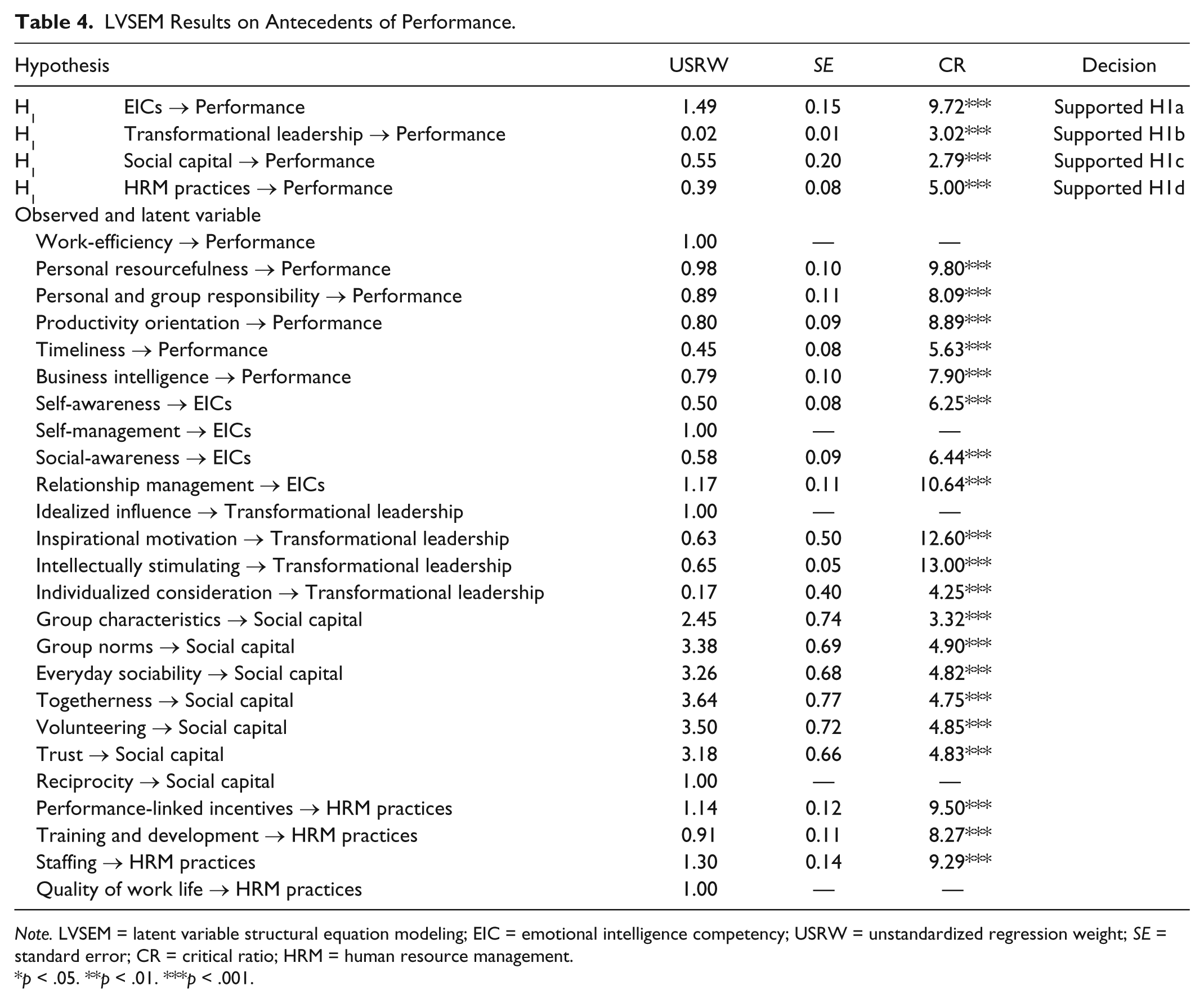
Note. LVSEM = latent variable structural equation modeling; EIC = emotional intelligence competency; USRW = unstandardized regression weight; SE = standard error; CR = critical ratio; HRM = human resource management.
p < .05. **p < .01. ***p < .001.
From the standardized regression weights of all constructs, it was observed that EICs of SPs were the most important antecedent to determine their job performance. The standardized regression weight of EICs alone was about 2 times greater than the combined standardized regression weights of transformational leadership, social capital, and HRM practices (Figure 2).

Standardized path coefficients of antecedents of performance.
To test the second hypothesis depicting moderator effects, two groups of structural equation modeling were performed using median split samples for value of and opportunities for knowledge sharing because each moderator was an observed variable. The same structural equation modeling as shown in Figure 2 was estimated for high (above median) and low (below median) sample groups on two moderators. For a more rigorous comparison, two tests for each high and low group were conducted for each moderating variable, based on four corresponding models A, B, C, and D proposed by Dabholkar and Bagozzi (2002). Four models using SEM were constrained in terms of error variances explained by latent variables and path coefficients among latent constructs. Model A was constrained to be the same across high and low groups in error variances and path coefficients. In Model B, only error variances were constrained and in Model D only path coefficients were constrained. With regard to Model C, both path coefficients and error variances were free across the two groups. Comparing the constrained with free models, if the χ2 differs significantly between models such as A and B (or C and D), this could be from path coefficients and if the χ2 differs between A and D (or B and C), this could be from error variances in the dependent variable. Therefore, if the variable of interest is a true moderator, Models A and B (or C and D) should be significantly different.
According to the results, χ2 differences between pairs of given models indicated that there were significant differences between Models A and B on value of knowledge sharing and opportunities for knowledge sharing for both the high and low groups (Table 5). This suggested the presence of moderating effects.
Structural Equation Results for Moderating Effects.

Note. RMSEA = root mean square error of approximation; GFI = goodness of fit index; CFI = comparative fit index.
p < .05. **p < .01. ***p < .001.
Testing was carried out to verify whether the changes in coefficients were due to group differences and not due to measurement error. If the chi-square difference between the high and low groups divided by the change in degree of freedom (Δχ2 / Δdf) was significant, then there were significant moderating effects across the low and high groups. The high and low groups on value of and opportunities for knowledge sharing differed significantly because the χ2 difference for one degree of freedom was significant. Thus, the moderators at high and low values affected differently the antecedent–consequent relationships (Table 6). Only after obtaining evidence of this, standardized regression weights were compared across the high and low group levels.
LVSEM Results for Moderating Effects Between Groups.

Note. LVSEM = latent variable structural equation modeling; CFI = comparative fit index; GFI = goodness of fit index; NFI = normed fit index; RMSEA = root mean square error of approximation; PCFI = parsimony comparative fit index; PGFI = parsimony goodness of fit index; PNFI = parsimony normed fit index.
p < .05. **p< .01. ***p < .001.
The path coefficients suggested that with high values of knowledge sharing and opportunities for knowledge sharing, it followed that EICs, transformational style, social capital, and HRM practices influencing performance were strengthened, and with low values of knowledge sharing and opportunities for knowledge sharing, such relationships were attenuated or nullified. Value of knowledge sharing varied directly with performance dimensions of personal resourcefulness and timeliness, and opportunities for knowledge sharing positively related to performance dimensions of work-efficiency, productivity orientation, timeliness, and business intelligence. Because value of knowledge sharing and opportunities for knowledge sharing varied positively with the dimensions of performance (Sharma, Durand, & Gur-Arie, 1981), they were quasi/partial moderators (Table 7). These findings supported the four components of the second hypothesis.
Path Analytic Results of Moderating Effects.

Note. SRW = standardized regression weight; USRW = unstandardized regression weights; SE = standard error; CR = critical ratio; EICs = emotional intelligence competencies; TL = transformational leadership; SC = social capital; HRM = human resources management.
p< .05. **p< .01. ***p< .001.
The full hypothesized model stating the relations between the antecedents and consequences along with the moderators is shown in Figure 3.

Moderators influencing antecedents and consequences.
Discussion
This study aimed to find the determinants and moderators of SPs’ performance. Findings suggest that EICs of SPs, transformational leadership style of team leaders, social capital among SPs, and HRM practices provided by software firms increased SPs’ performance. EICs of SPs were found to be the most important predictor of performance. EICs, transformational leadership, social capital, and HRM practices influencing job performance were strengthened (attenuated or nullified), under high (low) value of and opportunities for knowledge sharing.
Antecedents of Performance
Job performance of SPs is the criterion that guides decisions on their training, coaching, counseling, participation, transfer, promotion, pay-rise, and even demotion and lay-off. If the SPs evaluate their performance, they are more likely to over-rate themselves. Accordingly, the team leader evaluated the performance of SPs in his or her team. In earlier studies (Chi & Pan, 2012; Rich et al., 2010; Titu & Constantin, 2012), supervisors similarly evaluated the performance of subordinates’ on a set of behaviors including core job tasks. This procedure arrested common method bias because the performance of SPs was assessed by team leaders at a different time compared with the responses of SPs to other constructs of the study.
Corroborating earlier findings that job performance is determined more by emotional intelligence than cognitive intelligence (Boyatzis & Sala, 2004; Cherniss & Goleman, 2001; Goleman, 1998; McClelland, 1998), findings of this study suggest that SPs having high EICs are better performers. The model suggests that SPs with high EICs show behavior consistent with job demands when the job and organizational environment call for high job performance (Boyatzis, 1982). Self-awareness and self-managerial skills tune the SPs emotional framework to be adjustive, resilient, and responsive to customers’ demands. This intra-personal competency includes not only personal attributes of confidence, optimism, proactivity, self-control, emotional maturity, and tolerance for ambiguity but also contextual facilitative attributes of strategic goal-setting, team building, and customer focus. All these in tandem increase job performance. SPs with more inter-personal competency better synchronize their self-generated emotions with emotions of peers, clients, and team leaders. Empathizing with peers during pause-periods helps SPs to overcome fatigue and focus more on software quality. SPs’ emotional attachment with clients on successive interactions inspires reworking software products to satisfy clients. An emotional affection in the workplace helps cultivate organizational and cultural etiquettes when dealing with clients from different ethnic and religious backgrounds.
The findings concur with the earlier results that SPs writing open source code increased their job performance working under transformational team leaders (Li, Tan, & Teo, 2012). Informal discussion with the SPs revealed that their team leaders were senior to them. They and their team leaders had worked as colleagues in the past. The team leaders influenced colleagues and juniors to achieve project objectives. Through their deeds, they were able to mobilize the juniors, build trust, and bring the SPs’ talent to the surface for achieving goals of projects vis-à-vis software firms.
The model further suggests that SPs become confident, achievement driven, and courageously take up challenging tasks of software development under transformational team leaders. Team leaders enhance SPs’ effectiveness encouraging innovative ways to do the job, inspiring and elevating them to a higher plane, and removing deficiencies through teaching, training, and counseling. SPs can withstand the challenges posed by clients’ requirements because the team leaders have intellectually stimulated and encouraged SPs to think critically and do the job in novel ways. This is parallel to the “Pygmalion effect.” The team leader inspires, stimulates, and expects higher performance from SPs, and SPs perform accordingly.
The model also suggests that SPs overcome the pressure of performance through cooperation, mutual support, and networking with others (Taeube, 2005). They practice togetherness with colleagues and peers, interacting with them and collecting insightful information about the project that helps improve performance. With freedom of expression and interaction with talented engineers, SPs improve their knowledge about how to contribute to the project.
This study complements the evidence (Dechawatanapaisal, 2005) that improved HRM practices do increase performance. The model indicates that HRM practices motivate SPs to work hard in meeting deadlines and fulfilling the needs of clients. SPs conscientiously attend training and development programs offered by the firm to improve their domain expertise and multi-skilling abilities. Performance-linked incentives reinforce engagement in work activities, offering excellent services to the clients/customers, adhering to norms of firms, and bringing discipline to the workplace. The staffing function hires the right people to handle the job. Through staffing, SPs design more bug-free and more agile programs with appropriate lines of code. The top managements of software firms are quick to respond to needs of employees about quality workplace. A case in point is the Microsoft Company (Redmond, USA). SPs are given a free hand to purchase and place orders for any item that they consider essential to improve the quality of the workplace without hierarchical hassles (Microsoft, 2006). If the SPs are more reciprocated, satisfied, trained, and provided incentive in accordance with performance, they are more likely to meet clients’ requirements. When the needs of SPs’ are met in a conducive work environment, their performance increases to meet the requirements of external clients (Kotler, 1994).
Cognitive intelligence assesses analytical and language abilities. Although it can ensure quality and quantity of performance, SPs are less likely to vary in it because they have to continuously pass through a series of such tests. Supporting the observation of Boyatzis et al. (2000), EICs are found to be the most important predictor of job performance.
Moderators of Performance
Value of and opportunities for knowledge sharing make the exchange of knowledge easier among SPs (Minbaeva, 2008). Opportunities for knowledge sharing have reciprocally benefited the individual employees as well as others in innovation and idea generation. Under favorable conditions, EICs, transformational leadership style, social capital, and HRM practices have increased performance. Contrarily, when such favorable conditions are lower, the antecedents have attenuated or nullified their relationship with job performance.
Implications and Limitations
This study contributes to current knowledge of variables affecting SPs’ performance, and it has implications for the workplace. EICs are found to be the most important predictor of performance. In addition, EICs, transformational leadership style, social capital, and HRM practices influencing the SPs’ performance can further improve performance with high value of and more opportunities for knowledge sharing. While recruiting and selecting potential SPs, a HR manager can select those having high EICs to maximize workplace performance. After recruitment and selection, fine-tuning the leadership style, and improving social capital and HRM practices can further boost performance. Moreover, awareness about the value of knowledge sharing in complex software projects and exchange of work-related information through group discussions, blog, networking, You Tube, and Facebook can help SPs to augment their knowledge vis-à-vis performance.
There are certain limitations of this study. First, the individual level construct of EICs of 441 SPs, the group level construct of transformational leadership and social capital of 55 teams, and the enterprise level construct of HRM practices of eight firms call for a multi-level statistical analysis. However, the relatively small number of companies could not yield sufficient statistical power to conduct a three-level analysis. However, depending on group members’ behaviors, including communication, politics, and conflicts, the perception of leadership style, social capital, and HRM practices will vary from one SP to another. Moreover, job performance, the outcome construct of the study, was assessed individually. Therefore, the SP was the unit of analysis.
Second, the data have been collected from IT hubs at Bangalore, Hyderabad, and Kolkata in India. Moreover, the LVSEM includes five latent variables studied through 27 observed variables (Note: Four for EICs, four for transformational leadership style, seven for social capital, four for HRM practices, and six for performance. In addition, there is one observed variable for value of knowledge sharing and another for opportunities for knowledge sharing.). Estimating the sample-size (Soper, 2013; Westland, 2010) for 5 latent and 27 observed variables requires a minimum of 463 respondents if one wishes to detect effects with a statistical power level of .8 and with a small effect-size of .10 (Cohen, 1988), and a minimum of 129 respondents for the structure of the model. Although the sample-size is adequate for the structural model, LVSEM falls short by 22 respondents to detect effects. Therefore, caution must be exercised in generalizing the findings.
Conclusion
Reviewing the literature from individualistic Euro-American cultures, a model of SPs’ performance was proposed specifying the antecedents and facilitators of performance. Analysis of information collected from the collectivist culture of Indian SPs supports the model suggesting its cross-cultural validity and application in work settings.
Extending Goleman’s (1995) proposition, transformational leadership, social capital, and HRM practices in software firms along with SPs’ EICs are found to improve the performance of SPs. Such relationships are also found to be elevated under high values of and opportunities for knowledge sharing.
Footnotes
Acknowledgements
The authors are grateful to the anonymous reviewers and Gladis Villegas for their constructive criticisms and suggestions to improve the quality of the manuscript.
Declaration of Conflicting Interests
The author(s) declared no potential conflicts of interest with respect to the research, authorship, and/or publication of this article.
Funding
The author(s) received no financial support for the research and/or authorship of this article.