




Abstract
The article documents the mediasphere in the state of Jammu & Kashmir (J&K). The analysis reveals a tremendous increase in the number of publications in the state of J&K over the period of time. On the basis of the data retrieved from the official website of the Registrar of Newspapers for India (RNI), periodicals were also identified district-wise and region-wise. Furthermore, language-wise analysis was also done to gauge the difference in the growth of press in various languages in the state. Besides, the study also maps radio, TV, internet and mobile phones, media schools, and so on in the state.
Introduction
Jammu & Kashmir (J&K) is a picturesque province renowned for its breath-taking locales. Earlier, J&K state comprised three regions—Jammu, Kashmir valley, and Ladakh. It consisted of 22 districts (Jammu and Kashmir Official Portal, 2020). According to Census of India, 2011, J&K has a total population of 12,541,302.
Press in this socially and culturally rich region plays a monumental role in extensively covering all the events of significance. The media here have always played a cardinal role in totality and prove to be an eye opener for the people.
Press has been instrumental in highlighting the progressive agenda and contributing to the society at large. It plays a cardinal role in public awakening and proves to be one of the most important social institutions of the people.
History is witness to the fact that press in J&K has played an important role in the development of a public sphere at large. Historically, the development of journalism in Kashmir owes a lot to the Urdu press (Chandan, 2007).
Urdu is one of the most read languages of the state of J&K. Being the official language of state, Urdu remains to be the lingua franca in this multilinguistic J&K.
Urdu journalism actually paved the way for a more sensible and mature English press in the region. After doing wonders in the field of journalism, unfortunately, Urdu press couldn’t match the speed of technological advancements lagging far behind the English press.
Kashmir is a very difficult terrain to understand, discuss, and write. The situation here keeps on changing with time. The special status of the State was revoked in 2019 turning a new page in the history of J&K (CNN Editorial Research, 2020).
With a minimal option of documenting and disseminating all these implicit and explicit cries, media has a cardinal role to play in totality in such a condition. But actually before studying the role of media, it essentially becomes paramount to map different mediums of mass communication in J&K.
The first and foremost problem in J&K is that media here have not been mapped so far. So, before studying the role of media of this important region in detail, it becomes essentially important to map different mediums of mass communication in J&K.
In this regard, this research article is an attempt of mapping all the mediasphere in J&K. The study has been designed to gauge the growth of newspapers, radio, TV, cinema, internet, and other forms of media. The study will also help to get an idea about the media consumption or media diet of the citizens of the state at large.
Significance of Study
This study is an attempt to gauge the growth and development of various channels of mass communication in J&K. It will trace the development of newspapers, radio, TV, cinema, internet, and other forms of media in J&K. The study will also cover a brief history and will help to map the development of associations of journalists, media schools, and hybrid editions of the newspapers and national newspapers’ J&K edition to get an idea about the media literacy and other journalistic activities in the J&K.
While reviewing the literature, it was found that print media in J&K remains to be the main source of mass dissemination. The print media took birth in the region very late comparatively and no systematic evidences have been given till now regarding the development of media in this particular state. The study also intends to analyze the development of newspapers over the period of time. The study will further help to examine the developments of print media in view of periodicity, language, and region-wise and district-wise growth of newspapers in J&K.
Research Objectives
Following research objectives have been formulated:
To map all the mediums of mass communication including newspapers, radio, TV, cinema, internet and mobile phones, telephone, and so on.
To analyze the growth of newspapers over the period of time.
To gauge the periodicity, language, and region-wise publication of newspapers in J&K.
Method
On the basis of the data retrieved from the official website of the Registrar of Newspapers for India (RNI), the growth of the newspapers in the state would be gauged. Periodicals would also be identified and categorized district-wise and region-wise. Furthermore, language-wise analysis was also carried out to gauge the difference in the growth of press in various languages in the state. Besides that, the study also maps radio, TV, internet and mobile phones, media schools, and so on in the state.
Furthermore, the narrative analysis based on some primary and secondary sources is also the part of this mapping. The important newspapers currently in circulation have been considered for a historical narrative. Quantitatively, the periodicals of the state and their circulation would be further compared with other Indian states to get a rough idea of the share of the state in total.
Using both qualitative and quantitative techniques, this study actually uses a triangulation method which is a mixture of quantitative and qualitative content analysis (mixed method) and historiography. Furthermore, it may be stated that this study does not actually fall under the banner of either traditional history or critical history; this study using a top-down approach for studying the development of media institutions is actually a mixture of both the two methods and aims to give an evidence of the media institutions of the state in present.
Besides that, keeping in mind the topic of study, Sociologist Micheal Schudson’s (2002) first method, out of the three approaches, institutional history has been used to gauge the development of different media genres as medium of mass communication in the state. Nord (1989) refers to this approach as “hagiography.” As the study has been taking into account all the media institution in totality instead of studying different media “saints,” Nord’s (1989) understanding of this approach of “institutional history” may not be applicable in this study. This methodology has been primarily used to gauge the development and growth of different media institutions as medium of mass communication in the state.
Data Sources and Collection
The data related to periodicals were retrieved from the official website of RNI, a statutory body of Government of India. RNI was established on the recommendations of First Press Commission of India on July 1, 1956. RNI (2017) issues certificates of registration to the newspapers and other periodicals published under valid declaration. The data about various other media genres were collected from different sources especially from government and private websites, state archives, books, research and newspaper articles, oral history, personal experience, and so on. These data were further substantiated with some other primary and secondary sources.
The data were analyzed using statistical measures like percentage analysis and analysis of variance (ANOVA) test. ANOVA is a statistical method used to determine the significance of differences among the means of three or more than three groups. Furthermore, statistically significant ANOVA was followed by Tukey’s HSD. Tukey’s HSD is a post hoc test used for the further analysis of data. This test is applied after statistically significant ANOVA, to find means that are significantly different from each other.
Furthermore, t-test was also used to analyze the levels of significance among the Jammu division and Kashmir division. Unlike ANOVA, a t-test is used to determine whether there is a significant difference between the means of two groups. So, the test was used to determine whether two divisions of the state—Jammu and Kashmir—are significantly different from each other on having total number of publications.
All the aforementioned tools and techniques were used collectively to develop a broader understanding of growth of various media channels in the state.
Literature and Discussion
Brief History of Press in J&K
Started in 1867, Vida Vilas, a weekly, is considered to be the first newspaper of the State of J&K. Published from Vidya Vilas Press, Jammu, a bilingual—Urdu & Hindi (Dev Nagri script), was an organ of Vidya Vilas Sabha, actually aimed to cover the proceedings of this sabha (Sharma, 2010). There were many ups and downs in the newspaper history of Kashmir till the Maharaja government permitted Mulk Raj Saraf to publish a regular Urdu newspaper Ranbir in 1924 (Sharma, 2010).
This study focuses only on the newspapers registered by RNI, so its history in J&K begins 8 years after the establishment of RNI when noted Kashmiri writer Rasheed Taseer registered first ever publication from the state. To mark the beginning of registered publications in J&K, Taseer registered Muhafiz, an Urdu weekly from Srinagar in 1964. The very next year, 1965, witnessed the registration of 21 new publications.
As per the data retrieved from the official website of the RNI on March 8, 2017, 1,326 titles have been verified from J&K till the aforementioned date. Out of a total of 1,326 titles, the year of verification of 13 titles remains to be unknown. The dates available with the RNI reveal that the first ever verification of a title from J&K was made on December 19, 1957. As per the record, there were some 15 verifications made on the same day. The data analysis shows that 1,176 titles have been registered so far from the state.

Depicting difference in verified and registered titles.
Registration of Publications
To gauge the growth of the newspapers and periodicals in J&K over the period of time, the discrete data available with the RNI was arranged year-wise and further decade-wise. For an easily understandable report of the growth of print media in the state, the data were shaped decade-wise with 1957 as the base year. 1957 was treated as base year as the first ever verification from the state was made in this year. The time period was divided into a total of six decades from 1957 to 2016. Following this pattern, a group of following years was conceived: 1957–1966, 1967–1976, 1977–1986, 1987–1996, 1997–2006, and 2007–2016. These decades were further coded as D1, D2, D3, D4, D5, and D6, respectively.
The total number of registered and verified titles was organized accordingly.
Year-Wise Verification and Registration of Publications During D1 in J&K.

It is important to mention that the 13 unknown titles, as mentioned above, have also been listed in D1. Many important newspapers currently in circulation like Kashmir Times and Daily Excelsior were registered during this decade.
The foundation of J&K’s first English newspaper, Kashmir Times, was laid by Baldev Prasad Sharma and Pandit Gawsha Lal Koul on November 26, 1934. Kashmir Times, a weekly, ceased its publication and was re-launched by Abdul Rehman Mitha, congress leader from Bombay, in 1943 (Mohi Ud Din, 2012).
Kashmir Times was reviewed as a weekly from Jammu in 1954. The newspaper was converted into a daily in 1964 (Kashmir Times, 2017). Ved Bhasin, one of the renowned and oldest journalists of J&K, was the founding editor of the Kashmir Times in 1954. He remained to be the long-running editor of the newspaper from 1964 to 2000. Kashmir Times group also publishes Dainik Kashmir Times, a Hindi daily, Jammu Prabhat, a Dogri daily, and a monthly children’s magazine, Springer. Dainik Kashmir Times was started in 1989 and Jammu Prabhat in 2008 (Kashmir Times, 2017).
One of the important and oldest English-language newspapers in the state registered during this period was Daily Excelsior. The newspaper started its publication from Jammu on January 1, 1965, as a weekly tabloid. SD Rohmetra is the founder-cum-editor in Chief of the newspaper actually owned by Excelsior House. It became a daily in 1967 (Daily Excelsior, 2017).
Known for his satire “Khazar Suchta Hai Wular Kay Kinaray,” Kh. Sanaullah Bhat switched back to Kashmir valley in 1957 and started publishing his newspaper, Aftab (Mohi Ud Din, 2012). Bhat registered the newspaper with RNI in 1965 as an Urdu daily from Srinagar. The newspaper in its 61st year of publication is considered as one of the reputed language newspapers of the valley. Ghulam Mohammad Mir has been registered as the publisher of the newspaper. Aftab in post 1950s is remembered as the representation of a nation speaking to itself and is considered as a watershed of struggle after the end of the feudal rule in the state. The range of issues that this newspaper would cover left hardly any segment—from culture to history, light read to literature, social issue to hard hitting political questions—untouched. With a distinct style, Aftab was the first newspaper with a home delivery service. Being a trend setter in many ways, the newspaper, unlike others, was also circulated to towns and rural areas apart from Srinagar city (Mohi Ud Din, 2012).
Roshni, an Urdu daily from Srinagar, was started in 1943. Although Roshni claims to be in its 75th year of publication, the newspaper was for the first time registered with RNI in 1965 by Zahoor A. Shora. Roshni is currently printed and published by Shora. Aziz Kashmiri is the founding editor of the 8-page newspaper. AINA was started by Shamim Ahmad Shamim in 1965. AINA became so popular that it was converted into a daily newspaper in 1975. But after the Shamim’s untimely death, paper could not survive long and thus it became an archival reference of great significance (Mohi Ud Din, 2012).
A Kashmiri language monthly periodical Kashur Adab was registered by Ghulam Rasool Santosh in 1966. Many other publications registered during this decade include Martand, an Urdu daily started by Dina Nath Kotra from Srinagar in 1966, Jammu Post (1966), Jahan-I-Nav (1965) by Shamboo Nath Gurkha, Imarat (1965), Humwatan (1965) and Hamara Kashmir (1966), Hamdard, an Urdu weekly in 1965 by GR Arif, AINA (1965) by Shamim Ahmad Shamim and Azad to name a few.
Year-Wise Verification and Registration of Publications During D2 in J&K.
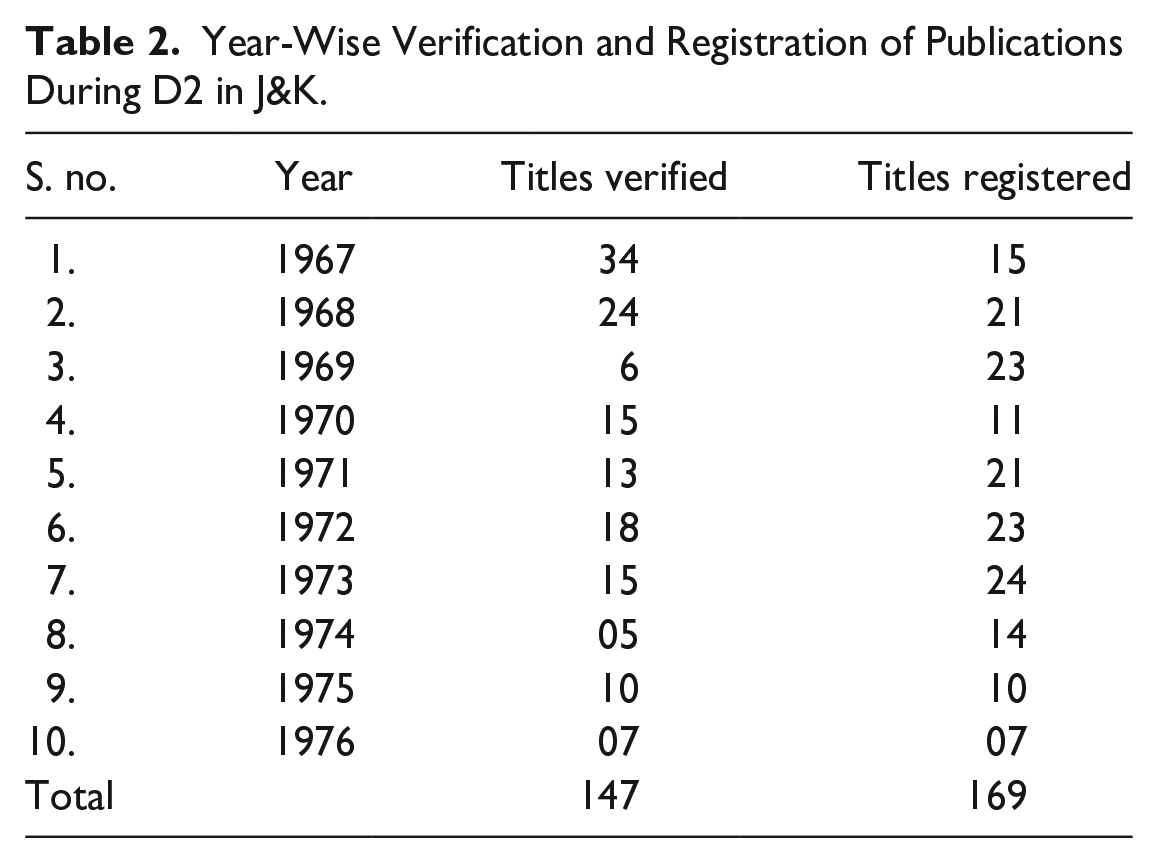
D2 witnessed some five times increase in the number of titles as compared to D1. Some 169 titles have been registered during this decade. Some of the prominent newspapers of the state including Srinagar Times were started during this decade. Srinagar Times was started as an Urdu weekly by Sofi Ghulam Mohammad from Srinagar in 1969. This is also one of the longest surviving newspapers of the valley. Srinagar Times may not be the most read newspaper of the valley, but the daily cartoon of the newspaper is one of the special features readers get to see in the newspaper every morning. Srinagar Times came up with its trademark cartoonist—Bashir Ahmad Bashir (famously known as BAB) made many a morning. His cartoons were as telling as Kh. Sonaullah’s “Khazar Suchta Hai Wular Kay Kinaray.” BAB joined Srinagar Times in 1969 and helped the paper to edit reports and letters to the editor. Brother of the founder of the newspaper, Sofi Ghulam Mohammad, BAB is said to be the father of political cartoons in Kashmir. In 1971, the newspaper published its first ever cartoon in its mid page made by BAB on Sheikh Abdullah (Wani, 2014). Rehbar is credited to have started publishing of political cartoons in the State of J&K. First cartoon was made by Dost Mohammad Khan for Rehbar in 1934 (Taseer, 1989, pp. 140). Even though another newspaper Hamdard started publishing political cartoons in 1935 almost daily, but Srinagar Times’ cartoons have been considered best ever political cartoons in the journalistic history of Kashmir.
Year-Wise Verification and Registration of Publications During D3 in J&K.

Surprisingly, D3 witnessed a decline in the number of registration of new titles in the state. Despite this, some most prominent newspapers currently in circulation like Chattan and Afaq Srinagar came into being. Chattan was registered as an Urdu newspaper from Srinagar by Tahir Mohi-ud-din in 1978. The newspaper was re-registered in 1983. Since then, Mohi-ud-din is the publisher, printer, owner, and Chief Editor of Chattan. The newspaper started its publication in 1985 as a weekly (Daily Chattan, 2017). The 8-page newspaper is printed at Abid Enterprises, Zainakote, Srinagar. The newspaper continuously updates news and views through popular social networking site Facebook.
Afaq Srinagar, an Urdu daily, is also one of the important newspapers of the state started in 1985. Mohd. Yousuf Qadri is the founder of the newspaper.
Year-Wise Verification and Registration of Publications During D4 in J&K.

In threat of their life, many talented journalists left the valley during 1990s. On their departure, the baton of the journalism automatically passed into the hands of local editors. A serious challenge of manning local newspapers was thrown up for the local editors and journalists. Paving way for the growth of journalism, local editors and journalists had a series of new and important stories to report. This marked the beginning of the era of English journalism in the state of J&K. This was the period when one of the state’s largest English daily, Greater Kashmir, hit the stands and filled the vacuum (Bukhari, 2012).
After 6 years of its publication as a weekly, Greater Kashmir took on the daily garb from a weekly one in 1993. With this, valley got its first standard English daily owned by a Kashmiri Muslim, Rashid Makdoomi. Earlier, the journalists in the Kashmir valley were skeptical about the possibility of a local English-language daily in Kashmir that could sustain itself exclusively on readership and advertisements provided locally. On the other side, with growing literacy rate, even Kashmir Times, a Jammu-based newspaper, had a dependable readership in the valley in comparison to that in the Jammu region. Not many senior journalists and editors believed that the valley had readership or even the talent that could support and sustain a professionally edited daily English newspaper (Mohi Ud Din, 2012).
Fayaz Ahmad Kaloo is the Editor-in-Chief of the newspaper. Kashmir Uzma, the sister publication of Greater Kashmir, is one of the largest circulated Urdu dailies of the state. The Greater Kashmir Media Group is owned by Greater Kashmir Communications Pvt Ltd. The group also owns an English weekly tabloid, Kashmir Ink and Urdu weekly magazine Nawa e Jehlum. Kashmir Ink was actually started as a monthly magazine in 2014. Later, in 2016, Kashmir Ink was turned into a weekly tabloid. Currently, it is published in the form of some supplement pages with the main book weekly. Greater Kashmir enjoys the mileage of being one of the most read newspapers of the valley. “Write Hand,” a very short column written by Ajaz-Ul-Haque every Sunday is believed to be one of the most enjoyed columns of the newspaper. GK Communications Pvt. Ltd also uploads the latest videos on the GKTV, the audio-visual platform of the media group.
Within 6 months of uninterrupted circulation and positive response by the educated Kashmiris, advertisers started getting attracted to Greater Kashmir. With the passage of time, this newspaper became a torch-bearer for English journalism in Kashmir. In 1988, Zafar Aga became the first bureau chief of the newspaper in New Delhi (Greater Kashmir, 2017).
Another important daily, Alsafa News, was registered by Asraf Shabab in 1988. Alsafa, an Urdu daily was a household name in the state. Once the most read newspaper of the valley, Alsafa used to publish half of the pages of the paper in Urdu and the other half in English.
Another Urdu daily, Uqab, was registered by Manzoor Ahmad Anjum from Srinagar in 1994. Bashir Ahmad Nayak (famously known as Bashir Manzar) registered Kashmir Images, one of the finest English newspapers of the valley in 1996.
An English daily from Jammu, The Himalayan Mail, was also started in 1996 by Sneh Gupta. The 12-page newspaper was appointed the franchisee to run the edition of The Indian Express in the J&K.
Another newspaper, State Times, was registered as an English daily from Jammu by Raj Daluju in 1996. The newspaper has a hybrid publication. State Times also registered its Hindi edition in 2007.
Year-Wise Verification and Registration of Publications During D5 in J&K.

Some of the important newspapers started in this decade currently in circulation include The Kashmir Monitor, Tameel I Irshad, Early Times, Kashmir Observer, Kashmir Uzma, Rehbar, The Kashmir Convener, and The Rehmat.
One of the renowned journalists of J&K, Zafar Meraj started The Kashmir Monitor in 1998. Unlike the usual practice of publishing editorial on the left-hand column of the editorial page, The Kashmir Monitor publishes its editorial on the top of the editorial page. Zafar Meraj’s son Shameem Meraj is the owner, publisher, and editor of the newspaper.
Another important English daily, Early Times, was started by Bansi Lal Gupta in 2002 from Jammu. The newspaper also started a supplement Early Time Plus in 2010. The 12-page newspaper is being printed at Early Times Printing Press, Jammu. B.L. Gupta is the editor, printer, publisher, and owner of the newspaper.
Kashmir Observer is an English daily started in 1998 by Sajjad Haider from Srinagar. The newspaper allocates ample space to a wide range of issues prevailing in and outside the state. Currently, Sajjad Haider is the publisher and Editor in Chief of the newspaper.
Another Urdu daily, Tameel I Irshad, was started by Aakash Amin Bhat in 2002. Rehbar, a weekly, was started in 1932 by Ghulam Mohi-ud-Din Rehbar. Later, the newspaper was registered with RNI by Shahid Iqbal Rehbar in 2002 as an Urdu weekly from Srinagar. The newspaper and Ghulam Mohi-ud-Din Rehbar’s role resulted in his frequent arrests which affected the publication of paper. In 1933, Rehbar was stalled. Similarly, in 1936, 1938, and 1946, its publication was stopped (Rehbar, 2012).
Some of the national newspapers including Amar Ujala, Dainik Jagran, and The Indian Express also registered their Jammu edition during this decade.
Year-Wise Verification and Registration of Publications During D6 in J&K.
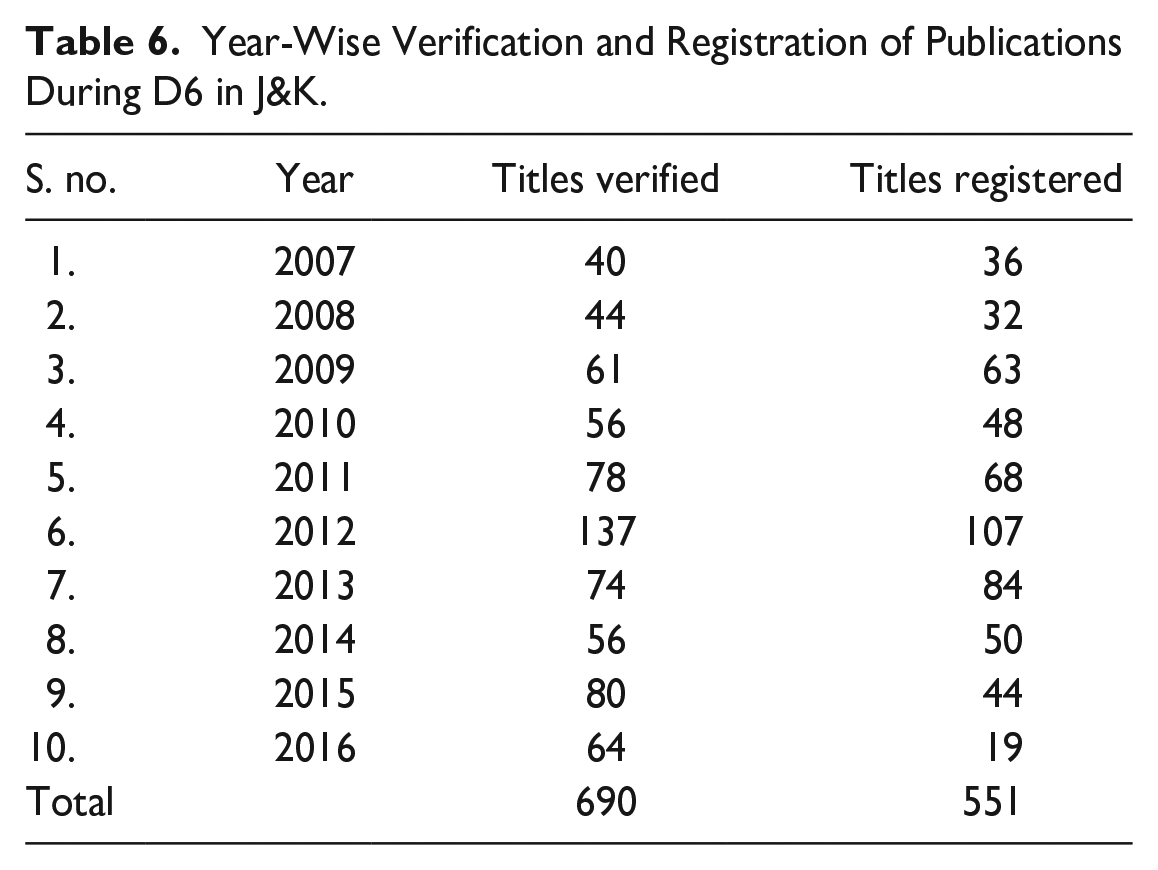
Rising Kashmir was started by Syed Rafi-U-Din Bukhari in 2007. Prominent journalist and former Bureau-in-Chief of The Hindu in Srinagar, late Syed Shujaat Bukhari, was the Founding Editor of newspaper till he was assassinated on June 14, 2018.
He was shot dead outside his newspaper’s office in Press Enclave of Lal Chowk Srinagar. Bukhari’s assassination was not a setback to the newspaper only but to whole journalist fraternity across the globe. Rising Kashmir didn’t stop the print and hit the stand next day of Bukhari’s assassination with a full-page photograph of newspaper’s murdered editor-in-chief on front page against a black background and message that said it would not be cowed down (“Rising Kashmir Hits the Stands With Shujaat Bukhari Tribute on Front Page,” 2018).
Catering the needs of the people in the valley, the newspaper under his editorship had been covering the diverse issues of the state in general and valley in particular since the inception. Rising Kashmir is owned by the Kashmir Media Group. The group also owns an Urdu daily Buland Kashmir and a Kashmiri language daily Sangarmal.
Setting a new benchmark in the field of journalism in the state of J&K, Kashmir Reader gained a lot of attention in the whole valley through its content and preference of the stories in a very short span of time. Registered in 2011, the newspaper was banned by the authorities for some 3 months in 2016.
On October 2, 2016, the birthday of Mahatma Gandhi, a proponent of free speech, five policemen entered the Kashmir Reader’s office in Srinagar at 8:15 p.m., with an order in hand banning printing of the newspaper. The order, issued by the District Magistrate Srinagar, without mentioning a particular write-up, read publication of the newspaper can “easily incite acts of violence and disturb peace and tranquillity.” Invoking Section 144 Cr.P.C., Section 3 of News Papers Incitement of Offences Act, 1971, and Section 10 of Press and Publication Act, 1989, the printing of Kashmir Reader newspaper was stopped (“Govt Bans Publication of Kashmir Reader. . . .” 2016). This was a major setback to the press freedom in the valley. Started as an English daily in May 2012, Kashmir Reader is the only daily newspaper in the state of J&K which prefers offbeat human interest stories on its front page as the lead of the day. Kashmir Reader is to Kashmir what New York Times is to the world.
The newspaper was started from Srinagar by Helpline Group, earlier the publisher of famous English magazine Conveyor. Haji Hayat Mohammad Bhat is the printer, publisher, owner, and Editor in Chief of the newspaper. Being a part of the mainstream media, Kashmir Reader seems to be fulfilling the duty of an alternative press in the valley.
An important English weekly tabloid, Kashmir Life was started by Hilal Ahmad Dar in 2009. Kashmir Life is one of the finest examples of human interest and long-form journalism in the valley.
Decadal Growth of Publications
Furthermore, to shape the data in a more lucid form to increase the comprehensibility regarding the growth of print media, decade-wise percentage of the registered periodicals was gauged. The analysis shows the percentage share of each listed decade separately.

Depicting decade-wise increase in the number of publications.
Depicting Percentage Share of All the Decades.

The data reveal that the number of publications registered during D6 (46.85%) is almost equal to the sum total of all the titles registered during remaining all the decades. With a share of 2.90%, the D1 remains to be last in registering new titles. The data also reveal that during D3 an overall decline has been witnessed in the registration of new titles. Except this, there has been an overall increase during the rest of the decades.
Apart from percentage analysis, the statistical test, ANOVA, was applied to see the significance of difference among the decades. ANOVA was applied to see the significance of difference among the decades.
Table 8 shows the decade-wise descriptive statistics on the total number of registered publications. D6 scores highest mean (55.10) as compared to the other decades.
Mean and Standard Deviation of the Decades.

Table 9 shows a significant difference among the decades. The F-value is 22.70 which is statistically significant at .01 level of significance. ANOVA test shows a statistically significant difference among the groups (Table 9). Furthermore, statistically significant ANOVA was followed by Tukey’s HSD.
Level of Significance Between the Groups and Within the Groups.

ANOVA = analysis of variance.
Multiple Comparisons and Level of Significance Between the Selected Decades Using Tukey’s HSD.

HSD = honestly significant difference.
The mean difference is significant at the .05 level.
There was a statistically significant difference between groups as determined by one-way ANOVA (F = 22.70) (p < .01). A statistically significant ANOVA was followed by Tukey’s post hoc test to see the significance of difference between the decades on total number of publications registered. Tukey’s test shows a significant difference between D1 and D5 (p < .05), D1 and D6 (p < .01), D2 and D6 (p < .01), D3 and D6 (p < .01), D4 and D6 (p < .01), and D5 and D6 (p < .01).
The analysis reveals a significant growth in the number of publications in J&K from D1 to D2. In the same way, a significant growth has been registered from D5 to D6. Analysis further reveals a significant difference between D1 and D6, D2 and D6, D3 and D6, D4 and D6, and D5 and D6. During the last decade (D6), an unprecedented growth in the number of publications has been recorded. With the findings of the study, it could be well established that there is a tremendous increase in the number of publications in the state of J&K over the period of time.

Depicting the growth of publications in J&K over the period of six decades.
District/Division-Wise Distribution of Publications
In erstwhile J&K, there were three divisions—Jammu, Kashmir, and Ladakh. An attempt has been made to compare all the districts and regions of the state on the basis of number of publications registered over the period of time. Publications registered in Ladakh were added to Kashmir division. Furthermore, Jammu division was compared with Kashmir division to gauge the difference among the two.
Depicting District-Wise Registration of Publications in Kashmir Valley.

Representing District-Wise Registration of Publication in Jammu Region.


Representing the percentage share of the three regions of the state.
However, the population of Kashmir region is more than that of Jammu, yet maximum titles were found to have been registered from Jammu region instead of the valley. With only five registered titles, Ladakh renders little help to Kashmir division to surpass Jammu in the total number of titles. With Jammu claiming 57.14% titles, there is ample difference between the two important divisions of the state. With incomplete information, four titles remained unrecognized. Although the district of publication of the title is unknown, still, one among them had been listed in Ladakh. In this study, the aforementioned title has been included in an additional category “Others” in Ladakh region (Table 13). The other three titles have been included in “Unrecognized Titles” (Table 14).
District-Wise Publications Registered in Ladakh Region.

Region-Wise Publications Registered in J&K.

After the percentage analysis, t-test was used to analyze the levels of significance among the two aforementioned divisions. The test is used to determine if two sets of data are significantly different from each other.
Depicting Division-Wise Publications Registered in J&K.

Table 16 shows a difference in the mean score of Jammu division and Kashmir division on the total number of publications registered in the divisions. The result shows an insignificant (t = .397, p >.05) difference between the two divisions. Jammu scores higher mean than Kashmir.
Mean, Standard Deviation, and t-Value of J&K Divisions.

Language-Wise Distribution of Publications
Linguistically, J&K is a very diverse state. Urdu written in Persian script is the official language of the state. Kashmiri and Dogri languages are the most spoken languages of the state. Kashmiri, Dogri, Pahari, Punjabi, Gujari, Ladakhi or Bodhi, Balti, Dardic, Kishtwari, and so on are some of the principal languages of the state. The newspapers and periodicals were identified language-wise to analyze the difference in the growth of press in various languages in different divisions of the state.
Language-Wise Registration of Publications in J&K.

It was found that newspapers and other periodicals were mainly found to have been registered in English followed by the official language of the state, Urdu. With 41.35%, English has ruled out Urdu from the top spot as the main contender for largest read language of the state in terms of newspapers and periodicals. The newspapers in other most spoken languages—Kashmiri in Kashmir division and Dogri in Jammu division—were very less in number. Figures reveal that the Hindi language press has also gained a significant importance in the state over the period of time.
As per the details of Registrar Newspapers of India (RNI), only 10 titles have been registered so far in the Kashmiri language. Among them, only one periodical Nahaj, a quarterly, was started by Akhtar Jan in 2014, from Pulwama. Rest of the newspapers were found to have been registered from Srinagar. Sangarmal, Kahwat, and Ernimal were registered as dailies. In 2006, Sangarmal was started by Syed Rafi-U-Din Bukhari, the founder of Rising Kashmir and Buland Kashmir, an Urdu daily. In 2011, Tariq Saleem Beigh started Ernimal. Kahwat was started by Aakash Amin Bhat in 2008 from Srinagar. Currently, Sangramal is one of the most important Kashmiri language newspapers in circulation in the valley. Kashur Adab remains to be the oldest Kashmiri language periodical started by Gulam Rasool Santosh as a monthly in 1966. Anis Ur Rehman started a bimonthly Naeb in 1968. Kashur Meeras, a weekly, was started by Attiqa Bano in 2012. Another weekly, Pragash, was started by Press Information Bureau in 1969. Abid Yousuf Miskeen started a weekly Soan Meeraas in 2006. One of the earliest Kashmiri language periodicals, Chaman, was started in 1968 by Yousaf Anjum as a weekly.
On the contrary, there is only one Dogri language daily newspaper in the state. Published from Jammu, Jammu Prabhat was started by Prabhat Jamwal in 2007. Another periodical Jot, a quarterly, was started by Yeswanti Devi Pathak in 1987 from Kathua. Ranbir remains to be the oldest Dogri language periodical started as a weekly in 1970 by Sehdev Rohmetra. Shiv Jyoti, a weekly, was started by Rakesh Gupta from Jammu in 1976. Another weekly from Jammu, Parchoal, was started in Rano Devi in 1997. Even though Pahari-speaking people constitute the largest tribe of the state, no periodical was found to have been registered in Pahari language until recently when a young journalist, Zubair Quershi, started publishing the first Pahari newspaper of the state, “The Voice of Hills.” It was further found that there was not a single periodical registered in other principal languages—Batli, Ladakhi, Gujari, and Kishtwari.
Periodicity-Wise Distribution of Publications
Depicting Periodicity-Wise Distribution of Publications in J&K.
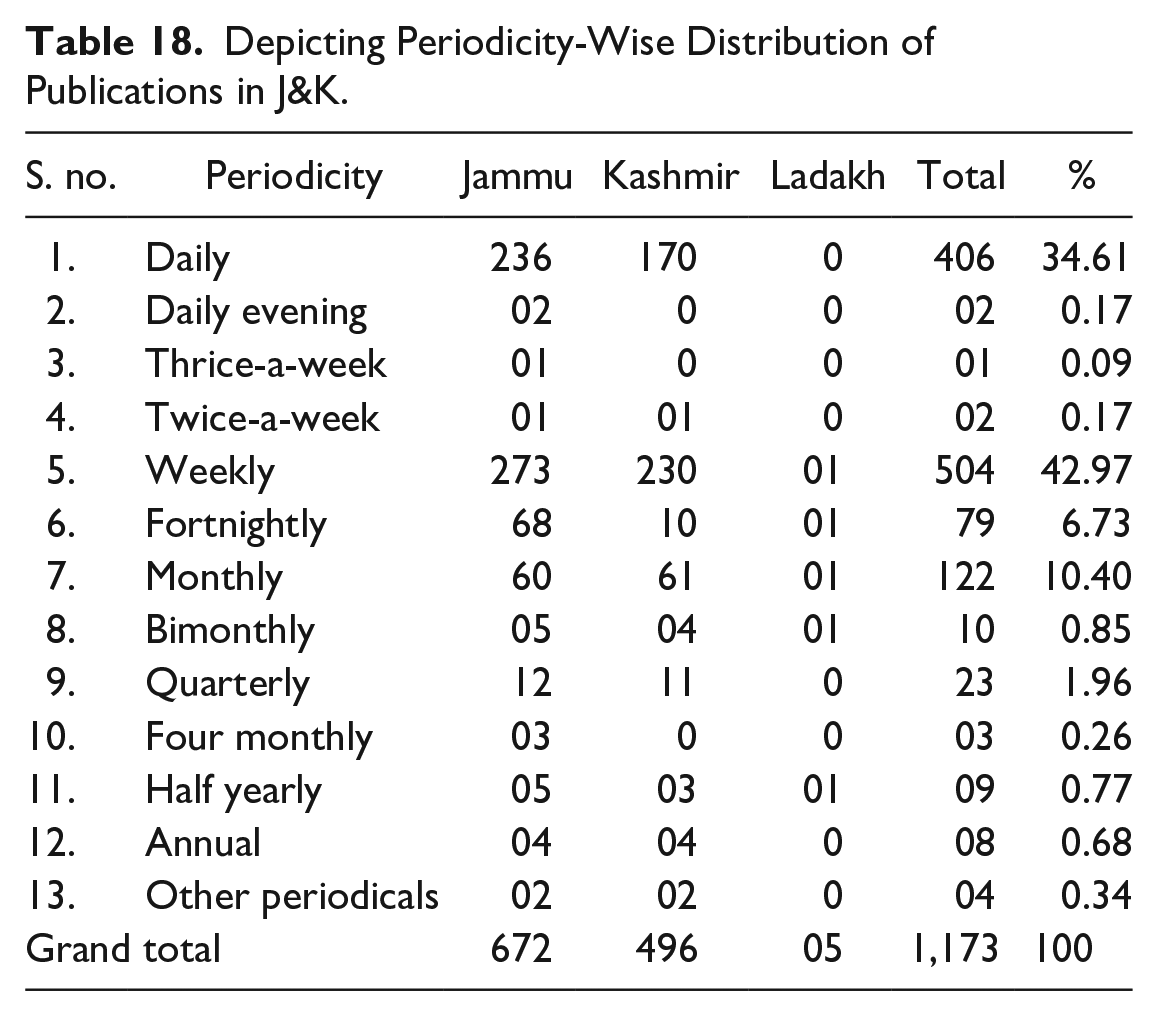
Most of the newspapers were found to have been registered as dailies, followed by weeklies. Jammu leads in publishing both the dailies and the weeklies in the state.
The analysis reveals that the J&K has witnessed an increase in the number of newspapers over the time. Initially, Urdu journalism witnessed a growth by leaps and bounds here. On the contrary, the English press took ample time to come into the scene. Government also started creating a feasible environment for the growth of press.
The literacy rate in the State increased after 1955. There was a significant increase in the number of readers and writers. A continuous increase in the literacy rate in the State was witnessed. On the contrary, press in such a place proved to be an important public organ. Press continued to provide the media diet to the people of the State.
Total Percentage Share
Furthermore, an attempt has been made to gauge the share of publications registered in J&K in the total number of titles registered with RNI. It was found that there have been some 132,431 registered publications with RNI in India till March 8, 2017. The data reveal that the titles registered in J&K constitute only 0.89% of the total share.

Depicting the percentage share of J&K in the total number of publications registered with Registrar of Newspapers for India (RNI).
To further evaluate the current position of the press in J&K, the portion of the registered titles in J&K obtained through simple mathematical formulas was compared with the other Indian states. This comparison helps to understand the pinnacles in the development of press in the state of J&K. With 1,176 titles, J&K was found to have been contributing a share of 0.89% to the total number of titles registered so far by the RNI.
The data were arranged state-wise to analyze and compare the present state of publications among the different states and union territories. The analysis reveals that the state of J&K figures at 19th place in the list.
Depicting State-Wise Publications Registered.

Circulation of the Newspapers
An attempt has been made to analyze the growth of press in J&K in terms of the total circulation of newspapers and periodicals in the state. The circulation of the newspapers and periodicals in the state was further compared with the circulation of the print media in other states. The data produced in the 58th Annual Report published by The RNI (2013–2014) was used. Findings reveal that a total of 99,660 titles were found to have been registered with RNI as on March 31, 2014. However, the circulation of newspapers and periodicals has been calculated on the basis of 19,755 publishers who have filed their annual statements online for the year 2013–2014. Furthermore, as per the data, there were 969 registered titles in J&K as on March 31, 2014. The total circulation claimed by the newspapers and periodicals in J&K was 9,627,424 copies as on March 31, 2014.
According to the report, out of a total of 969, only 347 publications were found to have submitted their Annual Statements for the year 2013–2014. It comprised 230 dailies, 99 weeklies, 7 fortnightlies, 8 monthlies, 2 quarterlies, and 1 others. Further dividing these publications on the basis of language, it was found that 158 were English, 122 were Urdu, 29 Bilingual, 27 Hindi, 5 Kashmiri, 4 Multilingual, and 2 Dogri language publications.
Break-Up of the Circulation in Terms of Language and Periodicity in J&K.

The report concluded that among the daily English newspapers, Daily Excelsior published from Jammu claimed to have the largest circulation of 308,988 copies a day and among the periodicals, Sharda, an Urdu weekly from Srinagar, was leading with a circulation of 60,500 copies per publishing day. According to RNI, Greater Kashmir has claimed a circulation of 137,305 copies, of both the editions for the year 2014–2015. In the same year, Kashmir Times has claimed a circulation of 390,634 copies for its three editions. Kashmir Uzma has claimed a circulation of 84,189 for its two editions. Rising Kashmir has claimed a circulation of 98,000 and 66,000 for its two editions while Sangarmal and Buland Kashmir claim to have a circulation of 66,000 and 72,000, respectively.
On the basis of circulation claimed by newspapers and periodicals across India, J&K was compared with other states to analyze its share among total registered publications.

State-wise comparison of circulation of publications.
Depicting J&K’s Contribution to Total Circulation of Publications in India.

The findings reveal that J&K constitutes 2.14% of the total circulation claimed by various publications across India.
Hybrid and Double Editions
Out of a list of 58 daily newspapers, only 21 (36.2%) newspapers of Kashmir are available online. Most of them have adopted social media technologies to some extent with Greater Kashmir, Rising Kashmir, and The Kashmir Monitor showing full visibility on the selected social media tools. The language newspapers seem to be quite at the stages of infancy in implementing these technologies (Gul & Islam, 2013). Few newspapers have also started publication of two editions, separately from Jammu and Srinagar. Greater Kashmir publishes two editions—Greater Kashmir from Srinagar, the summer capital and Greater Kashmir from Jammu, the winter capital of the state, respectively. The Jammu edition of the newspaper is also printed with the same title “Greater Kashmir.”
Rising Kashmir has also started another edition namely Rising Jammu. Kashmir Times also publishes Srinagar edition of the newspaper in addition to main edition, Kashmir Times Jammu edition. Greater Kashmir’s sister publication Kashmir Uzma also publishes Srinagar and Jammu editions of the newspaper.
Few newspapers also publish two separate newspapers in two different languages with the same title.
National Newspapers’ J&K Editions
On December 10, 2007, The Tribune, Chandigarh launched its Jammu edition in Jammu, becoming the third English daily from outside the state, after The Indian Express and Hindustan Times to have its separate edition. Apart from these three English dailies, Amar Ujala, Dainik Jagran, and Punjab Kesri have also launched their Jammu editions (“Tribune Launches Jammu Edition, Indicates Growing Prospects,” 2007). Hind Samachar also registered the Jammu edition of the newspaper in 2007 (RNI, 2017). These Hindi newspapers couldn’t extend their services to the valley due to language barriers. After Jammu Tribune, the newspaper also launched Kashmir Tribune on August 9, 2012 (Omar Launches Kashmir Tribune, 2012). Currently, the newspaper publishes a full J&K edition of the newspaper. Senior journalist, Ehsan Fazili, currently heads the Srinagar office of the newspaper.
The Indian Express had also started its J&K edition in collaboration with The Himalayan Mail which lasted for 12 years. The Indian Express’ J&K edition was available in the valley in coordination with The Himalayan Mail since 1998 (Rathore, 2010). My Times of Srinagar, a weekly supplement page of The Times of India, was also published for some time from Chandigarh. Apart from this, almost all the major national and international media organizations and news agencies have journalists, stringers, video-journalists, and photographers posted in J&K.
News Agencies
Kashmir News Service (KNS) is one of the major news regional agencies in the state. Current News Service (CNS), Global News Service (GNS), and few other local news agencies are also operational in the valley. Apart from this, ample newspapers have subscribed to Press Trust of India (PTI), United News of India (UNI), and IANS for national and other international news. Many newspapers reproduce the content of BBC, Aljazeera, Dawn, The Indian Express, Scroll.in, and other national and international media organizations.
Associations and Organizations
The journalists in State of J&K founded associations and actively participated in such activities since the Dogra period. The foundation of Kashmir Journalists Association was laid in the office of Vitasta in April 1933 under the president-ship of Sheikh Fazal Ahmad Kashmiri of Gulab. Bazaz was president while Baldev Prasad Sharma was its secretary.
The foundation of Jammu chapter of the association Jammu Journalists Association was laid under the supervision of Lal Ram Saran Das Malhotra. Munshi Mehraj Uddin Ahmad of Pasban was nominated its first president while Lal Shiv Ram Gupta its first secretary (Taseer, 1989, pp. 179–180).
The journalists of Kashmir were divided into three groups among which Kashmir Journalists’ Association and Kashmir Journalists’ Federation are important to mention. Initially, there was only one association in the valley, but few journalists under the influence of government broke up and started a new organization of journalists called Kashmir Journalists’ Federation (The Khidmat Issue dated January 22, 1942).
On May 19, 1942, under the leadership of Sadar Uddin Mujahid called upon all the members of Kashmir Journalists’ Federation and Kashmir Journalists’ Association and other non-affiliated journalists of the valley. After discussion, it was decided that the journalists of Kashmir will fight for their rights under one banner only.
The new organization of the journalists would be formed. Two names, Kashmir Journalists’ Federation and Kashmir Newspapers’ Society, were proposed for the new organization. Resulting in a tie, both the names got nine votes each. Ending the confusion, the president of the meeting, Mujahid voted in favor of Kashmir Newspapers Society. A sub-committee was also nominated for the drafting rules and regulations (The Khidmat Issue dated May 20 1942).
The Society organized a conference of all the journalists of the valley on April 10–11, 1943 (The Khidmat, Issue date January 29 1943). The Society also floated an idea of holding All Jammu and Kashmir Newspaper Editors’ Conference in the month of June which was later conducted in August. Under the president-ship of Mujahid, different committees were formed for the 3-day conference held between August 19 and 21, 1943 in Srinagar (The Khidmat Issue dated May 9 1943).
Maharajas also organized various press and journalists’ meets time to time in which reporters from different parts of the world were invited. Mulk Raj Saraf also invited Indian Federation of Working Journalists to organize an annual conference in Kashmir in 1964 which was later approved by the State government (Government of Jammu and Kashmir, Kashmir Bureau of Information, 1964).
Currently, some of the associations and organizations of the journalists working in different towns and cities of the state are as follows:
Kashmir Editors Guild (KEG);
Aiwaan-e-Sahafat;
Press Club of Jammu;
Anjuman-e-Udru Shafat;
Kashmir Working Journalists Association;
Kashmir Press Photographers Association (KPPA);
and many others . . .
Media Schools in J&K
Established in 1985, Media Education Research Centre (MERC), University of Kashmir (2017) is perhaps the first journalism school in the state. Offering a 2-year postgraduate course in Mass Communication and Journalism, MERC has nurtured a long list of journalists in Kashmir. MERC also publishes a fortnightly magazine, MERC Times.
Apart from MERC, Government Degree College Boys Baramulla, Government College for Women, M.A. Road, Srinagar and Government Degree College Anantnag are three important institutions offering courses in media. Baramulla College is one of the important and oldest institutions of the state offering two different graduation level media courses—Mass Communication and Multimedia Production (MCMP) now B.A. (Honours) Multi Media and Mass Communication (BMMMC) since 2004 and Mass Communication and Video Production (MCVP) since 2002—of 3 years each (Govt. Degree College Boys Baramulla, 2017). For nurturing tall journalists in the valley, Baramulla College is known to be the bedrock of journalism in Kashmir.
Islamic University of Science and Technology, Awantipora, Kashmir also offers a 2-year postgraduate course in Journalism and Mass Communication (Islamic University of Science & Technology, 2017). Department also publishes a tabloid, Echo. Central University of Kashmir also offers a postgraduate program in convergent journalism (Central University of Kashmir, 2017).
In Jammu, the Central University of Jammu, Indian Institute of Mass Communication, Jammu (IIMC Jammu) and Gandhi Memorial College of Education, Jammu (GMCEJ) offer a course in mass communication. IIMC started its regional center at Jammu in 2012–2013.
The University of Ladkah also started teaching media subject in 2020. Among all the aforementioned institutes, GMCEJ is the only private college offering the course in the state.
Cinema
The story of film-making in Kashmir begins in 1952 with a documentary Pamposh (Lotus). Made by Ezra Mir, Pamposh was screened at the Cannes Film Festival. The first Kashmiri feature film, Mehanzraat, was released in 1964. Directed by Jagjiram Pal, Mehanzraat was screened at a cinema hall in the main city of Kashmir and evoked tremendous response from the people. It was rewarded with president’s award (Altaf, 2012).
State particularly Kashmir valley also witnessed cinema-going culture for long. Even before that, the Field Publicity Organisation of the J&K State Information Department organized 300 film shows during the year 1955–1956 only.
The film shows were exhibited in schools, colleges, government offices, public places, hospitals, factories, and so on. The organizations also started exhibition of the film shows in the Srinagar Club weekly for the entertainment of visitors. They also exhibited films in the Central Jail, Srinagar, which was first of its kind in the history of Kashmir. The film shows were being exhibited fortnightly. The valley also witnessed a “Film Week” which commenced from March 24, 1956, was also organized by the Field Publicity Organisation of the J&K State Information Department. During this week, films of historical, cultural, and educational value were exhibited across the valley (Field Publicity Organisation, 1955–1956).
There were more than 17 film theaters in the State in 1963 only which included three in Srinagar, one in Sopore, one in Anantnag, one in Baramulla, four in Jammu, one in Udhampur, one in Baderwah, two in Kathua, one in Samba, one in Ranbirsinghpura, and one in Leh (Information Department, Srinagar Archives, 1963).
Despite the ban, cinemas continued to operate in the valley till December 31, 1989 (Mir, 2012). Currently, no cinema hall in Kashmir valley is operational.
Radio
To serve the communication needs for the World War II, radio sets were sold in different parts of the world. As it was considered a luxury item, only some 22 radio sets had come to Kashmir for sale that time. These radio sets called “Sky Champion,” made in Chicago, USA, were sold by Messrs Lyra & Co, Lal Chowk Srinagar (Ganjoo, 2001). Some of the buyers of the radio sets also include Maharaja Hari Singh, the management of the Amar Singh Club Srinagar, the then state physician, Dr S.K. Shangloo, Pandit Niranjan Nath Ganjoo and so on. Meanwhile, the “Air Messenger” brand radio sets were procured and issued for the community listening in various parts of Jammu and Srinagar (Ganjoo, 2001; Krishan, 2012).
Soon after the India-Pakistan partition, the radio broadcasts from the Pakistani radio stations, mostly from Radio Lahore, had a direct bearing on J&K where this station was clearly heard (Krishan, 2012).
Owing to Jammu’s proximity to the border, the first radio station in J&K was commissioned by All India Radio (AIR) in Jammu (Radio Kashmir, Jammu) on December 1, 1947. The radio station was inaugurated by Maharaja Hari Singh in the presence of the then Union Home Minister of India, Sardar Valabh Bhai Patel (Bamzai, 1994).
This station was operated in three classrooms of the Government Ranbir High School. Maharaja Hari Singh’s speech was the first to broadcast at 6.30 p.m. As there were no recording facilities, this speech was aired live. Hari Singh’s speech was followed by Maharani of Jammu and Kashmir’s speech (Golden Jubilee Souvenir of Radio Kashmir Jammu on its 50 years—1947–1997, p. 9 (as cited in Krishan, 2012).
Later, a station was started in Srinagar July 1, 1948. These two wings of Radio Kashmir were hurriedly set-up. These two stations began their operation under State Government’s Information and Broadcasting Ministry and continued to do so till April 1954 when the stations were merged with AIR (Krishan, 2012).
The first broadcast from Radio Kashmir, Srinagar was Yeh Radio Kashmir Hai (This is Radio Kashmir), made by Mir Ghulam Rasool Nazki was followed by the recitation from Holy Quran. Later, Sheikh Mohd Abdullah addressed the people of J&K (Hyderi, 2001, as cited in Krishan, 2012).
The Radio Kashmir, Srinagar station was temporarily shifted near Government Arts Emporium Building after being functional at Polo Ground for 3 years. The station was shifted back to Polo Ground transmitters gutted in the fire earlier were repaired. Prime Minister Bakshi Ghulam Mohammad laid the foundation of the current building of Radio Kashmir Srinagar on June 1960. Both Radio Kashmir Jammu and Radio Kashmir Srinagar had initially transmission for a duration of 3 hr with rural program for 20 min and news for 30 min (Krishan, 2012).
A new station was inaugurated on April 1, 1964. Another station was commissioned in Srinagar (Commercial Broadcasting Service, Radio Kashmir, Srinagar) on July 1, 1975.
In 2015, government approved licenses to 15 new FM channels in J&K. Out of a total of 15 channels, three each will be in Kathua, Bhaderwah, Kargil, Leh, and Poonch (“Government Approves 18 New FM Channels for Northeast, 15 for Jammu and Kashmir,” 2015). Big 92.7 FM, Red FM 93.5, Radio Tadka, Radio Mirchi, and others have also started services in Srinagar and Jammu. Besides that, there is also one community radio in the state at Islamic University of Science and Technology, Awantipora.
Television
In J&K, DD Kendras are stationed at Jammu, Srinagar, Rajouri, and Leh. In 1993, DDK Jammu got commissioned as PGF. DDK Jammu produces programs in eight different languages/dialects. DD Kashir channel was launched on June 26, 2000. It was converted into a 24-hr channel on August 15, 2003. This is primarily a satellite channel having a terrestrial support of 30 transmitters covering about 77% of the population in the Kashmir region (Bharati, 2015).
Even though private cable operators air local cable channels like KBC, JK Channel, Insaaf TV, and Sen Channel, J&K has no private satellite TV channel or national channel of its own. There were only eight local TV channels which are registered and have a license to beam entertainment programs among total 37 channels working in the valley till January 2010 (Manzoor-Ul-Hassan, 2012). Few channels like Network 18 Urdu and Hyderabad-based Munsif TV, New Delhi based Gulistan TV continuously air Kashmir news and have dedicated special time slots to the valley.
Internet and Mobile Phones
The mobile phone service in J&K was for the first time launched on August 20, 2003. Former chief minister of the state late Mufti Mohammad Sayeed in Srinagar made the first call to Indian prime minister late Atal Bihari Vajpayee in New Delhi (“PM Launches Mobile Phone Services for J&K,” 2003). Government-owned Bharat Sanchar Nigam Ltd (BSNL) was the first cellular services company to provide service in the state. J&K had 5.2 million cellular subscribers as of June 2010. BSNL, Airtel, Vodafone, Idea, Jio, and so on provide wireless cellular services in the state.
According to the latest figures available with Telecom Regulatory Authority of India (TRAI), quoted by Mirani (2015), J&K had some 35.3 lakh internet users till the end of June 2015. Another report by Malik (2017), quoting TRAI data published by Greater Kashmir, states that J&K crossed the mark of one crore mobile users at the end of October 2016. According to the TRAI data, J&K had 10,428,635 mobile users till the end of October 2016.
Conclusion
The analysis reveals a tremendous increase in the number of publications in the state of J&K over the period of time. Keeping in mind the world trends, D6 (2007–2016) is the time period when the print across the globe had been witnessing a decline in terms of readership due to the advent of technology and further growth of electronic and new media. Surprisingly, the J&K has been witnessing an unprecedented growth in the registration of new titles specifically during the aforementioned period.
Furthermore, increase in the number of mobile phone and internet users has no bearing on the print. Even though some FM channels have started their services in Kashmir, no license has been allotted to start a private satellite TV channel in J&K. Cinema culture on the other side has been the worst hit in Kashmir.
Kashmir’s media industry is not developing on the same model as is witnessed currently in the other parts of the world. It may be well established that print seems to be the main supplier of media diet in the state.
Footnotes
Acknowledgements
I would like to express my sincere thanks to Dr Mubashir Gull for his valuable assistance and suggestions.
Declaration of Conflicting Interests
The author(s) declared no potential conflicts of interest with respect to the research, authorship, and/or publication of this article.
Funding
The author(s) received no financial support for the research, authorship, and/or publication of this article.
