




Abstract
This article compares the TV and cinematic versions of the Chinese 3D animation Boonie Bears in terms of their representations of media violence within the context of social concern, government regulation, and industry self-regulation. These works are particularly significant among domestically produced animation with respect to their effects on children of exposure to violent programming. The first part of this article examines physical violence and verbal abuse in Boonie Bears and Pleasant Goat and Big Big Wolf, the two most influential and widely watched animated TV series in China. The second part reviews the corresponding public criticism the above two works have received and the reasons behind it. The third part of this article analyzes how and to what extent the production company has reduced the degree of children’s exposure to media violence in cinematic Boonie Bears productions (especially the first two films), which have been deemed acceptable by the majority of potential audience members.
Introduction
The Chinese Boonie Bears/Xiong Chumo/熊出没 brand, whose primary audience is young children between 3 and 10 years of age, comprises adventure-based 3D animated TV series and films produced by the privately owned Shenzhen Huaqiang Digital Animation Company. In the original television animation, two bear brothers, Briar (熊大, Xiong Da in Chinese, which means elder bear) and Bramble (熊二, Xiong Er in Chinese, which means younger bear), and other small animals live happily in the forest in Northeast China. However, their peaceful life is disturbed by the arrival of Logger Vick (光头强, Guangtou Qiang in Chinese), who is employed by the voice-only Boss Li to cut down forest trees for profit. The whole story centers on the farcical fight between the two bear brothers (sometimes with the help of other small animals) and Logger Vick as the animals seek to protect their forest home.
Pleasant Goat and Big Big Wolf/Xiyangyang Yu Huitailang (henceforth referred to as Pleasant Goat), a 2D flash animation that first aired in 2005, has remained one of the most popular domestically made animated TV programs, and at its peak, it had a 17.3% audience rating (Yin & Luo, 2010, p. 64). However, Pleasant Goat, once dominant on the Chinese television screen, has been gradually supplanted by the Boonie Bears series since the latter first appeared on prime-time television in 2012 (104 episodes, 13 min running time). The special TV production for the Lunar Year of the Snake, Boonie Bears: Homeward Journey/Xiong Chumo Zhi Guonian (2013) (14 episodes), which aired on China Central Television’s (CCTV) Children’s Channel, gained 3.85% of the audience share and was rebroadcasted several times within a short period, breaking all the ratings records set since the channel first began broadcasting in 2003 (Da, 2015).
Audience familiarity with the Boonie Bears TV animation, which features the massively popular animated stars Briar, Bramble, and Logger Vick, established a solid foundation for the brand’s film productions. In other words, the preexisting fame of the TV version has lent certain peculiar attributes or qualities to the motion pictures, thus removing the audience’s uncertainty and suspicion with regard to the film’s entertainment value to some extent. The Boonie Bears films may be considered imaginative recreations of the TV series for the large screen and feature more ambitious narratives and more characters. The first four cinematic productions earned 248.08 (2014), 295.72 (2015), 287.75 (2016), and 522.48 (2017) million Chinese Yuan during their public screenings, making Boonie Bears the most commercially successful domestically made animated film franchise (Entgroup, 2017). In general, this series indicates several practical publicity practices applicable to the marketing of Chinese animated films, such as product placement and cross-generational appeal. However, this does not mean that the reception process of the Boonie Bears films went as smoothly as the promotional activities and box office sales. Instead, their content was widely questioned by young parents before the first public screening in terms of whether the cinematic version of Boonie Bears was completely suitable for children. The above concern derived mainly from the frequent appearance of physical and verbal violence in the animated TV series.
The film productions are now playing an increasingly important role in popularizing the Boonie Bears entertainment brand. 1 Thus, this article aims to explore the general importance of the Boonie Bears films, with a particular focus on the first two installment, Boonie Bears: To the Rescue/Xiong Chumo Zhi Duobao Xiongbing and Boonie Bears: Mystical Winter/Xiong Chumo Zhi Xueling Xiongfeng (henceforth referred to as Rescue and Winter, respectively). These two productions not only best epitomize the aesthetic tone and narrative strategy of the whole series but also illustrate the production company’s efforts to reduce physical violence and verbal aggression on the silver screen. The discussion will focus primarily on the comparison of media violence between the Boonie Bears television series and the films for the purpose of exploring (a) how and to what extent the pressure from government regulation, public opinion, and the production company’s own self-examination influenced the creation of the Boonie Bears films and (b) how Huaqiang toned down violence to appease young parents and make Rescue and Winter box office successes.
Media Violence in the Boonie Bears and Pleasant Goat TV Animations and the Corresponding Impacts from Perspective of the Public
In this section, I analyze the ubiquitous physical violence and verbal abuse in the Boonie Bears and Pleasant Goat TV creations, which have been widely reported nationally. The Chinese government and the public have tended to simplistically associate the representation of media violence in the above products with the relevant imitative behaviors of child viewers. First, I briefly review the interaction between children and audiovisual media, especially television. Second, I examine the physically violent scenes and improper language in the Pleasant Goat and Boonie Bears TV series and the seemingly related child injury cases.
Randall Collins (2008, p. 277) finds that although, in most cases, there is a relatively distinct threshold between fun and when a fight turns serious, sometimes serious fighting may be disguised as playful behavior. This problem applies to the Boonie Bears animated TV series, which mainly targets child viewers, though efforts have been made to enhance cross-generational appeal. As indicated in the introduction, the major conflict in the environmentally themed Boonie Bears television series is between deforestation (Vick and Boss Li) and anti-deforestation (Briar, Bramble, and other forest animals) activities. Therefore, the realistic approach to the depiction of action sequences serves as a vital component of the storyline. To some extent, chase and fight scenes may be inevitable. Thus, a vital, directly related concern is whether the animators could depict action sequences as harmless playful fighting rather than harmful media violence. For now, however, the media violence in the Boonie Bears TV series and its main competitor, Pleasant Goat, has triggered heated debate among audiences, critics, and even official media in China. One further point that needs to be clarified here is that in this article, I take a neutral stance toward the representation of media violence and its impact on child audiences. Thus, when I quote different groups’ concerns or anxieties on the above issue in the following discussion, I am not expressing my own opinions.
Sally McNamee (2016, p. 142) summarizes two mainstream and paradoxical foundations for discussing children and screen-based media (especially television). On one hand, some scholars emphasize the positive ability of TV media to empower children. Tannis Macbeth (2014, p. 40) argues that watching educational preschool TV shows (live action, animation, etc.) provides a certain competitive advantage for children upon entering school, and this benefit has lingering effects that last for years according to a longitudinal research conducted in the United States and Sweden. Similarly, Jennifer Chakroff and Amy Nathanson also confirm the positive role of media in the development of children. For instance, “prosocial television can promote prosocial behaviors like helping and sharing . . . videogame playing can improve visual spatial and coordination skill” (Chakroff & Nathanson, 2010, p. 552). However, many critics accentuate TV media’s negative impact on children. Television has been dubbed the “one-eyed monster in the living room.” Perhaps the most famous argument of this type is Neil Postman’s regarding childhood. He maintains that the once clearly defined boundary between childhood and adulthood has become increasingly blurred as a result of the accessibility of TV, which has given children easy access to adult content such as violence and sex. Thus, childhood has, to a large extent, disappeared since the emergence of TV. The former cannot exist without adult control (as quoted in McNamee, 2016, p. 142). Postman argues, Television erodes the dividing line between childhood and adulthood in three ways, all having to do with its undifferentiated accessibility . . . [T]he new media environment that is emerging provides everyone, simultaneously, with the same information . . . [e]lectric media find it impossible to withhold any secrets. Without secrets, of course, there can be no such thing as childhood. (Postman, 1982, p. 80)
In this context, media violence has always been one of the most consistently controversial issues discussion related to TV animation. The 3-year National Television Violence Study reveals that more than 500 high-risk depictions of violence are shown to ordinary American preschool children and television viewers per year. This research also indicates that “there is nearly one high-risk portrayal of violence per hour in cartoons” (Cooper, 2007, p. 44). Douglas Gentile and John Murray (2014, p. 417) consider the effect of media violence on children by arguing that “children who see a lot of violence are more likely to view violence as an effective way of settling conflicts.” They also find that viewing violence may lead to real-life violence. Rowell Huesmann (2007, p. S8) systematically reviews the existing theory and research in terms of the impact of electronic media violence on both children and adults. He summarizes that the viewers in all demographic groups who served as experimental subjects exhibited seriously aggressive behavior toward others immediately after watching violent live action films, animations, or TV dramas or playing violent video games. Those who watched violent clips also had a high level of violence acceptance.
In the case of China, the above controversies can be illustrated by children’s exposure to violent behavior on the television screen, especially exposure that occurs while watching the Pleasant Goat and Boonie Bears TV series. According to the relevant statistics, in all the Pleasant Goat TV episodes that feature wolf-goat conflict, the main antagonist Wolffy (Big Big Wolf) is hit by his wife Wolnie’s frying pan 9,544 times and is captured by the goat families 1,380 times (Liu & Wu, 2013). Correspondingly, the goat leader Weslie (Pleasant Goat) is boiled 839 times and shocked 1,755 times (Liu & Wu, 2013). Other violent actions, such as burning and binding, are also fairly pervasive in the Pleasant Goat series. Regarding its Boonie Bears counterpart, Episode 29, The Scramble for the Electric Saw/Dianju Zhengduozhan, for example, depicts a sequence of chase scenes in which the characters vie for Logger Vick’s felling tool (an electric saw). At the beginning of the story, the saw is nabbed by Briar and Bramble; therefore, Vick has to cut down trees using a sharp axe instead. As shown in the upper left panel of Figure 1, Vick menaces the bear brothers by mumbling to himself while cutting a tree, “I will hack both of you to death like this!” (我砍死你们!). Physically violent behaviors, such as throwing the axe and threatening Bramble with the axe (shown in the upper right and bottom left panels of Figure 1, respectively), are also readily apparent in this episode. Some parents noticed that 21 swear or offensive words (moderate or mild) were uttered in a 10-min clip (Ma, 2014, p. 251).

Physical and verbal violence in The Scramble for Electric Saw.
With the great popularity of the characters in Pleasant Goat and Boonie Bears, seemingly correspondent imitative behaviors have spread widely among the shows’ child viewers, especially among young boys in China. For example, three boys under the age of 10 were reported to have imitated the “roasting live goat” plot from Pleasant Goat in April 2013. Two children were tied to a tree by another child, who then set fire to the surrounding bush. Both children suffered severe burns: one had burns covering 40% of his body, and the other had burns covering 90% of his body (L. Zhang, 2013). As a result, the parents of the victims sued the troublemaking child and the production company, Guangdong Creative Power Entertaining. The court judgment reveals the official attitude toward this incident. Creative Power Entertaining was mandated to assume 15% of the total civil liability and compensate the victims approximately 39,000 Chinese yuan because “the work (Pleasant Goat) contains obvious violent plots and scenes, which not only impose negative impacts on children’s cognitive behavior but also directly lead to dangerous imitation, thus resulting in serious consequences” (L. Zhang, 2013). In other words, the Chinese authorities supported the correlation between viewing violence and the occurrence of sporadic personal injury incidents among children.
The mass media in China has also associated the media violence in the Boonie Bears TV animations with several serious child injury cases. For instance, a two-and-a-half-year-old boy cut off two of his fingers with an axe in March, 2014; it was suspected that he was mimicking Logger Vick. Later in the same year, a 7-year-old boy used a tool to remove the cover of a fan in his home and then turned the power on while the family was asleep (Boonie Bears Episode 78, Super Air Fan/Chaoji Fengshan, narrates how Vick deals with the bear brothers with a modified air fan). His whole hand became caught in the fan and was injured. Even more tragically, the right sides of the face and nose of a small girl, aged 5, were cut by an electric saw in 2016. The perpetrator was her 10-year-old sister, who was an alleged enthusiast of the Boonie Bears TV series. The abovementioned incidents were often reported under headlines featuring obvious bias, such as “Accidents arising from imitating animated violence: ten-year-old girl saws off her younger sister’s nose,” “Imitation of violent scenes from Boonie Bears results in a series of tragedies of childhood injury,” and “Current controversies on Boonie Bears: children show a greater tendency toward violence and clamor.” These reports have been widely spread on a national scale, which has caused heated discussions about whether there is a direct causal link between the portrayal of violence in a cartoon show and child injury cases. Unsurprisingly, opinions and attitudes on the extent to which media violence leads to real-life tragedy vary. Like those in Pleasant Goat, the violent or dangerous behavior and inappropriate language in the Boonie Bears animated TV series have also attracted considerable attention since it began broadcasting, which will be analyzed in the next section.
Social Concern, Government Regulation, and Huaqiang’s Response Measures
In this section, I analyze the extensive social concern over and public criticism of the representation of media violence in the Boonie Bears animated TV series. First, I examine the mixed attitudes toward the series expressed by different groups (parents, scholars, the government, state media, etc.). Second, I briefly introduce the role of animation in cultural production in China. Third, I consider how Boonie Bears’s production company Huaqiang addresses the show’s media violence given the considerable social concern and pressure.
The Boonie Bears TV series has received a mixed response from adult audiences. On one hand, most young parents acknowledge its entertainment value and attractiveness. On the other hand, they also express serious concerns about the frequency of depictions of physical and verbal violence. In 2013, a journalist in Wuhan city conducted a random survey of 97 kindergarten children between the ages of 4 and 6 years; among them, 20 boys showed a certain tendency toward both physical and verbal violence (Yang, 2013). For example, those preschoolers were more likely to imitate Logger Vick’s coarse language (e.g., “You dare touch me! I will kick your ass” and “How dare you try to prevent me [from engaging in lumber production]; you have forced me to use the electric saw”) and offensive actions (e.g., waving the chainsaw). Moreover, one mother was frightened by the recent changes occurring in her 4-year-old son, who wanted to buy a real electric saw for “having fun” after long periods of Boonie Bears watching because his father refused to buy him a toy one (Yang, 2013).
The frequent appearance of physically violent acts and improper language in the Boonie Bears and Pleasant Goat TV series has even attracted criticism from Chinese state media in addition to extensive concern from parents. On October 12, 2013, the state-controlled CCTV’s National News Broadcasting 2 (新闻联播) selected several clips from the above two programs as examples of animated works containing “uncontrolled violence and uncivilized language,” “some dangerous plots” of which “are imitated by children and then lead to personal injuries.” However, unlike the public and officials, who often simplistically connect viewing with seemingly corresponding actions, media critics have expressed a variety of opinions on this issue. For example, J. Zhang and Xia (2014, p. 45) randomly select 100 min from the Boonie Bears TV series to analyze the occurrence of media violence. After quantifying the nature and frequency of violent behaviors in the samples, they conclude that Boonie Bears can be grouped with cartoon programs with “high-risk portrayals of violence.” While Sean Macdonald (2016, 196) compares the Boonie Bears TV series with American animations produced by Warner Brothers and MGM in the 1940s and 1950s, which share a similar chase-and-never-catch motif, he describes the violent scenes in Boonie Bears as “comic” rather than realistic. Chao Li (2013) maintains that parents should not worry or become too anxious about the so-called violent scenes in the Boonie Bears TV series; instead, they need to pay more attention to the educational aspect. Specifically, they should spend more time watching Boonie Bears with their children and then give their dependents proper guidance and advice to help them understand the proper way to behave.
The pervasive concern in Chinese society regarding the media violence in the Boonie Bears animated TV series is largely due to the role of animation in cultural production. Animation in the People’s Republic of China (PRC, hereafter referred to as China, 1949-present) has long been laden with heavy social responsibilities for two reasons. First, young children have been proclaimed the successors of the communist revolution by the ruling Chinese Communist Party (CCP). The title and first line of the team song of The Chinese Young Pioneers (中国少年先锋队), a mass organization of Chinese children aged 6 to 14 run by the Communist Youth League of China (中国共产主义共青团), is “We are the heirs of communism.” Daisy Yan Du (2019, p. 10) argues that children in socialist China were expected to think and act like adults based on communist ideology, even if the majority of children had only a hazy notion of it. Thus, the creation of animated works was one of the chief components of socialist cultural effort to instill common values in children. Accordingly, in 1949, the Ministry of Culture clearly declared that animation should serve child viewers. Animation media was further identified not only as a tool for child education but also as an entertaining activity primarily for children. Second, watching animation occupies an important position in the extracurricular time of most children. Children’s value orientations might be imperceptibly and unobtrusively affected by the values embodied in animated works. Thus, animation in China is required to be both instructive and interesting, largely because animation media is more popular and influential among child viewers. Weihua Wu (2017, p. 52) maintains that didactic expression is “the practice of ‘hidden education in an appealing form,’ which suggests the pragmatism of literature and artistic activities involves a performed entertainment with a strong educational orientation and underlies a grand metaphor of Chinese animation.” Animation could become an important supplement to compulsory school education if it could play a positive role in transmitting values and social attitudes.
Thus, the primary goal of animation production was to educate children and to explore a distinctive Chinese aesthetic. Chinese animation production was funded and circulated by the state-owned China Film Distribution and Exhibition Corporation (CFDEC) before the early 1990s. During this period, as Lent and Xu (2010, p. 111) note, the state provided domestic artists with time, resources, and funding to produce animated works with high aesthetic, social, and cultural value. Animators were not responsible for profit making. The Chinese animation sector began to be marketized in 1995. Correspondingly, animation has been regarded as a potentially profitable cultural product in addition to a didactic tool. Michael Keane (2009, p. 435) argues that the Chinese creative industries still have a dual identity in the new millennium, as they are operated as both public institutions (事业) and industries (产业). Meanwhile, X. Zhang (2006, p. 300) notes that the Chinese government has attempted to separate institutional functions from commercial functions in the development of domestic creative industries. Moreover, the Chinese animation sector, as an important branch of these creative industries, is still considered by society as a cultural institution that in most cases belongs to the area of public service provision.
In this context, Lent and Xu, in their 2017 studies, examine the censorship of domestically made animation: The types of comics/cartoons censored in China for cultural and moral reasons are those that raise the ire of arbitrators of public taste everywhere—even in more liberal environments: that is, content that is considered morally inappropriate and offensive or potentially unsafe for the physical well-being of humans—in other words, basically sex and violence. (p. 143)
However, China still lacks a comprehensive rating system for animation. Instead, audiovisual products (both animation and live action) have long been inspected by the State Administration of Press, Publication, Radio, Film and Television (SAPPRFT) and its subordinate agencies according to more-or-less universal but rough guidelines. The SAPPRFT, as observed by Lucy Montgomery and Eric Priest (2016, p. 350), is renowned for its “opaque film and television content regulations, sweeping discretionary power over audiovisual content and micromanagement over the creative process.” As suggested earlier, a Chinese court’s decision indicated that there was a clear causal relationship between watching the Pleasant Goat TV series and serious child injury cases. In view of the role of animation in cultural production and child education in China, the SAPPRFT believed that “several TV animations have problems such as promoting bloodiness, violence and coarse language, in which some dangerous scenes have induced imitations in the child, causing personal injury accidents and arousing public concern” (SAPPRFT, 2013b, p. 101). Thus, the agency issued a directive titled “Urgent Notice on Further Strengthening the Censorship of the Content of Domestically Made TV Animations” (关于进一步加强国产动画片内容审查的紧急通知) in June 2013 to “effectively correct the undesirable tendency in the creation of animations, and ensure that domestically made animated works could propagate proper values and provide healthy spiritual food (to child viewers).” The SAPPRFT stipulated the following: (1) Adhere to the correct orientation. The plot of animation must fully meet the requirements of the socialist core value system and spread the correct view of the world, life and values . . . (2) Avoid violence and terror. Animated works should not portray too many bloody fight scenes. Avoid language that threatens the lives of others or insults the personality of others . . . Avoid dangerous behaviors that can be easily imitated by children . . . (3) Have a healthy creative orientation . . . (and) give children the experience of enjoyment and spiritual pleasure . . . (4) Resist westernization and insist on promoting Chinese culture and national style . . . (5) Strengthen censorship. Provincial administrative departments for radio, film, and television are responsible for conducting a preliminary review of public records for domestically made animation, completing content review and issuing distribution licenses . . . Broadcasting platforms are in charge of prebroadcast and rebroadcast review. Animated works with problems found in the review stage must be resolutely replaced or modified. (6) Arrange comprehensive investigations. The provincial radio, film and television administrative departments shall organize local children’s channels, cartoon channels and other channels that broadcast animated works to reexamine the content of domestically made animated works that have been purchased but not broadcast in accordance with the spirit of this notice. Platforms shall not broadcast (those that) do not meet the requirements of this notice and have problems. (SAPPRFT, 2013b, p. 101)
The SAPPRFT controlled the circulation of content tightly through the issuing of distribution and broadcasting licenses. Thus, the so-called “notice” was actually a form of compulsory regulation issued by regulatory agencies. As a result, Huaqiang and 19 other influential children’s cartoon channels and studios (including Creative Power Entertaining) jointly released an initial written proposal named “A Proposal to Create Healthy and Beneficial Animation Programs for Children” (为孩子们制作播映健康有益动画片倡议) in October 2013 due to the considerable social pressure they were under. The initiative advocated that all industry practitioners in the Chinese animation sector must promise the public never produce or broadcast works containing violence, vulgarity, and uncivilized language and effectively ensure that animation plays a positive and healthy leading role in the development of children (SAPPRFT, 2013a). Accordingly, animators must follow five basic principles of creation: (1) Take on social responsibility for promoting the healthy growth and development of all children. Children are the future builders of the motherland and the successors to the cause of socialism with Chinese characteristics . . . Animators should enhance their sense of social responsibility and historical mission, create and broadcast healthy, civilized, positive, and progressive animated works. . . (2) Self-consciously spread the correct view of the world, life and values. Animated works must strive to embody socialist core values and promote truth, goodness and beauty while censuring the false and ugly. . . . Animation should focus on the presentation of positive stories, thus guiding child viewers to form correct moral cognition and behavioral norms. (3) Resolutely discard violent, vulgar and unhealthy content. Avoid the portrayal of violent, bloody, horrible, vulgar, and pornographic scenarios in animated works, completely eradicate elements such as violent attacks, self-mutilation and abuse that can be easily imitated by children. . . . Consciously maintain the standardization and purity of the motherland’s language and do not use swear words and insulting dialogue. (4) Reject vulgarity and inferiority and remain devoted to creating wholesome artistic products. (5) Improve the quality of employees and actively accept social supervision . . . Listen to the opinions and feelings of the representatives of parents and education experts. Seriously rectify the problems raised by the public and prohibit animation with harmful content and uncivilized language from being distributed and broadcasted to ensure that all animated works are beneficial to children. (SAPPRFT, 2013a)
It is not difficult to see how the seemingly voluntary and unforced proposal from the industry practitioners echoed the regulatory standards of the SAPPRFT and its provincial affiliates clause by clause. Jing Wang (2004, p. 13) maintains that “creative imagination and content are subjugated to active state surveillance” in the development of Chinese creative industries. Similarly, Keane analyzes creative freedom in China and views it as a compromise. He (2010, p. 118) argues that “Chinese creativity is about rearrangement according to circumstances, which may be political, social or economic.” The introduction of the animation sector’s A Proposal to Create Healthy and Beneficial Animation Programs for Children epitomizes how enormous pressure from both the social (parents, critics, etc.) and political (regulatory agencies) domains has evolved into mandatory corporate social responsibility. In other words, the initiative was not a result of entirely voluntary industry self-regulation. The animation sector achieves its profit objectives by making adjustments based on social concern and the mandatory legal enforcement of corporate responsibility.
In this context, Huaqiang further launched its own “Editorial Control on Huaqiang Televisual and Cinematic Programs” (华强影视节目编审准则) to guide the inspection of potentially harmful or improper content. For example, as a general rule, the regulation prescribes that Inappropriate dialogue such as indecent words, internet slang, malapropisms, discriminatory speech, and negative tones and attitudes that have a negative impact on children and are likely to be imitated by children should not appear in any programs regardless of the need for narrative threads. (Weng, 2013)
Thus, the company endeavored to remove most of the inappropriate content. It carried out a comprehensive inspection of the aired and newly completed episodes. Most of the suspected violent sequences and all the improper language were removed or replaced. In terms of the action scenes that were necessary to retain to preserve the narrative integrity of the story, a safety instruction popup message was inserted to remind viewers of the potential safety risks. As illustrated in Figure 2, Logger Vick is waving his shotgun while a minor character, a monkey named Tiki, appears in the left bottom corner accompanied by the line, “Kids: do not attempt to duplicate this in reality” (小朋友们注意 请勿模仿). The presentation of the above information not only guarantees a smooth narrative flow but also subtly points out informs viewers about appropriate behavior.

Safety instruction popup messages in the revised version of Boonie Bear TV series.
As mentioned earlier, Huaqiang began examining its own content in 2013. The company’s own regulatory measures can be considered a general agreement to ensure violence-free animation production in the future. Thus, the Boonie Bears films were created under the new principles and against the background of state intervention, industry self-regulation and social supervision. In Keane (2013) study (p. 183), he argues that “the effect of regulatory measures is acutely felt in the media production market . . . Regulations intended to protect the ‘spiritual health’ of the national audience have served to constrain innovation” in China. In this context, the production of the Boonie Bears films, produced solely to turn a profit, are still not wholly market-led within the context of public concern and guidance (compulsory or voluntary). The question here is whether the Boonie Bears cinematic creations have met public expectations with respect to the purging of media violence.
The Purging of Media Violence in the Boonie Bears Films
In this section, I focus on how and to what extent the creators reshaped the action scenes and dialogue in the Boonie Bears films. First, I focus on the sanitization of verbal attacks in the Boonie Bears films, which has resulted in mixed effects. Second, I analyze the reconstruction of action scenes in the films, which is characterized by the recreation of weapons and other props. Third, I conclude with an analysis of how adult audiences make sense of the redesigned Boonie Bears films.
The Boonie Bears TV animations have long been criticized for their excessive use of offensive and hostile language. For example, Vick always waves his electric saw and threatens Briar and Bramble with words such as “I will hack you to death!.” Furthermore, it is not rare to see the bear brothers and Vick verbally insult each other with words such as “go to hell,” “you idiot,” “you smelly bear,” (臭狗熊, Chou Gouxiong) and “you disgusting baldhead” (臭光头, Chou Guangtou). 3 The above exchanges between Vick and the bear brothers can be considered a form of bluster, which involves “making threatening gestures, especially the mixture of verbal and paralinguistic gestures in cursing and insulting” (Collins, 2008, p. 339). As discussed earlier, such scenes of bluster, from the perspective of the public and the government authorities, may be easily imitated by child viewers who have limited discernment of the dialogue’s potential harmful impact on themselves or others. Furthermore, the film features a collaboration between the once hostile human and animals. Thus, the potentially controversial choice of words in the TV series is either entirely abandoned or adjusted in both Rescue and Winter, foreshadowing a more cooperative relationship between Vick and the bear brothers.
Specifically, in both films, the simplistic and direct portrayal of verbal violence, including the use of phrases such as “go to hell” and “you idiot,” were completely eliminated from the narrative threads. Even in Rescue’s prologue, which features chase and fight scenes between Logger Vick and the bear brothers (the latter snatch the former’s suitcase, which contains tree-felling tools), the angry utterance “you smelly bear” is replaced by the more moderate and even slightly intimate nickname “little bear” (小熊熊, Xiao Xiongxiong). Similarly, Briar and Bramble call Vick his real name, Guangtou Qiang, rather than the epithet “disgusting baldhead” consistently used in the TV series. In terms of the dialogue in Winter, Vick almost always serves as the bear brothers’ helper in a campaign to save a mountain god (a white bear). Unlike their counterparts in Rescue, the opening sequences of Winter spend approximately 15 min depicting a close childhood friendship between Vick and the bears. In other words, the importance of the dramatic conflict between Vick and the bear brothers is further toned down because the two parties do not experience direct confrontation at any point in the story. Therefore, in Winter, verbal abuse is untenable in the context of such thematic development, completely eradicating the possibility of the appearance of aggressive dialogue that may lead to social discontent or imitation by child viewers.
However, this is not to say that such language purification efforts are satisfactory to all audiences and have no limitations. On one hand, the much more careful use of language in both Rescue and Winter has been, to a large extent, accepted and welcomed by most viewers, especially young parents (discussed later). On the other hand, the abovementioned “uncivilized” dialogue, whether good or bad, can be regarded as a form of verbal habit that plays an important role in shaping a character’s distinctive personality. Aline Remael (2004, p. 109) argues that dialogue in a film “makes use of these features, in interaction with its other semiotic systems, to construct its narrative, reveal information gradually and build character relations.” In terms of dialogue’s function in animation, Sullivan et al. (2008/2013, p. 163) maintain that dialogue reveals a character’s goals or motivations, attitudes toward a situation, and transformation over time. They also believe an antagonist’s motives can also be illustrated through dialogue. In other words, viewers can distinguish the characters from one another and understand their motives and aims through each character’s individual verbal habits. Audiences have gradually formed a relatively fixed idea of the personalities of Vick and the bear brothers by watching the television series. However, this long-standing impression is, more or less, overturned by the massive change in those characters’ speaking habits in the Boonie Bears films. Such an abrupt transformation may cause cognitive confusion regarding Vick and the bear brothers and the identities they represent. A user commented on an online news article reporting on the language purification issue in the Boonie Bears films as follows: I think such change (in dialogue) is unwise: the characters speak in a very unnatural way. For example, Vick angrily shouts “you smelly bear” because Briar and Bramble want to prevent him from cutting the trees. Therefore, why does Vick affectionately call the bear brothers “little bear” when the latter take away his suitcase containing his tree-felling tools in the film? If your wallet was stolen, would you say ‘Would you please be so kind to stop and give me back my wallet, Mr. Thief’? (“The Civilized Boonie Bears”, 2014)
The animators also put effort into adjusting the action scenes, largely through the recreation of props. In the Boonie Bears TV series, the shotgun and electric saw are Logger Vick’s two main weapons. As mentioned earlier, physical violence, which is reflected in the highly repetitive use of the above tools, seems most likely to be imitated by child viewers. Regarding this potentially high risk, as Figure 3 shows, the shotgun, as a powerful symbol of violence against the forest animals, becomes in Rescue a toy-like water rifle used in playful fighting between Vick and the bear brothers. The real bullet is thus replaced by water. Furthermore, the electric saw, another lethal weapon, is destroyed by Bramble in the opening sequences of Rescue. Figure 4 shows that the younger bear smashes the electric saw against a pine tree while shouting, “I will never let you cut the tree down” (俺让你再也砍不了树). Furthermore, the shotgun and electric saw are completely absent from Winter. The above changes in prop design greatly reduce viewers’ exposure to portrayals of physical violence, thus significantly decreasing the risk of harmful imitation among child viewers.

Water rifle in Rescue.

Bramble smashes the electric saw on a tree.
Efforts to sanitize the violence in the two Boonie Bears films can also be found in other action scenes with respect to prop design. For example, the climax of Rescue features intensifying chase and fight sequences between the righteous side (Vick and the bear brothers) and the villain forces (an evil boss and his rocket soldier underlings) to save a little girl named Du Du. As illustrated in Figure 5, Bramble’s anti-rocket-soldier weapon is being set off as a box of fireworks and firecrackers instead of being used as actual weaponry. In most scenes, the younger bear utilizes the above items to frighten rather than to directly destroy the rocket soldiers. By adding the above nonlethal weapons to the action scenes, the seemingly unavoidable portrayal of physically violent behavior is replaced by playful fighting scenarios, thus avoiding potentially harmful and dangerous imitation by children to some extent. Furthermore, the bear brothers “weapons” are similar in appearances (in shape and pattern) to their real-world counterparts. Lighting fireworks and firecrackers is one of the most common ways to celebrate the approaching Lunar New Year 4 in China and serves to heighten the festive atmosphere. However, Claudio Delang (2016, p. 93) notes that in recent years, the government of Beijing city has started to regulate firework displays in its jurisdictions for the purpose of easing the severe air pollution caused by Lunar New Year celebrations (fireworks produce a large amount of harmful gases and metallic oxides). Similar regulations have also been imposed on a large number of Chinese cities, many of which have even completely banned lighting firecrackers, especially in urban areas. Such measures do indeed contribute to air quality improvement, but many residents miss the “festive mood.” In recent years, Boonie Bears films have been annually released during the Lunar New Year Festival season. Therefore, the firecracker-lighting behavior on screen can be considered a replacement of the real world activity, adding a more festive atmosphere to the Spring Festival celebration.
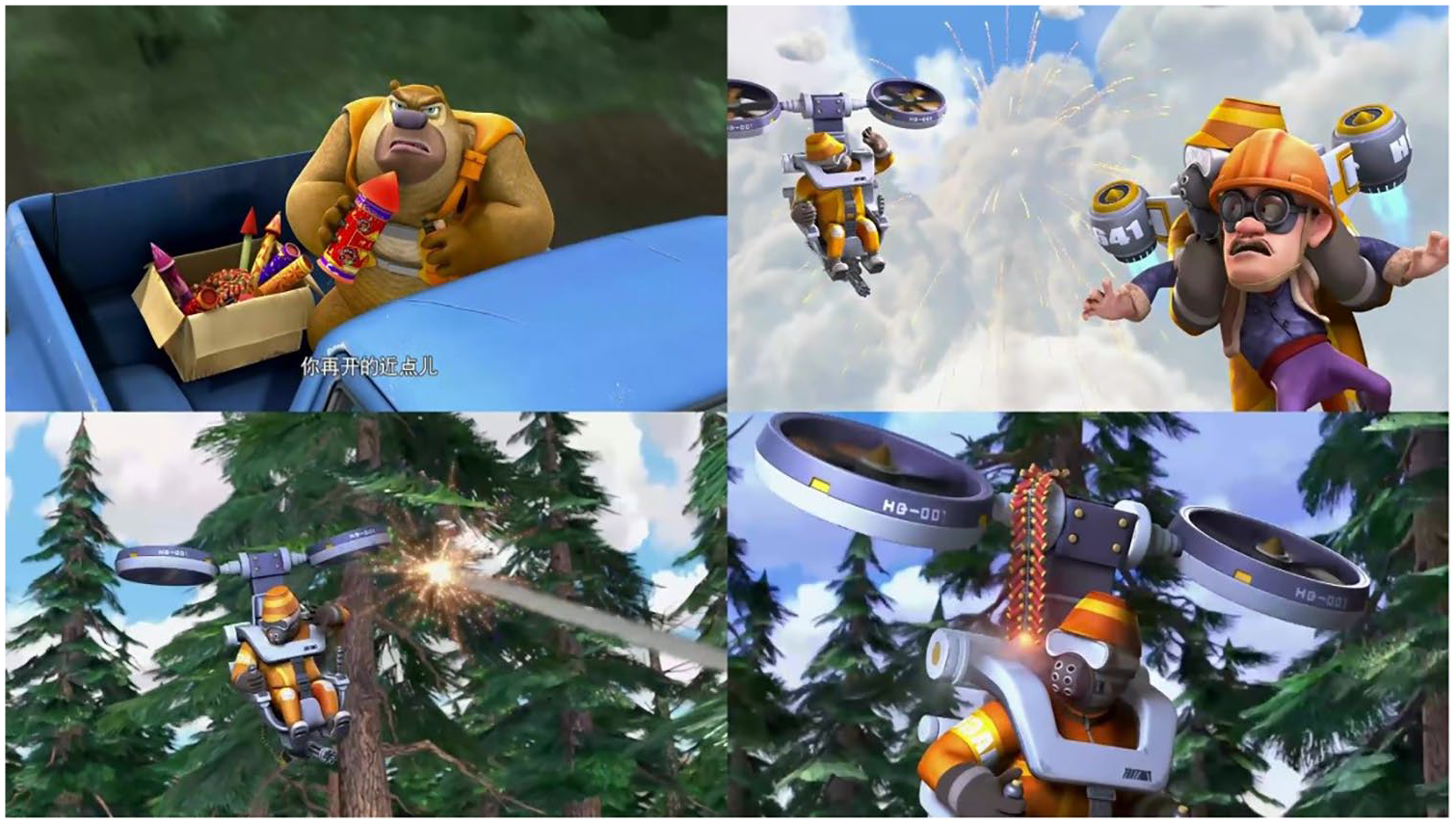
Fireworks and firecrackers as weapons.
As a result of the verbal and physical violence purification campaign, the Boonie Bears films have been well received by young parents. It is reported that the distributor of Rescue organized a series of free preview activities in 53 Chinese cities before the film’s public release. Young parents were exclusively invited to determine the suitability of the film’s content for their dependents based on their individual viewing experiences. Overall, 92% of 15,000 adult viewers showed a positive attitude toward the film and confirmed that they “did not find dissatisfactory contents” (Wang & Li, 2014). Similarly, Winter also adopted a free limited release strategy by inviting over one hundred teachers from kindergartens, primary schools, and secondary schools to examine the film from the perspective of professional educators. Consistent with the evaluation result for Rescue, 90% of teachers found Winter suitable for “all age groups” (Wang, 2015). As noted in the previous section, China currently lacks a rating system for animation products. Chinese parents and teachers are invited to animated film previews, which can be regarded as a method of self-censorship in addition to official regulation by the SARPPFT. These groups are concerned and willing to take part in judging cultural products such as animation that may affect children’s development. Moreover, they make relatively more objective and responsible evaluations when reviewing films because their participation generally does not involve commercial interests. Rescue and Winter received outstanding reviews from guardians and educators, thus further consolidating the basis of their box office success. These practical experiences have also been referenced by their domestic competitors, such as Roco Kingdom 3 (released on July 10, 2014), providing a plausible direction for animated film production and distribution in China.
Conclusion
This article focused on the Chinese 3D animated adventure franchise Boonie Bears, specifically analyzing the TV series and two films, Rescue (2014) and Winter (2015), all representative of Chinese animations production in terms of the manifestation, self-regulation, and sanitization of media violence. The physically violent scenes and inappropriate language in the Boonie Bears animated TV series have triggered great concern among young parents, critics, state-controlled media, and cultural authorities. The abovementioned physical violence and verbal attacks are consistent features of Boonie Bears and its main competitive rival, Pleasant Goat, the two most influential television animation brands in China. Young parents, state media, and the Chinese government have expressed considerable concern over the uncontrolled violence and uncivilized language in the above productions. They often simplistically connect viewing violence with the enactment of seemingly corresponding actions. However, several scholars maintain that parents should pay more attention to educating and guiding their children while watching Boonie Bears programs. The above universal social discontent over the representation of violence on the TV screen is mainly attributable to the role of animation in cultural production. Animation media has also long been asked to shoulder heavy social responsibility.
The SAPPRFT gives permits for the distribution and broadcasting of domestically made animated works. The agency expressed serious concern over the excessive appearance of violent scenes in the Pleasant Goat and Boonie Bear television series by issuing an urgent notice to guide animation production. In response, Huaqiang, the company that produces the Boonie Bears TV episodes and cinematic works, adopted a series of measures to regulate content creation for the purpose of avoiding similar controversies in the films. The direct verbal aggression between the bear brothers and Logger Vick was completely eliminated from the cinema screen. In addition, other forms of verbal abuse were replaced by more moderate and even intimate conversation. Such transformation of the dialogue reflects Huaqiang’s language purification effort and led to changes in the character relationships and plot development in the film products. The abrupt change in the characters’ manner of speaking contradicted established impressions of the characters, creating confusion in viewers regarding the characters’ role identity to some extent. The designers also transformed the action scenes in the Boonie Bears films by redesigning weapons and other props to avoid the direct depiction of physical violence that could easily be copied by child viewers. As a result, the content of the Boonie Bears films has received recognition and praise from adult viewers, as illustrated by young parents’ and professional educators’ attitudes toward the Boonie Bears films in free limited release campaigns.
Footnotes
Declaration of Conflicting Interests
The author(s) declared no potential conflicts of interest with respect to the research, authorship, and/or publication of this article.
Funding
The author(s) disclosed receipt of the following financial support for the research, authorship, and/or publication of this article: This study was supported by Social Sciences Foundation of Jiangsu Province (Grant/Award Number: 20YSC007) and The Fundamental Research Funds for the Central Universities (Grant/Award Number: 3213042008B2).

1.
The Boonie Bears entertainment franchise now includes products and derivatives such as a stage play, picture books for children, intelligent toys, clothes, figurines, a video game, stationery, and snacks.
2.
National News Broadcasting is the leading CCTV program and is without rival “in view of geographical coverage, audience size and visual imperatives”; it also ranks as China’s “dominant and most authoritative sources of news, information and ideas” (Cooper-Chen & Liang, 2010, 104).
3.
As mentioned in the Introduction of this article, the Chinese name of Logger Vick is Guangtou Qiang. “Guangtou” in Chinese means “baldhead” or “baldheaded,” while “Qiang” is the real given name of Vick. One of the most distinctive features of Vick in both the television and cinematic versions of Boonie Bears is his hairless head. Therefore, the bear brothers always make fun of Vick by calling him “you disgusting baldhead.”
4.
The Lunar New Year Festival (also known as Spring Festival) refers to the first day in the Chinese lunar calendar. It is the most important traditional Chinese festival and is widely celebrated in the Sinosphere. The date of the Spring Festival is fluid and can fall between January 21 and February 21 on the Gregorian calendar.