




Abstract
Consumer privacy information is used to target persuasive advertising in E-commerce, which raises consumer privacy concern. Consumer privacy concern is relative to consumer’s intrinsic privacy concern and social concern over the application of consumer privacy information, known as the anchoring effect of privacy. The anchoring effect of privacy influences targeted persuasive advertising competition. With a game-theoretical model, this paper studies how asymmetric duopolistic firms compete with targeted persuasive advertising considering the anchoring effect of privacy. The results indicate that when the advantageous firm increases its advertising level, the advantageous firm gets more profit, and the disadvantageous firm gets less profit only if the anchoring effect of privacy is greater than zero. Otherwise, the disadvantageous firm gets more profit, but the advantageous firm gets less profit. Then, in equilibrium, the increase in the expected anchoring effect of privacy, expected consumer’s intrinsic privacy concern, and advertising influence power reinforce the competition asymmetry. Whereas, the increase in social concern over the application of consumer privacy information weakens the competition asymmetry.
Plain language summary
Purpose: This paper aims to analyze the competitive targeted persuasive advertising strategy considering the anchoring effect of privacy, which is relative with consumer intrinsic privacy concern and social concern. Methods: A three-stage theoretical model is established to study the targeted persuasive advertising strategy. In the model, two competitive firms compete with targeted persuasive advertising and price, and the anchoring effect of privacy, advertising persuasive power and product prices influence consumers’ purchase decisions. Conclusions: We find that when the advantageous firm increases its advertising level, only if the anchoring effect of privacy is greater than zero, the advantageous firm gets more profit, and the disadvantageous firm gets less profit. Moreover, the increase in the expected anchoring effect of privacy, expected consumer’s intrinsic privacy concern, and advertising influence power reinforce the competition asymmetry. Whereas, the increase in social concern over the application of consumer privacy information weakens the competition asymmetry. Implications: We suggest that firms should be cautious about increasing their advertising levels in competition, because they may suffer the loss with a greater advertising level due to the existence of the anchoring effect of privacy. Then, when competing with targeted persuasive advertising and price, the firm with low quality-cost margin should try to eliminate the asymmetry between itself and its competitor. Limitations: Firstly, the model in this paper does not cover all the features of the competition markets. Secondly, we just assume that persuasive advertising enhances consumer’s perceived quality, where persuasive advertising may alter consumer preference. Thirdly, it is interesting to investigate and verify our research topic with empirical approach.
Introduction
Competitive targeted persuasive advertising is widely used in practice. For example, Miller Lite and Coors Light are the two major competitors in the U.S light beer market, they are heterogenous and preferred by different demographic groups, they target persuasive advertising to attract their competitor’s consumers (Iyer et al., 2005). Targeted persuasive advertising is targeted to special consumers based on consumer’s privacy information, it is considered to alter consumers’ utilities over the advertised product and capture consumers from the advertised firm’s competitor (Bagwell, 2007).
But some reports (Duggan et al., 2015; TRUSTe, 2014) emphasized that consumers concern about firms’ collection and application of their privacy information. Consumer privacy concern refers to consumers’ concern over how consumers control their privacy information and how their privacy information is used, it is consumer’s intrinsic attribute (Dinev et al., 2006). In reality, consumer privacy concern is also relative with the social privacy concern over privacy features of the advertised product category (or SCPF, for short). Following N. A. Zhang et al. (2022) and Masad (2011), SCPF is defined as “general feeling of being unable to maintain functional personal information.” For example, consumers are more likely to disclose their personal ID and less concerning about the using of their personal ID information when they surf on JD.com, because the public trust the security system of JD.com. But consumers concern more about the using of their personal ID when they surf an unknown website, because the public are taught that the unknown website is riskier. Hence, SCPF is more likely to be a surrounding attribute.
Consumers are sociable and knuckle under to the mainstream of the society (Gallagher, 2017), their privacy concern is not only related to consumer intrinsic privacy concern but also SCPF. As the above-mentioned example, consumers with the same intrinsic privacy concern are more willing to surf on JD.com than on an unknown website. Indeed, consumers make their decisions based on the gap between consumer intrinsic privacy concern and SCPF. In this paper, we define it as the anchoring effect of privacy. Since the anchoring effect of privacy is an important factor during consumer decision process, when firms use consumer’s privacy information to target persuasive advertising, it should be taken into consideration. Following the example of JD.com and an unknown website, consumers trust the targeted advertising on JD.com more than on the unknown website. Sometimes, consumers even do not trust the targeted advertising on the unknown website. Obviously, the anchoring effect of privacy influences persuasive advertising effectiveness, the firms’ managers should adjust their targeted persuasive advertising strategies considering this factor in a competitive situation. This paper examines how duopolistic firms compete with targeted persuasive advertising considering the anchoring effect of privacy. This research question is divided into the following questions: (1) How does the anchoring effect of privacy influence firms’ advertising and pricing competition? (2) Which firm can benefit from advertising considering the anchoring effect of privacy? (3) How do the firms set their advertising and pricing strategies?
However, few of the existing researches have studied these questions. Researchers have studied several related topics of our paper. One branch is the impact of consumer privacy concern on targeted advertising competition. Researchers (Jung, 2017; Kim et al., 2022; Toubiana et al., 2010) find that consumer privacy concern reduces targeted advertising effectiveness and the advertised firms will be worse off. Different from these researches, our paper attempts to analyze the competitive targeted persuasive advertising strategy considering the anchoring effect of privacy. Another branch is the how the anchoring effect of privacy impacts on consumers. Celebi (2015) finds that when the social feel more secure and less concern over the privacy feature, consumers might have less privacy concern. Similarly, Masad (2011) holds that the anchoring effect of privacy is another type of herb effect, which is affected by the consumer herself and the rest of her social network. N. A. Zhang et al. (2022) think consumer privacy concern is not only relative with consumers themselves but the peers in the network. Although these researches have demonstrated the existence of the anchoring effect of privacy, few of them analyze the impact of the anchoring effect of privacy on the competitive targeted advertising strategy.
To fill the research gap, we develop a three-stage game theoretical model where two heterogenous firms compete with targeted persuasive advertising and price. The three-stage game is established as follows: (1) Stage 1: firms’ advertising decisions. Both firms choose their advertising levels simultaneously and independently. (2) Stage 2: firms’ pricing decisions. Both firms set their retailing prices simultaneously and independently. (3) Stage 3: consumers’ purchase decisions. Consumers make their purchase decisions considering their preferences, privacy concerns, and SCPF. In our three-stage game theoretical model, persuasive advertising shifts the demand curve directly, because it enhances consumers’ willingness to pay (direct effect of advertising). On the other hand, consumers with different privacy concerns and SCPF are heterogeneous over the consumption (indirect effect of advertising).
The rest of this paper is organized as follows. Section “Related literature” reviews the literatures which are relevant with our work. Section “Model setup” describes the basic model and main components. Section “Equilibrium analysis” analyzes the equilibrium advertising and pricing strategies when firms compete with targeted persuasive advertising. Section “Conclusion” gives the main findings and provides the limitations of our research. All proofs are given in Appendix.
Related Literature
This paper seeks the answers to the above-mentioned questions with a game theoretical model. Our work is related with three main strands of literature: targeted persuasive advertising, consumer privacy concern, and the anchoring effect of privacy.
Firstly, targeted persuasive advertising is considered to persuade the chosen consumers to enhance/alter their purchase decisions, researchers explain how persuasive advertising impacts on firms’ competition and how firms set their targeted advertising strategy. On the one hand, the research on how persuasive advertising impacts on firms’ competition explains how persuasive advertising influences consumer’s purchase decisions and firms’ competition. Persuasive advertising tries to attract the rival’s loyal consumers with altering consumer’s perceived valuation of the advertised product, but it results in a higher price than without advertising (Von der Fehr & Stevik, 1998). Wu et.al (2009) find out that when two competitive firms can choose whether to adopt persuasive advertising or not, the one with advertising always benefits from its persuasive advertising. B. Jiang and Srinivasan (2016) examine firms’ persuasive advertising strategies with a Hotelling model, they find that the firm with low quality-cost margin increases its advertising level, meanwhile the high quality-cost margin firm decreases its advertising level when consumer preference increases. Meanwhile, Lin and Narasimhan (2020) derive that persuasive advertising helps the firm with higher-quality product to establish a competitive advantage. Choi et al. (2018) conclude that persuasive advertising leads to higher pricing competition and consumer surplus may decrease if the advertised products are less differentiated. J. Zhang et al. (2020) analyze the persuasive advertising strategies in a dual-channel supply chain, they conclude that persuasive advertising may hurt the manufacturer but benefit the retailer. In the above literature, when the persuasive advertising increases consumer’s willingness to pay, firms would like to adopt persuasive advertising because they may get more profits. Moreover, persuasive advertising helps the firm with higher-quality to maintain a competitive advantage. On the other hand, researchers study how competitive firms choose their advertising’s targeted consumers. Firms can get more profits by targeting advertising to consumers with higher preference (Iyer et al., 2005; Shaffer & Zettelmeyer, 2004; J. Zhang & He, 2019; Jiang & Wu, 2022). But when the firm target advertising to its weak segment, its rival will be hurt, because targeted advertising triggers price competition in the firm’s weak segment. März (2019) demonstrates that targeted persuasive advertising moderates the price and advertising competition under moderate levels of loss aversion and product differentiation. Arnold et al. (2022) show that in equilibrium the duopolistic firms only target advertising to their loyal consumers or their loyal consumers and switchers, but both get less profits. Based on these existing literature, we conclude that firms always target advertising to consumers who are more preferrable of them. Although the above-mentioned researched have examined how to targeted persuasive advertising, but they ignore the impact of consumer privacy concern in targeted persuasive advertising competition. In this paper, we further consider the impact of consumer privacy concern in the firms’ targeted persuasive advertising competition. We follow the assumption of these researches that persuasive advertising increases consumer’s willingness to pay, and assume firms will not target advertising to consumers who are less preferable of their products.
Our work also relates to the literature on consumer privacy concern. One branch is the relationship between consumer privacy information and privacy concern. Consumer privacy information includes consumer demographics characteristics (Cooper et al., 2022), preferences (Iyer et al., 2015; Sana, 2020), browsing history (Boerman et al., 2017), and so on. The application of consumer privacy information raises consumer privacy concern. Privacy concern is considered as a kind of interaction between individuals and external fields (Newell, 1995), different consumers have different valuations over their privacy information, and their privacy concern vary correspondingly (Beresford et al., 2012, Stuart et al., 2019). Privacy concern impacts on consumers’ online shopping behaviors (Van Slyke et al., 2006), privacy protection behaviors (Youn, 2009), and the valuations over the service based on their privacy information (Li et al., 2014). Moreover, Acquisti et al. (2020) find that consumers concern about their privacy even privacy protection exists. Another branch of studies discusses the relationship between consumer privacy concern and advertising effectiveness. Goldfarb and Tucker (2011) find that when the privacy regulation is enacted, the online advertising effectiveness is lower. Tucker (2014) concludes that consumers may click the advertising more if the firm enhances consumers’ perceived control over their privacy information. Walrave et al. (2018) examine how adolescents respond to the personalized advertising by considering their attitudes toward advertising and privacy concern. They find that high personalization can generate the most positive response, but privacy concern does not moderate the adolescents’ response over the advertising. Mpinganjira and Maduku (2019) find that consumer privacy concern has a significant negative effect on consumers’ attitudes over targeted advertising. Cooper et al. (2022) conclude that different consumers have different reactions to the application of their privacy information in targeted advertising. These papers indicate that the using of consumer privacy information will trigger consumer privacy concern and influence advertising effectiveness, but most of them treat consumer privacy concern as an absolute variable. In this paper, since targeted persuasive advertising is targeted based on consumer privacy information, we assume it raises consumer privacy concern, and we think that consumer privacy concern is a relative variable during consumer and firms’ decision process.
Lastly, a very little of literature discusses the anchoring effect of privacy. Lai and Hui (2006) analyze the anchoring effect of privacy when consumers choose to approve the using of their privacy or not. Lowry et al. (2011) explore the relationship between culture and privacy disclosure techniques through empirical research. They find that culture affects consumer privacy concern, meanwhile, consumer privacy concern and the Internet users’ privacy awareness further affect the application of privacy disclosure technology. Teovanović (2019) finds that the impact of anchoring effect of privacy on individual consumer is different. N. A. Zhang et al. (2022) conceptualize that consumer privacy concern can be divided into self-oriented and peer-oriented privacy concern. These papers show that consumer privacy concern is not absolute, but relative.
Existing researches on persuasive advertising mostly focus on which segment of consumers should be targeted, few of them consider the anchoring effect of privacy on consumers’ purchase decisions and firms’ targeted persuasive advertising strategies. The papers of consumer privacy concern mostly focus on how consumer privacy concern impacts the advertising effectiveness and advertising competition, few of them consider the impact of the anchoring effect of privacy on consumers’ decisions. In this paper, we model the anchoring effect of privacy on consumers’ perceived utilities and purchase decisions. Furthermore, the researches on the anchoring effect of privacy study the conceptualization and impact of the anchoring effect of privacy, but seldomly analyze how the anchoring effect of privacy influences the targeted advertising strategies. Our paper differs from these papers in that, we think the anchoring effect of privacy impacts on consumers’ perceived utilities of the competitive products and purchase decisions, and influences the competitive targeted persuasive advertising strategy.
Model Description
The research method of this paper involves game theory, which has been widely-used in the fields of society and economics. Game theory, like many other disciplines that use mathematical tools to study social and economic phenomena, abstracts basic elements from complex phenomena, analyzes the mathematical models composed of these elements, examines the effects of key elements and derive the equilibrium strategies. Game models include players, players’ strategies, and players’ payoffs under different strategies. In equilibrium strategies, all participants are faced with the situation that when others do not change the strategy, their strategies at this time are the best. In other words, if one participant changes his strategy, his payoff will be reduced so that each participant will not have incentive to deviate from equilibrium strategies alone (Myerson, 2013).
Based on the game theory, we consider a unit market with two competitive firms (firm
Notations Summary.No table of figures entries found.

Consumer’s Perceived Value
We firstly introduce the consumer’s perceived value of firm

The weighting factor
We model the competition between the firms with a Hotelling model. Specifically, we assume the population of consumers is uniformly distributed on a unit length with two rivals locate at the extremes of the line. Each consumer needs to pay a price of

Targeted persuasive advertising can be targeted to a certain segment of consumers, it may change consumer’s perceived quality of the product, which equals the consumer’s willingness to pay for the product. So, when a consumer receives firm

The consumer’s willingness to pay for the advertised product is affected by both advertising and her intrinsic utility, where the weighting factor
We model the key feature that consumers make their purchase decisions depending on the others’ decisions and the anchoring effect of privacy. With consumers’ privacy information, firms can target advertising more precisely; meanwhile, consumers may get their “ideal” product more easily. But consumers differ in privacy concerns over the application of their privacy information in the targeted persuasive advertising. Some of them enjoy the convenience from targeted advertising; some are resentful of the utilization of privacy, and some do not care about the using of their privacy. In line with our model concerning the horizontal mismatch, we assume the effect of privacy concern on the perceived value of the advertised product is linear. To analyze different privacy concern of the consumers, we define there is a continuum of consumer privacy concern type

The expected privacy concern of all consumers is
On the other hand, the extrinsic utility of the advertised product is relative with SCPF. Different kinds of products own different SCPF
In our model, we divide the effect of consumer privacy concern into two parts, one is affected by the expected demand of the product. Consumers refer to the expected demand when they are asked to offer their privacy information. The expected demand of firm
We assume that a consumer’s extrinsic utility depends on her privacy concern. When consumers expose their privacy information, they concern the general privacy concern and the others’ consumption, which is known as Herd Effect. Herd Effect is common especially in some special goods categories, such as sex toys industry, it makes consumers who buy the sex toy less exclusive and increases her perceived extrinsic utility. Following Karni and Schmeidler (1990), we define extrinsic utility of firm

Where
Firm’s Expected Profit Function
Then, we model the firm’s expected profit function. Assume firm
We derive a reduced-form approach to describe the role of consumer privacy concern over targeted persuasive advertising. Each firm’s demand is affected by the advertising level

From the above equation, with standard comparative statics, we can see that the externality of consumer privacy concern affects the equilibrium advertising level. That is to say,
In this paper, we consider the following three-stage game: Stage 1: Firm
Equilibrium Analysis
In this section, we firstly characterize the demand functions of the firms; then we analyze the interaction of targeted persuasive advertising and consumer privacy concern; thirdly, we characterize the sub-game prefect Nash equilibrium within competition.
Basic Model
We define a value
Following the standard Hotelling model, the indifference curve of consumer’s utility from purchasing two firms’ products is given as

To guarantee the above assumption exists, we assume the horizontal mismatch caused by the externality of privacy concern satisfies
Derived from the above indifference curve, the set of consumers with different privacy concern

The gross expected demand of firm 0 is

And firm 1’s demand equals to
Hence, firm

Firm
Meanwhile, the anchoring effect of privacy, the expected privacy concern and SCPF affect the sensitivity to the mismatch between consumers and their preferable products, and then affect the demand.
Theorem 1 indicates the anchoring effect of privacy, the expected privacy concern and SCPF can influence the firm’s demand. The firm with higher quality-cost margin benefits from a greater anchoring effect of privacy and expected privacy concern, but suffers the loss from the increasing SCPF. A greater anchoring effect of privacy enhances consumer’s perceived value of the product and expands the differentiation between the firms which results in a greater asymmetric demand. Similarly, a greater expected privacy concern also makes consumers hard to change their purchase decisions. Since the anchoring effect of privacy and expected privacy concern always benefit the firm with higher quality-cost margin, in practice, firms should try to get a higher quality-cost margin in competition to achieve competitive advantages. A lower SCPF makes consumers concern more about their own privacy during their purchase. For example, Netherlands is an open society to sex, the social privacy concern connected to sex toys is low. So, when they purchase sex toys in Netherlands, they may not concern about the privacy about sex toys. But in India, the situation is opposite, Indian society treat sex as one of top privacy, the social privacy concern connected to sex toys is very high. Due to the different SCPF, the sex toy sales volume in Netherland is much larger than that in India, even India has a much larger population than Netherland. Hence, in practice, the firm with higher quality-cost margin needs to reduce SCPF to maintain its competitive advantage. Oppositely, to eliminate the disadvantage of lower quality-cost margin, the firm with lower quality-cost margin should make the public pay more attention to SCPF.
The Interaction of Advertising and Anchoring Effect of Privacy
Following the role of persuasive advertising, a higher advertising level can enhance consumer’s willingness to pay. When one firm choose a different advertising level (assume firm 0 chooses a higher advertising level), it will lead to a shift of the indifference curve of the consumer utility function. Because consumers get a higher perceived quality
Since quality has a demand-enhance effect, the reference sales

Changes of the indifference curve when firm 0 increases its advertising level.
The demand-enhancing effect of increasing advertising level is reinforced for the consumer whose privacy concern is higher than SCPF, and weakened for the consumer whose privacy concern is lower than SCPF. With a given SCPF, consumer can benefit from providing privacy information when her privacy concern is higher than SCPF. It results in a demand-enhancing effect. On the contrary, when consumer privacy concern is lower than SCPF, even her privacy concern is positive, she suffers the loss from exposing her privacy information. Therefore, those consumers whose privacy concerns are higher than SCPF are more attractive to the heavily advertised brand.
We compare the demands before (
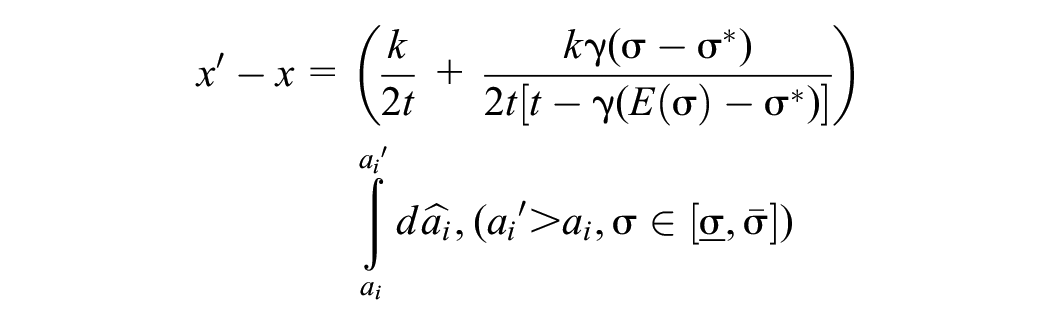
Targeted persuasive advertising impacts the consumers with the same privacy concern directly and indirectly.
Lemma 1 shows that the anchoring effect of privacy, expected privacy concern, and SCPF impact on the increment of demand caused by the indirect effect of targeted persuasive advertising. When the anchoring effect of privacy increases, consumers could get more perceived value with a greater advertising level of firm
In Lemma 1, when firm
The aggregate demand equals to the sum-up of individual demand across consumers who are affected by the targeted persuasive advertising.
Theorem 2 shows that an increase in the expected privacy concern
Corollary 1. When firm
Corollary 1 indicates that the increasing advertising level of firm
Nash Equilibrium Solutions and Analysis
There exists the sub-game prefect Nash equilibrium of the game in our paper. With a given

With first order condition to maximize the profit function

Hence, when two firms choose their advertising levels simultaneously, firm
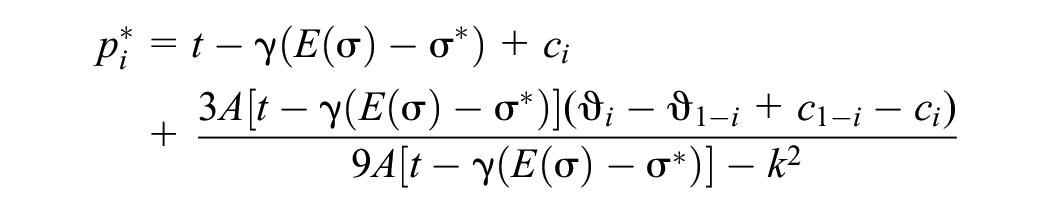
and

Firms’ equilibrium advertising level is affected by the advertising persuasive power. If the advertising persuasive power tends to zero, firms are not willing to invest in advertising because advertising has no demand-enhancing effect. However, the equilibrium price is influenced by the expected anchoring effect of privacy
Corollary 2. When two firms compete with targeted persuasive advertising, the aggregate equilibrium advertising level is fixed and equals to
Corollary 2 shows the aggregate equilibrium advertising level depends only on the unit advertising cost
Following Anderson and De Palma (2006), the “quality-cost margin” is given as
Corollary 3. The relationship between firm
Bagwell (2007) indicates that the persuasive role of advertising makes the heavily advertised product more expensive than the less advertised product, because persuasive advertising improves consumer’s willingness to pay. Corollary 3 suggests that when the anchoring effect of privacy is less than
Furthermore, we discuss how the marginal changes of the expected anchoring effect of privacy, the expected privacy concern, SCPF, and advertising persuasive power influence the competition. Based on Theorem 3, we derive that
Corollary 4. When the expected anchoring effect of privacy
Corollary 4 indicates that when the expected anchoring effect of privacy increases, the market structure is more asymmetric, which results in a greater market concentration. Similarly, when the expected anchoring effect of privacy is greater, firm 0 invests more in advertising which could capture more consumers from firm 1, and it is more profitable with a higher price. To reduce the disadvantage, firm 1 needs to reduce its price. Hence, the increasing expected anchoring effect of privacy reinforces the price asymmetry.
Corollary 5. When the expected privacy concern increases, the demands, advertising levels, and prices in equilibrium are more asymmetric. When SCPF increases, the demands, advertising levels, and prices in equilibrium are less asymmetric.
Corollary 5 shows that a marginal increment of the expected privacy concern makes the market structure more asymmetric, it also increases the market concentration. Both firms try to capture more consumers to enhance their market power. Firm 0’s advantage of quality-cost margin is enhanced, and the consumer’s extrinsic utility increases with the increasing expected privacy concern. Differently, an increasing SCPF moderates the asymmetries between the firms. A higher SCPF indicates that consumers suffer less pressure from purchasing the product, it reduces the advertised firm’s market power, and moderates the price and advertising competition, the market structure is less asymmetric.
Corollary 6. In equilibrium, the increase of advertising persuasive power reinforces asymmetries of advertising levels, but it reinforces the asymmetry of prices when
Advertising is an effective tool in competition when it plays the persuasive role. Corollary 6 shows that an increasing advertising persuasive power reinforces firm 0’s market power. Firm 0 always advertises more to gain more profit, but firm 1 may increase or decrease its advertising level. Since firm 1’s quality-cost margin is low, if it invests more in advertising, its marginal profit will decrease and suffer more loss, so it decreases its advertising level. Hence, when the advertising persuasive power increases, the equilibrium advertising levels are more asymmetric. But the impact of an increasing advertising persuasive power on the equilibrium prices varies. When
Corollary 4 to 6 explains the factors that influence firms’ competition. The firm with greater quality-cost margin could always benefit from the increase of the expected anchoring effect of privacy, expected privacy concern, and advertising persuasive power, but may be worse off with a greater SCPF. Hence, when SCPF is low, firms should increase their quality-cost margin to establish competitive advantage; when SCPF is high, they should try to be homogeneous with their competitors.
Conclusion
Consumer privacy information is used to target persuasive advertising, it triggers consumer privacy concern and influences consumers’ purchase decisions. With a three-stage theoretical model, this paper mainly discussed how the duopolistic firms compete with targeted persuasive advertising considering the anchoring effect of privacy.
Main Findings
The main finding of this paper is that when one of the duopolistic firms increases its advertising level, targeted persuasive advertising hurts the firm but benefits its rival if the anchoring effect of privacy is negative. The finding is different with Wu et al. (2009) and contradict with common sense, where the advertising investment benefits the higher advertised firm due to the demand-enhancing effect of persuasive advertising. The reason is that, when the anchoring effect of privacy is negative, consumer’s perceived utility of the higher advertised firm will reduce, but his perceived utility of the lower advertised firm will not change, more consumers will buy from the rival, the demand of the higher advertised firm reduces, meanwhile the advertising cost increases, hence, the higher advertised firm gets less profit but its rival gets more profit.
Then, based on the equilibrium prices and advertising levels in the model, we find that the firm with higher quality-cost margin advertises more and charges a higher price. The increases in the expected consumer privacy concern and advertising persuasive power will reinforce the asymmetry of the equilibrium prices, advertising levels, and demands. Furthermore, an increase in SCPF will weaken the asymmetry of the equilibrium prices, advertising levels, and demands. Finally, an increase in the anchoring effect of privacy reinforces the asymmetry of the equilibrium advertising levels and demands, but under certain conditions, it could soften the asymmetry of the equilibrium prices.
Managerial Implications
Our findings can help firms to effectively set their competitive targeted persuasive advertising and pricing strategies considering the anchoring effect of privacy. We suggest that firms should be cautious about increasing their advertising levels in competition, because they may suffer the loss with a greater advertising level due to the existence of the anchoring effect of privacy. Firms should pay more attention to consumers whose privacy concern is lower than SCPF, because these consumers’ perceived utilities of the advertised firm decrease rapidly and are more likely to change their purchase decisions, it results in a lower profit of the advertised firm. Accordingly, firms should focus on the consumers whose privacy concern is higher than SCPF.
Then, when competing with targeted persuasive advertising and price, the firm with low quality-cost margin should try to eliminate the asymmetry between itself and its competitor. On the contrary, the firm with high quality-cost margin should reinforce the asymmetry in the competition. Specially, firms should pay more attention to the anchoring effect of privacy because it directly influences the firms’ advertising and pricing strategies, and the disadvantageous firm should try to weaken the anchoring effect of privacy as well as the quality-cost margin.
Finally, our findings are helpful for the market regulators, they should try to increase SCPF, since a greater SCPF may moderate the advertising and price competition, and reduces the asymmetry of the competitive firms which ensures the competitiveness of the market and benefits consumers.
Limitations and Future Research
Our research contributes to the connection between targeted persuasive advertising and consumer privacy information, especially the researches on the anchoring effect of privacy. But there are several limitations. Firstly, the model in this paper does not cover all the features of the competition markets. We simply treat that the relationship between consumer privacy concern and SCPF is independent. It will be interesting to analyze the firms’ advertising and pricing strategies when the relationship is dependent. Meanwhile, we assume that persuasive advertising enhances consumer’s perceived quality, where persuasive advertising may also alter consumer preference. It will be meaningful to analyze firms’ advertising and pricing strategies when persuasive advertising alters consumer preference. Moreover, in our game theoretical model, we simply adopt linear function to describe consumer’s perceived utility, it is meaningful to adopt other forms of functions to describe consumer’s perceived utility and study how firms compete with targeted advertising strategy considering the anchoring effect of privacy. Finally, it is interesting to investigate and verify our research topic with empirical approach. We hope to address these researches in the future.
Footnotes
Appendix
Declaration of Conflicting Interests
The author(s) declared no potential conflicts of interest with respect to the research, authorship, and/or publication of this article.
Funding
The author(s) disclosed receipt of the following financial support for the research, authorship, and/or publication of this article: This work is supported by National Natural Science Foundation of China (Grant No. 72371069, 71871054).

Data Availability Statement
Data sharing not applicable to this article as no datasets were generated or analyzed during the current study.