




Abstract
Social media, whose core element is interactivity, has become an important tool for people to establish and maintain relationships. According to social exchange theory (SET), weighing costs and benefits in the context of online interpersonal interactions can also guide people to decide whether to make a connection with others. While there have been studies of social interaction, few have looked at specific behaviors, including sharing and responding, within the same framework. Therefore, this study aimed to investigate the benefit-cost balance of social interaction behaviors on social media that involve self-disclosures and proactive interactions such as commenting, forwarding, and liking. Via an online survey of Chinese adults (n = 2,767) and structural equation modeling (SEM) techniques, we found that social media users were at once motivated by bridging social capital and restrained by privacy concerns when making decisions regarding self-disclosure. However, users were not swayed by privacy concerns when engaging in proactive interactions; instead, they were encouraged by both bonding and bridging social capital. Moreover, the benefit-cost model was extended by investigating the moderating effect of attachment anxiety and found that the more anxious individuals were about attachment, the weaker the effects of bridging social capital and the stronger the effects of privacy concerns on their social interaction behaviors, which complemented the existing literature at the level of individual differences.
Keywords
Introduction
Social media has transformed the landscape of interpersonal relationships, serving as a pivotal tool for both fostering and sustaining connections within interactions (Aichner et al., 2021; Jun & Yi, 2020; Shim et al., 2015). Accordingly, social interaction has become one of the motivations for users to use media and a more and more important consumer’s behavior to be considered in the marketing mix (Alsharif, Salleh, Abdullah, et al., 2023). Existing studies have carried out conceptual interpretation and holistic research on online social interaction (e.g., Ampong et al., 2018; D’Arienzo et al., 2019; Fischer & Reuber, 2011), but few studies have explored specific classification at the behavioral level, and compared and analyzed the similarities and differences of interactive behaviors on social media under the same theoretical framework.
The conversational conditions of social Interaction require at least two parties to exchange information (Hall, 2018). On the one hand, social media has provided a platform where users could reveal a great deal of information about themselves to others (Ampong et al., 2018; Kim, 2023; Meeus et al., 2023), which is traditionally and typically defined as self-disclosure (Jourard, 1971). Usually, sharing information has been regarded as a kind of communication and interactive behaviors on social media (Wang et al., 2022). And for individuals, disclosure decisions and strategies reflect a balance of conflicting needs aimed at maximizing strategic rewards and minimizing personal risks (Petronio, 2002). On the other hand, when individuals share personal information on social media, they often elicit responses from their connections, such as comments, likes, or shares (Dolan et al., 2019). From the perspective of customer behavior, commenting, forwarding, and liking has been collectively known as social media engagement which occurs as a user builds relationships with other users (Hallock et al., 2019). And some researchers have proposed an assessment of social media engagement, based on the number of comments, likes, shares, followers etc (Khan et al., 2019; Medjani et al., 2019). Clearly, social interaction on social media is accompanied by the flow of information, involving a disclosure of and response to publicly visible information and the process of reciprocal influence (Little, 2023). Therefore, this study specifically focused on investigating and comparing two types of interactive behaviors, namely self-disclosure (i.e., sharing content about oneself with others) and proactive interaction (i.e., actively responding to the content posted by others), within the same framework, rather than treating social interaction on social media as a singular, holistic behavior.
Previous research has indicated that the use of social media has both positive and negative impacts (e.g., Gillespie-Smith et al., 2021; González-Nuevo et al., 2022; Ho et al., 2023). Accordingly, we suggested that social interaction behaviors on social media should be influenced not only by positive benefits but also by a consideration of negative outcomes. Some studies have demonstrated that interactive behaviors on social media can contribute to the accumulation of social capital (Chen, 2018; González-Bailón & Lelkes, 2023; Li & Chen, 2022; Zhang et al., 2019), while others, approaching from a risk perspective, have highlighted the restrictive impact of privacy concerns on social media usage (Arruda Filho et al., 2023; Krämer & Schäwel, 2020). However, few studies have simultaneously explored and compared the roles of social capital and privacy concerns from the perspectives of balance and exchange. This is precisely what this study aimed to address. In other words, the central focus of this study lied in unraveling the psychological mechanisms underlying the balance of benefits and costs in two types of social interaction behaviors.
Furthermore, the diversity that people exhibit in interpersonal relationships and social interactions should be driven by personal characteristics because of the uniqueness of individuals. Attachment anxiety has found to be strongly related to social anxiety in both online and offline social interactions (Kaurin et al., 2022; Yen et al., 2012), and could guide users on how to utilize social media, including extent, motivation, patterns, and more (Alfasi, 2022; Baek et al., 2014; Stöven & Herzberg, 2023). Based on this, this study further explored whether different levels of attachment anxiety could change the individual psychological trade-of process during social interactions.
Literature Review and Hypotheses
Social Exchange Theory (SET) and Behavioral Outcomes
Social Exchange Theory (SET) describes the psychological process of negotiating and comparing perceived benefits and costs involved in behavior, specifically focusing on how expected benefits drive people’s behaviors (Cook et al., 2013; Zhang et al., 2019). Social exchanges occur in social interactions, where individuals gain benefits from contacting and communicating with others while risking potential harm by exchanging information with others. In a relationship, benefits are elements with positive value, while costs are elements with negative value (Zhang et al., 2019). The greater the benefits or the fewer costs an individual perceives, the more likely he or she is to engage in a relationship (Stafford & Kuiper, 2021). Moreover, when individuals face benefits and costs at the same time, their comparison of these is crucial for behavioral outcomes (Xia et al., 2021). In general, when the benefits outweigh the costs, individuals are more inclined to act, and when costs weigh more, they tend to avoid.
SET has been verified to be applicable to the digital context, such as using social networking sites during lockdown (González-Nuevo et al., 2022; Xia et al., 2021), self-disclosure on social media (Lin et al., 2021; Liu et al., 2016), engaging in replies, retweets, and mentions (Lee et al., 2020), data disclosure when shopping online (Urbonavicius et al., 2021), SNS gifting (Kim et al., 2018), etc. Based on this, this study adopted Social Exchange Theory as a framework to investigate two kinds of social interaction behaviors of users on social media from the perspective of benefits and costs.
Benefit Perspective: Social Capital
Positive stimuli would urge individuals toward achieving goals (Alsharif et al., 2022). Social capital has been regarded as a kind of social benefits that is embedded within any network of relationships. According to the classic definition, social capital is the aggregate of the actual benefits of potential resources (Bourdieu, 1986) and is derived from social interactions. Social capital can be subdivided into bonding social capital and bridging social capital (Putnam, 2000). The former is related to close ties, where emotional support can be exchanged (Ellison et al., 2007; Pfeil et al., 2009). The latter results from weaker ties between people who meet through business or social engagements (Aharony, 2016). Specifically, bonding social capital emphasizes the emotional benefits from strong ties with close friends and family, and bridging social capital emphasizes the informational benefits of a heterogeneous network (Steinfield et al., 2008).
The interactive features of social media have allowed users to engage in impersonal communications, build social relationships, and maintain and expand their social networks (Chen & Beaudoin, 2016; Ellison et al., 2007; Ha et al., 2015). Social capital was a positive outcome that not only stems from relationship building (Ellison et al., 2011) but also typically stimulates social interaction. Social capital mechanism has effectively empowered individuals to mobilize their networks to improve life opportunities. The structure and composition of social media, by opening access to information, has activated this mechanism, guiding decision-making and behavior (González-Bailón & Lelkes, 2023). Some studies have indicated that there is a general relationship between social capital and self-disclosure (Aharony, 2016; Chen, 2018; Zhang et al., 2019). Moreover, Tzortzaki et al. (2016) found that while novel bridging social capital on Facebook could increase users’ self-disclosures, additional bonding social capital could not. In contrast to self-disclosure, the relationship between individual social capital benefits and proactive interaction activities has not been fully explored. Chen and Beaudoin (2016), for example, performed a content analysis of 558 photos on Flickr and found that social capital indicators are positively associated with photo comments and photo favorites. Accordingly, in light of these findings, the following hypotheses were proposed:
Hypothesis 1 (H1): Bonding social capital would be positively related to self-disclosure (H1a) and proactive interaction (H1b).
Hypothesis 2 (H2): Bridging social capital would be positively related to self-disclosure (H2a) and proactive interaction (H2b).
Cost Perspective: Privacy Concerns
In the motivational dimension, negative stimuli could lead to distraction (Anderson et al., 2013). From the perspective of social costs, privacy leakage or infringement is both a potential crisis and risk of using and interacting on social media. Generally, individuals using social media should possess the authority and capability to govern and oversee their privacy (Al-Turjman, 2022). As such, the Communication Privacy Management Theory directs attention to the dynamic and continual process through which individuals regulate their personal information (Petronio, 2002).
Privacy concerns are therefore involved in social interaction on social media. Self-disclosure has been shown to be a critical outcome after people consider their privacy; that is, people selectively disclose and manage relative content (Child et al., 2009). Privacy concerns entailed an individual’s subjective beliefs regarding privacy in online environments (Dinev & Hart, 2006), such as his or her fear of cyberbullying, surveillance, stalking, or identity theft, which have been cited as key concerns (Ampong et al., 2018; Debatin et al., 2009; Strater & Lipford, 2008). What’s more, with the intelligent development of technology, the information that people do not share and do not want others to know may be read and analyzed by platforms (Jozani et al., 2020; Shin et al., 2022) or other high-tech tools (Alsharif, Salleh, Hashem et al., 2023; Mileti et al., 2016), resulting in the invasion of secrets or privacy and influencing or even manipulating users’ decisions (Berlińska & Kaszycka, 2016), which could be easy to cause concerns.
Individuals with a high privacy concern may establish a stronger privacy boundary and reduce their flow of information to minimize privacy-related risks (Son & Kim, 2008). More specifically, users may restrict online communications to select friends (Ellison et al., 2010; Ellison et al., 2011) or reduce disclosures (Dwyer et al., 2007; Gruzd & Hernández-García, 2018; Krasnova et al., 2010). However, there is a “privacy paradox”, that is, the paradoxical contradiction between clearly voiced privacy concerns and seemingly careless self-disclosures (Barnes, 2006; Krämer & Schäwel, 2020). For instance, Krasnova et al. (2012) found that privacy concerns did not significantly impact self-disclosure behaviors in their model. Other research has indicated that privacy concerns do not necessarily affect social media usage intentions (Baruh et al., 2017; Boyd & Hargittai, 2010; Tan et al., 2012). Although some studies from the past decade have investigated the effect of privacy concerns on online self-disclosure, other social interaction behaviors (such as commenting, forwarding, and liking) have not been investigated. In addition, with the ongoing development of intelligent technology, such as algorithms, and the deepening of people’s understanding of privacy issues, whether privacy concerns affect the social interaction behaviors of social media users (including self-disclosure and proactive interaction) under the benefit-cost balance framework merits further evaluation. Although studies have reached conflicting conclusions about privacy, this study tended to regard it as a manifestation of cost and therefore put forward the following hypotheses:
Hypothesis 3 (H3): Privacy concerns would be negatively related to self-disclosure (H3a) and proactive interaction (H3b).
Personality Differences: Attachment Anxiety
Clearly, individual differences exist in all decisions and behaviors that are based on diverse personal characteristics. As social media typically comprises an interactive platform, filled with relationships and networks, how social media users participate in social interactions is guided by their relationship attachment style (Baek et al., 2014). According to attachment theory, individuals’ attachment expectations and communication behaviors are influenced by their attachment style, shaped through their existing interpersonal interactions (Baek et al., 2014; Sun & Zhang, 2021). Attachment anxiety, along with attachment avoidance, represents one of the prevalent dimensions employed to characterize an individual’s attachment style (Fraley et al., 2000).
Attachment anxiety is a hyperactivated attachment system that is characterized by an extreme fear of rejection by others and by an excessive need for closeness and approval (Sun & Zhang, 2021), which can be reflected in interpersonal communication and may distinguish the decision-making process of interactive behavior. Previous research has demonstrated the role that attachment anxiety plays in blogging (Trub et al., 2014), in using social media to avoid personal face-to-face communication (Nitzburg & Farber, 2013), in maintaining relationships and seeking feedback on social media (Hart et al., 2015; Oldmeadow et al., 2013), and in some problematic Internet use behaviors (Demircioglu & Goncu Kose, 2020; Flynn et al., 2018; Worsley, Mansfield, Corcoran, 2018; Worsley, McIntyre, Bentall, et al., 2018). Moreover, Baek et al. (2014) found that social network sites (SNS) users’ attachment style moderates the influence of SNS motives and uses on their psychological outcomes, such as loneliness, life satisfaction, or SNS addiction. Accordingly, people with different levels of attachment anxiety may exhibit different levels of psychological influence during social interactions. Thus, based on our principal theoretical framework of SET, in this study, we attempted to examine whether attachment anxiety would affect the effects of the benefit (i.e., social capital) and cost (i.e., privacy concerns) on social interaction behaviors. That is, we explored the moderating role of personality differences in the benefit-cost balance. Therefore, the following hypotheses were addressed and the theoretical model of this study was shown in Figure 1:
Hypothesis 4 (H4): Attachment anxiety would moderate the influence of bonding social capital on self-disclosure (H4a) and proactive interaction (H4b).
Hypothesis 5 (H5): Attachment anxiety would moderate the influence of bridging social capital on self-disclosure (H5a) and proactive interaction (H5b).
Hypothesis 6 (H6): Attachment anxiety would moderate the influence of privacy concerns on self-disclosure (H6a) and proactive interaction (H6b).

Theoretical model of this study.
Methods
Data Collection and Sample
An online survey was conducted, and participants were recruited through IPSOS (China) in March 2021. During the survey, the respondents were informed that the data was for academic use only and that they could opt out at any time. The respondents were rewarded after they successfully submitted the questionnaire. A total of 3,000 copies of the questionnaire were collected, with sampling made in accordance with Chinese netizens’ structure reported by China Internet Network Information Center (CNNIC). A commonsense question (“Is the earth square or round?”) was asked to screen out invalid questionnaires, and 10 were eliminated. Generally, a person at the age of 18 years in China is considered an adult with an independent capacity for socialization. Since we aimed to investigate the effect of social capital benefits on social media usage, the underage samples, whose social ties were still largely confined to their family of origin, were excluded. Therefore, another 223 questionnaires were eliminated, and a total of 2,767 completed responses were included in the data analysis. The age and sex distribution of the stratified samples was as close as possible to the proportion of the population distribution in China, and more demographic information was listed in Table 1. All study procedures were ethically approved by the authors’ university.
Demographics of the Sample.

Variable Measurement
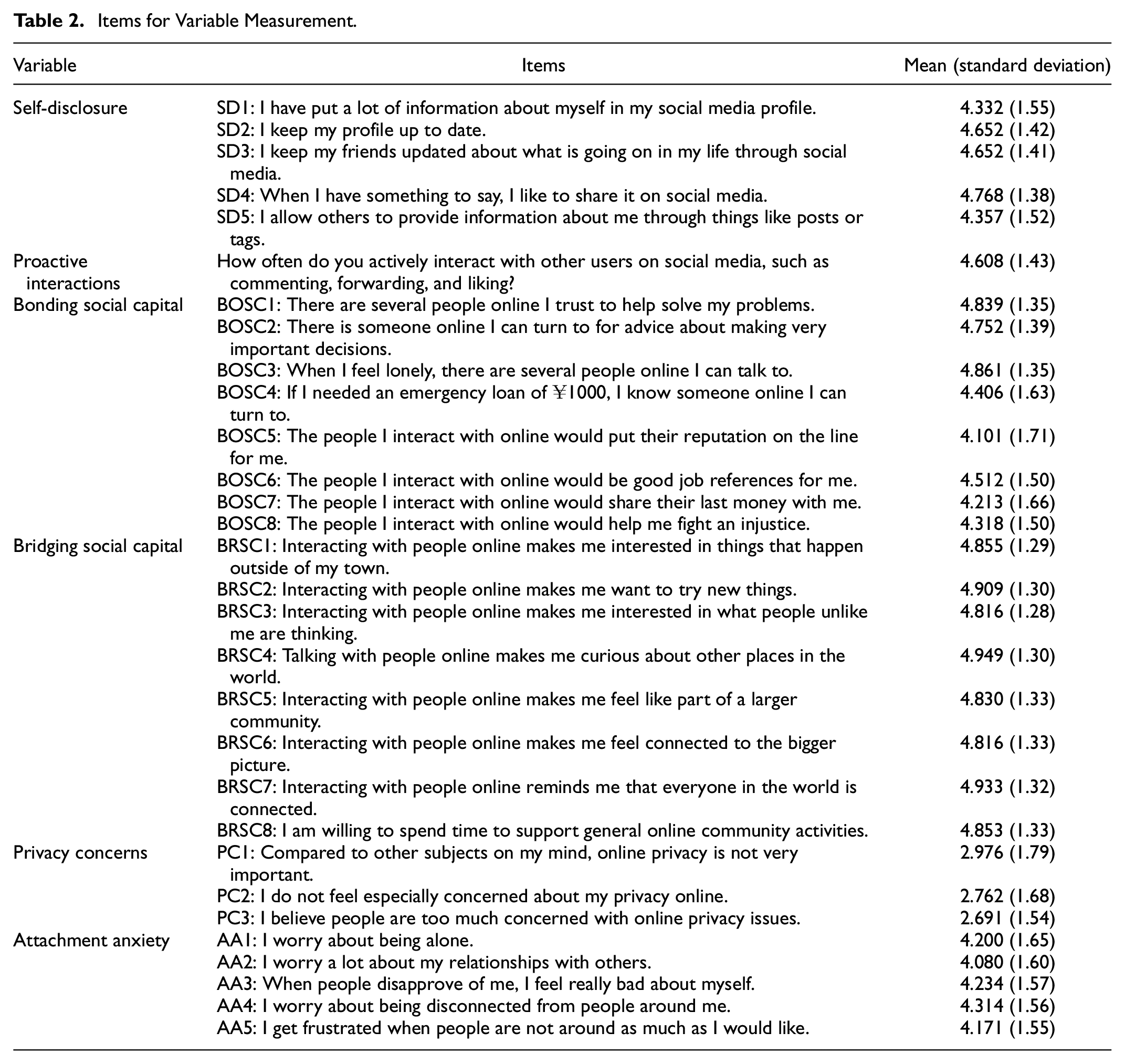
Self-disclosure (Cronbach’s α = .852) was measured through a 7-point Likert-type scale (1 = “strongly disagree” to 7 = “strongly agree”) developed by Dienlin and Metzger (2016). Proactive interactions, that is, commenting, forwarding, and liking behaviors, were measured by asking about their respective frequencies, and answers ranged from 1 (=never) to 7 (=always).
Bonding social capital (Cronbach’s α = .879) and bridging social capital (Cronbach’s α = .906) were assessed using the Internet social capital scales developed and validated by Williams (2006). Privacy concerns (Cronbach’s α = .791) were measured through a scale adapted from Dienlin and Metzger (2016). Attachment anxiety (Cronbach’s α = .902) was measured by 5 items with the attachment style scale of Baek et al. (2014). Responses were reported on 7-point Likert-type scales (1 = “strongly disagree” to 7 = “strongly agree”) for these variables (see Table 2).
Items for Variable Measurement.
Factor Analysis and Common Method Bias Test
Exploratory factor analysis (EFA) and confirmatory factor analysis (CFA) with maximum likelihood estimation were used to examine the reliability and validity of the measurement scales in the overall model. EFA Results showed that assumptions of sphericity (Barlett’s test of Sphericity: p < .001) was satisfied, and the KMO statistic was 0.954, well above the minimum standard for conducting factor analysis (Kaiser, 1974). For CFA, Model chi-square with its degrees of freedom, Root Mean Square Error of Approximation (RMSEA), Comparative Fit Index (CFI), and Standardized Root Mean Square Residual (SRMR) were suggested to be reported (Kline & St, 2022), and it showed that the model proposed in this study fit the data at an acceptable level (see Table 3). Factor loadings from the model ranged from 0.669 to 0.837 and were statistically significant. The general requirements of Average variance extracted (AVE) and construct reliability (CR) were greater than or equal to 0.5 and 0.7, respectively (Cheung et al., 2024), and the lowest values in this study were 0.515 and 0.795, respectively, demonstrating construct reliability in all the scales. The factor-to-item relationships were considered satisfactory based on the overall results and model fit, so the structural model could be tested with a validated measurement model. More details were listed in Table 4.
Results of the Model Fit.

Reference for cut-off values: Kline and St (2022).
Confirmatory Factor Analysis Results.

Furthermore, the common method bias was tested by controlling for the effects of a single unmeasured latent method factor (Podsakoff et al., 2003). The increase in CFI and TLI by more than 0.1, as well as the decrease in RMSEA and SRMR by more than 0.05, suggests the presence of significant common method bias (Wen et al., 2018). The analysis yielded a non-significant change, as all the value changes were within the range (see Table 5). Thus, the presence of common method bias was not substantively influencing the relationships among the variables in the model, which provided confidence in the reliability and validity of the study’s findings.
Results of the Common Method Bias Test.
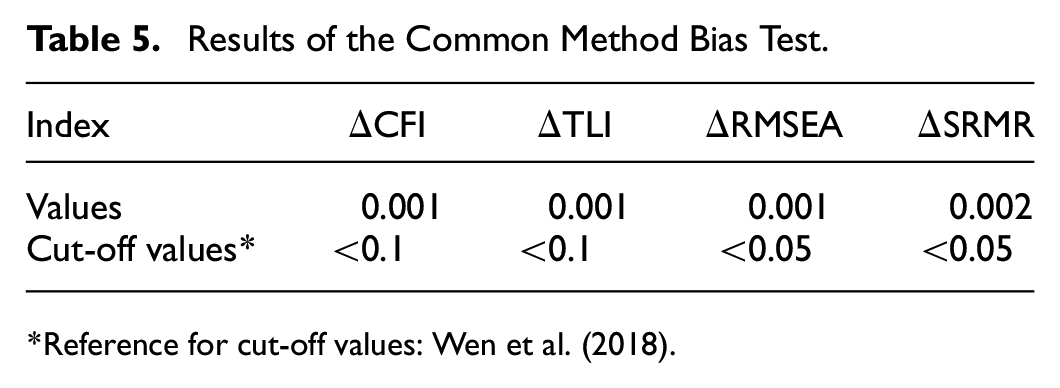
Reference for cut-off values: Wen et al. (2018).
Data Analysis
Mplus (version 8) was used for data analysis. Structural equation modeling (SEM) techniques with maximum likelihood estimation were adopted to analyze different effects in this study. Since both the independent and moderating variables in this study were latent variables, the latent moderated structural equation (LMS) approach, one of the most popular methods to estimate latent variable interactions (Aytürk et al., 2020), was used for the moderating effect test in the SEM model. As a kind of estimation procedure, the LMS takes the distributional characteristics of non-normally distributed variables explicitly into account (Schermelleh-Engel et al., 2017). Sex, age, highest education level and number of social media platforms used were the control variables.
Results
Significant correlations were found between all the variables (see Table 6). SEM results (see Table 7) showed that bonding social capital benefits did not significantly predict self-disclosure on social media (β = .081, p > .05) but did significantly predict proactive interaction (β = .141, p < .05). Thus, H1b was supported, while H1a was rejected. Bridging social capital benefits had a significant effect on both self-disclosure (β = .413, p < .001) and proactive interaction (β = .327, p < .001), supporting H2a and H2b. Privacy concerns could significantly predict self-disclosure (β = −.331, p < .001) but not proactive interaction (β = .003, p > .05), confirming H3a and refuting H3b.
Mean, Standard Deviation (SD), and Pearson Correlation Matrix for Continuous Variables.

p < .05, **p < .01, ***p < .001.
Structural Equation Modeling Standardized Results.

p < .05, **p < .01, ***p < .001.
As the LMS results showed, based on the significant effect of bridging social capital benefits and privacy concerns on self-disclosure, attachment anxiety could moderate the influence of bridging social capital benefits (β = −.173, p < .001) and privacy concerns (β = −.072, p < .05) on self-disclosure. That is, for people with higher levels of attachment anxiety, the positive effect of bridging capital benefits on self-disclosure was weaker, while the negative effect of privacy concerns was stronger. For proactive interaction, attachment anxiety could moderate the influence of bridging social capital benefits (β = −.085, p < .05). In other words, the positive effect of bridging social capital benefits on proactive interaction was weaker among people with higher levels of attachment anxiety.
Figure 2 showed the visualization results of structural equation model. The interaction of attachment anxiety × bridging social capital benefits on self-disclosure and proactive interaction was presented in Figure 3 and 4, respectively. The interaction of attachment anxiety × privacy concerns on self-disclosure was presented in Figure 5.

Results of the model.
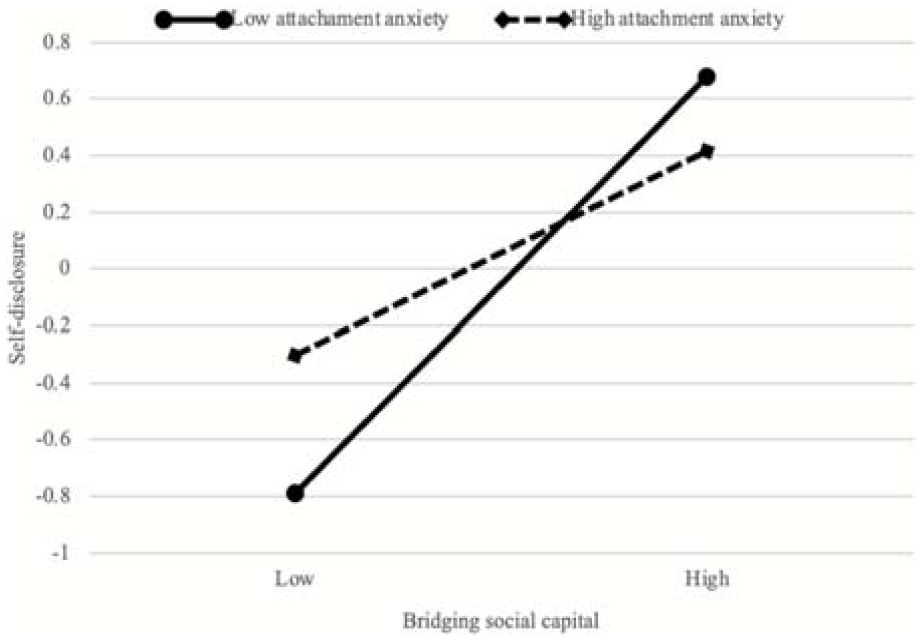
Interaction of attachment anxiety × bridging social capital on self-disclosure.

Interaction of attachment anxiety × bridging social capital on proactive interaction.
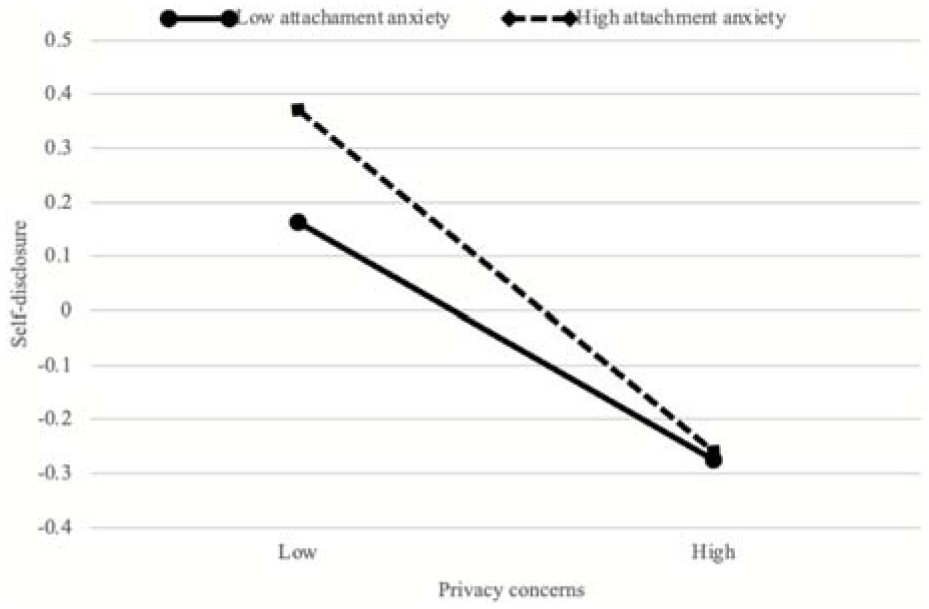
Interaction of attachment anxiety × privacy concerns on self-disclosure.
Discussion
One notable revelation from our results is the differential motivational underpinnings of self-disclosure and proactive interactions, and the discrepancy suggests a nuanced interplay between the pursuit of social capital and the desire to safeguard personal privacy, influencing users’ choices between different modes of interaction on social media. It appears that individuals are likely to engage in both self-disclosure and proactive interactions when driven by the potential positive social capital benefits. Simultaneously, concerns about privacy violations seem to act as a notable deterrent for self-disclosure. Previous research has provided mixed results concerning the issue of privacy when using social media. Zhang and Fu (2020) found that privacy concerns were negatively related to the amount, intimacy, and honesty of self-disclosure on SNSs. Significant effects were found between privacy concerns and different privacy management strategies (Li et al., 2019), and individuals’ communication privacy management practices could influence the amount and depth of their self-disclosure (Chennamaneni & Taneja, 2015). Consistent with these studies, this study supports the assertion of privacy as a cost, which can reduce interaction through disclosure of personal information on social media. This may stem from the personal nature of privacy concerns. Privacy mainly refers to a sense of control over personal information, which is influenced by one’s sharing environment and accessible audience (Kanter et al., 2012). And people possess a strong-albeit varying-motivation to safeguard their privacy, which is grounded in fundamental human needs (Krämer & Schäwel, 2020).
Following the privacy calculus, people evaluate risks and gratifications of disclosing self-related information to others (Dienlin & Metzger, 2016). The calculations have cultural and situational differences (Masur, 2019; Trepte, 2015; Trepte et al., 2017). Despite the well-documented risks, individuals appear to be intrigued by others’ disclosures and driven to engage in self-disclosure themselves. That has been proved by our results that bridging social capital benefits (0.413) weighed more than privacy concerns (−0.173) when people decided to share personal information. Moreover, from an economic perspective, privacy is defined as a commodity; thus, people often trade privacy to accrue benefits (Xu et al., 2009), social capital in particular. What’s more, the social norms and collective culture in China may address an emphasis on social connectedness and participation (Trepte et al., 2017), which may lead individuals to prioritize social capital benefits and be more willing to trade off some privacy for the sake of social interaction.
It is highly significant for researchers and practitioners to study and know the responses to reward processing because the positive rewards enhance the accuracy and cognitive task (Alsharif et al., 2022). Our study identified a significant association between bonding social capital and proactive interactions but not with self-disclosure. This intriguing distinction implies that the motivation for strengthening close-knit social ties may predominantly drive actions such as commenting, forwarding, and liking, which contribute to a more interactive and reciprocal online environment. Strong ties have been clarified to be positively related to social support, especially emotional support (Carr et al., 2016; Krämer et al., 2021). Our results, based on this, demonstrate that responding to others is a more active and involved interaction and is more likely to derive supportive benefits from it, which are difficult to stimulate self-disclosure (Tzortzaki et al., 2016). Overall, bridging capital appears to play a more influential role on social interaction than bonding capital. That is, informational benefits, based on ordinary relationships, seem to drive social interactions more than emotional benefits that are based on intimate relationships, which may be related to the typically weak ties that currently exist on social media. On social media, weak ties may provide unique information not available in close circles (due to homophily and other factors), making them valuable as information sources. That’s why weak ties might be more powerful than strong ties (Granovetter, 1973). Additionally, previous research has shown that there was a relation between SNS usage and perceived bridging social capital when the network was used for social interaction (Guo et al., 2014), and users’ preference for weak tie support played a role in perceptions of social capital and construction of their SNS networks (High & Buehler, 2019). Social media has greatly expanded the social boundaries of individuals, which facilitates connections with countless nodes through interconnection technology (Lombardo et al., 2021), and entails broader individual access to bridging social capital.
Extending the benefit-cost model, our study delved into the moderating effect of attachment anxiety. We found that individuals with higher levels of attachment anxiety exhibit weakened effects of bridging social capital on both self-disclosure and proactive interactions. Meanwhile, the influence of privacy concerns on self-disclosure becomes more pronounced among individuals with elevated attachment anxiety levels. This novel insight underscores the importance of considering individual differences in attachment styles when examining the interplay between social media behaviors and psychological factors. For people with a higher level of attachment anxiety, bridging social capital is less effective at promoting their social interaction behaviors, which may be because attachment anxiety concerns closeness and intimacy (Collins & Feeney, 2004), whereas bridging social capital concerns ordinary relationships that are built on weak connections (Aharony, 2016). Attachment anxiety is often associated with difficulties in trusting others (D’Arienzo et al., 2019; Gillath et al., 2021). Privacy involves an individual’s desire to control information that is kept from others (Nissenbaum, 2009; Schermelleh-Engel et al., 2017). Individuals with high attachment anxiety may have experienced past betrayals or emotional harm, leading them to be cautious about controlling personal information. Besides, the more attached an individual is to a relationship, the more he or she is afraid of being abandoned (Sakman et al., 2021), and therefore, the more he or she will consider the social costs that may be detrimental to social interaction.
The main theoretical contribution of this study is threefold. First, it elaborates more facets of social interaction on social media which should be dissected as a two-way cycle of self-disclosure and interaction and provides a better explanation of adults’ social interaction behaviors. Second, it extends SET regarding social capital, privacy concerns, attachment anxiety and social interaction through our analysis of new empirical data from a Chinese adult population, increasing the understanding of the benefit-cost balance of social interaction behaviors. Finally, it underscores the significance and importance of personality differences among social media users with different levels of attachment anxiety, complementing the current literature on individual social interaction behaviors. Additionally, our findings have practical implications for platform designers and marketers, emphasizing the need to tailor strategies considering the multifaceted motivations and concerns that guide user behaviors on social media. On the one hand, the results of this study can be applied by social media platforms to develop their product functions. On the other hand, social media users have expressed growing concerns about privacy, and social media companies, policymakers, and regulators should pay more attention to privacy protection mechanisms and policies. Notably, there needs to be close cooperation between policymakers, regulators, and social media companies to prevent the exploitation of uers’ technological vulnerabilities.
There are some limitations in the construction, evaluation, and generalizability of our model. First, the self-reporting nature of the survey may entail non-responsible and social desirability bias, which is common in user research. We incorporated common-sense questions to foster screening, and we adopted anonymous questionnaires to try to weaken these biases. Second, the cross-sectional design restricted our ability to interpret causal relationships. A future longitudinal study may be needed to supplement the current study. Finally, we used social media as a general concept in the survey and we did not refer to a specific social media platform or website, as we aimed to broadly explore social interaction phenomena from the perspectives of benefit-cost balance and attachment anxiety. Similarly, this study did not distinguish among different proactive interaction behaviors as outcomes. In further research, specific social media platforms and detailed interaction behaviors can be tested to check for similarities and differences. Moreover, in addition to attachment anxiety, future research may investigate the role of other personality characteristics in individuals’ benefit-cost assessments during social interactions.
Conclusion
For social media users, every social interaction is a two-way cycle that is built on relationships and involves the two dependent variables of self-disclosure and proactive interaction. Analyzing and comparing these two kinds of social interaction behaviors in a single framework and model fills a research gap in the current literature on social media use, which has focused more on self-disclosure than on proactive interaction from the specific perspective of social exchange. Our results have pointed to the benefit-cost balance that determines how adults disclose themselves, proved the positive motivations of proactive interactions and raised further understanding of the differences among the individual personalities. The findings shed light on distinct patterns and predictors associated with these behaviors, contributing to a more comprehensive understanding of user engagement in the digital realm.
Footnotes
Declaration of Conflicting Interests
The author(s) declared no potential conflicts of interest with respect to the research, authorship, and/or publication of this article.
Funding
The author(s) disclosed receipt of the following financial support for the research, authorship, and/or publication of this article: This work was supported by the National Social Science Fund of China (18ZDA317), and the Fundamental Research Funds for the Central Universities (JB2024089).
Ethical Approval
This research project was conducted in accordance with the ethical principles outlined in the Declaration of Helsinki. Participants were informed of the purpose of the study and their right to withdraw at any time. Informed consent was obtained from all participants prior to their participation in the study. Confidentiality and anonymity were maintained throughout the study, and any personal data collected was stored securely and accessed only by the researchers. The study was approved by the ethics review committee of the author’s university.

Data Availability Statement
The data used in the research cannot be publicly shared but are available upon request. The data can be obtained via email.