




Abstract
Although the results of the final examination in Indonesia were the dominant factor in determining high school graduation, the public still did not know how the examination was administered nor how results were used to determine student graduation. Despite its importance, no comprehensive studies about its implementation have been conducted. The present study investigates the implementation of school-based assessment (SBA) in upper secondary schools focusing on the development and administration of the English writing test. This particular test was not covered in the English national examination. Twenty-one schools were surveyed, selected through stratified random sampling. In-depth case studies were conducted in three selected schools representing fully implementing school (FIS), moderately implementing school (MIS), and partially implementing school (PIS). The majority were categorized as PIS. This study suggests that the way in which examinations were implemented needs serious consideration, especially in light of the new regulation that student graduations are based on the result of the school examinations and no longer on the result of the national examination.
Introduction
The recent government regulation in Indonesia has changed the status of school examinations from being low stakes to being high stakes (Regulation No. 13/2015). In the Indonesian context, school-based assessment (SBA) in upper secondary school is intended to measure whether students have attained competence standards for graduation, and SBA can now determine whether or not students graduate. The competencies cover subject mastery, knowledge, good character, and attitude and skills necessary to become independent individuals and to continue their education.
Despite the absence of a comprehensive study of the results of Indonesian school examinations, some writers outside Indonesia have reported positive aspects of the implementation of SBA. For example, Chong (2009); Talib, Kamsah, Naim, and Latif (2014); and Tong and Adamson (2015) mentioned that SBA can promote a favorable education process that is oriented to learning. As such, schools are no longer preoccupied with teaching to test practices due to negative washback effects of the National Examination (Andrew, Fullilove, & Wong, 2002; Cheng & Watanabe, 2004; Furaidah, Saukah, & Utami, 2015; Qi, 2005). They allow teachers to get involved in making assessment decisions and improving teaching methods in response to students’ needs (Maxwell & Cumming, 2011, in Talib et al., 2014).
SBA challenges teachers’ creativity in monitoring students’ learning progress and designing appropriate tests aligned with the curriculum content (Sulistyo, 2009; Talib et al., 2014). In the writing test in Indonesia’s National Examination, for example, teachers needed to become more creative in designing more relevant performance assessments, especially as they still use indirect testing. Indirect testing of performance reduces its validity (Cohen, 1998; Hughes, 2003; McNamara, 1996; Weir, 1993) because it is difficult to find any correlation between the micro aspects of linguistics (knowledge of grammar and vocabulary) with writing ability.
Other studies were also in doubt. In Hong Kong, for example, skepticism about the appropriateness of SBA was widespread when it was first introduced (Cheng, Andrews, & Yu, 2011). In Malaysia, a similar issue had revolved around the technical aspects of the implementation and teacher–student readiness for change. Majid (2011) mentioned that teachers in Malaysia still had some uncertainties about the demands of SBA. In particular, the teachers were concerned about their ability to meet its demands and their role, and expected difficulties in implementation. The same findings were also reported by Talib et al. (2014), who mentioned that almost 80% of Malaysian teachers’ SBA was within the range of unsatisfactory to basic. This finding implies that the teachers’ knowledge of language testing was still low. Similar stories have also been reported by Sulistyo (2009) when interviewing a number of Indonesian teachers long before SBA was made a high-stakes test. The teachers were not fully ready to conduct SBA and still needed expertise in language testing.
Although the prevailing laws have made all schools in Indonesia implement SBA as a criterion for student graduation, no comprehensive study has been conducted. This study seeks to fill the gap in the literature by focusing on the implementation of writing skills as one of the subjects tested in the examination at the end of upper secondary school. It begins by presenting the results of the survey in general upper secondary schools in the city of Malang (East Java Province, Indonesia), and then reports on a study carried out in three of them. The article concludes with recommendations for appropriate treatment of writing tests. These improvements contribute more widely to the effective development of SBA examinations in Indonesia.
Method
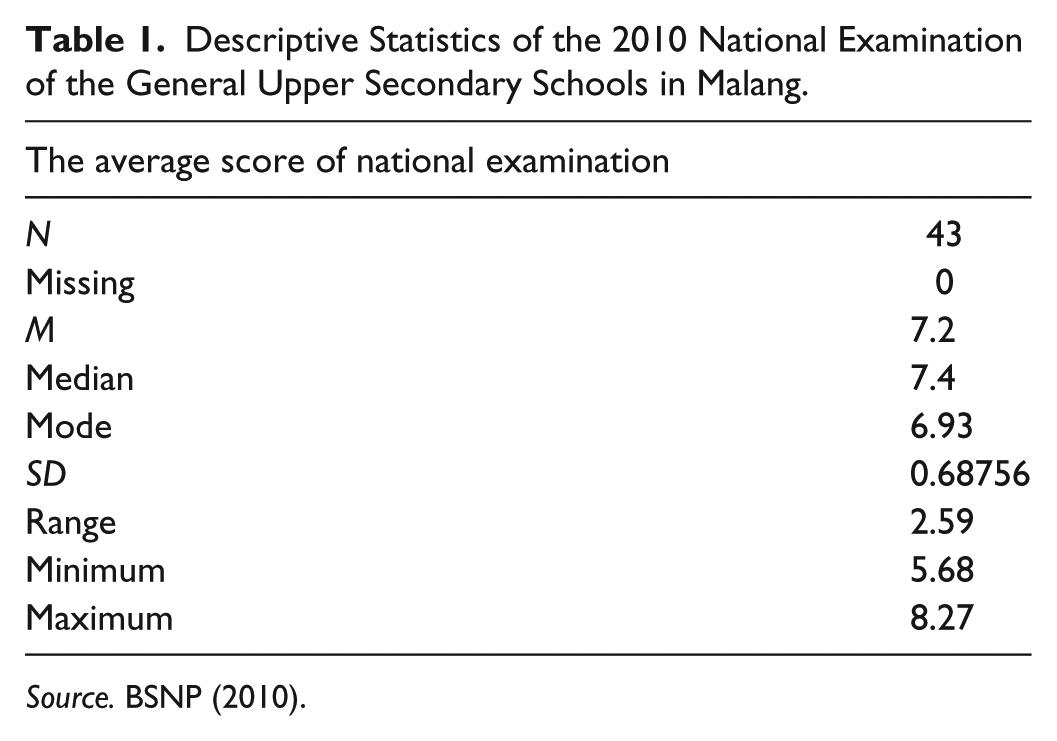
The target population of this present study included all of the general upper secondary schools in Malang conducting SBA writing tests as the examination at the end of upper secondary school. Referring to the reports of the National Examination from the Education National Standard Body Badan Standar Nasional Pendidikan (BSNP) 2009-2010, 43 general upper secondary schools in Malang were reported to have participated in the National Examination in 2010 (see Table 1).
Descriptive Statistics of the 2010 National Examination of the General Upper Secondary Schools in Malang.
Source. BSNP (2010).
This population reflected an imbalance; students in private and public schools had different levels of achievement. For example, the score distribution varied considerably, with the highest and lowest scores totaling 8.27 and 5.68.
For that reason, a stratified random sampling technique was used with the following procedure. First, the desired sample size was 50% of the total population (43 schools), giving 22 schools to be subjects. Next, samples were stratified on the basis of whether schools were state or private and on the basis of their achievement. This was done by establishing the quantitative categories of school achievement and the interval values for each category. The range (2.59) was obtained by subtracting the lowest score (5.68) from the highest score (8.27). Next, the interval score (0.9) for each school achievement category was established by dividing the range score of 2.59 by 3. This resulted in three categories of school: low achieving (5.68-6.48), middle achieving (6.49-7.29), and high achieving (≥7.30). The summary of the stratified random sampling of this present study can be seen in Table 2.
School Samples of the Present Study.

Following the survey, three different schools were studied, representing full, moderate, and partial implementation. These three schools were then categorized according to the extent to which they had implemented the writing test as a school examination, determined by a checklist of about 14 yes/no questions (a dichotomous closed question format). A yes answer was scored 1, a no answer was scored 0, and a blank answer was also scored 0. Checklist items were weighted because each question had a different degree of importance: less important (0.10), important (0.30), and very important (0.60). Of the 14 questions, two were considered as less important (14%), five were viewed as important (36%), and seven were regarded as very important (50%).
This resulted in three categories of schools for their implementation of the test (see Table 3):
Categorization of Schools Based on Writing Test Implementation.

Note. PIS = partially implementing school; MIS = moderately implementing school; FIS = fully implementing school.
Exploratory factor analysis (EFA) was carried out to assess the construct validity of the instrument (Walt & Steyn, 2008; Weigle, 2002). The qualitative data were obtained from document study and interview with semistructured format. The data analysis obtained from the checklist went through three stages. First, it dealt with the descriptive statistics. Second, this present study used the chi-square test of a distribution to obtain the evidence of the significant differences in the frequency distribution of different categories. Third, following the chi-square computation, the data were then analyzed by means of cross-tabulation statistical technique.
Statistical Validation
The chi-square technique was used to check for significant differences among the variables under investigation: the implementation of the writing test in the state and private secondary schools. This study found that the value of the asymptotic significance (two-sided) Pearson chi-square was .024, which was smaller than the significance alpha (α) .05. As such, the approximately significant (.024) <.05 indicated that the null hypothesis (H0) was rejected. Hence, it was concluded that there was a significant difference in terms of the implementation of the writing test in the state and the private upper secondary schools.
Next, cross-tabulation was done to indicate the frequency with which the corresponding categories of the categorical variables co-occur. Referring to Table 4, the majority of the upper secondary schools (48%) were categorized as partially implementing school (PIS) category, followed by 42% as a moderately implementing school (MIS) category and 10% as fully implementing school (FIS) category.
Cross-Tabulation Analysis of the Implementation of the Writing Tests.

Note. PIS = partially implementing school; MIS = moderately implementing school; FIS = fully implementing school.
Findings of Categorization of Writing Tests
Regarding the ratio of private to state schools, this study categorized 56% of private schools and about 20% of the state schools as partially implementing. In the MIS category, 44% were private schools and 40% were state schools. About 40% of state schools belonged to the FIS category, but no private schools.
The clustering indicated that the policy on the writing tests in school examinations had not yet operated as expected; nearly all subjects were clustered in moderate and partial implementation categories.
Implementation Description
The following is a detailed description about how schools implemented the writing tests.
In the checklist, the respondents were asked whether they had made some alternative writing materials (the secondary tests and the makeup tests). Quite surprisingly, 95.2% of all schools in the sample preferred not to prepare other writing materials (see Table 5). According to the teachers in the majority of schools (MIS and PIS), their heavy teaching loads kept them from preparing alternative tests. They reported that they usually had to handle from four to six classes, representing approximately 24 teaching hours per week. Besides, they also believed that students could not cheat in the writing test because it was subjective.
Preparation for Other Writing Test Materials.

The next question in the checklist asked respondents whether they had involved experts in validating assessment constructs. Table 6 shows that both MIS and PIS, as the majority (76.2%), did not consult experts either inside or outside their schools. Schools in both categories viewed the involvement of experts outside their schools as complicated because of administrative procedures. They were not sure whether the schools supported the idea of involving external experts in test development. Instead, the teachers were asked to work on their own test designs. Even if there was Musyawarah Guru Mata Pelajaran (MGMP) (a teacher association teaching in the same subjects), they never contacted them due to their heavy teaching loads. This implies that most schools did not see the involvement of experts as an urgent need.
Consultation With the Experts.
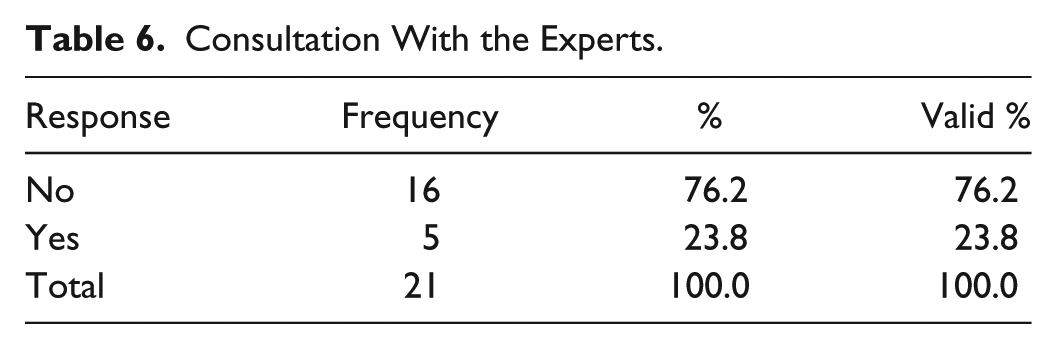
Meanwhile, only FIS (23.8%) had involved experts in test design. These experts were usually assigned to check whether the test design had fit the requirements of the construct representation and construct relevance.
The next checklist question asked respondents whether their schools had followed the regulation for seat arrangement in the test room, moving the seats of test takers 1 meter away from each other (see Figure 1). Table 7 shows that nearly all schools (FIS and MIS; 90.5%) adhered to this regulation. By contrast, PIS (9.5%) that did not follow the procedure had permitted the students to sit as in a regular class. The PIS teachers believed that fair administration of the school examination was not always primarily indicated by such a seat arrangement. Instead, they relied on thorough supervision of the teachers.
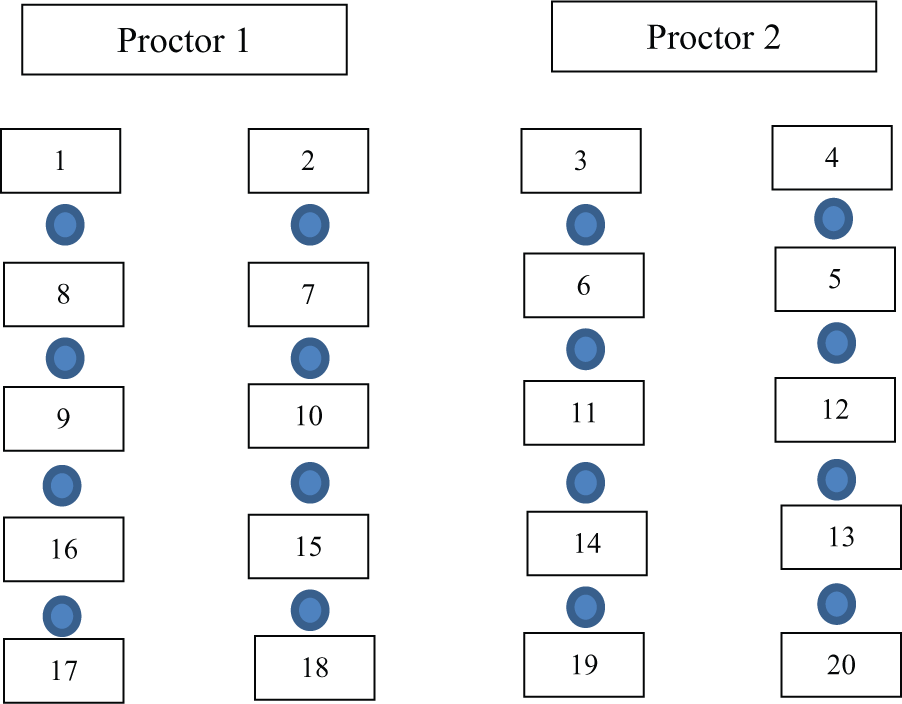
Seating arrangement in the school examination.
Seating Arrangement.

The next question asked respondents whether their schools had informed both the students and proctors about the procedures for penalties for cheating during the examination. About 90.5% of schools (FIS and MIS) reported that they had informed both students and the proctors of those procedures through oral delivery in meetings and in printed documents (see Table 8). The majority of schools (FIS and MIS) adopted the rules of the test administration from the local National Education Department and disseminated them prior to the exam. Moreover, teachers in FIS and MIS reported that the schools posted the rules on the walls of all testing rooms so that everyone could see them.
Sanction for the Students and Proctors.

By contrast, PIS (9.5%) reported the rule was only disseminated orally prior to the examination. Teachers in PIS mentioned that it was not necessary to inform proctors of penalty procedures; violating the norms of the test administration would never make any sense to proctors as they were good people tied to ethical codes.
The next item in the checklist asked respondents whether they as assessors had shared their scores to obtain the average as the final score. While MIS and PIS, as the majority (85.7%), never carried out this procedure, FIS (14.3%) had used this strategy in the scoring procedure (see Table 9). FIS headmasters assigned a teacher to carry out cross-scoring. All assessors took turns to read all students’ work independently and then entered the scores in the forms. The students’ final scores were obtained by dividing all scores. This achieved greater objectivity in scoring.
The Final Score.

MIS and PIS, the majority of schools (85.7%), did not have a cross-scoring procedure and never applied average scores to obtain final scores. For them, cross-scoring was time-consuming and was impossible due to the limited number of assessors (three to five teachers). Some reported that more than 400 students took the tests. For practicality, teachers decided to divide students’ writings into equal piles. For example, if there were 100 items and two assessors, then, each assessor would get 50 items to read and score. They only read and scored students’ writings of their own, and never shared those pieces with other assessors to read and score. The school administrators often demanded that they had to submit the scores in short time frames, with some teachers even reporting that they were required to finish only 1 day after the examination.
As another alternative, MIS conducted a cross-prompt assessment procedure. Different teachers were assigned particular prompts in the test. For example, if there were four writing prompts in the writing test, teachers would only read and score the prompts to which they had been assigned. As Teacher A had been assigned to read Prompt 1, he or she only scored that part and left other prompts to other teachers. In the same way, Teacher B was assigned to read Prompt 2, and he or she only checked and scored that part. The same procedure was also true with Teachers C and D. Hence, the final score was obtained by adding all scores from Teachers A, B, C, and D. These teachers believed that this procedure potentially increased the fairness of the scoring. The assumption was that teachers easily tend to give unfairly higher scores to their own students.
The next item on the checklist was to ask respondents whether they had involved third assessors to resolve discrepancies in scores. MIS and PIS, as the majority (90.5%), never involved a third assessor to mediate score discrepancies (see Table 10). For them, this procedure was unnecessary and they preferred to score the students’ work individually. In addition to the limited number of assessors, scoring the students’ work individually was more practical as they could submit the score list in due time.
The Involvement of the Third Rater.

Meanwhile, FIS, as the minority (9.5%), that had used a cross-scoring procedure viewed the involvement of the third assessors as necessary to solve score discrepancy problems. According to FIS teachers, besides mediating the score discrepancy, the third assessors were also assigned to check the assessors’ lists of scores. When discrepancies inevitably occurred, the third assessor usually asked all assessors to meet to discuss them. If they came to agreement when reexamining their previous grades, the two assessors simply modified the scores. However, if they could not get agreement, then the third assessor was assigned to read the students’ work and give their own scores. In these cases, students’ final scores were the mean of the scores from all assessors, including the third assessors.
Another item in the checklist asked whether respondents had prepared scoring rubrics to score the students’ essay (see Table 11). In practice, MIS and PIS as the majority (85.7%) had used mixed scoring formats both for essays and objective tests. For objective tests, they prepared the answer keys to such test prompts: filling in the empty blanks with the correct words and arranging the jumbled sentences into good paragraphs (see Figures 2 and 3). Meanwhile, for essays, the scoring rubrics were designed in an analytical format that included such aspects as grammar, mechanics, vocabulary, and content. Hence, the students’ final scores were the combination of the results from both objective tests and essays.
The Scoring Rubrics.


The sample of objective writing prompts in MIS.

The sample of objective writing prompts in PIS.
Meanwhile, FIS, as the minority (14.3%), had used a holistic scoring rubric. Some descriptors even described certain levels of competence for each score (5, 10, 15, 20, and 25). FIS also trialed their writing tests prior to implementation as the real test (see Figure 4). A small number of the students were invited to take the test, and the results were gathered for analysis. One teacher with extensive experience in language testing took roles of both expert and chairperson of the teacher panel that was responsible for validating the test.

The sample of writing prompts in FIS.
The next question asked respondents whether they had trialed the writing test before using it. This step collected evidence on whether the particular test models and scoring rubrics had been properly designed. Table 12 shows MIS and PIS, the majority of schools (95.2%), did not trial the test. Instead, the teacher panel discussed the test quality. PIS that had a shortage of teaching staff entrusted the teacher to assess the quality of their own tests.
The Tryout of the Tests.

By contrast, the teachers in FIS (4.8%) stated that the trial was part of a series of activities in test development. Teachers observed the test administration and analyzed the results of the writing tests. During the trial, about three or four voluntary students did the writing tests. The teachers gathered the responses of the sample students and reviewed them. They focused on noting areas of students’ confusion, vague or incomplete responses, and unanticipated responses. If students’ responses indicated ineffectiveness, considerable restructuring of the testing tool would be necessary.
The next question in the checklist asked respondents whether they had scored the students’ writing at the same time and place in a group work. Table 13 shows that MIS and PIS, the majority of schools (85.7%), had disregarded this procedure in the writing test administration. They did not see such a procedure as important. To them, this requirement was impractical due to possible distractions from other members of the group and the limited number of assessors, so they preferred to score students’ work individually. Thus, the teachers shared the students’ writing in equal number and took them home for further scoring.
The Scoring Under Controlled Reading.

By contrast, FIS regarded the controlled reading procedure and scoring as a necessity. The headmasters in FIS (14.3%) officially required that the reading of the students’ writing took place at the school within the scheduled time. It was done at a certain date and place and led by one teacher who had been appointed as convenor. The convenor usually announced the technical aspects of the scoring procedure with which assessors had to comply, such as reading the students’ writing attentively, applying the scoring rubrics to the students’ writing, using the students’ writing samples to represent different levels of performance or the aspects being assessed, putting the students’ score on the list of the grades provided, obtaining the final scores, and involving the third assessor in case of a discrepancy in scores.
Discussion
This study found the writing test had not been satisfactorily implemented. In practice, nearly all schools were clustered into PIS (48%) and MIS (42%), with very few categorized as FIS (10%). Many schools neglected substantial aspects of language testing, such as validity and reliability (Bachman & Palmer, 1996; Brown, 2007; Hamp-Lyons, 1991; Weigle, 2002). For example, the threat to validity is obviously apparent for most schools (MIS and PIS), which still used indirect testing for assessing writing skills. Besides the absence of experts and test trialing, many teachers still believed that an indirect testing approach, as used in the National Exam, is credible. In line with Sulistyo’s (2009) findings, most teachers readily adopt indirect testing to develop writing tests in the SBA because none of them doubted the validity of the National Examination. Moreover, the threat to reliability is quite observable; most schools never scored under controlled reading, never used cross-scoring, and never involved a third assessor to resolve score discrepancies between assessors.
Although the School Examination test has high stakes for students, it did not affect teachers’ professional performance. The present study has shown how teachers were reluctant to be creative in developing a more relevant assessment to test performance skills like writing. Saukah and Cahyono (2015) have reported that teachers in mostly low-achieving schools have given their attention to the preparation of the National Examination, although it is no longer the sole basis for student graduations. They mention heavy workloads and the absence of institutional support as reasons for not developing their professional skills. These findings were similar to the study by Talib et al. (2014). Teachers were unprepared for the change and found the new system challenging. About 79.66% of Malaysian teachers were not fully engaged in practicing SBA. Similarly, overall results revealed that Malaysian teachers’ SBA practice classrooms are within the range of unsatisfactory to basic levels of almost 80%.
Conclusion
This study finds that the practices of the writing test in the final examination of secondary school have resulted in different patterns of implementation, with a strong tendency for the partial implementation of policy. Hence, this study recommends some action points. First, teachers should be aware that the school examination, as a high-stakes test, demands significant responsibility on the part of teachers, and this should affect their professional performance. The decisions that teachers make in the school examination will affect the future of their students. Second, although the government has so far provided the teachers with technical guidance for administering the examinations (Pedoman Teknis Pelaksanaan Ujian Sekolah/Madrasah/The Technical Guidance of the Implementation of Madrasah/School Examination), teachers clearly need professional development to improve their skills. Short training courses given by experts would help teachers to be able to design better tests for school examinations.
Footnotes
Declaration of Conflicting Interests
The author(s) declared no potential conflicts of interest with respect to the research, authorship, and/or publication of this article.
Funding
The author(s) received no financial support for the research and/or authorship of this article.