




Abstract
This study is a systematic and scientific attempt to fill five identified research gaps in the existing literature with regard to employee engagement through the use of empirical evidence from Sri Lankan listed companies. This study focuses on investigating employee engagement, its selected dynamics such as high-performance work practices (HPWPs), religiosity, personal character, leadership, work–life balance, and mediating effects of employee engagement on the relationship between the selected dynamics and employee job performance. The data gathered from 272 executives and managers in the Sri Lankan listed companies were analyzed and a set of hypotheses established and developed based on the theoretical and empirical accounts with regard to the dynamics of employee engagement, the combined effect of the dynamics of employee engagement, employee engagement as an independent variable, and the mediating role of employee engagement. A total of 12 hypotheses were tested with minimum researcher interference, in a noncontrived setting as a cross-sectional study and they were substantiated. Implications of the research findings have been discussed.
Introduction
Human resource (HR) is the most valuable asset for an organization (Shrotryia & Dhanda, 2019) and employee retention is considered as the heart of organizational success (Khalid & Nawab, 2018). Engaged employees are drivers of the business activities of any organization to reach its desired destination. Other resources make things possible, but only engaged employees make things happen. Organizations do want their employees to be engaged with their work (Patrick & Bhat, 2014) as well as with their organization, which is one reason why employee engagement has become a buzzword in the business world. Kahn, well known as the first researcher who produced an academic paper on employee engagement in the year 1990 (Guest, 2014; Iddagoda et al., 2016), describes employee engagement as one’s psychological presence when executing one’s organizational tasks. Employee engagement is a hallmark of the relationship between an employee and his or her organization, as well as his or her job. This is supported by the definition formulated by Iddagoda et al. (2016), namely, employee engagement is the extent to which an employee gets involved in the job and the organization cognitively, emotionally and behaviorally.
Gallup (2013) investigated the level of employee engagement in years 2011 and 2012 with a global focus. It was revealed that 14% of employees in Sri Lanka are engaged, 62% are not engaged, and 23% are actively disengaged. There is an increase in the employee engagement level in the year 2017, according to Gallup (2017). The report reveals that there are 38% of employees engaged in Sri Lanka. This finding is a general one, not a specific one. It has generally been observed that there is a highly felt need of increasing employee engagement in Sri Lanka. There is no particular recent study conducted in Sri Lanka to identify and describe the level of employee engagement showing a contextual gap. Furthermore, only little research has been done on employee engagement, its dynamics or antecedents, and its consequences, particularly in Sri Lanka, perhaps in the Asian context. This study focuses on employee engagement and its focus is on the mediating effects of employee engagement on the relationships between certain antecedents and a major consequence which were selected from the identified research gaps in the existing literature.
Identified Research Gaps
An extensive literature review was carried out by the authors of this article and the results were published in detail (Iddagoda & Opatha, 2017a). Table 1 presents a summary of the key studies on employee engagement. A further attempt was made to explore and review studies conducted on employee engagement recently.
Key Studies on Employee Engagement.

Source. Adapted from Iddagoda and Opatha (2017a).
Iddagoda and Opatha (2017a) identified certain research gaps in employee engagement. Sri Lankan studies of high-performance work practices’ (HPWPs) impact on employee engagement are unavailable. This has been identified by Iddagoda and Opatha (2017a) as a research gap in employee engagement. According to them, there is an absence of theoretical and empirical studies on the impact of religiosity on employee engagement in both Sri Lankan and perhaps in international contexts. Gallup (2010) discovered a relationship between religiosity and employee engagement. The limitation is that their study was not based on the hypothetico-deductive approach. Another research gap identified by Iddagoda and Opatha (2017a) is the relationship between employee engagement and personal character, which is neither theoretically reasoned nor empirically tested both in Sri Lanka and globally. These researchers also unearthed another gap in that there is no empirical evidence on religiosity, HPWPs, personal character, leadership, and work–life balance that significantly affect employee engagement in a theoretical framework/nomological network in both the Sri Lankan and the international context. Having conducted an extensive literature review, Sun and Bunchapattanasakda (2019) revealed that there is lack of research on the mediating role of employee engagement. There is no empirical evidence with regard to the mediating effect of employee engagement on the relationships between religiosity, HPWPs, personal character, leadership, work–life balance, and employee job performance in the Sri Lankan context as well as in the international context and this is another vital research gap in the literature of employee engagement.
Objectives
The main objective of this research article is to investigate relationships between the selected variables and employee engagement and its mediating effects on the relationship between those variables and one outcome variable, that is, employee job performance. For the purpose of investigating relationships of employee engagement, five variables were considered and they were HPWPs, religiosity, personal character, leadership, and work–life balance which were taken as antecedents of employee engagement because they relate to it or they contribute to it. Owing to three reasons, these five variables were selected. The first reason is that, according to the research gaps, the researchers have identified HPWPs, religiosity, and personal character as determinants of employee engagement. The second reason is that some factors or determinants of employee engagement have been used by the majority of previous researchers. Researchers like Christian et al. (2011), Xu and Cooper Thomas (2011), Bedarkar and Pandita (2014), and Hewitt (2015) have identified leadership as a determinant of employee engagement. Bedarkar and Pandita (2014) and Hewitt (2018) hold the view that work–life balance is another antecedent of employee engagement. The authors’ preference is the third reason. Employee job performance was considered as a consequence of employee engagement and hence it could be labeled as the dependent variable. Employee job performance was considered in this study as an outcome or a result of employee engagement because of the reasons that it is a critical phenomenon in human resource management (HRM) and organizational behavior (OB) (Armstrong, 2009; Dessler, 2009; Opatha, 2009, 2015), and it serves as the vehicle for judging the effectiveness of individuals, groups, and organizations (Szilagyi, 1981). According to Motyka (2018) who had conducted a systematic literature review of employee engagement and performance, scholars and practitioners indicate that low level of employee engagement at work is currently one of the most alarming global economic problems and the potential consequence of this phenomenon is declining work performance. In another recent study, Saks (2019) found that employee engagement predicts job satisfaction, organizational commitment, organizational citizenship behavior, and intentions to quit. Today, business leaders know that a high level of employee job performance is indispensable for the progress and sustainability of their organizations. Consequently, employee engagement has become a top business priority for business leaders. As far as the local context and global context are concerned, we believe that these dynamics and the major consequence seem to be critical in the literature of employee engagement.
This study is an attempt to bridge the identified research gaps using empirical evidence from the Sri Lankan context. Our approach is to fill the gaps using a hypothetico-deductive approach and the specific research objectives are to investigate (a) whether HPWPs, religiosity, personal character, leadership, and work–life balance significantly and positively relate to employee engagement; (b) whether there is a significant combined effect of HPWPs, religiosity, personal character, leadership, and work–life balance on the variability of employee engagement; (c) whether employee engagement and employee job performance are significantly and positively related; and (d) whether there are significant mediating effects of employee engagement on the relationships between HPWPs, religiosity, personal character, leadership, work–life balance, and employee job performance.
Theoretical Framework and Hypotheses
Using authors’ general theories, logical beliefs, previous empirical findings, and arguments, an attempt was made to develop a network of associations among the seven variables of interest to this research study. Five variables such as HPWPs, religiosity, personal character, leadership, and work–life balance can be considered as dynamics of employee engagement because they work as factors whose changes make changes in the behavior of the variable, that is, employee engagement. These factors are subject to change and their change has an effect on or a relationship with a dependent phenomenon, here employee engagement. Employee engagement is considered as the mediating variable on the relationships between the five antecedents and employee job performance. Hence, employee job performance can be considered as the dependent variable. This study examines all these variables in a nomological network as shown in Figure 1.

Nomological network of employee engagement.
Hypotheses
Dynamics of Employee Engagement
HPWPs and employee engagement
According to Kroon et al. (2013), HPWPs are HRM practices that target employee stimulation and organizational performance. Appelbaum et al. (2011) in their study talk about the relationship between HPWPs and employee engagement. Rana (2015) presents a conceptual model which analyzes the relationship between employee engagement and high-involvement work practices.
Regular appraisal and pay for performance are the HPWPs (Guest, 2000; Pfeffer, 1995). “Theories” can explain the relationship between HPWPs and employee engagement; the agency theory and the justice theory provide an educate proof of this relationship. Under the former, as Eisenhardt (1989) mentions, agency relations are problematic as far as (a) the principal and agent have contradictory goals and (b) it is difficult or expensive for the principal to monitor the agent’s performance. The agent, here, is the employee who adopts HPWPs. The organization thus conducts regular appraisals, which is an HPWP, at frequent intervals so that the employees are made aware of where they stand.
Organizational justice, as defined by Greenberg and Baron (2007), is people’s perceptions of fairness in an organization. The justice theory subsumes distributional justice, interactional justice, and so on. Distributive justice is the degree to which employees perceive their receptive outcomes as fair. According to this theory, the employee is motivated by the comparisons he or she makes between himself or herself and other employees. Here, an employee compares his or her inputs and outcomes with those of others. The inputs comprise his or her efforts in performing his or her job, physical and mental effort, knowledge, skills and time, and so on. What an employee receives from the organization is the “outcome,” for instance, salary, pay increments, and recognition. Distributive justice is provided by “pay for performance,” which is an HPWP. Paying the same amount to employees of the same job rank becomes unfair when the degree of performance is different, and therefore a distinction should be made between high performers and low performers. Employee motivation increases when and if the pay is fair. This effect ultimately leads to an increase in the level of employee engagement.
Symbolic egalitarianism, which is another HPWP, implies the use of symbols to lessen dissimilarities between all levels of employees whose work objective is to achieve a common organizational goal. Symbols like dress and the use of physical space, as Pfeffer (1995) states, are noticeable signs. Consistent dress codes, common cafeteria, common parking areas, and constant office arrangements can initiate symbolic egalitarianism in an organization. The employee feels no discrimination in his or her position at this juncture, which, in turn, enhances his or her dignity.
Dunham (1984) mentions that the degree to which a person considers his work or job to be central to his or her self-concept is a component of job involvement and work involvement. He also mentions that a person who is high in this component of job involvement and work involvement makes frequent reference to his work or job in evaluating himself or herself as a person. The researchers believe that, because of symbolic egalitarianism, the employee feels that the organization values his or her work or job. The reason is that all the employees use common office arrangements regardless of their designations. This ensures the employee’s self-concept and, therefore, enables him or her to work with dignity or self-respect. Employee engagement increases when employees feel that they are respected people in the organization and their leaders show that they value their employees (Seijts & Crim, 2006; Wollard, 2011). Cropanzano et al. (2002) reveal that interactional justice refers to the quality of the interpersonal interaction between individuals. Cropanzano et al. (2002) also point out that interactional justice occurs when the leader as the decision-maker respects the interpersonal dignity of the employee. Positive perceptions of fairness and justice about the organization enhance employee engagement (Maslach & Leiter, 2008; Saks, 2006).
These relationships between HPWPs and employee engagement suggest the following hypotheses:
Religiosity and employee engagement
Iddagoda and Opatha (2017b) defined religiosity as the extent to which an employee (particular person) believes in and venerates the founder, gods, or goddesses of the relevant religion, practices the relevant teachings, and participates in the relevant activities. Religiosity involves being religious earnestly and really rather than being religious frivolously and nominally. A Gallup (2010) survey in 114 countries in 2009 indicates that religion continues to play a significant role in many people’s lives worldwide. The religiosity level in Sri Lanka is 99%. The relationship between religiosity and employee engagement can be explained using some theories and conceptual literature. Considering unstated, undeveloped, and obscure theories in the global and local contexts is important. Uyangoda (2015) also mentions that there can be unstated theories in a scholarly work. Some of the Buddhist teachings in the Mangala Sutta and in Christian teachings in Ephesians, Chapter 6 verses 5-9 [Epistle of St. Paul], can be considered global examples.
The Sutta Pitaka is a Pali canon that contains the words of the Buddha. The Mangala Sutta also offers some guidance for employees. It preaches about work that is free from distress or confusion (anakula), which, as mentioned by Harvey (2000), is a great blessing. The reason is that it diminishes conflict between employee and employer. Say, stay, and strive are the outcomes of employee engagement (Hewitt, 2015) and freedom from confusion (anakula) will easily lead to these outcomes. There are Bible scriptures that can be related to increasing employee engagement, one of which is given below: And masters, treat your slaves in the same way. Do not threaten them, since you know that he who is both their Master and yours is in heaven, and there is no favouritism with him. (Ephesians, Chapter 6:5-9)
The above Bible text is about slaves, that is, employees, and about masters, that is, employers. Seijts and Crim (2006) in their study mention that leaders or employers should give proper recognition and praise for the good performance of the employee so as to strengthen employee engagement. This perception is summarized by Seijts and Crim (2006) in the “Fifth C” titled “Congratulate” under their Ten Cs.
Opatha and Opatha (2019) mention that locus of control is not only a very important phenomenon in the literature of OB but it is also deemed as a fundamental personality trait or characteristic. There is an interconnection between the theory of locus of control, religiosity, and employee engagement. Eysenck (2004) states that one who leans more toward an external locus of control believes that the results or consequences will predominantly depend on destiny or other external factors such as chance. Accordingly, employees pursuing an external locus of control and a high level of religiosity tend to be disengaged from their job and organization. The reason is that they have a tendency to apply for leave very often to take part in religious activities such as religious observances or pilgrimages.
Eysenck (2004) believes that one who leans more toward internal locus of control believes that because of his or her own effort he or she experiences its outcome or consequence. Researchers hold that a particular person’s beliefs follow what his or her religious books teach leading him or her to achieve the key performance indicators (KPIs) of their organization.
Employee engagement leads to higher productivity and lower turnover at the employee level, as well as increased customer satisfaction and loyalty (Christian et al., 2011; Gallup, 2013; Richman, 2006). Anitha (2014) states that employee engagement is high when employees maintain good relations with their coworkers. The relationship between religiosity and employee engagement can be explained using the theory of the ABC Model as well, which consists of three components of attitudes titled the ABC Model of Rosenberg et al. (1960) as cited in Opatha (2015, see Figure 2), namely, the cognitive, affective, and behavioral aspects. In the ABC Model, the employee believes (cognitive) that he or she has to fulfill the task and duties assigned by the organization. If his or her religiosity level is high, then the employee considers neglecting or disregarding work as a sin because most religions teach that employees should accomplish their duty well (see Figure 3).

Theoretical assertions derived from justice theory.

Theoretical assertions derived from the ABC Model.

Adaptation of the general systems theory to the study variables.
Based on the above reasoning, the second hypothesis is formulated as follows:
Personal character and employee engagement
It is important to consider unstated, undeveloped, and obscure theories in the global and local contexts. In the Sri Lankan context, there are many unstated, undeveloped, and veiled or hidden theories and it is hard to find references to these theories in the literature. However, these theories are well known and well accepted in Sri Lankan society. The Sri Lankan aphorism, Rajakariya (duty to the king) is nobler than Devakariya (the duty to the gods), is one such example.
According to Opatha (2010), a person of good character has a high level of virtues. Virtue is right conduct (Turriago-Hoyos et al., 2016). Opatha and Teong (2014) mention that a “virtue,” which is useful for a person himself or herself as well as for others, is a good habit and a moral attribute. The higher a person’s personal character is, the more virtues he or she develops. Therefore, the employee considers that just staying in office, disregarding organizational objectives, is not a good practice. According to Sahoo and Sahu (2009), engaged employees are loyal. Loyalty is a virtue that one should possess and, as Opatha (2010) mentions, loyalty involves being firm and not changing one’s relationship with someone, some organization, or country. According to Keller (2007), when a particular person is loyal to someone or something, it has an effect on his or her actions. He also states that a particular person demonstrates loyalty by following orders, promoting the interests of the object, and prioritizing them in some way over other potential choices. Therefore, a person of high personal character is frequently high in loyalty, making him perform his or her duty with loyalty, considering that it is nobler than the service to divinity. These arguments lead to the following hypothesis:
Leadership and employee engagement
“Leader,” as defined in the Pocket Oxford English Dictionary (2007), is a “person or thing that leads and as a person or thing that is the most successful or advanced in a particular area.” Leadership has been noted as the most influential psychosocial factor in the workplace for many employees (Jacobs, 2019). Homans (1958) offered an idea about social behavior, which was founded on exchange. Fundamentally, the concept of exchange was not limited to material goods, and this, according to Homans, also includes symbolic values such as approval and prestige. Cropanzano and Mitchell (2005) suggest, via the social exchange theory (SET), that an individual prefers to exchange resources that are equal to the resources that he or she has received. A stronger theoretical rationale that explains employee engagement, according to Saks (2006), is found in SET. Saks further states that a strong theoretical justification has been laid down by SET to explain why the employee reacts to work-related resources with varying levels of engagement. Seijts and Crim (2006) listed Connect, Career, Clarity, Convey, Congratulate, Contribute, Control, Collaborate, Credibility, and Confidence as the Ten Cs of employee engagement. They point to what business leaders should practice to strengthen employee engagement. Anitha (2014) shows the impact of employee engagement on employee job performance. According to Harter et al. (2002), employee engagement leads to high levels of organizational performance. Many researchers have discovered a positive relationship between employee engagement and leadership (Christian et al., 2011; Hewitt, 2015; Papalexandris & Galanaki, 2009; Seijts & Crim, 2006; Xu & Cooper Thomas, 2011).
The influence of leadership on employee engagement leads to the following hypothesis:
Work–life balance and employee engagement
Greenhaus et al. (2003) defined work–life balance as the extent to which an individual is equally engaged in and equally satisfied with his or her work role and family role. Greenhaus et al. (2003) propose three components of work–family balance: time balance, involvement balance, and satisfaction balance. Time balance is an equal amount of time devoted to work and family roles. Involvement balance is an equal level of psychological involvement in work and family roles. Satisfaction balance is an equal level of satisfaction with work and family roles. Each component of work–family balance can reflect a positive balance or a negative balance, depending on whether the levels of time, involvement, or satisfaction are equally high or equally low.
In employee engagement, work–life balance plays a vital role (Bedarkar & Pandita, 2014; Hewitt, 2018). Role theory explains the link between work–life balance and employee engagement. Jackson and Schuler (1995) opine that role theory recognizes that the behavioral expectations of all role partners can influence the behavior of the organization’s members. Jackson and Schuler (1995) further state that the implementation of effective HRM helps employees meet the expectations of role partners within the organization (i.e., supervisors, peers, subordinates) at organizational boundaries (i.e., customers and clients) and beyond (i.e., family and society). According to Opatha (2010), if a particular person achieves the respective demands satisfactorily, he or she can be said to have a right balance between work and family. The person with a work–life balance recognizes his or her work role and family role, which leads to fulfilling the behavioral expectations of all role partners. This influence on employee engagement suggests the following hypothesis:
Combined Effect of the Dynamics on the Variability of Employee Engagement
Researchers have given theoretical and empirical justification for the five relationships between employee engagement and its dynamics. They are (a) the relationship between HPWPs and employee engagement, (b) the relationship between religiosity and employee engagement, (c) the relationship between personal character and employee engagement, (d) the relationship between leadership and employee engagement, and (e) the relationship between work–life balance and employee engagement. Taking these relationships together leads to the following hypothesis:
Mediating Role of Employee Engagement
It is interesting to study whether there is theoretical evidence of the mediating role between the dynamics of employee engagement and employee job performance. The mediating role of employee engagement can be explained using the general systems theory.
Wright and Snell (1991) state that the general systems theory discusses inputs, process, and outputs. At this point, the inputs are HPWPs, religiosity, personal character, leadership, and work–life balance. Inputs should follow action, which is what employee engagement is. According to Iddagoda et al. (2016), employee engagement is a combination of attitudes and behavior. Certain activities in employee engagement make employee engage in the “action.” To put it differently, employee engagement turns into the “process,” and the result is employee job performance. According to the general systems theory, employee job performance becomes the output.
To identify the mediating role of employee engagement, it is necessary to examine whether there is a relationship between employee engagement and employee job performance. The view of Jyoti and Bhau (2015) is that employee job performance marks the completion of the role or task allocated to a particular employee. HRM plays an active role in helping organizations improve employee performance (Al Doghan et al., 2019). Originally, the concept of job performance was perceived as a unidimensional construct, but with the growing literature researchers found that job performance is a multidimensional construct (Al Doghan et al., 2019). Stewart and Brown (2011) divide employee job performance into three specific parts: task performance, organizational citizenship behavior, and counterproductive performance. Many researchers have emphasized the relationship between employee engagement and employee job performance. Christian et al. (2011) and Anitha (2014) found strong evidence of linking employee engagement with employee job performance. Employee engagement increases employee job performance (Demerouti & Cropanzano, 2010), especially in instances where there is a relationship between employee engagement and elements of employee job performance such as task performance and organizational citizenship behavior (Christian et al., 2011; Macey & Schneider, 2008; Rich et al., 2010; Richman, 2006). Thus, researchers deduce that a relationship exists between employee engagement and employee job performance. Thus, the seventh hypothesis is as follows:
It is argued that employee engagement has a temporal quality or time dimension (based on Sekaran & Bougie, 2010). It is believed that employee engagement surfaces between the time and antecedent, for example, HPWPs, starts operating to influence employee job performance and the time its impact is felt on it. Employee engagement has a role of working as a function of the antecedent and explains how the influence of the antecedent on employee job performance occurs. The researchers of this study believe that the impact of the antecedent/dynamic on employee job performance occurs through employee engagement. Thus, on a timeline, the antecedent/dynamic occurs at time (1), employee engagement occurs at time (2), and finally employee job performance occurs at time (3). This reasoning directs to formulate the following hypotheses with regard to the mediating effects of employee engagement on the relationships between the selected dynamics and employee job performance.
The nomological network of employee engagement is shown in Figure 5.

Nomological network of employee engagement with the hypotheses.
Research Methods
A quantitative study was conducted to achieve the main objective and the specific objectives of the study. The six components of the research design, according to Sekaran and Bougie (2010), are the purpose of the study, type of investigation, extent of researcher interference with the study, study setting, unit of analysis, and the time horizon of the study. This research was explanatory or hypothesis testing as it seeks to elucidate the relationships between the independent variables and the dependent variable in the nomological network. The type of investigation in this research is a correlational study. The view of Sekaran and Bougie (2010) is that a correlational study is conducted with the researchers’ minimum interference in an organizational environment with natural and normal work movements. Therefore, the researchers’ interference was minimal, and the study setting was noncontrived. The unit of analysis was individual, that is, executives and managers in the listed companies of Sri Lanka. Sajeevanie (2007), in her study, found that Sri Lankan listed companies practice HRM considerably. Also the listed companies make a higher contribution to Sri Lanka’s gross national product compared with other companies (nonlisted). Therefore, the researchers decided to collect data from the managers and executives in Sri Lankan listed companies. Employees at lower levels did not have much understanding of the management phenomena in the study, but executive- and managerial-level employees had that understanding. Managerial employees have more familiarity and knowledge with regard to HPWPs, leadership, and so on rather than nonmanagerial employees. Furthermore, in our country, to get responses for a questionnaire from nonmanagerial employees is more difficult owing to their lack of exposure. Another reason was that almost all managerial employees were competent in English to respond to a questionnaire prepared in English resulting in no need of translating into the local language. The time horizon of this study was cross-sectional, with one reason being the time constraint. Data were collected through a self-administered questionnaire that included seven instruments developed by the researchers through proper conceptualization and operationalization for the seven variables or constructs of the study. Full accounts of the conceptualization and operationalization of some variables have been published (see Iddagoda et al., 2016, for employee engagement; Iddagoda and Opatha, 2017b, for religiosity; and Iddagoda and Opatha, 2018, for HPWPs). Only three results of the execution of conceptualization and operationalization are shown in Appendix owing to the reason of space. Khalid and Nawab (2018), Mukanzi and Senaji (2017), and Naujokaitiene et al. (2015) used instruments with a Likert-type scale in their studies. The measurement scale for this study was the Likert-type scale with the rating scale being a five-point Likert-type scale.
Reliability and validity of the instrument were tested. Prior to the analysis of exploratory factor analysis (EFA), the appropriateness of using the EFA is determined by the results of Kaiser–Meyer–Olkin (KMO) test and Bartlett’s test of sphericity. Bartlett’s test of sphericity is significant for all the constructs. The survey results show that each construct correlates reasonably. To investigate these relations, varimax rotation was conducted and it identified factors with an eigenvalue. In view of that, EFA was conducted for each construct (see Table 2).
KMO and Bartlett’s Test for the Construct.
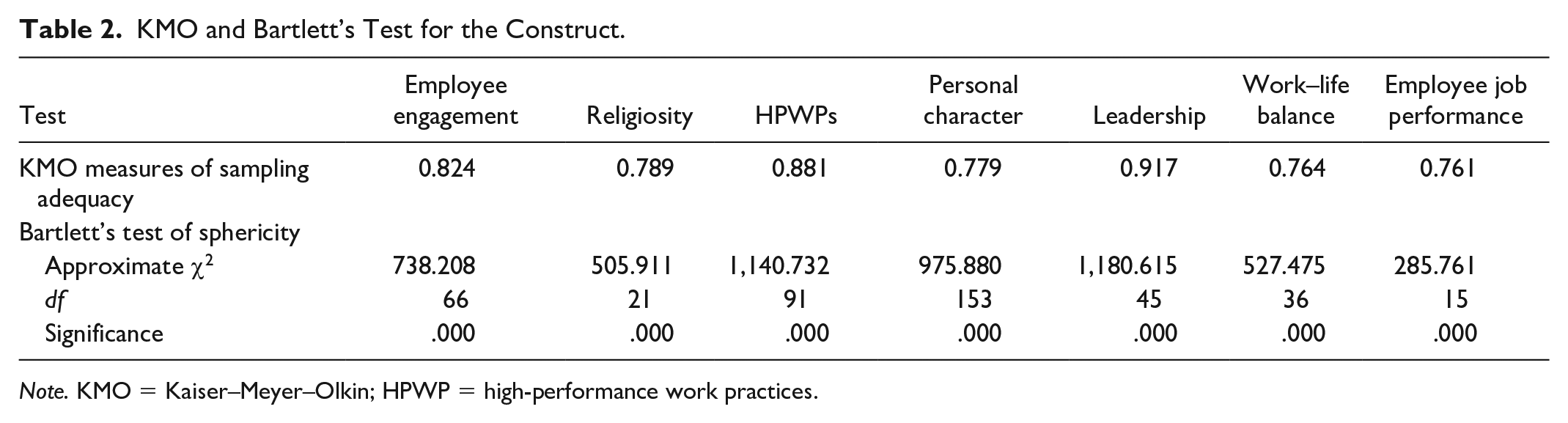
Note. KMO = Kaiser–Meyer–Olkin; HPWP = high-performance work practices.
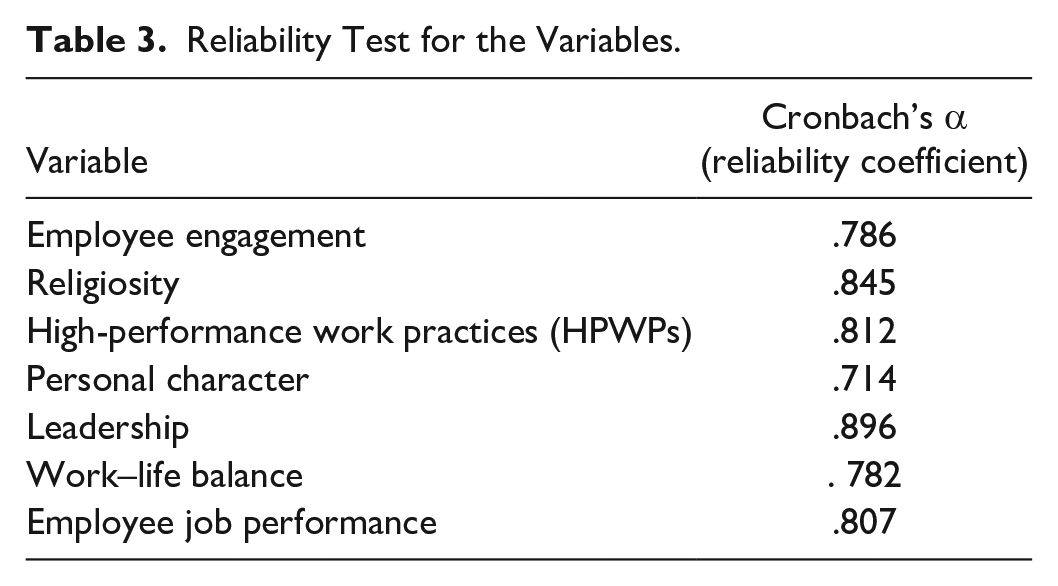
Table 3 presents the details of inter-item consistency reliability (Cronbach’s alpha) for the constructs. Cronbach’s alpha values range from 0 to 1, and in social sciences the values at or above .7 are desirable (Nunnally and Bernstein, 1994, as cited in Andrew et al., 2011). Cronbach’s alpha values of all the variables were in a desirable level.
Reliability Test for the Variables.
Sekaran and Bougie (2010) state that proper conceptualization and operationalization support the content validity. This study has ensured content validity of all the instruments through conceptualization and operationalization. With regard to each element of the dimensions, a question statement was developed.
The researchers used nonprobability sampling and the sample consisted of 272 respondents and followed a rule laid down by Roscoe (1975) as cited in Sekaran (2003). That is, when deciding the sample size, a sample size larger than 30 and less than 500 is appropriate for most research. The response rate was 52% of a population of 614. The Statistical Package for Social Sciences version 23 (SPSS 23) software was used.
Testing the Hypotheses
Testing the Hypotheses About the Selected Dynamics of Employee Engagement
Testing H1
The investigation of the Pearson correlation matrix of the variables is shown in Table 2. A one-tailed test was conducted. According to the bivariate hypothesis, when HPWPs are high, the level of employee engagement should be high. In other words, this is a nondirectional hypothesis. As shown in Table 4, HPWPs and employee engagement are highly correlated with a coefficient of .361. The relationship between HPWPs and employee engagement is highly significant at the level of .01. The null hypothesis is rejected and it can be concluded that the relationship between the two constructs, that is, HPWPs and employee engagement, is highly significant. Thus, the null hypothesis is rejected and the researchers can claim that there is a significant correlation between HPWPs and employee engagement. The same procedure was used to test H2 to H5 and the results show that the hypotheses formulated can be accepted while rejecting the relevant hypotheses (Table 5).
Correlation of HPWPs and Employee Engagement.

Note. HPWPs = high-performance work practices.
HPWPs and employee engagement are highly correlated with a coefficient of .361.
Testing Hypotheses 2 to 5.

Testing the Hypothesis About the Combined Effect of the Dynamics of Employee Engagement
The combined effect of the constructs on employee engagement emerged with a synchronized end product with five constructs, namely, HPWPs, religiosity, personal character, leadership, and work–life balance. Earlier, the construct called religiosity was hypothesized as an independent variable that relates to employee engagement (H2). HPWPs, personal character, leadership, and work–life balance were hypothesized as independent variables that positively relate to employee engagement (H1, H3, H4, and H5). Thus, it is argued that these five constructs will have a combined effect on employee engagement. These relationships collectively lead to H6.
Testing H6
The sixth hypothesis is based on the combined effect of five independent variables on employee engagement. Multiple regression analysis was used as the testing procedure and the results are presented in Table 6. The multiple regression coefficient (R) of the five independent variables and employee engagement was .452 (Table 7). The R2 value was .204 and it was substantiated that 20% of the variance (R2) in employee engagement has been significantly explained by the cluster of the five independent variables. Statistical evidence is presented in Table 8 to reject the null hypothesis. In other words, the large F value of 13.629 (p = .000) supports H6.
Multiple Regression Analysis for the Aggregate Impact of the Selected Dynamics on Employee Engagement.

Note. ANOVA = analysis of variance.
Dependent variable: Eng5. b Predictors: (Constant), WorkLifeBalance5, Religiosity5, HPWPs5, PersonalCharacter, and Leader5.
Aggregate Impact of the Selected Dynamics on Employee Engagement.

Predictors: (Constant), WorkLifeBalance5, Religiosity5, HPWPs5, PersonalCharacter, and Leader5.
Influence of the Dynamics of Employee Engagement on Employee Engagement.

Moreover, the effect of each of the five independent variables on employee engagement is shown in Table 8. HPWPs (HPWPs5) exemplify the strongest explanatory variable with the largest standardized beta of 0.264, while holding all other independent variables constant. Personal character (Personal Character) is the second strongest explanatory variable with a standardized beta of 0.174. With a standardized beta of 0.133, work–life balance (WorkLifeBalance5) becomes the third strongest explanatory variable. Religiosity (Religiosity5) and leadership (Leader5) have the standardized beta values of 0.057 and 0.050, respectively, which were not significant.
The t value presented in Table 8 is useful to identify the significance. A t value greater than 2 is considered significant. Therefore, religiosity and leadership are less significant. Tolerance tests were conducted for each independent variable. As per the recommendation by Norusis (1997), none of the tolerances for each of the independent variables is 0.01 or less than 0.01. It is evident that these independent variables do not suggest a multicollinearity problem. HPWPs, religiosity, personal character, leadership, and work–life balance were found to be significantly, positively, and jointly related to employee engagement. On the other hand, religiosity and work–life balance were not found to be significant predictors of employee engagement (though they are related individually).
Testing the Hypothesis About Employee Engagement as an Independent Variable
Testing H7
The same method used to test H1 was used to test H7. Employee job performance and employee engagement are significantly correlated according to Table 9. Thus, H7 is accepted.
Correlation Between Employee Engagement and Employee Job Performance.

Employee engagement are highly correlated with a coefficient of .228.
Testing the Hypotheses About the Mediating Role of Employee Engagement
The most common method for testing mediation in psychological research was developed by Frazier et al. (2004). There are four steps (with regression equations) for establishing the mediation effect of a variable on the relationship between a predictor variable and an outcome variable (Frazier et al., 2004). The four steps are as follows:
Showing that the predictor is significantly related to the outcome (Path C in Figure 6);
Showing that the predictor is significantly related to the mediator (Path A in Figure 6);
Showing that the mediator is significantly related to the outcome variable (Path B in Figure 6);
Showing that the strength of the relation between the predictor and the outcome is significantly reduced when the mediator is added to the model (compare Path C with Path C′ in Figure 6).
The relevant figure for the above method is shown in Figure 6.

Diagram of direct and mediating effects.
Direct Effect of HPWPs and the Mediating Effect of Employee Engagement
Testing H8
The testing hypothesis formulated for this study was that employee engagement will significantly mediate the relationship between HPWPs and employee job performance. The null hypothesis that there is no mediation of employee engagement on the relationship between HPWPs and employee job performance is stated. Multiple regression is used because Frazier et al. (2004, Figure 7) state that it is the appropriate statistical test to test hypotheses regarding the mediating effect.

Diagram of the direct effect of HPWPs and the mediating effect of employee engagement.
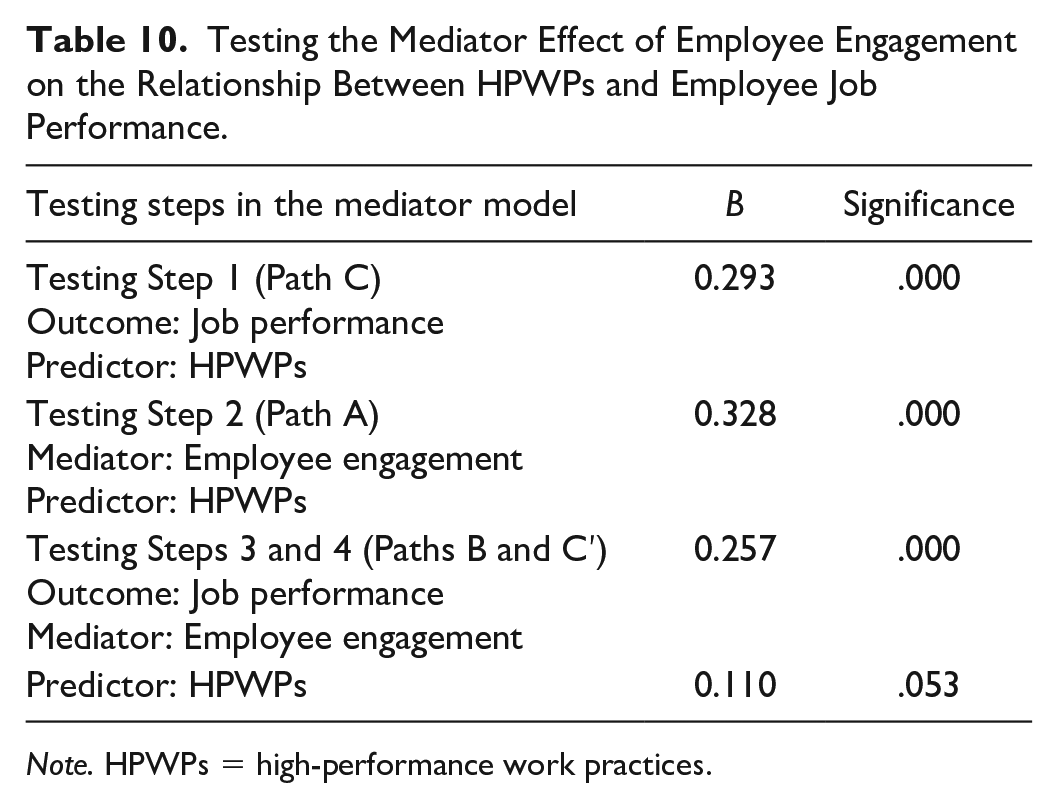
The results of the three regressions, the equations performed, are presented in Table 10. As shown in Table 10, the unstandardized field regression coefficient (B = 0.293) associated with the effect of HPWPs on employee engagement was significant (p < .01). Accordingly, Path C was significant and therefore the requirement for mediator in Step 1 was met. To establish that the predictor is significantly related to the mediator (Step 2), the regressing employee engagement on HPWPs was performed. Path A was significant. The reason is that the unstandardized regression coefficient (B = 0.328) associated with this relation was also significant at p < .01, and consequently the requirement for mediation in Step 2 was met. Employee job performance was regressed simultaneously on both employee engagement and HPWPs with the intention of meeting the requirements for Steps 3 and 4. There is a significant relationship (B = 0.257, p < .01) between employee engagement and employee job performance (controlling for HPWPs). The requirement for Step 3 was met as a result. In other words, Path B was significant. While controlling for employee engagement, the third regression equation also provided an estimate of Path C′, the relation between HPWPs and employee job performance.
Testing the Mediator Effect of Employee Engagement on the Relationship Between HPWPs and Employee Job Performance.
Note. HPWPs = high-performance work practices.
Frazier et al. (2004) point out that when Path C′ is zero, there is complete mediation; otherwise, a partial mediation exists. In this case, Path C′ was 0.110 and this is still significant (p < .01). As it was smaller than Path C (which was 0.293), there is a partial mediation. Accordingly, the eighth hypothesis is accepted. For this reason, it is possible to claim that employee engagement is a significant mediator of the relation between HPWPs and job performance.
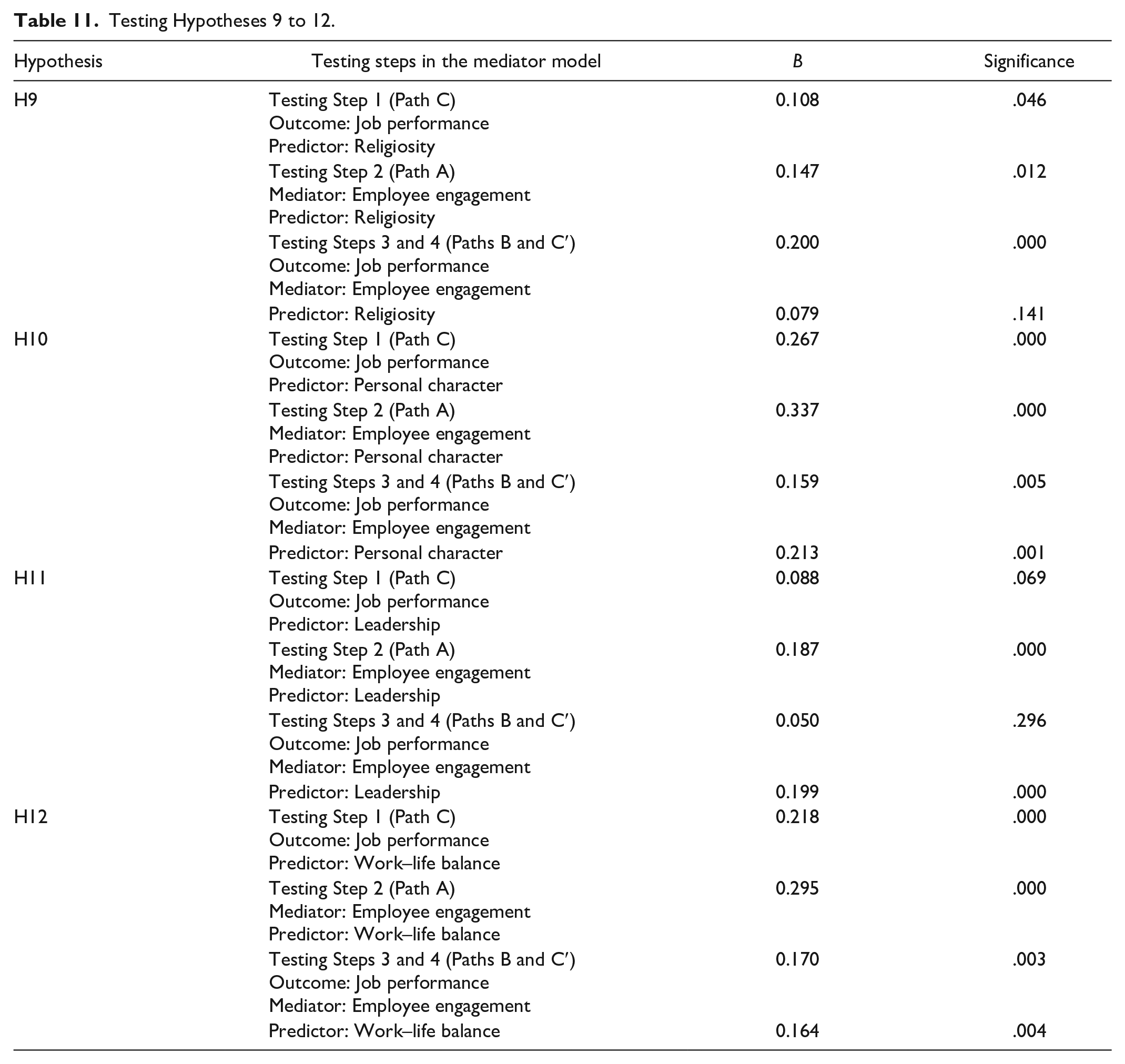
The same procedure was used to test H9 to H12 and the results (shown in Table 11) reveal that the formulated hypotheses can be accepted while rejecting the relevant null hypotheses. Thus, there is statistical evidence to claim that the selected five dynamics for this study play a mediating role in the relationship between employee engagement and employee job performance.
Testing Hypotheses 9 to 12.
Discussion
Even though a large number of studies on employee engagement have been conducted, ambiguities are still present. This is the view of Saks and Gruman (2014). The reason for their view is that in the frenzy or passion for research insufficient emphasis has been placed on the meaning of employee engagement, underlying theories, and measurement of employee engagement. This study was an attempt to fill five identified gaps in employee engagement using empirical evidence from Sri Lanka. In the business and academic domains, there is a desire to understand the essence of employee engagement in the present day, as the outcomes contribute to employee job performance (Anitha, 2014; Kang & Sung, 2019; Wassem et al., 2019).
As there are no previous similar direct studies being available to the researchers, there is no possibility of making a comprehensive traditional type of discussion to confirm the research findings through the previous empirical research evidence. Anyway, it is the belief of the researchers that the theoretical framework stands in a way that is theoretically sound as it was developed using the arguments, some empirical evidences, logical beliefs, and general theories. The first specific objective of the study was to investigate whether HPWPs, religiosity, personal character, leadership, and work–life balance significantly and positive relate to employee engagement. The relevant analysis produced significant and positive relationships or correlations between HPWPs, religiosity, personal character, leadership, work–life balance, and employee engagement.
It is evident that there is a significant positive relationship between HPWPs and employee engagement. Appelbaum et al. (2011) and Rana (2015) have conducted conceptual studies on the link between HPWPs and employee engagement. The relationship between these HPWPs and employee engagement can be explained theoretically with agency theory and justice theory. By testing the hypothesis that “the higher the HPWPs, the higher the employee engagement,” the researchers found a significant positive relationship between the two constructs, that is, HPWPs and employee engagement. Further analysis revealed that HPWPs become the strongest explanatory variable of employee engagement.
The study shows a significant correlation between religiosity and employee engagement. These findings point to the theoretical relationship with the theory of locus of control, employee engagement, and religiosity. Being a person with an internal locus of control, Eysenck (2004) possesses the idea that reward, outcomes, and consequences are the result of his or her own efforts. One will, as a result, be more concerned about practicing what their religious books teach as a way of fulfilling the duties and responsibilities given by his or her organization. According to Rahula (2006), the Sigalowada Sutta emphasizes the responsibilities of the employee, one such responsibility being the employee speaking well of the employer, complimenting his good reputation. As Hewitt (2015) mentions, an important attribute of the engaged employee is his or her positive comments about the organization to coworkers and customers, including positive comments about his or her leader.
As Eysenck (2004) states, certain people with an external locus of control hold the general belief that outcomes or the consequences will mostly depend on destiny, good fortune, or other external factors. Thus, employees with an external locus of control and a high level of religiosity tend to apply for leave to take part in religious worship or pilgrimage, which ultimately results in employee disengagement as a result of detachment from their office work. Researchers can state that the interrelationship between the theory of locus of control, religiosity, and employee engagement leads to a low correlation between religiosity and employee engagement. A highly religious employee with a tendency toward an external locus of control will have a tendency to be detached from work, as mentioned above, which ultimately leads to employee disengagement. On the other hand, the highly religious employee with a tendency more toward internal locus of control, in the belief that the rewards, outcomes, and consequences are a result of his own efforts, leads to employee engagement, as he or she practices what his or her religion says, with the intention of receiving assistance when accomplishing organizational goals.
The next is to take the relationship between personal character and employee engagement. It is important to consider unstated, undeveloped, and obscure theories in the global and local contexts. The adage, “the duty to the king” (Rajakariya) is nobler than “the duty to the gods” (Devakariya), is one such example from Sri Lanka. Loyalty is a virtue that a person with good personal character should have and loyalty, as Opatha (2010) mentions, involves being firm and not fickle in one’s relationship with someone, some organization, or country. Keller (2007) states that a particular person being loyal to someone or something means that he or she has an effect on his or her actions. Keller (2007) further states that the ways a person demonstrates loyalty are by following orders, promoting the interests of the object, and prioritizing it over other potential choices. Consequently, a person of high personal character is usually high in loyalty as well, which makes his or her performance of duties with loyalty to his or her organization considering it as a nobler service to divinity/religion.
Sahoo and Sahu (2009) state that engaged employees are loyal. Therefore, it is interesting to know about the relationship between employee engagement and personal character. Based on the theoretical evidence, the hypothesis developed is that “the higher the personal character, the higher the employee engagement.” A bivariate correlation analysis supported this hypothesis. Personal character is the second strongest explanatory variable of employee engagement.
This study also deals with the relationship between leadership and employee engagement. In their research, Christian et al. (2011) established that transformational leadership and leader member exchange were positively connected to employee engagement. The elucidation by Seijts and Crim (2006) as to how corporate leaders are duty bound to make the level of employee engagement among the employees stronger is explained under the Ten 10 Cs for employee engagement. The hypothesis that “leadership is positively related to employee engagement,” (H4) was also tested. The bivariate correlation analysis establishes that the constructs of leadership and employee engagement are significantly correlated, confirming that leadership has a positive relationship with employee engagement among the executives and managers in Sri Lankan companies.
Work–life balance is positively related to employee engagement in the directional hypothesis, namely, H5. Work–life balance and employee engagement were found to be positively and significantly correlated according to the bivariate correlation analysis.
The second specific objective of this study was to investigate whether there is a significant combined effect of HPWPs, religiosity, personal character, leadership, and work–life balance on the variability of employee engagement. The researchers empirically found that work–life balance and the four dynamics collectively explain 20% of the variability in employee engagement and this explanatory impact is significant.
The third specific objective of the study was to investigate whether employee engagement and employee job performance are significantly and positively related. Job performance is a critical phenomenon in the HRM, OB, and general management literature and is generally considered as a vital output or outcome (Opatha & Rathnayake, 2018). According to Szilagyi (1981), job performance is the key dependent or predicted measure of management and serves as the vehicle for judging the effectiveness of individuals, groups, and organizations. The relevant analysis produced a significant correlation between the two variables. This found relationship was instrumental in achieving the fourth specific objective of the study, that is, to investigate whether there are significant mediating effects of employee engagement on the relationship between the selected dynamics and employee engagement. It was found that employee engagement plays a significant mediating role on the relationship between the selected dynamics and employee job performance. The mediating role of employee engagement was partial. Iddagoda and Opatha (2017a) have identified some research gaps in the literature of employee engagement, and these findings of this study help bridge the identified research gaps.
Implications
The organization that is in need of enhancing employee job performance (ideally every organization must do) to achieve its vision, mission, and long-term goals is required to create and improve employee engagement. For the purpose of creating and improving employee engagement, the findings imply that HPWPs and personal character need to be manipulated appropriately. In this regard, it is suggested that the organization should concentrate on a bundle of the right HR practices which make a relatively higher impact on organizational effectiveness. In developing personal character of an employee, it is mandatory to build and enhance virtues such as honesty, loyalty, benevolence, patience, humility, and tolerance. Further vices such as jealousy, anger, hostility, retaliation, reprobation, selfishness, and deception are to be minimized within the employee. In this regard, HR functions such as selection, induction, training, performance evaluation, rewards management, and discipline management need to be directed to create, enhance, and maintain morality within employees to provide the organization with a workforce that is moral resulting in high employee engagement. In an attempt in HRM to develop an employee with a high level of religiosity, there may be problems because this is a personal matter. Also, different employees may follow different religions and in some organizations one religion is dominant. Attempting to promote other religions will be a big challenge and also may be unnecessary.
Leaders who supervise employees should set a good example of employee engagement and motivate subordinates to be engaged in their jobs. It is implied that efforts taken to increase employee engagement will significantly lead to increased employee job performance.
Limitations
Social desirability bias is a limitation. This can happen when the respondents answer questions relating to their personal character. Maccoby and Maccoby (1954), as cited in Fisher (1993), reveal that respondents are often unwilling or unable to report accurately on sensitive topics for ego defensive reasons and because of their perception of what is “correct” or “socially acceptable.” This social desirability bias was avoided to some extent by a clause in the questionnaire, which says, “Please avoid giving responses which are ideal if they do not genuinely represent your state or expectations.”
This study was based on a cross-sectional research design. Saunders et al. (2007) described a cross-sectional study as a study of a particular phenomenon (or phenomena) at a particular time, that is, a “snapshot.” They considered a longitudinal study as a study of a particular phenomenon (or phenomena) over an extended period of time. This research was based on a cross-sectional design. One reason is the time constraint and the other is the organizations’ main concern with profit making. Therefore, they do not allow their employees to spend time answering the questionnaires several times. The employees also are reluctant to answer the questionnaires at their leisure time. The reason is that there are many employees in the organizations who do not have much awareness of research methods. Also, they may misunderstand the reason for answering the same questionnaire several times.
Delimitations
The characteristics that limit the scope and define the boundaries of the study, in the view of Suresh (2015), can be the sample size, geographic size, population traits, and so on. He further mentions that delimitations help define the scope clearly and make the research study more practical and feasible. The most noticeable delimitation is that this research has focused on the five dynamics of employee engagement.
Future Studies
This nomological network can be tested in other countries as well. The identified research gaps can be empirically tested in the South Asia, Europe, Africa, United States, and so on by other researchers in the future. Field experiments or longitudinal studies can also be carried out as this study is only a cross-sectional study. This nomological network can be tested by adding other dynamics, and career development–oriented behavior of an employee is one such dynamic. For example, a particular individual may exhibit a high level of employee engagement if he or she aims at getting the next promotion seriously.
Conclusion
A total of 12 hypotheses were developed to test the relationships and mediating effects in the proposed nomological network of employee engagement. The results indicate that all the dynamics of employee engagement, namely, HPWPs, religiosity, personal character, leadership, and work–life balance, are significantly and positively related to employee engagement. The findings of this empirical study validate an explanatory model of employee engagement that could increase the understanding of the dynamics of employee engagement and be applied to enhance employee engagement in the listed companies in Sri Lanka. The general systems theory gives rise to the mediating role of employee engagement. These systematically and scientifically tested hypotheses are a contribution to the existing literature of employee engagement, especially in the Sri Lankan context where research on employee engagement is sparse.
Footnotes
Appendix
Declaration of Conflicting Interests
The author(s) declared no potential conflicts of interest with respect to the research, authorship, and/or publication of this article.
Funding
The author(s) received no financial support for the research, authorship, and/or publication of this article.
