




Abstract
New products improve competitiveness through their creativity and innovativeness. Creativity and innovativeness are parallel yet non-identical concepts; newly introduced products are either somewhat thematically similar or taxonomically similar to the existing products. There is a need for the explication of creativity and innovativeness as separate or as unified concepts in newly developed products, in particular, thematic products. A mixed-method design was adopted to establish definitions and components of creativity and innovativeness in the ideas presented at the innovation summit through 489 perceptual reports on 14 feature-based and theme-based product ideas. On the whole, three components—originality, value, and commercial appeal—were derived and tested. Results revealed the significance of originality as a major component of creativity and innovativeness in all products. Perceived value was significantly related to originality in both taxonomic and thematic products. Originality and value predicted creativity whereas innovativeness was predicted by commercial appeal along with originality and value in all products. The underlying purchase intention in taxonomic and thematic product ideas was the product’s relatedness with lifestyle. A product idea to be implemented in business as innovation was found to be dependent on its creativity and commercial appeal. This asserted three factors mandatory at the Fuzzy Front End (FFE), namely, originality, value, and commercial appeal. Discussion includes the interpretation of results and future directions.
Introduction
Creativity and innovation have a pervasive impact on the economic progress of a region. The driving force for prosperity, quality of life through the growth of enterprises, and sustained profits are due to novel products and services (Christensen, 2013; Drucker, 1998). The Western countries invest in Research and Development (R&D) which is positively linked with the production of novel products, processes, services, and optimized business performance (Brasil et al., 2016; Griffith et al., 2006). In less advanced countries, the outcome of investment in R&D is not always as expected (Crespi & Zuniga, 2012). Commitment toward R&D alone is not sufficient but bringing out the creativity which is the drive for scientific, cultural, and technological innovation is equally essential (de Buisonjé et al., 2017). It is the National Innovation System (NIS) which integrates all innovation-related initiatives and makes up a genuine base for creative and innovative output of a country (Freeman, 1995; Nelson, 1991). In the local context, ul Haq et al. (2014) expressed that Pakistan is making national-level efforts to attain innovativeness through an integrated NIS. According to Cornell University et al. (2015), Pakistan is the second country in South East Asia after India whose Gross Domestic Expenditure on R&D (GERD) was 0.68% in 2007, and since then, it is on a growing trend, which indicates its determination to strengthen NIS. Keeping aligned with the goals of NIS in Pakistan, Higher Education Institutes (HEIs) and Higher Education Commission (HEC) have taken a number of measures to raise Pakistan as a country which concentrates on research for socio-economic development (Kumari, 2015). Establishment and mobilizing Office of Research, Innovation, and Commercialization (ORIC) at HEIs and integration of HEIs with South Asia Triple Helix Association SATHA (Chapter Pakistan) are few of the milestones.
SATHA with the collaboration of Institute of Research Promotion (IRP) organizes Innovation Summit in all provinces of Pakistan to represent university enrolled students’ innovative outputs in multiple disciplines. The industry, as well as subject experts, evaluates these products, and the product ideas considered as patentable and promising are adopted by industry. The utility of innovation contests for new ideas that are novel and have commercial value is already supported in many studies (Haller et al., 2011; Hansen et al., 2011; Leimeister et al., 2009; Piller & Walcher, 2006). Choosing new product ideas from a platform which has endorsement from NIS makes the study rigorous yet very credible. Jackson et al. (2018) expressed that it is essentially “Mutuality” of the outcomes of various activities that can deliver bilateral benefit from collaboration and this gives a concrete purpose to the firm–university relationship.
Froehlich (2013), one of the seminal authors in “thematic thinking,” studied thematic ideas in the innovation contest held in Germany. The author analyzed the evaluations made on thematic ideas; yet no further analysis was done. As such, there is no study to date up to our knowledge in which the innovative student ideas are categorized on the basis of similarity and conceptualized as business ideas to comprehend creativity and innovativeness.
We used the new product ideas from a reliable, representative national platform; classified them based on taxonomic and thematic similarity; and extracted the definition and components of creativity and innovativeness in them. We estimated if creativity and innovativeness are perceived to the same extent in taxonomic and thematic products, and segregated the components which explain creativity and innovativeness. In addition, we have proposed the briefest components needed in new products for favorable evaluation at Fuzzy Front End (FFE).
Purpose of the Study
The purpose of the study is to connect the disjointed sub-fields of idea generation (usually associated with creativity) and idea implementation (associated with innovation) in one study as encouraged by Anderson et al. (2014) and advocated by the seminal authors in the domain of thematic thinking (Estes et al., 2011).
New products introduced in the market are fundamentally knitted in the concept of similarity; they are taxonomically or thematically similar to the existing products. They are expected to be creative and innovative, yet these two concepts are still evolving; they are controversial and overlapping (Isaksen & Treffinger, 1985). As dynamic concepts, new aspects are regularly supplemented in them. “Potential originality” and “inconclusive creativity” are recently added components of creativity (Corazza, 2016). So these must be defined continually in different contexts and different products.
It is still unexplored if taxonomic and thematic products are perceived as creative and innovative with identical components and with the same association with their components or not. The study extends to the comparison of thematically and taxonomically constructed new products on the aspect of creativity, innovativeness, new product ideation, and purchase intentions in the local context. We inventively proceeded with the definitions, fundamental elements, and interrelationship of creativity and innovativeness by integrating theory, interview themes, and local description. The void of thematic thinking’s application in the local context is filled by the empirical investigation on how subject-related respondents perceive creativity, innovativeness, and their components in feature-based and theme-based new product ideas. Reaching rigorously at the minimum criteria for shortlisting new product ideas at the FFE and deriving the underlying factors an individual considers in preferring one product over another highlight the practical significance of thematic thinking in the innovation literature.
Due to the differences in the cognitive approach, it is generally believed that Eastern raters would trade novelty for usefulness as compared with Western raters (McCarthy et al., 2018). Ideas based on thematic and taxonomic similarity were subjected to individual ratings on creativity and innovativeness, which were expected to be different due to diverse cultural backgrounds of the raters and construction of these products. However, no empirical finding is reported if there is a trade-off in assessment on taxonomic and thematic products in the Eastern context, which is addressed in this study.
Creativity and innovativeness in products are desired to encourage purchase intentions. Empirical investigation to uncover the underlying elements of purchase intention in thematic and taxonomic products is negligible in the local context. So, thematic and taxonomic products were conceptualized as business ideas to extend earlier attempts to assimilate thematic thinking with business as conceived by Froehlich and Hoegl (2012) and Gibbert and Hoegl (2011). This practice was done to propose a straightforward mechanism at FFE of businesses to predict the success of a product in the market. Core elements of an idea at the ideation stage, which could make it more likely to be purchased, were determined. The underlying cognitive side of purchase intentions (applicability in the daily scenario or accentuated features) due to thematic and taxonomic product preference was also assessed.
Theory and Hypotheses
There are different types of motivations behind ideas which are launched in the market. Thematic ideas and thematic products are also derived from various impulses. These can be aimed to improve the experience of the users within the context as Xylobands do in concerts and light shows. They can be developed to strengthen the relationship with customers as Amazon Kindle. Thematic ideas can provide a solution to a problem as Octoberfest Security App, and the aspiration can be to commercialize an existing product in a new target group as Liberation Wrapper was introduced in the Japanese market (Froehlich et al., 2014). In these cases, the construction of products mentioned above is governed by the role of thematic similarity among the entities that perform complementary functions in the development of new valuable and successful products.
Taxonomic relations are explained by Estes et al. (2011) as they “entail membership in a common category based on shared features, they are based on internal properties of objects with themselves, so they tend to be similar to each other in their features” (p. 255). The similarity in features is not only about internal properties, but they are context-dependent too (Hampton, 2006; Markman & Wisniewski, 1997; Medin & Shoben, 1988). So ideas that are based on the similarity of features, although in different contexts, are developed in ways to accentuate features of a product which are quite similar to the core products in somewhat predictable ways. The business domain is full of success stories of products which are based on taxonomic similarity like Frito Lays, which has introduced several flavors based on taxonomic similarity and aimed at giving an improved value for the product.
Estes et al. (2011) defined thematic relation as “any temporal, functional relation between things. Entities or things are thematically related if they perform complementary roles in the same scenario or event” (p. 251). Later, Golonka and Estes (2009), Lin and Murphy (2001), and Wisniewski and Bassok (1999) explained thematic ideas as those ideas in which two or more entities which apparently seem distant are joined in complementary roles in a common theme.
The most famous example of such innovation is Nike+, which is a collaboration of Apple’s iPod and Nike Jogging shoes. Nike incorporated a chip in the shoe, which enables the person to know jogging speed, monitor calories burnt, and customize music preference. It was launched in 2006, and 450,000 units were sold by 2007 (Froehlich et al., 2014; Gibbert & Mazursky, 2009). The ideation through a thematic lens has unrestricted options for new products. The activation of category relations plays a fundamental role in analogical thinking where the same entities can have unlimited relations distinct from the individual entities (Green et al., 2006).
Studies have shown that individuals process information governed by a dual process, and those who tend to process information globally would look into the entities by giving preference for thematic similarity (Estes et al., 2011). Thus, individual raters will assess the product as per their distinct processing style. It is yet to be known how ideas of products constructed on different types of similarity are evaluated on aspects of creativity and innovativeness comprehended in background knowledge of these concepts. This is even more challenging as the components of creativity and innovation have a variation in interpretation as pointed out by Weisberg (2015), that the term “value” has different interpretation by common people and subject experts.
For example, when creativity is considered as a process, it is attached with the ability to solve problems and improve processes for higher productivity as cited by Kaplan and Simon (1990). Creativity at the individual level describes the abilities and traits of an individual to exhibit specific characteristics of generating original ideas and problem solving (Guilford, 1950).
On occasions when creativity is about products, it is related to embrace specific characteristics such as novelty, value, adaptability, surprise, and adaptive to reality (Barron, 1955; Bruner, 1962). We contest creativity as described by Amabile (1982) that any product is creative when it is considered creative by appropriate observers and has the attributes of novelty and usefulness. She further explained creativity as the best guess made by the appropriate observer on the primary concept of originality and value attached by its users and implementers. Amabile (1996) emphasized that individual creativity leads to innovativeness in organizations; she explained an interconnection where creativity acts as raw material, and innovation is the final output in the form of successful new products. If the drive is more creative, the result would be better innovations too. R. G. Cooper and Kleinschmidt (1993) and R. G. Cooper (2003) stated that innovativeness in products is the unique benefit that is meaningful to its customers. The main element “unique” is related to creativity, “benefits” are derived from value, and “meaningful to its customers” indicates that the customers can be end-users or other businesses. And they must derive a comprehendible advantage from the product. This suggests that creativity and innovativeness are closely nested concepts. The discussion is concluded in the following hypothesis, which explains the high interrelatedness of creativity and innovativeness in all products apart from how they are developed and how they perform:
New products and new product ideas can both be considered as products and thus can be given a similar treatment when being assessed on creative content (Guilford, 1967; Runco et al., 2001). The quantification of creativity in products is reflected in the Runco Ideational Behavior Scale (RIBS), which is used as a criterion of creative ideation. One of the earliest frameworks which addressed the evaluation of creativity in products was revealed by Besemer and Treffinger (1981). It was published as Creative Product Analysis Matrix (CPAM) by Besemer and O’Quin (1986). Later it was revised, and an improved version of the Creative Product Semantic Scale (CPSS) was developed by Besemer and O’Quin (1987). The creative elements in CPSS were established on three dimensions: novelty, resolution and elaboration, and synthesis. In an extended study, data collected on CPSS was subjected to factor analysis and O’Quin and Besemer (1989) found only two distinct factors in CPSS, that is, novelty, and resolution and elaboration, whereas other subscales migrated to these two factors. It shows the three-dimension synthesis, which was about the design, elegance, and charm of the product, to be a weaker independent factor and not a critical, independent element of creativity. This evidence endorses our theoretically supported elements of originality and value as components of creativity. In business, though, the creativity alone is not enough to implement an idea, and is called “a starving artist”; to get the status of the creative product in businesses, it has to be appealing to attract customers and market share. There is, thus, an implicit indication that commercial appeal is related with the creative output of businesses. The element’s commercial appeal is an important component of innovativeness as only those creative ideas are implemented which are considered in demand. Our understanding is supported by Damanpour and Gopalakrishnan (2001), who suggested that originality and value are the basic factors which lead to the implementation of an idea as innovation. The fine line of demarcation between the two concepts is still not tested in the local context; consequently, creativity and innovation are perceived as overlapping concepts, one concept, or closely related. It is, however, clear that originality (novelty, uniqueness), the use-value of a product (adaptability, application, and utility), and commercial appeal (competitiveness) are the main elements to explain creativity and innovativeness in all product categories.
Long (2014) pointed out that judgments made on the creativity of a product are mainly personal conclusions and depend on those implicit virtues of creativity which individuals have in their minds. Amabile (1982) had addressed this by pointing at the unreasonableness of predefined criteria for creativity; she negated the concept of universal criteria for creativity and supported personal disposition. The personal logic and disposition on creativity are also advocated by Beghetto and Kaufman (2007) who demonstrated that there is a significant reflection of one’s interpretation and subjectivity on the assertion that a product, process, or idea is creative or not. A product which is considered creative and innovative by one may not be evaluated in a similar way by others. It was discovered by Estes et al. (2012) that participants judged thematic brand extensions more positive due to the ease with which they processed and evaluated the products. But Froehlich and Hoegl (2012) found on the contrary that people with a preference for thematic similarity did not predict creativity as they might have higher standards for creativity and innovativeness. Therefore, it is correct to say that raters are also affected by their cognition, subjectivity, and preference. We consider that ideas at innovation summit would vary in their appeal to the subject-related participants on creativity and innovativeness as well as their derived components. The following hypotheses are, therefore, framed:
There is no doubt in expressing that new product development and innovation are interlinked. In business, only those ideas which are creative as well as innovative can move in the production pipeline; all other ideas are rejected. For this study, we would take on the briefest yet a very comprehensive description provided by Stauffer (2015), who expresses innovation as “valuable novelty.” This definition has two significant parts; the first part says that innovation must give some benefit through its adoption and use. Innovation must be of utility reflected in either improving competitive position or processes or give enhanced experience in using it, and it should be appealing to prospective customers for adoption. The other aspect says that innovation must be something new, new not always in its absolute sense, but it should be an outcome of some cognitive effort and not be an intentional duplication. Innovativeness is elaborated further as “the capacity to produce valuable novelty” (Stauffer, 2015), which elucidates innovativeness in two ways. First, innovative products have two virtues, that is, novelty and value which are attributes of creativity (Amabile, 1982), and second, innovative products have varying capacity to be new (unique, uncommon) and valued (competitive, useful, adaptive). Clearly, originality and value are mandatory factors for creativity as well as innovativeness, and the implied hint is that for an original/novel product to be implemented, it must have sufficient demand in the market. Here, we reach at two points that creativity in an idea can be original and valuable alone, but to implement a creative idea as innovation in business, it should have commercial appeal along with originality and value. This discussion supports in deriving the following hypothesis:
As we have built our case for assessment of creativity and innovativeness when the products are at the ideation stage, its congruence with FFE is expected. The domain FFE in new product development was enriched by Smith and Reinertsen (1998), and its relevance to the returns led the researchers to conduct many studies in this field (R. G. Cooper & Kleinschmidt, 1994; Koen et al., 2001). The FFE is a filter stage which allows only novel, value-driven, useful, adaptable, and commercially competitive ideas to go further into various advanced stages of new product development. If an idea is deemed as not original, useful, practical, and adaptable, it is rejected (Murphy & Kumar, 1997) at FFE. Ideas at the FFE if evaluated rigorously can bring out creative ideas as promising innovations (Herstatt et al., 2006). Hart et al. (2003) studied 166 businesses on their devised evaluation criteria for new product ideas in the suggestion systems; they stated that product uniqueness, its feasibility, and intuitive appeal were given significant importance as evaluation parameters. Licuanan et al. (2007) emphasized on originality as major evaluation criteria for success of ideas although they cautioned that overemphasis on originality might curb many potentially competitive ideas which might be more successful innovations through adaptability and value. Froehlich et al. (2014) found “scenario” and “experimental proximity” as critical elements in thematic idea construction, which contribute to the favorable evaluation. These studies, among others, have implied fundamental components which make up the briefest list. This study has conceptualized these factors as originality, value, and commercial appeal; all of them are the attributes of creativity and innovativeness, so we propose the following:
New products are actually “the best fit” between existing products and newly developed needs; we may say that new ideas are generally similar to the existing ideas or core products but refined to current needs. This is especially evident in brand extensions where the extension products are similar to the core products as Keller and Aaker (1998) pointed that 80% new products which are offered in the market are somewhat similar to the core product.
If two or more entities are directly compared with each other, this determines their similarity (Tversky, 1977), known as taxonomic similarity. On the contrary, if two stimuli interact and participate in a common theme or scenario although they are difficult to compare, a secondary process of integration comes in, and thematic similarity is perceived (Bassok & Medin, 1997). So similarity is one of the main cognitive constituents by which new product ideas are generated and anticipated “best fit.” Yet, their appeal to their prospective users and success in business are due to different factors. The expectations are usually derived from the core products, which are, to a certain degree, imaginatively similar to the new product. Martin and Stewart (2001) clearly expressed that “perceived similarity is highly relevant to purchase intentions; the role of similarity is so pervasive that knowledge, affect and intention are transferred through this medium” (p. 471). Studies conducted in the field of neuropsychology established that brand extensions which are based on thematic similarity are evaluated more favorably than taxonomic brand extensions (Lee & Labroo, 2004). Estes et al. (2012) gave an excellent example of Budweiser Chips and Budweiser Cola in which cola is the taxonomic brand extension, which is not a hit but the combination Budweiser chips is a hit.
Similarly, in the local scenario, Pepsi’s integration with Lays Chips is a notable success. Theme-based ideas do not necessarily have entities in complementary roles in a traditional sense (Estes et al., 2012), as thematic ideas have unlimited ways to form new products and there are no pre-established complementary links among the products. So, a new idea may emerge as a result of perceived similarity of unrelated entities complementing each other in a purely novel and unique way (Estes & Jones, 2009; Simmons & Estes, 2008).
There is a greater potential of making valuable, successful new products thematically as the concept of thematic similarity goes above and beyond the existing complementary goods which usually have a very high association (Estes et al., 2011). It is the unique feature of thematic thinking, which allows imagining new scenarios and creating one’s own interpretation of the thematic relations. It is equally possible that one can think of ways in which an idea can be generated in scenarios one has never experienced in an actual way. In a study done on the evaluation and understanding of product pairs, it was found that product pairs that were linked through feature were comparatively difficult to understand and interpret (disk-iron; an iron which was round and flat). Whereas product pairs which had a relational link were easily understandable by the participants (leather iron; an iron which can iron leather) denoting the ease in processing thematic pairs. It was interpreted that product pairs which were relational (car–computer, armchair–TV, and collar–phone) were more scenario-based; and understanding of such relational links among entities was easier by the participants (Gill & Dube, 2007). This cognitive mechanism is based on fluency which is the speed and ease with which a link is processed and adds to the positive evaluation of the product or idea for adoption (Froehlich et al., 2016), so we hypothesize the following:
A meaningful evaluation of the ideas presented at the early stages of idea generation makes it possible to carry forward only those ideas which have the highest potential for more business (Glen & Hauser, 1993). This decision is only possible if accurate knowledge about the product concept, its adaptability, demand in the market, and its alignment with company strategy is judged through various evaluation methods (J. R. Cooper, 1998). One of the significant aspects considered at the new product development stage is the product concept which is based on the competitive potential of a product to enter a market (Kleinschmidt et al., 2005). The competitive strength of a product is driven by the ratio of price and performance when compared with the similar products in the market, where the performance of the product is attributed to its supplementary enhanced features which differentiate it from the other products (R. G. Cooper, 1994). Continuous improvement of the manufacturing function which is translated in the perceived value of the product plays a very important role in the pursuit of competitiveness in the long run of a firm as found in the Indian context (Singh et al., 2008). It is reported that products are evaluated positively at the very initial stages if they are unique, are novel, and have the potential to perform well due to their improved features as compared with other products (J. Kim & Wilemon, 2002; Schmidt et al., 2009). We hypothesize as follows:
Method
Sample and Data Collection
The sampling frame for this research comprised the subject-related recruits. The suitable respondents were the students with basic knowledge of business-related concepts of creativity and innovativeness in new product ideas. The population was the business students from management sciences and business administration departments from all five provinces of Pakistan. Master’s-level (marketing) and graduate students in their final semester with marketing as specialization were contacted at random.
This study utilized a cross-sectional survey design, and a questionnaire was floated to get data on various research questions. The questionnaire was crafted to extract the definition and components of creativity in half of the survey forms, which we called Sample 1. The other half of the survey forms explored the definition and components of innovativeness, which we called Sample 2. An appropriate proportion of the respondents from each province was reflected in the samples. The questionnaires were sent officially through the ORIC (component of NIS) established at all HEIs. Wherever possible, a parallel effort was done to administer the questionnaire through various groups on social sites of the universities as well as through reference.
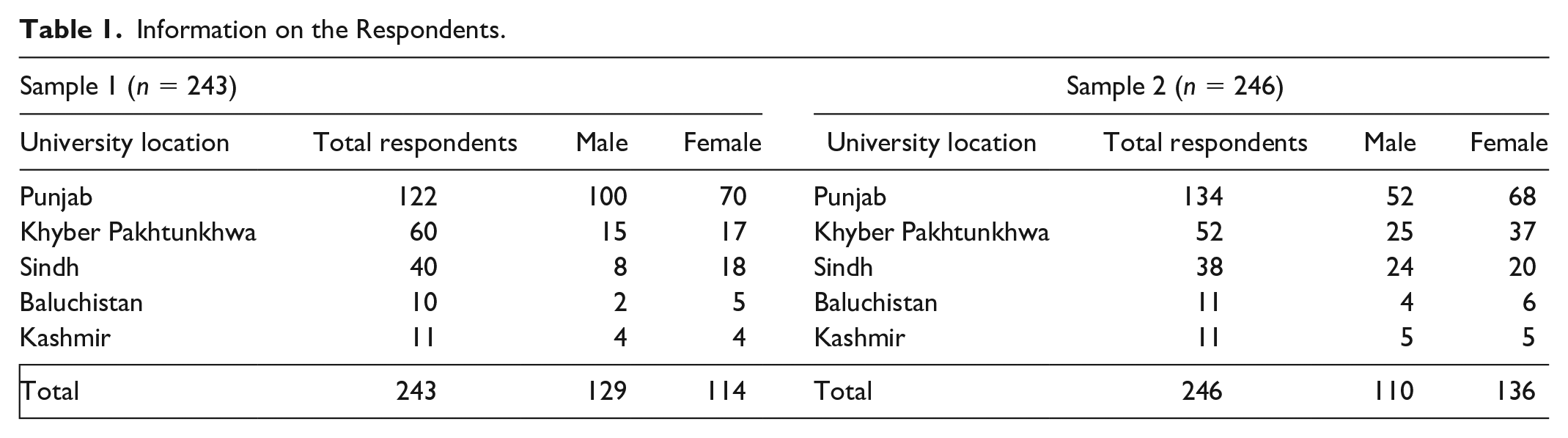
One thousand survey forms were sent to subject-related recruits. A total of 500 forms were received back, but complete forms in all respect were 243 in Sample 1 (who responded for creativity) and 246 in Sample 2 (who responded for innovativeness), the response rate was 50%. Information on the respondents included in Samples 1 and 2 is given in Table 1.
Information on the Respondents.
Tasks
More than 500 ideas from 2010 to 2016 were shared from Innovation Summit Organizers through proper channel by IRP. The product ideas belonged to three categories. They were
ideas,
ideas in experimental stages, and
ideas whose prototypes were made.
Inclusion Criteria for Products
As the idea and its basic construction was the base for analysis, all ideas were included in the first step. In the next step, any idea which belonged to the field of pure science, which lacked the element of commercialization, or in which simply in-depth understanding of the idea was not possible for a subject-related respondent (Business Administration, Management Science) was excluded from the list. This study was conducted during 2014–2017, so older ideas presented from 2010 to 2013 were excluded. Ideas which were attractive, less inclined to pure sciences, and presented between 2014 and 2017 were more than 100.
There is an indication in creativity literature that it is a dichotomous trait: people, processes, and things are either creative or not (Amabile, 1983). This preliminary inclusion criterion was adopted to restrict the study to creative and innovative ideas only. The list of 100 products was circulated among the research groups working in the domain of marketing, brand management, industrial management, and entrepreneurship. The context of this study was explained, and they were asked to give their opinion (Yes/No) on the incidence of creativity and innovativeness in them. Every idea was reviewed by five participants; if two reviewers out of five considered the product as not creative, the idea was discarded from the list. Out of 100 ideas, only those ideas which had an overall agreement on the creative factor were selected. The final list had 70 ideas, and the ratio of thematic and taxonomic ideas was 25:45. Two thematic and two taxonomic ideas from 2014 to 2017 were chosen by two independent researchers. The conditions for selection were that they were clearly distinguishable as thematic and features-based ideas, were suitable on social aspects, and were interesting to read. We finally had 14 ideas, half thematic ideas and half feature-based ideas.
To assess that the product list is coded with accuracy, an inter-rater reliability assessment was done by two subject-related independent trainees. Kappa statistics was employed to verify the inter-rater reliability. The assumptions of Cohen’s Kappa were met as two raters were independent, they gave their response on a categorical variable, and the categories were mutually exclusive. Thematic products were coded “1” and feature-based products were coded as “0.” Both raters assessed the same product ideas, each response variable had the same number of categories, and cross-tabulation was symmetric; here it was 2 × 2, and the two raters were fixed as they were specifically chosen for this study.
Out of 14 ideas, all seven products were classified as thematic products by both raters. Similarly, both raters agree on six products to be categorized as taxonomic or feature-based products. The consistency of agreement was established by using Kappa, the values of Kappa was 0.857 (p < .001) which is considered substantially good agreement according to the standard mentioned by Landis and Koch (1977) with 95% confidence intervals (CI) [0.590, 1.123]. Recent application of inter-rater reliability is quoted by Stephens et al. (2015) among many who employed independent student trainees for coding.
Operationalization of Variables
The definition of a creative and innovative product is depicted by Pakistan patent ordinance 2000 which says that “patent is an exclusive right granted by the State for an invention that is new, involves an inventive step and is capable of industrial application.” This definition focuses that innovativeness and creativity mean newness with use-value in the local context.
A short interview was conducted with the creative heads and brand managers of five MNCs to comprehend their perception of principal elements of new product ideas, which are creative and innovative. For the current research, 11 heads of MNCs which are well-known in the local context for their creative products and services were contacted. These top-level managers were taken as the empowering leaders and knowledge managers as they render support for inbound and outbound open innovation by involving their employees in improving their knowledge management capability and participating directly in decisions related to the implementation of creative product ideas. Recent research by Naqshbandi and Tabche (2018), Naqshbandi et al. (2019), and Naqshbandi and Jasimuddin (2018) also supported this notion that the organizations with innovative output perform well due to the empowered leaders, knowledge management capability, and highly involved followers in decisions related to new knowledge developments.
We collected data via short face-to-face interviews with 11 cases. We found a minimal number of themes which they considered vital as components of creativity and innovativeness in new products. The themes which were highlighted by all of them were originality, value, and commercial appeal or competitiveness. Technical feasibility was also expressed as a critical factor by them, but we ignored it as it was not in the scope of this study.
From literature, standard definition of creativity was adopted which was first introduced by Stein (1953) and later endorsed by many including Amabile (1983), James et al. (1999), and Mumford et al. (1994). This definition also coincides with the local concept of creativity. We considered creativity as a two-factor concept; one factor revolves around novelty, uniqueness, originality, and surprise element, and the other factor is related to usefulness, adaptability, and improved value for usage.
Innovativeness for our study was defined as any creative idea which has the adjudication and potential of gaining acceptance and adoption by its users. The concept of “valuable novelty” by Stauffer (2015) was focused on defining innovativeness in new products and processes. These ideas are potentially beneficial to the business; the same concept is endorsed by R. G. Cooper and Kleinschmidt (1995). This definition also agrees with the elaboration of innovation given by West and Anderson (1996) and Wong et al. (2006).
In addition, creativity and innovativeness are mostly expressed as related concepts; past studies endorse that creativity is the element which captivates new ideas, and ideas when adopted and accepted for implementation, are considered to be innovative (Shalley et al., 2015). Innovation is elaborated as a process that starts with a creative idea and ends on its successful implementation (Nahavandi et al., 2013). So, innovativeness was conceptualized in the current study to build on three factors, namely, originality, value, and its commercial appeal.
Procedure
Participants were provided with a survey questionnaire which had a brief description of the product in simple language. The order of questions after description was random in all survey forms except the first question; each product in the survey form in Sample 1 was about creativity, and for Sample 2, it was about innovativeness. As the aim was to uncover the definitions for creativity (in Sample 1) and innovativeness (in Sample 2), these two terms were not defined. Yet the other factors or constituents, that is, originality, value, and commercial appeal were defined, keeping in view the literature, local definition, and themes derived from interviews. A similar convention was employed by Acar et al. (2017) to extract the definition of creativity and innovation in the Western context. It was asked as follows:
Brief description of the product (e.g., Milk Boiling Indicator)
Please rate the extent to which you consider this product has the element of “creativity.”
In Sample 2, the first question after a brief description of the product was asked about its “innovativeness.”
The rest of the survey in Samples 1 and 2 was the same; the following questions were asked in random order. The terms to explain the factors were derived from Amabile (1996), Acar et al. (2017), R. G. Cooper and Kleinschmidt (1995), and local definition.
Please rate the extent to which you consider this product is “original”; by originality we mean to refer to the qualities of infrequency, novelty, unusualness, rarity, uncommonness, uniqueness and as an inventive step.
Please rate the extent to which you consider this product is of “value”; by value we refer to the qualities of a product’s capability to resolve a problem, to work properly, to serve a purpose, adaptable, or helpful in short and long terms.
Please rate the extent to which you consider this product is of “commercial appeal”; by commercial appeal we refer to the qualities of the product if implemented to gain customer liking, its competitiveness, its potential to attract buyers, and its expected industrial application and demand.
Two separate questions were asked to assess the purchase intentions linked with creativity in Sample 1 and innovativeness in Sample 2.
If you buy this product due to its creativity (Sample 1)/innovativeness (Sample 2), to what extent it is the product’s relatedness with lifestyle which makes it more creative (Sample 1)/innovative (Sample 2)?
If you buy this product due to its creativity (Sample 1)/innovativeness (Sample 2), to what extent it is due to the product’s enhanced features which make it more creative (Sample 1)/innovative (Sample 2)?
Participants were asked to rate their perception on a 5-point Likert-type scale ranging from very low creativity to extremely high creativity and very low innovativeness to extremely high innovativeness. The scale for originality, value, and commercial appeal ranged from very low to very high. Whereas for relatedness the scale was not at all related to highly related and for features, it ranged from not at all due to features to mostly due to features on 5-point Likert-type scale to acquire the variation of ratings in the variables of interest.
Results and Discussion
The analysis examined the proposed hypotheses of the study, and a prior examination to test the assumptions of multiple linear regression was conducted rigorously. A sample size of 489 (Sample 1 = 243, Sample 2 = 246) was considered adequate, given the number of variables of study (Tabachnick & Fidell, 2001). The independent variables were unique and considered singular as they were not a combination of other independent variables. The correlations among the variables were all above 0.30 and below 0.80, which suggested that the variables were neither redundant nor multi-collinear (Hair et al., 2008). The collinearity statistics, that is, Tolerance and VIF (variance inflation factor) were within the acceptable range as defined by Hair et al. (2008). None of the values for tolerance was above 1, and VIF values were always less than 10. The VIF values in our analysis did not exceed 3.95 and mostly ranged from 1 to 3.5. Therefore, multicollinearity did not pose a threat to the regression results of this study.
As this was an exploratory study based on rater’s assessment of new thematic and taxonomic product ideas, the Cronbach’s alpha values ranging from .50 to .72 were deemed acceptable as per Cristobal et al. (2007), Sprecher (2002), and J. Kim and Wilemon (2002), and explained by Cronbach and Shavelson (2004). An examination into the Mahalanobis distance scores did not indicate any multivariate outliers. Residuals and scatter plots indicated that the assumptions of normality, linearity, and homoscedasticity were all met as per the defined standards of Hair et al. (2008) and Pallant (2013).
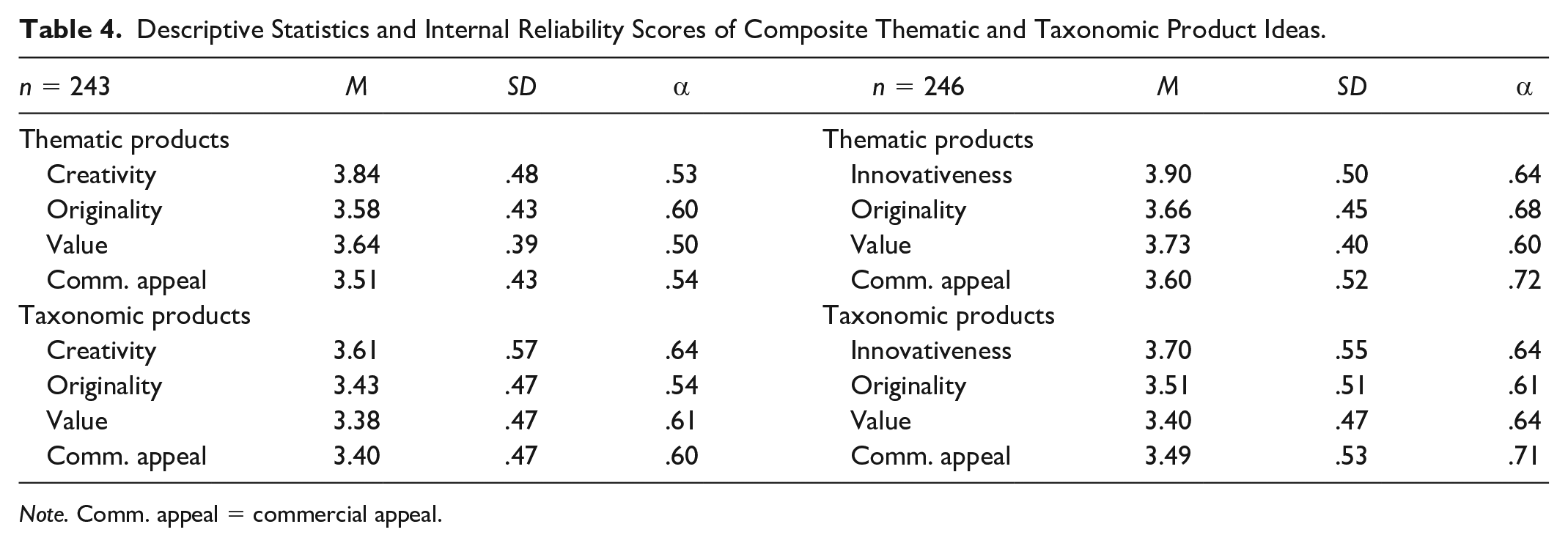
Tables 2 and 3 present the descriptive statistics for Sample 1 and Sample 2, respectively, and in Table 4, the composite values are given.
Descriptive Statistics of Individual Thematic and Taxonomic Product Ideas and Creativity.

Note. Comm. appeal = commercial appeal.
Descriptive Statistics of Individual Thematic and Taxonomic Product Ideas and Innovativeness.

Note. Comm. appeal = commercial appeal.
Descriptive Statistics and Internal Reliability Scores of Composite Thematic and Taxonomic Product Ideas.
Note. Comm. appeal = commercial appeal.
As the same respondent rated creativity in Sample 1 as well as the other three factors “originality, value, and commercial appeal.” Similarly, in Sample 2 same respondent answered for innovativeness along with other factors. The survey design was carefully crafted to avoid common method variance (CMV) and common source variance (CSV). Three strategies were adopted to take care of the potential error in measurement. First, the order and sequence of the variables were not kept constant, but the independent variables were shuffled in the survey forms. Mixing and counterbalancing the sequence of the questions is a neat strategy to avoid CMV according to Podsakoff et al. (2003). This measure was practiced by Acar et al. (2017) in a study in which they derived the components of creativity and innovation in four types of products. Second, clear and context-based definitions of the components were given to avoid any ambiguity as technical jargon or colloquialism may cause CMV, as explained by Spector (1992). Originality, value, and commercial appeal were defined in the light of previous literature, short interviews, and local context. This step was taken to avoid the CMV, as indicated by Fiske (1982). Third, the survey did not embrace elements of social approval or acceptance, so the chances of bias were naturally less. Still, respondents’ participation was voluntary; they were not paid and were randomly selected, their identity was not compromised, and these actions further reduced the elements of leniency and social desirability effects decreasing CMV as explained by Podsakoff et al. (2003).
All items were subjected to exploratory factor analysis (EFA) in which the number of factors was constrained to one known as Harman’s Single Factor test. All perceived variables were subjected to factor analysis to observe the unrotated factor solution to discover the number of factors necessary to account for the variance in the variables (Podsakoff & Organ, 1986). The unrotated solution was analyzed and the single factor was obtained that explained much less than 50% of the variance; to be precise, 14% in Sample 1 and 14% in Sample 2, suggesting the absence of common method bias.
Control Variables
As control variables, three demographic variables were added in the first step of regression. Among the product ideas, many were more male-role focused, and many were female-role focused. Usage context by gender roles (generally) might lead to biased responses according to Urban and Von Hippel (1988). Previous research also showed that the assessment of a product might be affected by the perceived value the evaluators attach to a product (Bloch et al., 2003; Franke & Schreier, 2008). It is also indicated in literature that if an individual (male/female) is more desirous for a product and gives importance to its usage, its evaluation would be more positive and that individual would consider the product more creative and innovative (Swait & Sweeney, 2000; Treadgold, 1999). So we used gender as a control variable in which males were coded as “1” and females were coded as “0.”
“Status,” which indicated if the respondents had a rural or urban background, was controlled for in the analysis. It was coded as “1” for urban and “0” for the rural background of respondents. The local context is around 60% rural, so it was pragmatically decided to control for the inflated or deflated response from respondents of rural or urban origin due to differences in lifestyle and awareness of creative and innovative ideas.
Finally, a variable “education” was also controlled for due to the regional differences in education. It was considered that the differences in assessment of products might be attributed to the quality of education and conceptual clarity on various business-related concepts taught in different regions of Pakistan. The difference in the quality of HEIs was determined by the ranking of HEC in Pakistan. Higher ranking of the HEI was coded as “1” and lower as “0.” These controls were included in the first step of hierarchical linear regression to combat the bias in responses due to other factors.
It was found that raters evaluated creativity and its components differently from innovativeness and its components in thematic and taxonomic products, as depicted in Table 4. To test if the raters assessed creativity in thematic products statistically different than in the taxonomic products, we ran a t test. When creativity was analyzed in Sample 1, the t value t(242) = 7.426, p < .000, showed that there was a statistically significant difference in the ratings for creativity in thematic and taxonomic products. The mean difference of 0.227 indicated that there was a significant increase in the ratings for thematic products than the taxonomic products. When innovativeness was analyzed in Sample 2, the t value t(245) = 6.46, p < .000, showed that there was a statistically significant difference in the ratings for innovativeness in thematic and taxonomic products. The mean difference of 0.2 indicated that there was a significant increase in the ratings for thematic products when compared with taxonomic products. These results showed that our hypothesis regarding the perceived difference due to subjectivity and the cognitive difference was valid for this study.
The correlation values presented in Table 5 depicted that creativity in thematic products (upper half) was significantly and positively correlated with all factors, but it was highest for originality (.658, p < .001). In thematic product ideas, originality and value had the highest positive correlation (.721, p < .001).
Bivariate Correlations Among Creativity, Originality, Value, and Commercial Appeal Among the Thematic Product Ideas (Upper Level) and Taxonomic Product Ideas (Lower Level) in Sample 1 (n = 243).

Correlation is significant at the .01 level (two-tailed).
Similarly, the correlation values of creativity in taxonomic products (lower half) were significantly and positively correlated with all factors, but it was highest for originality (.708, p < .001). A similar trend of highest correlation between value and originality was found in taxonomic products reaching the value of .800 (p < .001). These highest correlational values indicate that whether it is a thematic or taxonomic product, raters perceive products more creative if they consider it more valuable, showing that originality and value are significant to decide whether a product is creative.
Another reason for this strong correlation is that products exhibited in the innovation contest were student group output, and they were equally dedicated to the usefulness aspect rather than novelty alone. The contestants, as well as the raters associated value as a very important component of creative and innovative products. This deduction has support from a stream of studies on the cultural aspect of how people perform individually and in groups when engaged in creative projects. It is discussed by Liou and Lan (2018) that Eastern cultures (Taiwanese) came up with more useful rather than novel ideas when engaged in group tasks whereas Western (American) participants produced more novel ideas when they worked in groups. We also concluded that the raters in Eastern culture evaluated thematic products higher on creative and innovative content as they considered them more applicable, useful, and of value.
These correlation values presented in Table 6 depicted that innovativeness in thematic products (upper half) was significantly and positively correlated with all factors, but it was highest for originality (.717, p < .001). In thematic product ideas, originality and value had the highest positive correlation (.784, p < .001) with a little difference that originality was correlated with commercial appeal (.719, p < .00). The correlation values depicted that innovativeness in taxonomic products (lower half) was significantly and positively correlated with all factors, but it was highest for originality (.687, p < .001). In thematic product ideas, originality and commercial appeal were strongest in positive correlation, having a value of .787 (p < .001). These results conferred that innovativeness was strongly associated with implementation by raters and, therefore, commercial appeal is a strong correlate of innovation in both taxonomic and thematic products.
Bivariate Correlations Among Innovativeness, Originality, Value, and Commercial Appeal Among the Thematic Product Ideas (Upper Level) and Taxonomic Product Ideas (Lower Level) in Sample 2 (n = 246).
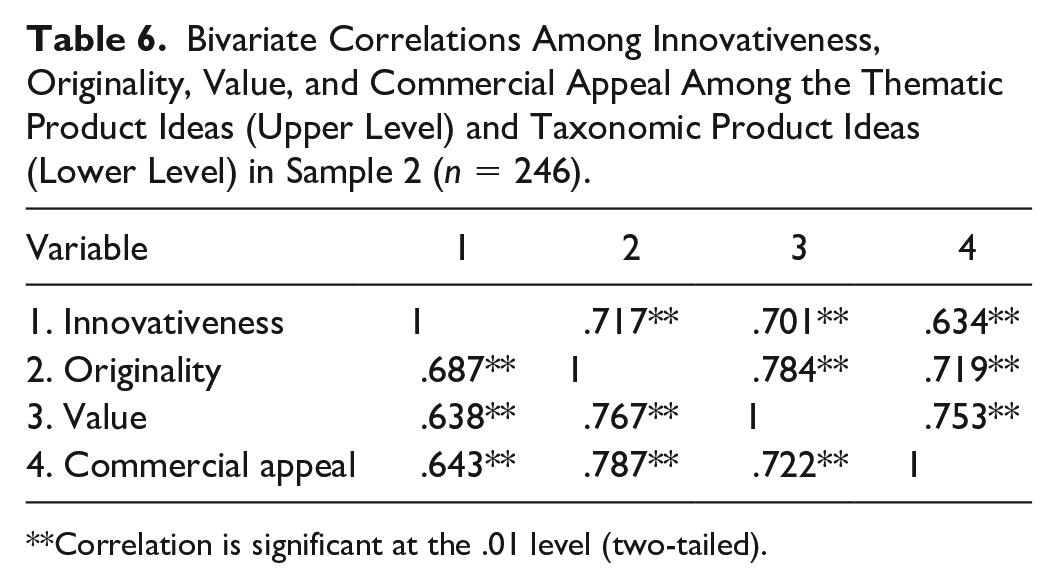
Correlation is significant at the .01 level (two-tailed).
We ran a regression to establish the predictive power of originality, value, and commercial appeal for creativity in Sample 1 and innovation in Sample 2 to confirm our hypotheses. The regression results are summarized in Table 7.
Regression Analysis Results for Composite Values of Thematic Product Ideas and Taxonomic Product Ideas for Creativity and Innovativeness.

**p < .01.
Separate regression analyses were run to acquire the relative explanatory power of originality, value, and commercial appeal for creativity in Sample 1 and innovativeness in Sample 2 as a whole. The analyses were controlled for variance due to other factors by including gender, status (representing background), and education at the first step. In the final step, all predictors (originality, value, and commercial appeal) were entered at once to explore how these predictors affect the criterion variables (creativity, innovativeness). In Sample 1, the three predictors, originality, value, and commercial appeal, explained 53.5% variance in creativity, the beta values indicated that only two predictors, originality and value, were significant at p < .001. In Sample 2, the three predictors, originality, value, and commercial appeal, explained 61.3% variance in innovation, the beta values indicated that all three predictors, originality, value, and commercial appeal, were significant at p < .001. The coefficient values indicate that they are highest for originality (β = .48 and β = .32 for creativity and innovativeness, respectively) followed by value (β = .23 and β = .28 for creativity and innovativeness, respectively) and then commercial appeal (β = .04 and β = .21 for creativity and innovativeness, respectively) in which the beta values of commercial appeal for creativity were insignificant but significant for innovativeness. Hence, our hypotheses for components of creativity and innovativeness were supported by our study results. It is also worth noting that the third element, commercial appeal, has strong theoretical links with the implementation of creative products as innovations (Amabile, 1996; Shalley & Zhou, 2008) and so reinforce the components of innovativeness. This relation is empirically reflected in the regression analyses for innovativeness, where innovativeness is significantly predicted by originality, value, and commercial appeal. As Anderson et al. (2004) pointed out in their study, an adaption of a new product which might not be truly or absolutely creative is also innovation as it is implemented due to its utility and value. Far earlier, it was expressed by Zaltman et al. (1973) that innovation includes revolutionary ideas as well as incremental ideas which are less novel but more practical for businesses. Table 7 explains that originality is the primary predictor of creativity and innovativeness in both thematic products and taxonomic products. To explore if these factors go above and beyond originality to predict creativity and innovativeness in taxonomic and thematic products, we utilized hierarchical linear regression and entered originality first, then value, and finally commercial appeal was entered. The results are detailed in Table 8.
Hierarchical Regression Analysis Results for Composite Values of Thematic Products Ideas and Taxonomic Product Ideas for Creativity and Innovativeness (n = 243).

p < .05. **p < .01.
Gender, status, and education were entered in Step 1, originality was entered in Step 2, value was entered in Step 3, and commercial appeal was entered in Step 4 of hierarchical linear modeling (HLM). The analysis with creativity as the dependent variable indicated that originality explained 43.4% of unique variance in thematic products and 51.9% variance in taxonomic products. Value explained 2% additional variance for thematic products and 4% additional variance for taxonomic products. The last factor of commercial appeal could not explain any variance above and beyond originality and value.
When innovativeness as the dependent variable was analyzed, originality explained 52.1% variance in thematic products and expressed 51.2% variance in taxonomic products. Value explained 5% additional variance for thematic products and 1% additional variance for taxonomic products. Commercial appeal explained 1% additional variance for thematic products and 3% additional variance for taxonomic products above and beyond originality and value. These results indicate that creativity and innovativeness in products are explained by one pervasive factor, originality, which is a necessary component of both. Yet value is expressed as a second major factor; in business-related products, it accompanies originality to predict creativity. But when innovativeness is analyzed, commercial appeal comes up as a component which explains innovativeness above and beyond originality and value. This relationship explains the trade-off between novelty and usefulness in the local context. It also indicates that new product ideas which are selected for implementation in business can be a little less novel, but they must have commercial appeal. This finding is an accurate match with the new products launched in the local context, which perform well in the market place more due to their value and usefulness rather than novelty alone.
Two separate questions were asked to assess the purchase intentions of respondents owing to creativity in Sample 1 and innovativeness in Sample 2. It was asked by the raters in two separate questions against every product to know how these products were evaluated on two separate aspects. The questions were framed as follows:
If you buy this product due to its creativity (Sample 1)/innovativeness (Sample 2), to what extent it is the product’s relatedness with daily scenarios and lifestyle which makes it more creative (Sample 1)/innovative (Sample 2)?
If you buy this product due to its creativity (Sample 1)/innovativeness (Sample 2), to what extent it is due to the product’s enhanced features which makes it more creative (Sample 1)/innovative (Sample 2)?
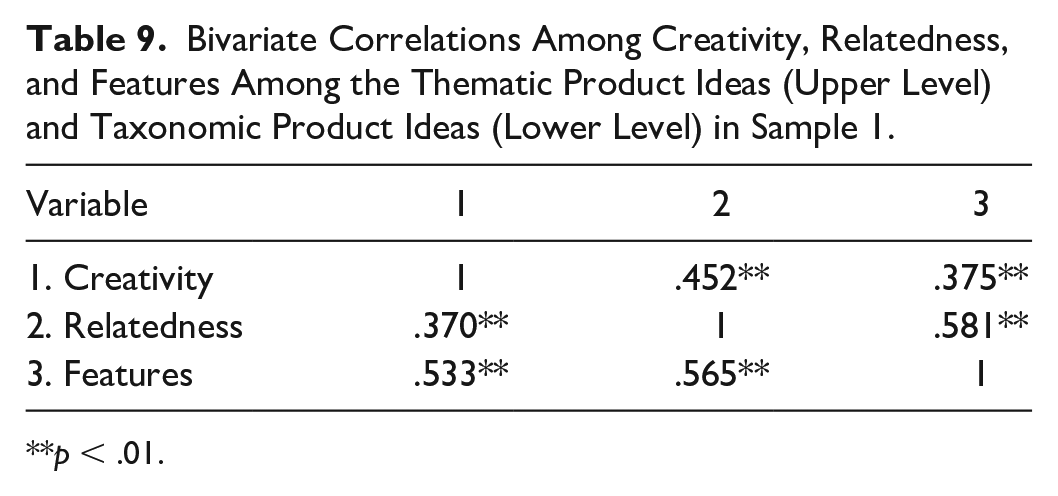
The correlations of creativity in thematic and taxonomic product ideas with relatedness and features are depicted in Table 9.
Bivariate Correlations Among Creativity, Relatedness, and Features Among the Thematic Product Ideas (Upper Level) and Taxonomic Product Ideas (Lower Level) in Sample 1.
**p < .01.
The correlations show that creativity in thematic products was more strongly correlated with relatedness (r = .452, p < .01) as compared with features (r = .375, p < .01), and creativity in taxonomic products was more strongly correlated with features (r = .533, p < .01) as compared with relatedness (r = .370, p < .01). This result reveals that raters considered thematic products creative and buyable as they considered them more related to their lives. Whereas, taxonomic products were rated creative and buyable as they had advanced features. In both cases, creative products either based on themes or features were bought with a perspective that they were original plus they give value. It is equally possible that they may have found novelty in combining unrelated themes and value in advanced features.
The correlations of innovativeness in thematic and taxonomic product ideas with relatedness and features are depicted in Table 10.
Bivariate Correlations Among Innovativeness, Relatedness, and Features Among the Thematic Product Ideas (Upper Level) and Taxonomic Product Ideas (Lower Level) in Sample 2 (n = 246).
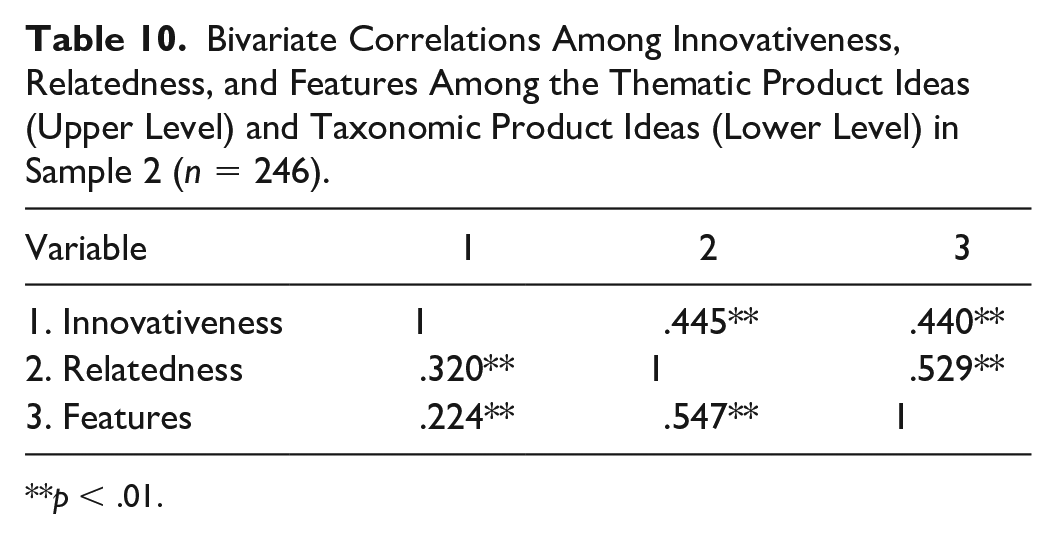
**p < .01.
The correlations show that innovativeness in thematic products was more strongly correlated with relatedness (r = .445) as compared with features (r = .440, p < .01). But in contradiction to our hypothesis, innovativeness in taxonomic products was more strongly correlated with relatedness (r = .320, p < .01) as compared with features (r = .224, p < .01) although it was hypothesized that innovativeness in feature-based products would be attributed to their advanced features. This result revealed that raters considered thematic as well as taxonomic products more innovative and buyable because they considered them related to their lives. Estes et al. (2012) pointed out in his study that thematic products were evaluated more positively, and such ideas were processed quickly due to the processing ease in relating the product ideas.
It was, therefore, assumed in this study that thematic product ideas would be rated higher on creativity and innovativeness ratings by focusing more on their participation in common themes. As taxonomic products are constructed on the concept of improved features in the core products, the underlying reason for their purchase would be the features, but our findings were contrary. Raters always evaluated the products when keeping in mind their purchase intent by preferring the relatedness of the products with their lives to make purchase decisions. The findings, however, reinforce our previous conclusion that innovativeness is perceived as the implementation of something unique, valuable, and having commercial appeal. If a new product has all three attributes, it has an edge in the market to be sold. As this edge could not be traced in feature-based product ideas presented at innovation contest, raters did not relate their buying intentions with the features rather they related their buying with the closeness of product ideas with daily scenarios. Plausibly it can be said that feature-based innovations also need to touch the relatedness aspects to become successful innovations.
The results of the empirical analysis have few findings which are concurrent with the previous findings. The component originality has been established as the essential element for both creativity and innovativeness. Originality being the most important factor for creativity has support from the previous work of Runco and Acar (2012), Diedrich et al. (2015), and Acar et al. (2017). Whereas originality as the most dominant component of innovativeness has its support from many historical innovations such as telephone in 1880, automobile 1900, and the airplane by Wright brothers in 1903 as discussed by Kline and Rosenberg (2010). Acar et al. (2017) also found originality as a dominating factor when they analyzed the components of innovation in three different types of products, that is, ideas, everyday creative products, and socially recognized products. Nieto and Santamaría (2007) based their study on the novelty of innovations in Spanish industry and expressed it to be an important element for successful innovations made in technological sectors. There is also an agreement on the primacy of originality as a fundamental component of creativity and innovativeness as reflected in the definition of the patent in the local context which says that it must be an “inventive step.”
This study highlights that innovativeness in the local context is expressed as a concept which is composed of three factors: originality, value, and commercial appeal. This relationship was found valid in both types of products, thematic and taxonomic, in our analysis. So the implementation of a creative idea to become innovation has three components: originality, value, and commercial appeal. Kline and Rosenberg (2010) expressed that it is the commercial value, the economic relevance, or competitiveness of a product that acts as a vital factor to make it a successful innovation. All the components predicted creativity and innovativeness as a whole, yet the individual ratings differed in these two groups. Raters ranked thematic products as more creative products compared with the taxonomic products (Mthematic = 3.84, Mtaxonomic = 3.61) and rated innovativeness high in the thematic products as compared with the taxonomic products (Mthematic = 3.90, Mtaxonomic = 3.70). This finding supports the suggestion by Froehlich and Hoegl (2012) that there is an enormous scope of thematic products as they are able to create the best “fit” between needs and new products by supplementing the taxonomic perspective in new product development.
The products exhibited in the innovation contest were a joint output of HEIs, IRP, and SATHA, which are integral elements of NIS. They were focused equally on the aspects of being creative and useful for the socio-economic progress of Pakistan. Integration of student outputs as thematic and feature-based new product ideas to the business environment was for the first time ever done in the local context, which opens up new projects to explain thematic thinking in the local business environment.
The significant positive correlations between originality and value are coherent with the results of Acar et al. (2017) but contrary to the findings of Diedrich et al. (2015) who reported a negative correlation between novelty and value in their study. This difference might be due to the particular type of ideas which were studied by them, and respondents did not attach value to those novel products. We also conclude that the rater evaluation for thematic products was higher on creative and innovative content as they considered them more novel as well as applicable and useful. This discussion leads us to the conclusion that there is a wide space for thematic products to supplement taxonomic products in the market as successful new products.
Theoretical and Practical Contribution
This research has bridged the gap between the two separate, yet related, models of idea generation related to creative problem solving and idea implementation allied with innovation as team cognitive processes which occur as social process in organizations as identified by Reiter-Palmon et al. (2012). The current research has pooled theory, practice, and respondent perception on creativity and innovativeness yet keeping the sanctity of thematic thinking as a fundamental cognitive process affecting new product ideation as well as evaluation in real-life products.
The current research has opened an avenue to embrace thematic similarity when constructing new product ideas or initiating idea generation process. It has empirically established the parallels as well as the odds of two interrelated concepts, which clarify the comprehension of these intertwined concepts to augment the existing knowledge at FFE of new product development. The study supports that individual perception to prefer a product is attributed to the “value” one attaches to a product (E. Kim et al., 2019); this creates a relevance of successful products with a lifestyle. Hence, the current study endorses Froehlich et al. (2016) on the manifestation of themes, experimental proximity, and inclusion of personal perspective in innovative products.
Limitations and Directions for Future Research
This study focused on the raters’ assessment for creativity and innovativeness and obtained assessment on only creative and innovative products exhibited in the innovation contest. A similar study on those product ideas which are in the R&D of various industries can enrich the real state, volume, and response of taxonomic and thematic products. There is an agreement that prospective users of the products can give valuable inputs in innovation (Magnusson, 2009) but the assessment they give may lack the necessary reliability to make informed decisions (Eling et al., 2015), although we kept this in mind, to avoid it, expert opinion could be used for more authentic ratings.
The major emphasis of this study was on the conceptualization of creativity and innovativeness and their components in two major types of products; a separate study on thematic products alone in an explorative manner could be helpful to understand any further components which can predict their success in the market. To reduce individual tendency to rate a product more superior than the other, some other confounding variables could be operationalized in future studies. Only one aspect of culture, that is, status as an urban or rural was accommodated in this study; other dimensions such as “tolerance for ambiguity” which is generally low in Eastern culture could be tested in future studies.
Footnotes
Declaration of Conflicting Interests
The author(s) declared no potential conflicts of interest with respect to the research, authorship, and/or publication of this article.
Funding
The author(s) received no financial support for the research, authorship, and/or publication of this article.
