



Abstract
While a consensus has emerged on the importance of creativity in graphic design and multimedia field, little systematic research has attempted to understand its facilitators or inhibitors in the graphic and multimedia education across colleges and universities. The current investigation surveys a sample of experts as well as professors teaching across the Arab World concerning their perceptions on the most significant correlates of creative thinking among students. Results point to the importance of: (1) instructors’ engagement; (2) appropriate use of instructional strategies, tools, and resources; (3) institutional support; (4) peer support; and (5) the removal of red-tape regulatory frameworks. Most importantly, this research highlights the need to move away from the rigid higher education creativity model assuming perfection, precision, accuracy, and optimal effectiveness to a more flexible creativity framework. The Multi-Layered Autonomous Phases Model (MLAPM) is proposed as an alternative approach to cultivating creativity at the higher education level. The MLAPM applies to all levels beginning with the students and the instructor in the classroom and all instructional tools applied, moving upward to the institutional administration levels. The model offers cost-effective, flexible, dynamic, and effective practices that improve levels of creativity and creative thinking among students without the need to invest in new costly equipment, tools, curriculum, or instructional programs.
Introduction
Creativity is defined as “the process of sensing problems or gaps in information, then identifying the difficulties and seeking solutions through trial and error or through forming hypotheses” (Torrance, 1966). Creativity has been found to significantly improve students’ academic performance, employability, productivity at work, and career promotion prospects (Jackson, 2006; Jahnke et al., 2017; McIntyre et al., 2018; Sharif, 2019). Increased creative thinking abilities are highly correlated with higher entrepreneurial activity, enhanced leadership practice, and more avenues for innovation (Hughes et al., 2018; Rambe et al., 2017).
Undergraduate students across countries have performed poorly on creativity assessments (Kim, 2011; Niu & Sternberg, 2001; Sebastian & Huang, 2016). Irrespective of college major, students have exhibited low scores on verbal and figural creativity tests (Beck & Davidson, 2001; Kohn, 2000; Milner, 2012; Proctor et al., 2006; Rana & Mahmood, 2010). Numerous studies reported meagre achievement of undergraduates on emotional expressiveness, storytelling articulation, vitality, elaboration, novel visualization, richness of imagery, colorfulness, fantasy, playfulness, and innovative closures (Elias et al., 2011; Newman-Ford et al., 2009; Pitan, 2013; Putwain et al., 2013; Yusoff et al., 2013). The present research investigates the facilitators and barriers of creativity in higher education within the Arab World, a neglected context in creativity research (Adeniyi & Yusuf, 2016; Alshare & Sewailem, 2018; Chan, 2013; Karpova et al., 2011; Kim et al., 2019; Mrayyan, 2016; Razzaque & Moylan, 2015). This study examines graphic design and multimedia classrooms in which creativity and innovation are essential and critical.
A number of problems in the creativity literature are addressed by this study. First, it offers instructors, students, administrators, and policymakers in the Arab World with a distilled list of facilitators, as well as strategies to implement them to foster increased creative thinking, a missing resource in creativity research in Arab higher education literatures (Al Shobaki et al., 2018; Hillman & Baydoun, 2020; Rababah et al., 2018). Second, it offers a flexible model for creative thinking abilities overcoming the perfection, resource draining and universality problems describing common frameworks for creative thinking enhancement (Barak & Levenberg, 2016; Bryndin, 2019; Hidayat et al., 2018). Third, it provides future researchers with a validated instrument measuring creative thinking from faculty’s and experts’ perspective in Arabic, a needed tool reiterated by many authors in the literature (Ahrari et al., 2016; Ulger, 2018; Ülger & Morsünbül, 2016).
The research problem of this research is the absence of systematic knowledge on the facilitators and inhibitors of creative thinking and creativity in graphic design and multimedia majors in the Arab World universities. Further, the perspective of experts and faculty concerning creativity cultivation in Arab colleges and universities is seldom investigated. Another related research problem is the need to elevate low levels of creativity among Arab college students majoring in graphic design and multimedia. Further, most of Arab colleges and universities have limited resources requiring an alternative approach to creativity fostering. There is an imminent need to improve creativity attitudes and practices among undergraduate students, and therefore knowing the facilitators help faculty in fostering more creative thinking in their classrooms.
Two main contributions characterize the present manuscript. First, it identifies the most necessary qualities required to improve students’ creative thinking from faculties’ and experts’ perspectives based on an extensive survey. Instructor’s interactivity, engagement, and empowerment of students’ autonomy, as well as collaboration facilitates the construction and implementation of creative thinking. Further, the use of peers’ facilitated group-based projects, problem-solving, simulations and gaming are likely to foster more creative thinking and application in, as well as beyond the classroom. The removal of bureaucratic, and institutional red tape blocking instructors, department chairs and deans from injecting new instructional, and cooperative programs is highlighted among the most important features supporting the construction, and manifestation of creative thinking in higher education.
Second, the Multi-Phases Autonomous Model (MPAM) for creative thinking enhancement across all levels of higher education is introduced. This model overcomes many common problems plaguing existing or promoted creativity models in higher education today (Burnett & Keller-Mathers, 2017; Catarino et al., 2019; Donnelly, 2004; Jackson et al., 2006). It is not sequential requiring the complete fulfillment of each necessary step requirements prior to the commencement of the next step like Waterfall paradigms (Baillie, 2006; Cheng, 2019; Miller & Dumford, 2016; Sharif, 2019). Also, it is not resource-draining like many models in the literature like the Waterfall-based creativity initiatives prevalent in policymaking circles in education departments and ministries (Cropley & Cropley, 2008; James & Nerantzi, 2019; Lee et al., 2015). In addition, its implementation is flexible, and could be applied by a single faculty or the entire personnel of a higher education system (Fischer et al., 2016; Jackson et al., 2006; Vally et al., 2019). This guarantees the injection of creative thinking at a minimum at every classroom endangering change toward the elevation needed in creative thinking aptitude among Arab college students.
Literature Review
Limited research has examined the facilitators of creative thinking at the undergraduate level in the Arab World (Al Shobaki et al., 2018; Hillman & Baydoun, 2020; Rababah et al., 2018). More importantly, the perspective of faculty and experts in the literature on creativity in higher education in the Arab World is neglected (Yusoff et al., 2013). Graphic design and multimedia majors require a great deal of creativity, and systematic knowledge based on empirical findings on its facilitators at the undergraduate level is meagre (Sharif, 2019).
Creativity in Higher Education
Despite the proliferation of investigations on the conceptual parameters of creativity in higher education, most thinkers agreed on core dimensions of the construct including the identification of gaps, originality of solutions, expressive elaboration of details and the colorful narratives, figures or products conveying information (Chang, 2014). Franken refers to creativity as the proclivity to produce or acknowledge original work and ideas that have value for a special purpose, including academic, entertainment, communications, arts, or in any given field/discipline (Franken, 1998). Creativity is perceived as a need to solve encountered problems, communicate a set of ideas or values to others, or inject a modicum of motivation and stimulation in order to generate desirable changes in a given domain. This understanding is consistent with Weisberg’s (1993) understanding of the adjective creative being either the original and novel product of value, the person who made it, and the ability to generate such a product. Similarly, Csikszentmihalyi (1997) conceptualized creativity as the ways in seeing the world in original and novel fashions and creative individuals are those who possess such a characteristic, as well as being engaging, interesting, stimulating, and motivating.
A survey of the literature has generated five domains of factors that influence undergraduate students’ creative thinking: instructor, instruction, institution, peers, and systemic attributes. Instructor factors concern the qualifications, experience, knowledge, skills and abilities of the individual teaching creativity. Institutional factors cover the formal and informal policies, norms, expectations, culture and climate concerning creativity at the organizational level. Peers’ factors concern the qualities, characteristics and attributes of learners’ classmates, colleagues and coworkers, as well as any collaborative or group interaction involving creativity. Systemic factors refer to the general environment surrounding the higher education infrastructure including government policies, existing human capital, resources and technologies.
Instructor and Creativity
Teachers with higher levels of professional development, experience, skill sets, and specific training involving creativity have been better at sparking creative thinking in their courses (Thurlings et al., 2015). Teachers who value the role of creativity, understand the myths surrounding its harm in the classroom, and are regardless committed to its implementation and better at increasing their students’ interest and implementation of creative learning (Owen, 2015). Papadakis (2016) concluded that teachers’ prior experience as creative individuals in their fields is associated with the level of innovation injected in the classroom. Instructors’ technical expertise in various learning technologies also influence the level of creativity in assessments, instruction, and feedback, which in turn affects students’ creative learning levels (Cropley, 2015). Moreover, teachers who are not rule-bound and foster the use of outside material and resources not mandated by the curriculum are better at fostering creativity and innovation in comparison to traditional teachers who stick to the curriculum (Ferrari et al., 2009).
Instruction and Creativity
Research on creativity in education has demonstrated a robust link between instructional strategies used in the classroom and students’ level of creative thinking. Seechaliao (2017) interviewed 11 experts in instructional strategies and asked them about the profiles of instructors best suited for cultivating creativity in the classroom and beyond. Respondents suggested that instructors who rely on problem-based inquiry approaches, featuring the provision of challenging problems to students requiring detailed solution proposals and unique findings coupled with timely, responsive, and constructive feedback, are more likely to encourage and improve creative thinking. Papaleontiou-Louca et al. (2014) found that instructors who employ curiosity, challenging tasks, analogies, collaborative learning, and diverse instructional methods enhances students’ innovative and creative thinking. In their review of the enablers of creative and innovative learning, Ferrari et al. (2009) suggested that teachers who demonstrate their value of creativity tend to exercise democratic practices in the classroom, project passion and involvement in class material, tailor tasks toward student needs, emphasize process-based learning, and develop students’ self-efficacy, regulation, and esteem.
Prior research on creative thinking in undergraduate classrooms has highlighted the significant positive role of technology in fostering better creative learning environments (Al-Zahrani, 2015). Use of social networking sites, collaborative platforms, and cooperative-based mediums of education have increased students’ ability to model, write, and express their thoughts in new and valuable ways (Clandfield & Hadfield, 2017). They assist instructors in facilitating the collaborative inquiry and problem-based learning activities that have been shown to correlate well with innovative thinking (Bloom & Doss, 2019). Use of simulation-based techniques in the classroom provides students with role models of how to use technology not only to garner and reproduce knowledge, but also to enhance them in new creative ways (Liu et al., 2016). Furthermore, the use of game-based learning has recently shown an improvement of students’ understanding of technology-based courses like computer science or graphic design and multimedia (John & Wheeler, 2015).
Institutions and Creativity
Research on creativity and innovation in higher education has found strong relationships between institutional characteristics, and creative thinking (Hilala et al., 2013). Universities that allow faculty and staff to escape the rigidities of stringent policies, procedures, and rules feature more creativity on their campuses and inside their classrooms (Taylor, 2018). Universities that offer students support in time management, self-regulation, and specialized training modules on changing traditional learning habits have better levels of creative thinking compared to other institutions that do not provide such types of support (Fuentelsaz et al., 2018). Institutional leadership that fosters creative thinking and out of the box instruction, assessment, and curricular strategies are endowed with an enriched level of creativity and innovation (Lee, 2018).
Peers and Creativity
Research on undergraduates’ development of creative thinking and vision has established a robust connection between peer interaction, feedback, collaboration, and critique with the evolution (as well as refinement) of creative thinking. In a study at a small textile design class in Australia, Budge et al. (2013) concluded that peers’ constructive critiques on the work and products of their classmates helped students better reflect on their work and ideas, sparking the use of creativity to enhance the end product. Bandura (2010) summarized a long-standing research agenda by concluding that students learn from their peers through observation, modelling the same behavior, and imitating good actions. Burke and Sass (2013) tested several linear and non-linear models to estimate the effect of peers on academic achievement in Florida, finding support of the overall hypothesis that they exert a sizable influence on academic achievement gains. Creative thinking is therefore a communicable skill, ability, and vision where peers motivate each other to possess and enhance it (Zenko & Mulej, 2011).
Systematic Attributes and Creativity
A host of regulatory factors influence the incidence and emergence of creativity at the undergraduate level (Said-Metwaly et al., 2020). First, higher education regulatory bodies’ policies directly dictate the extent to which institutions exercise power over their operations (Al-Khatib, 2012). In some countries like the United States, higher education is decentralized and colleges and universities have great latitude in determining their internal policies. In highly centralized systems like Turkey, the curriculum and instruction programs are prescribed by the Ministry of Education, and therefore universities or colleges have little to no freedom in determining educational strategy, technology, or pedagogy (Rababah, 2018). Similarly, in many countries, the available human capital capable of generating more creativity is higher compared to others. In Qatar for instance, universities and colleges attract faculty with lucrative salaries bringing on talent to their universities’ campuses. The case is not the same in Sudan or Yemen where talent is constantly flowing abroad leaving students with less experienced faculty and experts. The collection of these factors is referred to as systemic since they relate to the overall environment surrounding the higher education infrastructure (Rababah, 2018).
The Crisis of Creativity in Arab Higher Education Systems
Arab college students’ performance on creative thinking assessments is poor. Said-Metwaly et al. (2020) administered the Torrance Test of Creative Thinking (TTCT) on a sample of Egyptian college students reporting low scores on the verbal and figural dimensions of creativity. Al-Khatib (2012) reported low scores on the originality, fluency and flexibility dimensions of the TTCT among a sample of female Jordanian students attending a large public university. Rababah (2018) concluded that the majority of students in Jordanian public universities fall within the low to moderate categories of creative thinkers when their writing responses are analyzed in English language courses. Ahmed and Alzahrani (2020) concluded that Saudi students’ creative thinking abilities measured by the TTCT figural form is low. Authors have called for further investigation into the chronic inadequate creative thinking plaguing Arab higher education systems (Rababah, 2018; Said-Metwaly et al., 2020).
A movement of reform across Arab higher education systems has emphasized the centrality of creativity in improving students’ outcomes, and its contemporaneous dearth across curriculum, instruction and assessment. Kirby (2018) called for revolutionizing higher education in the Arab world, demanding further originality at all levels in the system. Hijazi and Alfaki (2020) called for immediate reforms to induce undergraduate classrooms with more problem-solving, collaborative, and independent learning based instructional strategies in order to motivate creative thinking in highly complex subjects such as statistics. Guessoum (2018) proposed that Arab colleges and universities need to borrow the flexibility and agility practices of the Liberal Arts Institution Model in order to remove procedural and normative challenges facing the creation of effective post-modern curriculum and instruction. Willoughby (2018) concluded that for creative thinking to become a sustained phenomenon observed in classrooms across the region, more flexible and practical models of reform need to be implemented.
The Waterfall Perfectionist Models of Creativity
The common approach to modelling creativity in higher education follows a waterfall framework. This framework utilizes seven steps, as follows: requirement analysis, system design, implementation, system testing, system deployment, and system maintenance. Each step in the sequential model serves as the input to the following phase. Educators often follow the sequence specified in the innovation process model as described by design science research and illustrated in Figure 1. Mintz (2019) recommended the model for increasing levels of innovation in American higher education, serving as a classic example of similar frameworks that share a significant proportion of prescribed norms and behaviors at the individual, institutional, and systematic levels. Developing prototypes (strategies or practices) and trying them out cannot proceed without adequate idea generation, capturing, and conceptual development as Figure 1 illustrates. Such models require a hefty cost, immense planning, plenty of resources and high degree of coordination from the various stakeholders. The stakeholders in this context are university administrators, faculty, staff, as well as partnering actors conducting business with higher education institutions.

Innovation process modeling approach in higher education adapted from Peffers et al. (2006).
Such an approach to higher education creativity is limiting. First, they paint an ideal picture of change and its realization along with specifying too many recommendations, strategies, and action plans without regard to real-world circumstances and resources. This points to the importance of developing simple, realistic, models capable of generating desirable results in the classroom. Models of creativity should not aim for perfection because their evaluations should conclude their success if they are deemed to be satisfactory, rather than exemplary, given the plethora of limitations educators are faced with in today’s higher education world.
Research Design
The research steps taken to complete this research are outlined in the following sequence. First, the researchers constructed the following questions to guide their endeavors: What are the most influential factors that facilitate or inhibit creative thinking in graphic design and multimedia fields in the Arab World? And how could higher education institutions implement creativity models without expending colossal investments or requiring unrealistic outcomes? Second, a thorough literature review searching for predictors of creativity and creative thinking at the undergraduate level was performed by the researchers. In the survey of the literature, the researchers also looked at how higher education institutions implement creativity models, and the components comprising approaches to cultivating creativity. Third, the researchers designed the 66 items instrument representing the five domains found to influence creativity. A panel of faculty at Qatar University reviewed the items, and the final version was approved by the panel, as well as the researchers. Then, faculty at Qatar University teaching in the graphic design and multimedia fields were asked to prepare lists of individuals across the Arab World who have taught and possess industry experience in the fields. Once a final list was prepared, the questionnaire was sent to all members on the list. Completed responses were taken as the raw information for the data analysis in this research.
The research design is a quantitative cross-sectional design investigating faculty perceptions on creativity indicators. One of the most utilized methods suitable for this design is the survey methodology. Respondents may supply researchers with their perceptions easily on a number of survey items that could be analyzed using descriptive and inferential statistics. Quantitative survey-based research utilizing introductory statistical techniques are popular in education, and are used to complete this research.
Sampling
This study follows a cross-sectional correlational descriptive design. A sample of 58 current and former faculty as well as experts in the graphic design and multimedia fields completed a 66-items questionnaire developed based on the factors identified in the literature review. The inclusion criteria of the study stipulated that each faculty participant taught graphic design and/or multimedia courses at a college or university and possessed at least 5 years of related industry experience. Based on this criterion, the researchers distributed the questionnaire on their networks composing a purposive sample to complete the study. The sample came from many Arab nations and represented many majors including graphic design, multimedia, communications, education, and journalism from both academia and practice. Survey Monkey was utilized to organize participant’s responses prior to the data analysis phase. All items were measured on a Likert-type ordinal scale ranging from 1 = strongly disagree and 5 = strongly agree. The exact wording of all items is included in Table 3.
This study utilized purposive sampling as an appropriate sampling design to recruit respondents. This method provided authors with selecting nominated individuals who have practiced graphic design and multimedia in both academic teaching and practice. A probability sampling technique requires a sampling frame that includes all the elements of the population possessing the recognition criteria. The use of recognition ensured the inclusion of individuals who have done much work on creativity in instructional or training capacities where they could identify facilitating factors easier than other groups of the population. While this sampling design scores low on the external validity of the findings (generalizability) of the findings based on its responses, a deliberate attempt to select a wide selection of nominees from different occupations, countries, ages, genders and educational levels was performed.
The actual number of experts and faculty in graphic design and multimedia fields in Arab colleges and universities is unknown. This prevented the authors from using probability sampling methods. The questionnaire was sent to 200 identified faculty and experts with the relevant experience, and 58 completed responses were returned, and used for this analysis. Faculty and experts who did not teach or work in the industry for 5 years or more have lower levels of knowledge on creative products, works, and their predictors. The 5 years criteria guarantee a higher discerning ability for creative thinking and works produced by students. Having the teaching and work experience combination ensures that faculty and experts are better able to ascertain important facilitators and inhibitors of creativity compared to lower years of experience. The authors reached out to experienced faculty at Qatar University to nominate individuals with the aforementioned criteria. The total list was made of 200 individuals and all were sent the questionnaire.
Table 1 presents the demographic characteristics of respondents in the study. Note that the gender distribution of the sample is almost equal, 31 males and 27 females. Three main occupational categories comprised the sample: 44% university instructional staff, 22% media companies’ personnel and 34% senior graphic designers. In regard to age, 62% of the sample fell between 25 and 40 years of age while 38% were between 41 and 60. Concerning educational level, 72% of the sample possessed at least a doctoral degree in their field, and the remaining 28% obtained at least a Master’s degree. The geographic distribution of respondents is varied where the largest group came from Egypt, 32%, followed by Qatar, 19%, whereas the rest of respondents came from Jordan, Lebanon, Morocco and The United Arab Emirates.
Demographic Characteristics.

Instrument Development
The list of 66 items were grouped into five dimensions: instructor, instructional, institutional, peers and obstacles. The instrument was evaluated by a panel of experts at the Center for Excellence in Teaching and Learning at Qatar University, concluding its possession of high face validity. The panel also concluded that the language, readability, and clarity of items were excellent. Appendix A shows the English translation of the questionnaire. The indicators facilitating or inhibiting innovation and creativity in undergraduate classrooms are directly taken from the literature. They are represented in the 66 items each relating to one of the five domains identified: instructor, instruction, institution, peers, and systemic attributes.
Validity and Reliability
To determine the validity of the 66-item questionnaire, construct validity through the investigation of convergent and discriminant validity was performed. Table 2 demonstrates the inter-item correlations between the five constructs making the instrument. Each construct is a summated rating scale comprised of the total score for all items corresponding to the construct per respondent. While correlations are moderate to strongly positive between the five constructs, there are no extremely strong correlations (above .7) calling for a multicollinearity or interdependent dimensional structure among the constructs (Nunnally, 1978). This indicates that each of the constructs measures its own dimension, discriminant validity. In Table 3, the Corrected-Item Total Correlation refers to the association of each item and the total score on the 66 items received by respondents. All items featured moderate associations, signaling a stable structure for each item and considerable amount of convergent validity, and all items correlated well with the total score on the instrument. Internal-consistency of the entire 66 item instrument was estimated by Cronbach Alpha, which was .93 yielding a high reliability state as recommended by Nunnally (1972) Further, the third column in Table 3 indicates that each item’s deletion from the scale comprised of the 66 items did not significantly change Alpha, suggesting a high internal consistency for each item.
Construct Validity: Inter-Item Correlation Matrix.

Corrected-Item Total Correlation.
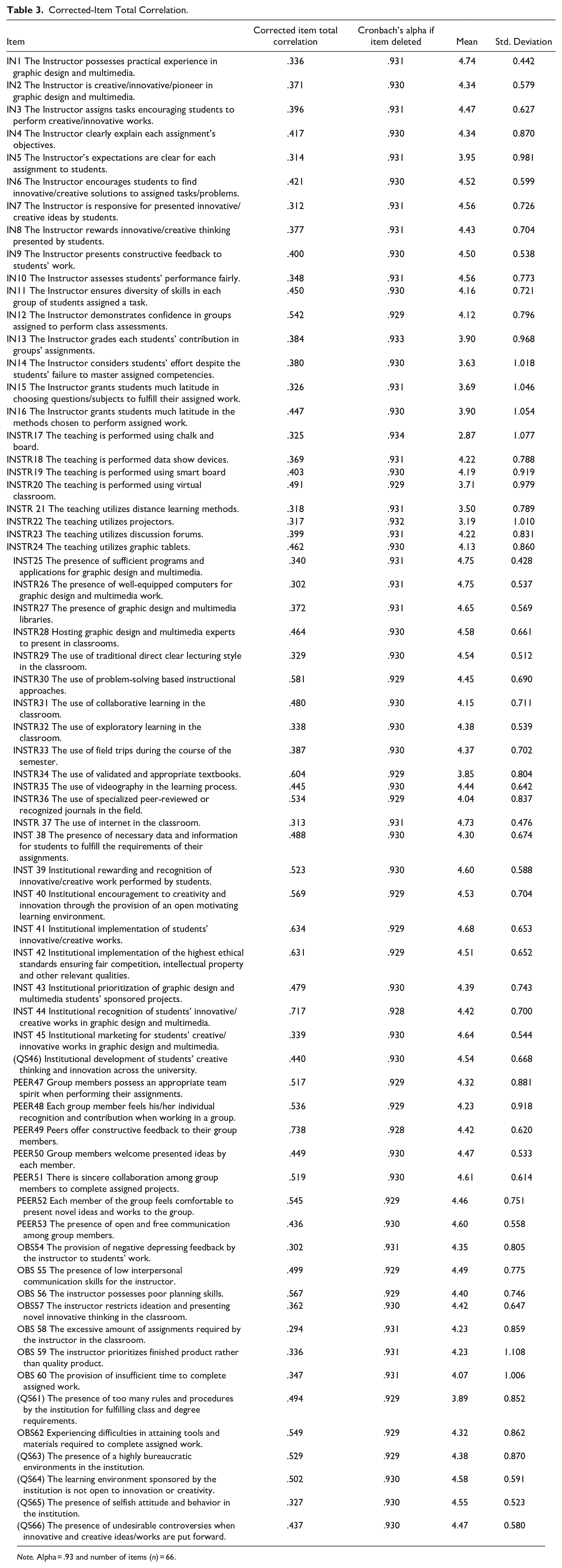
Note. Alpha = .93 and number of items (n) = 66.
Note that all items represent the five domains identified in the literature survey affecting creativity at the undergraduate level. All items were assessed by a panel of experts at Qatar University for their relevance to undergraduate education, as well as graphic design and multimedia fields. The items are universal applicable to all disciplines taught at the undergraduate level. This does not mean that they do not relate to graphic design or multimedia fields. On the contrary, each domain is represented with a set of items each measuring one facet of that dimension. The facet is applicable to graphic design and multimedia fields.
Data Analysis
This analysis presents a descriptive account of the findings obtained from the questionnaire data gathered from the sample concerning the factors facilitating or hindering creativity. Bar graphs are used to present the means of all 66 items to indicate the most typical value chosen by respondents per item. While the items are measured ordinally, the reporting of the means is acceptable and preserves a great deal of space consumed by reporting the raw frequencies and percentages per item. Further, the Pearson Product Moment Correlation Coefficient, is used to explore the relationships between the five dimensions comprising the 66 items. Each of the five dimensions was calculated as a summated rating scale where its items were added, yielding a score per respondent. Therefore, the scales feature different minimums and maximums given the number of items composing them. The Instructor scale had 16 items making its minimum 16 and maximum 80. The instructional strategies, tools, and resources scale was comprised of 21 items, making its minimum 21 and maximum 105. The institution scale was made of nine items, generating a minimum of nine and a maximum of 45. The peers’ scale was comprised of seven items, making its minimum seven and maximum 35. Finally, the obstacles scale was composed of 13 items, making its minimum 13 and maximum 65. Descriptive statistics, means, and standard deviations were also inspected for the five scales made from the dimensions and their relationship with a total score of 66 items added was evaluated.
Ethical Considerations
The Institutional Review Board of Qatar University approved a request made by the authors to perform the study prior to data collection. A copy of the approval is included in Appendix B. Respondents were informed about the anonymity, and security of their information by an electronically signed informed consent form. Prior to accessing the questionnaire, respondents were presented with a page asking for their agreement by clicking “I AGREE” to the terms and conditions presented to them. Respondents who wished to disagree were instructed to close the page and terminate their participation. All completed questionnaires included an electronic agreement from respondents.
Findings
Table 4 demonstrates the means for the 66 items on the questionnaire broken down by their respective dimension. Overall, respondents have rated the items highly citing their importance as factors facilitating/hindering creative thinking in graphic design and multimedia classrooms. Concerning instructor related factors, the lowest mean was received by IN 14 (“the consideration of effort in assessing assignments rather than only the completion of the correct requested product”) measuring about 3.5 and an indication that all items were considered important in fostering creative thinking. By the same token, among the 21 items measuring instructional strategies, tools, and resources, INSTR17 (“the use of regular chalk and board in teaching”) received the lowest mean of 2.9, which is still moderately high, indicating that respondents agreed that all the highlighted items influenced the development of creative thinking in graphic design and multimedia. Concerning institutional factors, respondents reported high levels of agreements, all item means are above 4, indicating high acquiescence rates with the importance of the items in bringing out creativity in the classroom. Considering the influence of peers, respondents highly rated the role of class and group peers in developing creative thinking and ability (all items possessed means above four). Finally, among the 13 items concerning other obstacles, respondents rated all of them high on important for nourishing creative thinking in the classroom and across the institution (means are all approximately four or above). The emerging evidence is clear in Table 3 where means of the 66 items were found to be high, indicating the approval of respondents to the fact that each item featured on the questionnaire across the five dimensions is important in constructing creative thinking among graphic design and multimedia students in the Arab World.
Item Statistics.

Table 4 presents the descriptive statistics, means, and standard deviations of the five summated rating scales constructed based on the questionnaire. All means are high on their respective scales, indicating that respondents believed that the dimensions were important for fostering, nourishing, and harnessing creative thinking in graphic design and multimedia classrooms. Further, a total summated scale based on the 66 items was composed where the minimum is 66 and the maximum is 330. The mean on this scale was 283 (4.29 retaining the original scale) indicating a high level of participant agreement with the items comprising the entire data collection tool. Inspecting the values informs the reader that respondents rated peer influence to be the single most important dimension relative to the others. This is trailed by the effect of obstacles, instructors, instructional strategies, tools, and resources, and then institution.
To investigate the explanatory power of each dimension on the complete scale comprised by the addition of all items in the questionnaire, the coefficient of determination was calculated. It can be inferred that the proportion of variance explained by each dimension is almost equal to those explained by others, about 60%. This indicated the importance of each dimension in constructing the total questionnaire. This evidence calls for the consideration of all dimensions in investigating factors influencing students’ creative thinking without omitting a relevant area of factors.
Table 5 reports multiple regression analysis results with the total score (as the dependent variable) and the set of items per dimension (five sets, as independent variables) to investigate the predictive power per item to be retained in future shortened questionnaires. Table 5 presents the results from the instructor related dimension, showing IN2, IN11, IN12, and IN16 to be the only statistically significant items predicting the total score. This indicates that respondents rating of instructors’ creativity and innovation profile and confidence in students’ groups assigned to perform work using their chosen methods and composed with diverse skills, are set to be the most important facilitators for creative thinking in graphic design and multimedia education. Table 5 also demonstrates the influence of instructional strategies, tools, and resources on the total score of creativity facilitation in the instrument. Only INSTR 30 and INSTR 34, the use of good textbooks and problem-solving using inquiry-based learning in the classroom were found to be significant in predicting the outcome variable in the model. In addition, Table 5 presents the results from regressing institutional factors on the total score, indicating that the INST44 is the only statistically significant factor. This suggests that institutional recognition of innovative and creative works produced by graphic design and multimedia students is the single most important institutional facilitator for creative thinking cultivation. Besides, Table 5 presents the results from a regression analysis where the peers’ items are the independent variables and the total score is the dependent outcome, with PEER 48, PEER 49, and PEER 52 being found to be statistically significant. This indicates that respondents’ perceptions of individual group members’ recognition, freedom to express novel ideas/works, and the offering and receipt of constructive feedback with others are the most influential factors contributing to creative thinking expansion and evolution in the classroom. Besides, Table 5 shows the results of a regression analysis of the items measuring other obstacles, predicting that the total score of OBS 62 and OBS 64 are found to be statistically significant. This suggests that the availability of tools and materials for students, as well as institutional openness toward creativity, are the most significant factors within the obstacles dimension according to participant responses.
Instructor Results.

Note. Adjusted R2 = 0.69.
p < .01. ** = 0.01.
Discussion
Theoretical Implications
To expect all colleges and universities in the region endowed with varying financial, human, and technical resources to adopt a fully-fledged creativity inducement model as prescribed by the suggested framework is simply impractical, unrealistic, and without value. Therefore, a more agile model satisfying the practical reality is needed. This is achieved by the Multi-Phases Autonomous Model presented in Figure 2. The proposed innovation model has the underlying logic that actors within a system only have access to a limited set of resources. Based on available time, money, and quality standards, an instructor, department chair, college dean, or university president can implement an innovation program or product. Each phase or stage is a reflection of the resources afforded to the actor, which engenders given changes in learners’ outcomes or performances.
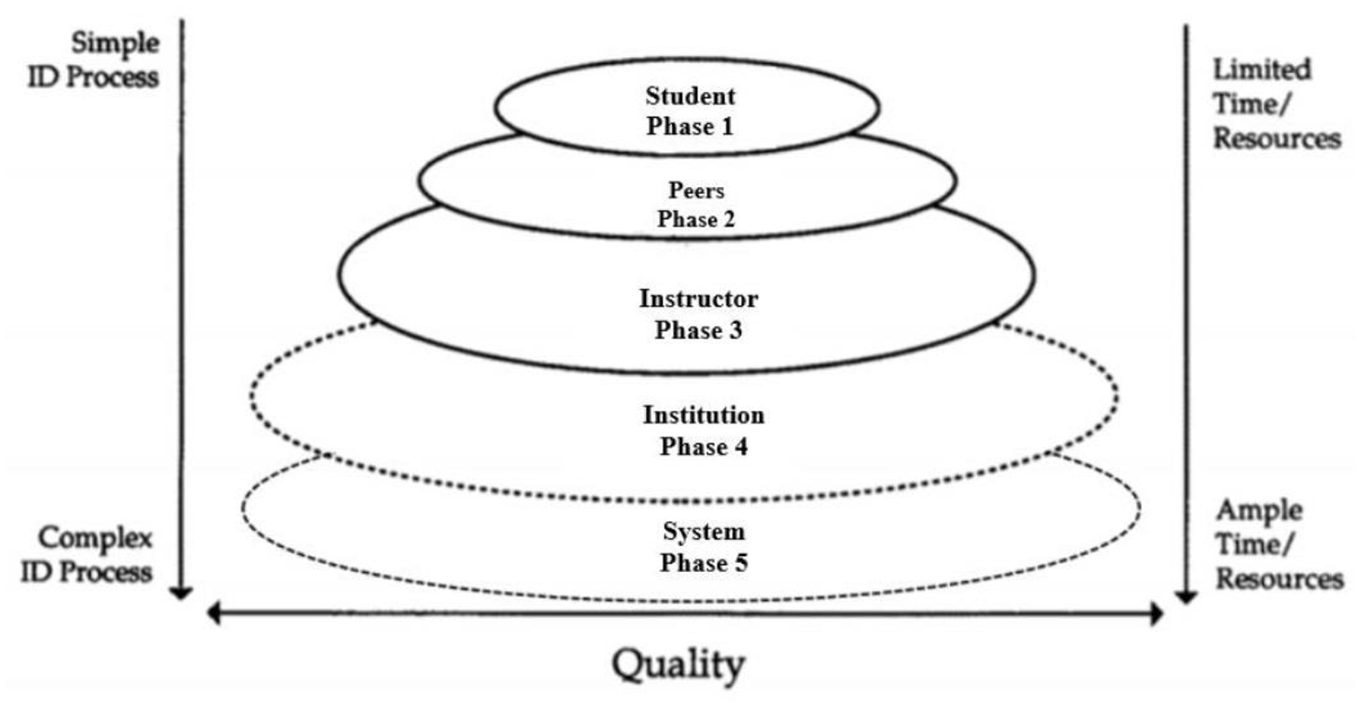
The multi-phases autonomous model.
There are many differences between the multi-layered innovation higher education model and the traditional waterfall prescriptions of creativity and innovation prevalent in the literature. First, the proposed framework in this analysis emphasizes principles of innovation and creativity rather than specific procedures to be followed. Second, traditional models highlight each stage as a discrete and important phase of the model while the multi-layered approach points toward the fulfillment of all stages within a single layer, thereby formulating a complete and scalable program of innovation and creativity. The multi-layered model works with the realistic settings of today’s higher education needs and prioritizes lean management and execution.
The Multi-Phases Autonomous Model is an alternative to the current waterfall creativity models popular in higher education systems. The MPAM is a model that could be implemented by any actor individually within a college or university. It also could be holistically applied by all actors within the higher education system. Waterfall models cannot be implemented individually and require unrealistic coordination among all actors in the system. MPAM is flexible concerning the creativity learning outcomes where the student, faculty, department chair, college dean or university provost could identify the needs and desirable objectives. Waterfall models oftentimes set ambitious goals requiring the investment in new technology, instruction, and curriculum. The MPAM model works with available resources and does not require the college or university to heavily invest in novel resources. MPAM could be implemented in the short or long term trajectories depending on the need specified by the actor.
Practical Implications
This research offers two instruments measuring faculty’s and expert’s assessment of creative thinking facilitators and inhibitors in the Arab World universities. The first long questionnaire is represented by the 66 full statements validated by the current manuscript. The short version features only the 12 items that demonstrated statistical significance in predicting the overall faculty’s and expert’s assessment of creative thinking facilitators. Depending on the resources, time and context, stakeholders may choose either to administer the long or the short versions. Stakeholders include faculty, staff, department heads, college deans, and their auxiliary personnel, as well as university provosts or presidents. Stakeholders also include higher education policymakers interested in cultivating more creativity in the undergraduate classroom. Table 6 presents the short questionnaire comprised of 12 items: instructor (4), instructional (2), institution (1), peers (3), and obstacles (2).
Short Version of Questionnaire.

Table 7 presents a framework based on the findings in the current study facilitating the creation and sustenance of creative thinking in the Arab world universities. At the institutional level, several mandates on instructors, departments, and students are necessary for requiring everyone in the educational enterprise to immerse themselves in creativity through workshops, professional development, or courses. Further, institutional units (like academic departments) need to prioritize creativity in their work and improve their practices through continuous measurement and enhancement of their innovations. Moreover, the recognition of creative work by instructors, staff, and students needs to be celebrated across the institution and its community. Such celebratory moments need to be linked to practical incentives, including scholarships for students and awards for teachers such as tenure track promotions or financially lucrative assignments. At the instructor level, teaching staff needs to partake in professional development activities and utilize the most recent strategies, technology, materials, and tools in their respective fields. They also need to undergo training in problem solving and collaborative and inquiry-based learning to better practice it in their classrooms and workstations. In addition, instructors need to recognize their students’ contributions and creative works, as well as encourage their freedom to choose the methods selected to fulfill assigned work. Finally, instruction in the classroom should be built around collaborative and group assignments built on the principles of independent research and discovering problem solving oriented assessments.
Framework for Creating and Sustaining Creative Thinking in the Arab World Universities.

One of the most noticeable findings of this research is the effect of peers on creative thinking in classrooms and overall campus environment. Institutions, departments, and instructors need to increase the number of group activities (whether on small scale like group-based assignments or large scale such as the creation of student clubs dedicated to advance students’ skills through collaborative work on projects in their field. Departments across Arab universities should invest more in creating learning environments with similar characteristics to real-world practice. This includes assigning students to work on producing prototypes, movies, written or figural illustrations of expected work outcomes within their own fields.
The direct beneficiaries from this research are faculty, department heads/chairs, college deans, higher education personnel, and interested actors in creativity within the undergraduate education. Most importantly, students benefit from the application of the flexible creativity model and practices based on the empirical findings. Other indirect beneficiaries include students’ and faculty’s peers, as well as their employers.
The impact of this research is significant. First, it highlights the perils of current higher education creativity models. It points to their inefficiency and ineffectiveness in generating desirable creativity results while wasting colossal investments on technology, educational curricula, and instruction. Applying the flexible model with little to no cost at many instances guarantee the cultivation of creativity across undergraduate classrooms. Faculty may utilize highlighted facilitators in their classrooms to improve creative thinking among their students.
Limitations and Future Research
This research is descriptive, cross-sectional, and based on convenience sampling, thus generating low levels of external validity. This leads to low confidence in generalizing findings to similar contexts, raising methodological concerns about the approaches utilized to study innovation in general. To overcome such shortcomings, experimental and longitudinal designs have been called upon to be implemented in future studies on creative thinking in higher education. To better draw causal linkages between determinants that explain variation in creative thinking at the individual level under factor analysis approach, more and different data sources needs to be analyzed (Abduljaber, 2020). Besides, future studies need to include more than one metric of creative thinking. Such measures are preferably quantitative and objective, rather than ordinal and scales based, thus providing more accurate and precise predictions that can help educators better devise interventions for increasing creative thinking across the board. Furthermore, the utilization of game theoretical method together with empirical approach can also help to provide important insights showing interaction among stakeholders at individuals, institutional, or systemic levels (Onder, 2019). Stakeholders refer to students, faculty, staff, college administrators, and higher education policymakers, as well as interested parties like non-for-profit organizations or vested individuals.
Conclusion
This study is situated within the literature on creativity in higher education in the Arab World. A sample of faculty and experts responded to a 66 items questionnaire on a set of potential facilitators and inhibitors to creative thinking of undergraduate graphic design and multimedia students. Our selection of the graphic design and multimedia students to carry out this research is based on the importance of creative thinking in this field. Based on the empirical findings of the survey, the study proposes a flexible creativity model easy to be implemented at all levels beginning with the classroom reaching the entire university or college system.
This research found that factors concerning instructors, instructions, institutions, peers, and systems facilitate creativity at the undergraduate level in Arab colleges and universities. A questionnaire of 66 validated items measuring the aforementioned five dimensions demonstrated sufficient reliability and validity to be used in future studies investigating creativity in Arab higher education systems. A short form of the questionnaire with 12 items showing the best predictive power over creativity was constructed and could be used in similar studies.
A flexible interactive cost-effective creativity model demonstrated superiority to the existing waterfall approaches guiding colleges and universities efforts in cultivating creativity. The multi-layered model proposed applies to all levels of the educational process starting in a single classroom extending to an entire program, college, or curriculum. The model could be applied by individual faculty, departments, colleges, or universities improving levels of creativity among undergraduate students.
Footnotes
Appendix A
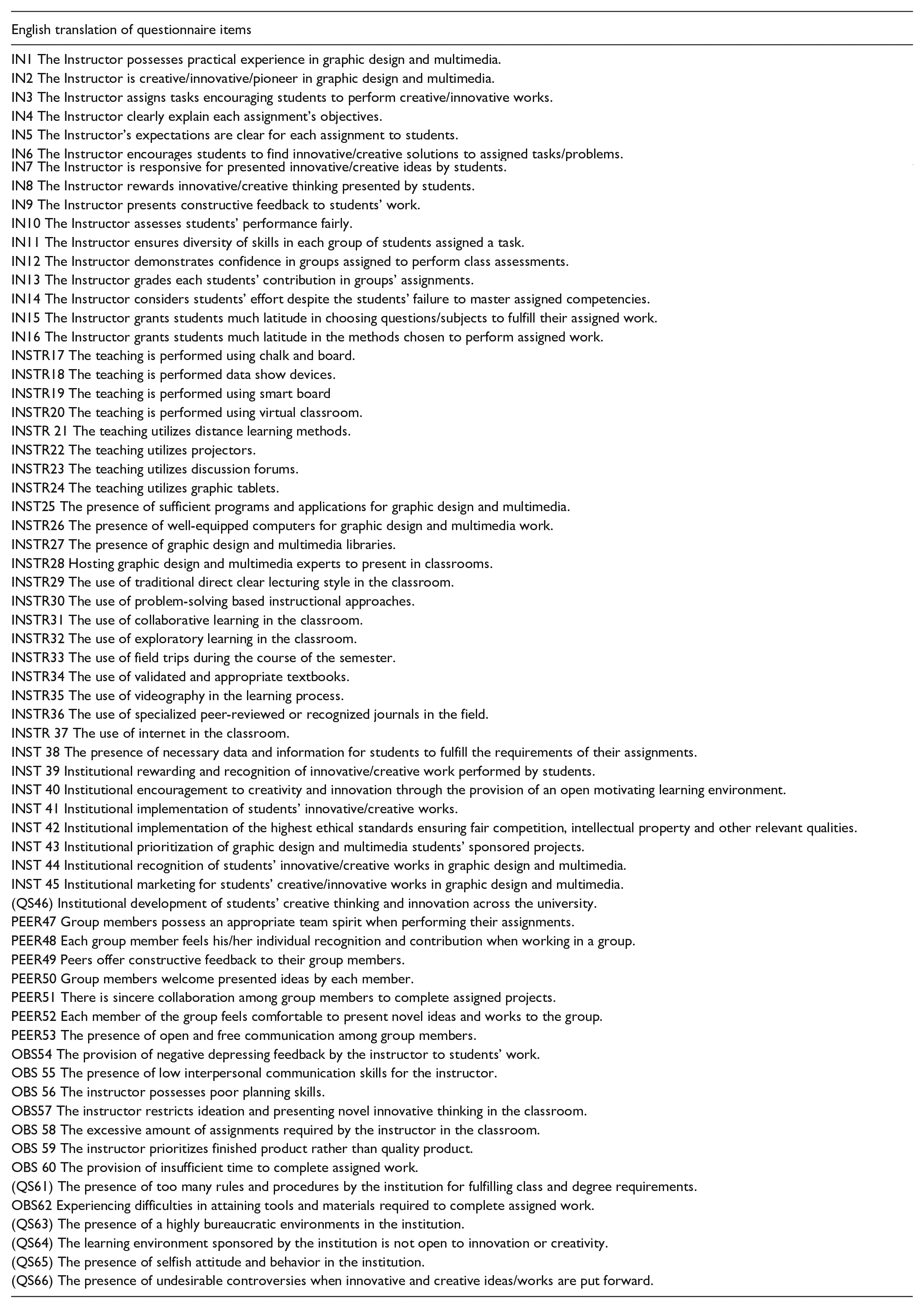
| English translation of questionnaire items |
|---|
| IN1 The Instructor possesses practical experience in graphic design and multimedia. |
| IN2 The Instructor is creative/innovative/pioneer in graphic design and multimedia. |
| IN3 The Instructor assigns tasks encouraging students to perform creative/innovative works. |
| IN4 The Instructor clearly explain each assignment’s objectives. |
| IN5 The Instructor’s expectations are clear for each assignment to students. |
| IN6 The Instructor encourages students to find innovative/creative solutions to assigned tasks/problems. |
| IN7 The Instructor is responsive for presented innovative/creative ideas by students. |
| IN8 The Instructor rewards innovative/creative thinking presented by students. |
| IN9 The Instructor presents constructive feedback to students’ work. |
| IN10 The Instructor assesses students’ performance fairly. |
| IN11 The Instructor ensures diversity of skills in each group of students assigned a task. |
| IN12 The Instructor demonstrates confidence in groups assigned to perform class assessments. |
| IN13 The Instructor grades each students’ contribution in groups’ assignments. |
| IN14 The Instructor considers students’ effort despite the students’ failure to master assigned competencies. |
| IN15 The Instructor grants students much latitude in choosing questions/subjects to fulfill their assigned work. |
| IN16 The Instructor grants students much latitude in the methods chosen to perform assigned work. |
| INSTR17 The teaching is performed using chalk and board. |
| INSTR18 The teaching is performed data show devices. |
| INSTR19 The teaching is performed using smart board |
| INSTR20 The teaching is performed using virtual classroom. |
| INSTR 21 The teaching utilizes distance learning methods. |
| INSTR22 The teaching utilizes projectors. |
| INSTR23 The teaching utilizes discussion forums. |
| INSTR24 The teaching utilizes graphic tablets. |
| INST25 The presence of sufficient programs and applications for graphic design and multimedia. |
| INSTR26 The presence of well-equipped computers for graphic design and multimedia work. |
| INSTR27 The presence of graphic design and multimedia libraries. |
| INSTR28 Hosting graphic design and multimedia experts to present in classrooms. |
| INSTR29 The use of traditional direct clear lecturing style in the classroom. |
| INSTR30 The use of problem-solving based instructional approaches. |
| INSTR31 The use of collaborative learning in the classroom. |
| INSTR32 The use of exploratory learning in the classroom. |
| INSTR33 The use of field trips during the course of the semester. |
| INSTR34 The use of validated and appropriate textbooks. |
| INSTR35 The use of videography in the learning process. |
| INSTR36 The use of specialized peer-reviewed or recognized journals in the field. |
| INSTR 37 The use of internet in the classroom. |
| INST 38 The presence of necessary data and information for students to fulfill the requirements of their assignments. |
| INST 39 Institutional rewarding and recognition of innovative/creative work performed by students. |
| INST 40 Institutional encouragement to creativity and innovation through the provision of an open motivating learning environment. |
| INST 41 Institutional implementation of students’ innovative/creative works. |
| INST 42 Institutional implementation of the highest ethical standards ensuring fair competition, intellectual property and other relevant qualities. |
| INST 43 Institutional prioritization of graphic design and multimedia students’ sponsored projects. |
| INST 44 Institutional recognition of students’ innovative/creative works in graphic design and multimedia. |
| INST 45 Institutional marketing for students’ creative/innovative works in graphic design and multimedia. |
| (QS46) Institutional development of students’ creative thinking and innovation across the university. |
| PEER47 Group members possess an appropriate team spirit when performing their assignments. |
| PEER48 Each group member feels his/her individual recognition and contribution when working in a group. |
| PEER49 Peers offer constructive feedback to their group members. |
| PEER50 Group members welcome presented ideas by each member. |
| PEER51 There is sincere collaboration among group members to complete assigned projects. |
| PEER52 Each member of the group feels comfortable to present novel ideas and works to the group. |
| PEER53 The presence of open and free communication among group members. |
| OBS54 The provision of negative depressing feedback by the instructor to students’ work. |
| OBS 55 The presence of low interpersonal communication skills for the instructor. |
| OBS 56 The instructor possesses poor planning skills. |
| OBS57 The instructor restricts ideation and presenting novel innovative thinking in the classroom. |
| OBS 58 The excessive amount of assignments required by the instructor in the classroom. |
| OBS 59 The instructor prioritizes finished product rather than quality product. |
| OBS 60 The provision of insufficient time to complete assigned work. |
| (QS61) The presence of too many rules and procedures by the institution for fulfilling class and degree requirements. |
| OBS62 Experiencing difficulties in attaining tools and materials required to complete assigned work. |
| (QS63) The presence of a highly bureaucratic environments in the institution. |
| (QS64) The learning environment sponsored by the institution is not open to innovation or creativity. |
| (QS65) The presence of selfish attitude and behavior in the institution. |
| (QS66) The presence of undesirable controversies when innovative and creative ideas/works are put forward. |
Appendix B
Declaration of Conflicting Interests
The author(s) declared no potential conflicts of interest with respect to the research, authorship, and/or publication of this article.
Funding
The author(s) received no financial support for the research, authorship, and/or publication of this article.
