




Abstract
Hofstede’s cultural value framework has inspired many empirical studies in various fields. Scholars have advanced our understanding of how the Hofstede value model is used. However, there remain a number of underexplored areas regarding the ways in which Hofstede’s framework has been used over the last decade. Drawing on the co-authorship network and cultural diversity literature, we attempt to make a contribution that goes beyond the existing research by addressing underexplored areas, namely, the network diversity of institutions, authors, and countries engaged in Hofstede-inspired research. As a result, the cultural diversity and diversity of specialization of the networks of institutions, authors, and countries engaged in research incorporating the Hofstede framework are still too Western-based and psychology-oriented to acquire new research directions and increase innovation opportunities in new fields. We summarize the possible limitations of this study and provide some future research directions, including how to expand networks, the influence of author identity on networks, the appropriate number of authors and the diversity level of participants in a network, and the main motivations of author co-authorship networks.
Introduction
Research has shown that cultural values are related to workplace behaviors and attitudes toward other organizational outcomes (e.g., Ahmad, 2012; Hofstede, 1980a; Huff et al., 2014; O’Reilly et al., 2014). In this research stream, the most influential framework of cultural values is that of Hofstede. Upon its publication in 1980, Hofstede’s value model became one of the most cited books in the social sciences (Green, 2016). Over the past 40 years of development, his study has triggered very many empirical studies and expanded the research scope from pure psychology to include various fields. The Hofstede model has been widely used; thus, it is a daunting task to investigate its use and impact. In this research stream, within the scope of use of the Hofstede framework, some studies have reviewed the use and influence of the Hofstede cultural model to suggest future research directions (Beugelsdijk et al., 2017; Kirkman et al., 2006; Taras et al., 2010). As noted by the selection committee members (Kendall Roth, Chair) for the 2016 JIBS Decade Award, the article by Kirkman, Lowe, and Gibson covered approximately 20 wide-ranging research topics at the individual, group, and country levels. Raising fundamental questions regarding the theoretical and methodological underpinnings of Hofstede’s work was considered one of the major contributions of their article.
More and more scholars have begun to attach importance to collaborative research because collaborative research plays a very important role in the production and dissemination of scientific knowledge (Beaver, 2004). The development of a collaborative network greatly promotes access to resources and data, improves the efficiency of researchers, and boosts the reputation of scholars and institutions (Beaver, 2001). Co-authorship network and cultural diversity studies show that it is important not only to analyze co-authorship networks of institutions, authors, and countries but also to focus on co-authorship network diversity. Thus there is a literature gap between cross-cultural studies and co-authorship network studies. Although many prior cross-cultural studies have led to significant progress in establishing how Hofstede’s framework has been used in international business over the last decade, we are still not quite clear about the history of Hofstede-inspired research. Despite the importance of network diversity of author collaboration, particularly the close collaboration of institutions and authors with different previous knowledge and from different backgrounds, for acquiring new research directions, we do not know the network diversity of institutions, authors, and countries engaged in Hofstede-inspired research.
We learn the importance of the networks between authors based on two new cultural value dimensions found by Hofstede: long-term orientation and indulgence versus restraint. After Hofstede’s cultural model was first proposed, it was criticized for its Western-oriented perspective, one that does not fully reflect the cultural perspective of Asia (Chinese Culture Connection, 1987). Hofstede worked closely with Canadian Professor Michael Harris Bond (social psychologist) from the Chinese University of Hong Kong for many years; they finally developed the fifth dimension, first called Confucian dynamism and then given the name long-term orientation. To explain the variation in happiness levels associated with economic development, Hofstede and Bulgarian professor Michael Minkov (social anthropology) in 2010 added a dimension of indulgence and restraint (Hofstede et al., 2010). This cross-country, transdisciplinary, and cross-cultural collaboration has greatly complemented the Hofstede theoretical framework. The development process of these two newly added cultural value dimensions shows the importance of networks of global research cooperation, particularly the close collaboration of institutions and authors with different previous knowledge and from different backgrounds, for acquiring new research directions.
In modern times where globalization and technology are developing so rapidly, geographic and linguistic limitations are no longer an important obstacle to global collaboration. We wanted to explore the development history and collaborative achievements of Hofstede-inspired research from nearly 40 years of research. We try to answer two questions from this study. First, which authors and institutions have conducted in-depth research using Hofstede’s theory, and where have they conducted the research? Second, does the research on Hofstede’s theory by scholars around the world form a co-authorship network over the past 40 years, and do the scholars involved in such collaboration have different backgrounds?
To answer these questions, we analyzed 1,093 studies incorporating the Hofstede framework with information visualization techniques to analyze the co-authorship networks of authors, institutions, and countries. This study examines Hofstede-inspired research from a new perspective on the author collaboration network, and based on the theory of co-authorship network and cultural diversity, we explored Hofstede-inspired research development courses and collaboration networks. We combine collaborative research and network diversity research to fill the literature gap in this area, contributing new research methods. Also, we apply the network perspective to the traditional bibliometric field and present our results more effectively in the form of knowledge mapping, which helps more scholars understand the development status more intuitively. Such an attempt can also expand the knowledge system of traditional bibliometric research.
The first part of this article is an introduction, and the second part presents a theoretical basis. The third part explains the analysis method and data in detail. The fourth part gives a detailed description of the analysis results from the author, institution, and country. The fifth part summarizes this research and puts forward suggestions for improvement and future research directions.
Theoretical Background
Co-Authorship Networks
In 1965, Price noticed that collaboration was the trend of the times, with increasing numbers of authors beginning to collaborate (Price, 1965). As collaboration is an increasingly important part of scientific research, the historical trend of scientific specialization also has a greater need for scientific cooperation (Acedo et al., 2006; Hara et al., 2003). Collaboration can bring together the knowledge, skills, and abilities required for research and promote the development of disciplines more quickly (Stevens & Campion, 1994). In the natural sciences, research teams use laboratory facilities and expensive equipment to generate a large number of co-author relationships (Laband & Tollison, 2000). In the social sciences, the work of research teams is also becoming increasingly popular (Moody, 2004). Co-authorship is the most frequent form of intellectual cooperation in scientific research. It involves two or more authors participating in the same study. Such joint research can raise the quality or quantity of scientific output above the highest level that can be achieved by individuals (Hudson, 1996). As a result of the co-authorship trend of cooperation, researchers have a great deal of interest in the phenomenon of collaboration between scientists.
There are two types of co-authorship research: One involves analyzing the reasons for and results of author cooperation (Cainelli et al., 2015; Hara et al., 2003; Jeong et al., 2011); the other concerns social networks based on co-authorship, with research of this type studying the characteristics of a certain discipline in the network (Barabâsi et al., 2002; Moody, 2004; Newman, 2001). There are many reasons that determine the collaboration of co-authors. Hara et al. (2003) found four factors that affected cooperation: compatibility, work connections, incentives, and the sociotechnical infrastructure. Jeong et al. (2011) believed that the development of in-depth professional expertise in various subject areas and the expansion of knowledge also promoted the division of labor. It is also believed that the increase in the number of scientists has increased the probability of finding a suitable researcher. Hudson (1996) further proposed that researchers from different fields should interact with each other when conducting interdisciplinary or transnational research. Collaboration is often an important part of research, and researchers can benefit from collaboration by sharing resources and knowledge (National Research Council Chemical Sciences Roundtable, 1999). Engineers can work together to develop new products (Whitehead, 2007). Students can solve problems and explore new knowledge more effectively through collaboration (Johnson & Johnson, 2002; Tran, 2014). The ultimate goal of co-authorship is to improve the quality or increase the output of papers. Bayer and Smart (1991) also proved that co-authors can improve the quality of papers and increase the likelihood of acceptance.
Co-authoring an article creates another form of social network. This type of social network not only describes an academic society but also shows us a knowledge structure (Newman, 2004). The co-authorship network is an important social network category; it is similar to but different from a citation network. Even if the authors do not know each other, a citation network can appear; the node of the citation network is the paper and the links are the references. In a co-authorship network, the nodes are authors and the links are collaboration, making the network closer (Uddin et al., 2011). In a co-authorship network, the links are more like the strong ties in the network relationship proposed by Granovetter (1977), while in a citation network they are more like weak ties.
With the passage of time and the expansion of professional fields, an increasing number of scholars are involved in collaborative research in specific research fields or interdisciplinary research fields, as a result of which the co-authorship network is continuously developing. More and more scholars have begun to attach importance to collaborative research because collaborative research plays a very important role in the production and dissemination of scientific knowledge (Beaver, 2004). The development of a collaborative network greatly promotes access to resources and data, improves the efficiency of researchers, and boosts the reputation of scholars and institutions (Beaver, 2001). Authors may come from different research fields and different geographical locations with different cultural backgrounds. The diversity and complexity of network members also increase the necessity for our research. By studying the co-authorship network, we can know the characteristics of a specific field and identify the invisible colleagues and social groups existing in this field (Acedo et al., 2006). It is also possible to explore different statistical characteristics and behavioral patterns of scientific cooperation (Liu et al., 2005). Social network analysis (SNA) allows us to know cooperative relationships and editorial behavior from a sociological perspective (Moody, 2004). With the social network methodology, co-authorship networks can also be used as a new way to conduct social network analysis (Barabâsi et al., 2002; Newman, 2001).
Cultural Diversity
Roberge and Van Dick (2010) believed that diversity was a subjective phenomenon generated by group members’ classification of others as similar or different based on their different social identities. If a group is composed of different individuals, then this group is diverse. In many cases, diversity and identity are synonymous, and one’s identity is constituted by the ability to distinguish one person from another (Delanty, 2011). Loden and Rosener (1991) divided diversity into two dimensions. The primary dimension is mainly reflected in the aspects that have a major impact on our identity, such as gender, age, disability, and ethnicity. The secondary dimension has a very subtle impact on personal identity and is not static. It is dynamic and malleable and changes over time. Examples include religious culture, sexual orientation, mindset, geographical origin, lifestyle, work experience, education, family status, and political views. The primary dimension shapes the individual’s self-image and basic world view, while the secondary dimension affects the individual’s self-esteem and self-definition.
Cultural diversity is a collection of individuals in a social system with group relationships that have distinctly different cultural backgrounds (Mazur, 2010). A large number of research results show that, based on the viewpoint of diversity values, diversity within the organization or within the working group can improve work efficiency. Compared with an organizational structure with strong homogeneity, an organizational structure with diversity has more advantages relevant to performance (Kundu & Mor, 2017; Lu et al., 2015). For example, multicultural organizations can more easily capture market share in an increasingly globalized market and provide appropriate services to external customers because of their deeper understanding of foreign legal, political, social, economic, and cultural environments (Adler & Gundersen, 2007). In research and high-tech industries, the broad talent base generated by multicultural organizations becomes an invaluable advantage, and multicultural researchers can also create amazing results because creativity comes from diversity (Morgan, 1989). There are also multicultural organizations that tend to have greater organizational flexibility and be better at solving problems (Mazur, 2010). When dealing with problems, the members of an organization will be flexible in considering issues from all angles. Avoiding the influence of group thinking not only helps solve problems but also cultivates members’ ability to expand.
In sum, co-authorship creates a social network of researchers (Barabâsi et al., 2002; Moody, 2004; Newman, 2001), and creativity comes from diversity (Morgan, 1989). Reviewing co-authorship and cultural diversity studies shows that it is important not only to analyze co-authorship networks of institutions, authors, and countries but also to focus on co-authorship network diversity.
Methodology and Data
By analyzing co-authorship networks, we determine whether a diverse collaborative network has been formed in visualization technology and improvements in computer processing capabilities, many effective tools for drawing scientific knowledge maps have been invented, such as HistCite, CiteSpace, SPSS, the Thomson Data Analyzer, Bibexcel, and Pajek. Knowledge maps show the relationship between the development process and the structure of scientific knowledge at the macro, meso, and micro levels and reveal the laws of scientific knowledge.
In this paper, CiteSpace software is used for co-authorship network analysis 1 ; this software is a free application based on Java. It can perform co-authorship analysis, co-citation analysis, co-word analysis, and co-occurrence analysis (C. Chen, 2006). Because of its powerful functions and simple operation, it has recently become one of the most widely used Atlas software packages (Cui et al., 2018; Hu et al., 2013; Li et al., 2017).
The data are taken from the Web of Science database. Web of Science is one of the best web literature databases because it has the most complete data structure; in addition, it is one of the recommended databases for CiteSpace software (D. Chen et al., 2016). We have determined the search criteria using “Hofstede” as the keyword, but we set the following criteria before searching.
Choice of Data Sources
The core collection of Web of Science was used instead of referring to all databases, so that the articles are of high quality and are influential in this field. The Science Citation Index Expanded (SCI-Expanded) and Social Sciences Citation Index (SSCI) were used as citation indexes to make the samples more comprehensive.
Time Span
The time span is from 1980 to November 17, 2018, because Hofstede’s theory of cultural values was published in 1980. The research type is article.
Search and Extractions of Records
We reconfirm whether the following words are included in the selected papers in the database to ensure that the papers belong to this field: Hofstede, power distance, individualism, collectivism, masculinity, femininity, uncertainty avoidance, long-term orientation, short-term orientation, indulgence, and restraint. We did it to make sure that selected papers belong to Hofstede-inspired research. Finally, we identified 1,093 papers for research data. Although Web of Science did not contain all the papers about Hofstede, the collected data and references to the data covered almost all the important articles in the field; thus, the key points can be shown on the diagrams of the references referenced, authors or institutions.
CiteSpace version 5.3 is used as the analysis software for this paper. Among the citation, co-citation, and co-authorship analysis types, we chose co-authorship analysis. As the next step, author, institution, and country were selected for micro, meso, and macro networks, respectively. These different levels of analysis require different threshold settings. We need to determine c, cc, and ccv in the first, middle, and last three time partitions. Among these, c represents the lowest citation or occurrence frequency; cc represents the co-occurrence or co-citation frequency of slices in this time; and ccv represents the co-occurrence or co-citation rate. The thresholds of the remaining time partitions are automatically generated by the software, using a linear interpolation algorithm (C. Chen, 2006). The time slicing was set as 1 year, showing the first 50 pieces of data in each time slice. This setup is designed to extract the top 50 authors that appear most frequently each year. This ensures that our analysis results are the most representative and efficient. Then, according to the research content, the network map is stylized and tailored.
Results
Document Information
Among the collected data, most of the articles are in English (N = 1,093) because the SCI-Expanded and SSCI databases are mainly composed of English journals. Hofstede’s theory of cultural values was first published in 1980, but research on Hofstede’s theory did not increase dramatically over the next 20 years, with only 109 papers published. After 2000, with the development of globalization, researchers from different countries began to pay attention to the importance of the cultural differences between countries. In 2015, the number of Hofstede-related research papers exploded, reaching 106 a year. In just the 8-year period from 2011 to November 2018, the total number of papers reached 671, more than double the number from 2000 to 2010 (see Figure 1).

Number of publications in Web of Science for each year from 1984 to 2018.
Co-Authorship Network Diversity Analysis
Authors
A total of 2,464 authors participated in the 1,093 papers. Of course, the scholar who contributed the most research was Hofstede himself, with 19 publications. In frequency analysis, CiteSpace only counts the occurrence of the first author, so the contribution ranking of research results can only be based on the first author. The second-ranked research contributor is Professor Peter B. Smith of the University of Sussex in the United Kingdom, who contributed 11 research papers. The third place went to Professor Sunil Venaik from the University of Queensland in Australia, who contributed nine papers. Tied for fourth place are Professor Paul Brewer of the University of Queensland and Michael Minkov, a Bulgarian professor, who each contributed eight papers. The fifth-ranked scholars are all from Hong Kong. Professor Chan, Alex Wing Ho (The University of Hong Kong), and Professor Cheung Hon Yeung (City University of Hong Kong) each contributed six papers.
Surprisingly, we did not find a Hofstede centric network cluster. The node size in the author’s collaboration map indicates the number of papers published by the author. As we can see in Figure 2, Hofstede’s name is the largest, indicating that he has the largest number of published papers, which is also realistic. Hofstede has also worked with many academics, but not as extensively or frequently as Professor Smith. There is no denying that many scholars are more interested in the four basic cultural dimensions that Hofstede published independently (i.e., power distance, Individualism–Collectivism, Masculinity–Femininity, Uncertainty Avoidance) and have conducted extensive and in-depth research.

Co-authorship networks.
Also, 60 independent and small co-authorship networks composed of 217 authors are captured among 2,464 scholars with the highest frequency of occurrence and cooperation. The authors who have the highest number of papers contributed, except for Professor Peter B. Smith, have not formed a large-scale co-authorship network. Sixty scattered small co-authorship networks have forced us to focus only on larger groups. Therefore, we mainly focus on the network that has been formed, including more than four scholars, with a total of eight groups. We marked the order of Group1 to Group8 above Figure 2.
The largest co-authorship network is Group 1, with Professor Peter B. Smith as the node; he has cooperated with other authors 12 times. His research mainly focuses on the individualism and collectivism dimensions of Hofstede, and he investigated the values of managers in 43 countries (Smith et al., 1996) and 47 countries (Smith et al., 2002). Hofstede’s research on the dimensions of individualism and collectivism is reexamined. At the beginning of 1990, empirical research was conducted on the leadership theory of Japanese prime ministers (Smith et al., 1992) and the leadership theory of Latin American organizations (Smith et al., 1999). The research results also verified Hofstede’s theory and clarified the concepts of individualism and collectivism. Professor Michael Harris Bond, from the Hong Kong Polytechnic University, is also a central author in Group 1, having 11 co-authors. Although Professor Michael Harris Bond is Canadian, he has lived in Hong Kong. He has researched Chinese cultural values in depth. The LTO dimension in Hofstede’s theory is based on his research. Group 1 includes 21 co-authors from different countries, institutions, and specializations whose joint research results have enabled Hofstede’s cultural theory to be developed and studied in depth in multiple fields.
Group 2 is a co-authorship network with Professor Arrindell Wa as the node. The scientists in Group 2 do not show diversity. Five of them come from the same university in the Netherlands and the Academic Hospital of the University of Groningen. There is only one researcher, Chryse Hatzichristou, from the University of Thessaly, Greece. The six authors are clinical psychology professionals, and their study examined subjective well-being using the Hofstede dimensions (Arrindell et al., 1997).
Group 3 has 5 authors, and Groups 4 to 8 have only 4 authors. The diversity of the authors’ countries and specializations in these groups is not obvious. Group 3 is a cooperation between a Korean university and an American university; Group 4 is a cooperation between American universities; Group 5 is a cooperation between Australian universities; Group 6 is a cooperation between American universities; Group 7 is a cooperation between an American university and a Danish university; and Group 8 is a cooperation between American universities. Not surprisingly, even though he is the most influential author of the theory, Hofstede did not form a large co-authorship network.
We additionally analyzed author network diversity to determine whether the networks of authors have cultural diversity to provide more opportunities for new research directions. We used Ronen and Shenkar’s synthesized cultural clustering of countries based on similarity and dissimilarity in cultural values (Ronen & Shenkar, 2013). The world was clustered into 11 cultural clusters: the Far East, Confucian, Anglo, African, Germanic, Nordic, Latin Europe, East Europe, Latin American, the Near East, and Arab. Theoretically, if authors are located in all 11 cultural clusters, the author network diversity of Hofstede-inspired studies will be the highest. If all the authors are in the same cultural cluster, the network diversity will be the lowest. In addition, we analyzed the diversity of the authors’ specializations. Many scholars have emphasized the interdisciplinarity among history, criminology, psychology, social psychology, sociology, political science, anthropology, law, and geography in enriching cross-national research (Buckley et al., 2017; Cheng et al., 2014; Sekaran, 1983). Interdisciplinary research can promote the development of theory more widely. Therefore, it is necessary to examine whether the most influential theory of Hofstede has been studied by scholars in multiple fields.
Table 1 shows the number of co-authorship network cultures and the diversity of specialization. 2 We clearly see that Group 1 contains the most different cultural clusters but only five specializations. This indicates that the cultural diversity of the co-authorship network is higher than its diversity of specialization. Most of the co-authorship networks were formed between specialists in psychology. This result is understandable, given that scholars are more likely to collaborate with other researchers in the same field (Gallagher & Savage, 2013). Group 2 has seven authors but only two cultural clusters and specializations, indicating that the group’s diversity is low. Groups 4, 5, 6, and 8 have Anglo–Anglo networks, but the four authors of Group 6 are from four different specializations; thus, their disciplinary cooperation is relatively diverse.
Cultural Diversity and Diversity of Specialization of the Co-Authorship Networks.

Note. Gen & Strat = general management and strategy; OR = operations research; MS & POM = management science, production and operations management; IB = international business; Entrep = entrepreneurship; OS/OB = organizational science and organizational behavior; HRM = human resource management; IR = industrial relations.
From the analysis of the cultural diversity of the eight groups, Anglo–Anglo cultural networks are the most common, appearing 32 times in a total of 127 cases, which is approximately 25%. Regarding specialization, psychology–psychology networks are the most frequent, appearing a total of 53 times. Among the 11 cultural clusters in the Ronen and Shenkar study, no network from the Germanic, Arab, or East Europe cultural clusters appeared in our study, and we did not see any specialization diversity network formed by geography, criminology, or history.
Institutions
This section examines the institutional network diversity of collaborative research. The research institutions to which we refer here are the universities of the authors. As Mintrom (2008) argued, general progress in knowledge comes from research-based discovery behavior, which is why the research function of universities is important. Universities increase the sharing of human knowledge through research. The top contributor was the University of Queensland in Australia, which published 11 papers; Tilburg University and the University of Groningen in the Netherlands tied for second place, each of these contributed nine papers; the institution ranking third, the University of Hong Kong, contributed eight papers; the University of North Carolina in the United States and Maastricht University in the Netherlands tied for fourth place, with each contributing six papers; the institution ranking fifth, the University of Granada, from Spain, contributed five papers (see Table 2).
Details of the Institutions.

We analyzed institutional network diversity using Ronen and Shenkar’s (2013) national cultural clusters, connecting 34 institutions and 11 cultural clusters. We found that 17 schools were founded before 1900. These schools not only have a long history but also have a long cultural heritage, which enables each university to form its own unique values. They have excellent research teams, and the professors and scholars on these teams have become the research leaders in the field of cultural values because the team-based approach is one of the most effective ways to conduct research (Birx et al., 2013). Through scientific research, these universities have made significant contributions to the development of an internationally competitive knowledge and innovation cluster in professional fields and broader areas.
From the institutional networks in Figure 3, we see that there is no large-scale network of research institutions around the world and that the cooperation networks are very scattered. The University of Queensland in Australia not only contributed the most papers but also has frequent contacts with six cooperation organizations in different countries and different cultural clusters. Other subnetworks can be broadly divided into the United States–Canada cluster, the Spain–Peru cluster, the Hong Kong cluster, and the Australia cluster. Moreover, the research institutions in the Netherlands formed networks with other institutions in major countries, for example, the networks between the Netherlands and the United States, between the Netherlands and the United Kingdom, between the Netherlands and Spain, and between the Netherlands and Iran. These results indirectly prove that the research institutions in the Netherlands have greatly contributed to the global spread of Hofstede’s theory.

Institutional co-authorship networks.
From the institutional network diversity perspective, Table 3 clearly shows that 13 institutions belonging to Anglo cultures have networks with the same cultural clusters, followed by six institutions belonging to Nordic cultures and five institutions of Latin Europe. In total, there are 29 institutional networks. However, the Anglo–Anglo networks were most common, appearing eight times, followed by the Anglo–Nordic networks, appearing four times. These results show that there is still a lack of institutional network diversity. The most common institutional networks are still connected among Western countries: Anglo–Anglo (8) and Anglo–Nordic (4).
Cultural Diversity of Institutional Co-Authorship Networks.
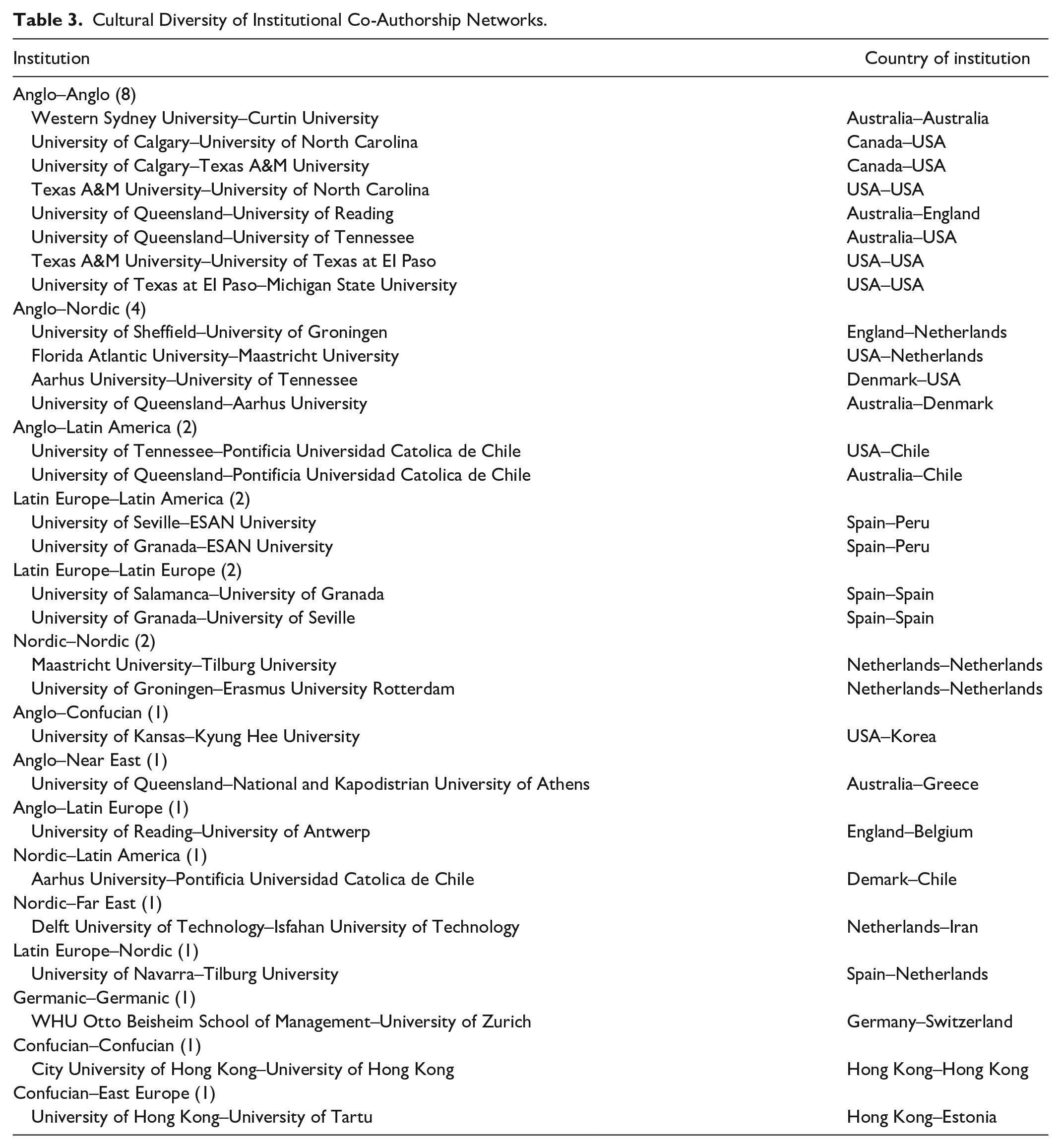
On the other hand, among the 11 cultural clusters, no institutional network from the African or Arab clusters was found. In addition, despite the increasing numbers of studies from the Confucian cluster, the Confucian cluster is connected with only the Anglo (1), Confucian (1), and East Europe (1) clusters. It was not connected with the Nordic, Germanic, Latin Europe, or Latin African clusters. In sum, the cultural diversity of the institutional co-authorship networks is still low and Anglo culture-oriented.
Countries
This paper analyzes 1,093 papers incorporating the Hofstede framework in 91 countries. Table 4 shows that the top 10 countries accounted for 35% of the total data and that the United States published the most papers, 381 articles. 3 The country with the second highest number of papers is the Netherlands. This is understandable because Hofstede is Dutch. England was next, followed by China and Australia in fourth and fifth places, respectively. Both countries have been studying Hofstede’s theory since 2001; China contributed 76 papers and Australia contributed 75 papers.
Top 10 Countries by Number of Publications.
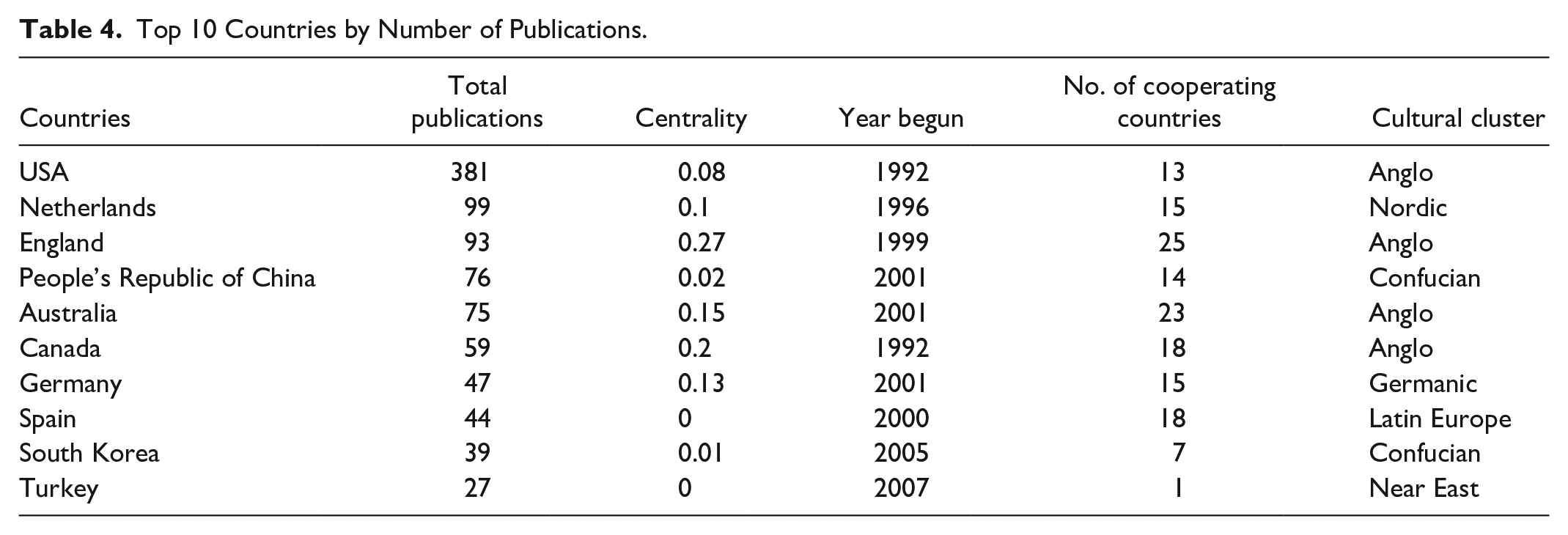
The rise of the Chinese economy has aroused the interest of global scholars in understanding the Chinese market and cultural differences through the Hofstede framework (Kwon, 2012; Yoon, 2009). However, Chinese researchers themselves have begun to compare the cultural differences between China and Western countries (Huang et al., 2003; Martinsons & Ma, 2009). Although Chinese researchers have published a large number of research papers, the impact of these papers is still at a very low stage, with centrality scores of only 0.02 (please see Note 3). The most influential country among the top 10 is England, with a centrality score of 0.27. It is interesting that although England has a lower number of papers, it is the most influential country, with a centrality score of 0.27. Canada (centrality = 0.2) was second, and Australia (centrality = 0.15) was third. We also analyzed country co-authorship networks (see Figure 4). England has a network with 25 countries, and Turkey has the fewest, having only one network, with Norway. Surprisingly, although American scholars have contributed 381 papers, they have a very narrow network consisting of only 13 countries. In contrast, Australian scholars have contributed few papers but the number of networks is high, 23. Open network cooperation can stimulate innovative research and make research results more influential.

Country co-authorship networks.
We also analyzed the network diversity of co-authorship countries. We found 14 different types of network from 16 different countries, total of 58 collaborations. As shown in Table 5, the Anglo–Confucian network has appeared 13 times, constituting the largest network. One possible explanation for this result is that with the economic development of Asian countries, scholars in the English-speaking world are paying more attention to Asian culture and are also more willing to cooperate with scholars in the Asian region. It is interesting that the number of Anglo–Confucian networks is larger than the number of Anglo–Latin Europe networks (11).
Cultural Diversity Analysis of the Country Co-Authorship Networks.

However, overall, the diversity of co-authorship country networks is quite low. A total of 38 collaborations among 58 collaborations, almost 67%, were connected between the same or similar cultural clusters, for example, Anglo–Anglo (7), Confucian–Confucian (4), Latin Europe–Latin Europe (2), Anglo–Latin Europe (11), Anglo–Germanic (5), Anglo–Nordic (4), Nordic–Germanic (2), Nordic–Latin Europe (2), and Germanic–Latin Europe (1). Only 20 country networks among 58 collaborations, almost 35%, were connected between countries of different cultural clusters, for example, Anglo–Confucian (13), Confucian–Latin Europe (3), Confucian–Germanic (2), and Nordic–Near East (1).
In addition, we could not find any Anglo–Near East, Nordic–Near East, Confucian–Near East, Germanic–Near East, or Latin Europe–Near East networks, which would be expected to have high cultural diversity.
Conclusion and Discussion
This paper examined whether the co-authorship networks of Hofstede-inspired research over the last 40 years are sufficiently diverse from the perspectives of cultural diversity and diversity of specialization to inspire creative future research. We analyzed 1,093 studies incorporating the Hofstede framework with the CiteSpace knowledge mapping software to analyze the co-authorship networks of authors, institutions, and countries. Our results are summarized as follows:
First, as expected, Hofstede, a psychologist from the Netherlands, is the most published scholar, with 19 articles. The University of Queensland in Australia, founded in 1909, is the most prolific institution, with 11 published papers. The most published country is the United States, with 381 publications since 1992.
Second, the results of this study show that there is no large-scale co-authorship network among authors. Only Peter B. Smith, a psychologist from England, and Michael Harris Bond, a psychologist from Hong Kong, jointly form a large co-authorship network with 21 authors. Regarding the institutional networks, only the University of Queensland in Australia, as the center, has formed a co-authorship network, one that includes seven other institutions. With regard to the country networks, England has formed a strong network with other countries and is the most influential country (centrality = 0.27).
Third, overall, the co-authorship network analysis indicates very low cultural diversity. For example, the number of Anglo–Anglo networks is the highest, with such networks appearing 47 times, followed by 29 Anglo–Confucian networks and 18 Nordic–Nordic networks (see Table 6). Although network diversity research has emphasized that co-authorship network diversity provides more opportunities for new research directions and increases innovation in this field (Barabâsi et al., 2002; Mazur, 2010; Newman, 2001), these results show the high frequency of networks among scholars who have the same cultural values. These results can be explained by “the principle of proximity.” The closer is the spatial distance, the closer is the psychological distance and the higher is the frequency of communication. Conversely, the farther is the spatial distance, the farther is the psychological distance and the lower is the frequency of communication (Festinger et al., 1950).
Total Number of Cultural Clusters and Collaborations Between Specializations Appearing in This Paper.
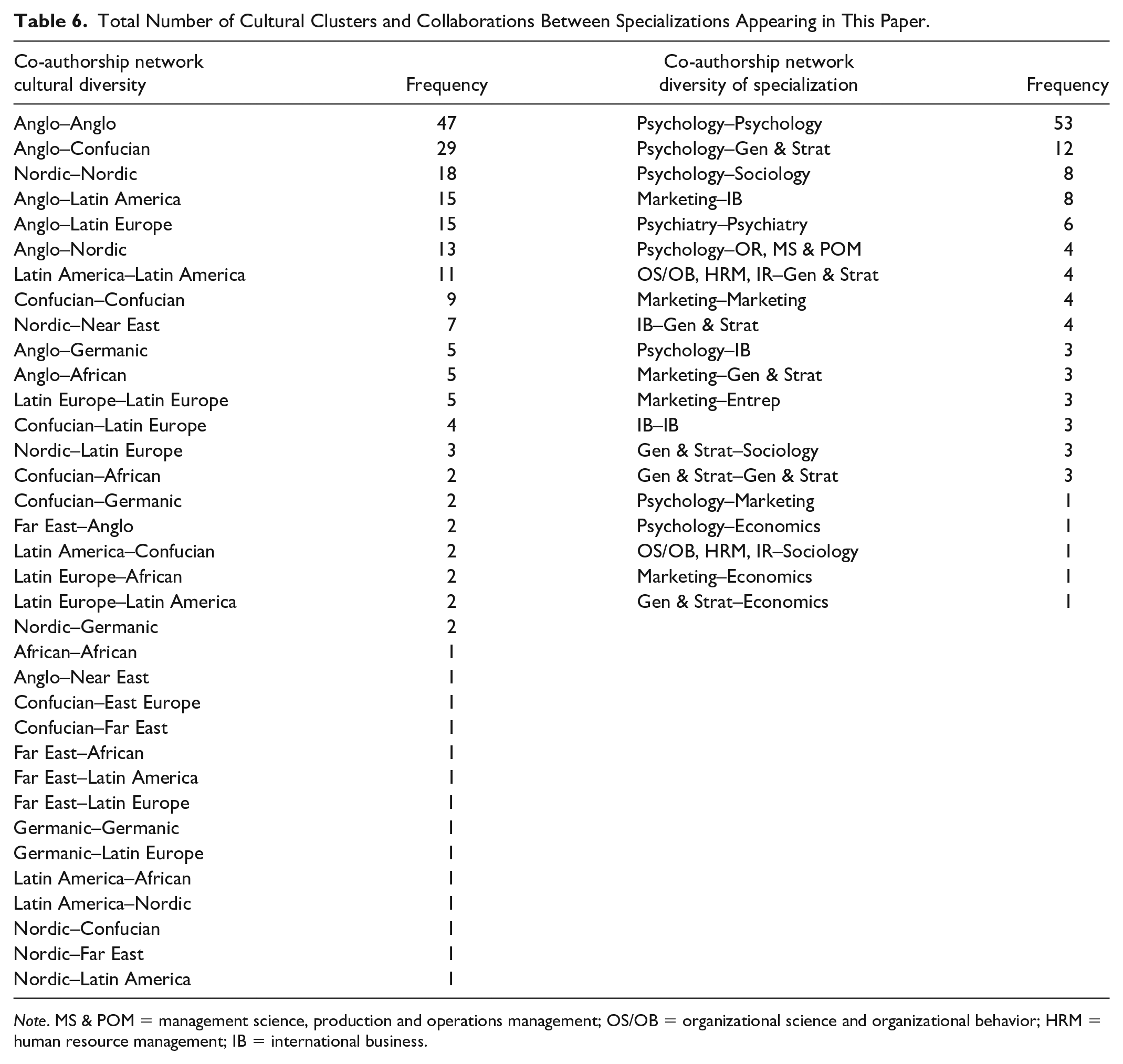
Note. MS & POM = management science, production and operations management; OS/OB = organizational science and organizational behavior; HRM = human resource management; IB = international business.
Fourth, as shown in the network analysis of diversity of specialization, Hofstede-inspired research is related to the psychology, general management and strategy, marketing, IB, economics, sociology, psychiatry, organizational science and organizational behavior (OS/OB), human resource management (HRM), industrial relations (IR), operations research (OR), management science, production and operations management (MS & POM), and entrepreneurship fields. Although it covers most fields in the humanities and social sciences, apart from the vast majority of researchers in psychology, we do not find that scholars in other fields are very interested in Hofstede’s theory. Moreover, we have not found any research results in the fields of history, criminology, or geography. From the network analysis of diversity of specialization, we found that networks formed between psychologists were absolutely dominant, appearing a total of 53 times (see Table 6). The low frequency of networks in other areas is quite understandable (Hara et al., 2003). Collaborators should be interested in the same phenomenon, and the complementarity of professional knowledge, skills, and abilities is one of the reasons for promoting collaboration. In addition, it is understandable that conflicts among researchers in the same field will be reduced (Hara et al., 2003). However, according to the research results of Granovetter (1977), we can also believe that the close form of interactive relations and the high frequency of collegial contact will easily form a closed system, strengthen the original cognitive views, and reduce the integration with other views, which is not conducive to the innovation and development of Hofstede’s theory.
We now summarize the limitations of this study and provide some suggestions for future research.
First, Extend the Networks to Cover Underresearched Areas
Research on Hofstede’s theory has reached a mature stage, and each research institution in each country has excellent researchers and research capabilities. However, to adapt to the rapid changes in today’s society, it is necessary for scholars from different cultural backgrounds and research fields to make concentrated efforts to conduct large-scale innovative research. Although researchers have formed networks with some cultural clusters, most research is mainly concentrated in the Anglo, Confucian, and Nordic clusters. In future research, scholars and countries belonging to the East Europe, Near East, African, and Arab cultural clusters should pay attention to forming networks to conduct in-depth studies in this research field. Scholars in the Anglo, Nordic, and Latin Europe areas, which have conducted more research, should also strengthen collaboration with areas that have conducted less research. We also suggest that researchers in different disciplines should use Hofstede’s theory to conduct professional research in their own fields, such as transnational crime, linguistic history, archeology, political education, and other fields.
Second, Explore the Influence of Author Identity on Networks
The results of the co-authorship network analysis give us a clearer understanding of which authors, institutions, and countries are collaborating. When analyzing co-authorship, one of the most significant issues is the impact of author identity on the results of papers (Pavlíčková, 2013). However, this paper does not analyze the influence of author identity on the quality of papers or the results of papers. Here, identity includes the nationality of the author, the research major at the time of gaining PhD status, the editorial status of each journal, and the ranking of personal reputation research results. Identity is an added value; although it is invisible, it very subtly affects the development of academic achievement. As Hara et al. (2003) pointed out, cooperation with well-known scholars may increase the chances of obtaining project funding and the probability of journal acceptance. In future research, it is necessary for us to investigate the identity of the authors of Hofstede-inspired research and to conduct an in-depth study on the degree of influence on the formation of cooperation and theoretical development.
Third, Explore the Appropriate Number and Degree of Diversity of Participants in the Networks
The question of the appropriate number of participants in a co-authorship network also warrants further study. Siva et al. (1998) indicated that more than four authors per article are too many. However, Smith et al. (1996) surveyed the national culture in 43 countries, and the number of cooperations reached 39. This implies that for multinational research it is necessary to increase the number of authors to complete such a large-scale project. Therefore, in future studies, we can explore the appropriate number of authors participating in a collaboration to ascertain what the appropriate number is and how the appropriate number depends on the characteristics of the project. It is also necessary to conduct in-depth research on network diversity. When collaborating, what degree of diversity is most conducive to improving the quality of the paper and the output of the research? With an increase in cultural diversity, the probability of conflict will increase significantly. In particular, if multiple subcultures exist in medium-sized heterogeneous groups, then conflict may be maximized (Mosakowski & Earley, 2000), and the interaction and communication between groups may even be hindered (VanderPal & Ko, 2014), thus affecting the output of the results.
Fourth, Analyze the Reasons for Co-Authorship Networks
Scientific research is not purely rational. It is influenced by social factors (Hara et al., 2003). Especially when we engage in teamwork to complete a task, there are all kinds of uncertain factors. Identifying the influencing factors will help remove the obstacles to cooperation, promote the formation of collaboration, and ultimately achieve common goals. However, this paper does not discuss the reasons for collaboration among the authors in Hofstede-inspired research, which makes it difficult for us to accurately judge the real reasons for the formation of networks between cultural clusters and between disciplines. In future research, it is necessary for us to determine the reasons for co-authorship networks because networks can produce higher performance than individual research (e.g., National Research Council, 1993) and are more likely to promote the development and application of Hofstede’s theory.
Fifth, Use Other Techniques to Expand the Scope of Research
As we analyzed only the co-authorship networks of authors, institutions, and countries using CiteSpace, we did not analyze the journals, contents, and citations of Hofstede-inspired research over the last 40 years. Therefore, we highly recommend using other technology to determine other types of cooperative relations, such as co-citation analysis, co-word analysis, journal analysis, and cited reference analysis, reveal the quantitative characteristics and internal development laws of Hofstede-inspired research. We can also explore the collaborations between the authors of Hofstede-inspired research from the perspective of the strength of weak ties (Granovetter, 1977) to explore new ways of theoretical development.
This paper also has some data limitations. For example, although we used database search data recommended by CiteSpace, the Web of Science database is not comprehensive. We believe that the research results for the past 40 years could involve more than 1,093 publications. The data we have collected include the results of many single-author or single-institution studies. The research results of these authors also greatly promoted the development of Hofstede’s theory in various fields, which is an important part. However, because our research focuses on exploring the cooperative network among authors, these achievements may not be captured in the analysis, which also becomes an inevitable technical limitation of this research. There is also a language limitation. Non-English papers are not included in the data used in this paper; thus, we do not know whether the co-authorship networks of non-English papers have formed a large-scale network. We hope that these limitations can be addressed in future research. Hofstede’s theory of cultural dimensions provides a strong theoretical basis and support for people to analyze and interpret cultural differences in the context of cross-cultural communication, and it is one of the most cited theories in the social science literature. We believe that this study compensates for the gaps in the qualitative and quantitative analyses of Kirkman et al. (2006) and Taras et al. (2010), respectively. It provides a new, complementary, and visual perspective for future researchers to examine Hofstede’s theory.
Footnotes
Declaration of Conflicting Interests
The author(s) declared no potential conflicts of interest with respect to the research, authorship, and/or publication of this article.
Funding
The author(s) disclosed receipt of the following financial support for the research, authorship, and/or publication of this article: This work was supported by the State Scholarship Fund of the China Scholarship Council (201808260002). Both authors declare no conflict of interest.
