




Abstract
The nonprofit organizations rely on volunteers as key human resources. Recent literature emphasizes effective volunteer management to enhance the utilization of volunteers. At present, empirical knowledge on the subject exists in fragments causing difficulties in analyzing its growth. There is a need to evaluate its vast literature using a statistically rigorous method. The study aims to identify the internal structures and hidden inferences on volunteer management in nonprofit organizations using bibliometric data. The study collected 1,605 related journal articles indexed by Scopus from 1956 to 2022. The VOSviewer software was utilized to analyze the data. The results revealed diachronic growth in the area and identified its leading contributors. International collaboration and high-frequency keywords are also illustrated. The results are discussed in terms of article representations, area maturity, impacts of external environment, and emerging opportunities. The study provides insights into the state of knowledge surrounding volunteer management in nonprofit organizations.
Plain language summary
Nonprofit organizations (NPOs) heavily depend on volunteers to achieve their missions. Understanding how to manage volunteers effectively is crucial for NPOs. However, the information on this topic is currently scattered, making it difficult to fully grasp the trends and developments in volunteer management from academic literature. This study aims to reveal deeper insights into how volunteers are managed in nonprofits by examining a large amount of published research. The researchers analyzed 1,605 articles about volunteer management in NPOs published from 1956 to 2022 and indexed in the Scopus database. They used a software tool called VOSviewer to examine the data, which helped identify trends, key contributors, and the evolution of research in this field. The analysis showed a growing interest in volunteer management over the years. It identified key researchers and regions contributing to this field and highlighted frequent topics and themes discussed in the literature. It also noted the significance of international collaborations in advancing research on volunteer management. The insights from this study can help guide future efforts in volunteer management by providing a clearer understanding of how research has evolved and what areas need more focus. This can improve strategies for managing volunteers more effectively in NPOs, ultimately enhancing their capacity to serve their communities.
Keywords
Introduction
Non-profit organizations (NPOs) have been known with various terms such as “non-governmental organizations (NGOs),”“civil society,”“voluntary organizations,” and “the third sector.” Notwithstanding the heterogeneity, these entities share common features (Salamon et al., 1999) in the sense that they: have organizational structure; are separate from the public and private institutions; typically have a non-profit orientation; are self-governing; and operate under a voluntary membership basis. In this paper, following key scholars such as Salamon et al. (1999) and DiMaggio and Anheier (1990), we use the term “non-profit organizations” to reflect the wider umbrella of the whole sector.
NPOs exist in many types and perform various social, political, and economic roles (Anheier & Daly, 2006; Lu et al., 2020; Moura et al., 2019; Smith, 1997). These include functioning as charitable organizations, grassroots associations, foundations, universities, and healthcare organizations Comparative research on NPOs shows the diversity in regional NPO practices and highlights associated challenges in studying the NPO phenomenon (Casey, 2016; Davies, 2019; Mirabella et al., 2007; Von Schnurbein et al., 2018). Over the years, NPOs have been playing a wider range of responsibilities in local and international arenas (Arranz et al., 2020; Jäger & Beyes, 2010; Lewis, 2010). Recent research shows the critical involvement of NPOs in creating sustainable communities on all fronts (Moldavanova & Wright, 2020), including in supporting the United Nations Sustainable Development Goals (UN SDGs) (Besiou et al., 2021; Díaz-Perdomo, 2021).
Given the significant roles of NPOs (Pennerstorfer & Rutherford, 2019), the number of NPOs has also increased worldwide. For instance, according to the National Center for Charity Statistics’ study (2020), there were more than 1.5 million NPOs in the United States as of 2016, an increase of 4.5% from 2006; an estimated 64.4 million US citizens volunteered in 2017, this is a 4.2% increase from 2008. In the UK, the value of volunteerism was estimated to be $22 billion, and the percentage of persons who volunteer rose from 39% to 41% for men and from 39% to 42% for women from 2000 to 2015 (Office for National Statistics, 2017). In mainland China, the Ministry of Civil Affairs of China reported that there are 866 thousand registered nonprofit groups, an increase of more than 300% from the year 2000 to 2019, comprising 9.8 million full-time laborers (Dong & Lu, 2020).
NPOs are faced with many challenges that affect their overall operations (Helmig et al., 2004). One of the key issues relates to the supply of volunteers (Nencini et al., 2016). With government cost-cutting and public spending reductions taking place globally, staff shortage at NPOs are common problems as NPOs (Alfes et al., 2017). NPOs depend on volunteers to carry out their missions (Zboja et al., 2020). Due to the growth in volunteer utilization, many NPOs recognize the importance of volunteer management (Cho et al., 2020; Rogers et al., 2013). Volunteer management (VM) refers to how volunteers’ emerging expectations are being satisfied to maintain the operations of NPOs (Tiltay & Islek, 2020). Successful VM concerns with the policies and practices in recruiting, developing, and retaining an efficient, enthusiastic, and committed team of volunteers. The NPO sector is challenging as it requires a balancing act between social, economic, and organizational sustainability objectives in managing volunteers (Thoits, 2021; Wu et al., 2016). People strategies pursued by NPOs should benefit both the organizations’ and volunteers’ individual needs (Ashfaq et al., 2021).
The first dedicated book on VM was published by Naylor (1967) in which he emphasized the importance of a strategic approach to fostering volunteer leadership in organizations. Since then, research on VM has received increased interest from both academic and practitioner constituents with numerous works being written to develop the area (Brudney, 1990; Culp et al., 1998; M. Wilson, 1976). During the past years, VM has been discussed in different disciplines (Alfes et al., 2017; Lockstone-Binney et al., 2010; Warner et al., 2011; J. Wilson et al., 2020), and has involved studies on various volunteer groups (Bazan et al., 2021; Hustinx et al., 2012; Leonard et al., 2004; Moore & Allen, 1996; Shandra, 2017). Due to regional variations, previous studies attempted to manage international volunteers by taking cultural nuances into account (Akintola, 2011; Hayghe, 1991; Henry, 2022; Hodgkinson, 2003). Many challenges in VM are examined, including the need for volunteer training, and the issue of volunteer retention (Brudney, 1992; Garner & Garner, 2011; Lee, 2021). Table 1 shows some of the key references covered with regard to NPO and VM literature.
Literature Map.

Research on VM in the NPO sector is at present can be described as fragmented and disjointed. Knowledge on the subject has come from disciplines such as marketing (e.g., Lee, 2021), human resource management (e.g., Cuskelly et al., 2006), and nonprofit management (e.g., Kaur et al., 2022). Despite its growth, little integration has occurred between these parallel streams of research. There is a dearth of systematic and complete literature reviews on VM which is critical for its development as an academic study. This information is needed for researchers to evaluate what is known about the subject, how well it is established, and where it could be most beneficial for future investigation.
A huge amount of information on a given research topic may prove challenging for researchers to gain an overview of pertinent scientific literature (Zhou et al., 2015). The latest review techniques enable a systematic way to scan and analyze the available literature. A common technique that enables a macro-scopical overview of academic literature is bibliometric analysis (BA). The features and growth of scientific output can be quantitatively mapped and tracked (Nobanee et al., 2021). Authors, journals, nations, and institutions can all be compared in terms of production and research patterns using bibliometric methods. Furthermore, these methods can be used to detect and quantify the patterns of collaboration that exist between these entities (Alsolbi et al., 2022; Guiling et al. 2022). It is possible to recognize influential authors and articles, as well as key journals, countries, and organizations that publish on a particular subject. The number of journals published on a single topic and the subject categories given to publications can be used to infer the diversity of study topics and the multidisciplinary nature of a research area. In this sense, BA makes it possible to identify the most recent developments, theoretical gaps, and study directions of VM in nonprofit organizations, both conceptually and geographically (Perianes-Rodriguez et al., 2016; Zyoud et al., 2018).
Before starting a full BA article on this subject, a quick literature search was conducted using the Google Scholar database to avoid redundancy. The keywords used for the search were: “bibliometric analysis” on “volunteer management.” The results show that there have been previous attempts to conduct BA on related topics, such as volunteer motivation (Ahmad et al., 2021; Chen et al., 2022), and corporate volunteering (Dreesbach-Bundy & Scheck, 2017). Existing reviews have adopted a rather general observation of the VM’s sub-themes and neglected to consider the perspectives of NPOs. To our knowledge, no studies have examined the development of VM in NPOs using the BA approach. Now with more content written on the subject, a bibliometric study is timely to provide a rigorous and statistically driven analysis on the literature.
Against this backdrop, we aim to address this research gap by identifying the internal structures and hidden inferences contained in bibliometric data of published articles on VM in non-profit organizations. In line with the capability of BA, our study will focus on several elements in the data, that is, leading journals, articles, countries, institutions, authors, collaboration networks, key topics, and potential areas in the study of VM. Specifically, the study will pursue the following objectives: (i) to investigate the temporal distribution trends of journal articles published in VM; (ii) to highlight the contributions of eminent authors, productive academic institutions, and top nations; (iii) to draw attention to popular research areas; and (iv) to shed light on potential cooperation and future routes. Through these objectives, the findings should highlight the present constraints, advancement, and potential areas that are required for continued growth and improvement in VM research. These will help future researchers understand the academic stage of VM’s growth and highlight important research implications.
The following paper is organized as follows: The bibliometric range and data-gathering procedure are first outlined under the method section. Next, is a detailed illustration of the findings, which includes the descriptive analysis and bibliometric maps. We then discuss several observations regarding the findings in relation to the overall progress and emerging opportunities in VM. The final section concludes the study objectives, contribution, and limitations.
Methods
Data Source and Search Strategy
Data for the study were retrieved from 5th to 10th March 2023. We conducted our scoping review study by generally following the modified Preferred Reporting Items for Systematic Reviews and Meta-Analyses (PRISMA) framework (Vest et al., 2021) (Figure 1). We first identified the most appropriate database to extract the dataset for the study. We chose the Scopus database for several reasons. It provides worldwide coverage of high-quality, peer-reviewed materials. Scopus holds more than 27,000 active journal titles, which is far larger than its closest competitor database (McCullough, 2023). It has extensive global coverage, which is of great importance to analyzing the publishing patterns, trends, and prospective gaps required in our bibliometric study. Key university ranking agencies also recognize Scopus to measure publication quality and performance. Scopus is shown to be a reliable database in many bibliometric studies (for instance, Dinh et al., 2023; Guiling et al., 2022). Although it was only launched in 2004, it contains over 6.5 million records from pre-1970, with the oldest document dating back to year 1788 (McCullough, 2023). Scopus also collaborates with 60 major publishers to expand its content coverage for pre-1996 documents. For comparative purpose, we searched our study keywords on both Scopus and the Web of Science. We found that Scopus did not only generate more documents but also contained much earlier publications on the topic.

Research strategy.
The terms “volunteer management” and “nonprofit organization” and their synonyms were used as the search topics. They were identified in the title and abstract fields. We restricted our search to only journal articles. Advanced search was used to enter complex search queries with the use of field codes, Boolean operators, and proximity operators. Quotation marks were added to the search words to generate robust results. Hence, the query string used for the search was: TITLE-ABS (“Volunteer satisfaction” OR volunteers OR “volunteer management” OR “volunteer engagement” OR “volunteer coordination” OR “volunteer administration” OR “Volunteer Inclusion” OR volunteering OR “Volunteer time” OR volunteerism OR voluntarism OR “Volunteer retention” OR “Voluntary work”) AND TITLE-ABS (“nonprofit organization” OR nonprofit OR “third sector organization” OR “voluntary organization” OR “non-governmental organization” OR “civil society”) AND (LIMIT-TO [SRCTYPE, “j”]) AND (EXCLUDE [PUBYEAR, 2023]) AND (LIMIT-TO [DOCTYPE, “ar”]). As shown under Step 1 in Figure 1, the query string generated 1,648 journal articles.
We further screened the results by identifying review articles, which would not be suitable for our study. Under Step 2, we introduced additional terms to the query string to identify words like “review,”“perspectives,”“recent,”“trends,”“progress,” and “bibliometric,” in the articles’ titles and abstracts. This procedure highlighted 180 articles. Under Step 3, we then manually browsed the abstracts and full texts of the 180 articles to verify their contents. Out of 180, we found 32 review articles and 11 articles which were unrelated to VM. Hence, under Step 3, we removed 43 articles from the 1,648 total articles. The final dataset for the study consisted of 1,605 journal articles. The EIDs of these publications, a Scopus unique article identifier, were removed from the next search term so that they would not show up in the search results. Based on the query string, we found that the earliest publication on the topic is from 1956, and the latest is from 2022. Hence, following Scopus, we set this timeframe as the duration of our searched articles.
We evaluated the 1,605 articles using descriptive statistics for the source, year, author, nation/territory, affiliation, and subject area. CiteScore, h-index, total publications, total citations, and other bibliometric measures were used to rank the most prolific journals, authors, keywords, most productive countries, and academic institutions in publications. By focusing on the search results on a specific country, data for single-country publications (SCP) were found. In addition, the VOSviewer software was employed to cluster the terms based on author keywords to produce co-occurrence maps. We created thesaurus files to re-label the countries and the author keywords to merge various textual variations for data cleansing before performing the analysis.
Bibliometric Maps
To construct bibliometric maps, data for bibliographical, citation, and author keywords were exported to the VOSviewer software. A link, also known as a connection or relationship between the things, can exist between any two objects. The strength of each link is indicated by a positive numerical value. The stronger the relationship, the higher this value. When it comes to co-authorship analysis, the number of publications co-authored by two linked countries is indicated by the link strength between them. The total link strength reflects the overall strength of a certain country’s co-authorship ties with other nations. Similar to co-occurrence analysis, the frequency of publications where two keywords appear together is indicated by the connection strength between author keywords.
Analysis of Co-Authorship
The co-authorship analysis comprised 96 countries and linked to 3,728 authors in total. The VOSviewer software assigned these countries to five continents: America, Europe, Asia, Africa, and Oceania.
Analysis of Co-Occurrence
The analysis of author keyword co-occurrence included 3,640 keywords from 1,605 articles. Congeneric phrases and synonymic single words were examined before the author keyword list was imported into the VOSviewer software. For instance, “NGO,”“NGOs,” and “non-governmental organizations” were reclassified as “non-governmental organizations.” VOSviewer was configured to analyze a minimum of 11 keyword occurrences. The average publication year, frequency, and link quality of the keywords were displayed by using the overlay mode. The hue of a keyword indicates the average year in which the articles that contain the keyword were published.
Results
Publication Output and Growth of Research Interest
Since 1956, 1,605 research articles have been published in the course of 65 years. Figure 2 depicts the year-by-year trend of publications in chronological order. Looking at the cumulative number of publications in Figure 2, it is possible to conclude that the significance of VM research has grown. It took 54 years (from 1956 to 2010) to publish almost 500 articles. In the subsequent 6 years (2011–2017), this number climbed to roughly 1,000 publications. Throughout the study period, the number of research articles fluctuated from year to year. For example, there was a downward trend in publications from 1996 to 1998, but the number slightly increased in 1999. Until 2010, the publications on the topic remained limited. Significant interest in VM was more evident starting 2010—the first time the number of publications surpassed 50. From 2019 onwards, the figures increased steadily with more than 100 articles published annually. The fastest rate of growth occurred in 2022 when the total number of publications nearly reached 200.

The annual and cumulative number of VM research publications indexed in Scopus from 1956 to 2022.
Our analysis shows that out of the 1,605 articles, 28.2% (453) and 9.8% (158) were published as open access and gold open access respectively. This suggests that a vast majority of papers on the subject remain relatively inaccessible, which may affect their citations.
The findings also showed that there were 23 different languages used to publish the articles. A large majority of the articles (1,408; 87.7%) were published in a single language, while the remaining (10; 0.6%) were produced in two languages. The most prevalent language was English (1,505; 93.8%), followed by Russian (28; 1.7%) and French (15; 0.9%). Other languages such as Afrikaans, Arabic, Chinese, Dutch, Greek, Hebrew, Persian, and Slovak were only used in one article. As a note, Scopus required publishers to supply an English title and abstract for any foreign language articles.
Preferred Journals
There are 1,605 articles that appeared in 159 different journals. Most articles were published in the areas of social sciences (40.0%), followed by business, management, and accounting (18.2%), and medicine (12.9%) (Figure 3). Results from Scopus show that out of the 159 journals, 77 journals (48.4%) published two articles, 45 journals (28.3%) published three articles, and 12 journals (7.5%) published eight or more articles on the topic of VM.

Article distribution by subject area.
Table 2 shows the 12 most prolific journals, which are owned by seven publishers. Overall, Wiley-Blackwell plays more significant role in publishing VM-related articles. More than 20.0% (321) articles were published in these 12 journals, suggesting their recognition as the main outlets for scholars in the VM area. The top 12 journals were mostly in social sciences, followed by business, management, and accounting: marketing. The most productive journal was Nonprofit and Voluntary Sector Quarterly with 104 (6.5%) articles, followed by Voluntas (90, 5.6%), and Nonprofit Management and Leadership (66, 4.1%). With a total of 3,382 citations, Nonprofit and Voluntary Sector Quarterly not only received the highest number of citations but also published the most cited article titled “The rest of the nonprofit sector: Grassroots associations as the dark matter ignored in prevailing ‘flat earth’ maps of the sector” by Smith (1997).
The 12 Most Prolific VM Journals with Their Most-Cited Paper.

Note. TP = total publications; TC = total citations.
Journal impact on specific subjects is highly determined by citations of their articles. The higher the citations, the more influential the journals are in that particular subject (Caon, 2020). Scopus created the CiteScore methodology to reflect citation impact of a journal’s contribution (Scopus, 2022). The 12 highest-ranked journals display CiteScores in the range of 1.6—8.8, and 7 of them were founded before 2000. Whereas 6 publications had a CiteScore of 3 or higher. Based on the CiteScore 2022 report, 10 of these journals are also in the top 50% of their respective subject areas. This demonstrates that most journals have relatively considerable influence and have begun to make an impact. The highest CiteScore journal is Public Administration Review, with a CiteScore of 8.8, and the second one is the Review of Public Personnel Administration, with a CiteScore of 7.2. This suggests that the articles published in the two aforementioned publications have received increased attention.
Leading Countries, International Collaboration, and Top Institutions
The top 10 countries that have made the biggest contributions to the global growth of VM articles are shown in Figure 4. They are the United States, the United Kingdom, Canada, Australia, Germany, Netherlands, Russia, Spain, China, Belgium, and Italy. Belgium and Italy both share the same 10th position in the rank. About 51.4% of global papers were contributed by the United States and the United Kingdom, demonstrating that these two nations are major contributors to the VM area. In addition, 7 of the top 10 most productive nations are in Europe, with China being the only 1 in Asia. This highlights the unbalanced contributions of VM articles in the regions. The United States led the world with 631 publications, accounting for 39.3% of the global total. Although the United Kingdom ranked second to the United States in output, it had much fewer publications overall. Among the 11 countries, United States (83.4%), Russia (80.5%), Spain (74.3%), Italy (71.9%), and Canada (66.3%) had more than 2/3 single-country publications (SCP). This shows that intra-country cooperation is very strong among these countries. In contrast, Netherlands had the lowest percentage of SCP with 15 out of 43 publications having numerous affiliations from 28 countries. Interestingly, compared to publications generated without international collaboration (SCP), articles created through multiple-country collaboration (MCP) had more citations per article, except for Germany and Belgium. This pointed out that in most cases, the articles of international collaboration contributed more citations.
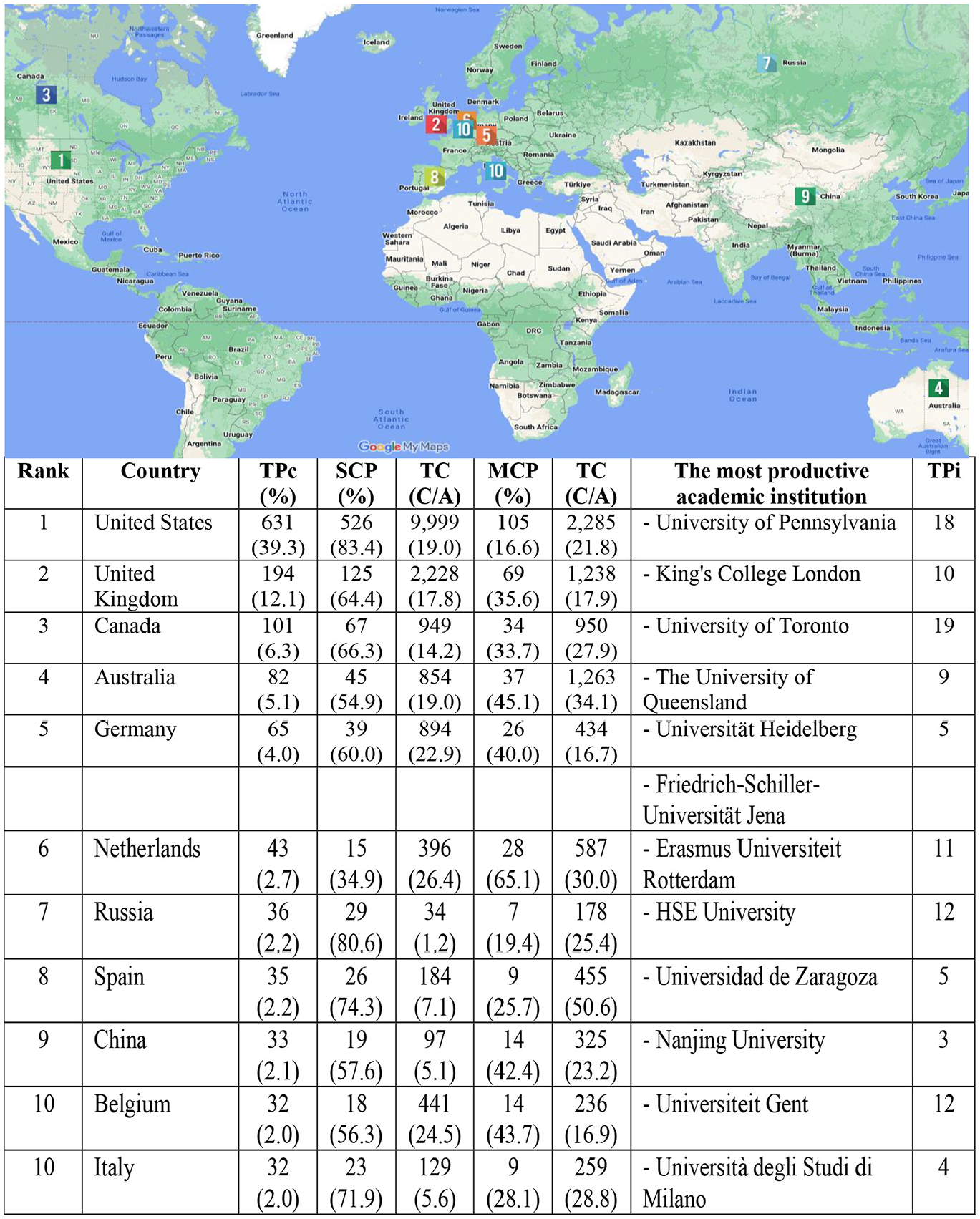
The top 10 most productive countries and academic institutions in publications of volunteer management.
Figure 5 illustrates the geographical distribution of co-authorship based on the authors’ affiliation countries. In VOSviewer, the closer two countries are to one another, the greater their relationship. A thicker line suggests a stronger connection between the two countries. The regions with the greatest number of countries for international co-authorship were Asia (32) and Europe (32), followed by Africa (17), America (13), and Oceania (2). This may demonstrate an imbalance of international collaboration between continents, and it is clear who is most active in international cooperation. Co-authorship results revealed that the United States was the most associated nation, with 140 instances of co-authorship involving 53 countries/territories. This is followed by the United Kingdom (98 co-authorships, 44 links), Australia (65 co-authorships, 28 links), Netherlands (54 co-authorships, 29 links), Canada (42 co-authorships, 11 links), and others. Moreover, it was shown that approximately 77% of countries had worldwide collaborative publications with fewer than ten countries. VOSviewer data shows that the number of VM studies conducted in developing nations (such as Nepal, Zambia, and Vietnam) is significantly lower than in developed nations (such as the United States, the United Kingdom, and Canada). Nearly 80% of articles were conducted in high-income economies, exhibiting a contextual void that could prompt future academics to conduct additional research on underexplored economies.

Bibliometric map created using network visualization mode based on co-authorship.
The 1,605 articles on VM were written by 3,728 researchers. This leads to an average of 2.3 authors per article overall. The cooperation pattern of authors publishing on VM was evaluated using VOSviewer, as shown in Figure 6. A minimum of one article on the topic has been published by authors who are inside the network. The colors symbolize the clusters of collaboration. Nine author clusters can be distinguished within the cooperation network. The number of publications is represented by the size of the circles, while the collaboration between two writers is shown by the line between them. Authors not connected to other authors in the network are not listed. Jeffrey L. Brudney, Lesley Hustinx, Rebecca Ann Nesbit, Young-Joo Lee, and Femida Handy are the main researchers in the network. In particular, Jeffrey L. Brudney has a close working relationship with the other four scholars. There may be a bias when it comes to authorship as the authors with various names could not be integrated. Also, authors with the same name could not be distinguished.
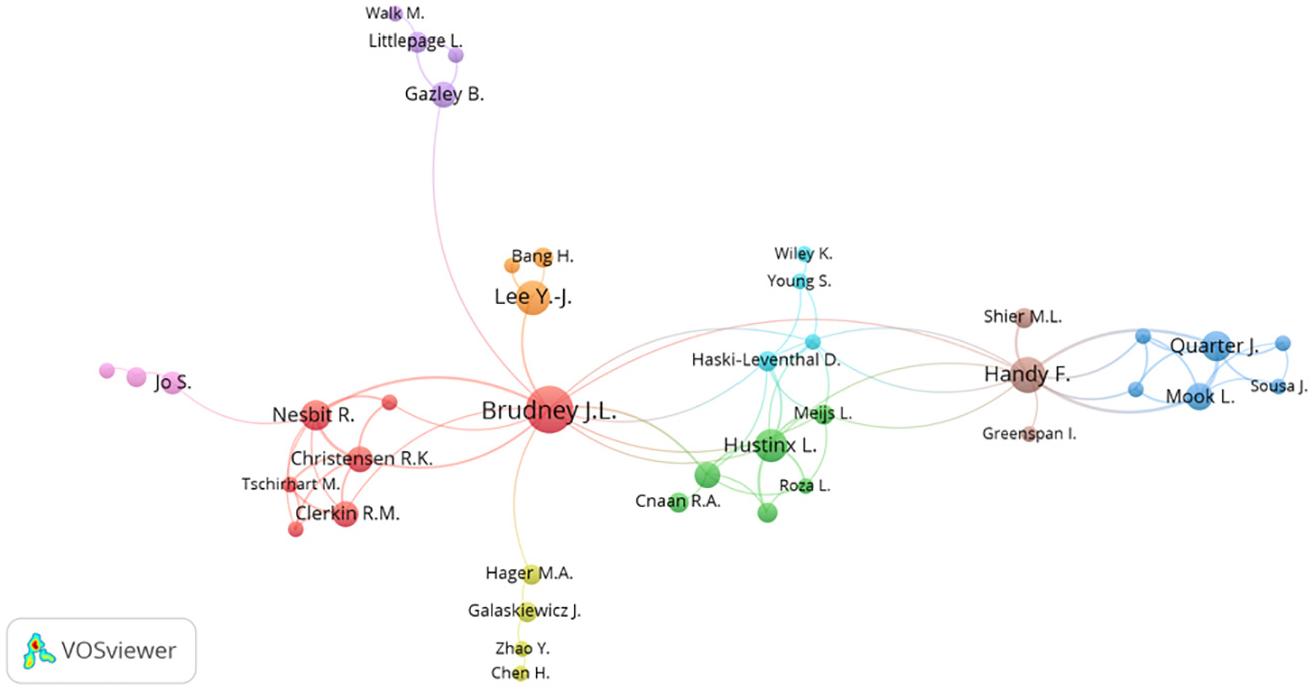
Authors cooperation network in VM research.
In terms of the top institutions on VM research, University of Toronto was the most productive academic institution, with 19 publications. Moreover, based on the QS World University Rankings 2022, 5 universities were ranked within the top 100 universities (QS Quacquarelli Symonds Limited, 2021)—the University of Oxford (ranking second), University of Pennsylvania (13th), University of Toronto (26th), King’s College London (35th), University of Queensland (47th), and Universität Heidelberg (63rd). This suggests that the top universities worldwide have paid attention to VM research.
Leading Authors
We determined the most prolific scholars based on the number of articles they produced. Table 3 shows the top 12 authors in the VM subject based on their total publications. The top authors are represented by the United States (8 authors), Belgium (2 authors), Australia (1 author), and Canada (1 author). The first articles published by these leading authors varied from 1990 to 2011, with eight as the first author and four as co-authors. According to the authors’ affiliations, VM research was conducted in public relations, organizational psychology, economy, management, and public administration.
The top 12 authors in the research field of VM in NPOs.

Note. Role in co–authorship, superscripts.
First author.
Co-author.
The impact and perceived quality of researchers’ contributions were measured by using the indicator h-index. The evaluation approach measures the scientific output of a single researcher using a single-number criterion (Bornmann & Daniel, 2007). Seventy five percentage of the most prolific authors recorded an h-index higher than or equal to 15. Jeffrey L. Brudney from the United States led the list with 17 publications since 1990, 33 h-index, and 304 times citations. Table 3 includes Jeffrey L. Brudney’s two author IDs because he has two Scopus author profiles. The second top author, Femida Handy is affiliated with the University of Pennsylvania. The highest author h-index of 36 is Nancy L. Morrow-Howell from the Washington University in St. Louis. It is important to note that authors whose papers received the most citations in Table 2 may not be featured in Table 3. The findings show that the only two names that appeared in both tables are Richard D. Waters and Young-Joo Lee. These two authors have produced the most articles and received the most citations in their works.
Keywords Analysis
A cluster analysis of frequently used keywords might reveal the overall state of a certain study subject. The keywords of a paper represent the subject of an investigation. Keywords with high frequency suggest that they are popular in a particular field. The Price’s Law, according to Wei et al. (2019), can be used to find high-frequency keywords as well as the primary writers on a given topic. The formula, M = 0.749*√Nmax (Nmax means the most often occurring keyword, Nmax = 227), M ≈ 11.28. Therefore, frequency ≥11 is considered a high-frequency keywords in the field of VM research. After re-labeling synonymic single words and congeneric phrases, 3,378 author keywords were obtained. From this figure, 43 keywords met the requirement of at least 11 occurrences for the mapping in VOSviewer. Table 4 displays the top 10 keywords in VM together with their frequency and total link strengths.
The top 10 keywords in VM-related articles.

By analyzing keyword clusters with a high frequency, researchers can determine the primary study foci in a certain topic, thereby gaining a deeper understanding of each focus. As the co-occurrence map in network visualization mode shows, the weights of the nodes are represented by the size of the nodes and words. The weight increases with the size of the node and term. The separation between any two nodes indicates how closely related they are. In general, a closer distance indicates a stronger relationship. Two keywords are separated by a line to indicate that they have appeared together. The line becomes thicker with more co-occurrences (Gu et al., 2017). Same-colored nodes are clustered together.
The VOSviewer software produces two types of visualization maps. The first map shows the clustering of keywords to indicate how each keyword relates to the others in the searched articles. The second map portrays the time information of the keyword clusters to reflect the years they appear. These two maps can provide insights regarding the topic trends and potential gaps in VM research.
For the first visualization, the software has classified VM keywords into six clusters in red, blue, cyan, green, yellow, and purple colors (Figure 7). The red keywords (cluster #1) include a total of nine items mainly connected to non-governmental organizations (NGOs). The related keywords “non-profits” (58 occurrences), “voluntarism” (20 occurrences), and “education” (12 occurrences) are among the most used in this cluster. NGOs are a type of civil society organization that is non-profit and operates independently of any government, and they can be focused on a wide range of issues, such as human rights, environmental protection, poverty alleviation, public health, and education. Since the 17th century, volunteers in Western countries have played an important role in shaping a functioning civil society by enhancing public participation (Xu, 2013). By introducing a transnational perspective to theories of NGOs and voluntarism, Schnable (2015) proved the necessity for decentralization of aid to volunteers.

The bibliometric map generated by network visualization mode for the co-occurrence of author keywords.
The green keywords (cluster #2) include a total of 227 items mainly connected to volunteering. The related keywords “corporate social responsibility” and “corporate volunteering” appeared 18 and 13 times separately. This suggests that volunteerism has received stronger attention in the corporate world. This evidence should concur with the increasing trends whereby corporations engage and involve their staff in corporate social responsibility programs, and channel fund not-for-profits organizations in corporate volunteering activities (Samuel et al., 2013; Brzustewicz et al., 2022). The presence of other keywords “human resource management” and “qualitative research” implies that the perspective of human resource management and the qualitative method are widely adopted to explore volunteering management subject. The results also suggest the need to employ different methodologies to investigate VM in future studies.
The blue keywords (cluster #3) include a total of 20 items mainly connected to philanthropy which is the field that has grown in cultivating donors and volunteers during the past two decades. For example, a development taxonomy was put up by Van Slyke et al. (2007) to help NGOs successfully engage African Americans as possible donors. Haas (2013) conducted research to investigate the extensive benefits that volunteering and charitable work can provide to older migrants living in the United Kingdom. T. K. Bauer et al. (2013) painted a comprehensive portrait of philanthropic behavior in Europe by evaluating the correlation between charitable monetary gifts and volunteer labor, as well as their interrelation.
The yellow keywords (cluster #4) include a total of 91 items mainly connected to civil society. The influence of civil society in voluntary social work is the focus of this cluster. Ambrosini (2024) talked about the different types of assistance offered by volunteers and the participation of “humanitarian” actors originating from civil society in handling the refugee reception issue. In both Sweden and Korea, the civil society sector, according to Kim (2004), has played a significant role in governance.
The purple keywords (cluster #5) include a total of 133 items mainly connected to volunteers. Containing seven words, this cluster examines ways to keep volunteers in NGOs, especially in light of the COVID-19 pandemic. For instance, Traeger et al. (2023) discovered that organizational identity in NGOs can affect volunteer outcomes and how supportive volunteers feel about the organization. Pirani et al. (2022) discussed the difficulties in managing volunteers during the COVID-19 pandemic in Iran, including managerial, policymaking, sociocultural, and operational restrictions.
The cyan keywords (cluster #6) include a total of 31 items mainly connected to voluntary organizations. This cluster investigated the worth of voluntary organizations. Like Dekker and Van den Broek (1998) discovered empirical evidence to support the idea that engagement in voluntary groups promotes social cohesiveness and political democracy, and voluntary associations also make use of social capital and advance public debate.
The components with low frequency have yet to receive enough attention and can be explored in the future. From a variety of angles, the goal of factor analysis is frequently to arrive at an explanation that makes sense for how well volunteers did their jobs. The constant influx of new components provides fresh visual characteristics for VM study, which is a crucial factor in promoting the growth of this subject.
Figure 8 displays the author keywords co-occurrence map of the VM papers with time information to highlight the changes in study topics over different periods. The hue of a keyword represents its average publication year. Recent topics are shown in lighter colors. Earlier researchers paid plenty of attention to observing volunteering activities for nonprofit purposes. Earlier works in NPOs have mostly focused on NPOs as social agents. Published articles in the early years have used keywords like “voluntarism,”“social capital,” and “fundraising” that reflect the most traditional and established role of NPOs as non-government organizations to deliver services to people in need and support social transformation (Lewis, 2010). We noticed that the themes moved to topics associated with “civic partnership,”“philanthropy,”“charity,” and “governance” that may suggest beginning emphasis on accountability and collaboration with stakeholders in NPOs’ activities. The focus on elderly individuals in VM started earlier in 2014, compared to young people which began surfacing in 2017. In 2016, most articles focused on management aspects in VM, using keywords such as “volunteer management,”“corporate social responsibility,”“corporate volunteering,”“volunteer motivation,”“education,” and “human resource management.” These keywords are aligned with the managerial movement for efficiency and effectiveness in NPOs. In 2019, more VM researchers paid attention to the role of technical factors like social media. Finally, the map reveals a rising tendency in publications dealing with refugee issues and COVID-19. Despite the increased proliferation of sub-topics in VM, more research is needed to further explore the involvement of managerial perspectives in the subject.
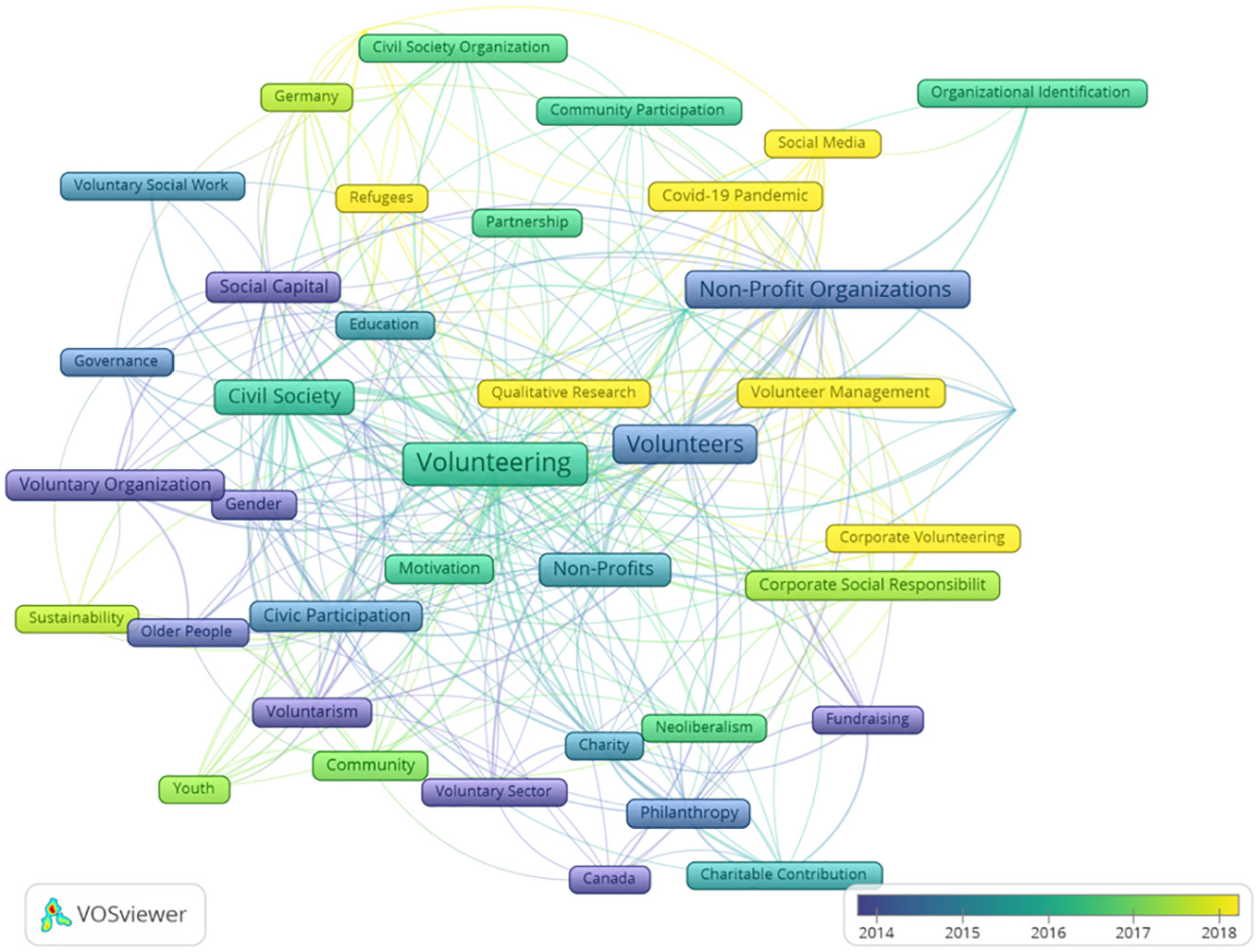
Time trend overlay visualization mode of keywords co-occurrence analysis.
Figure 8 displays the author keywords co-occurrence map of the VM papers with time information to highlight the changes in study topics over different periods. The hue of a keyword represents its average publication year. Recent topics are shown in lighter colors. The focus on elderly individuals in VM started earlier in 2014, compared to young people which began surfacing in 2017. In 2016, most research focused on management aspects in VM such as motivation, education, and human resource management. In 2019, more VM researchers paid attention to the role of technical factors like social media. Finally, the map reveals a rising tendency in publications dealing with refugee issues and COVID-19. Despite the increased proliferation of sub-topics in VM, more research is needed to further explore the involvement of managerial perspectives in the subject.
Discussions
We conducted the study to leverage on the bibliometric data of VM articles to determine the internal structures and hidden inferences that have informed the publications of VM as an area of study. We have clarified that these can be deciphered by analyzing the leading journals, articles, countries, institutions, authors, collaboration networks, key topics, and potential areas in the study of VM. In the earlier section, we have shown the findings of each element based on descriptive data and bibliometric maps. The results above raised several observation points. We discuss them in the aspects of representation of the articles, maturity of the area, NPOs external environment, and emerging research opportunities.
Articles Representation from More Developed Versus Less Developed Countries
Our findings show the prominence of certain countries in the VM subject. The United States outperformed other countries in terms of total article production (39.3% papers), cross-country collaboration (co-authored with 53 countries), and top researchers (8 of the top 12 authors are from the US). The US and UK combined produced half the total global papers on the subject. The other top countries in the subject are mostly from Europe. Furthermore, our study shows that 80% of the articles were conducted by authors in developed economies. Intra-country collaborations of the top countries are also quite low, suggesting a need of knowledge sharing in the area. For instance, the United States had the highest single-country publications (SCP) (83.4%). Moreover, it was shown that approximately 77% of countries had worldwide collaborative publications with fewer than ten countries. The result may give the impression that less-developed nations are behind in pursuing non-profit objectives.
The practice of NPOs is contextually bounded. Salamon et al.’s (2004) seminal study on comparative NPOs highlighted the regional diversity in the sector. Economic, regulatory, and social factors affect NPOs in different regions (Casey, 2016; Von Schnurbein et al., 2018). NPOs may take on different shapes and perform a variety of functions in different countries (Lewis, 2010). Each NGO operates within an environment that is developed by a particular condition. Furthermore, the imbalance of economic growth between countries might lead to inequality in the development of NPOs. For instance, philanthropic activities in a country can be influenced by the availability or accessibility of wealth and investment (Adam, 2014; Fuchsová et al., 2018). These factors may influence systematic efforts in advancing knowledge on NPOs, specifically on the topic of VM, through research and publications. In other words, the lack of published papers from less developed countries may be due to various underlying factors that shape differences in NPOs’ practices.
We believe that a symbiosis between theory and practice is crucial for a field’s advancement. Scholarly empirical papers conducted based on rigorous approach allows relevant stakeholders to share and learn from each other. Studies on power relations consider academics as one of the global elites due to their ability to create knowledge and shape social dialogues (Sovacool & Brisbois, 2019). Other than for professional growth, academics should publish to fulfill their social obligations as neutral researchers and to support the scientific advancement of their disciplines (Sovacool, 2023). Based on Hegel’s philosophy, Sovacool (2023) emphasized that publishing is “the cornerstone of communication within the academy, a foundation for where we can all generate data, analysis, and findings that can advance critical dialogue, provide feedback, and promote dialectic learning” (p. 3). Without good scholarly output, it will be difficult to critically assess the progress, gaps, and future actions to enable continuous advancement in the area. We acknowledge that there are many platforms on which VM and NPO researchers could publish or disseminate information, such as academic conferences, books, industry reports, seminars, and consultation papers. However, there should be a more balanced global presence of VM and NPO research on an established peer-reviewed platform like Scopus that can allow wider outreach of the papers.
Maturity of VM as the Area of Study
The number of peer-reviewed publications is an essential indicator to measure the development of a scientific research subject or topic (Van Nunen et al., 2018). Our study shows that in 65 years, the subject has published 1,605 papers. In the beginning, it took 54 years for the area to publish almost 500 articles. The publication momentum started in 2010 (around 50 articles per year), in 2019 (100 per year), and in 2022 it doubled to 200 articles per year. In other words, despite philanthropic practice having a deeper history in past centuries (Lewis, 2010), VM coverage in peer-reviewed publications is a recent phenomenon. This observation is consistent with the growing significance of NPOs in global development (Casey, 2015; Hengevoss, 2021), resulting in more attention on its sustainability (Helmig et al., 2004).
According to Price’s (1963) law, which assesses the total growth of scholarly publications in a particular field, a research domain expands through the following four stages (Dabi et al., 2016). Firstly, a preliminary stage occurs during which a small number of researchers publish works on a novel subject. The next stage is characterized with a proper exponential growth, where an increasing number of scientists are drawn to the subject’s vast unknown features. The field then moves to a synthesis of the existing collection of knowledge. And finally, once established, it will experience a reduction in publication volume. From this point of view, VM may be placed between the second and the third stage. We anticipate that the yearly publication of VM will continue to increase. The visualization map produced from our study suggests the expanding curiosity of researchers on the subject. VM is still a young area that needs more scholarly research and output to benefit its growth.
We further assess the maturity of VM research based on the literature analysis framework provided by Keathley-Herring et al. (2016). According to the framework, a mature research field displays seven characteristics. It adopts diverse research methods; tests a multitude of variables; analyses a significant number of hypotheses; involves authors from diverse backgrounds; shows strong correlations between authors and study topics; portrays a convergence of results; and reflects solid academic-practitioner collaborations. While our bibliometric data cannot assess all these aspects, based on the authors’ backgrounds, we posit that the study of VM still has a long way to go. Immature fields commonly begin with writing on a particular subject by small circles of people (Maloni, et al., 2009). A more mature field involves producing high convergence of findings by a large divergence of authors (Kathleen et al., 2016). Our study shows that the 1,605 articles on VM were written by 3,728 researchers, affiliated with 96 countries, and were published in 159 journals. Of these figures, as mentioned, 51% of the articles came from just two countries.
The growing stage of the area can also be seen from the diversity of topics. Our study shows the top areas consisted of articles from social sciences (40.0%); followed by business, management, and accounting (18.2%); and medicine (12.9%). Social science articles are traditionally studied with sociological and psychological perspectives (Lockstone-Binney et al., 2010). Our study also found the contributions of other fields such as business management and medicine, although the number is considerably lesser. Every discipline may offer a unique perspective in managing volunteers. The sociological lenses pay attention to human social behavior (Stedman & Rudd, 2004) but tend to neglect specific and practical action plans for NPOs (Helmig et al., 2004). This gap can be addressed by looking at business management papers that are interested in optimizing volunteers’ efficiency and effectiveness (Devaney et al., 2015; Vretenar et al., 2020). For instance, human resource practices such as recruitment, training, and performance evaluation are important in VM (Alfes et al., 2017). Similarly, with heightened competition in the sector, NPOs can learn a lot from the business management field regarding approaches in fundraising, financial sustainability, and branding (Helmig et al., 2004). Therefore, the multi-disciplinary character in the VM area should provide richer perspectives that are critical for the sector.
Impacts of External Environment on NPOs
The literature allocated different spaces to illustrate NPO functions and their interactions with the surrounding context. The high-frequency author keywords on “refugees,”“COVID-19,”“sustainability,” and “social media” reveal how external environment have a significant impact on NPOs’ priorities, operations, and resource allocation (Douglas, 2023; Fuller & Rice, 2022). On refugee services, NPOs must adjust their operations considering logistics and cultural-linguistic adaptations to effectively serve the needs of influx of displaced refugees (Evans et al., 2024). During the pandemic, NPOs are forced to rapidly reassess and reallocate resources, demonstrating their role in crisis response and operational agility (Pitowsky-Nave, 2022). Following the UN SDGs, the agenda serves NPOs with a guiding framework and specific targets as seen by more studies emphasizing the role of NPOs in the SDGs’ attainment (Kassem et al., 2021). Furthermore, increasing studies recognized the profound influence of social media in transforming NPOs’ engagement and advocacy. This research emphasis provides the potentials of social media in helping with VM (Li et al., 2020; Oksiutycz & Mwadiwa, 2023). These research hot areas reflect how NPOs are susceptible to the changing environment. They must be agile to handle urgent societal needs, offering service gaps that governments and other sectors are unable to address (Beaton & Dowin Kennedy, 2021). NPOs also need to be adaptable in leveraging on emerging social technology for better stakeholders’ engagement. With the significance of sustainable development, NPOs further play a crucial role to provide grassroot supports and policy interventions. Given the high dependency of volunteers in NPOs (Matos & Fernandes, 2021), effective VM is pertinent to allow rapid adjustment and manpower mobility to suit the changing environment.
The purpose of existence of NPOs is to provide benefits to societies (Stock & Erpf, 2023). Despite the multi-roles they have served over the years, this societal mission remains a top priority and often becomes a yardstick in judging NPOs relevance and legitimacy (Treinta et al., 2020; Worth, 2020). Our findings suggest NPOs seem to adapt based on the societal needs emanating from the external environment. Given increased global challenges, the roles of NPOs are expected to evolve necessitating the need to properly manage and retain volunteers. Drawing upon our study observation points, we propose a framework based on the PEST analysis framework to depict how the external environment influences the evolution of NPOs (Figure 9). PEST analysis, which stands for Political, Economic, Social, and Technological analysis, is a method frequently employed to understand the macro environment influencing organizations (Cox, 2021). PEST provides insight into how external factors impact NPOs’ operations as they adapt to their constantly shifting surroundings.

External macro environment of NPOs—PEST analysis framework.
The framework presents an outline of the different macro-environmental aspects influencing NPOs reflecting its nature as an open system. Understanding these environmental impacts through a detailed bibliometric analysis assists in developing a more globally inclusive NPO strategy that accommodates diverse needs and stakeholders worldwide.
Emerging Research Opportunities
Our analysis highlights several areas for future research. We divide our suggestions into research topics and general research approaches.
Future Research Topics
NPO research can be driven by several factors (Von Schnurbein et al., 2018). The first driver is shaped by efforts to understand NPOs’ roles as social capital agents to support governments in policy-making and implementation. The second factor is influenced by the new public management (NPM) movement that introduces management vocabularies in NPO operations. The third impulse is due to globalization and the economic growth of transnational NPOs. Our study provided visualization to describe how these drivers have translated into published works in NPO.
Through bibliometric maps, our study has captured certain keywords that describe the temporal movement in research interests and priorities. Earlier works in the area were mainly triggered by the first driver, that is, NPOs as social agents. The later publications, that is, from 2016 onwards, injected NPM/managerial principles into NPO operations. In this period, the articles began pursuing topics related to VM. Our keyword analysis shows that corporate volunteering, in a CSR context, received significant research attention. We also found the keyword “organizational identity” on the map, a concept often linked to volunteer retention (Kreutzer & Rueede, 2019). Future research should further study the issue of volunteer retention and engagement. Given the rising volunteering trend, more research is needed to come up with better ways to manage and serve the needs of different groups of volunteers. For example, motivations of latent or potential volunteering groups, such as people with disabilities, can be explored in future studies.
The word “voluntary” that defines NPOs’ workforce may require revisiting in future research. Recent development requires NPOs to treat volunteers as critical resources through strategic HRM (Cooper et al., 2020). More research is needed to determine the best strategies to manage and retain them. We also found emerging phrases like “social media” suggesting the importance of NPOs’ online presence to engage younger generations. The keyword “sustainability” suggests that further study may investigate how VM might assist NPOs by leveraging on their people resources. Our study did not capture keywords related to transnational NPOs. Future studies may investigate how VM contributes in enhancing the cross-national capacity of NPOs.
Suggestions on General Research Approach
Our study also points to several avenues relating to study contexts, design, and collaboration.
In terms of geographical contexts, we found that most of the articles were authored by those based in developed countries. Although our study limits us from scrutinizing the contents, based on the authors’ affiliations and keyword analysis, we assume that the articles also represent VM issues and NPO samples from developed nations. We need more research from underexplored countries. NPOs act as catalysts, implementers, and partners depending on whether they operate in developing, transitional, or developed societies (Lewis et al., 2020). Studies in these contexts can fill the contextual void that could prompt future academics to conduct additional research on unchartered territories.
In line with the above, we suggest more comparative studies on VM. This is to fill the gap we have raised earlier and potentially encourage more multi-country collaborations between researchers. Comparative NPO studies are important given the high diversity in NPO practices. Scholars also acknowledged and called for more research to adopt a comparative paradigm involving NPOs in multiple contexts (Anheier, 2023; Salamon et al. 2004). Further research may take this as a gap to pursue studies that examine the differences or similarities between countries. We believe that comparative research design may involve researchers/authors from different countries. This should encourage multi-country co-authorship, which also helps in improving paper visibility and citation.
Conclusion
This study assessed global research trends on VM publications in NPOs from 1956 to 2022. We have identified the leading journals, articles, countries, institutions, authors, collaboration networks, key topics, and potential areas in the study of VM. We discuss the findings in the aspects of representation of the articles, maturity of the area, and emerging research opportunities. As a subject that changes with the times, VM is popular in a variety of fields. Although the number of research articles fluctuated from year to year, it is projected that scientific production in this sector will continue to increase. The analysis contains 1,605 papers on VM published by 3,728 authors and published in 159 journals, representing 96 nations or territories. Leading countries/academic institutions (e.g., the United States and the United Kingdom) in the subject were identified. These entities can provide opportunities for researchers from other nations to expand their research collaborations. This study also identified a list of influential authors, productive institutions, and core journals in the VM area. Some points of concern could be drawn from the findings, such as the correlation between regional disparity and economic progress. The high-frequency author keyword clusters and their evolution tendencies have demonstrated the field’s focus and hotspots. The study has also uncovered some fresh research spots that serve as a decision-making resource in selecting future study subjects. The study shows that BA effectively maps published literature and identifies research needs in a given field.
However, our study is not without limitations. The study was designed to leverage bibliometric data of journal articles based on a reputable indexed database. There is a myriad of documents on VM and NPOs that fall beyond our scope. For the study purpose, our search scope was restricted to Scopus-listed articles. There may be a potential bias in the database due to our search period that could produce incomplete records of VM literature. The results may be limited in capturing complete realities in VM, given the global diversity in NPOs. In other countries, the sector may exist in different forms. By limiting the Scopus database, we may have missed rich publications from certain countries and cultures.
Footnotes
Acknowledgements
This is not applicable.
Declaration of Conflicting Interests
The author(s) declared no potential conflicts of interest with respect to the research, authorship, and/or publication of this article.
Funding
The author(s) received no financial support for the research, authorship, and/or publication of this article.
Ethical Approval
This is not applicable.

Data Availability Statement
Data sharing not applicable to this article as no datasets were generated or analyzed during the current study.