



Abstract
Occupational stress among faculty has become an important research topic in psychology. Unlike previous studies, this research integrates resilience, job satisfaction, and psychological capital into a unified analytical framework based on Social Identity Theory and Conservation of Resources Theory. It aims to investigate the underlying mechanisms and boundary conditions between professional identity and work engagement. Using a cross-sectional survey design, we collected data from 950 Chinese university faculty through questionnaire assessments, focusing on the relationships among professional identity, resilience, job satisfaction, psychological capital, and work engagement. Results indicate that professional identity shows a significant positive association with work engagement. Resilience and job satisfaction play parallel mediating roles in this relationship. The main contributions of this study include revealing the complex internal processes linking professional identity and work engagement, and verifying the significant moderating role of psychological capital in the path from professional identity to resilience. These findings offer a new theoretical perspective for understanding the formation mechanism of work engagement among university faculty. They also provide empirical support for higher education management practices that emphasize building professional identity, fostering resilience, and developing psychological resources.
Introduction
The ongoing reform and increasing functional diversification of higher education have exposed university faculty to growing professional challenges. Faculty members now face sustained occupational stress due to multifaceted role demands, including pedagogical innovation, research evaluation, and community engagement. In this context, work engagement (WE) has emerged as a critical determinant of higher education quality. Enhancing faculty among WE to improve educational outcomes has consequently become a key focus in both educational theory and practice.
WE represents a constructive and rewarding psychological condition at work, marked by energy, commitment, and full engagement (Schaufeli et al., 2002). Previous studies demonstrate significant associations between university faculty’s WE and multiple outcomes, including job performance, turnover intention, and student academic achievement (Bakker et al., 2008; Duckworth et al., 2009; Roth et al., 2007). Furthermore, WE correlates strongly with faculty motivation and job satisfaction (JS), while serving as a protective factor against occupational burnout (Dai & Wang, 2025). These findings underscore the importance of investigating the antecedents of work engagement to promote faculty well-being.
Theoretical Foundation Framework and Hypotheses
Theoretical Foundation
Social Identity Theory (SIT) posits that individuals strive to establish or maintain a positive social identity, primarily derived from advantageous distinctions between their own group and comparable external groups. According to SIT, when employees feel a strong connection to their occupation, they typically report greater professional satisfaction (Alexander-Albritton & Hill, 2015). Existing studies demonstrate that educators who develop a robust sense of professional identity (PI) tend to experience enhanced JS (Baojuan et al., 2017). These teachers typically demonstrate greater enthusiasm for their work, show stronger interest in student success, and develop clearer understanding of their professional roles. These factors collectively are associated with enhanced career satisfaction. Empirical evidence confirms that positive PI is linked to teachers’ JS (Oubibi et al., 2022), though the underlying mechanisms require further exploration. According to the JD-R theory, psychological capital (PsyCap) may relate to WE (Demerouti et al., 2001) and shows connections with work outcomes. Similarly, the COR theory maintains that workers demonstrating higher levels of PsyCap tend to exhibit stronger WE and superior performance results (Hobfoll, 2002). Existing studies reveal consistent associations between PI and both resilience (RES) and JS among teachers (Dawborn-Gundlach et al., 2025; Day & Smethem, 2009), while RES and JS similarly correlate with WE (Pongton & Suntrayuth, 2019; Wingerden & Poell, 2019). Although prior research has established pairwise relationships among these variables, few studies have systematically examined whether RES and JS serve as parallel mediators between PI and WE. Grounded in SIT and COR theory, this study investigates the determinants and mechanisms of WE of university teachers. The findings will extend theoretical applications in higher education while providing both theoretical insights and practical guidance for enhancing faculty engagement.
Hypotheses
Professional Identity and Work Engagement
Work engagement describes an active and fulfilling psychological condition marked by high energy levels, strong commitment, and complete focus in work-related tasks (Schaufeli et al., 2006). Within the framework of self-determination theory, work engagement reflects intrinsic motivation and correlates with favorable outcomes among educators (Bakker & Bal, 2011). Among various influencing factors, professional identity emerges as a crucial individual-level variable. Professional identity reflects a person’s cognitive and affective psychological bond with their occupational role, reflecting their understanding and affirmation of professional worth (Meijers, 1998). For teachers, it denotes a resolute, positive attitude toward their profession—manifested as strong commitment, persistence, and achievement motivation. Empirical studies consistently demonstrate positive associations between PI and WE (Xing, 2022; Q. H. Zhang et al., 2024). Teachers with stronger PI report greater job fulfillment and exhibit more active participation in daily work (C. Wu et al., 2022).Van der Want et al. (2019) confirmed this positive relationship, while Zhao et al. (2019) specifically identified significant correlations between PI and both teaching perspectives and classroom engagement levels. The stronger a teacher’s PI, the greater their intrinsic motivation for WE tends to be (Q. H. Zhang et al., 2024). This study therefore examines the mechanisms linking university faculty’s PI to WE, proposing the following hypothesis:
The Mediating Role of Resilience
RES refers to an individual’s ability to overcome adversity, recover from setbacks, and adapt to changing circumstances (Kangas-Dick & O’Shaughnessy, 2020). In the teaching context, RES reflects educators’ capacity to maintain their effectiveness and well-being despite workplace demands and constraints (Mansfield et al., 2016). Prior research indicates a significant association between RES and WE (Clark et al., 2021). From a vocational psychology perspective, teacher’s RES is correlated with WE (Wingerden & Poell, 2019), with highly resilient individuals typically exhibiting higher levels of work engagement (Cao & Chen, 2019; Lyu et al., 2020). Furthermore, PI and RES are closely linked among teachers, serving both motivational and protective functions (Dawborn-Gundlach et al., 2025). Teachers’ confidence in their professional competencies (e.g., subject knowledge and pedagogical skills) contributes to the development of their RES (Navy et al., 2022). Although existing studies have separately examined the relationships between PI and RES, as well as RES and WE, research on whether RES mediates the connection between the two remains limited. Accordingly, the present investigation seeks to explore the potential mediating mechanism of RES linking PI and WE. The study tests the following hypothesis:
The Mediating Role of Job Satisfaction
JS as a construct was initially proposed by Hoppock (1975), who defined it as employees’ subjective responses to their work environment and their physical and psychological experiences within it. In psychological research, JS refers to employees’ affective reactions to their work conditions (Sypniewska, 2015; Yousef, 2017). Existing studies demonstrate that teachers’ JS—their emotional or attitudinal evaluation of work—closely relates to WE, with the two showing positive correlations (Dai & Wang, 2025; Mérida-López & Extremera, 2020; Zang & Feng, 2023). Additionally, positive PI serves as a key psychological resource that is associated with teachers’ JS (Oubibi et al., 2022). J. S. Wu et al. (2024) specifically examined the relationship between PI and JS among 300 Pakistani university teachers. Their results revealed a significant positive association, indicating that strong PI plays a crucial role in boosting university teachers’ JS. While prior research has separately established links between PI and JS, as well as between JS and WE, studies investigating JS as a potential mediator remain scarce. Thus, the current investigation additionally examines JS as an intervening variable connecting PI with WE. The study tests the following proposition:
The Moderating Role of Psychological Capital
PsyCap represents an individual’s positive psychological resources, comprising four key components: self-efficacy, hope, optimism, and resilience (Luthans et al., 2004). For teachers, PsyCap refers to their collective psychological resources for addressing professional demands and challenges (Viseu et al., 2016). In educational settings, higher levels of PsyCap enable educators to approach complex classroom situations with greater confidence, maintain optimism in adversity, inspire hope in students, and demonstrate resilience in meeting professional development requirements (Y. Zhang et al., 2019). Existing research indicates that PsyCap not only directly relates to teachers’ work experiences but also plays a significant moderating role between PI and JS (Sunbul & Gordesli, 2021). Specifically, teachers with higher PsyCap tend to invest more time and effort in self-development and actively experience teaching-related achievements. These behaviors are linked to a stronger PI, which in turn is associated with enhanced JS (Crisci et al., 2019). Conversely, when teachers face prolonged stress without adequate psychological resources, their PsyCap may become depleted. This state is linked to negative emotional responses, a weakened sense of professional belonging and value identification, and subsequently, is associated with reduced JS. While previous studies have examined psychological capital’s moderating effect between PI and JS, no research has thoroughly investigated whether PsyCap moderates the relationship between PI and RES. Therefore, this study extends current knowledge by exploring psychological capital’s moderating role in both PI-JS and PI-RES relationships. We propose the following hypotheses:
The Current Study
Although existing research has confirmed a robust association between PI and WE, important unanswered questions persist in this domain. First, limited research has examined how background characteristics such as gender, teaching experience, and academic discipline differentially influence work engagement across different populations. Second, while studies have established the relationship between PI and WE, research on the mediating roles of psychological resources like RE and JS remains limited. Furthermore, most existing studies focus primarily on the direct association between PI and WE, lacking comprehensive investigation into the underlying mechanisms. Finally, although PsyCap serves as a key psychological asset that improves people’s adaptability and WE when facing challenges, research on its moderating role in the professional identity-work engagement relationship remains insufficient. Specifically, core elements of psychological capital such as confidence in one’s abilities, positive future expectations, and RES may play crucial moderating roles in how individuals translate PI into WE. Therefore, this study aims to address these research gaps by: (1) examining the differential effects of gender, teaching experience, and academic discipline among teachers; (2) investigating the mediating roles of RES and JS in the relationship between PI and WE; and (3) analyzing the moderating effect of PsyCap in this relationship. Figure 1 displays the conceptual framework of this study.

Research model.
Method
Sample and Data Collection
Data were gathered via the web-based survey tool Questionnaire Star (www.Sojump.com) to examine the hypothesized model. A random sampling method was adopted to select faculty members from multiple universities in Henan Province of China. The survey was conducted between April and May 2025. Prior to administering the survey, every participant was fully informed about the goals of the study and the procedures, and all respondents participated voluntarily, with clear assurances regarding data confidentiality. Ethical endorsement for this investigation was obtained from the Research Ethics Committee.
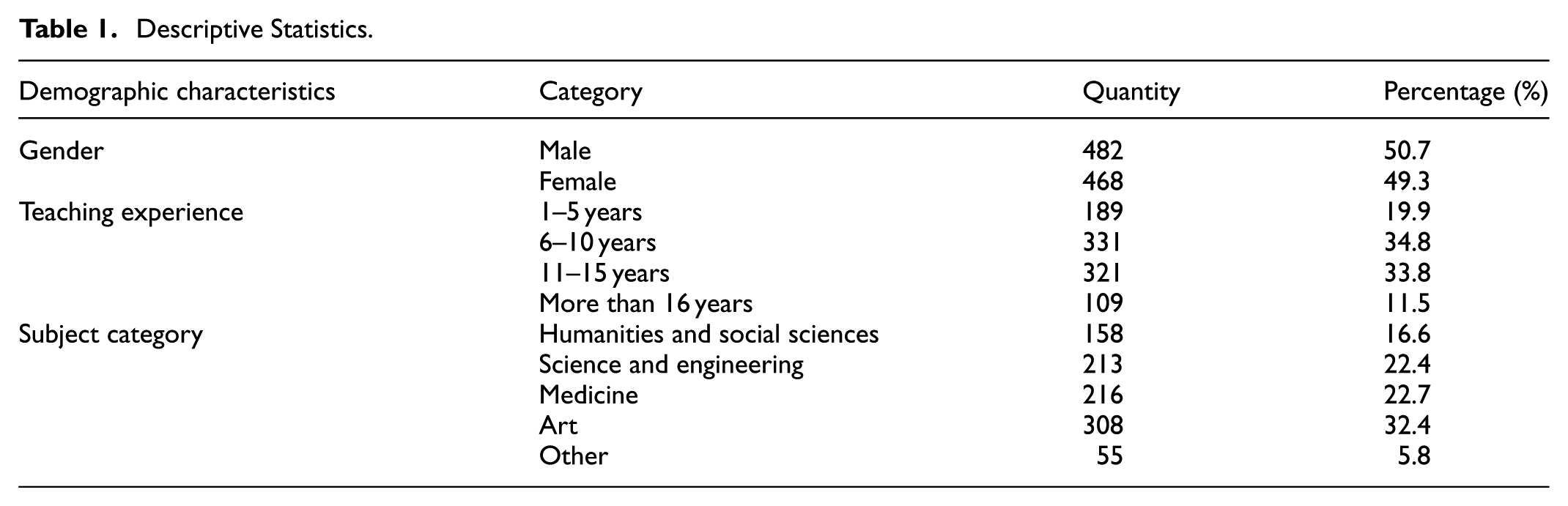
During data cleaning, questionnaires were deemed invalid if (1) more than 20% of the items were left unanswered, or (2) patterned responses were detected, such as selecting “Strongly Agree” or “Strongly Disagree” for more than 80% of items, which may lead to bias. After removing invalid questionnaires based on these criteria, the final sample comprised 950 valid responses. As shown in Table 1, the sample included 482 males (50.7%) and 468 females (49.3%). Teaching experience distribution was: 1 to 5 years (n = 189, 19.9%), 6 to 10 years (n = 331, 34.8%), 11 to 15 years (n = 321, 33.8%), and 16+ years (n = 109, 11.5%). The majority of participants specialized in arts disciplines (32.4%).
Descriptive Statistics.
Measurement Instruments
Work Engagement
The work engagement of university teachers was measured using the Utrecht Work Engagement Scale (UWES) developed by Schaufeli et al. (2002). This measure contains 17 items assessing 3 key aspects: energy, commitment, and full concentration. Participants evaluated all statements using a 7-point scale (1 = never, 7 = always), where elevated scores reflected stronger WE. The adapted Chinese UWES has shown satisfactory reliability and validity in previous studies (Xie, 2021). The current investigation found the measure demonstrated strong internal consistency (α = .945 for the full scale). Confirmatory factor analysis indicated acceptable model fit: χ2/df = 2.243, CFI = .983, NFI = .970, IFI = .983, RMSEA = .036, confirming that the items adequately represented their respective factors.
Resilience
Resilience was evaluated with the 10-item Connor-Davidson Resilience Scale (CD-RISC-10), a validated instrument originally created by Campbell-Sills et al. (2009). This short form derives from the original 25-item multidimensional scale Connor and Davidson (2003), which remains a widely recognized measure of resilience. Faculty members rated each item on a 4-point scale (1 = strongly disagree to 4 = strongly agree), where elevated scores reflected stronger RE levels among university teachers. The Chinese version has demonstrated satisfactory psychometric properties (Wang & Pan, 2023). In our study, the measure demonstrated strong RE coefficients (α = .934). CFA produced these model fit statistics: χ2/df = 4.904, CFI = .981, NFI = .976, IFI = .981, RMSEA = .064, suggesting acceptable factor representation despite the relatively high χ2/df ratio.
Psychological Capital
We measured Psychological Capital using the 24-item scale developed by Luthans et al. (2004), comprising the following four essential elements: RE, hope, optimism, and self-efficacy. Participants responded on a 5-point Likert scale ranging from 1 (strongly disagree) to 5 (strongly agree), with higher scores indicating greater PsyCap. The Chinese version has demonstrated good reliability and validity (Ma, 2023). In our study, Excellent internal consistency was demonstrated by the scale (α = .953). CFA indicated good model fit: χ2/df = 2.626, CFI = .975, NFI = .960, IFI = .975, RMSEA = .041, confirming the four-factor structure.
Job Satisfaction
Job Satisfaction was measured with a 5-item instrument originally established by Greenhaus et al. (1990). Responses were recorded on a 5-point Likert-type scale ranging between 1 (strongly disagree) and 5 (strongly agree). Elevated values indicated stronger JS. The Chinese adaptation has demonstrated adequate measurement characteristics in validation studies (Sun et al., 2022). The scale in our investigation showed outstanding dependability (α = .850). CFA yielded acceptable fit indices: χ2/df = 4.477, CFI = .992, NFI = .990, IFI = .992, RMSEA = .061.
Professional Identity
We measured university teachers’ professional identity using the 18-item scale developed by Sun et al. (2022), consisting of four components: professional values, role values, sense of professional belonging, and tendencies toward professional behaviors. Responses rated items using a 5-point Likert scale (1 = strongly disagree to 5 = strongly agree), where elevated scores reflected enhanced PI. The Chinese version has demonstrated excellent psychometric properties (Sun et al., 2022). In our study, the scale showed excellent reliability (α = .947). The CFA results supported acceptable model fit: χ2/df = 3.129, CFI = .969, NFI = .956, IFI = .970, RMSEA = .047, confirming the four-dimensional structure.
Data Analysis
Parallel mediation pathways were analyzed employing Model 4 of the PROCESS macro (v4.0) in SPSS. This model was adopted given its capacity to effectively evaluate concurrent mediation pathways, aligning with our primary objective of investigating how professional identity indirectly influences university teachers’ work engagement through both RES and JS. To ensure the reliability of our mediation analysis, Bootstrap resampling (5,000 iterations) was utilized to compute 95% bias-adjusted confidence intervals for each indirect effect. For testing moderation effects, we utilized PROCESS Model 7 to examine whether psychological capital moderated the hypothesized relationships. This approach allowed us to systematically evaluate both the mediating and moderating mechanisms within our conceptual framework.
Results
Descriptive Statistics and Correlations
The descriptive statistics and correlation analysis revealed significant positive relationships between WE and PI, RES, and JS. Similarly, professional identity showed positive correlations with both job satisfaction and resilience. As shown in Table 2, all correlation coefficients reached statistical significance and displayed hypothesized directional patterns, supporting the appropriateness of proceeding with further mediation analysis.
Descriptive Statistics and Correlation Analysis Results.

Note. WE = work engagement; RES = resilience; PsyCap = psychological capital; JS = job satisfaction; PI = professional identity.
p < .01.
Common Method Bias (CMB)
CMB was first evaluated through Harman’s single-factor analysis. The results showed that the initial factor explained 20.989% of total variance, falling below the rigorous 40% cutoff. Podsakoff and Organ (1986), suggesting minimal concerns about CMB in our study. Furthermore, this study employed the latent variable method for supplementary testing. The Chi-square difference test revealed that the two models had Chi-square values of 2,001.531 and 1,998.983 with 1,169 and 1,168 degrees of freedom respectively. The Chi-square difference was 2.548 (with 1 degree of freedom difference), which did not reach statistical significance (p > .05). This indicates that incorporating the common method factor did not significantly improve model fit, and the common method factor accounted for only a minimal proportion of variance. Therefore, results from the latent variable method further confirm that CMB did not substantially influence the construct relationships in this study.
Reliability Analysis
We evaluated scale reliability using Cronbach’s alpha coefficients, with values above .8 indicating good reliability. As indicated in Table 3, while the CR of our scales was generally high, some items had outer loadings below .70. Following Hair (2022) recommendations, we considered removing items with loadings between .40 and .70 when doing so improved CR or average variance extracted (AVE) beyond recommended thresholds. After removing these items, we observed significant improvements in the model’s outer loadings, and both reliability and validity indices met acceptable standards.
The Results of the Reliability Analysis.

Note. WE = work engagement; RES = resilience; PsyCap = psychological capital; JS = job satisfaction; PI = professional identity; CR = composite reliability; AVE = average variance extracted.
Confirmatory Factor Analysis
CFA is an analytical approach that examines whether a scale’s latent structure aligns with its theoretical model, commonly used to assess construct validity. The CFA results yielded satisfactory model fit, with all goodness-of-fit indicators exceeding established thresholds (Ji et al., 2024; see Table 4).
Model Fit Indices.

Note. CMIN = chi-square value; DF = degrees of freedom; RMSEA = root mean square error of approximation; GFI = goodness-of-fit index; AGFI = adjusted goodness-of-fit index; CFI = comparative fit index; IFI = incremental fit index; TLI = Tucker–Lewis Index.
Gender Differences Analysis
Gender-based comparisons (male/female) for primary variables were assessed using independent t-tests (see Table 5). The results indicated no significant gender effects on work engagement (t = −.553, p = .580), resilience (t = .401, p = .688), psychological capital (t = .574, p = .566), job satisfaction (t = 1.177, p = .239), or professional identity (t = 1.416, p = .157).
Analysis of Gender Differences in WE, PI, PsyCap, RES, and JS (N = 950).

Note. WE = work engagement; RES = resilience; PsyCap = psychological capital; JS = job satisfaction; PI = professional identity.
Teaching Experience Differences Analysis
Homogeneity of Variance Test
Prior to analyzing teaching experience effects, we performed homogeneity of variance tests for professional identity and work engagement. Both variables met the homogeneity assumption (professional identity: Levene’s F = .345, p = .792; work engagement: Levene’s
Homogeneity of Variance Test.

Note. WE = work engagement; PI = professional identity.
Post Hoc Multiple Comparisons
ANOVA revealed significant teaching experience differences in professional identity (F = 2.698, p = .045) but not in work engagement (F = 1.153, p = .327; see Table 7). To address potential inflation of Type I error rates from multiple comparisons, we conducted post hoc analyses using Bonferroni correction. After this adjustment, the previously observed significant difference in PI was reduced to marginal significance. Specifically, teachers with 6 to 10 years of teaching experience showed lower PI levels than those with 11 to 15 years of experience, though this difference did not reach conventional statistical significance thresholds (mean difference = −2.92, p = .064). All other between-group comparisons for PI, as well as all comparisons for WE, remained non-significant (all p > .05). Detailed results for PI group comparisons are presented in Table 8.
ANOVA Test.
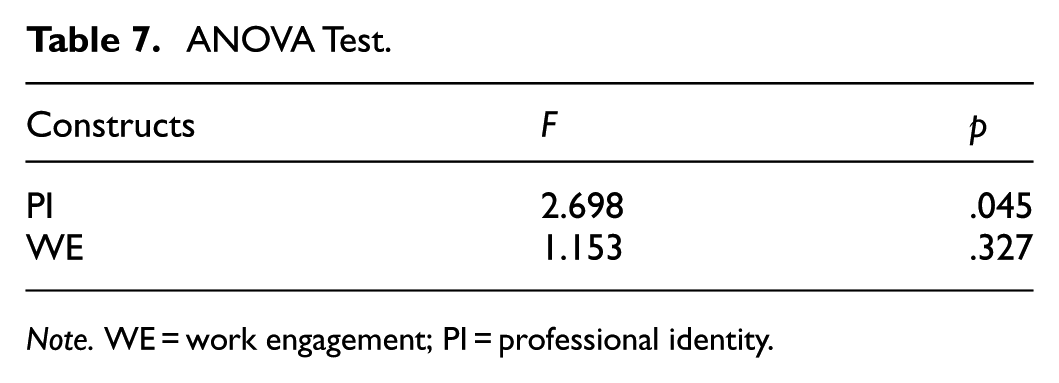
Note. WE = work engagement; PI = professional identity.
Post Hoc Multiple Comparisons.

Note. PI: professional identity.
Mediation Model Testing
Our analysis met all statistical requirements for examining the mediating roles of RES and JS. Using Hayes’ SPSS macro with 5,000 bootstrap samples, we constructed 95% bias-corrected confidence intervals. A significant mediation effect was established when the 95% confidence interval of the standardized path coefficient excluded zero. We employed Model 4 from the PROCESS macro to test the parallel mediation model with two mediators.
As shown in Table 9 and Figure 2, after including JS and RES as mediating variables in the model, PI maintained significant positive associations with both JS (β = 0.087, t = 8.350, p < .001) and RES (β = .117, t = 5.847, p < .001), while its direct relationship with WE remained significant (β = .120, t = 2.735, p < .01). Simultaneously, JS showed a significant positive association with WE (β = 1.006, t = 7.577, p < .001), as did RES with WE (β = .298, t = 4.320, p < .001).
Hierarchical Regression Analysis of Parallel Mediating Effects (N = 950).

Note. WE = work engagement; RES = resilience; PsyCap = psychological capital; JS = job satisfaction; PI = professional identity.
p < .01. ***p < .001.
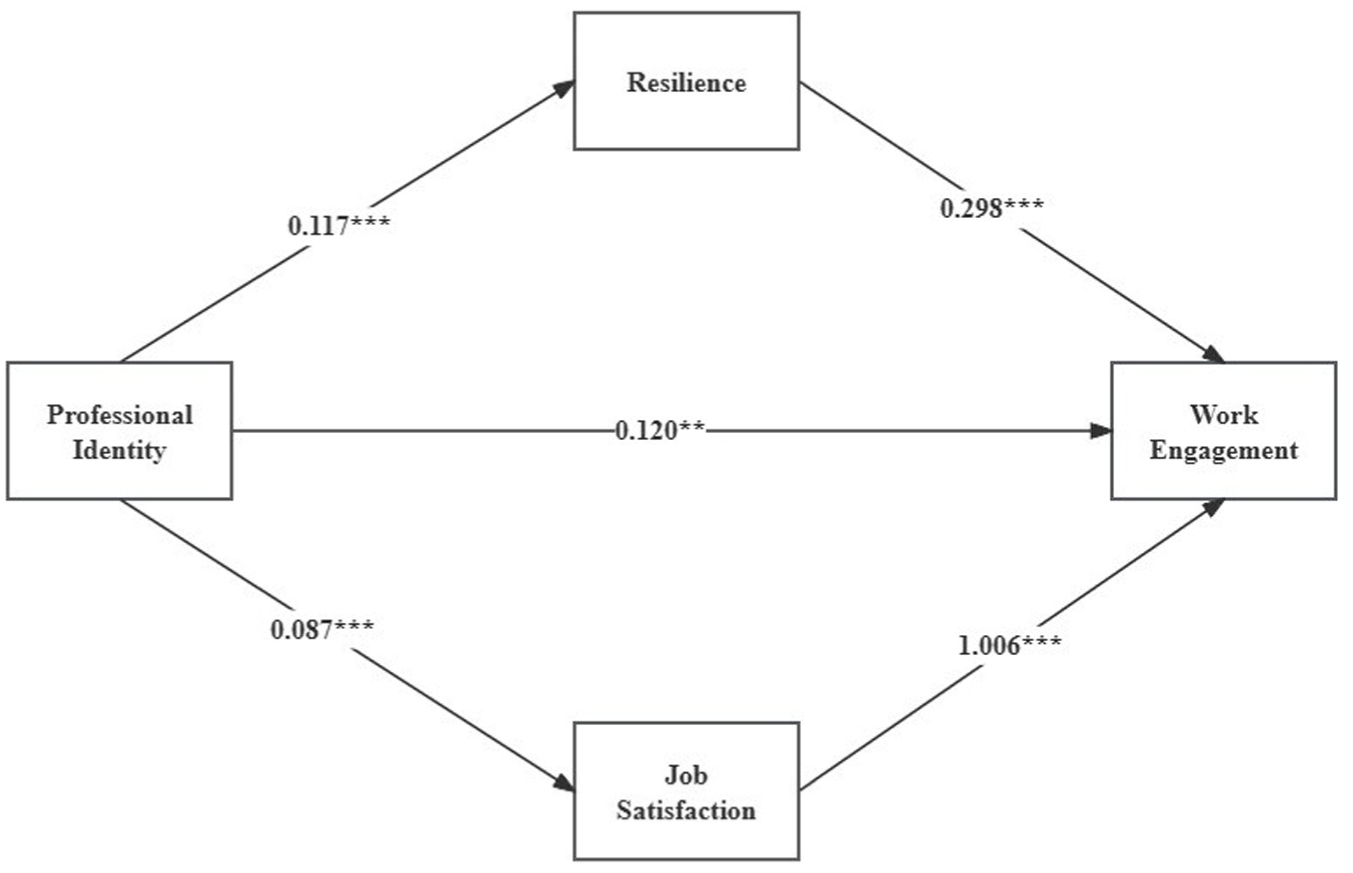
Mediation pathway diagram.
The bootstrap analysis (Table 10) provided additional evidence for the partial mediation effects of RES and JS in the relationship between university teachers’ PI and WE. Standardized indirect effect values showed β = .035 for the resilience path and β = .088 for the job satisfaction path. According to Preacher and Kelley (2011) criteria, these effect sizes reached small to medium levels. The independent mediating effects accounted for 14.463% (RES) and 36.150% (JS) of the total mediation effect. The proportion of mediation through JS exceeded that through RES, which may reflect theoretical considerations. Theoretically, while RES serves as a fundamental personal resource that helps teachers withstand challenges (Dawborn-Gundlach et al., 2025), JS may represent a more immediate and intense affective outcome. JS shows closer connections to daily work experiences and the fulfillment of psychological needs, potentially making it a stronger pathway for translating PI into sustained WE (T. Zhang et al., 2021).
Mediation Effect Test.

Note. WE = work engagement; RES = resilience; PsyCap = psychological capital; JS = job satisfaction; PI = professional identity.
Moderation Effect Analysis
We examined the moderating effects of psychological capital using Model 7 from the PROCESS macro. As shown in Table 11, PsyCap significantly moderated the association between PI and RES (interaction term β = .002, p = .030), but not the correlation between PI and JS (interaction term β = .000, p = .418). Although this moderating effect reached statistical significance, its unstandardized coefficient (β = .002) was notably small. To clarify the pattern of moderation and facilitate interpretation, we conducted simple slope analysis. As shown in Figure 3, among university faculty with higher levels of PsyCap (mean +1 SD), the positive association between PI and RES appeared slightly stronger than among those with lower PsyCap levels (mean −1 SD). This finding suggests that while PsyCap demonstrates statistical significance as a moderator, its amplifying effect on the PI-RES relationship may hold limited practical significance.
Analysis of the Moderating Effect of Psychological Capital.

Note. WE = work engagement; RES = resilience; PsyCap = psychological capital; JS = job satisfaction; PI = professional identity.
p < .05.
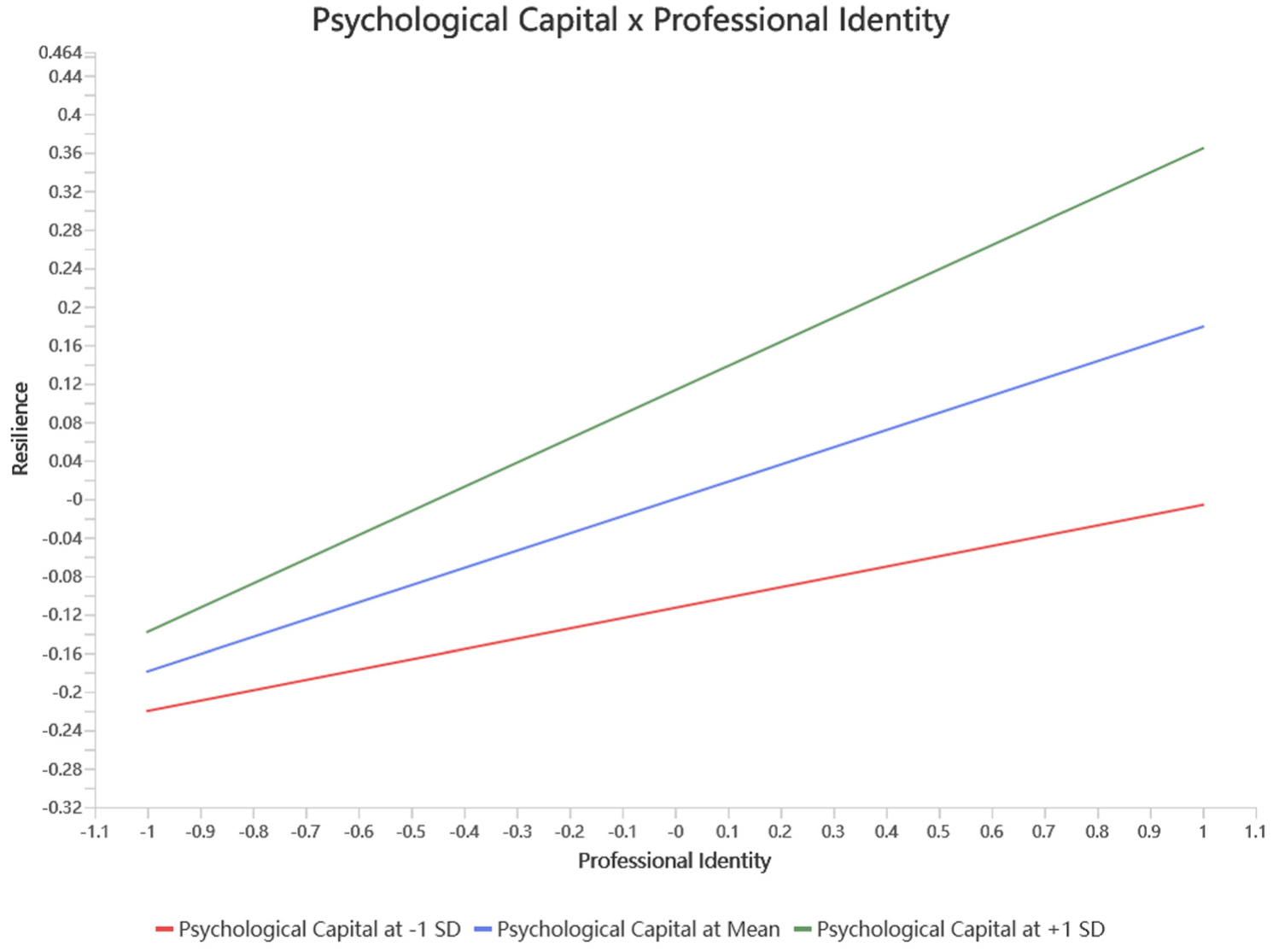
The moderating role of psychological capital in the relationship between professional identity and work engagement among university faculty.
Discussion
This research explores the correlation between university teachers’ PI and WE, investigating the parallel mediating roles of RES and JS, along with the moderating effect of PsyCap. The results revealed significant differences in PI across teaching experience levels, and all hypotheses were supported except for the non-significant moderating effect of PsyCap on the PI-JS relationship. We discuss these findings in relation to our initial research questions and hypotheses.
We found a positive association between PI and WE (supporting H1), consistent with Van der Want et al. (2019) conclusion that PI represents the most stable predictor of teachers’ WE. This relationship manifests through two mechanisms: Firstly, strong professional identity in teachers is associated with an enhanced sense of teaching mission (Zhao et al., 2019), which in turn correlates with a greater willingness to devote additional effort to teaching and research. Secondly, professional identity helps establish an internal motivational system for professional development, enabling teachers to maintain high work engagement even when facing occupational stress (Wu et al., 2022). This finding contrasts with the self-efficacy mediation mechanism proposed by Rasool et al. (2024) in their international study, suggesting that the pathways through which professional identity operates may differ across occupational groups and cultural contexts. Whereas employees in their study primarily relied on enhanced self-efficacy, university teachers in our Chinese sample appeared to depend more on the establishment of an internal motivational system to sustain their work engagement.
Both resilience and job satisfaction served as parallel mediators between PI and WE (supporting H2 and H3). Our findings suggest two distinct pathways: Firstly, Teachers with stronger professional identity demonstrate greater resilience (Jafarianamiri et al., 2022; Lu et al., 2022), which enhances their capacity to manage work stress and sustain engagement. Specifically, resilience provides emotional regulation and adaptability, allowing teachers to maintain positive attitudes in demanding environments. Secondly, teachers reporting higher levels of professional identity also report greater job satisfaction (Q. H. Zhang et al., 2024). These more satisfied teachers describe their work experiences more positively, a characteristic that shows a clear connection to their level of engagement (Wu et al., 2024). Specifically, the more teachers identify with their professional roles, the more favorable their affective responses tend to be, a pattern that coincides with elevated levels of both satisfaction and engagement.
The non-significant moderating effect of psychological capital on the professional identity-job satisfaction relationship (Hypothesis 4 not supported) contrasts with Crisci et al. (2019) findings. Future research could explore this difference through several approaches. First, subsequent studies could examine whether organizational climate serves as a contextual buffer. Specifically, researchers might investigate whether university faculty’s perceived organizational support and positive culture strengthen the connection between PI and JS (Han et al., 2023), thereby potentially diminishing the moderating role of PsyCap. Second, the uniqueness of the teaching profession warrants further investigation. Future research should focus on domain-specific factors such as professional autonomy, academic achievement, and educational responsibility. These factors might explain the attenuated moderating effect observed in our sample. The formation of PI among university faculty typically stems from long-term academic accumulation rather than psychological resource modulation. This characteristic may represent an important boundary condition for the moderating function of PsyCap.
However, psychological capital significantly moderated the professional identity-resilience relationship (supporting H5). Specifically, among faculty with high psychological capital, stronger professional identity is linked to greater resilience development, as it is associated with access to greater internal resources for coping with teaching challenges. Conversely, this effect was non-significant for low psychological capital faculty, suggesting psychological capital’s essential role in enabling professional identity to foster resilience.
The analysis of teaching experience differences revealed significant variations in professional identity among university faculty across different career stages. Specifically, faculty with 6 to 10 years of teaching experience showed significantly lower professional identity than those with 11 to 15 years and over 16 years of experience. This disparity may stem from the transitional challenges faced by early-career faculty during their professional adaptation phase. At this stage, faculty members are typically adjusting to teaching responsibilities, professional roles, and academic environments, which may contribute to their relatively weaker professional identity. As faculty accumulate teaching experience over time, they develop greater career stability and enhanced self-efficacy, which gradually strengthens their professional identity (Banegas, 2023). Faculty with 11 to 15 years and over 16 years of teaching experience demonstrated significantly stronger professional identity. This pattern suggests that sustained teaching practice facilitates identity development through three key mechanisms: ongoing pedagogical self-reflection, accumulated instructional expertise, and deepened understanding of educational missions. Furthermore, experienced faculty typically receive greater social support and professional recognition within academic communities, which appears to reinforce their professional identity over time (Canrinus et al., 2011). These results indicate that educational administrators ought to adopt tailored intervention measures to address the professional identity disparities among faculty at different career stages. Specifically, institutions should develop mentorship programs and reduced teaching loads for early-career faculty to facilitate their professional identity development during the critical transition period.
Implications and Limitations
Theoretical Implications
This study establishes an integrative theoretical model that systematically examines the multilevel mechanisms influencing university teachers’ work engagement by connecting professional identity (an intrinsic psychological factor) with mediating mechanisms (resilience and job satisfaction) and moderating variables (psychological capital). Our empirical findings not only clarify the mediating roles of resilience and job satisfaction in the professional identity-work engagement relationship, deepening theoretical understanding of teachers’ professional psychological processes, but also expand theoretical perspectives on work engagement research. This exploratory finding provides important theoretical insights for future research to examine boundary conditions of psychological capital in teacher development. Moreover, this innovative theoretical framework offers valuable guidance for teacher professional development practices.
Practical Implications
For university faculty members, this study provides actionable approaches to enhance work engagement through several key strategies. Faculty can strengthen their professional identity by engaging in regular teaching reflection practices and participating in cross-disciplinary collaboration initiatives. To build psychological resilience, they may benefit from mindfulness training programs and structured peer achievement sharing sessions. Effective time management techniques and strategic integration of research and teaching responsibilities can help achieve better work-life balance. Additionally, establishing academic support systems through professional learning communities and regular scholarly exchange forums can provide valuable peer support. These evidence-based approaches enable faculty to maintain strong academic productivity while simultaneously enhancing their occupational well-being and ensuring sustainable career development.
For academic institutions, the findings suggest several important organizational improvements. Institutions should enhance professional development systems to foster faculty identity by implementing ongoing development programs, creating merit-based recognition mechanisms, and developing clear career progression pathways. To support faculty resilience, schools need to strengthen mental health services by offering stress management workshops, providing confidential counseling resources, and systematically addressing research evaluation pressures. Furthermore, institutions should optimize organizational environments to improve job satisfaction through multiple measures: designing transparent performance assessment protocols, ensuring equitable compensation structures, cultivating collaborative academic cultures, and promoting inclusive departmental climates. These comprehensive institutional supports can create more favorable conditions for faculty to thrive professionally while maintaining psychological well-being.
Limitations and Future Research Directions
While this study examines multiple factors influencing university teachers’ work engagement, including professional identity, resilience, and job satisfaction, this study has certain methodological constraints. Notably, the use of cross-sectional and self-report data in this study limits our ability to draw definitive causal conclusions and may introduce susceptibility to response bias. Although we implemented procedural controls during data collection, we cannot completely rule out the potential influence of common method bias. Therefore, we recommend interpreting these findings as revealing close associations among variables rather than establishing causal directions. Future research should prioritize longitudinal designs to track the temporal dynamics of these constructs. Incorporating multi-source data would also help enhance the validity of research outcomes. Second, our reliance on self-report questionnaires may limit the depth of understanding about work engagement determinants. Self-reported data are inherently susceptible to respondent bias. Incorporating mixed-methods approaches, including qualitative approaches like semi-structured interviews and longitudinal observations, could yield richer and more objective data in future investigations. Finally, our model primarily focuses on individual-level psychological constructs. This means several important external institutional variables such as workload and organizational culture remain unexamined. Future research should integrate these variables to develop a more comprehensive framework for understanding the driving mechanisms of faculty WE.
Conclusion
This study investigated the influencing factors of university teachers’ work engagement, with particular focus on examining the parallel mediating roles of resilience and job satisfaction in the relationship between professional identity and work engagement, as well as the moderating effect of psychological capital. The results demonstrate a positive association between professional identity and work engagement among university faculty. Both resilience and job satisfaction served as significant parallel mediators in this relationship. Furthermore, PsyCap moderated the relationship between PI and RES. The results advance theoretical comprehension of the mechanisms underlying university teachers’ work engagement, providing valuable theoretical insights and practical implications for enhancing faculty engagement levels and optimizing human resource management strategies in higher education institutions. Although the observational nature of the data restricts causal conclusions, this research lays a crucial foundation for future longitudinal research to further validate these relationships.
Footnotes

Ethical Considerations
The researchers confirms that all research was performed in accordance with relevant guidelines/regulations applicable when human participants are involved (e.g., Declaration of Helsinki or similar). This study was approved by the Ethics Committee of Zhengzhou Vocational College of Intelligent Technology (Approved No. ZVCIT-0015).
Consent to Participate
The participants received oral and written information and provided written informed consent before participating in the study.
Author Contribution
Peng Qin: Conceptualization, Methodology, Formal analysis and investigation, Writing – original draft preparation, Writing – review and editing, Supervision: Peng Qin. The author has read and agreed to the published version of the manuscript.
Funding
The author received no financial support for the research, authorship, and/or publication of this article.
Declaration of Conflicting Interests
The authors declared no potential conflicts of interest with respect to the research, authorship, and/or publication of this article.
Data Availability Statement
The data that support the findings of this study are available on request from the corresponding author.