




Abstract
The factors influencing job burnout and job satisfaction among general education lecturers (e.g., English lecturers) in Chinese higher education have been understudied. This research utilized a cross-sectional survey design to examine how self-efficacy mediates the relationship between instructional leadership and English lecturers’ job burnout and satisfaction. A total of 507 valid responses were collected from English lecturers in Chinese universities through an online survey. Data were analyzed using covariance-based structural equation modeling with validated scales. The results revealed that instructional leadership significantly enhanced lecturers’ self-efficacy, reduced job burnout, and improved job satisfaction. The study employed the bootstrap method to test mediation effects. The results suggested that self-efficacy partially mediates the effects of instructional leadership on job satisfaction and job burnout. Notably, the study identified self-efficacy as a critical buffer against burnout for general education faculty, who face unique challenges such as weaker professional identity and lower student engagement in compulsory courses. The study advances theoretical understanding by validating self-efficacy’s mediating role in the leadership–well-being nexus and offers practical strategies for reducing burnout in underrepresented general education contexts.
Keywords
Introduction
The modern university environment presents lecturers with a diverse array of challenges (Hammoudi Halat et al., 2023), resulting in increased pressure that often contributes to job burnout and diminished job satisfaction (Dube & Ndofirepi, 2024; Si, 2024). Chinese university lecturers, who, facing the dual pressures of work and personal life, are increasingly grappling with career dissatisfaction and an erosion of professional well-being (Huang, 2024). A 2018 Mycos survey on the well-being of Chinese university lecturers reveals that 88% experience moderate to severe work-related stress (Tian & Lu, 2017). Among the top sources of this stress are the demands for scientific research and publication (70%), followed by bureaucratic challenges within institutions (60%) and heavy workloads (57%). Prolonged exposure to such pressures without relief often leads to job burnout (Si, 2024). This negative cycle ultimately threatens the development of students, faculty, and the entire institution.
Within educational institutions, leadership is widely regarded as a crucial factor influencing the work experiences of lecturers (Basham, 2012; Leithwood et al., 2020). The role of university leaders, particularly in organizing and managing human resources, is critical in minimizing burnout and enhancing job satisfaction (Susar et al., 2023). Research indicates that lecturers’ perceptions of leadership significantly influence their stress levels and professional commitment, underscoring the importance of effective leadership in mitigating burnout (Zhan et al., 2023). Various leadership styles in higher education have been explored (Azeem & Mataruna, 2019; Jamali et al., 2022) including transformational leadership (Basham, 2012; Howell et al., 2022), instructional leadership (Bada et al., 2020; Liu et al., 2022; Zheng et al., 2019), and sustainability leadership (Leal Filho et al., 2020), each with its unique implications for fostering a supportive academic environment. Among which, instructional leadership refers to a leadership style that involves articulating the university’s vision and academic goals, setting performance standards, and promoting the professional development of lecturers (Leithwood et al., 2020). This form of leadership deserves greater attention, especially within Chinese higher education, where faculty often experience significant pressure to prioritize research at the expense of teaching (Tian & Lu, 2017). Previous findings reveal practical ways for instructional leaders to use individual characteristics to support lecturer well-being (Bellibas & Liu, 2017; Liu et al., 2021; Zheng et al., 2019).
Moreover, personal factors significantly influence job satisfaction and burnout levels among lecturers (Skaalvik & Skaalvik, 2010). Grounded in Bandura (1977) social cognitive theory (SCT), extensive research indicates that educators’ work experiences are shaped by their self-perception. Among these factors, self-efficacy has been consistently recognized as a critical determinant of lecturers’ professional effectiveness (J. Chen et al., 2024). Prior research demonstrates that self-efficacy directly increases job satisfaction by fulfilling innate psychological needs (Skaalvik & Skaalvik, 2017, 2020; Yang & Du, 2024), and lecturers with higher self-efficacy show stronger professional commitment and satisfaction (Baroudi et al., 2022; Ma, 2022).
Research confirmed that instructional leadership and self-efficacy affected burnout and satisfaction (Liu et al., 2021), yet a key gap remained. Few studies had treated self-efficacy as a mediator between leadership and job outcomes, and most focused on K–12 education rather than higher education (Matos, Iaochite, et al., 2022; Shoji et al., 2016). This oversight was especially relevant in China, where general education lecturers (e.g., English instructors) faced distinct challenges—such as weaker professional identity and lower student engagement—which made them more dependent on instructional leadership for developing self-efficacy.
To address this, our study examines how self-efficacy mediates the effects of instructional leadership on burnout and job satisfaction among Chinese university English lecturers. This study specifically examines university English instructors as a representative general education faculty population, based on three key considerations: (1) Existing literature demonstrates a significant research gap regarding general education faculty (e.g., English and ideological-political instructors), whose burnout mechanisms systematically differ from discipline-specific faculty (Land, 2021); (2) The disciplinary characteristics of English instruction—including standardized curricula and students’ instrumental learning motivation—offer clearer observation of the interplay between instructional leadership and self-efficacy; (3) China’s ongoing English curriculum reforms (e.g., the ESP transition) present an ideal context to examine how institutional changes impact faculty well-being. By exploring how instructional leadership influences job outcomes through self-efficacy, this research advances theoretical understanding and offers practical insights for leaders to enhance lecturer well-being by leveraging individual psychological factors.
Theoretical Background and Hypothesis Development
General Education in Chinese High Education
Chinese higher education has undergone rapid expansion and reform in recent decades, becoming the largest system in the world by enrollment (Cheng & Zhu, 2021). Notably, Chinese high education is highly influenced by national policies, such as the “Double First-Class” initiative and the recent Discipline Optimization Action Plan (2025–2027), which prioritizes resources for fields aligned with strategic emerging industries (e.g., AI, integrated circuits; Han et al., 2023). This often marginalizes general education disciplines (e.g., English, ideological-political education) in resource allocation. In recent years, a growing body of research from Chinese scholars has focused on general education. For example, Xue et al. (2023) investigated nine first-class research universities, seven key provincial teaching–research universities, and seven teaching universities in China regarding the integration of major and general education. They found a widespread issue of “strong majors and weak general education.”Yan and Zhang (2024) conducted semi-structured interviews with 18 university students, revealing various tensions in current general education practices, such as “tao of universities” versus the “use of universities.”Shi et al. (2024) compared general education in China with Western models, highlighting reform strategies adopted by Chinese universities to address globalization challenges and holistic education needs. Notably, most existing studies focus on macro-level institutional reforms, while research from micro-level, individual teacher/work-related perspectives remains scarce.
Lecturers’ Job Burnout and Job Satisfaction as Job-Related Outcomes
Job burnout is a widespread problem affecting educators, marked by three key symptoms: emotional exhaustion, a sense of detachment (depersonalization), and diminished feelings of personal achievement (Chirico et al., 2021). This state arises from chronic stress, leading to emotional and bodily depletion (Maslach & Leiter, 2000), and as the gradual erosion of engagement in work (Maslach, Jackson, et al., 1997; Maslach, Schaufeli, et al., 2001). Emotional exhaustion, considered the core element of burnout, is marked by a loss of energy and chronic fatigue (Lee et al., 2019). In the teaching profession, cynicism manifests as negative attitudes toward students, and a diminished capacity to meet their needs (Maslach, Schaufeli, et al., 2001). Reduced personal accomplishment, another critical aspect of burnout, involves negative self-evaluation and the feeling of failing to perform well in one’s job (Maslach, Schaufeli, et al., 2001).
As noted by Llorens-Gumbau and Salanova-Soria (2014), prolonged exposure to occupational pressures can exhaust an individual’s coping resources, leading to burnout. University lecturers frequently encounter stressors such as excessive workloads, rigorous performance expectations, and the emotional labor inherent in teaching. The consequences of burnout in this profession are significant, often manifesting as decreased work engagement, impaired instructional quality, and lower research output. Prior research has extensively analyzed burnout antecedents in academia (Olorunsola, 2013; Salami, 2011; Skaalvik & Skaalvik, 2020). For example, Skaalvik and Skaalvik (2020) assessed how Norwegian secondary teachers’ burnout levels were influenced by three occupational demands—time constraints, student disengagement, and value conflicts—and two mitigating resources—professional autonomy and administrative support. Similarly, in another work conducted by Salami (2011) explored how job stress, personality factors, and social support systems jointly and independently predicted burnout dimensions among college lecturers, noting that personality and social support moderated stress effects on personal accomplishment. In contrast, Mohammed (2017) emphasized socioeconomic triggers, demonstrating that delayed salary payments in Iraqi Kurdistan’s universities exacerbated burnout, with emotional exhaustion frequently precipitating depersonalization.
Conversely, job satisfaction describes an employee’s overall sense of fulfillment and positive appraisal of their occupational role (Chirico et al., 2021). This multifaceted construct is shaped by numerous elements, including intrinsic job characteristics, interpersonal dynamics in the workplace, and career development prospects. Research consistently demonstrates that elevated job satisfaction correlates with enhanced work motivation, organizational loyalty, and improved psychological health (Faragher et al., 2005; Lee & Kim, 2023). Within academic settings, faculty members reporting greater job satisfaction tend to exhibit higher levels of professional output, teaching engagement, and scholarly creativity (Huang, 2024).
Understanding lectures’ job burnout and satisfaction is essential because the two constructs are often intertwined (Ersozlu & Saklan, 2016). An inverse relationship exists between burnout and job satisfaction among lecturers, with affected lecturers reporting diminished work satisfaction while satisfied lecturers exhibit lower burnout vulnerability. Therefore, exploring the factors that mitigate burnout and enhance job satisfaction is a critical area of research, particularly in the demanding university environment. They have found that, time pressure was the strongest predictor of emotional exhaustion whereas low student motivation and working in a dissonant value context were the strongest predictors of cynicism.
Instructional Leadership as an Antecedent
Over the years, extensive research has examined instructional leadership within the field of education (Leithwood et al., 2020). For example, Park and Ham (2016) explores teacher collaboration in three Asia-Pacific countries—Australia, Malaysia, and South Korea—by investigating whether differing perceptions between principals and teachers about principal instructional leadership could hinder the development of a school environment that fosters collaborative interactions among teachers. Cansoy (2019) conducted a systematic review examining how school principals’ leadership behaviors influence teachers’ job satisfaction. The studies primarily explored the impact of principals’ transformational and interactive leadership styles on teachers’ instructional practices. Grissom et al. (2013) examined the connection between leadership behaviors and student achievement, highlighting the critical role of effective time management for school leaders. Neumerski (2013) called for a reevaluation of instructional leadership, aiming to identify gaps in existing knowledge and explore ways in which leaders can enhance instructional practices.
In higher education, instructional leadership is typically exercised by department heads, deans, and other administrators responsible for overseeing academic programs and supporting faculty members (Ersozlu & Saklan, 2016). Lecturers’ perceptions of instructional leadership have been shown to positively influence their teaching motivation and overall job satisfaction (Ersozlu & Saklan, 2016). By fostering a supportive and growth-oriented environment, instructional leaders can help lecturers manage their workloads, reduce stress, and enhance their sense of professional accomplishment (Hallinger et al., 2017). In a related study, Khan and Gupta (2024) found that instructional leadership boosts teacher self-efficacy, enhancing job satisfaction in Indian elementary schools. Moreover, the Job Demands-Resources (JD-R) Model (Bakker et al., 2023) offers a theoretical basis for understanding the relationship between instructional leadership and lecturers’ job burnout and satisfaction. According to JD-R, instructional leadership can serve as a key job resource that mitigates demands and enhances lecturers’ well-being. Gillet et al. (2015) found that instructional leadership can foster job satisfaction by fulfilling psychological needs for competence and recognition. Thus, this study proposed that:
According to JD-R, as a resources, Instructional leaders help reduce emotional exhaustion (a core dimension of burnout) by mitigating the impact of excessive workloads or challenging teaching contexts by providing support, autonomy, and professional development. X.-M. Chen et al. (2024) found lecturers’ perceived instructional leadership negatively influenced their job burnout during COVID-19. Thus, this study proposed that:
Lectures’ Self-Efficacy as a Mediator
Self-efficacy, as conceptualized by Bandura (1977), refers to an individual’s belief in their capability to execute the actions necessary to achieve specific goals. Rooted in SCT, self-efficacy highlights the role of human agency, asserting that individuals have the ability to exert control over their actions (Bandura, 1977; Bandura et al., 1999). Bandura et al. (1999) further elaborates that self-efficacious individuals are self-organizing, proactive, self-regulating, and self-reflective. Self-efficacy shapes how individuals perceive environmental opportunities and obstacles, influencing whether they adopt an optimistic or pessimistic outlook (Bandura & Hall, 2018). These beliefs also affect susceptibility to stress, worry, and depression, shaping how individuals respond to challenges (Bandura & Hall, 2018). Furthermore, self-efficacy determines activity choices, the effort exerted, and the persistence individuals demonstrate in the face of adversity (Pajares et al., 2007). Individuals with high self-efficacy tend to set ambitious goals and remain resilient, whereas those with low self-efficacy may focus on their limitations (Bandura & Hall, 2018). Thus, this study proposed that:
Self-efficacy significantly influences lecturers’ job satisfaction and burnout levels. Those with strong self-efficacy perceive challenges as growth opportunities, while low self-efficacy contributes to overwhelm and burnout. Research consistently links higher self-efficacy with greater job satisfaction and lower burnout rates (J. Chen et al., 2024; Yang & Du, 2024). Confident lecturers typically experience better job satisfaction due to enhanced coping abilities. Research consistently links teachers’ professional identity with job satisfaction and well-being (Canrinus et al., 2012; Zakariya, 2020). For example, Canrinus et al. (2012) found that job satisfaction, commitment, self-efficacy, and motivation were interconnected among 1,214 Dutch secondary teachers, reinforcing prior professional identity research. Similarly, Ortan et al. (2021) identified self-efficacy, positive student behavior, career growth, and supportive work conditions as key job satisfaction drivers for 658 Romanian pre-university teachers. These factors enhance well-being, reduce burnout, and improve retention. Zakariya (2020) further confirms that self-efficacy boosts job satisfaction and helps teachers manage stress. Thus, this study proposed that:
In previous study, Matos, Sharp, et al. (2022) demonstrated that self-efficacy reduces emotional exhaustion and depersonalization by improving quality of life, which in turn mitigates burnout. To further explore the relationship between lecturers’ self-efficacy and their job burnout in higher education, we propose the following hypotheses:
Given its significance, self-efficacy may mediate how instructional leadership influences lecturer’s satisfaction on their jobs. Effective instructional leadership enhances lecturers’ self-efficacy by offering essential resources, support, and constructive feedback aimed at improving their teaching practices. In turn, heightened self-efficacy can lead to reduced burnout and increased job satisfaction. This suggests that instructional leadership may not directly impact burnout and satisfaction but instead exerts its influence through its effect on self-efficacy (Ortan et al., 2021). Thus, this study proposed that:
Given burnout’s established link to occupational stressors (Skaalvik & Skaalvik, 2020), an inverse correlation between self-efficacy and burnout is theoretically anticipated. The particularly strenuous environment of academia heightens the relevance of institutional working conditions. Nevertheless, the potential mediating function of faculty self-efficacy in connecting instructional leadership with burnout remains insufficiently examined in higher education settings, prompting the following research hypotheses:
The research framework is shown in Figure 1.

Conceptual framework.
Methods
Samples and Data Collection
This study utilized a cross-sectional research design, employing an online survey distributed via Wenjuanxing, China’s predominant digital survey platform, during June to July 2024. This study employed a non-probability sampling technique (i.e., simple random sampling) due to the impracticality of obtaining a complete sampling frame given the large population of university lecturers across China.
The web-based data collection strategy enabled efficient nationwide sampling of the target population while ensuring standardized administration procedures. The online survey was mainly disseminated through various social media platforms (Xiaohongshu, QQ groups, WeChat groups, Weibo, and Douyin). Participants were screened based on their academic discipline, with only English-major lecturers included in the final analysis. The survey incorporated an informed consent form emphasizing its purely academic nature and guaranteeing strict confidentiality. Participants must click “Agree to participate in the survey” after reading the informed consent statement before proceeding to the subsequent questionnaire process. The questionnaire title explicitly specified the target population as full-time English faculty in higher education institutions, thereby excluding administrative staff.
The study received 538 responses in total, with 507 valid responses retained after excluding 31 invalid questionnaires, characterized by uniform or systematically patterned selections throughout the entire survey. The responses represent various ages, genders, educational backgrounds, and types of colleges, including both public and private institutions (Table 1). The respondent demographics closely mirror the national profile of Chinese university English instructors documented in the Ministry of Education (2010)’s statistics, showing predominant female representation (approximating the 3:1 national ratio), a majority of mid-career faculty aged 30 to 50, and near-universal attainment of graduate-level degrees. Moreover, the surveyed lecturers are distributed across various regions in China suggesting that the location is highly representative. Thus, the sample is demographically representative of China’s higher education context.
The Portfolio of Samples.

Measurements
This research employs a questionnaire, utilizing a scale derived from prior studies that has been validated by extensive research. This study assessed these factors via a 7-point Likert scale, wherein participants rated their level of agreement with the questionnaire items. The following is the source of the scale for each variable. The translation accuracy was ensured through authorial cross-verification, supported by a bilingual (Chinese–English) questionnaire to facilitate participants’ comprehension.
Instructional Leadership
Instructional leadership was specifically referenced from the study by Lai and Lien (2023), which has 12 items and originally evaluated via a 7-point Likert scale.
Self-Efficacy
The self-efficacy of lecturers was assessed using 12 items derived from Klassen et al. (2009), originally rated on a 7-point Likert scale.
Job Burnout
A condensed version of the Maslach Burnout Inventory – General Survey (MBI-GS), comprising 10 questions, was utilized to assess job burnout (De Beer et al., 2024; Merino-Soto et al., 2023), originally rated on a 7-point Likert scale.
Job Satisfaction
Job satisfaction was assessed using four questions derived from the study by Malinen and Savolainen (2016), originally based on a 7-point Likert scale.
Data Analysis
The data analysis followed a multi-step procedure using SPSS 26.0 and AMOS 24. First, descriptive statistics (e.g., means, standard deviations) were computed for all demographic variables and study constructs to summarize the sample characteristics. Subsequently, variance inflation factors (VIFs) were analyzed though SPSS 26.0 to check the common method bias. The results revealed that multicollinearity was not a significant concern in our study, with all VIF values below 5.0 and tolerance values exceeding .4.
Subsequently, Confirmatory Factor Analysis (CFA) was conducted using AMOS 24 to evaluate the measurement model. The internal consistency of the scales was assessed by Cronbach’s alpha and composite reliability (CR). Convergent validity was examined through average variance extracted (AVE) and factor loadings, while discriminant validity was verified by comparing the square root of the AVE with inter-construct correlations.
Finally, Structural Equation Modeling (SEM) was employed to test the hypothesized relationships (Thompson, 2000). The model fit was evaluated using multiple indices: χ2/df, RMSEA, GFI, CFI, NFI, TLI, and IFI. The significance of direct and indirect effects was examined. Specifically, the mediation effect of self-efficacy was tested using a bootstrap procedure with 5,000 resamples and a 95% bias-corrected confidence interval (Preacher & Hayes, 2008). An indirect effect is considered statistically significant if the confidence interval does not include zero.
Results
Measurement Model
This study evaluated the relationships between the latent variables through AMOS 24.0, which required a multivariate normal distribution of the data (Table 2). The investigation indicates that the skewness of all the observed variables in this sample ranges from 1.625 to 0.847, while the kurtosis ranges from −1.201 to .842. Exhibiting kurtosis and skewness values below 3, and indicating that the variables conform to a normal distribution and meet the prerequisites for structural equation analysis (Kline, 2023).
Descriptive Statistics.

Note. IL = instructional leadership; LSE = lecturers’ self-efficacy; JB = job burnout; JS = job satisfaction; SD = standard deviations.
The results indicate that the overall fit index of the model shows χ2/df = 1.077, which is below 3; RMSEA = .012, below .08; GFI = .927, greater than .8; CFI = .993; NFI = .965; TLI = .997; IFI = .997, all beyond .9, indicating a favorable model fit (Hair et al., 2017). Moreover, the item factor loading for each variable exceeds .6 and is statistically significant, demonstrating a strong measurement correlation between each item and its corresponding variable (Table 3). The Cronbach’s α for instructional leadership is .975, for lecturers’ self-efficacy is .967, for job burnout is .982, and for job satisfaction is .933. Generally, a Cronbach α score above .7 implies strong internal consistency of the scale variables.
CFA Results.

Note. IL = instructional leadership; LSE = lecturers’ self-efficacy; JB = job burnout; JS = job satisfaction; AVE = average variance extracted; CR = composite reliability.
p < .001.
The results of convergence validity demonstrated that the Average Variance Extracted (AVE) for each scale variable exceeded .5, and the Composite Reliability (CR) value beyond .7. The results of discriminant validity (Table 4) used Fornell–Larcker criterion, and revealed that the square root of the AVE for all variables surpassed the correlation coefficients among the variables, signifying that the model’s variables displayed robust discriminant validity. Thus, the results suggest that the measurements were reliable and the variables were acceptable (Hair et al., 2017).
Discriminant Validity Results.
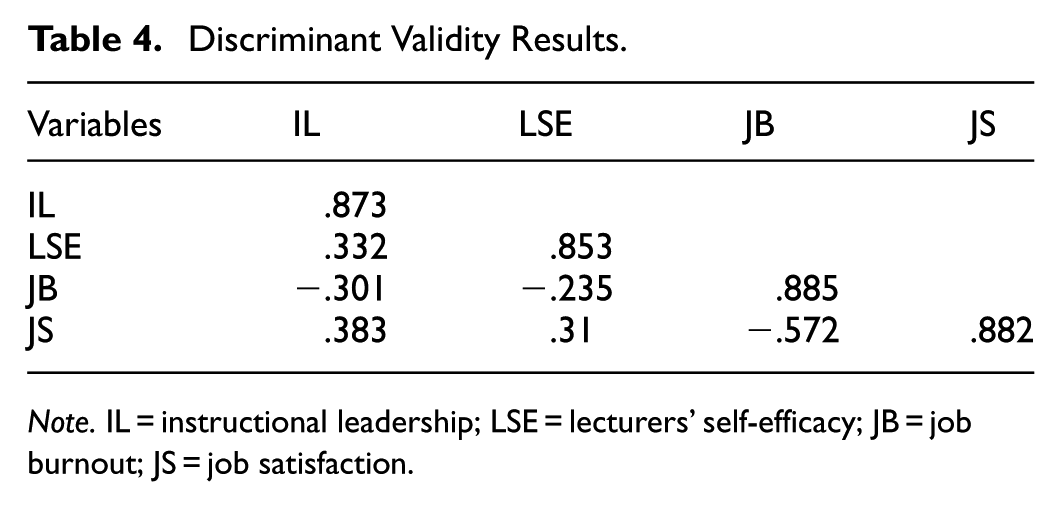
Note. IL = instructional leadership; LSE = lecturers’ self-efficacy; JB = job burnout; JS = job satisfaction.
Structural Model Assessment
The results of the model indicated a good fit (χ2/df = 1.236, less than 3, RMSEA = .022, less than .08, GFI = .992, greater than .8, RFI = .957, CFI = .992, NFI = .960, TLI = .992, IFI = .992, all greater than .9; Hairet al., 2017).
Direct Effects
The SEM analysis results (Table 5, Figure 2) revealed that instructional leadership had a significant and positive effect on lecturers’ self-efficacy (β = .332, p < .001), thereby supporting hypothesis H1. This study presents a model where two factors directly impact job burnout: instructional leadership and lecturer self-efficacy. The effect of instructional leadership on lecturer job burnout was found to be both statistically significant and negative (β = −.254, p < .001), confirming hypothesis H2. Moreover, lecturers’ self-efficacy showed a significantly negative effect on their job burnout (β = −.154, p < .001), supporting hypothesis H4. The findings suggest that instructional leadership has the most substantial influence on job burnout and is the key factor. A higher perception of instructional leadership among lecturers is associated with lower levels of job burnout. Lecturer self-efficacy is the second factor influencing job burnout, with higher self-efficacy leading to reduced burnout.
Direct effects of the model.

Note.β = standardized path coefficient; IL = instructional leadership; LSE = lecturers’ self-efficacy; JB = job burnout; JS = job satisfaction.

SEM results.
Additionally, the study identified two factors that directly affect job satisfaction: instructional leadership and lecturer’s self-efficacy. The analysis showed that instructional leadership significantly and positively impacted lecturer job satisfaction (β = .318, p < .001), thus confirming hypothesis H3. Lecturer self-efficacy also significantly and positively influenced job satisfaction (β = .207, p < .001), validating hypothesis H5. These results suggest that instructional leadership, as perceived by lecturers, is the most critical factor affecting job satisfaction, with stronger instructional leadership associated with greater satisfaction. Self-efficacy is the second most important factor, where higher self-efficacy leads to increased job satisfaction.
Mediating Effects
This study utilizes the bootstrap method to examine the mediating role of lecturers’ self-efficacy in the relationship between instructional leadership, job burnout, and job satisfaction. A bootstrap sampling procedure with 5,000 iterations was employed, surpassing the recommended minimum of 1,000, with a 95% confidence interval—commonly set at 90%, 95%, or 99%—used to assess the significance of indirect effects (Preacher & Hayes, 2008). The bias-corrected confidence interval’s upper and lower limits were observed, and when these intervals did not contain zero, it indicated a significant mediation effect. The results are shown in Table 6.
Mediating Effects.

Note. IL = instructional leadership; LSE = lecturers’ self-efficacy; JB = job burnout; JS = job satisfaction; LCIL = lower confidence interval level; UCIL = upper confidence interval level.
In the pathway instructional leadership → lecturers’ self-efficacy → job satisfaction, the direct effect size was .318 (p < .05), indicating a significant positive direct effect of instructional leadership on job satisfaction. The indirect effect size was .069 (p < .05), and the total effect size was .386 (p < .05). As with job burnout, the confidence intervals did not include zero, confirming that lecturers’ self-efficacy partially mediate the relationship between instructional leadership and job satisfaction. Thus, H6 is supported.
In the mediation pathway of instructional leadership → lecturers’ self-efficacy → job burnout, the direct effect size was −.254 (p < .05), demonstrating a significant direct negative effect of instructional leadership on job burnout. The indirect effect size was −.051 (p < .05), while the total effect size was −.305 (p < .05). Importantly, none of the confidence intervals for these effects included zero, signifying that lecturers’ self-efficacy plays a negative and partial mediating role in the relationship between instructional leadership and job burnout. Thus, H7 is supported.
Discussion
This study examined the interrelationships among instructional leadership, university lecturers’ self-efficacy, and their subsequent effects on job burnout and satisfaction, with particular attention to general education faculty exemplified by English lecturers. The results demonstrated significant direct and indirect impacts, advancing our understanding of how instructional leadership and self-efficacy collectively shape the distinct professional experiences of lecturers in non-specialized teaching contexts.
Our findings provided insights on the unique challenges faced by general education lecturers, who often operate outside formal academic departments and consequently develop weaker professional identities (Hanstedt, 2024). For English lecturers specifically—who frequently contend with student disengagement toward required language courses—self-efficacy was found to derive more substantially from institutional leadership than observed in prior studies of discipline-specific faculty (Demirdag & Reviews, 2015; Harris et al., 2015; Leithwood et al., 2020). Our results contributed to the theoretical claim that instructional leadership plays a crucial role in shaping job-related outcomes for this understudied population (Ejjebli, 2023; Khan & Gupta, 2024). Specifically, instructional leadership positively influences lecturers’ self-efficacy (H1), with particularly strong effects observed among general education staff who lack disciplinary support networks. This aligns with Leithwood et al. (2020)‘s framework on leadership efficacy in marginalized teaching contexts. The leadership-to-efficacy pathway proved vital for English lecturers, as institutional guidance compensated for the professional isolation characteristic of general education positions.
The study also found that instructional leadership can significantly reduce job burnout (H2). This effect is particularly significant among general education faculty, who face unique stressors such as teaching students with widely varying proficiency levels. From the perspective of the Job Demands-Resources (JD-R) Model (Bakker et al., 2023), this study extends the theoretical framework by empirically validating instructional leadership as a significant job resource within the Chinese higher education context. Specifically, H2 and H3 demonstrate that instructional leadership not only directly reduces job burnout (H2) but also enhances job satisfaction (H3), highlighting its dual role in mitigating the negative impact of job demands while simultaneously promoting positive psychological outcomes. These findings enrich the JD-R model by identifying instructional leadership as a contextual resource that actively shapes both health impairment and motivational pathways. Moreover, this finding supports Hallinger et al.’s (2018) study that leadership interventions yield disproportionate benefits for vulnerable educator groups. Practically, the observed reduction in burnout proved critical for general education lecturers, validating Maslach and Leiter’s (2000) finding that targeted support systems can reduce the “emotional labor” of being a lecturer of public courses.
Additionally, our study confirms that instructional leadership positively affects job satisfaction (H3). This is consistent with existing literature suggesting that effective leadership enhances job satisfaction by improving the work environment and support structures (Ersozlu & Saklan, 2016). Lecturers who perceive strong instructional leadership experience higher job satisfaction, which is crucial for their career fulfillment and motivation.
The results substantiate Bandura (1978)’s self-efficacy theory, demonstrating its dual predictive capacity for occupational outcomes. Consistent with H4 and H5, improved self-efficacy levels corresponded with both reduced burnout symptoms and enhanced job satisfaction. This empirical validation extends prior evidence that high self-efficacy lecturers exhibit superior stress modulation capacities and derive heightened professional gratification from pedagogical activities.
A key contribution of our study is the examination of self-efficacy as a mediating factor in the relationship between instructional leadership and job-related outcomes. The results indicate that self-efficacy partially mediates the relationship between instructional leadership and both job burnout and job satisfaction, supporting H6 and H7. This finding aligns with the theoretical expectation that self-efficacy serves as a crucial mediator in the impact of instructional leadership on job-related outcomes (Ortan et al., 2021). Specifically, self-efficacy serves as a partial negative mediator between instructional leadership and burnout, indicating that instructional leadership both directly and indirectly (via enhanced self-efficacy) reduces burnout (Matos, Sharp, et al., 2022). Similarly, it partially mediates the leadership-satisfaction relationship, where leadership boosts satisfaction primarily by strengthening self-efficacy (Zakariya, 2020). These dual pathways emphasis self-efficacy’s pivotal role in translating leadership into improved occupational outcomes.
Although this study is situated within the specific context of Chinese higher education, the findings offer valuable insights for other systems experiencing comparable challenges, such as heavy research pressure, high teaching loads, and the marginalization of general education faculty. The demonstrated role of instructional leadership and self-efficacy in mitigating burnout and enhancing job satisfaction may resonate particularly in developing countries and mass higher education systems undergoing rapid expansion and reform. Thus, while contextual particularities must be considered, the mechanisms identified in this study contribute to a broader international discourse on supporting lecturer well-being through academic leadership and psychological resource development.
Implications for Practice
First, university administrators should develop instructional leadership practices that account for general education contexts. This includes providing discipline-specific resources (e.g., language teaching tools), clear pedagogical expectations for heterogeneous classes, and feedback mechanisms addressing the emotional labor of teaching general education-related courses. Such support can directly enhance lecturers’ self-efficacy by improving their professional identity at the university administrative level rather than at traditional departmental levels. Moreover, it is also recommended to recognize teaching excellence by creating formal awards and recognition systems for innovation and effectiveness in general education courses. This would signal that pedagogical skill is valued equally alongside scholarly publication, thereby boosting instructional leadership.
Second, higher education institutions should invest in self-efficacy-building programs designed for general education demands. For example, training could focus on strategies for engaging disinterested students or managing mixed-proficiency classrooms. Since self-efficacy mediates burnout and satisfaction, these initiatives would disproportionately benefit general education lecturers by helping them handle distinct institutional and student-related pressures. Furthermore, mastery-based training and mentorship for early-career faculty can also be beneficial. Pair less experienced novice lecturers with senior lecturers who can offer not only verbal persuasion and encouragement but also concrete advice on navigating the unique pressures of general education teaching, thereby reducing anxiety and building confidence.
Implications for Policy
The findings offers several policy implications. First, policymakers should implement policies that ensure university leaders receive adequate training in instructional leadership. This includes fostering skills to provide constructive feedback, facilitate professional development, and support lecturers’ teaching and research activities. Second, universities should allocate resources to professional development programs that focus on boosting self-efficacy among lecturers. These programs could include mentorship, peer collaboration, and training on stress management techniques. Third, policies should address reducing administrative burdens and bureaucratic obstacles that contribute to job burnout, creating an academic environment that promotes lecturer well-being. Institutions should also establish regular assessments of job satisfaction and burnout, enabling targeted interventions that enhance lecturer performance and retention.
Implications for Theory
This study contributes to the theoretical understanding of how instructional leadership influences job outcomes through the mediating role of self-efficacy. First, it extends social cognitive theory by demonstrating that self-efficacy not only affects individual performance but also serves as a critical link between leadership practices and workplace well-being. The findings highlight the need for theoretical frameworks that integrate organizational and individual factors to understand job satisfaction and burnout more comprehensively. Second, this study contributes empirical evidence from general education faculty, expanding higher education research on occupational outcomes through a liberal arts education perspective. These findings are critical for developing a comprehensive understanding of the factors influencing university faculty well-being (i.e., job satisfaction and burnout)—across diverse academic contexts.
Limitations and Future Research
While this study offers valuable insights, it has limitations. First, its exclusive focus on English lecturers in Chinese higher education may restrict the applicability of findings to faculty in specialized disciplines. The unique nature of language instruction—with its emphasis on cultural pedagogy and general education delivery—likely shapes self-efficacy perceptions and leadership interactions differently than in fields like engineering or the sciences, where technical expertise dominates. Future investigations should incorporate comparative analyses across disciplines (e.g., humanities, STEM) to examine potential field-specific variations.
Second, the cross-sectional design constrains causal inference regarding the relationships between instructional leadership, self-efficacy, and occupational outcomes. Longitudinal approaches would better establish temporal precedence and causal pathways. Additionally, the Chinese institutional context may limit cross-cultural generalizability. Subsequent research should test these associations in diverse national and educational systems to determine their broader validity.
Thirdly, as the majority of samples were from eastern China, which is a more developed region, the findings may be influenced by regional biases. Factors such as higher resource availability, institutional support, and salary structures in eastern provinces may elevate perceptions of instructional leadership and self-efficacy, potentially limiting the generalizability of results to less developed regions in central and western China, where academic resources and policy support might differ considerably.
Conclusion
In summary, this study confirms the significant roles of instructional leadership and lecturers’ self-efficacy in shaping job burnout and job satisfaction. Effective instructional leadership enhances lecturers’ self-efficacy, which, in turn, positively impacts job satisfaction and reduces burnout. These findings align with and extend existing theoretical frameworks, emphasizing the importance of both leadership and self-efficacy in improving lecturers’ work experiences and highlighting the need for continued research and practical efforts to foster supportive academic environments.
Footnotes

Ethical Considerations
This study was approved by City University of Dongguan Research Ethics Committee (approval no. DGC -2024-011) on April, 2nd 2024.
Consent to Participate
Informed consent was obtained from all subjects involved in the study.
Funding
The authors received no financial support for the research, authorship, and/or publication of this article.
Declaration of Conflicting Interests
The authors declared no potential conflicts of interest with respect to the research, authorship, and/or publication of this article.
Data Availability Statement
All data is contained within this article.