




Abstract
The purpose of this study was to examine the push (i.e., socio-motivation) and pull (i.e., ski resort attribute preference) factors influencing the level of participation of leisure skiing in China. Leisure skiers (N = 300) from a major ski resort in China participated in this study. Based on a comprehensive review of the literature and a test of content validity, a survey questionnaire was formulated to measure push and pull variables, demographic information, and ski resort participation frequency. Conducting multiple regression analyses to discover the relationship between push factors and skiing frequency, the escape factor was found to be influencing the skiing frequency most significantly (p < .05). Four pull factors including sceneries, condition of slopes and snow, training course feature, and cost showed different demand when the demographic backgrounds of participants were taken into consideration (i.e., gender, age, skiing frequency). Discussions are centered on the theoretical and managerial implications on procedures of pushing and pulling consumers to ski resorts at large and increasing skiing participation in China.
Introduction
As local governments are eager to seize the opportunities triggered by the 2022 Beijing Olympics, winter sports tourism in China is tipped to boom in the coming years. According to the China National Tourism Administration (CNTA), governmental agencies in China are making concerted efforts to encourage people to participate in winter sports and aiming to reach 300 million people of regular participations by the time of hosting the 2022 Winter Olympics. Resulted from the swift construction of event facilities, establishing the infrastructures, and developing promotional campaigns to prepare for the winter Olympic Games, the popularity and attraction of winter sports are gradually growing in China, along with related tourism activities in the host city and the surrounding region. As a result, increasingly more people are participating in winter sports today, especially skiing. By the end of 2018, the scale of the winter sport industry in China was ¥367.9 billion (about US$53 billion), of which leisure skiing was the core segment, accounting for 83.6% of all winter sport expenditures (Lin, 2019).
Although skiing plays a crucial role in promoting and driving the winter sport industry and the local economy in China (Weng & Li, 2020), this sport segment of the winter sport industry is facing major challenges. The first challenge for ski resort in China is to promote repeated participations. Compared with developed skiing markets in Western countries, in China the proportion of novice ski participants is rather large and dominating, and the conversion rate from ski experiencers to frequent skiers is extremely low and also slow (J. Wang & Tian, 2019). Attaining recurring participation would serve as a major boost for the sustainable development of the skiing market (R. Yang & Xu, 2019). Second, functions, programs, and services in ski resorts may be carefully developed and improved based on the considerations of consumers’ diverse needs and wants, particularly in the area of teaching novice learners and nurturing them to advance in the consumption escalator. The impulsive, fast-paced constructions of ski resorts without meticulous planning and implementation of training programs, operational logistics, and promotional schemes that are tailored to different market segments could slow industrial development, suppress consumer interest, and undermine the surging wave created by hosting the Winter Olympic Games (Xu & Lin, 2018).
The rapid growing participation rate with a low level of frequency make skiing market in China stay at an introductory stage. For sustainable development, understanding those reasons that lead to the initial ski participation and also reasons that help elevate participation frequencies of individual consumers would help ski resort managers improve their operations, services, and promotional activities. According to Pitts and Stotlar (2012) and Mullin et al. (2014), effective sport marketing centers on meeting customer needs and achieving organizational goals by focusing on activities that nurture and facilitate the delivery of goods and services from sport organizations to consumers. According to J. J. Zhang, Lam, and Connaughton (2003) and J. J. Zhang et al. (1995), with increasing competitions in the sport marketplace, it is necessary for sport organizations to examine those organizational and consumer variables that affect individual consumption behavior so as to improve product design and delivery, elevate the level of service quality, and ultimately enhance the competitiveness of sport organizations. Byon and Zhang (2019) indicated that sport organizations should conduct regular market assessments, identify the characteristics of core consumer groups, analyze the market situation and environment, and evaluate customer acceptance and the satisfaction of sport products and services.
Numerous scholars indicated that understanding consumer motivation is the key for sport organizations to comprehend the reasons that drive individuals to take part in sport, leisure, and related tourism behaviors, which could help sport managers to create psychographic profiles of consumers, improve their services, and develop communication strategies in an effort to meet the needs and satisfy the wants of consumers (Mullin et al., 2014; J. J. Zhang et al., 2007). Sport consumer motivations can be conceptualized into push (i.e., internal) and pull (i.e., external) factors (Funk et al., 2009). Factors related to internal desires are defined as push factors, which are characterized by a series of intangible sociopsychological motivations that represent individual needs and wishes that push consumers toward specific goal-driven behaviors. Pull factors are consumer demand variables, which are related to the integral attributes of core products or services provided to consumers (Braunstein et al., 2005; J. J. Zhang et al., 1995; J. J. Zhang, Lam, Bennett, & Connaughton, 2003). Considering that ski resorts are a relatively new phenomenon in China and little research has been found to examine the reasons motivating ski consumers in this market environment, the purpose of this study was to examine push (i.e., socio-motivation) and pull (i.e., ski resort attribute preference) factors influencing the level of participation of leisure skiing in China.
Review of the Literature
Concept of Motivation
Motivation is an activated state that drives and sustains the development of goal-oriented behaviors (Mowen & Minor, 1998; R. M. Ryan & Deci, 2000). In consumer behavior studies, identifying individuals’ motivations is crucial in predicting behavior. For marketers, it is necessary to understand what drives people’s decisions to engage in goal-directed behavior. Once individual sociopsychological motivations for consuming a sport product or service are uncovered, marketers can develop and implement appropriate strategies, programs, and services to meet consumer needs and channel their drives (Cianfrone & Zhang, 2013). Research on the motivation could be traced back to nearly a century ago when early motivation researchers discovered that people started and insisted on a behavior that is led by the expected consequences or goals (Lewin, 1936).
According to Maslow (1943), human behaviors are driven by physical, personal, and social needs in a hierarchical fashion. This proposition laid a foundation for many subsequent studies. Hebb (1955) defined motivation as “the energizing of behavior” that would inspire people toward desired outcomes (p. 245). Similarly, Bayton (1958) referred to motivation as the “drives, urges, wishes, or desires” (p. 282). Katz (1960) proposed the functional approach to explain one’s motivation, indicating that an individual’s orientation of drive is formed to satisfy his or her internal, psychological needs. This study discovered four functions of motivation, including knowledge, value expression, utility, and social adjustment.
Dweck (1986) explained that motivation research is the study of “the causes of goal-oriented activity” (p. 1040). Research on motivation usually focuses on understanding the factors that drive individuals to act in a particular way and examining the effects of motivational factors on people’s behavior. A rich profusion of the sport consumer literature has identified and measured a myriad of motives with much of the existing knowledge devoting to scale development and modeling in an attempt to identify the motivational factors that stimulate people to engage in consumption behavior and their impact on the level of consumption (Funk et al., 2001; Kilpatrick et al., 2005; McDonald et al., 2002; Pease & Zhang, 2001; Sloan, 1989; Wann et al., 1999; J. J. Zhang, 2015). Recent studies on sport consumer motivation have primarily focused on psychological needs and goal-directed behavior in different sport settings, such as game attendance (e.g., S. K. Kim et al., 2013; Pease & Zhang, 2001) and media product consumption (e.g., Johnson et al., 2019; Y. Kim et al., 2008; Stavros et al., 2014; Witkemper et al., 2012), and indicated that fulfilling the psychological needs of people would influence their level of involvement and behaviors.
Research has categorized motivation into push and pull factors (Baloglou & Uysal, 1996; Crompton & McKay, 1997; Hanquin & Lam, 1999). Dann (1981) first applied the push–pull theory in the field of leisure tourism motivation and came up with two specific terms for simplifying tourism motivation, which are push and pull factors. Based on theoretical reasoning and experiences of applying the concept, McCabe (2000) and Snepeger et al. (2006) indicated that the push and pull concept would be applicable to consumer behavior studies that are beyond the areas of leisure, tourism, and travel. Following this proposition, researchers have specified that sport consumer motivation can also be classified into pull (utilitarian or external) factors or push (hedonic or internal) factors (e.g., Cianfrone & Zhang, 2013; Funk et al., 2001; Qian et al., 2020).
Notably, previous research often failed to recognize the duality of push and pull factors; rather, studies only focusing on one side of consumer motivation have been the primary norm. On one hand, prior work on consumer motives examined push factors as the direct determinant of sport consumption. On the other hand, studies on the market demand of core product attributes have presumed that high product quality would automatically lead to consumption behaviors (Zhang, Lam et al., 2003). An issue with this assumption is that, regardless of product quality, consumption would hardly take place without gratifying consumers’ deprived psychological needs. Given the influence of push and pull factors as well as the effect of the interaction between these two forces on different consumer decision-making processes, it is of great importance to integrate the alternative views of motivational orientation as both push and pull factors are relevant and necessary in understanding consumer behavior (Qian et al., 2020).
Push Factors
Factors related to internal desires were defined as push factors, which are characterized by a series of sociopsychological motivations that represent consumers’ internal desires and push consumers toward specific goal-driven behaviors. They refer to subjective perceptions, judgments, or responses to the sport or service as intrapersonal and interpersonal factors that explain people’s decision to consume sports from a psychological standpoint, for instance, social interaction, aesthetics, excitement, drama, entertainment, and diversion (Dwyer & Kim, 2011; Funk et al., 2003; Lee et al., 2013). Research on the push factors could be traced back to nearly a century ago when motivation researchers discovered that people started and insisted on a behavior that is led by the expected consequences or goals (Lewin, 1936). This proposition laid a foundation for subsequent research. Crompton (1979) discovered seven social–psychological motivations (push factors) related to tourism, including relaxation, escape, regression, self-exploration, prestige, kinship enhancement, and social interaction. Beard and Ragheb (1987) used 14 factors to measure holiday motivation, including relax, discover new, avoid the hustle and bustle of daily life, relax the body, get quiet atmosphere, increase cognition, have a good time with friends, be with others, build friendships, use my imagination, achieve a sense of belonging, challenge personal ability, exert physical abilities in sports, and develop close friendships.
The theories for explaining the socio-motivations of sports consumption behavior are organized into five theoretical categories: salubrious effect, stress and stimulation seeking, catharsis and aggression, entertainment, and achievement seeking (Sloan, 1989; Zillmann & Paulus, 1993). Based on the theory of salubrious effect, consumers are interested in sports for happiness and physical and mental health. People can reduce fatigue and boredom and recharge their batteries by participating in sports and leisure activities, which is a kind of escaping from the routines of life and work. According to the stress and stimulation seeking theory, people are attracted to sports to meet their needs for pressure, risk, arousal, and socially acceptable stimulation experiences. Because of the lack of stimulation in daily life, when people need certain stimulations outside life routines, sports events are often viewed as a healthy way for people to experience the stimulation and challenge. Catharsis and aggression theorists believe that aggressive and risky behaviors in sports are a source of attraction to people. Aesthetics and representations of moral values are two content-dependent notions for the attraction of sports in the entertainment theory. People are attracted to sports for pursuing enjoyment, sentiment, content, well-being, and representations of moral. The aesthetic application of skills in plays during sport activities offers an artistic form to demonstrate the beauty and grace of the human kinetic movement. The theory of achievement seeking posits that individuals are attempted to use sport opportunities to recognize the achievements of people, share their successes, acquire knowledge, and meet their need for social prestige through alternative associations. According to Tajfel and Turner (1985), an individual’s social identity promotes the product consumption associated with the realization of that identity.
Following Sloan’s (1989) and Zillmann and Paulus’s (1993) indications, the Spectator Motivation Scale was developed by Pease and Zhang (2001) to assess push factors affecting the attendance of professional sports events. Through rigorous measurement procedures that included the qualitative research process, the test of content validity, factor analyses, and the test of internal consistency reliability and predictive validity, four factors (fan identity, team image, health appeal, and entertainment value) were identified to be critical push factors. Cianfrone and Zhang (2013) identified eight factors (competition nature, diversion activity, game enjoyment, fantasy experience, social interaction, sport interest, knowledge application, and team identification) affecting the participation of leisure sport video plays and completions. Yoon and Uysal (2005) proposed that push factors include internal or psychological forces, such as excitement, education, relaxation, enjoyment, and escape. Driver (1983) developed the Recreation Experience Preference Scale (REP) to capture seven push factors affecting people’s leisure and recreation activities, including enjoying nature, achievement seeking, family togetherness, socialization opportunity, physical fitness, risk taking, and escape and relaxation.
Pull Factors
Pull factors are conceptualized as a series of consumer demand variables, which are related to the attributes of core products or services provided by a sport organization or product to consumers (Braunstein et al., 2005; J. J. Zhang et al., 1995, 2003). It is an attitude construct containing a set of cognitively oriented variables that may lead or influence consumer behaviors (Byon et al., 2010, 2013). Pull factors reflect both consumers’ evaluations and expectations for a core product’s features and attributes (M. K. Kim et al., 2009; J. J. Zhang et al., 2003). Previous studies on the pull variables related to sport consumption were usually approached from the perspectives of market demand (e.g., J. J. Zhang et al., 1995, 2003) and event operation programs (e.g., J. J. Zhang, Connaughton, Ellis, et al., 2004; J. J. Zhang et al., 1998, 2005). A review of past studies (e.g., Greenwell et al., 2002; J. J. Zhang, Connaughton, & Vaughn, 2004) indicated that these two concepts were originated from the general concept of sport service quality. By adopting the dispersing method, variables were divided into core service that is related to a sport product, program, or performance (Mullin et al., 2014) and peripheral service that is related to the promotion and operation of a sports event (e.g., Van Leeuwen et al., 2002).
Market demand was defined as the consumers’ expectations of the key attributes of the core product (J. J. Zhang et al., 1995). The sport activity itself is often considered as the core product of sport programs (Mullin et al., 2014; J. J. Zhang et al., 1995). Schofield (1983) inaugurated the study and classified the market demand variables into four distinct categories, including demographic variables, economic variables, game attractiveness, and other preferences. Braunstein et al. (2005) emphasized on the concept of market demand to be a foundation of sport consumer studies, in that sport organizations use activities, programs, and services to meet the expectations (i.e., the demand) of their existing and potential consumers. The theoretical framework for the market demand can be ascribed to the Theory of Reasoned Action, which postulates that behavioral intention is a function of attitude and subjective norms and leads to actual behavior (Fishbein & Ajzen, 1975). In terms of explaining behavioral intentions, in some previous studies attitude was found to have more explanatory power than subjective norms and perceived behavioral control (Byon et al., 2013; Warshaw et al., 1986; Yoon & Uysal, 2005). Several researchers posit that when a consumer has a strong opinion on an attitude object, the attitude is often used as an influential inspiration. Prior sport market demand studies implied that the positive attitude of sport consumers can be a driving force of attendance and reattendance behaviors (Braunstein et al., 2005; Cianfrone & Zhang, 2013).
In terms of sport service attributes, they are related to customer service, facility accessibility, and event amenities, which are sport support programs essential for the provision and enjoyment of sport activities (J. J. Zhang et al., 1998). Different from market demand for core product attributes, the quality of these service attributes can usually be controlled before, during, and after the event by sport managers and marketers. During sports event operations, it is obviously more important for sports organizations to pay attention to these controllable variables to enhance the experience of attendance (Mullin et al., 2014; Murray & Howat, 2002). The two-component theory of service quality (Grönroos, 1984) and the appraisal-emotional response-coping framework (Bagozzi & Yi, 1988) are often adopted as the theoretical framework for studies on the quality of sport support programs. The two-component theory (Grönroos, 1984) is composed of technical quality and functional quality. Technical quality (tangible service) is related to the outcomes of the service and functional quality (intangible service) is related to the process of the service. Bagozzi and Yi’s (1988) appraisal-emotional reaction-coping framework shows that positive consumer behaviors are associated with one’s initial evaluation of service quality. The emotional reaction to the initial assessment could intercede the relationship between appraisal and behavior. For instance, the positive feedback could be a driving force of future attendance when a sport consumer is satisfied with the service during participation. In their study of professional sport spectators, J. J. Zhang et al. (1998) confirmed that sports event consumption behavior was indeed influenced by the quality of game support programs.
Leisure Ski as a Form of Sports Tourism
Sports tourism refers to the movement of people away from their main place of residence to participate in recreational or competitive sports or to attend sports event as spectators (Gibson, 1998). Standeven and De Knop (1999) defined sports tourism as “all forms of active and passive involvement in sporting activity, participated in casually or in an organized way for noncommercial or business/commercial reasons, that necessitate travel away from home and work locality” (p. 12). In an effort to understand what constitutes sports tourism, researchers have explored various aspects of sports tourism. Gibson (1998) categorized sports tourism into active sports tourism, event sports tourism, and nostalgic sports tourism. Hinch and Higham (2011) simplified sports tourism activities into active sports tourism and passive sports tourism. Active sports tourism is referred to as participation in sport activities, whereas the passive one is to attend and watch the sporting events. Gammon and Robinson (2003) classified sports tourists according to their travel reasons: (a) involving in sports activities as the main travel purpose (i.e., primary sport tourists) and (b) not taking participation as the main travel reason (i.e., secondary sport tourists). For instance, a secondary travel motivation would be to have a conference travel (primary) and play golf (secondary) during this visit. Robinson and Gammon (2004) used the terms of “sport tourists” and “tourism sport” to describe primary and secondary motives. They even recaptured the distinction by a hard–soft analogy. A hard sport tourist would travel to participate or watch a competitive sport when the competition is the key attribute of a “hard” sport tourist. Conversely, a “soft” sport tourist would be a person in a sport experience with recreational motivations other than sport competitions. It should be stressed that both sport tourists and tourism sport have “hard” and “soft” categories.
When studying sports tourism, pull factors are often found to be associated with destination attraction and image studies (e.g., Byon & Zhang, 2010; Echtner & Ritchie, 2003; Esper & Rateike, 2010). It is significant to study destination image that depicts the peculiarity and attractive characteristics of the destination. Combined with a place’s attributes and overall impression in the mind of consumers, destination image represents the general consumer perceptions of a specific place according to its social, historical, psychological, and functional characteristics (Echtner & Ritchie, 2003; Teodorescu et al., 2012). As a part of tourism development, ski resorts are often built and developed based on their appealing features (Alexandris et al., 2007). Nowadays, tourism marketers not only need to deal with the complexity of push motives that are formed within consumers but also need to create pull factors with high-quality activities, programs, and services that attract consumers to the place from market competitions and other destinations, which has actually become increasingly challenging. For leisure skiing in China, scholars have primarily focused on the operation patterns and market strategies of the skiing industry (e.g., X. Wang et al., 2018; W. Yang & An, 2018; T. Zhang, 2016), revealing various issues in ski resort operations (e.g., low-quality equipment, singular programs, lack of market promotions, multifunctional service, staff training) and market strategies and practices (e.g., price strategy, branding effort, meeting consumer needs). As ski venues have started to compete with each other for customers in China, ski resort functions and services become more and more important to attract new skiers and sustain their attendance, which need to meet or exceed consumer expectations.
For effective marketing of a ski resort, it is necessary to have a good communication between the service provider and customers. For sustainable development, understanding the reasons that affect skiing participation and skiing frequency would help managers to improve program offering and delivery. Research on the participants’ aspect of leisure skiing has overall been limited. Although some research efforts have been made to conduct the demographic analysis and segmentation of skiing participants, rare efforts have been made to have in-depth knowledge of participation motivation or skiers’ demands. Push and pull factors affecting people to attend a ski resort more frequently have not received much attention from marketers and scholars. Although increasingly more women, children, and novice leisure skiers are attracted to various ski resorts, programs, functions, and services in Chinese skiing resorts have seldom been considered to meet the needs and expectations of different participation groups (Xu & Lin, 2018).
With a growing number of leisure participants turning to skiing as encouraged by the governmental publicity and promotional efforts, it is not surprising that leisure skiers are becoming popular and attracting a diverse group of consumers; yet, many ski resorts, especially the small and medium-sized ones, have very low customer retention rates. Due to poor management, many first-time visitors rarely return to the same site. Understanding the needs and wants of consumers with different backgrounds would be essential for ski resort and tourism destination mangers to develop products and services to meet the differential demand of consumer segments (Holden, 1999; X. Wang et al., 2018; Xu & Lin, 2018). Previous studies have researched the attribute preferences on ski resorts related to gender differences; however, age and skiing consumption level have rarely been considered (e.g., Nabitz & Lendi, 2014; X. Wang et al., 2018; Xu & Lin, 2018).
Method
This study was designed to examine push (i.e., socio-motivation) and pull (i.e., attribute preference) factors affecting the level of participation of leisure skiing in China and also investigate into attribute preferences of consumers with respect to their demographic backgrounds. Research participants (N = 300) were leisure skiing attendees at the Songhuahu ski resort. The site was chosen because it is one of the major and most popular ski resorts, which is located in the northeastern region of China. The northeastern area has long and cold winter, which is similar to Northern Europe with suitable climate for skiing. February is the most popular month to ski according to a previous Chinese ski industry report (Chinese Ski Association, 2019).
Based on a review of the literature, a survey questionnaire was developed, which contained three parts including the Scale of Ski Motivation (SSM) measuring the push variables, attribute preferences measuring pull variables, demographic information, and ski resort participation frequency. SSM measures the push factors associated with ski resort attendance, with 33 items adapted from the REP that were originally developed by Driver (1983). These items were selected based on their relevance, representativeness, and applicability to the leisure skiing setting, which fell into seven factors: enjoying nature, achievement, family togetherness, socialization, physical fitness, risk, and escape. Manfredo et al. (1996) conducted a meta-analysis of articles that used REP and provided evidence for the validity and reliability of the scale. Each of the push items was phrased into a seven-point Likert-type scale ranging from 1 = strongly disagree to 7 = strongly agree. The measurement of the ski resort pull factors was based on attribute preferences that were adapted from Nabitz and Lendi’s (2014) customer preference scale on a ski resort’s offerings, which were of nine variables including the condition of slopes and snow, slope sceneries, facility and equipment, waiting time, ski resort accessibility, training education program, safety measures, ski cost, and training course feature. These variables were phrased in a dichotomous scale with conformation and disconfirmation options. The demographic information and ski resort participation frequency variables were adopted from previous studies related to leisure activities (Alexandris et al., 2009; Gibson et al., 1998).
A test of content validity was conducted by a panel of four experts in sport marketing and ski resort management. The panel members were asked to examine each item’s relevance, representativeness, and clarity with respect to its designated factor. Based on the feedback of the panel members, some revisions mainly related to wording clarity were made. Overall, the panel members approved the adoption of the survey instrument. As all of the respondents were Chinese, the language of this survey questionnaire was only Chinese. The survey questionnaire was administered at the selected ski resort during the peak month of a recent winter season. A total of 326 copies were distributed and 300 completed copies were returned, representing a response rate of 92%. Procedures in the IBM SPSS Statistics 25.0 version were carried out to calculate descriptive statistics and conduct correlational and regression analyses.
Results
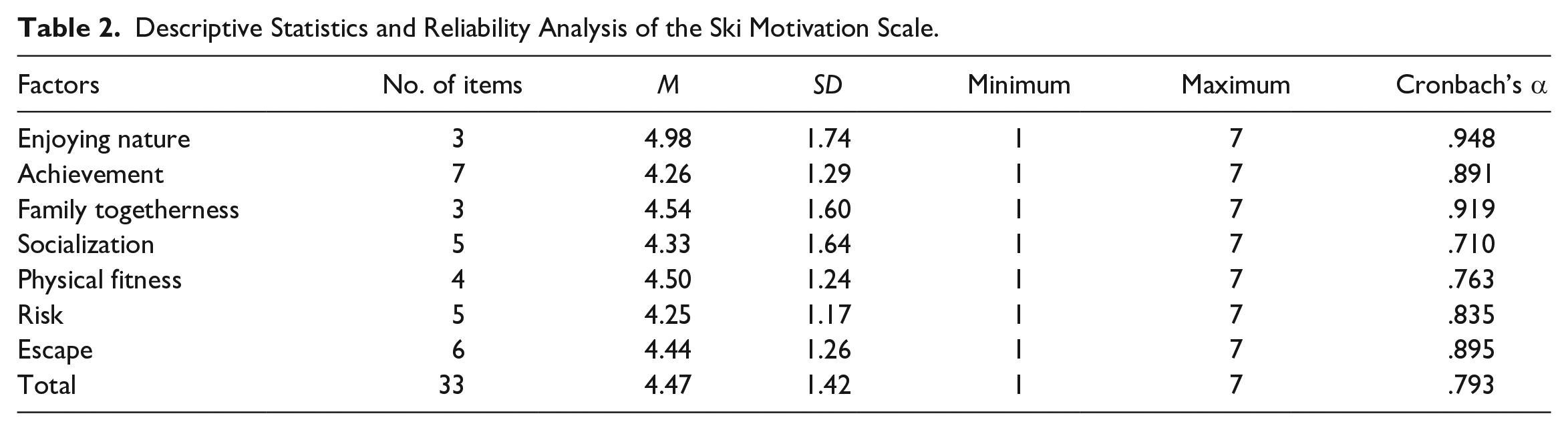
Of the research participants, slightly more than one half of the leisure skiers were female (n = 153; 51%). A majority of the skiers were between 19 and 40 (36.0%) or between 41 and 65 (43.3%) years old. Most of the respondents (74%) participated in skiing at the specified ski resort less than five times per year (Table 1). Descriptive statistics for the seven push factors are presented in Table 2. All of the mean factor scores were above 4.0 on a seven-point Likert-type scale, indicating their importance as perceived by leisure skiers. The enjoying nature factor had the highest mean score of 4.98 and the risk factor was ranked with the lowest mean score of 4.25. Cronbach’s alpha coefficients for the factors ranged from .710 to .948. All of them were above .70, showing that the scales were reliable in terms of internal consistency.
Frequency Distribution of Demographic and Ski Resort Attendance Variables.

Descriptive Statistics and Reliability Analysis of the Ski Motivation Scale.
Calculating zero-order correlation coefficients between the SSM factors and ski resort attendance, all the seven push factors were found to be significantly (p < .05) related to ski resort attendance frequency. Also, interfactor correlations among the pull factors were found to be statistically significant (p < .05) although all of the coefficients were of low to medium magnitude (Table 3). For conducting a multiple regression analysis, multicollinearity was not identified to be a concern. Multiple regression analyses revealed that, collectively, the push factors explained a total of 16.9% of variance in ski resort attendance frequency. Among the push factors, the escape factor (β = 0.286) had the most significant impact on ski resort attendance frequency (Table 4).
Zero-Order Intercorrelation Coefficients Between Push Factors and Ski Resort Attendance Frequency.

Correlation is significant at the .05 level (two tailed). **Correlation is significant at the .01 level (two tailed).
Multivariate Regression Analysis on Skiing Frequency.

Note. VIF = variance inflation factor.
When assessing the leisure skiers’ demands for the ski resort’s attributes, safety measures, slope sceneries, training education program, and facility and equipment were identified to be primarily considered and demanded for the ski resort offerings and services. As the leisure skiers participating in the study were mainly composed of beginner skiers and infrequent attendees of the ski resort, it appears that only small portions of them confirmed the relevance and importance of the condition of slopes and snow, waiting time, ski resort accessibility, ski cost, and training course feature although 37% of respondents did pay particularly attention to ski cost (Table 5).
Ski Resort Attribute Preferences Representing Pull Variables.

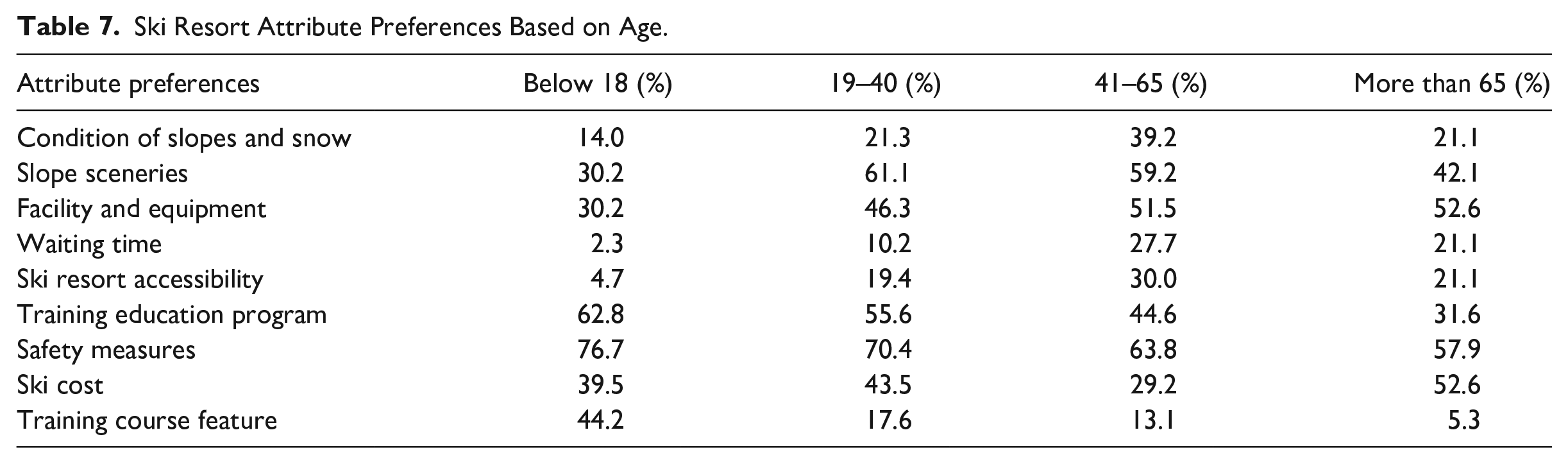
There were some differences toward ski resort attributes between male and female leisure skiers. Female skiers in general paid more attention to ski resort sceneries than male skiers. Conversely, male skiers had higher demand for shortening the waiting time than female skiers (Table 6). Table 7 shows the classification of age into four categories based on Chinese age classification. The age group of 41 to 65 demanded the condition of slopes and snow and waiting time as essential attributes when selecting the ski resort as the destination. Most of the 19- to 40-year-old skiers paid attention to slope sceneries and skiers more than 65 years old preferred ski resort with good facility and equipment. Skiers below 18 years old had the highest demands on the training education program, training course feature, and safety measures. In terms of ski cost and price, one half of the participants more than 65 years old considered it as an important factor.
Ski Resort Attribute Preferences by Gender.

Ski Resort Attribute Preferences Based on Age.
Ski resort attribute preferences based on skiing frequency are presented in Table 8. Skiers participating in skiing more than 10 times per year paid more attention to the condition of slopes, waiting time, ski resort accessibility, safety measures, and training course feature than the other groups. It is noteworthy that there were 0% of high-skiing-frequency participants who demanded on lowering the ski cost. Medium-skiing-frequency participants (6–10 times) preferred ski resorts with good facility and equipment and training education program, whereas participants skiing less than five times per year had higher demand on slope sceneries and low cost.
Ski Resort Attribute Preferences Based on Skiing Frequency.

Discussion
The study of sport consumer behavior usually focuses on delineating the factors that motivate a person to carrying certain behavior(s) that are associated with spending time and/or resources for product, activity, or program. Like previous studies, this investigation was aimed to explore why people get involved in ski resort attendance from both push and pull perspectives. The obtained information can be useful for developing effective marketing strategies to attract new participants, sustain existent consumers, and increase income for a ski resort. Motives for ski resort attendance are based on a combination of social, psychological, and physical needs. Participating in sports is to meet individuals’ needs through physically or emotionally engaged activities. Understanding particular motives that affect the consumptive behaviors of leisure skiers should be the focal point of ski resort management in China.
Due to the increasing demand of Chinese skiing industry that is triggered by 2022 Beijing Winter Olympics, it is vital to promote ski resorts’ functions and services to meet consumer expectations and enhance the level of skiing participation in China. Previous studies related to the skiing industry in China were usually focused on the general trend of development (e.g., Xu & Lin, 2018). This study studied Chinese skiing industry from participants’ socio-motivation and product preference perspectives while taking into consideration the differences in consumers’ backgrounds (gender, age, skiing frequency). Although the total variance explained in the multiple regression analysis was small in this study, the information was informative in terms of the importance and relevance of push and pull factors affecting the level of participation of leisure skiers.
This study applied an adjusted REP scale to measure the motivation of skiers, which was more appropriate for leisure skiers. According to the findings of previous studies, the socialization, enjoying nature, family togetherness, and escape factors were related to leisure tourism (Bansal & Eiselt, 2004; Holden & Sparrowhawk, 2002; C. Ryan & Glendon, 1998), whereas the achievement, physical fitness, and risk factors were closely relevant to skiing. All of these seven socio-motivational factors, including enjoying nature, achievement, family togetherness, socialization, physical fitness, risk taking, and escape, were found to be correlated with and relevant to the frequency of ski resort attendance in this study. Indications of previous researchers (e.g., Cianfrone & Zhang, 2013; Driver, 1983; Pease & Zhang, 2001; Sloan, 1989; Yoon & Uysal, 2005; Zillmann & Paulus, 1993) are verified and further supported through empirical evidence. The findings in this study were overall consistent with those of previous studies, supporting the presence, importance, relevance, and significance of the push aspect of motivations that affect the frequency of ski resort attendance of leisure skiers. The enjoying nature factor had the highest mean score of 4.98, which highlighted the significance of the natural environment when planning to build a ski resort. It also indicated that leisure skiers have a strong desire to spend time in a beautiful, relaxing, and natural environment during skiing experience. A study on ecotourists showed similar findings on environment-related dimensions (Holden & Sparrowhawk, 2002). The finding of the family togetherness factor having a high mean score was unique to this sample, which might be related to Chinese culture and the current society situation that people spend increasingly less time with family due to intensive work schedule and expanded professional obligations. It is notable for resort managers to develop family-related programs and services.
Previous studies related to leisure skiing motivation indicated the potential relationship between psychological variables and behaviors of leisure skiers (Schiffman & Kanuk, 2004; Tsiotsiou, 2006). There are three aspects to describe the level of skiing participation, including skiing population, skiing ability, and skiing frequency. From the findings derived from the multiple regression analysis on skiing frequency, the “escape” factor was found to have the most noticeable impact on skiing frequency in this study, indicating that a skier would have a higher frequency of skiing participation when being driven by escape motivation, namely, seeking for recreation, diversion, rest, and relaxation. There are two aspects of this “escape” motivation: escape social pressure and escape physical pressure (Manfredo et al., 1996). The managers of a ski resort should plan and offer good leisure and relaxation programs and services to ease skiers’ life stress and anxiety and help recoup their physical well-being, which can be an effective strategy to increase skiing frequency for participants. Noticeably, when the interrelatedness among the seven socio-motivational factors was taken into consideration, only one factor (i.e., escape) was identified as the primary predictor of leisure skiers. As there was likely a suppressing effect in the multiple regression analysis, future studies are encouraged to further examine the unique contribution of each of them.
The findings that safety measures, slope sceneries, training education program, and facility and equipment were primarily considered and demanded for the ski resort offerings and services support the importance and relevance of pull factors when operating a ski resort (e.g., Braunstein et al., 2005; Byon & Zhang, 2010; Echtner & Ritchie, 2003; Esper & Rateike, 2010). Although going to a ski resort is a sports tourism activity (Alexandris et al., 2007; Gibson, 1998), leisure skiers had ski-related factors as their major consideration when making decisions to attend a ski resort; out of these, safety measures come first to one’s mind, which is followed by the attractiveness of a slope’s scenery and the high quality of ski resort facilities and equipment. Because a majority of the leisure skiers are beginners, which is a highlighted uniqueness of the Chinese winter sport marketplace (e.g., J. Wang & Tian, 2019; R. Yang & Xu, 2019), ski training and educational clinics or programs appear to be essential to introduce this sport to consumers, help them gradually learn and improve ski skills, and ultimately advance in the consumption escalator.
For more specific research on pull factors of ski resort, this study segmented demographic groups in gender, age, and skiing frequency. A number of previous studies on sport tourist motivation took gender and age groups into consideration (e.g., Alexandris et al., 2009; Dolinting et al., 2015). From the findings related to product attribute preference in this study, the safety measure attribute (68%) is the most important for skiers, meaning that the safety factor is the most important condition for choosing a ski resort. Slope sceneries is ranked second, which is followed by training education, whereas waiting time is of the lowest concern. It is noteworthy that, in this study, there were 0% of participants with a high skiing frequency who showed preference of lowering the cost of attending the ski resort. Similar findings on program attribute preference were found by Williams and Lattey (1994), indicating that ski attribute and environment are more important than the price attribute. In terms of demographic groups, male skiers, skiers aged 41 to 65 years, and skiers with a skiing frequency more than 10 times have higher requirements on the condition of slopes and snow than other groups. Skiers below 18 years old have higher demands on training education courses. Hence, it is necessary to set up teenager skiing training camps with more interesting, safer, and more effective instructional features. Females were found to pay more attention on ski resort sceneries than males in this study, suggesting the necessity of developing specific marketing campaigns to attract females to the ski resort. In terms of ski cost and price, one half of the participants more than 65 years old would consider it as a vital factor (52.6%). Ski resort marketers should consider using sales promotions to attract elder people.
In brief, this study investigated into the push and pull factors influencing the level of participation of leisure skiing at one ski resort in China. Further studies with a larger sample representing diverse ski resorts are necessary to enhance the generalizability of the research findings. This study first explored the relationship between skiing motivation and skiing frequency and found the “escape” factor to exert a positive influence on skiing frequency. This research also explored pull factors attracting participants with respect to different age, gender, and skiing frequency groups. Future research can extend this study by exploring the influence of other demographic variables, such as socioeconomic status, occupation, and lifestyle. Future studies are also suggested to expand the sample size, adopt more advanced research and data analytical procedures, and examine the push and pull factors in a more comprehensive ecological context to examine their interactions with various organizational, environmental, and information processing factors and how they function together to enhance the marketing of a ski resort in China and beyond.
Footnotes
Declaration of Conflicting Interests
The author(s) declared no potential conflicts of interest with respect to the research, authorship, and/or publication of this article.
Funding
The author(s) received no financial support for the research, authorship, and/or publication of this article.
