




Abstract
As organizations adopt novel work methodologies in response to technological advances and evolving priorities, new ways of working which characterized by flexible work arrangements, remote and hybrid models, digital collaboration tools, and a shift from presence-based to output-based management have emerged. It leads to the relationship of new ways of working and employee outcomes within these frameworks become crucial. This study investigates how new ways of working affect employee psychological well-being, work engagement and organizational citizenship behavior within the socio-cultural context of an Asian country, Vietnam. A quantitative approach was employed, using data from 331 Vietnamese employees, collected through non-probability sampling across sectors such as technology (electronics, information technology), services (marketing, healthcare, general services), education, and other sectors. The data were analyzed using Partial Least Squares Structural Equation Modeling. The findings reveal that new ways of working enhance work engagement, psychological well-being, and organizational citizenship behavior. Importantly, psychological well-being serves as a key mediating mechanism, reinforcing its centrality in promoting prosocial outcomes in flexible work environments. This study advances organizational behavior research by demonstrating how new ways of working indirectly foster organizational citizenship behavior through motivational and affective mechanisms, offering theoretical insights and practical guidance for optimizing employee outcomes in digitally evolving, culturally specific environments.
Keywords
Introduction
The evolving nature of work strategies, catalyzed by technological advancements and shifts in organizational priorities, underscores a complex landscape of employee experiences in the modern workplace. As businesses increasingly embrace remote work, flexible schedules, and greater autonomy, the impact on employee psychological well-being (PWB), work engagement (WEG), and organizational citizenship behaviors (OCB) has become a focal point of contemporary research (Andrulli & Gerards, 2023; Bareket-Bojmel et al., 2023; Krajcsák & Kozák, 2022; Lenz et al., 2023; Podsakoff, 2000). This transition, accelerated mainly by the COVID-19 pandemic, has facilitated a deeper integration of technology in managing human resources (López-Cabarcos et al., 2020) and employees’ performance (Jaiswal et al., 2024).
As organizations now shift toward a “new normal” there remains uncertainty about the nature and implications of this transition. One key dimension of this transition involves the adoption of new ways of working (NWoW) reflecting broader shifts in how organizations structure work in the post-pandemic era. NWoW refers to a coherent set of organizational practices that aim to enhance employee autonomy, flexibility, and performance through the strategic use of digital technologies, decentralized work structures, and output-based management (Gerards et al., 2018). While initially developed in Western corporate contexts, NWoW is increasingly adopted in diverse cultural and institutional settings, requiring a contextualized understanding of its outcomes (Andrulli & Gerards, 2023; Gerards et al., 2018). Furthermore, existing studies on the NWoW are predominantly concentrated in Western contexts, resulting in a significant gap in understanding how it and related constructs such as OCB function in non-Western and developing economies (Yang & Huang, 2024). Most current research overlooks how cultural values, institutional environments, and digital infrastructure mediate the adoption and impact of these practices (Nguyen et al., 2024, 2025). However, research exploring how these novel work setups in that context impact employee experiences is still sparse (Alfes et al., 2022).
Besides, as globalization accelerates the adoption of telework across international organizations, cultural mismatches and communication barriers within virtual teams remain underexplored, highlighting the need to examine OCB in culturally diverse, digitally connected workplaces (Yang & Huang, 2024). Additionally, although OCB has long been associated with organizational effectiveness, ongoing transformations under the NWoW necessitate a reexamination of how OCB is enacted, perceived, and valued in digitally mediated work environments (Bolino et al., 2024).
Moreover, recent empirical studies reveal conflicting findings regarding the prevailing notion that NWoW inherently diminishes PWB. Some scholars suggest that remote and flexible work enhances work-life balance, autonomy, and positive well-being (Alfes et al., 2022; Andrulli & Gerards, 2023), while others argue that it leads to social isolation, stress, and blurred boundaries (Mirowska & Bakici, 2024; Wang et al., 2023). Various studies have identified increased technostress due to remote work, though some argue that remote work could alleviate such stresses (Andrulli & Gerards, 2023). Similarly, opinions are divided regarding the impact of NWoW on WEG (Gerards et al., 2018).
With the widespread adoption of teleworking during the pandemic, employees often find themselves in an “invisible” or hidden work environment, which can potentially lead to decreased engagement (Jaiswal et al., 2024). This knowledge gap is significant, considering organizations’ growing adoption of alternative work arrangements, which has substantial implications for employee outcomes (Alfes et al., 2022). According to Nguyen et al. (2021), adopting teleworking as a safety measure during the pandemic and the subsequent “new normal” era has significantly altered conventional work practices in emerging countries, such as Vietnam. In addition, the “Vietnam Remote Working Market Report Q1 2025,” released in May 2025, reveals the distinctive trajectory of NWoW in Vietnam, where a dynamic blend of rapid digital transformation, increasing foreign investment, and progressive government policies is reshaping the workplace. Uniquely positioned within Southeast Asia, Vietnam stands out for how its digital infrastructure, evolving real estate landscape, and proactive corporate shifts are adapting to the remote work era (ReportLinker, 2025).
On the other hand, Decision No.749/QĐĐ-TTg, issued by the Prime Minister in June 2020, officially approved the National Digital Transformation Program to 2025, with a vision toward 2030. This program outlines Vietnam’s ambition to become a digital nation by 2030, emphasizing technological innovation, economic modernization, and pioneering new work models. The government’s strong policy direction not only supports digital infrastructure development but also encourages both public and private sector organizations to embrace flexible, technology-enabled work environments. As such, NWoW is not only a response to global labor trends but is also a central component of Vietnam’s national development strategy. Despite these developments, empirical research examining how these transformations affect work behaviors, particularly in the Vietnamese context, remains limited. In addition, given the specific cultural context of an Asian country, Vietnam, characterized by a solid collectivist orientation (Vu et al., 2022), teleworking can substantially impact work-life balance, WEG, and employee behavior as OCB explores employees’ voluntary contributions to the organization beyond their formal job responsibilities. Consequently, it is essential to investigate how these NWoW impact PWB, WEG, and OCB in Vietnam. It provides valuable insights into the specific context and its implications for organizational practices. To the best of the authors’ knowledge, this investigation is among the first endeavors to understand the impacts of novel work modalities and their mediators’ impact on OCB within the Vietnamese environment, particularly teleworking.
The primary objective of this study is to scrutinize the impact of NWoW on OCB and to comprehend how these practices mold employees’ readiness to engage in behaviors that seek to elucidate how these human resource management (HRM) practices mold employees’ readiness to participate in activities that boost organizational efficiency. Furthermore, the study investigates the influence of these contemporary labor practices on PWB in the Vietnamese corporate context. This study draws on the Job Demands–Resources Theory (JD-R) (Bakker & Demerouti, 2007) and Social Exchange Theory (SET) (Blau, 1964). JD-R frames NWoW practices such as flexibility, digital tools, and decentralized structures as job resources that promote motivation, well-being, and discretionary behaviors like OCB (Bakker et al., 2014; Gerards et al., 2018). Complementing this, SET explains how flexible work signals organizational trust and support, encouraging employees to reciprocate with extra-role behaviors (Cropanzano & Mitchell, 2005). By doing so, the research aims to identify potential benefits or challenges and provide insights into how companies can improve PWB in these innovative work environments. Furthermore, the study examines the correlation between contemporary work methods and employee engagement. Completely engaged employees are pivotal for fostering workplace joy, satisfaction, and vigor. The research seeks to understand how these cutting-edge work practices can enhance employees’ commitment, enthusiasm, and dedication to their tasks and organizational goals. Finally, the study will examine the collective influence of new work practices, PWB, WEG, and OCB on the performance of Vietnamese firms.
Responding to the following research questions will help achieve the stated objectives:
This study contributes significantly to the field of HRM, especially within emerging economies. It delves into the intricate relationship between these innovative work methods and critical organizational outcomes such as PWB, WEG, and OCB. It enhances our academic understanding of workforce interactions and offers implications for managerial decision-making and HR policy development. The insights from this study can guide strategies that foster a conducive working environment and drive individual and collective achievements (Andrulli & Gerards, 2023). The focus on Vietnam is unique, considering the implications of evolving work patterns in an emerging economy undergoing digital transformation (Vo-Thanh et al., 2021). Understanding these patterns concerning HRM is crucial to grasping the impacts of rapid digital transformation, particularly in sectors often overlooked in NWoW research.
Literature Review
New Ways of Working
The concept of NWoW, which is shaped by evolving societal expectations, technological advancements, and an increasing demand for adaptability and creativity in the workforce, broadly includes practices like digital nomadism, remote work, flexible scheduling, collaborative environments, and enhancements in productivity through technology (Gerards et al., 2018). Among these, remote working is defined as performing work outside the traditional office setting, often from home or other non-centralized locations (Leonardi et al., 2024), which is one component of NWoW, particularly emphasizing spatial and temporal flexibility. While remote work specifically refers to the decoupling of work from a fixed location, NWoW also captures broader organizational and cultural shifts, such as enhanced access to organizational knowledge and open workplaces (Gerards et al., 2018). Flexible work arrangements, such as part-time, flextime, and flexplace, grant employees’ greater control over their work schedule and location, reducing physical presence at the workplace and impacting employee citizenship behavior (Krajcsák & Kozák, 2022). Furthermore, remote working can affect the work-life balance (Lopes et al., 2023) and the well-being of teleworkers (Sparrow, 2000).
Theory Framework
Blau (2017) posited the SET, stating that reciprocal relationships based on mutual benefits often determine organizational dynamics. It posits that workplace relationships are governed by reciprocal exchanges of resources and support between employees and organizations. This was observed during COVID-19, with employees maintaining safe remote work conditions showing increased optimism and loyalty (Vu et al., 2022). Meanwhile, a lack of flexible work options may prompt employees to seek better alternatives. Conversely, the absence of such job resources, such as flexibility and autonomy, can lead to dissatisfaction and turnover intentions. In this study, we conceptualize NWoW as a form of job resources that signals organizational care and trust, thus initiating a positive social exchange process. Supplementing SET, the JD-R devised by Bakker and Demerouti (2007) categorized job attributes into demands and resources, crucial for employee behavior and well-being. Job resources significantly impact WEG growth (Peláez Zuberbühler et al., 2023), boost productivity and well-being, and increase workload (López-Cabarcos et al., 2020). Finally, Demerouti and Bakker (2023) stressed the interaction between individual responses and resources across life domains, emphasizing the continuous balance requirement. Taken together, NWoW serves as a job resource that activates affective and motivational mechanisms (WEG and PWB), which in turn foster OCB as a reciprocal outcome, consistent with the principles of SET.
Hypothesis Development
New Ways of Working and Organizational Citizenship Behavior
OCB refers to discretionary, extra-role behaviors exhibited by employees that are not formally recognized by the reward system but contribute to the effective functioning of the organization (Organ, 1988). In the context of digitally transformed and flexible work environments, the conceptualization of OCB requires critical re-examination. Traditional forms of OCB, such as punctuality, visible effort, and face-to-face helping, were developed in physical, co-located work settings. However, in the digital era, where remote and hybrid work models are increasingly prevalent, these behaviors manifest differently or lose salience altogether (Bolino et al., 2024). OCB is influenced by organizational culture and is particularly relevant in teleworking contexts, with ICT playing a crucial role in enabling flexible work in terms of time and location (Krajcsák & Kozák, 2022).
NWoW has a positive association with OCB, and increased autonomy, a prominent characteristic of telework, tends to elicit more frequent demonstrations of the OCB (Lenz et al., 2023). When organizations offer flexible work arrangements promoting work-life balance, employees are intrinsically motivated to exhibit OCB (Krajcsák & Kozák, 2022; Morganson et al., 2010). Flexible work arrangements, providing control over work schedules and location, reduce the need for physical presence at the workplace and have been shown to enhance OCB, as employees remain committed to delivering exceptional service despite any inconveniences or discomforts associated with the flexibility (Zoltán & Kozák, 2022). Besides, in the digital work era, NWoW can enhance OCB primarily through the lens of SET. This is because the practices (e.g., autonomy, flexibility, accessibility) associated with the digital era can be perceived by employees as positive investments and signals of trust from the organization. The digital era has introduced in significant changes in how and where work is performed, including the widespread adoption of remote and hybrid work arrangements. These flexible arrangements, more frequently having variable work schedules, are highly desired by most employees and are viewed as benefits provided by the organization (Bolino et al., 2024). Consequently, the hypothesis is formulated as follows:
New Ways of Working, Work Engagement, and Organizational Citizenship Behavior
WEG is a critical aspect of employee performance and well-being. It refers to a state of mind in which employees experience a deep sense of fulfillment, enjoyment, and emotional connection to their work (Bakker, 2022). It is characterized by three key components: vigor, dedication, and absorption (Schaufeli et al., 2002). Engaged employees demonstrate enthusiasm, dedication, and a willingness to invest extra effort, acting as a vital link between job and personal resources, resulting in positive job performance and influencing outcomes like turnover intention (Demerouti & Bakker, 2023). Several studies have underscored the beneficial role of NWoW in enhancing WEG. Specifically, the flexibility enabled by NWoW through remote work opportunities and flexible schedules promotes a healthy work-life balance (Morganson et al., 2010). Moreover, evidence suggests that remote work does not inherently undermine job engagement, particularly for individuals with lower loneliness levels (Bareket-Bojmel et al., 2023). This flexibility crucially allows employees to establish psychological boundaries between work and non-work periods (Lopes et al., 2023), promoting recuperation from work-related stress and boosting performance and engagement during work hours. Further, advanced technologies integrated into NWoW can mitigate traditional communication barriers, fostering a community sense and enhancing workforce productivity (Nagata et al., 2021). Employees actively engaged in their work are often driven to exceed their formal roles and exhibit OCB, spurred by a sense of purpose and a desire to contribute meaningfully.
Engaged employees often transcend their formal roles, exhibiting OCB spurred by a sense of purpose and desire to contribute meaningfully (Demerouti & Bakker, 2023). This intrinsic motivation results in beneficial organizational behaviors, such as assisting colleagues and assuming additional responsibilities (Ohana, 2016). Engaged employees, typified by positive emotions, demonstrate empathy and willingness to help others, reflecting on OCB actions and promoting a harmonious work environment (Bakker, 2022). Empirical research consistently affirms that WEG significantly enhances OCB. For instance, McManus et al. (2025) found that when hospitality employees are engaged, they are more likely to exhibit discretionary behaviors that benefit the organization, their co-workers, and customers. From the perspective of the JD-R theory, WEG serves as a key motivational mechanism that links job resources to positive behavioral outcomes (Demerouti & Bakker, 2023). Considering these factors, we posit that:
New Ways of Working, Psychological Well-Being, and Organizational Citizenship Behavior
In examining the facets of employees’ mental health and happiness, PWB emerges as a pivotal concept, characterized by Jaiswal et al. (2024) as a comprehensive positive state that encompasses essential aspects of human functioning, including a sense of competence, good interpersonal connections, and the pursuit of a meaningful, purpose-driven life. The increasing remote work trend has emphasized HR’s role in promoting PWB and embracing the NWoW paradigm, which utilizes technology to enhance work performance and human well-being in the digital era (Andrulli & Gerards, 2023; Jaiswal et al., 2024). NWoW is a profound shift in work environments and organizational structures significantly affecting PWB (López-Cabarcos et al., 2020). Previous studies highlight the positive influence of PWB through improved managerial actions promoting trust and psychological connection (Jaiswal et al., 2024). Lopes et al. (2023) emphasized teleworking, an essential aspect of NWoW that positively impacts PWB. The JD-R theory advocates for greater autonomy and flexibility, allowing employees to customize their work and enhancing management ability. This perspective insinuates that NWoW implementation positively affects PWB (Demerouti & Bakker, 2023). Based on SET, when feeling well-supported and valued in their work environment, they are more likely to have positive employee attitudes toward their work (Oberländer & Bipp, 2022). This positive predisposition may further evolve into a more profound commitment to the organization, prompting employees to exhibit OCB. Employees who feel valued and supported generally foster positive attitudes toward their work and coworkers, often leading to more profound organizational commitment and display of OCB (Krajcsák & Kozák, 2022). Moreover, PWB is associated with trust in management (Jaiswal et al., 2024), exhibiting a positive relationship with OCB.
NWoW is conceptualized as job resources that enhance employee autonomy, flexibility, and digital support. These elements have been shown to improve PWB. When employees experience greater autonomy through NWoW, they are more likely to report positive affective states. According to JD-R theory, this enhancement in PWB serves as a motivational condition that enables employees to perform beyond role expectations (Demerouti & Bakker, 2023). Consistent with SET, when the flexibility and support inherent in NWoW are perceived as organizationally supportive, employees are more likely to engage in discretionary behaviors that exceed normal job requirements due to increased psychological satisfaction with their work. Considering the aforementioned theoretical framework and empirical evidence, we propose the concluding hypothesis:
Work Engagement and Psychological Well-Being
WEG is becoming increasingly significant in modern job contexts, especially with a growing emphasis on aspects such as initiative, commitment, personal development, and happiness in the workplace (Demerouti & Bakker, 2023). Existing research has extensively explored the link between WEG and organizational outcomes, providing crucial insights. Notably, a meta-analytic study by Neuber et al. (2022) confirms a robust relationship between WEG and improved work efficiency, implying that engaged employees are more committed to their organizations. Additionally, engaged employees often experience a sense of autonomy, giving them perceived control over their tasks and decreasing stress levels. This autonomy, motivated cognition, positive emotions, and sustained effort facilitate employee self-actualization and promote PWB (Peláez Zuberbühler et al., 2023). Building on these discussions, NWoW could positively influence WEG (Bareket-Bojmel et al., 2023), enhancing PWB (López-Cabarcos et al., 2020). If PWB is elevated, it could potentially increase OCB (Bakker, 2022). Essentially, the influence of NWoW on OCB is not only direct but also occurs indirectly through a sequence of influences (Andrulli & Gerards, 2023; Magdaleno et al., 2023), especially WEG and PWB, in this context. This suggests that NWoW affects OCB through the interconnected influences of WEG and PWB. This causal ordering is grounded in the JD-R theory, which posits that job resources such as flexible work arrangements first enhance motivational states like WEG. Sustained engagement then contributes to improved PWB (Bakker & Demerouti, 2007). In turn, higher well-being is associated with increased discretionary behaviors such as OCB. Accordingly, we posit:
Research Method
This study employs quantitative approaches to investigate the relationships among research constructs (Figure 1), facilitating the empirical examination of hypothesized relationships through statistical analysis.
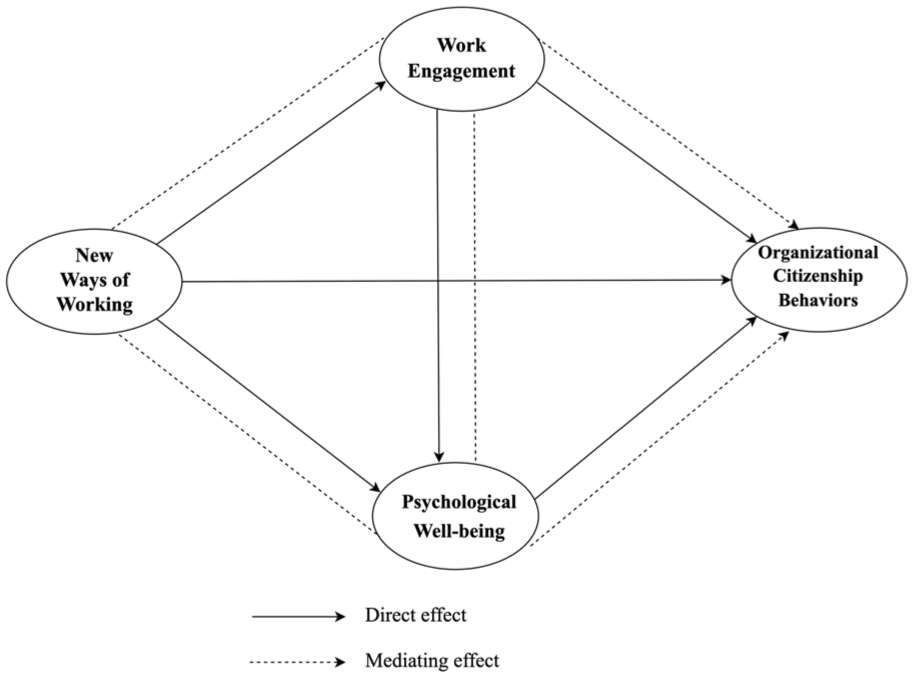
Conceptual model.
Measures
The focal constructs encompass NWoW, WEG, PWB, and OCB, each construct was carefully operationalized using scales adapted from prior research, ensuring relevance and rigor. Specifically, the construct of NWoW was assessed using a 10-item scale adapted from Gerards et al. (2018), which measures the adoption of modern work practices and environments. We operationalized PWB using an eight-item scale from Jaiswal et al. (2024), focusing on emotional and occupational well-being. Besides, WEG was measured by a nine-item scale based on the work of Gerards et al. (2018), capturing the vigor, dedication, and absorption dimensions of engagement. Finally, OCB was evaluated through a six-item scale from Henderson et al. (2020), including discretionary behaviors contributing to organizational effectiveness. All measures are detailed in Appendix 1.
Questionnaire Design
The questionnaire design was central to the methodology of this study, underpinning its ability to elicit reliable and valid data on NWoW, WEG, PWB, and OCB within a Vietnamese context. Initially constructed based on established theoretical concepts, the questionnaire underwent rigorous translation to ensure linguistic and conceptual fidelity, employing the back-translation method. This translation process was essential for maintaining the integrity of the questionnaire’s content across cultural boundaries. To minimize the risk of harm, the questionnaire was carefully designed to avoid any sensitive or intrusive questions. The survey was completely anonymous, and participants were not asked to provide any identifying information. Participation was entirely voluntary, and respondents were provided with a clear explanation of the study’s objectives, their rights as participants, and data confidentiality before beginning the survey. Consent was obtained via an electronic acknowledgment on the first page of the online survey. A comprehensive pre-testing phase was undertaken to ensure the questionnaire’s clarity and applicability. This involved a dual approach: initially, eight independent researchers reviewed the draft to ensure alignment with academic standards and the effective measurement of the intended constructs. Subsequent refinements were informed by a pilot test involving 10 respondents from the target demographic. It provided insights into the questionnaire’s practical aspects, such as its content’s understandability and relevance. Feedback from this pilot testing led to targeted amendments to improve the questionnaire’s clarity and respondent friendliness. The final questionnaire was structured into two main sections: The first collected extensive demographic information, facilitating a nuanced analysis of data across different population segments. The second section, focused on the primary research constructs, employed a five-point Likert scale to gauge participants’ attitudes and perceptions. This structured approach not only streamlined data collection but also enriched the multidimensional analysis of the interplay between the model’s constructs. Through these punctilious preparatory and execution processes, the questionnaire was crafted to robustly support the exploration of organizational behaviors in the Vietnamese socio-cultural context.
Sampling Method and Data Collection
In addressing the research objectives, the study adopted a non-probability sampling strategy, specifically combining convenience and snowballing methods, to effectively explore the determinants of OCB within Vietnam’s distinct socio-cultural framework. This methodological choice was driven by the practical considerations of accessing a broad and diverse sample across various Vietnamese locales, including major urban centers such as Ha Noi and Ho Chi Minh City, as well as other significant regions like Thai Nguyen, Bac Ninh, Bac Giang, Hai Duong, Binh Duong, Yen Bai, Ba Ria-Vung Tau, and Bac Kan. The data collection was conducted digitally through Google Forms to ensure convenience, safety, and accessibility, spanning from March to June 2023. This decision leveraged the widespread digital connectivity in the region to enhance the reach and efficiency of the survey process. This online platform facilitated the distribution of the questionnaire across extensive personal and professional networks, enabling participants to contribute via direct invitations sent through emails and social media platforms, as well as through in-person solicitations where feasible. Such a strategy ensured a broad geographical and demographic representation and allowed for rapid data collection. Prior to beginning the survey, all participants were presented with an informed consent statement outlining the purpose of the study, their voluntary participation, the right to withdraw at any time, and assurances of anonymity and confidentiality. No personally identifiable information was collected, and the survey did not involve any minors. This proactive and inclusive approach to data gathering yielded a substantial dataset of 331 valid responses, which stands as a testament to the robustness and comprehensive nature of the survey strategy. The rich demographic diversity of the participants, detailed in Table 1, underscores the sample’s representativeness and substantiates the findings’ relevance within the broader Vietnamese context.
Sample Characteristics.

Source. Author’s work.
Data Analysis
Our investigation utilized SPSS statistics version 25.0 to scrutinize demographic characteristics and perform preliminary data screening, thereby offering crucial insights into the constitution of the dataset. We employed the SmartPLS 3.3 software, a Partial Least Squares Structural Equation Modeling (PLS-SEM) approach, to analyze our theoretical framework and better understand complex relationships. PLS-SEM enabled us to segregate direct and indirect effects and evaluate mediation effects with multiple indicators. The dependability and validity of the measurement model were meticulously assessed to ensure precise and consistent construct measures. In addition, the structural model underwent thorough evaluations, which involved assessments of reliability, discriminant validity, determination coefficients (R2), predictive relevance (Q2), and effect sizes (f2). These stringent evaluations established a sturdy foundation for empirically examining the constructs and their interrelationships, effectively guiding our study’s objectives.
Result
Common Method Bias
Harman’s single-factor test was employed to assess CMB. The analysis revealed that the single factor accounted for 46.172% of the total variance, well below the 50% threshold recommended by recent literature (Podsakoff et al., 2003), indicating that CMB was not a serious concern in this study, which aligns with related recent studies in the field. Emphasizing methodological rigor, the research incorporated several procedural remedies before data collection to minimize the risk of CMB. Additionally, following Kock (2015), we conducted a collinearity assessment within the PLS-SEM framework using the inner VIF values. All inner VIF values were below 3.3, which indicates the absence of substantial common method bias.
Measurement Model Analysis
The present investigation employed a measurement framework and conducted a meticulous statistical analysis to ensure credibility and reliability, as shown in Table 2. The outer loading values were meticulously scrutinized in the preliminary phase, adhering to the recommended criteria of 0.70 and statistical significance at 0.05. The work addressed multicollinearity using the variance inflation factor (VIF). VIF values were below 5.0, meeting the criterion (Hair et al., 2019). After that, the questionnaire’s reliability was ascertained using Cronbach’s alpha, with values surpassing 0.884, suggesting exceptional reliability. The questionnaire measurements were validated using composite reliability (CR) and average variance extracted (AVE) scores. All constructs displayed CR values above 0.9 and AVE values exceeding 0.6, affirming the constructs’ high internal consistency and validity.
Result of Reliability and Convergent Validity.

Source. Author’s work.
This research’s credibility was based on assessing discriminant validity, which measures the non-correlation between observed variables, highlighting their uniqueness (Fornell & Larcker, 1981). Table 3 demonstrates the use of the Fornell-Larcker criterion, a well-established method to determine latent variables’ correlation and discriminant validity. The data confirmed that the AVE square root value exceeds the correlation value, affirming discriminant validity and meeting the Fornell-Larcker criterion. The integrity of the model is reinforced by examining the Heterotrait-Monotrait (HTMT) ratio (Henseler et al., 2015). An HTMT value below 0.9 confirms discriminant validity between paired constructs. The result showed that all HTMT values meet the desired threshold of 0.9, see Table 4, supporting the model’s reliability and validity. This validates the discriminant validity of the constructs in the model.
Fornell-Lacker Criterion.

Source. Author’s work
HTMT Ratio.
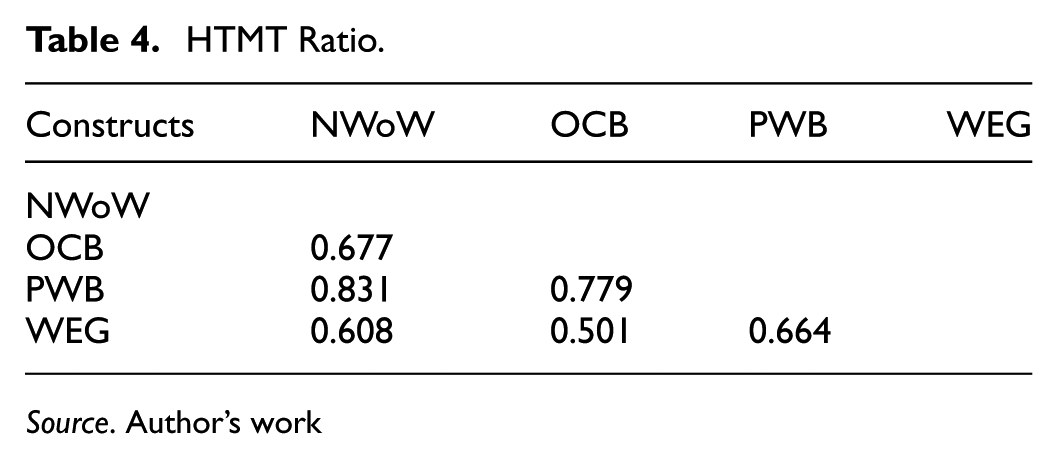
Source. Author’s work
Model Fit Indices
Fit indices were assessed to evaluate the model’s explanatory power, predictive relevance, individual construct impact, and overall fit. First, the R2 values for WEG, PWB, and OCB were 0.323, 0.634, and 0.512, respectively. All these values surpassed the 0.1 threshold (Hair et al., 2021), indicating adequate explanatory power. The derived Q2 values for WEG, PWB, and OCB were 0.235, 0.401, and 0.339, respectively, suggesting a robust predictive relevance for the model as these values were more significant than zero (Sarstedt et al., 2021). Furthermore, the f2 was evaluated to assess the influence of each exogenous construct on the endogenous construct’s R2 value. According to Cohen (2013) guidelines, the f2 values of 0.02, 0.15, and 0.35 represent small, medium, and large effects, respectively. In this study, the f2 values were observed to vary from marginal to large, depending on the exogenous construct. Finally, the standardized root means square residual (SRMR) value, which was 0.066 in our study, was used to assess the model fit. The study confirmed a satisfactory model fit with this SRMR value being less than 0.08 (Hair et al., 2021). Therefore, examining these fit indices substantiates the proposed model’s adequacy and capacity to represent the data effectively.
Structural Model Analysis and Hypothesis Testing
The analysis involved bootstrapping using 5,000 subsamples, a statistical technique that improves accuracy by approximating the sampling distribution. The result from the path analysis shown in Table 5 and Figure 2 indicated that NWoW had a significant and positive effect on both OCB (β = 0.167, p < 0.01) and WEG (β = 0.568, p < 0.001). These results are consistent with earlier research (Lenz et al., 2023; Morganson et al., 2010; Zoltán & Kozák, 2022), confirming hypotheses H1 and H2a. Hypothesis 3a is also confirmed since NWoW is positively associated with PWB (β = 0.601, p < 0.001). These findings corroborate those of previous studies (Andrulli & Gerards, 2023; Jaiswal et al., 2024). However, WEG insignificantly mediates the relationship between NWoW and OCB (p > 0.05, VAF = 6.96%), following the guidelines by Hair Jr, Hult, et al. (2017), a VAF value greater than 80% indicates full mediation, a value between 20% and 80% suggests partial mediation, while a value below 20% implies no mediation. Based on this criterion, the low VAF value offers insufficient evidence to support Hypothesis H2. This finding does not align with prior studies (Bakker et al., 2023). One possible explanation is that cultural norms emphasizing hierarchy, compliance (Ho et al., 2022), and risk avoidance may discourage employees from turning engagement into voluntary, extra-role behaviors. Additionally, the lack of recognition or rewards for OCB in many organizations may limit its expression, even among highly engaged workers. Moreover, a significant and positive relationship exists between PWB and OCB (β = 0.565, p < 0.001), confirming hypothesis H3b, and PWB has a significant mediating relationship between NWoW and OCB (β = 0.340, p < 0.001), supporting hypothesis H3. As observed in previous literature, similar patterns have been reported (Andrulli & Gerards, 2023; Dewangan & Goswami, 2025; Jaiswal et al., 2024; Lenz et al., 2023). The findings also support the hypothesis H4, asserting a significant positive link between WEG and PWB (β = 0.282, p < 0.001). This finding aligns with prior studies (Tesi et al., 2019). Lastly, WEG and PWB collectively played a serial double mediation role in the NWoW-OCB relationship (β = 0.091, p < 0.001, VAF = 35.15%). This result is consistent with prior studies (Andrulli & Gerards, 2023; Magdaleno et al., 2023), supporting hypothesis H5.
Path Analysis and Hypothesis Testing.

Source. Author’s work.

Hypothesis testing results.
Discussion and Implications
This study adds to the literature on NWoW by situating their effects within a transitional, non-Western context and showing both convergence with and divergence from prior findings. In line with European studies (Krajcsák & Kozák, 2022; Lenz et al., 2023), our results affirm that NWoW create job resources that foster engagement and well-being, thereby supporting the motivational pathway of the JD-R theory. At the same time, the absence of a direct link between engagement and OCB departs from research in other settings (Xiaoxin et al., 2025), pointing to possible cultural and organizational explanations. In Vietnam, hierarchical traditions and strong expectations of visibility may dampen the translation of engagement into discretionary behaviors, while PWB proves to be the more salient condition for OCB. These findings extend both JD-R and SET by demonstrating that the mechanisms through which NWoW influence employee behavior are not universally uniform but shaped by cultural and institutional dynamics. Future research should examine these boundary conditions such as leadership style, cultural norms, or degrees of remote work intensity to better explain cross-context variations in the pathways linking NWoW with prosocial outcomes. The subsequent sections will offer a detailed discussion of these findings and their implications.
Discussion
Our research underscores the profound influence that NWoW has on OCB. This finding aligns with prior Western studies, such as Krajcsák and Kozák (2022) in Hungary and Lenz et al. (2023) in Germany, which demonstrate that NWoW can foster or at least maintain OCB under specific organizational or cultural conditions. The findings support the notion that NWoW is crucial in promoting OCB, suggesting that organizations aiming to improve OCB can benefit from integrating NWoW strategies. In addition, our findings are consistent with SET, which posits that employees reciprocate favorable treatment, such as increased autonomy or flexibility, with positive discretionary behaviors like OCB. However, despite these benefits, studies such as McDonald et al. (2022) also caution that reduced visibility in remote settings may suppress observable OCB, especially in cultures or organizations where face-time is valued. This implies that cultivating OCB within an NWoW context might prove more challenging than traditional workplaces due to changes in work organization, cultural diversity, leadership support, and values.
In alignment with a study by Andrulli and Gerards (2023), which sampled participants from Dutch our research underlines the substantial and positive correlation between NWoW and WEG. It provides compelling empirical evidence that NWoW significantly enhances WEG, primarily by functioning as comprehensive job resources that directly motivate employees. These results offer strong support for the core mechanisms of the JD-R theory, particularly its motivational pathway. The obtained result is also consistent with Gerards et al. (2018), who emphasized that employee engagement is promoted through manageable outputs, access to organizational knowledge, and an open work environment. Employees can maintain high WEG if they have autonomy and the company provides a conducive working environment (Nagata et al., 2021). Lee et al. (2023) expand on this notion by presenting empirical evidence that both formal and informal utilization of ICT contribute to enhanced employee engagement, especially in remote work scenarios. Previous studies, such as Alfes et al. (2022), Andrulli and Gerards (2023), and Nijp et al. (2016), highlighted the predominantly positive impacts of NWoW, such as increased work engagement, greater satisfaction, and improved PWB. These findings emphasized the importance of NWoW in improving working conditions and overall employee satisfaction.
Our study challenges the findings of Sridadi et al. (2022) by demonstrating an insignificant relationship between WEG and OCB. This unexpected result also contrasts with more recent evidence from Xiaoxin et al. (2025), whose study conducted in the hospitality sector in China found that employee engagement was one of the strongest predictors of OCB. This divergence suggests that the engagement-OCB link may be more context-dependent than previously assumed. This novel finding calls for further exploration into the factors that may weaken the impact of WEG on OCB or the underlying mechanisms governing the interaction between these two constructs. In contrast, our data strongly support a direct association between PWB and OCB. This finding aligns with the research conducted by Salas-Vallina et al. (2021), which demonstrated that employees with high PWB experience job and personal life satisfaction and positive emotions and possess the necessary resources to engage in OCB. Hence, promoting employee mental health becomes crucial in cultivating OCB. This reinforces the view shared by both JD-R and SET that employees who feel psychologically supported and valued are more likely to reciprocate through extra-role behaviors.
Consistent with Peláez Zuberbühler et al. (2023), our research indicates a positive association between WEG and PWB. However, it should be noted that the NWoW approach does not directly facilitate OCB through WEG mediation. This finding contrasts with Farid et al. (2019), who found that engaged employees are more likely to extend support to others due to their ability to allocate resources effectively and maintain optimal energy levels, thereby enhancing task execution. Thus, WEG alone may not promote voluntary pro-social behaviors in the workplace. According to the JD-R theory, introducing flexibility, autonomy, and an open approach to the workplace represents job resources (Bakker et al., 2023). These resources equip employees to manage work effectively according to their abilities. Flexible work environments can enhance PWB (López-Cabarcos et al., 2020) and increase the likelihood of OCB. Therefore, the influence of new work practices on OCB is indirectly influenced by their positive impact on PWB as a job demand. In other words, NWoW improves PWB, subsequently fostering OCB.
The study findings indicate a causal pathway starting with NWoW and leading to OCB, with WEG and PWB acting as intermediary factors. NWoW alone can enhance WEG; however, this alone may not be sufficient to motivate individuals to engage in discretionary behaviors beyond their assigned duties, key characteristics of OCB. Conversely, the impact of NWoW on OCB can be strengthened by enhancing employees’ PWB. Individuals with higher levels of PWB experience greater satisfaction, stimulation, and resilience (Oh et al., 2022). They also develop better relationships with colleagues and exhibit a stronger commitment to the organization, which are crucial aspects of OCB. While WEG may not directly lead to OCB, it promotes PWB, subsequently facilitating OCB. This serial mediation pathway is grounded in the JD-R theory, which posits that NWoW functions as a job resource that first fosters WEG by increasing employees’ autonomy, flexibility, and perceived support (Bakker & Demerouti, 2007). In turn, engagement positively influences PWB, as engaged employees experience higher levels of energy, fulfillment, and resilience. Elevated PWB then becomes a critical predictor of OCB, as psychologically healthy individuals are more likely to help others, support their teams, and demonstrate extra-role behaviors. These findings emphasize the importance of PWB and WEG in shaping employee behavior, highlighting the need for holistic strategies that foster a supportive environment for WEG and PWB. By adopting these holistic strategies, organizations can cultivate a positive workplace culture and encourage employees to go above and beyond their formal job responsibilities.
Implications
Within the HRM field, this research contributes to a growing body of literature exploring how NWoW shape employee behaviors across diverse cultural settings. While this study is situated in the Vietnamese context, its findings may have broader relevance for other emerging and developed economies. Specifically, the mechanisms by which NWoW enhance OCB through PWB and WEG align with universal theoretical frameworks such as the JD-R theory and SET. The psychological mechanisms through which NWoW operate, enhancing well-being and engagement, are not culturally exclusive. Therefore, this study not only deepens our understanding of NWoW’s impact within Vietnam but also supports the theoretical generalizability of these mechanisms to other national and organizational settings. Particularly in the Vietnamese context, an emerging economy with unique cultural attributes, the findings have filled an empirical gap in understanding the interplay between emerging work models and culture-specific factors (Nijp et al., 2016). The study extends the WEG concept’s scope, acknowledging the universal importance of employee engagement and well-being. It explored the mechanism of NWoW adoptions, particularly the transformative effects of digitalization in work practice, and their role in enhancing PWB and OCB.
Practically, while the study provides specific recommendations for Vietnamese HR practitioners, these insights are transferable to organizations in similar institutional environments. Organizations that prioritize flexible workspaces, work-life balance, and employee autonomy increase employee engagement and foster positive behavior (Zoltán & Kozák, 2022). It is crucial for HR policies regarding work hours, remote work, leaves, and benefits to be regularly reviewed and updated to align with the changing needs of the workforce. Moreover, due to the flexibility in work location, there is potential for an increase in hiring talent beyond national borders, as employees can work from anywhere (Choudhury et al., 2021). Consequently, HR departments are encouraged to consider strategic planning to prepare leaders to understand and manage the nuances of mixed work models, cultural differences, and PWB while incorporating cross-cultural training. This study, therefore, lays the foundation for globally aware and culturally specific HR practices in an emerging country. Ultimately, by situating Vietnam as a representative context for broader shifts in the digitalization of work, this study bridges micro-level HR practices with macro-level cultural and institutional dynamics, offering insights of value to scholars, practitioners, and policymakers navigating the future of work globally.
Conclusion, Limitations, and Future Research
This research explored the relationships between NWoW, WEG, PWB, and OCB in Vietnam’s context. It aimed to answer two key research questions: (a) How does NWoW influence OCB? and (b) What role do psychological mechanisms play in mediating this relationship? Our findings revealed a direct positive impact of NWoW on both WEG and PWB, highlighting the benefits of flexible work models in fostering an engaged and healthy workforce. However, NWoW did not directly enhance OCB, but exerted a significant indirect effect through PWB, suggesting additional strategies may be necessary to cultivate these behaviors in the NWoW context. PWB was a strong determinant of OCB and acted as a key mediator between NWoW and OCB. This underscores the importance of PWB in driving OCB, indicating that enhancing PWB could be an essential strategy for organizations aiming to encourage OCB. Moreover, our results supported a sequential mediation mechanism (NWoW → WEG → PWB → OCB), thereby addressing RQ2 by showing that WEG and PWB jointly explain how NWoW can lead to citizenship behaviors. Therefore, this study meets its stated research objectives by demonstrating how NWoW indirectly fosters OCB through motivational and affective mechanisms. These insights offer both theoretical advancements and practical implications for managing employee behavior in digitally evolving and culturally specific work environments such as Vietnam.
Despite its contributions, the study still has several limitations. First, while this study offers valuable insights, the magnitude and nature of the observed relationships may vary across cultural contexts. In Western individualistic societies, the reciprocity norms underlying OCB may be less pronounced, as employees often prioritize individual achievement over relational or collective obligations. In contrast, in collectivist cultures such as Vietnam, PWB may be more strongly associated with pro-organizational behaviors, as these actions are typically reinforced by social and cultural expectations. Future research should examine these dynamics across countries and organizational settings to assess the cultural robustness and generalizability of the findings. Second, our cross-sectional research design prevents causal conclusions. Longitudinal or experimental designs might improve our causal comprehension of our variables of interest. Third, future research should investigate disparities between rural and urban populations in Vietnam, particularly in education, employment, and income, and explore how the agricultural and industrial sectors are evolving, including rural diversification into non-farm activities and associated wage and structural shifts (Le & Chung, 2020; Liu et al., 2020). Fourth, this study is the gender imbalance (111 males vs. 220 females), which may introduce response bias and affect the generalizability of results. Although unintentional, this imbalance highlights the need for more gender-balanced sampling in future research or exploring potential gender-based differences in how NWoW affect employee outcomes, to enhance the robustness and inclusivity of the findings. Fifth, while participants came from various organizational levels, subgroup sizes were too small for stratified analysis. We recommend that future studies explore potential differences by gender and job role, particularly in perceptions of NWoW, PWB, and OCB. In addition, although our research examined a variety of different work models, it was not feasible to examine all potential variants and their impacts. NWoW is not practical in areas like manufacturing, trading, and personal services, where personnel must be present. It is advised that future studies explore more complex work models and hybrid working approaches. Moreover, we used self-report measures to evaluate PWB and WEG, which may be biased. Future research should adopt more objective measures or incorporate multi-source data such as supervisor ratings, peer evaluations, or behavioral indicators to enhance the robustness and validity of the findings. Additionally, this study only examined the pathway from WEG to PWB and did not test the reverse relationship. Future research could explore whether PWB also influences WEG, using longitudinal or cross-lagged designs to capture potential bidirectional effects. Finally, OCB may affect social and organizational results, but we focused on individual outcomes. To capture these intricacies, future investigations should use multilevel models.
Footnotes
Appendix
Measurement Items (Vietnamese).

| Construct | Items |
|---|---|
| Những phương thức làm việc mới | |
| NWoW1 | Tôi có thể tự thiết lập giờ làm việc cho riêng mình |
| NWoW2 | Tôi được lựa chọn địa điểm để làm việc (ở cơ quan, ở nhà, quán cà phê…) |
| NWoW3 | Tôi có thể xác định cách thức (quy trình) mình làm việc |
| NWoW4 | Tôi có thể truy cập tất cả thông tin cần thiết của tổ chức bằng máy tính, điện thoại thông minh và/hoặc máy tính bảng của mình |
| NWoW5 | Tôi có thể liên hệ với các đồng nghiệp trong nhóm một cách nhanh chóng |
| NWoW6 | Tôi có thể liên hệ với quản lý một cách nhanh chóng |
| NWoW7 | Tôi có thể liên hệ với các đồng nghiệp (bên ngoài nhóm) một cách nhanh chóng |
| NWoW8 | Tôi có khả năng điều chỉnh kế hoạch làm việc của mình cho phù hợp với từng giai đoạn của cuộc sống và những mong muốn của tôi |
| NWoW9 | Nơi tôi làm việc được sắp xếp sao cho đồng nghiệp có thể dễ dàng kết nối với nhau. |
| NWoW10 | Nơi tôi làm việc được bố trí để nhân viên có thể dễ dàng kết nối với người quản lý của mình |
| Gắn kết với công việc | |
| WEG1 | Tại nơi làm việc, tôi cảm thấy tràn đầy năng lượng |
| WEG2 | Trong công việc, tôi cảm thấy tràn đầy sức sống |
| WEG3 | Tôi say mê với công việc của mình |
| WEG4 | Công việc truyền cảm hứng cho tôi |
| WEG5 | Khi tôi thức dậy vào mỗi sáng, tôi muốn đi làm |
| WEG6 | Khi làm việc hăng say, tôi thấy mình hạnh phúc |
| WEG7 | Tôi tự hào về công việc mà tôi đang làm |
| WEG8 | Tôi hoà mình vào công việc |
| WEG9 | Tôi bị cuốn đi khi tôi đang làm việc |
| Sức khỏe tinh thần | |
| PWB1 | Tôi hướng đến những ý nghĩa cuộc sống |
| PWB2 | Các mối quan hệ của tôi mang tính hỗ trợ và có ích với tôi |
| PWB3 | Tôi tham gia và quan tâm đến các hoạt động trong tổ chức của mình |
| PWB4 | Tôi đóng góp một cách tích cực cho niềm hạnh phúc của người khác |
| PWB5 | Tôi có năng lực xử lý những việc quan trọng của mình |
| PWB6 | Tôi là một người tốt và sống một cuộc sống tốt. |
| PWB7 | Tôi lạc quan về tương lai của mình. |
| PWB8 | Mọi người tôn trọng tôi. |
| Hành vi công dân trong tổ chức | |
| OCB1 | Tôi đã giúp đỡ đồng nghiệp khi họ có quá nhiều việc. |
| OCB2 | Tôi đã hỗ trợ cấp trên ngay cả khi họ không yêu cầu. |
| OCB3 | Tôi quan tâm đến đồng nghiệp của tôi. |
| OCB4 | Tôi tham gia vào công việc một cách nhiệt tình. |
| OCB5 | Tôi đã thông báo trước nếu tôi không thể đến làm việc. |
| OCB6 | Tôi luôn giữ gìn và bảo vệ tài sản của tổ chức. |
Acknowledgements
The authors express deep appreciation to the study participants and esteemed colleagues for their substantial contributions and support, which were essential to this research. This paper, part of a series from one project, employed the salami slicing technique. The authors also acknowledge the crucial roles of reviewers, editors, research teams, and collaborators.
Ethical Consideration
This study was conducted in accordance with SAGE’s publishing ethics and the APA Ethical Principles of Psychologists and Code of Conduct (2017), Section 8.05. It did not require formal approval from an Institutional Review Board (IRB) or ethics committee, as it involved minimal risk and complied with local regulations, specifically, the National Health and Wellness Commission guidelines, which state that only life science and medical studies require formal ethical review ( ). The study design posed no foreseeable harm to participants. It utilized an anonymous, self-administered online questionnaire covering general work-related topics, with no collection of personal identifiers or sensitive information. Participation was voluntary, and respondents could withdraw at any time. All data were anonymized and securely stored. Informed consent was obtained through a detailed introductory statement at the beginning of the survey, which explained the study’s purpose, confidentiality, and voluntary nature. In line with APA Ethics Code Section 8.05(c), proceeding with the survey was considered as implied consent in this low-risk, anonymous research. The study did not involve vulnerable populations, minors, or any form of deception. It was conducted in accordance with the ethical principles outlined in the Declaration of Helsinki.
Author Contributions
Phuong Ngoc-Duy Nguyen: Conceptualization, writing—reviewing and editing, supervision, project administration. Trang Thi Giang: Conceptualization, writing—original draft, data curation, writing—reviewing and editing. Hiep Cong Duong: Conceptualization, software, writing—original draft preparation; Huan Hong Nguyen: Conceptualization, methodology, writing—review & editing.
Funding
The authors received no financial support for the research, authorship, and/or publication of this article.
Declaration of Conflicting Interests
The authors declared no potential conflicts of interest with respect to the research, authorship, and/or publication of this article.
Data Availability Statement
Data will be made available on request.
Declaration of Generative AI and AI-assisted Technologies in The Writing Process
While preparing this work, the authors used ChatGPT and Grammarly to improve readability. After using this tool/service, the authors reviewed and edited the content as needed and took full responsibility for the publication’s content.