




Abstract
The high attrition rate of college counselors in Chinese colleges has evolved into a social problem that is receiving an increasing amount of attention. The current study aims to investigate the link between organizational justice and organizational commitment on turnover intention and whether this effect is mediated by job satisfaction, drawing upon the framework of Social Exchange Theory. Meanwhile, whether the relationship between organizational justice and turnover intention is moderated by job embeddedness based on the Job Embeddedness Theory. Data gathered from 161 college counselors in China were analyzed using a structural equation model. The results showed significant relationship between organizational justice, organizational commitment, and turnover intention. Furthermore, job embeddedness plays a moderating role in the relationship between job embeddedness and turnover intention; specifically, the higher the degree of job embeddedness, the weaker the effect of organizational justice on turnover intention. Most importantly, it is confirmed that job satisfaction partially mediates the link between organizational justice, organizational commitment, and turnover intention. These outcomes contribute valuable new knowledge that can be employed to improve counselor retention in colleges. Meanwhile, the findings are examined in detail, and recommendations for future studies are provided.
Plain Language Summary
Purpose: This study aims to explore the influencing factors of college counselors’ TI in the context of China based on the Social Exchange Theory. Method: Data gathered from 161 college counselors in China were analyzed using a structural equation model. Conclusion: The results show that these variables significantly predict the TI of counselors. At the same time, logically speaking, the mediating role of JS and the moderating role of JE are also legitimate. According to the developed framework, this study provides suggestions for university management to decrease the TI of counselors and improve the stability of counselors. At the same time, it also makes up for the lack of research on the TIs of college counselors in China. It has certain theoretical and practical implications. Implications: Firstly, this study theoretically explains why the influence of OJ on the TI of counselors is affected by their JE. Secondly, this research contributes to a better understanding of what elements are involved in shaping TI. Limitation: Firstly, because this research is carried out exclusively in the setting of China, its applicability to the circumstances of other nations is likely to be restricted. Secondly, the factors that influence TI among college class teachers should be studied longitudinally. Thirdly, the current study consisted solely of quantitative measures. Fourthly, we discussed the moderating effect of JE on OJ and TI.
Keywords
Introduction
According to figures from the Ministry of Education (2022), the total number of counselors working in Chinese colleges today far exceeds 240,000, an increase of around 52,000 over 2019, and the teacher-to-student ratio varies from 1:205 to 1:171. College counselors have emerged as an indispensable group of instructors in colleges as well as an independent category of professionals in modern society (Chen & Muktar, 2022; Ding, 2021). The importance of college counselors to colleges is self-evident: Firstly, college counselors not only act as a bond between the university and its students, but also as the specific implementers and practitioners of various student work (Ding, 2022; Ruixue, 2021). Secondly, counselors have a far-reaching impact on the worldview, outlook on life, and values of college students because of the dual roles they play in teaching and managing students (Chen & Muktar, 2022). This includes award evaluation as well as providing students with study and life support, career counseling, and solving psychological issues (Gao & Wu, 2015; Wang, 2016). However, more importantly, counselors often encounter problems such as mental stress overload in actual work based on the survey, unsatisfactory income and salary, and small promotion opportunities (DeDiego et al., 2022). Therefore, it is generally believed that the professional stability of college counselors is increasingly affected by the surrounding environment (Gopalan et al., 2019; Mullen et al., 2021).
There is consensus among researchers about the issues facing college counselors (Herbert et al., 2020; Hill, 2022; L. Lee et al., 2022). For instance, firstly, the extensive workload leads to professional fatigue in counselors (Y. H. Lee et al., 2022). Secondly, low sense of professional identity. The work of college counselors is in a state of constant flux between student work and administrative work, which will lead to an unclear understanding of their role in the colleges’ work, and blurred boundaries of work content (A. A. Ali et al., 2022). Thirdly, constraints on professional advancement (Khairunisa & Muafi, 2022). Due to high work pressure, low external recognition, and comparatively lower professional status and salaries in comparison to professors, there is a higher likelihood of college counselors resigning (Karaoğlan Yılmaz, 2022). Whereas in the context Chinese college counselors, they face unique challenges due to China’s specific cultural, institutional, and educational context. China’s large population results in a vast student body, making it difficult to provide personalized counseling and support, causing significant stress. Furthermore, there is no nationwide counseling training and certification system, leading to disparities in counselor training and service quality. Additionally, Chinese counselors have multifaceted responsibilities, including academic guidance, mental health support, and career counseling across various fields, increasing the complexity of their role.
According to the survey conducted by Chen and Muktar (2022), if the right opportunity presents itself, more than 50% of college counselors choose to leave their current employment. Such a high turnover rate has brought many adverse effects on colleges and students (Wan & Duffy, 2022): From the standpoint of the colleges, the resignation of counselors makes the school pay additional expenses to recruit new counselors (including time, money and management costs (Szopiński & Bachnik, 2022). From the perspective of students, since counselors are the group who contact students directly and are the most familiar with students, frequent replacement will make students feel less secure and less belonging, which will be detrimental to their personal growth (Hussain & Khan, 2019; Kim & Beier, 2020).
In order to minimize the unfavorable impact of the high turnover rate, it is necessary to explore what factors will affect the TI of college counselors so as to further reduce their turnover rate. In a large number of previous studies on this topic, organizational commitment (OC), organizational justice (OJ), job satisfaction (JS), and job embeddedness (JE) have had a high degree of impact on TI (Ampofo & Karatepe, 2022; Danku, 2022; Mullen et al., 2021). Numerous studies have demonstrated that employee turnover intent is strongly influenced by OC (Aggarwal et al., 2022; Albalawi et al., 2019; Chiedu et al., 2022; Parmar et al., 2022). For instance, Suárez-Albanchez et al. (2022) found that employees in the IT consulting industry with a high sense of OC have lower TI. Moreira et al. (2022) and Alkadash (2020) also believe that the higher the employees’ organization identity, the more willing they will be to accept the values and mission of the organization, so as to be more loyal to the company, thus avoiding employees’ TI. OJ is considered that employees believe that they can be treated fairly and then have a positive attitude toward work, which will help reduce their intention to leave (Aggarwal et al., 2022; Almousa, 2022; Aryani et al., 2021; Mengstie, 2020). Mengstie (2020) holds that a higher sense of fairness (distribution justice or procedural justice) leads to higher OC. It can be seen that the sense of fairness is indeed a factor (directly or indirectly) influencing TI. In addition, JS is negatively correlated with TI (Chiedu et al., 2022; Ertürk, 2022; Nurhayati et al., 2020; Song, 2022). In particular, the study found that JE is especially important for the stability of the employee team in the organization. That is, if the embeddedness level is improved, the employee’s voluntary turnover will be reduced (Ampofo & Karatepe, 2022; Peltokorpi, 2022; Qian et al., 2022).
From the above literature review, it can be seen that OJ, OC, JE, and JS all affect employees’ TI to varying degrees. However, most of the existing studies on TI are conducted in the western context. For example, Y. Li et al. (2019) studied the TI of American manufacturing workers; Hussain and Khan (2019) explored the TI of employees in Pakistan’s print media department. Nevertheless, there are few studies on the TI of college counselors in China. Therefore, due to the differences in cultural values, concepts, and social environments, the conclusions drawn by previous researchers cannot be directly applied to the Chinese context. In addition, in the process of generating the counselor’s TI, JE will take different forms for different people and evolve over time (Khairunisa & Muafi, 2022; Peltokorpi, 2022). So it is necessary to explore whether JE plays a moderating role in the relationship between OJ and TI in accordance with the tenets of Job Embeddedness Theory in this context. To sum up, this study aims to explore the influencing factors of college counselors’ TI in the context of China based on the Social Exchange Theory. For this purpose, the following research questions were raised:
What factors can affect the TI of college counselors in China?
To what extent do these factors explain the variance of TI?
Does JE moderate the relationship between OJ and TI?
In this context, the contributions of this study are as follows: First of all, this study attempts to explore the impact of OC and OJ on the TI of college counselors in the Chinese context. Secondly, in view of previous studies, OC and OJ are multi-dimensional (reflective-reflective). Thus, the study developed a reduced model by modeling it as a higher-order structure and evaluated the study model using Partial Least Squares Structural Equation Modeling (PLS-SEM) according to the evaluation procedure recommended by Sarstedt et al. (2019). Finally, the possible moderating role of JE is discussed.
Literature Review and Hypotheses
Literature
TI
The term “TI” refers to a type of withdrawal behavior that employees exhibit after becoming dissatisfied with their jobs. Namely, the ideas and inclination of members to leave the organization (J. Li et al., 2021). There are two types of resignation: active resignation and passive resignation. The TI is part of the active resignation (Shan et al., 2022). Generally speaking, an employee voluntarily resigning from their position will result in a significant loss of human capital investment for the organization. This is something that is not favorable to the growth and stability of the enterprise (Redding et al., 2019). Because resignation will have far-reaching effects on personal career, organization, and family, employees generally think long and hard about whether to quit or stay put. Before a formal resignation, they will more or less show their TI, which is considered the last step before the employee leaves (Olsen & Huang, 2019).
A significant amount of previous research has concentrated on teacher TI (Albalawi et al., 2019; Alkadash, 2020; Kafumbu, 2019; Pratama et al., 2022). W. Fu et al. (2022) examined the factors affecting the TI of Chinese special education teachers. The results showed that females and teachers with longer teaching years had lower TI, and work engagement played a mediating role in social support, subject well-being, and TI. Kafumbu (2019) found that there is a correlation between teachers’ JS and their TI, and this correlation is strongly influenced by demographic factors. Kartika and Purba (2018) examined the relationship between JS and TI of international school teachers, which was fully mediated by affective commitment. Extensive attention has been paid to OJ, OC, and JS in the aforementioned studies of TI, and these findings have been supported by some empirical studies. However, there are few studies on the TI of college counselors.
OJ
In organizational science research, OJ is the sense of justice of people in organizations or units, which is different from the sense of social justice (Meyer & Allen, 2001). The following definition of “OJ” is used in this study: whether employees consider they are treated fairly and efforts are being appropriately rewarded (Bakotić & Bulog, 2021). Fair treatment of employees by the company or organization can increase their sense of happiness, belonging, and trust. Fairness perception is an important right of the counselors’ profession. Counselors’, like company employees, who are treated fairly by college administrators will not only work harder to complete their own work, but also consciously do other related work, creating greater values for the colleges (Zhou, 2022). OJ can be classified into three distinct categories, including distributive (Hadi et al., 2020), procedural (Dalia Khalid & Zain Noori, 2022), and interactional justices (Dalia Khalid & Zain Noori, 2022). Distribution justice refers to teachers’ views on the fairness of resource distribution for tangible (wages, social status) or intangible (recognition, social status, etc.) decision-making results (Khalil & Sharaf, 2015). Interactive justice focuses on the impact of the interpersonal interaction mode on the sense of justice during the feedback implementation of the distribution results (Khalil & Sharaf, 2015). Procedural justice emphasizes the fairness of the procedures and processes used in allocating resources.
Scholars have been examining the effects of OJ on employee attitudes and actions since it was first conceptualized. These attitudes include OC (Y. Li et al., 2018), JS (Mete & Sökmen, 2019), and TI (Al-Jabari & Ghazzawi, 2019; Widayati & Fatimah, 2018). Based on Social Exchange Theory (SET), a substantial body of literature has revealed a negative relationship between OJ and TI. SET is a framework used to explain how individuals make decisions and behavioral choices in social interactions. According to this theory, people establish reciprocal relationships in organizations or society, and if they perceive fair treatment, they are more likely to respond positively, such as improving job performance, maintaining job satisfaction, and reducing turnover intentions. For instance, Mete and Sökmen (2019) took 235 academicians as a sample and found that when academic staff’s perception of OJ increased, their OC level and JS might increase, while their TI might decrease. According to Arif’s (2018) explanation, fairness perceptions foster trust between workers and their employers, which boosts JS. Y. Li et al. (2018) explored the impact of supervisor support and OJ on emotional commitment among 420 university teachers. The results show that university teachers’ perception of OJ has a positive impact on their emotional commitment, and the perceived supervisory support partially mediates this relationship. Based on the above literature analysis, we can see that the unfairness of the workplace will stimulate employees’ negative emotions, thus triggering their intention to leave.
OC
In the field of organizational behavior, OC is a crucial concept. It is the sense of belonging to the organization formed by individuals in the process of interaction with the organization, reflecting the subjective attitude or psychological contract of employees toward the organization (Allen & Meyer, 1991). Counselors’ OC is the extension and application of OC in the field of education. As a result, it is an important indicator to test the counselors’ loyalty to the college. The job performance of the counselors’ who have a stronger OC will be more in line with the requirements and standards set by the organization, and they are more able to show a higher level of job engagement (Albalawi et al., 2019; Pratama et al., 2022). Meyer and Allen (1991) proposed a three-factor model of OC, including emotional commitment, continuance commitment, and normative commitment. Emotional commitment refers to a person’s psychological reliance on the organization, emphasizing the emotional connection between individuals and organizations (Meyer & Allen, 2001). The term “continuance commitment” is used to describe a commitment that employees have to remain in the organization in order not to lose the benefits they have earned from years of investment. Normative commitment refers to the obligation that employees feel to remain with the organization.
The topic of OC is studied from a variety of angles by many academics (Albalawi et al., 2019; Al-Jabari & Ghazzawi, 2019; Dahmardeh & Nastiezaie, 2019; Pratama et al., 2022). For instance, Widayati and Fatimah (2018) studied the relationship among nurses’ job stress, OC, and TI, and found that job stress mainly played a role in TI by reducing employees’ OC. Based on the social exchange theory, Alkhateri et al. (2018) combines psychological contract with OC and turnover rate research. The research reveals that when employees sense a low OC, psychological contract is low and turnover rate is high. Alkadash (2020) found that employees’ job happiness, emotional commitment and satisfaction are negatively related to their TI through research. To sum up, most scholars use OC as a mediator variable to explore the relationship between other variables and TI, while some scholars directly examine the link between OC and TI. From the current research results, it is discovered that OC and TI are negatively correlated.
JS
Counselors’ JS is a crucial construct to investigate when evaluating TI among them (Malik et al., 2010). JS is acknowledged as a positive emotional state resulting from the evaluation of the overall domain of a person’s job (Malik et al., 2010). Not only is JS an emotional propensity, but it is also a rational choice made by people. This mindset has a significant impact on personal behavior (Kosi et al., 2015). Kurniawaty et al. (2019) consider that JS will affect employees’ perception of their own work. Those who are satisfied with their work pay more attention to it than those who are dissatisfied with it.
The main focus of foreign researchers’ studies on teachers’ JS is on influencing factors (Al-Jabari & Ghazzawi, 2019; Mete & Sökmen, 2019; Mullen et al., 2018). Adusei et al. (2016) proposed that teachers’ satisfaction is significantly influenced by both their compensation and interpersonal relationships, where interpersonal relationships mostly refer to their interactions with students and coworkers. Mullen et al. (2018) are mostly concerned with management and leadership. They are of the opinion that the leadership and decision-making styles of managers have a substantial bearing on the level of JS experienced by instructors. Albalawi et al. (2019) investigate how JS acts as a moderator of the relationship between perceived organizational support and TI. The outcomes show that JS did not moderate the relationships between organizational support, perceived job alternatives, and OC. Furthermore, in order to measure JS in a more complicated manner, it is required to go beyond basic linear relationships due to the interrelationships between the variables (Pratama et al., 2022). Therefore, some studies believe that JS should serve as a mediator in studies examining the connection between OJ, OC, and TI (Ertürk, 2022; Karaoğlan Yılmaz, 2022; Song, 2022).
The Moderating of JE
Employee turnover and retention are driven by distinct psychological and motivational factors. Different from other scholars, Mitchell et al. (2001) analyzed TI from the perspective of retention and developed the concept of “JE”—”various factors preventing employees from quitting their job.” Three factors comprise “JE”: linkages—linkages to job-related other aspects; fit—the idea of a job-person fit; and sacrifices—the sacrifices associated with quitting the job. Generally speaking, employees are more loyal to their jobs and show less TI when they feel that their personal values, career goals, and future plans fit well with the culture of the job.
Job embeddedness theory (JET) can be used to explain why some individuals choose to stay in an organization when they perceive OJ, while others may consider leaving (Mitchell et al., 2001). That is, JE moderates the influence of OJ on TI. JET is a theory of organizational behavior used to explain employee retention and exit decisions. The theory emphasizes the degree of embeddedness between employees and their jobs and organizations, that is, how firmly employees are in their jobs and organizations, and the losses they may face when they leave the organization. Previous studies have shown that JE enhances the negative correlation between OJ and TI (Ampofo & Karatepe, 2022; Khairunisa & Muafi, 2022; Peltokorpi, 2022; Qian et al., 2022). For example, in one study, Arif (2018) found that employees who are deeply embedded in the organization and believe that they are treated fairly by management are less likely to consider leaving. Nurhayati et al. (2020) analyzed that the impact of distributive justice on TI is stronger among employees with high levels of JE. Furthermore, Karatepe and Shahriari (2014) also point out that, when combined with job embedding, OJ could also lessen TI. To put it another way, the negative connection between OJ and TI may be exacerbated by JE. In light of the preceding discussion, the moderating effects of JE on TI are evident.
Hypotheses
JS, one of the crucial factors, has received a lot of attention from OC scholars and researchers. The majority of studies have shown a positive and statistically significant correlation between these two constructs (Al-Jabari & Ghazzawi, 2019; Mete & Sökmen, 2019; Pratama et al., 2022). A person with a strong sense of OC is more likely to identify with his career and experience positive feelings about it than a person without a sense of OC (Dahmardeh & Nastiezaie, 2019). Kartika and Purba (2018) hold that those who lack a sense of OC are frequently dissatisfied with their work, which leads them to perform their duties without enthusiasm or even slack off. Similarly, a meta-analysis of 155 studies with 178 independent samples discovered that OC is a predictor of TI (Parmar et al., 2022). As a result, we have a working hypothesis:
H1: OC is positively related to counselors’ JS.
OJ academics have also taken an interest in JS, with many finding a strong, linear relationship between the two. That is, perceptions of fairness foster trust between employees and their organizations, which stimulates JS (Addai et al., 2018; Mengstie, 2020; Mete & Sökmen, 2019). Mete and Sökmen (2019) point out that employees who feel that their employer is treating them fairly are more likely to have a positive attitude about their work, put in extra effort, and, as a result, be more enthusiastic about their jobs. A high degree of OJ will lead to increased levels of JS for employees working for the organization and show that they are more eager to achieve organizational goals. Therefore, the study proposes the following hypotheses:
H2: OJ is positively related to counselors’ JS.
Studies have shown that one of the best indicators of TI is OJ (Aryani et al., 2021; Mengstie, 2020; Mulang, 2022). Mengstie (2020) claimed that people’s judgments of unfairness in distributive justice would cause them to feel injustice, which would cause them to be less productive, less content, and thus more likely to quit their jobs. According to Altuntaş et al. (2022), when they feel that there is an unfair distribution of justice, employees will often decide to quit. Mulang (2022) also pointed out that people’s judgments of injustice will have negative effects, including a number of withdrawal behaviors, with turnover being clearly the most predominant. It is evident that OJ will have a significant impact on employees’ TI. So, we speculate that:
H3: OJ is negatively related to counselors’ TI.
Literature provides ample evidence of the significance of OC and its influence on TI (Alkadash, 2020; Dahmardeh & Nastiezaie, 2019; Pratama et al., 2022). Albalawi et al. (2019) highlight that OC is the most accurate indicator of TI. The three dimensions of OC were found to have a significant negative relationship with TI in a meta-analysis conducted by Guzeller and Celiker (2019). Al-Jabari and Ghazzawi (2019) point out that when employees are less dedicated, they will find another opportunity to leave. If the opportunities are not available, their emotional or mental state may cause them to leave the organization. Based on the literature analysis and the characteristics of college counselors, this study makes the following assumptions:
H4: OC is negatively related to counselors’ TI.
An employee is less likely to leave their job if they are pleased with their working environment. The link between JS and TI has been proven by numerous researchers (Boamah et al., 2022; Ertürk, 2022; Song, 2022). A meta-analysis of 94 studies by R. Li and Yao (2022) revealed that the likelihood of an employee quitting their job is inversely proportional to the person’s level of JS. With nurses as a sample, Hu et al. (2022) examined the relationship between organizational identity, JS, and TI. The results found a substantial inverse relationship between employee JS and TI. Pratama et al. (2022) considered that low levels of JS are linked to counterproductive and withdrawing behaviors like turnover. As a result of the preceding analysis, the following assumptions are made:
H5: JS is negatively related to counselors’ TI.
JE, according to the findings of some academics, has moderating effects on the relationship between OJ and TI (Ampofo & Karatepe, 2022; Arif, 2018; Peltokorpi, 2022). The reason is that JE affects people’s propensity to leave the organization. Employees who are deeply embedded in perceptions of OJ would be less inclined to quit the job (Karatepe & Shahriari, 2014). This is due to the fact that these workers are a great match for the job and the culture of the firm, and they are aware that they would be giving up a variety of advantages and chances if they left the organization (Robinson et al., 2014). Additionally, Qian et al. (2022) revealed a stronger negative link between OJ and TI among employees with high levels of JE in a longitudinal study. Based on these studies, it may be argued that JE can compensate for the negative effects of OJ on teachers’ TI. Consequently, the following hypothesis will be examined:
H6: JE moderates the negative effect of OJ on counselors’ TI.
Research indicates that employee turnover might originate from deliberate decision making, reflexive reactions to unfair outcomes, or bad interpersonal relationships (Boamah et al., 2022; Mengstie, 2020). It has also been shown through research that OJ has an impact on attitudes in the workplace (such as JS), which in turn have an impact on employees’ TI (Arif, 2018; Mengstie, 2020). Therefore, it is reasonable to hypothesize that JS plays a mediating role in the connection between OJ and TI (Suifan et al., 2017). From this, the following hypothesis has been proposed:
H7a: JS significantly mediates the link between OJ and TI.
Studies have revealed that the OC-JS mediation model may influence a positive attitude toward the work through a process of rationalization (Balogun et al., 2020; Brouwers & Paltu, 2020; Dewi & Nurhayati, 2021). According to this point of view, a change in OC may have an indirect effect on TI through JS (Brouwers & Paltu, 2020). Therefore, the aim of this study is to investigate the role that JS plays as a mediator between OC and TI (Figure 1). The following hypothesis is examined:
H7b: JS significantly mediates the link between OC and TI.

Proposed research model for TI.
Method
Participants
This research adopts the questionnaire research method in empirical research. All of the surveys are made available to respondents using online network survey systems (e.g., WeChat, QQ, email, etc.). In order to guarantee that the sample is representative of the whole and to more accurately reflect the actual state of affairs regarding the TI of university class advisers with a Chinese educational background. This study uses the universities in Nanchang City, Jiangxi Province, as the main distribution scope of the questionnaire and employs stratified random sampling. Furthermore, we separate the class advisers into categories based on gender, years of teaching experience, and age to create various homogenous strata. Meanwhile, the probability ratio and size of each layer are compared to obtain representative samples. Following meticulous planning and execution, a total of 199 questionnaires were distributed; however, only 177 were successfully returned. A total of 161 valid questionnaires were received after 16 invalid questionnaires were deleted, achieving an effective recovery rate of 80.90 %. Hair et al. (2014) recommend that the minimum sample size should be 10 times the maximum number of arrowheads pointing at a latent variable anywhere in the PLS path model. It can be seen from the model diagram of this study that the number of arrows pointed at by TI is the largest, so the minimum sample size is 30, and the sample size used in this study is 161, which meets the requirements.
The essential characteristics of the sample are listed in Table 1. Among the valid samples collected, 54 are male (33.54 %) and 107 are female (66.46 %). Roughly 63.35% had less than five years of working experience, 22.98 % had 6 to 10 years, and 13.66 % had more than 10 years. The majority of respondents (46.58%) have at least a Bachelor’s degree, whereas 43.48% hold Master degrees, and only 9.94% hold Doctor degrees. Most of the participants are in the age range of 20 to 29 (55.90 %), followed by those between 30 and 39 (38.51%). Only 5.59 % of people range of 40 to 49.
Demographic Description (N = 161).

The common method bias will be caused by the characteristics of the subjects as well as the research environment. This is a problem that needs to be addressed when using the questionnaire survey technique. In this regard, this study explains the non-utilitarian nature of the survey purpose to the respondents, which reduces the participants’ guesses about the measurement purpose and thereby avoids common method bias to a certain extent.
Procedure
The following are the specific investigating procedures: Firstly, we reached out to the presidents of 33 universities in Nanchang, presented them with an explanation of the goal of this survey, and received permission from 13 presidents. Secondly, the link to the online questionnaire is sent by the presidents to class advisers to collect data. Thirdly, making it clear that the personal information will only be used for academic research and the requirements and notes for filling in the questionnaire. Lastly, the authenticity of the questionnaire is ensured by having it filled out in an anonymous manner by the respondents. The study strictly followed the ethical guidelines set forth by the American Psychological Association for research involving human participants.
Measurement
The questionnaire is divided into two parts based on the goals of the research. The first part of the survey requires the participants to provide some basic personal information for descriptive statistics; The second part is the scale, which includes JS, OC, OJ, JE, and TI scale. In addition to drawing from the scales that are becoming increasingly mature in other countries, the design of the questionnaire is also altered according to the unique objectives of the study. This ensures that the reliability and validity of the scale are maintained. Also, researchers adapt the English scale to Chinese situations to avoid problems caused by cultural differences. All items, with the exception of the control variables, used a 5-point Likert scale (1 = strongly disagree to 5 = strongly agree). The detailed contents of the scale are presented in Table 2.
Instrument After Measurement Model Assessment.

The Software of Data Analysis
The collected data were inputted into the Statistical Package for Social Science (SPSS) version 26.0 in order to conduct a descriptive analysis of the variables and the profiles of the respondents. In order to evaluate the measurement and structural model, partial least squares path modeling (Smart-PLS 3.0) is used. There are several reasons relevant to the application of PLS-SEM: (1) small sample sizes; (2) typically achieving high statistical power with small sample sizes; (3) easily integrating reflective and formative measurement models; and (4) evaluating complex models (including mediation and moderation effects) (Hair et al., 2014).
Results
The systematic assessment of PLS-SEM results follows a two-step process that incorporates independent evaluations of the measurement models and structural models. The measurement model evaluates the relationship between constructs and indicators, whereas the structural model evaluates the relationship between constructs (Hair et al., 2014).
On the basis of the relevant methodological literature, we distinguished between formative and reflective constructs (Diamantopoulos & Winklhofer, 2001). A reflective construct reflects a causal relationship from the construct to the indicators, while a formative construct reflects a causal relationship from the indicators to the construct. In this research, as these items are interchangeable in measuring the same construct (such as OJ, OC), they are considered reflective. Thus, we report the findings in reflective measurement models, and structural models, all in accordance with Chin (2010) guidelines and criteria.
Measurement Model: Reflective Measures
When evaluating reflective measurement models, internal consistency reliability, and validity are taken into consideration. Specific measurements include composite reliability (as a method for evaluating internal consistency reliability), convergent validity, and discriminant validity (Hair et al., 2014).
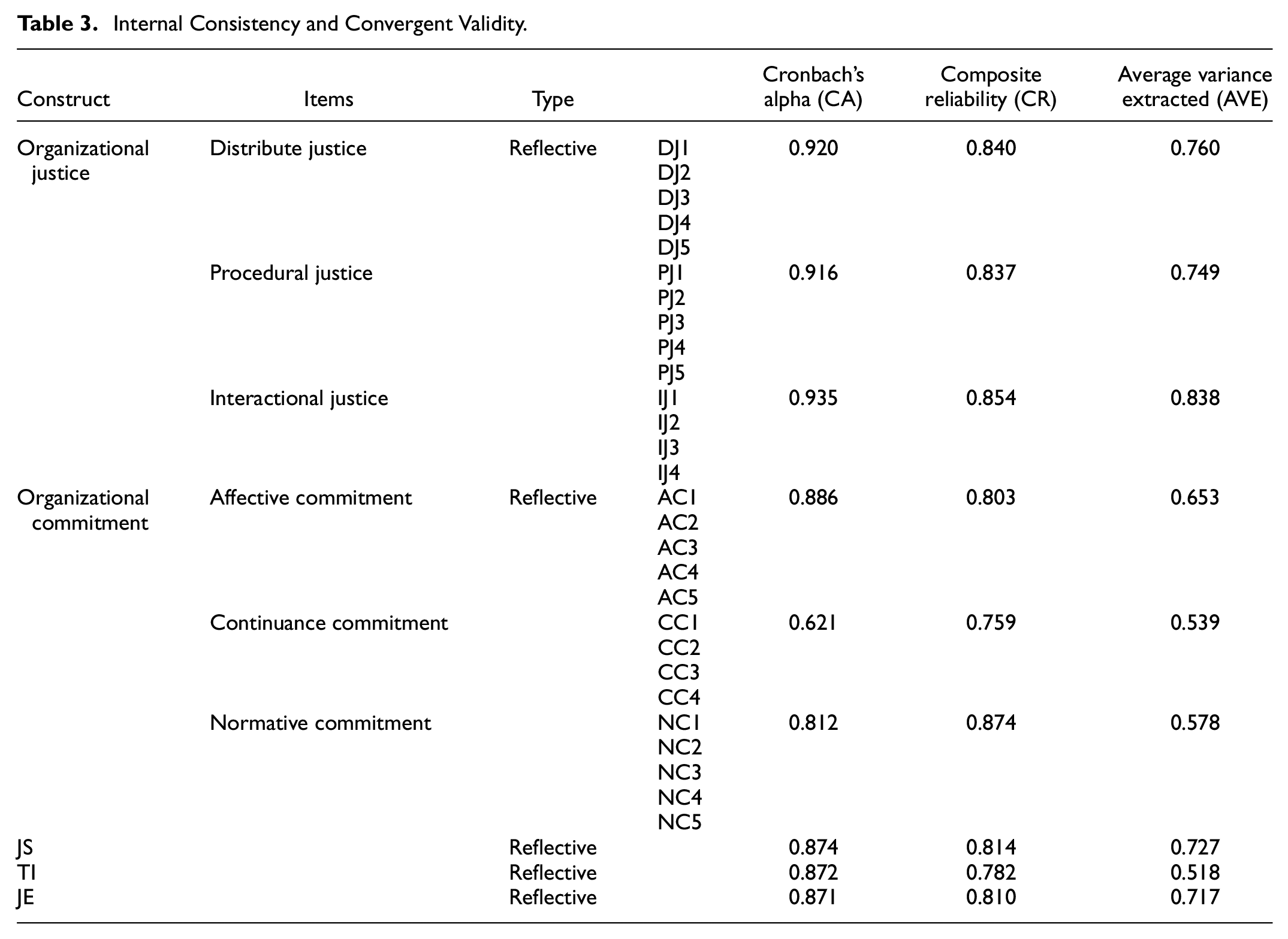
First of all, internal consistency reliability is evaluated by Cronbach’s alpha (CA) and Composite reliability (CR) (Bagozzi & Yi, 1988; Hair et al., 2011). CA offers an estimate of the reliability based on the inter-correlations of the observed indicator variables, where 0.70 serves as the evaluation threshold. Furthermore, internal consistency can also be examined through the use of CR, which is also a convenient and adequate test to perform. According to the rule of thumb, values between 0.70 and 0.90 can be regarded as satisfactory (Nunnally, 1994). According to the information presented in Table 1, all of the CA and CR values seemed to meet standards.
After the establishment of reliability, the convergent validity and discriminant validity of the construct are further evaluated. Convergent validity is the extent of similarity between the scores of two instruments that are supposed to measure the same construct. In this study, we used the average variance extracted (AVE) to assess convergent validity (Fornell & Larcker, 1981a). This criterion refers to the grand mean value of the squared loadings of the indicators associated with the construct. If the AVE is 0.50 or greater, the construct accounts for more than half of the variance in its indicators (Chin, 1998). Table 3 reveals that the AVE appeared satisfactory based on the recommended threshold. Thus, there is substantial convergent validity to the reflective constructs.
Internal Consistency and Convergent Validity.
Discriminant validity refers to the extent to which a construct is truly distinguished from other constructs by empirical standards. In this research, the discriminant validity is evaluated using the Fornell-Larcker criterion (Fornell & Larcker, 1981b) and the cross loadings (Hair et al., 2011). According to the Fornell-Larcker criterion, the square root of AVE values should be higher than the highest correlation it has with any other construct. Table 4 shows that there is sufficient discriminant validity because the bold values (the square root of the AVE) on the diagonal is larger than every corresponding element in its row and column.
Fornell-Larcker Criterion.

Recently, Fornell and Larcker (1981b) criterion has been criticized for its unreliability in diagnosing discriminant validity. In light of this, Henseler et al. (2015) propose an alternative based on a multi-trait-multi-method matrix, also known as the heterotrait-monotrait (HTMT) ratio of correlations. Therefore, in order to pass the discriminant validity test, all HTMT values must be lower than 0.85 (Markus, 2012) or 0.90 (Gold et al., 2001). The results in Table 5 satisfactorily meet the standard, proving discriminant validity.
HTMT.

Note. Overall, the HTMT and the Fornell-Larcker criterion support discriminant validity.
As can be observed, all of the criteria for evaluating the model have been met, which provides support for the reliability and validity of the model.
Evaluation of the Structural Model
The structural model estimates are not examined until the reliability and validity of the constructs have been established. Hence, after reliability and validity are established, the structural model need to be evaluated in the following stage.
Collinearity Issues
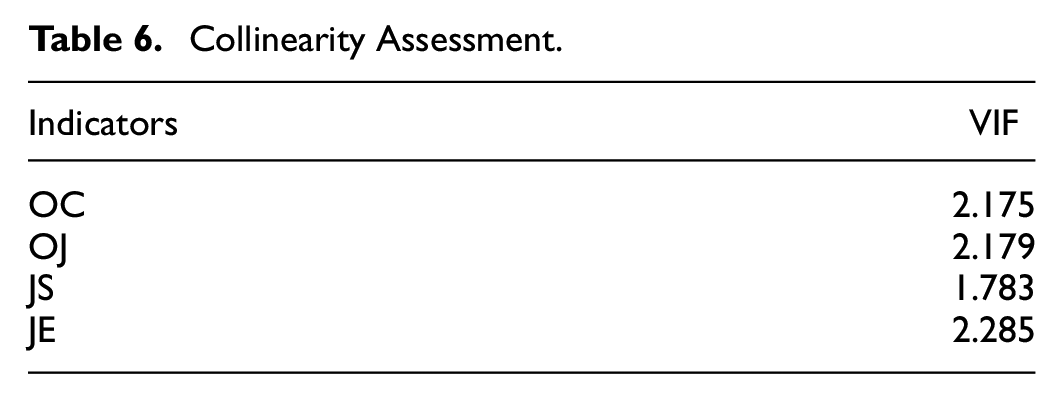
To begin, we need to determine whether or not the structural model exhibits collinearity issues. The reason for this is that significant levels of collinearity among the predictor constructs may cause the path coefficients to be biased (Hair et al., 2011; Henseler et al., 2009). The method to evaluate the collinearity issues is to test the variance inflation factor (VIF). Each indicator’s tolerance (VIF) value should be higher than 0.20 (lower than 5) to indicate that the potential collinearity problem does not exist (Hair et al., 2011). According to the results in Table 6, the estimation of the PLS path model does not encounter collinearity problems.
Collinearity Assessment.
Effect Size (f 2)
The effect sizes (f 2) are reported as a component of the evaluation of the structural model (Sullivan & Feinn, 2012). According to Cohen (1988),f 2 values of 0.02, 0.15, and 0.35 reflect, respectively, small, medium, and large effects of the exogenous latent variable. The data in Table 7 indicate that JS has a substantial effect on the intention to leave since f 2 values are greater than 0.35.
Results of R2, Q2, and f2 Values.

Coefficient of Determination (R2)
This coefficient measures the predictive accuracy of the model. It denotes the exogenous latent variables’ combined impacts on the endogenous latent variables (Hair et al., 2012). The value of R2 can range anywhere from 0 to 1, with higher values suggesting greater degrees of prediction accuracy. Specifically, R2 values of 0.75, 0.50, and 0.25 for endogenous latent variables are characterized as substantial, moderate, and weak (Hair et al., 2011; Henseler et al., 2009). The R2 value of TI is 0.657, which means that 65.7% of the variance in TI is explained by OC, OJ, and JS. As a result, we reach the conclusion that our model has a high degree of predictive accuracy (see Table 7).
Blindfolding and Predictive Relevance (Q2)
Furthermore, researchers should examine Stone-Geisser’s Q2 values’ magnitude as a measure of predictive relevance (Geisser, 1974; Stone, 1974). For a specific endogenous concept, Q2 values greater than 0 suggest that the model has predictive relevance. Specifically, values of 0.02, 0.15, and 0.35 show that an exogenous construct has a small, medium, or large predictive importance for a specific endogenous construct (Chin, 1998). The Q2 values of TI (0.435) demonstrated their predictive relevance.
Structural Model Path Coefficients
To appraise the significance of the hypotheses, it has been suggested to report the path coefficients, p-values, and t-statistics from the structural model (Hair et al., 2019). As recommended by Henseler et al. (2009), the direct relationships are analyzed before estimating the mediation and moderation effects using PLS path modeling.
Table 8 depicts the hypotheses tested regarding the direct relationships. H1 is developed to investigate the relationship between OC and JS. This link is significant, according to the path analysis results (β = .358, t-value = 2.865, p < .005). Moreover, the findings support the H2, indicating that the relationship between OJ and JS is significantly positive (β = .361, t-value = 2,679, p < .01). Likewise, hypothesis H3 is also supported, as the relationship between OJ and TI is highly relevant (β = −.284, t-value = 2.328, p < .005). We also found the path predicted by H4 on the relationship between OC and TI positive and significant (β = −.288, t-value = 2.420, p < .05) and there was strong evidence showing a significant and positive relationship between JS and TI (β = −.353, t-value = 2.893, p < .05), thus H4 and H5 are supported.
Hypotheses Testing of Direct Relationships.

p < 0.005. **p < 0.01. *p < 0.05.
Testing the Mediating Effects
Before beginning the mediating analysis, the PLS path model needs to be evaluated without the mediator variable JS (Hair et al., 2014). Table 8 demonstrates that the relationship between OJ and TI is significant, as is the OC and TI relationship. In the subsequent step, the mediator variable needs to be taken into account. The primary focus is on determining whether the indirect effect of OC and OJ, via the JS mediator variable, on TI is significant. The outcomes of the structural model examination in Table 8 supported this. The final step is to assess the effectiveness of such mediation. In order to examine the strength of the mediation variance accounted for, the VAF method is used (Hair et al., 2014). It is determined by dividing the indirect effect by the total effect. In this circumstance, the VAF would be lower than 20%, implying that almost no mediation occurs. On the contrary, when the VAF has extremely high results exceeding 80%, full mediation can be assumed. Partial mediation can be described as a situation in which the VAF is more than 20% but less than 80% (Hair et al., 2014). Consequently, results calculated according to Table 9 indicate that JE partially mediates the relationship between OJ and TI. Besides, 30.4% of OC’s effect on TI is explained by the JS mediator, which can be characterized as partial mediation.
The Results of Mediation Analysis.

Testing the Moderating Effects
Moderating effects refer to variables whose changes affect the strength or direction of a relationship between an exogenous and an endogenous latent variable (Hair et al., 2014). In PLS path modeling, the interaction effects of moderators are investigated by using the product indicator method, as proposed by Hair et al. (2014). To assess the moderating effect, OJ (predictor) and JE (moderator) are multiplied to form an interaction construct (OJ × JE) to predict TI (F. Ali et al., 2016; Henseler & Fassott, 2010). According to the results in Figure 2, the t-value of JE × OJ → TI is 2.634 > 1.96, which indicates that the moderating effect of JE is significant. In addition to, from the result of simple slope analysis in Figure 3, it can be concluded that when the degree of JE is at a high level, the relationship between OJ and TI is strong; when the degree of JE is at a low level, the relationship between OJ and TI is weak. That is to say, counselors with high-level JE are less likely to leave their college because they firmly believe that the various systems of college are fair.

Moderation effect analysis.

JE strengthens the negative relationship between OJ and TI.
Discussion
The goal of this research is to explore the influencing factors of college counselors’ TI through detailed data and systematic illustration. The study also examined the mediating role of JS among these variables and the moderating role of JE in OJ and TI. The specific discussion is as follows:
The results of this study show that OJ and JS are positively correlated. This also accords with our earlier outcomes, which showed that the higher the level of OJ, the higher the JS of counselors (Chiedu et al., 2022; Mullen et al., 2021). A possible explanation for this might be if the college can ensure the fairness of job task allocation, the equity of salary promotion mechanisms, a supportive work environment, and equal career development opportunities that align with counselors’ expectations for their work, then they will be more motivated to fulfil their responsibilities, create a more positive working atmosphere, and consequently experience higher JS in their future work.
The current investigation found that OJ had a negative relationship with TI. Some studies related to TI support this finding as well (Herbert et al., 2020; Hill, 2022; Mullen et al., 2021). This suggests that when counselors perceive fairness in the allocation of resources, procedures, and interpersonal interactions within the college, their propensity to leave the college is significantly diminished. What may be inferred from this outcome is that those counselors who think that they can get fair treatment from the college in terms of salary satisfaction, decision-making process, and interpersonal treatment may be optimistic about their current school and may not think that external alternatives are attractive. Therefore, it is unlikely that they intend to leave their current college.
It was shown that TI was inversely related to JS, indicating that JS of counselors significantly influences their career retention and the decision to stay within the profession This result agrees with those of previous studies (Chiedu et al., 2022; Nurhayati et al., 2020; Olsen & Huang, 2019). Specifically, JS is not merely an emotional experience but also reflects counselors’ perceptions of their work environment. When counselors perceive their work environment as positive and conducive to personal and professional development, they are more likely to achieve high levels of JS. This perception may involve aspects such as the management and support policies of educational institutions, the reasonableness of workload, and the availability of professional development opportunities. When these factors are met, counselors are more inclined to remain in their current positions and exhibit lower TI.
The findings showed that the OC of counselors was negatively correlated with TI. Consistent findings were obtained in preceding studies (Al-Jabari & Ghazzawi, 2019; Mete & Sökmen, 2019). This phenomenon can be explained by the fact that Chinese universities offer relatively stable career opportunities, emphasize organizational loyalty and social identity, and provide comparatively favorable welfare benefits. These factors collectively reduce the motivation of counselors to seek other job opportunities, making them more inclined to stay in their current positions and maintain the stability and quality of the university counseling workforce. This reflects the values in Chinese university culture that prioritize professional loyalty and long-term stability.
The results indicate that JE significantly moderates the relationship between OJ and TI. This finding was also reported by Qian et al. (2022), who found that highly-embedded counselors with the perception of OJ are less likely to leave the college. This is because in the environment of Chinese universities, counselors usually have a high sense of identity with the educational mission, pay attention to student growth, and therefore show a high level of engagement in their work. However, at the same time, there may also be some fairness issues within universities, such as salary gaps and limited promotion opportunities. Therefore, JE may help counselors better cope with these issues, alleviate dissatisfaction caused by unfairness, and thus reduce their intention to resign.
The research findings revealed that there was a significant positive influence between counselors’ OC and JS. The results are also in line with the findings of Parmar et al. (2022) who found that JS contributes 75% to the employees’ TI. As far as OC is concerned, it can enable employees to maintain a stable attitude, and pool the core strength of employees. In its daily work, the college management department must use the humanized management model, create a democratic and harmonious atmosphere, strengthen mutual understanding, and build trust. So as to improve the enthusiasm of counselors.
It was discovered that JS partially mediated the relationship between OC and TI. That is, the relationship between OC and TI is not a single linear relationship, it is also affected by JS. This outcome corresponds with the findings of Ding (2021), who considered that the relationship between OC and TI is mediated by JS. This reason could be attributed to OC typically encompasses loyalty to the organization and a sense of long-term dedication. When counselors perceive a high level of commitment to college, they are more likely to invest greater effort and time in their work, leading to an increase in their JS. Elevated JS, in turn, reduces the counselors’ TI.
It was also discovered that JS partially mediated the relationship between OJ and TI. The result aligns with the findings of Parmar et al. (2022), who think that when counselors perceive organizational fairness, they are more likely to feel satisfied and less inclined to resign. A possible explanation for this is that when counselors perceive fair treatment from the organization in the context of Chinese universities, it typically leads to an increase in their JS. This satisfaction can stem from fair treatment in various aspects such as compensation, promotion opportunities, and workload distribution. As counselor job satisfaction rises, they are more likely to develop positive emotions toward their work, reducing their inclination to leave.
All in all, it is possible to conclude that high levels of OJ and commitment result in lower TI. The mediating role of JS and the moderating role of JE have also been verified. The research findings add valuable new knowledge about the relationships between these variables, and they put the focus on the practical consequences of OJ and OC in college counselor retention.
Implications
Practical Implications
The results of this research demonstrate that counselors’ perceptions of OJ and commitment can significantly affect their JS and TI. In addition, JE also moderates the link between OJ and TI. Therefore, it is necessary to prioritize in order to improve the sense of OJ and OC of counselors in the management of colleges, so as to reduce the occurrence of counselors’ TI. Based on the outcomes of this investigation, the following recommendations are proposed.
From the angle of colleges, the results show that OJ has a strong ability to predict the TI of counselors. Therefore, first and foremost, colleges must maintain transparency in order to assure fairness. Transparent internal information channels allow colleges to send pertinent information to each counselor on time. Secondly, colleges should focus on the equitable distribution of material aspects (i.e., salary and welfare) and improve the incentive mechanism so as to make counselors devote themselves to management, education, and teaching. Lastly, create sensible and efficient management systems. Colleges could encourage counselors to participate in school management and decision-making activities, and form an equal competitive environment and a democratic interpersonal environment. Otherwise, if counselors feel they are being treated unfairly in such practices, they may consider leaving the college. Furthermore, our research highlights the significance of JE as a moderator between OJ and TI. It is vital to improve JE and strengthen counselors-colleges contact (Niu et al., 2022). As a college administrator, if you wish to decrease the flow of counselors and improve the stickiness between counselors and colleges, you need to reinforce the JE of counselors to make them more integrated.
According to the results of this study, OC also plays an important role in influencing counselors’ TI (X. Fu et al., 2022; Niu & Wu, 2022; Wu & Tian, 2022). First of all, from an emotional point of view, colleges can hold more activities to increase the ties that connect counselors. Second, colleges should provide a salary and benefits to provide financial support for the counselor based on their continuous commitment. Finally, strengthen normative commitment. Colleges should provide various training and development opportunities for counselors so that they can provide further services for the colleges. The combination of these forms can help the counselors form a sense of overall psychological attachment to the college, thus reducing the TI.
From the perspective of counselors, counselors should cultivate their own healthy personalities (Wu & Wang, 2018, 2020). First of all, counselors should understand their own advantages and disadvantages and face up to their own emotional changes so as to promote the balance of body and mind. Secondly, it is necessary to cultivate positive self-consciousness and be good at managing your own emotions. Finally, counselors should learn to replace negative emotions with positive ones and be good at releasing various pressures in life and work.
Theoretical Implications
This research expands on prior research by providing a fresh perspective that hasn’t been explored before. Firstly, this study theoretically explains why the influence of OJ on the TI of counselors is affected by their JE. As a new variable for the study of employee TI, the majority of current research focuses on using it as a mediation variable to directly evaluate TI (Karatepe, 2011; Sekiguchi et al., 2008). Thus, recognizing this restriction, this study investigated the moderating role of JE as OJ and counselor TI (Aryani et al., 2021; Boamah et al., 2022; Luo et al., 2021).
Secondly, this research contributes to a better understanding of what elements are involved in shaping TI. There is currently a lot of study both domestically and internationally on the factors influencing TI (Hill, 2022; Khairunisa & Muafi, 2022; Mulang, 2022). However, the study on counselors’ TI is not yet complete in Chinese colleges. Thus, this paper chooses JS as the mediation mechanism between OJ, OC, and TI, as well as JE as the moderation mechanism between OJ and TI, demonstrating the formation process of counselor TI. Further empirical support is given to the influencing factors of TI, which enriches the existing theory and provides a brand-new avenue for future research.
Limitation
This study has limitations that must be considered. Firstly, because this research is carried out exclusively in the setting of China, its applicability to the circumstances of other nations is likely to be restricted. Accordingly, it is possible that studies of a similar nature could be carried out in other developed nations. Thus, the results of those studies can then be compared to those of our study so as to further explore the factors affecting the class teacher’s TI. Secondly, the factors that influence TI among college class teachers should be studied longitudinally. The single-cross-sectional study design hinders us from elucidating the causal relationship between variables and TI in great detail. Data can be gathered in the future at various time points to contribute to the evidence supporting model causation. Thirdly, the current study consisted solely of quantitative measures. It is recommended as a result that future research on the same subject make use of mixed methodologies, including both qualitative and quantitative approaches, as this would offer a more holistic understanding of the topic that is being investigated. Fourthly, we discussed the moderating effect of JE on OJ and TI. Future research can further explore what other factors will moderate the TI of counselors.
Conclusion
A high turnover of counselors will have adverse effects on universities and students. Consequently, this negative impact can be mitigated by identifying the underlying cause and implementing measures whenever possible (Watlington et al., 2010). The objective of this research is to examine the influencing factors of TI among college counselors in China and see if JS mediates the link between these variables, as well as whether the moderating effect of JE is significant. The results show that these variables significantly predict the TI of counselors. At the same time, logically speaking, the mediating role of JS and the moderating role of JE are also legitimate. According to the developed framework, this study provides suggestions for university management to decrease the TI of counselors and improve the stability of counselors. At the same time, it also makes up for the lack of research on the TIs of college counselors in China. It has certain theoretical and practical implications.
Footnotes
Declaration of Conflicting Interests
The author(s) declared no potential conflicts of interest with respect to the research, authorship, and/or publication of this article.
Funding
The author(s) received no financial support for the research, authorship, and/or publication of this article.
Informed Consent Statement
Informed consent was obtained from all subjects involved in the study.

Data Availability Statement
The data that support the findings of this study are available on request from the corresponding author.