




Abstract
Job embeddedness is a collection of forces and a motivational variable that enables health care managers to retain employees. In light of this, our empirical study assesses job embeddedness as a mediator linking coworker and supervisor support to nonattendance intentions and extra-role performance. Data gathered from staff nurses in three waves (time lag: 3 weeks) and their head nurses in public hospitals in Northern Cyprus were utilized to assess the abovementioned linkages via structural equation modeling. Staff nurses who obtain sufficient support from their head nurses are highly embedded in their jobs. Such nurses in turn exhibit lower propensity to be late for work (PLW). Simply put, job embeddedness completely mediates the influence of supervisor support on PLW. The rest of the linkages are not supported. Implications of the findings as well as future research directions are presented in this article.
Keywords
Introduction
Today’s health care environment highlights the global nursing shortage, which is a serious problem in many countries (Johnson, 2018; Moloney, Boxall, Parsons, & Cehung, 2018). Such shortage is also observed in Northern Cyprus, where this empirical investigation was conducted (Kibrispostasi, 2018). With this stated, it is of great importance to examining the factors that enable health care managers to retain nurses in the organization as well as in the profession (Moloney et al., 2018). As nursing is a human-centered occupation (Kaya & Tosun, 2018), it is also of utmost importance to investigating the factors that result in desirable attitudinal and behavioral outcomes among nurses (F. Chen, Yang, Gao, Liu, & De Gieter, 2015; Kim, Kim, Kim, Yu, & Lee, 2014).
A systematic search of the nursing literature reveals that there has been an increasing interest in workplace stress as well as individual and organizational factors that influence nurses’ affective and performance consequences. Specifically, a study conducted with nurses in South Korea documented that work–family–school role conflicts exacerbated burnout (Goong, Xu, & Li, 2016). The findings of another study in Taiwan illustrated that surface acting as well as frequency and duration of interaction reduced nurses’ job satisfaction, whereas display rules positively affected their job satisfaction (Yang & Chang, 2008). The findings further indicated that surface acting had a detrimental effect on nurses’ organizational commitment.
In a study of nurses in China, it was reported that satisfaction with pay and satisfaction with psychological rewards from head nurse mitigated withdrawal cognition and enhanced satisfaction with the job and organizational commitment (F. Chen et al., 2015). The findings of a recent empirical study in Italy documented that job satisfaction, self-efficacy, and work engagement as well as several agentic capacities (e.g., self-reflection) were negatively associated with nurses’ propensity to quit (De Simone, Planta, & Cicotto, 2018). An earlier systematic review of the nursing literature demonstrated that variables such as role conflict, role ambiguity, job stress, and working conditions were linked to nurses’ job satisfaction (Lu, Barriball, Zhang, & While, 2012). A study conducted in Japan indicated that work–family culture, job control, job support, and living with family lessened hospital nurses’ propensity to leave the organization, whereas work–family conflict aggravated their quitting intentions (Yamaguchi, Inoue, Harada, & Oike, 2016). The findings of this study further documented that job control and living with family diminished hospital nurses’ propensity to leave the profession, while work–family conflict heightened their inclination to leave the profession (Yamaguchi et al., 2016).
Although the abovementioned studies and their findings have provided significant insights into the factors influencing nurses’ affective and performance outcomes, there is still a dearth of evidence about nurses’ job embeddedness (Dechawatanapaisal, 2017, 2018). Another void has been underscored in a review study that there is still a need for more research that links job embeddedness to nonturnover outcomes (Lee, Burch, & Mitchell, 2014). In addition, Moloney et al.’s (2018) review highlights the need for seeking ways to retain skilled nurses despite the changing conditions.
Job embeddedness has three components: links, fit, and sacrifice (Mitchell, Holtom, Lee, Sablynski, & Erez, 2001). Links refer to “formal or informal connections between a person and institutions or other people” (Mitchell et al., 2001, p. 1105). Fit is defined as “an employee’s perceived compatibility or comfort with an organization and with his or her environment,” whereas sacrifice is associated with “the perceived cost of material or psychological benefits that may be forfeited by leaving a job” (Mitchell et al., 2001, p. 1105). Employees who feel closely connected to their supervisors and coworkers are likely to be better performers at work (Tian, Cordery, & Gamble, 2016). The availability of fit between employees’ values, career goals, and plans for future and the culture of the company as well as the requirements of the job makes them become professionally tied to the organization (Bambacas & Kulik, 2013). Employees who intend to leave their supportive organization know that there are financial and nonfinancial losses as a result of voluntary turnover.
In a study conducted in China, Tian et al. (2016) illustrated that organizational links, fit, and sacrifice enhanced employees’ job performance. They further indicated that ability-enhancing human resource practices (e.g., training) were related to job performance indirectly through organizational links, fit, and sacrifice, whereas organizational sacrifice mediated the linkage between motivation-enhancing human resource practices (e.g., performance appraisal) and job performance, and organizational fit and sacrifice mediated the effects of opportunity-enhancing human resource practices (e.g., information sharing) on job performance. Ampofo, Coetzer, and Poisat’s (2017) study in South Africa reported that organizational fit and sacrifice fostered employees’ life satisfaction, whereas community fit had a positive influence on life satisfaction.
In addition, when employees fit well within the work environment, they are likely to report desirable outcomes such as better performance and lower voluntary turnover (e.g., Dechawatanapaisal, 2018; Lee et al., 2014; Lev & Koslowsky, 2012; Sun, Zhao, Yang, & Fan, 2012). Employees possessing formal and informal connections with work and nonwork friends and/or the community seem to exhibit desirable outcomes as mentioned above (e.g., Dechawatanapaisal, 2018; Karatepe & Shahriari, 2014; Lee et al., 2014; Sun et al., 2012). Similarly, employees remain with the organization without sacrificing their valued things such as salary and benefits (e.g., Bergiel, Nguyen, Clenney, & Taylor, 2009; Thakur & Bhatnagar, 2017).
The presence of work social support can trigger nurses’ perceptions of job embeddedness. Employees who can obtain support from their coworkers and supervisors are more enmeshed in their jobs (Bergiel et al., 2009; Karatepe, 2016). This support can be in the form of care and consideration received from coworkers and supervisors (Karatepe, 2016). The importance of coworker and supervisor support in enhancing employees’ job embeddedness has also been highlighted in Singh, Shaffer, and Selvarajan’s (2018) study.
Sun et al.’s (2012) study documented that job embeddedness partly mediated the influence of psychological capital on nurses’ in-role performance in China. Wheeler, Harris, and Sablynski’s (2012) study highlighted the significant positive linkage between community embeddedness and job performance among hospital workers. However, their study did not support the linkage between on-the-job embeddedness and job performance. The findings of another study conducted among nurses in China indicated that job embeddedness partly mediated the influence of quality of work life on quitting intentions and affective commitment (Zhao et al., 2012).
Using a sample of general hospital nurses in South Korea, Kim et al. (2014) demonstrated that the work environment positively influenced job embeddedness. Vardaman, Rogers, and Marler (2018) showed that job embeddedness was linked to nurses’ quitting intentions through change-related self-efficacy. In a study of health care professionals, including nurses, in Thailand, Dechawatanapaisal (2017) found that work–life balance and job characteristics fostered job embeddedness, which in turn reduced quitting intentions. The findings of the abovementioned study further reported that career opportunities enhanced job embeddedness, which in turn mitigated both quitting intentions and actual turnover. Dechawatanapaisal’s (2018) study conducted in Thailand revealed that organizational identification partly mediated the influence of leader–member exchange on job embeddedness, whereas job embeddedness completely mediated the association between organizational identification and quitting intentions. A study conducted with self-initiated expatriates in public health care organizations in the United Arab Emirates showed that job embeddedness weakened quitting intentions (Hussain & Deery, 2018). The same study also reported that such expatriates were more inclined to leave the organization when they were highly embedded in the community.
As discussed above, nurses who are high on job embeddedness display positive outcomes. Reduced nonattendance intentions such as diminished propensity to be late for work (PLW) and high levels of extra-role performance are among these positive consequences. In our study, PLW refers to “an individual’s specific affective and cognitive responses to being late for work” (Foust, Elicker, & Levy, 2006, p. 122). Extra-role performance refers to nurses’ discretionary behaviors displayed in the organization (Netemeyer & Maxham, 2007).
Our study uses social exchange and job embeddedness theories to develop the linkages among the constructs of interest. Broadly speaking, social exchange theory contends that there are certain rules of exchange the employees and the organization should adhere to (Cropanzano & Mitchell, 2005). If management of hospitals creates an environment that enables employees to obtain support from their coworkers and supervisors, employees reciprocate through higher job embeddedness in the organization. Job embeddedness theory proposes that job embeddedness is a significant mediating construct that links the relevant variables to the attitudinal and behavioral consequences among employees/nurses (Holtom & O’Neill, 2004; Karatepe, 2016). This provides a theoretical foundation about job embeddedness as a mediator of the impact of work social support (e.g., supervisor support) on nurses’ PLW and extra-role performance.
Against this backdrop, our study assesses job embeddedness as a mediator of the influences of coworker and supervisor support on PLW and extra-role performance using data gathered from staff nurses in three waves and their head nurses in the Northern Cyprus health care industry.
As shown in the conceptual model in Figure 1, our study proposes the following hypotheses:

Conceptual model.
Method
Sample and Procedure
Data came from staff nurses from the two public hospitals in Northern Cyprus. The official permission obtained from the Ministry of Health enabled the researchers to contact staff and head nurses directly. Each survey had a cover page, which consisted of such information as “Management of the hospital endorsed participation but participation was voluntary” and “There were no right or wrong answers to the items in the questionnaires.” The cover page also contained information about anonymity and confidentiality.
To diminish the likelihood of common method variance, our study gathered data in three waves where the time lag between each wave was 3 weeks. Our study also gathered data from head nurses regarding staff nurses’ extra-role performance. Utilizing time-lagged data as well as obtaining head nurses’ ratings for staff nurses’ extra-role performance is congruent with the recommendations given in the literature (Podsakoff, MacKenzie, Lee, & Podsakoff, 2003).
As this empirical study used four surveys to collect data from nurses and had no patient involvement/was unrelated to experiments on humans and animals, approval for such a survey-based study from a research and publication ethics board was not required in Northern Cyprus or at the university where the researchers were employed at the time of this empirical study. In addition, staff nurses as well as their head nurses placed the completed surveys in the special boxes. This showed their consent (I.-H. Chen, Brown, Bowers, & Chang, 2015).
The researchers distributed 250 Time 1 surveys to staff nurses in the first wave. Two hundred thirty-two surveys were obtained. Then 232 Time 2 surveys were distributed to the same staff nurses in the second wave. However, 225 surveys were received. Two hundred twenty-five Time 3 surveys were distributed to the same staff nurses. Two hundred twelve Time 3 surveys were obtained in the third wave. The response rate was 84.8% (212 / 250). Two hundred twelve surveys were also obtained from head nurses regarding staff nurses’ extra-role performance. Subject profile is given in Table 1.
Subject Profile (n = 212).

Measurement
The study variables were assessed with three reflective items per variable. This practice “. . . allows for a just-identified (df = 0) measurement model of each construct where model fit is primarily determined by the structural relations among constructs” (Karatepe, Yavas, Babakus, & Deitz, 2018, p. 6). Variables in the conceptual model were operationalized via the existing scales (Crossley, Bennett, Jex, & Burnfield, 2007; Foust et al., 2006; Karasek, Triantis, & Chaudhry, 1982; Netemeyer & Maxham, 2007). These scales were widely utilized in a number of past and recent studies (e.g., Dechawatanapaisal, 2018; Karadas & Karatepe, 2018; Ozturk & Karatepe, 2019; Sun et al., 2012; Yavas, Karatepe, & Babakus, 2014; Zhao et al., 2012). The Time 1 survey consisted of the coworker and supervisor support items. It also included items about nurses’ prolife. The Time 2 survey contained the job embeddedness items, whereas the Time 3 survey included the PLW items. Finally, the head nurse survey consisted of the extra-role performance items.
Coworker support included three items from Karasek et al. (1982). The coworker support items are “I feel I am accepted in my work group,” “My coworkers back me up when I need it,” and “I feel comfortable with my coworkers.” Supervisor support consisted of three items (Karasek et al., 1982). The items for supervisor support are “My head nurse encourages staff nurses he or she supervises to work as a team,” “My head nurse offers new ideas,” and “My head nurse encourages staff nurses he or she supervises to exchange opinions and ideas.”
Job embeddedness was assessed through three items (Crossley et al., 2007). Our study asked staff nurses’ agreement with the following items, “after considering both work related (such as relationships, fit with job, benefits) and nonwork related factors (such as neighbors, hobbies, community perks).” This was done for measuring both on-the-job and off-the-job embeddedness. The items used to measure this variable are “I am too caught up in this hospital to leave,” “I feel tied to this hospital,” and “I am tightly connected to this hospital.” The items in coworker support, supervisor support, and job embeddedness were answered on a 5-point scale (5 = strongly agree to 1 = strongly disagree).
Three items were utilized to operationalize PLW (Foust et al., 2006). The items used to assess this variable are “Tardiness to work should be acceptable as long as the work gets finished,” “Occasional tardiness for work should be acceptable,” and “I find it acceptable to be ten minutes late to work.” The response format was a 7-point scale with anchors that ranged from 7 (strongly agree) to 1 (strongly disagree).
Extra-role performance was assessed with three items (Netemeyer & Maxham, 2007). The head nurse survey items were prefaced with the phrase, “Within the last six months, how often did this nurse engage in certain behaviors . . . ” regarding their extra-role performance. The items for extra-role performance are “How often did this nurse go above and beyond the ‘call of duty’ when serving patients?,” “How often did this nurse willingly go out of his or her way to make a patient satisfied?” and “How often did this nurse help patients with problems beyond what was expected or required?” This scale used a 7-point scale anchored on the ends by always and never.
All the surveys were originally prepared in English and then translated into Turkish through the back-translation technique. The Time 1, Time 2, and Time 3 surveys were piloted with three different groups of 10 nurses. The head nurse or the supervisor survey was also piloted with five head nurses. Staff and head nurses reported no difficulty understanding the items. Consequently, no amendments were made.
Statistical Analyses
In line with other studies (e.g., Bambacas & Kulik, 2013; Ozturk & Karatepe, 2019), we used Anderson and Gerbing’s (1988) two-step approach. First, our study employed confirmatory factor analysis pertaining to issues of convergent and discriminant validity in the measurement model (Anderson & Gerbing, 1988; Fornell & Larcker, 1981). This was followed by the test of composite reliability for each latent construct (Bagozzi & Yi, 1988). Coefficient alphas as well as correlations were reported. Second, the associations in the structural model were tested via structural equation modeling (SEM; Anderson & Gerbing, 1988). The Sobel test was employed to gauge the significance of the mediating effects. One-tailed test was used to detect significant impacts (t > 1.65, p < .05; t > 2.33, p < .01).
The fit statistics used in our study was as follows: “the χ2 / df, comparative fit index (CFI), parsimony normed fit index (PNFI), root mean square error of approximation (RMSEA), and standardized root mean square residual (SRMR)” (Hair, Black, Babin, & Anderson, 2010). Tests of the measurement and structural models were carried out via LISREL 8.30.
Results
The Measurement Model
The findings from confirmatory factor analysis illustrated that the five-factor measurement model fit the data well. Model fit statistics (Table 2) was as follows: χ2 = 143.71 df = 80; χ2 / df = 1.80; CFI = 0.97; PNFI = 0.71; RMSEA = 0.061; SRMR = 0.041. Most of the standardized loadings were greater than 0.70 and all loadings were significant. The average variance extracted (AVE) by each latent construct was equal to or greater than 0.50. Specifically, the AVE by coworker support, supervisor support, job embeddedness, PLW, and extra-role performance was 0.50, 0.71, 0.62, 0.60, and 0.94, respectively. The findings regarding model fit statistics, AVEs, and significant loadings illustrated that convergent validity was confirmed (Anderson & Gerbing, 1988; Fornell & Larcker, 1981).
Scale Items and Measurement Properties.

Note. All loadings were significant. AVE = average variance extracted; CR = composite reliability; CFI = comparative fit index; PNFI = parsimony normed fit index; RMSEA = root mean square error of approximation; SRMR = standardized root mean square residual.
The findings further supported discriminant validity of the constructs. Specifically, the square root of the AVE by each latent construct was larger than the correlations between pairs of constructs (Fornell & Larcker, 1981). For example, the square root of the AVE by coworker support was 0.71. This value was larger than the correlation between coworker support and supervisor support (0.43), coworker support and job embeddedness (0.01), coworker support and PLW (–0.03), and coworker support and extra-role performance (0.05). Furthermore, the composite reliability score for coworker support, supervisor support, job embeddedness, PLW, and extra-role performance was 0.75, 0.88, 0.83, 0.82, and, 0.98, respectively. Each of these scores was higher than 0.60 (Bagozzi & Yi, 1988). As presented in Table 2, coefficient alphas for the observed variables were also above the 0.70 threshold (Karatepe et al., 2018). Overall, the findings indicated that internal consistency reliability was achieved. Table 3 presented means, standard deviations, and correlations.
Summary Statistics and Correlations of Observed Variables.

p < .05. **p < .01 (one-tailed test).
The Structural Model
The skewness values for coworker support, supervisor support, job embeddedness, PLW, and extra-role performance was −1.209, −0.983, −0.655, 1.120, and −0.362, respectively. It seemed that there was no evidence of nonnormality (Kline, 2011). The findings from the χ2 difference test (Δχ2 = 5.35, Δdf = 4, p > .05) revealed that the fully mediated model (χ2 = 149.19, df = 85) appeared to possess a better fit than the partially mediated model (χ2 = 143.84, df = 81). In light of this, the fully mediated model (Figure 2), which fit the data well was used to assess the linkages among variables. Model fit statistics was as follows: χ2 = 149.19 df = 85; χ2 / df = 1.76; CFI = 0.97; PNFI = 0.75; RMSEA = 0.060; SRMR = 0.056.
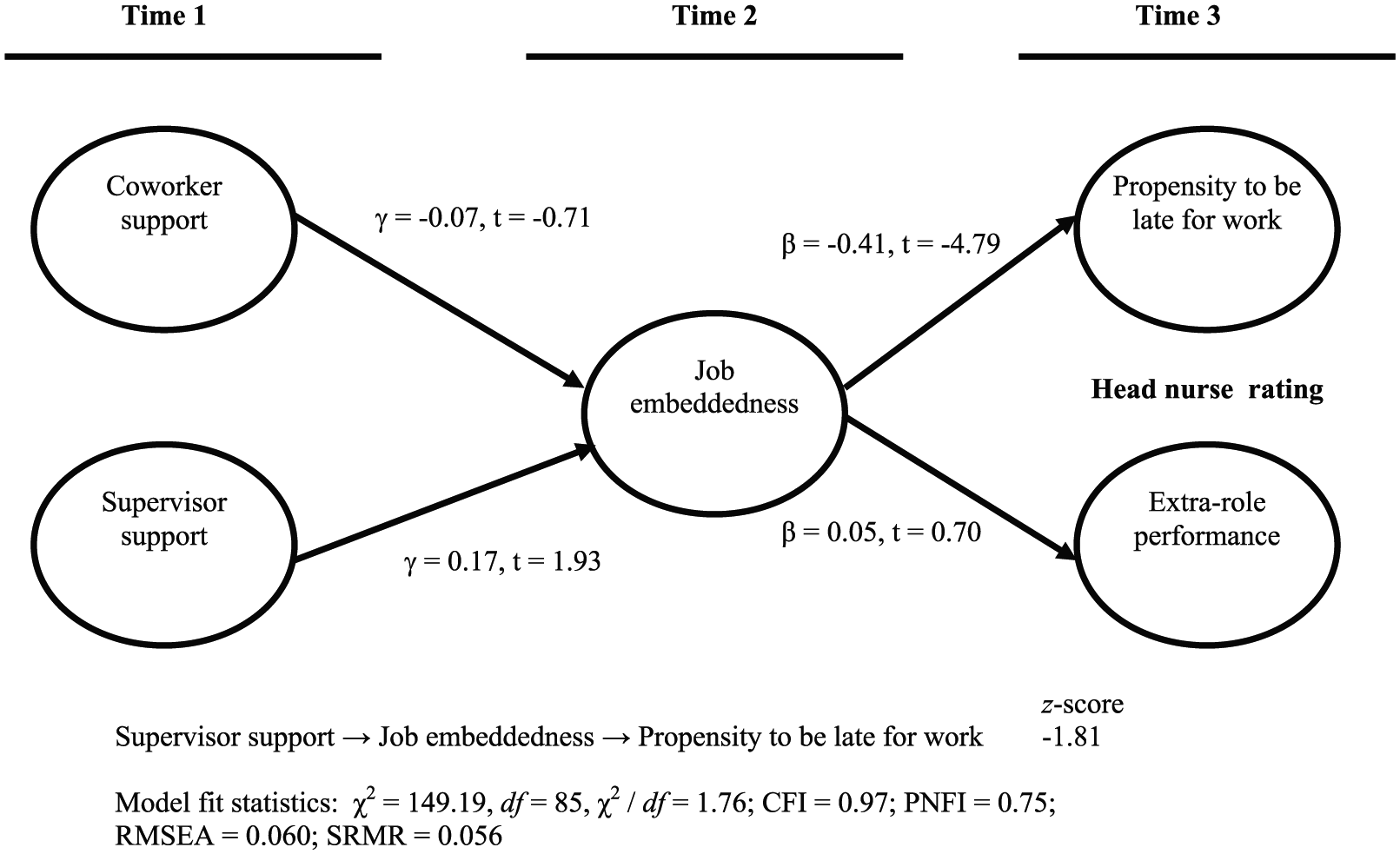
Structural model test results.
The findings from SEM highlighted that supervisor support depicted a positive association with job embeddedness (γ = 0.17, t = 1.93), whereas coworker support did not (γ = −0.07, t = −0.71). Hypothesis 1b received support from the empirical data. However, Hypothesis 1a was not supported. The findings from SEM further illustrated that job embeddedness was negatively associated with PLW (β = −0.41, t = −4.79). Hence, Hypothesis 2a was confirmed. On the contrary, the findings did not support the positive linkage between job embeddedness and extra-role performance (β = 0.05, t = 0.70). Therefore, Hypothesis 2b was not supported.
The Sobel test finding for job embeddedness as a mediator of the influence of supervisor support on PLW was significant. Based on this result (indirect effect = −0.07, z = −1.81), job embeddedness completely mediated the impact of supervisor support on PLW. Hence, Hypothesis 4a was confirmed. However, there was no empirical support for Hypotheses 3a, 3b, and 4b. The variance explained in job embeddedness, PLW, and extra-role performance was 0.02, 0.17, and 0.01, respectively.
Discussion
Key Findings and Implications
Our study tested the impact of job embeddedness in the intermediate linkage between coworker and supervisor support and PLW and extra-role performance through data gathered from staff nurses in three waves and their head nurses in the Northern Cyprus health care industry.
The findings suggest that support surfacing from head nurses fosters staff nurses’ job embeddedness, which in turn leads to diminished PLW. It seems that support emerging from head nurses reflects more links and better fit for staff nurses. Supervisor support represents an important link between staff nurses and head nurses and reflects staff nurses’ comfort with the current public hospital. Such motivated nurses in turn display reduced inclination to be late for work. The finding regarding the positive impact of supervisor support on job embeddedness is in line with the work of Singh et al. (2018).
On the contrary, job embeddedness does not significantly mediate the influence of coworker support on PLW and extra-role performance. The nonsignificant findings concerning the linkage between coworker support and job embeddedness as well the one between job embeddedness and extra-role performance are responsible for the absence of the significant mediating effects. The finding which reveals that coworker support has no bearing on job embeddedness does not receive support from the work of Singh et al. (2018). Employees who are embedded in their jobs exhibit higher extra-role performance. However, the finding concerning this relationship delineated in our study is not consistent with the works of Lev and Koslowsky (2012). Although Wheeler et al. (2012) discussed that job embeddedness energizes directs, and sustains behaviors, our study does not support the proposition that job embeddedness is a motivational variable enhancing extra-role performance among nurses.
The absence of significant relationships mentioned above can be attributed to the work conditions in Northern Cyprus. First, there is a nursing shortage in the country. It appears that management of hospitals is unable to make a decision regarding the replacement of poor performers with the ones who can display extra-role performance at higher levels (Yavas et al., 2014). Second, it seems that staff nurses do not pay attention to the importance of extra-role performance because they know it is not easy to fire poor performers from a public hospital.
Third, staff nurses do not appear to appreciate the critical role of coworker support in handling services given to patients. Instead, support arising from head nurses is more important for staff nurses. This may be due to the fact that they want to maintain a good relationship with their head nurses expecting that they can receive a positive outcome as a result of the annual performance appraisal. Fourth, the results presented in this article echo the findings of a past study conducted with staff nurses in the same country (Yavas et al., 2014). That is, the findings showed that staff nurses were not interested in organizational resources (e.g., training), and these resources did not significantly contribute to their extra-role performance (Yavas et al., 2014). It appears that staff nurses do carry out the traditional requirements of the job but do not seem to exhibit extra-role patient services.
One implication associated with the findings reported above is that management of hospitals needs to create an environment where head nurses provide adequate support to staff nurses. This can be done via various continuous training programs. In these programs, the critical incidents or the conditions can be taught to head nurses who are expected to provide support to staff nurses without losing any time. This is important because the availability of such support will reflect the formal and informal connection between the two parties and show staff nurses’ comfort with the organization. Support provided by head nurses also contributes to staff nurses’ reduced PLW indirectly.
Limitations and Future Research
There are some limitations, which should be highlighted. First, our study used two important consequences of job embeddedness (i.e., PLW and extra-role performance). Future research can test the other potential significant consequences such as absenteeism and voice behavior.
Second, nepotism and favoritism in public hospitals in Northern Cyprus seem to be widespread (Yavas et al., 2014). In recognition of this, future research can gauge the moderating role of nepotism and/or favoritism on the association between job embeddedness and extra-role performance. Specifically, nepotism and/or favoritism may reduce the positive impact of job embeddedness on staff nurses’ extra-role performance. Finally, replication studies with larger sample sizes in the same country or similar countries where nepotism and/or favoritism seem to be prevalent would broaden the database regarding the generalizability of the findings.
Conclusion
This study enhances our knowledge by investigating job embeddedness as a mediator between coworker and supervisor support and nonattendance and performance consequences such as PLW and extra-role performance. Unlike the preponderance of empirical studies, our study utilized data obtained from nurses in Northern Cyprus.
The findings lend credence to job embeddedness as a mediator of the influence of supervisor support on PLW. However, the other relationships do not receive any support from the empirical data. Future research, which can gather data in the same country or different countries, may shed lights on the nonsignificant findings pertaining to the supervisor support → job embeddedness → extra-role performance linkage as well as the coworker support → job embeddedness → PLW and extra-role performance linkages.
Footnotes
Authors’ Note
Data used in our study came from part of a larger project.
Declaration of Conflicting Interests
The author(s) declared no potential conflicts of interest with respect to the research, authorship, and/or publication of this article.
Funding
The author(s) received no financial support for the research, authorship, and/or publication of this article.