




Abstract
The purpose of this article is to contribute to the research literature on entrepreneurial intention (EI) of engineering students in an emerging economy. Through the lens of Ajzen’s theory of planned behavior (TPB), we investigate the influence of academic curriculum, institutional support, family, and peer effects in fostering an intent to be self-employed among Indian engineering students. Data collected from 210 final-year engineering students were tested using partial least squares structural equation modeling method. The antecedents of the TPB, namely, attitude toward entrepreneurship (ATE), subjective norms (SN), and perceived behavioral control (PBC), demonstrated a favorable influence on EI. Whereas the regular academic curriculum seemed to have a negative influence on ATE, institutional support showed a positive effect. Both curriculum and academic support were found to have no significant impact on either PBC or SN. However, both family and peer influence revealed a strong positive relationship with all the antecedents of EI.
Keywords
Introduction
The subject of entrepreneurial intention (EI) is keenly discussed in the academic community. In view of the enhanced role of entrepreneurship in a country’s economy, there is increasing interest in the researches that delve into what drives people to be self-employed. Specifically, technical entrepreneurship could be thought of as one of the means to alleviate most of the social as well as economic problems in a developing nation. However, it is intriguing to note that India, an emerging economy, still struggles with entrepreneurial ventures that are primarily nontechnical in nature (Ministry of Micro, Small and Medium Enterprises, 2019). Only 3.3% of the Total Early-Stage Entrepreneurial Activity (TEA) was from technology-related business services, ranking a dismal 47 out of the 50 participating nations (Global Entrepreneurship Research Association, 2019/2020). The biggest pool of entrepreneurial talent that could possibly transform the nation’s technology sector is the 1.4 million engineering students graduating from Indian engineering colleges every year.
Among Brazil, Russia, India, China, and South Africa (BRICS) nations, India has the lowest desirability for entrepreneurship as a career option and only 10.6% of the population is engaged in early stage entrepreneurial activities (Global Entrepreneurship Research Association, 2016/2017). The Second National Commission on Labour of India (2002) stressed the inevitability of education and training early on to emphasize entrepreneurship development as a source of job creation. Many colleges have programs and initiatives to help engineering undergraduates who are at the threshold of their career paths to successfully create nascent start-ups and take their ventures to fruition. The Government of India recognizes the importance of technical entrepreneurship and has a network of technology and incubation centers to accelerate the process and promote start-ups for innovation and entrepreneurship (Ministry of Micro, Small and Medium Enterprises, 2019). Recently, the Ministry of Human Resources Development (2019) launched “The National Innovation and Startup Policy 2019” as a guiding framework for higher education institutions (HEIs) in an attempt to actively engage both students and faculty of HEIs in entrepreneurship-related activities. In addition, the daunting challenge of providing jobs for the large number of engineering students graduating every year can be turned into an immense opportunity if factors shaping their EI is well understood.
Past studies have theorized the role of academics on EI (Farhangmehr et al., 2016; Kolvereid & Moen, 1997; Liñán et al., 2011; Othman & Nasrudin, 2016). In addition, family and peers seem to have an effect on the EI of students (Farrukh et al., 2017). Among various theories employed to study EI among students, the theory of planned behavior (TPB) has been extensively used (Gird & Bagraim, 2008; Karimi et al., 2016; Kautonen et al., 2015; Maresch et al., 2016; Miranda et al., 2017). Researchers have sought to understand EI through other theoretical models and by integrating TPB with other theories as well (Al-Jubari, 2019; Kallas, 2019). However, studies related to EI in the technical education context are few, especially in developing countries. India graduates an exceptionally high number of engineering students every year and it would be interesting to examine the factors that are most likely to influence their intent to start business ventures. The objective of this study is to examine the influence of academic curriculum (CUR), institutional support (SUP), and the role of family and peers on EI through the antecedents of TPB in the Indian context.
The article is structured as follows: A comprehensive review and summary of the insights from previous research on TPB and the broad influence of the independent variables of the study on EI are presented in the beginning. In the section “Hypotheses development,” several hypotheses and their respective evidences are put forward. The “Method” section describes the methodology and the key findings of the structural model analysis. In the “Discussion” section, the results are presented and, in the “Conclusion and implications” section, the conclusion and implications are outlined. Finally, the limitations and the future scope of the study are conveyed.
Literature Review
Ajzen’s TPB
Ajzen’s TPB is widely used in psychology, social sciences, and management to explain human intent and behavior in various contexts. TPB has been successfully applied to a wide range of research topics like driving behavior (Lindstrom-Forneri et al., 2007), charitable intent (Van der Linden, 2011), purchase intention (Kim & James, 2016), online trading behavior (Gopi & Ramayah, 2007), and green behavior (Mancha & Yoder, 2015) to name a few. TPB owes its wide acceptance to the robust framework and its usefulness in particularly explaining non-spontaneous behavior (Armitage & Conner, 2001). Opting to be an entrepreneur is essentially a planned response rather than a spontaneous decision (Krueger et al., 2000). Therefore, in spite of the availability of various other theories in the domain, researchers are drawn to TPB as the basic model for studying EI and entrepreneurial behavior (Fayolle & Liñán, 2014; Schlaegel & Koenig, 2014).
Ajzen (1991), in the TPB model, proposed three contributing factors, namely, attitude toward behavior, subjective norms (SN), and perceived behavioral control (PBC) to explain the intention of an individual to engage in a certain behavior. As EI can be thought of as an immediate predecessor to entrepreneurial behavior, TPB can be employed, as demonstrated by researchers globally (Autio et al., 2001; Carr & Sequeira, 2007; Gird & Bagraim, 2008; Shook & Bratianu, 2010), to explain the elaborate and intricate processes leading to student entrepreneurship behavior through the constituents of the model, namely, attitude toward entrepreneurship (ATE), PBC, and SN. ATE refers to the mind-set of the individual, whether favorable or not, toward entrepreneurial behavior. SN addresses the contribution of perceived social influence to engage or not to engage in entrepreneurship. Finally, PBC is the ease or difficulty that a person attributes to a career in business venturing.
Academic Influence on EI
The intent to be an entrepreneur is viewed to be a definite predictor of actual entrepreneurial engagement (Kautonen et al., 2015). Nonetheless, there is an ongoing debate among researchers whether the entrepreneurial initiatives such as entrepreneurship-related courses and initiatives promoted by the universities promote the entrepreneurial aspirations of students.
Among Norwegian graduates, it was found that those who studied courses related to entrepreneurship as a part of their curriculum did not express a desire to become entrepreneurs no more than the regular graduates (Anne Støren, 2014). Barba-Sánchez and Atienza-Sahuquillo (2018) observed that entrepreneurial education did not actually have a noteworthy influence on EI among Spanish engineering students. In contrast, Solesvik (2013), reported that academic enterprise education courses and engaging students in entrepreneurial development programs in the university impacted the EI of Ukrainian engineering students and motivated them to start new ventures. However, while comparing French, Polish, and German students, Packham et al. (2010) found that, whereas business-oriented curriculum positively benefited EI of French and Polish students, it adversely affected male German students.
Among emerging economies, corresponding contradictory findings were noted. A study among final-year business students in India, Malaysia, and Singapore, reported that institutional environment has a substantial positive effect because of increased PBC (Trivedi, 2016). Comparably, concept development assistance provided by the academic institution was shown to improve the EIs of students (Mustafa et al., 2016). In contradiction, when EIs of business, medical, and law students were analyzed, the study concluded that university entrepreneurial atmosphere did not show any significant influence (Sesen, 2013). In support, among Malaysian students, the academic achievement of the student was found to have negative impact on the intent to own and run a business venture (Mohamad et al., 2015).
Given the impetus on business-related subjects, it would be useful to check whether these courses are, in true sense, increasing EI of engineering students in developing countries, where studies have been limited.
Family Influence (FLY) on EI
Prior exposure in the form of direct experience, like family’s entrepreneurial background, can be presumed to affect attitudes and perceptions about entrepreneurship as a career (Basu & Virick, 2008). Students whose parents were entrepreneurs showed a significantly higher preference for self-employment than for paid employment, which can be attributed to the attitudinal change and increased belief on one’s perceived ability (Van Auken et al., 2006). In a study conducted by Farrukh et al. (2017) among students in Pakistan, the family’s entrepreneurial background was found to have a positive effect on EI. Nonetheless, it was found that the entrepreneurial involvement of family or family members had a negative impact on the EI of Portuguese students (Marques et al., 2012). The authors reason that the students might have had instances when they missed the presence of their family members during critical instances of their life and therefore did not wish to become entrepreneurs themselves. It would be interesting to note how the family influences EI in the Indian setting.
Peer Influence (PEER) on EI
Peers, due to social influence rather than institutional, are understood to have a strong positive effect on a student’s entrepreneurial transition and the effect is supposedly stronger among spatially close university peers (Kacperczyk, 2013). Even among workplace colleagues, PEER not only influenced EI positively but also was the strongest for workers with little prior exposure to entrepreneurship (Nanda & Sørensen, 2010). Consequently, this study examines the proposition whether PEER could affect a student to engage in entrepreneurial behavior.
Hypotheses Development
Influence of CUR on the Antecedents of TPB
Entrepreneurship can be fostered among students in many ways; one of them may be through compulsory, core or elective courses by means of either formal or informal format (Mohamad et al., 2015). Among business students in Saudi Arabia, entrepreneurship-related courses was shown to influence SN and PBC, but not ATE (Aloulou, 2016). In Ukraine, business students who participated in an entrepreneurship training reported a higher level of ATE and PBC, whereas the involvement was not seen to promote SN (Solesvik, 2013). Studying two or more elective courses related to entrepreneurship as a part of the curriculum was found to positively influence students’ EI (Lange et al., 2011). To understand whether the CUR, in general, does indeed support the EI of engineering students, the following hypotheses are put forward.
Influence of SUP on the Antecedents of TPB
Though EI is related to SUP, studies in Spain found no significant relationship between the two (Coduras et al., 2008). Using the antecedents of TPB, Trivedi (2016) found that university support was found to have statistically significant relationship only with PBC but not with ATE. Supportive university environments can favorably affect students’ interest in entrepreneurship as a career, thus affecting ATE, and help improve their business knowledge and self-confidence, and increase self-efficacy, thereby improving PBC positively (Mustafa et al., 2016). Internships in new ventures were found to be advantageous (Basu & Virick, 2008). The following hypotheses are stated to investigate the effect on EI through SUP by means of infrastructure, networking opportunities, and encouragement to enable entrepreneurial behavior among engineering students.
FLY on the Antecedents of TPB
Many researchers regard that family has a significant positive influence in the formation of the EI of a student (Krueger, 1993; Van Auken et al., 2006; Basu & Virick, 2008; Farrukh et al., 2017). “Entrepreneurial families” seem to have a direct positive effect on the EI as the aspiring individual would value entrepreneurship more highly than other available options of income, therefore enhancing the ATE (Liñán, 2008). In fact, in South Asian countries, which tend to be more collectivist in culture, the familial influence can be substantial, thus improving the SN and possibly ATE and PBC as well (Laspita et al., 2012), However, it is possible that unpleasant entrepreneurial experiences in the family result in a significant negative impression on students’ EI, and drive them to incline toward paid employment as it is perceived to have lesser risk (Zhang et al., 2014). Technical education in India, particularly in colleges of repute, opens up lucrative options of salaried employment through campus placements and excellent openings of higher education. It would be interesting to know whether students from entrepreneurial families choose to be entrepreneurs despite the other opportunities with guaranteed financial rewards. In this regard, the following hypotheses are formulated:
Influence of Peers (PEER) on the Antecedents of TPB
Positive PEER is believed to bring about entrepreneurial behavior among students by increasing the likelihood of choosing a business-related major and prompting the decision to have a graduate start-up (Hacamo & Kleiner, 2018). Another possible explanation for the effect may be because of the ability to shape the entrepreneurial identity through individuals’ socialization (Falck et al., 2012). During the 4 years of undergraduate engineering study, most students spend an increasing amount of time with their peers and away from home and therefore it can be theorized that peer-related stimuli is high and it will significantly increase all the three antecedents ATE, SN, and PBC among students. Hence, the following hypotheses reflect whether spatial proximity and social interaction among university peers increase their likelihood of becoming entrepreneurs.
Method
Research Instrument
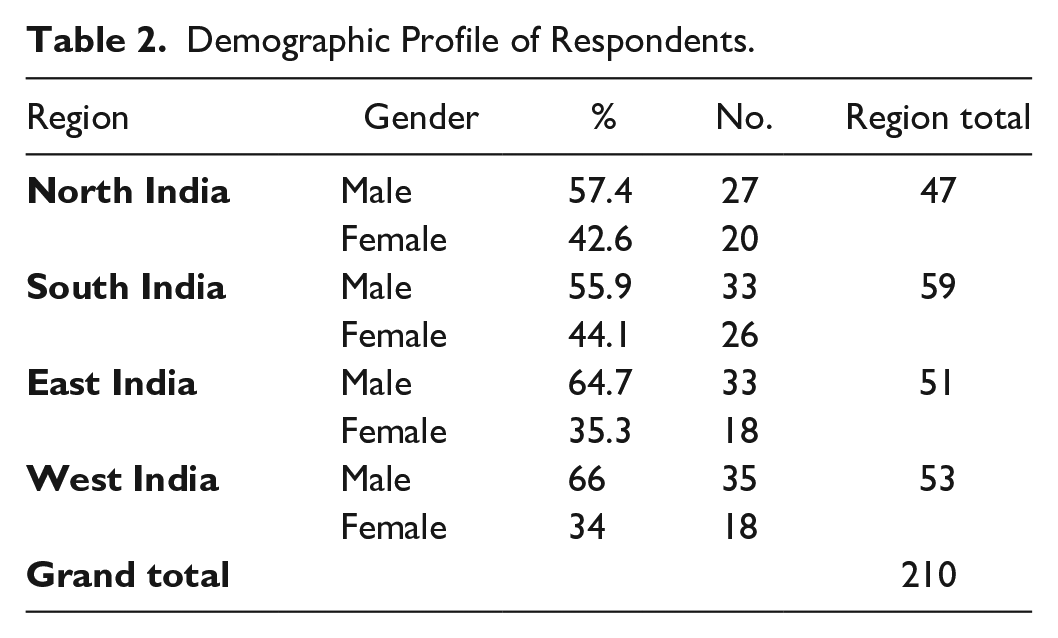
This research uses quantitative approach and data are analyzed using partial least squares structural equation modeling (PLS-SEM) method for testing the hypotheses. The questionnaire used in this research is developed based on past researches, such as Liñán (2008), Mustafa et al. (2016), Coduras et al. (2008), Farrukh et al. (2017), and Falck et al. (2012). Furthermore, the questionnaire was subjected to content validity by experts in the field of entrepreneurial research in academics. The questionnaire consists of a total of 36 items measured on a 7-point Likert-type scale as shown in Table 1. Care has been taken to include students from various regions across the country to get a comprehensive national representation (Table 2).
Research Instrument.

Note. Items FLY 2, PEER 4, and SN 2 deleted due to low factor loading.
Demographic Profile of Respondents.
Sampling
Final-year engineering students belonging to different technical departments from a university that ranked among the top 20 private engineering institutes in India as per the National Institute Ranking Framework (NIRF) ranking report, 2018, participated in the survey. The selected engineering institute has a diverse student population with ample representation from all regions of India. An online survey form was created and emailed to the students. A total of 216 responses were received from the students over a period of 4 months. However, six responses were excluded from analysis on the grounds of straight-lining and incoherent answering. Finally, 210 responses were found complete in all respects and were used for the final analysis. Overall, there were 128 (61%) male respondents and 82 (39%) female respondents. The domicile region of the 210 respondents was well distributed among the four regions of India and has adequate gender representation (Table 2).
Statistical Analysis
Smart PLS V3.0 was used to analyze the hypothetical research model, using PLS-SEM approach (Hair et al., 2016). The PLS approach does not make any assumptions about the normality of the data and can be used to handle data sets with smaller sample size (Aguirre-Urreta & Marakas, 2010). Hence, the PLS approach was deemed suitable for this study. However, one of the limitations of the PLS SEM approach is that it does not have an adequate global goodness-of-model fit measure (Hair et al., 2016). The PLS-SEM analysis consists of two levels of analysis—the measurement model analysis and the structural model analysis. Measurement model analysis is conducted for establishing the validity and reliability of the instrument used. After passing these tests, the structural model is analyzed to test the relationships between the constructs.
Common method bias test
Common method bias (CMB) needs to be assessed when both independent and dependent variables are assessed using the same survey instrument. CMB was assessed using Harman’s single factor analysis (Lee et al., 2014). The result of this test shows that a single factor explains 26.4% of the total variance. As this value is significantly less than 50%, it is safe to assume that there does not exist any one dominant factor in the data set. Hence, it is proved that CMB issue does not exist with the collected samples.
Multicollinearity test
For testing multicollinearity issues of the model, variance inflation factors (VIFs) of the latent variables of the study were analyzed. The results indicate that the VIF factors are in the range of 1.104 to 1.814 (Table 3), which is well within the threshold value of 5 (Venkatesh et al., 2012). Hence, it can be concluded that collinearity issues were not present in this study.
Multicollinearity Testing—VIF Scores.

Note. VIF = variance inflation factor; EI = entrepreneurial intention; ATE = attitude toward entrepreneurship; PBC = perceived behavioral control; SN = subjective norms; CUR = academic curriculum; FLY = family influence; PEER = peer influence; SUP = institutional support.
Measurement model analysis
The validity and reliability of the survey instrument is assessed in measurement model analysis. The validity is assessed through convergent and discriminant validity analysis (Chan et al., 2010). Convergent validity is defined as the degrees to which two or more items measuring the same variable agree (Thong, 2001). Convergent validity is assessed through analysis of average variance extracted (AVE) and outer loading values. For convergent validity to be established, the AVE values of each dimension should be greater than 0.50 (Fornell & Larcker, 1981) and the outer loadings of each item of a construct should be more than 0.60 (Lee et al., 2015). The measurement model analysis shows that all the AVE values were in the range of 0.54 to 0.83 for all the constructs (Table 4). The outer loading values of the items of all the constructs were in the range of 0.65 to 0.92 (Table 4). Both the criteria for determining the convergent validity of the constructs were met and hence convergent validity of the model was established. Reliability of the items was measured through Cronbach’s alpha and composite reliability (CR). The acceptable values for reliability are above .60. All the constructs were found to exhibit reliability satisfactorily (Table 4).
Measurement Model Analysis.
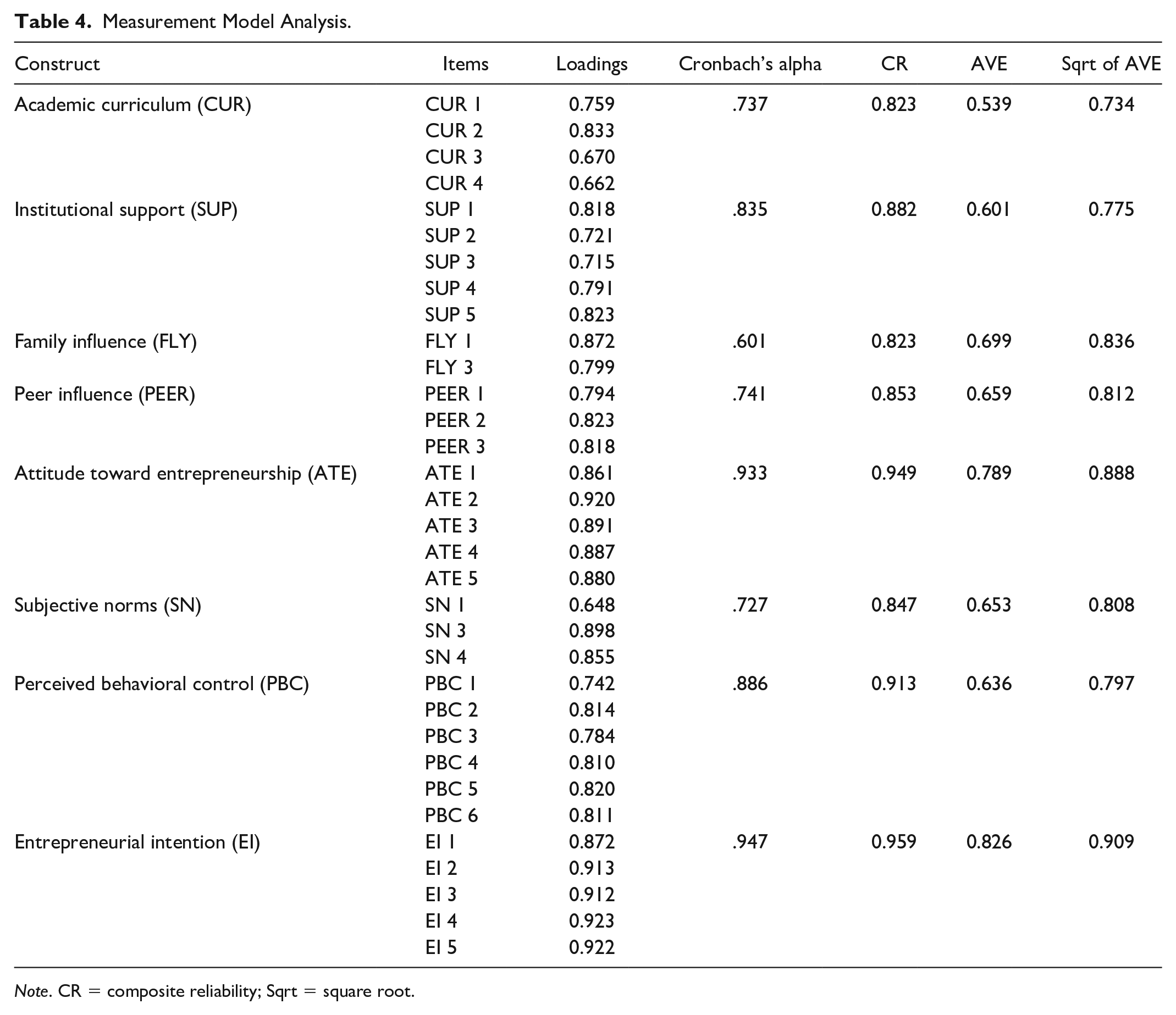
Note. CR = composite reliability; Sqrt = square root.
Discriminant validity is defined as “the degree to which items differentiate between variables” (Thong, 2001). Discriminant validity can be assessed by the Fornell–Larcker criterion using correlation analysis and Heterotrait-Monotrait (HTMT) ratio (Hair et al., 2016). According to the Fornell–Larcker criterion, if the square root of AVE values is greater than the latent variable correlations, discriminant validity may be established (Hair et al., 2016). Results reveal that the square root of AVE values of all the constructs was greater than the inter-construct correlations (Table 5). For further establishing the discriminant validity, the latent variable correlation values should not be very high (>.90; Lee et al., 2014). The results reveal that the highest inter-item correlation value is .63 (between ATE and EI). Therefore, based on the Fornell–Larcker criterion and correlation analysis it was proved that adequate levels of discriminant validity exist in the measurement model. HTMT ratio, a significant measure for assessing discriminant validity, was also evaluated. All the constructs were found to have HTMT ratios well below the cutoff value of 0.85 (Table 6), which further established the discriminant validity of the model.
Discriminant Validity (Fornell–Larcker Criterion).
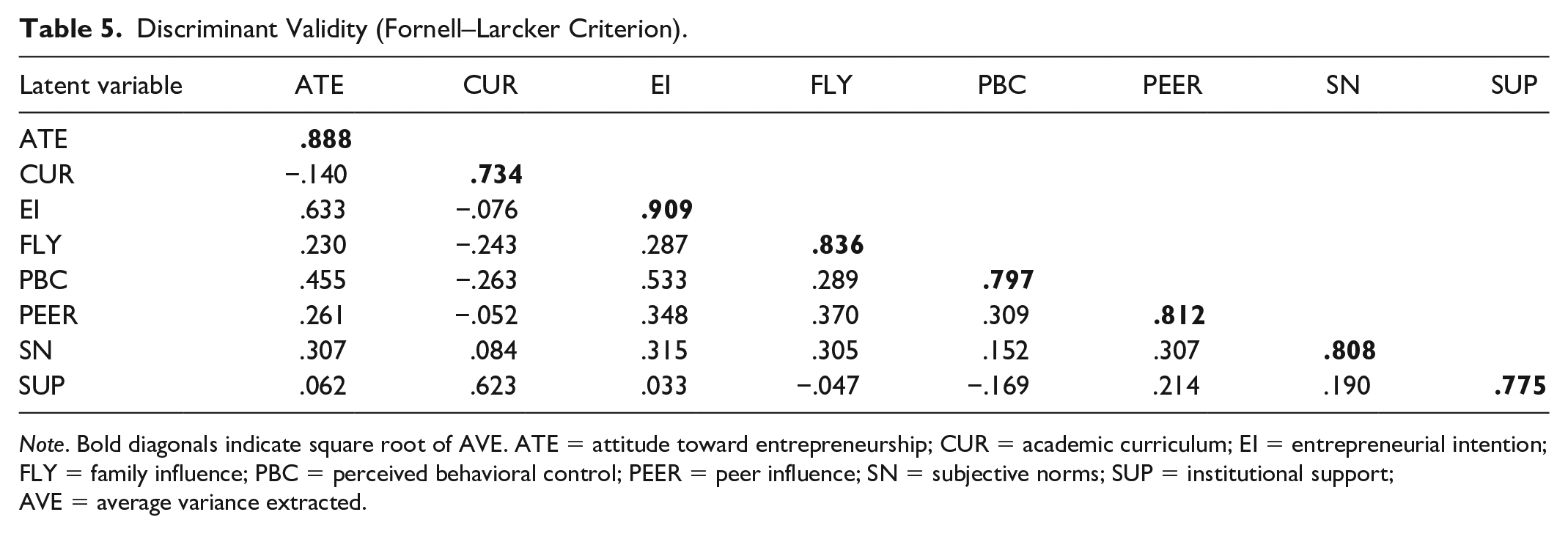
Note. Bold diagonals indicate square root of AVE. ATE = attitude toward entrepreneurship; CUR = academic curriculum; EI = entrepreneurial intention; FLY = family influence; PBC = perceived behavioral control; PEER = peer influence; SN = subjective norms; SUP = institutional support; AVE = average variance extracted.
Discriminant Validity (HTMT Ratio).
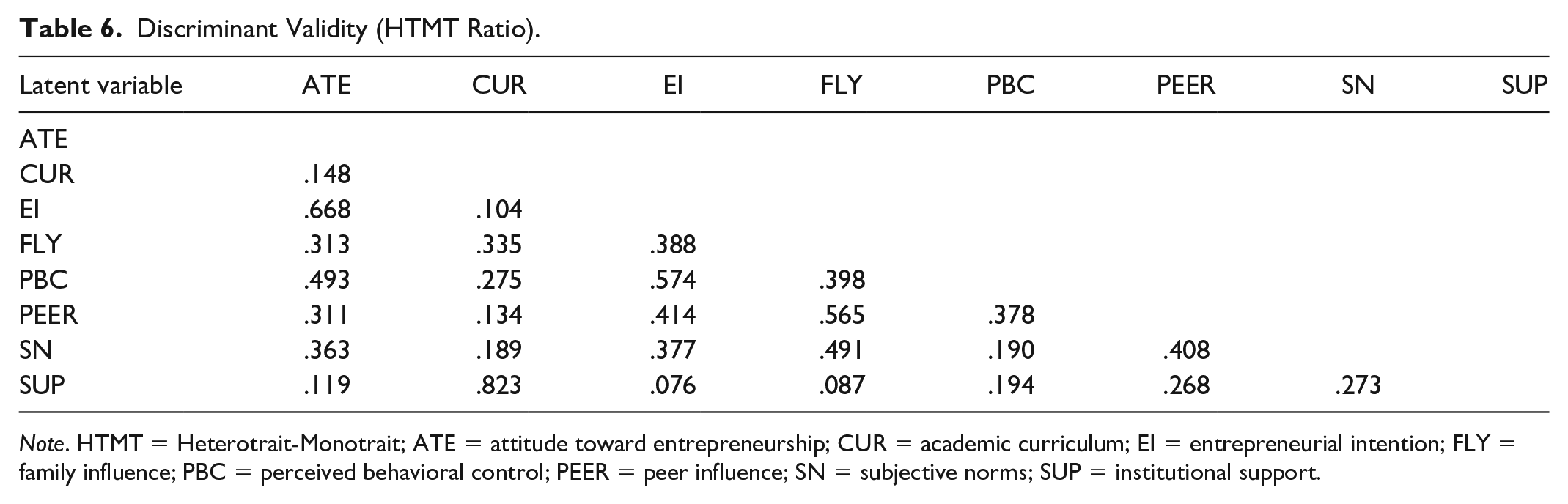
Note. HTMT = Heterotrait-Monotrait; ATE = attitude toward entrepreneurship; CUR = academic curriculum; EI = entrepreneurial intention; FLY = family influence; PBC = perceived behavioral control; PEER = peer influence; SN = subjective norms; SUP = institutional support.
Structural model analysis
After the validation of the measurement model, the structural model evaluation was conducted for testing hypotheses. The R-squared value of the structural model was assessed to determine the suitability of the proposed model. The PLS-SEM result revealed that 49.1% variance in EI was explained by the constructs ATE, SN, and PBC. The variances explained by the latent variables CUR, SUP, FLY, and PEER on ATE, SN, and PBC were 11.1%, 16.6%, and 18.6%, respectively.
The hypothesis testing tests (Figure 1, Table 7) reveal that CUR (β = –.196, p < .05), PEER (β = .171, p < .05), SUP (β = .154, p < .1), and FLY (β = .126, p < .1) have a significant influence on ATE. Hence H1a, H2a, H3a, and H4a were supported. The factors FLY (β = .149, p < .05) and PEER (β = .279, p < .001) had a significant influence on PBC. But the factors CUR (β = –.121, p > .05) and SUP (β = –.147, p > .05) did not show any significant influence on PBC. Hence H3b and H4b were supported and H1b and H2b were not supported. For the latent variable SN, the factors that had a significant influence were FLY (β = .262, p < .001) and PEER (β = .193, p < .01), whereas factors CUR (β = .093, p > .05) and SUP (β = .103, p > .05) did not have any significant influence. This meant that H3c and H4c were supported and H1c and H2c were rejected. In the second stage of the model, all the factors, namely, ATE (β = .453, p < .001), PBC (β = .307, p < .001), and SN (β = .130, p < .05) were found to have a significant influence on EI. Hence Hypotheses H5a, H5b, and H5c were accepted.
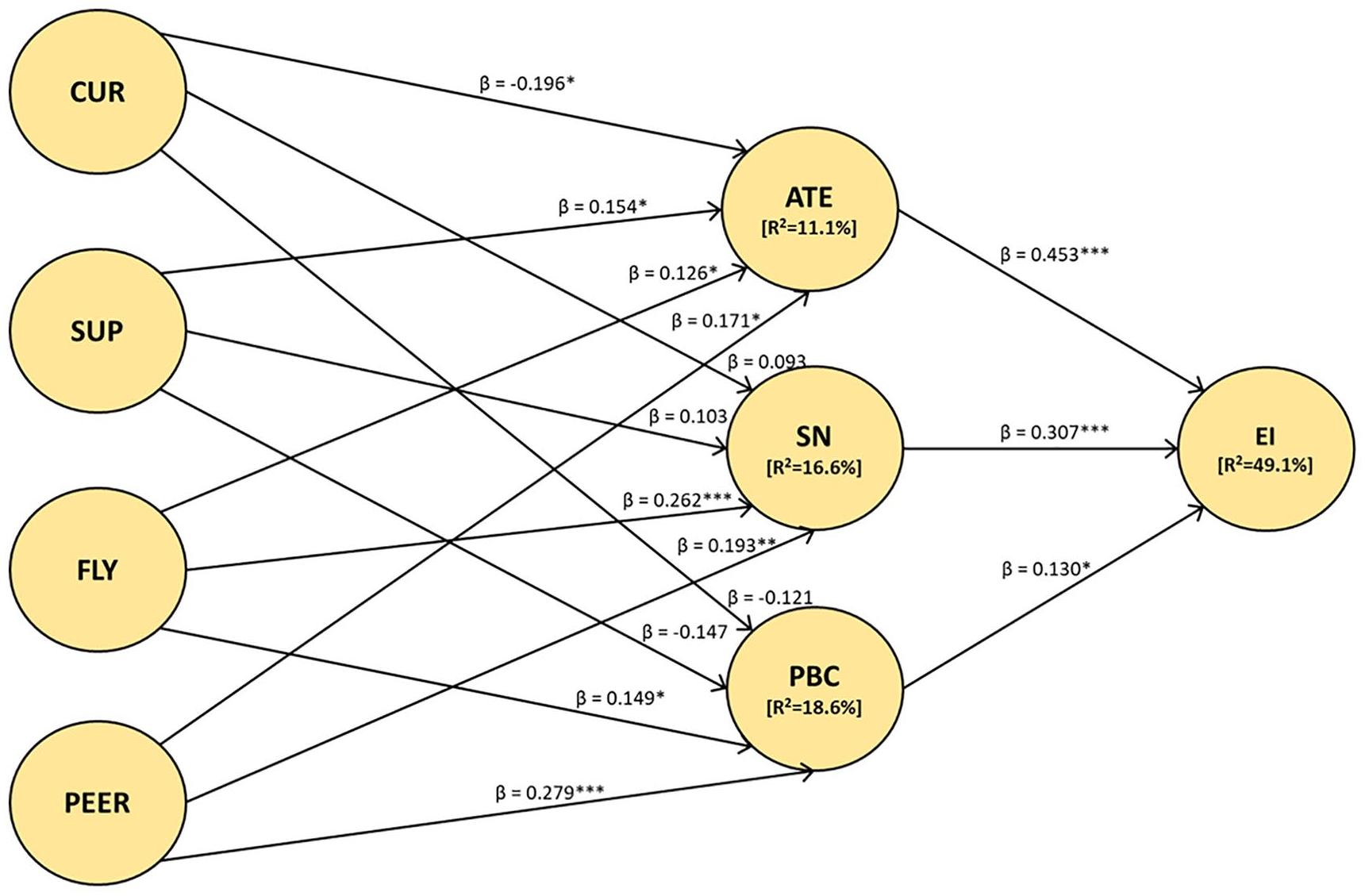
Partial least square results.
Hypothesis Testing Results.

Note. CUR = academic curriculum; ATE = attitude toward entrepreneurship; PBC = perceived behavioral control; SN = subjective norms; SUP = institutional support; FLY = family influence; PEER = peer influence; EI = entrepreneurial intention.
p < .1. **p < .01. ***p < .001.
Discussion
As predicted by the TPB, the results of this study confirmed that ATE, SN, and PBC have a statistically significant and positive relationship with EI of engineering students. In line with other research findings, among the three explanatory variables of EI although ATE, SN, and PBC strongly supported EI, PBC’s influence was found to be weaker than the other two (Ajzen, 1991; Autio et al., 2001; Gird & Bagraim, 2008; Kautonen et al., 2013).
CUR was found to have a significant negative influence on ATE, but did not have a statistically significant relationship with either PBC or SN. Although there are findings on both positive (Basu & Virick, 2008; Mohamad et al., 2015; Mustafa et al., 2016; Solesvik, 2013; Trivedi, 2016) and negative influences (Anne Støren, 2014; Barba-Sánchez & Atienza-Sahuquillo, 2018; Coduras et al., 2008; Mohamad et al., 2015; Sesen, 2013; Yukongdi & Lopa, 2017), the findings can be interpreted on the basis that the CUR considered in this study referred to the regular business-related courses and not entrepreneurship specific courses. The negative influence of CUR on ATE may be due to the lucrative employment opportunities that are available after graduation, particularly for students from institutes of repute, which may be the reason for their unfavorable disposition in ATE.
According to the All India Council for Technical Education (AICTE), which is a statutory body and a national-level council for technical education under Department of Higher Education, Ministry of Human Resource Development, whereas nearly 1.4 million students graduated from technical institutions in 2018–2019, only 28% of the students found employment. A plethora of factors, such as disparity in the quality of basic education, lack of adequate entrepreneurial training for teachers, ineffective pedagogical methods, lack of SUP, insufficient mentoring and inaccessible resources, to name a few, act as impediments to provide quality entrepreneurial education to these students (Shankar, 2016). As noted by Mukesh et al. (2018), a huge proportion of students in India with entrepreneurial potential and intent are graduating from HEIs without acquiring the essential entrepreneurial skills. Apart from courses on entrepreneurship, a curriculum with a focus on creativity may influence the students’ entrepreneurial behavior by enhancing their innovative ability as creative potential may be thought of as a predictor of entrepreneurial behavior (Solomon et al., 2008). Therefore, a curriculum with dedicated courses on entrepreneurship and creativity may help students to develop a positive attitude toward business venturing.
SUP was found to have a significant positive impact on ATE but did not influence the other two factors of the TPB model. Student ideas are nurtured into workable concepts through conducive institution support. The results indicate that academic support, in the form of motivation, networking, infrastructure, and role model guidance, has a significant positive influence on the attitude of the students toward entrepreneurship. Tailor-made mentoring programs based on the student’s entrepreneurial personality type may improve mentor–protégé relationship (Memon et al., 2015). Although influence on either SN and PBC was not found to be significant, initiatives such as mentoring and internships in thriving start-ups are likely to improve the perceived self-efficacy factor among aspirant students, thereby affecting PBC positively.
The culture of a nation is well acknowledged as an influencer of the antecedents of TPB, particularly SN (Farrukh et al., 2019). Collectivism was found to have a positive influence on self-efficacy and reduce the fear of failure (Wennberg et al., 2013). India, being a collectivistic nation, the influence of family and peers on critical decisions like higher education and future career of an individual is predictable. Not surprisingly, Family (FAM) showed a significant positive influence on all the three antecedents of the TPB model. Family businesses and family members’ approval may instill confidence and thereby affect the attitude and perceived difficulty, thereby facilitating ATE, PBC, and SN. As India is a melting pot of numerous distinct local cultures, in-depth studies on EI may have to further consider the influence of regional culture as well (Valliere, 2016).
In agreement with prior studies, a statistically significant positive effect of peer relationships was observed on all components of TPB, namely, ATE, SN, and PBC (Falck et al., 2012; Hacamo & Kleiner, 2018; Kacperczyk, 2013; Nanda & Sørensen, 2010). The peer effect was found to be enhanced by virtue of spatial proximity and networking. In a college/university setting, this is particularly true because of constant interactions among peers at both academic and personal levels. At the cusp of transition from adolescence to adulthood, this synergy may boost the EI of a student through ATE, SN, and PBC.
Conclusion and Implications
In India, engineering education, for most students, has a perception of being a low-risk route to paid employment with decent remuneration. Those few who have had a positive impression toward business venturing may be swayed by the curriculum that is mostly geared toward corporate employment, higher studies, or research. However, it is important to note that SUP does have a significant positive impact on the student’s ATE.
Universities play a crucial and formative role as students mainly get the first exposure to technical education as well as their entrepreneurial dispositions at undergraduate engineering institutions. The results obtained place a greater onus on the part of the institutes of technical education to formulate visible, constant, and sustainable strategies implemented at an individual student level. Once implemented, continuous assessment of the effectiveness of the entrepreneurship development strategies needs to be made. Longitudinal studies related to change in entrepreneurial personality, motivation levels, and changes in attitude toward venture creation would provide more realistic information that can be used to refine the existing strategies. Alumni who have started business ventures may be roped in to mentor students in accordance with their entrepreneurial personalities. Inculcating a positive entrepreneurial atmosphere visibly, by means of displays of successful entrepreneurial examples of alumni, regular interaction, and mentoring with prominent entrepreneurs in an open platform will create a positive ATE. Internships in successful start-ups, inclusion of core and elective courses on creativity, innovation, entrepreneurship, and business management may improve the self-efficacy factor.
Familial presence in entrepreneurship has always been an impactful factor as their opinion is highly regarded by individuals belonging to nations of collectivist culture. The family’s presence in entrepreneurship has an advantage of knowledge due to prior exposure, which could improve the perception of self-efficacy. However, if the student is expected to take over the family business, which is nontechnical in nature, institutes may have a limited role to play to stimulate technical entrepreneurship intention in the student.
The important result from this study is the recognition of the strong positive influence of peers on all the antecedents of TPB, which can be thought of as a positive sign in improving technical entrepreneurship. Students with higher entrepreneurial intention can be grouped either with peers sharing a similar interest or with other students to form an entrepreneurial peer group. Engineering institutes that facilitate networking among students and increased social time together through various forums, business competitions, entrepreneurship-related courses, interdisciplinary learning exposure, and entrepreneurship development programs are likely to witness an increased number of technical start-ups.
In addition, courses on creativity and innovation may be included in the curriculum during the initial years of undergraduate study, thereby sensitizing students to the possibility of entrepreneurship as a career. Integrated modules may be offered in consultation with the entrepreneurship incubators and industries to enhance the practicability of entrepreneurial learning. Students may be provided an opportunity to engage in interdisciplinary studies based on individual interest that could inspire innovation, leading to venture creation. Simultaneously, academic content and institutional policies may need to be relooked, evaluated, and bolstered in a way that kindles as well as nurtures the entrepreneurial spirit among students who are so inclined.
The article presents one of the few studies where effects of CUR, entrepreneurial support by the institute, family, and PEER on EI are examined concurrently. The findings add to the limited literature on EIs of engineering students in emerging economies where technical education is usually seen as a gateway to success, primarily through employment rather than entrepreneurship. Fascinatingly, the results of the study reveal that peer effects dominate over CUR and institutional sway. Engineering institutes may therefore explore the possibility of strengthening peer ties through inventive measures as a means to positively foster EI.
Limitations and Future Scope
This study was a case study of one engineering institute and therefore cannot be generalized. However, the current study makes an earnest attempt to equitably capture the regional diversity as the university is among the top ranked engineering institutes and is one of the very few with a comprehensive national representation. Future research may consider samples from both government and private universities as well as from polytechnic colleges throughout the country to understand the technical entrepreneurship intention among students in a comprehensive manner. Longitudinal studies on the EIs of the students and evaluation of various influencing factors, such as personality traits, academic influence, prevalent social structures, attitudes, self-efficacy, familial background, and regional culture, to name a few, can be conducted. Future studies may consider adopting other entrepreneurial behavior theories to explore a holistic interpretation of the prevalent situation. The possible influence of regional culture within the country on students’ EI may be analyzed. In addition, exploratory inquiries using qualitative methods can be conducted to comprehend the realities at a basic level, which may provide finer insights.
Footnotes
Declaration of Conflicting Interests
The author(s) declared no potential conflicts of interest with respect to the research, authorship, and/or publication of this article.
Funding
The author(s) received no financial support for the research, authorship, and/or publication of this article.
