




Abstract
Tourism is a key source of income and employment today, and different parts of the world are heavily dependent on it. The main purpose of this article was to demonstrate the consequences of long-run and short-run relationship on international tourism in Pakistan and its impact on economic growth by applying an autoregressive distributed lag (ARDL) bounds testing approach. Augmented Dickey–Fuller unit root test was employed to check the stationarity of the variables, while an ARDL bounds testing approach was used to measure the long-run and short-run dynamics linkage among the study variables. The results show that international tourism and expenditures for passenger transport items have a positive impact on economic growth. Similarly, long-run dynamics also revealed that international tourism expenditures for travel items and international tourism expenditures, international tourism receipts for passenger transport items and international tourism receipts for travel items also had a positive impact on the economic growth. The present analysis of the long-run suggested better policies should be implemented to attract more international tourists to the country.
Introduction
Tourism is a significant social and cultural phenomenon that has a main economic effect on cities and is also the fourth largest export in the world, after fuel, chemicals and food (Curry et al., 2016). In Pakistan, the average level of tourism interaction has increased significantly over the last three years. In the 1980s, the total number of tourists worldwide was 41 million. It was 45 million in the 1990s. The total number of visitors over the last decade was 196 million. In 2015, 11.86 million traveled abroad and the international tourism industry generated an export income of US$1.5 trillion, which contributed to tourism being named the fifth largest industry in the world (United Nations World Tourism Organization, 2016). In addition, from the viewpoint of policy makers, outbound travel investment is an important factor for the countries of origin of tourists and exporters of destination countries that have great importance to macroeconomic management in many countries, especially developing countries (Eugenio-Martin & Campos-Soria, 2014). The role of marketing in explicitly or indirectly supporting tourist destinations is a significant feature of the growth of tourism. Direct promotion also takes the form of television commercials, selling brochures, booklets and catalogs, organizing, or rewarding activities that inspire people to travel. However, the type of implied or indirect promotion is a beneficial externality, excluded from exporting music, films, television shows, reality shows, bilateral agreements and visas. The fundamental premise is that citizens are drawn to international locations to learn the beauty of this society or foreign government policy (Beeton, 2005; Connell, 2012; H. Kim & Richardson, 2003; Macionis & Sparks, 2009; Portegies, 2010).
Sönmez & Graefe (1998) addressed the indirect effect of previous foreign knowledge on prospective actions. The essence of past trips often influences potential travel behavior (Mazursky, 1989). Gunduz and Hatemi (2005) focused at the travel-led development hypothesis in Turkey. Guidance causality research has been utilized and the findings have demonstrated that there is a one-way causal link, from tourism management to the development of economic growth. Similarly, Dritsakis (2004) concluded that there was a two-way causal connection between tourism and economic development in Greece. Cortés-Jiménez and Pulina (2006) identified proof of the prevailing growth hypothesis of tourism in Spain by means of a multivariate Granger causality study. Khalil et al. (2007) looked at the connection between Pakistani tourism and economic development by using the annual time series data ranging from 1960 to 2005. Adnan Hye and Ali Khan (2012) examined at Pakistan’s tourism-led development hypothesis using annual time series data from 1971 to 2008. The findings suggest that there is a long-term connection between tourism income and Pakistan’s economic development.
Similarly to exports, inbound tourism will boost economic development. For example, tourism makes a major contribution to foreign exchange reserves, which help add modern technologies to the development process. Tourism encourages innovation in modern technology, intellectual resources and competitiveness (Blake et al., 2006; Lemmetyinen & Go, 2009; McKinnon, 1964). With comparison to other factors impacting economic growth, financial sustainability is also becoming the significant engine of economic growth (Shahbaz et al., 2017). Several attempts have been made to increase the competitiveness of the tourism sector in most tourist destinations. A variety of studies have been undertaken to demonstrate and thoroughly explored the relationship between foreign policy instability, trade balance and exchange rates, tourism production, renewable energy use, economic development and tourism revenues (Dogru et al., 2019; Isik et al., 2018, 2019). Tourism is growing in many countries a causal connection between economic development and tourism revenue becomes progressively important to policymakers (Knežević Cvelbar et al., 2016; Momeni et al., 2018; Yousaf & Xiucheng, 2018). The objective of this study is to encourage the understanding of tourism expenditure. The Augmented Dickey–Fuller (ADF) unit root test was used to verify the stationarity of the variables, while an ARDL (autoregressive distributed lag) bounds testing approach was used to evaluate the long-run and short-run causality of the variables. In addition, a new perspective is being placed forward on the interaction between dependent and independent variables. Besides the introduction section the remaining article is organized as follows: The “Existing Literature” section deals with the previous literature. The “Method” section presents the data sources and model specification. The “Empirical Estimation Strategy” section show the unit root test for stationarity and cointegration with auto regressive distributed lag model. The “Results and Discussion” section concluded and discussed the results of the cointegration test, long-run analysis results, and short-run analysis results and the “Conclusion and Policy Implications” section provides the conclusion and policy implications. The international tourism scenario in Pakistan from 1995 to 2015 is illustrated in Figure 1.

International Tourism Scenario in Pakistan from 1995–2015.
Existing Literature
Over the last few decades, both industrialized and emerging countries have performed comprehensive partnership work in the form of economic development and tourism revenues. As tourism in many countries increases, the causal correlation between economic development and tourism revenues is becoming an essential resource for policy makers (Sokhanvar et al., 2018). As a consequence of globalization, this growth of the tourism industry has raised more than ever in the twenty-first century. It has also moved more and more people from developed countries to emerging countries to pursue health treatment. In addition, developed countries are expected to grow the tourism sector to increase their market share (Fetscherin & Stephano, 2016). Tourism is a cornerstone of the service industry and plays a significant role in the development of hotels, restaurants, transport, and other relevant services. The state and the central government are formulating a number of tourism policies. A lot of money has been invested in the growth of tourism. Tourism also generates jobs and supports gross domestic product (Kumar & Singh, 2019).
The tourism industry has undergone rapid growth and is a significant sector that has arisen and is economically competitive in terms of employment formation, foreign exchange earnings, government revenues, and poverty reduction (Surugiu & Surugiu, 2013; Yap & Saha, 2013). In addition to its direct impacts, the tourism sector has had an extremely indirect positive influence on economic development through its contribution to the market, growing human living conditions, expanding government revenues through incomes and taxation, and even extending the production of goods and services (Jin, 2011). It is noted that the ministry of tourism of any nation aims to encourage and grow the tourism sector of the nation and can also play a dominant role in the economic growth of the country (Nag, 2018). Tourism has now been an important part of the economy for both industrialized and emerging countries. The labor force as a factor of production also includes skills, education and vocational training, as well as all elements that can increase efficiency and competition (Assaf & Tsionas, 2018; Sokhanvar et al., 2018; Wu & Wu, 2019).
Indeed, tourism is an important business sector in the world. The importance of this sector can be seen in the fact that it increases income, creates jobs, and encourages the private sector and develops infrastructure (World Tourism Organization [Madrid] et al., 1997). Economists have put forward different channels so the tourism sector can raise the economic growth of a country. Tourism has boosted economic growth through competition among domestic firms and international tourism destinations and local firms that create economies of scale (Bhagwati & Srinivasan, 1979; Helpman & Krugman, 1985; Krueger, 1980). The steady flow of international tourist traffic over the last few decades has clearly shown the strength and expansion of the global tourism industry (Shahzad et al., 2017). Pakistan received more than 50,000 foreign visitors per year until the global economic crisis. According to the World Economic Forum, the total share of travel and tourism is 6.5% of the gross domestic product (GDP). In addition, in 2011, travel and tourism produced about 3.4 million employment opportunities, accounting for 5.7% of the overall employment level. The share of travel and tourism in exports in 2011 was 86 billion rupees. It is also important to mention that it raised its rank in 2009 from 125 to 113 in 2010 (World Economic Forum, 2011).
More and more developing countries are strategically utilizing foreign tourism as an engine of economic growth to slow down the progress of other sectors and the country as a whole. This also plays a part in foreign exchange earnings and work development (Holzner, 2011; Pablo-Romero & Molina, 2013; Payne & Mervar, 2010). In addition, tourism’s contribution to the balance of payments, measured as a percentage of overall exports, is especially large for small islands. Overall, there is proof that small islands are extremely specialized in tourism activities among the top ranks based on the contribution of tourism activities to the gross domestic product (GDP) (H. J. Kim & Chen, 2006; Schubert et al., 2011).
The increase in tourism spending may lead to increase activity in related industries, and the overall change associated with this will be greater than the first infusion. If this effect is activated, one of the best ways to improve economic efficiency through tourism and agriculture, fisheries, manufacturing tourism construction, and other services (Castro-Nuño et al., 2013; Cernat & Gourdon, 2012). However, the real importance of tourism is not only that it contributes to general economic growth, but also that the growth of tourism industry can influence the economic, social, and cultural progress and improves the welfare of the residential population in the appropriate circumstances of its structural basis (Chou, 2013; Hernández-Maestro & González-Benito, 2014; Rosentraub & Joo, 2009). Tourism is one of the fastest growing industries in the world and a major driver of economic growth and social and economic progress, not only for many developing countries like Pakistan but also for some developed countries.
Method
Data Sources
Time series data were used in this study from 1995 to 2015, and these data were collected from the World Development Indicators (WDI). The variables used in this study were the following: GDP per capita (US$), international tourism expenditures for passenger transport items (US$), international tourism expenditures for travel items (US$), international tourism expenditures (US$), international tourism receipts for passenger transport items (US$) and international tourism receipts for travel items (US$), respectively.
Model Specification
This study employed a multivariate regression model to explore the connection amid dependent and independent variables and specified as

Equation (1) can also be written as

GDPPC indicates the GDP per capita, ITEFPTI indicates international tourism expenditures for passenger transport items, ITEFTI indicates international tourism expenditures for travel items, ITE indicates international tourism expenditures, ITRFPTI represents international tourism receipts for passenger transport items, ITRFTI indicates international tourism receipts for travel items, and μt is the error term.
Equation (2) can be written in its logarithm form as

Equation (3) illustrates the variables’ log-linear form.
Empirical Estimation Strategy
Unit Root Test
ADF (Dickey & Fuller, 1981) unit root tests, including trend and intercept, was used to determine that none of the variables were integrated in the I(2). The ARDL model requires no pretesting for checking the unit root test for stationary of the variables. Because the ARDL bounds testing approach is invalidated in cases where I(2) used for variables. Therefore, the ADF unit root test was performed as below:

In the above equation (4), F demonstrates the variable to be tested in the unit root, Δ entails the first difference, linear trend is represented in the equation by T, t illustrates the time, μt shows the error term, and m designates white noise residuals to achieve.
ARDL Model Specification
To demonstrate the long-run and short-run analysis amid dependent and independent variables, this study applied the ARDL bounds testing approach, which is developed by the Pesaran and Shin (1998) and further extended by Pesaran et al. (2001). Except in the existence of I(2), the testing approach is pertinent unrelatedly in the integration order about related variables in the order zero and one. Here we will illustrate the model separately for both long-run and short-run analysis. The depiction of the long-run model can be specified in equation (5) as follows:

where Δ is the operator for difference; i, k, j, h, g, and f show the lags order; and

In equation (6) v, c, g, e, l, and o shows the lags order. Similarly, the demonstration of the short-run analysis amid study variables are depicted by following the Error Correction Model (ECM) in the ARDL and specified as
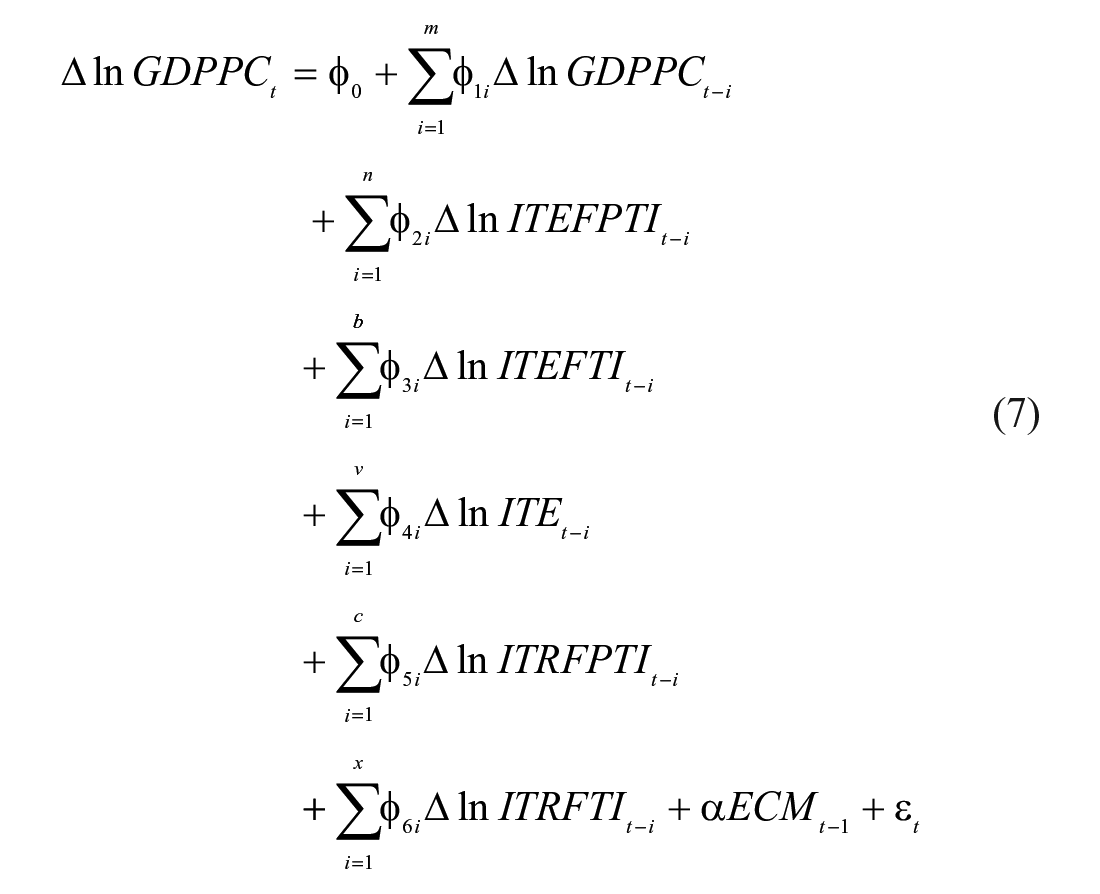
The short-run analysis among study variables is shown in equation (7) by ECM model, and m, n, b, v, c, and x show the lags order.
Results and Discussion
ADF Unit Root Test Results
The results of the ADF unit root test with trend and intercept at the level, the first and second difference could be seen in Table 1 below.
ADF Unit Root Test Results.
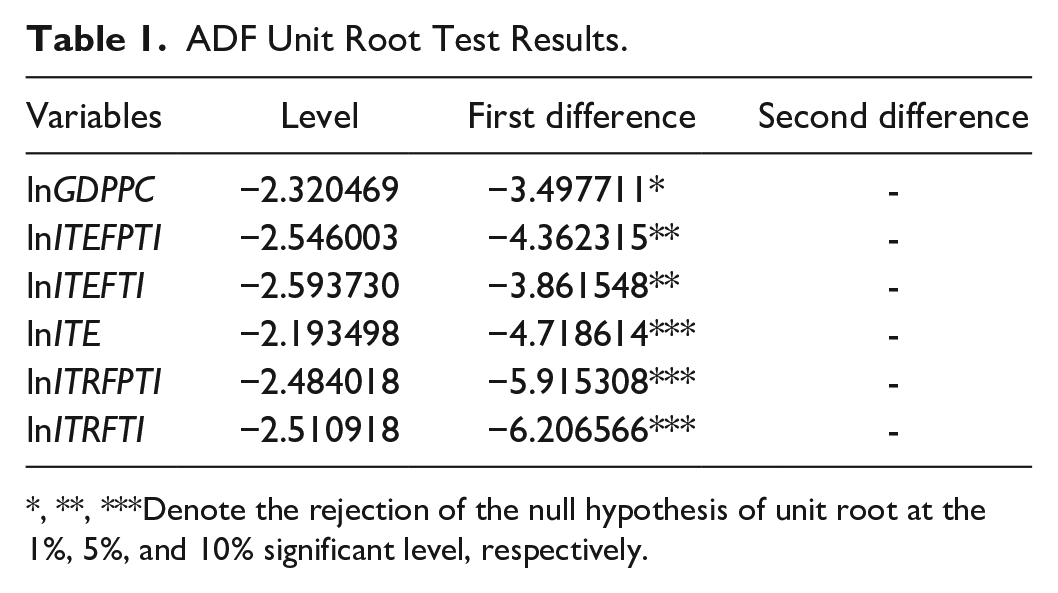
Denote the rejection of the null hypothesis of unit root at the 1%, 5%, and 10% significant level, respectively.
The ARDL model was applied because the unit root test indicates no variable was integrated with the order of I(2).
Cointegration Test
When F-statistic or W-statistic applies to the upper bound of the selected significant level, then the cointegration test was used. The various statistics are reported in Table 2 below.
ARDL Bounds Test for Cointegration Results.
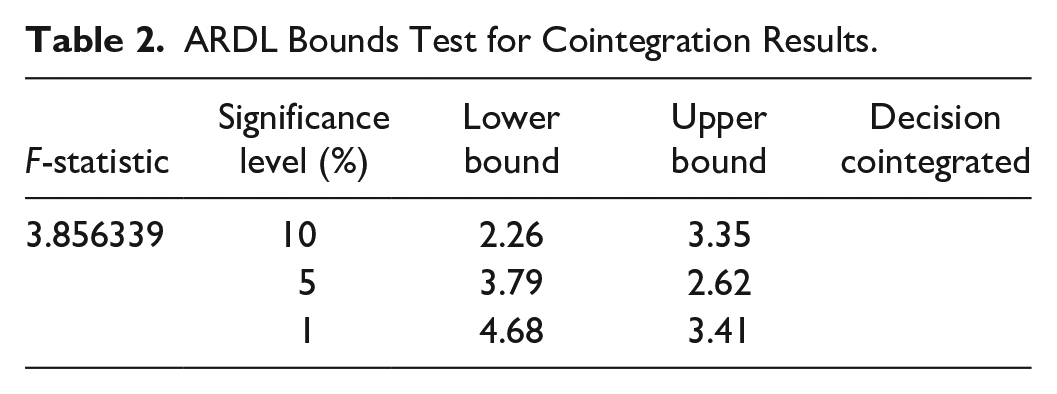
As shown in Table 2, at 1%, 5%, and 10%, the bounds tests summarize the existence of a cointegration relationship between GDP per capita and all other independent variables. The results of the Johansen cointegration test (Johansen & Juselius, 1990) are illustrated in Table 3, which confirms the robustness of the long-run association. The trace test statistics values indicate that the null hypothesis was rejected with no cointegration in the model. The values of the trace statistics and the maximum eigenvalues were greater to the critical values.
Results of the Johansen Cointegration Test Using Trace Statistic and Maximum Eigenvalue.

Denotes rejection of the hypothesis at the .05 level. **MacKinnon–Haug–Michelis (1999) p values.
Long-Run Analysis Results
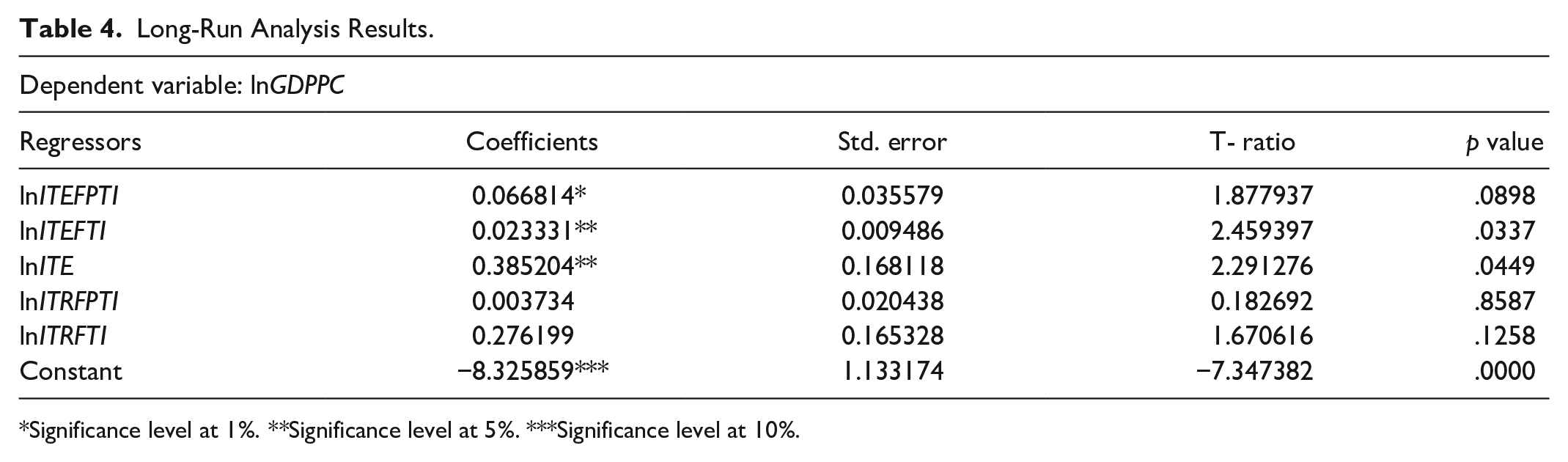
The results of the long-run analysis are reported in Table 4.
Long-Run Analysis Results.
Significance level at 1%. **Significance level at 5%. ***Significance level at 10%.
The model shows the elasticity amid variables. The results revealed that international tourism expenditures for passenger transport items having the coefficient of 0.066814, which is positive with a p value of .0898. It means a 1% increase in international tourism expenditures for passenger transport items with its explanatory power 0.066 suggests increasing the GDP per capita by 0.066%. Similarly, in the long-run relationship, the coefficient of international tourism expenditures for travel items, international tourism expenditures, international tourism receipts for passenger transport items and international tourism receipts for travel items also had a positive impact on GDP per capita with their coefficients being .023331, .385204, .003734, and .276199 and p values of .0337, .0449, .8587, and .1258, respectively. Furthermore, international tourism receipts for passenger transport items and international tourism receipts for travel items showed statistically nonsignificant linkage due to their p values. The development in the tourism industry has led to a raise in government revenues and household income through different channels such as the improved balance of payments and other engagements. Tourism can support policy makers in promoting economic growth by producing regional jobs, providing foreign exchange, encouraging transportation, beverage, and accommodation sectors. Furthermore, policy makers can use tourism as a tool to reduce regional welfare variations, which leads tourism to income transmissions from developed to developing countries (Castellani & Sala, 2010; Dredge, 2006; Joppe, 1996; Tugcu, 2014).
Tourism has been the main focus in recent decades for the researchers and policymakers to attain sustainable development and economic growth. They concluded and agreed that tourism development played a dominant role to increase foreign exchange earnings, provide employment opportunities, and invigorates the tourism growth (Khoshnevis Yazdi et al., 2017; Bilen et al., 2017). Moreover, in developing economies, tourism is the gateway to employment, and therefore has a dynamic impact on people’s living standards and balance of payments. Tourism offers a range of work incentives for researchers to explore their association with economic development (Paramati et al., 2017).
In the last few decades, foreign tourism has become increasingly important and tourism has started to play a key role in the economies of several countries. Tourism is seen as an intensification of overall economic growth, and this rise in growth is usually deemed positive and the substantial effect of tourism on economic growth is also described. Tourism is projected to have a significant effect on long-term economic development across various channels (Arslanturk et al., 2011; Mihalic, 2016; Tang & Tan, 2015; Wang & Xia, 2013). Recognizing the causal link between international tourism, carbon dioxide emissions, financial development, investment and economic growth has a profound impact on the development of various tourism strategies and policy choices in emerging economies (Isik, 2012; Isik et al., 2017). For instance, if there is a strong one-way causal relationship between tourism development and economic growth, tourism-led economic development will be feasible (Oh, 2005; Othman et al., 2012; Picard, 2015; Toni et al., 2018; Zuo & Huang, 2019).
Tourism provides jobs, creates local produce, and extends the tourism sector. This also plays a critical role in supplying necessary financial tools for infrastructure production to accelerate economic growth (Can & Gozgor, 2018; De Vita & Kyaw, 2017; Yu-Chi & Lin, 2018). In many countries of the world, international tourism is considered the main revenue increasing industry and also is an essential source of foreign income. It has a critical contribution to the economy of every nation and generally measured based on its contributions to economic development. The potential of an economy to benefit from tourism depends on whether there is capital investment for infrastructural development including transportation (Jebli et al., 2019; Shaheen et al., 2019; Sokhanvar, 2019).
Short-Run Analysis Results
The existence of a cointegration relationship among the variables requires an error correction model (ECM) to capture the short-run dynamics of the system and its coefficient, which measures the speed of adjustment to obtain equilibrium in the event of shocks to the system. Table 5 reports the results of the short-run dynamic growth equation.
Short-Run Analysis Results.

Significance level at 1%. **Significance level at 5%. ***Significance level at 10%.
In the short-run dynamics of the model, the F-statistic confirmed the joint significance of all independent variables at a 1% significance level. The DW statistic was 2.787, which was not equal to the standard DW value for proof of the absence of any autocorrelation; however, it was great enough to debunk the presence of any autocorrelation in the model. The results of the short-run analysis revealed that gross domestic product per capita exposed a positive coefficient .652440 with p = .0000. Similarly, results also show that international tourism expenditures for travel items, international tourism expenditures, and international tourism receipts for travel items have positive coefficients .008109, .195855, and .095996 with p values .0902, .0020 and .1729, respectively. Furthermore, international tourism expenditures for passenger transport items and international tourism receipts for passenger transport items exposed negative coefficients −.012736 and −.005825 with p values .4628 and .3293 that exposed statistically nonsignificant association.
Diagnostic and Stability Tests
The diagnostic and stability test results are shown in Table 6.
Diagnostic and Stability Tests.

The stability tests using CUSUM and CUSUM Square point to stable the long-run and short-run parameters, and the graph of both CUSUM test and CUSUM Square test are presented in Figures 2 and 3, which indicate that all values lie within critical boundaries at 5% level of significance.

Plot of CUSUM Test.

Plot of CUSUM Squares Test.
Conclusion and Policy Implications
The key motive of this study was to check the association amid international tourism in Pakistan and economic growth. ADF unit root test was used to check the stationarity of the variables, while an ARDL bounds testing approach was applied to check the dynamics linkage among the study variables. The long-run analysis results revealed that international tourism expenditures for passenger transport items have a positive impact on economic growth. Similarly, long-run dynamics also revealed that international tourism expenditures for travel items, international tourism expenditures, international tourism receipts for passenger transport items, and international tourism receipts for travel items also had a positive impact on the economic growth. According to the findings of this study, the government of Pakistan may need to pay attention to the tourism sector to improve this sector and also to introduce better policies to attract more foreign tourists to the country.
Furthermore, the Government of Pakistan needs to improve the security situation in the country so that foreign tourists will be enticed more and feel safe in the country and thus enhance the image of the country. Together with these initiatives, Pakistan needs to promote its reputation by projecting itself on different platforms around the world and rewarding it for enhancing its image. Tourism contributes considerable income to the national economy while providing employment opportunities for a large number of people. More investment in tourist resources is needed to attract local and foreign tourists. On the contrary, the protection premise means that, as the economy improves, people will spend more money on tourism. In this way, the government should make economic development a top priority strategy. Pakistan can attract a significant number of visitors due to natural beauty, and the government should provide opportunities for tourism in the form of a high-quality transport system and tourism related sectors, such as the development of tourism services. Political stability needs to be developed to boost Pakistan’s reputation in the world. The Government should also ensure the safety of all tourists and establish sustainable policies on tourism.
Footnotes
Declaration of Conflicting Interests
The author(s) declared no potential conflicts of interest with respect to the research, authorship, and/or publication of this article.
Funding
The author(s) received no financial support for the research, authorship, and/or publication of this article.
