




Abstract
In China, the employment problem of higher education, social governance, and economic development is important. Exploring the employment mechanism and distribution of general colleges and universities can provide empirical evidence to the employment generating ability of colleges and universities and also suggestions for the development of regional talent policies. Based on the theories of growth, employment, and structural employment, this study analyzes the influence of macro- and micro-factors on the employment of science and engineering and economics and management graduates, adopting a multiple regression and structural equation model. Although employment of science and engineering and economics and management in general universities is affected by different macro- and micro-factors, the former has both direct and indirect effects on employment, which are stronger than the latter. The employment distribution of science and technology is highly correlated with regional gross domestic product, while the employment distribution of economics and management reflects regional stickiness.
Keywords
Introduction
Employment, one of the statistical indicators of the national economy, is the foundation of people’s livelihood and a key policy objective of any country (Chambers, 1995; Ellis, 1999; Liu et al., 2014). It has become one of the top priorities for university graduates, particularly since Nunley et al. (2016) illustrated that the employment of university graduates is increasingly becoming contingent on the major subject. However, the employment rate of college graduates is more than just a socioeconomic indicator (Roksa & Levey, 2010). It is closely linked to the development of national economy, safety, and prosperity as well as the graduates’ personal development and value realization (Moreau & Leathwood, 2006). Moreover, due to its influence on the evaluation of university performance and student entrance registration, employment is of practical significance. Specifically, in the case of China, the comprehensive ranking system, size and quality of enrollment, and investment of education funds are all related to the employment factor of universities and colleges (Bai, 2006; Li et al., 2008). Therefore, the study of university’s employment capability has become a focus area in the disciplines of education economics, labor economics, and sociology.
The policy of university enrollment and employment characterizes China’s political economy development (Chen & Feng, 2000; Wan, 2006; Zha, 2009). After the full resumption of college entrance examination in 1981, the number of such enrollments increased consistently, although the growth was marginal. During that time, the Chinese university education was primarily limited to the elite and catered to less than 2% of the entire population (Hayhoe et al., 2012). This meant that the number of college students was scare, and their demand far exceeded their supply. Prior to 1996, China had a uniform employment distribution policy to meet the needs of the country. The graduates did not choose their own jobs but were allocated various regions and units by the Chinese government. The national employment policy was same across all regions, and there was no unemployment problem for college graduates.
The year 1999 marked an important turning point when China’s university education was transformed and expanded to cater even to the general public (Hayhoe et al., 2012). There was a large-scale expansion of college enrollment across the country, with a 48% increase in enrollment and an overall acceptance rate of 50% for the first time (Hayhoe et al., 2012). The number of students admitted through college entrance examinations increased rapidly. China stopped the uniform distribution employment system in 2000, after which college graduates were allowed to freely choose their place of work and employers could recruit the personnel of their choice (Hayhoe et al., 2012). This employment system of two-way selection not only increases the flexibility of college students’ employment and enterprise’s employment system but also improves their satisfaction levels greatly.
The problem of university student’s employment gradually surfaced in 2003, after the expansion in college enrollment since 1999, when students graduated and sought employment (Bai, 2006). According to a survey of 3.38 million college graduates initiated by the Pecking University in 2007, only 33.7% of university graduates actually signed contract with companies in 2005. If completion rate is combined with other parameters such as waiting for a contract to be signed, freelancing, or continuing higher studies, this figure increases to 74.5%. The employment of college students has become difficult with the employment market for college graduates changing from a seller’s market to a buyer’s market (Wei & Binglong, 2014). Moreover, with the continuous expansion in the enrollment of students, the number of graduates has increased adding to the employment dilemma of college students, which presents a serious situation (Wang & Liu, 2011). The importance of employment in higher education has reached an unprecedented level, with colleges and universities raising the employment issue to a strategic level. The focus of students’ work has shifted to improving employment, and independent departments have been set up to take charge of the employment of graduates, although the effect has only been marginal.
China’s east coast and some central regions developed rapidly in 2010, not only driving the overall brisk growth of the entire economy but also effectively promoting the employment of university graduates. The southeast coastal and central regions are financially strong and use economic means to attract talent needed for their economic development. In particular, special employment policies such as housing, monetary subsidy, children’s education, and spouses’ job placement are provided for young educated intellectuals with bachelor’s, master’s, and doctor’s degrees. It has become the first-choice area for graduates to seek jobs and has abundant talent with high education, which has facilitated the transformation of the region from hosting traditional manufacturing industries to high-tech industries. However, during the early days of the formation of the People’s Republic of China, Northeast China was classified as an industrial base because of its geographical proximity to the erstwhile Soviet Union. Northeast China is home to a large number of state-owned traditional industrial and military enterprises, squeezing the development space of private economy. However, due to the heavy burden of state-owned enterprises using outdated technology caused by the planned economy system, the transformation to market economy was not swift. Consequently, the Northeast region has witnessed negative economic growth, fewer jobs, and fewer innovative high-tech industries. Moreover, because Northeast China is located at a far distance from the economic center of Southeast China’s coastal areas, it has not been able to enjoy the multiplier effect of the development of Yangtze river delta and the Pearl river delta, leaving its economy far behind the average development level of China. The region, which has many college graduates, has witnessed a large brain drain, thereby gradually losing its population welfare budget allocations. The use of coercive administrative measures by the provincial government has worsened the situation. On one hand, colleges and universities in the province exhort the students to remain in the province for work, as the employment rate of college graduates staying in the province is taken as the indicator of the evaluation of colleges and universities. On the other hand, in the name of social responsibility, state-owned enterprises are required to recruit a certain number of graduates from local colleges every year. However, this is not as effective as the market forces of demand and supply, which further restricts the economic transformation and development.
As the high-tech economy enters a stable period, the demand for talent has shifted from quantity to quality, which entails higher professionalism (Zhao & Du, 2012). Due to the lack of work experience and professional practical skills, graduates’ major studies are not aligned with modern economic demand, even in economically developed areas, where the demand has also saturated (Zhiwen & van der Heijden, 2008). In 2013, the Chinese government asserted that it would give higher priority to the employment of college graduates, improve the policy system, strengthen employment guidance and entrepreneurship education, and spare no effort to improve the employment of college graduates. In 2015, the Ministry of Education also highlighted in their document that improving education quality was the core objective of college work and that breakthrough structural adjustment should be undertaken. The report to the 18th National Congress of the Communist Party of China proposed to increase the vitality of the market economy, broaden employment channels, enrich employment forms, and complete the employment and entrepreneurship of college graduates in a better way. For majors with low employment rate, the enrollment plans should be reduced in a time-bound manner. This will facilitate adapting the disciplinary structure to employment and in turn to economic and social development. In addition, the emphasis on different levels of education should be strengthened. On the basis of the original focus of universities, the training objectives of “the University of 985 Projects,” “University of 211 Project,” and general institutes of higher learning and vocational colleges need further strengthening. These policy orientations show that the employment problem of college graduates is relative, dynamic, and constantly changing.
China’s higher education has developed and transformed from a traditional unified graduation allocation system into a mutual choice employment system. However, the employment of university graduates varies greatly among regions in China. For example, compared with the Southeast region, the economic growth rate of Northeast China is slow, which has led to inefficient utilization of a large amount of educational funding, thereby resulting in huge waste of educational training. Therefore, this study aims to accomplish two main goals. First, it compares some relevant theoretical models with regard to their predictions about the employment rate of graduates in the job market, and the similarities as well as differences in the macro- and micro-factors influencing employment among the graduates of science and engineering and economics and management disciplines of general universities in Northeast, China. Second, it investigates the mobility of employment under the influence of these factors. In other words, this research uses diversified empirical methods incorporating both macro- and micro-factors into the same framework, thereby expanding the research paradigm of employment in universities.
Theoretical Background and Propositions
Screening Theory and Growth Employment Theory
Spence (1973), in his doctoral dissertation, discussed the information structure and related phenomena in the job market. Subsequently, Stiglitz (1975), Taubman (1990), and other scholars focused on how education, as a device in the job market, transmits signals and how wages are adjusted and balanced against such educational signals. Screening theory was then formed, which postulates that education is a means to help employers identify candidates with different abilities and place them into different occupational positions (Groot & Oosterbeek, 1994; Stiglitz, 1975; Taubman & Wales, 1973). It reasonably allocates human resources and avoids the inherent conflicts of interest between workers and employers—in other words, education–screening–wages. Although there is some inefficiency in explaining the relationship between education and salary in the overall employment market, this theory has a strong explanatory power for the relationship between employment and education of fresh college graduates.
The information of the job market for fresh graduates is incomplete—There is a serious information asymmetry between employers and job seekers, and the market is unable to provide employers with complete information about job seekers (Bushway & Apel, 2012). However, the market can provide job seekers with complete information about what employers and job seekers need. Therefore, under the circumstance of information mismatch, employers need to screen the candidates according to their personal attributes (Spence, 1973). As for the attributes of job seekers, one is innate, such as gender and ethnicity, which is generally called identification (Belman & Heywood, 1991; Jaeger & Page, 1996). The other is acquired, such as education and marital status, commonly known as signals. Employers screen job applicants not primarily on identification but on signals. In particular, education is treated as an effective signal for job seekers such as university graduates, for whom education is directly linked with efficiency and technical ability (Arrow, 1973). As there is a negative correlation between signal cost and individual labor productivity, more education means more cost (Spence, 1973). Individuals with higher labor productivity have lower signaling costs for changing their educational status, while graduates spend the same amount of time in university education (Weiss, 1995). When applying for jobs, if graduates convey a good personal education signal, it indicates strong self-management ability and high learning efficiency during their study. Therefore, it is possible to identify the working ability of graduates through the recognition of educational signals. In addition, employment of college and university graduates is not merely affected by their personal education but also by the economic environment (Allen & van der Velden, 2001; Bridgstock, 2009).
The growth employment theory studies the correlation between socioeconomic growth and employment change, and includes the growth condition theory, the Phillips curve (Phillips, 1958), and Okun’s law (Okun, 1962). The most famous of these are the Harrod–Domar Model, Solow Model, and the Neo Cambridge Growth Model. They postulate that economic growth is essential to maintain high employment, and that economic growth usually leads to increased employment (Klamer et al., 1988; Palley, 2017; Sato, 1964). The most outstanding theoretical studies on the correlation between economic growth and employment change in the history of economic development are the Phillips curve and Okun’s law. The Phillips curve reflects an inverse relationship between unemployment and inflation—When inflation is high, unemployment is low and vice versa. In the 1960s, American economists Samuelsson and Solow, using American historical data, verified that the inverse relationship between unemployment and inflation as indicated by the Phillips curve also held true in the United States. Therefore, the relationship between inflation and unemployment is the relationship between economic growth and employment. Okun’s law shows a fairly stable relationship between unemployment and real gross domestic product (GDP; Okun, 1962). It says that for every 2% increase in GDP, unemployment falls by about a percentage point, that is, there is an inverse relationship between economic growth rate and unemployment rate (Okun, 1962). Lower growth means higher unemployment (Okun, 1962). Both the Phillips curve’s inverse relationship between unemployment and inflation, and Okun’s law’s inverse relationship between unemployment and real GDP growth suggest that employment is subject to macroeconomic influences (Okun, 1962).
It should also be noted that the education industry is also a part of the overall economy. At the same time, the overall education level of the region will also be affected by the degree of local economic prosperity. For graduates affected by the overall level of education, the reverse-feeding effect on economic development will not be the same. World-renowned universities will never be found in poor and backward countries. Likewise, regions with famous universities or large number of universities will never have a poor economy. There is a certain correlation between educational attributes and economic prosperity. According to the above analysis of signal screening theory and growth employment theory, the first research proposition can be stated as follows.
Theory of Aggregate Labor Supply
With the all-round development of human activities and social relations, human quality and personality is also enriched and comprehensively developed (Erosa et al., 2016; Farmer, 1984). Human quality includes not only physiological and psychological qualities but also science, culture, common sense, and skills. The all-round development of people’s qualities is the all-round development of these qualities and the coordinated development of various qualities. However, each person is unique, and the comprehensive development of human personality must break the pattern to reflect a person’s subjectivity and uniqueness. Therefore, the all-round development of people does not mean a balanced development of everyone but the full development of personal quality and personality in general development. There are significant differences among students from different disciplines in activity development, social relationship development, personal quality, and personality development. In particular, due to the difference in syllabus and training programs, the development of science and engineering, economics and management, art, and other disciplines has led to a significantly different results regarding students’ personal development.
Labor supply and demand are two basic elements of the job market (De Grip et al., 2004; Kalleberg & Sorensen, 1979). Labor demand refers to the total size of the social demand for labor force in a country or a region at a certain point in time. There are many factors influencing the demand for labor, such as the changes and development of the country’s social and economic situation, the organizational form of enterprise production, and the development level of science and technology. Labor supply refers to the amount of labor force that can be provided for the labor market. One of the determinants of the size of the labor force is the number of people in the labor force doing a particular job, the number of people looking for a certain job, and the number of potential workers entering the labor force (i.e., the total number of college graduates). Therefore, the supply of labor force is a dynamic process.
According to the labor supply theory, college students, as the main body of labor, participate in market activities in the specific form of employment (Sandmo, 1981). On one hand, due to the differences in the development of students of different disciplines, the labor supply offered by them is different. On the other hand, the society is in a process of constant change and development, and the demand for talents in science, engineering, economics, management, law, art, and other fields is also undergoing dynamic adjustment. The labor supply provided by college graduates of different majors is different, and the labor demand in the job market keeps changing continuously. This inevitably leads to a difference in the employment of different disciplines under different needs, which is embodied in the various factors affecting the employment of different disciplines. In addition, the number of students in science and engineering and economics and management discipline is far greater than in subjects such as literature, sports, and arts. The two disciplines constitute the main body of college students, and thus, the factors influencing the difference in employment between them are statistically more significant. Based on the above analysis, the second proposition can be stated as follows:
Theory of Social Mobility and Structural Transformation of Occupation Employment
Social mobility theory is a trend of social and historical development, focusing on long-term effects, while transformation of occupation employment concentrates more on the impact of structure on employment in the short term (Beller & Hout, 2006; Goldthorpe & Jackson, 2007; Room, 2011). The employment mobility of college graduates in different provinces and regions is influenced by both these theories. Social mobility refers to the process of movement from one social class to another, and has time as an essential feature, given that it takes place over time (Prais, 1955). Structural movement is caused by the development of scientific technology and productivity, which is objective and does not reflect personal willingness. For example, the Petty–Clark theorem and Kuznet’s law (Kuznets, 1955) prove that the lower the per capita national income level, the greater the share of agricultural labor force. With the increase in per capita GDP, the labor share of the secondary and tertiary industries has increased sharply. It inevitably leads to the labor transfer from the agriculture to secondary and tertiary industries. However, the free flow of talent, treated as an unstructured flow, is caused by personal professional knowledge and skills that can reflect job applicants’ mobility intention. In China, university employment policy has already changed from national unification allocation model to the mutual choice employment model. The career development system is increasingly becoming open in China, and job applicants have more choices and freedom to work. The space for free flow of society is continually expanding. The role of market choices and interpersonal relationships in the process of career selection has become increasingly prominent, thereby actively promoting social mobility.
Structural transformation of occupation employment posits that fast economic growth may reduce unemployment, but it also has a creative destruction effect, resulting in job vacancies and employment difficulties in the labor market simultaneously (Aghion & Howitt, 1994; Miyamoto & Takahashi, 2011; Mortensen & Pissarides, 1998). For example, the skills and abilities required for job vacancies are not matched with the job applicants’ background or the vacancy is not located in the area where the job applicants prefer to work.
In China, students are more likely to take economically developed regions into consideration and move to those regions when seeking a job. For example, in China, Beijing, Shanghai, and Guangzhou are treated as modern developed regions in terms of economy, culture, institution, and personal career development. Besides, graduates are likely to stay for employment in the province where their universities and families are located. However, there may be structural employment issues for university disciplines design, which will lead to involuntary flow of employment to other regions. For example, the knowledge and skills of university students vary greatly due to the different disciplines they major in. In China, science and engineering majors are highly market targeted, and the employment is primarily concentrated in the secondary industry. The employment area is inevitably concentrated in the developed areas of those related industries. However, students majoring in economics and management are widely adaptable and adoptable. Although they are more likely to find jobs in tertiary industry, they can also be employed in agriculture and secondary industries without region limitation. Therefore, there may exist regional employment mobility difference and inconsistency between university students in science and engineering and economics and management. According to the above analysis, the third proposition of this article can be stated as follows:
Method
Sample and Data Source
This research uses several sources for the database. First, the bulk of macro-data is sourced from the statistical yearbook of China and the State Administration for Industry and Commerce, which provides reliable and commensurable data on related indicators. Second, this research uses the micro-data collected from university graduate’s information from Northeast China. Based on the labor market segmentation theory, different levels of employment of university graduates may result in structural difference of market factors. Therefore, this research excluded the employment data of graduates from the top universities, private independent colleges, vocational colleges, and “the University of 985 Projects” affiliated to the Ministry of Education in Northeast China.
Empirically, this research set out research context in science and engineering and economics and management discipline of general science and technology universities for three reasons. First, graduates from different education levels have different market structure requirements and demands of employment. The structure and level of employment market for graduates from top universities, general universities, private independent colleges, and vocational colleges are significantly different. Second, the rate of primary employment agreement, the graduate entrance examination rate, and the passing rate of College English Test–4 (CET-4) that can reflect a student’s personal quality are low in private independent colleges and vocational colleges. Third, in general, the number of students from science and technology institutes, which covers a wide range of disciplines and majors, accounts for a large proportion of all higher education students and is the main body of higher education in China. In addition, the proportion of science and engineering and economics and management graduates is relatively large in China, and they normally prefer getting jobs rather than studying abroad. However, the number of science and engineering majors in arts universities is small in China and is neither representative nor conducive for analyzing the dynamics shaping the employment of science and engineering and economics and management majors.
This research uses panel data for analysis. Before 2010, the Ministry of Education did not force universities to disclose employment data, and therefore, many universities do not have such data available. However, after 2015, the employment scope changed. To represent the employment rate of colleges and universities, free and flexible employment and studying abroad were all counted as employment categories, rendering the data seriously distorted, not reflecting the real employment situation. Therefore, we selected data from 2010 to 2014. Considering the heterogeneity of the characteristics and attributes of the majors under the main disciplines of science and engineering and economics, the similar majors under science and economics are categorized. Specifically, science and technology disciplines are divided into the following five categories.
Chemical engineering: It mainly comprises chemical science–related majors, such as chemical engineering technology and applied chemistry.
Mechanical construction: It primarily includes mechanical engineering and construction engineering science–related majors, such as mechanical manufacturing and civil engineering.
Petroleum: It includes petroleum and natural gas science–related majors, such as petroleum engineering and thermal energy.
Information automation: It comprises system science and control science–related majors, such as electrical automation and testing technology.
Computer science: It mainly includes computer science–related majors, such as software development and network technology.
Economics and management discipline can be categorized into the following three majors:
Economics and management: It includes majors, such as economics and management.
Engineering and management: It mainly includes management science–related majors, such as management science and engineering and operations research.
Social management: It primarily comprises special management and cross-field–related profession, such as sports social management and social pension management.
Eight categories are used as eight sections of panel data. The first five sections belong to science and engineering, and the last three sections belong to economics and management. This can not only distinguish science and technology disciplines from economics and management disciplines but also reflect the differences of similar majors within disciplines, to ensure that the panel data contain more information.
Main Variables and Measurement
Dependent variable
Employment Rate (ER): It is measured by calculating the annual employment rate of college graduates.
Independent variables
The following six macro–micro dimensions are used as independent variables. The pass percentages of CET-4 and the postgraduate entrance examination are the two main indices for the evaluation of undergraduate educational quality in China. GDP growth rate and the number of enterprises can reflect the dynamic economic growth in the region. Therefore, these are divided into two categories, measured by month-on-month growth rate: one is inside Northeast China and the other is outside.
CET-4 = The percentage of university graduates passing the CET-4
Postgraduate Entrance Examination (PEE) = The percentage of university graduates passing the postgraduate entrance examination
GDP1 = Annual GDP growth rate outside Northeast China (month-on-month rate)
GDP2 = Annual GDP growth rate inside Northeast China (month-on-month rate)
Enterprise 1 (E1) = Annual growth rate in enterprise personnel outside Northeast China (month-on-month rate)
Enterprise 2 (E2) = Annual growth rate in enterprise personnel inside Northeast China (month-on-month rate)
Control variables
Considering the balance between labor supply and demand, the number of university graduates (UG) is introduced as control variable and measured using its Log.
Analysis and Model
Table 1 shows the test results of the adjusted regression equation. The variance inflation factor (VIF) of the Pool-OLS (ordinary least squares) model is 61.8, which is far more than 10. The Pool-OLS model has multicollinearity, and the results of Breusch–Pagan test show the heteroscedasticity. However, further tests show that both multicollinearity and heteroscedasticity are caused by the macro-variables, namely, the GDP1 and GDP2. In addition, White’s test also indicates that there is no heteroscedasticity. The F-statistic of individual effect test of panel data is 3.41, which is significant at the level of 5%, indicating the existence of cross-sectional individual effect. The fixed-effect model of panel data is better than the Pool-OLS model regarding the mixed data, and therefore the regression equation of panel data is adopted in this article.
Testing Results of Regression Equation.

Note. OLS = ordinary least squares; FGLS = feasible generalized least square; VIF = variance inflation factor.
Based on the theoretical analysis above, the employment rate is mainly affected by macro- and micro-variables. Considering that the self-correlation of college students’ employment rate is weak, the empirical model adopts a static panel approach. In addition, the difference among disciplines may not belong to the same employment mobility. As a result, inter-group heteroscedasticity may exist in the samples of each major subject. The results of Table 1 indicate that the group-wise heteroscedasticity test of fixed-effect model has heteroscedasticity. Furthermore, there is a greater possibility that different majors are correlated with each other during the same period, as graduates seek jobs during the same period. Meanwhile, there may be intra-group self-correlation in each group. Therefore, the feasible generalized least square (FGLS) of panel data of Stata 14 is employed to suit the static panel empirical model to overcome heteroscedasticity, intra-group autocorrelation, and inter-group contemporaneous correlation. As Table 1 shows that there is no heteroscedasticity problem in the modified FGLS model, the empirical regression model is as follows:

where ER is the dependent variable defined as the percentage of employed fresh graduates; CET-4 is the percentage of university fresh graduates passing the CET-4; PEE is the percentage of university fresh graduates passing the postgraduate entrance examination; GDP1 represents the annual GDP growth rate of mainland China outside the Northeast China, whereas GDP2 represents the annual GDP growth rate inside the Northeast China; E1 is the annual growth rate in enterprise personnel outside Northeast China and E2 is the annual growth rate in enterprise personnel inside Northeast China; UG stands for the control variable which is measured by its Log;
There may be a certain correlation between factors affecting employment. For example, at the macro level, the economic situation outside the province may affect its economy. At the micro level, the passing rate of CET-4 may affect the postgraduate entrance rate. Therefore, another empirical method of the structural path model is constructed to test the stability of the influence of employment factors on employment rate. The structural equation model (Figure 1) is as follows.
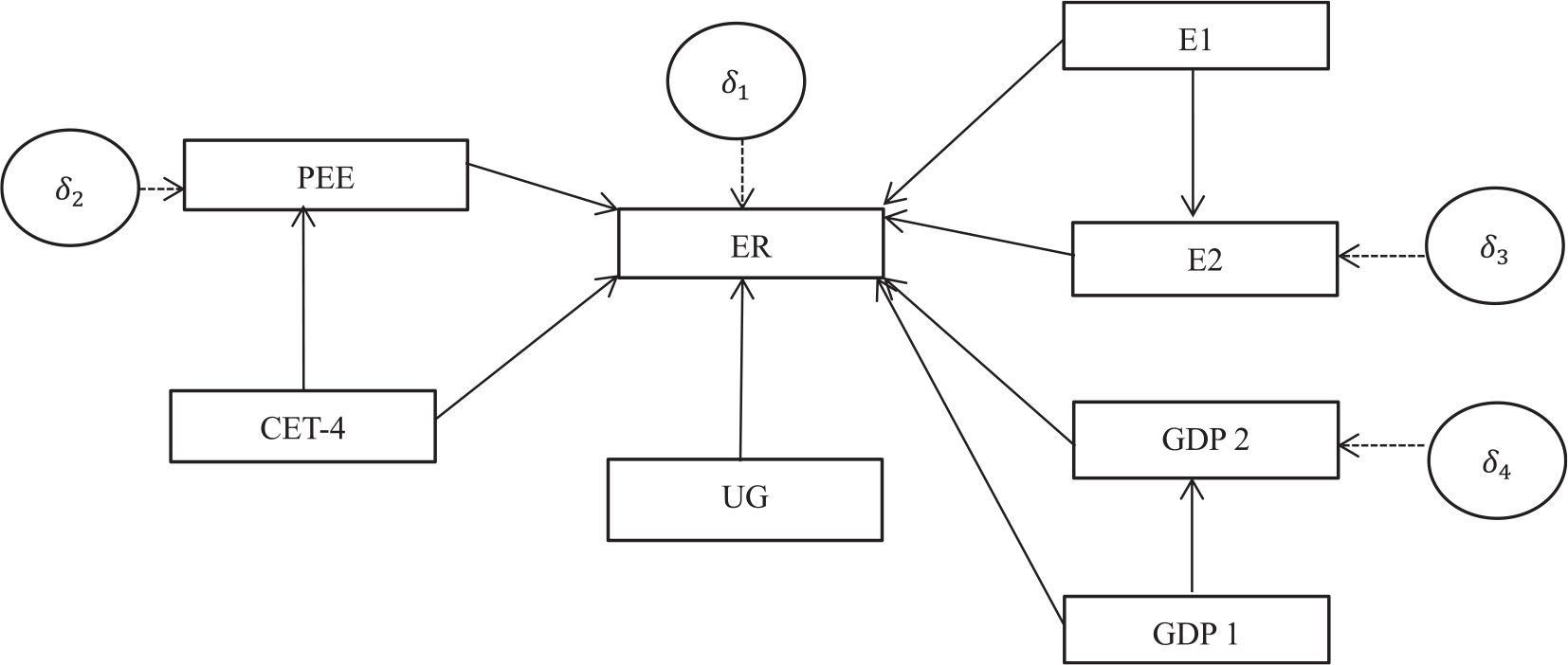
Structural equation model.
Results and Discussion
Regression Results and Analysis
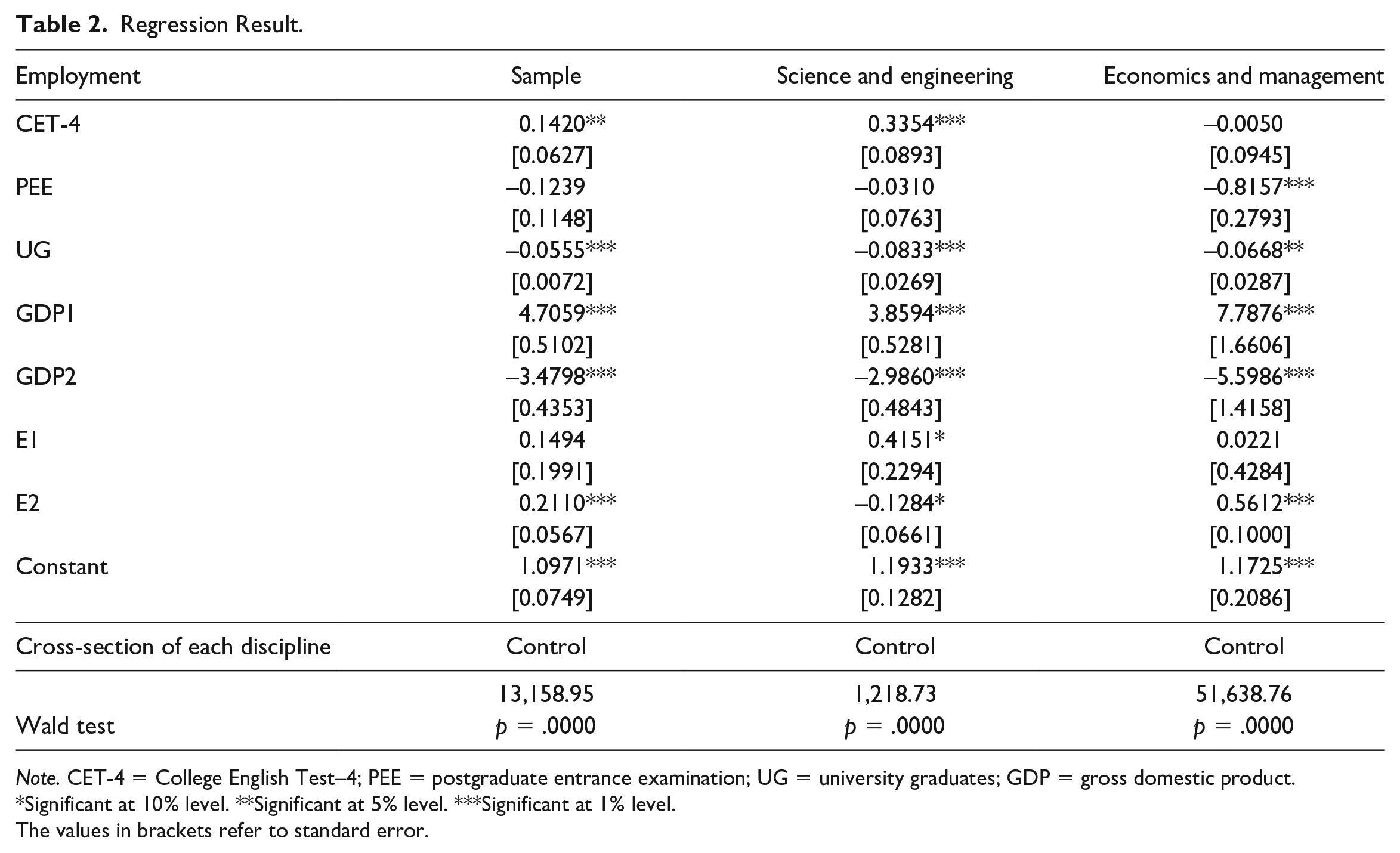
Table 2 presents the result of the FGLS method of static panel in the research sample. The Wald test of regression coefficients under each sample is significant and the difference in variables is large, indicating that the overall data fit is good, the design of the equation is reasonable, and the explanatory degree is high. The constant term is significantly positive in all samples, which indicates that the existence of rigid employment is consistent with the employment guidance policy of Chinese government for university students. Therefore, the government, state-owned enterprises, and other large companies are supposed to recruit a certain number of fresh graduates every year. The control variable is significantly negative in all samples, demonstrating that the number of graduates is negatively correlated with employment rate. The significance of other independent variables is different in engineering sample and management sample. The results show that the employment of science and engineering graduates is significantly affected by both macro- and micro-factors. However, when the macro-variables in the model are manually removed for further research, the regression results of all the micro-variables become significant. It indicates that the micro- and macro-impacts on employment rate are not independent. A covariation exists between them within the same system. Proposition 1 is thus proved.
Regression Result.
Note. CET-4 = College English Test–4; PEE = postgraduate entrance examination; UG = university graduates; GDP = gross domestic product.
Significant at 10% level. **Significant at 5% level. ***Significant at 1% level.
The values in brackets refer to standard error.
The passing rate of CET-4 is significantly positive in the sample of science and engineering discipline, while it is not significant in the sample of economics and management discipline. It implies that the passing rate of CET-4 has a significant impact on the employment rate of science and engineering; however, it has no impact on the employment rate of economics and management. As a micro-indicator, CET-4 can effectively reflect an individual’s ability but fails to serve as an effective signal in the employment of management graduates. One of the reasons is that the data of the research samples are all from general technology and engineering universities, where the demand for science and engineering disciplines’ graduates by the enterprises is higher. Thus, CET-4 is only a screening signal for science and engineering disciplines. Conversely, CET-4 is a basic requirement for managerial positions. Job candidates for management positions without CET-4 are not qualified for screening. Therefore, the passing rate of CET-4 cannot be an effective signal to screen for management graduates. Another reason is that male students are more likely to study science and engineering, whereas female students are more interested in economics and management. Compared with male students, female students have advantage in literature and English, resulting in a higher passing rate of CET-4. As a screening signal, CET-4 has high screening efficiency in science and engineering discipline, where majority are male students. However, due to the relatively high passing rate of CET-4 in economics and management studies, where the majority is female, it fails to be a screening signal for differentiation.
The rate of graduate school entrance examination is not significant in the science and engineering discipline but is significantly negative in the economics and management discipline. It implies that the postgraduate entrance examination has no impact on the employment rate of science and engineering disciplines but has a negative impact on the employment rate of economics and management disciplines. The rate of graduate school entrance examination is counted for occupational employment statistics, and theoretically, it is positively correlated with employment rate. However, the result is inconsistent with the expected analysis. On one hand, the graduates from general technology and engineering universities, particularly male graduates, are more likely to get employed directly (Bedard & Ferrall, 2003; Rose, 2006). In addition, the situation of science and engineering discipline is positive for male job applicants in China. Therefore, those graduates from science and engineering discipline prefer direct employment rather than postgraduate school entrance examination in China. On the other hand, graduates from economics and management discipline are forced to take the postgraduate school entrance examination as a way of relieving employment pressure. Therefore, the more severe is the employment situation, the higher is the graduate school entrance examination rate, thereby causing the paradox of the negative impact of graduate school examination rate on the employment rate.
In our research, GDP is significant in both science and engineering and economics and management disciplines, indicating that national economic growth has a significant impact on the employment of university graduates. The coefficient of GDP1 (outside Northeast area) is positive, implying that the external economy of the location where the university is situated promotes the employment of university graduates in the region. It also indicates that the employment mobility of university graduates is suitable, which is consistent with the above theoretical analysis. However, the coefficient of GDP2 (inside Northeast area) is negative, suggesting that the economy of the region where the university is located inhibits the local university employment rate. According to previous studies, economic growth is supposed to promote employment. However, due to the issue of economic data falsification in the Northeast region, the result shows a paradoxical relationship between regional economic growth and employment. The sample was extracted for the time when China’s economic growth is stable. However, in some regions, such as the Northeast and Northwest, economic growth rate was far behind the average national economic level. Therefore, the employment rate of university graduates in such regions is low and the brain drain is high. The empirical results show that the regional mobility of employment in general universities is highly related to regional economy. It provides reasonable explanation for the current regional employment mobility and the trend of talent flow.
The number of enterprises is less significant in the samples of science and engineering and economics and management. The significance of Enterprise Number 1 (outside Northeast region) and Enterprise Number 2 (inside Northeast region) in the science and engineering discipline does not reach the statistical test level of 5%, while Enterprise Number 1 is not significant in the economics and management discipline. Enterprise Number 2 is significantly positive only in the economics and management discipline. It means that the growth in the number of corporate personnel has a weak influence on the employment rate of science and engineering graduates and an increase in their number is unlikely to increase the employment rate of science and engineering universities. On the contrary, the employment rate of economics and management is expected to increase with the increase in the number of enterprise personnel in the area where the university is located.
The employment of science and engineering graduates is focused more on production, research and development, technical support, and other related positions. The number of these positions is highly correlated with the size of the economy and has a low correlation with the number of enterprises. For example, for any commodity, as long as the total social production—determined by aggregate demand—is constant, whether it is produced by one enterprise or by multiple enterprises, the total number of personnel used for production is fixed within a certain range with small fluctuations. The graduates of economics and management are more likely to engage in management and service positions. The number of positions is influenced not only by the size of the economy but also by the organization of production. However, the number of enterprises to organize production is determined by the efficiency of the whole economic development. The increase in the number of enterprises will provide more management and service positions. Therefore, the employment rate of economics and management disciplines will be influenced by the number of enterprises and the development of national economy. In the empirical results of the economics and management discipline, only Enterprise 2 is significant while Enterprise 1 is not. It indicates that the growth in the number of enterprise personnel outside the university cannot promote the employment of economics and management discipline of the university, while the increase in the number of enterprises in the region where the university is located can. Those who are employed in the economics and management discipline, it is more important to consider management and service positions. They are expected to recognize the local, corporate, and institutional culture of the employers. As those graduates have studied and lived in the university for 4 years, they have been well integrated into the local culture and system and are more likely to integrate into the enterprise. The employment of maximum graduates will reduce the recruitment cost of the enterprise. The interviews and surveys of sample university graduates also show that compared with science and engineering graduates, economics and management graduates are more likely to find positions in civil service, public institutions, and banks. Most of the economics and management graduates are concentrated in the areas where their universities are located. This may be a result of the mutual choice employment and free choice between the economics and management graduates and the enterprises in the region where the university is located.
Furthermore, according to the empirical results, the coefficient size and significance of micro-factor variables (CET-4, postgraduate entrance examination rate) and macro-factor variables (GDP, the number of enterprise personnel) demonstrate that, on one hand, the dynamics shaping the employment rate of science and engineering disciplines and economics and management disciplines are not consistent, except for the influence of GDP. On the other hand, irrespective of the discipline, the macro-factors have a greater impact than the micro-factors on the employment rate. Therefore, regional economic differences lead to the uneven distribution of employment among different disciplines. At the same time, the influence of some macro-factors (such as the number of enterprise personnel) on employment also varies among different disciplines, resulting in inconsistent regional distribution of employment between science and engineering disciplines and economics and management disciplines. Therefore, the empirical results confirm Propositions 2 and 3.
Structural Equation Model Results and Analysis
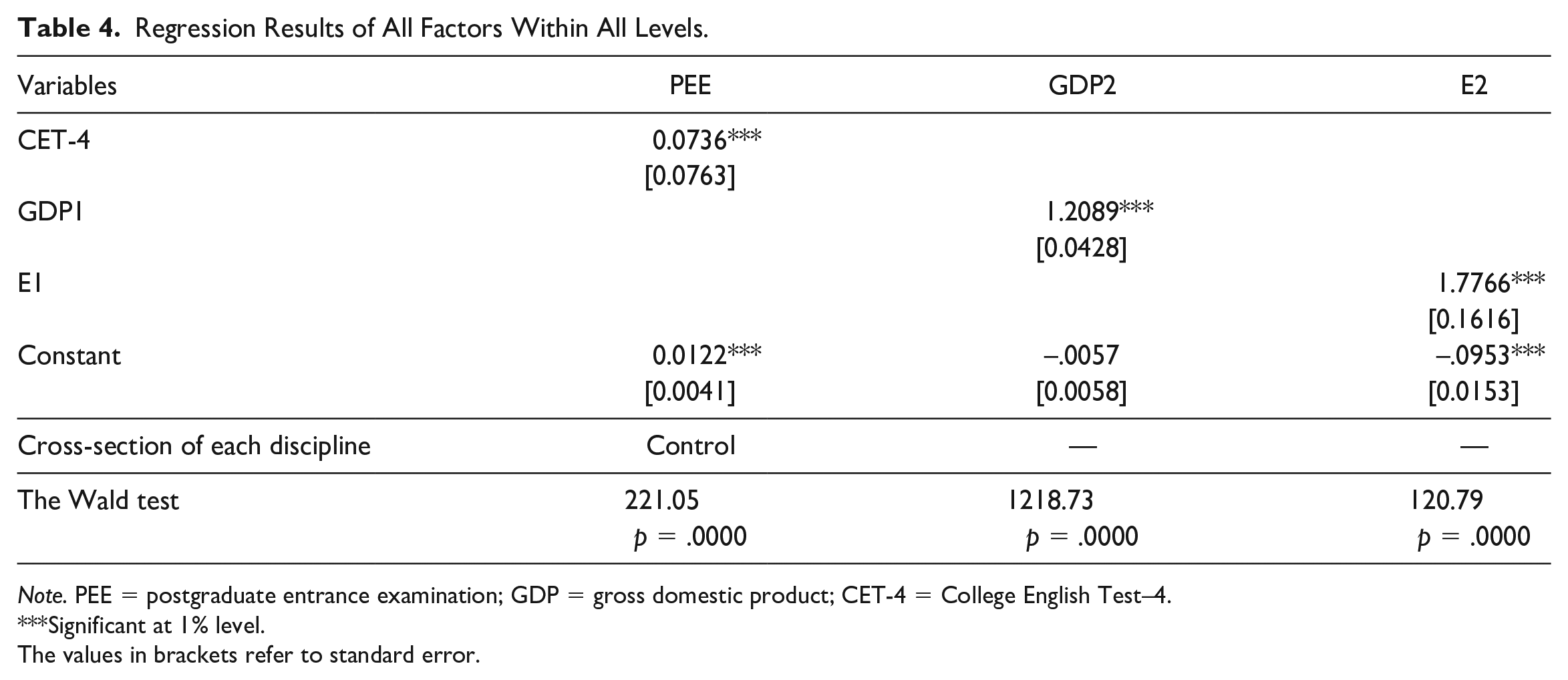
Considering the strong correlation between various factors, there may be different degrees of covariation between the influencing factors at different levels in the same system, which may affect the empirical results. As is evident from Table 3, at least at the macro level, there is a large correlation between GDP1 and GDP2, and E1 and E2. This indicates that at the macro level, the external economy may affect the economy of the region where the university is located. In turn, this affects the employment of college students in the area. At the same time, there is also reason to question that at the micro level, there may be a similar mechanism at play on the rate of entrance examinations due to the passing rate of CET-4.
Variable Correlation Coefficient.

Note. CET-4 = College English Test–4; PEE = postgraduate entrance examination; GDP = gross domestic product.
Significant at 10% level. ***Significant at 1% level.
The regression results of the micro-level factors in Table 4 confirm the above question: The coefficient of the pass rate of CET-4 is significantly positive, indicating that the pass rate of CET-4 has a positive effect on the postgraduate entrance examination. At the macro level, the coefficient of GDP1 and E1 is significantly positive, demonstrating that the economy of the region where the university is located will be driven by the external regional economy. If the independent variables and dependent variables in the model in Table 4 are exchanged, the coefficient of the independent variable is still significant, 1 which suggests that the factors within the level interact with each other.
Regression Results of All Factors Within All Levels.
Note. PEE = postgraduate entrance examination; GDP = gross domestic product; CET-4 = College English Test–4.
***Significant at 1% level.
The values in brackets refer to standard error.
Due to the possible interaction between factors within each level and the possible systematic association of different levels, an explanatory variable may influence employment through other variables within the level. Simultaneously, the coefficient is also affected by other variables in the system. To completely explain the influence mechanism of various factors on employment, a structural equation model 2 is adopted.
Figure 2 is the result of the structural equation model of the employment rate of science and engineering discipline. The coefficient of CET-4 passing rate and GDP1 is significantly positive, while that of GDP2 is significantly negative. Meanwhile, the coefficient of graduate entrance examination rate, the number of enterprises, and number of graduates is not significant. It shows that the passing rate of CET-4 and GDP have significant impacts on the employment rate of science and engineering disciplines. However, the rate of postgraduate entrance examination, the number of enterprises, and the number of university graduates have no significant influences on the employment rate of science and engineering graduates. The results of the structural equation model are basically consistent with the results of the FGLS method with static panel, except for the control variables (number of graduates).

Structural equation model result: Science and engineering disciplines.
Figure 3 is the result of the structural equation model of the employment rate of economics and management discipline. The path coefficients of GDP1 and E2 are significantly positive, while the path coefficients of the number of graduates, graduate entrance examination rate, and GDP2 are significantly negative. The path coefficients of CET-4 passing rate and E1 are not significant. It implies that the rate of graduate entrance examination, E2, and GDP have significant impacts on the employment rate of management and economics discipline. However, the passing rate of CET-4 and E1 bears no significant influence on the employment rate of this discipline. The results of the structural equation model are completely consistent with the results of the FGLS method using static panel (including control variables).
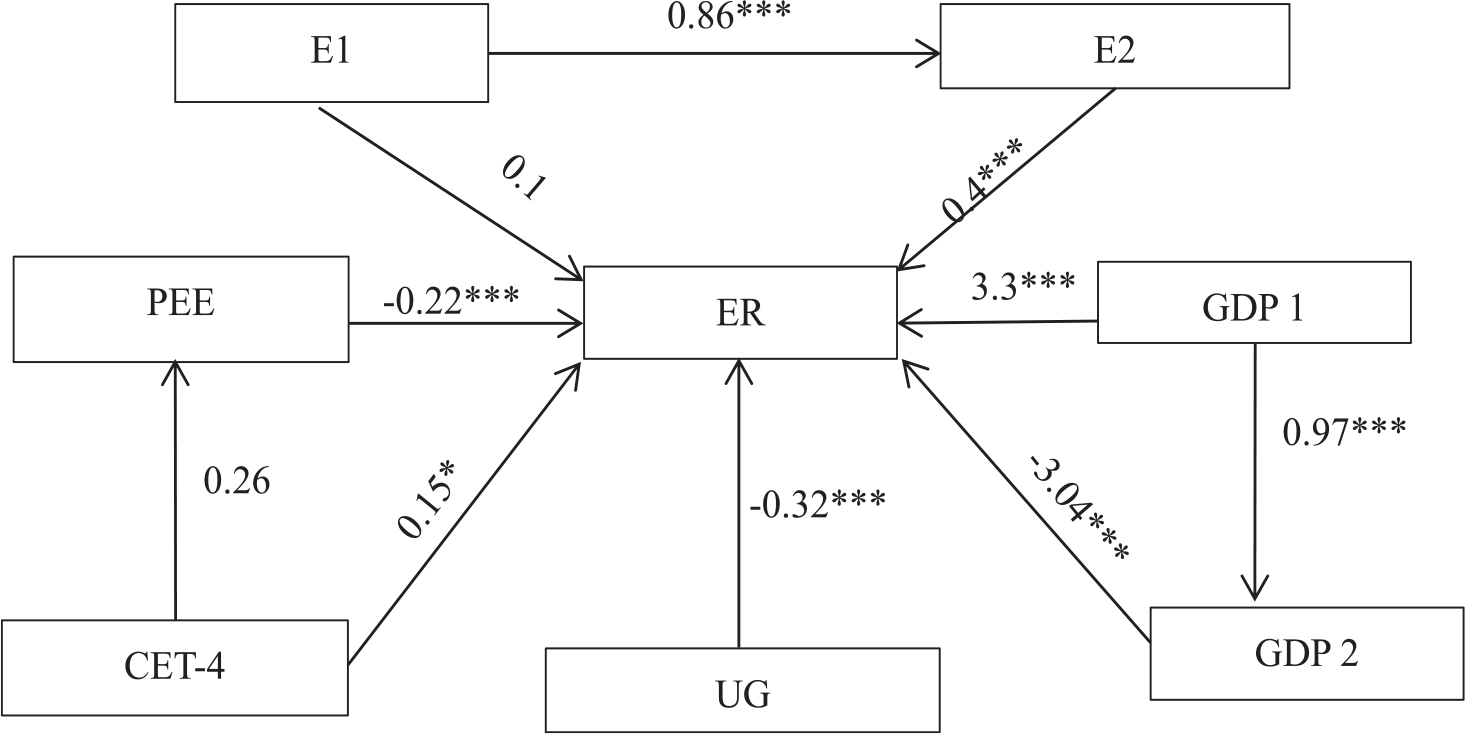
Structural equation model result: Economics and management disciplines.
In addition, according to the results of structural equation model, within the employment system, the path coefficient of CET-4 passing rate on the postgraduate entrance examination rate is not significant. Therefore, there is little possibility of CET-4 indirectly affecting the employment rate by affecting the graduate entrance examination rate. As the structural equation is a simultaneous equation model, it also shows that the graduate entrance examination rate cannot indirectly affect the employment rate through CET-4. At the micro level, all the influencing factors have direct effects rather than indirect effects on the employment rate. At the macro level, the coefficients of GDP1 and GDP2 on employment rate are positive and significant. It reveals that the impact of GDP on employment rate not only has a direct effect but also has an indirect effect. The above mechanism, therefore, exists both in the science and engineering and economics and management disciplines. However, the coefficient of the number of enterprises on the employment rate is only significant in E2 in the discipline of economics and management. Therefore, the indirect effect of E1 on employment rate is only significant in the employment system of economics and management discipline.
The result of the structural equation indicates that the generalized least square method is stable. It also demonstrates how macro-factors influence the employment rate. The influence mechanism of macro-factors on the employment rate is more complex than that of micro-factors, which further proves that the influence of macro-factors on university graduates is greater than that of micro-factors.
Discussion and Conclusion
The employment of university graduates is influenced not only by the macro-environment but also by the attributes of university graduates themselves (Li & Bray, 2007; Li et al., 2008). Both of them play a role in the system of university employment mechanism. This is consistent with the research conclusions of Gao (2010). However, this study further finds that macro- and micro-factors have different influence mechanisms on employment rate. While macro-factors have both direct and indirect influence, micro-factors only have a direct impact on the college employment rate. Although macro- and micro-factors affect employment at the same time, their effects on employment have a greater impact on general institutions of higher learning and may even be interdependent.
Although the employment situation of universities is more dependent on the macroeconomic environment in general, it does not mean that the university graduates’ own quality development is not important (Goldstein & Drucker, 2006). On the contrary, in view of the analysis of characteristics and attributes of the general institutions of higher learning in the research samples, it may also indicate that the general college graduates in the regions with slow economic development are not yet complete in their own quality construction, and the mechanism of promotion and feedback cannot be formed between college education and regional economic development. As a result, the employment rate will decline resulting in reducing the university ranking, which will lead to further recruitment and employment problems. Therefore, generally, higher education institutions are supposed to develop and improve the quality of students, so that they can take the initiative in employment. At the same time, the GDP growth rate and the increase in the number of enterprises in the regions with slow economic growth will be pulled up and stimulated by the economic growth rate in the developed regions. This suggests that regions with slower growth are not isolated from the domestic environment.
There are some differences between the employment factors of science and engineering and economics and management. From the micro-perspective, the passing rate of CET-4 can improve the employment rate of science and engineering graduates, while it does not strongly influence economics and management graduates. The graduate entrance examination rate can improve the employment rate of economics and management graduates, although it does not have a high impact on the science and engineering graduates. From the macro-perspective, the growth of national economy can effectively promote the employment of both science and engineering and economics and management disciplines. However, the growth in the number of enterprises can only promote the employment of the economics and management graduates in the region where their university is located.
To better solve the employment issue of universities, science and engineering disciplines are supposed to train students to obtain more individual attribute certificates with high social recognition. For example, the CET-4 certificate can help reduce the information asymmetry between employers and applicants, which can improve the probability of graduates’ success in job-hunting. Even if the influence of CET-4 on the employment rate of economics and management is not significant, it just demonstrates that CET-4 is not able to distinguish the graduates of economics and management, indicating a weak effect to eliminate information asymmetry. However, if graduates of economics and management can obtain College English Test–6, even the International English Language Testing System, Test of English as a Foreign Language, or other qualification certificates, it will strengthen their own attributes and increase the possibility of success in job-hunting. In addition, science and engineering graduates can also explore the option of taking the postgraduate entrance exam. On one hand, the passive employment can be alleviated, and on the other hand, the quality of students can be comprehensively improved through higher studies, enhancing their competitiveness in the job market. Furthermore, postgraduate entrance examination is also a second opportunity for graduates to choose a place for further career. The employment opportunities and the employment dimensions for graduate students can be broadened by taking the entrance examination of top universities.
Macro- and micro-factors have different effects on the employment rate (Kwon et al., 2016). The macro-factors have direct and indirect impacts on the employment rate of colleges and universities, while the micro-factors only have direct impacts on the employment rate. Although both macro- and micro-factors affect employment rate, the path of employment is still different within the respective systems. In the macro-employment system, the GDP growth rate and the increase in the number of enterprises in less developed regions will be driven and stimulated by the economically developed regions. It implies that the local region with slow economic growth is not isolated from the domestic economic development. In the micro-employment system, the passing rate of CET-4 cannot improve the postgraduate entrance examination rate. It demonstrates that college education fails to form a good system for college employment, and there is no mechanism for promotion and feedback between college education and employment. The failure or the inability to apply learning into practice will inevitably lead to the decline of employment rate and the ranking of colleges and universities. It will further cause enrollment and employment problems. Therefore, there may exist another effective way to improve the employment situation of general institutions of higher learning by reforming their education system from academic undergraduate education to applied undergraduate education.
The employment mobility of science and engineering and economics and management graduates has its own respective features. The graduates of science and engineering in general colleges and universities are more inclined to be employed directly by the secondary industry. China’s regional economy, particularly the Northeast, is still dominated by the secondary industry, and thus, the economic growth rate is slow. For the sake of their own employment and career development, science and engineering graduates in this type of regions are bound to move to the developed and rapid growth regions. The employment of graduates majoring in economics and management is also affected by the economic growth rate. However, employment of economics and management graduates is broadly distributed over a wide range of industries. It can be affected by the number of enterprises, cultural system, and other factors that are not completely determined by the regional economy. The degree of convergence between the mobility of employment and the mobility of regional economic conditions is not as high as that of science and engineering disciplines, and there is a certain degree of regional viscosity. The proportion of economics and management employment in the area where colleges and universities are located is higher than that of science and engineering disciplines.
Given that talent is important for economic growth, brain drain is undoubtedly a bottleneck that restricts regional economic development (Grubel & Scott, 1977). Attracting the flow of external talent is an important measure for spurring competition in the region (Meyer et al., 1997). To tackle the issue of brain drain and demand, slow economic growth regions are suggested to prioritize science and engineering graduates, so as to meet the demands of scientific research and technical talents needed for the economic development. The employment policy of the region with rapid economic growth can be appropriately inclined in favor of economics and management graduates to meet the talent pool of the auxiliary economy to ensure rapid economic growth. After the policy has achieved initial results and the economic growth rate stabilizes, it is bound to be backed up by a talent policy, thus forming a virtuous circle of talent reserve and economic development. In addition, colleges and universities should also adjust the allocation of enrollment in various disciplines. Developed areas with rapid economic growth have a great demand for economics and management talents, but it is more difficult to introduce science and engineering disciplines. At the same time, the brain drain of science and engineering disciplines in slow economic growth regions is more serious than that of economics and management disciplines. Therefore, the enrollment ratio of economics and management disciplines in general universities can be moderately increased according to regional conditions. It can meet the demand for talents in economic and management disciplines in regions with rapid economic growth and slow down the outflow of talents in regions with slow economic growth.
Footnotes
Declaration of Conflicting Interests
The author(s) declared no potential conflicts of interest with respect to the research, authorship, and/or publication of this article.
Funding
The author(s) received no financial support for the research, authorship, and/or publication of this article.
