




Abstract
This study seeks to describe and analyze the challenges occasioned by brain drain or human capital flight of librarians on service delivery in Nigerian Universities. The research adopted a descriptive survey design. A purposive sampling technique was used to select two geopolitical zones (South-South and South-West) from the six geopolitical zones of Nigeria. Total enumeration was used because the population under study was considered appropriate for the research. The instrument used for data collection was questionnaire. Sixty copies of the instrument were distributed to 60 librarians in the two selected geopolitical zones. Copies of all the questionnaires were completed, retrieved, and found usable, thus giving a response rate of 100%. Survey results indicated that 315 librarians emigrated to foreign lands for various reasons, including unstable academic calendar and prospects for further training among others. This loss of personnel in the university libraries has a negative impact on service delivery as qualified information professionals and Information and Communication Technology (ICT) experts are limited to mentor the younger professionals. Shift duties in academic libraries are also scaled down for lack of manpower. Based on the findings, the researchers recommend that the Federal Government of Nigeria should, as a matter of urgency, robustly fund tertiary education to enhance productivity. As they do this, the National Universities Commission (NUC) is to empower academic libraries by ensuring that the staff development policy is strictly adhered to. This will translate into self-enhancement for staff, positive job attitude, and retention of professionals in the system.
Introduction
Libraries, information centers, archives, and records centers all have one major aim, which is, the delivery of relevant information to patrons from all walks of life. Information is unarguably a very indispensable factor for promoting the developmentof society and also an essential part of a nation’s resources. The quality of life, to a great extent depends on the quantum, quality, and accessibility of information available to patrons. The growth and stability of a nation’s economy are also dependent on available human and capital resources. Corroborating this assertion, Efobi (2012) observed that organizations, companies, or individuals with marginally better information and systems tend to pull ahead of their competitors. Information is power, and a nation with robust information professionals virtually translates into efficient and effective information service delivery to users.
This notwithstanding, the mass exodus of information professionals, particularly librarians from the Nigerian University System and other tertiary institutions (polytechnics and colleges of education) may affect services if nothing is done to that effect. Consequently palpable fears are expressed about the future of the profession in event of sustained emigration of professionals to other countries. For any nation to survive, it requires the input of everyone to drive her transformational agenda. Various professionals and skilled workforce, most of the times and for various reasons, battle with the choice to leave Nigeria to seek for “greener pastures” in Western and Asian countries. Lamenting on the multiplier effect of brain drain in a brainstorming session held in Lagos, Odiogor (2013) reported that the Nigerian Minister of Interior indicated that Nigerians prefer to live and die in foreign countries rather than living a hopelessness occasioned by joblessness. According to Odiogor, the Minister went further to inform the bewildered audience that scores of Nigerians are even languishing in foreign jails all in the illegal pursuit of jobs that are scarcely available.
This report is disturbing to say the least. The mind boggling aspect of it all is that Nigeria is fast losing her skilled workforce and professionals to foreign countries in search of a better future. Saleh (2011) in an attempt to explain library education from the perspective of the educators stated that all library schools in Nigeria lack adequate qualified faculty (professors and senior lecturers) capable of teaching and supervising postgraduate students. The bulk of the faculty he observed are in the lower academic cadre of assistant lecturers and Lecturers I and II. He concluded that brain drain and few library schools are some of the reasons for the imbalance. In as much as this article is not in any form against the freedom of movement of people, the mass emigration of intellectuals, especially from the information industry, may be detrimental to information service delivery in Nigeria.
It is probably in this light that Ajibero (1990), bemoaning the effect of brain drain of librarians from the Nigerian library schools, which has “developed into a crisis,” cautioned that some programs and schools may go into extinction if no action is taken to address the trend. Brain drain or human capital flight is an ill wind that is blowing full blast on the information society. And for Nigeria to survive the emerging serious impact of information technology (IT), be relevant, and benefit from the immense opportunities provided by the information society, conscious efforts must be made to bring home Nigerian knowledge workforce from their “comfort zones” (Uwaje, 2012).
Definition of Concept
“Human capital flight” popularly referred to as “brain drain” is used interchangeably in this work meaning “a bogus exodus of professionals with special technical skills, and knowledge to other nations.” Specifically, Schultz (1971, 1981), cited by Haque and Kim (1995), identified human capital as an important determinant of economic growth of a nation. Haque and Kim strongly asserted that brain drain reduces the growth rate of the effective human capital that remains in the economy and hence, generates a permanent reduction of per capita income growth in the home country. Brain drain is common among developing nations, and Nigeria is not exempted. To buttress this point, Okunubi (2013) posited that the United States Diversity Immigrant Visa Lottery makes up to 55,000 diversity visas available annually to countries with low rates of immigration to the United States. Out of this figure, Nigeria has the highest number of entries yearly.
In his article on brain drain of health professionals and knowledge from Africa, Muula (2005) defined brain drain as both a loss of health workers (hard brain drain) and unavailability of research results to users in Africa (soft brain drain). A more comprehensive definition, better suited for the purpose of this article from Wikipedia (2013), defines brain drain as “the departure of educated or professional people from one country, economic sector, or field for another, usually for better pay or living conditions.” It is a sustained loss of skilled intellectuals, professionals, and technical labor through emigration, where donor nations (developing countries) are denied the services of experts in various areas of knowledge. Human capital flight leads to sustained decrease in income growth rate of developing nations. And it is in support of this that Olunloyo (2013), in his submission on brain drain and capital flight in Nigeria, defined brain drain as movement of financial capital and an economic cost. This is because according to him, emigrants usually take with them the value of their education and expertise sponsored by their home governments to foreign lands.
The library and information science profession in Nigeria is restrategizing and retooling with the introduction of Information and Communication Technology (ICT) in service delivery. Librarians and other information professionals (archivists, records managers, and curators) are hence encouraged to update themselves to remain relevant and well equipped to render quality service to the clientele. However, in the course of interaction during the Nigerian Library Association (NLA) annual conference and general meeting held in Abuja 2010, it was observed that a significant proportion of librarians had left the country. This observation was authenticated by some university librarians who indicated that the exodus of professionals to foreign countries in search of better job opportunities is gradually affecting job schedules.
Objectives of the Study
The focus of this article therefore is to
determine the job allocation and designation of librarians who emigrated,
ascertain their reasons for emigration,
examine the effect of brain drain of librarians on service delivery in Nigerian Universities, and
suggest ways to stem the tide of brain drain.
Research Questions
Literature Review
Most countries in the West African subregion, nay, the whole of Africa have experienced, at one time or the other, an exodus of highly skilled experts from almost all known professions to developed countries. In this era of ICT, the services of professional librarians are badly needed to take care of the information requirements of various clientele in the tertiary institutions of Nigeria. They are also to collaborate with the Ministry of Communications Technology in its national assignment of reversing the “Technological Brain Drain” (TBD), as noted by Uwaje (2012). It may be interesting to note that the information industry is not alone in this quagmire of brain drain. One of the best professionals who are seeking employment abroad, according to Mcnutt (2008), are the medical practitioners. Mcnutt went further to state that it is the same with engineers, pilots, and other professionals. They are leaving their countries to try their luck in developed nations for reasons given as conflict, lack of opportunity, political instability, or health risks (Iravani, 2011).
Reasons for Establishing Library Schools in Nigeria
Nigeria has 210 tertiary institutions, made up of 129 universities, 41 polytechnics, and 37 colleges of education servicing the entire tertiary educational system of the nation (National Universities Commission, 2013). Out of the 129 universities, only 25 (or 19%) are accredited by the NUC to offer courses in library and information science with the following objectives:
To produce graduates mature enough to face the modern challenges of information delivery services;
To produce graduates who will constitute middle-level and high-level manpower needed to carry out management of different types of libraries;
To produce graduates with adequate theoretical knowledge to teach in one or more areas in the field of library, archival, and information science; and last,
To produce individuals who will be mature enough to identify and conduct research in any problem area of the information profession (Ochogwu, 1990).
The implication of this is that a mind blowing number of librarians are needed to constitute the professional workforce for both the library schools and university libraries.
Service Delivery
For university libraries to brace up to their responsibility of taking care of the teaching, learning, research, and community service needs of users, high-level professionals must be on ground. This also means that brain drain or human capital flight of whatever shade among librarians, or other information professionals, is counterproductive. The services of a university library to its immediate community and environs include acquisition, processing, dissemination, and provision of access to library information resources (print and nonprint). ICT may not thrive or make any meaningful impact without professionals to drive it. Arguing in support of this, Osinubi (2007) maintained that the most important part of IT system is the people who use it. This indicates that without people, there cannot be any noteworthy development or improvement in any sector of the economy. Professionals are needed to run the affairs and contribute to the development of any nation.
Brain Drain of Librarians
But what do we see in the Nigerian University System? The brain drain of librarians is fast depleting scarce human resources and crippling tertiary education as noted by Ajibero (1990). Universities in Nigeria are rated by the standard of their libraries as no university can rise above the status of its library. This is because a university library is the single largest academic resource of last recourse. Corroborating this assertion, Anafulu (1997), addressing the Committee of University Librarians of Nigerian Universities (CULNU), stated that if we had no laboratories and workshops, the enterprise of learning would continue so long as we had well-stocked and organized libraries manned by professional librarians. Similarly, in a recent communiqué to the Federal Government, the Committee of Vice Chancellors (CVC) of Nigerian Universities painted a gory picture and advised the government to do everything within its reach to halt the alarming rate of mass exodus of academics to foreign lands. They concluded that if nothing is done, and very fast too, Nigerian Universities may be existing but not functioning.
Brain drain is gradually robbing the Nigerian economy of skilled manpower in several areas of knowledge. The medical profession, law, engineering, IT, and nursing, to mention just a few, are battling on how to control the out flow of vital human resources from Nigeria to developed nations. Addressing participants in a workshop on how to bring Nigerian knowledge workforce home from their “comfort zones” in foreign lands, Uwaje (2012) emphasized that the concept of bringing them home is not just physical. It involves the linking and connecting with the diaspora knowledge worldwide, irrespective of where they are and where they reside. To drive home his point, he reported that there are15,000 full-time Nigerian professors, and 10,000 other academic staff of Nigerian extraction in U.S. higher education institutions (universities and colleges). Added to this are more than 1,500 pharmacists, 2,800 nurses, 700 Nigerian lawyers, and a mind boggling 174,000 IT specialists with most of them in the telecommunications and allied services (Uwaje, 2012). Uwaje concluded that according to the past U.S. census, there are 1.15 million Nigerians in the United States, and among them, 4,500 are Nigerian medical doctors in the 50 states of the United States.
Nigeria with a population of about 160 million is serviced by 210 tertiary institutions (universities, polytechnics, and colleges of education). The libraries of these academic institutions, in this information age, are more than store houses of knowledge with the librarians and other paraprofessionals tasking their professional competence to assuage the information requirements of users. A situation where librarians and other information experts from Nigerian universities relocate to developed nations in search of “better working conditions” is not the best to say the least. Only 25 universities as mentioned earlier are accredited to run courses in library and information science by the NUC. In view of this, the NLA and the Librarians’ Registration Council of Nigeria (LRCN) have at various fora expressed concern over the limited number of library schools and subsequent loss of professionals to other countries.
Presenting an article on career choice of students of library and information science in tertiary institutions of Imo State, Nigeria, Okoro (2009) observed that more than 60 young information professionals have so far left Nigeria over the past few years for “greener pastures” in developed countries. And for how long advanced nations will continue to enjoy this free riding on poor countries’ educational efforts is anybody’s guess. This is because education in a developing country may not lead to faster economic growth if a huge proportion of the country’s highly skilled and educated workforce desert the country. Some of the reasons advanced for the mass exodus of professionals from Nigeria include unstable academic calendar, poor remuneration, political instability, robust remittances to families back home, and job dissatisfaction. Interesting as these reasons may sound to potential emigrants, the question begging for answer is, “for how long should Peter be robbed to pay Paul”?
All hands must be on deck to recall Nigerian professional information providers from their countries of emigration in Western Europe, and North America respectively, to add to the Nigerian pool of brain power. The end result is that both Nigeria and Africa will be taken to enviable heights in information, education, and research. The Nigerian Computer Society (NCS) has taken the lead in this direction. It is reconnecting with Nigerian knowledge resources abroad and has mounted the first Nigerian IT Summit in 2001, at George Washington University, in Washington, D.C. The Federal Government took a clue from this and established the Nigerian Diaspora Commission all in an effort to encourage Nigerian knowledge workforce to return.
The United States, as noted by Lowell (2003), is the world’s largest magnet for skilled migrants. This may explain the explosive number of visa applicants always found at the U.S. embassies in Lagos and Abuja respectively, more than any other embassy or high commission in Nigeria. Same reasons for emigration as advanced by health workers and noted by Muula (2005) were also echoed by some visa applicants in an informal interview with the authors in September 2008. The reasons included better remuneration and working conditions, opportunities for further education, and career advancement in foreign countries, among others (Muula, 2005).
Method
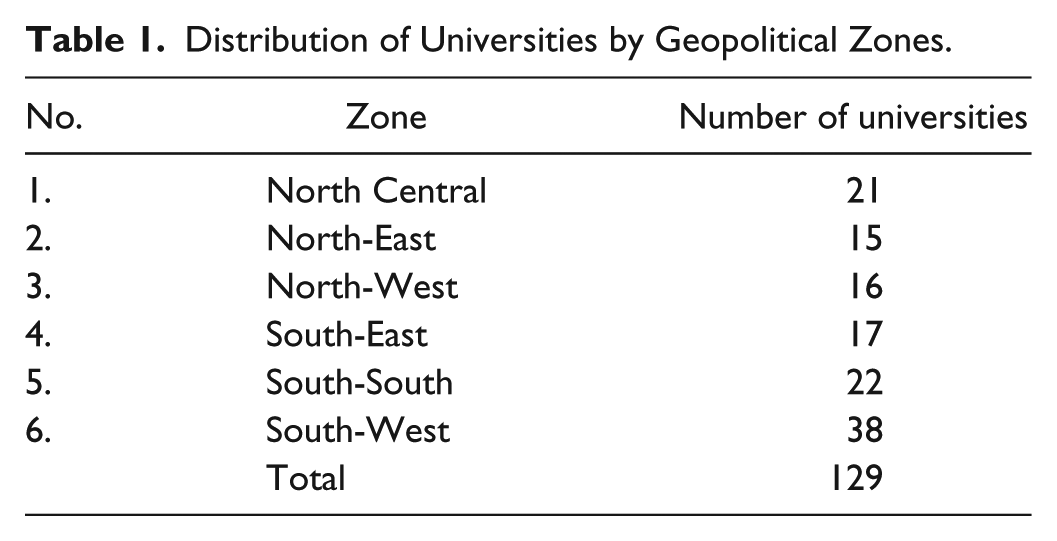
The research adopted a descriptive survey design. A purposive sampling technique was used to select two geopolitical zones (South-South and South-West) from the six geopolitical zones of Nigeria as shown in Table 1. This was because the two zones have the highest number of universities. Nigeria is divided into six geopolitical zones for ease of governance and political expediency. The zones are (a) North Central, (b) North-East, (c) North-West, (d) South-East, (e) South-South, and (f) South-West. In the South-South and South-West zones, which are the targets of this study, there are 22 and 38 universities respectively, making a total of 60, which is the highest from any two geopolitical zones in Nigeria as shown in Table 1.
Distribution of Universities by Geopolitical Zones.
The total population of 60 university librarians was used for the study. Total enumeration was also used because all the population under study was considered to provide information on staff (librarians) who emigrated from 2006 to 2010. This time span (2006-2010) was carefully chosen because it was a period characterized by frequent and prolonged industrial actions by university faculty and staff. Subsequently, the academic calendar in Nigerian universities was adversely affected. The choice of respondents (university librarians) was also influenced by the fact that the records of all library staff are domiciled in their offices. Thus, they are best suited to provide information on librarians in their employ, as is always done during the annual staff evaluation exercise (appraisal) for promotion. Second, any librarian disengaging from service usually fills out a disengagement or clearance form stating reason(s) for such action. The university librarian dispatches the documents to the university administration through the human resources (HR) department. Disengaged staff also maintain contacts with the university librarian from wherever they are residing.
Instrumentation
The primary instrument for data collection was an investigator-structured questionnaire tagged “Librarians’ Brain Drain and Service Delivery Questionnaire” (LBDSDQ; see the appendix). Interviews were equally held with university librarians, mostly, to authenticate some of the responses provided in the questionnaire. Both interviews and distribution of questionnaire were carried out in two sessions with the aid of two research assistants. This was to ensure complete coverage of the study areas. The first exercise was during the National Conference and Annual General Meeting of the NLA, held in Awka, Anambra State in 2011. The second round of interaction took place at a workshop organized by the LRCN in 2012.
Based on the total number of respondents (university librarians), 60 copies of the instrument were distributed as shown in Table 2. All the questionnaires were returned and found usable, thus giving a response rate of 100% as indicated in Table 2. Note that a total number of 60 respondents were used for this study. The respondents reported that a total of 315 librarians had emigrated from their libraries. See discussions under “Gender of Emigrants” section of this article for clarification.
Distribution of Questionnaire and Respondents.

Data Analysis
To analyze the data obtained from this study, descriptive statistics (frequency and percentages) were used. Figures were tabulated for clarity and easy comprehension of displayed data.
Results and Discussion
Demographic Information of Emigrants (DIE)
DIE 1: Gender of emigrants
Result shows that 315 librarians emigrated from Nigeria. Out of the total number of emigrants, 272 (86.3%) were males whereas only 43 (13.7%) were females. This disparity may be because men are more adventurous than women. And the girl child is discriminated against in terms of acquiring Western education particularly in the northern parts of Nigeria.
DIE 2: Age range of emigrants
A total of 38 (12.1%) were within the age of 20 to 30 years, 58 (18.4) were of the age of 31 to 40 years, 92 (29.2%) were of age 41 to 50 years, 103 (32.7%) were of age 51 to 60, whereas 24 (7.6) were 60 years and above. The result shows that the most affected age group is 51 to 60 years accounting for 32.7% of all emigrants. The least involved age group is 20 to 30 years which accounted for 12.1%. About 60% of emigrants are 50 years and below. Job satisfaction is a function of age of the worker. Younger librarians generally tend to be more satisfied and less restive in their jobs as affirmed by Anderson (1998). This assertion did not tally with the findings of the present study and that of Okoro (2002) who, in a study on job satisfaction among professional librarians of selected university libraries in Nigeria, indicated that the older respondents (50 years and above) are always exploring alternatives mostly outside of Nigeria because of economic factors.
DIE 3: Educational qualification of emigrants
The educational qualification of emigrants revealed that 111 (35.2%) were PhD degree holders, 20 (6.3%) were MSc degree holders, 89 (28.3%) held Master of Library and Information Science (MLIS) degree, while 95 (30.2%) had Master in Library Science (MLS) degree. Result indicates that the most affected group are those with the various variants of master’s degree accounting for 64.8% of all emigrants. However, emigrants with the terminal degree of PhD accounted for 35.2% of the population. Brain drain is not only limited to the higher grades of librarians but also apparent with the middle-level staff (those with master’s degree). The prevailing economic crisis in Nigeria has compelled the Federal Government to scale down on subsidies for the social sector including education. The resultant underfunding affects teaching, research, and service delivery. The urge to enroll for doctoral programs in the country suffered a downturn as scores of librarians with master’s degree left to pursue PhD programs abroad and stayed back on completion. They cited job satisfaction, career opportunity, social security, and salary as reasons for their action as reported by Okoro (2002).
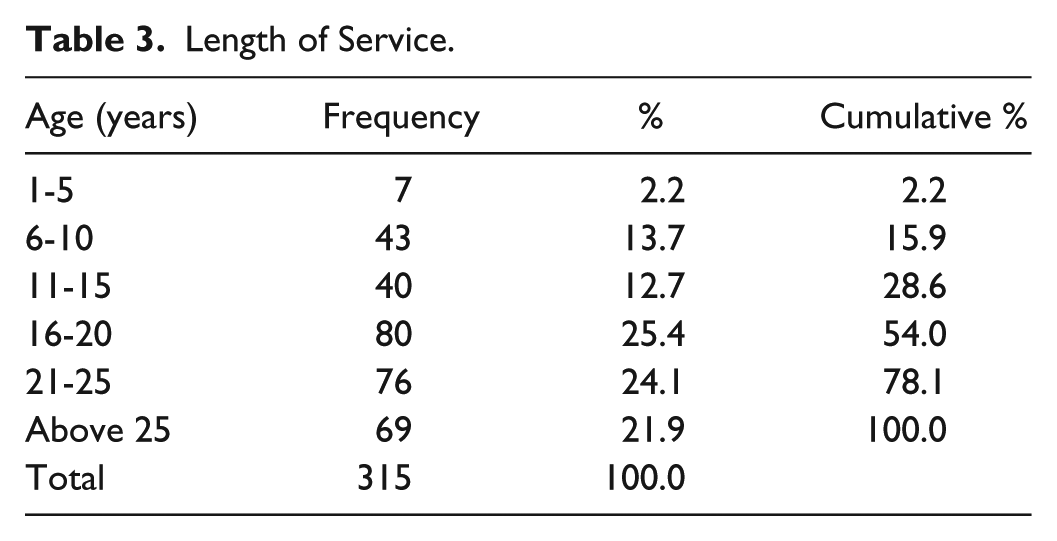
It is evident, as indicated in Table 3, that staff who served for 16 to 20 years are the most involved in emigration, as they accounted for 25.4% of all emigrants. The least involved is the 1 to 5 years category, which made up 2.2% only. It is interesting to note that the findings of this study are in tandem with that of Tomobri (2009). In a study of retirement syndrome among staff of an oil company in Nigeria, Tomobri asserted that workers begin to feel hopeless as they contemplate growing older in a job that holds little interest for them. The conclusion is that such jobs may demand a pace too fast for the advancing years of the worker. This causes low morale and the worker begins to dream of ways to leave the establishment. In the present study, the emigrants who have served for 16 to 20 years are between the ages of 51 and 60 years (see “DIE 2”). And they are the most dissatisfied of the group, which is evident in their mass exodus to explore alternatives abroad.
Length of Service.
Related to this is the rank of emigrants. In the Nigerian University System, professional librarians are ranked as their counterparts in the faculties. Table 4, therefore, shows the ranks of librarians who emigrated.
Rank of Emigrants.
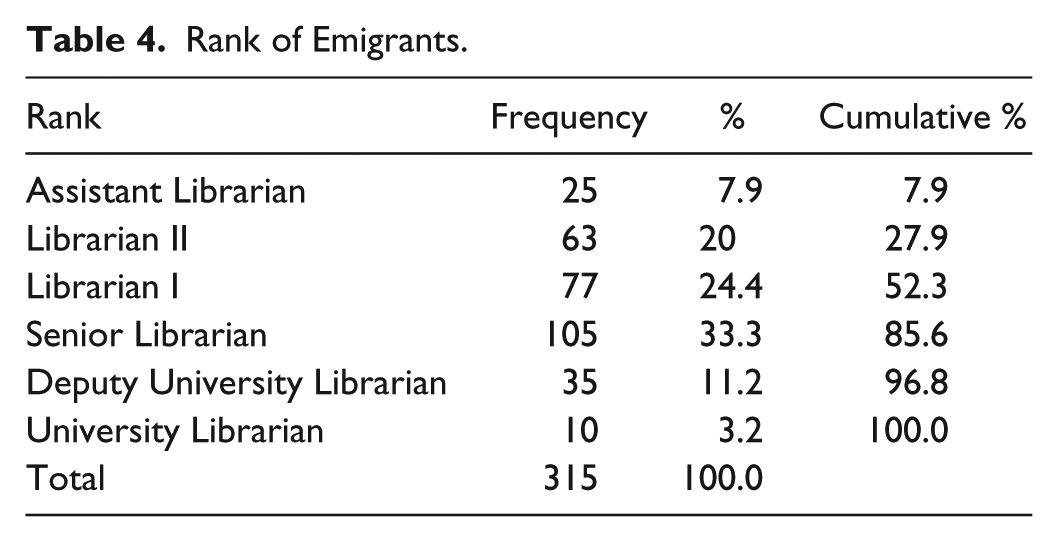
The most affected group of emigrants are the senior librarians (33.3%). The university librarians are the least affected (3.2%), as revealed in Table 4. To attain the rank of a senior librarian, a staff should have served for at least 12 unbroken years with a doctorate degree. A university librarian is the zenith of academic librarianship in Nigeria, and it is terminal because it is a professorial position. This may explain the low rate of emigration by this group. However, senior library staff, as observed by the authors from long years of service, are in a rush to achieve or acquire higher status to enhance their earning capacity. This observation was corroborated by Usman (1982) who reported that 75% senior librarians left their jobs to emigrate to other countries from Nigeria between 1976 and 1981 as a result of unfulfilled aspirations.
The study also sought information on job allocation of emigrants as indicated in Table 5.
Job Allocation of Emigrants.

Note. IT = information technology
As can be observed from Table 5, it is clear that librarians from the IT sections, who also take care of the systems, are by far the most affected. They are responsible for 58.4% of all emigrants. Technical services took a distant second position with 23.2%, whereas medical librarians are the least affected with only 1.6%. This may be attributed to the fact that ICT is witnessing a downturn in Nigeria because of the epileptic nature of power supply and perhaps issues relating to youth restiveness, kidnapping of IT professionals, and terrorism targeted at telecom facilities as witnessed in the northern parts of Nigeria in the past few years (Ajayi & Marama, 2013; Obe, 2013; Opara, 2013; Sahara Reporters, 2012).
In most university libraries, complete automation is yet to be achieved and this is necessary to provide support for electronic and digital databases. The near lack of Internet facilities and proxy servers for better control of the bandwidth is frustrating, to say the least. IT librarians in many Nigerian universities are so discouraged because of the following factors:
Poor policy planning and implementation;
Insufficient and unrealistic infrastructural facilities;
Lack of appropriate technical skills, education, and training;
Project funding and sustainability, as noted by Amkpa and Abba (2009).
These factors contribute in no small measure to negative feelings that may graduate into emigration.
It is essential at this stage to mention that all these factors, as possible reasons for emigration, (Table 6) were presented to the university librarians to choose the most commonly cited reasons by the staff from their various institutions who left for “greener pastures.” And as can be observed from Table 6, unstable academic calendar was the reason given by most emigrants (93.3%), as indicated by the university librarians. This has been the signature tune of tertiary education in the Nigerian University System. Academic, nonacademic, and support staff of Nigerian public universities most of the times embark on industrial actions that have a negative impact on the academic calendars of the institutions. For instance, at the time of writing up this study, all the government universities in Nigeria had been shut down for 6 months (July to December 2013). The reasons for this are that lecturers are asking for improved library and laboratory facilities, conducive academic environment to promote effective teaching, learning and research activities, and enhanced teaching allowances to mention just a few. The government, however, is dragging its feet, and the negotiations have hit a brick wall. The result is that Nigerian students are idle at home as only the private universities are functioning at the time of this study.
Reasons for Emigration.
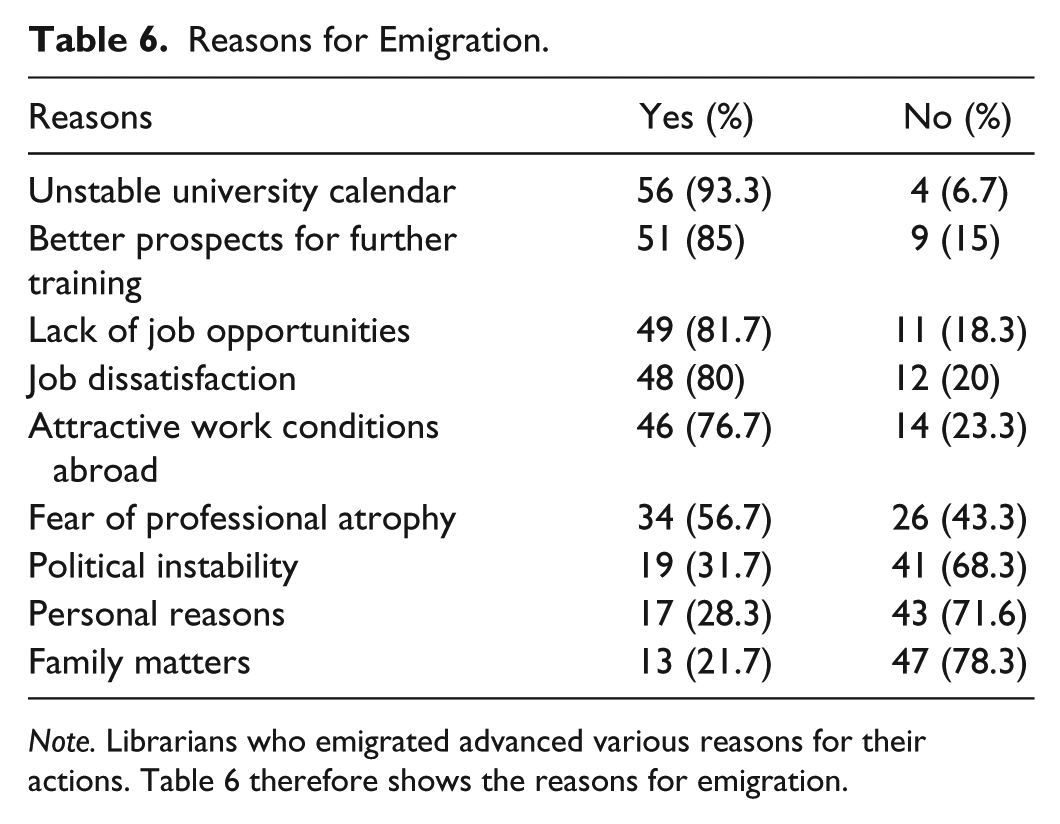
Note. Librarians who emigrated advanced various reasons for their actions. Table 6 therefore shows the reasons for emigration.
The status quo may be responsible for a myriad of other unpleasant circumstances as low prospect for further training (85%), lack of job opportunities (81.7%), job dissatisfaction (80%), and fear of professional atrophy (56.7%; see Table 6). It is a truism as can be confirmed from the observation of the authors that when academic calendars are truncated, the bandwagon effect is disillusionment on the part of both staff and students. When this happens, most of the staff are left with no alternative than to seek attractive work conditions abroad as indicated by 76.7% of the emigrants (see Table 6).
The problem, however, is that most of the migrants rank among the brightest and the best, and they leave because of the fear of being stifled by the system as asserted by (Mbanefoh, 2007). The question now is, what is the effect of this magnitude of exodus on service delivery?
It is evident, as can be observed in Table 7, that the most affected aspect of library and information service delivery is in the area of ICT. Ineffective ICT (86.7%), as indicated, caused some academic programs to lose accreditation from regulatory bodies. In Nigeria, the NUC remains the sole regulatory body for all programs to remain afloat in the university system. The denial of accreditation for any program translates into scrapping of the said program, pending reaccreditation after 2 or 5 years, as the case may be. ICT is the bane of most university libraries as it is yet to be fully implemented either as a result of paucity of funds, erratic power supply, and most importantly, lack of qualified personnel to drive the tool as noted by Ayo (2001). ICT librarians from most universities left as a result of unconducive work environment, and this had a negative impact on service delivery. In most cases, as averred by Amkpa and Abba (2009), denial of accreditation for the library is the most significant. The LRCN works in tandem with the NUC to make sure that university libraries are continuously providing adequate, relevant, and efficient services to the clientele. Anything short of this is highly unacceptable.
Effect of Emigration on Service.

Note. ICT = information and communication technology.
The effect of emigration on library services is not yet done as the junior librarians are fast losing their mentors (78.3%), shift duties are truncated (66.7%), and most branch libraries are manned by junior staff (61.7%). The technical services department where new books are processed before they are sent to the shelves is also depleted of manpower (60%), as indicated in Table 7. The department is the engine room of a library where meta-data are carried out. This activity is what differentiates a library from a bookshop. It is also against professional ethics for junior librarians to head or man branch libraries. This normally must be under the strict supervision of a senior staff. All these factors as enumerated, exerted negative influence on job schedules as exemplified in the exodus of manpower from the universities under study.
It is perhaps in view of this that the New Partnership for African Development (NEPAD) advocated an educational process with legal and regulatory framework to support people’s capacity to leverage their human capital to the fullest (Vil-Nkomo, 2007).
Conversely, as can be observed from Table 7, paper presentation in journal clubs witnessed a boost as indicated by (51.7%) respondents. This may be because librarians as academic staff are assessed by their publication output. The maxim now is “Publish and Excel” as against the “Publish or Perish” syndrome. No staff wants to stagnate as a result of lack of publication.
Discussion of Findings
The findings of this study revealed that brain drain, otherwise known as human capital flight, is a challenging factor in service delivery of the Nigerian University Library System.
Findings from the study indicated the staff in the rank of senior librarians who served for about 20 years in the ICT units of the library are the most involved in emigration. This corroborated an earlier finding of Usman (1982) who reported that 75% of senior librarians left their jobs to emigrate to other countries from Nigerian between 1976 and 1981 as a result of unfulfilled aspirations. Following closely are emigrants in the Librarian 1 cadre (24.4%). The university librarians have hit the bar in the profession and hence, the low rate of emigration (3.2%), as indicated in Table 4. This position is the zenith of academic librarianship in Nigeria. Research findings further indicated that the male gender (86.3%) and staff with various kinds of master’s degree (64.8%) emigrated the most (see DIE 1 and DIE 3) respectively.
There were several reasons based on the findings in Table 6 that warranted the emigration. Findings revealed that unstable university calendar with 93.3% better prospects for further training (85%) and lack of job opportunities (81.7%) were the major reasons for emigration. This result is in tandem with Amkpa and Abba’s (2009) and Iravani’s (2011) findings as some of the factors that spurred the emigrants to leave. Furthermore, job dissatisfaction (80%); attractive work conditions abroad (76.7%), as confirmed by Mcnutt (2008), Okoro (2009), and Uwaje (2012); and low morale arising from ineffective ICT tools, lack of mentorship for junior staff, which translated into their poor leadership roles in branch libraries, and low academic content of modern meta-data are all the monumental effects of emigration on service delivery.
Frequent shut down of universities in Nigeria as a result of industrial actions by academic staff is an albatross to the educational system. Insincerity on the part of the government in funding tertiary education is the bane of all the industrial actions in the educational sector in Nigeria.
This factor coupled with lack of job opportunities, better prospects for further training, attractive work conditions abroad, and fear of professional atrophy all conspired to produce feelings of dissatisfaction that culminated in emigration and eventual brain drain of professionals.
Findings on Table 7 show the direct effect of brain drain on library’s service delivery. The result reveal that 86.7% of the respondents indicated that emigration of librarians caused ICT network to be ineffective. This finding validates Osinubi (2007) assertion that IT system is the people who use it. Findings also shows that 78.3% of the respondents affirm that emigration of librarians left few senior librarians to mentor young professionals. It is also apparent on table 7 that emigration of librarians led to junior library staff headship of branch libraries as established by Ayo (2001). Human capital flight of librarians also affects shift schedules, which witnessed a downturn as a result of paucity of qualified professionals. The junior library staff are left to man major duties (see Table 7).This finding is in line with that of Bamidele, Omeluzor, Imam, and Amadi’s (2013) study which indicates that among the library assistants, 86.7% had Senior School Certificate of Education (SSCE). This adversely affected service delivery to library clients as this low level of staff did not have required skills, knowledge, and training to man major duties.
From the literature reviewed in this study and responses harvested from Section D of the instrument (see the appendix), the challenging factors of brain drain among librarians may be reversed thus:
The NUC, through the Federal Ministry of Education, should make it mandatory for all library staff to be ICT compliant. This is to ensure that enough manpower is always on ground to man this area.
Criteria for succession and replacement of librarians should be stepped down a little to ensure retention of qualified staff in the system. This will also prevent the junior librarians from taking up responsibilities above their expertise.
Robust funding should be dedicated to the universities, and the library intervention fund should be increased to at least 15% of the institutional budget.
Increased funding will surely take care of the following:
Unstable academic calendar Poor prospect for further training of staff Will enhance employment opportunities Creates conducive work environment Foster job satisfaction Sponsorship to workshops, conferences, and seminars Provide current and adequate information resources in the libraries
When all these are put in place, restiveness by faculty and staff in the university system will be reduced. The result is unbroken academic calendar, job satisfaction, and professional enhancement.
Effective security measures must be provided for ICT equipment and personnel who man them. Terror attacks targeted at telecom facilities are a very great discouraging factor.
Last, it is essential to state here that in an oral interview with the respondents (university librarians), more than 75% of them mentioned that high capacity alternative power sources with effective inverters should be provided for every university library in Nigeria. This will check frequent power outages that adversely affect the systems.
Conclusion
The findings of this study revealed that brain drain, otherwise known as human capital flight, is a challenging factor in service delivery of the Nigerian University Library System. First, the male gender, which constitutes a greater percentage of the workforce, is the most affected by the mass exodus. And because job satisfaction is a function of age of the worker, the middle age bracket (51-60 years), with the various variants of master’s degree, emigrated for “greener pastures.” The findings also indicated that senior library staff who have served for about 20 years in the ICT unit are the most involved in emigration.
Job dissatisfaction and low morale arising from ineffective ICT tools, lack of mentorship for junior staff, which translated into their poor leadership roles in branch libraries, and low academic content of modern meta-data are all the monumental effects of emigration on service delivery. As if these are not enough blows on librarianship as a service profession, the shift schedules witnessed a downturn as a result of paucity of qualified professionals. Various reasons naturally are advanced by emigrants to justify their movement. The topmost among them is unstable academic calendar. Frequent shut down of universities in Nigeria as a result of industrial actions by academic staff is an albatross to the educational system. Insincerity on the part of government in funding tertiary education is the bane of all the industrial actions in the educational sector in Nigeria.
Finding also indicated that the technical services departments where all the processing (meta-data) are done for new information resources lost staff through emigration, and this scaled down the rate of book processing to the open stack.
This factor coupled with lack of job opportunities, better prospects for further training, attractive work conditions abroad, and fear of professional atrophy all conspired to produce feelings of dissatisfaction that culminated in emigration and eventual brain drain of professionals. This oversight function may discourage junior headship of branch libraries.
Recommendations
Based on the findings and conclusion of the study, the following recommendations are made:
The Nigerian Federal Ministry of Education in collaboration with the NUC should be committed to serious funding of tertiary education for better productivity. As a follow-up to this, at least 15% of the institutional budget is to be set apart for the university library. This will ensure robust funding for purchase of information resource because poor library facilities are always a sore point between government and university staff.
The NUC as a matter of urgency should collaborate with the Ministry of Communications Technology in its drive to reverse the TBD. This can be achieved by fully implementing the ICT policy and soliciting for external funding from donor agencies and nongovernmental organizations (NGOs). ICT is capital intensive, and adequate finance is required for effective project implementation. As this is done, serious security measure must be provided to secure ICT personnel and equipment.
The lip service paid to the Nigerian University System by government is distressing to say the least. Disruption of the university calendar occasioned by industrial actions is not an acceptable option to settling scores. The government should allocate an agreeable percentage of the national budget for education and ensure that it is properly disbursed. A robust funding of the education sector is advocated to end the frequent industrial actions. Special incentive packages are to be developed for senior librarians to encourage them to remain in the system to mentor the younger professionals.
Staff development policy of various university libraries must be vigorously implemented. This is to allow qualified staff to pursue postgraduate programs for self-enhancement and effective service on completion. Sponsored staff are bonded to ensure retention in the system.
Attractive work conditions should be provided through a formal structure for distribution of rewards and sanctions to support compliance. Wage increase for library staff is recommended. This should be able to withstand the rigors of personnel grievances, public criticism, and at the same time, have the capability to attract and retain competent personnel. This is more of the fact as the university library is open for longer hours daily. Librarians who covered shift duties are to be paid some stipend in addition to their take home package. This should also be extended to staff of technical services department because of the peculiar nature of their job schedule.
Qualified fresh graduates from library schools should, as much as possible, be employed in various academic libraries. This will afford them the opportunity of sponsorship for postgraduate degrees, while achieving self-enhancement and actualization.
Finally, all university libraries must be provided with very strong alternative power supply. Frequent power outages and, in most cases, poor voltages adversely affect the systems and cause them to malfunction. Solar energy is another power source to tap into. Adequate power supply is central to ICT development, and this may help in reducing human resource deficit in the education sector.
Footnotes
Appendix
Declaration of Conflicting Interests
The author(s) declared no potential conflicts of interest with respect to the research, authorship, and/or publication of this article.
Funding
The author(s) received no financial support for the research and/or authorship of this article.