




Abstract
The purpose of this study is to explore how various dimensions of leadership style are being used to measure organizational effectiveness. Job satisfaction is one of the essential indicators used to measure organizational effectiveness. Literature suggests that the manager’s transformational leadership style highly influences the employees’ job satisfaction. This study focuses on identifying the role of a transformational leader in developing job satisfaction in employees of the banking industry, using the organizations’ learning culture as the moderating variable. For this purpose, a total of 180 respondents were surveyed from UAE’s banking sector. In this study descriptive statistics, Pearson’s correlation coefficient, and multiple regression analysis were employed for the data analyses. The results confirmed that the five dimensions of transformational leaders and overall transformational leadership style significantly affect the employee’s job satisfaction, whereas the moderating effect of the organizational learning culture on any of the said relationships was found insignificant. This study used self-reported data based on a cross-sectional survey in the banking sector only. The research emphasizes the implication of the leaders’ personal traits to be a significant determinant of an employee’s satisfaction. In addition, managers in the banking sector in UAE realized that organization learning culture (OLC) has not had any significant impact on employees’ job satisfaction. As there is not sufficient literature on the moderating role of organizational learning culture, this study is a valuable contribution to the existing body of knowledge.
Introduction
For today’s organizations, adapting constant change which has become crucial for their survival and growth align its roots deep into various leadership practices (Alirezai et al., 2017). Today’s ever-changing, globally mutually dependent, highly competitive, and dynamic business environment is forcing organizations to develop a sustainable competitive advantage, and thus, requires organizations to fully understand the needs of the employees and the leadership styles of the managers (Avolio et al., 2009). In a diverse environment where employee ages can range between 25 and 40 years, it becomes crucial to have capable leaders with the needed ability to adequately identify and manage such generation gaps (Macon & Artley, 2009; Smaylind & Miller, 2012). Leadership competencies needed in such diverse environments include the ability to give fair judgment and ensure the satisfaction of employees of all ages (Burris et al., 2014; Deyoe & Fox, 2011). The theory of organizational behavior considers job satisfaction to be a significant predictor of employee retention and it is significantly negatively correlated with the employee turnover (Rehman, 2012). Some of the researchers have shown very interesting results about diversity. Ray and Rizzacasa (2012) mention that a majority of American employees are not happy at their workplace. Whereas, other researchers have reported that millennials show higher levels of job satisfaction; the reasons for the same remain unknown (Kowske et al., 2010; Twenge, 2010). The research conducted by Jiang et al. (2017) suggested that transformational leadership (TFL) positively influences the employee performance with the mediating effect of organizational citizenship. Such organizational challenges call for the adaptation of TFL styles at the workplace (Avolio et al., 2009, 2010). A TFL style is where the relationship between leaders and followers is based on trust, admiration and respect (Bass, 2008). The literature suggests five basic elements of TFL, which are (a) idealized influence, (b) idealized behaviors, (c) inspirational motivation, (d) intellectual stimulation, and (e) individualized consideration (Avolio et al., 2004). It is also argued that moral behavior, ethical choices, ethical values, personal character, and an effective relationship with the employees are the key ingredients of TFL (Bass, 2008). Numerous researchers have confirmed the relationship between TFL and organizational effectiveness (Bass, 2008; Burns, 1978; Hersey et al., 2008). However, literature also argues that organizational success cannot be linked to any one particular style of leadership (Hill, 1969; McFadden et al., 2005; Vroom & Jago, 2007). The core area of this study is to investigate the relationship between TFL style and employee job satisfaction, with the moderating effect of organizational learning culture on this relation. Previously, cross-sectional and longitudinal studies have been conducted where organizational learning culture has been studied as an independent factor (Ahmad et al., 2010; Tsai, 2011). However, this study investigates organizational learning culture as a moderating factor. Based on the extensive literature analysis, the following research questions designed for: (a) to what extent does a manager’s idealized attributes, idealized behaviors, inspirational motivation, intellectual stimulation, and individual consideration predict job satisfaction? (b) to what extent does the overall TFL style of a manager predict job satisfaction? and (c) to what extent does organizational learning culture moderate the relationship between TFL and job satisfaction among banking sector employees, who have experience ranging between 1 and 5 years?
Literature Review and Hypotheses Development
Leaders who follow synergy, mutual respect, communication, and delegation to achieve individual and organizational objectives are said to be transformational leaders. The roots of this leadership style can be traced deep into ethical and moral values in relation with the inspiring and motivational behavior toward followers (Alirezai et al., 2017; Al-Sada et al., 2017; Banks et al., 2016; Caldwell et al., 2011). Employees view these leaders to be effective in communication, inspiring, and charismatic, which enables them to grow both personally and professionally (Caldwell et al., 2011; Y. Yang, 2009). Transformational leaders focus on each follower individually, which enhances the follower’s job satisfaction (Avolio et al., 2009; Braun et al., 2013; Caldwell et al., 2011; Y. Yang, 2009). There is empirical evidence of positive relationships between TFL and improved employee productivity; and it consequently leads to positive organizational results like employee satisfaction (Burris et al., 2014; Caldwell et al., 2011; Y. Yang, 2009). Moreover, it has also been reported that working on followers’ passions and enabling them to explore themselves beyond their present interest is an important quality of transformational leaders (Avolio et al., 2004; Bass, 1985; Warrick, 2013). Following the same literature, Bass (2008) proposed his theory of transformational leaders where he talks about the five dimensions of transformational leaders, which are (a) idealized influence, (b) idealized behaviors, (c) inspirational motivation, (d) intellectual stimulation, and (e) individualized consideration.
The first dimension of Bass’ (2008) model, idealized influence, is about engaging and influencing the followers through adopting and creating a moral and ethical vision. The followers idealize and get influenced by the integrity, moral values, and respectful behavior of the transformational leaders (Bacha & Walker, 2013). The followers are not only inspired and motivated by the high expectations set by the transformational leaders, but also display high efficacy beliefs. Another dimension that is, intellectual stimulation states that the interest in followers can be generated through fostering creativity and giving individual attention to employees (Bass, 1985). To imbue motivation in the followers, a transformational leader encourages the followers to participate in setting objectives and display persistent efforts (Bacha & Walker, 2013). The aim of intellectual simulation is to develop and empower employees to become ethical, and train them to challenge their deeply held beliefs and norms to foster creativity (Bacha & Walker, 2013). This effort, toward devolving an independent mind-set, enhances the employee’s job satisfaction and workplace productivity (Bacha & Walker, 2013; Warrick, 2013). The last element of Bass’ model, individual consideration, refers to the ability of the leader to treat each of the employees uniquely, taking into consideration their personal motivational, and developmental needs (Bacha & Walker, 2013). The followers thus build the belief of fairness, respect, and trust for the leader (Avolio et al., 2004; Bacha & Walker, 2013). A study conducted by Paillé et al. (2010) examined and collected data from 355 employees of a business school in France. The results confirmed a high positive correlation between the leaders’ behavior and the employees’ satisfaction. Similarly, another study conducted by Miao (2011) on the employees of a Chinese steel industry suggested a significant positive relationship between job satisfaction and the managers’ behavior. Furthermore, Kwak et al. (2010) carried out a study on a Korean hospital’s nurses, and the results suggested that there is a high positive correlation (i.e., r = .36) between the supervisors’ behavior and nurses’ job satisfaction. Moreover, various researchers have claimed that employee job satisfaction is dependent on the perceived organizational and managerial support (Al-Sada et al., 2017; Baranik et al., 2010; Farrell & Oczkowski, 2009; Filipova, 2011; Jokisaari & Nurmi, 2009; Lent et al., 2011; Miao et al., 2011; Pepe, 2010; Tekleab & Chiaburu, 2011). Literature also advises (e.g., Li et al., 2014) that although TFL has been reported to have a positive influence on the followers, a detailed analysis of this leadership style, along with the context in which it is applied, needs to be researched (Avolio et al., 2004; Bass, 2008). Various researchers (Deyoe & Fox, 2011; Latham, 2014) have emphasized on researching the perspective of leadership from the context of cross-generational settings. Therefore, this study is an attempt to fill the gaps identified in literature. The following are the study’s hypotheses:
Literature also highly emphasizes the significance of organizational culture in endorsing job satisfaction to employees. Research suggests that an organizational learning culture not only fosters workplace co-operation, but also nurtures the employees’ learning capabilities (Ahmad et al., 2010; Eisenberg et al., 2018; Tsai et al., 2007). The effects of organization’s learning culture along with the job satisfaction have also been studied with the findings of the positive effects on employee motivation (Egan et al., 2004) which leads to job satisfaction as well. A positive correlation between job satisfaction and the employees’ learning capacity has also been evident (Chiva & Alegre, 2009). Furthermore, the influence of organizational learning has also been studied where job satisfaction is considered to be positively antecedent of it (Hsu, 2009). Al-Sada et al. (2017) conducted a study among 364 faculty members of different higher educational institutions and found significant positive relationships between organization learning culture and job satisfaction, and supportive culture and organizational commitment (Eisenberg et al., 2018). A learning organization provides such culture to its employees where they can learn continuously and share their ideas with each other. Therefore, organizational learning culture needs to be provided by the managers. Moreover, research also argues that a flexible organizational culture contributes positively toward employee satisfaction (Al-Sada et al., 2017; Lund, 2003). Likewise, Johnson and McIntye (1998) mentioned that there are certain elements of culture (i.e., sharing, involvement and empowerment) that lead to employee satisfaction. Moreover, the relationship between the organizational learning culture and customer satisfaction where job satisfaction is researched as a mediating variable (Desa & Ding, 2016; Maleki, 2016). Likewise, Chang and Lee (2007) conducted research on a Taiwanese insurance company and concluded that employee satisfaction gets positively influenced by organizational learning culture. Furthermore, a study conducted in the Lebanese banking sector reported a highly positive correlation (r = .63) between the learning culture and employee satisfaction (Dirani, 2007). Therefore, we conclude that organizational learning culture can serve as moderator on the relationship between leadership style and employees’ job satisfaction (see Figure 1). We hypothesize as follows:
Conceptual Framework of Study

Conceptual framework of the study.
Methodology of Study
Participants and Method
For sampling purposes, the study considers employees from three of the seven different banks in UAE whose head offices are in Abu Dhabi. These banks include The National Bank of Abu Dhabi, The Abu Dhabi Commercial Bank, and The Abu Dhabi Islamic Bank. These three banks play a major role in UAE’s economic development, particularly in Abu Dhabi and Dubai. In general, researchers collected the questionnaire from 180 full-time banking employees who work in three local banks in UAE. This sample was selected based on statistics given by Ruane (2005). The banking employees who were recruited to participate in this study worked full-time and were currently employed, with 1 to 5 years’ experience, on the basis of the random probability sampling technique. Those participants who started, but did not complete the survey, as well as individuals who completed the survey in less than 10 min, and demonstrated what appeared to be careless or haphazard responses to reverse-scored distractor items, were removed from the data set. After cleaning the data, 180 participants remained, who represented 60% of the original sample. These individuals’ ages were between 25 and 40 (M = 28.33) years old. These participants worked a weekly average of 30 to 40 hr, had an average of 3.24 years of work experience in their respective banks, and worked with their current supervisors for an average of 2.80 years. In addition, 65% of participants were males and 35% were females.
Survey Instrument
Research survey scale has been adapted from following past studies (see Table 1):
Questionnaire Design.

Note. AN = almost never; AA= almost always; SA = strongly agree, SD = strongly disagree.
Results
Confirmatory Factor Analysis and Reliability
In this study, the standardized factor loadings, factor correlations, and parameter estimates were examined. The current study’s factor loadings were found to range between 0.61 and 0.865, which is above the minimum acceptable level. Kline’s (2011) criterion to accept the standardized factor loadings was set at >0.50. Kline (2011) suggested that in applied factor analytic research, the standardized factor loadings of 0.50 and above can be commonly used to operationally define a salient factor loading. The reliability (Cronbach’s α) and composite reliability were found to be above the acceptable level (see Table 2), because Nunally (1978) and Cascio (1995) reported that the acceptable level was >.70. Similarly, Kaiser–Meyer–Olkin’s (KMO) measure of sampling adequacy tests was found at >.85, which reflects that the number of respondents (N = 180) was enough for further analysis.
Confirmatory Factor Analysis and Reliability (N = 180).

Note. FL = factor loading; CR = composite reliability; α = Cronbach’s alpha; KMO = Kaiser–Meyer–Olkin measure of sampling adequacy test; IA = idealized attributes; IB = idealized behaviors; IC = individual consideration; IM = inspirational motivation; IS = intellectual stimulation; JS = job satisfaction; OLC = organization learning culture.
Correlation Analysis
After analyzing the constructs, the researcher calculated the descriptive statistics including the mean, standard deviations, and correlations between all the study variables, which are presented in Table 3. The mean responses of 7 Likert-type scale were found between the ranges of 4.9889 to 5.0356, whereas the responses of the 5 Likert-type scale were between the range of 3.7361 and 3.8095. The correlation between the study variables was in the expected direction and below .90, which revealed the absence of multicollinearity and can contribute a unique variance to the model (Tabachnick & Fidell, 2001), except for the overall TFL variable. All the main constructs and sub-dimensions were significantly correlated with each other (p < .01). These findings support the multiple regression analysis.
Mean, Standard Deviation, and Correlations (N = 180).

Note. IA = idealized attributes; IM = inspirational motivation; IS = intellectual stimulation; IC = individual consideration; OTFL = overall transformational leadership; JS = job satisfaction; OLC = organization learning culture; IB = idealized behaviors.
Correlation is significant at the .01 level (two-tailed).
Hypotheses Testing of Predictors on Outcome Variable (Job Satisfaction)
Our findings in Table 4 show that the idealized attributes (standardized β = .727, t = 14.55, p < .01) of leaders, idealized behaviors of leaders (standardized β = .796, t = 17.735, p < .01), inspirational motivation of leaders (standardized β = .701, t = 13.129, p < .01), intellectual stimulation of leaders (standardized β = .746, t = 14.93, p < .01), and individual consideration (standardized β = .746, t = 14.93, p < .01) were significantly and positively predicted to employees’ job satisfaction in UAE’s banking sector. Therefore, H1a, H1b, H1c, H1d, and H1c were significantly supported. This clearly reflects that TFL influences employees’ job satisfaction. We also hypothesized whether the overall TFL style is a positive predictor of the employees’ job satisfaction. Results show (Table 4) that TFL is a significant predictor (standardized β = .798, t = 17.69, p < .01) of job satisfaction. Therefore, H2 is also supported.
Results of Linear Regression Analysis.

Note. IA = idealized attributes; IB = idealized behaviors; IM = inspirational motivation; IS = intellectual stimulation; IC = individual consideration; OTFL = overall transformational leadership.
Correlation is significant at the .001 level, dependent variable: employees job satisfaction.
Moderation Effect of Organization Learning Culture
The results (Table 5) of the multiple regression analysis have shown that both models, model 1 and model 2, are statistically significant (p < .01), which explains 60% and 69.20% of the variation in the employees’ job satisfaction. The control variables of gender, age, education, company, and position were found to be non-significant in our analysis. When OLC was added to the Model 2, the R2 increased from .60 to .692. The R2 is significant on the 5% level, which means that the impact of the OLC variable is significant, and OLC adds the explanation power to the model. Concerning the coefficients of the moderation, it was observed that when product (OLC × OTFL) was entered in Model 3, the results were found to be non-significant, which means that OLC can influence job satisfaction, but cannot influence the relationship between OTFL and job satisfaction. At the same time, the R2 and adjusted R2 were reduced in interaction effect as compared with Model 1 and Model 2. Furthermore, in Model 3 the F value significantly reduced, which reflects that in UAE’s banking sector only OTFL has an influential impact on the employees’ job satisfaction. Hence, H3 is not supported at all.
Results of Multiple Regression Analysis.
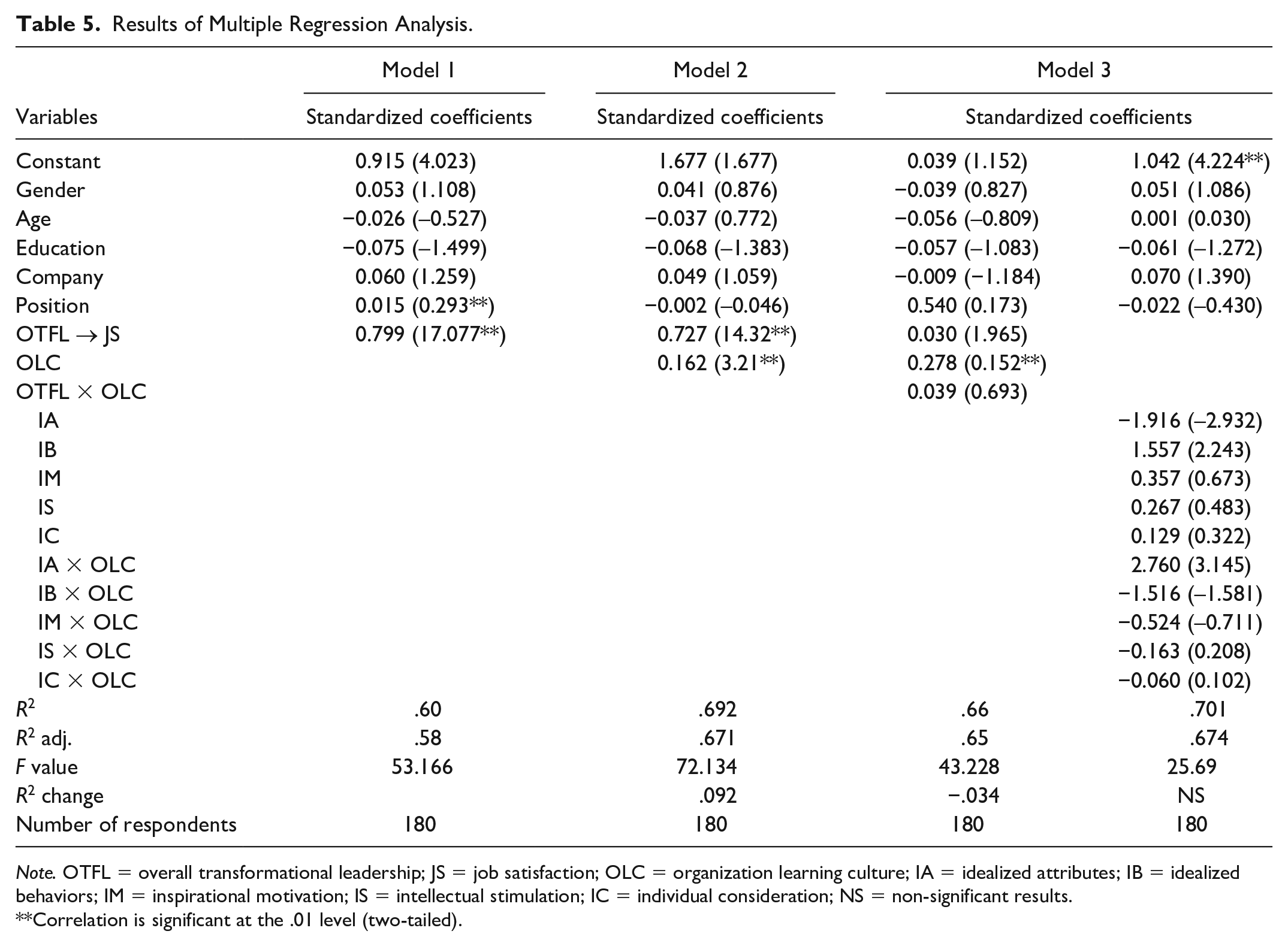
Note. OTFL = overall transformational leadership; JS = job satisfaction; OLC = organization learning culture; IA = idealized attributes; IB = idealized behaviors; IM = inspirational motivation; IS = intellectual stimulation; IC = individual consideration; NS = non-significant results.
Correlation is significant at the .01 level (two-tailed).
Discussion
This study’s focus was to empirically examine the moderating role of organizational learning culture in relation to TFL and job satisfaction. The TFL construct was tested as a single construct as well as using the five dimensions model of leadership. To empirically test the research hypotheses, a quantitative survey design was employed. The research results confirmed that TFL behavior has a positive impact on the banking sector’s employee satisfaction (path coefficient = 0.798, t = 17.69, p < .001), and therefore the H2 was accepted. Furthermore, the five dimensions of TFL were also found to be significantly correlating with job satisfaction and these dimensions also predicted significantly to employees’ job satisfaction. The research results of the study are aligned with the earlier studies (e.g., Al-Sada et al., 2017; Baranik et al., 2010; Farrell & Oczkowski, 2009; Filipova, 2011; Jokisaari & Nurmi, 2009; Lent et al., 2011; Miao et al., 2011; Pepe, 2010; Tekleab & Chiaburu, 2011). To cope with today’s fierce competition, especially in UAE’s banking sector, it is critical for leaders to have highly satisfied employees (Lim, 2003) to have high performance. Moreover, Witt (1991) also emphasizes that employees’ satisfaction and the attitude to display positive behavior (motivation) nurtures and forms the belief that their leader is supportive and understanding. Moreover, a research also concluded that the perceived positive leadership behavior leads to the feeling of job fit and ensures high job satisfaction levels (Miao et al., 2011). Furthermore, it also mentioned that the employees’ satisfaction leads to positive employee behavior, which enables the organizations to perform effectively (Baranik et al., 2010; Tekleab & Chiaburu, 2011) in a competitive dynamic environment like UAE.
Another hypothesis of the study examined the moderating role of organizational learning culture between the relationship of the five dimensions of TFL and job satisfaction. This research study aimed to contribute toward the organizational learning culture theory, which was suggested by the researchers who worked on OLC as an independent construct (Ahmad et al., 2010; Chang & Lee, 2007; Chiva & Alegre, 2009; Lund, 2003; Tsai et al., 2007). The research results for the hypothesis H3 showed that OLC did not moderate the relation between TFL and employee’s job satisfaction, such as path coefficient of product (OLC × TFL = .039, t = 0.693, p = .723). These results contradict the past studies (Ahmad et al., 2010; Al-Sada et al., 2017; Chiva & Alegre, 2009; Tsai et al., 2007). Thus, present findings reject the hypothesis H3 using data of the banking industry of UAE. Therefore, the following factors can be cautiously inferred: (a) the employees of the banking sector do not consider the learning organizational culture (continuous learning, vision sharing and team learning) to be a significant predictor of their job satisfaction; (b) The current study’s data is from respondents who belong to a conventional banking sector, where the importance of a learning culture is not established, rather than from compliance or risk management employees, where the learning culture enhances the job performance, and hence their satisfaction need to be studied.
Conclusion
Based on current study, we have concluded that TFL as a single construct or with five dimensions has significant positive influence on employees’ job satisfaction which could affect employees’ commitment. On the other side, organizational learning culture found to be non-significant on the relation between TFL and employees’ job satisfaction. This finding suggests that employees in banking sector of UAE are not able to learn/change from culture of bank.
Limitations of the Study
Despite all the efforts to prudently fulfill all the technical requirements of the research, this research work has a few limitations.
The data collection for this research work was a one-point study or cross-sectional study. It has been reported that such methods of data collection adversely affect the quality of respondents (Podsakoff et al., 2000). Hence, the differences in the respondents’ answers over time are not taken into account. The respondents represent only the banking sector, and literature suggests that data collection from any one particular sector can generate sector specific results, which may not be generalized for other sectors and other geographical areas (Jo & Joo, 2011; Rhoades & Eisenberger, 2002). Finally, this study only approached conventional banking employees as respondents, and employees working in compliance or risk management have not been included. The results might differ because of their exposure to learning needs and initiatives.
Footnotes
Declaration of Conflicting Interests
The author(s) declared no potential conflicts of interest with respect to the research, authorship, and/or publication of this article.
Funding
The author(s) received no financial support for the research, authorship, and/or publication of this article.