




Abstract
This article examines the influence of total rewards—comprising extrinsic, intrinsic, and social rewards—on employee retention in Islamic banks in Jordan, with particular focus on the employee perspective. A questionnaire is used to collect data from the study sample, which consists of 500 employees working in various Islamic banks across Jordan. The study hypotheses are then tested using partial least squares (PLS) technique by applying structural equation models (SEMs). Results show that extrinsic, intrinsic, and social rewards are all important factors in achieving employee retention. Interestingly, social rewards were shown to have the highest level of influence on employee retention. This research is new in the Jordanian context; it offers a deeper understanding of some of the most important factors in retaining talent and thereby increasing organizational productivity and competitive advantage. It furthermore provides new insights into the relationship between total rewards and employee retention within the context of the Middle East, a combination previously uncharted.
Introduction
What is the most effective way for human resources (HR) and total rewards managers to ensure employee retention within Islamic banks in Jordan? Herein lies the central question driving the current study. Organizations across the world seek to retain their talent. The loss of an employee has been proven to incur exorbitant costs in the recruitment, selection, and training of a replacement, costs amounting to a full year’s compensation or more (Allen & Bryant, 2013; Cascio, 2006). Furthermore, an organization’s human resources are among its most precious; skilled and competent employees—and thus their retention—are acknowledged as being imperative for business success (Maamari & Alameh, 2016; Mandhanya, 2015; Taamneh, Alsaad, & Elrehail, 2018). How to attract and then retain such human capital is thus a key concern for businesses globally, no less for Jordan’s Islamic banks.
Over the last two decades, a growing amount of research has investigated the factors that contribute positively to employee retention (Akhtar, Aamir, Khurshid, Abro, & Hussain, 2015; Dobson, 2009; Hollihan & LeComte, 2006; Morgan, Dill, & Kalleberg, 2013; Steinhaus & Perry, 1996; Young, Worchel, & Woehr, 1998). This research has consistently demonstrated that total rewards—the sum of every form of financial and nonfinancial compensation—play a key role in increasing employee retention within organizations (Allen, Shore, & Griffeth, 2003; Malhotra, Budhwar, & Prowse, 2007; Newman & Sheikh, 2012; Twenge, 2010). Social exchange theory, for example, has been used to argue that when employees are satisfied with the total rewards offered by their organization, this leads to employee retention.
It can thus be convincingly maintained that an individual’s motivation to remain with an organization is greatly determined by the total rewards he or she receives. To guarantee not only the retention of but also optimum performance from its employees (Milkovich & Newman, 2008), an organization must offer a range of diverse means of rewarding its staff. Indeed, effective total rewards systems have been envisioned as ongoing processes of exchanges between employer and employee, on the psychological, sociological, economic, and political levels (Bergmann & Scarpello, 2002).
While a significant amount of research exists to support the effectiveness of total rewards as a contributing factor to employee retention (Akhtar et al., 2015; Cao, Chen, & Song, 2013; Durrani & Singh, 2011; Medcof & Rumple, 2007; Morgan et al., 2013; Twenge, Campbell, Hoffman, & Lance, 2010; Wangari & Were, 2014), there is little consensus regarding which of the three types of rewards—extrinsic, intrinsic, or social—has the strongest impact on retention (Akhtar et al., 2015; Morgan et al., 2013; Newman & Sheikh, 2012). Armstrong and Murlis (2004); Bakuwa, Chasimpha, and Masamba (2013); Chen and Hsieh (2006); Gibson and Tesone (2001); Milkovich and Newman (2008); Muralidharan and Sundararaman (2011); and Zingheim and Schuster (2007), for example, all offer evidence of intrinsic rewards as demonstrating greater influence on retention than either extrinsic or social rewards. Morgan et al. (2013) and Nnabuife, Chiekezie, and Elom (2017), however, claim there is a closer relationship between extrinsic rewards and employee retention.
Especially in the context of the ongoing war for talent, it is essential that employers understand how different elements of total rewards influence the willingness of employees, notably the high performers and most highly qualified, to remain with an organization. This is also because it is, of course, unfeasible that an organization supply every possible financial and nonfinancial benefit to it employees. One key factor that has so far been largely disregarded in the extant literature on how total rewards relates to employee retention is the individuality of every employee: There is no guarantee that the various rewards provided will affect each individual employee in the same way, and this should be accounted for. A system of total rewards cannot therefore expect to be successful unless the organization has a thorough understanding of the various needs, expectations, and values—as well as education, skills, and potential—of its different employees.
This study aims at achieving a deeper understanding of the relationship between total rewards and employee retention in Islamic banks in Jordan, taking account of the particularity of the employees in this specific setting. Especially in developing countries and the organizations therein, employee retention has become a problem that significantly hinders business development. While a total rewards approach has been highlighted as a critical determinant of employee retention in any context, there remains a limited understanding based on empirical proof of what a successful total rewards system comprises, and minimal recognition of the importance of including employee needs in the design of such a system. Furthermore, none of the extant studies into different types of rewards and how effective they are in improving employee retention have been conducted in the particular context of Islamic banks in Middle East. Given the ethical codes, corresponding expectations and priorities of much of the workforce therein, this context will not necessarily follow patterns typical in Western countries and organizations. The Islamic banking sector is furthermore one that holds economic importance in the Middle East, and particularly in Jordan; its prosperity is of significant consequence to the country and region’s economic welfare, thus meriting closer study. It is the intention of this study to address this gap.
Literature Review
Employee Retention
Employee retention continues to pose one of the greatest challenges facing organizations and managers today (Pregnolato, Bussin, & Schlechter, 2017), with the loss of valuable talent incurring heavy costs to the organization in terms of institutional know-how as well as the time, money, and efforts needed to recruit and train replacements. Iqbal (2010), in a study of employee turnover in Saudi Arabian organizations, claimed that in a technical firm, the cost of losing one employee can reach up to $200,000 or 250% of that employee’s salary. Chiboiwa, Samuel, and Chipunza (2010) put the cost of replacing an employee at 150% of that employee’s salary, a significant draw on the operations and maintenance budget. Anis, Rehman, Rehman, Khan, and Humayoun (2011) evaluated the cost of replacement at roughly the same sum of 1 year’s salary plus benefits for the given employee. In itself, finding suitably qualified replacements is not easy (Boyens, 2007) and requires significant efforts as well as expense.
In the current climate of intense competition for talent among businesses worldwide, high turnover is an ever-greater threat. As more and more organizations begin to offer higher rewards systems that foster individual career development, others are having to seriously address their own retention strategies. For organizations to keep up with their competitors and guarantee the growth of their businesses, such strategies must effectively ensure employee satisfaction, enhance employee performance, and ultimately safeguard against high turnover (Nwokocha & Iherirohanma, 2012; Ramlall, 2004).
Employee retention strategies are therefore those aiming to prevent the loss of an organization’s highly valuable employees. They aim to motivate employees to remain with their employer organization for as long as possible to the advantage of both. Acquiring and retaining capable employees is key for any organization given that employee expertise and knowledge stand at the core of a firm’s economic competitive advantage. A longer employee retention period is considered a significant part of an organization’s competitive advantage; an organization’s performance and productivity are therefore expected to increase when its employees remain with the firm for a longer period. According to Amadasu (2003), Gberevbie (2008), and Taplin, Winterton, and Winterton (2003), the implementation of appropriate and adequate employee retention approaches will result in employees staying and working toward achieving the organizational objectives.
Various studies have attempted to identify the determining factors behind employees’ intentions to leave their job and move to another organization (e.g., Bluedorn, 1982; Kalliath & Beck, 2001). The reasons that have emerged are multiple. A combination of job pressure, lack of job satisfaction, and low commitment to the organization is cited as leading to employees’ resignation (Firth, Mellor, Moore, & Loquet, 2007). According to Kaliprasad (2006), the employee retention capacity of an organization totally relies on the organization’s capability to manage its human resources well; it is well noted that unhappy employees will lean toward leaving their organization (Schuler & Jackson, 2006).
Total Rewards
Total rewards consist of all monetary, nonmonetary, extrinsic, intrinsic, and social benefits that an employee could receive from his or her employer organization (Chinyio, Suresh, & Salisu, 2018; Dessler & Cole, 2011; Dobson, 2009; Morgan et al., 2013; Twenge et al., 2010). Several studies have demonstrated the critical role played by a total rewards approach in ensuring organizational commitment and willingness to remain among employees (Chiboiwa et al., 2010; Medcof & Rumple, 2007; Morgan et al., 2013; Newman & Sheikh, 2012). Wang (2004) furthermore argued that the increased motivation and retention of employees, as a result of total rewards, contributed to ensuring top-notch individual performance and workforce loyalty.
Within the literature, three principal forms of organizational rewards are identified: extrinsic, intrinsic, and social (Morgan et al., 2013; Twenge et al., 2010; Williamson, Burnett, & Bartol, 2009). Extrinsic rewards essentially consist of tangible benefits including pay, promotion opportunities, career development, and a reasonable workload (Malhotra et al., 2007; Morgan et al., 2013). Intrinsic rewards, on the contrary, are intangible forms of compensation, such as the opportunity to have input into the definition of one’s job tasks, meaningfulness of job tasks, and coworker support (Hackman & Oldham, 1976; Morgan et al., 2013). Social rewards include those derived from positive social interactions within the workplace such as enjoying supportive relations with colleagues and supervisors (Twenge et al., 2010; Williamson et al., 2009).
As previously discussed, while much research supports the premise that a total rewards approach to employee compensation positively impacts retention (along with motivation, organizational commitment, and performance), there are inconsistent findings concerning which types of rewards are most effective in this regard. A comprehensive literature review suggests that a majority of modern studies support the greater influence of intrinsic rewards as determinants of retention. Stone, Bryant, and Wier (2010), for example, noted that financial incentives do not always achieve what they are supposed to, and that material incentives in general fail to fulfill employees’ basic psychological needs or indeed account for the diversity of individual needs. On the same note, Hill and Tande (2006) found that 88% of highly skilled employees left their organization on the basis of nonmonetary motives. The principal causes of turnover were limited development opportunities (39%), unhappiness with management (23%), and feeling a lack of recognition (17%).
Ultimately, however, numerous recent studies advocate for the implementation of a total rewards strategy comprised of a diverse range of incentives so as to meet the various material and nonmaterial needs of an organization’s workforce and thus increase their likelihood to remain within the organization (Akhtar et al., 2015; Armstrong & Brown, 2006; Cao et al., 2013, among others).
Extrinsic rewards
Extrinsic rewards are considered the factors that make up the external context within which a job is executed (Herzberg, Mausner, & Synderman, 1959; Olsen, Kalleberg, & Nesheim, 2010). They consist of the total package of tangible benefits obtained by the employee from their employer organization, including financial compensation, employer insurance, organizational support for education and training, promotion opportunities, reasonable workload, and supervised career development (Morgan et al., 2013). As noted by Thorndike (1911), the idea that people are motivated to work by key factors like wages or other financial or material incentives, thus extrinsic rewards, goes back to the very dawn of academic research into work. And despite the fact that much recent literature focuses primarily on the importance of other types of compensation, extrinsic rewards remain essential to employment and employee management (Twenge et al., 2010). The receipt of extrinsic benefits deemed sufficient for the individual employee’s needs is likely to positively affect his or her choice to remain with that organization (Chinyio et al., 2018). Specifically, it has been noted that wages are likely the only essential extrinsic reward (McGovern, Smeaton, & Hill, 2004), although various studies link employees’ intention to continue with their current employer with the joint benefits of high wages and opportunities of advancement (Bishop, Weinberg, Leutz, Dossa, & Pfefferle, 2008; Chinyio et al., 2018; Stearns & D’Arcy, 2008).
Based on the above, the following hypothesis is made:
Intrinsic rewards
Intrinsic rewards refer to nonfinancial benefits such as supervisor support in executing job tasks, the opportunity for autonomy in or having one’s own input into job tasks, the meaningfulness of those tasks, and support from coworkers (Morgan et al., 2013). In exchange for the intrinsic rewards offered to employees, the principal benefit gained by the employer organization is the core motivation that develops in an employee to achieve his or her job tasks rather than motivation driven purely by the idea of receiving tangible incentives and further extrinsic rewards. Hence, an interesting work environment, challenging and varied work tasks, and responsibility are all acknowledged as factors that render a job intrinsically motivating. Such a job should furthermore allow employees to see the results of their hard work, and sense how their work makes a significant difference to others (Deci & Ryan, 2000; Hackman & Oldham, 1980).
These intrinsic features of the job are an essential factor in an employee’s evaluation of their job regardless of the significance of the job’s extrinsic aspects (Gallie, Felstead, & Green, 2012). Intrinsic rewards usually exist within and emerge from doing the job itself, such as a sense of accomplishment, challenge, autonomy, personal and professional development, status, acknowledgment, the admiration of superiors and coworkers, and self-esteem (Mahaney & Lederer, 2006, p. 43). It is believed that employees are more likely to work hard and generate excellent results if they are well motivated; feel proud of what they do; believe their exertions are vital for the success of the team; and have jobs that are exciting, rewarding, and stimulating (Mahaney & Lederer, 2006, p. 50). The effects of the lack of some of these intrinsic benefits have been interestingly documented. For example, Wetzels, Ruyter, and Bloemer (2000) and De Ruyter, Wetzels, and Feinberg (2001) found that feelings of uncertainty, subsequent stress increase, and ultimate emotional detachment from the employer organization are likely to occur in employees who are uncertain about their employer’s expectations of them. If, on the contrary, such clarity was afforded to the employees, they might reasonably be expected to demonstrate greater intention to remain. Other studies have highlighted the effectiveness of intrinsic rewards such as work–life balance, appreciation, challenging tasks, and special projects in motivating and retaining employees, notably those who already have significant work experience (Hytter, 2007; Jeffords, Scheidt, & Thibadoux, 1997; Zahra, Irum, Mir, & Chisti, 2013). Ultimately, there are numerous academic voices that have laid emphasis on the importance of offering intrinsic rewards for the sake of improving employee retention (Cao et al., 2013; Medcof & Rumple, 2007, among others).
Accordingly, the following hypothesis is proposed:
Social rewards
As stated in most of the needs-based motivation theories, one of the elements of intrinsic motivation is the need to belong or to be connected (McClellend, 1985; Ryan & Deci, 2000). Social rewards target this particular need and include affection, admiration, praise, and attention from others. They are social interactions known to produce a sense of security and to reinforce employees’ feelings of belonging and acceptance within the working environment. Social rewards manifest in the opportunities a working environment offers to individuals to build friendships and have positive contact with multiple other individuals in the course of work. In receiving these social rewards, employees will experience the feeling of proficiency and self-confidence both in the performance of their tasks and in social interactions. This type of reward is particularly significant because it can be delivered frequently and instantly, for example, directly after witnessing desirable behavior from an employee. The simplest gestures, expressed through a smile or a kind word from a person of interest, can be the best motivation for individuals to go the extra mile and excel at what they do. Employees are likely to develop a sense of obligation and emotional attachment toward their organization if they are pleased with the way in which their supervisors direct them and evaluate their performance (Eisenberger, Armeli, Rexwinkel, Lynch, & Rhoades, 2001). Hence why social rewards can be an excellent choice to maintain continuant and consistent employee involvement within an organization, and why social rewards are considered a more effective motivation tool than financial incentives.
Based on the above, the following hypothesis is proposed:
Method
The instrument used in this study to collect data is a questionnaire. The questionnaire consists of five parts. In the first part, respondents were asked to provide demographic information (gender, age, level of education, years of experience, and employer bank). In the remaining parts, respondents were asked to express their level of agreement with multiple statements relating to the main variables in this study: extrinsic rewards, intrinsic rewards, social rewards, and employee retention. The measures of both extrinsic and extrinsic rewards were taken from Morgan et al. (2013). The measures of social rewards were taken from Twenge et al. (2010). Finally, the measures of employee retention were taken from Kehoe and Wright (2013). All answers were given on a 5-point Likert-type scale where 1 = strongly disagree and 5 = strongly agree.
The study population included all employees in the Islamic banks in Jordan: Islamic International Arab Bank, Jordan Islamic Bank, Jordan Dubai Islamic Bank, and Al Rajhi Bank, distributed over 136 branches across Jordan (this figure being taken from the Central Bank of Jordan, 2016 report). A sample consisting of 500 employees were randomly selected for the study to avoid sampling bias. The analysis unit included branch managers, administrative staff, and accountants. Of the total number of questionnaires distributed in the study sample, 392 (78.4%) were recovered. Seven questionnaires were incomplete and therefore not valid for analysis. Thus, the final number of questionnaires that fulfilled the necessary conditions and accordingly underwent analysis was 385, 77% of the total distributed.
Descriptive Statistic
Table 1 demonstrates that the number of male respondents came to 244, representing 63.3% of the total respondents, while 141 were female, representing 36.6%. In terms of age group, the highest percentage of the sample (50.9%) was between 31 and 40 years old, while the second highest (28.1%) was aged 41 years or more. Regarding the level of education, the highest proportion of the total study sample (67%) was bachelor’s degree holders, 22.3% were master’s degree holders, while the lowest percentage (10.65%) have a PhD degree. Finally, as regards professional experience, the greatest proportion of the sample (30.9%) claimed to have between 5 and 10 years of experience, and the second largest between 11 and 15 years, representing 28.8%.
Demographical Characteristics of the Respondents (n = 385).

Data Analysis
This study selects the variance-based structural equation modeling with partial least squares (normally known as PLS-SEM) to analysis our model. As a nonparametric technique, PLS-SEM can be used for prediction purposes by maximizing variance explained in dependent variables, particularly when data violates the normality assumption and when some key regressors are omitted from the model (Garson, 2016; Hair, Hult, Ringle, & Sarstedt, 2014; Petter, 2018). In addition to these proprieties, we belief that PLS-SEM is appropriate for this study because it offers a greater statistical power in that it is more likely to identify relationships as significant when they are indeed present in the population (Hair, Risher, Sarstedt, & Ringle, 2018; Sarstedt, Ringle, & Ting, 2019). Therefore, PLS-SEM is the data analysis technique of this study. We conducted the PLS-SEM analysis with the software ADANCO by Henseler and Dijkstra (2018) to assess both the measurement and structural models of this study. Each model is described and discussed in detail below.
Measurement Model Assessment
The measurement model of this study involves four latent constructs, including extrinsic rewards (ER), intrinsic rewards (IR), social rewards (SR), and employee retention (ERT). Both extrinsic and intrinsic rewards are operationalized as reflective second-order constructs (multidimensional constructs); meanwhile, social rewards and employee retention are operationalized as reflective first-order constructs (unidimensional constructs). The construct of extrinsic rewards is reflected through five first-order constructs, including financial rewards (FR), organizational support for education and training (OSET), promotion opportunities (PO), reasonable workload (RW), and supervised career development (SCD) (Morgan et al., 2013). The construct of intrinsic rewards is reflected through four first-order constructs, comprising supervisor support of job tasks (SSJT), input into job tasks (IIJT), meaning of job tasks (MJT), and coworker support (CWS) (Morgan et al., 2013).
Because the measurement model contains latent variables constructed at a second-order level, we first assess the psychometric proprieties of the first-order constructs (Alsaad, Mohamad, & Ismail, 2015; Wetzels, Odekerken-Schröder, & Van Oppen, 2009). Then, using repeated indicator approach to model the second-order construct of extrinsic and intrinsic rewards (Becker, Klein, & Wetzels, 2012; Polites, Roberts, & Thatcher, 2012), we simultaneously estimated the second-order model and the structural model. The results indicate that the measurement model of the first-order constructs comes across standard validity and reliability criteria. As shown in Table 2, loadings of items and the average variances extracted (AVE) of each construct were all greater than the threshold of 0.5, which demonstrate an acceptable convergent validity (Hair, Ringle, & Sarstedt, 2011). For reliability, the table shows that composite reliability (CR) coefficients were greater than the cutoff 0.7, demonstrating a great deal of reliability (Hair et al., 2011). For discriminant validity, Table 3 shows the results of Fornell-Larcker criterion which is a common way to provide insights into discriminant validity. In this criterion, discriminant validity is proven when each construct’s AVE is larger than its squared construct correlations with other constructs (Fornell & Larcker, 1981), which is the case of this study. Furthermore, we used the cross-loading method to evaluate the discriminant validity of the measurement model (Hair et al., 2011). The results presented in Table 4 showed that the item loadings in their postulated latent variable are all higher than the loadings of the items in other constructs, demonstrating acceptable discriminant validity.
The Psychometric Proprieties of the First-Order Constructs.

Discriminant Validity: Fornell-Larcker Criterion.

Note. Average variances extracted in the diagonal. FR = financial rewards; PO = promotion opportunities; OSET = organizational support for education and training; SCD = supervised career development; ERT = employee retention; RW = reasonable workload; SSJT = supervisor support of job tasks; IIJT = input into job tasks; MJT = meaning of job tasks; CWS = coworker support; SR = social rewards; ER = extrinsic rewards.
Discriminant Validity: Cross-Loading.

Note. FR = financial rewards; PO = promotion opportunities; OSET = organizational support for education and training; SCD = supervised career development; RW = reasonable workload; SSJT = supervisor support of job tasks; IIJT = input into job tasks; MJT = meaning of job tasks; CWS = coworker support; SR = social rewards; ERT = employee retention.
Bold values indicate that the item loadings in their corresponding columns are all higher than the loadings of the items used to measure the other constructs.
Similar to the first-order model, the second-order model performs very well in terms of validity and reliability. Results in Table 5 show that the dimensions (first-order constructs) of extrinsic and intrinsic rewards all weight more than 0.5 on their postulated second-order construct which were well greater than the conventional threshold (Alsaad, Mohamad, & Ismail, 2017, 2018; Becker et al., 2012; Polites et al., 2012). Moreover, all the path coefficients and t-values from second-order to first-order are significant at p < .001.
Evaluation of the Second-Order Model.

Note. IR = Intrinsic Rewards; SSJT = supervisor support of job tasks; IIJT = input into job tasks; MJT = meaning of job tasks; CWS = coworker support; ER = extrinsic rewards; FR = financial rewards; PO = promotion opportunities; OSET = organizational support for education and training; RW = reasonable workload; SCD = supervised career development.
Common Method Bias (CMB)
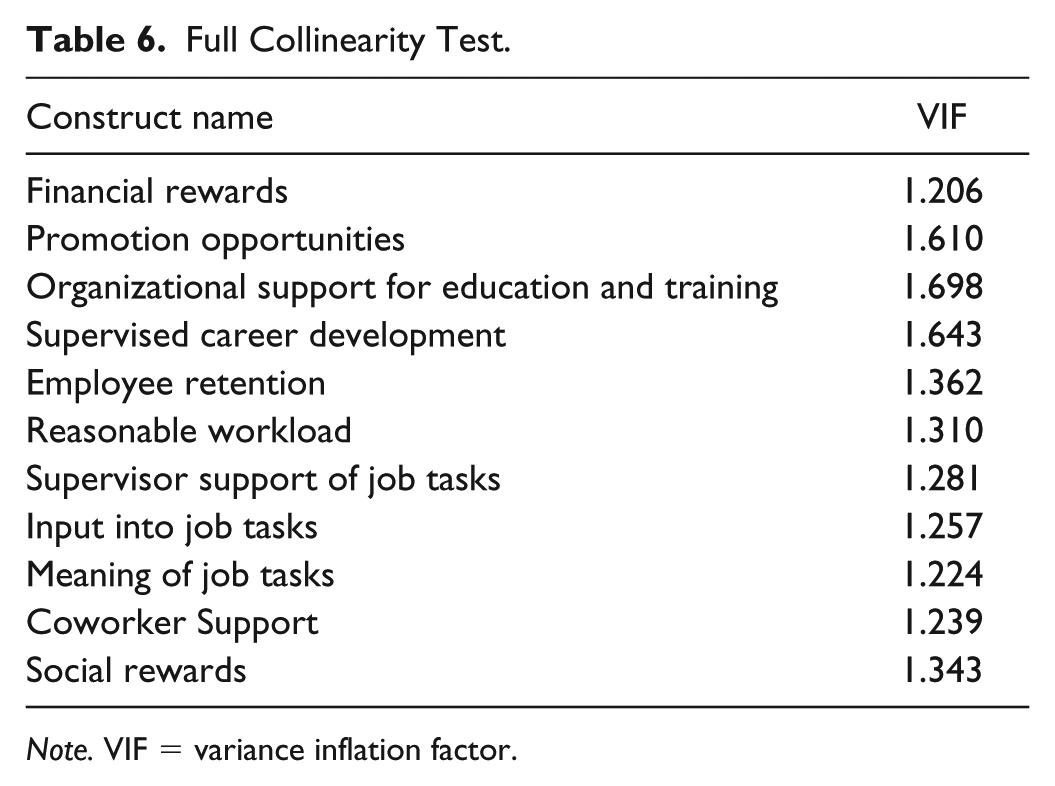
This study employed Harman’s one-factor test to assess common method variance (Podsakoff, MacKenzie, Lee, & Podsakoff, 2003; Podsakoff & Organ, 1986). A principal component analysis was conducted of all variables included in this study. The results show that no single factor appeared as a dominant factor accounting for most of the variance. The factor with the greatest eigenvalue accounted for only 13.0% of the variance, which indicates that CMB is not a major concern. Because Harman’s one-factor test suffers some limitations (Jarvis, MacKenzie, & Podsakoff, 2003), we also adopted full collinearity test which is effective in the identification of CMB, particularly in PLS-SEM (Kock, 2015, 2017; Kock & Gary, 2012). Full collinearity test examines whether, or not, predictor variables along with a criterion variable collinear with each other in a model. According to rule of thumb, the model can be considered free of CMB if variance inflation factors (VIFs) of the full model, including the criterion variable, does not exceed the threshold 3.3 (Kock, 2015, 2017; Kock & Gary, 2012), which is the case of this study as shown in Table 6.
Full Collinearity Test.
Note. VIF = variance inflation factor.
Structural Model Assessment
We assess the hypothesized relationship in this section and examine the explanatory power of the model. We applied the PLS algorithm and bootstrap procedures to estimate the R-square, path coefficients, standard error, and t-statistics. The results are presented in Table 7 and depicted in Figure 1. According to R-square assessment of the employee retention, the percentage of variation explained is moderate (R2 = %23.6). Based on the results in Table 7, there appears to be a positive effect of extrinsic rewards on employee retention (coefficient = 0.084, p < .05). This indicates that the increase of one degree in extrinsic rewards leads to an 8.4% improvement in employee retention. There is furthermore a positive effect, statistically significant on an alpha level of α < 0.05, of intrinsic rewards on employee retention (coefficient = 0.098, p < .05). Thus, an increase of one degree in intrinsic rewards leads to improving employee retention by 9.8%. A positive effect, statistically significant on an alpha level of α < 0.05, of social rewards on employee retention (coefficient = 0.431, p > .00) is also evident, indicating that the increase of one degree in social rewards leads to an improvement in employee retention of 43.1%. Accordingly, we accept all of our hypotheses which state that there are relationships between total rewards (extrinsic, intrinsic, and social rewards) and employee retention in Islamic banks in Jordan.
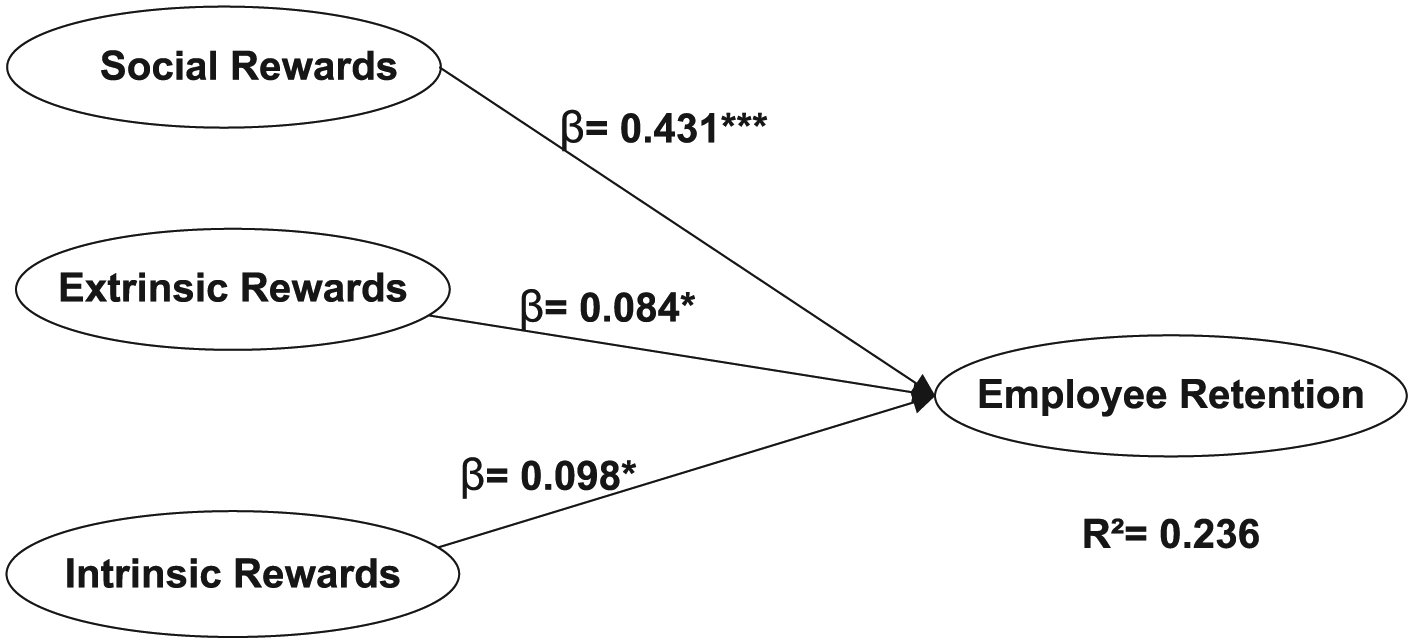
The results of the structural model assessment.
The Results of the Structural Model Assessment.

Discussion
The aim of this study was to discover the relationship between total rewards and employee retention in Jordanian Islamic banks. Our findings demonstrate a positive significant relationship between total rewards (extrinsic, intrinsic, and social) and employee retention in Jordanian Islamic banks. This finding is in line with Akhtar et al. (2015); Malhotra et al. (2007); Morgan et al. (2013); Oyoo, Mwandihi, and Musiega (2016); Newman and Sheikh (2012); Twenge et al. (2010); and Wang (2004). The first hypothesis has therefore been proven.
It is widely recognized that an organization’s success relies heavily on the quality of its employees. Keeping employees, in particularly high performers, can be said to depend significantly on the effectiveness of the total rewards system implemented within the organization. In addition, a higher employee retention rate will significantly reduce the overall cost of the recruitment, selection, and training process within the organization. In the aim of retaining high-quality employees, all of the Islamic banks in Jordan are implementing total rewards strategies. Strategies such as paying the thirteenth-sixteenth salaries, offering interest-free loans, and following up with employees concerning their personal issues are gestures made by the management to demonstrate that the bank system cares for the welfare of its employees. Furthermore, supervisors treat employees with respect, give them credit for their contributions, and give them the space to express their opinions and observations (Jordan Islamic Bank, 2017).
Herzberg et al. (1959) clarify the importance of this categorization of different types of rewards, as opposed to previous studies that proposed job satisfaction in general as an indicator of employment intention and turnover (Griffeth, Hom, & Gaertner, 2000). In addition, modern organization theory on extrinsic rewards, such a system is widely recognized as playing a key role in the employment process and retention (Brett and Stroh, 2003; Chinyio et al., 2018; Ryan & Deci, 2000).
The results of this study reveal that social rewards engender higher levels of effectiveness on employee retention than intrinsic or extrinsic rewards, with employees expressing their happiness and satisfaction with their prestigious jobs that give them a chance to make friends, to come into contact with a lot of people, and to develop a relationship with their employers.
Modern organization and managers realize that social rewards are extremely important to retain talent employees. Today’s employees want leisure time (e.g., vacation time or days off) to travel or spend with friends. In addition, managers might consider incorporating increased social rewards (e.g., a job that gives you a chance to make friends, and a job that permits contact with a lot of people) into rewards system to attract and retain employees (Twenge et al., 2010). Yet, managers and organizations are often unaware about the key role of social rewards to increase retention rate.
Islamic banks across the world have barely been affected by the global financial crisis (Alqahtani & Mayes, 2017), unlike non-Islamic banks, evidence that the policies adopted by Islamic banks including their total rewards systems positively affect employee retention, enhance customer confidence, and contribute to greater financial security and overall reliability of service. This research contributes to the field of total rewards and employee retention by providing evidence from this unstudied but important context, reinforcing the findings of previous studies hitherto conducted in primarily Western contexts.
Limitations
It is important to acknowledge the limitations of this article. First, there were significant difficulties in distributing the questionnaires due to the wide geographical distribution of Islamic bank branches throughout the kingdom, which has proved a highly time-consuming process. It may be that this study is not then truly representative of the entire kingdom. Second, this study is the first of its kind in Jordan, meaning that there is limited benefit in comparing its findings with those of other studies whose contexts are vastly different. Therefore, it would be useful to study this topic in other sectors to be able to generalize the results across different industries. In addition, it is recommended that mix methodology using both quantitative and qualitative data collection and analysis should be adopted. This would not only provide with greater information but would also help in generalizing the results of the study. It is also recommended that a comparative analysis of Islamic banks and non-Islamic banks should be done to ascertain the differences between retention and total rewards policies adopted by the banks. Third, although PLS-SEM offers a greater statistical power, it has received in recent times many scholarly criticisms, such as the lack of quality indices and the inability to capture measurement error (Alsaad, Yousif, & AlJedaiah, 2018; Hair et al., 2018). Thus, future research should employ another SEM approach that handles such limitation (e.g., Amos).
Conclusion
The key aim of the study was to discover the relationship between total rewards and employee retention in the specific context of Islamic banks in Jordan. The findings of this article help to paint a relatively detailed picture of this relationship. Based on these findings, it is strongly recommended that efforts to minimize turnover in Jordan’s Islamic banks must incorporate carefully designed total rewards strategies—incorporating extrinsic, intrinsic, and social rewards—aimed at motivating employees, and satisfying their particular needs. In addition, by understanding the total rewards and retention relationship, human resource management and managers can develop policies and strategies for not only retaining the qualified employees but also to become more profitability and successful.
This article contributes to the literature on employee retention by increasing academic knowledge concerning the relationship between employee retention and total rewards, notably in the context of the Middle East where little quantitative research has so far been conducted on the topic. However, further investigation is needed to better understand the variety of motivating factors, besides organizational rewards, behind employees’ decisions to continue working for their respective organizations. Such variety might well be explained through discrepancies in culture, orientation, employee needs and relations, among other factors. Future research could furthermore build on this study to examine the extrinsic, intrinsic, and social rewards implemented among a larger sample of commercial banks and even businesses in other sectors in Jordan or across the region.
Implications and Recommendations
The findings of this study in themselves offer some very clear implications for both individuals, notably those in management and senior management, and organizations (particularly, but not exclusively, Islamic banks) in terms of improving employee retention through the use of total rewards. Notably, retention strategies within Jordan’s Islamic banks should specifically consider how to target the more highly qualified employees in its workforce. It would furthermore be of great benefit if this research were to adopt the new model that contains the three types of rewards which are merged to form one composite variable of total rewards that motivate and increase retention rate to get the competitive advantage. In order to truly demonstrate and emphasize how a total rewards strategy can prevent the turnover of human resources, improve productivity, and ultimately ensure an organization’s competitive advantage.
Globally, it is essential that organizations develop effective strategies for retaining their most talented employees to ensure stability and business success, and maximum support should be offered to both researchers and practitioners in building on and responding to the findings of this study.
Footnotes
Declaration of Conflicting Interests
The author(s) declared no potential conflicts of interest with respect to the research, authorship, and/or publication of this article.
Funding
The author(s) received no financial support for the research, authorship, and/or publication of this article.
