




Abstract
This article studies how the political affiliation and administrative rank of news organizations in a nondemocratic setting affect news selection autonomy. While existing studies have found that further commercialization contributes to more news selection autonomy, the extent to which political affiliation and administrative rank of news media explain autonomy remains unknown. Eight Chinese news organizations of varying political affiliations and administrative ranks were thus selected to compare their news and frame selection strategies. The findings reveal that political affiliation largely explains news selection autonomy: Party-affiliated outlets generally have lower news selection autonomy than nonparty outlets. Administrative rank has some effect on news selection autonomy in the highly competitive media markets, where news organizations with a lower administrative ranking must play more with propaganda control to compete with their higher ranking counterparts.
Introduction
Due to political control, news organizations in nondemocratic environments have limited autonomy on news selection (Hao et al., 1998). The politics–media relations in authoritarian regimes are characterized by “parallelism,” that is, political parties own news organizations and determine their news content (Blumler & Gurevitch, 1995; Seymour-Ure, 1974). Also, in autocracies, however, the media autonomy, here defined as the media’s degree of freedom to select news issues and frames based on audience rather than political demand, varies, for instance, according to news type: There is more freedom to select economic than political news (Hu, 2011), because the former has less impact on state governance (Hao et al., 1998).
Our autonomy definition reflects the impact of the antagonistic relations between the audience and the political authorities on media content: Commercialization is expected to correlate positively with news selection autonomy and negatively with political control. Indeed, previous studies have found that media commercialization possibly reduces party parallelism and increases journalistic autonomy (Blumler & Gurevitch, 1995; Seymour-Ure, 1974). Although communication studies in China have indicated that media marketization and commercialization, which had been led by the Chinese party-state, have promoted the stability of authoritarian rule with the state–media connection being strengthened rather than weakened (e.g., Lee et al., 2006; Stockmann & Gallagher, 2011; Winfield & Peng, 2005; Zhao, 2000). Yet this does not mean that the Chinese media have not gained more autonomy since the marketization.
Most of the Chinese news organizations are now commercialized. Although economically liberalized, politically they remain part of the party-state propaganda apparatus. This unavoidably leads to market–politics conflicts and places the media in a dilemma; on one hand, the party-state needs the news organizations to serve state interests by toeing the propaganda line on what can and cannot be reported—and how (Pan & Chan, 2003; Zhang, 1993). On the other hand, as financially independent corporations, news organizations must meet the audience’s demands for professional journalism.
Extant studies on media development in China indicate that increasing media autonomy in recent decades has resulted from media commercialization due to economic reforms (Pan & Chan, 2003; Stockmann, 2011, 2013; G. G. Wu, 2000) As Qian and Bandurski (2011) suggest, the media commercialization, in combination of the growing norms of journalistic professionalism and the development of new media, have eroded “the CCP’s monopoly over the public agenda” and promoted the formation of “a limited public sphere” (p. 39). However, despite these developments, party control over the mass media has become even more effective than previously, and the prospects for press freedom continue to be bleak without political reforms (Hadland & Zhang, 2012; Huang, 2001; Li, 2013; Winfield & Peng, 2005).
These studies have examined news selection autonomy from a longitudinal macroscopic perspective. Little is known about if and how news selection autonomy varies across the Chinese news organizations. Inspired by the political economy theory on news media production, this study is breaking new ground by comparing the news selection strategies of different news outlets and hopes to answer an underexplored question: How do Chinese news organizations with different political affiliations and administrative ranks vary in terms of news selection autonomy?
Influences on News Selection Autonomy
The power of news organizations to decide which news issues enter the public sphere and which aspects of issues are presented (Gans, 1979) is constrained by extra-media factors, including political/governmental control and market forces (Scheufele, 1999). For instance, Hallin and Papathanassopoulos’s (2002) comparative study on clientelism shows how oligarchs, industrialists, parties, and/or the state have instrumentalized news organizations in Southern Europe and Latin America. Political influence on media autonomy is particularly strong in less democratic settings.
Since the 1990s, the news media in authoritarian China have become increasingly financially independent of the state but remain subjected to tight political control. Political control increases the tendency of news organizations to obey political directives on news selection. Not only emphasizing the persistence of political domination, some researchers also see the media marketization sponsored by the party-state as a new form of control promoting the stability of the authoritarian regime (Lee et al., 2006; Stockmann & Gallagher, 2011; Winfield & Peng, 2005). Research indeed found that the state authorities have been successful in keeping the media within their orbit (Akhavan-Majid, 2004; Zhao, 2000). But the strengthened authorities–media connection should not conceal the fact that the media have in fact gained considerable autonomy subsequent to marketization. News media autonomy, for example, has increased gradually due to either promotions from above by the state or efforts from below by journalists resisting political control (G. G. Wu, 2000). This increased news media autonomy becomes obvious when comparing the news reporting of the different types of news outlets (Stockmann, 2013). Because of the expanded media autonomy, journalistic professionalism is becoming a competing paradigm to party journalism in China (Pan & Chan, 2003).
Comparisons of media autonomy in different countries/regions (see also Blumler & Gurevitch, 1991, 1995; Hallin & Mancini, 2004; van Dalen, 2011) indicate that the news selection autonomy of news organizations differs according to their respective affiliations with the political parties. In the same vein, we expect Chinese news organizations to vary in their news selection autonomy as a result of organizational differences. Here, the focus is on two such differences: political affiliation and administrative rank.
Political Affiliation
Chinese news organizations have a party or nonparty affiliation. The distinction is often compared with the Western elite–tabloid dichotomy (Shao, 2002; Wang, 2004), yet it is fundamentally different. In China, all of the news organizations are state-owned. Previously, they were all party-affiliated, propagandizing the lines, principles, and policies of the party-state (Wei, 1999). Since the 1990s, existing party news organizations, following state-sponsored economic reforms, have established market-targeting, subnews outlets. This is essential for their survival, because the state no longer subsidizes them while requiring them to fulfill propaganda functions. This transformation first occurred in the print media with the flourishing of mass-appeal newspapers (Wei, 1999; Zhao, 2000). Later, radio and television followed suit with “civic news programs” focusing on issues of interest to the public.
Despite increasing commercialization, party news outlets remain the “authoritative voice of the ruling power” (Huang, 2001), whereas nonparty outlets are market-oriented, seeking profits to support the operations of the media conglomerate.
Comparative studies of party and nonparty newspapers reveal how the two differ on three key dimensions (Huang, 2001; Wei, 1999). The first dimension is news content. Party newspapers focus more on policies and party guidance, whereas nonparty newspapers highlight materials appealing to the public (Shao, 2002). The second dimension is political status. As the authoritative voice of the party-state conveying policies, party newspapers have high political status, whereas nonparty newspapers are not considered to be official media (Shao, 2002). The final dimension is circulation. The circulation of most party newspapers depends on mandatory subscriptions paid by the state (Huang, 2007; Shao, 2002). For instance, all state agencies are required to subscribe to party newspapers. Nonparty newspapers instead depend on market circulation. There have been no studies of party and nonparty radio and TV news organizations in China, but they are expected to display traits similar to those of the newspaper organizations.
With more politics-oriented content, higher political status, and state-supported circulation, party news organizations are expected to have less news selection autonomy than nonparty organizations with more market-oriented content, lower political status, and marketized circulation.
Administrative Rank
Chinese state organs are ranked according to their level of governance (Zhan, 2002). As state-owned units, news organizations are subjected to the hierarchical administrative system in which their administrative rank can be one of the following, listed from high to low: ministry/province level (buji), subministry/province level (fu buji), department level (tingji), subdepartment level (fu tingji), division level (chuji), subdivision level (fu chuji), section level (keji), and subsection level (fu keji). The administrative rank of a news organization is usually one level lower than its direct supervisory body (Wei, 2012).
The administrative rank of a news organization affects the reporting and censorship restrictions imposed by supervisory bodies (Lu, 2005). News organizations with a higher administrative ranking have fewer restrictions imposed on them than lower ranking organizations but are subjected to closer censorship, because they potentially have a greater social impact, as they cover a wider range of topics and have privileged access to political news sources in higher level government units. A news organization with a low administrative ranking has limited access to interview higher ranking officials and cannot report on issues forbidden by propaganda organs with a higher administrative ranking. Due to their limited social impact, however, superior authorities subject them to less control. They therefore tend to produce more lively news content to attract a greater share of the audience.
As the administrative ranking of a news organization has both positive and negative effects on news selection autonomy, we do not expect administrative rank to correlate with news selection autonomy.
Studying News Selection Autonomy
Chinese propaganda supervision authorities issue “propaganda notices,” that is, bans on/promotions of specific news issues and frames, and their significance for journalistic practice is well documented (i.e., Lu, 2005; Rui, 2010). A news organization’s news coverage of an issue can differ greatly before and after the propaganda notice reaches the newsroom (Rui, 2010). We therefore focus on the following two dimensions in our study of news selection autonomy: self-censorship and compliance with propaganda notices, which indicate, respectively, the autonomy of a news organization before and after receiving a propaganda notice.
Self-Censorship
China never had journalistic laws or regulations (J. Wu & Yun, 2005). Propaganda notices are made on an event-by-event basis, that is, only when an event happens will the propaganda authorities inform the news media if the event can be reported and/or how it should be reported (Lu, 2005). In theory, news media should have more freedom to select news issues and news frames before receiving a propaganda notice. Yet news workers often talk about “invisible control” and self-discipline in the absence of a propaganda notice (Lu, 2005; C. Zhang, 2011). In fact, research on the framing of sensitive news in China has suggested that party newspapers are more self-censored than their nonparty counterparts are as they use more leadership frames, which highlight the speeches and actions of political leaders (Kuang & Wei, 2018). Self-censorship is thus one aspect to be studied when comparing the news selection autonomy of Chinese news organizations.
Compliance With Propaganda Notices
Although many have now been commercialized, Chinese news organizations remain primarily political organs (Zhao, 2000). They must therefore obey propaganda notices for fear of sanctions from the propaganda authority (Zhang, 2010). Nevertheless, journalists from nonparty news organizations often talk about “playing with the edge 1 ” of the propaganda notice, indicating that there is some space to avoid obeying the propaganda notice entirely (Hao, 2004). Many studies, for example, Kuang (2017), Tong (2007), and Zhao (2000), indeed find that the Chinese journalists have been developing strategies or tactics to reduce control from the propaganda authority. Compliance with propaganda notices is thus another aspect to be studied when comparing the news selection autonomy of Chinese news organizations.
Method and Data
Eight news organizations, demonstrating variations in political affiliations and administrative rank, were selected to examine news selection strategies: three party outlets and five nonparty outlets, as seen in Table 1. The administrative rank of the eight ranges from subministry to division. No nonparty news outlets at the subministry or department levels and no party outlets at the division level were sampled, because there are very few news organizations belonging to these categories in China. At least two news workers from each news organization were interviewed (two from nonparty outlets and three from party outlets). Due to the sensitivity of the topic, the interviewees are kept anonymous and the news organizations give fictitious names.
News Organizations Studied by Political Affiliation and Administrative Rank.

Access to journalists and editors is extremely difficult to obtain, even for Chinese scholars and even more so for foreign scholars. A snowball technique was therefore adopted to sample the cases. On the basis of the professional network developed by this article’s first author when working as a journalist in China from 2004 to 2008, the journalists and editors from most types of news organizations fitting the case selection strategy were approached.
The reliance on the researcher’s personal network was not only necessary but optimal, as Chinese news workers are forbidden to accept interview invitations from abroad, and formal interview invitations sent to news organizations are usually rejected. Carrying out interviews with journalists and editors acquainted with the author also increased the reliability of the data, as interviewees are more open and honest when talking to someone they trust.
Relying on personal networks may, however, produce selection bias. To remedy this, attempts were also made to contact news workers outside of the researcher’s professional network. In fact, most of the interviewees were not members of the researcher’s original professional network but rather introduced by these members. Although the newly introduced interviewees were also asked to introduce colleagues from their network for an interview, many declined. This further proves the importance of personal relationships (guanxi) when selecting interviewees in the Chinese context. The closer the relationship between the interviewer and interviewee is, the greater the chance of securing a reliable interview.
The data from the cases were analyzed and compared. Before the comparison, a qualitative content analysis of the interview texts was carried out to decide which news organizations have higher or lower news selection autonomy. On a case basis, text segments from the transcribed interviews were classified as referring to “self-censorship” and “compliance with propaganda notices,” respectively, before a value (strong, medium, or weak) was given to each case. To determine whether a news outlet is strong, medium, or weak in terms of self-censorship, we considered (a) the frequency with which the news organization selects news issues or frames that are sensitive to their supervisory bodies and (b) the willingness of the news organization to select news issues and frames of interest to the public. To measure the extent of compliance with propaganda notices (strong, medium, or weak), we examined the gap between the demand of the propaganda authorities shown in the propaganda notices and the actual news reports by the news organization. Whether a news organization has “low,” “medium,” or “high” news selection autonomy depends on the combined value of its self-censorship and compliance with propaganda notices.
Results
Propaganda notices on news reporting in China are made on an event-by-event basis. A propaganda authority will not issue a propaganda notice to the newsroom unless it considers the early media reports harmful to governance. The news selection autonomy of a news organization can therefore be evaluated by examining its degree of self-censorship before the propaganda notice arrives and the extent to which it complies with the propaganda notices.
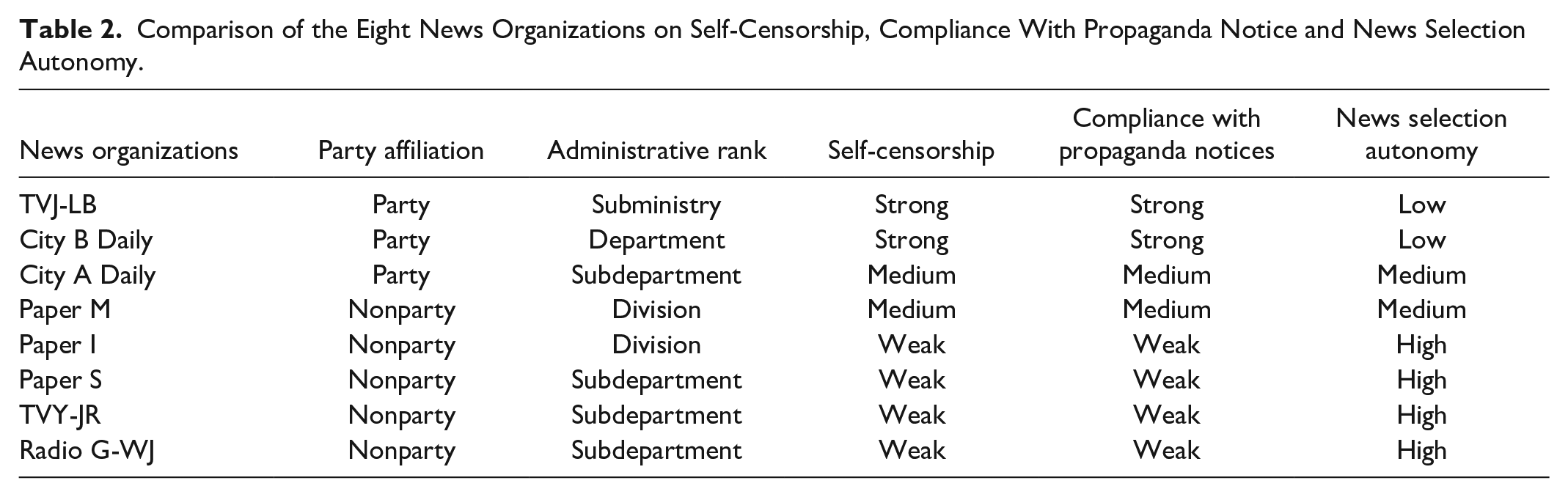
Based on the measurement, we set to evaluate the “self-censorship” and “compliance with propaganda notices” described in the previous section, TVJ-LB and City B Daily are found to have “strong,” City A Daily and Paper M “medium” and Paper I, Paper S, TVY-JR, and Radio G-WJ “weak” self-censorship and compliance with propaganda notices (see Table 2).
Comparison of the Eight News Organizations on Self-Censorship, Compliance With Propaganda Notice and News Selection Autonomy.
Self-Censorship
TVJ-LB and City B Daily
TVJ-LB is a news program hosted by TVJ, a television station with the ministry-level State Administration of Radio, Film and Television as its direct supervisory body. The administrative rank of TVJ-LB is thus subministry level. It is considered the mouthpiece of the central state and enjoys privileged access to political information from the state power center. The state propaganda authority requests that all satellite TV stations in China simultaneously rebroadcast its news program. With 130 million daily viewers, TVJ-LB is the most widely watched TV program in the world despite not being marketized.
However, it is also one of the most self-censored news outlets in China. As one of the program’s journalists explains, Strictly speaking, TVJ-LB is not a news program, but rather a pure party “propaganda window” [xuanchuan chuangkou]. It is absolutely impossible for the program to have any political problems, because everything is plotted . . .
Irrespective of news value, TVJ-LB always features the activities of the political leaders first. This is followed by reports on topics assigned by the propaganda authority. Next, there is some business or other hard news before the international news is presented.
The TVJ-LB news production is extremely cautious. In contrast to all of the other TVJ news programs, which depend on the TVJ News Center for news feeding, TVJ-LB has its own camera crew for filming the daily activities of central government leaders. The central propaganda authority provides very deliberately written captions for news clips. The selection of news for the part of the program following the assigned-topic section is also cautious. Breaking news over the course of the day does not necessarily appear in the evening news program. “Proposals” for news considered fit for the program must be examined by a 20-member committee comprised of high-ranking editing managers.
TVJ-LB’s internal organization prevents it from violating “propaganda discipline” (xuanchuan jilv). Negative news is usually excluded from the program. If negative news is already widely circulated in other news programs, TVJ-LB attempts to reassure its audience. For example, while other media outlets questioned the Ministry of Railways on the Wenzhou high-speed train collision in July 2011, TVJ-LB reported how the casualties received perfect treatment.
As the mouthpiece of the central state, TVJ-LB is said to have “superb, huge influence.” However, this makes the news program very cautious. As one TVJ producer explained, TVJ-LB cannot change. Why? It represents the voice of the party-state. It’s not allowed to broadcast news like TVJ-WJXW [a nonparty TVJ news program] does . . . it has to follow the Central Government . . . every word used in the news is deliberated. Many people can see the political “weathervane” in TVJ-LB. They can detect change in Chinese politics by observing tiny changes in the news program.
As a newspaper supervised by the subministry-level provincial propaganda department, City B Daily’s situation is similar to that of TVJ-LB. The news content primarily consists of official releases regarding party and government policies and guidelines, and the newspaper enjoys privileged access to political news from the provincial government. As all state and party units are obliged to subscribe to City B, the newspaper also enjoys privileged circulation. But because its circulation area is mostly within City B, its operations must be subsidized by several nonparty newspapers in the same media group.
The newspaper has department administrative rank, one level lower than its direct supervisor, the provincial propaganda department. Like TVJ-LB journalists, City B Daily journalists emphasize that the newspaper’s social impact requires them to exercise extreme caution when reporting on government affairs. When market and political demands conflict, the newspaper submits to politics, even though this may come at the cost of their popularity in the market. This is of limited importance to the newspaper, because the mother media group has a few nonparty subnews outlets, which subsidize its operations. Some of our interviewees described the “division of labor” between the media group’s party news outlets, which serve as the state mouthpiece, and their nonparty subnews outlets as a “game playing” process reflecting the “two lines” of news organizations: the “politics” and “society” lines.
Consequently, City B Daily exercises self-restraint even when there is no propaganda notice on negative news. According to a journalist, their starting point for doing reports is to avoid arousing social attention but to solve problems. If there is negative news, they would rather write internal reports (neican) which are only available for the officials. He also admitted that because these have been the unwritten rules at the newspaper, journalists can usually judge for themselves which news to report or not.
Although City B Daily has a column set for monitoring the implementation of public policies, it never criticizes government policies or related departments. A journalist from the newspaper described how
Although many policies are not implemented as well as the government promised, we will not say that the policies are not good. Instead, we indicate which problems have been seen since the policies came into effect. Then we interview officials to see why there are such problems and the proposed solutions.
TVJ-LB and City B Daily staff both emphasize the political responsibilities they carry. They highlight their outlets’ “trustworthiness” and “social responsibility,” the former meaning that the party news outlets are the only ones that can reach government officials and convey the real voice of the government, the latter meaning that the paper should not stir up a state–public conflict. As one of them explained,
As far as events addressing state–public conflict are concerned, a news organization should think about what is good for the state and society . . . media have the responsibility not to “fan the flames.” If there is a government–public conflict and the media stand up to the government merely because they are motivated to help the “weaker” public, they are fanning the flames, which can lead to terrible results.
The news staff considers their news organization to be an integrated part of the political system. One TVJ-LB newsperson offered this view: “We are an official medium, a state medium, and so we should be careful when selecting what to report . . . When people are watching TVJ-LB, they feel that it’s like an officer’s speech.”
City A Daily and Paper M
City A Daily is a party newspaper under the leadership and supervision of the City A Propaganda Department with department-level administrative rank, making it a subdepartment-level news organization. Despite its political status as the official media of the political committee of the City A municipality, its content is much more market-oriented than its party counterparts TVJ-LB and City B Daily. Directly led by the municipal propaganda department, the newspaper is further away from the influence of the communist political center than the party organs at the provincial and central state levels. Compared with other party organs, the newspaper pays more attention to market expansion and profits, which is impossible with too much involvement from the supervisory body in news production. As a newspaper led by the municipal propaganda authority, however, City A Daily is restricted to report the issues that are sensitive to the municipal government whereas its counterparts with higher administrative rank are not. The newspaper has its own distribution system, but it is also mandatorily circulated within the government system in City A.
For news issues which are not sensitive to the City A municipal authority and not yet censored by the propaganda authority, City A Daily usually chooses more balanced news frames. However, once the news issues are sensitive to the municipal authority, it is much more cautious than nonparty outlets. A journalist explained, Although we’re a party newspaper, we’re good at making news [that serves public interests]. Of course we follow the general party guidelines, but civic news reporting is one of our strengths. Voices questioning the authorities may be better reported by other newspapers, but we also include such voices [in our reports], only if they do not conflict with the party . . . It is not as open as metropolitan newspapers [nonparty newspapers], but more open than other party newspapers.
The market-oriented content, nonofficial status, and self-operated distribution of Paper M make it a typical nonparty news outlet, yet it distinguishes itself from most nonparty outlets in terms of its operations and supervisory bodies. While nonparty outlets are typically both operated and supervised by state-owned organs, a private company runs Paper M, leasing the newspapers’ issue number from a state-owned publishing house with subdepartment-level administrative rank, making it a division-level newspaper. As private companies are not allowed to own a serial number, both the private company and publishing house are challenging the political authorities. Consequently, Paper M was established as a weekly newspaper focusing on international events, as most politically sensitive issues are domestic. Still, its direct supervisor, the state-owned publishing house, keeps a close eye on Paper M’s news production, fearing that the news staff might make “political mistakes.” Thus, Paper M has stronger political affiliations than other nonparty news organizations and therefore adopts a strategy similar to that of City A Daily: It is cautious when handling international news that may be sensitive to the authority. If news is not considered sensitive by proofreaders, Paper M journalists work hard to attract reader interest.
Paper I, Paper S, TVY-JR, and Radio G-WJ
Paper I, Paper S, TVY-JR, and Radio G-WJ are all nonparty news outlets. Paper I is a market-oriented newspaper at the City A Daily Group. Established and led by City A Daily, a subdepartment-level organization, its administrative rank is division level, among the lowest of the major daily newspapers competing in City A. It is constrained by its low administrative rank and cannot report on issues banned by higher level supervisory bodies. Instead, its nonparty nature drives it to use lively and sensational material to please the market. Circulation of the newspaper largely depends on private subscriptions and newsstand sales.
Paper S is a market-oriented newspaper, set up and directly supervised by Province A Daily, a department-level newspaper and the “authoritative voice” of the Provincial Chinese Communist Party (CCP) Committee. With its base and headquarters in City A, the newspaper competes with City A Daily and Paper I in the market, while its master newspaper, Province A Daily, mainly follows the “party line.” It focuses on civic news to generate public interest, although it also pays attention to news materials on party policies to compete with City A Daily, which is faring well in terms of pleasing both the party and public. Not being a party mouthpiece, however, the newspaper has less access to firsthand policy information than its party counterparts do. On the contrary, it enjoys fewer restrictions on reporting news that is considered sensitive at City A Daily, because its supervisors are Province A Daily and the provincial propaganda department—but not the municipal propaganda department. Private subscription and newsstand sales are the major circulation channels for Paper S.
TVY-JR and Radio G-WJ are news programs at TVY and Radio G, respectively, both of which are under the leadership of the Radio, Film and TV Administration of Province A, a department-level organ under the subministry-level provincial propaganda department in Province A. TVY-JR and Radio G-WJ thus have the administrative rank of subdepartment level. Both TVY and Radio G have another news program focusing on party-oriented news. TVY-JR and Radio G-WJ, on the contrary, mainly target the public and produce more “civic news.” Although the broadcast time for both news programs is not as good as that of their party counterparts in the same station, they are among the most popular programs.
In contrast to the four news outlets discussed above, Paper I, Paper S, TVY-JR, and Radio G-WJ try to ensure that politically sensitive messages reach the public before the propaganda notices arrive, even when they assume that the news will breach the coming “propaganda boundary” (xuanchuan koujing). Journalists therefore attempt to act fast, publishing or broadcasting news before a ban comes. As a TVY-JR journalist explains, When something negative happens, we’ll report it and try to get it broadcasted. If more news media join in, the influence is bigger. When it reaches a certain level, the potential “xuanchuan koujing” might be loosened. At times, when there’s no “xuanchuan koujing,” the news would be 100 percent broadcasted.
To conclude, as TVJ-LB and City B Daily are among the news organizations which show the least frequency to select sensitive news issues and frames to please the audience, they are categorized as “strong” self-censorship outlets (see Table 2). City A Daily and Paper M, attempting not to offend the party-state but also trying their best to choose news issues or frames that favor the public, have “medium” self-censorship, while Paper I, Paper S, TVY-JR, and Radio G-WJ, which usually select sensitive news and can best meet public demand on news information, even though the information is sensitive, are having “weak” self-censorship.
Compliance With Propaganda Notices
TVJ-LB and City B Daily
The news organizations also vary in the degree to which they comply with the propaganda notices.
TVJ-LB best showcases its full obedience to propaganda notices when a routine part of the program focuses on topics assigned by the State Administration of Radio, Film and Television and the Central Propaganda Department (CPD). Journalists call such propaganda tasks “assigned writing.” When the data for this study were collected, an orchestrated, nationwide propaganda event called “visiting the grassroots” (zou jiceng) took place. The central propaganda authority requested that journalists visit people at the bottom of society or living in the most remote areas of the country to report on their lives. A journalist assigned to this task found that it would be naïve to think that journalists could report on the real lives of ordinary villagers: Before commencing the reporting, you must attend a news topic seminar . . . Prior to this, the Central Propaganda Department gives you the guidelines, including all locations for doing “zou jiceng” reporting. The locations are where the CPD leaders have visited and believe to be the best. So you won’t have any negative reporting.
The journalist also used the Wenzhou high-speed train collision as an example to explain how breaking news was reported:
In the beginning, we only reported when, where, what happened and how many deaths. Then we waited for the orders. Soon there came a notice from the CPD requesting the media to guide public opinion in a positive way, not to produce reports arousing negative feelings, and to report more about how the authorities saved people and made remedies. Soon, there were many reports about how many people were rescued, how villagers near the accident site participated in the rescue efforts, what the remedies were, and how the measures were made . . . they were trying hard to make it more positive . . .
City B Daily demonstrates the same extent of compliance with propaganda notices. Journalists from the newspaper admitted that they unconditionally follow the instructions of the propaganda authority. For some sensitive issues, they use the reports from the Xinhua News Agency, the official press agency of the Communist Party. One of them said, If there’s word from above saying that we’re not allowed to report on the issue, then all newspapers are supposed to not report on it. Of course, some newspapers try to report on it in the way of “da cabianqiu” [playing with the edge], but we usually don’t do such things.
City A Daily and Paper M
Being the mouthpiece of the City A authority, City A Daily also demonstrates its loyalty to the propaganda authorities and rarely questions propaganda notices. One journalist described how they act differently from their competitors in the city, the nonparty newspapers in City A, although both types of newspaper claim to have the same goal, namely, “promoting social progress”: “The political demand is the same for all newspapers, but maybe they [the nonparty newspapers] do not strictly execute the orders, whereas we usually follow the guidelines of the party and don’t do ‘something.’”
When reporting on a specific municipal project, the newspaper’s slant toward the municipality was obvious, especially after they received “directives” from the municipal propaganda authority. All three interviewees mentioned this news issue and said that their reporting angles were different from the nonparty newspapers in City A except for Paper I.
Paper M’s reaction to propaganda notices concerning sensitive international news is unconditional execution. Yet the newspaper, as the international news section in City A Daily, has room to play with the edge when it comes to propaganda notices on sensitive domestic issues. They can do so by featuring international news stories that allude to what is happening in China. An editor explained,
When cases of food poisoning were exposed by the media, we featured reports on food security mechanisms in foreign countries. Because there’s limited space in the media to discuss domestic food security problems—which, moreover, is not our field of reporting—we usually find cases abroad to contrast such hot domestic issues.
The editors at both Paper M and City A Daily claimed such reporting to be successful in attracting public interest while avoiding the violation of propaganda discipline.
Paper I, Paper S, TVY-JR, and Radio G-WJ
In contrast to the just-discussed four news organizations, Paper I, Paper S, TVY-JR, and Radio G-WJ all display resistance to political propaganda. They consistently favor reporting political issues from the perspective of the public rather than the government. “Civic” (minsheng), “civilians” (laobaixing), and “vulnerable group” (ruoshi qunti) were the most frequently used terms by the journalists when discussing their choice of news frames. Considering themselves to belong to the civilians and the disadvantaged facing a strong state, the journalists favor the voice of the civilians in the event of a conflict between civilians and the local government. However, there is also another reason why the voice of the public is heard more often than the government’s voice:
Usually we can only hear the voice of the public, because the other side of the conflict, the government, is unwilling to give interviews or say anything about the issues. Therefore, we see the news events from the perspective of the public concerned.
At the same time, these news organizations tend to resist propaganda notices to a greater extent. A TVY-JR journalist indicated that unless media censorship is tightened, they try to play with the edge of propaganda notices. Another journalist provided an example: When a propaganda authority requests all news media to frame a controversial issue in a positive way and to avoid negative frames, journalists will wait for a press conference organized by the government agency concerned or comments made by political leaders and then highlight some aspects relating to the “negative side” of the story.
To summarize, TVJ-LB and City B Daily exhibit “strong” compliance, as they strictly execute political orders in the propaganda notices (see Table 2). City A Daily and Paper M display “medium” compliance, as they play with the propaganda notices when they feel safe to do so, while Paper I, Paper S, TVY-JR, and Radio G-WJ demonstrate “weak” compliance, as they always try to play with the propaganda notices.
Case Comparison
Political affiliation
A comparison of the eight news outlets reveals a strong connection between the news organizations’ political affiliations and their news selection autonomy (see Table 2). The party news outlets are more self-censored than the nonparty outlets before propaganda notices reach the newsroom and more obedient to propaganda notices when they have been issued. The three party news outlets thus have lower news selection autonomy than the five nonparty outlets. An exception is that City A Daily and Paper M, one being a party and the other a nonparty newspaper, have the same degree of news selection autonomy. This implies that other factors than political affiliation may affect news selection autonomy.
Administrative rank
Comparison of the eight cases on administrative rank and news selection autonomy shows that the two are not strongly correlated. But our findings also indicate that administrative rank may matter in a media market with fierce competition. Five of the news organizations—City A Daily, Paper I, Paper S, TVY-JR, and Radio G-WJ—are based in City A, a city with a competitive media market. Here, news organizations with lower administrative rank face problems for two reasons. First, because they receive propaganda notices from all higher level propaganda authorities, they are subjected to more political restrictions than news outlets with a higher administrative rank, which are not subjected to propaganda notices from lower level propaganda authorities. Second, lower level news organizations have fewer news sources in higher level governments than their higher ranking counterparts.
Consequently, party news organizations with a low administrative rank attempt to please their audience in a competitive media market, taking into consideration that their subnews outlets are also less competitive due to their low administrative rank. Thus, we can see that City A Daily, with the subdepartment administrative rank, lower than the administrative rank of the other two party news organizations, including City B Daily (department level) and TVJ-LB (subministry level), exhibits comparatively more news selection autonomy. Besides, the profit-making pressure of news organizations could also explain why party news outlets with higher administrative ranks show lower news selection autonomy. Higher ranking news organizations like TVJ-LB and City B Daily can receive more government funding than those with lower ranking like City A Daily. Therefore, they do not have to play a game with government control to produce more appealing news to attract public interest for profit.
The same is true for nonparty outlets with a low administrative rank. For example, Paper I, which in terms of news sources cannot compete with its nonparty competitors, plays more with the edge of propaganda notices in an attempt at winning the audience’s heart. This may explain why its news selection autonomy, despite its administrative rank being the same as that of Paper M, is higher than the latter’s.
Discussion
Over time, economic liberalization has had an impact on media autonomy in China (Stockmann, 2011, 2013; G. G. Wu, 2000). However, we do not know what brings about the different degree of autonomy across news organizations. This article compares the news selection strategies of eight news organizations, which vary in terms of political affiliation and administrative rank, and shows that party news organizations generally have lower news selection autonomy than nonparty news organizations. Administrative rank, on the contrary, matters for news organizations suffering from strong market competition and profit-making pressure.
The findings show that party news organizations are more self-censored than the nonparty news organizations as Kuang and Wei (2018) suggest. Indexing (Bennett, 2016) remains a norm for party news media in China, as they set the news agenda and frame news issues in a manner favorable to the political elites. Due to their economic market interests, nonparty news outlets, on the contrary, attempt to inform the public before they receive a propaganda notice. The market is more important for them, but sticking to the political bottom line is essential. In their longtime “game-play” with the propaganda authority, nonparty outlets have got to know exactly how much is too much for the Communist Party authority.
Before a propaganda notice is sent to the newsroom, the news selection autonomy of the news organizations varies considerably, indicating substantial organizational influence in the absence of direct political control. The variation in news selection autonomy is dramatically reduced with the arrival of a propaganda notice, although variation in compliance with propaganda notices can still be seen.
The findings confirm not only the fundamental influence of political forces in news production in nondemocratic settings but also the hypothesis from Shoemaker and Reese’s (1996) multi-level hierarchical model of influences on media content, which assumes that each level of factors has its own effect, but the effect is limited by each hierarchically superior level. The Chinese case demonstrates that the influence of a news organization’s political affiliations, which is at the third level in the model, is largely limited by external political control, which is at the fourth level in the model.
Our findings also confirm that media marketization does not necessarily bring press freedom (Hadland & Zhang, 2012; Winfield & Peng, 2005). It is true that state control over the news media has been rather effective, as none of the news organizations would breach the limits set by the propaganda authorities. But media autonomy is not necessarily reduced, as there is always a time gap between the occurrence of news and the issuing of propaganda notices, and commercialized nonparty news organizations try to get the news stories published before the propaganda notice arrives. The Chinese case somewhat resembles the Western experience, which indicates that the commercialization of the news media may increase journalistic autonomy (Czepek et al., 2009; Hallin & Mancini, 2004; Hong & Hsu, 1999).
Still, due to the overwhelming strength of politics in China, the autonomy of the Chinese news media has not been expanded much. Even nonparty news organizations only have a small margin of autonomy in the face of political control. Although the communist party-state has to seek capital by marketizing some of its news organizations, it only allows press autonomy within the limits of what it can tolerate. Despite their organizational differences, Chinese news media can only “play ping pong within the table.” Until there has been considerable political reform, media autonomy in China will not increase substantially, no matter how commercialized the news media become. State control over the media is still effective, which helps explain why the communist state can control public opinion and sustain its governance.
While this study has made considerable contributions to people’s understanding of an underexplored topic, that is, how news organizations with different political affiliations and administrative ranks vary in news selection autonomy, its findings are still tentative. This is because it only compares eight news organizations and samples two participants from each outlet due to the difficulties of collecting interview data on the topic from Chinese journalists. Future studies could expand the sample size or do a quantitative content analysis on how different news organizations vary in terms of news selection autonomy for generalization of the results.
Besides, with only two TV news outlets, one party and one nonparty, the study is lacking in evidence to demonstrate how the different commercialization levels between newspapers and TV news outlets could distinguish the news selection autonomy of party and nonparty and higher and lower administrative ranking news organizations. A further exploration on this would be interesting and necessary as existing studies indicate that the commercialization of newspapers in China has been more progressive than television. This is because newspapers were the first to be commercialized (Stockmann, 2013) while television remains as “the most tightly controlled type of media in China” (Miao, 2011, p. 96).
Footnotes
Declaration of Conflicting Interests
The author(s) declared no potential conflicts of interest with respect to the research, authorship, and/or publication of this article.
Funding
The author(s) disclosed receipt of the following financial support for the research, authorship, and/or publication of this article: This work was supported by the Danish Research Council under Grant 94-556-85013 and the Jiangsu Bureau of Education Philosophy and Social Sciences Programme under Grant 2015SJD616.
