




Abstract
The current research delves into the correlation between corporate social responsibility (CSR) and the environmental performance (EP) of manufacturing enterprises in China. In addition, we examined the mediation impact of green innovation practices (GIP) on the interaction between CSR and EP. The study also looked at competitive advantage (CPA) as a moderator to see how it influences the connection between CSR and EP in dynamic capability view theory (DCV). A structured questionnaire was adapted to collect data from 910 manufacturing companies in Zhanjiang city, in Jiangsu province, China. The partial least squares (PLS-SEM) methodology analyzed the theoretical framework. The empirical findings are as follows: (1) CSR is a crucial predictor of EP. (2) GIP has a direct impact on EP. (3) GIP acts as a mediator in the CSR-EP connection, and (4) Lastly, the CPA strongly enhances the interaction between CSR and EP. These findings contribute practically and theoretically to understanding how CSR fosters EP, emphasizing the necessity for manufacturing companies to institute policies and initiatives for environmental sustainability and prioritize ecologically friendly practices to enhance EP.
Introduction
Over the past decade, the global discourse has intensified around the detrimental impact of greenhouse gases (GHG), primarily carbon dioxide (CO2) emissions, and other environmental pollutants on climate change and the overall ecological landscape. Extensive research has established a direct link between these environmental stressors and their profound consequences on human health and the escalating levels of climate-related anxiety (W. Cai et al., 2022; Hang et al., 2022). This grim scenario is primarily attributed to human activities, with manufacturing enterprises emerging as significant contributors to environmental degradation, adversely affecting both the environment and living organisms.
The repercussions of environmental degradation, encompassing global warming, climate change, air emissions, biodiversity loss, public health concerns, and ecological footprints, have spurred a paradigm shift in corporate strategies (D’Orazio, 2024; Sampene, Li, Wiredu, et al., 2023). The escalation of environmental pollution and climate change concerns, in particular, has astounded industrialists and economies. Hence, industries are now compelled to adhere to stringent eco-friendly development regulations, necessitating the integration of environmental considerations into their organizational frameworks (Hang et al., 2022; Kraus et al., 2020). This transformation is instigated by pressure from stakeholders urging corporations to prioritize environmentally sustainable practices.
Recognizing the imperative for strategic management tools to elevate environmental performance (EP), scholarly discourse has spotlighted avenues such as green innovation practices (GIP) and corporate social responsibility (CSR; Khan et al., 2023; Kim et al., 2018; Kraus et al., 2020). Scholarly discussion has focused on GIP and CSR as essential ways for strategic management tools to improve EP (Abdallah & Al-Ghwayeen, 2019; Khan et al., 2023; X. Zhou et al., 2022). CSR, defined as a company’s commitment to considering social, economic, and environmental factors in its operations (Guang-Wen and Siddik, 2022), emerges as a potent driver for improving corporate performance and gaining a competitive advantage (Hang et al., 2022; Nyantakyi et al., 2023). Particularly in developing countries like China, CSR is increasingly recognized as a strategic means to integrate green innovations into organizational ecosystems for practical improvement (Hang et al., 2022).
GIP, centered on pollution avoidance and sustainable product development (Moshood et al., 2022; X. Zhou et al., 2022), is pivotal in mitigating environmental emissions from manufacturing activities (Sarpong et al., 2022). Most manufacturing companies in developed and developing countries have contributed to environmental degradation due to illegally polluted water dumping and discharging radioactive materials, chemicals, heavy metals, or gases into major, significant waterways that adversely impact marine life and the ecology. In alignment with this, Zailani et al. (2012) revealed that industrial product pollution and waste endanger the earth’s existence, leading to various diseases in humanity, weakening humanity’s health, and shortening one’s life expectancy significantly (Rodriguez-Alvarez, 2021; Zhao et al., 2022). Consequently, encouraging environmental performance is increasingly crucial for addressing global concerns.
From an academic literature viewpoint, prior researchers have gradually switched their emphasis from general discussion to developing CSR and GIP. There have been extensive studies conducted on the relationship between CSR, GIP, organizations’ performance, and environmental sustainability in both developed and developing countries. Hence, this current study shares more insightful evidence from the perspective of Chinese manufacturing industries. For instance, H. Y. Ali et al. (2020), Hasan et al. (2018), and Tunio et al. (2021) utilized CSR to examine financial performance (FP). Furthermore, studies by Hao and He (2022), Padilla-Lozano and Collazzo (2022), and Yuan and Cao (2022) also investigated the relationship among CSR, GIP, competitiveness, and FP.
Despite numerous studies exploring the complex connections between CSR, GIP, competitiveness, and overall firm performance, there is still a gap in the scholarly landscape, particularly concerning the nuanced exploration of EP within the CSR framework. The prevailing discourse predominantly navigates through FP, competitiveness, and broader sustainability metrics, often sidelining the intricate dynamics of a manufacturing company’s environmental stewardship within the CSR paradigm. This limitation in the literature becomes even more pronounced when we consider the contemporary imperatives of global environmental sustainability and the significant harmful impact of manufacturing industries. As the world grapples with escalating climate concerns, pollution challenges, and the imperative to curtail carbon footprints, it becomes essential to zoom in on the specific contribution of CSR initiatives to environmental well-being. How do CSR practices impact manufacturing companies’ EP, and to what extent can they be considered catalysts for ushering in positive ecological change? What other antecedents can influence this positive effect?
This study, therefore, seeks to bridge this conspicuous gap by meticulously delving into the nexus between CSR and EP within the context of manufacturing industries in China. We aim to unearth insights contributing to theoretical advancements and hold practical implications for businesses, policymakers, and stakeholders invested in sustainable corporate practices. This current study, positioned within the context of Chinese manufacturing industries, aims to address this gap by exploring the influence of CSR on EP in Zhenjiang, Jiangsu province. Four research objectives guide the study:
Assess the effect of CSR on EP.
Explore the positive stimulus of GIP on EP.
Investigating GIP as a mediating factor between the connection of CSR and EP.
Examine the influence of competitive advantage (CPA) on the interconnection between CSR and EP.
With this thoughtful interest, this present study contribution includes the following: First, theoretically, the study is underpinned by drawing inspiration from one prominent psychological theory, namely the Dynamic Capability View (DCV) Teece (2007), as it has been utilized in prior research (Horng et al., 2022; Yuan & Cao, 2022). This theory facilitates an examination of how environmental-related CSR dimensions (ENVR-CSRD), social-related CSR dimensions (SCOR-CSRD), and economic-related CSR dimensions (ECR-CSRD) impact CSR. Secondly, the study introduces a novel perspective by exploring the role of competitive advantage (CPA) in shaping the connotation among CSR and EP. Despite a growing body of literature on CSR and GIP, the association between CSR, EP, and CPA remains underexplored. This current study aims to bridge this gap through empirical analysis. Thirdly and importantly, given the severity of China’s environmental challenges, the study extends beyond theoretical contributions to offer practical policy recommendations. By evaluating how manufacturing firms can enhance their environmental performance, this research provides valuable insights for government policymakers, corporate executives, and other stakeholders to reduce environmental pollution levels in China collaboratively.
This research also addresses the underrepresentation of CSR studies in emerging economies like China, where CSR is still in its early stages of development (Yuan & Cao, 2022). Finally, the focus on Chinese manufacturing industries provides unique insights. It contributes to a broader understanding of CSR’s role in fostering eco-friendly change through GIP, which mediates the interplay linkage between CSR and EP. Thus, we argue that GIP enhances the EP of manufacturing companies in China and is, therefore, essential to investigate.
This study’s significance lies in its theoretical contributions, empirical analyses, and practical implications for environmental sustainability in China. The subsequent sections delve into the theoretical framework and the development of the hypotheses (Section 2). Section 3: The adopted methodology. Detailed results and discussion (Section 4). Section 5 Conclusions, practical and theoretical implications, future studies, and limitations are presented in Section 5.
Literature Reviews
Theoretical Support: Dynamic Capability View (DCV)
The current study is guided by the dynamic capability view (DCV) theory, emphasizing the pivotal role of dynamic adaptability in Chinese manufacturing companies to sustain a competitive edge in a dynamic environment and examining the CSR link in the sector’s green growth. The DCV theory emerges as a crucial framework for understanding the strategic management of manufacturing firms, particularly in the context of maintaining competitiveness in dynamic environments. Teece (2007) expounds on the DCV theory, asserting that an organization’s success depends on its competence to adapt external and internal competencies in response to unexpected environmental changes. This dynamic adaptability is crucial because resources well-suited to current conditions may become obsolete in the face of evolving external circumstances (Horng et al., 2022; Teece, 2007).
The adaptability emphasized by DCV underscores the importance of processes that enable organizations to identify and acquire resources and reorganize them effectively. Simply possessing resources is insufficient; the key lies in an organization’s capacity to navigate change, seize opportunities, and position itself advantageously in the market. DCV echoes the sentiment that an organization risks losing its competitive edge, even with abundant resources, without the capability to adapt (Qiu et al., 2020; Scarpellini et al., 2020; Teece, 2007).
Within the manufacturing sector, the application of DCV becomes especially relevant as firms seek to incorporate eco-friendly practices and embrace CSR initiatives. The growing inclination toward CSR and GIP responds to heightened public concerns about sustainable EP. This shift addresses societal expectations and enhances competitiveness and corporate performance. Notably, the purpose of organizations extends beyond profit maximization to achieving long-term viability through continued expansion and outstanding performance. In line with DCV, organizations are compelled to foster eco-friendly practices as a reaction to market trends and a strategic response to environmental vulnerabilities.
In alignment with green practices, the organization’s ability to adjust its capabilities over time becomes imperative for maintaining a CPA in the dynamically evolving manufacturing landscape. Thus, DCV provides us with a theoretical foundation for understanding how manufacturing companies can be successful over the long term by continuously adapting to new situations, incorporating CSR principles, and coming up with innovative green processes and products when doing business (Qiu et al., 2020; Scarpellini et al., 2020; Teece, 2007). By exploring the DCV, this study seeks to unravel the nuanced connections between CSR and EP, specifically focusing on how CPA acts as a moderating variable.
Hypothesis Development
CSR and EP Nexus
In recent years, corporate social responsibility (CSR) has emerged as a vital practice for ensuring sustainable corporate operations, driven by the global imperative for enhanced environmental performance (EP). By responding to pressure from various stakeholders, firms are urged to address environmental and social concerns (Xiang et al., 2021). Even though eco-friendly practices are becoming more popular, the complexity and context-dependency of CSR have led to different interpretations, which is one reason why there hasn’t been a single definition in previous research (Sarwar et al., 2023; Yuan & Cao, 2022). Nevertheless, Carroll (1979) CSR theory enjoys broad acceptance, underscoring the multifaceted nature of CSR and its integral role in the success of corporate environmental performance.
A substantial body of prior CSR research focuses on unraveling the impact of CSR activities on business performance (Bresciani et al., 2023; Zeng & Schoenecker, 2015). Aftab et al. (2023) showed that CSR positively affects FP, and Ma et al. (2023) expanded the study to include the Pakistan Stock Exchange. These studies confirmed that CSR practices are essential for environmental sustainability and financial success through PLS-SEM utilization. Similarly, Xu et al. (2022) explored CSR’s direct impact on EP and firm finances in Chinese manufacturing, indicating green technology innovation as a solid mediating factor. Furthermore, a web-based survey of 230 Spanish hotel managers using a quantitative method by Mariño-Romero et al. (2020) also showed that CSR has a small but significant effect on the functions of RevPAR and marketing variables. In their study, CSR directly influenced RevPAR at a significant positive level, influencing it indirectly through marketing variables. Dai et al. (2022) investigated CSR, green finance (GF), green innovation (GI), and EP, surveying 357 bankers.
Structural equation modeling revealed CSR’s positively significant influences on GI and EP, with GI powerfully enhancing EP. GF positively influences GI and EP. GI is fully mediated between CSR-GF and EP. This study emphasized CSR, GF, and GI for achieving EP, stressing the need for sustainable banking strategies with vital policy implications. Another survey by Hernández et al. (2020) uniquely explores CSR’s impact on economic performance in MSMEs, testing the “social impact” hypothesis of stakeholder theory. Findings confirm that engaging in CSR activities enhances economic performance across different aspects. The study shows that MSME size moderates this relationship, with a more substantial positive impact observed as organizational size increases.
Despite these valuable contributions, prior literature has often overlooked a comprehensive assessment of CSR and EP through established theories such as DCV theory. This gap is addressed in the current study by empirically observing this phenomenon through the lens of the DCV within the context of Zhanjiang City. Including the DCV theory provides a strategic framework for aligning CSR initiatives to enhance a firm’s ability to create shared value and improve EP. By integrating findings from various studies, this literature review contributes to a more critical synthesis of existing knowledge, highlighting the importance of understanding CSR’s nuanced interplay with EP and financial outcomes. The discussion also emphasizes the need to bridge gaps in the literature and underscores the theoretical contribution of the DCV framework in advancing our understanding of CSR’s impact on EP. We argue and agree that CSR activities can help firms improve their EP through these three dimensions of CSR, which include social, economic, and ecological (Alvarado-Herrera et al., 2017). Therefore, we suggest the subsequent hypothesis:
H1: CSR has a positive and significant effect on firms’ EP
CSR and GIP Nexus
Corporate social responsibility (CSR) is an integral component deeply interwoven with the development of GIP as organizations seamlessly integrate ethical and sustainable practices throughout the entire product lifecycle. This integration ensures environmental benefits and underscores a profound commitment to social and ethical responsibilities, contributing to an environmentally conscious market and positively impacting ecosystems and communities. Corporate environmental strategies, evolving within the CSR framework, are pivotal in deepening comprehension among internal and external stakeholders. This elucidation effectively highlights the intricate interconnection between CSR initiatives and the emergence of green products. Within the conceptual framework of DCV, innovation is emphasized as a dynamic capability (Teece, 2007). GIPs emerge as tangible manifestations, signifying a firm’s capacity to innovate through environmentally friendly methods. The DCV perspective supports the notion that organizations with a robust CSR orientation develop the capability to foster and implement green innovations. Empirical evidence from D’Orazio (2024) research reinforces this perspective, suggesting that firms engaged in CSR are predisposed to invest in eco-friendly technologies and processes, thereby enhancing their GIP.
Recent academic discourse has witnessed a consensus emerging, indicating that CSR positively influences GIP (Hou et al., 2023; Kraus et al., 2020; Padilla-Lozano & Collazzo, 2022; H. Wang et al., 2021; Xie, 2022; J. Zhang & Liu, 2023; Zheng et al., 2022). Seman et al. (2019) research substantiates that CSR significantly influences GIP, enhancing firms’ EP. In a parallel investigation, the Javeed et al. (2022) study delved into the effect of corporate ecological strategies on eco-innovation (GI), indicating a positive influence of environmental regulations, pro-environmental strategy (ES), and corporate management. Additionally, it accentuates a positive moderating effect of corporate management on the interconnection interplay of corporate PES and EI. Furthermore, the Aftab et al. (2023) study focused on the manufacturing sector in Pakistan and established that CSR positively affects FP. Also, the study further reveals that “green innovation” (GI) and “green dynamic capabilities” (GDCs) had positive and significant effects on both CSR and FP. The results show how important CSR, GDCs, and GI are for driving FP. J. Zhang and Liu (2023) and Zheng et al. (2022) study further unveiled a significant relationship between CSR’s environmental, social, and governance (ESG) performance and companies’ green innovation. In Ecuadorian manufacturing, a model with three second-order constructs was tested on 325 managers, confirming CSR and green innovation’s significant impact on manufacturing competitiveness (Padilla-Lozano & Collazzo, 2022).
Moreover, the empirical findings further reveal that CSR initiatives enhance firms’ green innovation performance. Shahzad et al. (2020), using PLS-SEM and gray relational analysis to look at data from 282 participants in Pakistani manufacturing companies, found that all aspects of CSR play a significant role in promoting environmentally friendly growth, which in turn has a positive outcome effect on green innovation. Xie (2022) and Hou et al. (2023) reported a positive interplay between CSR and technology-green innovation (GTI), mainly when unabsorbed slack resources exist. Xie highlights the contributory role of CSR in GTI, with Hou focusing on the role of CSR construct in improving green innovation performance. H. Wang et al. (2021) and Kraus et al. (2020) both observed a positive link between CSR and green innovation, with the latter noting that this relationship is mediated by environmental strategy. Wang highlights the impact of stakeholders’ views on green innovation. All these findings collectively suggest that CSR is generally associated with and can even enhance green innovation practices. Weng et al. (2015) empirical study states that GIP decreases a company’s negative environmental impact and improves social and firm financial success.
However, companies’ inconsiderate and heavily polluted factory practices have raised numerous environmental concerns, leaving the world vulnerable. Therefore, echoing the transition of green practices through CSR in manufacturing is posited to revoke companies’ negative environmental impact, enabling stakeholders to focus on environmental and natural protection. In light of the comprehensive review of the existing literature, the current study proposes the subsequent hypothesis:
H2: CRS has a significant and positive effect on GIP
GIP and EP Nexus
Organizational efforts to enhance EP encompasses diverse initiatives aiming to surpass societal expectations for the natural environment. This conceptualization extends beyond regulatory adherence, signifying a steadfast commitment within organizations to exceed established legal requirements (Singh et al., 2020). Within this intricate framework, a meticulous examination assesses the environmental impact of manufacturing firms’ products, processes, and resource utilization. These facets are anticipated to seamlessly align with prevailing legal and ecological requirements (Dubey et al., 2015). Prior research has shown that for the best results, environmentally friendly products and green process improvements must be well integrated, and environmental sustainability must be considered in business operations and product development (Niazi et al., 2023; Yahya et al., 2022).
In contemporary green growth, green innovation practices have become integral to a company’s environmental management strategy, stimulating firms’ overall EP. Adegbile et al. (2017). Green innovation practices (GIP) encompass environmentally friendly processes and product innovations that incorporate improved green raw materials into a company’s strategic manufacturing product and process design. Objectively, GIP aims to decrease emissions of pollutants, utilize natural materials such as lands, forests, and water bodies more sustainably, lower energy consumption, and reduce global warming, among other objectives (N. Ali et al., 2022; Yuan & Cao, 2022). Global warming is a severe problem that requires urgent attention, like GIP, in corporate eco-management agendas (Albort-Morant et al., 2016; Gunasekaran & Spalanzani, 2012; Li et al., 2020).
The existing literature consistently suggests a positive association between green innovation (GI) and EP. For instance, H. Wang et al. (2021) and Seman et al. (2019) both found a significant and positive link between GI practices and EP. Eco-innovation processes and products decrease the adverse ecological impact of businesses and simultaneously improve a company’s social-financial performance by cutting costs and resource waste. Weng et al. (2015) supported this by identifying factors such as pressure from the government, competitors, and employee behavior positively affecting green innovation practices. Similarly, Ferreira et al. (2020) indicate that technology transfers and innovation could occasionally impact the environment negatively. Studies by Kam-Sing Wong (2012) found a favorable association between CPA, new product success (NPS), and green product and process innovations among 203 R&D project leaders in Chinese electronics enterprises; thus, green is achieved.
Moreover, the study reveals that GIP significantly mediates the association between innovations and NPS. H. Wang et al. (2021) also found a positive connection between green innovation strategy and performance, with organizational green learning playing a mediating role. Mulaessa and Lin (2021) found that proactive environmental strategies and GIP are positively linked, with environmental regulations and firm performance playing a moderating role. Borsatto and Bazani (2021) also highlighted that the interplay between environmental regulations and green innovation is positive. Furthermore, García-Machado and Martínez-ávila (2019) identified green innovation as a positive mediator factor between green culture and EP. Marco-Lajara et al. (2022) found that CSR and knowledge management (KM) mediate the positive and significant relationship between GIC and GIP. Further, Marco’s study was expanded and supported by Martínez-Falcó et al. (2023), who found that green supply chain management (GSCM) partially mediates the GIC–sustainable performance (SP) relationship.
Previous research suggests that GIP should not be seen as a company’s response to pressure from stakeholders but as a planned and active way to improve EP and gain a competitive edge (Niazi et al., 2023). The development of GIP and sustainable EP are relatively emerging concepts (Shahzad et al., 2020). GIP is linked to an organization’s EP and management (Adegbile et al. (2017). GIP provides an efficient system to comply with ecological standards; likewise, it offers an excellent approach to enhancing total factor productivity by utilizing resources and energy more efficiently. Employing the DCV, we posit that green innovations are pivotal organizational assets. Firms strategically leverage these resources to optimize their EP, cultivating goodwill among key stakeholders. Therefore, the current study hypothesizes that:
H3: GIP has a significant positive effect on EP.
The Mediation Nexus of GIP on CSR and EP
A recent study has found a positive impact of CSR on GIP, with GIP partially mediating the CSR-EP relationship. CSR, encompassing social, environmental, and economic aspects, significantly influences EP (H. Wang et al., 2021). Previous discussions as a formation have established CSR’s substantial impact on GIP and its positive effects on EP. CSR activities involve multiple stakeholders in GIP and align with DCV theory, emphasizing adaptability, flexibility, and stakeholder integration. Rooted in ethical and sustainable practices, CSR enhances dynamic green capabilities, fostering long-term sustainability and competitiveness. This approach, grounded in Andersen and Skjoett-Larsen (2009), creates a green-oriented business operation, generating stakeholder value and averting adverse influences on the manufacturing industry EP through sustainable operations. Integrating green innovation in manufacturing streamlines resource use minimizes environmental and societal risks, sustains ecological balance, ensures compliance, reduces costs, differentiates the market, enhances brand image, satisfies stakeholders, mitigates risks, fosters long-term resilience, and delivers comprehensive benefits. Hence, it can be said that CSR and green innovation practice (GIP) are intertwined.
CSR strategies assist businesses in establishing positive connections between all stakeholders and obtaining green environmental developments and prerequisites from government organizations, clients, and vendors (Shahzad et al., 2020; Singh et al., 2022). In addition, a study by Wei et al. (2020) establishes a positive relationship between digitization and CSR, suggesting firm-level digitization enhances innovation inputs and outputs, especially in companies with lower financing restrictions, “larger sizes,” and “higher asset cash recovery rates.” Building on CSR’s positive influence, Aftab et al. (2023) unitized PLS-SEM in a study in Pakistan. They found that “green dynamic capabilities” (GDCs) and “green innovation” (GI) play a mediating role in the importance of CSR, GDCs, and GI in driving financial performance. The study indicated that the use of PLS-SEM strengthens the study’s results. Furthermore, García-Machado and Martínez-ávila (2019) identified green innovation as a mediator between green culture and EP.
A study by Xu et al. (2022) also elucidates the direct impact of CSR on both EP and firms’ finances. Further, it confirmed the mediation character of eco-technology innovation between CSR, the firm’s finances, and EP in Chinese manufacturing. The research stresses considering technological aspects in understanding CSR’s linkages. From the perspective of prior literature, despite the numerous significant empirical founding studies by Adegbile et al. (2017), Seman et al. (2019), Tunio et al. (2021), Weng et al. (2015), and Yuan and Cao (2022) on the impact of GIP-CSR, CSR-(GIP-GDC-GT), GIP-EP, and GIP-FP, few studies exist to evaluate GIP as a mediation variable to know its effect on the connection between CSR-EP. Moreover, research studies conducted by Hernández et al. (2020), Kraus et al. (2020), and Le et al. (2022) found mixed results in their studies over the years. Hence, the dynamic relationship of GIP between CSR and EP is inconclusive and thus requires additional analysis to investigate the notion further by including a mediating variable such as GIP. As a result, we provide the following hypotheses:
H4: GIP mediates the nexus between CSR and EP
CPA Moderates the Nexus Between CSR and EP
Competitive advantage (CPA) or differentiation advantages refers to the unique attributes, resources, or capabilities that empower a business to outperform its competitors within a specific industry or market (Horng et al., 2022; Sarwar et al., 2023). This strategic approach is theorized not only to enhance customer and stakeholder engagement but also serve as an incentive mechanism for firms to reduce their negative environmental impact while simultaneously improving firm performance through CSR initiatives, to achieve a greener environment, foster long-term competitiveness, and improve corporate performance (Battaglia et al., 2014; Famiyeh et al., 2018; Singh et al., 2020). Furthermore, given the contemporary emphasis on environmentally friendly practices in response to global environmental concerns, CPA has emerged as a strategic tool for manufacturing firms (Y.-S. Chen, 2008; Day & Wensley, 1988; Porter & Kramer, 2006).
A study by Hernández et al. (2020) demonstrated a significant impact of CSR efforts on EP, particularly in medium and small-sized enterprises (SMEs), where a CPA achieved through sustainable initiatives led to performance improvements. Hang et al. (2022) emphasized that CSR efforts contribute significantly to a company’s competitiveness, establishing distinctiveness as the foundation for differentiation from competitors. In underdeveloped economies such as China, combining CSR activities and competitive advantage has enhanced organizational effectiveness (X. Zhou et al., 2022). Eksandy and Mulyadi (2020) found that competitive advantage partially moderates the positive relationship between environmental and economic performance. Similarly, Abubakar et al. (2022) found firms can attain that green competitive advantage (SCA) in the form of green business strategy behavior and innovation, respectively, mediates the relationship between CSR and FP, leading to positive outcomes, based on 176 dates collected from respondents. Additionally, Singh et al. (2020) and Z. Zhou et al. (2022) posit that firm performance is a product of sustainable advantage achieved through the strategic implementation of CSR, with CPA moderating the relationship between the variables and contributing to the overall firm’s performance. Burak (2021) proposed a theoretical model that suggests a moderating effect of environmental innovation on the relationship between CSR and FP, further highlighting the importance of competitive advantage in this nexus.
Moreover, the DCV recognizes the strategic role of the CPA in navigating the external environment (Sarwar et al., 2023; Scarpellini et al., 2020; Teece, 2007). In the context of this novel study, based on these literature reviews, CPA is conceived as a strategic moderating approach to ensure the effective implementation of CSR within manufacturing firms aiming at sustainable EP. This theoretical foundation lies in the idea that a firm’s adeptness at building and sustaining a CPA may amplify or mitigate the impact of CSR on EP. Existing literature neglects this relationship. The relationship between CSR, EP, and CPA is complex and multifaceted, which can be observed via the lens of the DCV theory. The DCV facilitates the conceptualization of CPA as a dynamic capability shaping how firms deploy and manage their CSR initiatives within the broader competitive context.
As a result of the theoretical underpinnings and insights from the literature, we formulate the following hypothesis:
H5: CPA has a positive and significant moderation effect on the association between CRS and EP.
Conceptual Framework
Based on these in-depth literature reviews, the research framework (shown in Figure 1) guided the study. The framework pictorially describes the research hypothesis. It illustrates the association between CSR and EP. The roles played by the mediator (GIP) and moderator (CPA) were also presented to show the indirect and direct effects of the interplay connection of CSR and EP of manufacturing companies within Zhenjiang City, Jiangsu Province.

Theoretical framework of the study.
The conceptual framework shows different relationships. The bold black lines show the direct connections. The dotted red line shows the indirect relationships in the presence of mediation. The propel line shows the moderating relationships. Corporate social responsibility (CSR), green innovation practice (GIP), competitive advantage (CPA), and environmental performance (EP)
Methodology
The current study employed an explanatory research design following an extensive literature review, explicitly focusing on investigating the phenomenon under exploration to expand our comprehension and address notable gaps in the existing literature. The study focused on manufacturing businesses in Zhenjiang City, Jiangsu Province, China, spanning various industries such as food and beverage processing, furniture and textiles, tires, plastics, rubber, petrochemicals, papermaking, printing, industrial machinery, metal, equipment, pharmaceuticals, and automotive companies, among others, for inclusion in the survey. This location was chosen due to its economic significance, diverse industrial composition, and proactive stance on green innovation and sustainability, aligning with global demands for a high eco-economy and decarbonization (Xu & Liu, 2022). Zhenjiang City’s manufacturing sector, committed to carbon reduction and CSR initiatives, underscores its dedication to green innovation and sustainable development. The research aims to scrutinize carbon emissions, assess the linkage between green innovation and CSR, and explore the moderating effect of CPA within Zhenjiang’s manufacturing sector, offering a comprehensive framework for environmental performance. The survey utilized self-administered questionnaires and purposive sampling techniques for participant selection.
Data Collection
An online survey was conducted to gather data for the current study from the manufacturing businesses in Zhenjiang City, located within Jiangsu Province, China. The data collection process involved administering a self-administered questionnaire to 1,240 respondents representing 60 firms from February to July 2022 via WeChat and email. Purposive sampling was used to choose participants from the industries listed above, ensuring that the employees knew enough about their companies’ environmental strategies, such as whether they had CSR departments or programs or had previous experience with CSR programs. The reliability and accuracy of this sampling methodology have been demonstrated in prior studies (Nyantakyi et al., 2024; Owusu et al., 2022; Sappor et al., 2023). The Cochran technique was also applied to determine the sample size (Sarpong et al., 2023; Woolson et al., 1986). Equation 1 expresses the Cochran estimate:

where Z represents statistics, p signifies the proportion of the sample population, and e is the margin of error. We received 931 responses, of which 21 inconclusive answers were excluded, resulting in a legitimate study sample of 910, indicating a high response rate of 97.8%. Before distributing the questionnaires, we consulted industry experts to ensure the validity and reliability of the current study measurements. When distributing the surveys, researchers included a permission form and study objectives. Participants were informed that their responses would remain confidential. Ethical clearance was sorted from the ethical standards committee of the School of management, Jiangsu University. Furthermore, the study data were anonymized, and participants volunteered to participate.
Descriptive Analysis of Participants
The survey data indicated that n = 510 (56%) were male respondents and n = 400 (44%) were female. Within were respondents aged between 25 and 44 years (MAGE = 33.1 years, SD = 0.91) as the majority. In terms of their educational backgrounds, out of the total sample size (n = 280), 31% possessed master’s degrees, n = 518 employees (57%) held bachelor’s degrees, and additionally (n = 112), 12% held qualifications other than degrees. Regarding work experience, among the participants, 382 individuals (42%) reported having 5 to 10 years of working experience, 246 participants (27%) indicated 2 to 5 years, 27 participants (14%) reported more than 10 years, and 155 participants (17%) stated up to 1 year of experience. Concerning their corporate categories, 32% were in pharmaceuticals, 11% were in automotive, 27% were in plastics and rubber production, 16% were in technology and communication, and 14% were in other fields. As for employment status, 58% were permanent employees, 24% represented workers who were on a contractual basis, and 18% were interns.
Measurement Scale
This current study used a Likert scale of five points, ranging from “1,” demonstrating strong disagreement, to “5,” denoting strong agreement, for construct measurement as seen in Appendix 1A. Methods used to quantify each construct are as follows: We used the 15 CSR item measurement scale from Alvarado-Herrera et al. (2017) to check the company’s CSR practices. This scale has three parts: environmental-related CSR dimensions (ENVR-CSRD), social-related CSR dimensions (SCOR-CSRD), and economic-related CSR dimensions (ECR-CSRD). The study ECR-CSRD consisted of five elements, SCOR-CSRD consisted of five elements, and ENVR-CSRD consisted of five parts.
Secondly, the study employed an eight-item measurement scale for Green Innovation Practice (GIP), drawing upon reputable sources (T. Y. Chen et al., 2006; Yuan & Cao, 2022). The evaluation of GIP encompassed two dimensions: green-process and green-product innovation. Each subcategory of GIP comprised four distinct elements. Four specific items were included in the assessment of green innovation products, as exemplified by the statement, “The company selects materials for product development that generate minimal pollution.” Simultaneously, the GIP evaluation involved four items, with an illustrative example: “The company’s manufacturing process effectively minimizes the emission of hazardous substances or waste.”
Thirdly, this study’s competitive advantage measurement is based on a six-item scale adapted from Barney (1991), Chang et al. (2019), and Singh et al. (2019). Participants were asked to respond to statements such as “Our company is well-positioned to outperform others in the industry.”
Lastly, a six-item scale was adopted to measure environmental performance, integrating items from scales developed by researchers (Chow & Chen, 2012; Naz et al., 2023; Paillé et al., 2014). Participants rated statements such as “Our company disposes of waste in an environmentally friendly manner” on a five-point Likert scale.
Analytical Approach
The study employed structural equation modeling partial least squares (PLS-SEM) to analyze the theoretical framework of this study. Initially, SEM-PLS investigates the structure and measurement to quantify path constructions appropriately (Khan et al., 2023; Kir et al., 2021). The SEM-PLS is recognized as a suitable statistical technique for exploratory research and facilitates the exploration of mediation and moderation influences, especially when dealing with complex interactions and relatively small sample size (J. F. Hair et al., 2019; Rehman et al., 2022; Sahoo & Vijayvargy, 2021). Furthermore, SEM-PLS incorporates bootstrapping mechanisms, enabling researchers to delve into the factor loadings of constructs and assess their internal validity and reliability (Naz et al., 2023; Owusu et al., 2022). Finally, several researchers have generally used this analytical approach and demonstrated robustness across various study disciplines, including GIP, and indicated robust outcomes (Ahmed et al., 2019; Gawusu et al., 2022; J. F. Hair et al., 2019; Kraus et al., 2020; Tu & Wu, 2021). The utilization of SEM-PLS in this study is underpinned by its established effectiveness within a similar framework.
Main Results
As part of the prerequisite assumptions that had to be met to conduct PLS-SEM analysis, the study first analyzed the correlation matrix of the collected data, as shown in Table 1. The results indicated that statistically significant relationships exist among the study’s variables. As anticipated, the empirical evidence revealed that EP significantly correlated with CSR, GIP, and CPA. This research is essential to fully understanding the proposed path model for this study. Indicating a linear relationship among the variables; hence, we could conduct an SEM-PLS analysis.
Correlation Matrix of the Constructs.
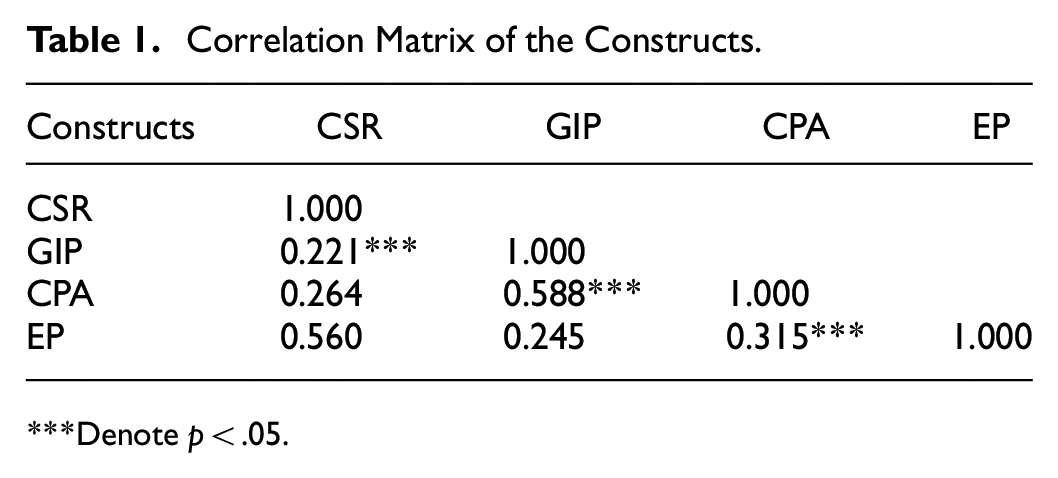
Denote p < .05.
Measurement Model Assessment
Reliability and Validity
As depicted in Table 2, to avoid measurement mistakes, the authors rigorously tested the reliability and validity of this study’s measures to ensure consistency in the study outcome. All the loaded items met the threshold specified by the factor loading analysis suggested by (J. F. Hair et al., 2019). The composite reliability coefficient (CR) ranged from 0.818 to 0.889, exceeding the minimum threshold of 0.70. Cronbach’s alpha (CbA) spanned from .876 to .915, exceeding the proposed .70 threshold (J. F. Hair et al., 2019; Kraus et al., 2020), indicating a high level of internal consistency. Additionally, each variable’s average variance extracted (AVE) ranged from 0.519 to 0.642, surpassing the 0.50 threshold. Rho_A statistical values, ranging from 0.843 to 0.900, affirmed satisfactory reliability.
Results of Validity and Reliability of Items Constructs.

Common Method Bias (CMB)
Data were collected from respondents using a questionnaire. As a result, we had to use the proper procedures to help deal with the bias issues related to the questionnaires. We applied several methods described by Podsakoff et al. (2003). Firstly, the authors emphasized the respondents’ anonymity to protect and reduce the respondents’ anxiety. Participants were guaranteed that their responses held no inherent right or wrong answers; therefore, they were encouraged to provide sincere and honest answers to the questions presented.
Furthermore, Harman’s single-factor test was utilized to detect common method biases. Every construct was loaded onto a single factor. The feedback from our data set shows that a single factor accounted for 39.47% of the total variance. The explained variance by the single factor is under 50%, signifying that our dataset is not affected by common method biases. We used the variance VIF to quantify collinearity among the variables. Table 2 shows that VIF values fall below the (5.0) threshold recommended by Sampene et al. (2021). Hence, this current study did not suffer from common method bias.
Assessing the Reflective Measurement Model
The evaluation of this study’s validity involved the computation of the Fornell-Larcker Discriminant validity criterion and the Heterotrait-Monotrait Ratio (HTMT) for the model. Discriminate validity is acknowledged when the researcher’s set of object variables can be distinguished from one another (Fornell & Larcker, 1981; J. F. Hair et al., 2019). Fornell and Larcker (1981) criteria suggested a traditional two-way correlational matrix. According to the first proposed test, the diagonal values within all constructs denote square roots of the AVE, which should be greater than the row and column, indicating the construct correlation value among each AVE to be .5. The second proposed test also indicates that the associations among all constructs are less than 0.90, as depicted in Table 3. Thus, these findings meet the requirements concerning discriminant validity.
Discriminate Validity (Fornell-Larcker Criteria).

Another technique and pivotal method for evaluating model multicollinearity and validity, as seen in SEM-PLS, is the application of Heterotrait-Monotrait (HTMT). This ratio assesses the correlation attributes within the model. According to Fornell and Larcker (1981), caution is advised when the HTMT value surpasses 0.90, indicating potential issues with discrimination. Therefore, ensuring that the HTMT ratio remains below the 0.90 threshold J. F. Hair et al. (2019) is crucial. The outcomes depicted in Table 4 reaffirm the established principles by prior scholars, confirming that the HTMT discriminant level is valid in this study, given that all construct values are below the specified threshold of 0.90.
Heterotrait-Monotrait Ratio (HTMT).

Model Performance and Goodness of Fit
Table 5 displays the model’s significance level and goodness of fit. The study adopted R2, Q2, and F2 to show the significance of the model. The R2 test evaluates the predictive power of an endogenous variable in this study. The R2 score denotes an accurate prognosis (J. F. Hair et al., 2020). According to the statistical value of R2, the relationship between CSR and EP has an R2 of .702. At the same time, CSR to GIP indicates an R2 value of .820, and GIP to EP accounts for .718 of the variances in these variables. The statistical significance of Q2 aids structural model analysis via Geiser-Stone predictive accuracy.
Hypothesis Testing Results.
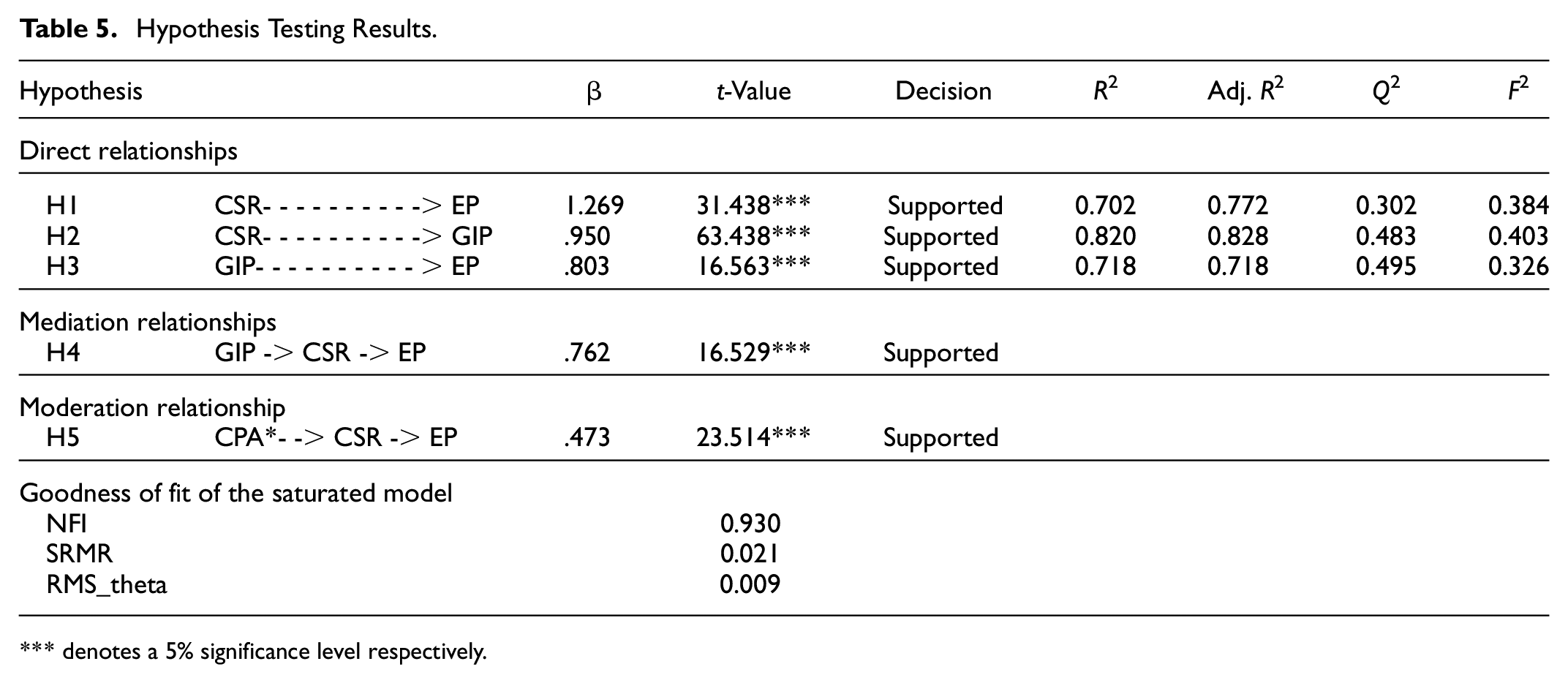
denotes a 5% significance level respectively.
The assumption is that the Q2 value should be greater than zero (0), as recommended by earlier studies (L. Cai et al., 2022). Therefore, the Q2 values in Table 5 of this current study’s model prediction are of greater accuracy than zero in all variables. The saturated model of the goodness of fit is also shown in Table 5. Furthermore, the effect size (F2) analysis test indicates the strength-interplay path among the latent variables in the structural model (F. Hair et al., 2014). The statistical values of F2 > 0.02, 0.15, and 0.35 showed a small, average, and significant effect, respectively, as recommended by Cohen (1988). The F2 value reveals whether an exogenous construct significantly impacts an endogenous construct. The results of the F2 test, shown in Table 5, indicated a significant effect (0.403) of EP and an average effect for GIP and CSR. Table 5 further presents the saturated model of the goodness of fit.
In line with Field Henseler et al. (2016) recommendation, the standardized root mean square (SRMR) value should exceed 0.08 to determine the PLS-SEM model’s fitness level. Our empirical findings revealed the sufficient fitness of the model, with an SRMR value of 0.021. The outer model residuals’ root mean squared residual covariance matrix (RMS theta) is also calculated. Dijkstra and Henseler (2015) recommend that the RMS theta value be smaller than 0.12. The model meets this condition, as evidenced by the analysis’s RMS theta value of 0.009. The model’s normal fit index (NFI), a different way to judge the goodness of fit, shows that it meets the NFI criterion established by Hu and Bentler (1999) with a value of 0.930. The structural model used in the study has an adequate capacity for prediction.
Hypothesis Testing
Assessing path coefficients in the structural model was pivotal in hypothesis testing. This study employed t-statistics and the actual means approach of PLS-SEM, utilizing resampling bootstrap techniques with 5000 bootstrapped samples (J. F. Hair et al., 2012). Table 5 and Figure 2 present the path coefficients and p-values for all five hypotheses at a significance level .0001.

Outcome of the structural model.
Direct Path Analysis
Our empirical discoveries provide robust statistical backing for H1 (CSR → EP; β = 1.269; t-value = 31.438; p = .000). Similarly, H2, positing that CSR positively impacts GIP, also garnered substantial support (β = .950; t-value = 63.438; p = .000). Additionally, the outcomes of H3 unveiled a direct and noteworthy correlation between GIP and EP (β = .803; t-value = 16.563; p = .000), consolidating the affirmation for H1 to H3.
Mediation Analysis
Following the methodology proposed by L. Cai et al. (2022), mediation analysis was employed to assess the influence of a third variable on the interactions between two others. In an intervening model, we presuppose that a variable named X affects an outcome variable named Y through intervening factors, sometimes termed mediators (M). In our investigation of GIP as a mediator in the CSR-EP relationship, we used the Smart PLS bootstrapping approach (J. F. Hair et al., 2020). The empirical results of our study showed that CSR had a statistically significant indirect effect on EP through GIP (H5; β = .762; t-value = 16.529; p = .000), which means that GIP played a substantial role in mediating the CSR-EP link.
Moderation Analysis
The concept of moderation posits a scenario in which the association between two conceptual variables is not consistently stable but is contingent upon the influence of a third variable known as the moderator variable. As expounded by Sampene, Li, Khan, et al. (2023), this moderator variable governs the strength and directionality of the interaction between the two structures within the model. Following this theoretical framework and the study’s goals, we looked at how the moderator variable, competitive advantage (CPA), affects the connection between CSR and EP using the statistical method of partial least squares (PLS).
The results supported H5 (CPA*→ CSR → EP; β = .473; t-value = 23.514; p = .000), indicating a significant influence of CPA on the correlation between CSR and EP. Figure 3 shows an iteration diagram that shows how CPA affects the association between CSR and EP in the manufacturing industry.

Moderation role of CPA between CSR and EP.
Discussion
Despite extensive research on the relationships among CSR, organizational culture, organizational performance, GIP, sustainability, and the sustainable environment, comprehensive studies have yielded mixed findings in emerging and developed countries, leaving the discourse inconclusive. This study is crucial to advancing the debate on this phenomenon, particularly within the nuanced context of Chinese manufacturing industries. Recognizing the imperative nature of understanding these intricate relationships, we investigate the links between CSR and EP, incorporating GIP as a mediator variable and CPA as a moderator variable. Our focus on Zhenjiang City in Jiangsu Province offers a unique lens into the dynamics of these relationships within a specific regional setting. The empirical findings from a sample of 910 employees establish that CSR significantly influences EP in China. Furthermore, GIP mediates the link between CSR and EP, while CPA positively moderates the interaction between CSR and EP. These results are meticulously addressed in the subsequent paragraphs.
Empirically, our study reveals a direct and significant association between CSR and EP, aligning with prior researchers who found that CSR positively enhances EP (Ahmad et al., 2021; Gligor-Cimpoieru et al., 2017; Guang-Wen & Siddik, 2022; Zeng & Schoenecker, 2015). Suggesting that the growth of CSR practices in China’s manufacturing firms will advance eco-environmental performance, contradicting the findings of Kraus et al. (2020) and Rehman et al. (2022), who did not find a direct association between CSR dimensions and EP. The confirmed positive influence of CSR on EP (H1 supported) underscores the pivotal role of CSR in enhancing EP in the manufacturing sector. Organizations should recognize the potential influence of CSR initiatives on their overall ecological sustainability.
The second hypothesis is heavily supported by empirical results, indicating that CSR directly enhances GIP. The study’s outcomes reveal a significant increase in CSR, leading to a substantial increase in green innovation practices, aligning with other studies that found a positive relationship between CSR and GIP (Hou et al., 2023; Kraus et al., 2020; Padilla-Lozano & Collazzo, 2022; H. Wang et al., 2021; Xie, 2022; J. Zhang & Liu, 2023; Zheng et al., 2022). Additionally, the positive relationship between CSR and GIP (H2 supported) emphasizes the interconnectedness of responsible business practices and innovative environmental initiatives. This insight encourages practitioners to integrate green innovation practices within their CSR frameworks for a more holistic and impactful approach. Therefore, we highlight those leaders and employees in China’s manufacturing industries, mainly in the study area, are actively engaged in shaping and executing impactful GIP by ensuring effective implementation of GIP into product lifecycles. Specifically, local processes and products and imported goods encourage the manufacturing sector to adopt green techniques and products to create a greener ecosystem, as indicated by the findings of this research.
The third hypothesis, testing whether GIP significantly influences EP, is supported. This outcome resonates with prior research indicating a positive relationship between GIP and EP Albort-Morant et al. (2016), N. Ali et al. (2022), and Yuan and Cao (2022), emphasizing the positive impact that increased green innovation has on reducing environmental hazards and emissions. The established direct and significant relationship between GIP and EP (H3 supported) highlights the tangible environmental benefits that result from proactive green innovation practices. Manufacturers can leverage this insight to develop and prioritize environmentally friendly innovation strategies. Thus, firms that increased their green innovation process and product production positively influenced the environment by not contributing much to environmental hazards and emissions. The study is consistent with Chiou et al. (2011), which found negative interplay associations between GIP and EP. Based on the result, this study can conclude that institutional pressures on manufacturing firms to go green in their products, goods, and services have strategically influenced manufacturing industries to ensure a greener ecosystem.
Our study further synthesizes the role played by GIP as a mediator in the association between CSR and EP. Empirically, results display that CSR indirectly affects EP through GIP, supporting prior research (Adegbile et al., 2017; Seman et al., 2019; Shahzad et al., 2020; Tunio et al., 2021; Weng et al., 2015; Yuan & Cao, 2022). Thus, this underscores the importance of combining CSR, GIP, and EP to achieve a greener ecosystem, strategically benefiting manufacturing industries in China. The mediation analysis revealed CSR’s statistically significant indirect impact on EP through GIP (H4 supported). This finding suggests that adopting GIP mediates CSR’s positive influence on EP. For practitioners, this implies that implementing GIP acts as a channel through which CSR efforts translate into improved environmental outcomes. Consequently, organizations should strategically integrate green innovation into their CSR initiatives to maximize their ecological impact.
Finally, in this insightful study, we moderated the CPA construct to ascertain whether CPA indirectly influences CSR and EP. The study finding of hypothesis 5 demonstrates that CPA indirectly affects CSR and EP, positively moderating the association between CSR and EP. Hence, the present study confirms that constructive strategic measures of CSR practice in manufacturing would drastically reduce the current damaged environment. The study outcome supports previous findings on EP, such as (Hang et al., 2022; Yuan & Cao, 2022; Z. Zhou et al., 2022). It highlights that CSR, directly and indirectly, influences EP, emphasizing the need for managers and owners to recognize the impact of CSR practices on corporate performance. The moderation analysis demonstrated that CPA significantly affects the correlation between CSR and EP (H5 supported) and is in line with Eksandy and Mulyadi (2020), who later found CSR to be positive on economic performance after moderating CPA. The current study suggests that CSR has a positive association with EP nexus and maintains its positiveness in enchanting effect when moderated by CPA, confirming its positive role between CSR and EP. Thus, the study’s responses to Burak (2021) study called for the potential of CPA as a moderator of CSR and economic performance. This study underscores the importance of considering CPA as a contextual factor shaping the connection between CSR and EP in manufacturing industries. Organizations striving for environmental sustainability should align their CSR practices with competitive advantage strategies to optimize the positive impact on environmental outcomes.
Conclusions and Implications
This research provides enhanced insight into sustainable development. Evaluating and presenting empirical findings addresses gaps in the literature on CSR and its impact on EP. Utilizing PLS-SEM, the study collected 910 legitimate responses from Chinese manufacturing companies in Zhenjiang City. The empirical findings reveal key insights: (1) CSR is a crucial predictor of EP. (2) GIP has a direct impact on EP. (3) GIP acts as a mediator in the CSR-EP relationship, and (4) Lastly, the CPA strongly enhances the interaction between CSR and EP. Overall, these findings underscore the significance of CSR and GIP in the context of CPA and EP for manufacturing firms. The analysis concludes by emphasizing the need for manufacturing firms to allocate internal resources to CSR, GIP, and CPA to promote ecological targets.
Moreover, the study outcome highlighted that GIP acts as an intermediary between the association between firms’ CSR initiatives and their transition to higher environmental sustainability. Thus, GIP will enable manufacturing enterprises to build on their CSR actions, improve sustainable strategies, and increase overall firms’ EP. The outcome of this study will enhance the confidence of managers and enterprises to continue to invest in GIP and CSR plans. In addition, the study’s outcome confirmed the moderated impact of CPA on the connection between CSR and EP. Therefore, manufacturing enterprises can gain insightful knowledge on CPA to stimulate the association between CSR and EP.
Theoretical Implication
Hence, the study significantly contributes to these areas as an inventive research endeavor incorporating CSR (environmental, economic, and social), GIP (product and process), and EP into a unified research model while moderating CPA in manufacturing companies in China’s Zhenjiang City. This current study theologically provides unique, insightful contributions to the academic body of knowledge. First, the study enriches the DCV theory by incorporating new variables such as GIP, CSR, and CPA to examine its influence on EP. The outcome presented, therefore, contributes to existing studies that have evaluated this theory to evaluate how firms can harness the capabilities and abilities of their employees to enhance EP (Meirun et al., 2020; Qiu et al., 2020; Wu, 2010; Yahya et al., 2022).
Second, another significant contribution of this study is that it evaluated the mediation role of GIP between CSR and EP. Thirdly, the concept of CRS is a new domain that requires thorough investigation. Through the empirical outcome of this study, we have highlighted the essential role of CRS in promoting GIP and EP from Chinese manufacturing firms. Only a few studies exist to evaluate this relationship; hence, this study enhances knowledge of CRS in emerging economies such as China. This analysis also shows how Chinese manufacturing companies optimize their CSR, GIP, and CPA to achieve EP. Lastly, the study contributes to four streams of concepts in environmental management, which include CSR (Ansari et al., 2021; Saeed et al., 2019; Shahab et al., 2020; Tunio et al., 2021); GIP (Khan et al., 2023; Song et al., 2021; N. Wang et al., 2022); CPA (Kam-Sing Wong, 2012; Padilla-Lozano and Collazzo, 2022; Wei et al., 2020; Y. Zhang et al., 2020); and EP (Darvishmotevali & Altinay, 2022; Padilla-Lozano & Collazzo, 2022; Ren et al., 2022; Yahya et al., 2022).
Practical Implication
This current paper significantly contributes to the knowledge of general managers, shareholders/investors, and policymakers/governments. Empirically, most prior studies on the notion of CSR and environmental sustainability performance have not been able to confirm to what extent the triple combined CSR dimensions, such as ecological, economic, and social, might be traded off or achieved while considering the interconnections of GIP and CPA to achieve environmentally sustainable performance. Thus, the study framework provides enterprises with a novel concept about the emerging influence of CSR, GIP, and CPA on implementing EP. As contemporary commerce commences, investors and stakeholders desire green process goods. Since China is considered the hub of manufacturing firms globally, it comes with the aligned negative detriment of increasing environmental problems such as high carbon emissions. This study will contribute to expanding education, research, and development on the need for corporate social responsibilities and their impact on the environmental performance of firms. Manufacturing should engage with its stakeholders to move internationally to the green innovation process and product to achieve a more significant competitive advantage. Many consumers and customers are gradually moving away from firms with lower CRS practices and poor environmental performance. Hence, since most firms in Zhenjiang, China, aim to produce and supply to the global market, research findings of this nature will be beneficial to achieving this goal. Manufacturing firms should consider CSR a driving force toward green production practices and contribute their social quota through CSR. Lastly, this study is deemed significant to stakeholders and policymakers in corporate social responsibility. It reduces environmental havoc through production activities by ensuring firms achieve a competitive advantage through green innovation practices. Firms should also ensure they engage more in environmentally related corporate social responsibilities for the environmental harm they cause.
Limitations and Future Research
Despite the insightful and significant contributions of this present study to CSR, GIP, and EP, there are also some limitations that future researchers can work on. First, our research and its results were restricted to only manufacturing companies in Zhenjiang City, Jiangsu Province, China. Future research should extend the survey to other provinces or conduct a comparative study to evaluate the effect of CSR and GIP on EP across different regions. Additionally, researchers can explore the relationship between CSR and EP, incorporating green strategic and transformational leadership as mediating or moderating constructs. A similar study might be carried out in other nations to observe changes, as the current research was done in China, which has its own culture and conventions. Furthermore, future scholars can apply circular economy principles to assess the triple dimensions of CSR performance, providing a more comprehensive understanding of sustainable practices in manufacturing industries.
Supplemental Material
sj-docx-1-sgo-10.1177_21582440241242847 – Supplemental material for Fostering Environmental Performance Via Corporate Social Responsibility and Green Innovation Initiatives: Examining the Moderating Influence of Competitive Advantage
Supplemental material, sj-docx-1-sgo-10.1177_21582440241242847 for Fostering Environmental Performance Via Corporate Social Responsibility and Green Innovation Initiatives: Examining the Moderating Influence of Competitive Advantage by Esther Agyeiwaa Owusu, Lulin Zhou, Agyemang Kwasi Sampene, Francis Atta Sarpong and Francisca Arboh in SAGE Open
Footnotes
Declaration of Conflicting Interests
The author(s) declared no potential conflicts of interest with respect to the research, authorship, and/or publication of this article.
Funding
The author(s) received no financial support for the research, authorship, and/or publication of this article. This research received funding and support from the National Natural Science Foundation of China, grant number 71974064.
Ethical Clearance
The study received ethical clearance from the ethical standards committee of the School of Management, Jiangsu University.
Participant Consent
Verbal Informed Consent was sorted from participants and promise of confidentiality.
Publication Consent
All authors have thoroughly examined and endorsed the manuscript.

Data Availability Statement
Research data will be provided by the corresponding author by request.
Supplemental Material
Supplemental material for this article is available online.
References
Supplementary Material
Please find the following supplemental material available below.
For Open Access articles published under a Creative Commons License, all supplemental material carries the same license as the article it is associated with.
For non-Open Access articles published, all supplemental material carries a non-exclusive license, and permission requests for re-use of supplemental material or any part of supplemental material shall be sent directly to the copyright owner as specified in the copyright notice associated with the article.
