




Abstract
Continuous use is critical for the survival and success of any tourism online-to-offline (O2O) platforms. Much prior research has focused on initial trust on initial adoption of e-commerce websites but pays less attention to the effect of ongoing trust on continuous use. This study presents an integrated model, including two categories of ongoing trust to test their contributions on tourism O2O platform continuance. It also examines their different antecedents, impacts, and the interactions between them. Drawn from a web-based survey with 418 responses, empirical results show that ongoing trust in O2O platforms positively influence platform continuance, whereas ongoing trust in offline destinations positively influence ongoing trust in platforms. Confirmations of expected product and service quality are significant to ongoing trust in destinations, but confirmation of expected convenience is not. Confirmations of expected platform quality, specific guarantees, and loyalty program benefits are significant to ongoing trust in platforms. In addition, the antecedents and effects of ongoing trust in platforms are different between experienced and less-experienced customers. These findings have useful implications on how academics and practitioners work together to ensure the sustainable development of their tourism O2O businesses.
Introduction
With the widespread use of information technologies and exponential growth of social communities, a new e-commerce model called O2O e-commerce has become increasingly popular in recent years (Pan et al., 2019). The O2O business model refers to the integration of offline business opportunities with online platforms (e.g., Ctrip and Qunar; Phang et al., 2014). O2O platforms attract customers through merchant-provided or used-generated online contents, whereas the real consumption must be experienced by customers offline (Du & Tang, 2014). This model is quite suitable for experiential service industries. China’s online travel industry is a large-scale experiential service industry with O2O activities, which has been developing and expanding rapidly and maturely. According to a report released in 2018 by IResearch, China’s tourism O2O market size reached 738.4 billion RMB at the end of 2017, with an increase of 25.1% from 2016. Attracted by the great profit potential, more internet firms are entering this new market. As a result, this market is increasingly crowded and customers can easily switch among competitors.
The latest feedback from the tourism O2O market reveals that the success of tourism O2O business largely depends on whether customers can obtain consistent products or services from offline destinations, as claimed online, and can build ongoing trust toward O2O platforms (S. Xiao & Dong, 2015). If both destinations and platforms behave in a reliable and expected way, customer ongoing trust will be built up. Then, the platform continuance use intention will be motivated and the closed loop of online ordering–offline experience–online ordering will form, which in turn achieves customer retention and a sustainable competitive advantage. Conversely, the tourism O2O system would fail because of its broken operation flow induced by early trust loss and customer withdrawals. As such, ongoing trust plays a vital role in tourism O2O platform continuance and O2O closed-loop formation.
In addition, O2O e-commerce is quite different from traditional B2B/C2C/B2C e-commerce, where customers can easily change or return products and thus their ongoing trust can be timely repaired. The O2O model emphasizes offline experiences (Du & Tang, 2014). Only after customers experience products or services offline can they form their real trust perceptions about the destinations and the O2O platforms. They cannot easily change or return the products or services, even when they receive a poor experience. On the contrary, not only offline destinations but also tourism O2O platforms have fewer opportunities to repair customer trust. In this view, both destinations and platforms in tourism O2O commerce face more difficulties and thus must place more effort into preserving trust among customers.
Given the outstanding importance of trust in retaining customers and increasing customer loyalty, scholars have devoted much effort to exploring trust-building factors and trust-building process in e-commerce (H.-W. Kim et al., 2004; Pengnate & Sarathy, 2017). However, previous findings cannot perform well in understanding the effect of ongoing trust on tourism O2O platform continuance and thus require further expansion. First, previous research has drawn upon signaling theory to explore the informational cues of trust building (Kirmani & Rao, 2013). Reliability reevaluation in O2O commerce mainly embodies in whether customers can receive the expected products or services (S. Xiao & Dong, 2015). That is to say, expectation-confirmation theory (ECT) is more required to investigate the ongoing trust-building factors in the tourism O2O scenario. Second, many destinations do not have the ability to develop an online channel to promote their destinations (Chang et al., 2018). They have to rely on popular intermediary platforms to attract customers. Consequently, ongoing trust-building factors must involve both online system and offline destination trust-related variables. Meanwhile, trust in destinations interacts with trust in platforms (L. Xiao et al., 2016). Specifically, for recurring customers, ongoing trust may transfer from offline destinations to tourism O2O platforms, and then promote platform continuance intention. Prior researchers tend to study trust-in-destination (Sannassee & Seetanah, 2014) or trust-in-platform (Agag & El-Masry, 2017 ; M.-J. Lin & Wang, 2015) separately, ignoring the effect of trust-in-destination on trust-in-platform. Third, customers in traditional e-commerce reassess the trustworthiness of an e-vendor mainly by the consistency of product quality (H.-W. Kim & Gupta, 2009). Customers in tourism O2O context must consume products or services offline, and thus need to consider other factors (such as environmental factor) for making a trustworthiness reassessment. As such, the factors influencing ongoing trust building are more complex in tourism O2O e-commerce than in traditional e-commerce. Finally, recurring customers have accumulated experience resulting from their past tourism O2O platform usage. Although online experience has been identified as a moderator in the relationship between customer attitude and its antecedents (Min et al., 2017; Wu et al., 2017), it has been scarcely discussed in the issues of ongoing trust and tourism O2O platform continuance.
To leverage these opportunities, we develop a new research model by classifying ongoing trust in tourism O2O e-commerce into two types: ongoing trust in destinations and ongoing trust in platforms. Based on ECT and trust transfer theory, we test our integrated model and attempt to answer three research questions:
This study makes significant contributions to tourism literature and trust literature. For tourism literature, we contribute by investigating online tourism under the O2O model, a new e-commerce model that is receiving growing research attention. For trust literature, we contribute by focusing on ongoing trust, a very suitable research domain which can help improve customer retention. More specifically, we contribute by addressing a two-trustee involved model, a novel theoretical framework that has been scarcely applied in understanding platform continuous usage intention. This study also contributes to the prosperity of tourism O2O e-commerce by examining the above ongoing trust-building issues. Although the sample represents tourism O2O e-commerce, the findings may provide value to firms in other O2O commerce models (e.g., catering and transportation), which can use the insights as a reference to guide their businesses in the emerging markets.
Concept Framework and Theoretical Foundations
Trust in Tourism O2O E-Commerce
Trust is the willingness of a party (trustor) to be vulnerable to the actions of another party (trustee) based on the expectation that the other will perform a particular action important to the trustor, irrespective of the ability to monitor or control that other party. (Mayer et al., 1995, p. 712)
The following the definition of trust includes three main characteristics: ability, benevolence, and integrity (Mayer et al., 1995). In e-commerce, trust is conceptualized as a set of beliefs about e-vendors (H.-W. Kim et al., 2012). For example, trust in tourism O2O platform can be regarded as the belief that the platforms will provide a safe and credible internet business environment. Trust in offline destinations is the belief that the destination will behave in a reliable, risk- and hassle-free manner in the business relationship. Trust in platforms and trust in destinations contain the three dimensions as well.
Trust is an evolving process (H.-W. Kim & Gupta, 2009). The evolution process can be characterized as initial trust and ongoing trust if the trust life cycle is divided at the first interaction event (H.-W. Kim et al., 2012), as shown in Figure 1A. It can also be characterized as pretrust and posttrust if the trust life cycle is divided at the continuing interaction event (J. Lin et al., 2014), as shown in Figure 1B. Pretrust, to a large degree, corresponds to initial trust, whereas posttrust corresponds to ongoing trust (H.-W. Kim et al., 2004). In this study, ongoing trust in destinations can be better described by Figure 1A, as customers generally would not likely frequently revisit a destination. Ongoing trust in platforms can be better described by Figure 1B, as customers tend to continuously interact with the platforms. As indicated in Figure 1A, potential customers build up initial trust toward a destination based only on browsing its joining website platform and researching online information. This type of trust is not based on any real experience and firsthand information but on an assumption that offline destination will behave in expected way. If offline destination satisfies their expectations after direct offline experience, consumers enter into a state of ongoing trust (Jin, 2012), although the state may last a long period of time. Figure 1B suggests that ongoing trust in platforms gradually develops and is reinforced over time through continuous interaction with the platforms. Customers may have formed trust (pretrust) perception toward an tourism O2O platform prior to using it. Then, they choose the platform to place an order. In the postusage stage, customers reevaluate the platform based on past use and prior expectations. Trust will be developed and enhanced if the performance of O2O platform is greater or equal to their expectation. In other words, the feedback loop of trust–action–trust is repeated, resulting in the promotion of ongoing trust (J. Lin et al., 2014). Ongoing trust is dynamic whether it is a new or ongoing relationship (J. N. Lee & Choi, 2011).

Trust evolution process.
Much research has attempted to understand how initial trust influence individuals starting to use a specific technology system (Hoehle et al., 2012), but left the matters of ongoing trust and its effect on continuance intention less studied. Initial customers without any real transaction experience perceive the technology system only through webpage browsing and online content research (e.g., platform description, feedback reviews). No matter how much knowledge a customer obtains, without transaction experience, such knowledge is inadequate to lead to stabilized trust (H.-W. Kim et al., 2004). By contrast, ongoing trust is grounded in knowledge about the trustees, developed through direct transaction (Holsapple & Wu, 2008). Such knowledge gathered from a real experience is likely to lead to stabilized trust (H.-W. Kim et al., 2004) and continuance intention (Hoehle et al., 2012). In the tourism O2O e-commerce context, continuance use of a certain platform often occurs. In such context, customers can accumulate evidences of the trustworthiness of the platform, and these evidences significantly affect their ongoing trust beliefs. Moreover, as many internet firms are endeavoring to enter the tourism O2O markets, attracting new customers is increasingly difficult. When attracting new customers is considerably more expensive than making customers return, retaining customers is financially imperative for an vendor (Hoehle et al., 2012). In reality, recurring customers contribute most of the revenue of tourism O2O business. Therefore, we affirm that ongoing trust is the most suitable setting for stimulating continuance use intention and O2O close-loop formation in the fiercely competitive tourism O2O markets.
ECT
ECT has been extensively used in the marketing domain to examine postpurchase behavior and customer loyalty (Fu et al., 2018; Oghuma et al., 2016). According to the ECT model, consumer behaviors can be recognized by the following process sequence. Consumers hold specific expectations of the products or services prior to real transaction experience. After consuming these products or services, they will form perceptions of actual performance and then compare them with their original expectations (Oghuma et al., 2016). If their perceived performance meets their satisfaction level, their expectations are confirmed, and otherwise disconfirmed. The more positive the confirmation, the more likely the consumers will to be satisfied (J. Lin et al., 2014). Satisfied customers develop their ongoing trust, whereas dissatisfied customers lose initial trust or pretrust (Hoehle et al., 2012).
Trust Transfer Theory
Trust transfer refers “a cognitive process that may arise from one familiar context to another new context, or from one trusted entity to another unknown entity” (J. Lin et al., 2011, p. 616). Three actors are involved in the trust transfer process, that is, the trustor, the trustee, and a third entity (N. Wang et al., 2013). The trustor is an individual who judges whether to trust others; the trustee is another individual who is assessed by the trustor based on his or her trustworthiness; and the third entity acts as the broker in the trust transfer process (X. Chen et al., 2015). The underlying logic of trust transfer mechanism is that “when the trustor trusts in the third person and there is a close relationship between the trustee and the third person, the trustor’s trust in the third person will be transferred to the trustee” (N. Wang et al., 2013, p. 1396). Here, the third entity, the familiar context or trusted entity, is called as the source of trust transfer, and the trustee, the new context or unknown entity, is called as the target of trust transfer (Stewart, 2003; N. Wang et al., 2013). Perceived relationship between the trustee and trust source plays a crucial role in the trust transfer and trust formation process (X. Chen et al., 2015; L. Liu et al., 2018).
Marketing, marketing information system (MIS), and e-commerce research categorize the trust transfer process as either intrachannel or interchannel (J. Lin et al., 2011). As intrachannel trust transfer is not relevant for this research, we only focus on interchannel trust transfer. Interchannel trust transfer refers to “consumer trust in one entity being transferred to another related entity between different channels” (Yang et al., 2015, p. 79). Numerous scholars agreed that consumer’s attitude toward an offline vendor positively affects his or her perceptions of the vendor’s online business, and have significantly studied how to design the offline–online trust transfer process (K. C. Lee et al., 2007). Some scholars confirmed that trust in a firm’s web shopping services positively affect evaluation of this firm’s mobile shopping services (J. Lin et al., 2011; Yang et al., 2015). By reviewing the existing interchannel trust transfer literature, we find that not only in traditional e-commerce but also in m-commerce, the trustee does not change but rather shift from offline vendor to e-vendor or from e-vendor to m-vendor. Online channel fights with offline channel as they function in different transaction process. Trust transfer in O2O commerce is quite different from extant literature. This transfer mechanism involves two different trustees, namely, O2O platform and offline destination. O2O platform and offline destination work together because they function in the same shopping process. This study aims to investigate how ongoing trust helps generate continuance intention to use a specific platform after the completed transaction process (online searching–ordering–offline experience). Thus, we focus on using the trust transfer theory to examine the specific direction in the correlation: ongoing trust in destinations to ongoing trust in platforms.
Research Models and Hypotheses
Antecedents of Ongoing Trust in Offline Destinations
Destination image is believed to the major factor which influences tourists in the process of customer choice, subsequent evaluation, and future intention (Chi & Qu, 2008; Rousta & Jamshidi, 2020). It is defined as “an individual’s overall perception or total set of impressions of a place, or the mental portrayal of a destination” (Loureiro & González, 2008, p. 120). Product (such as attractions and facilities) quality, service quality, and convenience are often regarded as the core elements measuring destination image (Chi & Qu, 2008; Khan et al., 2017); besides, each element contributes uniquely to the overall satisfaction that directly affects customer trust (Orth & Green, 2009). Thus, it is appropriate to infer that confirmation of expected product quality, service quality, and convenience exerts different effects on ongoing trust building, which needed to be examined separately.
Confirmation of expected product quality
Perceived quality of the destination product is an antecedent of customer trust (Loureiro & González, 2008; Sannassee & Seetanah, 2014). In general, higher quality relates to higher trust (Loureiro & González, 2008; Orth & Green, 2009). Thus, customers would have high expectations about destination product quality when they make a purchase decision by reading online information. However, to make online information attractive, offline merchants (including offline destinations) have strong incentives to hide the key defects and disadvantages of their products and emphasize good aspects when posting product descriptions online. Moreover, some merchants commit trust fraud by purchasing or exchanging positive online reviews (L. Chen et al., 2017). If customers think they do not receive expected products, they will doubt the truthfulness of the online information (Du & Tang, 2014). This trust violation will lead to a continuous decline in and loss of trust (Yoon, 2017). On the contrary, excellent experiences with destination products meeting customer expectation continue to invoke the calculative process of ongoing trust building. Accordingly, we hypothesize the following:
Confirmation of expected service quality
Service quality concerns a customer’s comprehensive evaluation of the service provider’s performance. By extension, in the tourism O2O commerce, destination service quality is all about a customer’s assessment of the performance of services consumed in an offline destination (Bhat, 2012). As O2O e-commerce is a particularly suitable commerce model for a service industry such as tourism, service quality naturally plays an important role in increasing customer satisfaction and retention (Permatasari et al., 2017). However, destinations also have strong intentions to post or manufacture exaggerated information about their offline services. According to the ECT, a full tourism experience that leaves a customer with a feeling of receiving services of the utmost quality increases satisfaction (Chin & Lo, 2017; Sannassee & Seetanah, 2014). Suhartanto et al. (2016) also argued that if the service quality meets expectations, customer satisfaction will be high, and alternatively, customer satisfaction will be low. Moreover, satisfaction strengthens customer trust (Song et al., 2019). Indeed, a positive service quality evaluation based on real destination experience reinforces customers’ tourism brand trust, which further engenders brand loyalty (So et al., 2016). Based on the above discussion, this study suggests the following:
Confirmation of expected convenience
Berry et al. (2002) defined convenience as the “consumers’ time and effort perceptions related to buying or using a service” (p. 1). It can be measured by the SERVCON model (Seiders et al., 2007), which contains five dimensions: decision convenience (e.g., easy to read information), access convenience (e.g., easy to find destination or easy parking), benefit convenience (e.g., easy to find merchandise), transaction convenience (e.g., easy to complete purchase), and postbenefit convenience (e.g., easy to obtain after-sales service; Colwell et al., 2008). Because after-sales service is not a necessary process in the tourism O2O commerce transaction, we do not consider postbenefit convenience. The multiple items of convenience positively affect behavioral intention (Seiders et al., 2007). Thus, travelers are supposed to have expectations about convenience and have placed confidence in it when making purchase decision online. Then, satisfactions with convenience derived from real experience increase repurchase spending and repurchase visits (Seiders et al., 2007). In the tourism O2O commerce context, satisfaction of convenience resulting from expectation confirmation also positively influences overall satisfaction (Suhartanto et al., 2016). Satisfaction then positively affects posttrust (J. Lin et al., 2014) . In addition to product and service quality, convenience in destination should be included in concept model as it affects visitor loyalty (Permatasari et al., 2017). Although little research has examined the relationship between confirmation of expected convenience and ongoing trust, based on the above discussion, we infer that if customer expectations are positively confirmed, their trust toward the offline destinations will be developed, whereas disconfirmation will ruin their initial positive conception and cause distrust. Thus, we hypothesize the following:
Ongoing Trust in Offline Destinations and Ongoing Trust in Tourism O2O Platforms
O2O platforms afford merchants opportunities by stimulating online promotional information generation, from which customers build up product knowledge and awareness to make offline consumption decision (Phang et al., 2014). Meanwhile, O2O platforms have the responsibility to monitor the physical stores and ensure consistency between online and offline in the O2O commerce (Du & Tang, 2014). If a destination behaves in an untrustworthy and unexpected way, its joining platform should take legal actions, such as monetary penalties or the right to join taken away, to publish the dishonest destination on behalf of customers. In reality, destinations have strong incentives to manufacture positive information and beautify destination image. Thus, if customers perceive a high fit between offline quality and online claims during or after consumption, they tend to reinforce their beliefs about the tourism O2O platform’s ability, responsibility, and benevolence. In other words, customers’ trust perceptions about an offline destination based on direct experience will stabilize and develop favorably toward the online platform. As such, trust in destinations is automatically transferred to trust in platforms because of the perceived interrelationships between them. On the contrary, cultivating trust in platforms in nature is a dynamic process (J. Lin et al., 2014). Customers hold high expectations of destination image because they trust its joining platform. After having real travel experience, they will compare the prior expectation generated by reading online information with the actual performance of the destination. The formation of ongoing trust in destination suggests a high congruence between expectation and actual performance. Then, customer trust toward tourism O2O platforms will be accumulated and enhanced. This also confirms that trust in destinations can be transferred to trust in platforms. In addition, an experienced customer who has built strong trust toward a destination is more likely to convince that the destination will select excellent and trustworthy O2O platform to tap on. Following the trust transfer theory, we hypothesize the following:
Antecedents of Ongoing Trust in Tourism O2O Platforms
Many cues such as website quality, structural assurance, perceived usefulness, and perceived ease of use have been suggested as critical triggers in developing consumer trust toward an online platform in traditional online travel literature (Agag & El-Masry, 2017). However, these cues only reflect the quality of a particular website, many of them are interrelated (Y. Liu et al., 2013). In addition to these website cues, specific guarantees and loyalty program benefits are also commonly used by consumers to evaluate tourism O2O platform trustworthiness. Accordingly, confirmation of expected platform quality and specific guarantees, and loyalty program benefits are used for recurring consumers to reevaluate the specific platform and accumulate trust.
Confirmation of expected platform quality
Platform quality refers to “the users’ evaluations of a website’s features meeting users’ needs and reflecting overall excellence” (Aladwani & Palvia, 2002, p. 469). There are two main aspects to platform quality: system quality and information quality (H.-W. Kim et al., 2004). System quality is a measure of “a website system’s overall performance and can measured by customer perceived degrees of user friendliness” (Hsu et al., 2012, p. 553). Information quality is “a measure of value perceived by a customer of the output produced by a website” (Hsu et al., 2012, p. 553). The three expectation categories measuring platform quality, such as ease of use, usefulness, and value, are usually to be managed for successful information system (IS) adoption (C.-C. Chen & Tsai, 2019; Jin, 2012). After using the online service platform, if customers have accumulated evidences that the positive impact of perceived ease of use and perceived usefulness meets their expectation, their satisfaction toward the system will be improved (Hou, 2016). Furthermore, the positive relationship between satisfaction and postuse trust has been validated (J. Lin et al., 2014). In the tourism O2O context, if a travel platform is already perceived to be easy-to-use and useful as expected, the customers on the platform will strengthen their trust beliefs about the platform (Agag & El-Masry, 2017). Hoehle et al. (2012) also confirmed that confirmation of expectation following actual use positively influences customer ongoing trust in internet service system. Although little research on system continuance has examined the relationship between expectation-confirmation of quality and ongoing trust building in terms of O2O platform, based upon the above discussion, we suggest the following:
Confirmation of expected specific guarantees
Similar to vendor-specific guarantees (Sha, 2008), a specific guarantee in tourism O2O commerce is the degree to which a customer believes that the customer service policies provided by a tourism O2O platform could protect customers’ interests and well-beings. These policies include safety policies, order cancelation policies, and other customer service policies. These policies indicate respect for customers and favor customers’ interests (Sirdeshmukh et al., 2002), and thus mitigate customers’ perceptions of contextual risks inherent in online transaction (Fang et al., 2014), and ultimately motivate customers to understand the online platform (Sha, 2008). As such, special guarantee policies serve as a series of promises that help customers establish trust in policy providers before ordering online. If customers pleasurably experience these policies during or after trips, they will be more convinced about the platforms’ ability, responsibility, and benevolence. Accordingly, we hypothesize the following:
Confirmation of expected loyalty program benefits
Loyalty programs is defined as “continuity incentive programs offered by a retailer to reward customers and encourage repeat business” (Dorotic et al., 2012, p. 218). Applied to the tourism O2O e-commerce environment, platform providers play the role of retailer to offer loyalty programs for online customers. According to Dorotic et al. (2012) and Stathopoulou and Balabanis (2016), customers perceive three main types of benefits from loyalty programs, including utilitarian, hedonic, and symbolic benefits. Utilitarian benefits refer to economic savings that loyalty programs provide, such as discounts, coupons, cashback, and points (Dorotic et al., 2012; Stathopoulou & Balabanis, 2016). Hedonic benefits reflect the potential entertainment that customers perceive from the online shopping experience, involving trying new products and exploring new trends (Dorotic et al., 2012). Symbolic benefits are recognized as psychological benefits that the loyalty programs offer, including sense of belonging, special approval, privileged treatment, social status, and recognition (Brashear-Alejandro et al., 2015; Dorotic et al., 2012). Loyalty program benefits act as an indication of the firm’s attention to understand and adapt to the needs of individual customers. Customers involved loyalty programs generally hold the expectations that the programs will meet their goals before purchase. Their subsequent affective state result from evaluating perceived discrepancy between expected benefits of loyalty programs and actual benefits (Stathopoulou & Balabanis, 2016). Based on ECT, the more customers positively perceive the benefits of a loyal program in relation to their expectation, the more likely is their reassurance about the provider’s credibility. Using relationship marketing theory, Mimouni-Chaabane and Volle (2010) showed that loyalty programs incorporating valuable benefits, as a relationship investment, have positive effects on the development of customer trust. Thus, a recurring customer who gains more benefits from loyalty programs is more likely to re-convince the O2O platform competent and reliable. Accordingly, we hypothesize the following:
Ongoing Trust and Continuance Intention
A high degree of postuse trust toward a specific e-commerce platform (including tourism O2O platform) can outweigh the uncertainties and risks in online shopping and thus help consumers enhance continuance use intention (M.-J. Lin & Wang, 2015). Other research has also supported the notion that ongoing trust can encourage individuals to continue using e-commerce portals (Hoehle et al., 2012; Shao et al., 2019). In fact, the positive perception and attitude toward an online platform can be automatically transferred to any unknown destinations related to the platform (X. Chen et al., 2015). Consequently, these unfamiliar destinations will then be viewed as trustworthy transaction partners. Similarly, a returning customer who trusts a familiar tourism O2O platform may also trust any unfamiliar offline destinations on the platform, and then have a strong continuance use intention with respect to the platform to study and select a new offline destination.
Differences Between Consumers With Different Experiences
The effect of customers’ trust on reusage intention may change with gaining IS/IT (information technology) using experience (Min et al., 2017). According to S. Wang et al. (2004), trust can be classified into experience-based or cue-based. Experience-based trust is acquired via repeated interactions, whereas cue-based trust is founded on cues provided by or associated with a single encounter (e.g., an O2O platform). Experienced customer who has store knowledge about a specific web platform is more likely to downplay risk cognition and tend to make faster repurchase decisions on the platform (Rodgers et al., 2005), whereas inexperienced users comment more frequently about their potential internet anxiety (C. P. Lin & Ding, 2005). That is to say, trust exerts a strong influence in customer behavior when they have limited useful cues to evaluate the trustees. Once habit has formed from repetitive online shopping experience, customers will silence uncertainty, and then the importance of trust on reusage intention decrease gradually (Chiu et al., 2012). Institutional trust in traditional e-commerce (trust in internet environment and system quality) can significantly affect e-loyalty for low experience customers, but not for high experience customers (L. Xiao et al., 2016). These literatures suggest that experience negatively moderates the effects of ongoing trust in platforms on platform continuance intention. Hence, we hypothesize the following:
The influence of antecedents on trust building differs between high online experience consumers and low experience ones (J. Kim et al., 2012; Min et al., 2017; Rodgers et al., 2005). Customers with little prior IS experience depend heavily on available cognitive signals such as web architecture design, content design, and special content design to stimulate their trust (Karimov et al., 2011). Whereas, these signals may be not that important for customers with much prior IS experience in that they believe the online transaction environment to have high normative standards (C. P. Lin & Ding, 2005). According to the cognitive dissonance theory, H.-W. Kim et al. (2004) confirmed that repeat customers may downplay website impressions and transaction environment issues in building trust. McKnight et al. (2002) also believed that over time and interaction with the trustees, the trust-building factors, such as perceived site quality and structural assurance, may become less salient. Although these cue-based trust-related variables become less important over time with repeated use of online technology system, experience-based trust-related variables will play a greater role in continuation of trust in platform service (Karimov et al., 2011). Based on the above discussion, we propose the following:
By including major antecedents and the impacts on continuance intention of ongoing trust in platforms, we present the research model with hypotheses in Figure 2. In addition, although the relationship between ongoing trust in destinations and O2O platform continuance is not hypothesized, we still include it in Figure 2 to ensure the model completeness.

Research model.
Research Methodology
Measure Development
We used prior literature as a basis to develop items. The three items measuring confirmation of expected product quality were adapted from Suhartanto et al. (2016) and Chi and Qu (2008). The four items measuring confirmation of expected service quality were adapted from Parasuraman et al. (1991) and H.-W. Kim et al. (2004). The five items measuring confirmation of expected convenience were adapted from Colwell et al. (2008) and Seiders et al. (2007). To measure confirmation of expected platform quality, we used one-dimensional construct adapted from H.-W. Kim et al. (2004). To measure confirmation of expected specific guarantees, we used four items adapted from Sha (2008). To measure loyalty program benefits confirmation, we used five items adapted from Stathopoulou and Balabanis (2016). Meanwhile, to fit our research context, we added words like “which is consistent with what I expected” or “consistent with what I expected,” and so on to the above item descriptions. Ongoing trust in destinations was measured with four items adapted from Choi et al. (2016) and M. J. Kim et al. (2011). Ongoing trust in tourism O2O platforms was measured with four items adapted from Agag and El-Masry (2017). Similarly, we add words like “Based on my experience, I think” to the descriptions of the two constructs. Finally, continuance use intention was measured with four items adapted from K. C. Lee et al. (2011) and Agag and El-Masry (2017). The list of questionnaire items was finalized and presented in the appendix.
Data Collection
We constructed and published our survey questionnaire on Wenjuan.com, a well-known professional questionnaire platform in Chinese that provides free online survey hosting services. The survey was available online for 4 months (July–October). Individuals with experience using tourism O2O platforms to select destinations and traveling to the destinations in the latest year were invited to recall their most recent travel experience and then rate all the items on a 7-point Likert-type scale. To publicize our online survey, we distributed the questionnaire’s URL address to the most popular social network sites in China, such as QQ and WeChat. To increase response rate, we awarded responses with WeChat Red Bags or QQ Red Bags.
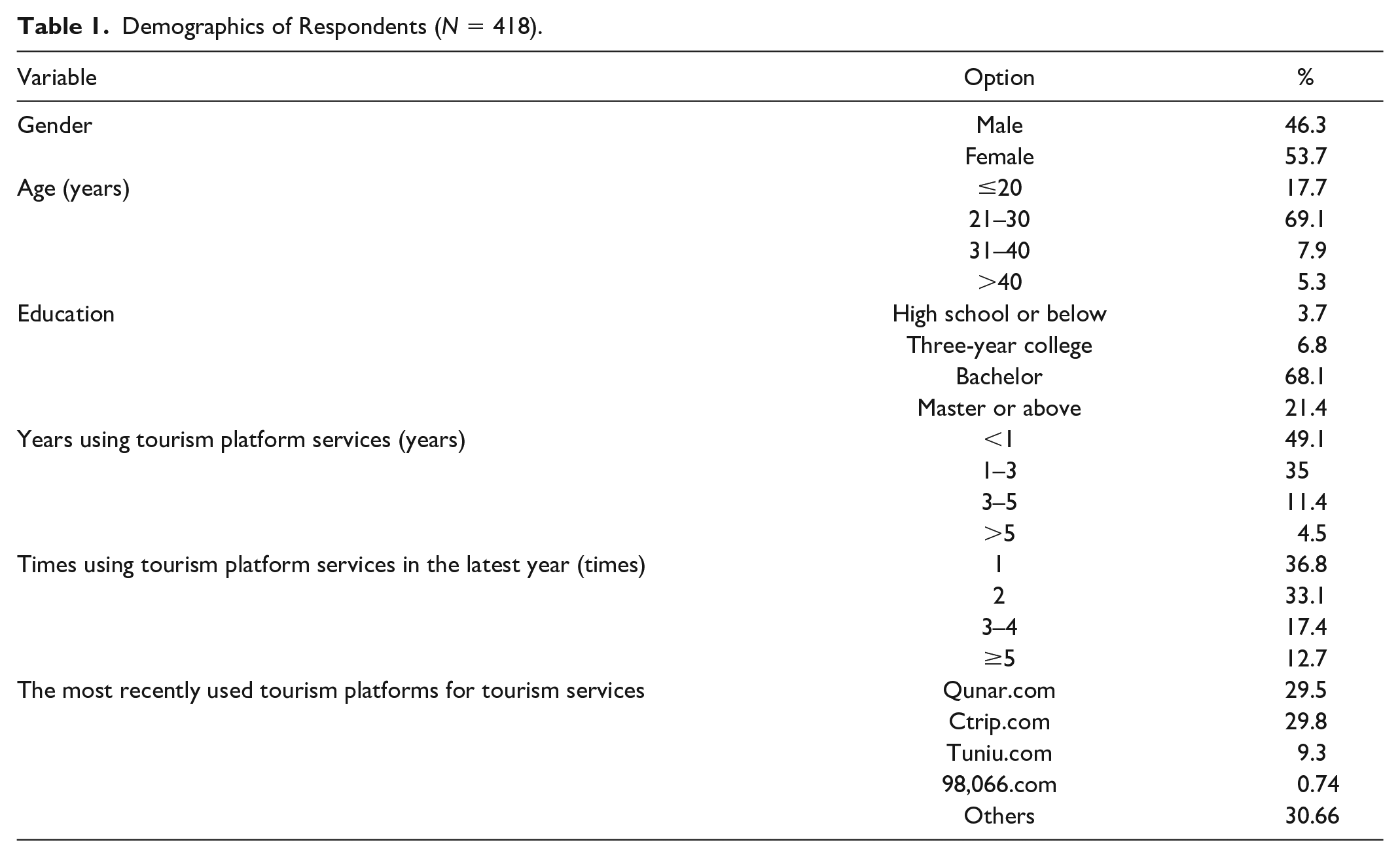
After removing problematic responses (e.g., giving all the items the same value), a total of 418 valid responses were ultimately received. Of these 418 respondents, 46.3% were male and 53.7% were female (see Table 1). The respondents were relatively young: 69.1% aged between 21 and 30, and 7.9% aged between 31 and 40. In terms of education, 74.9% had a college degree, and 21.4% had a master’s degree or higher. To examine whether the sample characteristics in this study are consistent with the available statistics on China’s tourism O2O market, we investigated the annual statistic reports published by IResearch (2018). The reports indicate that 46.5% of online travel customers on Qunar.com (a popular tourism O2O platform in China) are male and 53.5% are female; 67.3% are aged younger than 34, indicating that online travel customers are relatively young. Regarding education level, more than 90% of online travel customers have high education levels (college degree or above). According to the results of comparison analysis, we confirmed that our sample represented general O2O travel customers.
Demographics of Respondents (N = 418).
Common Method Variance (CMV)
As CMV may be a contaminant of our data (Podsakoff et al., 2003), and Harman’s single-factor test is inappropriate to determine the extent of CMV (Hulland et al., 2018), we tested for CMV using the approach proposed by Liang et al. (2007). The results, shown in Table 2, indicated that the average substantively explained variance of the indicators was much larger than the average method-based variance (0.562–0.013). Meanwhile, most method factor loadings were insignificant. Thus, CMV was unlikely a threat in our data set.
Common Method Variance Analysis.

p < .05. **p < .01. ***p < .001.
Data Analysis and Results
Measurement Model
To test the measurement model, we first evaluated the reliability, convergent validity, and discriminant validity. As shown in Table 3, all standardized factor loadings were above .6 and statistically significant. All average variances extracted (AVEs) were higher than 0.6211, above the criterion of 0.5. The Cronbach’s alpha ranged from .7712 to .8919, all above the benchmark value of .7. All composite reliability values were above the recommended value of 0.7. Overall, the measurement model demonstrated adequate reliability and convergent validity. Discriminant validity was evaluated by comparing the square roots of the AVE of each construct with the correlation coefficients among constructs, and was found to be well achieved.
Reliability, Validity, and Correlations for Constructs.
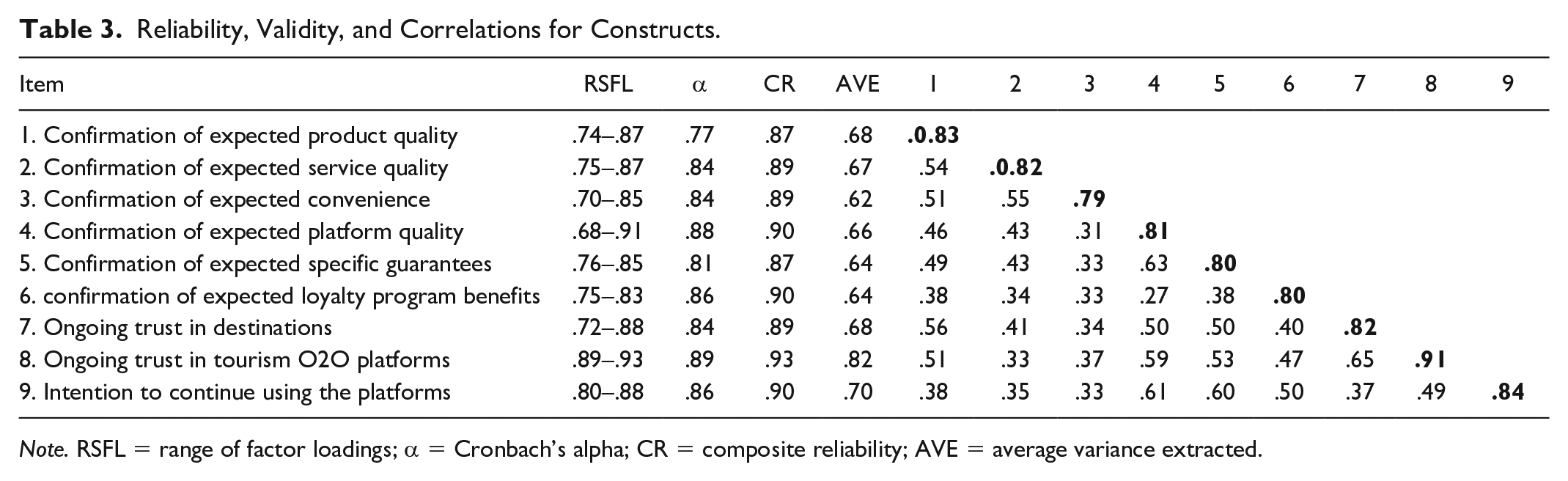
Note. RSFL = range of factor loadings; α = Cronbach’s alpha; CR = composite reliability; AVE = average variance extracted.
Given that several interconstruct correlations were higher than .6, we further performed multicollinearity test. Multicollinearity exists when the variance inflation factors (VIFs) exceed to 5 (Marquardt, 1970). The results indicated that our VIFs values, ranging from 1.571 to 3.287, were all lower than 5.0. Thus, multicollinearity was not a significant problem in the present research.
Structural Model and Hypothesis Testing
Figure 3 showed the standardized PLS path coefficients along with R2. Standardized root mean square residual (SRMR) was 0.047, which indicted a good fit. This model, though very parsimonious, explained 32.6%, 52.3%, and 42.9% of the variances on ongoing trust in offline destinations, ongoing trust in tourism O2O platforms, and continuance intention, respectively. Bootstrapping with 2,000 replications was applied to estimate the statistical significance of the regression weights. As confirmed, confirmations of expected product and service quality were found to have significant impacts on ongoing trust in offline destinations, whereas confirmation of expected convenience was found to have nonsignificant impact, supporting H1a and H1b but rejecting H1c. Then, ongoing trust in offline destinations exerted significant impact on ongoing trust in tourism O2O platforms, supporting H2. Meanwhile, confirmations of expected platform quality, specific guarantees, and loyalty program benefits did have significant impacts on ongoing trust in tourism O2O platforms, leading to the support of H3a, H3b, and H3c. Finally, ongoing trust in tourism O2O platforms shows significant impact on continuance intention, supporting H4.

Results of structural model.
To investigate the differences between consumers with different tourism O2O experience, we conducted the PLS-MGA (multigroup analysis) on our data set. Customers who used tourism O2O platforms only once in the latest year were classified as less-experienced customers (N = 154), and the others were experienced ones (N = 264). Prior to the multigroup analysis, we used a three-step approach proposed by Henseler et al. (2016) to test the measurement invariance of composites. Step 1 involves assessing configural invariance. For the two groups, our measurement models had the same factor structure, including the same constructs, items on each constructs, and scale. In addition, there were no group differences in terms of the algorithm settings. Thus, configural invariance was established between the two groups of data. Then, a permutation test was done to assess the compositional invariance (Step 2), and equality of composite mean values and variances (Step 3). In light of the results presented in Table 4, we concluded that all composite constructs attained full measurement invariance for the less-experienced and experienced groups.
Measurement Invariance Test.

Note. OTID = ongoing trust in destinations; CEPLQ = confirmation of expected platform quality; CESG = confirmation of expected specific guarantees; CELP = confirmation of expected loyalty program benefits; OTIP = ongoing trust in tourism O2O platforms; ICU = intention to continue using the platforms.
As the different model estimations across groups did not exhibit distinctive content and meanings of the constructs, we performed the multigroup comparisons by using Welch–Satterthwait test. Table 5 reported the results. Ongoing trust in platforms was found to have significant impact on continuance use intention for both groups. Furthermore, the positive impacts were found to be significantly different, that is, ongoing trust in tourism O2O platforms had a weaker effect on continuance use intention for experienced customers than for less-experienced ones, supporting H5. Regarding the interrelationship between the two types of ongoing trust, both groups showed that ongoing trust in destinations had positive impact on ongoing trust in tourism O2O platforms. However, the path difference between the two data sets were not statistically significant, rejecting H6d. Regarding the antecedents of ongoing trust in tourism O2O platforms, for less-experienced customers, confirmations of expected platform quality as well as loyalty program benefits significantly affected ongoing trust in platforms, whereas for experienced customers, only confirmations of expected platform quality had significant impacts. We further found that the path coefficients for less-experienced customers were greater than that for experienced ones and the path differences were significant, supporting H6a and H6c. Contrary to our expectation, the effect of confirmation of expected specific guarantees seemed to be weaker for experienced customers than for less-experienced ones. Nonetheless, the path difference was not supported by p value, rejecting H6b.
Path Differences by Tourism O2O Experiences.

Note. OTIP = ongoing trust in tourism O2O platforms; ICU = intention to continue using the platforms; CEPLQ = confirmation of expected platform quality; CESG = confirmation of expected specific guarantees; CELP = confirmation of expected loyalty program benefits; OTIP = ongoing trust in tourism O2O platforms.
p < .05. **p < .01. ***p < .001.
Discussion
Key Findings
This study attempts to understand the effects of ongoing trust on platform continuance as well as the ongoing trust-building process in the tourism O2O commerce environment. The relationship between ongoing trust in offline destinations and ongoing trust in tourism O2O platforms is also investigated. Several key findings present answers for the three research questions as follows.
First, ongoing trust in tourism O2O platforms can directly influence the intention to continue using the platforms. When we compared the results for customers with different O2O travel experience, we found that the path coefficient was significantly greater for the less-experienced group than for the experienced group. These results confirm the theory related to cue-based and experience-based trust (K. C. Lee et al., 2007), in that for customers having low familiarity with O2O commerce context, reusage behavior will be more dependent on cue-based trust (e.g., security protection, privacy concern, and awards). This is because they are more doubtful about the safety, privacy, and benefit aspects of O2O tourism platform. For customers who have high familiarity with O2O transaction environment, they may rely more on experience-based trust (e.g., familiarity or habit) to make a decision to continue using the platform, regardless of their trust feelings toward the online environment.
Second, ongoing trust in offline destinations can positively influence ongoing trust in tourism O2O platforms for both groups. This finding implies that, although ongoing trust in offline destinations does not directly influence O2O platform continuance, it can exert indirect influence through trust transfer,. Therefore, the effect of ongoing trust in offline destinations should not be ignored, as it is still a very important factor in making continuance use decision for customers, whether they have rich transaction experience with the platforms or not.
Third, confirmations of expected platform quality, specific guarantees, and loyalty program benefits are significant to ongoing trust in tourism O2O platforms. However, the group analysis results show that the effect of confirmation of expected loyalty program benefits is significant for less-experienced customers, but not for experienced ones. This further complies to the theory related to cue-based trust and experience-based trust (Sparks et al., 2016), in that customers who have accumulated knowledge about the O2O platform do not care much individualized services or monetary savings. For customers having less knowledge about the O2O platform, they still need to use benefits realization as an important cue to reevaluate the platform’s trustworthiness. Similar to prior argument that online purchasing experience negatively moderates the effect of platform quality on customer trust (H.-W. Kim et al., 2004), this study confirms that confirmation of expected platform quality exerts stronger impacts on ongoing trust in platforms for less-experienced customers than for experienced ones. In contrast, for the two data sets, confirmation of expected specific guarantees contributes similarly to the development of ongoing trust in platforms. A possible reason is that the number of the customers who use tourism O2O platforms twice in the latest year is large in the experienced group.
Finally, confirmation of expected product and service quality has significant impacts on ongoing trust in offline destinations, while the impact of confirmation of expected convenience is not supported. A possible explanation is that experienced customers understand that it is difficult to provide convenient traffic and clear guidelines in most destinations in rural China, so they do not have high expectations of the destination convenience. However, for less-experienced customers without rich knowledge about the geographical conditions of the destinations, they may have higher expectations for convenience, and then use expectation confirmation to reevaluate the destinations’ trustworthiness.
Theoretical Implications
This study focuses on ongoing trust in tourism O2O commerce, a worth examining trust type and an increasing popular e-commerce model. By highlighting offline experiences and expectation confirmation, it provides an understanding of how ongoing trust operates in the tourism O2O closed-loop formation process. Moreover, while previous research (Jin, 2012; H.-W. Kim et al., 2004) emphasized that two trustees (platform and merchant) are both involved in the online shopping environment, only a few of the literature separate these two categories of trust and examined them simultaneously in a model. This study takes a detailed approach by differentiating between ongoing trust in platforms and ongoing trust in destinations, and provides evidence indicating that these two types of trust are determined by different factors and have distinct impacts on the intention to continue using the tourism O2O platform. In addition, we find that ongoing trust in offline destinations has a positive impact on ongoing trust in tourism O2O platforms. Our finding validates the trust transfer theory and supports the viewpoint that a complex construct (e.g., ongoing trust) should not be explored in isolation (L. Xiao et al., 2016). Finally, this study examines the moderating role of tourism O2O experience. It also inspects and compares the antecedents and the impact of ongoing trust in platforms between customers with different tourism O2O experience. This distinction suggests future research directions that the online shopping experience can be included as a key moderator into the research model.
Practical Implications
First, the research findings suggest that customers use confirmation of expected product quality and service quality as important signals to judge the trustworthiness of the offline destinations. Thus, destinations need to put much effort into supplying consistent products or services, as claimed online. On the contrary, although O2O platforms cannot directly control the offline destinations, they need to take all possible technical measures to monitor the destinations and ensure the reliability, credibility, accuracy, and consistency of the product/service information posted on their websites. Meanwhile, platform designers are recommended to develop a certain kind of prosecution service, which can help customers easily report any online information that are fraud and exaggerative. This study also suggests that ongoing trust can transfer from offline destinations to tourism O2O platforms. Thus, offline destinations should maintain and develop customer trust as it is critical for the entire O2O system. When finding a loss in ongoing trust, they need to put as much effort as possible into providing strategies to restore it. For example, communication is key to the process of trust repair.
Second, to satisfy customers’ increasing expectations, tourism O2O platform providers, especially young and immature platform providers (e.g., the rural tourism O2O platform provider 98,066.com), can put much effort into platform quality enhancement, such as encouraging their R&D teams or leveraging professional service companies to design aesthetically pleasing websites. These platform sites should contain differentiated and valuable information columns for offline destinations and customers to post information, while allowing for easy navigation and reading, and fast query processing. In addition, platform providers need to fulfill specific guarantees for customers, including reward guarantees, order cancelation service, and safety guarantees. Meanwhile, they should offer promised loyalty program benefits to recurring customers, including discount, coupon, credit point, free visit, cashback, preview of destination information, VIP members, and so on to deserve trust and maintain long-term relationships with customers.
Moreover, this study suggests that less-experienced customers are different from experienced ones in the antecedents and consequences of ongoing trust in platforms. With advanced information technologies, tourism O2O platform providers can easily classify customers, and then apply different strategies to retain their trust.
Limitations and Future Research
This study attempts to capture the most significant settings of ongoing trust determinants in our research model. However, the structural model results suggest that other critical settings such as habit and personal schema may be considered, especially for experienced customers. Moreover, although online tourism is a typical example of the O2O model, the generalization of our findings to other O2O business (e.g., catering and education) requires additional research. In addition, although the respondents in this study were asked to recall their most recent travel experience with an tourism O2O platform, memory recall bias might still influence our results. Future research could consider combining other methods (e.g., experiment) to increase the data quality. Finally, demographic information, including gender, age, and education level, may have significant impacts on tourism O2O continuance intention. Future research can include these demographic factors as control variables or moderating variables into the research model.
Footnotes
Appendix
Constructs and Items.

| Constructs | Descriptions | References |
|---|---|---|
| Confirmation of expected product quality | The product quality of this destination was consistent with what I expected. | Suhartanto et al. (2016); Chi and Qu (2008) |
| The product variety of this destination was in line with the online description. | ||
| The product uniqueness of this destination was consistent with what I expected. | ||
| Confirmation of expected service quality | Employees’ knowledge and ability in this destination were consistent with what I expected. | Parasuraman et al. (1991); H.-W. Kim et al. (2004) |
| This destination provided warmer services than I expected. | ||
| In the case of any problems, this destination did give me prompt services. | ||
| I really needed not worry about safety problems when I traveled to this destination. | ||
| Confirmation of expected convenience | The attractions in this destination were easy to find, which was consistent with what I expected. | Colwell et al. (2008); Seiders et al. (2007) |
| This destination offered easy parking, which was consistent with what I expected. | ||
| This destination offered convenient traffic. This was consistent with what I expected. | ||
| I could pay flexibly, as I expected. | ||
| The clarity of signs and instructions about destination products or services confirmed my expectations. | ||
| Confirmation of expected platform quality | This website was easy to use, which was consistent with what I expected. | H.-W. Kim et al. (2004) |
| This website could quickly load all the text and graphics, as I expected. | ||
| Information on this website was reliable, as I expected. | ||
| Information on this website was sufficient, which is consistent with what I expected. | ||
| Information on this website was relevant to my need, as I expected. | ||
| Confirmation of expected specific guarantees | I do feel safe conducting business on this website, because it complied with customer service policies. | Sha (2008) |
| I do feel comfortable conducting business on this website, because it complied with its safety policies. | ||
| I do feel comfortable conducting business on this website, because I could cancel order easily. | ||
| I do feel like this is a bargain business on this website, because it fulfilled reward guarantees. | ||
| Confirmation of expected loyalty program benefits | This website provided coupon and credit points as claimed. | Stathopoulou and Balabanis (2016) |
| This website rewarded me discounts as claimed. | ||
| This website is more willing to offer me tourism destination information and promotional information after purchase. | ||
| This website treats me with more respect after purchase. | ||
| This website gives me individual attention after purchase. | ||
| Ongoing trust in offline destinations | Based on my experience with the offline destination, I think it is trustworthy. | Choi et al. (2016); M. J. Kim et al. (2011) |
| Based on my experience with the offline destination, I think it is capable of providing products and services. | ||
| Based on my experience with the offline destination, I think it keeps promise and commitments. | ||
| Based on my experience with the offline destination, I think it cares about my needs. | ||
| Ongoing trust in tourism O2O platforms | Based on my experience with the O2O website, I do think it is reliable. | Agag and El-Masry (2017) |
| Based on my experience with the O2O website, I do think it is competitive. | ||
| Based on my experience with the O2O website, I do think it keeps its promises and commitments. | ||
| Intention to continue using the platforms | I have the intention to use the services provided in this website again. | K. C. Lee et al. (2011); Agag and El-Masry (2017) |
| I will recommend this website to others. | ||
| I will visit this website as frequently as possible. | ||
| I will return to this website if I plan to travel in the future. |
Declaration of Conflicting Interests
The author(s) declared no potential conflicts of interest with respect to the research, authorship, and/or publication of this article.
Funding
The author(s) disclosed receipt of the following financial support for the research, authorship, and/or publication of this article: The authors are grateful to the financial support from the National Social Science Foundation of China (Grant No. 16BGL192) and Hubei Soft Science Research Program (Grant No. 2019ADC149).
