




Abstract
The purpose of this study was to discover the transformation preschool teacher candidates go through in their perceptions about teacher and teaching during their teacher education program. The participants of the study were 35 senior students enrolled in the preschool teacher education program at a university located in the Eastern Anatolian Region of Turkey. A qualitative survey instrument was conducted to examine the preservice teachers’ perceptions. The data collected from the survey were analyzed by adopting a constant comparative coding method. The study revealed a change in the participants’ perceptions about preschool education before and after they enrolled in the program. The hardest parts of teaching in preschool were the need of high level of energy, patience, and skills to manage the classroom while the most pleasurable sides were having fun, play opportunities, and the positive impact teachers make on children. The qualities of an ideal preschool program listed by the participants involved curriculum, physical environment, and social-emotional atmosphere while the themes regarding the ideal preschool teacher were revolved around the personal qualities, professional attitude, and professional knowledge and skills. Hence, the findings of this qualitative study can only be generalized in the context the study was conducted; however, the study could have important implications for preschool teacher education in Turkey and in other countries, and help the international readers perceive preschool teacher education from a different perspective.
Introduction
Preschool education in Turkey has been improved by the recent initiatives of governmental and nongovernmental organizations. The general aim of these initiatives was to increase the nation’s young children’s enrolment rates in preschool as much as possible. The national education statistics of formal education for the education period of 2013-2014 published by the Turkish Republic Ministry of National Education (MoNE; 2014) revealed that the 27.71% of children between 3 and 5 years, 37.46% of children between 4 and 5 years, and 42.54% of children 5 years old received preschool education. Following the initiatives to improve preschool education, in the education year of 2006-2007, the Council of Higher Education (CoHE; 2007) revised the national teacher education curricula to increase the quality of teacher education in Turkey’s universities. Although the preschool education undergraduate program in use was revised in 2006, there is still a need for another revision since the Turkish education system was reshaped in 2012 and the preschool age range was specified from 37 months to 66 months (MoNE, 2012b). Students graduating from Turkish preschool teacher education programs are granted their preschool/kindergarten teaching license, and are entitled to teach in public and private preschools and kindergarten classes.
MoNE (2011) defines professional qualities for preschool teachers in seven major areas: child development, communicating with families and involving families of young children, assessment, communication skills, creativity/aesthetic, collaboration with school and community, and professional development. Although the professional qualities in early childhood and preschool education vary from country to country, those cited by the MoNE (2011) are common and universal areas for high-quality early childhood teaching (e.g., Center for the Study of Child Care Employment [CSCCE], 2008; European Commission, Directorate-General for Education and Culture [EC, DGEC], 2011). However, recent increase in the number of universities opening in every city of Turkey brings the challenge of qualitative and quantitative shortage of human resources, and environmental facilities in turn lower the quality of teachers trained by the same institutions (Mother Child Education Foundation [MCEF], 2007). Therefore, preschool teacher education programs must review their program outcomes through different means and resources to improve the quality of the preschool teacher education in Turkey.
Problem of Research
It has been widely acknowledged that the process of preservice training greatly influences the formation of novice teachers’ professional identities (Early et al., 2007; Fukkink & Lont, 2007). Richardson (2005) emphasizes the quality of the experience with formal knowledge during the professional training as a factor affecting teachers’ perceptions about teaching. Black and Halliwell (2000), however, accentuate the importance of teachers’ past experiences in shaping their teacher image. The researchers indicate that documenting and reflecting on individuals’ past educational experiences could help them discern their images about teaching. Similarly, Joram and Gabriele (1998) point to that teacher candidates use their previously constructed ideas and perceptions to interpret the theoretical and practical information they gain throughout their teacher education programs. While the research literature on perceptions about teacher and teaching mostly focus on elementary and upper level, little known is preschool preservice teachers’ perceptions about teacher and teaching, and how those perceptions affect formation of their professional qualities.
Research Focus
As teacher educators, the authors of this article believe that it is imperative to discover the kinds of transformation preschool teacher candidates go through in their perceptions about teacher and teaching during their teacher education programs so that the preschool teacher education programs review and revise their approach to training Turkey’s growing preschool teacher workforce.
Method
General Background of Research
In the present study, the authors worked with the senior students of the preschool education program at an Eastern Anatolian University to answer the following research questions:
Participants
Out of 45 senior students enrolled in the preschool education program at an Eastern Anatolian University, 35 students agreed to participate in the study.
Instrument and Procedures
In this study, the authors used a qualitative approach to investigate preschool preservice teachers’ perceptions about teaching and teacher in the context of Turkish culture. The authors used a survey instrument, which was used in another study to investigate the perceptions of a culturally and linguistically different group of early childhood preservice teachers (Aldemir, 2007). The instrument was independently translated from English to Turkish by the authors of the study. The authors consulted each other on each item of the instrument. Later, the Turkish version of the survey was sent to three different university professors at the preschool teacher education programs in Turkey to get more insights about whether the instrument items were conveyed the intended meanings in Turkish Language. Upon feedback, the revisions were made on the instrument. Both authors were Turkish and studied their master’s and doctoral degrees in the United States; therefore, they were capable of translating documents from English to Turkish and from Turkish to English.
Using survey method as a qualitative means to collect data works differently than using the same method in quantitative studies. Jansen (2010) defines qualitative survey method as follows: The qualitative type of survey does not aim at establishing frequencies, means or other parameters but at determining the diversity of some topic of interest within a given population. This type of survey does not count the number of people with the same characteristic (value of variable) but it establishes the meaningful variation (relevant dimensions and values) within that population. (p. 3)
The qualitative survey instrument utilized in this study was prepared according to predetermined categories as Jansen (2010) suggests. This approach is called “deductive” or “predetermined” survey method. Such instrument allows the researcher to observe the selected population from a more refined eye to study the values reflected by the population as they relate to those predetermined categories. In the present study, the authors formed the questions in the instrument in three sections: (a) demographic information (e.g., gender, age, academic- and job-related experiences, preschool experience as a child, and reasons to choose preschool education as a major), (b) program experience (e.g., courses taken, theories learned, favorite courses and theories, and before and after thoughts in the program about preschool education), and (c) perceptions (e.g., qualities of preschool and preschool teacher, and concerns about future teaching). Sections 2 and 3 included open-ended questions.
The surveys were applied to the students in the academic year of 2009-2010 in the context of Parent Education course at the appropriate class times. Some students preferred to complete the surveys at their convenient times and e-mailed them back to the instructor. The instructor was the second author of the article and already had a well-developed rapport with the students. The researchers were eager to conduct such a study to gain information about the students’ feedbacks on the experiences during their educational journey. The participants were in their last year of preschool education undergrad program and they were equally eager to fill out the surveys and share their experiences. The students also stated that the results of this study were important and need be taken into consideration by the professionals and lawmakers in the preschool education field.
Data Analysis
The data collected from the open-ended questions of the survey were analyzed by adopting a constant comparative coding method (Glaser & Strauss, 1999). Coding a set of qualitative data helps the researcher define the similar occurrences throughout different cases and thereby make meaningful interpretations (Charmaz, 2005). Through constant comparative coding method, initially each piece of data was analyzed and compared with the previous incidents that have already been analyzed. This process helped the authors refine the predetermined categories and their properties. As the data analysis progressed, the authors compared each new piece of data with the categories previously formed. The NVIVO 7 qualitative data analysis software was utilized in categorization of the data. The software was useful in saving time that could be lost with hand-coding.
The credibility of the survey instrument was assured through back translation method and feedbacks from the experts in the field as mentioned in the research instrument section. Furthermore, the integrity of data analysis was maintained through the investigator triangulation. The researchers cross checked the credibility of their interpretations of the meanings in the participants’ responses to the survey. The second author was the gatekeeper for this research since she had a well-developed rapport with her students and was familiar with the research site culture. Thus, she was able to provide better insight about the meanings the students conveyed through the survey instrument. In addition, the “Findings” section include rich, thick descriptions of the participants’ answers (Whittemore, Chase, & Mandle, 2001).
Findings
The findings of the study are presented in three sections: “Demographic Information,” “Program Experience,” and “Perceptions.” Below, the relevant research questions are presented for each finding.
Demographic Information
RQ1: What are the demographic characteristics and previous experiences of the students in the field of preschool education?
Thirty-five senior preschool preservice teachers, 29 females and 6 males, participated in the study. The ages of the participants ranged from 21 to 25, except 3 students who were in the 26-to-29-year age range. Of the 35 participants, only 5 attended a kindergarten program before their enrolment in first grade, and 2 participants received center-based child care as a child. Although the majority of the participants were from the working-class households, they did not work to support their education expenses at the time the study was conducted. Only 2 participants were full-time employees in the state agencies. Two other participants were volunteers at rehabilitation centers for children with special needs. Eight participants mentioned practica/field experience courses as the only source of experience in which they had gained insight into working with young children.
RQ2: Why did the students choose preschool teaching as a profession?
The participants were asked to state why they chose preschool education as their future profession. Table 1 displays the responses provided by the participants, explaining why they chose preschool teaching as a profession and ratings for each reason.
Reasons to Choose Preschool Teaching as a Major.

Note. SSE = Student Selection Examination.
The analysis showed that the first reason to choose preschool teaching as a career was love for children. This finding echoed the findings from previous studies (Gürbüztürk & Genç, 2004; Özbek, 2007) that the Turkish preservice teachers chose the teaching profession as a career path because of the personal reasons such as that teaching is a respected profession or love for children. The second reason to choose preschool teaching was the job guarantee. The graduates of teacher education programs in Turkey are mostly employed by the state public schools (Yüksel, 2012), which provide them with job security, benefits, and a standard living level. The third reason to choose preschool teaching was the participants’ scores in the Student Selection and Placement Examination. The higher education institutions in Turkey are centralized under the CoHE. Acceptance to undergraduate programs of the universities, either state or private, is centralized by the Student Selection and Placement Centre (SSPC). Enrolment to an undergraduate program requires a composite score of the central exams and high-school grade point average (CoHE, 2010). Because the scoring system determines the type of program a student would be enrolled in (World Bank, 2007), some participants in this study chose the preschool teaching profession because their composite score matched with the preschool education program entrance score.
Program Experience
RQ3: What were the most beneficial courses for the students?
The first section of the open-ended questions in the survey intended to explore the participants’ program experience. One student did not respond to this question. Table 2 shows the courses with their listing rates.
ECE Program Courses and Listing Rates.

Note. CC as depicted in the central CoHE preschool undergrad curriculum; EC as depicted by the Faculty Board Decision; ECE = early childhood education; CC = Compulsory Course; EC = Elective Course; CoHE = Council of Higher Education.
RQ4: What were the most influential theories for the students?
The students were asked to list the theories that they thought were the most influential in their teaching philosophy and to explain the effects of those theories in their teaching philosophy. Two students did not respond to this question. Many of the participants listed more than one theory and explained the effects of those theories in their teaching philosophy.
Erik Erikson’s psycho-social theory was listed in the 30.30% of the responses. One of the participants stated that she felt much closer to Erikson’s theory about child development “because his theory explains how social environment can impact children’s development.” Piaget’s cognitive learning theory was the second most popular theory with a rating of 27.27%. A student explained that, learning comes from inside of a child and that it is an active exploration process. Therefore, instead of trying to load the information to the child, a teacher must prepare materials that interest children and help them solve problems by themselves.
A total of 18.18% of the students chose not to mention any specific theory but stated that they were eclectic in applying theories of child development in their teaching. One student stated that she valued all the theories and she would like to apply them according to children’s different needs. Howard Gardner’s multiple intelligences theory received attention from the 15.15% of the participants. A participant stated, “I feel closer to his ideas about learning. When I plan and implement activities, I consider individual variations and do not expect the same performance from all the students.” As popular as Gardner’s theory was Carl Roger’s humanistic theory. One of the participant stated that each person had a potential for self-actualization when appropriate conditions were provided. Albert Bandura’s social learning theory captured the attention of 12.12% in the responses. One of the students indicated, “I think a child learns from his family and close surrounding. Because of this, I find Bandura’s theory closer to my views.” Vygotsky’s social development theory was listed in the 9.09% of the responses. A participant stated, “I find Vygotsky’s development theory closer to my views. Because children gain information by constructing it. Development cannot be separated from the social context. Learning helps development. Language plays a fundamental role in the development of mind.” Finally, 9.09% of the participants mentioned that they found Freud’s Stages of Psychosexual Development closer to their views. One of the students wrote, “I find Freud’s Stages of Development true. Personality development occurs 0 to 6 years old period.”
Perceptions
RQ5: What were the changes in the students’ thoughts about preschool education before and after the program?
The participants were asked to state the change in their thoughts about preschool education before their entrance to the program and after their education in the program. All the participants stated a change in their perceptions about preschool education before and after. The dichotomy between before and after thoughts was drastic in the participants’ perceptions about preschool education. Seven change areas emerged from the students’ responses. The themes were put in Table 3 with corresponding statement examples from the participants.
Changes in the Participants’ Thoughts About Preschool Education.

Mainly three themes surfaced as more important among nine: “Necessity of preschool education, behavior management, and curriculum in preschool education.” The participants transformed their ideas about the necessity of preschool education. Some of them used to believe that the education in this period of life was not very important. After their education in the program, they became advocates of preschool education for young children.
Another drastic change was in their perceptions about behavior management. Prior to their program entrance, the participants did not have a good understanding about what might cause children’s misbehaviors. After their education in the program, they were able to better analyze young children’s behaviors and propose ways to communicate with them. Another change was observed in their perceptions about preschool curriculum. Previously, they were not aware of the value of children’s play, songs, and games on children’s development. With their education, they were able to understand how play and musical/movement activities in early ages could contribute to children’s development.
RQ6: What were the hardest and the most pleasurable sides of teaching young children?
The participants shared their thoughts about the hardest and the most pleasurable sides of teaching young children. Thirty-four students answered this question, and several listed more than one aspect for the answer. The themes emerged from the participants’ responses about the hardest and most pleasurable sides of teaching are displayed in Table 4 with the students’ response rates.
Hardest/Most Pleasurable Parts of Teaching Young Children.

Majority of the responses (38.64%) pointed out that maintaining a certain level of physical energy and patience was the hardest part of teaching young children. A participant stated, “I am afraid that I will not be patient and loving when I get older doing this job.” Having adequate professional knowledge and skills to teach young children appeared as the second theme (22.73%). One of the students mentioned that the hardest side of preschool teaching is “fear of giving wrong knowledge and not being able to getting down at their level.” Classroom management followed with 18.18% of the responses. A student stated, “The hardest part is not being able to control the class.” Interestingly, under the program experience section, the “classroom management” course was among the least rated courses by the students. A total of 13.64% of the responses revolved around the perception that the hardest side of teaching young children was the thought of their impact on children. A participant wrote, “Children are very open to take in negative things therefore we need to be very careful.” Finally, 6.82% of the responses mentioned working with families as the hardest part of preschool teaching.
The responses about the most pleasurable parts of teaching young children revealed four themes (Table 4): positive impact on children, having fun with children, young children, and approaches to teaching. A total of 32.65% of the participants stated that the most pleasurable side of teaching preschool children was to see the positive impact of their teaching on young children. A participant stated, “We will shape those children’s personalities and we will teach children all the right, good, and nice things.” Almost equally rated was having fun and playing with children (30.61%). One of the participants mentioned, “You are always happy and it is possible that you may laugh all day. Being on the go and having fun are very nice.” Young children were mentioned as the most pleasurable side in 20.41% of the responses. “Most pleasurable side is to see children’s purity that they hug to show their love . . .” a participant wrote. Finally, 16.33% of the responses referred to the nature of teaching in preschool as the most pleasurable side. A student stated, “Creativeness is at the highest level. It [preschool education] is not a passive education.”
When the themes for hardest side and most pleasurable sides of teaching young children were compared, the former focused on more concrete issues related to professional knowledge and skills, guiding children’s behavior, and maintaining physical strength to keep up with young children’s energetic nature, whereas the latter seemed to idealize preschool as an environment that is always fun and that children are pure, innocent, and fun creatures. In fact, this thought pattern is a recurring theme throughout teacher education studies conducted in different cultures (Aldemir, 2007; Cook & Young, 2004; Knowles & Holt-Reynolds, 1991).
RQ7: What are the qualities of their ideal preschool education?
The participants were asked to list the qualities of their ideal preschool education. One participant did not respond to this question, and two participants listed the qualities of their ideal preschool teacher instead of preschool education; therefore, 32 responses were coded for this question. All the responses revolved around six areas, and some responses included more than one quality (Table 5).
Qualities of Ideal Preschool Education.

Curriculum theme received a rating of 33.33%. Being child-centered, supporting creativity, and being play based, hands-on, and planned according to multiple intelligences and constructivism were the qualities of an ideal preschool curriculum mentioned by the participants. Physical environment was the focus of 19.70% of the responses. Providing independence to make choices, and having rich stimuli and adequate materials were the qualities of a preschool environment listed by the participants. Social-emotional atmosphere also received 19.70% of the responses. According to the participants, an ideal preschool education should provide a social-emotional atmosphere that is also democratic, socializing, and trustful. Responsiveness theme emerged from 18.18% of the participants’ responses. Developmental appropriateness and appealing to children’s interests have been listed by the participants to emphasize the responsiveness of a preschool education. Only 6.06% of the participants mentioned family involvement and focused on the quality that a program must collaborate with families and recognize family as a unit. The last theme teacher factor was mentioned by only 3.03% of the participants. Having teachers who hold at least a bachelor’s degree in early childhood education (ECE) and encouragement for teachers to research were two qualities related to teacher factor mentioned by the participants.
RQ8: What are the students’ perceptions of a preschool teacher?
All the students responded to this question with more than one quality area (Table 6).
Qualities of a Preschool Teacher.

Of total responses to this question.
The responses were categorized under three themes: personal qualities, professional attitude, and professional knowledge and skills. Personal qualities (40.40%) appeared as the most important professional quality with professional attitude being the second (32.45%), and professional knowledge and skills is the third (27.15%). Among the personal qualities, being patient was the most frequently (36.07%) mentioned quality. Being loving, although it was the highest second quality, was mentioned in only 19.67% of the responses. These two qualities by far surpassed the others listed (e.g., tolerant, genial, cheerful, energetic, etc.) under the theme of personal qualities.
As for the professional attitude theme, the participants mentioned love for children most frequently (26.53%) in their responses. Being creative was the second most frequently (16.33%) mentioned quality. The professional qualities theme seemed to be more concrete in revealing specific knowledge and skill areas preschool teachers must possess. For instance, knowledge about profession was mentioned in the 24.95% of the responses while good communication skills/using Turkish language properly was perceived almost equally important (21.95%). In addition, 19.51% of the participants thought updating professional knowledge on a regular basis should be part of professional knowledge and skills.
RQ9: What are preservice teachers’ concerns about teaching in the future?
The last question asked the participants to state their concerns about their future teaching. Two students did not mention any concern. The rest of the responses focused on eight concern areas (Table 7).
Concerns About Future Teaching.
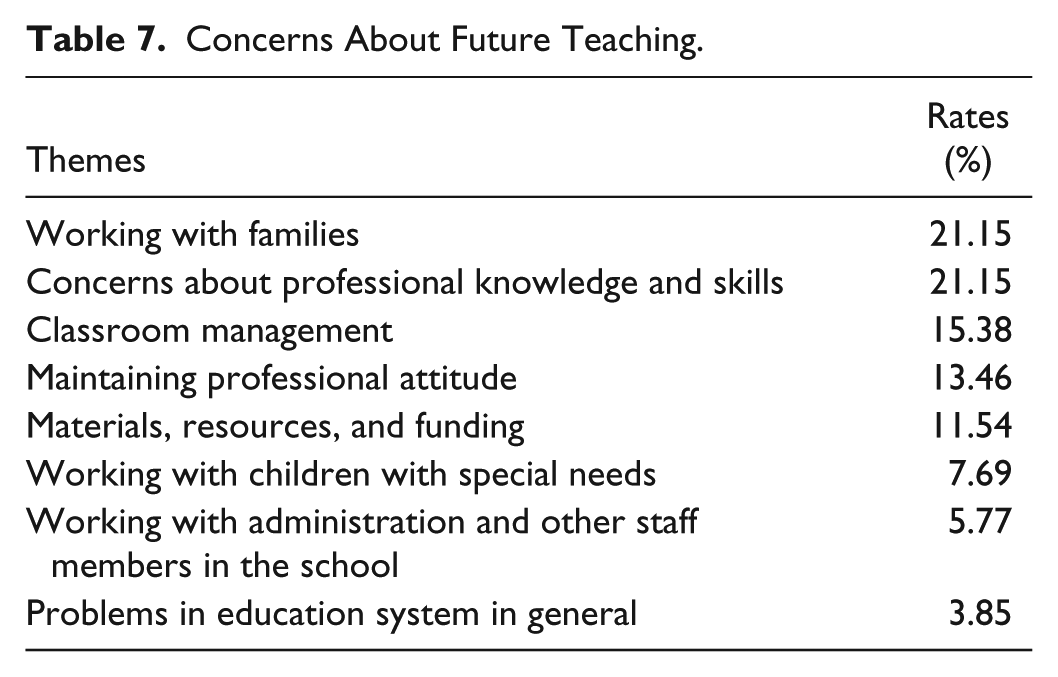
One of the areas the students were most concerned was working with families (21.15%). A participant stated that his biggest concern is “having to work with families who think they know everything but do not know anything.” Concerns about professional knowledge and skills were equally important in the 21.15% of total responses. The students seemed to lack the confidence about their knowledge, pedagogical skills, and planning and instructional skills. For example, a student mentioned that her concern was “not being able to answer their [children’s] questions adequately.” The third concern category was classroom management (15.38%). A student stated, “What I am most concerned is whether I will be able to maintain classroom control.” Some of the answers (13.46%) focused on concerns over maintaining a professional attitude throughout the years that they will be in the profession. A participant mentioned, “I am concerned about whether I will be able to have the same attitude toward my profession and show the same performance when I get older.” Materials, resources, and funding were another concern area found in the 11.54% of the responses. A total of 7.69% of the responses were about working with children with special needs. As 5.77% of responses were about concerns related to working with administration and other staff members in the school, problems in the education system in general was a concern for 3.85% of the participants.
Discussion
The demographic data showed that the majority of the students came from working-class families with little to no preschool experience as a child. Although the Elementary Education Regulations in Turkey (MoNE, 2012b) authorizes each elementary school to open kindergarten classrooms depending on the need in their respected locations, kindergarten entry is still not compulsory in Turkey. Considering the fact that this group of preservice teachers are the first graduates of preschool teacher education programs after the revision of teacher education curricula in Turkey in 2007, it is very critical for these teacher candidates to advocate the preschool education’s positive impact on children’s academic performance and social-emotional adaptation to formal schooling. Another finding from the students’ background information showed that the love for children was the most important reason to choose preschool teaching as a career. This finding was parallel to the participants’ listing of love for children as one of the most important qualities a preschool teacher must possess.
To understand their program experience, the participants were asked to list the courses they favored the most. While art courses (e.g., drama, music, rhythm, and dance) were among the most favored courses, the students paid little attention to practica/field experience courses, classroom management, and parent education. Furthermore, the course on children with special needs did not receive any recognition from the students. Interestingly, when the students’ concerns about their future teaching were examined, it was found that the main concern areas were revolved around working with families, professional knowledge and skills, and classroom management. Practica/field experience as part of teacher training is to help preservice teachers continue the transformation they experience throughout their program courses and gain crucial professional dispositions to work with young children and their families, teach in preschool classroom, and be an advocate for the profession. More collaboration with local education directories and schools could help communicate goals and expectations of practicum courses and create volunteer opportunities for teacher candidates to apply their knowledge and skills that they gained during their program experience. Also such collaboration could increase teacher candidates’ confidence about their professional capabilities.
The participants were asked to explain the changes in their perceptions about preschool education before their enrolment and after their education in their teacher education program. The changes revolved around three themes: necessity of preschool education, behavior management, and preschool curriculum. Without any exception, all the participants mentioned a drastic change in their pre- and after-program perceptions. The authors implicate that in many cases, people need an outside agency to make them aware of the changes and transformations that took place in their attitudes and perceptions. Teacher educators may help preservice teachers discover the transformation in their perceptions throughout their program experience. Morrison (2006) called this process as “reflective practice,” which is a cycle of thinking before teaching, thinking while teaching, and thinking after teaching. As the teacher candidates observe this positive transformation in their perceptions, they can be more self-confident and have high self-efficacy in facing the challenges their professional teaching career may bring to them.
One of the recurring issues throughout all the themes that emerged from the students’ responses was the lack of recognition of families. As mentioned previously, working with families was a subject, course area, and a professional quality that gained little recognition from the participants, yet it was one of the highest rated concern areas about their future teaching. Graue and Brown (2003) mentioned preservice teachers’ limited perceptions about families of children. Morris and Taylor (1998) explain that lack of course work to prepare preservice teachers effectively to work with parents was one of the reasons for teachers’ lack of knowledge and skills for parent involvement. In case of inadequate course work and practica/field experience to work with families, teacher candidates may rely on their observations and perceptions that they formed through their cultural upbringings and their 12 or more years of schooling experience to communicate with families of young children. Preschool education is where parent involvement occurs at the highest level; therefore, preservice teachers should be presented with opportunities to challenge their existing perceptions about families of young children and study culturally appropriate ways of involving them in the education of their children.
One of the points emerging from this study was the participants’ lack of confidence about classroom management. This subject also appeared as one of the hardest sides of preschool teaching in the participants’ responses. Classroom management has also been cited as an important concern for other Turkish preservice teachers by Çakmak (2008). The authors of this study propose that preservice teachers should be able to realize that the effective classroom management skills are part of designing a developmentally appropriate preschool curriculum. Therefore, each curriculum and method course and practicum/field experience course needs to emphasize integrating classroom management strategies in unit and curriculum plans. Further support should be provided by mentor teachers and student teaching faculty by providing immediate feedback to preservice teachers upon their curriculum implementation. A healthy mentor teacher and preservice teacher relationship has been defined as crucial for the practicum/field courses (Loizou, 2011).
The participants listed some qualities that they think a preschool teacher must possess. As three themes (i.e., personal qualities, professional attitude, and professional knowledge and skills) emerged from this area, the participants listed more qualities for the areas of personal qualities and professional attitude than they did for professional knowledge and skills. Unfortunately, knowledge and skills such as knowledge of child development, planning activities for different intelligences, capturing children’s attention, use of technology, knowledge about children’s interests, being a good observer, and communicating with families were mentioned only once by different participants. Love for children appeared as the most important personal and professional quality, which received a higher rating than all the qualities for professional knowledge and skills, in the students’ response. Certainly, one cannot deny the fact that love for children must be one of the prerequisites to teach and care for young children. However, as Morrison (2006) indicated, an early childhood professional needs to have competence in “personal characteristics, educational attainment, professional practice, and public presentation” (p. 5). A teacher’s personal qualities and professional dispositions cannot be separated from the teacher’s professional identity as one must acknowledge that professional knowledge and skills are also part of this identity. To maintain the balance across those three areas, teacher candidates should examine different dimensions of the teaching profession and what makes a teacher highly qualified to teach young children. Teacher education programs can help preservice teachers examine effective teaching practices via case studies, real classroom experiences, and vignettes, and, most importantly, analyze their own teaching implementations. Such reflective practice (Morrison, 2006) will help teacher candidates comprehend the different dimensions of preschool teaching and give equal importance to each area in this profession.
Perceptions about working with children with special needs hardly gained attention from the participants. Although there is state support, incentives, and subsidies provided to children with special needs and their families, many schools, classrooms, and teachers are unprepared to accommodate the varying needs of children with exceptional needs (Er-Sabuncuoğlu & Diken, 2010). Perhaps this is a good opportunity to address and reemphasize the importance of training future preschool teachers adequately to work with children with special needs and their families. Preschool education is the period where problems in development and learning are detected, and the preschool teachers are the ones who need the ability to observe and detect potential risks and delays in children (Er-Sabuncuoğlu & Diken, 2010). Therefore, teacher education programs in Turkey have a great responsibility to help teacher candidates gain skills and knowledge to accommodate the needs of all children. In fact, recently there has been more emphasis on special education and inclusion applications in the preschool classrooms for young children with special needs in the last revision of the preschool teacher education program in 2012 (MoNE, 2012a).
In sum, the purpose of this study was to examine preschool preservice teachers’ perceptions about teacher and teaching in the Turkish teacher education context. The data collected through a survey instrument were coded into categories to explore the patterns in a group of Turkish preschool preservice teachers’ perceptions. The results of the study provided important insights on Turkish preschool preservice teachers’ perceptions about teacher and teaching. Yet, the study had its limitations. Perhaps one and the most important limitation of the study was the subject size. It would have been more robust to conduct the survey with the graduates of the program few years back. However, currently, there is no organized system in this program to keep in touch with the program alumni; therefore, the possibility of reaching out to the recent graduates did not exist. The researchers are aware that the findings of this qualitative study can only be generalized in the context wherein the study was conducted. Nevertheless, the study can have important implications for preschool teacher education in Turkey and in other countries as well, and help the international readers perceive preschool education from a different cultural perspective. This study and other studies on preservice teachers’ perceptions within specific cultural contexts could present valuable information and insights for academicians, teachers, administrators, and lawmakers in the field of preschool education around the world.
Footnotes
Declaration of Conflicting Interests
The author(s) declared no potential conflicts of interest with respect to the research, authorship, and/or publication of this article.
Funding
The author(s) received no financial support for the research and/or authorship of this article.