




Abstract
This case study investigates two Chinese children’s shared reading experiences in both home and preschool contexts. The parents and the educators were interviewed about their general attitudes and practices relating to shared reading for promoting the Chinese children’s bilingual development. Detailed observations were undertaken to record the parents and the educators’ interactions with the children during shared reading. The language use of the parents and the educators was analyzed with systemic functional linguistic theories. The findings demonstrate significant differences between the two cases, although the two children shared the same cultural and language learning background. The educators played a critical role in shaping the children’s shared reading experiences in the preschool and the nature of educator–parent cooperation. The mothers provided rich language learning opportunities for their children through active interactions in shared reading; however, the positive home learning experiences could not contribute to the children’s language learning in their preschools without effective educator–parent cooperation. This study suggests there are significant opportunities and strategies for the parents and the educators to capitalize on the educational functions of shared reading for facilitating Chinese children’s bilingual development based on mutual understanding and close cooperation.
Keywords
There is a consensus within the literature that shared reading is an effective educational practice for supporting young children’s language and literacy development. Research in both home and preschool environments indicates positive relationships between the quality of shared reading that preschool children experienced and their future development in oral language, vocabulary knowledge, printing awareness, and listening comprehension (Beauchat et al., 2009; Dickinson & Tabors, 2001; Zucker et al., 2013). The phrase “shared reading” refers to adult–child joint book reading, which includes adults’ reading aloud the text of books and adult–child interactions relating to the words, topics, and pictures presented in the books (Torr, 2019). Through shared reading, children gain the opportunities to be exposed to decontextualized information, less frequently used words, and meaningful connections between language and pictures (Coyne et al., 2004; Dickinson et al., 2010), all of which they are less likely to retrieve from other daily activities.
Shared reading is a well explored topic in the research of bilingual immigrant children’s language and literacy development. Studies in this field investigated the aspects of shared reading activity in bilingual children’s families and discussed its contributions to these children’s bilingual, biliteracy, and cognitive development (Leyendeckera et al., 2011; Ro & Cheatham, 2009). Researchers found that most immigrant parents used their home language in shared reading with their children and it benefits the children in both languages (Aarts et al., 2016). The conceptual understanding developed in the first language can be transferred to the second language and facilitate the second language learning (Cummins, 2007). Parents’ use of home language does not affect bilingual children’s second language learning when these children’s schooling is entirely based on the second language (Duursma et al., 2007; Hammer et al., 2009). Furthermore, Duursma and colleagues (2008) found that Hispanic background parents who used home language to read books regularly at home contributed to their children’s cognitive development better than those who speak English at home. This strand of research seems to confirm the benefit of parents’ use of home language to read books with their children, while this might also be the most practical way for many immigrant parents who lack proficiency in their second language.
Like the other bilingual children, many Chinese Australian children’s home environment is monolingual where their parents use Chinese mostly in their interactions with children, including shared reading activities (Hu et al., 2014a). However, most of the research relating to Chinese Children’s learning experiences focuses on the literal practices such as word recognition or schoolwork-related activities, and such research is mainly undertaken in the home context. Little is known about Chinese children’s shared reading experiences in both home and preschool contexts, though the knowledge in this field would enhance the connection of Chinese children’s home and school experiences, which is crucial for these children’s language development (Fishman & Garcia, 2010; G. Li & Ma, 2018). This case study is designed to address this issue by investigating Chinese parents and Australian educators’ attitudes and practices relating to shared reading. The findings from this study have implications for Chinese parents and Australian educators to capitalize the pedagogical functions of shared reading and support Chinese children’s bilingual development based on mutual understanding.
Bilingual Chinese Children’s Shared Reading Experiences in the Home Context
Research directly addressing bilingual Chinese children’s shared reading is limited and lacks a solid quantitative study that portrays the general state. Several case studies investigated Chinese children’s shared reading experiences from the perspective of parent–child interactions. Chinese parents were reported to value shared reading because it prepares children’s schooling skills and incorporates an entertaining aspect in education (Wan, 2000). During book reading, Chinese parents encouraged their children to join in meaning making discussions on the content of the books, connecting with their life experiences. For example, when a Chinese girl and her father came across a page of sheep, the father said “Oh, it is your jumper, very warm.” The father used his language to extend the information of sheep to wool, wool made clothe, and its function. Such conversations created opportunities for the child to use languages in various genres (e.g., recalling and narrative), assisting her home language development as well as her understanding of the concepts related to the book topics (L. Li & Fleer, 2015).
Differing from the above case studies that are based on direct observations and focused on preschool-aged Chinese children, D. Zhang and Koda (2011) used questionnaire to investigate the home literacy environment of 36 Grade 3 Chinese children in Pennsylvania, USA. They found that parent–child joint book reading in these families occurred frequently, but most of it was related to schoolwork. This finding is in line with a longitudinal study undertaken by Hsu (2015) who traced three Chinese families’ shared reading experiences from the children at preschool age to their middle or late years of primary school. Hsu (2015) found that the parents’ book reading to their children declined abruptly after children at Grade 1, as by that time, both parents and children began to focus on schoolwork. Meanwhile, the parents found difficult to continue reading books in Chinese as their children gradually shifted toward English language. Combining the above studies, the research in the field reveals the trajectory of Chinese families’ share reading experiences from preschool to primary school and the nature of parent–child interactions in book reading. However, it remains unknown how these home experiences are linked to these children’s schooling experiences. The current study explores the issue by comparing Chinese children’s shared reading experiences in both home and preschool contexts.
Preschool Educators’ Shared Reading Practices to Bilingual Children
Numerous empirical studies in literature discussed the impact of educators’ shared reading practices on young children’s language development. Research in this field examined both frequency and features of shared reading experiences in the classroom and discussed their educational functions. It is revealed that the frequency of preschool shared reading was not a significant predictor to these children’s longitudinal language outcome, rather, the features of educators’ talk such as inferential talk, which was associated with children’s vocabulary skills and later reading comprehension (Dickinson & Porche, 2011; Hindman et al., 2008; Van Kleek, 2008; Zucker et al., 2013). Educators’ language use in their interactions with children is an important factor influencing the language learning and extended thinking opportunities created by shared reading activities (Cohrssen et al., 2016; Torr, 2018).
With regard to educators’ shared reading to children from nondominant backgrounds, there is much less research undertaken in the field. Several studies suggested that educators need to adjust their interactions with children from disadvantaged backgrounds, for example, specific instructions referring to word meanings may assist these children to gain more understanding than inferential talk (Rush, 1999; Silverman & Crandell, 2010). A more relevant study undertaken by Aarts and colleagues (2016) investigated 15 bilingual Turkish-Dutch 4- to 6-year-old children’s shared experiences at home and in preschools from the perspective of parents and educators’ academic language use. The researchers found that the educators with bilingual Turkish children used less vocabulary and syntactically complex language in their shared reading than those with monolingual Dutch children. The educators used more academic language than the mothers in book reading, yet the mothers’ language input had more consistent and straightforward relationships with these children’s later development in both first and second languages. This study reveals the complicated facets of bilingual children’s shared reading experiences in the two contexts.
The current study aims to explore shared reading experiences of Chinese Australian children at home and in preschools that is rarely reported in literature. Chinese children are one of the most rapidly growing ethnic groups in Australian educational settings (NSW Department of Education, 2016). Australian educators are confronted with the challenge of working with more and more Chinese children learning English as second language in childcare centers. This study offers information for Australian educators to enhance their awareness in working with Chinese children and parents, based on the understanding of Chinese children’s shared reading experiences in both settings.
Theoretical Orientation
This study is underpinned by two theories. The first is Fishman’s theory regarding bilingual children’s language maintenance/shift (Fishman, 1991; Fishman & Garcia, 2010). This theory suits the study in interpreting the parents and the educators’ attitudes and practices relating to the Chinese children’s shared reading experience that was undertaken in two languages. The second theory is systemic functional linguistic (SFL) theory that is used for analyzing the pedagogical functions of the parents and the educators’ language used in shared reading. It reveals language learning opportunities embedded in shared reading.
Fishman’s Theory of Language Maintenance/Shift
As early as the 1960s, Fishman discussed language shift in the United States. Fishman (1966) analyzed American Census reports on home language use and described the language shift across generations. There is a tendency for the young immigrant generation to lose their home language skills and completely shift to English. However, home language matters to English language learners (ELLs) because it is connected to self-definition and self-realization of individuals (Fishman, 1991). Maintaining home language benefits ELLs in fulfilling their personal development with a positive self-identity and bilingual skills which would eventually benefit the whole community. According to Fishman and Garcia (2010), language shift is a by-product of social change and power influences. Individual bilingualism results from social bilingualism. A balanced social environment maintaining the boundaries and functions of language is essential to home language maintenance. School-based programs alone are insufficient to maintain and develop ELLs’ home language; instead, home and community play critical roles in maintaining a language across generations.
Fishman’s work laid the foundation for considering the role of educators and parents in assisting immigrant children’s language development. The current study focuses on bilingual Chinese children’s shared reading experiences in preschool and home contexts where the educators and the parents use different languages to read different books. This theory provides a broad view for the discussion of the educators and the parents’ general attitudes toward bilingualism and their relative reading practices to the bilingual Chinese children.
SFL Theory
SFL theory was employed for capturing the characteristics of parents and the educators’ language use. SFL is an influential sociolinguistic theory developed by Michael Halliday (Eggins, 1994). It interprets the relationship between the text of speakers’ language and the context of interactions from the perspective of language functions. This theory has been widely used in the analysis of adult–child interactions in the educational research field (Torr, 2018; K. Zhang et al., 2016).
According to Halliday and Matthiessen (2004), language has an interpersonal function that shapes the tone of language matching the speaker’s role of the instance of interaction. A semantic dimension to categorize interpersonal function of language is the commodity being exchanged in the language that can be categorized into information and goods and services (Halliday & Matthiessen, 2004). The speakers’ role in an instance of interaction is either giving or demanding information (statement & question), or either giving or demanding goods and services (offer & command). When speakers play a role to exchange goods and services in their interactions, no matter it is an offer (do you want a cup of tea?) or a command (Give me a cup of tea), it restricts the listeners’ reactions to accept or reject the goods and services. This process does not necessarily involve language skills, and most likely it could be responded in actions. However, if speakers’ speech role is to exchange information that includes question (How do you think about the tea?) and statement (The tea smells nice), the listeners need to address the question and the statement with language knowledge and sometimes it involves a high level of cognitive process. In adult–child interactions, adults’ language focusing on information may create a richer language learning environment for children than those relating to goods and services.
Another important language function is mode, which refers to speakers’ language being organized logically to express meaning and being coherent as a text (Halliday & Matthiessen, 2004). There are three major types of conjunctive relationships to maintain the cohesion of text: elaboration, extension, and enhancement (Eggins, 1994). To simplify the presentation, we name these three conjunctive relationships between cohesive clauses as three cohesive patterns. Elaboration represents a relationship of clarification, which means one sentence is an explanation or re-saying of another one. For example, “see the doggie looks sick. In fact, he is hungry.” Extension refers to a relationship of addition, whereby one clause adds or changes meaning of the previous one, such as “the poor doggie rested in the hole, and very soon he fell into sleep.” Enhancement is a causal relationship that one clause extends the meaning of another in terms of time, comparison, reason, condition, or concession. For example, “the doggie will have to run very fast, otherwise he cannot get home before the sunset (condition).” The diverse appearance of text being organized in the cohesive patterns has implications for children’s language learning in various genres (e.g., narrative or argument).
Drawing on the theories of SFL, the pedagogical functions embedded in the language used by the parents and the educators can be analyzed. Adults’ language that focuses on information exchange and appears to be consistent in various cohesive patterns would provide children with extensive language learning opportunities in terms of vocabulary and syntactic knowledge as well as the tone and the mode matching the interactional contexts (Halliday & Matthiessen, 2004).
Method
Participants
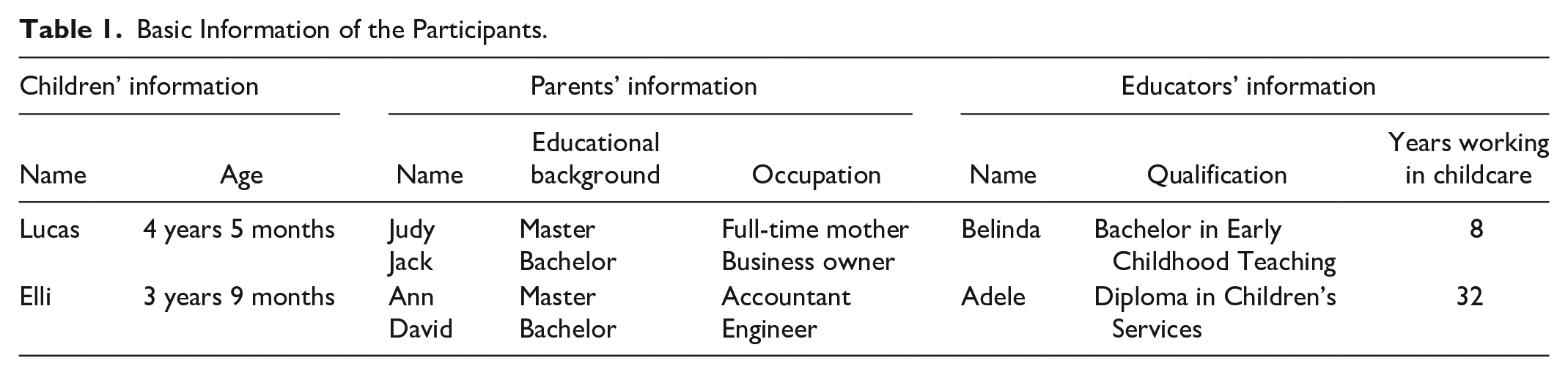
This study is framed by multi-case study method. It is a part of a larger research project exploring Chinese Australian children’s bilingual experiences at home and in preschools. The selection criteria of the participates of the large project include (a) preschool-aged Chinese children whose parents migrated from Mainland China; (b) the Chinese parents are skilled or business immigrants who represent the typical newly immigrated Chinese in Australia (Chan & Koh, 2018); (c) the Chinese children attended Australian preschools where their main preschool educators are monolingual English language background educators. This study selected two cases (Lucas & Elli) for the investigation of the Chinese children’s shared reading experiences. The choice of the two cases was made with the consideration of the educators of these two children showing very different attitudes and practices toward bilingual children’s language education in the previous studies of this project. According to Yin’s (2009) “replication logic” in multiple case design, chosen cases should either predict similar results or lead to contrasting outcomes for anticipatable reasons; hence, the findings from a few cases stand on logical reasons and can be more solid or representative (Yin, 2009). The two cases are in line with the “replication logic” that have some similar characteristic (e.g., both from middle-classed Chinese family) that predict similar results, and some discrepancies leading to diverging results. The information of the participants of this case study is displayed in Table 1.
Basic Information of the Participants.
Data Collection
The ethics for data collection was obtained from Macquarie University, Australia. Consent forms were collected from the participating parents and educators who read the information letters containing the objectives of the study and the process of data collection. The larger research project includes three sources of data collection: (a) interviews on parents and educators’ attitudes for supporting the Chinese children’s bilingual development; (b) nonparticipant observations on the parents and the educators’ language practices to these children (video recorded); (c) physical artifacts displaying the children’s language experiences, such as educators’ documentation and children’s work samples. The primary researcher visited participating families and preschools four times irrespectively. The first two visits were for gaining basic information and building connections with the participants. The interviews and the observations were undertaken at the third and fourth visit when the participants felt comfortable to be interviewed and observed. The fourth visit to a home or a preschool is labeled as “observation day,” and on that day, the researcher used a video camera to film the parent–child or the educator–child interactions. For this study, we used the part of the interview and the observation data that are related to shared reading.
Data Analysis
Analysis of interview data
The interview information was reviewed by the researchers, using the method of Qualitative Analysis Guide of Leuven (QUAGOL) (Dierckx de Casterle et al., 2012). A few concepts were synthesized from the interview information that include
parents and educators’ general attitudes toward Chinese children’s bilingual development;
the role that the parents and the educators think they should play for supporting these children’s language development;
book reading environment at home and in the preschools, including the number of books and the frequency of book reading; and
the strategies used for promoting shared reading to the Chinese children.
Analysis of observation data
Regarding observation data, while body languages such as children’s actions during shared reading were noted, the text of language used by the parents and the educators in their interactions with the children during shared reading was focused. The steps for the language analysis using SFL theory are listed as below.
Transcribe adult–child conversations during shared reading.
Break the parents and the educators’ language into clauses. A clause contains a subject and a verb (Halliday & Matthiessen, 2004). One sentence can have one or more than one clause.
Examine each clause and code it according to its interpersonal function that is either informational (information) or directive (good & service).
Examine each clause and code it according to its cohesive patterns including elaboration, extension, and enhancement.
Summarize the characteristics of the language used by the parents and the educators that include (a) the total number of the clauses generated (book text reading and minor clauses such wow or ok are excluded); (b) the number of each type of the language and the proportion of each type among the total clauses.
Findings
In this section, we report the findings of the parents and the educators’ attitudes and practices relating to shared reading to the focus children. We present the general experience of the individual case first, and then define the cross-case comparison. During data collection and analysis, we found that the mothers spent most time with their children and they were the book readers at home, so the home experiences focused on the two mothers’ attitudes and practices. For the convenience of presentation, the Chinese conversations between the mothers and the children are all translated and presented in English.
Case of Lucas
Attitudes and practices of Lucas’ mother
Lucas lives with his mother in a luxurious house in an affluent region in Sydney. His father is a businessman who spends most of his time overseas. His mother Judy is a full-time housemaker who pays extensive attention to his bilingual development. Although holding positive attitudes for supporting Lucas’ bilingual development, Judy seems to be concerned about Lucas’ English development during his preschool years. However, she still believes that she should maintain Lucas’ Chinese skills through Chinese conversations at home.
The purpose for me to bring him (Lucas) here is to let him have a formal English education in an English environment. Under the condition of his English skills developed well, I may seek opportunities for him to learn Chinese based on his interest. I continue using Chinese to talk to him at home, though my English skills are pretty good . . .
In terms of book reading, Judy noted that she has collected about a hundred children’s books at home, and 95% of them are Chinese books. Occasionally she guides Lucas to borrow English books from the local library. Another source of borrowing English books is from Lucas’ preschool where the educators encourage them to take at least one book home per week. Judy reads a few books to Lucas every night before sleeping.
On the observation day, Judy read an English book titled It Could Have Been Worse (Benjamin & Warnes, 2004) that was borrowed from the preschool. Judy read the book twice. For the first time, she read the book in Chinese, interpreting the story from English to Chinese throughout the pages. In the second time, she read the book in English but interacted with Lucas in Chinese. It is noticeable that during the shared reading, Judy used substantial language to direct Lucas’s behaviors, as Lucas seemed to be a bit unsettled. Judy’s language use is displayed in Extract 1 and Table 2.
Language Use of Lucas’ Mother.

Extract 1
Judy: “Snap!” (reading the English text) Do you know what this means? Lucas: Means “paa paa” (clap his hands). Snap mama (clap to Judy’s face) Judy: No, you cannot do it to your mum. Turn back and look at the book, or I stop reading.
Table 2 shows that while Judy’s language is mainly information based (64.9%), the directive language takes up a considerable proportion that is over 35%. Given that shared reading usually relates to decontextualized topics, this percentage of directive language is comparatively high. In terms of cohesive patterns, about half (50.7%) of her messages is presented consistently with extension being the dominant pattern (32.4%). Enhancement pattern was much less used (16.9%), and elaboration was least applied (1.4%). This indicates that Judy used language to extend certain topics in her interactions with Lucas but did not explain concepts often.
Attitudes and practices of Lucas’ educator
Lucas is attending a council owned preschool. The main educator in his room is Belinda who is Diploma qualified and has a long work experience (32 years) in childcare. Belinda believes that children should be encouraged to use two languages in preschools if they have bilingual skills; however, her responsibility as an educator is to help ELLs to develop English skills. She argued this with pragmatic reasons.
I guess in preschool I see it as our responsibility to encourage their (ELLs) English, because we are helping them get ready for school, and their school is in English. So it is important that their English language is encouraged, but not to the point of denying the other language.
Shared reading is viewed as an important approach by Belinda for supporting ELLs’ language development. There was a big book corner in the class and a small library in the foyer room. Belinda read books in her classroom every day, but before the big group reading, she may gather the ELLs first and teach them key words that develop their basic understanding of the story before sitting on the mat with the class.
For children who are really struggling we would do that on a regular basis. The story that we were planning to read today, we would actually read them during the morning play session, so that they were familiar with it when we come to do it as a large group . . .
Encouraging parents to take books from the preschool to read at home is another strategy that Belinda used frequently, as what Lucas’ mother had mentioned in her interview. With these methods, Lucas and the other ELLs were well prepared for the group reading time. They were able to join in the activity with certain understanding. On the observation day, Belinda read the book titled Too Many Pears! (French & Whatley, 2003). She interacted with the whole group and asked questions frequently. Lucas joined in the group and sat on the mat throughout the story. Although did not answer any questions, he looked at the book and listened to the story quietly and also observed the interactions between Belinda and other children carefully. Belinda’s language use during the book reading is demonstrated in Extract 2 and Table 3.
Language Use of Lucas’ Educator.

Extract 2
Belinda: Why did Pamela gaze at apples? Child: Cause she like the apple Belinda: Did you notice that the black patch on her body changed? (pointing to the picture) Child: Apple! Belinda: Yeah! It changed from a pear to an apple!
Table 3 demonstrates the language types used by Belinda in the group reading activity. The majority language used by Belinda was information, but she employed 36.7% directive language to manage children’s behaviors. About half of her language is expanded in cohesive patterns, which is similar to Judy’s. Extending (27.3%) is the most frequently used type in Belinda’s language expansion, which is followed by enhancement that is not far behind (18.8%). Elaboration was occasionally used for the explanation of a few concepts, taking up 4.7% of the total clauses.
Case of Elli
Attitudes and Practices of Elli’s mother
Elli’s parents both have professional jobs in Australia. Her mother Ann is an accountant in a big company and has a busy work routine. In the interview, Ann emphasized that she respects Elli as an independent and capable communicator by using sophisticated words and complex sentences in her conversations with Elli. From our observation data, we found that Elli would use sophisticated words in her language, for example, Ellis made a claim “Why our family is in such a tranquility? We are so bored!”
In term of Elli’s bilingual development, Ann has a strong desire to maintain her Chinese language. She does not worry about Elli’s English development because she believes that living in an English-speaking country, Elli will pick up English through attending Australian schools. She does not believe that a high quality of communication could exist among family members if Ellis lost Chinese skills and completely shifted to English.
Shared reading is used by Ann as an important strategy to develop Ellis’ Chinese language skills. Ann has collected more than 200 Chinese books at home. She understands the benefit of shared reading and implements this practice frequently at home.
I read books every day. No matter how busy it is, two stories before sleeping is a fixed routine. If I have more time at home, I will read as much as I can, because I read a book claiming that books are children’s best friend. Book reading will foster her (Elli) imagination and language development . . .
On the observation day, Ann read a Chinese book titled 弗洛格去旅行(Frog went to travel) (Velthuijs, 2006) after the dinner time. This book is a translated version of an English book originally published in Holland (belong to Max Velthuijs’ Frog series). Ann read it in Chinese and initiated various discussions, primarily expanding on logical pattern. Ann’s language style is demonstrated in Extract 3 and Table 4.
Language Use of Elli’s Mother.

Extract 3
Ann: Whom did the mouse see standing at the gate and welcoming them back? Elli: They are the pig, the duckling and the frog. Ann: How could the frog welcome the mouse? Elli: Why he couldn’t? Ann: They travelled out together. The travellers cannot welcome themselves. Did you see a guest coming to our home who can welcome himself? Elli: No, guests cannot (giggling)
Table 4 illustrates the characteristics of Ann’s language use that is dominated by informational exchange. The directive language use is constrained at a low level (13.8%). Ann’s mostly used language is organized in cohesive patterns (72.3%), with extension and enhancement styles both exceeding 30% and elaboration taking up 9.2% of her total language (clauses). This indicates that Ann used plenty of explanations and reasoning talk when interacting with Elli during shared reading.
Attitudes and practices of Elli’s educator
Elli attends a preschool belonging to an Australian university. Adele, the room leader of her class, obtained a university degree in Children’s service and has 8 years working experience. However, most of Adele’s experience was in a “small-town preschool” where ELLs were rare. She claimed that she does not have many experiences in working with ELLs, and she is in the process of adapting to the situation of [City] where ELLs are common in preschools. She thought that ELLs having two language skills are beneficial to their personal fulfillment, but preschools should be the place for English language while home language should be kept in home.
Sometimes we actually find it easier if they do home language at home, because that’s what the parents, their native like language . . . we find the children almost learn the English better if they hear everyone speaking English in preschool . . .
Adele believes that she has the responsibility to support ELLs English learning, but she does not need to use any specific strategies more than body languages to support these children, because these children can pick up English spontaneously in an English environment.
But I mean I feel responsible, not that I have to teach them English, but just because they’re around it every day, so I just use it every day, read stories, like you know talk to the other staff members in English, and yeah. They’ll just learn, pick it up that way.
Book reading is a frequently applied educational activity in Adele’s classroom. There are indoor and outdoor book corners in the preschool. Adele read a book titled To the Beach (Ashman & Westcott, 2005) for the before-lunch group time on the observation day. As an experienced educator, Adele read the book vividly and asked questions extending the story at the end. Her language was expanded extensively when guiding children to think about the questions she initiated. While Adele’s story attracted most children’s attention, Elli moved away half through the story and played puzzles at a corner of the room. Adele’s language use for this book reading is displayed in Extract 4 and Table 5.
Language Use of Elli’s Educator.

Extract 4
Adele: Do you think this family had more fun in their backyard than going to the beach? Child: Yeah Adele: Really? Don’t you think going to the beach is more fun? Do you want to go to a beach? Child: Yeah Adele: But why didn’t they go to the beach? Child: They forgot a lot of things Adele: Exactly, they were in a mess, as they were not well organized . . .
Table 5 shows that 41.8% of Adele’s language is in directive style, which is the highest among the four participants. More than half of her language was expanded (53.1%), and among the expanding clauses, extension and enhancement pattern were frequently used, taking up 24.5% and 21.4% irrespectively in her total clauses. The proportion of elaboration was 7.1%, which was the least used style like the other participants.
Comparison Between the Cases
Elli and Lucas have the same background that is from middle-class Chinese immigrant families. They both learn English as second language in Australian preschools. Shared reading, as an important language practice, was used frequently by their parents and educators in daily routines. While sharing these common backgrounds, the similarity and differences are both demonstrated in the two children’s shared reading experiences. Table 6 shows the summary of cross-case comparison based on the key information from the interview data.
Cross-Case Comparison Based on Interview Data.

Figure 1 displays the comparison of the language use of the mothers and the educators. Elli’s mother seemed to use higher quality of language in her book reading than the other three participants. Her language contains extensive information (86.1%) with 72.3% of the clauses being expanded. The logical link is an apparent characteristic in her language use with enhancement taking up 30.8% of her total clauses. In the contrast, Lucas mother used considerable directive language (35.1%) for managing Lucas’ behaviors. About half of her language (50.7%) was expanded in cohesive patterns, which was much less than those of Elli’s mother.

Language use of the parents and the educators.
The educators’ language displayed more similarities than differences. Both educators had more than half of their clauses presented in informational style and expanded in cohesive patterns. However, compared with the mothers, the educators used more directive language in shared reading. This might be due to their book reading to a group that requires directive language to regulate the children. Although the language styles of the educators are similar, Belinda provided some language learning opportunities for Lucas who was able to join in the group and gain a certain understanding of the book, whereas Adele’s book reading was meaningless to Elli who lost interest in the group reading activity and moved away.
Discussion and Conclusion
This study investigated two Chinese Australian children’s shared reading experiences at home and in preschools. It shows that while the parents and the educators hold positive language attitudes and put effort in shared reading for supporting the children’s language development, the two focus children had very different experiences. The study provides information for both parents and educators to utilize shared reading as an effective strategy for facilitating Chinese children’ language learning, which would potentially benefit other ELLs as well.
Two Languages and Two Contexts
The two parents and the two educators all agreed that bilingualism should be maintained for the Chinese Australian children. They had the idea that home is for home language development and preschool is for English language learning. Shaped by such a general attitude, the parents read Chinese books mostly at home and the educators focused on promoting Chinese children’s English book reading. This situation seems to be in line with what Fishman (1991, 2001) advocated, which is a balanced social environment for bilingualism. However, this balance could be easily broken, as Hsu (2015) described Chinese parents may gradually give up Chinese book reading at home when their children enter primary schools. In this study, Lucas’ mother, Judy showed concern to his English development and read the books in two languages. It seems that the balanced social environment for bilingualism was at the risk of being disrupted even when Lucas was at preschool age. Judy’s concern may represent the ideas of many Chinese parents who worry about their children’s English learning at a young age (Hu et al., 2014b). Educators and relevant shareholders should pay attention to assuring the Chinese parents and supporting them to maintain a balanced language environment at home.
An important finding in this study is the differences between the two educators’ attitudes and practices for supporting the two Chinese children’s English book reading. Lucas’ educator Belinda believed that ELLs need extra support and used several strategies to promote Lucas’ English book reading experiences. In contrast, Elli’s educator Adele thought ELLs would pick up English skills spontaneously in an English environment and she treated ELLs the same as other children. Accordingly, the two children’s reactions to the classroom group reading were totally different. This finding indicates that educators play a critical role in shaping ELLs’ shared reading experiences. There is an urgent need for systematic and targeted professional mentoring for promoting Australian educators’ knowledge and skills to support ELLs. Research suggests that explaining semantic meaning of certain words would significantly improve ELLs’ understanding of the text of books (Silverman & Crandell, 2010). Belinda’s strategy of pre-teaching key words to ELLs before group reading is in line with this principle and did support Lucas well. The finding confirms that ELLs need to be supported with specific strategies in language and literacy activities in childcare settings.
The cooperation between Lucas’ educator and his mother in English book reading is another noticeable point. The cooperation was initiated by Lucas’s educators, Belinda, who encouraged Lucas’ mother to borrow English books from the preschool and read them at home. Lucas’ mother applied the practice as Belinda suggested. This finding indicates that educator could significantly influence the nature of educator–parent cooperation. This is especially the case for Chinese children whose parents are usually willing to follow educators’ suggestions to complete schoolwork (G. Li & Ma, 2018). Educators could capitalize this characteristic of Chinese parents and strengthen the partnership with them in the education of Chinese children.
Language Use in Shared Reading
The analysis of language use reveals that the parents and the educators all input rich information in their interactions with the children during shared reading. The quality of the two Chinese mothers’ language use is similar or better than those of the educators. This finding is very different from Aarts and colleagues’ (2016) study who compared Turkish-Dutch children’s (4–6 years) parents and teachers’ language use in shared reading. They found that Dutch teachers input more academic language during shared reading than Turkish mothers. For Turkish-Dutch children, school reading context perhaps provides more language learning opportunities than home reading context. However, the Chinese children of this study seemed to have a positive language learning environment at home that was created by their mothers through shared reading. Research suggests that parents’ language use is significantly related to their socioeconomic status (Bernstein, 2000; Hason, 2009). The two participating Chinese mothers are both at middle-classed socioeconomic levels and are well educated. Their socioeconomic background might influence the nature of their language use. The difference between the current study and Aarts et al.’s (2016) study indicates the diversity of ELLs’ learning experiences that cannot be generalized according to learning contexts or language background.
The case of Elli deserves a further discussion as it displays that some educators may be completely unaware of the extensive support that Chinese parents provide to children in language and literacy learning at home. The language used by Elli’s mother during book reading contains substantial informational exchange and logical links, which was of the highest quality among the four adult participants. According to the observations of the children, Elli tended to use sophisticated language in her conversations with her parents, which indicates that her good home language skills were fostered in her family language environment. However, the virtuous home learning experience of Elli was not an advantage in her preschool class. There was no parent–educator connection in terms of shared reading in Elli’s case. Elli’s shared reading experience in preschool was undesirable. This finding also suggests that educators should not assume that an ELL child who does not demonstrate interest in book reading and literacy activities in childcare setting demonstrates the same behaviors at home. According to Adele’s interview, she lacks experiences of working with ELLs and this might contribute to her inactive attitudes and practices. Again, this finding urges the need of educator training programs including the topic of working with ELLs.
A small but related finding is that the book read by Elli’s mother is a translated Chinese version of an English book. Reading the same story in both English and Mandarin versions based on the cooperation between educators and parents could be a simple but achievable strategy for the support of Chinese children’s language development. In fact, there is a large number of translated books on the Chinese children’s book market and these books are widely used in Chinese families (Hsin, 2012). These books could be a resource for Australian educators to support Chinese children’s English language development. Most of the translated books have their original English version and educators can read these books in preschools. For example, if Adele read Max Velthuijs’ Frog series that Elli was familiar with, there’s a greater possibility for Elli’s to show interest in group reading. As Cummins (2007) suggested, meaningful learning activities that built on ELLs’ previous experiences are an effective approach for assisting ELLs’ English learning.
To sum up, this study reveals two Chinese Australian children’s shared reading experiences that are presented differently in their home and preschools. The parents and the educators all desired the Chinese children to develop the two languages well and used shared reading as an ideal approach for facilitating their language development. Educators play a critical role in shaping the children’s shared reading experiences in preschools, as well as the nature of educator–parent cooperation. The two mothers provided rich language learning experiences to their children through active interactions with their children during shared reading; however, the positive home learning experiences could not be integrated into the children’s preschool learning experiences without educator–parent cooperation. These findings suggest the needs of enhancing parents and educators’ awareness regarding the importance of ELLs’ home language maintenance in the process of their second language acquisition, the essence of educator–parent cooperation, and the effective ways for utilizing shared reading in supporting ELL’s language development.
Limitations and Avenue for Future Research
As a case study, the findings of this study cannot be generalized to other Chinese children or ELLs. This study may serve as a pilot study for future research that involves more participants, including Chinese families from a variety of socioeconomic background and the educators with different qualification and work experiences. Such research would determine whether the findings from this study are typical cases or common phenomena, and what factors may predict Chinese children’s shared reading experiences.
Another gap in the literature regarding Chinese children’s language development is that many studies focus on the investigation of current situations, and the intervention studies leading to positive changes are rare. Intervention studies are necessary for exploring and examining effective strategies to address the issues identified in the investigation studies. Future intervention studies that provide solid evidence for assisting parents and educators to promote Chinese children’s bilingual skills would greatly benefit individual Chinese children as well as the broader Australian community.
Footnotes
Declaration of Conflicting Interests
The author(s) declared no potential conflicts of interest with respect to the research, authorship, and/or publication of this article.
Funding
The author(s) received no financial support for the research, authorship, and/or publication of this article.
