




Abstract
This mixed-methods study explored the effects of structured moral dilemma discussions on preschool children’s moral decision-making and moral maturity. Thirty children aged 5 to 6 years were randomly assigned to either an experimental or control group. The experimental group participated in peer-based discussions facilitated through customized board games and a tabletop puppet theater (i.e., symbolic play). Quantitative results indicated significant improvements in prosocial decision-making sophistication, although no statistically significant changes were observed in overall Kohlbergian stage progression. Qualitative analyses revealed that children’s moral reasoning shifted from authority-driven responses to more relational, empathetic, and principle-based justifications. The integration of board games and symbolic play effectively facilitated emotional engagement, narrative reasoning, and perspective-taking. These findings highlight the potential of play-based, peer-mediated moral education approaches in early childhood settings. The study contributes to the literature by providing empirical evidence on the feasibility of moral discussion interventions for preschoolers and offers practical implications for incorporating structured moral reasoning activities into early childhood education curricula.
Plain Language Summary
This study looked at how 5- to 6-year-old children learn to make better decisions about right and wrong. The researchers used a fun and interactive approach: board games and group discussions with puppets and storytelling. Thirty preschoolers were divided into two groups. One group played special board games and talked about common situations children face, like helping a friend, sharing toys, or waiting their turn. The other group followed their regular classroom routine without the moral games. Before and after the activities, all children were asked what they would do in moral situations and why. The results showed that children who joined the board game discussions gave more thoughtful and kind answers after the sessions. Instead of just saying “because the teacher said so,” they started saying things like “because it’s fair” or “I want to help my friend.” They also began to consider how others might feel. While children didn’t reach the highest levels of moral reasoning in just four weeks, many showed clear progress in understanding fairness, empathy, and cooperation. The study also found that using puppets and games helped children feel more comfortable talking and thinking about their choices. This research shows that even young children can start thinking deeply about right and wrong when given the chance to talk with their peers in playful, meaningful ways. Teachers can use board games and guided discussions to help children grow not just academically, but also emotionally and socially.
Keywords
Introduction
Moral development is a critical facet of early childhood education, shaping not only children’s understanding of right and wrong but also their ability to make ethical decisions in real-life contexts (Killen & Smetana, 2015). As young children encounter interpersonal dilemmas in everyday settings, fostering their ability to reason about moral issues becomes increasingly important for both individual and societal well-being (Killen & Hart, 1995). Among the various approaches to promoting moral development, engaging children in discussions about moral dilemmas has gained attention for its potential to enhance moral reasoning and maturity in developmentally appropriate ways (Narvaez, 2002).
Previous studies have emphasized the relevance of moral dilemma discussions in enhancing children’s prosocial behavior and cognitive understanding of fairness, empathy, and justice. For instance, research grounded in Kohlberg’s stage theory (Kohlberg, 1984) and Rest’s Neo-Kohlbergian framework (Rest et al., 1999) suggests that guided moral dialogue can support the progression of moral reasoning stages. However, much of this research has focused on older children and adolescents, with relatively limited attention paid to preschool-aged children. Furthermore, empirical studies examining how young children process and respond to moral dilemmas in structured educational settings remain sparse (Caravita et al., 2012). In Taiwan and other East Asian cultural contexts, where moral education is often implicitly embedded in broader curricular goals, systematic interventions using moral dilemma discussions are particularly rare.
In light of these gaps, this study aims to investigate the effects of structured moral discussion on young children’s decision-making in moral dilemma scenarios and their level of moral maturity. A mixed-methods design was employed to examine not only the quantitative changes in children’s moral reasoning but also the qualitative shifts in their justifications and interpersonal perspectives. Through the integration of storytelling, visual aids, and guided peer discussions, this study seeks to create a developmentally appropriate intervention tailored for preschool-aged learners.
In recent years, board games have emerged as an effective medium for promoting various aspects of young children’s development, including language skills, executive functions, and social-emotional competencies (Hsieh, 2025; Whitebread & O’Sullivan, 2012). Their structured yet playful nature allows for engagement in rule-based decision-making, turn-taking, and perspective-taking, all of which are foundational to moral development. Despite these advantages, limited research has explored the use of board games as tools for facilitating moral dilemma discussions among preschoolers. Integrating board games into moral education may offer a developmentally appropriate and engaging context in which children can explore ethical issues, express viewpoints, and consider others’ perspectives in a collaborative setting (Rajkovic et al., 2019). Thus, in this study, board games are used as a pedagogical vehicle to guide children through moral dilemmas in both structured and peer-mediated formats.
The findings are expected to contribute to the literature in two significant ways, theoretically, by providing empirical evidence supporting the feasibility and effectiveness of moral dilemma-based instruction among young children, a group often underrepresented in moral education research. Practically, the results offer early childhood educators concrete pedagogical strategies to foster moral development in classroom settings, thereby enriching character education in early learning environments (Berkowitz & Bier, 2004; Berkowitz et al., 2017).
Literature Review
Moral Dilemmas as a Research Tool in Moral Psychology
Moral dilemmas have long served as a foundational method in the study of moral judgment, particularly in philosophical and psychological inquiries into ethical reasoning (Christensen & Gomila, 2012). These dilemmas involve situations in which individuals must choose between conflicting moral actions, each with potential negative outcomes (Brink, 1994). Classic examples include the trolley problem and the transplant case, introduced by Foot (1967) and later expanded by Thomson (1976, 1985). These scenarios elicit emotional and cognitive responses and are commonly used to investigate utilitarian versus deontological reasoning (Greene et al., 2001; Lanteri et al., 2008). Although such dilemmas have traditionally been used with adolescents and adults, applying them to early childhood education can reveal how young children interpret rules, balance outcomes, and engage with ethical conflicts (Killen & Smetana, 2015).
Moral Discussions and Their Influence on Moral Development
Classroom-based moral discussions play an important role in shaping children’s ethical thinking. Moral values, defined as internalized principles guiding judgments of right and wrong, can be cultivated through interactions in school and at home (Berkowitz & Grych, 1998). Early teacher–child relationships have been found to predict children’s academic and behavioral trajectories (Hamre & Pianta, 2001). Narvaez and Lapsley (2008) proposed five key strategies for cultivating moral character in educational settings, including creating supportive environments and fostering self-regulation.
Nucci and Narvaez (2008) emphasized peer interaction and moral dilemma discussions as key strategies in character education. Through discussion-based moral dilemmas, students encounter cognitive conflict and are encouraged to reflect on their beliefs and values, thereby stimulating moral development (Blatt & Kohlberg, 1975). Studies using literature (Biskin, 1974; Clare et al., 1996), films (Wonderly, 2009), and structured methods like the Konstanz Method (Lind, 2005) illustrate various approaches to facilitating moral reasoning in both formal and informal educational settings. Kohlberg’s (1974) six-stage model of moral development provides a theoretical foundation for evaluating children’s reasoning levels and assessing the potential developmental gains from moral instruction.
Factors Influencing Moral Decision-Making
Rest’s (1986) four-component model outlines the psychological processes underpinning moral behavior: moral sensitivity, moral judgment, moral motivation, and moral character. These stages emphasize the importance of recognizing moral issues, reasoning through decisions, forming intentions, and ultimately taking action. Mattison (2000) demonstrated how individuals often draw upon personal value frameworks when resolving moral dilemmas. Craft (2013) reviewed ethical decision-making research and found that most studies have focused on adult professionals, with minimal attention given to how children make moral decisions. This underscores the need for research on children’s value systems and the sociocultural dynamics influencing their ethical choices.
Educational Applications and Pedagogical Value of Moral Discussions
Piaget (1965) and Kohlberg (1976) advocated for moral education approaches that foster children’s ethical development through interaction and reflection. Moral discussions among peers are particularly effective when they introduce cognitive conflict, allowing children to consider differing perspectives and reevaluate their reasoning (Blatt & Kohlberg, 1975). These types of discussions not only promote moral growth but also strengthen critical thinking and emotional sensitivity (Althof & Berkowitz, 2006). When guided by educators, moral dilemma discussions become rich opportunities for children to explore justice, fairness, and empathy in social contexts.
Board Games as a Pedagogical Medium for Moral Education
In recent years, board games have gained recognition as powerful tools for supporting early childhood development, particularly in areas related to social cognition, perspective-taking, and collaborative problem-solving (Whitebread & O’Sullivan, 2012). The structured yet interactive nature of board games encourages rule-based reasoning, cooperation, and turn-taking, skills closely linked to moral reasoning. Rajkovic et al. (2019) found that board games can be effectively used to foster moral dialogue and ethical reflection when embedded in classroom-based activities. Similarly, game-based learning environments have been shown to offer authentic moral scenarios where children must navigate dilemmas and make value-laden decisions (Audu & Asino, 2024; Bagus et al., 2021).
For preschool learners, board games provide developmentally appropriate and emotionally safe contexts to practice ethical decision-making. They offer experiential learning opportunities that make abstract moral principles more concrete and accessible, allowing children to internalize values through play and peer interaction. The current study builds on this literature by employing board games as an instructional vehicle for facilitating moral dilemma discussions and assessing their impact on moral decision-making and moral maturity in preschool children, thereby contributing to a deeper understanding of how post-pandemic family dynamics continue to evolve within Taiwanese households.
Research Purpose
This study aims to investigate the effects of structured moral dilemma discussions on preschool children’s moral decision-making and moral maturity. Specifically, it explores how young children engage with ethical conflicts, justify their decisions, and reflect on different perspectives through peer-based discussions facilitated by board games. By incorporating developmentally appropriate, play-based learning strategies, the study examines whether preschoolers demonstrate cognitive and moral growth after participating in moral dilemma activities designed to provoke reasoning, empathy, and ethical reflection.
Research Questions
(1) How do preschool children’s moral decisions change before and after participating in peer-based moral dilemma discussions using board games?
(2) What changes in moral maturity, as conceptualized by Kohlberg’s stages, are observed after engaging in structured peer discussions?
(3) How do children articulate and justify their moral decisions, and how are these explanations shaped by interaction with peers?
(4) What are the pedagogical functions of board games in fostering preschoolers’ moral reasoning and collaborative dialogue?
Methodology
Participants
A total of 30 preschool children (15 in the experimental group and 15 in the control group) participated in this study. All participants were 5 to 6 years old (M = 5.1, SD = .3) and were recruited from a public kindergarten affiliated with an elementary school in Pingtung City, Taiwan. The preschool is located within a residential neighborhood and primarily serves children from the local community. Children were selected through convenience sampling and randomly assigned to either the experimental or control group, with equal group sizes.
The gender distribution was balanced, with 9 boys and 6 girls in the experimental group, and 7 boys and 8 girls in the control group. All participants were from the same geographic area and educational context, helping to ensure comparability in community background and environmental influences.
Parental background data were collected through self-report questionnaires. All participants came from two-parent households, and all families reported an annual household income within the range of NT$800,000 to NT$1,200,000 (approximately USD $25,000–$38,000), indicating a relatively homogeneous socioeconomic status (SES).
Parenting styles were categorized into three types—democratic, authoritative, and mixed (democratic + authoritative)—based on caregivers’ open-ended responses. Democratic parenting was the most frequently reported style across both groups, followed by mixed, then authoritative. These contextual variables were taken into account when interpreting the development of children’s moral reasoning in response to the intervention.
All participants were enrolled in mixed-age classrooms and had no diagnosed developmental delays or special education placements, as reported by their teachers. Random assignment ensured baseline equivalence between groups in terms of gender, age, and classroom experience. The study protocol was approved by the Institutional Review Board of National O O University (For the purposes of double-blind peer review, the institutional affiliation has been anonymized as “National O O University” in this article), and all ethical standards for research involving human participants were rigorously followed.
While the sample size (N = 30) may be considered modest for quantitative research, it is consistent with prior peer-reviewed studies in early childhood education that have employed small samples to investigate the developmental effects of targeted interventions (e.g., Hughes et al., 2011; Justice & Ezell, 2000; Mashburn & Pianta, 2006). Such studies demonstrate that meaningful cognitive and social outcomes can be observed even in small samples when developmental appropriateness, randomization, and methodological rigor are upheld. The richness of the qualitative data collected, through video recordings, transcriptions, and observational field notes, allowed for in-depth exploration of the children’s moral reasoning processes beyond what quantitative results alone could capture.
Instruments and Materials
To examine preschool children’s moral reasoning and decision-making, this study employed three core components: (1) a set of age-appropriate moral dilemma scenarios, (2) a customized board game as the primary pedagogical medium, and (3) a dual-level assessment rubric based on Kohlberg’s six-stage model of moral development.
Moral Dilemma Scenarios
The dilemma scenarios were adapted from classic philosophical problems, most notably the trolley problem (Foot, 1967; Thomson, 1976), and redesigned to reflect age-appropriate language, social contexts, and decision points for preschool-aged children. Each scenario portrayed familiar and developmentally relevant situations commonly encountered in early childhood education settings, such as peer conflicts, sharing dilemmas, and decision-making during daily routines. For example, children were asked how they would respond if a peer wet their pants during class, whether they would use their own or a classmate’s blocks when materials were limited, or whether they would intervene when another child refused to eat vegetables during lunch. Each dilemma was presented using a binary-choice format (Option A vs. Option B) to support cognitive accessibility.
To ensure clarity and emotional relevance, the dilemmas were reviewed and refined with feedback from three experts in early childhood education and developmental psychology. Their input helped ensure that the moral dilemmas were comprehensible, ethically appropriate, and engaging for children aged 5 to 6.
Board Game Materials
The dilemmas were delivered through an adapted, preschool-friendly version of Trial by Trolley, a board game originally designed to simulate moral decision-making under ethically conflicting scenarios. The research team extensively modified the original game to align with the cognitive, linguistic, and socio-emotional characteristics of young children. All violent, sarcastic, or abstract content was removed and replaced with realistic, socially grounded dilemmas relevant to preschool life.
To enhance immersion and engagement, a tabletop puppet theater (symbolic play) was designed, incorporating illustrated backdrops, hand puppets, and tangible props. Before each scenario, children selected an animal puppet to represent themselves in the game, promoting identification and emotional involvement. This storytelling approach enabled children to comprehend the dilemmas more deeply and articulate their responses more authentically. The final version of the game was pilot-tested with a small group of children, and expert consultation was used to revise the materials to ensure that the game functioned as a developmentally sensitive and ethically sound pedagogical tool.
Moral Maturity Assessment Rubric
Children’s development in moral reasoning was evaluated using a dual-level scoring rubric. The first level captured behavioral changes in moral decisions; the second assessed cognitive development in moral maturity. For each dilemma, a score of 1 was assigned if the child changed their decision after the discussion-based intervention, and 0 if the response remained the same. The total score across scenarios indicated the extent of behavioral change.
Children’s justifications were then analyzed using a rubric adapted from Kohlberg’s three levels and six stages of moral development (Blatt & Kohlberg, 1975). Each response was assigned a stage score ranging from 1 (obedience and punishment orientation) to 6 (universal ethical principles). For each scenario, a gain score was calculated as the post-intervention stage minus the pre-intervention stage. The sum of these gain scores represented the child’s developmental progress in moral reasoning. The detailed scoring criteria for each moral reasoning stage are presented in Table 1.
Scoring Rubric Based on Kohlberg’s Six Stages of Moral Development.

Note. This rubric was adapted from Kohlberg’s six-stage model of moral development (Blatt & Kohlberg, 1975). Example responses are adapted to reflect common verbal expressions among preschool-aged children.
Two raters (including the researcher and a faculty member specializing in moral development) independently scored all responses using the rubric. In a preliminary pilot phase (n = 15), the inter-rater reliability yielded a Spearman’s rank-order correlation coefficient of .952, indicating excellent agreement. Additionally, a test-retest procedure was conducted over a two-month interval using the same cohort of children. The test–retest reliability coefficient was .87, suggesting strong temporal stability and robustness of the scoring framework.
Additionally, to evaluate the qualitative depth of children’s moral justifications, a three-level classification rubric was applied to categorize responses within each moral construct. Responses were coded as follows:
Level 0: No response, uncertainty, or non-committal answers indicating confusion or disengagement (e.g., “I don’t know” or no clear decision).
Level 1: Obedience-based or punishment-avoidance reasoning, focusing on external rules or consequences without internalized moral principles (e.g., “Because the teacher said so” or “I don’t want to get in trouble”).
Level 2: Prosocial or socially responsible reasoning, demonstrating consideration of fairness, empathy, relational obligations, or group welfare (e.g., “Because it helps my friend” or “It’s not fair if I skip the line”).
This classification scheme was inductively developed during pilot coding and applied consistently across all moral dilemma scenarios.
Justification for Custom Instrumentation
The moral maturity rubric was adapted from Kohlberg’s stage theory and designed to align with the developmental characteristics of preschoolers. Although several standardized instruments, such as the Defining Issues Test (DIT; Rest, 1979), the Moral Judgment Interview (MJI; Colby & Kohlberg, 1987), and the Sociomoral Reflection Measure–Short Form (SRM-SF; Gibbs et al., 2013), are widely used in moral development research with adolescents and adults, they are not suitable for 5- to 6-year-old children. The MJI requires extended verbal explanations of abstract dilemmas in lengthy interviews, the DIT relies on advanced reading comprehension and ranking of abstract statements, and the SRM-SF similarly demands cognitive and linguistic abilities beyond typical preschool levels. To address these limitations, our adapted rubric employed simplified dilemmas presented through board games and symbolic play, enabling children to engage with the scenarios in a developmentally appropriate and engaging manner. This approach was taken to ensure that the children could demonstrate reasoning strategies through narrative responses and choices, providing valid insights into their emerging moral frameworks while maintaining continuity with Kohlbergian principles.
To address this limitation, this study designed a context-specific, developmentally appropriate rubric grounded in Kohlberg’s theoretical framework. The tool was tailored to real-life scenarios that preschoolers are likely to encounter and used language and formats accessible to young children. Validity was established through expert review, and reliability was addressed via inter-rater scoring. This custom tool enabled a sensitive and ecologically valid assessment of young children’s moral understanding within the interactive, peer-based discussion setting.
Procedure
The study was conducted over a four-week period and followed a three-phase procedure: pre-test, intervention, and post-test. All sessions were conducted in familiar classroom environments to ensure developmental appropriateness and ecological validity.
Pre-Test Phase
During the first week, all participants were individually presented with a set of age-appropriate moral dilemma scenarios. Each child was asked to make a decision (choosing between Options A and B) and explain their reasoning. Responses were audio-recorded and transcribed for analysis. The dilemmas were designed to assess both moral decision-making and reasoning, in line with Kohlberg’s six-stage model.
To ensure comprehension, each child first completed a practice trial using an enlarged and simplified version of the board game (see Supplemental Appendix A, Figure S1). This version employed highly accessible illustrations and straightforward scenarios to introduce the game rules and moral dilemmas. Facilitators asked comprehension questions (e.g., “Can you tell me what happened in the story?”“What are the two choices?”) to verify understanding before proceeding to the formal pre-test. Only when children demonstrated comprehension did the facilitator continue.
Intervention Phase
In Weeks 2 and 3, the experimental group participated in four small-group discussion sessions, each lasting 30 to 40 min. The sessions integrated two core pedagogical tools: a customized version of the Trial by Trolley board game and a researcher-designed tabletop puppet theater (symbolic play).
The customized board game presented moral dilemmas in four domains, altruistic helping, resource sharing, rule compliance, and health-related concerns, using illustrated scenarios embedded along the game path. Children advanced tokens, encountered prompts requiring moral choices, and discussed their decisions collectively in small groups (see Supplemental Appendix A, Figure S2). This playful format encouraged engagement while providing repeated opportunities for decision-making and reflection.
The puppet theater was used to dramatize the same dilemmas in a symbolic play format. Character puppets acted out scenarios, and children were invited to respond to the puppets’ moral conflicts by offering justifications and negotiating alternatives (see Supplemental Appendix A, Figure S3). This approach allowed children to externalize reasoning in a safe, narrative-driven context, facilitating perspective-taking and peer dialogue.
To ensure comprehension and fidelity during intervention sessions, trained facilitators continuously monitored the children’s engagement. When children showed signs of confusion, facilitators neutrally rephrased prompts or referred back to illustrations to support understanding, while carefully avoiding leading responses. A session checklist was completed after each meeting to document adherence to the protocol and confirm that no moral discussion activities occurred in the control group.
The control group continued with their regular preschool curriculum, which included daily routines such as circle time, storytelling, art activities, and free play, but did not receive any alternative programming related to moral reasoning, board games, or structured dilemma discussions. This design ensured that differences between groups could be attributed to the intervention rather than additional enrichment activities.
Post-Test Phase
In the final week, all participants completed a post-test identical in format to the pre-test. Children responded individually to the same dilemma scenarios, with both their decisions and justifications recorded and transcribed.
Data Documentation
All discussion sessions and individual assessments were audio-recorded. Supplemental video footage and observational field notes were collected to support qualitative analysis of changes in children’s reasoning strategies and peer interaction patterns.
Data Analysis
Both quantitative and qualitative methods were employed to analyze the effects of the intervention on children’s moral decision-making and moral maturity.
Quantitative Analysis
To examine within-group changes in children’s moral decision-making and levels of moral reasoning before and after the intervention, the Wilcoxon signed-rank test was applied to the experimental group’s pre- and post-test scores. This non-parametric test was appropriate due to the small sample size and ordinal nature of the data, particularly the stage-based moral maturity scores derived from Kohlberg’s six-stage model. Decision change scores (1 = changed, 0 = unchanged) were also analyzed using the same test.
In addition, Chi-square tests of independence were used to assess baseline equivalence in categorical variables such as gender and parenting style between the experimental and control groups. These tests confirmed that the two groups were comparable in key background variables.
Inter-rater reliability for the scoring of moral maturity stages was established using Spearman’s rank-order correlation between two independent raters, yielding a coefficient of .952. Furthermore, test–retest reliability was assessed by re-administering the post-test to a subset of participants after a two-month interval, resulting in a Spearman’s rho of .87, indicating strong temporal stability.
Qualitative Analysis
The analysis of the collected qualitative data rigorously adhered to the grounded theory methodology originally conceptualized by Glaser and Strauss (2017), progressing through the systematic phases of open coding, axial coding, and selective coding. Interview transcripts, peer discussion recordings, and classroom observation notes were systematically examined using constant comparative techniques.
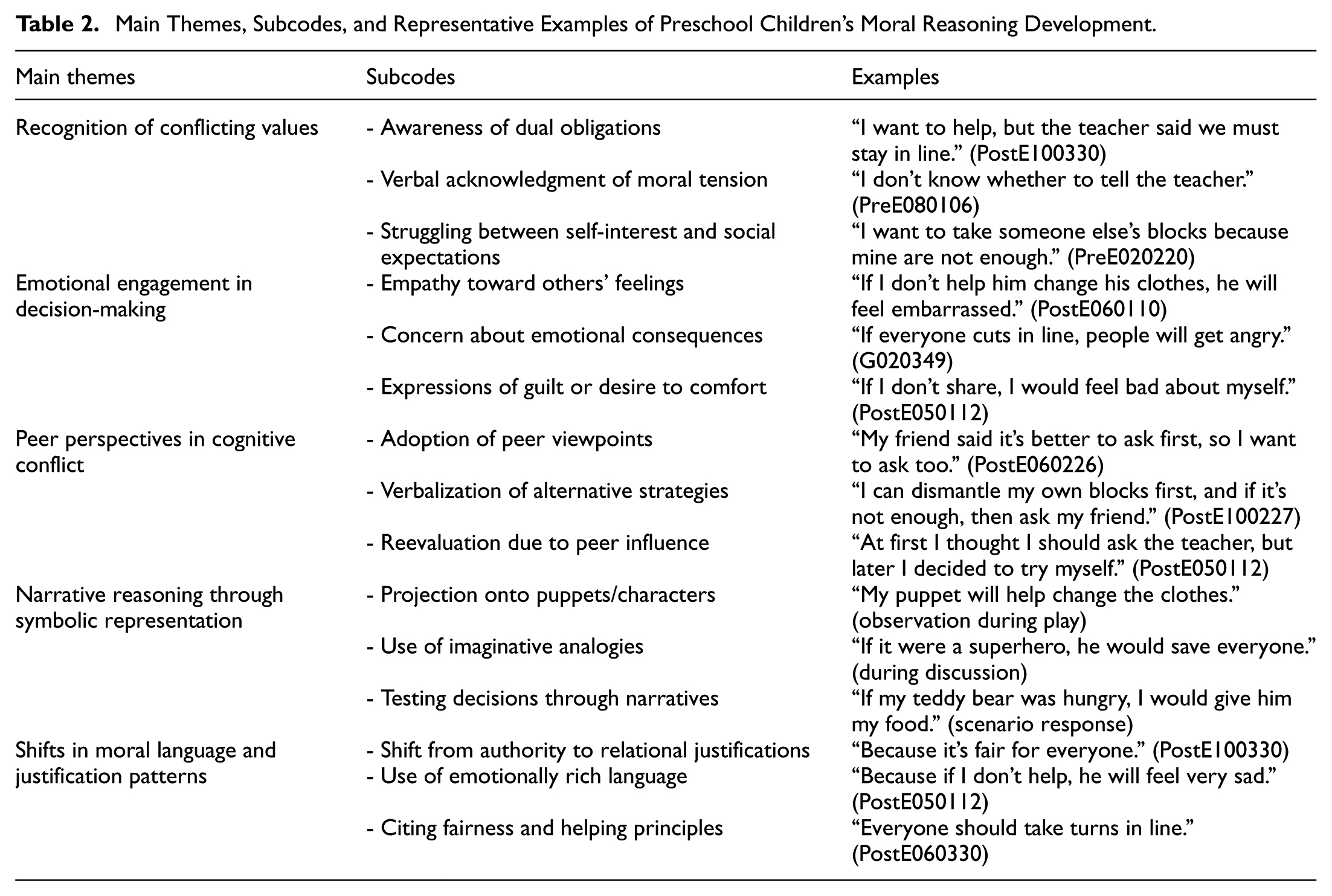
Through this iterative process, five major interconnected themes emerged, reflecting how preschool children experienced and processed moral dilemma discussions:
(1) Recognition of conflicting values,
(2) Emotional engagement in decision-making,
(3) The role of peer perspectives in cognitive conflict,
(4) Narrative reasoning through symbolic representation, and
(5) Shifts in moral language and justification patterns.
Each main theme was further elaborated through specific subcategories (subcodes), capturing the nuanced variations within children’s moral reasoning development.
To enhance analytic transparency and data credibility, representative examples from children’s actual discourse were aligned with each subcategory.
This integrated approach provided insight not only into observable shifts in moral behavior but also into the underlying cognitive, emotional, and social processes shaping children’s evolving moral understanding.
A summary of the main themes, subcodes, and illustrative examples is presented in Table 2.
Main Themes, Subcodes, and Representative Examples of Preschool Children’s Moral Reasoning Development.
Results
Changes in Moral Decision-Making
Children’s responses across the four domains—altruistic helping (AH), resource sharing (RS), rule compliance (RC), and health-related concern (HC)—were classified into three levels of reasoning: Level 0 (uncertainty or disengagement), Level 1 (obedience or punishment avoidance), and Level 2 (prosocial or socially responsible reasoning).
Descriptive results showed clear shifts following the intervention. The proportion of Level 2 responses increased substantially in all domains, while Level 0 responses declined. For example, in RS, Level 2 reasoning rose from 35.7% to 85.7%, and Level 0 dropped from 14.3% to 0%. In RC, Level 2 reasoning increased from 28.6% to 64.3%. AH showed the most pronounced decline in Level 1 obedience-based reasoning (42.9% → 28.6%), which was replaced by fairness- and empathy-oriented justifications.
Wilcoxon signed-rank tests indicated significant improvements across all domains: AH (Z = −2.85, p = .004), RS (Z = −3.00, p = .003), RC (Z = −2.70, p = .007), and HC (Z = −2.71, p = .007). Chi-square analyses further confirmed significant associations between intervention and decision change across the four domains: AH (χ2 = 12.34, p = .001), RS (χ2 = 10.25, p = .002), RC (χ2 = 9.18, p = .003), and HC (χ2 = 7.22, p = .006).
Together, these findings demonstrate that the structured moral discussions, supported by board games and symbolic play, not only increased the children’s likelihood of revising their moral decisions but also enhanced the sophistication of their reasoning strategies (see Table 3).
Moral Decision-Making Outcomes (Experimental Group).
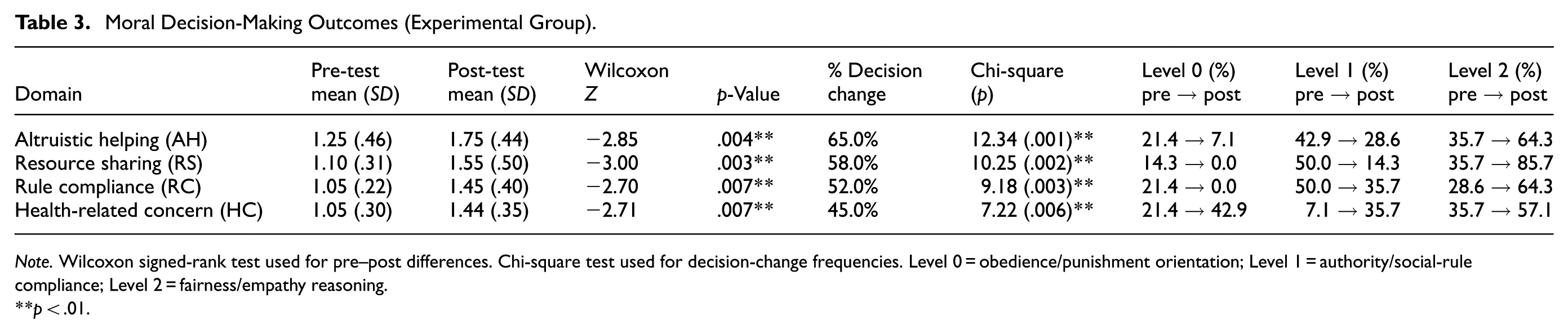
Note. Wilcoxon signed-rank test used for pre–post differences. Chi-square test used for decision-change frequencies. Level 0 = obedience/punishment orientation; Level 1 = authority/social-rule compliance; Level 2 = fairness/empathy reasoning.
p < .01.
Changes in Moral Maturity Stages
Children’s stage scores, derived from a Kohlberg-based rubric (Stages P1–P6), were compared across pre- and post-tests within each domain.
Wilcoxon signed-rank tests revealed no significant pre–post differences: AH (Z = −.00, p = .066), RS (Z = −36.5, p = .525), RC (Z = −2.0, p = .273), and HC (Z = −4.5, p = .414). However, Chi-square analyses indicated significant distributional shifts in three domains: AH (χ2 = 39.67, p = .006), RS (χ2 = 43.87, p = .011), and RC (χ2 = 33.02, p = .034), while HC showed no significant change (χ2 = 21.78, p = .353).
Stage distribution analyses further clarified these patterns. In AH, the proportion of children at Stage P4 increased from 14.3% to 28.6%, while P6 declined from 28.6% to 21.4%. In RS, P4 rose from 21.4% to 28.6%, accompanied by a decline in P1 (28.6% → 14.3%). In RC, P4 doubled from 14.3% to 28.6%, while P6 dropped from 14.3% to 7.1%. HC showed minimal movement across stages, with most children remaining at P2 to P3. Importantly, no children progressed into the advanced stages (P5–P6) beyond minor fluctuations, underscoring that the gains were concentrated in mid-level reasoning rather than higher-order moral principles.
These findings indicate that while the intervention promoted measurable gains in moral reasoning maturity within several domains, the improvements largely reflected shifts from lower to mid-level stages rather than structural progression to more advanced stages (see Table 4).
Moral Maturity Outcomes (Experimental Group).

Note. Wilcoxon signed-rank test used for pre–post score differences. Chi-square test used for stage distribution shifts. P1 to P6 = Kohlbergian moral maturity stages.
p < .05. **p < .01.
Thematic Analysis of Children’s Moral Reasoning
To explore how children justified their moral decisions before and after participating in moral dilemma discussions, a thematic analysis was conducted based on coded interview transcripts and observational field notes. Using open, axial, and selective coding procedures, children’s moral reasoning patterns were inductively categorized into four key domains: altruistic helping (AH), resource sharing (RS), rule compliance (RC), and health-related responsibility (HC). Within each domain, children’s reasoning exhibited considerable variation in complexity, depth, and consistency.
Altruistic Helping (AH)
Children’s responses in this domain ranged from passive reliance on authority to active expressions of empathy. Before the discussion, many children responded by saying, “Ask the teacher for help,” (PreE080106, PreE080108) indicating a reliance on external authority figures. However, after peer-based moral discussions, several children shifted toward more autonomous and empathetic responses such as “I would help my friend change clothes.” (PostE060110) These changes were most evident in children who directly experienced peer modeling during the group sessions, suggesting that witnessing prosocial behavior from peers influenced their moral reasoning. Still, a small group of children remained unsure or unable to articulate a clear action plan, highlighting the developmental diversity within the group.
Resource Sharing (RS)
This theme revealed children’s evolving sense of fairness and negotiation. Initially, many children chose to dismantle their own blocks to avoid conflict (PreE060226). After the intervention, responses became more nuanced, with children suggesting sequential strategies such as “First, I would use mine, and if that’s not enough, I’d ask my friend” (PostE100227, PostE100222). These responses reflected an increased ability to anticipate consequences and engage in problem-solving. Some children, however, did not show changes, suggesting individual variability in processing peer perspectives (PostE020220 and PostE020219).
Rule Compliance (RC)
The majority of children consistently indicated they would wait their turn to use the bathroom, both before and after the intervention (PreE010320, PostE010321), suggesting that this domain may reflect already internalized social norms. Notably, a few children who initially expressed a desire to cut in line (PreE060324, PreC060322, and PreE060305) later changed to more rule-abiding responses such as “I will wait because it’s fair” (PostE060324, and PostE060305). Conversely, some children still relied on adults for resolution or expressed verbal impatience (“I will tell the friend to hurry up”; PostE090332), suggesting their moral reasoning remained authority-dependent or emotionally reactive.
Health-Related Responsibility (HC)
In the health-related dilemmas, such as how to respond to a peer who refuses to eat vegetables, children showed the greatest range of responses. Some opted to verbally encourage the peer (“I would tell him to eat it because it’s good”; PreE0904347, PostE090439), while others proposed creative solutions (“Make the vegetables into soup or cookies”; PreE060430 and PostE060436). A few children, however, continued to express uncertainty or withdrew from the dilemma entirely. The overall change in this domain was limited, potentially due to the abstract nature of the issue or children’s limited experiences with food and health decision-making.
Grounded Theory Analysis of Moral Reasoning Shifts
To further uncover the underlying processes through which preschool children constructed and revised their moral reasoning, a grounded theory analysis was conducted. Interview transcripts and peer discussion recordings were systematically analyzed using open, axial, and selective coding. Through constant comparative analysis, five interconnected themes emerged, reflecting the developmental shifts in children’s moral cognition prompted by their participation in the intervention.
Recognition of Conflicting Values
Children began to express an awareness of moral conflict inherent in dilemma situations, such as whether to help a peer or obey a rule. Some children who initially defaulted to rule-following later acknowledged the emotional or social implications of their choices (e.g., “I want to help, but I’m not supposed to leave the line”; PostE100330), illustrating early-stage internal moral tension.
Emotional Engagement in Decision-Making
The data showed a deepening of emotional awareness in children’s responses. Over time, children were more likely to consider how their actions would affect others emotionally. For example, post-intervention transcripts included statements such as, “If I don’t help, he’ll be sad,” (PostE050112) or “He might feel embarrassed,” (PostE120107) revealing emerging empathy and affective sensitivity in moral deliberation.
The Role of Peer Perspectives in Cognitive Conflict
Many children revised their initial reasoning after hearing differing viewpoints during the group discussion. Peer contributions often served as triggers for cognitive disequilibrium, which led to reevaluation and, in some cases, internalization of alternative perspectives. For instance, several children shifted from “Ask the teacher” to “Maybe I can try to help first,” directly following peer input that highlighted self-agency (PostE050106, PostE050112, PostE120110, PostE120112).
Narrative Reasoning Through Symbolic Representation
The tabletop puppet theater (symbolic play) and board game formats provided children with symbolic and narrative frameworks to externalize their thinking. Children often projected their reasoning onto puppet characters or described the dilemma using imaginative analogies. This narrative distancing appeared to support cognitive scaffolding, allowing them to test and evaluate moral options without personal threat or confusion. As one child expressed, “The puppet helped me understand what the teacher was asking” (G020349), indicating that the symbolic medium supported cognitive engagement with the dilemma.
Shifts in Moral Language and Justification Patterns
A notable shift was observed in the language children used to justify their choices. Initial responses were often brief, repetitive, or authority-based (e.g., “Because that’s what the teacher says”; PreE0140326). In contrast, post-intervention justifications included more relational and principle-based reasoning, such as “It’s not fair if I go first,” (PostE100330) or “Because friends should help each other” (PostE100327). This indicates an evolving ability to articulate moral reasoning beyond obedience or consequence avoidance.
These themes illustrate a dynamic developmental trajectory in children’s moral reasoning, facilitated by peer interaction, guided discussion, and symbolic tools. The analysis suggests that early childhood moral development is not merely a matter of isolated choices, but rather a socially embedded, emotionally situated, and narratively structured process. Grounded theory analysis thus provides a robust framework for understanding how children make sense of complex moral dilemmas over time.
Discussion
This study examined how peer-based moral dilemma discussions supported by board games and symbolic play served to influence preschoolers’ moral decision-making, reasoning, and moral maturity. Drawing from both quantitative and qualitative analyses, the findings provided evidence that short-term, play-based interventions can foster early moral development, while also highlighting the limits of structural stage progression within a short period.
Changes in Moral Decision-Making
The studied intervention produced significant gains in children’s moral decision-making across all four domains—altruistic helping, resource sharing, rule compliance, and health-related concern. Children’s responses shifted away from obedience-based or uncertain justifications (Levels 0–1) toward prosocial and socially responsible reasoning (Level 2). For example, Level 2 reasoning in resource sharing increased from 35.7% to 85.7%, with Level 0 dropping to 0%. These findings are consistent with those in prior studies demonstrating that structured moral dialogue can enhance young children’s capacity to reason beyond authority and punishment (Hsieh & Chen, 2019; Killen & Smetana, 2015). The increase in Level 2 reasoning underscores the effectiveness of contextualized, peer-led activities, where board games and symbolic play provided emotionally engaging and cognitively challenging contexts for moral reflection.
Changes in Moral Maturity Stages
Results regarding moral maturity stages presented a more nuanced picture. Wilcoxon tests indicated no significant pre–post changes in stage scores across the domains, yet Chi-square analyses revealed significant distributional shifts in altruistic helping, resource sharing, and rule compliance. These shifts primarily reflected movement from lower stages (P1–P2) toward mid-level reasoning (P3–P4). For example, for altruistic helping, Stage P4 increased from 14.3% to 28.6%, while Stage P1 declined from 14.3% to 7.1%. However, no children advanced to higher stages (P5–P6), and there was no significant change for health-related concerns.
These outcomes suggest that while preschoolers are capable of measurable developmental gains through short-term moral discussions, such gains are largely confined to the middle stages of the Kohlberg’s framework. This pattern is consistent with prior studies indicating that genuine structural progression toward higher stages requires extended engagement and repeated opportunities for reflection and cognitive disequilibrium (Blatt & Kohlberg, 1975; Power et al., 1989). Thus, the present findings indicate that only stage-level changes are observable in early childhood, occurring primarily within developmentally proximal stages rather than advancing to abstract moral principles.
Shifts in Moral Reasoning Patterns
Qualitative analyses supported and elaborated on these quantitative outcomes. The children’s justifications increasingly emphasized fairness, empathy, and relational concerns, moving away from authority-based reasoning. These qualitative themes help explain the observed statistical progression to mid-level stages: while children demonstrated richer reasoning strategies, these advances did not yet extend to the abstract principles characteristic of advanced stages (P5–P6). This integration suggests that moral development in early childhood may follow a trajectory where qualitative transformations in reasoning precedes and supports quantitative progression across developmental stages.
Pedagogical Functions of Board Games and Symbolic Play
The use of board games and symbolic play proved effective in eliciting dialogue and fostering peer interaction. These playful tools provided a safe and engaging medium for children to externalize and negotiate moral reasoning. Comments such as “The puppet helped me understand what the teacher was asking” illustrate how symbolic play mediated children’s comprehension and expression of moral dilemmas. Such tools align with socio-constructivist perspectives on moral development, emphasizing the role of social dialogue, shared narratives, and collaborative play in fostering cognitive and emotional growth (Rogoff, 2003; Vygotsky, 1978; Wang et al., 2024).
Implications and Future Directions
The study results demonstrate that short-term, structured moral discussions can enhance preschoolers’ decision-making and reasoning, producing both qualitative and quantitative gains. For educators, incorporating board games, puppetry, and peer dialogue offers a practical and developmentally appropriate means to promote empathy and ethical reflection. Future research should explore the durability of these gains through longer interventions and examine how individual traits such as language ability and temperament moderate responsiveness. Additionally, replication of these results across larger and more diverse samples is essential. Replications across the Confucian cultural contexts and varied preschool environments would clarify the extent to which these findings generalize, and how cultural values and contextual practices shape the developmental trajectory of children’s moral reasoning.
Moreover, these findings directly contribute to the United Nations’ Sustainable Development Goal 4 (Quality Education) by demonstrating how innovative, play-based pedagogies can promote not only cognitive but also socio-emotional dimensions of early childhood education. By showing that the moral discussions embedded in board games and symbolic play foster empathy, fairness, and social responsibility, this study supports global efforts to ensure inclusive and equitable quality education and to cultivate lifelong values of respect and cooperation from the earliest stages of schooling.
Conclusions and Suggestions
Overall Conclusions
This study demonstrated that moral discussions embedded in board games and symbolic play served to significantly enhanced preschoolers’ moral decision-making across four domains. Children shifted from obedience-driven or uncertain responses toward socially responsible reasoning, with substantial increases in Level 2 justifications involving fairness, empathy, and relational concerns. Importantly, while Chi-square analyses revealed significant stage distribution shifts in altruistic helping, resource sharing, and rule compliance, these advances were largely confined to movement from lower stages (P1–P2) toward mid-level reasoning (P3–P4). No children progressed to advanced stages (P5–P6), and the domain of health-related concerns showed limited change. These results underscore that short-term interventions may foster measurable but developmentally proximal gains rather than structural leaps to higher moral stages.
Qualitative findings corroborated these results, highlighting growth in empathy, moral language, and narrative reasoning. Taken together, the mixed-methods evidence indicates that meaningful progress in moral sensitivity and interpersonal reasoning is achievable in early childhood, even though extended and sustained interventions are likely required for advanced stage-level development.
Theoretical Contributions
This study contributes to moral education theory by illustrating how early moral reasoning is socially constructed through peer interaction and narrative frameworks. The findings refine Kohlberg’s framework by showing that although higher-stage progression typically requires long-term, sustained exposure, short-term, developmentally appropriate interventions can stimulate both qualitative and quantitative advances in moral reasoning. By demonstrating that young children can progress from obedience-based reasoning to more relational and empathetic orientations within a brief period, this study underscores the importance of designing playful, socially grounded pedagogies for moral education.
Strengths and Limitations
Strengths of the Study
A key strength of this study lies in its innovative use of developmentally appropriate symbolic media—board games and puppet theater—to engage preschoolers in moral reasoning. These tools provided emotionally engaging and cognitively accessible contexts for exploring ethical dilemmas. The mixed-methods design enabled the integration of statistical evidence with qualitative insights, offering a holistic understanding of children’s developmental shifts. High inter-rated reliability and test–retest stability, which further reinforced methodological rigor, while the use of a tailored moral maturity rubric ensured appropriateness for 5- to 6-year-old children.
Limitations
Despite these strengths, the study has several limitations. The small sample size (n = 30) limits generalizability. Although consistent with early childhood intervention research, the scale restricts statistical power and reduces the diversity of developmental trajectories captured. Furthermore, although binary outcomes such as decision changes were analyzed using non-parametric tests due to the small sample size, logistic regression would offer a more precise analytical approach for modeling such outcomes. Future research with larger samples could employ logistic regression to provide more robust estimates of intervention effects. The 4-week intervention, while sufficient to produce measurable gains in decision-making and mid-level stage progression, was not long enough to promote advancement to higher moral stages, which typically require sustained engagement. Future research should employ longer interventions to test whether extended dialogue can yield structural development at advanced stages.
Additionally, the study did not include direct measures of emotional regulation, behavioral outcomes, or cognitive traits such as language proficiency, which may moderate responsiveness to moral interventions. Cultural specificity also presents a limitation: the Taiwanese preschool context reflects unique pedagogical practices and collective values. While the findings may extend to broader Confucian cultural contexts where relational ethics and group responsibility are emphasized (Chao, 1994; Ho, 1996; Li, 2012), caution is warranted in generalizing beyond these settings. Replication with larger, more diverse samples across cultural groups, school types (public vs. private), and contexts (urban vs. rural, varied pedagogical emphases) will be necessary to strengthen the external validity of these findings.
Supplemental Material
sj-jpg-1-sgo-10.1177_21582440261422009 – Supplemental material for Promoting Preschoolers’ Moral Reasoning Through Board Games and Peer Discussions: A Mixed-Methods Study
Supplemental material, sj-jpg-1-sgo-10.1177_21582440261422009 for Promoting Preschoolers’ Moral Reasoning Through Board Games and Peer Discussions: A Mixed-Methods Study by Chia-Yen Hsieh and Chia-Chi Wu in SAGE Open
Supplemental Material
sj-jpg-2-sgo-10.1177_21582440261422009 – Supplemental material for Promoting Preschoolers’ Moral Reasoning Through Board Games and Peer Discussions: A Mixed-Methods Study
Supplemental material, sj-jpg-2-sgo-10.1177_21582440261422009 for Promoting Preschoolers’ Moral Reasoning Through Board Games and Peer Discussions: A Mixed-Methods Study by Chia-Yen Hsieh and Chia-Chi Wu in SAGE Open
Supplemental Material
sj-jpg-3-sgo-10.1177_21582440261422009 – Supplemental material for Promoting Preschoolers’ Moral Reasoning Through Board Games and Peer Discussions: A Mixed-Methods Study
Supplemental material, sj-jpg-3-sgo-10.1177_21582440261422009 for Promoting Preschoolers’ Moral Reasoning Through Board Games and Peer Discussions: A Mixed-Methods Study by Chia-Yen Hsieh and Chia-Chi Wu in SAGE Open
Footnotes
Acknowledgements
The authors gratefully acknowledge the valuable support provided by CHIU, Wen-Hsin, HSU, Yu-Ling, and HUANG, Hsiao-Ping, preschool teachers at Hsueh Cheng Preschool, who generously assisted with the coordination of the study sessions. We also thank the participating children and their families for their time and engagement. During the preparation of this work, the authors used OpenAI to enhance the English writing in order to improve readability, as English is not the authors' first language. After using this tool, the authors carefully reviewed and edited the content as needed and take full responsibility for the final version of the manuscript. The authors also gratefully acknowledge the support of the National Science and Technology Council of Taiwan (NSTC) for funding this research project. Special thanks are extended to the teachers and children of Hsueh Cheng Preschool for their enthusiastic participation and valuable assistance throughout the study.

Ethical Considerations
The study was approved by the Governance Framework for Human Research Ethics at National Cheng Kung University (NCKU), Taiwan (Approval No. NCKU HREC-E-114-0820-2). Informed consent was obtained from all participants prior to data collection, in accordance with the Declaration of Helsinki.
Consent to Participate
Informed written consent was obtained from all participants’ legal guardians prior to their participation in the study. Participants were provided with full information regarding the study’s purpose, procedures, and their rights, and participation was entirely voluntary.
Author Contributions
Chia-Yen Hsieh contributed to the conceptualization of the study, the design of the methodology, the formal analysis of both quantitative and qualitative data, and provided supervision throughout all stages of the research process. Chia-Chi Wu was responsible for carrying out the experimental procedures, collecting both quantitative and qualitative data, and conducting the initial organization and coding of qualitative data under supervision. Both authors contributed to the writing, review, and approval of the final manuscript.
Funding
The authors disclosed receipt of the following financial support for the research, authorship, and/or publication of this article: This work was supported by the National Science and Technology Council (NSTC), Taiwan, under Grant No. 113-2813-C-153-037-H.
Declaration of Conflicting Interests
The authors declared no potential conflicts of interest with respect to the research, authorship, and/or publication of this article.
Data Availability Statement
The datasets generated during and/or analyzed during the current study are available from the corresponding author on reasonable request.*
Supplemental Material
Supplemental material for this article is available online.
References
Supplementary Material
Please find the following supplemental material available below.
For Open Access articles published under a Creative Commons License, all supplemental material carries the same license as the article it is associated with.
For non-Open Access articles published, all supplemental material carries a non-exclusive license, and permission requests for re-use of supplemental material or any part of supplemental material shall be sent directly to the copyright owner as specified in the copyright notice associated with the article.


