




Abstract
It is aimed to develop a measurement tool which is a basic motor movement, social skill, attitude observation and evaluation scale for Basic Movement Education. In the study, the natural observation from qualitative research methods is used. The scale outline with 40 items is formed as a result of literature review and negotiations. To determine the content validity of the scale draft, the opinions of six field experts (lecturers), two preschool teachers, two physical education (PE) teachers, and two language experts were analyzed using the Lashwe technique. By analyzing the experts’ opinions according to Lashwe technique, four items are removed since their content validity rate (CVR) assets are less than 0.75. CVR shows that the scale provides 4-point Likert-type construct validity and consists of two subdimensions with 36 items (the basic motor movement skill dimension is 16 items and social skill dimension is 20 items). Total points of the Spearman correlation coefficient are checked among the observers. While the correlation coefficient of the basic motor movement skill dimension is .71 (p = .000), the correlation coefficient of social skill dimension is .82 (p = .002). The correlation coefficient among the total points is more than .70, and the results (p < .01) are meaningful. This shows that the measurement tool is reliable, and the scale provides reliability with 4-point Likert-type gradation.
Introduction
Within the context of sustainability and development principle, it is emphasized that children’s basic motor performance and their social skill progress can maintain sustainability and continuity depending on both natural and structured environmental factors which are presented for children along with the inner, sensorial, and emotional processes. By taking into consideration the relations among children’s growth, development, basic motor performance, and social skills, Basic Movement Education (BME) is thought to be evaluated and revised whether social and communication skills are included along with movement and physical activity applications of movement education (ME) programs at different levels. One of the ways for acquiring basic motor proficiencies from pedagogical perspective is school-based physical education (PE).
PE gains students the proficiencies that they need so as to participate in the sport and exercise culture actively. Apart from physical fitness at basic level and knowledge about sports, students, first of all, need basic motor proficiencies to do sports and exercise actively (Herrmann, Heim & Seeling, 2019). Having got basic motor proficiencies is closely related to previous experiences and nonschool socializing processes. Not every student has a required motor proficiency level to participate in sport and exercise; therefore, PE courses are fundamental to balance socializing differences, enabling students to acquire basic motor proficiencies at minimum level and provide them to maintain their proficiences (Herrmann & Seelig, 2017a; Herrmann et al., 2019). Teaching the proficiencies which are introduced in the program, age standards and motor performance levels to be taught can be used to evaluate a school’s success. Observable performances related to PE program are viewed as tendencies to be measured via only observation by using the expression structures of doing skill movement structures and basic motor competences. And this results in the mission performances. Basic motor skills are classified into three categories: “movement (translocation), controlling an object (manipulative), and balance (static-dynamic)” (Hermann & Seeling, 2017b; Payne & Isaacs, 2017; Rintala et al., 2017). In PE and exercise studies, the foundation of motor performance is discussed from two perspectives: ability-oriented approach (the strength, power, speed, coordination, and elasticity of motor activity) and skill-oriented approach (motor tests and evaluation of motor skills; Herrmann et al., 2015). Motor tests can identify the strengths and weaknesses of children in a certain moment or period while they determine the children’s motor competency level. Namely, motor tests are used for identifying the development of motor functions and controlling whether it shows a development in time (Scheuer et al., 2019).
Generally, available test devices change according to theoretical frameworks because these are based on the structure’s “motor abilities,” “motor skills,” or “motor proficiencies” (Herrmann & Seelig, 2017a; Scheuer et al., 2019).
⇒ Motor ability tests are test tools to measure conditioned or coordinative ability levels. They represent physical performance and balance with physiological components of physical fitness very often.
⇒ Motor skill tests consist of process or result-based test items which measure certain individual movements in various areas of fine and gross motor skills. It focuses on the quality of a person’s movement performance or the master level of movement structure.
⇒ Motor competency tests are test tools to evaluate the mastership of motor skills in certain situations. It focuses on the result and on the matter that motor skills are applied both successfully and masterly.
The way of basing on the concept to develop test missions must be interrogated to develop a suitable test tool. The approach based on “basic movement skills” focuses on basic motor skills of daily motor activity, and “basic motor skills” of children in early childhood period are assumed that they gain a range of motor skills. These consist of movement competence skills, skills of controlling an object, and balance skills (Scheuer et al., 2017).
ME and PE are known as developing both basic motor skill and social skill acquisitions as well as developing motor performance. Increasing motor performance is known to depend on appropriateness of anthropometric qualities as well as performing skills as it should be (Battaglia et al., 2018; Krneta & Pocek, 2015; Opsteol et al., 2015), and it is thought that patterns of basic motor movements should be gained according to their features as well as the variety of exercises which are applied to the sportsmen and talent election (Roman et al., 2018). In this direction, it is thought that the content of teaching and learning processes and stages of development are determined with different methods and measurement tools from measurement and evaluation, and they should be held under control.
In the evaluation of BME, the measurement tool which is used for process planning and application is fundamental. Thus, the mistakes and shortcomings in planning and possible problems in applications can be corrected, and necessary precautions are taken for the next applications. How measurement tool measures skills, which skills are difficult for it to measure, and the fact that it proves deficiencies by evaluating them enable the measurement tool to be more qualified. According to the research, it is aimed to develop a basic motor movement, social skill attitude observation, and evaluation measurement tool by means of BME.
Materials and Methods
In the study, the unattended natural observation, one of the types of the observation method from qualitative research methods, is used owing to the fact that this is a field study which is aimed to determine the basic motor movement skills which preschool children perform in playgrounds, to determine at which level the social skills are, and to provide a fact finding to be done on their developments.
The features of the study group and at which level the study for developing “the basic movement, social skill and attitude observation, and evaluation scale” are fulfilled are presented below.
Study Group
The basic motor movement and social skills of children who study at two different preschools in two different education and training years are recorded by two professional observers with the attitude observation and evaluation measurement tool which is prepared to collect data in the context of the research. During the research, 62 preschool students (4-year-old 30 children and 5-year-old 32 children) with 31 boys and 31 girls participate in the ME activities.
Data Collection Tool
As a result of literature review, the basic motor movement, social skill and attitude observation, and evaluation scale outline consists of 40 items in the light of the data which are obtained with the analysis of revised education programs. Attitude observation and evaluation scale outline consists of two subdimensions: “the basic motor movement skill dimension” and “social skill dimension.” While the basic motor movement skill dimension consists of 19 items, the social skill dimension consists of 21 items.
To determine the content validity of the scale draft, the opinions of six field experts (lecturers), two preschool teachers, two ons of six field experts (lecturers), two preschool teachers, teachers, and two language experts were analyzed using the Lashwe (1975) technique. The opinion options “suitable,” “must be corrected”, and “must be abolished” are added into the attitude observation and evaluation scale outline. According to Lashwe analysis, the items which are under the content validity rate (CVR) are taken out of the scale. The content validity rate is found with the following formula: CVR = (** ÷ [* ÷ 2]) − 1, n = the total number of the experts, ng = the required number of experts for the Item (13). Veneziano and Hooper (1997) state that the CVR asset must be more than 0.75 at least in analyzing the content validity rate (CVR) of nine experts’ opinions with Lashwe technique to provide ease of CVR calculation in α = .05 significance level. As a result of the experts’ opinions, the CVR assets of four items which are seen in Table 1 are taken out because they are less than 0.75 (Veneziano and Hooper, 1997).
The Content Validity Rate (CVR) of the Attitude Observation and Evaluation Scale Outline.

The items which are taken out of the attitude observation and evaluation scale outline.
There are 36 items left in the attitude observation and evaluation scale outline after the content validity. There are 16 items left in the basic motor movement skill dimension, while there are 20 items left in the social skill dimension. All the scale items of the attitude observation and evaluation are positive items. Four-point Likert-type measurement tool is used for the scale as completely developed (4), slightly developed (3), must be slightly developed (2), and must be completely developed (1).
An observation form is filled by two different observers in practice areas of the lessons “Movement Activity” and “Play Activity” which are taken by 62 students who study at the preschool for the reliability analysis of the attitude observation and evaluation scale. Total points are checked with the Spearman correlation coefficient among the observers. While the correlation coefficient as to the subdimension of the basic motor movement skills is seen as .71 (p = .000), the correlation coefficient as to the subdimension of social skills is regarded as .82 (p = .002).
The correlation coefficient among the total points of the observation form which is filled by two different observers for the same students is more than .70, and the results (p < .01) are meaningful. Experts state that the measurement tool is reliable if the correlation coefficient is more than .70 (15–18).
The observation form with two subdimensions (the basic motor movement skill dimension and social skill dimension) and the total 36 items is proved to be a scientific measurement tool which provides minimum requirements of validity and reliability.
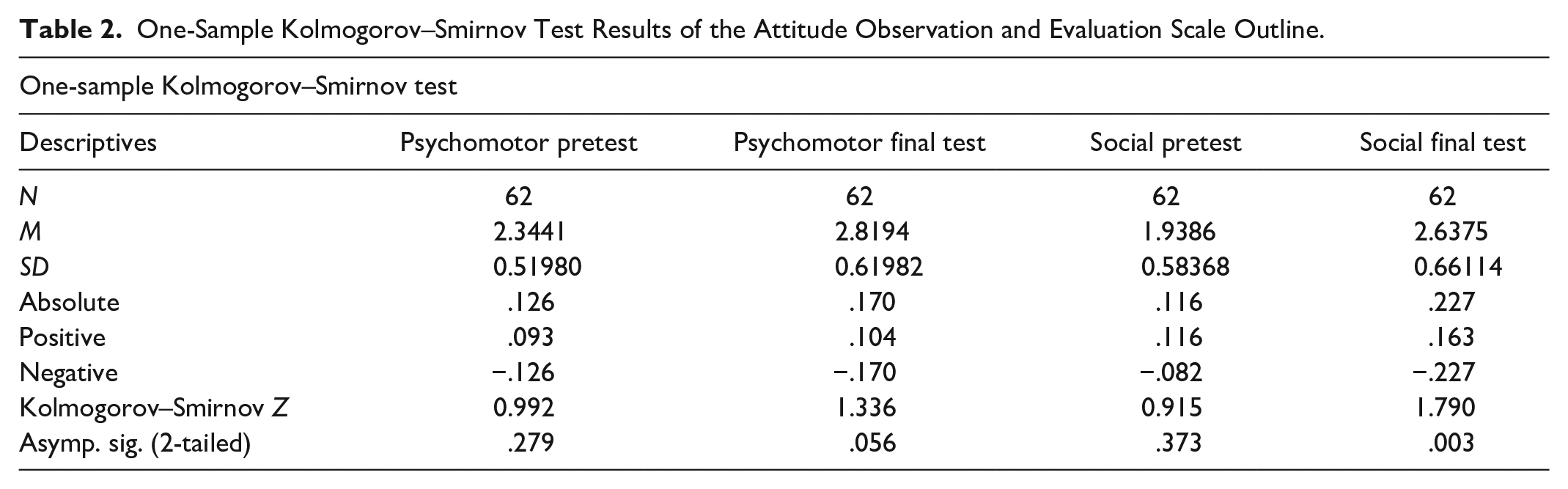
By observing 62 students who study at preschools and filling the observation form, the observation results are added into the statistical packet program, and the test of normality and Kolmogorov–Smirnov test are done for the raw data. As seen in Table 2, the kurtosis and skewness assets are between −1 and 1 and p assets are more than .05 which means it is meaningful; therefore, parametric tests are used statistically. As seen in Tables 3 and 4, pretest, final test, and dependent samples t test are used. The significance level is chosen as α = .01.
One-Sample Kolmogorov–Smirnov Test Results of the Attitude Observation and Evaluation Scale Outline.
Pretest and Final Test Results of Preschool (4- to 5-Year-Old) Children’s Basic Motor Movement Skills.

p < .01.
Pretest and Final Test Results of Preschool (4- to 5-Year-Old) Children’s Social Skills.

p < .01.
Results
Statistical Processes
As seen in the table, there is a positive significance at the .01 level in favor of final tests among the averages of prefinal test assets according to the results of paired samples t test which is done to determine whether there is a significant difference among the basic motor movement skill subdimension test results of the attitude observation and evaluation scale outline.
As seen in the table, there is a positive significance at the .01 level (p > .01) in favor of final tests among the averages of prefinal test assets according to the results of paired samples t test which is done to determine whether there is a significant difference among the social skill subdimension test averages of the attitude observation and evaluation scale outline.
Scale Evaluation
As a result of the study of developing the basic motor movement, social skill and attitude observation, and evaluation scale, it is a scale with 36 items which provides validity and reliability. Four-point Likert-type measurement tool is used for the scale as “Well developed (4), slightly developed (3), must be developed (2), and must be completely developed (1).”
The Scale’s Subfactors and Item Numbers.

The basic motor movements
These subfactors measure the situation of the basic motor movement skill. The items between 3 and 18 explain these subfactors. It shows that as the average of the total point increases, the quality of the basic motor movement skill increases.
Social skills
This subfactor measures the social skill level. The items between 1 and 2 and between 19 and 36 explain this subfactor. It shows that as the average of the total point increases, the quality of the social skill level increases.
The items from every factor are collected, and they are divided into the item number. Thus, the points of every factor change between 1 and 4. The average point of every factor is evaluated within itself. It can be benefited from the table below to provide an ease of evaluation.
Scale Evaluation Table.

Discussion
The research’s aim is to develop a measurement tool for valid and reliable basic motor movement, social skill and attitude observation, and evaluation to determine the development levels of children and the quality of BME activities.
Regarding the research area, under the guidance of the researcher, 50 senior university students (from PE and sports teaching department, preschool teaching department, and child development department) were asked to create criteria by adhering to the achievements of game and ME lessons and the characteristics of the developmental phase. A 40-item observation form was created for the scale draft in light of the criteria created, the acquisitions related to the field, and the data obtained through the literature review.
The opinions of 12 experts (six lecturers, two preschool teachers, two PE teachers, and two language experts) are analyzed with Lashwe (1975) technique to determine the content validity of the attitude observation and evaluation. The opinion options such as “suitable,” “must be corrected,” and “must be abolished” are added into the scale outlines. Minimum 5 and maximum 40 experts’ opinions are required to determine the content validity according to Lashwe technique.
According to Lashwe analysis, the items which are under the content validity rate (CVR) are taken out of the scale. The content validity rate is found with the following formula: CVR = (** ÷ [* ÷ 2]) − 1, n = the total number of the experts, ng = the required number of experts for the item (13). The content validity rate must be minimum 0.75 for the item whose CVR is in the α = .05 significance level for which Veneziano and Hooper (1997) take 12 experts’ opinions. CVR assets of four items which are less than 0.75 are taken out (Veneziano & Hooper, 1997).
There are 36 items left in the scale outline after the content validity. The scale outline of attitude observation and evaluation consists of two subdimensions. First subdimension includes basic motor movement skills and 16 items and second subdimension includes social skill dimension and 20 items. All the basic motor movement, social skill and attitude observation, and evaluation scales are positive items. Four-point Likert-type measurement tool is used for the scale as completely developed (4), slightly developed (3), must be slightly developed (2), and must be completely developed (1).
The scale outline is applied to 4- to 5-year-old 62 preschool students by observing in two different education and training years to develop the scale outline. The observation records of the observing researchers who fill in the scale of attitude observation and evaluation completely are recorded to the statistical packet program as completely developed (4), slightly developed (3), must be slightly developed (2), and must be completely developed (1). An observation form is filled by two different observers in practice areas of the lessons “Movement Activity” and “Game Activity” which are taken by 62 students who study at the preschool for the reliability analysis of the basic motor movement, social skill and attitude observation, and evaluation. Total points are checked with the Spearman correlation coefficient among the observers. While the correlation coefficient as to the subdimension of the basic motor movement skills is seen as .71 (p = .000), the correlation coefficient as to the subdimension of social skills is regarded as .82 (p = .002). In this case, it is seen that the scale provides minimum requirements of item correlations, and most of the items have a distinctive property at a good level.
The correlation coefficient among the total points of the observation form which is filled by the observers for the same students is more than .70, and the results (p < .01) are meaningful. Experts state that the measurement tool is reliable if the correlation coefficient is more than .70 (Alpar, 2014; Creswell, 2005; Cronbach, 1951, 1984; Fisher, 2007; Hartley, 2014; Simon & Goes, 2013; Taber, 2018).
In the study of the adaptation of the Motor Skills Protocol (Children’s Activity and Movement in Preschool Study [CHAMPS]), which was developed to evaluate the motor skills of children aged 4 to 5 years in the study of Kılıç et al. (2017), it was determined that the CHAMPS Motor Skills Protocol was a valid and reliable measurement tool to measure the motor skills of Turkish children. In the study conducted by Hermann et al. in 2019, it was concluded that the test tool (Motorische Basiskompetenzen im Kindergarten [MOBAK-KG]) developed to determine the basic motor competence of preschool children aged 4 to 6 years reliably assesses the motor competence (levels) of children 6 years reliably assesses the motor competence (levels) of children (Hermann et al., 2019). In Yücelyiğit and Aral’s study of adapting the Visual Motor Skills Test-3, which was developed to measure and evaluate the visual motor skills of preschool children into Turkish culture in 2018, the Visual Motor Skills Test-3 is valid and it has been determined to be a reliable measurement tool (Yücelyiğit & Aral, 2018).
Conclusion
It is very important to follow the developmental stages for a healthy childhood development. Motor competence and capacities affect the functional performance and skill tendencies of children. Play, movement, physical activity, and exercise support the developmental areas of children. Therefore, supporting basic motor capacities and competencies with play, movement, physical activity, and exercise plays an important role in the preschool period. Both a valid and an applicable test tool are required to be able to evaluate development areas in play and ME.
As a result, the observation form which is the measurement tool of the basic motor movement, social skills and attitudes observing, and evaluation with two subdimensions and a total of 36 items (the basic motor movement skill dimension consists of 16 items and social skill dimension consist of 20 items) is proved to be a scientific measurement tool which provides minimum requirements of validity and reliability.
Supplemental Material
sj-pdf-1-sgo-10.1177_21582440211031897 – Supplemental material for The Validity and Reliability Study of the Basic Motor Movement, Social Skill Observation, and Evaluation Scale for Basic Movement Education
Supplemental material, sj-pdf-1-sgo-10.1177_21582440211031897 for The Validity and Reliability Study of the Basic Motor Movement, Social Skill Observation, and Evaluation Scale for Basic Movement Education by H. Tolga Esen, Meriç Eraslan, Mustafa Altınkök, Hakan Eravşar, Bahadır Demir, Sinem Özküçük and Buket Şeran in SAGE Open
Supplemental Material
sj-pdf-2-sgo-10.1177_21582440211031897 – Supplemental material for The Validity and Reliability Study of the Basic Motor Movement, Social Skill Observation, and Evaluation Scale for Basic Movement Education
Supplemental material, sj-pdf-2-sgo-10.1177_21582440211031897 for The Validity and Reliability Study of the Basic Motor Movement, Social Skill Observation, and Evaluation Scale for Basic Movement Education by H. Tolga Esen, Meriç Eraslan, Mustafa Altınkök, Hakan Eravşar, Bahadır Demir, Sinem Özküçük and Buket Şeran in SAGE Open
Footnotes
Declaration of Conflicting Interests
The author(s) declared no potential conflicts of interest with respect to the research, authorship, and/or publication of this article.
Funding
The author(s) received no financial support for the research and/or authorship of this article.

Supplemental Material
Supplemental material for this article is available online.
References
Supplementary Material
Please find the following supplemental material available below.
For Open Access articles published under a Creative Commons License, all supplemental material carries the same license as the article it is associated with.
For non-Open Access articles published, all supplemental material carries a non-exclusive license, and permission requests for re-use of supplemental material or any part of supplemental material shall be sent directly to the copyright owner as specified in the copyright notice associated with the article.
