




Abstract
This article investigates how consumer attitudes toward green buying and subjective norms influence the network buying with the mediation of behavioral intentions and moderation of product type. Due to the increasing environmental concerns, network buying has positively changed human interactions with the environment. Based on a sample of 392 Chinese consumers, this study reveals that consumer attitudes toward green buying and subjective norms significantly influence network buying. The empirical results provide strong evidence for the mediating role of behavioral intentions in the relationship between the attitudes toward green buying and network buying. This study empirically tests a model, including the moderating effect of product type toward green products through network buying. Green consumption through network buying will help consumers to live a healthy life together with achieving environmental sustainability and consumer well-being at large. Interestingly, the current study suggests that network buying can drive sustainable consumption.
Keywords
Introduction
Network buying is now recognized as a critical driver of sustainable consumption, also called electronic buying where conumers can buy goods or services over the internet using web browsers (B. Xu et al., 2010; Zhou et al., 2013). Extensive researches have demonstrated the unsustainable consumption results in numerous ecological complications in the modern world (Yadav & Pathak, 2017). Chaudhary and Bisai (2018) have proposed green consumption as “an alternative that can be helpful to lessen down the impact of consumers negative environmental and social actions linked with consumption.” Previous studies on ecological use have focused on consumer attitudes for products selected based on the functional values and normative beliefs toward environment sustainability (Al Mamun et al., 2018; Yadav & Pathak, 2017). However, the existing researches have primarily ignored the opportunities connected with technology and sustainable consumption, such as network buying (Cao et al., 2005; Taufique & Vaithianathan, 2018). Researchers have suggested that technologies and infrastructure shape sustainable consumer buying behavior (Cao et al., 2005; Yadav & Pathak, 2017). Research is less evident in understanding the impact of these technologies on sustainable consumption (George, 2004; Zhang et al., 2018). In China E-commerce have start mounting up in 1990 when EFT (Electronic Funds Transfer) and EDI (Electronic Data Interchange) entererd in China (Lovelock & Ure, 2002). E-commerce then was only defined as “the implementation of electronic commercial transactions.” According to the Chinese online shopping report published by the National Bureau of Statistics, “Chinese GMV (Gross merchandise volume) amounted to 6.1 trillion Yuan in 2017.” Furthermore, based on the 2018 report it was up more than 70% year to year, and this growth was very much higher than that of the traditional retail stores in China. Regarding the China Internet Network Information Center report up to December 2016, China internet users counted as 731 million, and there was a yearly increase of 42.99 million. The internet growth rate of 53.2% is an inspiration to study consumer network buying behavior (Isa et al., 2016). Network buying has transformed the consumer buying, where the world ecological issues resulting from consumer actions, such as air pollution, noise pollution, and the greenhouse effect (He et al., 2018; Isa et al., 2016), are becoming more alarming; taking into consideration it is essential to cut down these detrimental consumer activities on the eco-environment (Poddar et al., 2009). Green product purchasing behavior will help mitigate such environmental pollution, and promoting environment-friendly products will ultimately increase the green product buying (Isa et al., 2016; Zhu et al., 2013).
Green consumption can be defined as “the use of goods and services that respond to the basic needs and bring a better quality of life, while minimizing the use of natural resources, toxic materials and emissions of waste and pollutants over the life cycle, so as not to jeopardize the needs of future generations” (Y. Wang & Hao, 2018).
The current research will focus on consumer attitudes toward green products, taking network buying into consideration. It offers insights based on the theory of planned behavior in understanding the personal beliefs and subjective norms, which in turn influence network buying (Ajzen, 1991; George, 2004). Research is evident that environment and functional concerns of green products through the Internet can drive sustainable consumption (Shaouf et al., 2016; Y. Wang & Hao, 2018; Yadav & Pathak, 2017). On one hand, bearing in mind the association between the internet and ecological consumption, limited research have identified the full impact of the internet on increasing green buying. On the other hand, further investigation is needed to determine the role of product type in regard to green buying, as studies in this area lack (Rana & Paul, 2017; Yadav & Pathak, 2017). In the following, we first discuss how the functional use belief and the environmental concern predict the attitude toward green products, in turn, understanding the effect of attitude on network buying through behavioral intentions. Then, we focus on product type’s particular relevance to green consumption and examine how specific product types help to increase internet green buying. The studies have already found green buying behavior, but to date, effect of product type in the relationship between green product buying and network buying has not received much coverage (Isa et al., 2016; Shahzad et al., 2015).
Our research would be very helpful to enhance understanding about factors which can drive consumer attitude toward green buying and latter initiate network buying. Study examine consumer’s attitudes toward green buying which drive behavioral intentions and the subsequent impact of behavioral intentions on network buying behavior within the Chinese context. It also utilizes the latter to help policymakers and managers to know consumers’ sustainable consumption tendencies so that network buying can be achieved.
Therefore, we investigate these research questions:
The harmful human activities and its subsequent related risks all across the world stress the need to inspect the reasons that are upsetting humans and environment at large. There is a significant need to reduce the impact of these human activities on the eco-environment (Al Mamun et al., 2018; Dermody et al., 2018; Poddar et al., 2009). However, an extensive review of literature indicates research inadequacies on this matter, with some studies focusing on this topic (Chaudhary & Bisai, 2018; Taufique & Vaithianathan, 2018). In fact, an assessment of the existing literature stresses the need to conduct studies on this topic in less developed countries. However, there is need of research within Chinese context due to the growing demand for sustainability concerns (Liu et al., 2017).
This is due to the fact that significant United Nations investment to developing countries has focused on the area of sustainable development goals around the globe; the latter, in turn, is causing a significant change to consumer activities (United Nations General Assembly Assembly, 2015). This has created an urgent need for authorities working in China to promote green consumption (Kumar & Ghodeswar, 2015).
Most of the Chinese population makes purchases online to save time and as a natural response to individualistic culture. To enhance the academic and practical needs, this study will attempt to provide new insights into internet green buying by developing an integrated model. The theory of planned behavior will be used to recognize the consumer network buying tendencies (Arli & Tjiptono, 2018; Browne & Cudeck, 1993; Díaz et al., 2017; Poddar et al., 2009).
Theoretical Background
Network Buying and Green Consumption
Internet has accelerated a radical revolution to promote healthy buying (Fumero et al., 2018; Hayes & Preacher, 2014). Network buying technologies increasingly replace traditional physical products, such as e-books, food, and appliances (Cao et al., 2005; Ko, 2018). For example, buying over the internet lessens pollutions effects linked with buying physically as well as emissions from transportation (Ko, 2018; Kumar & Ghodeswar, 2015). The internet has a vital role in the acceptance of eco-friendly products. For example, Amazon.com, Inc., reported that e-book usage could sustainably reduce the use of paper and packaging, also reduce transportation pollution, which ultimately encourages the pro-environmental attitudes (Zhao et al., 2014). Green consumption talk about “consuming those goods and services which are less harmful for environment, ensure consumer value of life, use less environmental resources and eco-friendly for future cohorts” (Webb & Webb, 2004, pp. 430–440). Internet use enables marketing support for the acceptance of green products and services, which, in turn, reduces the impact on the world’s ecosystem through social media, specially designed applications, and other online resources (Chang, 2018; B. Xu et al., 2010). Therefore, internet penetration sets a material foundation for the acceptance of green products (Sreen et al., 2018; J. Wang et al., 2017). Buying through group websites is readily accepted nowadays (Díaz et al., 2017).
Christine Roy et al. (2001) have argued that internet buying is strongly associated with website quality and service quality, which drive consumer satisfaction in the long run. Zhao et al. (2014) have found that consumer satisfaction is linked to website quality and in turn, with user intentions. Hence, it is reasonable to believe that consumer online experience is linked to the reputation of the website (Sam & Chatwin, 2015; Thongplew et al., 2017; Woodside, 2008). Moreover, website quality directly or indirectly influences purchasing behavior (Hartmann et al., 2016; Ozinci et al., 2017; Tzilivakis et al., 2012). Thus, network buying significantly contributes to consumer adoption of e-buying over traditional buying. Network buying is a platform that provides dynamic support to increase green consumption through customer-tailored advertising practices, which can ultimately affect both human beings and the environment positively (Dedeke, 2016; Ozinci et al., 2017). Therefore, network buying within the social settings enforce consumption of green products. These findings are well in line with other studies stressing the need of green consumption (Zhu et al., 2013). Studies conducted in China found high consumers involvement in Internet buying which is also supporting government matters and, setting a foundation to new heights (Guesalaga et al., 2016; McCarthy & Liu, 2017b). On the bases of above arguments, we can propose that network buying at a personal level increases green buying.
Effect of Functional Use Belief on Attitude Toward Green Consumption
Attitude have a significant effect on network buying. It is the positive or negative evolution toward a certain object by a person (Allen et al., 2018; Tikkanen, 2007). Within the green consumption studies context, green products were readily accepted when consumers perceived positively (Paul et al., 2016). Li et al. (2016) have stressed that the perceived value is a strong predictor of green buying, where purchase intention is significantly related to green buying. B. Xu et al. (2010) have stated that consumer health consciousness and environmental concerns are closely related to green buying behavior. The scholars estimate that consumers tend to purchase those products whose functional attributes influence their purchasing conduct (Ajzen, 1991; Hsu et al., 2017). The concept of attitudes toward functional aspects of products postulated as an element that shapes personal behavior is in agreement with the theory of planned behavior (Taufique & Vaithianathan, 2018; Tikkanen, 2007). In the context of functional aspects of products, consumer behavior is conclusive (Webb & Webb, 2004). As proposed by B. Xu et al. (2010), consumers’ positive attitudes toward organic products can stimulate green consumption. Green consumption studies maintain that attitude does not conclusively determine specific behavior (Perugini & Bagozzi, 2001). Functional use belief is an important antecedent of attitude in green consumption (Mishra et al., 2014). Empirically, the evidence indicates that a product’s functional attributes cause a change in buying behavior (Arli & Tjiptono, 2018; Paul et al., 2016), rendering it sensible to study these components (Huang, 2016). Accordingly, the researchers postulate the following:
Effect of Environmental Concern on Attitude Toward Green Buying
Likewise, research indicates that environmental concerns were found to be strong predictors of attitude (Xiao, 2018), particularly in the context of network buying (Yang et al., 2015). Zhu et al. (2013) indicated that consumers’ environmental sustainability concerns could influence their perception of green products. Consumer concerns about environmental protection affect their attitude toward green consumption positively (Mishra et al., 2014; Poddar et al., 2009). There are diverse theoretical frameworks and models which help to understand green buying behavior, like the planned behavior theory and the theory of reassoned action (Al Mamun et al., 2018; Chaudhary & Bisai, 2018; Ozinci et al., 2017; Zhao et al., 2014). Based on the above-cited literature, it can be assumed that environmental concerns can drive consumer attitude toward green buying, and this can successively lead to sustainable consumption. We therefore postulate the following:
Role of Attitude Toward Green Buying on Behavioral Intentions
Behavioral intentions are consumer personal and persuasive philosophies which can perform a specific behavior (George, 2004). Green product consumption can create a shared sense of accountability for the environment in the long term (Huang, 2016). In line with theory of reasonned action which “explain how a consumer performs a certain buying behavior” (Liu et al., 2017; Mishra et al., 2014; Thøgersen et al., 2015). The theory suggests that the personal motivations act as strong determinants of specific behavior and thus emphasize the strong associations between attitude, subjective norms, and behavior (Sheppard et al., 1988; Thøgersen et al., 2015). Studies conducted on green buying through the network in IT professionals have indicated that behavioral intentions effect positively in shaping actual behavior (Maniatis, 2016). Mishra et al. (2014) have also found that the theory of planned behavior (TPB) has greater predictability in green marketing setting: “theory of planned behavior argues the likelihood of performing a specific behavior which increases if the consumer has a positive attitude, more control and social approval for that behavior” (Ajzen, 1991; Taufique & Vaithianathan, 2018). In previous studies, TPB applied extensively to understand the environmental issues such as organic food consumption, environmental attitude, and buying of green products (Dermody et al., 2018; Magnusson et al., 2003; Reinartz et al., 2009; Y. Wang et al., 2016). In China, studies on green products have pointed out attitudes to be reliable predictors of green buying (Rana & Paul, 2017). Al Mamun et al. (2018) have reported that the purchasing convenience can prompt green consumption along with consumer education and family income. Accordingly, attitude toward green buying drive positive behavioral intention: On the bases of cited literature, we can propose that the following:
The Mediating Role of Behavioral Intentions
In agreement with previous studies, a consumer’s personal beliefs act as a driving factor for specific behavior. Certain attitudinal indicators can trigger the consumption of green products, that is, environmental sustainability and own health (Al Mamun et al., 2018; Chaudhary & Bisai, 2018; Tikkanen, 2007). The theory of planned behavior has provided firm foundations for studying intention and buying behavior, but few studies have examined the association between the intention to purchase green products and actual action in relation to network purchase (Ko, 2018; Paul et al., 2016; Poddar et al., 2009; Souiden & Rani, 2015). Zhu et al. (2013) have stated that consumer internal stimuli act as an internal value control factor that influences the consumption of green products. As a result, the researchers stipulate the following:
Subjective Norms and Network Buying
Subjective norms have been defined as “the norms which are followed by considering the other people in mind to make one acceptance for the people around him,” which has been recorded that descriptive and injunctive normative beliefs set a foundation in determining subjective norms (Perugini & Bagozzi, 2001; Tikkanen, 2007). Studies have shown the positive effect of family, friends, and professionals in purchasing conduct (Steinmetz et al., 2016). Furthermore, the subjective norm is “the opinions of others that are influential on an individual decision” (Aladwani, 2006; Mishra et al., 2014). The literature on consumer social behavior regarding green consumption emphasizes the idea from the theory of planned behavior, which connects with consumer social conduct and its outcomes (Hsu et al., 2017; Perugini & Bagozzi, 2001). Social groups exert an influence on their members (Sam & Chatwin, 2015; Shahzad, Tian, & Xiao, 2019). With reference to previous studies, it has been recorded that reference social groups, which mainly include perceived friends can influence consumer buying behavior, and these social groups help further explore consumers and their consumption patterns (Díaz et al., 2017; Shahzad, Bilal, et al., 2019). The subjective norms can be defined as the personal perception of what particular behavior others think one should possess; mainly, it involves social influence from family, friends, and coworkers (Sam & Chatwin, 2015). According to the social role theory, “consumer psychology in behavioral perspective driving from cognitive psychology proves that consumer buying behavior is linked with their social groups” (Ajzen, 1991; Chomvilailuk & Butcher, 2014; Webb & Webb, 2004). Tikkanen (2007) has argued that subjective norms and attitudes are strong predictors of specific behavior.
Aragoncillo and Orus (2018) have found a strong association between green buying and the role of family, friends, and co-workers in their decision. Hsu et al. (2017) have reported that consumer green buying behavior is strongly affected by internal factors like habits (Aragoncillo & Orus, 2018; Ozinci et al., 2017). Ajzen (1991) has found support and positive comments about critical mass and subjective norms to understand the essence of social influence, such as internet buying (Guesalaga et al., 2016). Therefore, consumer socialization has a strong effect on the consumer’s decision-making process (Al Mamun et al., 2018; Zhao et al., 2014). Consequently, we propose the following hypothesis:
Moderating Effect of Product Type
It must be noted that human activities and consumption have a considerable effect on social sustainability and personal welfare (Chaudhary & Bisai, 2018; Manning, 2013). A constant change in human activities across the world has become increasingly evident. It can also be observed that an increased risk of environmental sustainability has impacted consumer attitudes, personal beliefs, and overall consumption decisions (Enderwick, 2009; Y. Wang et al., 2019).
Green consumption has, again, received a lot of recent attention, which shows that each consumer derives sustainable value from green products (Tang et al., 2014). To some extent, not all consumers take the health-related and environmental benefits of these green products into consideration (Steinmetz et al., 2016). Li et al. (2016) have showed that, in terms of green product consumption, consumer interest varies across different categories of product—for example, consumers are less willing to pay for organic vice products (i.e., soft drinks, chocolate, beer, etc.) as compared with virtue products (such as yogurt, vegetables, and milk) (McCarthy & Liu, 2017a). The difference between conventional and organic products has given rise to studies determining competition between the two product types. These products possess inherent similarities, that is, both the functional and environmental qualities, for example, if one is high, then the other is low (Tang et al., 2014; Zhao et al., 2014). In this study, we examined the difference created by product type for attitudes toward green buying on network buying. It extends the literature by discussing the proposed connection between two categories of products, that is, food and appliances. Past research has examined the extensive literature on network buying but failed to investigate how different categories of products account for green consumption (Park et al., 2016). Likewise, given the importance of product type, consumers buy organic products online along with appliances and electronics, taking the risk of buying offline into consideration (B. Xu et al., 2010).
The present study explores a moderating variable of product type (appliances vs. food) in the proposed relationship. Consequently, the following hypothesis is proposed:
Research Model Hypothesis Development
Study aims to identify the factors affecting attitudes toward green buying, and, it also try to find role of product type on the relationship between attitudes toward green buying and network buying. It focuses specifically on Chinese consumers. The relationship among study variables is presented in Figure 1. In this model, network buying is the dependent variable, and attitudes toward green buying and subjective norms are independent variables. Moreover, functional use belief and environmental concern are proposed as predicting variables of attitudes toward green buying. Product type is intended as moderating the relationship between attitudes toward green buying and network buying behavior.

Conceptual model of network buying.
Method
Our investigation has employed a quantitative method which measures how the attitude toward green buying drives network buying through behavioral intentions. The study’s target population is those who buy online and have subnational understanding with contemporary technology when compared with others (Fumero et al., 2018). This target group was chosen since they are (a) familiar with internet buying, (b) convenience-oriented, and (c) highly involved in purchase conduct (Fumero et al., 2018). The researchers deemed WeChat social group, because of accessibility and representativeness within this group. It is obvious to believe that WeChat users tend to highly order online buying due to (a) the convenience of products and (b) their cost-effectiveness when compared with conventional (George, 2004).
A cross-sectional approach was followed by collecting quantitative data through an online survey to measure the effect of attitudes toward network buying in China (Zhao et al., 2014). An online research questionnaire was designed to obtain a response from the targeted population. Convenience sampling, a nonprobability sampling technique, was used (Zhu et al., 2013). Self-administration of the questionnaire was followed (Al Mamun et al., 2018; Webb & Webb, 2004). Due to resource and time constraints, it would be impossible to study the entire population; therefore, a representative sample set was selected in the Sichuan province of China.
Selection of Sample and Size
Representative cities from Sichuan province in China were chosen for the purpose this study. These cities include (a) Chengdu, (b) Nanchong, (c) Zigong, (d) Neijiang, and (e) Dadukou. These cities were consist on urban population. The convenience sampling method was then used to drawn sample, and it included both males and females. Convenience sampling method was used due to cost and time effectiveness and it also help to determine this specific generation to achieve study objectives (Shahzad, Tian, & Xiao, 2019).
Nunnally (1978) proposed that to cover biases and error, the sample size should be 300 or above. Therefore, and for the purpose of this study, 409 questionnaires were distributed across Sichuan.
The sample of 385 was calculated (Kadam & Bhalerao, 2010) using sample size calculation technique for a representative sample size (Kotrlik & Higgins, 2001), where Z = 1.96 (for 95% confidence level), p = percentage picking a choice (50% of 0.5), and c = ±2.5% (Kotrlik & Higgins, 2001). Four hundred nine questionnaires were distributed in 6 weeks, where 17 incomplete and invalid questionnaires were dropped. Finally, 392 valid questionnaires were used for statistical analysis. Questionnaire was developed online and distributed among target sample. WeChat data collection was used, as previous studies have also used such kind of data collection method, where mobile applications were used to collect data among targeted sample (B. Xu et al., 2010).
Research Instrument
E-questionnaire was utilized as it endorsed greater reach, and as the target group, consumers display high acceptance for this media (Fumero et al., 2018). The e-questionnaire was sent to this target group using the “wjx.cn” online data collection source. Previous studies have reported data collection method through mobile conducted in China (J. Xu et al., 2015).
The first part of the questionnaire consists of demographic characteristics of respondents, whereas next section consist of other variables which measure the proposed relationship, namely, functional use belief, environmental concern, attitude, subjective norms, behavioral intentions, product type, and network buying, adopted from exitsting literture. This section utilized a 7-point Likert-type scale.
The first question assessed network buying tendencies using a five-item scale taken from Lin and Huang (2012). This scale has previously been used to determine consumer online buying behavior. This scale was adapted for the purpose of this study as it is the most widely used for the prediction of network buying tendencies. It measures network buying motives in taking into consideration (a) environmental sustainability, (b) health consciousness, (c) quality, (d) human welfare, and (e) human sustainability.
Next, a five-item scale is employed to measure attitude toward green buying based on an original scale produced by Roy et al. (2001), whose scale was developed in accordance with experts in internet buying fields. The scale was adapted to the purpose of this study and assessed consumer attitude to green buying, which in turn allowed for the measurement of network buying trends.
Next, a seven-item measure of behavioral intention was adapted from a scale initially developed by Roy et al. (2001) to measure the degree of consumer behavioral intentions influenced by attitude, especially with regard to green products. It assessed consumer perception and the encouragement of green products.
Afterward, a five-item scale that measures social influence about green consumption was used; this scale was based on an original scale developed by Roy et al.( 2001). This scale was adapted to measure the degree to which social factors drive network buying specifically at factors such as (a) family friends and (b) peer groups.
The following section of questionnaire assessing functional use belief and consumption of green products three-item scale was adapted from Chomvilailuk and Butcher (2014) to measure the degree of functional use belief of green products and its impact on attitude development. It questions the respondent’s satisfaction with the safety, health concerns, and convenience of green products.
The final section addressed environmental sustainability by using a five-item scale adapted from Chomvilailuk and Butcher (2014). These questions aimed to establish whether consumers perceived green products as environmentally sustainable.
Statistical Analysis
To test the proposed mechanism statistical techniques then used for analysis. Structural equation modeling (SEM) was employed to test the reliability of scales. Other measures include internal consistency within the scale, convergent validity, discriminant validity, average variance extracted (AVE), effect size, and path coefficient (Tobler et al., 2011). To test the mediation effects of behavioral intentions, the indirect effect was measured with SEM using analysis of moment structures (AMOS). Correlation techniques were also used to understand the association between variables (Hayes & Preacher, 2014). Multiple regression methods using AMOS were encouraged in several studies (Chaudhary & Bisai, 2018; Chin et al., 2008; Sijtsema et al., 2012).
Results
Demographics
Out of 392 respondents, 179 (45.6%) were male and 213 (54.4%) were female. With respect to age, 51% were between 20 and 29 years old, 36.4% of them were 30 to 39 years old, and 12.6% were 40 years old and above. In terms of employment status, the majority of the respondents (53.4%) were students, 42.4% of them were employed, and 4.2% of them were unemployed. Moreover, 45% of the respondents were married, whereas 55% of them were unmarried. About 311 respondents reported a higher level of network buying, 31 very often, and the remaining 50 respondents were occasional and rare buyers (see Table 1).
Demographics.

Note. Percentages are computed based on a total usable sample of 392.
Measurement Model
AMOS were employed to test the measurement model for confirmatory factor analysis. Prior to testing a measurement model, a structural model was considered and tested. Most of the pervioues studies have utilized such kind of method to test the fundamental mechanism (Chaudhary & Bisai, 2018). To test the model correctness, following indices were applied: comparative fit index (CFI), relative chi-square (CMIN/df), root mean square residual (RMR), and goodness of fit index (GFI). Results of given indices (adjusted GFI = 0.874, CFI = 0.91, GFI = 0.92, CMIN/df = 1.425, RMSEA = 0.053, RMR = 0.037, and TLI = 0.922) have shown data correctness and model fitness as well. Constructs convergent validity and discriminant validity were also tested. For convergent validity, Cronbach’s α (representing inter-item consistency reliability), composite reliability (CR), and average variance extracted (AVE) values were considered (see Table 2). The Cronbach’s α shows that all variables achieve values of more than 0.80, ensuring reliability standards. Moreover, all the composite reliability values are higher than the threshold value of 0.7 (Bagozzi & Yi, 1988; Nunnally, 1978), indicating good internal consistency. Finally, the AVE of the constructs achieve the threshold value of 0.5 (Bagozzi & Yi, 1988; Hair et al., 1998; Sekaran & Bougie, 2011), and all the factor loadings for the tested items are found to be significant at p = .001.
Convergent Validity.
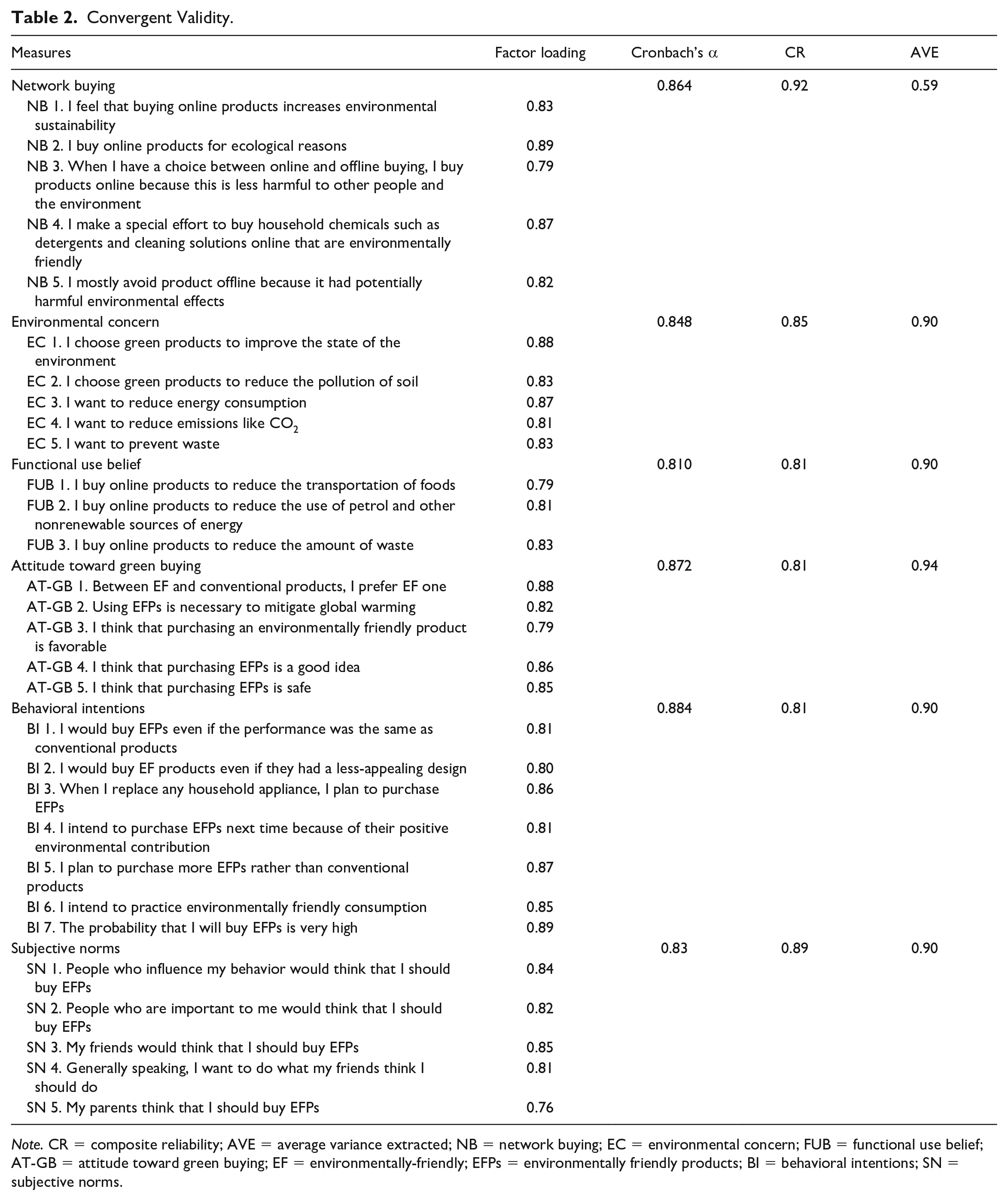
Note. CR = composite reliability; AVE = average variance extracted; NB = network buying; EC = environmental concern; FUB = functional use belief; AT-GB = attitude toward green buying; EF = environmentally-friendly; EFPs = environmentally friendly products; BI = behavioral intentions; SN = subjective norms.
Furthermore, Table 3 represents discriminant validity results using Fornell and Larcker’s (1981) approach. Results in Table 3, have shown significantly higher square root of AVE values compared to their correlations with other construct.
Discriminant Validity Results.

Note. All correlations are significant at p = .01; square-root AVE scores are displayed in parentheses. AVE = average variance extracted.
Results confirm that the measurement model meets the required validity and reliability criteria. This also confirms that present study model and constructs are fitting to test underlying propositions. The factor correlations and square root AVE scores are shown in Table 3. Therefore, it can be seen that all constructs exhibit sufficient convergent and discriminant validity.
Structural Model and Hypothesis Testing
Structural model was tested using path coefficients, t-statistics, were used to test the projected hypothesis with confidence interval α = 0.05 (see Table 4). The results indicating measurement value of functional use belief on attitude toward green products (H1) was (0.089, p-value = 0.000 (at 5% significance level) (Table 4). These results indicate a positive effect of attitude on green buying about the functional use belief of green products. The measurement value for the impact of environmental concern and attitude toward green buying (H2) was 0.125 (p value = .000, 5% significance level). Results suggest that ecological concern had a positive effect on attitude toward green buying. The standardized regression coefficients results showed that environmental concern had a higher impact on attitude toward network buying than functional use belief. R-square results showed that 12.5% of the variation in attitude was explained by environmental concern, where 8.9% was explained by practical use belief of green products. The measurement value for the effect of attitude toward green products on intention toward green products (H3) was 0.192 (p value = .000, 5% significance level). Results shown in Table 4 indicated that attitude toward green buying had a positive effect on the intention to buy green products. The measurement value of behavioral intentions on network buying (H4) was 0.156 (p value = .00, 5% significance level).
Structural Equation Modeling Estimates.

Note. CR = 1.96 (α = 0.05 level). CR = composite reliability.
Results indicated that behavioral intentions had a significant effect on network buying. To test the mediation effects, we included (a) a direct path from attitude to behavioral intentions (7.403, p < .05), (b) a direct path from behavioral intentions to network buying (1.114, p < .05), and (c) an indirect path from attitude to network buying through behavioral intentions (3.353, p < .05). Thus, for the most part, the effect of attitude toward green buying practices on network buying was entirely mediated by behavioral intentions, as expected (Barron & Kenny, 1986) (Hypothesis 5). The coefficient value for the effect of subjective norms on network buying (Hypothesis 6) was 0.122, with a p value of .000 (5% level of significance). This finding indicated that subjective norms of green buying had a positive effect on network buying. The standardized regression coefficients also specified that subjective norms had a significant impact on network buying. The r2 value implied that the subjective norms explained 12% of the variation in the network (see Figure 2).

Path coefficients model of network buying.
Moderating Effects
To know the moderating effect of product type between attitude toward green buying and network buying, the study used a nominal scale, namely “food” and “appliances and electronics” in-network buying. Moderting effect of these products were then caculted independently . This study used the invariance test to confirm the equivalence of constructs and multiple-group analysis to examine the moderation effect of a product type variable between attitude toward green buying and network buying. By using the approach set out in reference (Hair et al., 1998), the moderating variable was then categorized into two groups, that is, food and appliances and electronics. Bagozzi and Yi (1988) argues that to accept moderating effect of said variable, there should be a significant change in the chi-square between the constrained and unconstrained models. The significant growth in the chi-square value from the unconstrained to the constrained model also specifies that there is a moderation effect on established causal path. The moderating variable, namely, product type, documented a significant change of chi-square and degrees of freedom in a comparison between the constrained and unconstrained models (see Table 5). The results of SEM have shown that the difference in the chi-square value is 79.132 – 53.122 = 26.01, whereas the difference in degrees of freedom is 49 – 45 = 4.
Moderation Estimates.

Note. GFI = goodness fit index; CFI = includes comparative fit index; RMSEA = root mean square error of approximation.
To confirm that the latent interactions improved the overall quality of the model, the Satorra–Bentler scaled chi-square (He et al., 2018; J. Wang et al., 2017) statistic was used to test any change in the model’s explanatory power appropriately. These results confirm the acceptance of H7 (see Table 5).
Discussion and Implications
Research has examined the phenomenon of attitude toward green buying based on the constructs of functional use belief, along with environmental concern to better predict consumer green consumption behavior and its validating role toward network buying behavior (Taufique & Vaithianathan, 2018). Our study confirms that functional use belief and environmental concern effect consumer network buying behavior. In fact, today’s harmful human activities have raised the issue of environmental pollution and consumer health at large (McCarthy & Liu, 2017b). Moreover, due to this, human sustainability concerns are thought-provoking subject for policymakers (Shahzad, Tian, & Xiao, 2019).
Many studies suggest that network buying has a significant role in environmental sustainability (Woodside, 2008). First, a substantial excess of goods causes tremendous ecological pollution and wastes energy. Network buying significantly contributes to a more sustainable future. This study has attempted to examine green consumption behavior and the role of the internet in increasing green consumption in China. Previous studies fall short of their theoretical contribution and generalizability, as outlined in the literature review. To overcome these problems, this study contributes useful insights into consumer green product consumption behavior in China by employing a convenience sampling technique (Poddar et al., 2009; B. Xu et al., 2010). Outcomes of our study offered several theoretical contributions to green marketing research. First, the study explained the role of attitude toward green buying and subjective norms in the relationship of network buying and found a positive, significant association. Second, the research suggests that consumer attitude toward green buying through the network is mediated by behavioral intentions, and shows how they play an essential role in green buying.
Furthermore, the study confirms a positive effect attitude has on intentions and network buying. In fact, consumer attitude effects significantly consumer intentions toward green consumption, whereby everyday experience may enhance consumer inclination to purchase through the internet, taking into consideration green phenomena (Y. Wang & Hao, 2018). Furthermore, public policymakers stimulate sustainable consumption through their health and environment awareness activities, which not only increase sustainable but also encourage network buying (Y. Wang & Hao, 2018).
However, attitude drives positive emotions and feelings which result in green consumption. This study also confirms the findings of Y. Wang and Hao (2018), where network buying considerably improves the evolution from pro-environmental attitudes to ecological behaviors. The results are showing consistency with previous research conducted on environmental concerns and internet buying in other contexts (Díaz et al., 2017).
TPB also endorses that consumers possess innate ability in the selection of certain products (Chomvilailuk & Butcher, 2014; Perugini & Bagozzi, 2001). The overall findings from the analysis of network buying suggest that network buying is directly linked to attitude and enhances the transition from attitude to buying. Our study has revealed a robust mediating effect of behavioral intention in consumer evolution of green products in the context of network buying.
The outcomes clearly show that the environmental concerns of products are perceived as useful in green consumption (Ozinci et al., 2017). Study findings showed that behavioral intentions do mediate the relationship between attitude and network buying, which means green product marketers should consider personal perception in their promotions (Ozinci et al., 2017; Zhao et al., 2014).
This study has also revealed product type moderates and reinforces the relationship between attitude toward green buying and network buying (Chaudhary & Bisai, 2018). It often claims that consumer buy only those product or services which they believe are eco-friendly and convenient (Contini et al., 2018). It can also be seen from previous research that concerns for consumer sustainability has further empowered consumers, whereby individuals keep in mind the functional characteristics of products prior to adopting the given product (Conner & Godin, 2007). Similarly, consumers are nowadays more empowered with their decisions. Consumers associate their products acceptance or rejection decisions with consumer well-being. For instance, this confirmation is consistent with the study by Y. Wang and Hao (2018), which suggests that internet penetration drives sustainable consumption.
However, as shown above, unlike other developing countries where internet buying is not as well established, China is found to influence significantly pro-environmental behavior (Paul et al., 2016). The significant relation of product type to sustainable environment intention suggests that marketers can enhance the acceptability of green products by categorizing the products (Paul et al., 2016). There is a unique need for policymakers and government officials to develop public involvement showcasing the great importance of network green product consumption by encouraging environmentally concerned consumers.
Conclusion
In the end, this study has established that functional use belief and environment concern constructs drive consumer attitudes toward green consumption. Findings are also emphasizing that subjective norms affect network buying significantly. Nonetheless, this study demonstrates that attitude toward green buying, in turn, generates positive intentions that create network buying behaviors. The results further suggest that product type moderates green buying behaviors. As a result, the study has put forward numeroues theoretical and practical implications. Main findings indicating current understanding of the network buying phenomenon in the context of China, addressing the factors affecting attitude toward green buying. There are also practical findings for those marketers and public policymakers who are trying to limit consumer harmful activities. In this regard, this study indicates that consumer intentions are important. In China, the prevalence of air pollution has been increasing due to enlarged production system stressing the importance of awareness concerning healthy living.
For instance, human activities and environmental sustainability are important topics. It has been found that attitude and subjective norms were essential factors in green network consumption. Findings provided insights in terms of practical implications into green consumption intention and network buying behavior.
The findings seem to emphasize online retailers and policymakers for the development of an effective support system that can encourage green consumption via the internet. There are certain limitations to this study, such as limited geographical coverage. This study takes only two product categories in green use into account, that is, food and appliances. Future studies should take other product types into consideration to warrant further investigation. The research approach is also limited to a particular context, so results may lack generalizability. Longitudinal settings will provide new findings. Future research may comprise different green product settings like organic products, functional products, and the food services industry. Variables like generational aspects and self-motivation will provide new findings. The convenience sampling technique followed in this research could be a limitation. This study took place in China, where collectivistic culture prevails, and online buying has significantly developed; therefore, cultural differences will provide different insights. Future studies should be conducted systematically so that network buying behavior can be identified at a distance. The government should take into consideration the importance of green products by showcasing the message about green consumption and their impact on the environment. Consequently, researchers are encouraged to test the proposed schemes further.
Footnotes
Acknowledgements
The authors thank all those who participated in the survey and provided feedback.
Author Contributions
M.F.S. X.L. X.J., and J.K.K. conceived of the study and completed the paper. M.F.S. and J.K.K. involved in data collection and drafted the article. X.L. and X.J. revised the paper critically for valuable content.
Declaration of Conflicting Interests
The author(s) declared no potential conflicts of interest with respect to the research, authorship, and/or publication of this article.
Funding
The author(s) disclosed receipt of the following financial support for the research, authorship, and/or publication of this article: This study is partly supported by the Major Project of the National Social Science Foundation of China under Grant No. 18VZL006, the Tianfu Ten-Thousand Talents Program of Sichuan Province, the Excellent Youth Fund of Sichuan University under Grant Nos. skqx201607, sksyl201709, and skzx2016-rcrw14, and the Leading Cultivation Talents Program of Sichuan University.
