




Abstract
This study aimed at investigating the relationship between work–family conflict (work-to-family conflict [WFC] and family-to-work conflict [FWC]) and employee commitment (EC) in banking institution in Kenya. Furthermore, the study focused on exploring the moderating effect of perceived managerial support (PMS) on the relationship between work–family conflict and EC. This study was a cross-sectional survey of 334 employees working in banking institutions where data were collected using self-reported questionnaires. We found that WFC had a positive relationship with affective commitment (AC), continuance commitment (CC), and normative commitment (NC); and that PMS and gender significantly moderated the relationship between WFC and FWC and construct of EC. The moderating effect of PMS is explored to further elaborate on the relationship between work–family conflict and EC. This study provides valuable insights into the work–family conflict among employees with family responsibility in the banking institution. Applied implications for managers are suggested to minimize the WFC and FWC to ensure better work–life balance among employees. The study also contributes to the existing work–family conflict literature.
Introduction
The field of work–family conflict has gained a lot of attention in many organizations worldwide, and employees are experiencing a lot of work-related and family-related conflict due to changing workplace dynamics. Work–family domains are the two important spheres of an individual’s life, whereby fulfillment of the two spheres require a lot of time and energy (Rathi & Barath, 2013). However, if work and family role are not well balanced, it can increase both interpersonal and intrapersonal conflict in the organization resulting in work–family conflict, thus decreasing employee commitment (EC) (Casper, Martin, Buffardi, & Erdwins, 2002). Employers across the globe are facing difficulties in recruiting and retaining highly qualified staffs (Casper et al., 2002); therefore, management scholars are looking for better methods that will assist an organization retain its workforce, increase EC, and enhance productivity. According to extant empirical literature, frontline employees in banks such as those in customer service or tellers are susceptible to work conflict due to the multiple roles they perform (Aycan & Eskin, 2005). The current study contributes to the limitation in literature on the relationship between work–family conflict, managerial support, and EC especially in the Kenyan context.
Work–family conflict is generally defined as “a form of inter-role conflict in which role pressures from the work and family domains are mutually incompatible in some respect” (Hsu, 2011, p. 234), implying that employees participating in the work–family roles find it difficult working because they also need to participate in the family–work role. Finding from Beutell (2010) and Rathi and Barath (2013) shows that conflict in an organization arises when the two spheres (work–family and family–work) interfere with each other. Previous studies carried out in a number of countries with different cultural groups have shown that both employees and employers experience work–family conflict. Specifically, studies by Beutell (2010); Choi and Kim (2012); Karatepe (2010); Lu, Cooper, Kao, Chang, and Spector (2010); Namasivayam and Zhao (2007); and Rathi and Barath (2013) have shown that the work–family conflict is linked to increased employee turnover intentions, reduced job satisfaction, low employee productivity, and decreased EC in the organization. The association between work-related conflict or family-related conflict and EC has been empirically examined among employees working in different institutions such as hospitals, hotels, universities, security firms, software engineering firms, and construction industry (Karatepe & Kilic, 2007; Lingard & Lin, 2003; Rathi & Barath, 2013; Scholarios & Marks, 2004).
Although the association between family-to-work conflict (FWC) and work-to-family conflict (WFC) and other organizational outcomes such as EC, job satisfaction, and organizational–citizen behavior has been widely studied, past studies have clearly indicated that managerial support is an important antecedent of FWC and WFC. Nevertheless, this study departs from previous studies by considering the role of managerial support in the relationship between family–work and work–family conflict and EC. The choice of Kenya banking sector is an important context for this study. First, work-related activities and family-related activities are considered to be important elements of Kenyan culture (Isamah, 1996). Second, the work time around the world according to the Global Report of 2007 had found Kenya and other African countries (i.e., Benin, Burkina Faso, Mali, Cameroon, Madagascar, Chad, Gabon, Congo, Niger, Côte d’Ivoire, Djibouti, and Mauritania) having higher incidence of long working hours (more than 48 hr in a week) compared with 34 to 39 hr in France and 40 hr per week for the rest of other African countries (Lee, McCann, & Messenger, 2007). Long working hours is associated with increased FWC and WFC, high rate of absenteeism, sickness, and turnover intentions that affect organizational productivity, effectiveness, and EC (Spurgeon, 2003). Third, work–family conflict is dominant in banking institutions in Kenya, ranking third among the 24 industries (World of Work, 2011) compared with manufacturing and service industries. The working condition of more than 80% of front office employees in banks (known as customer service representatives and tellers) is very stressful (Aycan & Eskin, 2005), with little room for family activities in view of many deadlines to be met and unpredictable peaks during the course of the working time. As noted by Rathi and Barath’s (2013) similar study among police officers in India, bank employees in Kenya are likely to feel disregarded and receive very little backing from their managers because their numbers are very high to be supervised by few employed managers. Employees in Kenya have high work demand and most of the time their work schedules are not very flexible, meaning that they have limited time balancing work- and family-related issues, therefore contributing to increase in work–family conflict.
Kenya’s cultural practices emphasize on the importance of having a strong family unit, therefore giving first priority to family and social life (Isamah, 1996). Family responsibility and social life are the cornerstones of an individual life in the society; yet, most organizations do not give employees enough time to deal with their family responsibilities and social life due to high job demands (Rathi & Barath, 2013). Parents in Kenya experience more work–family conflict because of pressure and demand to fulfill the two roles (family and work) with majority of them having more than two children who need attention and guidance in terms of their schoolwork and social life. Similarly, employees who have no parental responsibilities also have to meet their personal, family, and/or societal demands such as taking care of their elderly parents, siblings, and extended family members, which may also affect their work responsibilities. Although the increase in the number of children increases the demand on employees (Rathi & Barath, 2013), perceived managerial support (PMS) helps individuals reduce the family-related and work-related conflict. To understand the current phenomenon, the study will examine the role of managerial support in the relationship between FWC and WFC and EC in the Kenyan work context, especially banking institution.
Review of Literature
Overview of Work–Family Conflict
Employees in many organizations around the world are experiencing work–family conflict because of the changing dynamics of work environment and the competitive nature of business today. Therefore, to understand clearly the concept of work–family conflict, it is better to revisit the work of Greenhaus and Beutell (1985), who elaborately define work/family conflict as an inter-role conflict, meaning that work-related pressure emerging from work/family sphere is incompatible; specifically, “participation in the work (family) role is made more difficult by virtue of participation in the family (work) role” (p. 77). “Responsibilities at work and in the family are obviously important to most individuals; however, when taken together, these responsibilities often result in conflicting demands” (Hsu, 2011, p. 234). Many studies have suggested that work/family conflict is generally a bidirectional construct, meaning that conflict comes from two spheres (family-to-work and work-to-family domains; Grandey, Cordeiro, & Crouter, 2005; Hsu, 2011; Judge, Ilies, & Scott, 2006). Organization experiences conflict when employees devote a lot of time to work role and forget to balance with family role. Practically, this implies that when employees are involved in work role, they need to balance with family role so as to avoid conflict, or specific work-related behavior that requires employees to deal with work role will make it difficult for them to handle family role (Greenhaus & Beutell, 1985).
WFC and FWC occur when employees transfer their work-related problems or family-related pressure to their work/family, which affects the well-being of their family and work mates (Netemeyer, Boles, & McMurrian, 1996). Conflict may occur in situations where family roles, duties, and responsibilities interfere with employee’s job-related responsibilities even when the two distinct spheres are interrelated (Hsu, 2011). Empirical literature has shown that employees who have family responsibilities experience WFC than FWC (Kinnunen, Vermulst, Gerris, & Mäkikangas, 2003; Lambert, Hogan, & Barton, 2002; O’Driscoll, Brough, & Kalliath, 2004). According to Tanacoody, Bartram, and Casimir (2009), the major source of work-related stress is WFC, which causes job burnout and turnover intentions (Demerouti, Nachreiner, Bakker, & Schaufeli, 2001; Lambert, 2006).
Employee Commitment
EC is believing in and accepting the goals, values, and norms of the organization by employees; it is the willingness by the employee to put forth extensive effort and maintaining appropriate organization citizen behavior (Porter, Steers, Mowday, & Boulian, 1974). Past research (e.g., Casper, Harris, Taylor-Bianco, & Wayne, 2011; Allen & Meyer, 1996) reveals that WFC is associated with the three dimensions of EC, suggesting that individuals are motivated to stay in the organization because of different motives. EC is manifested in three forms, namely, affective, continuance, and normative commitment (NC) (Allen & Meyer, 1996; Karrasch, 2003; Lambert, 2006).
Affective commitment (AC) is the emotional attachment by individuals to the organization and the willingness of those individuals to identify with the organization irrespective of the situation (Allen & Meyer, 1996). Nevertheless, continuance commitment (CC) is the material benefits an employee gains by being a member of a particular organization (Akintayo, 2010). This definition implies that many employees may prefer to work with their organization because they may fear losing the benefits, which they have acquired over a long period of time (such as increased salary, allowances, share option, or seniority). However, NC means that employees are obligated to keep on working of an organization because of the intrinsic and extrinsic reward they get (Lambert, 2006; Rehman & Waheed, 2012) possibly because they are being paid to work in the organization. Norm reciprocity has always been used to explain the link between work–life balance policies with EC in the organization. Employees may feel indebted to the organization and indicate loyalty when they see that management cares about their welfare. This kind of loyalty can increase their commitment to that organization (Allen & Meyer, 1996).
Contextual Understanding of Work–Family Conflict in Kenya
The study contributes to empirical literature by exploring the role of managerial support on the relationship between FWC and WFC and ECs using a Kenyan sample comprising employees working in banking institutions. This is important because most studies (Hsu, 2011; Judge et al., 2006; Lambert, 2006; Rehman & Waheed, 2012) in field of work–family conflict have literature predominantly from Western countries and continental Asia. Second, the study also considers the work dynamics related to the role of gender in an African setting including Kenya. Kenya scores 60 on masculinity meaning that Kenyan society values and maintains the traditional roles of male and female. Men are assertive in nature and have unquestionable authority over women (Hofstede, 2006). Therefore, low masculinity means roles are unclear, that is, they are not obvious because men and women perform equal tasks. The study, thus, also compares the differences that exist in WFC between two genders. Third, the study explores whether WFC relates to the three elements of EC with managerial support moderating the relationship. Employees are experiencing pressure from both workplace and from the family, which poses psychological challenges to them due to stress generated by work and family expectations (Frone, Russell, & Cooper, 1992a). Whereas empirical literature from Western and Asian countries acknowledges that work–life conflict is negatively associated with EC (Beutell, 2010; Judge et al., 2006; Rathi & Barath, 2013), there is a knowledge gap in such studies on WFC/FWC particularly from an African cultural setting. The banking sector provides an appropriate setting for the study because Kenya, like most countries in Africa, is an emerging economy and banks are playing a big role in the economic growth of the continent.
There are a number of statutory provisions, laws, and other cultural factors that affect employees in Kenya, compared with other countries. For example, Section 29 of the Employment Act of the Laws of Kenya states that “a female employee shall be entitled to three months maternity leave with full pay.” On return, “the female employee has the right to occupy the same position she held before she proceeded on maternity leave.” Similarly, “a male employee is entitled to two weeks paternity leave with full pay.” The Act provides a significant insight on the experience both genders go through during work. The number of women holding a managerial position in both private and public institution in Kenya is growing tremendously. The increase is due to constitutional provisions of 30% of either gender at workplace (Constitution of Kenya, 2010). However, the traditional roles for women have not changed much. Working mothers, for example, spend more time per week dealing with family issues than men. Recently, the role of women at the family level has increased by the enactment of marriage bill into law that allows men to marry more than one wife. It is assumed that having multiple wives (family) by men and increase in family responsibilities by women may increase WFC in Kenya.
Research carried out by Lambert et al. (2002) and Lobel (2009) reveals that men not only participate less in family roles than women but also earned significantly more money than women (Casper et al., 2011; Lobel, 2009). The disparities in income, time spend in dealing with family responsibilities, and the career mobility between the two genders affect the ways the two genders experience work/family conflict in Kenya. It brings out the difference in experience among the two genders. Extensive research has shown that there are gender disparities in work–family relationships (Kinnunen et al., 2003; Lambert et al., 2002), with (Casper et al., 2011) research showing that women may experience more work–family stress than men because women have more family responsibility compared with men. Men and women in Kenya have different social experiences that may affect work and family life. Kenya has lower culture egalitarianism. Research has shown that cultures with lower gender egalitarianism experience more work–family conflict than cultures with higher gender egalitarianism (Casper et al., 2011). The role of women and men has been traditionally defined despite the rise in level of education, empowerment, and gender equality awareness in Kenya. The main responsibility of women in the society has been taking care of the family, whereas men work to provide basic needs to the family (Casper et al., 2011). In line with the foregoing situation, it is assumed that women in Kenya should experience higher FWC because of family responsibility, and men should experience higher WFC, because of their work demand. We therefore, hypothesize, as follows:
Linking Work–Family Conflict and Employee Commitment
The need for continuous adaptation by organizations to their environment is imperative due to work dynamic, workplace environment, and employee characteristics. Nevertheless, in the current business environment, more and more employees are getting exposed to work-related and family-related conflict. Review of empirical literature shows that WFC is negatively related to EC (Ajiboye, 2008; Allen & Meyer, 2000; Beauregard, 2006; Mayer, Salovey, & Caruso, 2000). Research by Akintayo (2010) reported that WFC is associated with EC among employees in Nigeria’s industrial sector. It is also negatively associated with the two dimensions of EC (affective and continuance; Frone et al., 1992a; Parasuraman, Greenhaus, & Granrose, 1992). Study by Duxbury and Higgins (2001) on the effect of the three dimensions of work/family conflict on organizational commitment revealed that WFC and FWC are negatively related to EC.
The association between FWC and WFC with EC can be better understood by looking at the role theory. This theory is mainly about how work demand psychologically influences employee to exhibit negative emotions or attitude at home. The source of conflict emanates from the challenges organizations have in integrating employees’ work-related roles with the ever-increasing nonwork demand employees experience outside the work station and, therefore, affecting the well-being of employees (Boles, Wood, & Johnson, 2003). Rathi and Barath (2013) suggested that among the various roles played by individuals, work-related roles and family-related activities are very important issues affecting most employees. Therefore, incompatibility between the two spheres may be the source of tension and ill feelings among employees. For example, if employees perceive that family roles are important to them, they will see work as an activity that drains time required for the fulfillment of family roles, which may threaten employees’ well-being (Rathi and Barath, 2013). Review of empirical literature shows work-related activities are the many sources of interference of employee’s life, therefore, making them to have negative attitude toward their job, resulting in lower organizational commitment (Beutell, 2010; Rathi and Barath, 2013). Conflict that emanates from work and family domain can lead to low EC, particularly where to the two interfere with each other.
WFC is the inter-role conflict affecting the time employees spend doing their work and the strain created by work interfering with employees performing their family responsibilities such as caring of family members, whereas FWC is the inter-role conflict, which affects the time dedicated to family roles by employees and the pressure created by individuals having family responsibility interfere with performance of work-related activity (Netemeyer at el., 1996; Rathi & Barath, 2013). Many studies have examined the outcome of the two types of conflict on the individual and organization. Most of these studies reveal that WFC and FWC negatively affect both individual and organizational outcome such as commitment, productivity, organizational–citizen behavior, and turnover intentions (Grandey et al., 2005; Judge et al., 2006; Rathi & Barath, 2013). Based on the reviewed literature, we hypothesize the following:
Moderating Role of PMS
Management scholars have used social exchange theory in defining the concept of managerial support (Casper et al., 2011; Eisenberger, Stinglhamber, Vandenberghe, Sycharski, & Rhoades, 2002). The theory is about employees’ perception regarding how they relate with their managers and how well they can trust their manager with their individual issues. It means that, high management-supportive environment creates reciprocal behavior, in that employees who enjoy support from their managers may feel they have the obligation to “repay” their organization by not looking for other jobs elsewhere (Eisenberger et al., 2002). “Perceptions of managerial support have been argued to be more important than objective indices because it is perceptions that influence cognitive appraisals of situations” (Casper et al., 2011; p. 644). Study by Gagnon and Michael (2004) describes PMS in terms of the degree to which an employee feels that they are supported by their manager. From the social exchange theory perspective, employees will show organizational–citizen behavior if they perceive or feel that their managers value what they contribute to the organization, and communicate effectively to them, and treat everyone with respect (Hsu, 2011). Review of empirical literature shows that management support moderates the association between work–family conflict and EC (e.g., Hsu, 2011; Karatepe & Kilic, 2007; Lu et al., 2010). Specifically, increase in management support in the organization reduces the negative effect of WFC and FWC on affective, continuance, and NC. Consistent with extant literature, we present the following hypotheses:
Research by O’Driscoll et al. (2004), on the relationship between perceived management support, work–family conflict, and psychological strain, showed that the employees who reported higher levels of management support had less work–family conflict. Study by Ng and Sorensen (2008) found that if supervisor support is strong, employees will be more satisfied with their jobs, commit to their organization, and reduce on turnover intention. The influence of managerial support as moderator may be different in Kenya. Most working people with family responsibility can afford to have house helps or live-in nannies who are easily available and whose charges are affordable, and who can take care for children when their parents are absent or while they are engaged in work activities. In addition, most families live with their relatives or extended family members who help them to look after their children. In this regard, work–family conflict should be more easily managed in developing countries such as Kenya, and that managerial support may not have as much effect as it would in Western countries. Therefore, the followings hypotheses are proposed:
Gender as a Moderator
Empirical literature reveals that there is an association between gender, work–family conflict, and commitment. Scholars have used gender to moderate the association between WFC and EC before but in a different setting. Study by (Casper et al., 2011) used gender as a moderator in examining the relationship between WFC, managerial support, and organizational commitment in the Brazilian work setting. Traditional African culture requires men to be more dominant in work-related matters and women to be more outstanding in family-related matters. Thus, women have a different experience with WFC, whereas men should also have a different experience with FWC. Therefore, the association between WFC and EC is stronger for men, whereas association between FWC and EC is stronger among women. Consistent with extant literature, we further hypothesize as follows:
Theoretical Research Model
The study’s conceptual model is as a result of reviewed empirical literature, which hypothesizes relationships between independent variable (IV), moderator, and dependent variable (DV) as presented below (see Figure 1).
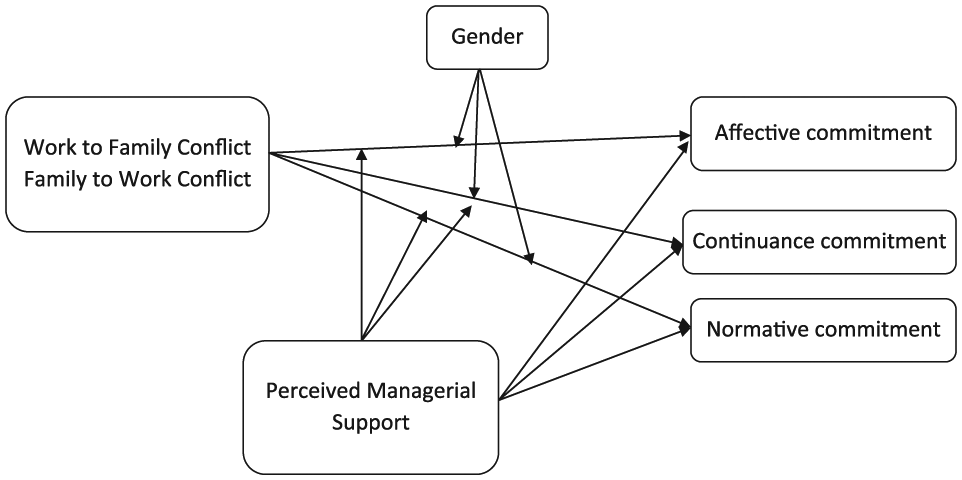
The proposed relationship between work-to-family conflict and family-to-work conflict on employee’s commitment with gender and PMS as moderators.
Method
Sample Size and Procedure
The data used were obtained from survey questionnaires sent to 334 employees comprising 181 who worked in the front office (lower level management), 107 middle-level managers (supervisors), and 37 top-level managers in banking institutions in Nairobi. Eight respondents did not indicate their job category. Ahead of the data collection process, a formal request was sent to the management of the banks requesting for permission for data collection. The employees were assured about the confidentiality of their identity, and collected data would only be used only for academic purpose. They were also informed that they could opt out of the study at any point. Once permission was granted, the surveys were either hand delivered or sent to employees via email. A total of 380 employees were contacted and requested to complete the surveys from January to August 2014 upon which 334 surveys were successfully filled and returned.
Measures of Variables
Besides data on the study variables, demographic data were also collected, coded, and entered into the SPSS program as control variable. Gender and marital status data of the respondents were collected and coded as marital status (not married = 0, married = 1) and gender (male = 1, female = 0). Furthermore, the measures of all study variables consisted of items with response options ranging from strongly disagree = 1 to strongly agree = 5, with disagree = 2, neither agree nor disagree = 3, and agree = 4. The study used Cronbach’s alpha (α) reliability to test for internal consistency among variables. Similar rating scales such as 1 = not at all to 5 = all the time were used for PMS moderator variable.
WFC
WFC was measured using items adapted from Netemeyer et al. (1996). There were a total of five items used for the study. It measures employee perception of the extent to which work interferes with fulfillment of family life. One of the items for the scale is “my family dislikes how often am preoccupied with my work while am at home.” To get the scores, we calculated the average of the five items and used it for analysis. WFC construct had Cronbach’s alpha coefficient of .892.
FWC
WFC was also measured using 13 items adopted Netemeyer et al. (1996), which measured employee perception of the degree to which family activities interfere with work responsibility such as “accomplishing work on time.” Scores for this variable were arrived at by taking the composite score of the 13 items. FWC had Cronbach’s alpha of .748.
PMS
PMS was measured using 10 items developed by Lambert (2000). One of the items for the scale is “the manager switches schedules (hours, overtime hours, vacation) to accommodate my family responsibilities.” Five-point Likert-type scale was used with not at all = 1 to all the time = 5. PMS had Cronbach’s alpha coefficient of .725.
Employee commitment
EC consisted of 13 items (affective continuance had three, continuance had five, and NC had five items), which were developed by Meyer, Stanley, Herscovitch, and Topolnytsky (2002). Respondent opinions were captured on 5-point Likert-type scale with strongly disagree = 1 and strongly disagree = 5. A higher score represented greater EC. One of the items for the scale is “This organization has a great deal of personal meaning to me” for AC, which had Cronbach’s alpha coefficient of .738. Similarly, one of the items for CC was “I feel that I have no option to consider leaving this organization” with Cronbach’s alpha coefficient of .785; and for NC, “even if it were to my advantage, I do not feel it would be right to leave my organization now” with Cronbach’s alpha coefficient of .700. EC had composite Cronbach’s alpha coefficient of .847.
Control Variables
Age, hours worked per week, years worked for the organization, and marital status (as either married [1] or otherwise [0]) were used in the study as control variables because they are associated with work–family conflict (Hsu, 2011) and EC (Beauregard, 2006). Scholars have suggested that, if in any case, we have variables that are significantly correlating with the IV and DV, those variables should be controlled so that the IV–DV relationship is weaker. The control can then reduce the common method variance (CMV) threat (Hsu, 2011; Podsakoff, MacKenzie, Lee, & Podsakoff, 2003).
Results
Response Rate
A total of 384 surveys questionnaires were distributed and 334 of the questionnaires were collected back representing a response rate of 87.9%. The 334 responses comprised 148 (44.4%) for female and 186 (55.6%) for male respondents. The mean number of hours spent at work was 45.119 hr with SD of 7.856. The mean age of the respondents was 30.160 with an SD of 6.351. Majority of the respondents were married (56.2%) compared with 41.4% who were not married. Furthermore, whereas 10.6% had no dependent children, 89.4 had dependent children.
The Correlation, Means, and Standard Deviations
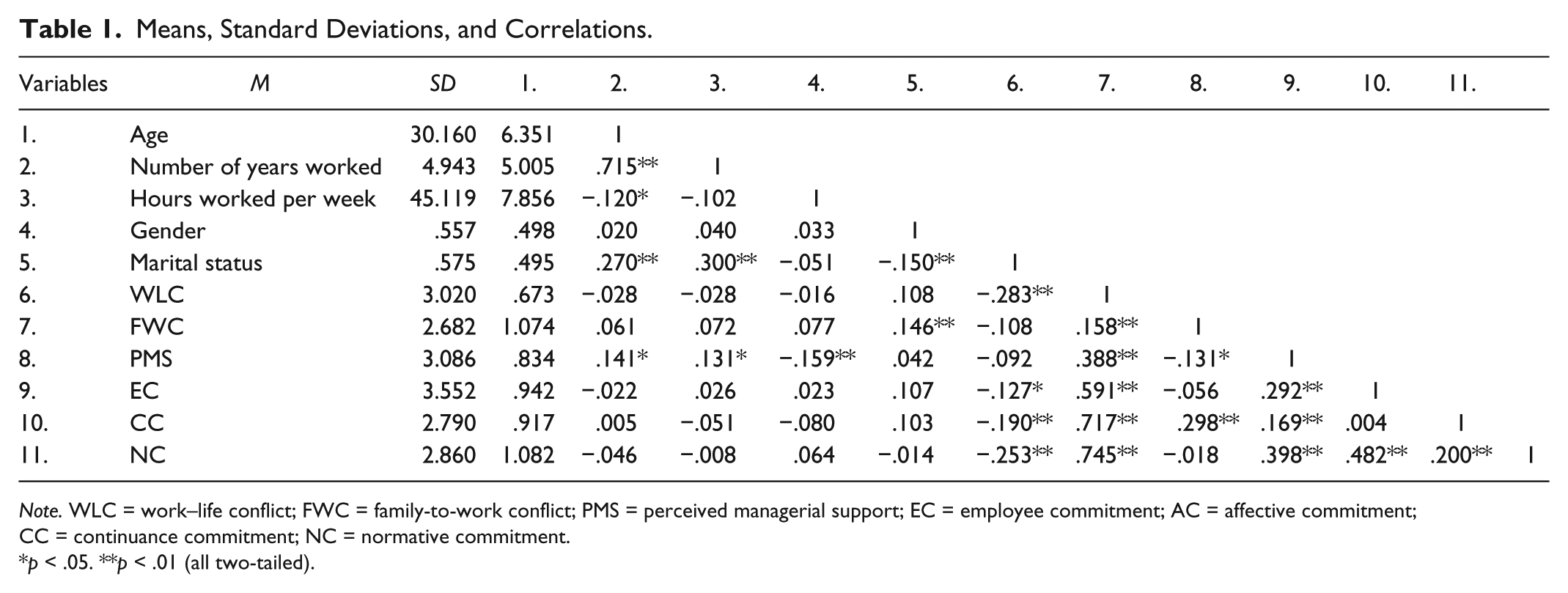
The correlation, means, and standard deviations for the variables (marital status, gender, number of years worked, age, hours worked per week, WFC, FWC, PMS, EC, CC, and NC) are reported in Table 1 below. From the result, we find that gender is significantly and positively correlated with FWC (r = .146**, p < .01), indicating that there was gender difference in the direction of FWC, therefore, H1a is supported. In the case of relationship between gender and WFC, the results show that there was no significant relationship between gender and WFC (r = .108, p > .05), indicating no gender difference in WFC, therefore, failing to support H1b.
Means, Standard Deviations, and Correlations.
Note. WLC = work–life conflict; FWC = family-to-work conflict; PMS = perceived managerial support; EC = employee commitment; AC = affective commitment; CC = continuance commitment; NC = normative commitment.
p < .05. **p < .01 (all two-tailed).
Upon testing of age, years worked in the organization, hours worked per week, and marital status, the result in Table 1 revealed that marital status is negatively correlated with gender (r = –.150**, p < .01), WFC (r = –.283**, p < .01), CC (r = –.190**, p < .01), and NC (r = –.214**, p < .01) but it had no significant relationship with AC.
Moderating Effect of PMS
To find out whether there are moderating effects of gender and PMS on the relationship between WFC and FWC separately on AC, CC, and NC, hierarchical regression analysis was used. Hierarchical regression allows the specification of a fixed order of entry for variables to control for the effect of covariates or to test the effect of certain predictors independently of the influence of others. Scores on the predictor variables and moderator variables were first standardized, then regression analysis was conducted because the response scales for the WFC, FWC, and PMS, and gender variable were of different magnitudes and at different levels of measurement, namely, ordinal (WFC, FWC, and PMS) and nominal (gender). The control variable (marital status) was first to be entered in the regression step, then gender, WFC, FWC, and PMS were entered in the second step. The two-way interaction (gender and PMS) was added in the third step and three-way interactions were entered in the final stage.
The results (Table 2) showed that the covariates, number of working hours per week, significantly predicted the variance in affective (β = .111*, p < .05) and NC (β = .128*, p < .05), meaning that participants who worked for more hours reported higher level of affective and NC. Marital status also significantly predicted variance in continuance (β = –.194**, p < .001) and NC (β = –.283**, p < .001), meaning that marital status had negative influence on continuance and NC.
Gender, WFC, FWC, and PMS Predicting AC, Continuance, and NC.

Note. WFC = work-to-family conflict, FWC = family-to-work conflict, PMS = perceived managerial support.
p < .05. **p < .01.
Examining the next stage (Step 2) of the analysis, WFC was strongly related with AC (β = .649**, p < .001), CC (β = .727**, p < .001), and NC (β = .640**, p < .001), respectively. Participants who reported greater WFC had higher level of affective, continuance, and NC. The results failed to support H2a, H2b, and H2c. However, FWC was not related to AC (β = –.048, p > .05) and NC (β = .004, p > .05), thus failing to support either H3a or H3c. However, participants who reported higher FWC had higher and significant level of CC (β = .176**, p < .001), therefore supporting H3b.
Furthermore, participants who reported higher PMS had a significant negative relationship with CC (β = –.124**, p < .001) but no relationship with AC (β = –.014, p > .05) to their organizations, failing to support H4a and H4b. But participants who reported greater PMS reported positive relationship in NC (β = .155**, p < .001) to their organizations (see Table 2), supporting H4c.
Table 2 results also show that interaction between PMS with WFC was a significant predictor of AC (β = –.197**, p < .001) but the prediction is negative. The interaction between PMS and NC showed no significant relationship (β = –.042, p > .05), thus failing to support H5a and H5c. Also the interaction between PMS with FWC was not a significant predictor of NC (β = –.034, p > .05), failing to support H6c. However, the interaction between PMS and WFC significantly predicted CC (β = .470**, p < .001), thus supporting H5b. Similarly, the interaction between PMS and FWC significantly predicted AC (β = .213**, p < .001), thus supporting H6a, whereas the interaction between PMS and FWC negatively predicted CC (β = –.297**, p < .001), failing to support H6b.
Furthermore, the interactions between WFC and gender was significant in predicting AC (β = .109, p < .05), CC (β = –.57, p < .05) and but not significant in predicting NC (β = .077 p > .05), thus failing to support H7a, H7b, and H7c. Finally, the interaction between FWC and gender was significant in predicting AC (β = .332**, p < .001) and NC (β = –.241**, p < .001), which was negative and significant, therefore supporting H8a and H8c. Nevertheless, the interaction between FWC and gender did not significantly predict CC (β = .060, p > .05), hence failing to support H8b.
Discussion
The present study is very important because it contributes to the empirical literature and extends the conversation by exploring work–family conflict and EC experience in the Kenyan context. The research also examined how different genders experience work–family conflict (WFC, FWC) and EC. It further, examined the moderating role of PMS on the link between WFC and FWC and the three elements of EC. The study is essential due to the fact that culture and work policies have significant effect on work–family relationships (Casper et al., 2011), and majority of work–family conflict research has taken place in Western countries and Asia (Hsu, 2011; Lambert, 2006; Rehman & Waheed, 2012). The result of this study was not consistent with finding of other studies; this may be due to the cultural difference between Kenya and other countries, which might have contributed to the difference. Despite the difference, similarities exist between the findings of the research with that of other scholars (Casper et al., 2011; Rathi & Barath, 2013). Therefore, generalization of this finding will not be appropriate until we establish the specific link or relationship that makes these studies similar.
There were also similarities between this study and other studies carried out in Western and Asia countries. Descriptively, the result revealed that marital status was negatively correlated with WFC, CC, and NC. The finding corresponds with previous ones (Beutell, 2010; Rathi & Barath, 2013), which found marital status to correlate negatively with WFC. Also, the number of working hours per week significantly predicted variance in affective and NC. Furthermore, research by Casper et al. (2011) found that there was association between the number of hours worked per week and AC. It also found that there were no gender differences in WFC experience, and this was not surprising because it can be attributed to differences in gender role in Kenya. This particular result was consistent with studies in other samples from other countries of the world (Anderson, Coffey, & Byerly, 2002; Casper et al., 2011; Frye & Breaugh, 2004). However, when it comes to FWC, gender was positively and significantly correlated with FWC, indicating that there was gender difference in the direction of FWC. We can link this with traditional and cultural practices that have predefined the roles of male and female genders at the family level and work level. The African traditional societies emphasize on distinctive roles of men and women; this traditional role emphasis tends to influence the society at family level and at work.
Majority of participants of this study were from lower level and middle-level management; thus, it is possible that the respondents in this study had a better understanding of traditional roles men and women play in society despite the fact that they are working in modern organizations (multinational banks) and they are practicing modern lifestyle. Kenya is an emerging economy, where work and family values are to some extent influenced by Western culture. As a result of this influence, it is believed that the influence of gender should not be that different at work and at family (Casper et al., 2011).
The findings of this study show that WFC has a positive relationship with AC, CC, and NC. This is different from studies by Anderson et al. (2002) and Frye and Breaugh (2004), who found negative relationship between work–family conflict with AC and CC across different cultures and environments. It shows that there are differences on how job stress operates across different environments and that these differences may be prominent because of societal values and expectations linked to work and family activities (Casper et al., 2011; Powell, Francesco, & Ling, 2009). However, FWC was not significantly correlated to AC and NC. This finding also contradicts the study by Hsu (2011) who reported that work–family conflict had a negative effect on AC, job satisfaction, productivity, and turnover intention. The finding shows that when employees experience work–family conflict, there is likelihood that work roles and responsibilities will remain unfulfilled, which will in turn negatively influence work attitudes (Kinnunen, Feldt, Mauno, & Rantanen, 2010; Rathi & Barath, 2013), leading to lower EC.
The findings of the present study provide significant insight and breakthrough into the similarities and differences on how PMS works across different cultures and settings. This study found that PMS had a significant effect on all the element of EC, which is consistent with social exchange theory by Casper et al. (2011) and Eisenberger et al. (2002). Specifically, employees who had greater support from their managers reported higher NC. This was not so with AC and CC. Participants who reported greater PMS reported negative relationship in AC and there was no relationship with CC. The findings may be attributed to the social support employee gets from informal groups that exist in the organization, which weakens the influence of managerial support. Also, too much support from managers raises suspicion among employees and interpret it to mean that they are not independent in their work.
However, from the study, we find that the interaction between PMS, WFC, and FWC predicted CC, whereas the interaction between PMS and FWC predicted AC. The result is similar to prior studies (Hsu, 2011; Lu et al., 2010; Ng & Sorensen, 2008), where it was found that interaction between PMS and WFC and FWC had a positive and significant relationship with affective and CC. Because managers are the driving force in the organization, employees may interpret management support as a fever from the organization (Casper et al., 2011) and, in return, reciprocate the support with emotional attachment to the organization. The current study found that PMS was a significant moderator on the relationship between work/family conflict and all forms of EC. The findings collaborate with those by Hsu (2011), Lingard and Lin (2003), and Lu et al. (2010) in the literature, who examined the moderating role of managerial support on the link between work–life balance and EC in the organization.
Practical Implications
As earlier stated, results show that employees in Kenyan banks experience work–family conflict at their work station. Therefore, employers especially in the banking sector should institutionalize work–life balance programs so that employees are able to handle multiple roles (balancing work and family roles). The findings of the study indicate that PMS is a moderator in the relationship between work–family conflict and EC. Specifically, it is important for employees to receive support from their top managers and immediate supervisors. Supportive leadership style is also required to help employees in managing the stressful working conditions. Mentoring relationships with managers may also help employees in banking institutions to cope with work–family conflict.
The management should also put in place targeted programs that can help employees negotiate and handle both work role and family responsibilities. For instance, flexible work schedule, alternative work arrangement, and part-time working are some of important programs that are useful in balancing the work role and family responsibility. Thus, management should also put in place mechanisms that will assist employees in dealing with work-related conflict and also work on how to enhance commitment in their organization. It is important for managers to institute and nurture cultures that allow employees to negotiate their roles with other members of the organization. Training is important to supervisors and managers so that they are enabled to get necessary skills to negotiate and renegotiate the different roles employees have in the organization.
Limitations of the Study
Even though the current study provides significant understanding of work–family conflict and EC and contributes immensely on knowledge in the field of work–family, there are some important questions regarding what the focus of future studies should be. The study has some limitations that future scholars need to address. First, this study was carried out in banking institutions and environmental context that is different from other studies. Therefore, the findings should not be generally applied to other industries because of the organizational dynamics that exist there. Nevertheless, future comparative studies could be carried out between different developing nations in Africa (such as Nigeria, Ghana, and South Africa) and developed countries (such as the United States, the United Kingdom, and Australia), which have conducted similar studies in the past. Second, the period in which the study was conducted is short, which means that those temporal considerations were not captured. Furthermore, this study only looked at the moderating role of PMS on the relationship of work–family conflict with EC. Future research needs to consider other potential moderators that are relevant in the African setting; moderators such as family dynamics and size, social support environment, cultural practices, leadership style, and personality can be examined. Future research could expand the existing studies by incorporating some of these moderators. In the current study, we have found that there are differences in experience among the genders with regard to work–life conflict and EC; hence, future studies should explore why there are such differences.
Conclusions and Future Directions
The study provides important insights on the disposition of managers and practitioners while handling employees in organizations. The findings suggest that the organizations that value and support their employees have an advantage over those that do not. In this type of organization, employees will exert extra effort in their work, and their chances of leaving the organization will be significantly reduced.
Footnotes
Declaration of Conflicting Interests
The author(s) declared no potential conflicts of interest with respect to the research, authorship, and/or publication of this article.
Funding
The author(s) received no financial support for the research, authorship, and/or publication of this article.