




Abstract
The purpose of this study is to (a) investigate the impact of workforce diversity management on job match, job satisfaction, and job performance; (b) test the influencing role of job match on job satisfaction and job performance; and (c) examine the mediating role of a person’s job match on the association between workforce diversity management and employees’ outcomes (job satisfaction and job performance). Structured questionnaires were sent to employees working in five-star hotels in China. In total, 324 valid responses were analyzed through AMOS-SEM to draw the statistical conclusion. Overall, results revealed that workforce diversity management is positively related to a person’s job match, job satisfaction, and job performance. Next, a person’s job match is positively related to job satisfaction and job performance, in particular a person’s job match mediates the relationship between workforce diversity management and employees’ outcomes. Most of the studies in the area of workforce diversity management focused on the management of diversity such as age, gender, race, and ethnicity from American perspective. This could be among rare studies which investigate another aspect of workforce diversity management, such as management of diversity on the basis of skills, knowledge, interest, and preferences of employees from the Chinese perspective.
Introduction
Workforce diversity has begun as a core strategic value that many organizations consider they have a duty to follow to promote fairness and equality in the organizations (Mor Barak, 2015; Ng & Sears, 2012). Administrative department’s energies have been stimulated to establish and develop a positive awareness in working environments, select skilled employees, and create advanced concepts to deal with job-related issues (Mor Barak et al., 2016). Workforce diversity management offers a mechanism for solving job issues related to equality, justice, inclusion, and bullying behavior, which are based on gender, age, and ethnicity (Adams, 1965; Mor Barak, 2015; Thomas, 1990). More recently, other job-related issues such as an inappropriate job or unfavorable job assignments are also being thought to be dealt with workforce diversity management (Moon & Christensen, 2019; van Zyl et al., 2019). Workforce diversity management refers to the management of all differences such as differences in race, gender, age, ethnicity, education, experience, interest, status, and functional diversity (Choi & Rainey, 2010; Manoharan & Singal, 2017; Pitts, 2009; Thomas, 1990). Higher job satisfaction and job performance also depend upon effective workforce diversity management (Choi & Rainey, 2014; Vanderschuere & Birdsall, 2019). Recently, job satisfaction and job performance are highly explored paradigms in organizational psychology (Alessandri et al., 2017). Job satisfaction refers to the effective evaluation of the employee’s job, whereas job performance covers a set of activities linked to organizational goals (Brief & Weiss, 2002; Murphy, 1989). Employees ought to be satisfied with their jobs through effective skills utilization (Pink-Harper et al., 2017). The greater job match leads to greater work attitude and behavior (Ju & Li, 2019); therefore, it is important to have a match between job demand and skills requirement. A person’s job match is defined as the placement of individual according to his or her qualification (Barrett, 1978; Edwards, 1991; Montgomery, 2017). The previous literature reveals that the hotel industry is a multicultural and diversified environment, where a positive diversity climate leads to job satisfaction and job performance (Madera et al., 2013).
Education and skills mismatch has become a critical issue in today’s working environment (Jones et al., 2014). Job mismatch is negatively related to employees’ outcomes (Rubel & Kee, 2014; Sloane, 2014; Sánchez-Sánchez & McGuinness, 2015; Zhu, 2014). One of the studies in America surveyed 200 employees for reporting multiple sclerosis. The results revealed that 29.5% of employees had experienced discrimination on the job, which was related to job assignment and job engagement, such as inappropriate job task and duties, restriction to certain job type, unfavorable job environment, and job condition (Li et al., 2017; Roessler et al., 2011). Although the relationship between workforce diversity management and job outcomes is well established, however, any study which investigates how workforce diversity management influences job match and how job match mediates the relationship between workforce diversity management and job outcomes may not be found. The mediating role of a person’s job match in the context of workforce diversity management and employees’ outcomes has not been explored earlier. To address these gaps, this study answers the following questions:
What is the impact of workforce diversity management on job outcomes (job satisfaction and job performance)?
What is the impact of workforce diversity management on a person’s job match?
What is the impact of a person’s job match on job outcomes (job satisfaction and job performance)?
How does a person’s job match mediate the relationship between workforce diversity management and job outcomes (job satisfaction and job performance)?
This study responds to all these questions by building the hypothetical model that proposes a relationship between workforce diversity management, a person’s job match, job satisfaction, and job performance. To test the model, we gather data from the Chinese hospitality industry, particularly from hotels in China.
After the 1980s, due to the rapid globalization and modernization, China expanded hotels with total rooms of 15,539 in 1978 to 948,185 in 2000 (Pine & Phillips, 2005). The Chinese hospitality industry has a goal to become the world’s best tourist destination by the year 2020 based on the China National Tourism Administration (CNTA) report. During the last three decades, China has experienced rapid growth in the tourism and hospitality industry (Huang & Hsu, 2008; Tsang & Hsu, 2011). It has been recorded that 141.2 million tourists visited China in the year 2018, a 1.2% increase compared with last year tourists in the same period (Baatarsuren, 2019). With the expansion of the hotel industry in China, the demand for workforce diversity is increasing and it is becoming a great challenge to manage workforce diversity (Dogru, 2016; Pine, 2002; Pine et al., 2000).
This study extends our understanding of workforce diversity management from a different perspective, that is, the role of a person’s job match in this context has been examined rarely. Most of the previous studies on diversity management issues are conducted in developed countries, especially in Western perspectives such as America and Europe. This study investigates the relationship among workforce diversity management, a person’s job match, job satisfaction, and job performance in the context of developing countries, particularly China. Research in developed countries mostly deals with the management of surface-level diversity, such as age, gender, and ethnicity, whereas this study deals with the Asian country (China) and examines deep-level diversity management such as diversity in functions, skills, preferences, and interests. The management of diversity based on skills, knowledge, functions, interests, and preferences is very rare. One of the recent studies suggests that workforce diversity management is currently dealing with skills-based diversity problem (Pink-Harper et al., 2017). One of the recent studies argues that demographic diversity (personal attributes such as age, gender, and race) is harmful to job performance, whereas job-related diversity is beneficial to performance (Moon & Christensen, 2019). Some of the studies indicate that the work environment is influenced by diversity management (Brimhall et al., 2014; Gonzalez & Denisi, 2009; Groeneveld, 2011), which leads to positive outcomes (Brimhall et al., 2014; Choi & Rainey, 2010; Glisson & James, 2002). The Chinese hotel industry is facing many challenges from human resource management perspective, which leads to negative growth of the hotel industry (Wong & Li, 2015). Studies based on the Chinese hospitality industry revealed that there was a lack of qualified subordinates and managerial employees (Qiu Zhang & Wu, 2004; Zins & Jang, 2019). Job mismatch is one of the reasons to leave the organization. Skilled employees play a key role in stabilizing the organization if their demand is met. A study conducted in India and China revealed that the growing workforce diversity leads to a war of talent that creates a competitive working environment (Beechler & Woodward, 2009; Cooke et al., 2014).
Therefore, workforce diversity if managed by matching skills, preferences, functions, and interests will be one step forward to get productive job outcomes. It is logical to expect that if an individual did not get a job according to his or her specific knowledge and skills, then employees tend to lose their interest and do not perform their jobs as expected. Therefore, a person’s job match is an important factor through which job outcomes are influenced. This study applies work adjustment theory, job congruence theory, and equity theory to empirically test the direct and indirect relationship among the constructs where workforce diversity management is an independent variable; a person’s job match is a mediator, and job outcomes such as job satisfaction and job performance are dependent variables.
Literature Review and Hypothesis Development
Workforce Diversity Management and Job Satisfaction (Direct Relationship)
Thomas (1990) was the first among scholars who explored workforce diversity management, including management of ethnicity, age, gender, race, education, function, interest, and status. He provided new insights into a different perspective of diversity which has been adopted by many other scholars and practitioners. His idea of diversity management focuses on job satisfaction, job performance, and motivation and helps to establish good interpersonal relationships. He states that workforce diversity management is designed in a way that it not only covers Equal Employment Opportunity (EEO) and Affirmative Action (AA) but also deals with the management of all differences such as skills, knowledge, interests, and preferences of the individuals in a working environment. Later diversity management is categorized into deep level and surface level, where deep-level diversity represents the personal attributes of the individuals, for example, age, gender, and ethnicity, whereas deep-level diversity represents the interest, preferences, function, ability, knowledge/skills, and so on (Casper et al., 2013; Harrison et al., 1998, 2002; Klein & Wang, 2010; Maati & Maati-Sauvez, 2019; Phillips et al., 2006)
The concept of workforce diversity management is consistent with the theory of work adjustment (TWA) because it works in a similar way. The TWA differentiates between a structural model, which focused on a match between individual and environment, and a vibrant process model involving actions, which focused on increasing the match between individuals and working environment (Dawis, 2005). The TWA work views as a direction of fulfilling the individual’s needs such as financial, social, and psychological needs for effective outcomes in the working environment (Eggerth, 2008). Deep-level diversity also refers to the diversity among staff members’ psychological characteristics, such as personalities, attitudes, and values (Jackson et al., 1995). Workforce diversity management fulfills the psychological needs by managing job-related diversity which is having an influencing role on employees’ job satisfaction. The TWA further highlights that if the person’s ability meets the required job’s demand, then employees get satisfied and perform the job successfully (Dawis & Lofquist, 1984).
However, Bassett-Jones (2005) and Luu et al. (2019) argued that workforce diversity management is a subsystem of human resource management comprising performance appraisal, employee development, recruitment, reward, and individual’s self-leadership behavior to produce competitive employee performance and develop interpersonal skills to work in a group. Human resource management with the subsystem of workforce diversity management is one step forward to maintain equality in the organization which safeguards employees from unfavorable job assignments, ultimately leading toward higher job satisfaction (Mor Barak, 2015; van Zyl et al., 2019). The right person at the right job strategy is a systematic workforce management planning for better job satisfaction and job performance (Stokker & Hallam, 2009). Job satisfaction is a perceived effective desire by an individual’s functional role in a present working condition (Kalleberg, 1977). Pitts (2009) states that workforce diversity management is strongly associated with both employees’ group performance and job satisfaction. Thus, based on the above review of the literature, we propose the following hypothesis.
Workforce Diversity Management and Job Performance (Direct Relationship)
Job performance is the activity toward the specific task which gives positive or negative outcome (Locke, 1969). Pitts (2009) states that workforce diversity management is strongly linked to both work/job satisfaction and work/job performance. Positive diversity climate leads to a low turnover intention, high organizational commitment, and high job performance (Chen et al., 2012; Madera et al., 2016). One of the recent studies related to job-related diversity states that the climate of workforce diversity management strengthens the relationship between workforce diversity management and job outcomes (Moon & Christensen, 2019). Park and Liang (2019) state that both merit-based practices and workforce diversity management have an independent impact on organizational performance. Furthermore, they argue that effective workforce diversity management will lead to an increase in positive merit-based practices, resulting in the enhancement of organizational performance. It implies that workforce diversity management also places people according to their expertise and specialization, which ultimately leads to higher job performance. In this way, workforce diversity management maintains a favorable working environment by providing the employees merit-based job for the effective utilization of employees’ skills for better job performance (Park and Liang, 2019; Pink-Harper et al., 2017). Thomas (1990) was one of the first scholars who analyzed and brought to light a different perspective of diversity management, which includes demographic attributes (age, gender, ethnicity, etc.) as well as task-related attributes (function, tenure, interest, preferences, etc.). Therefore, it is logical to expect that workforce diversity also manages employees who have distinct knowledge, skills, interests, preferences, and so on. In another way, it will provide an environment where discrimination will not take place on the basis of age, gender, ethnicity, functions, skills, knowledge, and so on. The previous study argues that workforce diversity management climate creates a positive working environment (Madera, 2016). The positive working environment gives a sense of positive changes in employees and organization, which may increase employees’ and organizational performance. Previous studies in the area of diversity state that workforce diversity management leads to employees’ and workgroup performance (Munjuri & Maina, 2013; Pitts, 2009). Therefore, we propose the following hypothesis.
Workforce Diversity Management and Job Match (Direct Relationship)
Hackman and Lawler (1971) state that employees’ psychological needs and the opportunity provided by the organization should be matched for employees’ motivation, which ultimately leads to positive outcomes in the organization. The deep-level diversity (job-related diversity) also linked with psychological attributes (Jackson et al., 1995). They also suggested that the congruence between job and person is essential for effective performance; therefore, both job with person fit and person with job fit work interchangeably which satisfies and improves employees’ and organizational performance. Edwards (1991) suggests the person’s job match as a demands-capability match and needs-supplies match; the demands-capabilities match denotes the congruence between the capabilities of employees and the demands of a job, whereas the needs-supplies match refers to the congruence between the desires of employees and the nature of a job. Theory of congruence states that a person’s job match is the match between the preferences of individual ability, skills, and knowledge (Barrett, 1978; Edwards, 1991; Montgomery, 2017). In addition, the theory of congruence elaborated that when knowledge, skills, ability, and opportunities meet, it will lead to positive results of motivation, ultimately resulting in positive job performance (Barrett, 1978; Chen, 2017; Edwards, 1991).
Workforce diversity management is a strategy to add value to the functions of employees via a person’s job match for effective organizational performance (Cooke & Saini, 2010). The persons from different backgrounds come with a variety of knowledge and skills, which leads to a competitive and creative working environment, ultimately contributing to the organizational decision-making process (Bunderson & Sutcliffe, 2002; Cox & Blake, 1991; Williams & O’Reilly, 1998). Recently, one study states that an increase in perception of workforce diversity culture leads to the effective utilization of skills (Pink-Harper et al., 2017) . The person’s job-related outcome is related to the person’s job match because they are at the same level in the working environment (van Loon et al., 2015). Based on the above discussion, we propose the following hypothesis:
Job Match, Job Satisfaction, and Job Performance (Indirect Relationship)
Different characteristics affect an individual’s job satisfaction, such as characteristics of the job, work context, and rewards (Byza et al., 2019; Duffy et al., 2015). Adams (1965) developed equity theory and argued that if a person perceives no discrimination and fair exchange in terms of contribution, effort, and time, then the employees contribute to an organization’s success. In addition, it leads to higher job satisfaction, higher job performance, and higher organizational performances. Employees’ job mismatch is considered as discrimination and inequality (Roessler et al., 2011), which could negatively affect the employees’ performance. Few studies have been able to mention that a person’s job match is a strong predictor of low job stress, commitment, motivation, job satisfaction, and job performance (Edwards, 1991; Kristof-Brown et al., 2005; Mensah & Bawole, 2017). Job characteristics of the employees are part of their skills, knowledge, and abilities. The greater match leads to greater work attitude and behavior. In another way, it does increase the level of job satisfaction and job performance (Montgomery, 2017). Based on the above discussion, we propose the following hypotheses:
To the degree that improved workforce diversity management practices result in a person’s perception that his or her expertise is properly matched with job demand (H3), an increase in job match contributes to an increase in job satisfaction and job performance (H4, H5); in this way, it gives the clue that there is an existence of indirect link between the presence of workforce diversity management and two employees’ outcomes (job satisfaction and job performance). Therefore, the impact of workforce diversity management practices contributes to job satisfaction and job performance via its influence on job match, which gives evidence to develop the following hypotheses:
Figure 1 demonstrates a theoretical framework where workforce diversity management is the independent variable, job satisfaction and job performance are the dependent variables, and person’s job match is a mediator.

Theoretical framework.
Method
Participants
Participants in this study were employees of Chinese five-star hotels in Dalian and Beijing. Dalian is characterized as a second-tier and Beijing as a first-tier metropolis in China. The questionnaires were distributed to 15 five-star hotels, five from Dalian and 10 from Beijing. These two cities display a great level of consistency with extensive economies in terms of the high level of population and intensive and extensive intercity networks (Huang et al., 2019; Yao et al., 2019). The attractiveness of metropolitan and tourist-based city leads to having many hotels, where a number of diversified and migrant employees work (Shen & Huang, 2012). Dalian is considered as one of China’s most cosmopolitan city; the weather, clean air, and early-20th-century architecture draw the attention of international travelers to the region (DalianLonelyPlanet, 2019), whereas Beijing is the capital and one of the leading global power cities which consists of important culture, business, education, language, politics, and diplomacy. Beijing is a home to a large number of fortune global 500 companies in the world, as well as the world’s largest financial institutions (bejingLonelyPlanet, 2019). Hence, the number of travelers in these cities is higher than other metropolitan cities, which shows high demand of numerous employees. The turnover rate of employees is increasing in Chinese hospitality industry, and job characteristics are the main reasons (Yao et al., 2019). Therefore, these two metropolitan cities were selected for the empirical investigation. Respondents from different departments such as food and beverage, housekeeping, front office, food production, accounting and finance, information technology (IT), and sales and marketing were part of our sample. Respondents were first-level employees, for example, waiters, bartenders, kitchen assistants, front office assistants, housekeeping attendants, and sales and marketing representatives. Sojump online software was used to develop an online questionnaire. Software-generated link was emailed to hotel staff working in each department, such as front office, food and beverage service, housekeeping, sales and marketing, and food production. These web-based techniques of the survey are considered as less prone to social desirability effect (Duffy et al., 2005). This study is based on cross-sectional data and used convenient sampling technique. In total, 1,000 questionnaires were electronically sent to individual employees, of which 324 valid responses were received at a response rate of 32.4%. Osborne and Costello (2004) advised that there is no exact rule to decide sample size in behavioral research. They found that one sixth of these research works used a 2:1 subject-to-item ratio and about 20% of these research works used less than a 5:1 subject-to-item ratio. Sample size of 324 respondents in our study was even better than the 5:1 subject-to-item ratio, which was considered appropriate for conducting the analysis.
This study was conducted in Chinese language, so it had to be translated. Back-translation (Brislin, 1970) technique was used to ensure the reliability and accuracy of the translation. This technique involves taking the translated version of a document and then translating it back to the original language. Hence, at first, the English questionnaire was translated into Chinese language by the translator, and then the Chinese version of the questionnaire was translated back to English language by a second translator. Two Chinese native speakers helped us to evaluate the accuracy of the questionnaire.
Measure and Instrument
Diversity management questionnaires (total of three items) were adopted from the study of Pitts (2009), which included items such as “managers, supervisors, and team leaders work well with employees of different backgrounds.” A person’s job match (total of three items) was adopted from the study of Mulki et al. (2006), which included items such as “my skills and abilities perfectly match what my job demands.” Six items relevant to job-related satisfaction questionnaires were adopted from the study of Choi (2008), and two items were removed due to the lower factor loading. This study includes an item such as “considering everything, how satisfied are you with your job?” Workforce diversity management, person’s job match, and job satisfaction were measured through a 5-point Likert-type scale ranging from 1 = strongly disagree, 2 = disagree, 3 = neither agree nor disagree, 4 = agree, and 5 = strongly agree. In the questionnaire evaluating job performance, a 5-point scale was used, ranging from very low to very high (1–5) adopted from the study of Yousef (2000), which included items such as “how do you evaluate the performance of your peers at their jobs compared with yourself doing the same kind of work?
Results
In this study, the “skewness” and “kurtosis” method was used to calculate the Z value to determine whether data are normally distributed or not (Ashfaq et al., 2019). The Z value lies between –1.96 to +1.96 for both dependent variables (job satisfaction and job performance), which states that data are distributed normally (Mishra et al., 2019). Nonresponse bias is a common issue that can arise in a survey study. This issue occurs if those who do not fill the questionnaire are systematically diverse from those who do. Nonresponse bias might carry a serious problem over the validity of results. To check the nonresponse bias, we compared survey results of initial and late respondents. Lindner et al. (2001) advised that late respondents are similar to nonrespondents because they respond to the last numerous interactions. In total, we sent three reminders to fill out the questionnaire. We received 33 responses after sending the last call. Lindner et al. (2001) stated that these respondents are regarded as “late respondents.” “Early respondents” in our study were considered as those individuals who responded to our survey without being sent any reminder. Based on this, we received 81 responses, and these individuals were regarded as early respondents. To check the nonresponse bias, we used t tests on the major constructs of this study to find out whether there is a significant difference between early and late respondents (Armstrong & Overton, 1977). Results suggested that there was no significant difference between early and late respondents with respect to the key measures of this study.
Descriptive Statistics
In total, the valid number of respondents was 324 employees working in a hotel in Dalian and Beijing. Respondents from different departments are part of our sample. Descriptive statistics result was obtained from SPSS.
Of the 324 valid responses, 207 (63.9%) respondents were male and 117 (36.1%) were female. Most of the respondents’ ages ranged from 20 to 40 (72.2%). In total, 67.3% of respondents had an undergraduate degree, whereas 72% of respondents had working experience ranging from 1 to 7 years. The detailed descriptive statistics are presented in Table 1.
Descriptive Statistics.

Measurement and Structural Model
Two-step approaches—measurement model and structural model suggested by Hair et al. (1998)—were used for further analysis. Various tests, such as normal fit index (NFI), relative fit index (RFI), incremental fit index (IFI), adjusted goodness-of-fit index (AGFI), goodness-of-fit index, Tucker–Lewis index (TLI), and comparative fit index (CFI), were applied. The value of all these goodness-of-fit tests ranged from 0 to 1. A value above or equal to .90 is supposed to be a good-fit model (Bentler & Bonett, 1980; Byrne, 1994; Hu & Bentler, 1999; Thompson, 2004). We also tested model fit through relative/normed chi-square (CMIN/df ) and root mean square error of approximation (RMSEA). CMIN/df below 3.0 and RMSEA value below .06 represent an acceptable model (Hooper et al., 2008).
Measurement Model
The measurement model was used to test the validity and reliability via different techniques such as confirmatory factor analysis. All the results with respect to the fitness of measurement model were obtained as follows: CMIN/df = 1.513, CFI = .967, GFI = .952, AGFI = .919, TLI = .948, NFI = .912, IFI = .907, and RMSEA = .04. As all the values are under acceptable range, it is a well-fit model.
Figure 2 shows the result of confirmatory factor analysis, where cross-loading and low factor loading items were removed. The standardized loading of each item is presented in Table 2. Table 2 also shows the Cronbach’s alpha value, mean value, and standard deviation value.
Mean, Standard Deviation, Standardized Loading, and Cronbach’s Alpha.

Note. WFDM = workforce diversity management; PJM = person’s job match; JS = job satisfaction; JP = job performance.
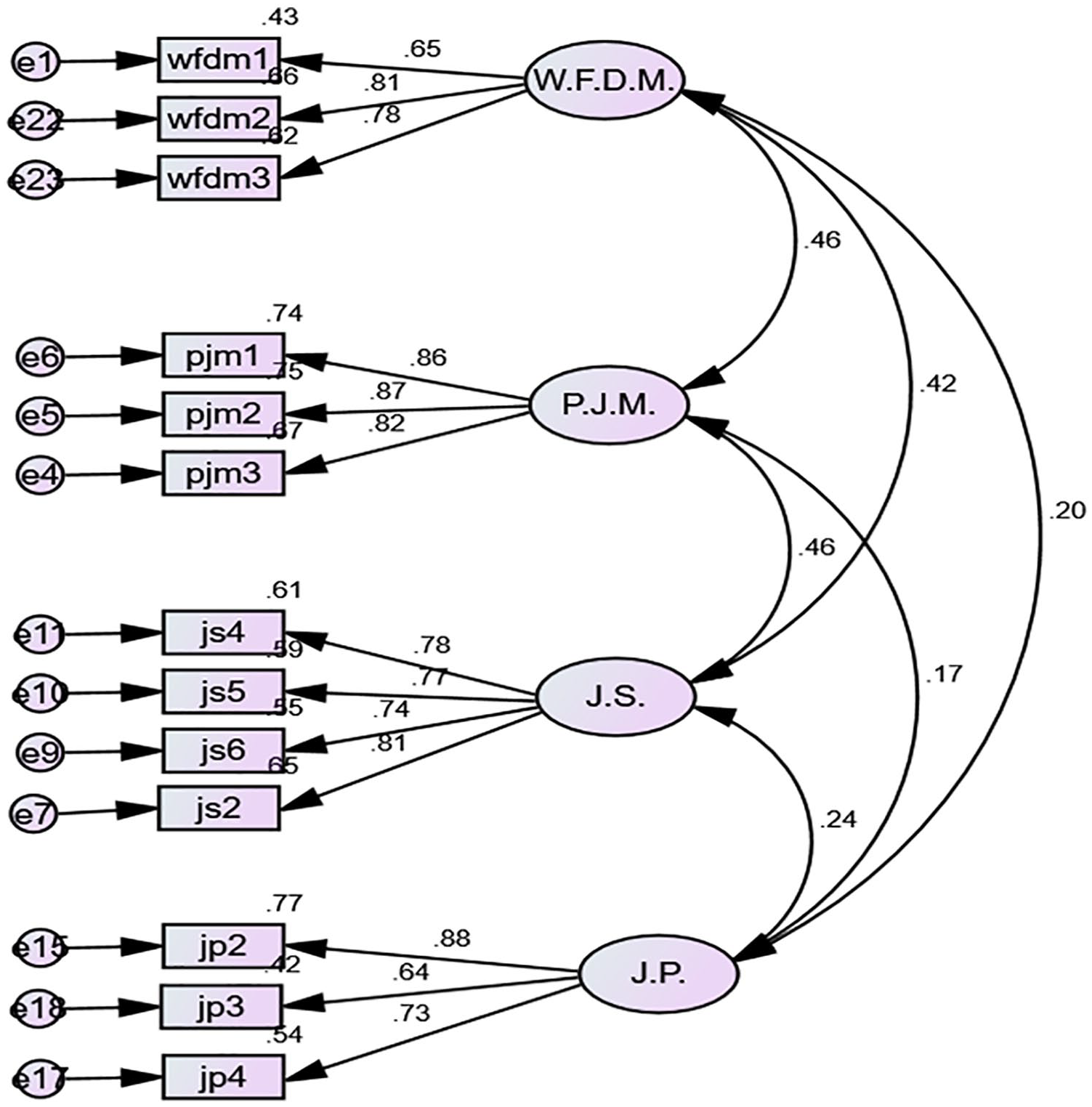
Confirmatory factory analysis (CFA).
Table 3 shows the average variance extracted (AVE) values and composite reliability (CR) value. Convergent validity was confirmed by the Cronbach’s alpha value which is above the threshold (.7) suggested by Hair et al. (1998); CR values were above the accepted limit (.6) suggested by Bagozzi and Yi (1988); and AVE values were also above the cutoff value (.5) suggested by Hair et al. (1998). The average of all item loadings is greater than .6 and significant at p < .01, showing that convergent validity is achieved. As shown in Table 3, the CR value ranged from .79 to .88, exceeding the recommended .7 threshold, which demonstrates reliability. Table 3 also shows the correlation analysis where the square root of AVE is greater for all variables than the corresponding correlation between those variables, showing that the discriminant validity achieved (Table 3).
Average Variance Extracted (AVE), Composite Reliability (CR), and Correlation.
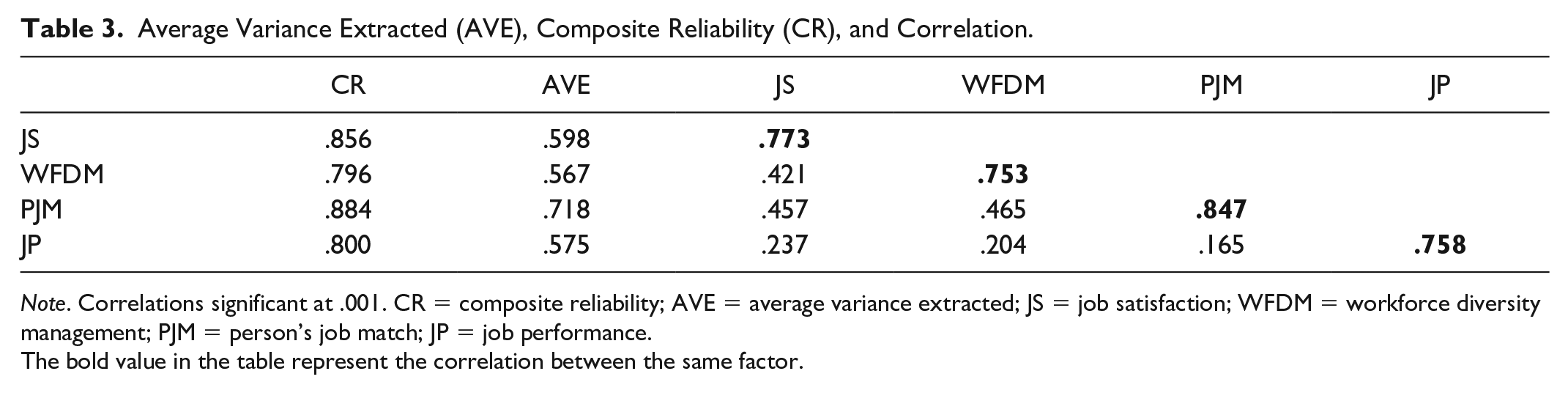
Note. Correlations significant at .001. CR = composite reliability; AVE = average variance extracted; JS = job satisfaction; WFDM = workforce diversity management; PJM = person’s job match; JP = job performance.
The bold value in the table represent the correlation between the same factor.
Common Method Variance
As all the measurement scales were self-reported, we performed different tests for common method variance in our study. At first, we performed an exploratory factor analysis in SPSS, where we simultaneously loaded all the items from each construct to determine the number of factors compulsory to explain variance in the variables. Factor analysis exposed the presence of four factors with eigenvalues more than 1.0. The four distinct factors accounted for 75.4% of the total variance, and the first biggest factor accounted for 29.9%, suggesting that the common method bias is not an issue in this study (Podsakoff & Organ, 1986). Second, we performed a common latent factor test in AMOS. This test revealed the common variance of 31% among the items of all scales. Finally, due to some limitations of a common latent factor as identified by Podsakoff et al. (2003), we added a marker variable by following Williams et al. (2010). The common variance decreased up to 11% after including the marker variable with the common latent factor. All these values suggested that there is no such issue of common method bias in our study.
Structural Model
We used the same fitness indices for path analysis in AMOS as suggested by the previous studies (Bentler & Bonett, 1980; Byrne, 1994; Hu & Bentler, 1999; Thompson, 2004). Fitness indices with respect to structural model are as follows: CMIN/df = 1.445, CFI = .914, GFI = .945, AGFI = .926, TLI = .941, NFI = .913, and IFI = .974. The RMSEA value is .051. All these values confirmed that our model fitted the data well.
Figure 3 shows the path analysis; we have as a control demographic variable. The dashed line represents the insignificant path, whereas the continuous line represents the significant path. Table 4 shows the mediating effects with and without a mediator. The result ensures that there is a positive relationship between workforce diversity management and employees outcomes (job satisfaction and job performance). The direct path coefficient from workforce diversity management was found to be .36 at a significance level of .001 for job satisfaction and .14 at a significance level of .013 for job performance, which supports H1 and H2. The mediating role of a person’s job match was tested by Baron and Kenny’s (1986) approach through direct and indirect effects without a mediator and with a mediator (Table 4). Results show that a person’s job match mediates the relationship between workforce diversity management and job satisfaction. The direct path coefficient from workforce diversity management to job satisfaction was found to be .36 at a significance level of .001, and the indirect path was found to be .18 at a significance level of .001. The indirect path size reduced after adding the mediator but was still significant, which ensured partial mediation. H6 was supported. The indirect effect was insignificant in the case of job performance while using a person’s job match as a mediator. The indirect path coefficient from workforce diversity management to job performance was found to be .14 at a significance level of .013 and the indirect path was insignificant, which ensured full mediation. H7 was supported.
Mediation Result.

WFDM = workforce diversity management; PJM = person’s job match; JS = job satisfaction, JP = job performance.
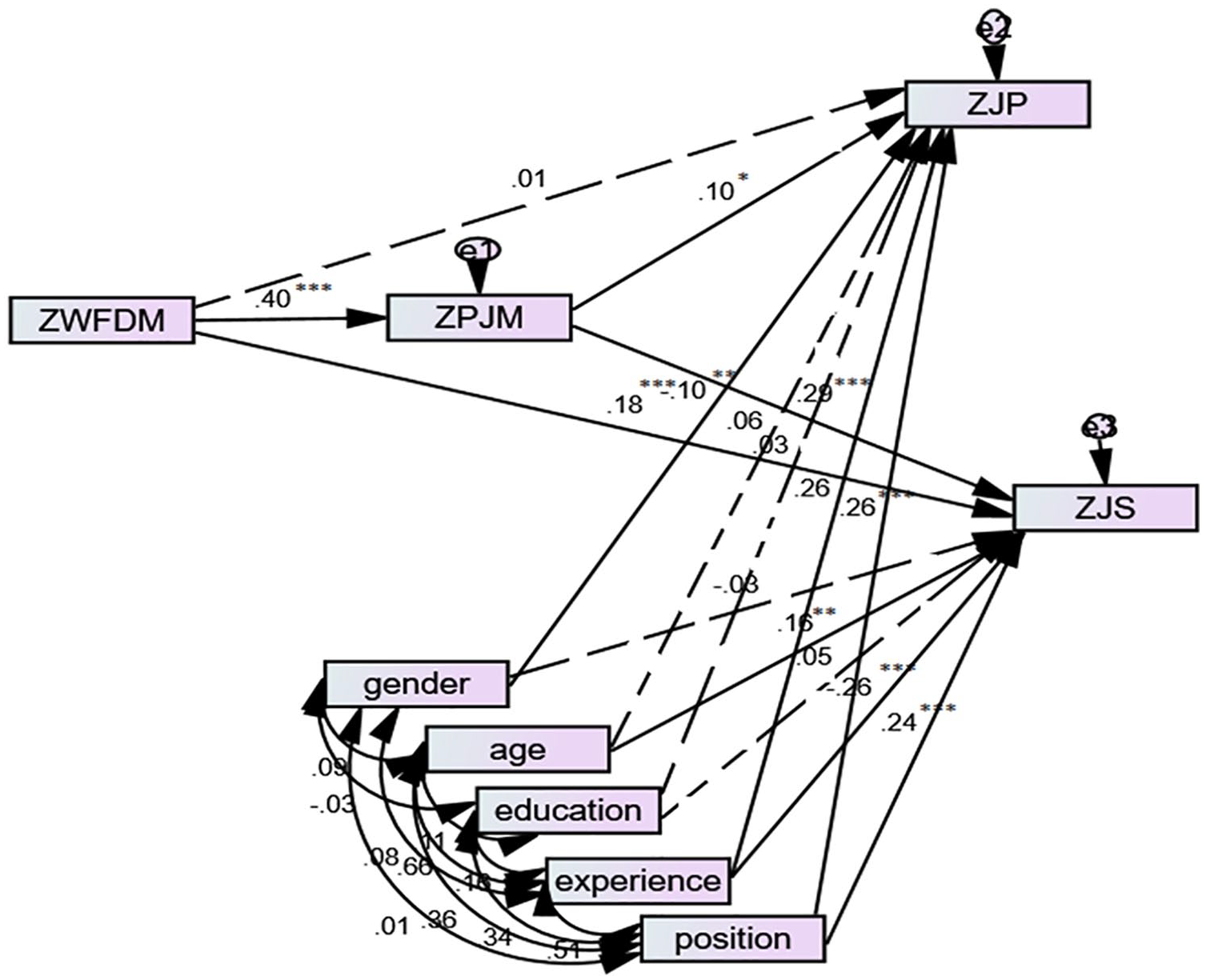
Path analysis.
Table 5 represents the summarized form of the hypothesized model and the actual result obtained through structural equation modeling. Workforce diversity management was positively related to a person’s job match, and the coefficient beta value was found to be 0.40 with a significance value of .001, which supports H3. A person’s job matches were positively related to job satisfaction and job performance, and the coefficient beta value was found to be 0.29 with a significance value of .001 for job satisfaction and .10 with a significance value of .05 for job performance, which supports H4 and H5.
Path Coefficients and Hypothesis Testing.

Discussion
The result indicates that workforce diversity management leads to job satisfaction and job performance (H1 and H2), and the direct relationship between workforce diversity management and job outcomes such as job satisfaction and job performance is in line with job adjustment theory, which suggests that the placement of employees according to their functional diversity, choices, and preferences leads to higher job satisfaction and job performance, which is inconsistent with the study of Pitts (2009) and Munjuri and Maina (2013). There are many similar studies which shed light on the relationship between workforce diversity management and various job outcomes such as employee engagement, employee citizenship behavior, employee turnover intention, work–life satisfaction, employee commitment, job outcomes, job satisfaction, and productivity (Choi & Rainey, 2010, 2014; Cooke & Saini, 2010; Cox & Blake, 1991; Groeneveld, 2011; Groeneveld & Verbeek, 2012; McKay et al., 2007, 2011; Pitts, 2009; Vanderschuere & Birdsall, 2019; van Zyl et al., 2019). Some of the studies contradict and state that diversity has both positive and negative impact on various outcomes such as job satisfaction and job performance (Akinola et al., 2018; Boerner et al., 2011; Hostager & De Meuse, 2002, 2008; Van Knippenberg et al., 2004). In this study, the result obtained from the Chinese hospitality industry and findings revealed that there is a positive effect of workforce diversity management on job satisfaction and job performance.
There are many previous studies which already established a significant relationship between workforce diversity management and job outcomes; nevertheless, this study can be among rare studies to examine the positive impact of workforce diversity management on person’s job match (H3). The direct link between workforce diversity management and a person’s job match has never been explored earlier, and significant positive results were obtained for this relationship. The significant positive impact of workforce diversity management on a person’s job match is in line with job congruence theory, which suggests that a person’s job match is the match between preferences, skills, ability, and interest. Today, retaining employees in an organization is becoming a challenging job for managers. Job loyalty is decreasing and employees switching to other jobs is increasing; one of the main reasons is not matching the employees’ desired job (Maden, 2014). Previous studies have found a positive impact of a person’s job match on job satisfaction, commitment, and performance and a negative impact on employee turnover intention (Jung & Yoon, 2013; Peng & Mao, 2015; Wiegand et al., 2018; van Zyl et al., 2019) (H4 and H5).
Thomas (1990) defined workforce diversity management as the management of all differences which consist of demographic differences as well as differences in preferences, functions, interests, and so on. A similar kind of study suggests that better job performance and job satisfaction can be achieved through positive diversity climate (Chen et al., 2012; Madera, 2013; Madera et al., 2016; McKay et al., 2007, 2011). Nowadays, workforce diversity management is dealing with job mismatch issues for engaging and improving organizational performance (Pink-Harper et al., 2017). In this way, the relationship between workforce diversity management and job match seems logical, which can have a great impact on various organizational outcomes. Similarly, the results indicate that there is an influencing role of workforce diversity management on job satisfaction and job performance via influence on a person’s job match (H6 and H7), which is inconsistent with equity theory. Equity theory suggests that if there is no discrimination between job demand and job supply, then positive job outcomes can be achieved. One of the current studies demonstrated that an employee’s job fit leads to positive job outcomes in the organization, such as higher job satisfaction, lower turnover intention, and higher job performance (Langer et al., 2019; Steijn & van der Voet, 2019). Most importantly, the direct and indirect link between workforce diversity management and job outcomes establishes the existence of the mediating role of a person’s job match. Moreover, there are many studies that highlight the positive role of workforce diversity management on job outcomes, but none of them highlight the mediating role of a person’s job match. Therefore, this study might be the first study to establish the relationship between workforce diversity management and employee outcomes via influence on a person’s job match.
Theoretical and Practical Implications
The current study examined three theories together (equity theory, job congruence theory, and job adjustment theory). First, equity theory provides equal representation of all segments of society, which provides a favorable exchange between job demand and skills utilization. Diversity management also manages the skills-based diversity to protect employees from unfavorable job assignment. Second, congruence theory represents a match between job and skills. Third, job adjustment theory represents the congruence between job and skills required for job satisfaction and job performance. In this way, the study provides the existence of the relationship which was lacking in the literature. These results provide compelling support for the existence of theoretical contributions.
Although selection and recruitment is the job of the human resource department, diversity management is a component of human resource management (Pitts, 2009), which creates a fair exchange of jobs. Various studies suggested that there must be proper management of workforce for getting a higher job performance and higher profit (Groeneveld & Verbeek, 2012; Kirton & Greene, 2015; Van Knippenberg et al., 2004; Verheij et al., 2017).
The hotel industry is a multicultural environment and faces workforce diversity problem on a regular basis (Madera, 2013). This study provides a new era to address job-related issues. A person’s job match is one of the major talent management activities which can be achieved through the management of employees. Most importantly, it provides a new way to solve job-related issues and control employee turnover intention. Talented employees are the nerve for regulating business and organization smoothly. Human resource managers and other functional departmental managers can control this issue. So, managers can address an individual’s desired work of interest in getting higher job performance. Many studies on team diversity focus on demographic differences. However, empirical research found that deep-level diversity such as a difference in opinion, attitude, and belief has an important role for the team which has long-standing importance (Pelled et al., 1999; Saud Khan et al., 2014). These findings also suggest that the skilled and qualified employees must be analyzed and should be in a strategic position (Avedon et al., 2010; Sloan et al., 2003). Skills and knowledge mismatch is a matter of dissatisfaction (Vieira, 2005). Employees are used for the wrong purpose, therefore the management team must manage workforce for effective organization outcomes (van Mesdag, 1986). Hence, the role of the manager must be such that he or she gives power to internal employees for intrinsic motivation (Tietjen & Myers, 1998).
Limitations and Future Directions
The sample size of this study might not be enough to generalize the study. This study used cross-sectional data, so it does not make causal interpretations (Choudhary et al., 2017). However, future research may be benefited from analyzing longitudinal data to establish the causality of their relationship (Muzamil Naqshbandi & Kaur, 2014). The empirical data were obtained from a single source in a single culture context. In the future, other cultural contexts or studies can replicate this study by including different contexts such as cross-cultures and other cultural contexts which would enhance the generalization of findings. It only focuses on particular hotel industry, and the nature of other service industries might be different, therefore we cannot predict that the same result can be achieved through different service industries. The manufacturing industry is different, so employees might perceive diversity management differently.
In the future, we can investigate the impact of workforce diversity management on other outcome variables such as intergroup conflict, turnover intentions, organizational commitment, and work–life balance by taking a person’s job match as a mediator. A similar kind of study can be undertaken in different perspectives such as different countries and different industries or different work settings, and we can compare the findings.
Conclusion
Despite its limitations, this study provides unique contribution to the literature and is useful for administrative practitioners. In a dynamic and competitive world, an individual’s productivity is critical for the effectiveness of the organization for sustainable development (Delmas & Pekovic, 2018; Oliver, 2018). As job mismatch leads to mental pressure and anxiety in today’s organizations, organizations have made considerable efforts to overcome this stress to increase individuals’ outcomes. Nevertheless, the organization’s diversity management strategy leads to an exchange between job demand and job supply on the basis of job match, which serves as a useful tool to reduce workplace negativism.
There are no other studies that highlight the direct effect of workforce diversity management on job match and the mediating role of a person’s job match on the association between workforce diversity management and job outcomes such as job satisfaction and job performance. Therefore, this study established the direct effect of workforce diversity management on job matches for the first time and revealed that the increase in workforce diversity management leads to an increase in a person’s job match. The effect of workforce diversity management on employees’ job outcomes via a person’s job match is logically proved in this study. Basically, the main purpose of workforce diversity management is to maintain equality in the organization; it overcomes the discrimination on the basis of gender, age, and ethnicity. This study found that discrimination on the basis of job characteristics may also be controlled by workforce diversity management because it leads to a person’s job match, which ultimately leads to employees’ job satisfaction and job performance. Therefore, this study may be helpful for academicians as well as may be implemented in the organization for favorable job assignment. Therefore, this study has both theoretical and practical implications. Managing workforce diversity issues, in this way, can be one step forward to solve job-related issues and control talented employees’ turnover intention. Hence, this study has significant importance on sustainable organizational development and strategic contribution to organizational behavioral studies.
Footnotes
Declaration of Conflicting Interests
The author(s) declared no potential conflicts of interest with respect to the research, authorship, and/or publication of this article.
Funding
The author(s) disclosed receipt of the following financial support for the research, authorship, and/or publication of this article: This work has been partially supported by the grants from the National Natural Science Foundation of China (71672026) and the impact of “Leader-follower” Interaction on Team Performance (LN2019J14), Research Project from Department of education of Liaoning Province.
