




Abstract
Translators of the Holy Quran confront many quandaries in their attempt to transfer the Qur’anic verses from Arabic into English. One of these quandaries is how to rhetorically communicate the intended meanings (implicatures) of the prepositional phrases in the Holy Qur’an. The translation of Arabic prepositional phrases in the Holy Qur’an as a source text (ST) may lead, in some Qur’anic verses, to a rhetorical loss in communicating their implicature in the target text (TT). That implicature or implicitly communicated meaning other than the explicature is the one intended to be expressed and required to be faithfully translated. In rendering the preposition into the target language (TL), translators bring into home only the explicitly stated meaning unaware of the implicitly stated meaning created as a result of the application of this specific rhetorical device. This study investigates the problem of the rhetorical loss encountered in the translation of prepositional phrases of the Qur’anic verses and identifies the cause of this problem. It also attempts to suggest a mechanism that is, to some extent, helpful and insightful in coping with the difficulties of translating Arabic prepositional phrases in Qur’anic verses. This research adopts a descriptive qualitative content analysis of the Qur’anic verses and their English translations that are relevant to the focus of the research. The source of failure of the English translations of the verses in conveying the rhetorical meanings of prepositional phrases has been identified in terms of the Relevance Theory and the distinction between explicature and implicature of these phrases. The study concludes that meaning equivalence in translation requires translators to be aware of not only the explicitly stated meanings of prepositions but the implicitly communicated ones as well which are recoverable through referring to Arabic heritage resources and interpretation books dedicated to exploring the rhetorical purposes of prepositions alternation in Qur’anic verses. The results of the analysis and the new suggested mechanism have been verified by an Arabic language and Qur’anic sciences expert who is a proficient speaker of English as well.
Introduction
Translation, in general, is a process of transferring a message from the source language (SL) into the target language (TL). In view of this definition, translation, from its inception, has been a form of communicating thoughts among different peoples, languages, and cultures (Imre, 2012; Sadiq, 2008). Steiner (1998) endorses the notion of viewing translation as a means of human communication whereby he states that “human communication equals translation” and “a study of translation is a study of languages” (p. 49). Torop (2008) argues that translators work at removing the boundaries among languages, cultures, and communities. In their contributions to render a text from one language into another, they are harbored a position between the poles of specificity and adaptation manifested in the skills of their translational activities. In this process, the translator renders a message of the source text (ST) and encodes it into target text (TT) in such a communicative way that meanings and intended effects inherited in the SL are to be accurately sold to readers of the TT. Translation, in this sense, is a means of reproducing the content of the original text using a TL.
Insofar as the translation of the Holy Qur’an is concerned, Morris (2000) asserts that the age we live in now accentuates the importance and demand for renditions of the Qur’an especially for non-Arab Muslims where the need for Qur’an translations has turned to be far greater than any past time. However, translating a sacred scripture or text as the Holy Qur’an is often beset by many quandaries and complications that may arise as a consequence of the nuances that exist between the two languages and cultures (Abdul-Raof, 2013; Ali & Ahmed, 2006). The word of Allah, the Qur’an, cannot be reproduced by the word of man, and, thus, translations of Qur’an often explicitly declare that they are not translations of the Qur’an but of its meanings (Elimam, 2013). One of the quandaries encountered in translating the Holy Qur’an into English is the rhetorical meaning loss that is expected to occur as a result of the translators’ failure to bring into home (TL audience) the appropriate required equivalence. Equivalence is a key concept in translation theories as it operates on different levels of language: linguistic, cultural, stylistic, semantic, structural, effect (rhetorical), communicative, and functional (Adab, 1996; Baker, 1992; Vinay & Darbelnet, 1995). These types of equivalence are dramatically underachieved or completely not achieved due to the failure in rendering Qur’an-bound rhetorical features, which pose a serious challenge for translators, or the real lack of the required knowledge of the fundamental characteristics of Arabic language and the Holy Qur’an. The view of the grave loss of rhetorical communication confronted when translating the Qur’an is rightly pointed out by Abdul-Raof (2004). Thus, advocating any approach in translating the Qur’an without being familiarized with Qur’anic variegated rhetorical characteristics will lead to distorting the message underlying the SL text, thus deteriorating the poles of both ST informativity and ST intentionality (Abdul-Raof, 2005; Elimam, 2013). Mason (1998), as reiterated by Abdul-Raof (2005), attributes the rhetorical loss in the TL to the distinct rhetorical and semiotic norms of the SL. Thus, style and meaning are intimately entangled into one another specifically in translating the religious texts because the former contributes to or even creates the latter (Adab, 1996). The Holy Qur’an with its specific characterization of composition and style of Arabic spells a unique effect on listeners and readers and forms a brilliant linguistic, religious, and moral portrait that constitutes minefield of complications in translating it between two linguistically and culturally incongruous languages such Arabic and English. Abdelaal and Rashid (2015) emphasize that because of the intricate boundaries between languages, translators encounter the dilemma of losing meaning in their TTs.
While translators and scholars agree to a certain extent that it is often possible to achieve a fairly good degree of semantic equivalence across texts of two languages such as Arabic and English (Abdul-Raof, 2013; Gutt, 1991), the same is proved difficult of rhetorical equivalence, which often results from the use of unique linguistic and rhetorical Qur’anic features such as the phenomenon of the prepositions alternation in Qur’anic verses. Meantime, prepositions or prepositional phrases, as one of the most distinctive aspects of Qur’anic discourse, have received little systematic attention from scholars interested in investigating how their rhetorical imports have been rendered into English. Alternation of prepositions in Holy Qur’an entails that the preposition used in the Qur’anic verse communicates one superficial assumption that is explicitly stated in the verse, and another intended assumption that is pragmatically inferred as a result of this alternation. As alternation of prepositions in Qur’anic verses is one of the Qur’an-bound linguistic characteristics and one of the frequent rhetorical devices, the translation of prepositional phrases into English will pose a major problem pertaining to the loss of their implicatures or rhetorical purposes. Non-Arab Muslim translators may commit mistranslation as a result of their lack of the deep knowledge of the potential of Arabic prepositions of alternating with one another in the Holy Qur’an for rhetorical functions. So, one aim of the present research is to address the rhetorical loss in the English translation of the verses containing phrases with the prepositions alternation as a rhetorical device in the Holy Qur’an. A second aim is to examine the source or cause of the identified rhetorical loss. The study also attempts to find a new modest mechanism that is helpful in abridging the gap of the meaning loss encountered in rendering verses with prepositions alternation.
Arabic Language and Prepositions of the Holy Qur’an
Qur’an-bound rhetoric-linguistic norms form a specific genre in its own right that is alien to languages and cultures other than Arabic (Abdul-Raof, 2005). Dkhissi (2018) goes in line with this notion stating that “the Qur’anic structures are so selective in that Arab grammarians categorize the structure of their language as Qur’anic Arabic and non-Qur’anic Arabic” (p. 43). Abdul-Raof (2005) goes further to refer to Qur’anic pragma-linguistic conventions as constituting a specific culture that is dramatically perplexing to its interpreters and translators. In the context of Arabic language, it has semantic and rhetorical flexibility, whether at the level of words or at the level of structures. On the contrary, Arabic language represents a major linguistic challenge to any attempt to understand the Holy Qur’an where this is a complex task to be rendered unless a deep knowledge of those linguistic characteristics is mastered. Prepositions are one of the rhetoric-linguistic devices that establish the Qur’anic style and discourse. Thus, one of the challenges that the language of the Holy Qur’an poses is how to properly render the rhetorical meanings (implicatures) of prepositions mentioned in Qur’anic verses.
In the Arabic language, the word that connects structures before and after is called harf al-Jarr. In English, it is called a preposition. In general, a preposition is a word that connects two entities; one of them is represented by the complement of the preposition (Quirk & Greenbaum, 1989). In Arabic, Ibn Jinni points out that a preposition is defined as an entity referring to meaning obtained in relation to the context that precedes and follows it (cited in Al-Attiya, 2008). Ibn Ilsiraj says that Arabic prepositions have fundamental functions in the structure of the Arabic language. Basically, prepositions are important to build the semantic structure of the sentence in Arabic where prepositions link the words of the sentence to each other to show their meanings. Prepositions are a means to link the meanings of the verbs that precede them and the nouns (objects) that follow them. In other words, a preposition in Arabic works as a bridge by which the verb passes to its object especially when verbs are intransitive (cited in Al-Attiya, 2008). In this way, “the genitive noun that follows the preposition is construed as an object of the verb literally, virtually but not actually. And this is one of the ways in which the intransitive verb becomes transitive and the mono-transitive becomes ditransitive” (Nasser, 2013, p. 68). So, like English, Arabic verbs are of two types: transitive and intransitive. A transitive verb is one that requires to be followed by a noun which is object, while an intransitive verb is one that does not require to be followed by an object. Transitivity, in the Arabic language, means that some verbs are linked to their objects through prepositions, even if these verbs are intransitive. The preposition, in Arabic, is the means by which the verb passes to its object.
The two languages, Arabic and English, belong to two different families. While English stems from Germanic languages, Arabic belongs to Semitic languages (Alhaj, 2015/2016). That will definitely differentiate the sub-systems and lead to very different linguistic structures of these two languages (Almahammed, 2016). This significant distinction between Arabic and English would lead translators and speakers of English to commit errors of transferring prepositions in Qur’anic verses from Arabic into English as they lack the required knowledge of the use of prepositions in the Holy Qur’an. The Arabic of the Holy Qur’an has some very unique characteristics that any attempt of translating it into another language is bound to fail. The meaning and use of Arabic prepositions in Qur’anic verses is one of the frequent rhetorical characteristics that pose complications to translators in their efforts to accommodate the TT and not betraying the ST.
The use of prepositions in Arabic language in general and Qur’anic discourse in particular reflects various explicit and implicit effects of meaning (Khan & Ali, 2017; Mat & bin Nokman, 2016). They are deemed to be a complex issue due to their flexible faculty of alternating with one another for rhetorical purposes where each preposition has a specific central meaning not logically altered with another unless it communicates more than what is said (implicature; Al-Batliosy, 1996; Al-Darweesh, 2003; Hassan, 2004). Prepositions alternation and the rhetorical use of Arabic prepositions in the Holy Quran have been studied by earlier researchers. Esseesy (2010), in his book, uses the concept of grammaticalization to widely “expand the prepositional repertoire of Arabic.” Mat (2014) examines the functional aspects of prepositions in the Holy Qur’an, indicating that the lexical meaning alone is not enough to bring into Malay their real meanings inherited in Qur’anic verses. Hummadi (2016) examines the influence of metaphor and metonymy in the polysemy of the Arabic prepositions in the Holy Qur’an, concluding that, because of metaphor and metonymy, prepositions undergo extension patterns from their basic meanings in Arabic language to their new meanings experienced in some Qur’anic verses. Mat and bin Nokman (2016) investigates the syntax–semantics of prepositions في (in) and على (on/over) in the Holy Qur’an restricted to partial phrase في الضلال and على الھدى ever discussed by Ibn Athir and in terms of Arabic rhetoric (Balagha). However, little attention has been given, so far, to explore how and why rendering prepositional phrases of some Qur’anic verses into English causes a rhetorical loss of meaning—a gap attracting the interests of researchers in different disciplines.
Relevance Theory and Translation
Relevance theory has emerged from the field of cognitive pragmatics that accounts to the contextual and inferential aspects of language communication, namely, the relationship between what is explicitly stated in language (explicature) and what is implicitly communicated (implicature) (Jobes, 2007). According to Wilson and Sperber (2004), explicit content (explicature) can be considered as a complement of Gricean notion of implicit content (implicature) which is theoretically underpinned to mean that expressing and recognizing intentions is the fundamental feature of any human communication. Haugh (2002) argues that by introducing the notion of explicature, Sperser and Wilson attempt to claim that pragmatic inferences contribute not only to what is implicated but to what is explicated as well. For Grice, explicitly stated meaning is a group of decoded assumptions and, reversely, implicitly stated meaning is a group of inferred assumptions. In contrast, Sperber and Wilson (1995) argue that no assumption can simply be decoded without elements of inference. They hold that to better understand the utterance meaning within the relevance-theoretic account, two important considerations are to be taken into account. The first one is between the linguistically decoded meaning and pragmatically inferred meaning. The second one involves the two types of propositions communicated by the speaker: explicature and implicature. Sperber and Wilson (1995) define explicature and implicature as follows: An assumption communicated by an utterance U is explicit [hence an “explicature”] if and only if it is a development of a logical form encoded by U. An assumption communicated by U which is not explicit is implicit. [hence an “implicature”]. (p. 182)
Carston (2000, p. 12) expands definitions of explicature and implicature through displaying that explicature is a propositional form communicated by an utterance which is pragmatically constructed on the basis of the propositional schema or template (logical form) that the utterance encodes; its content is an amalgam of linguistically decoded material and pragmatically inferred material,
and implicature is “any other propositional form communicated by an utterance, its content consists of wholly pragmatically inferred matter.” Hence, Sperber and Wilson (1995) conclude that “any assumption communicated which is not explicit must be implicit, and thus must be an implicature” (p. 182).
In view of the distinction between explicature and implicature of the relevance theory, the connection between the linguistic structure of the message and its rhetorical interpretation requires to be explored. Haugh (2002) states that theorists such as Carston and Sperber & Wilson working in relevance theory emphasize that “conceptual content of implicatures must be wholly inferred” and others, as Sperber & Wilson and Papafragou, add that for implicatures to be inferred, “they must be intended by the speaker, and understood by the hearer as intended” (p. 120). Based on this, Sperber and Wilson (1995), as reiterated by Al-Jarrah et al. (2018), point out that any verbal message reflects two aspects of intentions. One of them is the informative intention, which encompasses all possible interpretations that are contextually justifiable. These include the linguistically decoded meanings. The second is the communicative intention that involves the process of conveying the intended meaning (implicature) that the SL producer really intends to express. In translation, implicature can be recognized as a level of equivalence between an ST and a TT where effect (rhetorical) equivalence represents the seventh kind in Baker’s (2005) theory of translation. In Wilson and Sperber’s (2012) terms, the translator should look for the “fuzzier speaker’s meanings, consisting not only of what was said, but also of what was implicated” (p. 1).
Relevance theory is concerned with language communication. In Gutt’s (1991) point of view, translation is a special form of communication. Thus, instead of merely concentrating on encoding and decoding of utterances, relevance theory weights much importance to the inference from ostensive-linguistic clues. In relevance-theoretic terms, Gutt (1991) asserts that implicitly stated meanings are not usually conveyed explicitly without some (structure) distortion as explication often narrows the range of the intended meanings conveyed. Wilson and Sperber (2004) view that for communication to be appropriately communicated, there will be a need for a stimulus. Knowing of the speakers’ intention to pick out the most relevant stimuli in hearers’ environment and guide them to maximize their relevance, speakers are required to produce a stimulus which is likely to attract readers’ attention, to prompt their retrieval of certain contextual assumptions, and to project them toward an intended conclusion (implicitly communicated meaning). This type of ostensive-inferential communication “is not just a matter of intending to affect the thoughts of an audience; it is a matter of getting them to recognise that one has this intention” (Wilson & Sperber, 2004, p. 611). Jobes (2007), inspired by Wilson and Sperber (2004), argues that this inferential model of connecting meanings to words takes translation seriously as a form of human communication, and assumes that a communicator provides evidence of her intention to convey a certain meaning, which is inferred by the audience on the basis of the evidence provided. An utterance is, of course, a linguistically coded piece of evidence, so that verbal comprehension involves an element of decoding. However, the decoded linguistic meaning is just one of the inputs to a non-demonstrative inference process which yields an interpretation of the speaker’s meaning. (p. 607)
Method
Data Collection
The context for this study is the Holy Qur’an. In this research, some Qur’anic verses related to the problem statement constitute the data of analysis. In view of the research objectives, the study adopts a purposive sampling where the selection of the English translations of the Qur’anic verses focuses on those samples that demonstrate rhetorical loss of meaning. The translated verses were extracted from the works of different non-Arab Muslim translators so as to ensure the generalizability principles of the resulting findings. These translations have been collected from A. Y. Ali’s (1938/1968) work of The Holy Qur’an: Text, Translation and Commentary, Mamdouk Pickthall’s (1956) work of The Meaning of the Glorious Koran, and Muhammad Taqi-ud-Din Al-Hilali and Muhammad Mohsin Khan’s (1984) work of Translation of the Meanings of the Noble Quran in the English Language. Insofar as data collection procedures are concerned, Qur’anic verses and their rhetorical interpretations in the interpretation and Arabic heritage books were identified followed by identifying the matching translation of these verses in different Qur’an translation works. After that, the study initiates to make a comparison of the rhetorical meanings inherited in the Qur’anic verses and demonstrated in the interpretation books and their translated versions in an attempt to examine the rhetorical loss of meaning and its underlying cause.
Data Analysis
A descriptive qualitative content analysis was adopted in this research to examine qualitatively the exegetic content of the Qur’anic verses and the equivalence of their English translations. Qualitative content analysis is considered one of different qualitative methods currently used for analyzing data and interpreting its meaning. Qualitative content analysis, as a research method, “represents a systematic and objective means of describing . . . phenomena” (Elo et al., 2014, p. 1). Qualitative research, in general, “contributes to an understanding of the human condition in different contexts and of a perceived situation” (Bengtsson, 2016, p. 8). Pertinent to the focus of the current research, the research consulted interpretation books such as Arabic exegesis and heritage books to uncover the authentic interpretations of the verses under examination and to identify the rhetorical losses of meanings in their English translations. For purposes of trustworthiness, the rhetorical loss in the translation of prepositional phrases of the Qur’anic verses and the meanings of their new translated versions were verified by an Arabic language expert who is well-qualified in Qur’anic sciences and had mastered English as well.
Results and Discussion
This section is devoted to analyze in depth some examples of Qur’anic verses related to the problem statement of the current study. Each example of Qur’anic verse and its translated and transliterated versions are arranged within a table. Table 1 presents Example 1.
A Qur’anic Verse With Rhetorical Loss.

Translating the Holy Qur’an from Arabic as an SL into English as TL is accompanied by many linguistic problematic issues. The alternation of prepositions in Qur’anic verses is one of the big problems encountered by translators in rendering the intended meaning (pragmatically inferred assumptions) of the verse. In the above Qur’anic verse, Ali, Pickthall, and Al-Hilali & Khan adopted literal approach in rendering the preposition (عن) into English. Their translations of the verse in general and its preposition in particular comprised only the explicitly stated meaning (explicature) of the verse. However, the translations are not communicative in the sense that they never made a reference to the rhetorical meaning inherited in the verse due to the alternation of the prepositions (عن) and (من). According to the structure of Arabic, the verb (يقبل—accept) passes into its object with the preposition (من). In Ali, Pickthall, and Al-Hilali & Khan’s English translations, the verb of the target utterance passed to its object with the preposition (from—من) which causes a loss of rhetorical assumption communicated in virtue of this Qur’an-bound pragma-linguistic characteristic, alternation of prepositions in the Holy Qur’an. In view of the ostensive-linguistic clue demonstrated by alternating (من) with (عن) in the verse, and based on Gutt’s (1991) view of translation as an inferential process of verbal communication closely related to the brain mechanism, there is an implicature or rhetorical assumption inherited in the Qur’anic verse which is needed to pragmatically infer it. The ostensive-inferential communication intended by the evidence provided is the notice that Almighty not only accepts His slaves’ sincere repentance and their good deeds which is explicitly communicated by the meaning of the preposition (from—من) but forgives their earlier sins and erases them completely to be pure again (Al-Kudari, 1989; Al-Shafi’I, 1994). This contextual and inferential aspect of communication, being a powerful rhetorical assumption and more communicative than informative, has been conveyed by the use of the preposition (عن) which has a central meaning of “passing away from” and “being out of.” The loss of meaning that is not rendered in the translated verses as a result of the literal translation of the verse in general and the preposition in particular is the implicature of erasing all the slaves’ earlier sins besides the explicature of accepting their sincere repentance.
A second example of a Qur’anic verse with rhetorical loss is shown in Table 2.
A Qur’anic Verse With Rhetorical Loss.

Again, in the Qur’anic verse above, Ali, Pickthall and Al-Hilali & Khan did not recognize the communicative linguistic stimulus or the act of ostensive communication provided by the verb of the verse which passes to its object with the preposition (with—ب) other than (from—من) as it is structured in Arabic. In using the verb (drink) preceded by (wherefrom) as the preposition that the verb passes into in the TT, translators are only faithful to the explicitly communicated meaning of the ST unaware of the rhetorical purpose of alternating the preposition (من) with the preposition (ب) in the source Qur’anic verse. In this type of translation, the translator does not often pay attention to the textual content, and the target readers’ cognitive aspects are almost neglected (Gutt, 1991). Based on the framework of relevance theory, translation is also a process of ostensive-inferential communication. Accordingly, in translation, the translator must make inference according to the ostensive behavior of the original author and get the efficient contextual effect on one hand, and on the other he has to show his understanding of the original author’s intention in an ostensive way to the target language text reader so that the reader can make inference and get contextual effect. (Tina, 2011, p. 3)
Not adopting the ostensive-inferential process caused the translated TT to be pragmatically or rhetorically not equivalent. So, according to Sperber and Wilson’s (1995) definition of an implicature as “an assumption communicated by U which is not explicit is implicit” (p. 182), the implicitly communicated meaning by the verse in employing the meaning of “attachment” represented by (ب—with) is that people who are righteous and nearest to Allah not only drink water from the blessed spring, but they delectate it and reach to the extent of being fully satisfied and intoxicated. To be satisfied means to be completely filled and enjoyed in drinking water and having the sufficient amount of it. The meaning (من—from) accounts for the explicature of the verse, while the basic meaning of the preposition (ب—of, by, with, at), of “attachment,” accounts for the implicature of the verse. The explicit proposition of “just drinking” reflected by (من—from) does not necessarily mean having water to the extent of saturation and with the meaning of intoxication and pleasure achieved by the use of the preposition (الباء—with). Thus, this idea of being fully satisfied and intoxicated with drinking is not possible to be construed if the verb (يشرب—drink) passes with the preposition (من—from). So, the meaning of the preposition (الباء—with) communicated not only what is explicitly proposed in words but also what is implicitly stated (Al-Kudari, 1989; Al-Samarai, 1983).
Another Qur’anic verse is presented as an example in Table 3.
A Qur’anic Verse With Rhetorical Loss.
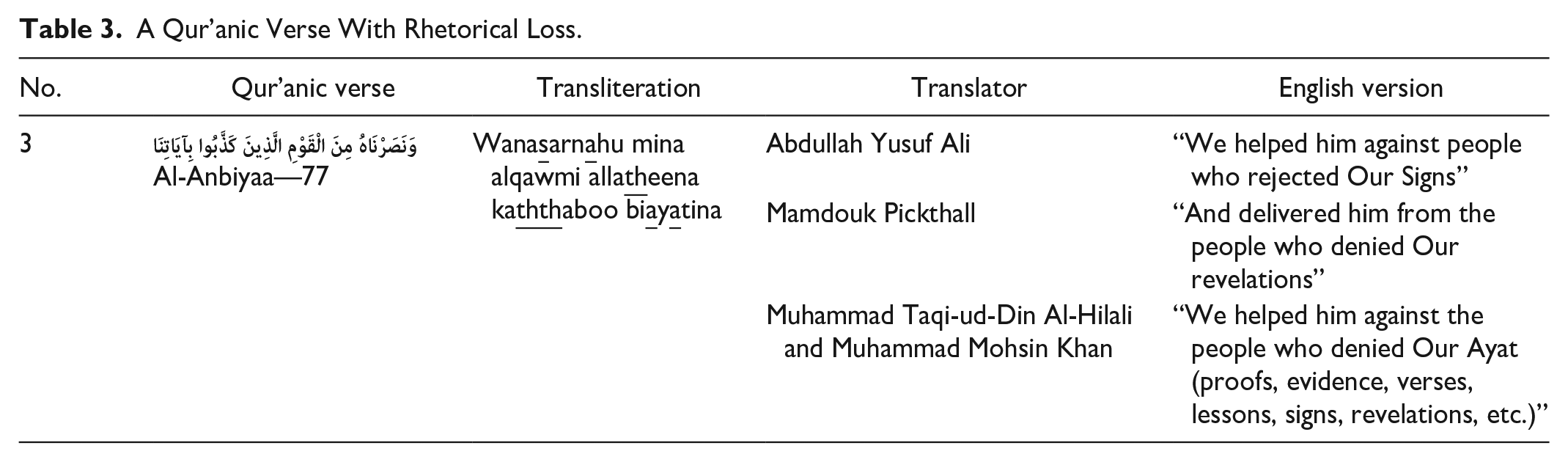
The English translations of the Qur’anic verse presented by Ali and Al-Hilali & Khan above are simply a matter of replacing the linguistic units of the ST with linguistic equivalent units of the TT without reference to factors such as the linguistic context, connotation, or implicature resulting from the phenomenon of prepositions alternation. This type of approach is called linguistic translation which is deemed “faithful” as it “contains elements which can be directly derived from the ST wording, avoiding any kind of explanatory interpolation or cultural adjustment which can be justified on this basis” (Nida & Taber, 1969, p. 134). In Arabic language, the verb (نصر—helped) should pass to its object with the preposition (على—against). Using the preposition (from—من) instead of (against—على) is an ostensive-linguistic behavior of the original author in an attempt to have readers not merely focusing on encoding and decoding of the verse but to project more emphasis on the inference from this specific ostensive-linguistic clue. Lacking the necessary knowledge of the rhetorical purposes of the prepositions alternation in the Holy Qur’an caused the rhetorical meaning of this verse to be lost in the translated version. Using the preposition (from—من) instead of (against—على) rhetorically communicates the meaning of delivering the prophet Noah from the people who denied Almighty revelations and Signs as shown in Pickthall’s translation which is more matching to the ST than other translations. In other words, the use of the preposition (against—على) in the verse implicitly conveys the rhetorical meaning of preventing those who denied Almighty Signs from doing harm to Noah especially when he was alone without followers as they (not Noah) were the powerful and controlling side in this conflict. Thus, this pragmatically inferred assumption has been completely lost in English translations presented by Ali and Al-Hilali & Khan. The literal translation of the preposition (from—من) of the SL into (against—على) communicated the explicitly stated meaning only. This explicature involved the meaning of victory awarded to the prophet Noah as the powerful and controlling side over those who denied Al-Mighty Signs and that contradicts the real meaning intended from prepositions alternation (Al-Kudari, 1989). Thus, Pickthall’s translation of this specific verse was more brought into home when rendered into English.
Another example of rhetorical loss is elucidated in the selected Qur’anic verse in Table 4.
A Qur’anic Verse With Rhetorical Loss.

In Arabic, as usual, the verb نظر (cast a glance) passes into its object with the preposition الى (to/into). Alternating (to/into) with (in) as shown in the Qur’anic verse is not without an implicature lost in the English translations of the verse. The three translators failed in bringing into home the intended rhetorical assumption needed from this clear break of the prepositions’ rules. Rendering the Arabic preposition (في—in) of the verse into (at) does not express more than the semantic message of the prophet Ibrahim’s look (through mere eyes) at the stars. The rhetorical loss that is caused and lost by the literal or linguistic translation when rendering the Arabic preposition (في—in) into (at) unaware of the rhetorical communication behind this ostensive-linguistic clue is the meaning that it is Ibrahim’s heart and thought that were preoccupied by the Stars’ creation. Ibrahim’s heart and thought were completely surrounded and controlled by this creation. Basically, this is the paramount difference between passing the verb (cast a glance) with the preposition (at) which explicitly communicates looking at the skies through eyes, and with the preposition (in) which rhetorically and implicitly communicates Ibrahim’s long thinking and contemplation in one of the brilliant God’s creatures (Al-Kudari, 1989). Thus, Ali, Pickthall, and Al-Hilali & Khan did not recognize that the preposition (في—in) used in the Qur’anic verse communicates one assumption that is explicitly stated in the verse, and another assumption that is pragmatically inferred as a result of this alternation. Their English translations are deemed inadequate as they betrayed the real intended meaning or the implicature of the verse.
Another Qur’anic verse identifying the prepositions alternation is shown in Table 5.
A Qur’anic Verse With Rhetorical Loss.
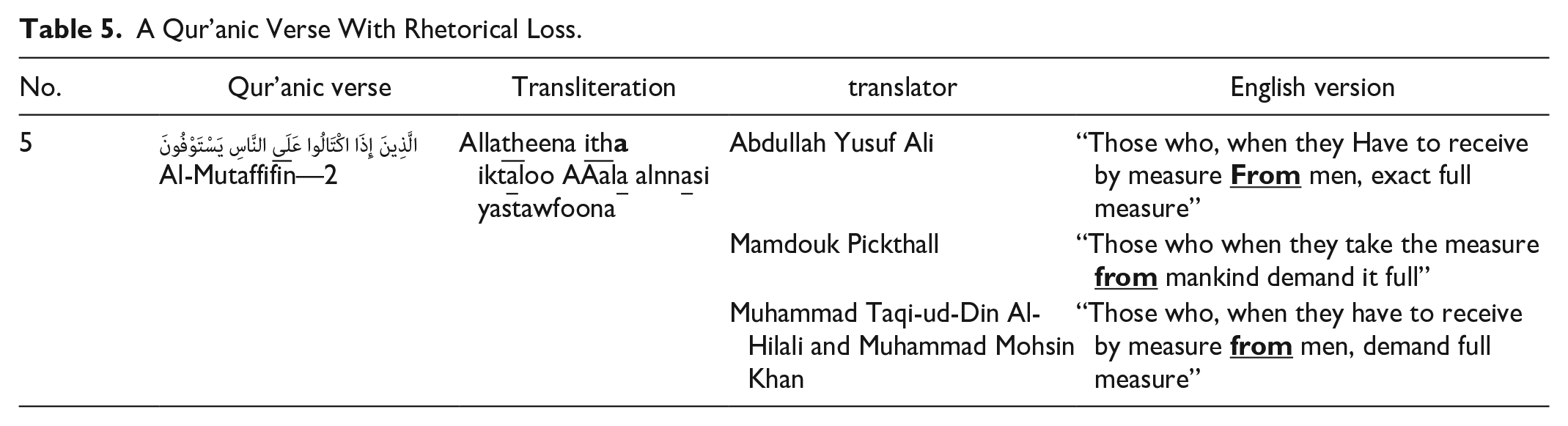
In the above Qur’anic verse, Ali, Pickthall, and Al-Hilali & Khan advocated a literal approach in transferring the preposition (على) into TT. Their translations of the preposition in particular revealed only the explicitly stated meaning (explicature) of the verse. They were not aware of the implicitly communicated meaning created as a result of the alternation of the preposition (on/over—على) with (from—من) in this specific Qur’anic verse. According to the structure of Arabic, the verb (اكتال—take by measure) passes into its object with the preposition (من). In Ali, Pickthall, and Al-Hilali & Khan’s English translations, the verb of the translated version of the verse passed to its object with the preposition (from—من) causing a loss of rhetorical meaning communicated due to the use of the preposition (on/over—على). The ostensive-inferential communication intended by the evidence provided through the use of (on/over—على) instead of (from—من) is to implicitly communicate the meaning that taking by measure is not to be understood positively as taking justly by measure but those who when they have to take by measure from mankind take in full through attempting tricks and other twisted ways (Al-Samarai, 1983). One of these tricks is to push strongly down the scale measure to allude people that it is a full measure. This contextual and inferential aspect of communication has been achieved through prepositions alternation to make distinctive the difference between two meanings. The first involves taking by measure from men which connotes that what has been taken from men is right and justly established and that is represented by the preposition (from—من). The second involves tricking by measure on men through zig-zag ways which is reflected by the use of the preposition (on/over—على), and evidenced by the negative use of the word “defrauders” used in the preceding Qur’anic verse.
Example 6 also shows the problem of rhetorical loss of meaning when prepositional phrase is rendered into English, as indicated in Table 6.
A Qur’anic Verse With Rhetorical Loss.

Again, the pragmatically inferred assumption in this Qur’anic verse has been created as a result of the application of the Qur’an-bound rhetorical device of prepositions alternation. In Arabic language, the verb يحمل (carry) passes into its object with the preposition (على—on) and not (في—in). This prepositions alternation exists to communicate that the Sons of Adam have been honored not only by providing them with transport on land and sea—the explicitly stated meaning reflected through the use of the preposition (على—on)—but by the ability, stability, and control in traveling across land and sea and administrating everything of daily life pertinent to land and sea to do their responsibilities toward humanity—the implicitly communicated meaning established by the intentional use of the preposition (في—in) in the this specific Qur’anic verse. Thus, the use of the containment preposition (في—in) is more communicative to God’s honor to the Sons of Adam than the elevation preposition (على—on) which delivers the meaning of being elevated on land and sea without the ability to do their requested human tasks (Al-Kudari, 1989). Unaware of the rhetorical purpose of prepositions alternation in this Qur’anic verse, the three translators failed in bringing into home the real equivalent of the intended meaning, and their translations of the verse impaired the implicature intended from the clear break of the preposition rules.
Another more example is indicated in Table 7 to elucidate the problem of rhetorical loss resulting from prepositions alternation in the Holy Qur’an.
A Qur’anic Verse With Rhetorical Loss.

Again, the three translations of the Qur’anic verse above are simply a matter of replacing the linguistic units of the ST with linguistic equivalent units of the TT committed to the explicature of the verse without digging deeply into the implicitly assumption intended from the prepositions alternation in this specific verse. In Arab speech, the verb عاد (return) passes into its object with the preposition (الى—to/into). In the specific Qur’anic verse above, the rules of prepositions in Arabic have been intentionally broken to deliver a more communicative meaning that has been lost in the TT of the translators. Not adopting the ostensive-inferential process caused the translated TTs to be pragmatically or rhetorically not equivalent to the ST. The rhetorical equivalence that should be inherited in the translated versions of the text is that the disbelievers aim that the messengers’ return to the disbelievers’ religion should be real not fake which is secured through the use of the (في—in) in the ST (Al-Qurtubi, 2004). Replacing (في—in) in the ST with (الى—to/into) in the TT causes the expression of the explicitly stated meaning and, unconsciously, neglecting the implicitly stated one causing this rhetorical loss. So, the meaning of the preposition (في—in) communicated not only what is explicitly proposed in words but also what is implicitly stated.
Summary of the Discussion
The Cause of Rhetorical Loss
Translation of Qur’anic verses has always been and still is a big challenge for translators in terms of equivalence, accuracy, and translatability. Translation quandaries can be caused as a result of rendering into English the Qur’an-bound rhetorical devices which flow into an effective and sublime Qur’anic style. One of the difficulties that translators confront and lead them to fail in accomplishing rhetorical equivalence when rendering Qur’anic verses into the TL is the phenomenon of prepositions alternation in the Holy Qur’an. Translators, especially the non-Arab Muslims, are frequently unaware of the implicature or the pragmatically inferred meaning that is communicated as a result of the ostensive-linguistic behavior represented by the breakage of the structures of the prepositions use in Arabic language. When a preposition is ostensibly alternated by another in a Qur’anic verse, an implicature or implicitly communicated meaning other than the explicature is intended to be expressed as a result of the application of this rhetorical device which is required to be faithfully translated. In rendering the preposition into the TL, translators bring into home only the explicitly stated meaning, thus accommodating the TL and betraying the SL causing rhetorical equivalence to be lost in the TT. In other words, translators, in the process of translation, recall into the TT the development of the logical form of the preposition used (explicature) unaware of its real intended assumption (implicature). Lack of the deep knowledge of this rhetorical device has been attributed to the short or absent reference to the interpretation and heritage books used for examining the authentic meanings of the verses under study and identifying their explicatures and implicatures.
At-tadmiin (Implication) as a Mechanism for Translating Qur’anic Prepositional Phrases
This section offers a modest mechanism or method to solve the problem of the rhetorical loss experienced when rendering Qur’anic prepositional phrases into English. The notion of At-ta
A Qur’anic Verse With Rhetorical Loss.

A Spring Wherewith the Slaves of Allah Are Saturated (and Intoxicated), Making It Gush Forth Abundantly
In this new rendering of the Qur’anic verse, the verb (saturate) has been used to imply the meaning of (drink—يشرب) as it appears in the Qur’anic verse and another meaning of being fully satisfied and intoxicated as the one that is implicitly communicated and pragmatically inferred through the ostensive-linguistic clue of prepositions alternation. By adopting the phenomenon of At-ta
Example 1: Know they not that Allah doth pass over His slaves’ sins at repentance
In applying the phenomenon of At-tadmiin (implication), the verb يقبل (accept) in the translated versions of the Qur’anic verses has been replaced with verb (pass) to match the preposition (عن—over), and imply the meanings of accepting repentance, forgiving slaves, and erasing their old committed sins.
Example 3: And delivered him from the people who denied Our revelations
In this example, the researcher sticks to Pickthall’s translation of the Qur’anic verse as it is the more matching one, among others, to the meaning of the preposition in the ST. The verb نصر (deliver) used in the TT with the preposition it passes with not only implies the meaning of helping the prophet Noah against those who denied Allah Signs but extends to involve the meaning of saving and delivering Him for ever.
Example 4: Then did he meditate carefully at the Stars
Because the verb نظر (cast a glance) with the preposition (في—at) in the translated versions of the verse expresses the semantic message of the prophet Ibrahim’s look (through mere eyes) at the stars only, it has been changed into the verb (meditate) in the TT to imply the meaning of quiet thinking about the stars as creatures of Allah besides Ibrahim’s look through mere eyes.
Example 5: Those who when they take the measure from mankind, employ tricks to take it full
Here, the mechanism of At-tadmiin (implication) has been employed to include the meaning of يستوفي (demand, take) in the ST within the new suggested verb (employ tricks) in TT as it embodies the implicitly stated meaning behind the use of the preposition (على—on) in the Arabic Qur’anic verse.
Example 6: We have honored the Sons of Adam; enabled them in the land and the sea
Because of the literal translation of the Qur’anic verse, translators fail to bring into home the rhetorical purpose behind alternating the preposition (في—in) with the supposed preposition (على—on) which passes the verb يحمل (carry) in Arabic. To suggest more accurate translation, the researcher has replaced the verb يحمل (carry) in the TT with the verb يمكن (enable) as it reflects the meaning of capacity and stability in administrating things and doing tasks, and the meaning of being carried on land and sea as well.
Example 7: And the Unbelievers said to their messengers: “Be sure We shall drive you out Of our land, or ye shall truly be in our religion.”
Again, to faithfully transfer the rhetorical meaning of the true and real involvement of the messenger to their religion, the verb يكون (be) has been employed to imply both the meaning of return and the real involvement in disbelievers’ religion.
Conclusion
This research has uncovered that rhetorical loss of meaning in the English translation of Qur’anic prepositions exists. The loss can be attributed to the lack of the knowledge of the Qur’an-specific linguistic-rhetorical device of prepositions alternation, which states that any alternation of preposition in the Holy Qur’an is accompanied with a new meaning that is not explicitly stated, but pragmatically inferred, an implicature. The study also concludes that translators, especially non-Arab Muslims, need to refer to Arabic heritage resources and interpretation books of Holy Qur’an that are dedicated to explore the rhetorical purposes of the literariness of the ST when confront prepositions alternation so as to identify the appropriate implicature and transfer into the TT the more matching translation of the verse. This research has also shown that mistranslation causing rhetorical loss of meaning occurs as a result of adopting either linguistic translation (semantic and syntactic) or literal translation (word for word). Rhetorical equivalence in translation posits that translators need to be aware of not only the explicitly communicated meanings but the implicitly stated assumptions as well. The study has also revealed that At-ta
Footnotes
Appendix
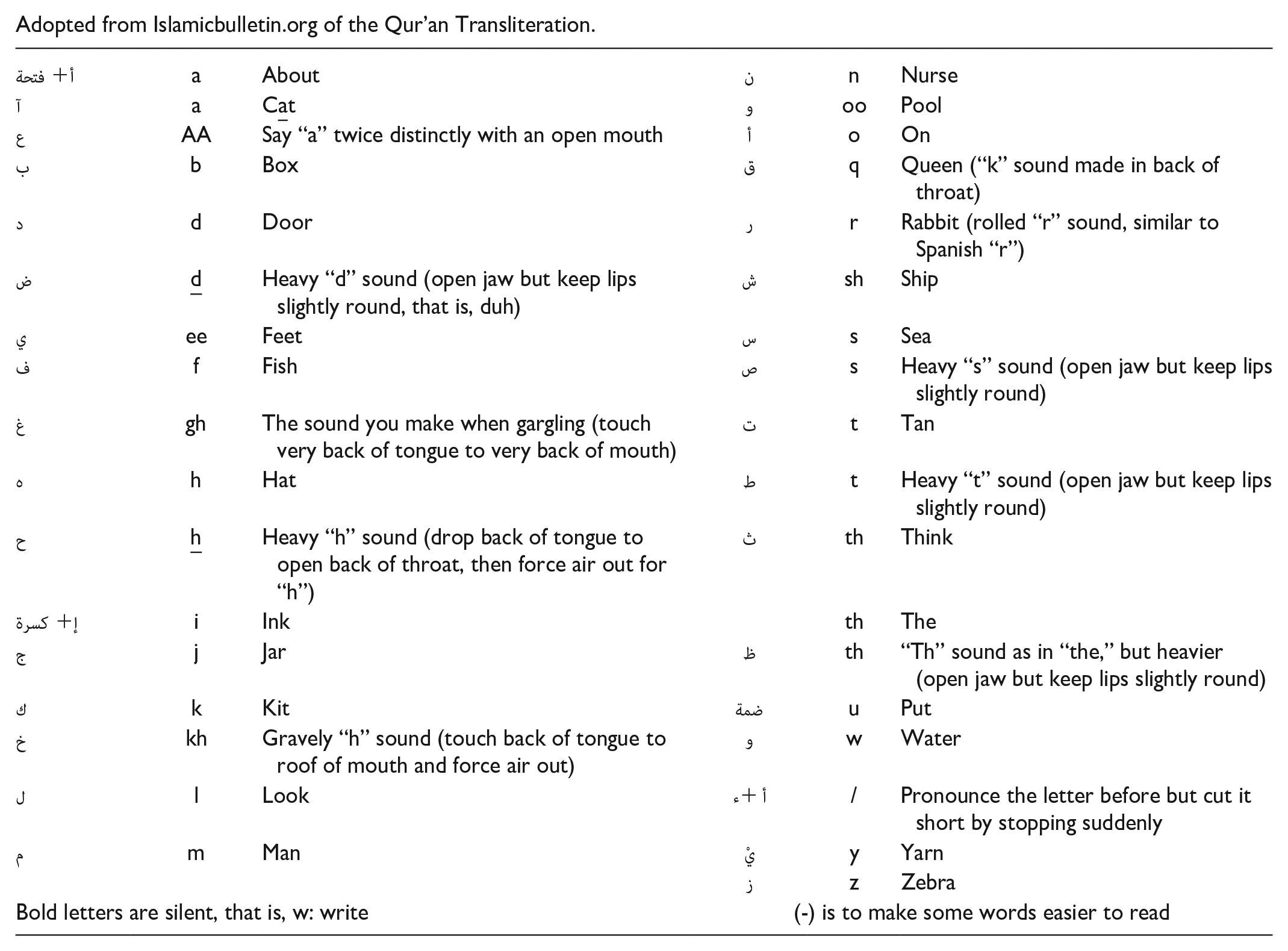
Adopted from Islamicbulletin.org of the Qur’an Transliteration.
| أ+ فتحة | a | About | ن | n | Nurse |
| آ | a | C |
و | oo | Pool |
| ع | AA | Say “a” twice distinctly with an open mouth | أ | o | On |
| ب | b | Box | ق | q | Queen (“k” sound made in back of throat) |
| د | d | Door | ر | r | Rabbit (rolled “r” sound, similar to Spanish “r”) |
| ض |
|
Heavy “d” sound (open jaw but keep lips slightly round, that is, duh) | ش | sh | Ship |
| ي | ee | Feet | س | s | Sea |
| ف | f | Fish | ص | s | Heavy “s” sound (open jaw but keep lips slightly round) |
| غ | gh | The sound you make when gargling (touch very back of tongue to very back of mouth) | ت | t | Tan |
| ه | h | Hat | ط | t | Heavy “t” sound (open jaw but keep lips slightly round) |
| ح |
|
Heavy “h” sound (drop back of tongue to open back of throat, then force air out for “h”) | ث | th | Think |
| i | Ink | th | The | ||
| ج | j | Jar | ظ | th | “Th” sound as in “the,” but heavier (open jaw but keep lips slightly round) |
| ك | k | Kit | ضمة | u | Put |
| خ | kh | Gravely “h” sound (touch back of tongue to roof of mouth and force air out) | و | w | Water |
| ل | l | Look | أ +ء | / | Pronounce the letter before but cut it short by stopping suddenly |
| م | m | Man | يْ | y | Yarn |
| ز | z | Zebra | |||
| Bold letters are silent, that is, w: write | (-) is to make some words easier to read | ||||
Declaration of conflicting interests
The author(s) declared no potential conflicts of interest with respect to the research, authorship, and/or publication of this article.
Funding
The author(s) received no financial support for the research, authorship, and/or publication of this article.
