




Abstract
This research aims to identify the factors affecting the adoption of Facebook commerce, in specific the adopted Facebook advertisements for both small and medium enterprises (SMEs) and how this contributes to enhancing such SMEs’ organizational performances. Specifically, ease of use, demographic targeting, interaction, and brand awareness are regarded as the key factors that can influence Facebook’s advertisements adoption. However, three organizational performance dimensions (efficiency, flexibility, and responsiveness) are considered to be the most significant areas of focus in this research. In this study, both the quantitative research approach and the descriptive research design were employed. Data were collected from different SMEs in Muscat and Dhofar in Oman, and the total valid questionnaires suitable for analysis reached 342. The participants were primarily from those who publicize their services through Facebook. Many statistical techniques including exploratory, confirmatory, and structural equation modeling have been adopted in this study; meanwhile, the quantitative data were analyzed using SPSS 25 and AMOS 25 softwares. The findings of this study suggested that the ease of use, demographic targeting, interaction, and brand awareness interpreted 20% of the variance in the Facebook advertisements as the dependent variable. However, Facebook advertisements as an independent variable were found to have a statistically significant effect on the SMEs’ performance dimensions (efficiency, flexibility, and responsiveness) with standard regressions of 0.66, 0.51, and 0.74, respectively, thereby explaining 44% of the variance in the efficiency, 26% of the variance in the flexibility, and 55% of the variance in the responsiveness. Regarding the researchers’ knowledge, this research stands out as the first research to highlight SMEs that measure statistically the relationship between the organizational performance dimensions and Facebook advertising as key social media tools within a unique context—such as Oman as an example of developing countries.
Keywords
Introduction
Ultimately transforming the way in which organizations operate and advertise their businesses today, recent ICT innovations assisted in this as well as the way we live. One of the business types affected by the new technology invention is the small and medium enterprises (SMEs). SMEs have become one of the key players in this economically complex era, and without keeping up with the latest marketing strategies’ tools, they can be exposed as being out of the race. Nevertheless, most SMEs realize that importance and have begun adopting social media and electronic commerce platforms with the aim of improving their marketing strategies, and as a consequence, their operational performance (Khan et al., 2016). Social media, however, has begun to attract and encourage many unemployed individuals to create their SMEs as supported by their governments (Bakaykina, 2013). In particular, they use Facebook as a relatively more social, interactive, and consumer-concentrated tool for business-to-business (B2B) organizations (Dahnil et al., 2014). However, many of the SMEs that sell their products and services on Facebook actually sell directly to the consumers. The use of Facebook by SMEs—as per (Carter, 2014)—has four main characteristics: (a) first, when dealing with either customers or other businesses, the business dealing approach is different; (b) Facebook is not suitable for business-to-business communication, whereas it is much more appropriate for business-to-consumers’ communication; (c) Facebook has more advantages in business-to-consumers interactions; and (d) Facebook offers better opportunities for new business entrepreneurs. Indeed, a study conducted by Carmichael and Cleave (2012) of the entrepreneurs who use Facebook for business-based advertisements revealed that Facebook advertisements can facilitate building relationships with consumers rather than advertising the products and services of the entrepreneurs. Generally, social media has influenced us by enhancing the life quality of individuals, rendering profitability to businesses, and by enabling easy interaction of the public with their government.
Furthermore, the Arab world is also not an exception. For example, to reinforce the overall economic conditions of Oman, the Omani government since 2012 has been focusing on SME growth. Starting in 2012, several programs have been initiated in Oman’s SMEs’ development and establishment to fight high unemployment rates. Indeed, according to Al-Badi and Alkawaz (2015), social media usage among the government agencies indicated that half of the Omani ministries—that is, nearly 46%—have been adopters of social media platforms. This can reveal the high importance of social media among the Omani governmental departments. Nevertheless, the penetration of Facebook in Oman was 18.9% in 2012, whereas in 2014 it reached 27.9%. Moreover, Facebook subscribers in Oman passed 800,000 in 2014, and between January and May of 2014 specifically, new users to Facebook accounted for 264,480 (Mourtada et al., 2014). In Oman, Facebook penetration has not only occurred in people belonging to the private sector but also among government officials to a great extent in recent times.
Figure 1 explains how social media channels such as Facebook, Twitter, YouTube, and WhatsApp have penetrated the Oman market. It is clear from this figure that Facebook’s penetration percentage is higher in Oman (86%), when compared with that of other social media websites such as WhatsApp (80%), YouTube (40%), and qTwitter (36%). Furthermore, Facebook usage has increased markedly among Omani businessmen for commercial purposes after its successful role in promoting business brands worldwide via its advertisement services. Meanwhile, Figure 2 illustrates the top five Omani brands that use Facebook as their primary marketing channel. They are, in order, Oman Air with 97,986 local fans and 896,618 total fans; Ooredoo Oman with 120,544 local fans and 185,551 total fans; Oman Air Arabic with 9,472 local fans and 142,459 total fans; the city center with 47,988 local fans and 101,917 total fans; and finally Omantel with 72,233 local fans and 98,858 total fans.

Use of social media channels in Oman.

Top five Omani brands in Facebook in 2015.
Furthermore, Oman offers good opportunities for startups and low budget companies to gain footprints rapidly through social media markets (Samuel & Sarprasatha, 2016). In addition, Oman also equips savvy marketers with the capability of rapid growth and profitability via e-commerce, PPC advertising, SEO (search engine optimization), and more, to ultimately encourage them to challenge other country’s online marketers (Oman Digital Marketing, 2012). However, while social media usage is considered to be an indispensable strategy for business promotions, its usage among Omani entrepreneurs is still not fully known, and neither are the impacts or changes that it could bring to their business owing to their lack of skills in digital technology usage (Ines, 2016; Umar, 2016). Therefore, this research aims to identify empirically the factors that are expected to affect SMEs when adopting Facebook as their primary advertising tool in their plan. Furthermore, it will measure to what extent this will help in enhancing the performance of SMEs. For that purpose, four factors may affect Facebook advertisement adoption namely, ease of use, demographic targeting, interaction, and brand awareness. Likewise, this research has considered efficiency, flexibility, and responsiveness as three vital organizational performance dimensions. This research focuses particularly on Oman to emphasize the importance of the usage of social media tools for the enhancement of business performance to Omani SMEs. Indeed, Facebook—as the most widely used social media platform in the Arab region—will be the primary social media platform under investigation for this study (KPSC, 2014). This research is expected to contribute to the knowledge body by increasing awareness of the importance of using social media as the primary marketing tool for enhancing Omani businesses’ performance. Ultimately, this is to make the best use of Facebook advertisements for the prosperity of their strategic goals. To this end, the remainder of this article is organized as follows: section “Literature Review” reviews the recent literature, section “Research Methodology” introduces the research methodology, and section “Data Analysis and Results” illustrates the data analysis and the study results. Meanwhile, section “Discussion and Implications” presents a discussion of the findings, while section “Conclusion” provides a conclusion to the research.
Literature Review
In most developing countries, SMEs’ efficiency is greatly assisted by the power of social media marketing. Specifically, the demographic targeting feature provided by social media renders the quality of the services offered by SMEs more accessible and easily ordered. Furthermore, the quality of services, cost utilization effectiveness, excellence in marketing, and the increased satisfaction of customers are among the major benefits that assist SMEs when using Facebook advertisements (Kithinji, 2014). Social media is argued to be more important for viewing both the business and customer aspects of any business (Chanthinok et al., 2015). Moreover, the findings of Parveen (2012) revealed that Facebook has been recognized as the most powerful medium in business practice. Furthermore, the study identified that the compatibility, relative advantage, entrepreneurial orientation, and ease of use features of social media advertisements have created a positive impact on the usage of social media by small- and medium-sized organizations. Meanwhile, Kiprotich et al. (2015) analyzed the moderating effect of social networking advertisements on the relationship between the orientation of entrepreneurs and the performance of SMEs in Kenya. Consequently, the study revealed that social networking advertisements positively moderate the relationship between the reactive nature of the entrepreneur and the SMEs’ performance.
It was further identified that the centrality of social network advertisements has facilitated entrepreneurial orientation by enhancing the capacity of the firms to access, identify, and mobilize the external resources that contribute to enhance the performance of an SME. For example, Ogunnaike and Kehinde (2013) identified in their study that electronic social media such as Facebook creates a significant impact on the sales turnover of the SMEs. Furthermore, physical social networks such as association of trade were found to have a significant impact on the efficiency of the business performance. The authors also concluded that social media networking is considered to be a worthwhile tool by many modern entrepreneurs when managing a successful business. Meanwhile, Galati et al. (2017) pointed out that social media websites are a key strategic marketing tool for any business in this era, in the context of supporting the business organizations when interacting with their customers, thereby enhancing their overall performance. However, SMEs, being price sensitive and short of much financial aid, are reluctant to spend money on IT and Web-based tools (Jagongo & Kinyua, 2013). Indeed, according to Subramaniam and Nakkeeran (2016), SMEs suffer from issues such as poor infrastructural and technical support, and lack clarity in the level of marketing strategy owing to minimum resources. On the other hand, Facebook advertisements provide flexibility for the entrepreneurs to advertise, interact, and gradually create relationships with customers at an expenditure that is far less when compared with that of the traditional advertising channels (Tikam, 2013). Consequently, as an integral part of their marketing strategy, the majority of current SMEs have begun utilizing social media. Therefore, the following section will discuss how Facebook advertisements could bring significant advantages to SMEs.
Demographic Targeting
Martin and Bavel (2013) stated that Facebook advertisements play key roles in actively engaging stakeholders, improving content creation, and targeting the intended clients. Likewise, Taneja and Toombs (2014) also analyzed the viability, visibility, and sustainability of small businesses that used social media for their business marketing, with their findings indicating that social media helped in reaching their demographic targets in very efficient ways. Furthermore, by tailoring the interests of the consumers toward enterprises services, this was identified as the primary factor for enhancing online and word-of-mouth communication. Another study conducted by Shields and Shelleman (2011) claimed that Facebook advertisements are the primary marketing tool for SMEs as they help them in increasing customer awareness toward the provided products and/or services. In addition, their conclusions showed that Facebook advertisements help SMEs to target a greater number of customers by promoting their business among consumers.
Ease of Use
This refers to the extent to which a user believes that transformation into electronic purchasing is easy (Alraja & Kashoob, 2019). Facebook advertisements act as successful marketing tools for endorsing business through presenting easy information to the consumers, alongside making the content more interactive and entertaining (Paquette, 2013). Similarly, Di Pietro and Pantano (2012) found that Facebook adverts facilitate presentation of the contents easily and enjoyably using the forms of games, applications, contests, polls, and so forth. This further helps businesses to attract large numbers of consumers toward a product or service. In addition, Razak et al. (2016) identified ease of use as one of the most important factors that render Facebook advertisements preferable by SMEs when marketing their products or services.
Interaction
To make business relationships across borders possible, Facebook advertising helps businesses interact with and build better relationships (Metcalfe et al., 2012). Specifically, interactivity, cost effectiveness (Prenaj, 2016), and trust are the primary variables that drive SMEs to select Facebook as a promotional tool for enhancing their business performance (Ainin et al., 2015; Prenaj, 2016). The authors pointed out that SMEs use social media technologies such as Facebook as a medium for communicating and collaborating with customers in a more efficient manner. Furthermore, enhancement of customer loyalty through a technology that supports compatibility and interactivity are the major benefits that persuade organizations to use Facebook advertisements (Öztamur & Karakadılar, 2014). In addition, the authors have identified that with Facebook advertising organizations are able to forge direct communication with the customers at low costs (Ainin et al., 2015).
Brand Awareness
According to Oestreicher-Singer and Zalmanson (2010), Facebook creates an impact on the brand awareness toward a product or service owing to huge community participation and reflection upon a product or service in online media. Consequently, positive and negative awareness of a brand becomes substantial even if it is experienced by one individual user. In their study, Haque et al. (2013)—conducted within the Malaysian context—proved that Facebook advertisements have generated significant impacts on the brand awareness of products and services among consumers owing to the various online communities. Likewise, Chigora (2016) studied the effects of social media on the branding of SMEs and identified how Facebook advertisements enhance brand recognition and increase the awareness of a particular brand among consumers. As such, even with its existing customers Facebook is able to attract new segments as well as continuing communication with its original users. According to Srinivasan et al. (2016), brand image, brand awareness, and brand association are the significant benefits of Facebook advertisements that, in turn, have enhanced their frequency of use by SMEs. Furthermore, Facebook’s advertisements have had an impact on the performance outcomes of SMEs at a higher level. For example, Hanaysha (2016) analyzed the importance of social media advertisements in enhancing brand equity in Malaysia. The study revealed that social media advertisements had a positive effect on the brand image, loyalty, preference, leadership, and brand awareness. Similarly, Musa et al. (2016) investigated the relationship between social media marketing and the performance of online SMEs. The authors identified that brand reputation image is enhanced for an organization when social media platforms are used for advertising. Furthermore, there is also an enhancement of organizational performance for SMEs, with the study also concluding that social media advertisements paved the way for enhancing brand awareness, thereby resulting in effective performance outcomes by SMEs. According to Grimshaw-Jones (2016), the Facebook platform acts as a tool that facilitates information exchange in a quick and easy manner between consumers and service providers. Ultimately persuading the buying intentions of the consumers, both brand image and equity are impacted significantly by Facebook advertising (Grimshaw-Jones, 2016). However, the performance of SMEs—according to Aramyan et al. (2007)—could be measured using the following major indicators: flexibility, efficiency, responsiveness, and quality. This research takes into consideration three of these dimensions for measuring the SMEs performance—namely, efficiency, flexibility, and responsiveness. Moreover, it explores how Facebook advertisements actually affect the efficiency, flexibility, and responsiveness of SMEs.
Efficiency
The main reason behind measuring the performance is to improve the efficiency (Adenso-Diaz, 2002). For instance, Roghanian et al. (2012) defined efficiency as the measure that appraises the ability of an organization to achieve its effective output. In other words, efficiency is the strategy of utilization of resources in such a way that they bring savings in money and time to the enterprise as well as enhancing the performance of the company in the long run. However, an efficiency target aims to increase the added value of the enterprise process and reduce the costs (Aramyan et al., 2007). In this context, one wishes to explore to what extent adopting Facebook advertisements can help SMEs achieve their goals through value generation and cost reductions.
Flexibility
In our context, the ability of a system to cope with changing circumstances caused by the environment is defined as flexibility (Kumar & Mishra, 2015). It can also be defined as the ability to restructure the system quickly, and as such flexibility reflects the enterprise’s ability to respond to variable environment changes (Persson & Olhager, 2002), as well as responding with agility to any new or transformed social networks. Accordingly, SMEs in Oman can adopt more effective tools to help react to unstable and inconstant environments—that is, to what extent Omani SMEs should utilize social media as a strategic tool to survive in such a volatile environment.
Responsiveness
Responsiveness can be defined as the capability of responding purposefully and in a timely way to the increased demand of the customers’ needs in the market place, to maintain their competitive advantage (Holweg, 2005; Persson & Olhager, 2002). More precisely, responsiveness reflects SMEs’ ability to provide customers with accurate information regarding recent products and services. Moreover, it imitates the ability to engage customers and respond to their concerns swiftly.
Conceptual Framework and Research Hypothesis
Figure 3 illustrates the conceptual framework of the impact of Facebook advertisements on enhancing the organizational performance of Omani SMEs.

The conceptual framework.

Tested model.
According to the above framework, the following research hypotheses can be derived for testing using statistical analysis:
Research Methodology
The aim of this study is to determine the factors that might affect the adoption of Facebook advertisements by SMEs and identify how Facebook contributes to improving their organizational performance. In addition, it will measure the impact of Facebook advertisements on the efficiency, flexibility, and responsiveness of Omani SMEs. The adopted research methodology is quantitative (Lincoln et al., 2011), while the adopted research approach is the deductive approach as the research is quantitative in nature and aims to test a new set of theoretical hypotheses (Thornberg, 2012). When conducting their research, it is indicated that the best research technique to be adopted by the researcher is the research design (Chia, 2002). Therefore, this study uses the descriptive research design, an approach that is best suited for the objective and quantitative research approach. Broadly, descriptive research helps the researchers to assess the hypothesis and attain results based on the test of an hypothesis (Saunders et al., 2012).
To collect the primary data, a sampling design provides the methodology with an appropriate respondent sample size (Ghauri & Grnhaug, 2005). Specifically, this research will adopt the clustering sampling method since Thompson (2012) argued that when the population of a research is comprised of homogeneous groups and can be distributed into sub-populations, cluster sampling is the most effective method to be utilized in the research. Consequently, in this particular study, the homogeneity lies among the population, especially as we are investigating the Omani SMEs’ context. Consequently, out of the numerous SMEs spread across various cities of Oman, they have been separated into geographical clusters. This study then focused on the SMEs in Muscat, and Dhofar in Oman. In addition to this, Thompson (2012) stated that even if the individual units are not known in detail to the researchers, cluster sampling can offer the convenience of selecting samples for data collection randomly. Hence, the researchers have distributed 420 questionnaires to owners/CEOs of SMEs, who own different types of business, and using Facebook as an additional advertising channel for their products and services. However, the researchers were able to return only 389 questionnaires. After studying the returned questionnaires, researchers discovered that 47 questionnaires were not valid for analysis. In many of them the questionnaire items had given the same answer, and in some of them the respondents did not complete answering all the questions. Consequently, the valid questionnaires for analysis were 342, which was 81% of those that were distributed. Muscat and Dhofar were chosen because they are one of the best locations in Oman where small and medium size businesses received support in performing their business strategy at better levels and allow them to achieve greater empowerment in the future, in addition to this a large proportion of Omani SMEs are located in these areas.
The questionnaire as the primary research instrument in this research was designed by the researchers after an extensive review of the present literature. This research tool contains three key sections: The first includes questions concerning demographical information; the second is designed to measure four constructs that denote the benefits or impacts of Facebook advertisement usage—namely, demographic targeting, ease of use, interaction, and brand awareness; and finally the third section of the questionnaire consists of items that measure the efficiency, flexibility, and responsiveness of SMEs and the constructs originally defined by Aramyan et al. (2007). However, to address the main research question in this study, scale-to-measure constructs have been developed by the researchers. The research has made use of the 5-point Likert-type scale and the questionnaire was translated into Arabic to allow easy understanding by the respondents who were not familiar or proficient with the English language. The prepared questionnaire has been piloted by a group of people who are expert in the field of social media and SMEs. Subsequently, according to the feedback from these experts, some alterations have been applied by ensuring the questionnaire is more accurate and precise. Moreover, to ensure that all the items of the final draft of the questionnaire are clear and free of ambiguity, another pilot study was conducted by a small sample comprising 20 CEOs from SMEs. Nevertheless, for testing the set hypotheses, we utilized different statistical tests such as validity and reliability tests—for example, internal consistency, normal distribution, construct validity, the common method bias, convergent validity, and reliability.
Data Analysis and Results
Exploratory Study
This research applied corrected item total correlations (CITC) to refine the adopted items of the scale. This analysis helps removing insignificant items that might affect the result of exploratory factor analysis (EFA). Consequently, the coefficients of all the items in the dataset were at the recommended value of 0.40 (Hair, 1998), as presented in Table 1. In addition, to ensure the internal consistency and validity of our investigated constructs, Cronbach’s alpha was applied with a threshold of 0.70 (Nunnally & Bernstein, 1994). However, the coefficients of all the study constructs exceed the specified threshold, and the results are displayed in Table 1. Moreover, the results of Skewness and Kurtosis statistics for each item was between +2 and −2 (Alraja et al., 2019; Cain et al., 2017) as they are shown in Table 1 which indicate that all the adopted items were normally distributed. Furthermore, Kaiser–Meyer–Olkin (KMO) test of sampling adequacy and Bartlett’s test of sphericity were performed to identify whether the EFA was suitable for the collected data. From Table 2, the KMO value for the dataset was above 0.60 while Bartlett’s test of sphericity had a p-value of <.001 (Ambulkar et al., 2015; Hair et al., 2010; Tabachnick & Fidell, 2007). Thus, the EFA can be conducted.
Means, Standard Deviation, CITC, Skewness, Kurtosis, Alpha, and EFA factor loadings.

Note. CITC = corrected item total correlations; EFA = exploratory factor analysis.
KMO and Bartlett’s Test.

In addition, using the principal component analysis with Varimax rotation, the results demonstrate that the loadings of the measurement items on their associated factors were above 0.40 (L. Carter & Evans, 2008; Dwivedi et al., 2006; Straub et al., 2004).
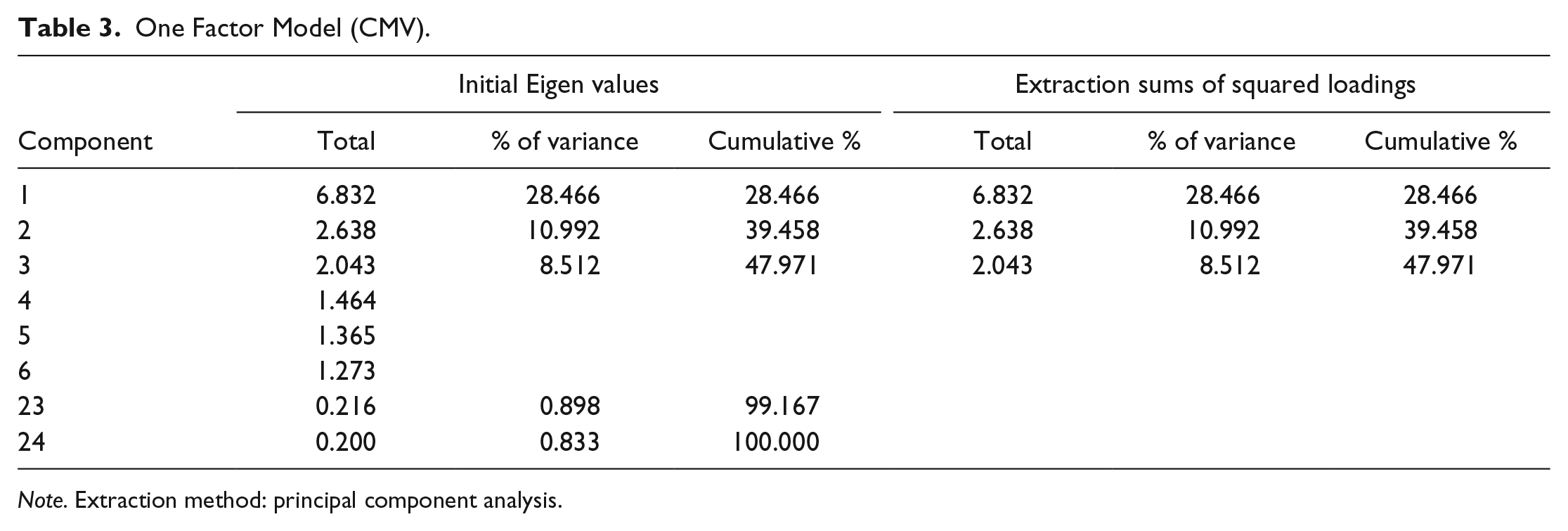
Furthermore, the extracted factor with the highest initial Eigen value, displayed in Table 3, comprised only 28.5% from the total variance which is less than 50% (Jakobsen & Jensen, 2015). Such results indicate that the common method bias was not detected in this particular study.
One Factor Model (CMV).
Note. Extraction method: principal component analysis.
Confirmatory Study
Confirmatory factor analysis (CFA) was conducted for all sets of items to determine the validity of the measurement model. Hence, the values of the fit indices of the CFA listed in Table 4 reached the accepted threshold.
Fit Indices of Confirmatory Model.

Note. GFI = goodness-of-fit index; CFI = comparative fit index; IFI = incremental fit index; TLI = Tucker–Lewis index; RMR = root mean square residual; RMSEA = root mean square error of approximation.
However, all the standard factor loads, listed in Table 5, were greater than 0.50. To confirm the estimates of reliability, the composite reliability was performed, and all constructs had values more than 0.70. These results conclude that the convergent validity can be determined. Moreover, thereby confirming the convergent validity, the average variance explained (AVE) was also calculated, with all the values exceeding the 0.50 threshold.
Confirmatory Factor Analysis Results.

Testing the Structural Model
Using structural equation modeling (SEM), the proposed model was examined.
The fit indices illustrate good fits as they are within their recommended values. Table 6 shows the fit indices of structural model.
Fit Indices of Structural Model.

Note. GFI = goodness-of-fit index; CFI = comparative fit index; IFI = incremental fit index; TLI = Tucker–Lewis index; RMR = root mean square residual; RMSEA = root mean square error of approximation.
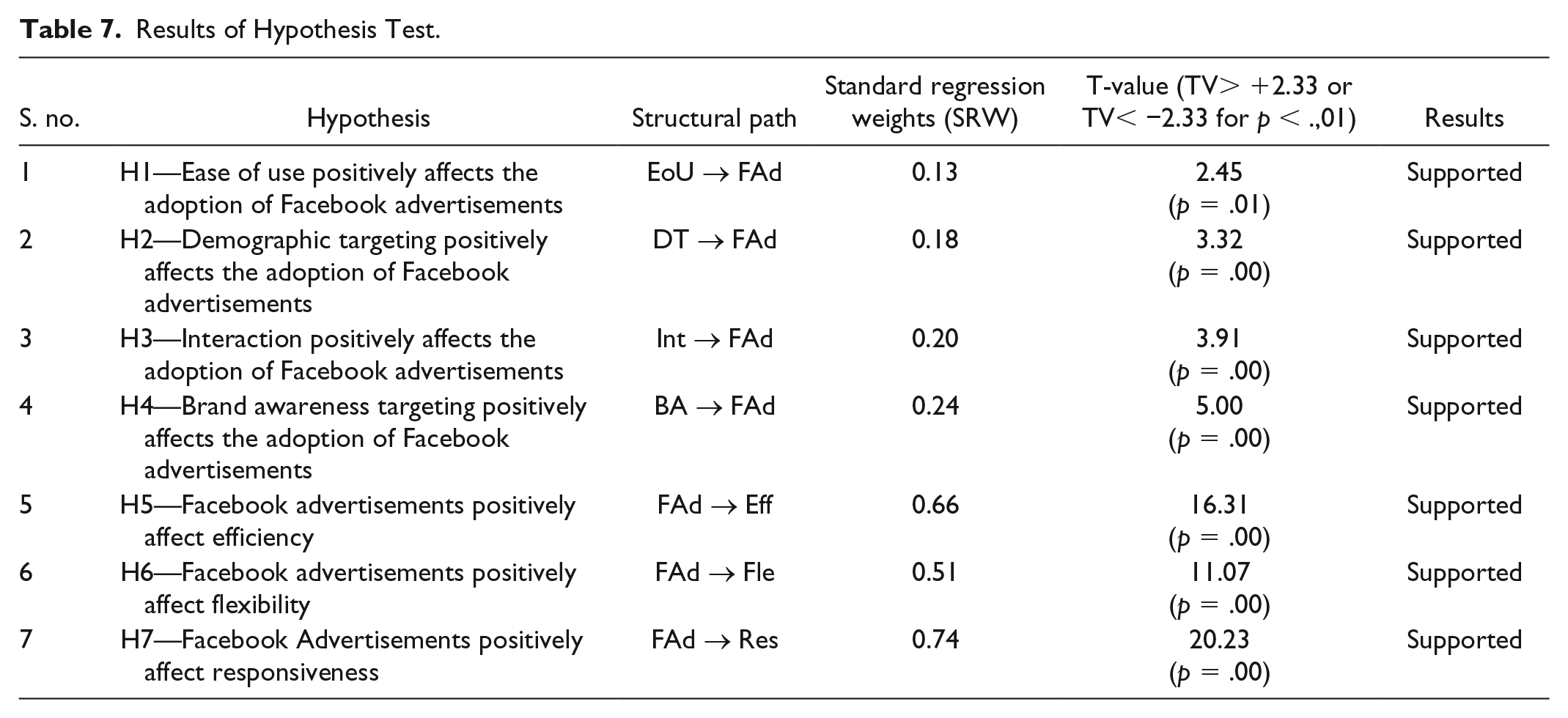
Nevertheless, to test the study’s hypotheses, the p-value had to be calculated, in addition to standard regression weights (SRWs) for each structural path and the path coefficients. The results revealed that the ease of use, demographic targeting, interaction, and brand awareness with SRWs of 0.13 (p = .01), 0.18 (p = .00), 0.20 (p = .00), and 0.24 (p = .00), respectively, interpreting 20% of variance in the Facebook advertisements as the dependent variable. Moreover, the results show that Facebook advertisements as an independent variable has a significant effect on certain dimensions of a SMEs performance (efficiency, flexibility, and responsiveness) with SRWs of 0.66 (p = .00), 0.51 (p = .00), and 0.74 (p = .00) respectively, explaining 44% of variance in the efficiency, 26% of variance in the flexibility, and 55% of the variance in the responsiveness. Table 7 demonstrates the hypothesis test which contains the hypotheses, structural path, SRWs and their p-value, and final results which either accept or reject the hypothesis. Finally, the following section will discuss these results in detail.
Results of Hypothesis Test.
Discussion and Implications
The main objective of this study was to investigate how the following factors—ease of use, demographic targeting, interaction, and brand awareness—can affect the administrators of SMEs to adopt Facebook advertisements and identify the extent to which the Facebook advertisements enhances the performance of SMEs by considering three dimensions of organizational performance, namely, efficiency, flexibility, and responsiveness.
This study shows that ease of use plays a significant role in determining whether SMEs adopt Facebook advertising, as shown in the findings. SRW = 0.13, t = 2.45 indicate that convincing the SMEs’ administrators to switch or at least embed this tool within their marketing strategy to promote their business is feasible. They know that customers will be more likely to buy the SMEs’ products and services if they expect easy entertainment and interaction, and more responsive tools to review the information of their products/services. Taking into consideration that creating and customizing a Facebook page does not require high technological skills and does not need heavy investments in technology, SMEs can easily use Facebook to customize it in a way that aligns with their strategic marketing goals. Therefore, adopting Facebook advertisements is an easy marketing tool to be used by the SMEs and for consumers to be accepted. Nonetheless, these findings are in line with Abdul Razak et al.’s (2016) results that found that ease of use is a very important factor that renders Facebook advertisements preferable over other marketing tools by business enterprises. Notwithstanding this, the lowest standard regression weight and t-value can be interpreted according to Venkatesh et al. (2003). This is because users with limited technological experience are more likely to be affected by the ease of use, as the enterprises usually employ staff with a minimum requirement of IT qualifications, but nonetheless sometimes have some weaknesses in terms of using social media to provide specific customized advertisements for each customer.
However, as a tool for promoting their services and/or products widely, SMEs should invest more in social commerce specifically its social media tools like Facebook. Furthermore, they should focus more on simplifying the adopted social media by following universal standards that can fit with diverse backgrounds. They also need, where possible, to train their marketing and IT staff on how to use social media and provide useful electronic tutorials on the social networks to help customers visit and use social networks effectively. Demographic targeting has a significant influence (SRW = 0.18, t = 3.32) on SMEs administrators to adopt Facebook advertisements in their enterprises. However, such results reflect that SME administrators are aware of the substantial role of Facebook advertisements in targeting the desired customers. Thus, unsurprisingly, as an efficient marketing tool for reaching the targeted demographic segments, Facebook advertisements can be employed. SMEs usually do not have enough capabilities to reach large numbers of customers using traditional communication methods. Therefore, SME administrators understand the importance of adopting Facebook advertisements as an exigency for their SMEs. Nonetheless, these findings are in line with the results of Martin (2013), Shields and Shelleman (2011), and Taneja and Toombs (2014) who found that social media—but particularly Facebook advertisements—actually help SMEs to reach their intended customers. Nevertheless, when targeting those specific clients, SMEs’ administrators should focus more on ensuring their posts are more accurate and up to date as this can affect their intentions to purchase. Subsequently, all the posted information should be carefully prepared, and it is better if this can be reviewed by specialists before posting.
Interaction (SRW = 0.20, t = 3.91) significantly affects the SME administrators in adopting Facebook advertisements in their business. It is apparent from this that SMEs’ administrators definitely recognize the significance of using Facebook advertisements as a powerful communication tool that help the enterprises provide direct and personalized answers to their customers’ queries. This result is correspondent with the findings of Ainin et al. (2015), Metcalfe et al. (2012), Öztamur and Karakadılar (2014), and Prenaj (2016) who mentioned that the Facebook advertisements result in building and interacting with more consumers effectively and efficiently. Moreover, the enterprises performance can usually be enhanced by utilizing Facebook advertisements as a means for promotional purposes to target effective segments regarding proper retargeting options. To engage people in effective interactions, SME administrators should provide intention to the shared content to customers, as this content should be informative and discussion-provoking. Therefore, the probability for more interactions can be increased especially when using Facebook Messenger if a private conversation with customers is required. Furthermore, SMEs’ managers should not wait for customers to request interaction, but rather they should take the initiative of engaging them in using their Facebook interactive features.
Regarding brand awareness, it has a significant impact (SRW = 0.24, t = 5.00) on the SMEs’ administrators when adopting Facebook advertisements in their enterprises. This is the most dominant factor of SME administrators when adopting Facebook advertisements. Such findings represent the strong beliefs of those administrators about adopting the Facebook advertisements in increasing the brand awareness. As the number of people using social media is drastically increasing, sharing their bad or good experiences about the consumed products and services is also going to grow. Moreover, SME managers are aware of the very important benefits of adopting Facebook advertisements when enhancing their brand recognition and increasing the mindfulness toward an enterprise brand among customers. In turn, this can improve the brand image, preferences, and customer loyalty. This result matches well with many findings (Chigora, 2016; Grimshaw-Jones, 2016; Hanaysha, 2016; Haque et al., 2013; Musa et al., 2016; Oestreicher-Singer & Zalmanson, 2010; Srinivasan et al., 2016), who all found that using social media for advertising has increased the enterprises’ brand reputation and image. Therefore, SMEs should take into consideration the quick response to customers’ concerns that should lead to improving the SMEs’ consistency. Moreover, any enterprise’s Facebook page should be assessed continuously to ensure a high rate of response among competitors. Specifically, this can be achieved by suggesting, uploading, and providing miscellaneous content. This diversity will help people enrich their experience of the company’s products and services. Ultimately, this will ensure the brand stays close to its customers by humanizing the SMEs’ brands.
By adopting Facebook advertisements, SMEs can achieve increased success, as evidenced by the research findings. This is seen in {efficiency (SRW = 0.66, t = 16.31), flexibility (SRW = 0.51, t = 11.07), and responsiveness (SRW = 0.74, t = 20.23)}. Such outcomes emphasize the perceptiveness of SMEs’ administrators in realizing the significant role of technology in helping their enterprises to properly utilize the available limited resources. This result is very special to SMEs as they have limited sources, that is, allowing them to perform their work effectively and efficiently while reducing their business costs and shortening the time required for achieving their enterprise goals. These results concur with the findings of Nair (2017) and Parveen et al. (2016), who showed that using social networks positively affects the organizations’ performance regarding efficiency, flexibility, and enhancement of responsiveness. However, SME administrators and owners should utilize Facebook advertisements in their strategic plans as both a strategic and powerful communication tool that leads to engagement with all the customers instantly with all the enterprise updates. This is especially through assisting the SMEs to do the right thing by choosing suitable options that meet all customers’ needs through using Facebook’s advertising system. This will ensure the enterprise advertisements are more agile, efficient, and tailored to consumers’ needs, with SMEs also using this system occasionally to remind consumers of low cost products, to understand their targeted niche, and to send personalized advertisements. Furthermore, Facebook will enable SMEs to understand single comments, pay individual attention to customers, and provide any required and fresh information. Moreover, interacting with customers and engaging them on Facebook will help SMEs to cope flexibly with all new situations and eliminate any uncertainty that affects customers’ decisions toward buying enterprise products and/or services.
Conclusion
Broadly, a country’s economic stability is reflected in successful business organizations. Certainly, SMEs play key roles in developing a country. SMEs in the Sultanate of Oman constitute 90% of the total corporate sector, but also generate most revenues, too. Over the last few years, social media penetration has increased in Oman, as demonstrated by this study. Consequently, using traditional media such as television, newspapers, and radio has become absolute and is not effective in maintaining competitive advantages. SMEs at Oman have begun using social media widely as an important marketing tool. This study shows clearly that Facebook has engaged a larger number of users compared with other social media platforms owing to the huge benefits provided to SMEs. The findings revealed that Facebook advertisements offer four major benefits: increasing brand awareness, ease of use, enhancing the customer’s interactions and service provider, and demographically targeting new segments. Looking from the theoretical perspective, this research has demonstrated the importance of social media advertisements, especially Facebook advertisements in creating direct impacts on the business performance of SMEs, especially in the Middle Eastern context. This research has also attempted to understand how business performance indicators defined by Aramyan et al. (2007) can individually be influenced when using Facebook advertisements to enhance the business performance. Accordingly, this study argues that adopting Facebook advertisements will increase the efficiency, responsiveness, and flexibility of the Omani SMEs in terms of offering services to their clients. Thus, in the long run, the overall performance can ultimately be enhanced for such organizations.
From practical perspectives where social media advertising becomes very popular and is broadly used by most business organizations, the results of this research can increase the SME owners’ or proprietors’ awareness in the Sultanate of Oman when understanding the needs of using Facebook advertisements, alongside the expected impact on moving their businesses to the next level. However, the findings of this study were limited to SMEs that are exclusively situated in Muscat and Dhofar in Oman. The sample size was limited to 342 SMEs administrators. Thus, to ensure the generalizability and consistency of the results, a larger sample size can be utilized in different Middle Eastern countries. Furthermore, the study could be extended further to other parts of the world and could be compared with the results obtained from the Omani context. While this study takes into consideration all business sectors, another study can be more focused on a specific business sector to understand in more detail the factors that most affect each particular industry when using Facebook advertisements.
Footnotes
Declaration of Conflicting Interests
The author(s) declared no potential conflicts of interest with respect to the research, authorship, and/or publication of this article.
Funding
The author(s) received no financial support for the research, authorship, and/or publication of this article.
