




Abstract
In this study, the relationships between the leadership styles of school principals, school culture, and organizational image are examined according to the teachers’ perceptions. The study is designed according to a relational survey model, and it consists of 370 teachers working in 20 schools in Selçuklu, Karatay, and Meram districts of Konya, Turkey. The leadership style scale of school principals (LSSSP), the scale for school culture (SSC), and the scale of the organizational image (SOI) were used as data collection tools. Pearson’s correlation, regression, and path analysis were used for analyzing data in addition to descriptive statistics. It was found that school principals manifest transformational leadership characteristics, the perception of school culture by the teachers is strong and the perception of the organizational image by the teachers is medium. It was also found that there are significant relationships between leadership styles, the school culture, and organizational image, along with the leadership style of school principals, which significantly predicted school culture, and school culture, which significantly predicted organizational image. School culture has a mediator effect on both leadership styles and the organizational image. This is due to the realization of the leadership styles that have an important role in developing an organizational image, through school culture. This research offers the presumptions that leadership manifested by the principal creates a positive effect on the members of the organization and contributes to the formation of strong school culture, in addition to leadership and school culture making a positive contribution to the organizational image of the educational institution.
Introduction
Today, social demands are emerging due to rapid changes and increasing needs that are affecting the educational process and forcing the educational institutions to be more dynamic. Educational institutions are one of the most important organizational structures, for which both input and products are basically “human.” Therefore, schools are organized to meet the needs of the information age of the 21st century and to identify, select, and educate students who have leadership potential. One of the basic aspects of these structures is the school administrator. Utilizing the human and material resources of educational institutes and sustaining their existence depend on an effective management approach, strong cultural texture, and strategic leadership that is compatible with the changing conditions of the world (Vélez et al., 2017; Yukl, 2008). Accordingly, sustainable leadership is of particular importance for schools, which are the organizations where education is carried out more than the other edifications.
There are 18 million students, more than 1 million teachers, and almost 81,000 school principals in the public and private schools (MEB, 2018a). School administrators working in educational institutions try to fulfill their administrative duties while simultaneously trying to adapt to the expectations of change and renewal. However, the lack of training directed at developing the professional and administrative capacities of school administrators can cause administrative problems in educational institutes. In addition to these, there is a basic expectation for school administrators to create an institutional identity that could respond to the necessities of the age, being a team, being productive and increasing the consciousness of humanity, and also managing unforeseen conditions, in addition to their administrative duties according to the education vision document 2023 of Turkey’s Ministry of National Education (MoNE; MEB, 2018b). However, there is a problem for policies related to the formation and assignment of school administrators: managerial arrangements are based on a technically oriented approach rather than a goal-oriented one. In recent years, positive developments have been observed in quantitative indicators such as enrollment rate, the number of classrooms, participation in education, and graduation rates in the Turkish National Education System (TMES; MEB, 2018b). On the contrary (OECD, 2015), the negative results in national and international reports and data from the Building the Future Report (United Nations Children’s Fund, 2017), Social Progress Index (2018), and Measurement, Selection and Placement Center (ÖSYM, 2018) manifest the problems directed at the quality of the education (Atasoy & Cemaloğlu, 2018). Thus, to achieve a sustainable structure in the school ecosystem, overcoming the administrative and instructional problems in the schools can only be realized with a strong school leadership (F. Altınay & Altınay, 2018; Cassano et al., 2019).
Another expectation for the school administrators is creating a strong school culture along with basic leadership aspects. Therefore, it is undeniable that they are able to demonstrate leadership behavior to establish positive relationships with all partners by activating the dynamics of the school under the administration of school administrators. Moreover, a positive organizational image forms the perception of the society directed at the educational institution, which acts as a form of institutional identity and reflects the value of the school. This is considered to be an important aspect for adapting the educational institution to environmental change and creating a sustainable organization (F. A. Altınay, 2015). In this framework, organizational image perception has increasing importance at the level of an educational institution. Specifically for the school administrators’ administrative approaches in the educational institution, how school culture and organizational image should be formed constitutes the main problem of this study. In this context, this research examines the relationships between leadership, school culture, and organizational image in educational institutions.
Leadership
Leadership is one of the most researched concepts, in terms of its characteristics in the historical process, which elements it contains, and which dimensions it consists of, conceptually. Leadership is the ability to mobilize a group of people gathered for specific purposes to achieve organizational goals and objectives (Bass et al., 2003). A leader is the one who has specific characteristic features that motivate individuals in the organization to help reach the common goal that conveys his or her experiences, the one who prepares them to change by interacting with them, motivates the staff by creating a synergy, exceeds the usual practices and authorities, and affects and directs the behaviors, beliefs, and attitudes of the staff who are under his or her management (F. A. Altınay, 2015; Aydın, 2010, p. 272).
The multidimensional field of leadership has led to different approaches and new developments, which demonstrates that leadership depends on personal aspects and progresses as various properties are determined: the behavioral approach, which mentions that leadership behaviors could be learned in the afterward; the modern leadership approach, which centers on human relationships in organizational structure; and the contingency approach, which emphasizes that different conditions require different leadership styles (Aydın, 2010; King & Vaiman, 2019). The progression of information technologies and knowledge with the changing economics and sociocultural life have affected the theoretical approaches to leadership since the 20th century (Drucker, 2011). Specifically, from the 1980s, through the changing points of view in the field, researchers started to mention leadership with a “transformation” aspect.
The contingency approach, which is a full-range theory of leadership that points out the complex structure of changing the environment and human relationships, is verbalized for the first time by Burns and improved by Bass and Avolio (Yukl, 2008). Multifactor leadership theory is one of the most researched theories in the social sciences field because it focuses on leadership and organizational effectiveness. However, there are different forms of this approach in the literature, and it is considered in three dimensions: transformational, transactional, and laissez-faire leadership styles (Hoy & Miskel, 2010). Transformational leadership places transformation, development, and human values at the forefront (Bass & Avolio, 1993) and is formed with idealized effects to inspire motivation, intellectual stimulation, and personal importance dimensions. Transformist leaders think, examine, and take risks for realizing tasks in the organization, in addition to imbuing certain notions and visions for organizational purposes in the employees of these organizations (Torres, 2019). Transactional leadership is defined as a leadership style that prioritizes the organizational achievements that are focused on the organization. The sub-dimensions of transactional leadership are conditional award, management with expectancy, and management with passive expectancy. Transactional leaders manifest a leadership style that focuses on the continuous accumulation of the productivity of employees over the organization’s history and they overlap with creativity and transformation. Laissez-faire leadership emerged in opposition to transformational and transactional leadership and refers to a managerial approach based on the absence of a leader in organizations and/or the indifference of the leader to the organization and its employees (Rowold & Schlotz, 2009).
In the literature, Morton et al. (2011) stated that school administrators were able to realize the transformation of their institutions thanks to their personality traits and abilities, and that the arrangements of leadership and administrative activities exhibited by the school administrator were necessary for institutional success. It was found that having a vision for a leader is important for reform, innovation, and change (Fasola et al., 2013), which affects proactive behaviors by affecting intrinsic motivation (Yi et al., 2019). Moreover, innovative and motivating school principals tend to exhibit more transformational leadership characteristics (Mi et al., 2019), and a visionary leader who structures a change-based leadership understanding is a reliable, respected social architect who constantly communicates with his or her followers. In addition, studies focused on areas such as the structure of leadership (Smith & Piele, 2006), teacher behaviors and student achievement (Leithwood & Jantzi, 2006), mobbing (Cemaloğlu, 2007), organizational cynicism (Güçlü et al., 2017), work, quality of life, and organizational commitment (Yalçın & Akan, 2016) enrich the literature.
School Culture
Organizations are formed with individuals who were raised in different social-cultural areas that have different rules and values. Moreover, the culture that defines a style of living for the society can be differentiated between the societies and between organizations (Katz & Kahn, 1977). Organizational culture becomes a concept consisting of the combination of the aims and activities of the organization with the social values, and the systematic examination of the people’s movements and attitudes within the organization. A strong organizational culture, which is adopted by management and employees with common beliefs and values, is extremely important in the formation of a structure that has achieved sustainable development (Cameron, 2012). One of these structures is the school organization, which emerged on the basis of organizational culture and gained a very important place in the field of education. The concept of school culture, especially after the 1980s, has been adapted to define the comprehensive character of the concept of organizational culture in educational institutions (Walker-Wied, 2005).
Therefore, regarding the main task of school administrators to create and form a strong school culture in educational institutions, school administrators should increase the commitment of the employees to the institution to meet individual expectations and to create a positive school culture (Lee & Louis, 2019). One of the main issues emphasized in the research on school culture is the strong and weak school culture. Schools that have a strong school culture are institutes where the students and teachers have a high motivation to learn and teach (N. Karadağ & Özdemir, 2015) and where sincere and honest relationships among school members and the sense of acting together become important. Administrators in such an environment have a clear sense of duty and purpose, develop positive relationships with the members of the organization, and transform the school as a sustainable structure into a learning organization with the participation of all partners (Şimşek, 2003). School culture is a very important factor that determines the perception of the school and the behavior patterns of all partners, especially teachers and students, in which the shared leadership style comes into play. Therefore, school culture is a phenomenon that affects the quality of human relationships in educational organizations and is also affected by the quality of these relationships. Common ideas that define the behavioral styles of the members of organization and assumptions, values, beliefs, along with the other aspects that create the identity of the organization’s members are considered to be the essential elements of school culture (Aslan et al., 2009, p. 271).
In the literature, research has manifested that the leadership behavior exhibited by school administrators strengthens the organizational commitment of the employees and increases the quality of work life (Akan et al., 2014), leadership styles, organizational health, and job satisfaction (Korkmaz, 2008); moreover, the organizational climate and working style fully mediate and complete the relationship between leadership style and job satisfaction (Moslehpour et al., 2019). In addition, there is evidence that the leadership exhibited by the school administrator plays an important role for sharing and growing the organizational culture of the institute (Avcı, 2016); in contrast, laissez-faire leadership has negative effects on the trust of the teachers in the school (Cemaloğlu & Kılınç, 2012), and there is a significant and negative direct relationship between transformative leadership and organizational cynicism (Byrne & Hochwarter, 2007; Güçlü et al., 2017; Sievers, 2007). Furthermore, studies have focused on the relationships of leadership with the components of organizations, and Aslan et al. (2009), Awbrey (2005), Carpenter (2015), Cemaloğlu (2007), Day et al. (2008), Medina et al. (2008), Ohlson (2009), Şahin (2010), Şimşek (2003), and Yalçın and Akan (2016) contribute to the literature.
Organizational Image
The organizational image can be defined as a general impression in the mind through the perception of the organizational purpose, aims, and values (Gregory, 2004; Uğurlu & Ceylan, 2013). This image has an important effect on the success and dignity of the organization by creating a tangible perception on all partners. When the effect is positive, this plays an important role in achieving a sustainable structure for the organization. Because of this feature, the positive image of the institution creates trust and commitment in the members of the organization and individuals outside the organization, creates faith and commitment, and forms the existence of the sustainable organization in the mind by affecting the organizational outputs directly or indirectly.
Every institution has a positive or negative image. This is also true for educational institutions. Currently, a positive organizational image is essential for the continuation of the organization’s existence and strategic achievement of the school. The school’s level of culture for the members of the institution and the leadership behaviors that are exhibited by school administrators determine a negative or positive image. Therefore, the school administrator has the key role in creating a positive image. The school administrator should build a strong foundation for long-term transactional development in the structure of the school and the understanding of management for creating a strong image by making a modification. This structure affects the inner image, and the performance of the partners would be increased by providing a perception of the school as good by teachers, students, and parents. This situation would affect the outer image by functioning as a mirror to the target audience. The abstract image would be positively affected by the institute’s response to the demands of both inner and outer environments by providing emotional benefits (quoted by Şişli & Köse, 2013, p. 169). Accordingly, the primary duty of a school administrator is to determine the level of organizational image perception, study the positive image perception aims, and take necessary measures for providing sustainability (Polat, 2011).
From the literature, it is evident that the researches have focused on the relationship between the organizational image, the leadership, and the organizational components. One of the factors that affect the image perception of the educational institutes is the quality of the management of the schools; in contrast, there is a positive relationship between the level of demand of school administrators for changing and innovation, and the organizational image (Palacio et al., 2002). Organizational image affects social perception in academic, physical, and social environments, contributes to the modification of organizational culture (Bektaş, 2010), and increases the ability to feel good (well-being) psychologically (Aityan & Gupta, 2012) by fortifying the commitment of the organization’s employees to the institute (Gadot, 2003). Moreover, the studies conducted by some of the researchers (Bakioğlu & Bahçeci, 2010; Lievens et al., 2007; Polat, 2011; Rynes & Barber, 1990; Sartore-Baldwin & Walker, 2011; Şanlı & Arabacı, 2017; Şişli & Köse, 2013; Tsai & Yang, 2010; Uğurlu & Ceylan, 2013) add wealth to the literature. Furthermore, it is seen that the relationships between leadership and organizational structure are examined (Abasilim et al., 2019; Akcil et al., 2018; F. Altınay et al., 2019; Bendikson, 2012; Döş & Savaş, 2015; Mitchell & Sackney, 2016; Murphy & Torre, 2015; Ng, 2013; Orsdemir et al., 2019; Ozberk & Altinay, 2019; Saini, & Goswami, 2019; Tokel et al., 2019; Ünler & Kılıç, 2019; Yıkıcı et al., 2019; Yasir et al., 2016). There are also studies that focus on the relationship between organizational structure and organizational image (Cerit, 2006; Duarte et al., 2010; Helgesen, & Nesset, 2007; Luque-Martínez, & Del Barrio-García, 2009; McGrath, 2002; Metcalfe, 2012; Polat, 2011; Sung & Yang, 2008; Tight, 2007). However, a study linking the relationship between the three research variables could not be seen in the literature review. This is also the focus of this research. The outcomes obtained from the bilateral relationships between the concepts of research show that leadership affects school culture in a positive way and there is a close relationship between school cultures and an organizational image. However, no research has been found that focuses on how the leadership style performed by the school administrators affects the school culture and organizational image, how the relationships between the variables are shaped as leadership styles differ, or examines the relationships between the research variables. Therefore, determining the mediator role of school culture between leadership styles and an organizational image could reveal more holistic results by determining the relationships between the variables, and the new interpretations and inferences contribute to the practitioners by determining the present situation.
The general purpose of this research is to determine the relationships between the leadership styles of school administrators, school culture, and organizational culture according to the opinions of the teachers. Within the scope of this aim, the answers to the following questions were sought according to the opinions of the teachers:
What are the perceptions of the teachers on the leadership styles of school administrators, school culture, and organizational image?
Is there a significant relationship between the teachers’ perceptions of the leadership style of school administrators, school culture, and organizational image?
Does the school culture have any mediator effect on the relationship between the leadership styles of school administrators and the organizational image?
Materials and Methods
This research, which examined the relationships between the leadership of school administrators, school culture, and the organizational image is performed in a relational survey model. The relational survey model is a model used to determine the presence or level of co-change with two or more variables (Karasar, 2009). The mediator role of the school culture in the relationship between the leadership styles of school administrators and the organizational image is tested by forming a model. In this scope, leadership is designed as an independent variable, organizational image is designed as a dependent variable, and school culture is designed as both an independent and dependent variable.
Population and Sampling
The population of this research consists of Imam Hatip Schools (IHSs) [Religious Vocational High Schools] in three central districts of Konya (Karatay, Selçuklu, and Meram). In this context, the list containing all IHSs’ information was obtained from Konya Province National Education Directorate, Department of the Strategy Development. It is found that 22 IHSs and 1,100 teachers are detected in these schools of three center districts of Konya province. The number of teachers in all schools was taken into consideration during the sampling process. The sampling of the research consists of 370 teachers who were selected by random sampling. In measuring the sample groups’ representative power of the research population, the confidence interval (CI) was accepted to be 0.95 and the margin of error was 0.05. Based on these figures, the minimum sampling size to represent the population of 1,100 teachers was calculated to be 285 (Büyüköztürk, 2008). The obtained results showed that the representative power of the research sample consisting of 370 units can be said to be sufficient. Descriptive characteristics of the study sampling are presented in Table 1.
Descriptive Characteristics of the Study Sampling.

For the 370 teachers who were examined in Table 1, the following characteristics were gleaned: 174 are female (47.02%) and 196 are male (52.98%); 290 teachers graduated (78.38%) and 80 of them are postgraduates (21.62%); 100 teachers (27.02%) have 10 years or less of professional seniority; 167 (45.13 %) have 11 to 20 years of professional seniority; and 103 (27.83 %) have 21 years or more of professional seniority. It is evident that 156 of the teachers (42.16%) officiated in the current educational institute for 1 to 2 years, 119 (32.16%) officiated for 3 to 4 years, and 95 of them (25.68%) officiated for 5 years and more in the current educational institute.
Data Collecting Tools
A data collection tool that consisted of four sections—personal information, leadership style scale of school principals (LSSSP), school culture scale (SCS), and organizational image scale (OIS)—was used in the research. The necessary permissions were obtained from the people who developed the scale by email. Information about data collection tools is given below.
The LSSSP was developed by Akan et al. (2014). This scale consists of 35 items and three sub-dimensions and is a 5-point Likert-type scale that ranges from “strongly disagree” to “strongly agree.” The Cronbach’s alpha values of the sub-dimensions of the 35-item LSSSP were as follows: transformational leadership style = .96, transactional leadership style = .85, and laissez-faire leadership style = .82. Some of the examples for the statements in the scale are as follows: “He or she guides us by his or her behaviors”; “He or she does not seem to be into the school at all”; and “He or she intervenes when things do not go well.” The Cronbach’s alpha value is .70 in the scope of the research.
The SCS was developed by Şimşek (2003) and consists of 35 items and 13 sub-dimensions. It is a 5-point Likert-type scale that ranges from “strongly disagree” to “strongly agree.” The Cronbach’s alpha value of the scale of the 35 items is calculated as .96 in the scope of the scale. Some of the examples for the statements in the scale are as follows: “I am happy to work at my school”; “Everyone does their best to make the school successful”; and “It is possible to see teachers at school outside of office hours.” Cronbach’s alpha value of the scale is .96 in the scope of the research.
The OIS was developed by Kazoleas et al. (2001) and adapted to Turkish by Polat et al. (2010). However, the scale is for defining the organizational image of the universities, and it is used in this research with the form that was adapted to secondary educational institutions by Uğurlu and Ceylan (2013). OIS consists of 31 items and five sub-dimensions and is a 5-point Likert-type scale that ranges from “strongly disagree” to “strongly agree.” The Cronbach’s alpha value of the scale is calculated as .91. Some of the examples of the statements in the scale are as follows: “Different ideas are respected, treated equally and given the opportunity to live”; “Teachers are focused on providing quality education”; and “Appearance/landscaping is good.” The Cronbach’s alpha value of the scale is .92.
Analysis of Data
The data of the research were collected in the fall term of the 2018–2019 educational year. The ethical permission certificate and official permission from the Konya Province Directorate of National Education were obtained for the implementation of the scales mentioned above in the related schools. The scales were applied to the teachers who officiated in the institutions used in the research through making the necessary explanations by the researcher. Consent forms were obtained from the participants and the data collection process was conducted on a voluntary basis. The scale application took 20 min on average. Of the 400 data examined, 30 data were not included in the study due to incomplete applications or multiple options being marked. In addition, two school administrators did not want to participate in the research because they had just started their duties. Data were analyzed using SPSS for Windows 21 program. The data set was formed from the 370 data that were transferred to the computer. Frequency and percentage values were calculated to determine the demographic characteristics of teachers (gender, education level, seniority, and tenure at the current school). In the analysis of the data, arithmetic means, standard deviation, frequency, Pearson’s correlation, regression, path analysis, and the Sobel test for significance were used. The arithmetic means were interpreted for leadership styles and organizational image; intervals of 1.00–1.79 were accepted as considerable low, 1.80–2.59 as low, 2.60–3.39 as medium, 3.40–4.19 as strong, and 4.20–5.00 as very strong. Interpretations for the intervals for the strong and weak aspects of the school cultures were as follows: intervals of 1.00–1.79 were accepted as considerable weak, 1.80–2.59 as weak, 2.60–3.39 as medium, 3.40–4.19 as strong, and 4.20–5.00 as very strong. For Pearson’s correlation analysis interpretation, the value 0.00–0.25 was accepted as too weak relationship, 0.26–0.49 as weak relationship, 0.50–0.69 as medium relationship, 0.70–0.89 as high relationship, and 0.90–1.00 as very high relationship.
Before analyzing the data set, the data to be used in the research were analyzed to determine whether they met the assumptions of normality, missing values, outlier data, multicollinearity, and variance homogeneity. First, frequency values and Mahalanobis distances were used to determine whether there were outliers in the data. In this context, nine outliers and 17 missing values were found and removed from the analysis. Four questionnaires were not included in the analysis because no feedback was obtained (Tabachnick & Fidell, 2013).
The analyses realized for the distribution of normality and the variation coefficients of the data were in the acceptable range (18%–25%). However, skewness and kurtosis values were found to be less than ±1 (−.30 to −.32), and the histograms and Q–Q graph distributions were normal. Tabachnick and Fidell (2013) considered the skewness and kurtosis values to be within ±1.5 limits for normal distribution. In addition, it was recommended that all the methods mentioned above should be evaluated together with the assumption of normal distribution (McKillup, 2012; Stevens, 2009).
When the linear regression analysis results of leadership skills and organizational culture and organizational image variables were examined for each variable, the variance inflation factor (VIF) values were in the range of 1.56–1.89, the CI values were between 6.68, 13.74, and 27.40, and the tolerance values were quite high (5.57, 6.40, 7.35). Thus, the multicollinearity assumptions were met for the independent variables.
Results
Descriptive Statistics and Pearson’s Correlation Findings
The findings of arithmetical mean, standard deviation, and Pearson’s correlation analysis for determining the relationship level between the variables concerning the perception of the teachers for the leadership styles of school administrators, school culture, and organizational image, regarding the first and second sub-problems of the research, are shown in Table 2.
Descriptive Statistics and Correlation Analysis Findings on Research Variables and Sub-Dimensions.

p < .05. ** p < .01.
From Table 2, it is evident that the transformational leadership style perception of the teachers is on high level (M = 3.85, SD = ±0.63); the transactional leadership style perception of teachers is on medium level (M = 2.85, SD = ±0.56); and the laissez-faire leadership style perception of the teachers is on low level (M = 2.15, SD = ±0.64).
Teachers responded strongly to the school culture (M = 3.86, SD = ±0.57) and all sub-dimensions. Sub-dimensions of the school culture are shown below: organizational commitment (M = 3.87, SD = ±0.68), facilitating values (M = 3.82, SD = ±0.67), human resources development (M = 3.89, SD = ±0.72), positive human relationships (M = 4.06, SD = ±0.77), effective communication (M = 3.77, SD = ±0.77), long-term employment (M = 3.78, SD = ±0.75), cooperation and trust (M = 4.08, SD = ±0.76), high motivation and productivity (M = 3.86, SD = ±0.73), control and discipline (M = 3.77, SD = ±0.74), clarity of the role and behavior guidance (M = 3.94, SD = ±0.69), teacher effort and student achievement (M = 3.69, SD = ±0.75), democratic governance and participation (M = 3.76, SD = ±0.86), and characteristics of the principal (M = 3.92, SD = ±0.68).
It is evident that the perception of the teachers for general organizational image is on medium level (M = 3.30, SD = ±0.59). The sub-dimensions of organizational image are as follows: with image of quality, it is on strong level (M = 3.68, SD = ±0.73); with appearance image, it is on strong level (M = 3.77, SD = ±0.81); with social image, it is on medium level (M = 3.35, SD = ±0.72); with infrastructure image, it is on medium level (M = 3.03, SD = ±0.80); and with program image, it is on weak level (M =2.69, SD = ±0.62).
Due to the correlation analysis of the variables placed in Table 2, it is evident that there is a weak (r = −.33, p < .01) relationship between the transformational leadership style and the transactional leadership style; the laissez-faire leadership style (r = −.60, p < .01) is negative and has a medium significant relationship. There is a significant, medium, and positive relationship between the transformational leadership and general school culture and all sub-dimensions (r = .65, p < .05). There is a significant and high-level relationship between the transformational leadership and the sub-dimension of the characteristic of the school principal (r = .76, p < .05). There is a weak and negative relationship between the transactional leadership style and the general school culture (r = −.10, p < .05), the sub-dimensions of the development of human resources (r = −.11, p < .05), effective communication (r = −.11, p < .05), democratic management and participation (r = .15, p < .05), and the characteristics of the school principal (r = −.23, p < .05). There is a weak and negative relationship between the laissez-faire leadership style and the general school culture (r = −.32, p < .05), along with all the other sub-dimensions except for the teachers’ effort and student success (r = −.09, p < .05). There is a medium and positive relationship between a transformational leadership style and the general organizational image and all sub-dimensions (r =.53, p < .05). There is no significant relationship between the transactional leadership style and the general organizational image and all the sub-dimensions (p > .05). It was found that there is a weak and significant negative relationship between the laissez-faire leadership style and the general organizational image (r = −.17, p < .05) and quality image (r = −.22, p < .05), appearance image (r = −.13, p < .05), and social image (r = −.19, p < .05) sub-dimensions.
Findings on Regression and Path Analyses
Structural equation modeling was used to determine whether the independent variables were a significant predictor of the dependent variables related to the third sub-dimension of the research. The mediator can be defined as a third variable with a productive mechanism that allows a given argument to affect a particular dependent variable (MacKinnon et al., 2007). According to the criteria of Baron and Kenny (1986), the relationship between mediator variable and predictor variable should be significant; there should be a significant relationship between both variables when both variables are entered into the regression analysis synchronically. When the mediator variable and predictor variable enter the regression analysis synchronically, the relationship between them is either no longer significant or the previous level of significance should decrease. In the current research, leadership styles were analyzed as an independent variable, school culture as a dependent and independent variable, organizational image as a dependent variable, and whether or not school culture had a mediating role in the relationship between the dependent and independent variables. An important effect of the leadership styles on the organizational image is examined in Figure 1 for testing the mediation.

Path diagram on the effect of leadership styles on organizational image (Model 1).
It is evident that leadership styles significantly predicted, statistically, the organizational image according to Figure 1. (β = .25, p < .05). Whether or not it has a significant effect on the school culture which is the second independent variable, on the organizational image alone is shown in Figure 2.
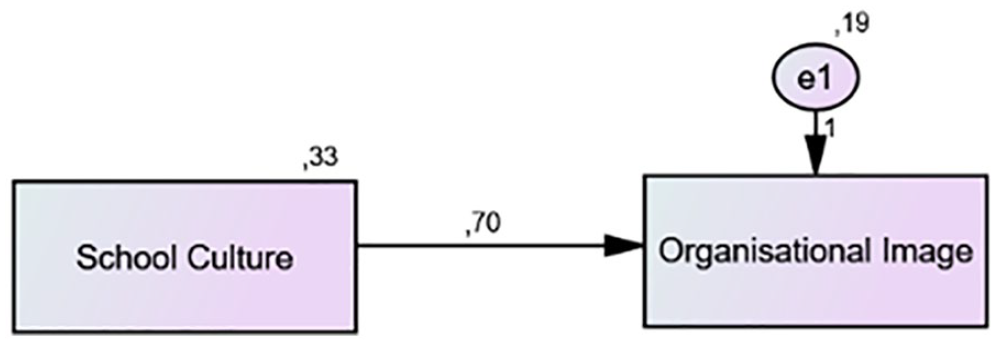
Path diagram on the effect of school culture on the organizational image (Model 2).
It was found that school culture predicted the organizational image significantly according to Figure 2 (β = .70, p < .05). Moreover, in Figures 1 and 2, both leadership styles and the school culture significantly predict the organizational image. According to this, the criteria considered necessary by Baron and Kenny (1986) were provided. The path diagram results on the mediator role of the school culture between the leadership styles and organizational image are shown in Figure 3.

Path diagram on the mediator role of school culture between leadership styles and organizational image (Model 3).
The goodness-of-fit index of the models that were formed to examine the mediator role of school culture between leadership styles and the organizational image is shown in Table 3.
Results of Goodness-of-Fit Belong to the Models.

According to Kline (2005), if χ2/df (chi-square/degrees of freedom) is lower than 3, it manifests a perfect fit; if it is between 3 and 5, it manifests an acceptable fit. According to this, Models 1 and 3 are in acceptable limits in terms of χ2/df. For the root mean square error approximation (RMSEA), which is in the range of 0.05–0.08 for Models 1 and 3, Models 1 and 3 have an acceptable fit, in terms of RMSEA, while RMSEA cannot be calculated for Model 2. If the calculated values for the normed fit index (NFI), comparative fit index (CFI), and goodness-of-fit index (GFI) are in the range of 0.90–0.95, this manifests the acceptable fit (Tabachnick & Fidell, 2013). It was evident that these three models have the perfect fit in terms of NFI, CFI, and GFI. Thus, it is determined that the created model has a good fit and it can be used for testing the mediation.
It was evident that the leadership style predicts the organizational image significantly according to the findings mentioned in Table 4 (β = .251, p < .05). It was found that school culture significantly predicts the organizational image (β = .700, p < .05). When the leadership styles and school culture were included in the model, the prediction level of leadership styles to the organizational image decreased, but was significant. The school culture has a partial mediator role between leadership styles and organizational image; therefore, the results of the Sobel tests, which were performed for the significance of mediating, were significant (z = 6.31, p < .05).
Regression Results of the Models.

p < 0.05.
These analyses indicate that conduction of mediation analysis in the model is feasible. The direct, indirect, and total effects are also calculated based on the effect calculation method for the model to see the power and level of relationships among the variables (MacKinnon, 2008). Analysis results of the direct, indirect, that is, the effect of mediator(s) on the dependent variable, and total effects in the model are shown in Table 5.
Direct, Indirect, and Total Effect Coefficients of the Latent Variables.

Note. All the values in the table are standardized beta coefficients (β).
The significance level of all the values is p < .01.
According to Figure 3, the relationship between leadership styles and organizational image is statistically significant, positive, and low level at first (β =.25, p < .01); but when the mediator is added into the model, the standardized path coefficient decreases (β = −.10, p > .01). In other words, school culture has a partial mediated effect on the relationship between leadership styles and organizational image. It is also found that the indirect effect, (β = .428 × .626), ([leadership/school culture] × [school culture/organizational image]), is β = .26. The level of indirect effects is moderate. However, it can be seen that the total effects (β =.36, p < .01) have a significant contribution to the model.
Discussion, Conclusion, and Suggestion
The leadership styles of the school administrators with school culture and organizational image perception levels were examined based on the data of the sampling that consisted of 370 teachers, in this research. In addition, relationships between the variables and the mediator role of the school culture between the leadership styles and the organizational image were researched.
The results of the research show that the level of the transformational leadership style of the school administrators is high, the level of transactional leadership is medium, and the level of the laissez-faire leadership style is low in the educational institutes where the teachers officiated. This research has a similarity to the other researches on leadership styles conducted in different school types in the literature (Akan & Yalçın, 2015; Avcı, 2016; Cemaloğlu, 2007; Cemaloğlu & Kılınç, 2012; Korkmaz, 2006, 2008; Şahin, 2011). It is evident that the transactional leadership style is performed at a medium level in the scope of the research. However, although the common treatment of the transformational and transactional leadership styles is to perform the organizational purpose, it was found that there are negative relationships between these two leadership styles. Burns (1978) states that in the relationship between transformational and transactional leadership, these two leadership styles consistently represent two opposite poles of a whole (narrated by Cemaloğlu, 2007, p. 83). This situation supports the opinions that transformational leadership positively contributes to all individuals for adopting the purposes of the educational institutions and the realization of student achievements and effective leadership behaviors (Shivers, 1999). Moreover, the effect of the transformational leadership on the performances of the employees (Piccola & Colquitt, 2006) with the functionality of the organizational structures contributes more than transactional leadership (Pillai et al., 1999).
Another result of the study is that the perception of the school culture of teachers is strong. The strongest school culture aspect that emerged was cooperation and trust. Cooperation was mentioned as an aspect of a strong school culture in the researches performed by Aslan et al. (2009), Saphier and King (1985), Şahin (2010), and Şahin-Fırat (2009), and trust was mentioned as an aspect of strong school culture by these same authors in the literature; thus, these researches support the findings of this study. In some researches that analyzed the aspects of strong and weak school culture, it was evident that strong aspects can be differentiated. While Angus et al. (2009), Aslan et al. (2009), Demirtaş (2010), and Saphier and King (1985) emphasize common purposes, Yıldırım et al. (2016) count being student-centered as a strong aspect of school culture. Thus, different aspects come forward in different researches focused on being strong or weak in school culture. It is thought that the reason is the differentiation of the common cultural factors appropriate to each school.
Cooperation and trust are very important aspects of the efficiency and productivity of educational institutions. Thus, the presence of relationships founded on cooperation and trust allow the formation of strong school cultures by affecting the productivity and performances of the school partners (Kukla-Acevedo, 2009; Sebring & Bryk, 2000). Understanding the characteristics of the school administrators by teachers in the relationships between school cultures and a transformational leadership can be the evidence that a school administrator would be the determinant for constructing a sustainable structure in an educational institute.
Furthermore, the organizational image perception of teachers is at medium level in the scope of the research. The results of the researches conducted by Şanlı and Arabacı (2017), Polat (2011), and Uğurlu and Ceylan (2013) support the findings of this research. In some researches of the literature, the organizational image perception of the teachers is high (Akman & Özdemir, 2019) and positive (Erdoğdu et al., 2013). It is remarkable, regarding the studies examined in the literature, that generally, the organizational images of the educational institutes were not negative. The positive opinions of the teachers can be explained by the development of the managerial adequacy in the educational institutions that cause a willingness of the teachers to work in the institutes (Borman & Dowling, 2006; Ingersoll, 2001) and a positive impression is given to the teachers by the increasing service quality (Trank et al., 2002). In recent years, although the infrastructure and technological investments in educational institutions have increased (TEDMEM, 2019), teachers have perceived the infrastructure and program image dimensions of educational institutions to be at a relatively weak level. An organizational image that focuses solely on appearance and quality may not be sufficient to create a sustainable structure in educational institutions. For an educational institution to be effective, it is expected that the image perceptions of all dimensions should be similar.
In the scope of the research, relationships between leadership styles and school culture were explored. The results showed that there is a significant relationship between transformational leadership and school culture. These results support the previous results of the former researches conducted by Avcı (2016), Erdem and Dikici (2009), Mendel et al. (2002), Şahin (2006), and Zembat et al. (2011). In contrast, there is a negative relationship between transactional leadership and laissez-faire leadership. There is a significant relationship between a transactional leadership style and school culture in the research conducted by Şahin (2011). Strong properties of either transformational leadership or transactional leadership are desirable aspects for educational institutions, and it can be posited that transformational leadership would be more open to the reforms directed at the sustainability of the institutional structure of the educational institutions. Transactional leadership seems weak for meeting the current expectancy of being open to reforms and innovations, the motivation of the employees with punishment and reward, and promoting team spirit by school administrators (Avcı, 2016; Hoy & Miskel, 2010; Leithwood & Jantzi, 2006).
There is a significant relationship between transformational leadership and an organizational image for the relationship of variables in the research. It is evident that there is no significant relationship between the transactional leadership and organizational image, but there is a negative relationship between laissez-faire leadership and the organizational image. In limited researches in the literature on relationship between leadership styles and organizational image, it was shown that positive perception related to the image of the institute rises by increasing the leadership aspects of administrators (Baloğlu & Karadağ, 2009; Erdoğdu et al., 2013; Uğurlu & Ceylan, 2013). In the scope of the research, the transformational leadership style predicts the school culture and organizational image. The results of this study have a parallelism with the results of the other studies which examined the relationships between the mentioned variables above (Fry, 2003; E. Karadağ, 2009; Wheatley, 2002).
Recently, advanced data analysis techniques have evidently helped researchers to propose ideas for the direct or indirect effects of variables by applications in the education field. School culture has a partial mediator role in the relationship between leadership styles and the organizational image in the research that was conducted for the limits in the literature. This result suggests that leadership styles that have an important role in the development of the organizational image achieve this effect through school culture. With this research, this study provides clues that the leadership exhibited by the administrator in educational institutions has a positive effect on the members of the organization, contributes to the formation of a strong school culture, and that leadership and school culture contribute positively to the organizational image of the educational institution.
In this research, the relationships between leadership styles, school culture, and organizational image were examined based on teachers’ opinions in the Konya sample. The relationship between the variables in Turkey and samples can be analyzed according to different variables. An in-depth analysis of the relationship between qualitative research and research variables may contribute to the field. According to the results of the research, suggestions for implementation can be developed. In-service training on leadership, school culture, and organizational image for school administrators and teachers may be useful to practitioners.
Therefore, leadership, school culture, and organizational image are closely related concepts. The importance of transformational leadership behaviors exhibited by school administrators to have a strong school culture and the organizational image is clear. The principal actors of the organizational image studies and the mission of creating a strong school culture to increase the preferability of educational institutions by the external environment are the school administrators. In this context, it would be beneficial to provide a sustainable structure to educational institutions, to develop transformational leadership behaviors of school administrators, and to organize training and development programs for a strong school culture and organizational image.
Footnotes
Declaration of Conflicting Interests
The author(s) declared no potential conflicts of interest with respect to the research, authorship, and/or publication of this article.
Funding
The author(s) received no financial support for the research, authorship, and/or publication of this article.
