




Abstract
The main aim of the present study is to build knowledge and understanding regarding the linguistic use of hedging by Malaysian speakers of English in academic spoken discourse and, more specifically, doctorate students presenting their thesis in the candidature defense. It looks not only to describe the specific nature of spoken academic hedging in Malaysia but to make inroads into identifying cultural factors that shape the way this hedging takes place. To realize these aims, a corpus-based investigative case study that used both quantitative and qualitative methods was used. Transcriptions of candidature defenses and semi-structured interviews regarding the nature of doctoral candidature defense were used to gather the data. The study found that national culture and the dynamic power distance in the educational culture surrounding the defense had an effect on the interpersonal hedging used by Malaysian speakers and the gap in hedging use between panel members and candidates. Disciplinary culture was also observed to influence hedging, specifically in referencing other work and testing theory to build an argument.
Keywords
Introduction
For the past decade, studies on academic research writing have received a lot of attention as compared with academic spoken discourse. One of the most popular lines of enquiry involves written universities genre. These studies range from looking at the move structure of various academic written genre (Bunton, 2002; Kwan, 2006; Lim, 2012) to analyzing the metadiscoursal features that can be specified under several labels, including “stance” (Conrad & Biber, 2000), “boosters” (Hyland, 2000), and hedging (Holmes, 1988; Hyland, 2000). These studies have shown that writers or speakers have to be cautious in choosing words to realize the communicative events.
Hedging Defined
Much work has been done regarding hedging and its use in the language of many different fields and contexts (Aijmer, 1986; Biber, 2006; Crompton, 1997; Hyland, 1996, 1998a, 1998b; Varttala, 1999). Perhaps it is useful to first distinguish the terms “hedges” and “hedging” before defining “hedging.” According to Zhang (2015), “hedges” can have varying focuses, either semantic or pragmatic, depending on the definition adopted. It is suggested that from a semantic viewpoint, hedges “can affect truth conditions” (Kay, 2004). A pragmatic perspective of hedges, however, emphasizes the forms and their functions. Lakoff (1973) defined a hedge as something “whose meaning implicitly involves fuzziness—words whose job is to make things fuzzier or less fuzzy” (p. 471). For the purpose of this study, we adopted a pragmatic function of hedges. In line with a pragmatic function of hedges, hedging is defined as “the use of words or expressions which encode the speaker/writer’s degree of commitment to the truth of what follows” (Channell, 1994, p. 218). Channell’s work on hedges is situated within the discussion of vague language (VL). The use of VL according to Channell depends on the contexts and situations and its appropriateness. This is closely aligned to the genre framework that highlights the purpose of the text and the discourse community. So, basically, hedging is a strategy that an author or speaker uses to distance themselves from the claim they are making. It thus can create conviviality, build more robust discussion, or maintain politeness (Hyland, 1996). Aijmer (1986) makes the point that the hedge gives the speaker a greater sense of freedom from the responsibility of the specific words they use. Crompton (1997) adds to the concept of hedging by describing its production by the social norms of the context it is in. He points out that, specifically in the context of academic text, writers must use the linguistic forms of hedging to fall in line with the social constraints and expectations that exist within their context.
There are multiple forms that hedging can take in spoken and written discourse. Probably the most pervasive form that hedging takes is that of modality and modal verbs. Biber (2006) found that in university registers of academic discourse, modal verbs were most frequently the form that was taken by authors and speakers to mark their stance toward something. However, as Varttala (1999) points out, the forms of hedging could really be inexhaustible as there are so many different ways to hedge.
In the same way that the forms of hedging are numerous and varied, so are the functions and uses for hedging. One of the most comprehensive works on the various functions of hedging was carried out by Hyland (1996, 1998a). Hyland’s (1996, 1998a) complex breakdown of hedging boils down to four basic functions of hedging. The first is his discussion about reader-oriented hedging where he describes how it is important for scientific writers to understand how their claims will be perceived and will affect the reader of their article. This function of hedging looks thus into maintaining relationship with the reader by deferring to colleagues and by asking direct questions of the reader as if they were being invited to give input into the research. Hedging also works in what Hyland (1998a) called an accuracy orientation. In this way, hedging is used to bridge the gap between the reality of how things really are and the perceived ideal of how things should be. One way this occurs is in the function of attribute hedging. This function of hedging allows the individual to soften their commitment to a claim or their results when that claim seems to be different from what is expected. Attribute hedging, thus, looks to describe variability and downplay the role of the individual. Another common function of hedging is to show the author’s level of uncertainty regarding the reliability of a claim. Hyland (1998a) calls this reliability hedging and argues that, in many situations, the author chooses to use a hedge to show that the claim they are making is not necessarily going to be accurate in any and every situation. This makes it possible for the authors to protect themselves if their claim is later proven to be partially inaccurate.
Theoretical Framework
To understand the language used in the doctoral oral defense, it is important to think of the defense as a genre. With the theory surrounding genre, there are a few takeaways that can be gleaned about genre across the board. First, it is important to realize that communicative events do not take place in a vacuum. They are not random but are affected by the outside sources that are around them and by the individuals that use them. It also must be understood that within that context, language works to meet that context’s goals or expectations. Thus, to really understand the language use, we must understand what it is trying to achieve. Part of this understanding comes from the realization that genre is socially motivated and oriented. If we desire to understand what language is trying to achieve, we must be attuned to the social dynamics at work that shape and form the norms and values of the context. It is at this juncture that the notion of the discourse community becomes important. Bhatia (2007) brings direction to this discussion claiming that understanding the motives behind why specific groups use language in the way that they do comes from looking into the discourses and actions within and outside of the text produced by the group. He is arguing that if we want to know why people use language, we need to gain a complete picture of how they use it. The discussion about communicative purpose is incredibly important for the present research. A major part of understanding how Malaysians hedge in spoken academic discourse is understanding why they hedge. It makes sense that their language use is trying to accomplish certain goals established in their overall discourse community and so our aim is to discern what their communicative purposes are and how hedging fits in with those purposes.
The Role of Cultural Context
Previous research has shown that there really is a need to gain a contextual understanding of language and this is true for hedging as well. One way is by looking at the cultural context. Generally, as we think about culture and this process of how culture is produced, we tend to think of it in the lens of national or ethnic culture. Some have described this using the term “large culture.” Holliday (1994) argues that to look at this big culture only gives an incredibly overgeneralized picture of how culture is being influenced by individuals and how it influences them. He urges a narrowing of scope; looking at the diverse and interconnected cultural influences that do not fall in line with big picture and are what he calls “small culture” (Holliday, 1999, p. 240), Atkinson (2004) makes the point that an analysis of these smaller cultural factors provides a more complex understanding of how they work together to influence the individuals within a group. The idea is that understanding small culture provides a more grassroots analysis of what is actually playing a role in how people act and think and even the things they say and how they choose to say them. Whether this process is conscious or subconscious is of less importance because the influences on the individual are the same.
Culture and Power
Hofstede et al. (2010) conducted a comprehensive look at multiple cultural values that can take shape as people work together. One of the factors that he discusses is power distance and how it influences how people work together differently based on their culturally based set of expectations. An understanding of the notion of power distance begins with the reality that not every individual is the same. Different individuals have different levels of status or power depending on a variety of different markers. Power could be different based on job status (i.e., employer and employee) or political office. Individuals having different power is true across every society everywhere. However, what is different across cultures is how that power influences the way that individuals with different levels of status relate.
For the present study, this viewpoint of culture will be important as it provides a greater understanding of the rules and expectations that guide oral defense. It will point out where those are established and how they are passed down. This view of culture also will point out how the actors within the culture approach and work to either support those rules and values or undermine them. This can tell us more about how language and culture work together in the Malaysian context. This will be even more clearly established as hedging and mitigation is a way to stay within the norms, values, and expectations of the society around the individual.
Related Studies
Hedging is a linguistic phenomenon that has been researched extensively across multiple linguistic fields. This is also true for studies looking to conduct comparative research looking at hedging in multiple arenas. Some studies have looked to compare the use of hedging between two or more national linguistic cultures (e.g., Hu & Cao, 2011). One of the most comprehensive areas of previous research in hedging has been done comparing hedging between English speakers and other languages users (e.g., Itakura, 2013; Vassileva, 2001; Yang, 2013). These studies show the employment of hedging was less common in other languages than it was in English.
Others have compared the use of hedging across multiple disciplinary contexts within the academic world (e.g., Poos & Simpson, 2002). It is expected that someone writing or speaking in the natural sciences addresses their topic differently and has different goals than an individual using language in the humanities. Parry (1998) noted that various disciplines carry their own values that influence the discourse. Parry (1998) adds valuable insight by providing a comprehensive picture of the kind of discursive practice that characterize different disciplines and their use of language in doctoral theses. She pointed out the underlying epistemological and cultural influences that shape the writing of theses from three different disciplines: science, humanities, and social sciences. She indicated that the science theses used language in a concrete, impersonal, and value-free way to give an objective viewpoint of the facts. The stance in these theses tended to be noncommittal and used a plethora of technical terms to bring out the points being made. This contrasted with much of the data Parry (1998) found in the humanities. The language used in this discipline tended to have a strong orientation to making and supporting a cohesive, intelligible argument. This made the use of language more personal and subjective in nature. Humanities and social sciences also differed from the natural sciences in that they had a stronger bend toward metaphorical language to present ideas.
Poos and Simpson (2002) conducted a study by narrowing their scope to a single form of hedging and looking to see how it was utilized differently based on disciplinary context and gender. Their study also brought the use of hedging into spoken discourse by using data from the Michigan Corpus of Academic Spoken English or MICASE. The study found that physical science had the lowest frequency of hedges while humanities saw the highest.
Biber (2006) further delves into the difference between written and spoken hedging by analyzing stance and how it is expressed differently between spoken discourses in universities and the textbooks that students in those universities use. This analysis of stance directly ties to hedging by looking at how claims being made can be grammatically marked and come out in how that grammar is used. The study found that, generally, spoken discourse had a higher prevalence of marked stance (including hedging) and that, overall, modal verbs were the preferred way to mark stance.
There are also emerging studies looking at VL in the context of academic writing. Using MICASE, Sabet and Zhang (2015) compared the use of VL by native speakers of English, Chinese, and Persian speakers. They found that L2 speakers tended to use language that is more vague compared with L1 speakers.
In Malaysia, the discussion of hedging has been gaining interests and more are looking to understand this phenomenon in the Malaysian context. Mohd Nor and Hashim (2016) wrote an unpublished paper looking at hedging in nonacademic discourse by analyzing how hedging was used to preface disagreement in spoken interactions on radio in Malaysia. In their study, they found that a common strategy for Malaysians to mitigate face-threatening speech was to use hedging. Tan and Chan (2008) bring the discussion back into the academic sphere by comparing the use of hedging between nonnative writers and native writers of English in Malaysian research articles. Hedging was used less frequently and had less variety in the writing of Malaysian users of English versus native writers of English. They also found that reliability hedging was the most common function of hedging for Malaysians.
These previous studies show us that there is still a lot of room for research on spoken discourse in the academic arena, specifically in doctoral thesis defense. To our knowledge, there is a lack of study looking into postgraduate defense sessions, as they are normally closed only for students and panel members. This article, which is based on a research by Damiano-Nittoli (2016), looks at how hedging functions are used in doctoral research defense and how the multiple levels of culture in the Malaysian academic context impacts the way they are used. The research questions that drive this article are the following:
Method
Research Approach
This is a case study that used both quantitative and qualitative approaches. This means that the basic format of the present study is one of mixed methods. Creswell (2002) presents a comprehensive look at the multiple variations of mixed-methods studies and his work brings more clarity to how the present study is looking to bring together both qualitative and quantitative methods. At this juncture, it must be explained what is exactly meant by qualitative and quantitative methods, specifically in the present study. The data collection phase began with taking transcriptions of candidature defenses and this was followed by taking a naturalized frequency of the hedges found in those defenses using a lexical software called Antconc. Data collection concluded with the conducting and transcription of semi-structured interviews with three panel members of difference candidature defense from three faculties. The recording and transcription process make up the bulk of the data collection phase. In the data analysis phase, those frequencies of hedging are used to put together diagrams and make general observations about the amount of hedging used in different contexts. Stemming from this analysis, the phase continues with an analysis of the interviews and documents collected regarding the nature of candidature defense and how the cultures surrounding it could influence the use of hedging. This leads to a level of interpreting how the amount of hedging and the culture surrounding hedging build an overall understanding of how Malaysians use hedging in academic oral discourse.
Corpus of the Study
PhD defense
The choice to analyze the candidature defense for doctoral students was motivated by several reasons. The first reason is that doctoral students, by nature of their work, are required to make more personal and original contributions to the academic community. They must persuade the examiners that their work and contribution is worth to allow them to enter the academy. This creates a situation where there is more to be lost and gained in their defense. In this situation, the need to hedge commitment and mitigate responsibility is more likely to be expressed than in other academic contexts, particularly for doctoral students. Another reason for selecting doctoral candidature defense came in the consideration of the command of English. One of the aims of the present study is to determine small culture effects on candidature defense as well as large culture differences in country and national language. This necessitated taking data from a context where the observed differences in hedging use could not just be boiled down to a lack of proficiency in English. If the data taken in Malaysia were drawn from sources where the command of English is quite low, then there is less room to analyze other cultural factors influencing hedging. So, the doctoral defense provided candidates who were more likely to have generally a higher command of English and thus could show culture on a wider spectrum than just as second language users of English.
Context of corpus
A subcorpus of doctoral defenses of native English speakers and Malaysian second language users of English was used to conduct a comparative analysis. The subcorpora of native speakers were taken from the MICASE https://quod.lib.umich.edu/m/micase/. This is a corpus developed by the University of Michigan and is a compilation of spoken data taken from a variety of places and people in the academic context. The MICASE was chosen because it provides transcriptions of doctoral defenses in spoken English that is distinctively in the American context. For these subcorpora, a filter was applied to take data from native speakers of English defending their candidacy for a PhD. From this filter, four doctoral defenses in the MICASE came up, including data from multiple disciplines (social psychology, artificial intelligence, geology, and music). From these data, three of the defenses were chosen for the present study, excluding the defense in music as it would not be possible to collect comparable Malaysian data for that discipline. So, the MICASE subcorpora are made up of three different doctoral defenses of native speakers of American English in the disciplines of natural science and social science. This brought the total number of tokens in the MICASE corpus to 43,150 words.
The Malaysian Corpus of Candidature Defense (MCD) was one that needed to be developed out of the audio recordings taken from doctoral candidature defenses at the University of Malaya, Kuala Lumpur. The process of developing the Malaysian corpus generally follows a pattern described by Leech et al. (1995). First, the data for the corpus needed to be taken from postgraduate-level candidature defenses and specifically doctoral candidature defenses. Second, for the means of comparison, it was important to make sure each of the corpora represented L2 users of English. It was also critical to ensure that the context of the data was similar in both corpora. They were taken from both the natural sciences and social sciences to be comparable with the MICASE data. The candidates for the oral defenses were all ethnically Malay to maintain similar ethnic identities and reduce large culture variables. The first language and cultural background of Chinese Malaysians is quite different than the language and culture of Malay, although they live in the same country. Therefore, to mitigate these differences, one group of Malaysian speakers was chosen. Recordings were done using a digital tape recorder and included both the presentation portion of the defense and the response portion by the panelists. These recordings were then transcribed word for word. The total number of tokens for the MCD corpus totaled in 13,381 words. So this necessitated any analysis on results to be done using normalized frequencies per 1,000 words.
Instruments
Various instruments were employed to conduct the multiple strands of the present study. The specific software used for the present study is Antconc 3.4 corpus software. Antconc was used to compile a word list of hedging forms from the transcripts and then generate the frequency of hedging instances from that word list. At an even deeper level of analysis, the analytical framework on hedging by Hyland (1996, 1998a) was employed to code the data for analysis. A set of interview prompts (see Online Appendix 1) was then designed to draw out the multiple layers of culture surrounding the oral defense from the viewpoint of faculty members. It seeks to understand the general cultural factors that surround the candidature defense, specifically the roles of panels involved in the defense presentation.
Data Analysis Procedures
Building a framework and parameters
To mark out the various functions of hedging in the Malaysian context, it is important to establish certain parameters that the study works within. There are a few different aspects of Hyland’s framework as presented in Table 1 that needed to be modified to suit to the hedging functions in the genre of PhD oral defense. In the original framework, writer-oriented hedging referred to the author or producer of the work and how they mitigated their connection to a specific claim being made. So, in the present study, writer-oriented hedging is adapted to speaker-oriented hedging but it fulfills the same function of hedging. Similarly, the function of reader-oriented hedging must be adapted to listener-oriented hedging for this study. The function itself remains the same where the hedge is looking to maintain the personal relationship with the audience by hedging the claim.
Functions of Hedging.
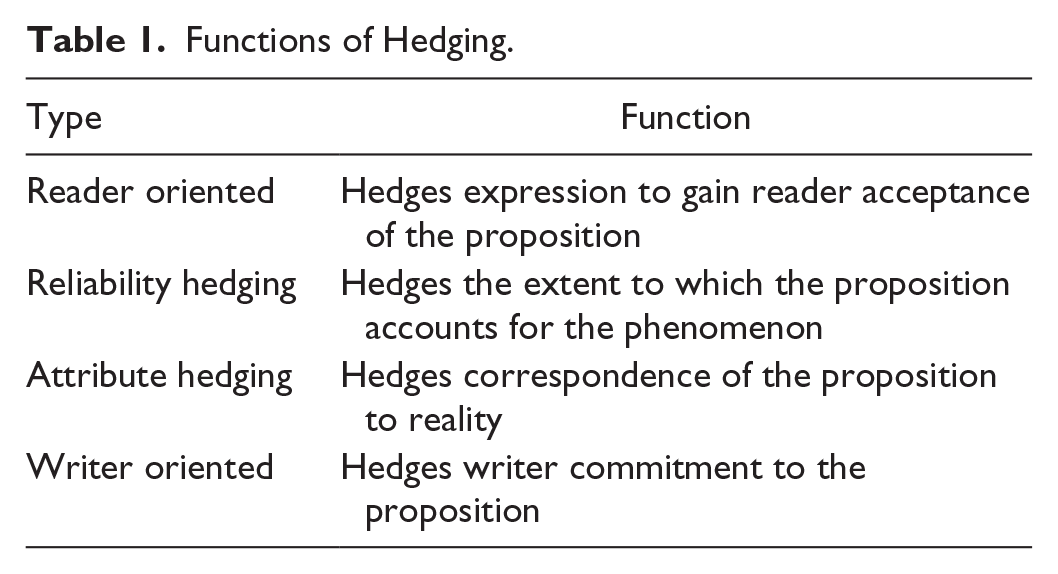
For the present study, the following forms were chosen to mark out hedging seen in Malaysian and American hedging in doctoral oral defense: modal verbs, epistemic lexical verbs (personal attribution comes alongside these), epistemic likelihood adverbs, and epistemic adjectives. These forms were taken from Hyland (1996, 1998a) and were chosen because they are the most pervasive in spoken discourse or specifically in oral defense.
Antconc
To pull out the instances of hedging that exist within the transcripts of the oral defenses, Antconc 3.4 concordance software will be used. This software makes it possible to pull out every sentence where the chosen forms of hedging occur. At this juncture, the corpus results were saved and compiled into text documents. The forms were then processed line by line to mark out which forms are actually functioning as a hedge.
The process of coding is critical because of the nature of hedging. A frequency count cannot just be taken straight from the concordance because the lexical items used in hedging are not always used to hedge. Once the forms were marked out as hedges, they were processed once more using the analytical framework on hedging by Hyland (1996, 1998a) as a guide to mark out what function of hedging corresponded to each one.
To mark out which instances means that a choice must be made as to what is hedging and what is not. This can be very subjective and so one person making these choices does not provide a reliable option. One practical solution to the problem of achieving accuracy of analysis is the use of the interrater reliability technique, using field specialists as independent raters. According to Bhatia (1993), as field specialists are active members of a particular discourse community, they are more aware of the generic features in a particular discipline than people outside the community. So during the process of analysis, the co-rater analyzed the data as well and the results were compared to the point where agreement of more than 97% was reached to ensure interrater reliability agreement. Agreement was calculated using the following formula:

Findings
Overall Frequency Analysis of Hedging in MICASE and MCD
Looking into the overall frequency of hedging in MICASE and MCD corpora as the initial step of the analysis is important as it informs us about general patterns in the words chosen by Malaysians to hedge and what functions of hedging those words are carrying out. The study found that, overall, the incidence of hedging was larger in the American doctorate defense than in Malaysian candidature defense. The amount of hedging in the MICASE data yielded a normalized hedging frequency of 24.7 hedges per 1,000 words. The Malaysian candidature defense data contained 18.3 hedges per 1,000 words.
Hedging frequencies by discipline in MICASE and MCD corpora
To understand the different cultural forces at work in the corpora, it is important to draw out comparisons in hedging use between the two corpora by pointing out the amount of hedging used per discipline in each corpus. Figure 1 shows the comparison between disciplines in terms of the normalized frequency of hedges per 1,000 words.

Hedging frequencies by discipline.
Figure 1 shows that hedging is employed most in the social sciences in both MICASE and MCD corpora. However, in the Malaysian candidature defense, we see that the difference in hedging use between the disciplines is not nearly as great as it is in the MICASE corpora. In MICASE, the difference between sciences and social sciences is 18.2 hedges per 1,000 words, whereas in the MCD corpora, the difference between hedging occurrences in sciences and social sciences is 1.2 hedges per 1,000 words.
Hedging frequencies by candidates and panels in MICASE and MCD corpora
At this point, the MICASE and MCD corpora were looked at as single units. However, it is important to understand that in each corpus, there are two groups of speakers present. There are the PhD candidates themselves and the panel that is responsible for evaluating their research. To expand the understanding of hedging use in the genre of PhD oral defense, the functions and forms of both the PhD candidates and also the panelists should be addressed. Doing this allows us to see not only the general patterns in hedging for the whole genre of PhD oral defense but to see it at a more in-depth level for each speaker. As the current study is looking to see cultural realities that influence hedging in Malaysian PhD oral defense, there is a need to see whether there are differences in the ways that different speakers in that context hedge. The overall difference in the amount of hedging employed between the PhD candidates and the panel members can be seen in Figure 2.

Overall frequency of hedging by candidates and panel.
One obvious finding from Figure 2 is that in both corpora, the PhD candidates hedged more than the panel members. Another apparent finding is that Malaysian PhD candidates hedged the most out of all the groups with 16.21 hedges per 1,000 words, whereas the Malaysian panel hedged the least in the defense with only 2.85 hedges per 1,000 words. In the MICASE data, the difference in hedging use between the panel and the candidates (2.11 hedges per 1,000 words) was not nearly as great as it was between the two Malaysian groups which is 13.36 hedges per 1,000 words).
Overall frequency analysis of hedging functions in MICASE and MCD
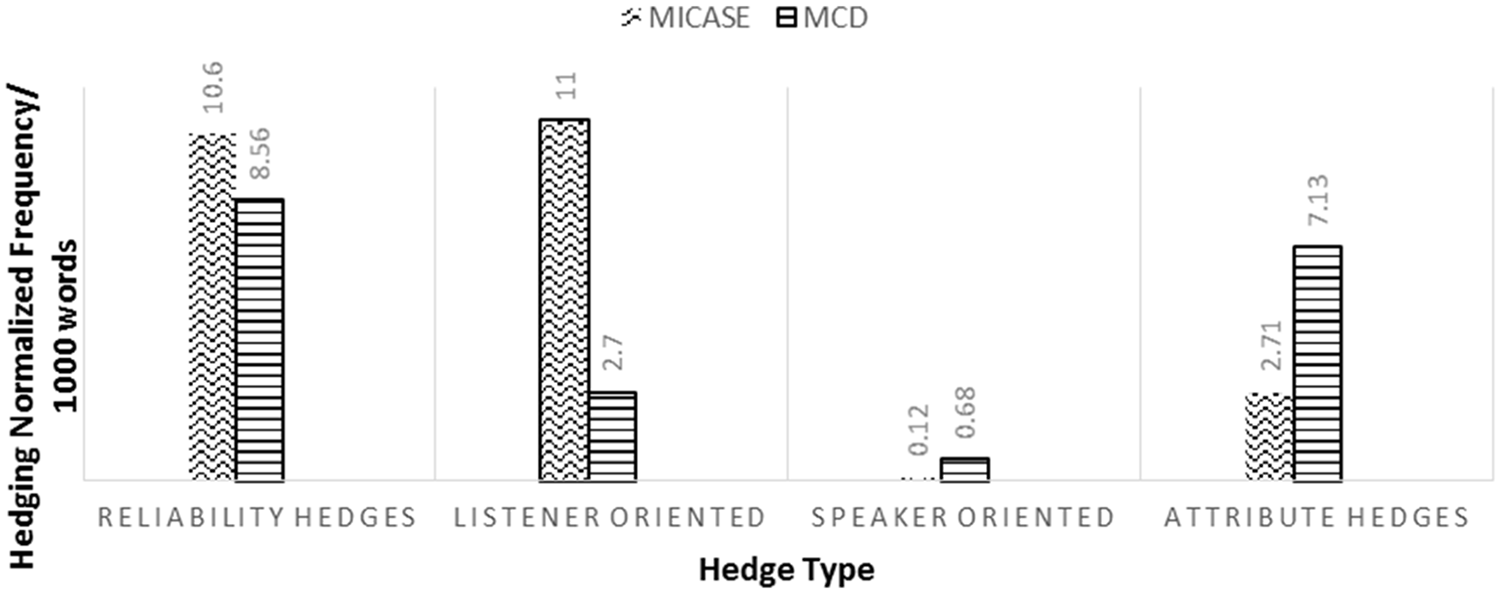
It is important to look at the frequencies of hedging utilized not only in the forms of hedging seen in the corpora but also in the functions of hedging seen in the corpora. Figure 3 shows the overall frequency of the specific functions of hedging in the MICASE and MCD corpora.
The frequency of hedging functions in MICASE and MCD.
The data in Figure 3 show that the use of reliability hedging is quite high and consistent between the MICASE corpus where the normalized frequency is 10.6 per 1,000 words, and the Malaysian corpus that sees reliability hedges at 10 per 1,000 words. For listener-oriented hedging, we can see the reverse is true. There is a major discrepancy between the two corpora. In the MICASE corpus, listener-orientated hedging is at 11 hedges per 1,000 words versus the Malaysian corpus where it is only at 2.7 hedges per 1,000 words. Speaker-oriented hedging was not utilized very much in either corpus but the Malaysian side utilized that function of hedging more often at 0.68 times per 1,000 words versus the 0.12 times per 1,000 words for the MICASE corpus. Attribute hedges were used in both corpora but, again, were utilized 7.13 times per 1,000 words in the Malaysian corpus over the MICASE at 2.71 times per 1,000 words.
MICASE and MCD hedging functions by discipline
Another level of the findings for this study was to look at the way that the corpora compared within each of the disciplines as far as the functions used to hedge. Figure 4 shows the breakdown of the functions employed to hedge in each of the corpora within social sciences.

Functions of hedging by MICASE and MCD in social sciences.
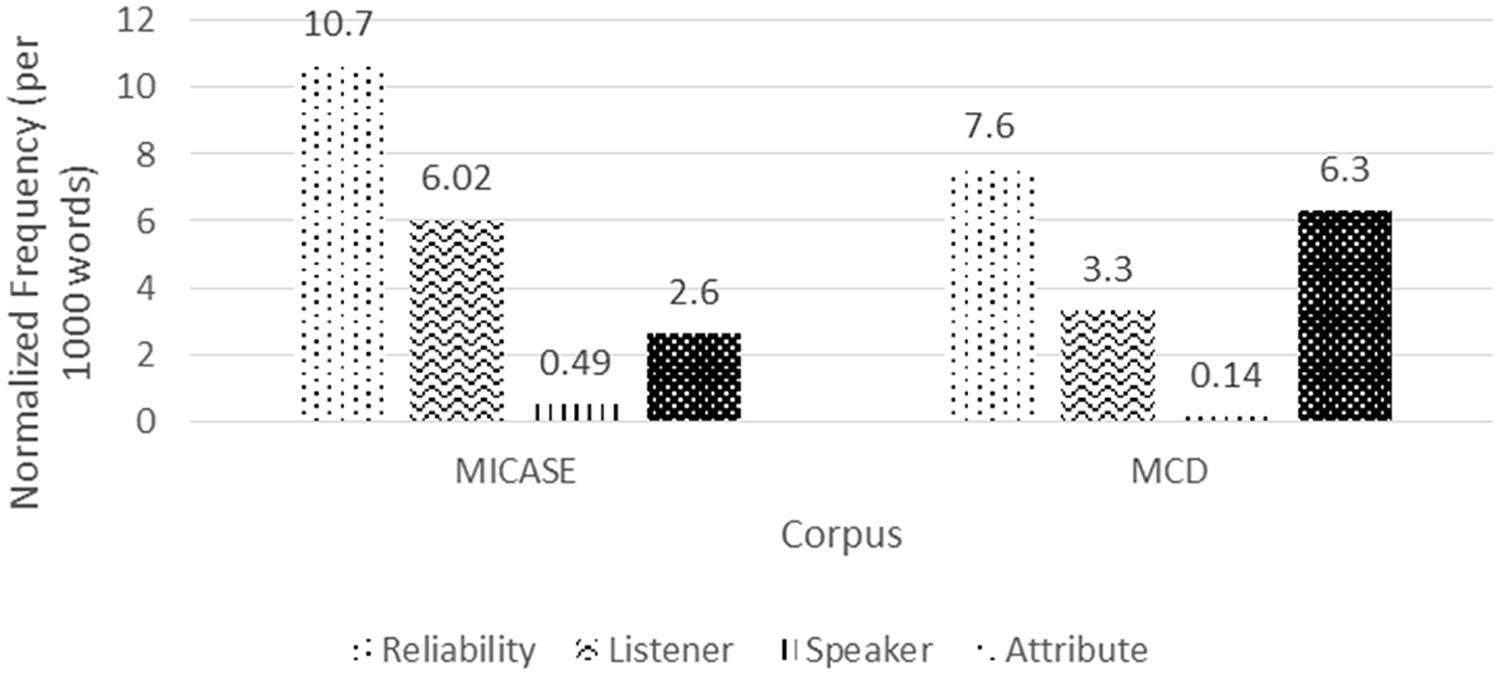
Figure 4 shows that within the social sciences, the use of reliability hedging is comparably high and consistent between the MICASE (11.6 times/1,000 words) and MCD (10.7 times/1,000 words) corpora. We see that speaker-oriented hedging is the least utilized in the social sciences at 0.1 hedges per 1,000 words. Within social sciences, we also see that the biggest differences between the corpora lie in listener-oriented hedging. In the MICASE data, listener-oriented hedging is far and away the most utilized function of hedging at 23 hedges per 1,000 words. However, in the MCD corpus, it is used at 2.7 hedges per 1,000 words. To build on this understanding with the disciplines, we must also look at the functions of hedging in each of the corpora within the sciences as well. Figure 5 breaks down the frequency of the hedging functions in each of the corpora, all within the science discipline.
Functions of hedging by MICASE and MCD in science.
Figure 5 shows that within the sciences, reliability hedging was most common in both the MICASE (10.7 hedges/1,000 words) and MCD (7.6 hedges per 1,000 words) corpora. We also see that listener-oriented hedging was used much less in the MCD corpus at 3.3 hedges per 1,000 words versus the MICASE corpus where listener-oriented hedges are used 6.02 times per 1,000 words. The difference in attribute hedging is also noticeable within the sciences. In the MICASE, attribute hedging is seen 2.6 times per 1,000 words, whereas in the MCD corpus, it is much higher at 6.3 hedges per 1,000 words.
Hedging functions by speakers in the PhD oral defense
It is important to understand that in each of the corpora, there are two groups speaking in the candidature defense. The speech of the candidate makes up the bulk of the defense, but their presentation is followed by a question and answer time where panel members direct questions and comments toward the candidate as they analyze their research. This portion of the defense is critical as a rich source of hedging as both the panelists and the candidates are naturally making claims and mitigating conflict in this portion.
Hedging functions by speaker in MICASE
An interesting note from Figure 6 is the difference between the panel and candidates is in their employment of listener-oriented and reliability hedges. For the candidates, reliability hedges were the most commonly used (7 times/1,000 words) where listener-oriented hedges were the second most commonly employed (4.7 times/1,000 words). For the panelists, listener-oriented hedges were utilized the most at 6.3 times per 1,000 words, followed by reliability hedges at 3.6 times per 1,000 words. For both the panelists and the candidates, speaker-oriented hedges were used the least at 0.32 times per 1,000 words for candidates and 0.02 times per 1,000 words for the panelists.

Hedging functions between the panel and candidates in MICASE.

Hedging functions between the panel and candidates in MCD.
Hedging Functions by Speakers in MCD
It becomes quite obvious that overall hedges are used much more frequently by the candidates in the Malaysian corpus. If we look beyond that we can see that both the candidates and the panelists used reliability hedges more than any other function. However, the data show that candidates employ attribute hedges second most, whereas listener-oriented hedges were used the second most by the panelists. It is interesting to see that there is a complete absence of speaker-oriented hedges in the panel’s use of hedging. Candidates used speaker-oriented hedging the least followed by listener-oriented hedging as the second to least commonly used function.
Interview Findings
Based on the analysis of the interview data, the researchers identified two main themes—the roles of panel members and the roles of disciplines. Each theme was further refined into two subthemes. The researchers found two key roles of the panel members, namely, as gatekeepers and as advisors. Panel members as gate-keepers carry the role of assessors in terms of whether the work fulfill the prescribed criteria and bring along the sense of moral obligation to disapprove the work if it fails to meet the criteria. As advisors, they are more concerned about how the work can be improved if they do not meet the prescribed criteria. The moral obligation of advisors is to help and support the candidates in improving the work by giving suggestions and advice so that the work meets the criteria. As these two roles have different perspectives on what defense entails, the interaction dynamics between panel members and PhD candidate rely heavily on the power distance assumed by these roles. The characteristics of two main disciplines were revealed to be a vital influence of the language use during defense. The nature and inquiry of knowledge as well as values in the sciences and social science differ and these were reflected in the interview findings.
Discussion
Hedging and Culture
The present study looked to connect the observed findings of hedging use with the cultural realities surrounding candidature defense in Malaysia. The goal was not only to understand how Malaysians use hedging but to get closer to understanding why they use hedges the way that they do. To do this, an amended version of Holliday’s (1994) framework on small cultures was used. This framework was chosen to get a more holistic picture of all of the cultural forces that may have influence on Malaysian doctorate candidates and also the panelists. The present study employed this framework to draw out cultural forces on two fronts—power distance in institutional culture and disciplinary culture. However, it must be noted, as Holliday (1994) marks out, that the lines demarcating the borders between these small cultures can be rather blurred as they are interconnected and interrelated. This means that different cultural factors might have various implications that cut across the borders of small cultures. For instance, power distance can be seen in national culture but it can also be seen as an influence within institutional culture.
Power Distance in Educational Culture
In many Asian countries, like Malaysia, the values regarding power distance are much different than in more egalitarian cultures. In these countries, there is a higher value on maintaining proper distances based on status and power. These cultures would thus have a higher level of power distance. Hofstede et al. (2010) measured the level of power distance seen in 50 different countries around the world in the corporate context and found that Malaysia ranked among the highest in power distance in the 50. So in Malaysian culture, there is observed to be a higher value to maintain the difference between individuals based on their status or power.
To believe that there is really a connection between hedging in PhD oral defense and power distance in the educational culture in Malaysia, there must be corroborating evidence seen in real data to support it. In the Malaysian corpus, the amount of hedging employed by candidates is much higher than it is for the panelists. So the candidates feel the need to hedge at a higher level even if they might not be able to grasp all the complexities around it. Another point of note from the Malaysian corpora was the low density of listener-oriented hedges seen by Malaysian speakers in PhD oral defense. Listener-oriented hedges are more interpersonal in nature and are looking to engage with the listener in such a way as to soften the force of a claim. So candidates in the defense and panel members both are not prone to hedge on an interpersonal level in this set of data.
If panel members view themselves as gate-keepers or individuals who are beyond questioning or even relating with on an interpersonal level, then the use of interpersonal hedging by the candidate would be limited even if the linguistic capabilities to use this hedging exist. And this is expressed in the data collected from the Malaysian corpora. One of the interviewees equates these gatekeepers as teachers in the Asian culture who carry a higher status of authority.
Hyland (1998) describes interpersonal hedging, saying that it is the way that a speaker can subtly create a “persona” that endears itself to the listeners in such a way as to make the claim more acceptable (p. 178). Some might make the argument that an overt deference to authority should create more interpersonal hedging. However, if the institutional educational norms experienced by candidates have reinforced the thinking that students should only discuss what has been taught to them, they may not have the experience in creating the kind of persona that Hyland described to be essential in interpersonal hedging. The norms and values of the education institution in Malaysia thus may be creating a situation where students just do not have the experience in academic discussion required to utilize interpersonal hedges.
This level of interpersonal hedging may also extend to the panelists in the candidature defense as well. If panel members have not had the opportunity to relate with candidates on a more interpersonal level, it may be harder for them to communicate using interpersonal hedges as well. So, overall, we are seeing that the data from the corpora along with the responses taken from the respondents, who are all faculty members in Malaysia, are pointing to a reality that power distance in the educational culture in Malaysia has an effect on the use of hedging in PhD oral defense.
Interestingly, the data collected in the present study reflect that there may be a link between the notion of power distance, specifically in educational culture, and the use of hedging in PhD oral defense. One respondent in the semi-structured interview mentioned the cultural value of the teacher in the Malaysian school context. They talked about how, in Malaysia, the teacher is seen as this super authority that should not be questioned and that any interaction with them must be done with extreme care. The participant went on to describe this in the candidature defense, saying, If this is somebody you should, like, be very respectful and everything, you would actually curb yourself from responding in a certain way or even posing comments that you just received from this person.
In the estimation of this respondent, the educational culture in Malaysia is such that students are to revere those in authority over them. This would include the panel members in their candidature defense who are most likely members of the faculty who may have even been an instructor for the candidate. This reverence was observed by this respondent to make it challenging for the candidates to engage in critical conversation with those in authority.
Another interviewee, when discussing candidature defense in Malaysia, mentioned that Malaysian candidates have trouble being independent from their supervisors in the defense and proposing ideas that are theirs. The respondent said, So Malaysian students, some of them tend to be, they tend to be, too uh dependent and always wanting to know if the supervisor is approving of their doing and whether that’s the way to go and not like take it away and do something and then come back and share their ideas.
Another role of the panel members is that of an advisor. As one of the interviewees stated, At the end of the day, the whole point is to help the candidate. It is not a session to show off for the panelist, it is not a blame session either . . . so if there is anything not going right, then think of a way to salvage the situation. That should be the focus of the session.
Again, we see a connection to Hofstede et al. (2010) and power distance in school. He highlights how the larger the power distance, the more that students are dependent on their teachers even in institutions of higher learning. In an institutional culture where students are spending their formative scholastic careers totally depending on their instructors, interpersonal hedging may be more unnatural for candidates.
Disciplinary Culture
Disciplinary culture is the norms and values that shape specific academic disciplines like the sciences or social sciences. For the present study, the question arises as to whether disciplinary culture affects the way that Malaysian speakers would use English in the genre of PhD oral defense and specifically in the way that they hedge. To understand the importance that disciplinary culture plays in academic language use, we can get the perspective from three respondents in different disciplines. One respondent said, The field is very different, the focus would be very different I don’t know, I’m just guessing, that maybe the science faculty would, they would maybe answer more questions about the stats involved in the lab, or how they use a machine or something, which we don’t do here, so, yeah.
This respondent made the point that different disciplines have different areas of focus for those who are practicing within the discipline. This difference in focus is inevitably going to shape the use of language. Another respondent discussed her own field pointing out how important language use can be in her field: The subject matter itself comes in with linguistics and so a whole lot of attention is paid to, what do you call, the language aspects of the thesis itself which may be overlooked in the sciences; maybe they will go more for the content whereas here the language also matters not just the content alone.
This perspective shows that language can be very important, especially in the social sciences to the point where it is something that the examiners are looking to measure. However, the last respondent from the sciences also felt that language is a key part to her discipline. She was asked how much language proficiency matters in the sciences and she responded, saying, It shouldn’t because uh, I would say science is a universal language.
So in her estimation, the discipline of science influences communication in such a way that a big thing like language proficiency can even be overcome by the language of science. So from all of these respondents, we can see that discipline is extremely important in shaping the norms and values of how communication and language should be done.
So if language is shaped by discipline, is hedging in Malaysian PhD oral defense also shaped by disciplinary culture? To answer this question, we need to know in what differences between disciplines, and specifically between science and social science, will hedging be evident. To get this understanding, we can look at the work of Sharon Parry (1998) who conducted a comprehensive analysis of discourse used in doctorate theses based on discipline of study. Her study went through the various aspects of the language used in doctoral theses in different disciplines to categorize the kind of language that characterizes each discipline. When she looked at the focus of theses, there was a strong orientation in social science to test or find an alternative to a framework or theory. If this is the case, the use of hedging in social sciences should utilize more attribute hedging as this kind of hedging works to specify or describe the specific aspects of the claim being made. If theory is being tested, we would expect to see some hedging as the speaker is making claims that address the specific nature of a theory or idea. The different attributes of the theory are in question and thus many claims in the social sciences surrounding the specific aspects of theory fall in line with attribute hedging which hedges the content of the claim in the actual specifics. For instance, the speaker may use the attribute hedge “generally” to imply that the theory in question applies most of the time but maybe not all of the time. In the Malaysian data, we see that in the social science corpus, attribute hedges occurred 7.8 times out of 1,000 words. In the sciences, attribute hedges occurred 6.3 times per 1,000 words. So the data found in the present study corroborate a stronger pursuit to test theory in the social sciences just as Parry (1998) proposed.
Another distinction between disciplines seen in the Malaysian data is that of the referencing to other work done on the subject. Parry (1998) makes the point that in social sciences, there is a greater need to include the accepted work of others to support the argument being made. In the sciences, referencing is done to bring in additional information that may be important. Speaker-oriented hedging is hedging that looks to diminish the speaker’s connection to a claim they are making because maybe they are not as convinced or perhaps do not have as solid backing for the claim. Thus, these hedges would be employed to take the pressure off of the speaker and put it onto other, more respected shoulders. Knowing this, we would expect to see more speaker-oriented hedging in the social sciences. It is supported that speaker-oriented hedging exists in the sciences (Hyland, 1998). However, the strong connection between referencing and argumentation in the social sciences would suggest that this kind of hedging would be even more pervasive in social science discourse. The present study reflects this idea showing that speaker-oriented hedging was more common in the social science corpus than in the science corpus.
The results of this study have corresponded to disciplinary differences already found to be true. So the question arises as to why this is important. The answer to this question can be seen in this very simple reality already stated. If these differences are corroborated by actual results shown in the forms and functions of hedging in the Malaysian context, then it becomes clear to see that the differences in disciplinary culture do have an effect on hedging use in Malaysian academic discourse. In this study, we see, more specifically, that disciplinary culture affects the way that Malaysians hedge as they discuss the specifics of theory and how they make reference to other work done in their field in the genre of PhD oral defense.
Conclusion
To say that language is shaped by and shapes the way that individuals use language is not a new idea. However, the relationship between culture and language often is often kept at a broad perspective of culture. This seems to be especially true in discussions about individuals using language that is not their first language. It shows that it is not enough to say that Malaysian speakers of English use language differently purely because they are second language users of English. From this study, we see that their status as candidates also influences the way they hedge and how they use language. The study also shows that the discipline they are involved in shapes the way they hedge. So it seems that if this more holistic picture of culture and language sheds light on something as specific as hedging in Malaysian PhD oral defense, that this kind of perspective on culture and language could be used in many other contexts as well.
Another set of theoretical implications has to do with the PhD oral defense as a genre and how it is influenced by and influences language use. A key concept in genre theory is the notion of a discourse community that develops around a specific set of communicative purposes (Swales, 1990). The present study is interesting in that it shows that the discourse community in Malaysian PhD oral defense does in fact shape their language use based on the communicative purposes they have. For instance, we see that in Malaysian PhD oral defense that the way members of the social sciences hedged very differently than the sciences in the way they approached theory and referencing. So the values of their discipline regarding those areas shaped the way that hedging was used. However, the present study also points out that there seem to be overarching values like power distance that can permeate and shape the ways that discourse communities use language beyond just the values they establish on their own.
Supplemental Material
Appendix_1 – Supplemental material for Hedging Functions in Malaysian Doctoral Candidature Defense Sessions
Supplemental material, Appendix_1 for Hedging Functions in Malaysian Doctoral Candidature Defense Sessions by Siti Zaidah Zainuddin, Alexander Charles Damiano-Nittoli and Azlin Zaiti Zainal in SAGE Open
Footnotes
Acknowledgements
The authors would like to thank all the doctoral candidates and panel members of the doctoral sessions involved in this study.
Declaration of Conflicting Interests
The author(s) declared no potential conflicts of interest with respect to the research, authorship, and/or publication of this article.
Funding
The author(s) disclosed receipt of the following financial support for the research, authorship, and/or publication of this article: This paper was supported by Universiti Malaya RU Grant Project No. GPF014N 2018.

Supplemental Material
Supplemental material for this article is available online.
Author Biographies
References
Supplementary Material
Please find the following supplemental material available below.
For Open Access articles published under a Creative Commons License, all supplemental material carries the same license as the article it is associated with.
For non-Open Access articles published, all supplemental material carries a non-exclusive license, and permission requests for re-use of supplemental material or any part of supplemental material shall be sent directly to the copyright owner as specified in the copyright notice associated with the article.
