




Abstract
In recent years, the challenges and lack of progress in writing argumentative essays in English have posed a pedagogical challenge for Chinese university students. To address this issue, this paper adopts an action research pedagogy and implements a 10-week intervention aimed at teaching argumentative writing based on the Toulmin model of argumentation. The instructional process followed a holistic-to-specific approach, encompassing the following three stages: (1) introduction of the general model, (2) instruction on the main dimensions of argumentative elements, and (3) teaching of the subdimension of argumentative elements. Data collection for this study included teacher-teaching diaries, students’ interviews, and four writing scores. Both paired-sample t-tests and repeated measures analyses were conducted, revealing significant improvements in students’ overall performance and the quality of argumentative elements across the different stages. This paper provides a comprehensive discussion on the impact of this whole-to-detail approach to teaching argumentation on the development of argumentative essay writing skills.
Introduction
Argumentation refers to the process of supporting, criticizing, and refining viewpoints (Osborne et al., 2003). It enables students to consider diversity in cognitive development and facilitates exploration of deeper and more sophisticated levels of epistemology (Perry, 1970). The concept of “argumentation theory” originated from Aristotle’s “Rhetoric.” Modern argumentation theorists believe that argumentation involves presenting a series of arguments to persuade others to accept one’s viewpoint and resolve disagreements. In this process, effective communication and interaction remain crucial, along with the willingness of individuals to accept the initiator’s perspective (Van Eemeren et al., 2014).
In the study of argumentative writing, researchers believe that understanding the structure of argumentation helps students express their views in a logical way (O’Hallaron, 2014) and thereby enhances their critical thinking skills (Kuhn, 2005). Therefore, argumentation has gradually become the core content of higher education (Andrews, 2015). In the learning environment, embedding and fostering argumentation activities can promote the development of creative thinking, conceptual change, and problem-solving abilities (Jonassen & Kim, 2010).
This paper summarizes not only the first author’s experience in teaching writing courses, underscoring the necessity but also the difficulty of guiding students in argumentative writing and critical thinking. In China, compared with other skills in English teaching, argumentative writing poses a greater challenge, and its significance has not been adequately addressed. Therefore, action research methods and Toulmin’s argumentation model have been employed in this paper to explore new methodologies for teaching argumentative writing. Simultaneously, the paper aims to clarify the connotation of argumentation theory, validate the applicability of the Toulmin model, and analyze the correlation between Chinese university students’ argumentation performance and the overall quality of argumentative essays, thereby providing a basis for the teaching and evaluation of argumentation skills.
Literature Review
Argumentation in Second Language Argumentative Writing
In the field of first-language argumentation, a mainstream viewpoint is to regard argumentation as a form of reasoning (Toulmin, 1958, 2003; Toulmin et al., 1984). This top-down approach emphasizes the use of reasoning or logic to compose a well-structured argumentative essay and highlights the final output. In short, students need to learn the reasoning process that contributes to this result. This approach is encouraged to be introduced into the topic of second-language argumentative writing (Hirvela, 2017). Comparatively, argumentative writing in a second language, as a core research topic in second language writing (Andrews, 2015; F. Liu & Stapleton, 2014), is marginalized in the academic field, and it characterized by insufficient attention and lack of theoretical or educational framework support in related research (Hirvela, 2017).
Meanwhile, teaching methods related to argumentation are rarely used in argumentative writing classrooms (McCann, 1989). From the perspective of writing teachers, they lack practical argumentation experience (Fan & Chen, 2021), making them potentially unqualified to teach argumentative writing. Thus argumentative writing becomes a nightmare for students of all grades (Fan & Chen, 2021; Gomez-Laich et al., 2019).
From the perspective of Chinese university students, the phenomenon of weak English argumentative writing skills among Chinese university students may primarily stem from the education and influence of Chinese thinking patterns. For instance, textbooks (Liao & Chen, 2009) and the influence of Chinese thinking modes have contributed to this issue. Despite many students being aware of the characteristics of English essays, they often struggle to break free from the influence of Chinese thinking patterns. In the process of argumentation, they frequently employ roundabout methods of expression, resulting in insufficient clarity in conveying their viewpoints (Wu, 2008). Moreover, traditional writing learning modes limit students’ intellectual development and innovation, as they lack a complete framework and clear ability to use argumentative elements in their writing (Cheng & Chen, 2009). Hirvela (2017) pointed out that in second-language writing, whether argumentation is viewed as an outcome or a process, both teachers and students first need to understand the basic concepts and structures of argumentation, which is currently overlooked in second-language writing education. Therefore, an urgent need exists to explore teaching paradigms suitable for second-language argumentative writing.
The Value of the Toulmin Model for Teachers and Students
In recent years, the Toulmin model has been widely applied in empirical research on second language writing, serving as a theoretical foundation or analytical framework for ESL writing (Greenwald, 2007; Magalhães, 2020; Qin, 2013). This model is more compatible with the development of argumentative essays and has thus been extensively utilized in second-language text analysis studies (Abdollahzadeh et al., 2017; Qin & Karabacak, 2010). The Toulmin model features a more modern and innovative approach to writing, breaking away from traditional formats such as the three- or five-paragraph structure. Many writing studies have praised the Toulmin model as a practical tool for teaching writing (Erduran et al., 2004; Simon, 2008; Warren, 2010), greatly simplifying the work of writing instructors. For writing teachers, the Toulmin model is a great blessing (Schroeder, 1997). Overall, applying this model benefits both writing teachers and university students.
First, the Toulmin model is beneficial for the professional development of writing teachers (Simon et al., 2006). This model allows writing teachers to understand the fundamental elements of argumentation through clear and visual representations. With this foundational knowledge of argumentation, applying the model enables teachers to have a more nuanced understanding of students’ writing and guide their thinking using the features of the model. This breaks away from relying solely on fixed teaching approaches, allowing writing instructors to help students extend their thinking before writing and express it in a well-structured manner. In addition, the model also enables teachers to identify existing deficiencies in students’ arguments and provides targeted guidance promptly, thus optimizing the process of writing argumentation to the greatest extent possible.
Furthermore, the Toulmin model is applicable to the writing learning needs of various levels and disciplines (Erduran et al., 2004; Kneupper, 1978; Lunsford, 2002; Qin, 2013), and it can help address the urgent need for improving logical reasoning in Chinese university students’ argumentative writing (L. Yang & Gao, 2013). In particular, the Toulmin model assists students in identifying their claims (what they believe) and how to support them. The model also aids students in constructing arguments, connecting claims with evidence, and prompting them to actively consider whether their argumentation process would be acceptable to readers. The key to enhancing students’ understanding and practice of argumentation lies in making the process easy to follow. Kneupper (1978) suggested that the structure of claim–evidence–warrant clarifies the flow of argumentation and makes the relationship between claims and evidence easier to grasp. The Toulmin model offers students a concrete and practical writing framework, along with a method for evaluating argumentative elements (Bulgren & Ellis, 2012; Fooladi, 2010). With its clear definition and explicit examples, the Toulmin model effectively facilitates students’ acceptance of this approach.
Taking into consideration the aforementioned factors, this study determined that the Toulmin argumentation model will be employed as the intervention framework conducting this action research.
The Present Study
This study is based on the characteristics of the Toulmin model, specifically the clear distinction between main dimension and subdimension, which is more suitable for the phased nature of the current action research. The exploration of teaching outcomes from the main dimension to the subdimension argumentative elements aims to further investigate the specific impact of the Toulmin model on university students’ argumentative writing and provide empirical data for future promotion of this model in the field of teaching. In particular, this paper aims to address the following research questions:
RQ1: Does the argumentative pedagogy influence the overall performance of students’ argumentative writing?
RQ2: Does the argumentative pedagogy influence the quantity and quality of the main dimensions of argumentative elements in students’ writing? Does the argumentative pedagogy influence the quantity and quality of the subdimension of argumentative elements in students’ writing?
RQ3: What is the impact and effect of applying Toulmin model to action research of teacher–student interaction on writing teachers and students?
Method
Research Design
During the first week of the action research program, before the formal intervention, students’ argumentative writing skills were tested and analyzed. Students were asked to complete a CET4 argumentative writing. This was essentially a diagnostic and pretest essay to initially identify students’ existing writing issues. The students’ essays were analyzed and the problems they encountered were recorded in their writing for comparison with their writing after the implementation of the intervention. In the subsequent 9 weeks of the action research project, intervention measures were implemented based on the identified problems. This included a three-stage teaching approach: from the overall Toulmin model to the main dimensional elements in the model, and then to the subdimensional elements (see Figure 1). After each of these three intervention sessions, students were required to complete another CET4 argumentative writing in class to assess the effectiveness of the teaching (specific arrangements can be found in Appendix E).
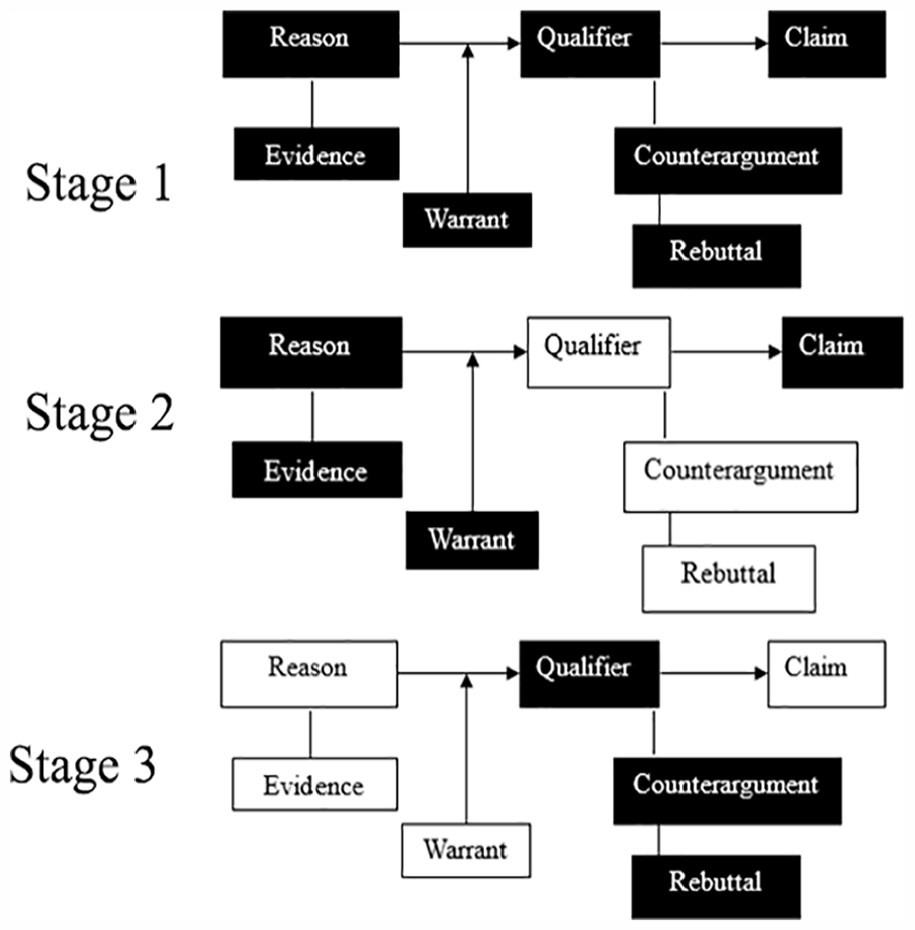
General flow of this action research.
This teaching approach, which takes the Toulmin model from “whole” to “part,” is a completely new attempt aimed at gradually addressing the problems that students encountered in their writing during the first week. These problems mainly fell into following four categories: (1) students’ writing structure is too simplistic, (2) many students use unclear argumentation processes, (3) a lack of connection between their reasons and claims exists; and (4) they lack counterarguments and rebuttals.
Participants and Ethical Considerations
In this study, all the 76 participants were in their late teens or early twenties at a university in Changchun. Table 1 provides detailed information about their average age and gender ratio. During the study, these students were in the second semester of their second year in college. The participants were divided into two natural classes, majoring in International Economics and Trade and Computer Information Systems respectively. Their class schedule was from 8:00 to 9:40 a.m. and from 10:00 to 11:40 a.m. on Mondays and Thursdays. The first author of this paper was their English teacher. Their English proficiency level was within the average range of Changchun university students. Their English classes mainly focused on basic language skills such as listening, reading, writing, and translation. They only had English courses in the first four semesters of their university education. Prior to this study, the authors conducted a questionnaire survey in which all participants indicated that they had not received any education related to argumentation and writing. All participants have duly completed and signed informed consent forms prior to their participation in this action research.
Description of Participant Gender Ratio and Average Age.

Collection of Data
Data gathered included individual interviews with 10 students, one author’s weekly journal entries, and students’ interviews. Based on criteria for the evaluation of argumentative elements by McCann (1989), the author of this article updated the scoring criteria for the main dimension and sub-dimension in order to better adapt to the expanded Toulmin model (see Appendix A and B). The scoring of argumentative elements and the overall scoring of the composition are scored and recorded according to the corresponding scoring criteria.
The author used the CET4 writing standard (see Appendix C) to evaluate student essays for relevance, clarity, thoroughness, and coherence of their writing. The CET 4/6 is the most common form of examination for university students. They can provide an objective and accurate measure of university students’ actual level of English. Writing instructors can use it as an assessment tool for teaching English writing in university. The test is administered by the Higher Education Department of the Chinese Ministry of Education.
The essays were evaluated by two professional raters. The first author, Rater A, is 37 years old and has worked as an English teacher at a common university in northeast China for the past 5 years. She has 9 CET 4 and CET 6 assessment sessions under her belt and has extensive experience teaching and evaluating essays. For the past 10 years, Rater B, 39, has taught university English at a top university in Northeast China. She has rated CET 4 and CET 6 writings for 13 times. She is well-versed in all aspects of the writing process. Only when the interrater reliability of the two assessors reaches a high level can we ensure the credibility of the scores (see Table 2).
Raters’ Reliability for Scoring the Quality of Argumentative Elements in Four Writing Sessions.

Implementation of the Action Research Plan
In the first stage, after the students completed their first argumentative writing, the teacher (who is also the first author) introduced argumentative teaching. The teacher presented a modified version of the Toulmin model and explained its overall structure to the students. After 3 weeks of practical teaching using the Toulmin model, students gained a clear understanding of the overall argumentative elements.
The second stage focused on the main dimensions of the argumentative elements in Toulmin model, including identifying and evaluating these elements. In this stage, the writing teacher used the modified version of the Toulmin model to teach the main dimensions of the argumentative elements, including claims, reasons, evidence, and warrants. In the final week of this stage, under the guidance of the teacher, students completed the writing of the main dimensions of the argumentative elements and received timely feedback.
In the third stage, students learned about the subdimension of argumentative elements, including identifying elements, understanding the connection between elements, and evaluating elements. For this, a modified version of the Toulmin model was used, with subdimension including qualifiers, counterarguments, and rebuttals. In the final week of this stage, under the supervision of the teacher, students completed the writing of the subdimension of the argumentative elements and received timely feedback. After each class, the authors. conducted semi-structured interviews with participating students (see Appendix D). The detailed steps of the action research are presented in Appendix E. The whole intervention design and writing tasks of the whole action research are presented in Figure 2.
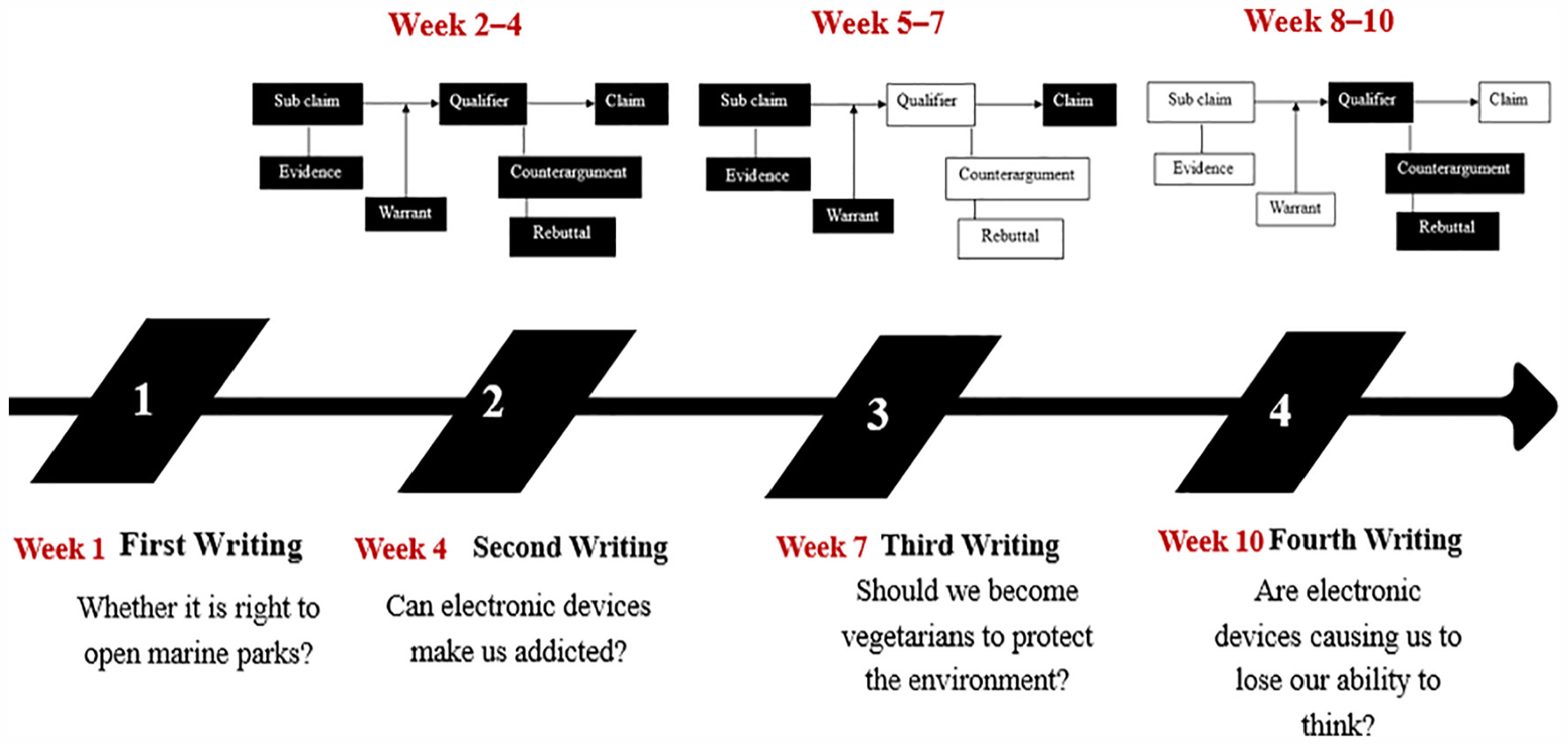
Specific writing dates and writing topics for this action research.
Data Analysis and Discussion
Stage 1 Result of Holistic Teaching of the Elements of Argumentation
To avoid students finding the teaching of argumentative essays boring and difficult to understand, I did some careful design and preparation before the lesson. In the lesson, I used the PowerPoint function to make the elements in the main dimension of the argumentative elements appear and combine one by one, followed by the same steps to show the subdimensional elements. Students showed greater interest in learning that the argumentative essay could be framed according to a new kind of diagram. I broke down the argumentative elements in the model essay and clearly listed each argumentative element next to the corresponding Toulmin argumentative model to deepen students’ understanding of that argumentative element. When students have studied model essays before, they have mostly focused on the long and difficult sentences and the complexity of the vocabulary, but this is the first time they have been exposed to a Toulmin model as a guide. The goal of this lesson was to provide students with an initial understanding of the concept and process of argumentation. (Teaching Reflection Journal 1)
This lesson continued as planned with an overview of the Toulmin model of argumentation. Unlike the previous week’s teaching, the material used this week was essays completed by the students for the first time. Two essays from each of the high (10–14 marks), medium (6–9 marks), and low (1–5 marks) groups were selected to be taught in relation to the Toulmin model. The students showed greater interest in this new teaching method. The two high-scoring essays differed in the placement of counter-arguments and rebuttals. The counterargument and rebuttal in high-scoring Essay A appeared after the reasons and evidence, while the counterargument and rebuttal in high-scoring Essay B appeared after the first claim. This also meant that the reasons and evidence in the two model essays were also in different positions. The purpose of this choice was that students could learn that the placement of argumentative elements was not fixed, but in a flexible and free style. In the medium-scored essay A, the claim, reasons, and evidence were clear and moderate, but the counterargument was not considered. In the medium-scored essay B, although the counterargument was considered, the reasons and evidence were not linked. These two essays were chosen to show students that the absence of an argumentative elements in writing or the weak quality of the argumentative elements can lead to lower quality argumentative essays. Low-scoring essay A had only one reason and no concluding paragraph, which was an unfinished essay. Low-scoring essay B had a component on how to care for the environment, which was not relevant to the topic of this essay. The choice to explain the low-scoring essay was to make students aware of the importance of time planning and reviewing the topic before writing. (Teaching Reflection Journal 2)
Argumentative essay writing has always been that part of my English studies that I have had the most trouble with, because I could never get to the point. After my first lesson, I learnt that the Toulmin model is perfect for developing ideas for writing argumentative essays because it has several well-defined elements of argument, and by remembering these key words, it helps to connect fragmented sentences effectively when writing, and I plan to apply this model when I write next time. (Student interview 1)
The Toulmin model is a very new concept to me, but it is presented in diagrammatic form and is relatively easy to understand. I had previously learned that claim, evidence, and warrant are the three elements of an argumentative essay, but I had not realized the two-by-two relationship between the three of them. (Student interview 2)
After the first stage, the number of qualifiers was decreasing, as shown in Table 3, which indicated that students were gradually focusing their efforts on writing the main body paragraphs and further validated the conclusion by R. Yang (2022) that no correlation existed between the number of qualifiers and the quality of argumentative essays. The two argumentative elements, reason, and warrant, slightly decreased in quantity; however, the number of arguments increased, indicating that through learning the Toulmin model of argumentation, students realized that using only reasons to support their claims was too weak and that evidence especially concrete examples, personal experiences, etc., were important in interpreting reasons, as well as combining reasons and supporting arguments together, and therefore consciously increased the number of evidence in their writing. In conjunction with the results of the teaching diary and the student interviews, the connectedness of the argumentative elements in the Toulmin model was a prompt for students to write effective argumentative elements. The students’“unconsciousness” arguments of the argumentative essay gradually transitioned to the interaction and connectivity between the argumentative elements.
Tests 1–2: Mean Score of Total Score and Mean Score of Number of Argumentative Elements.

Note. Rr = Raters’ reliability.
The teaching in the initial phase (2–4 weeks) centered on a detailed explanation of the overall dimensions of the Toulmin model, which involves the overall structure of argumentative thinking. A writing test was implemented following this teaching phase, with results indicating that except for the quality of claims and qualifiers, the quality of all other elements in students essays had improved (see Table 4).
Tests 1–2: Paired-sample t-test for Total Score and the Quality of Each Argumentative Element.

p < .01.
This indicated that after the first stage of teaching the Toulmin model, students made significant improvements in their overall grades and most elements in their writing. It was also possible to deepen students’ knowledge of the elements of argumentation in the classroom teaching. The claims and qualifiers did not improve significantly, probably because the claims came from the summary of the writing topics and were located at the beginning and the end of the writing, so they were not closely linked to the other elements, that is, the first paragraph of the claim was written as a mechanical answer to the writing topic and did not participate directly in the fluidity of the Toulmin model.
Stage 2 Result of Teaching of the Main-dimension Elements of Argumentation
In the second week of Phase 2, students were asked to evaluate themselves for the quality of each argumentative element in the model essay (good, moderate, or poor) as well as the quality of the connections between the argumentative elements, and to state their reasons. Students were not told the scores of the three model essays selected for this teaching. I encouraged students to identify the claims, reasons, evidence, and warrants in each model essay and asked them to evaluate the quality of each argument element and the validity of the connections between each two argument elements separately. The teaching was closely linked to the Toulmin model, allowing students to practice identifying elements and judging the relationships between them. At first, most of the students were intimidated by this exercise, but after my guidance and encouragement, some of them were able to identify the four elements of the argument more accurately. Through the questions asked in class, I found that students still overlooked the relationship between claims and evidence, that is, some of them could only list the reasons without thinking of verifying whether there was a causal relationship between the reasons and the claims. (Teaching Reflection Journal 5)
The purpose of this lesson, as set out in the lesson plan, was to have students write a brief claim–reason–reason(evidence) warrant triad for them to practice writing and constructing the elements. I asked students to fill in these elements in a “fill in the blank” format, following the main dimensions of the Toulmin model. With the existing model as a “scaffold,” the students were clearly less intimidated than before and completed the task more quickly. After writing, students were allowed to self-assess and three pieces of writing were randomly selected to be discussed and analyzed together. The students’ participation was much higher than in the previous lessons. (Teaching Reflection Journal 6)
The identification of the elements of the argument was a slightly difficult part for me, with the claims generally appearing in the opening and closing paragraphs, which were relatively well identified. The knowledge of reasons and warrants was the first time I noticed that I needed to take them seriously. Reasons are subclaims that support claims, evidences are expansion that further support the reasons in terms of specific examples or personal experiences, etc. The teacher taught us to match up reasons and claims one by one to see if there was a logical and reasonable relationship among them. In the past, when writing, we would only list reasons mechanically, without considering the relationship between the elements of the argument. (Student interview 5)
The teacher asked the students to write claims, reasons, and warrants in relation to the diagram of the Toulmin model. This was a novel approach and made it clear to me for the first time that the three were closely linked and could be integrated on a single diagram. The exercise also reinforced my ability to write and evaluate the elements of the argumentation, and I feel more confident in my writing. (Student interview 6)
The second stage of the teaching was an intensive presentation of the main dimensions of Toulmin’s argumentative model. After three weeks of teaching (5–7 weeks), the number of claims had dropped slightly and was basically the same as the previous time, as shown in Table 5. The number of reasons and warrants went up and the number of evidence went down, which was exactly the opposite of what happened in the previous round. The fact that the number of reasons and warrant had largely aligned suggested that after this round, students were more focused on the relationships inherent in the argumentative element, which was the bridge between reasons and warrants (Ketokivi et al., 2017; Verheij, 2005), and the simultaneous increase in the number of both elements also indicated the effectiveness of this round. The number of claims and qualifiers declined, possibly due to the fact that students continued to focus primarily on the main body passage. Counterarguments increased, but rebuttals decreased, suggesting that teaching only the main dimensional argument element had an unstable impact on the subdimension.
Tests 2–3: Mean Score of Total Score and Mean Score of Number of Argumentative Elements.

After the teaching weeks on the main dimensions of argumentative elements, the quality of the main dimensions of argumentative elements, namely reasons, evidence, and warrant, had significantly improved, and the overall writing quality of students also improved (see Table 6). It also further confirmed that although the number of evidences had decreased, their quality had improved significantly. The quality of the claims and qualifiers did not improve significantly in the comparison of the two essays, suggesting that although the number of claims and qualifiers had decreased, their quality had not improved accordingly. The lack of significant improvement in counterarguments and rebuttals suggested that focusing only on the main dimension of the argumentative elements could make teachers neglect the teaching of the subdimensional argumentative elements. Students had just learned about the overall Toulmin model in the first stage, which, if not consolidated comprehensively, could lead to an uneven development of the argumentative elements. Through the combination of teacher’s reflective journals and student interviews, the Toulmin model has played a more prominent role in teaching, effectively facilitating students to establish organic connections among argumentative elements. This approach not only helps students strengthen the correlation between elements from their foundational awareness but also provides teachers with higher quality instructional support.
Tests 2–3: Paired Samples t-Test for Total Score and Quality of Each Argumentative Element.

p < .05. **p < .01.
Stage 3 Result of Teaching of the Subdimension Elements of Argumentation
This week’s teaching focused on the subdimension of the argumentative elements. The qualifier used in the chosen high-scoring writing is
Students were given a “fill in the blank” approach to writing the subdimension of the argument in class. With the same main dimensional elements of the argument in the second stage, students completed them more quickly. When students’ essays were randomly selected for explanation, two students volunteered to be marked, indicating that students’ confidence in argument writing had increased. (Teacher’s reflective journal 9)
Previously, I only concentrated on writing sentences that stated support for my claims, believing that the opposing viewpoints were distractions and unnecessary to write. Learning about counterarguments and rebuttals in the argumentative element has helped me to expand my writing ideas. Stating a position that contradicts my own viewpoint does not weaken my argument, but rather makes my argument more comprehensive, because the argument is a comprehensive and preferred position after a plurality of viewpoints have been stated. (Student interview 8)
Compared to the “template” essays I learned in my first year, I have now discovered that writing and practice are the true means to improve my level of writing. I found that my writing skills had really improved by following the outer and inner “loops” of a model over and over again. While writing one element of an argument, another element comes to mind. I also began to conceptualize the internal relationship of these argumentative elements before I wrote. In Chinese culture, there is a saying “seeking common ground while preserving differences” and through the writing exercises in this class, I was able to better apply the essence of this idea to my English argumentative essay writing. I believe that although the argumentative elements in the subdimension “serve” the main dimension, they are the key to scoring high marks in argumentative essays. (Student interview 9)
The teaching in the third stage focused on providing detailed explanations of the subdimension of the Toulmin model. After three weeks of teaching (8–10 weeks), the students showed a decline in the number of all the elements of the argument except the number of qualifiers (see Table 7). This indicated that students were beginning to move away from formal variety within the constraints of limited writing time and limited word count. Students were focusing more on quality in a smaller number of argumentative elements.
Tests 3–4: Mean Score of Total Score and Mean Score of Number of Argumentative Elements.

After the weeks of teaching on sub-dimensions of argumentative elements, the writing test revealed that the quality of counter-arguments and rebuttals had significantly improved, while the quality of qualifiers did not change (see Table 8). It proved that teaching the subdimension based on Toulmin’s argument model not only improved the quality of the corresponding subdimension but also promoted the quality of the argumentative elements of the main dimension. The quality of qualifiers has not significantly improved, indicating that point-to-point subdimensional teaching on argumentative elements did not have a significant impact on the improvement of qualifiers.
Tests 3–4: Paired Samples t-Test for Total Score and Quality of Each Argumentative Element.

p < .05. **p < .01.
After four essay tests, the number of argumentative elements in the main dimension slightly increased overall, but the number of reasons and warrants fluctuated more in the middle stage, compared to a slow increase in the quality of argumentative elements, as shown in Figures 3 and 4, that is, for the main dimension of argumentative model, the number of argumentative elements does not necessarily represent the state of development of students’ argumentative skills.

Variation in the number of argumentative elements in the main dimension.

Variation in the quality of argumentative elements in the main dimension.
The number of qualifiers experienced a decline and an increase, but the quality of qualifiers remained largely unchanged, as shown in Figures 5 and 6. Because qualifiers appeared in the form of grammar, students’ grammatical ability tended to be fixed at the sophomore level. The number of counterarguments and rebuttals experienced fluctuations at different times; however, the final test results showed little overall change in their numbers, but a significant increase in their quality. This demonstrates the effectiveness of the third stage of instruction. Writing teachers often try to maintain a conflict-free teaching environment (Powell et al., 1985), so when teaching argumentative writing, prioritizing neutrality over encouraging different perspectives and other potential sources of conflict (Cotton & Winter, 2010) leads to a lack of clear emphasis on the effective relationship between argumentation and argumentative elements. In fact, such teaching methods are not aligned with the original purpose of argumentative education. Teaching through sub-dimensions demonstrates that students’ ability to generate different perspectives can be significantly stimulated. From the judgement of the quality of argumentation, we conclude that students’ writing cannot be judged solely on the number of elements of argumentation.

Variation in the number of argumentative elements in the sub-dimension.

Variation in the quality of argumentative elements in the subdimension.
Application of repeated measures in the general linear model in SPSS showed results for the four-test two-by-two comparison, which were generally consistent with the results of the paired-samples t-test. That is, an overall improvement was observed in the quality of the students in most of the argumentative elements through the overall teaching of the Toulmin argumentative model (see Table 9 Tests 1–2). After the second stage of teaching the main dimensions of the students’ argumentative elements, significant improvement were found in students’ writing in terms of the main dimensions of the main embodied reasons and evidence, but not yet in warrants (see Table 9 Tests 2–3), which indicated that the students had made progress in writing independent argumentative elements, but were still weak in the connections between the argumentative elements. In summary, as shown in Table 9, targeted teaching of argumentative elements at each stage can effectively improve the quality of corresponding elements.
Repeated Measures of Overall Performance and Argumentative Elements in the Four Writing Sessions.

p < .05. **p < .01.
After the third phase of instruction, students improved in the areas of claim, warrant, counterargument, and rebuttal, indicating that by learning the full range of argumentation, students not only improved in the elements of argumentation taught intensively over the ten weeks but also had significant improvements in the other dimensions. Each time there was a significant improvement in overall performance. Overall, in the comparison between the first and fourth writing assignments, only the quality of qualifiers did not show a significant improvement, while other elements of argumentation demonstrated significant enhancements.
Conclusion and Limitation
Through action research, the following conclusions and insights have been derived.
First, a completely consistent relationship between the quantity and quality of argumentative elements does not exist; they have a potential competitive relationship. In other words, as students gradually focus on writing argumentative elements of higher quality, the corresponding quantity of argumentative elements decreases. There are two possible reasons for this. On the one hand, while students emphasize the quality of argumentative elements, the number of words used to express these elements also increases. In the limited overall length of the composition, some students fully describe a certain argumentative element, resulting in a decrease in the number of words available when transitioning to the next argumentative element as the description length increases. In addition, based on interviews with students, it was found that as students delve deeper into learning the Toulmin model, they themselves pay more attention to expressing argumentative elements of higher quality. Understanding this potential competitive pattern can help writing teachers better balance the relationship between the two in the classroom, such as ensuring the quality of argumentative elements while also avoiding their excessively low quantity.
Second, the quantitative statistics presented in the text demonstrate the quantity and quality individual argumentative elements as well as their changes after each test. After the intervention on the main dimension of argumentative elements in the third phase, a decline was observed in the quality of warrants. Warrants refer to the implicit one-to-one connection established between reasons + evidence and claims. This indicates that when conducting framework interventions, writing teachers need to provide more specific explanations regarding the connections between elements. Therefore, in future argumentative writing courses, it is necessary to further strengthen the connections between argumentative elements to optimize teaching effectiveness.
Third, from the perspective of teachers, this action research validates the feasibility subdivision of the Toulmin model for teaching. This enables writing teachers to better understand the flexibility and practicality of the model, realizing that writing is not a rigid activity. Writing teachers can apply and optimize the process of this action research to their own students’ specific circumstances, further developing the potential contributions of the Toulmin model in argumentative writing, and enhancing teachers’ abilities in teaching argumentation. However, it is noteworthy that although students have a high acceptance of the Toulmin model, they do not persistently consolidate their understanding, and they are prone to forgetting. For instance, in the third phase, the focus of instruction was on teaching the subdimension, resulting in a decline in students’ mastery of the main dimensions. This indicates that in the limited time of writing instruction, a need exists to more effectively integrate writing instruction with the teaching of argumentative elements to optimize instructional effectiveness.
In conclusion, the action research that applied the Toulmin model to teacher–student interaction has yielded positive effects between writing teachers and students. For writing teachers, this action research has provided them with an effective teaching tool. By utilizing the Toulmin model, teachers are able to better guide students in argumentative writing and encourage their understanding and application of argumentative elements’ relationships and structures. In addition, teachers have deepened their understanding and flexible application of the Toulmin model, thereby enhancing their teaching proficiency and instructional capabilities. The findings of this study can provide supplementary insights for addressing the insufficient argumentation skills of second-language academic writing teachers (Hirvela, 2017). The intervention framework and action research procedures presented in this paper can serve as training materials for second-language academic writing teachers. For students, participating in this action research has equipped them with a powerful writing tool. Through the use of the Toulmin model, students are able to construct and develop their arguments in a more systematic and comprehensive manner. They have learned to evaluate and refute different viewpoints, thereby enhancing their critical thinking and logical reasoning abilities. Furthermore, through interaction and discussions with teachers, students have received more guidance and feedback during the writing process, leading to improved accuracy and persuasiveness in their writing expression The findings of this study, particularly the outcomes of the intervention in the third stage, can provide valuable insights and help address the issue of imbalanced production of argumentative elements among Chinese university students (D. H. Liu, 2020; Qin & Karabacak, 2010).
In future research, the ways SLW teachers respond to and evaluate students’ argumentative writing can be delved deeper into, such as whether they employ the Toulmin model. The impact of this model on the development of writing instruction can be explored and whether writing teachers can creatively extend its application in teaching can be investigated. In addition, the instructional strategies, activities, and materials can be examined that SLW teachers use to effectively facilitate students' acquisition of the Toulmin model. Furthermore, the gradual formation of argumentation concepts among writing teachers and their cognitive development in teaching argumentation can be tracked, thereby promoting their professional growth.
This paper has some limitations as well. The perspective of analyzing the improvement of argument elements in a 10-week teaching period may not reflect all the issues in Chinese university argumentative essays. In the limited time of writing instruction, the focus was on explaining the model and its application, without expanding students’ prewriting reading. This is a major reason for the limited improvement of arguments. In future research, researchers can effectively integrate pre-writing reading of controversial viewpoints with argumentative essay writing by including prewriting reading and extending the experimental time. This will continue to explore more optimized teaching methods for argumentative essay writing.
Footnotes
Appendix A
Toulmin Argumentative Scoring Criteria—Main Dimensions.

| Score | Claim | Evidence | Reason | Warrant |
|---|---|---|---|---|
| 6 | The writer states generalizations related to the proposition that are clear and complete. | The supporting data are complete, accurate, and relevant to the proposition. | The reasons are logically arranged and closely connected with the topic. | The writer explains data in a way that clarifies how they support the claim. |
| 4 | The writer states generalizations related to the proposition or topic; however, the assertions are incomplete. | The offered data that are relevant but incomplete. The writer leaves much for the reader to infer from the data. | The reasons are connected with the topic. | The writer explains the data in some way; however, the explanation is not linked specifically to the claim. |
| 2 | The writer makes generalizations related to the proposition or topic, leaving much for the reader to infer to determine the impact of the claim. | The offered data that are weak, inaccurate, or incomplete. | Sentences that can be regarded as opinions and can be connected with the topic exist. | An attempt is made to elaborate about some elements in the data. The attempt suggests that the writer recognizes a need to connect the data to the claim; however, the writer fails to make the connection. |
| 0 | No claim related to the proposition or topic. | No data are offered or the data have no relevance to the claim. | No sentences can be regarded as reasons. | No warrant is offered. |
Appendix B
Toulmin Argumentative Element Score Criteria—Subdimension.
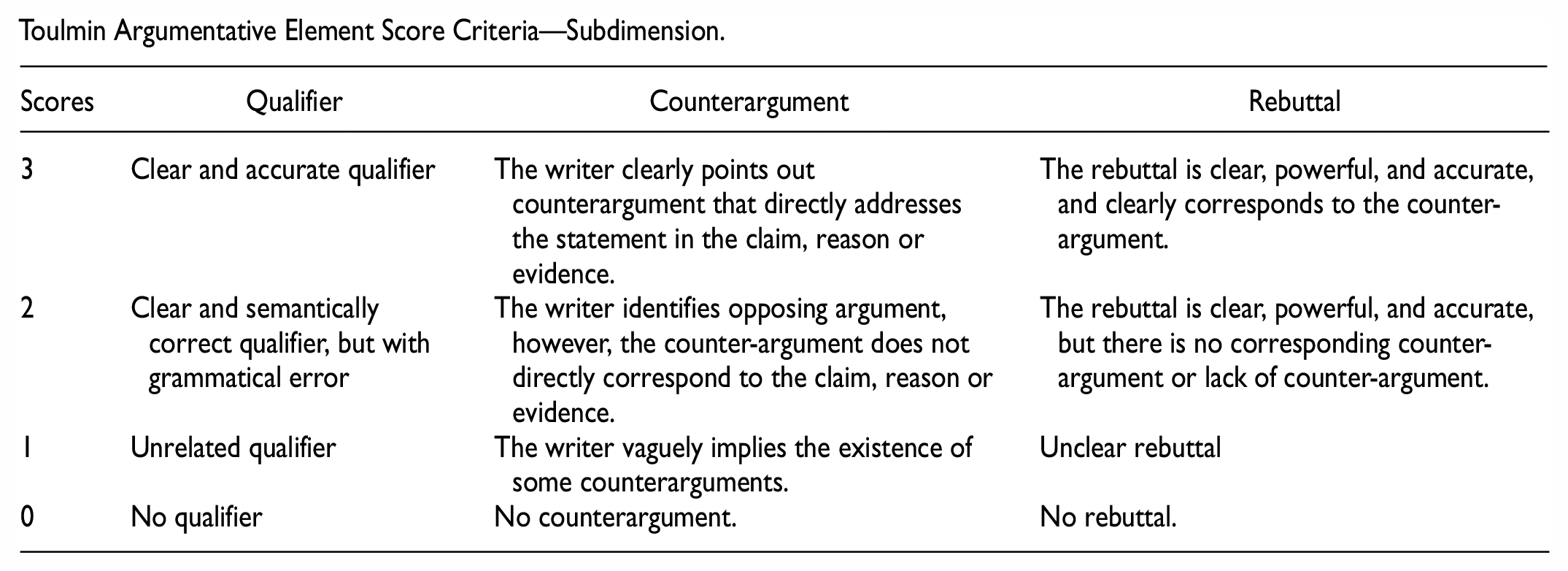
| Scores | Qualifier | Counterargument | Rebuttal |
|---|---|---|---|
| 3 | Clear and accurate qualifier | The writer clearly points out counterargument that directly addresses the statement in the claim, reason or evidence. | The rebuttal is clear, powerful, and accurate, and clearly corresponds to the counter-argument. |
| 2 | Clear and semantically correct qualifier, but with grammatical error | The writer identifies opposing argument, however, the counter-argument does not directly correspond to the claim, reason or evidence. | The rebuttal is clear, powerful, and accurate, but there is no corresponding counter-argument or lack of counter-argument. |
| 1 | Unrelated qualifier | The writer vaguely implies the existence of some counterarguments. | Unclear rebuttal |
| 0 | No qualifier | No counterargument. | No rebuttal. |
Appendix C
The scoring criteria for CET-4 English compositions of Chinese college students.

| Scores | Description |
|---|---|
| 13–15 | To the point, the expression is clear, the sentences are smooth and coherent, there are basically no language errors, only a few minor errors |
| 10–11 | To the point, the ideas are expressed clearly: the words are coherent, but there are a few language errors. |
| 7–9 | Basically to the point, some ideas are not clear enough, the words are barely coherent, and there are quite a lot of language errors, some of which are serious errors |
| 4–6 | Basically to the point, unclear expression of ideas: poor coherence, many serious language errors |
| 1–3 | Unclear organization, disordered thinking, fragmented language or most of the sentences have errors, and most of them are serious errors |
Appendix D. Semistructured interview outline
Appendix E
Implementation Steps of the Action Research.
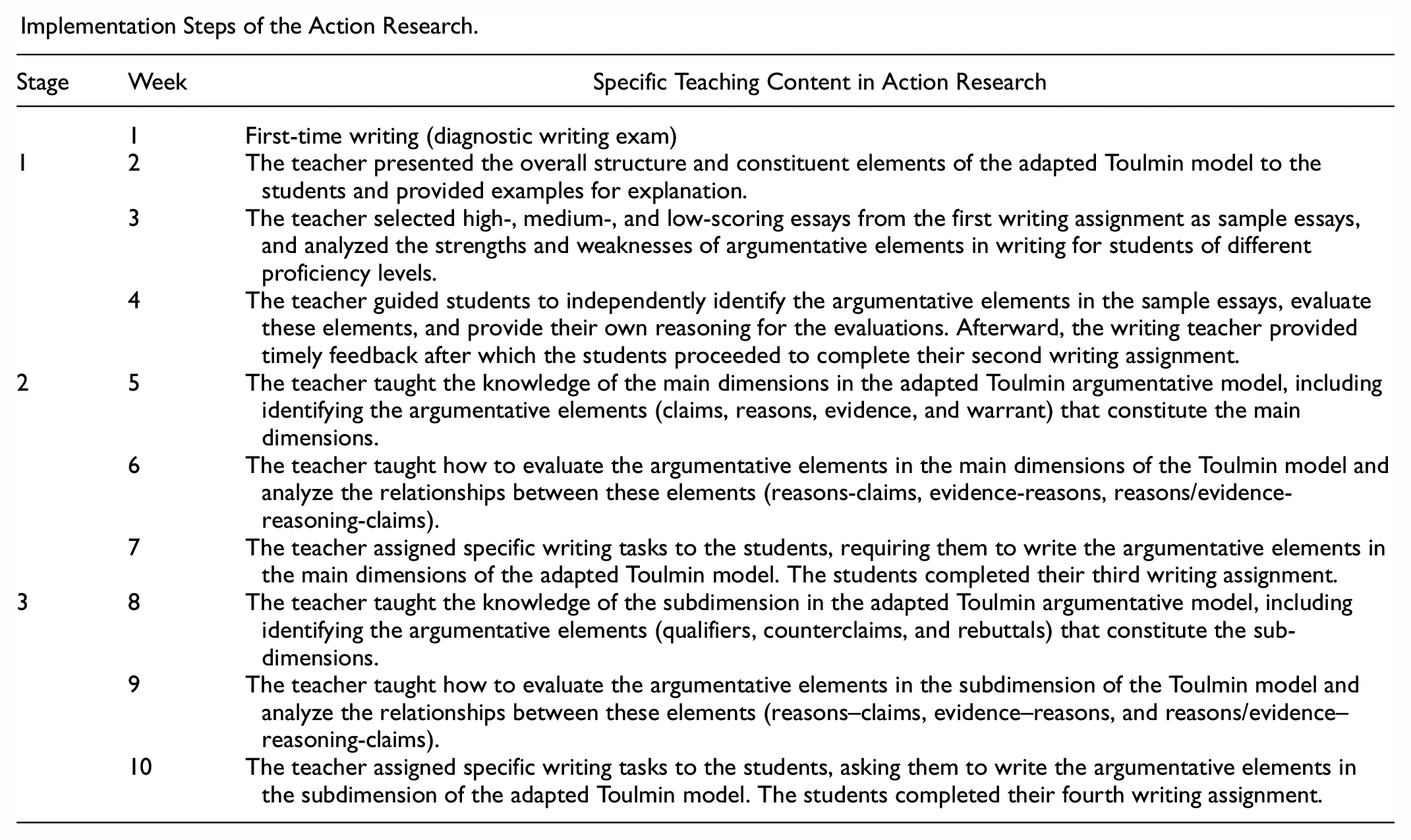
| Stage | Week | Specific Teaching Content in Action Research |
|---|---|---|
| 1 | First-time writing (diagnostic writing exam) | |
| 1 | 2 | The teacher presented the overall structure and constituent elements of the adapted Toulmin model to the students and provided examples for explanation. |
| 3 | The teacher selected high-, medium-, and low-scoring essays from the first writing assignment as sample essays, and analyzed the strengths and weaknesses of argumentative elements in writing for students of different proficiency levels. | |
| 4 | The teacher guided students to independently identify the argumentative elements in the sample essays, evaluate these elements, and provide their own reasoning for the evaluations. Afterward, the writing teacher provided timely feedback after which the students proceeded to complete their second writing assignment. | |
| 2 | 5 | The teacher taught the knowledge of the main dimensions in the adapted Toulmin argumentative model, including identifying the argumentative elements (claims, reasons, evidence, and warrant) that constitute the main dimensions. |
| 6 | The teacher taught how to evaluate the argumentative elements in the main dimensions of the Toulmin model and analyze the relationships between these elements (reasons-claims, evidence-reasons, reasons/evidence-reasoning-claims). | |
| 7 | The teacher assigned specific writing tasks to the students, requiring them to write the argumentative elements in the main dimensions of the adapted Toulmin model. The students completed their third writing assignment. | |
| 3 | 8 | The teacher taught the knowledge of the subdimension in the adapted Toulmin argumentative model, including identifying the argumentative elements (qualifiers, counterclaims, and rebuttals) that constitute the sub-dimensions. |
| 9 | The teacher taught how to evaluate the argumentative elements in the subdimension of the Toulmin model and analyze the relationships between these elements (reasons–claims, evidence–reasons, and reasons/evidence–reasoning-claims). | |
| 10 | The teacher assigned specific writing tasks to the students, asking them to write the argumentative elements in the subdimension of the adapted Toulmin model. The students completed their fourth writing assignment. |
Declaration of Conflicting Interests
The author(s) declared no potential conflicts of interest with respect to the research, authorship, and/or publication of this article.
Funding
The author(s) disclosed receipt of the following financial support for the research, authorship, and/or publication of this article: Construction and Evaluation of the English Writing Program in High Education based on Social-culture Theory (18YZA740034). This work was also jointly supported by China Scholarship Council [Grant No. 202100650002] and the Sino-Dutch Bilateral Exchange Scholarship programme (which is fnanced by the Dutch ministry of Education, Culture and Science).

Data Availability Statements
Data sharing not applicable to this article as no datasets were generated or analyzed during the current study.