




Abstract
Digital peer feedback, facilitated through various online platforms and tools, has become a significant pedagogical practice in language learning settings. Learners’ acceptance, affective and cognitive behaviors, and perceptions of peer feedback play a vital role in its utilization in the learning process. This study aimed to provide a comprehensive understanding of learners’ perceptions of digital peer feedback. To achieve this, a meta-synthesis of 22 articles from the Web of Science database was conducted. The reviewed studies focused on examining the internal mechanisms learners experience during the digital peer feedback process. This meta-synthesis highlighted the potential of digital peer feedback as a valuable component of EFL/ESL education. Moreover, it proposed some revisions for the existing internal mechanism models. The study concluded with recommendations for future research and practice, emphasizing the need for more review studies.
Introduction
Feedback, a key component of formative assessment, plays a crucial role in language acquisition by helping learners bridge the gap between current performance and learning goals. Although its benefits for achievement and performance are widely acknowledged, feedback can be complex and inconsistently effective, as students may resist or misinterpret it (Hattie, 2009; Panadero & Lipnevich, 2022). While teacher feedback is generally accepted due to the authority of the source, peer feedback (PF) is more contested, as it comes from fellow learners. PF allows students to take on roles traditionally held by instructors, promoting interaction, critical thinking, and metacognitive regulation (Ballantyne et al., 2002; Liu & Edwards, 2018; Noroozi et al., 2020). Rooted in socio-constructivist and socio-cognitive theories, PF encourages collaborative knowledge building and self-regulation (Jin et al., 2022). It supports language development by making input more comprehensible, offering opportunities to practice language use, revise writing, and increase learner autonomy, confidence, and motivation (Hyland & Hyland, 2006; Tütüncüoğlu & Koban Koç, 2024; Y. Wu & Schunn, 2021). With the advent of technology, using digital tools for peer feedback has become increasingly popular. Consequently, terms like e-feedback, online peer feedback, and digital peer feedback frequently appear in the literature, all referring to technology-based feedback. In this study, the term digital peer feedback (DPF, hereafter) has been chosen for its broader scope. However, the terminology used by researchers in their original articles is maintained when discussing previous studies.
DPF has been rapidly embraced in both educational practice and scientific research. Several factors contribute to its popularity. Firstly, limited class time poses a challenge for conducting effective peer assessment. While PF is intended to reduce the teacher’s workload and allow them to focus on other classroom activities, implementing it correctly and efficiently still demands significant time. According to Lin et al. (2021), one limitation of conventional peer assessment is its one-way interaction, where assessors give feedback but assesses cannot oversee the assessors. In conventional peer feedback, teachers get the students to give feedback to each other, but it is not easy to find time for also review feedback. Technology can help overcome this barrier as it provides studying outside of the classroom and two-way interaction options. Secondly, online PF offers a less threatening environment, encouraging greater and more equal participation among members compared to face-to-face conferencing (Guardado & Shi, 2007). DPF enhances critical thinking, autonomous learning, and social engagement, reasoning skills (Alsaleh, 2020; Aprilianti & Widyantoro, 2024). Nevertheless, students reported a feeling of comfort in providing feedback through electronic modes of interaction (Chen, 2016). As a result, computer-mediated peer feedback activities boosted student motivation and participation in composition classes (Cheng, 2007). It also creates a sense of community and both feedback receivers and providers have some gains although there are some technical and personal limitations (Sağlamel & Çetinkaya, 2022). Despite the benefits of DPF, traditional methods such as pen and paper are still preferred as “pen and paper are thought to be more familiar, less distracting for students, and easier for instructors to implement and manage” (Shannon et al., 2017, p. 5545).
With the growing number of studies on DPF, review studies that summarize and analyze previous work have emerged in literature, albeit in limited numbers. Most review studies focus on peer feedback in general without specifically addressing the digital aspect (Huisman et al., 2019; Teoh et al., 2016; Vuogan & Li, 2023; Wong & Shorey, 2022; Yu & Lee, 2016). Consequently, there are few studies reviewing DPF, which are important to highlight. To begin with, Chen (2016), reviewed the articles between 1990 and 2010. He concluded that the problems of traditional face-to-face peer writing groups such as off-task discussions, individuals’ domination, and unequal participation, became less influential in computer-mediated interactions. Replicating the study of Chen (2016), Cuocci et al. (2023) conducted a meta-synthesis on technology-supported peer feedback in EFL/ESL writing. They found that students had positive perceptions toward DPF as it improved writing skills, reduced writing anxiety, and increased motivation and self-confidence. Nevertheless, the restriction of the meta-synthesis to studies published between 2011 and 2022 limits the breadth and historical depth of its findings. Jongsma et al. (2023) reviewed the articles focusing on the perceptions of learners on DPF and comparing online versus offline peer feedback and found that online peer feedback was more effective than offline peer feedback. Besides, “online peer feedback is more effective when the outcome measure is competence rather than self-efficacy for skills” (Jongsma et al., 2023, p. 329). Although Jongsma et al. (2023) present a noteworthy finding, the limited number of studies included in their meta-analysis (n = 10) constraints the generalizability of the reported effect size.
After reviewing 84 research studies on online peer feedback in higher education by following Biggs’ (2003) model of peer feedback, Kerman et al. (2024) identified four dimensions that should be considered for an effective PF process. The first dimension includes students’ characteristics, such as academic background, personality traits, and psychological features.
The second dimension refers to environmental conditions, including the learning platform and setting. The third dimension focuses on learning processes, which encompass both content and technology. Finally, the fourth dimension involves learning outcomes, which can be classified into three categories: (a) cognitive outcomes including acquisition of knowledge, comprehension, application, analysis, synthesis, and evaluation, (b) behavioral outcomes including engagement and communication, and (c) affective outcomes including satisfaction, motivation, attitude, self-efficacy, sense of autonomy, and confidence.
In a similar vein, Cao et al. (2022) reviewed the online peer feedback literature and identified two main dimensions which were cognitive online peer feedback (face-based strategies, revision-based comments, writing performance, learning environment), and affective online peer feedback (reflection/critical thinking/responsibility, writing emotion, motivation, attitudes). Although the works of Cao et al. (2022) and Kerman et al. (2024) offer a useful conceptual framework, they remain largely theoretical and call for empirical validation across diverse educational settings.
The previous review studies have important findings for the field. The meta-analysis studies showed that digital peer feedback affected learners’ performance positively (Cui & Zheng, 2018; Zheng et al., 2020). Building on these foundational findings, the present study seeks to advance the field by shifting the focus from outcomes to the internal mechanisms that underlie the DPF process—an area that remains underexplored in the current literature. It aims to provide a comprehensive understanding of learners’ perceptions of digital peer feedback. Specifically, this study examines learners’ internal processes such as motivation, mindset, and emotional responses, with the aim of offering a deeper understanding of how these factors interact with DPF practices. Such insights can inform more nuanced and learner-centered approaches to peer assessment, enabling educators to better support students’ engagement and development. Furthermore, while prior reviews have largely concentrated on the use of DPF in writing contexts (e.g., Cao et al., 2022; Chen, 2016; Cuocci et al., 2023), this study adopts a broader perspective by investigating DPF across various skills and topics. In doing so, it contributes a more holistic understanding of the potential and challenges of DPF in diverse learning environments.
Theoretical Framework
This study utilized the model of the internal mechanisms of feedback processing of Lui and Andrade (2022). In this model, feedback is regarded as not something given but something received. Thus, the model assesses the students’ responses to the feedback through internal mechanisms. The model, that is proposed as a result of a meta-synthesis study examining previous responses to feedback models, has seven main elements which are external feedback, initial states, emotions elicited by feedback, decision-making, interpretation of feedback, behavioral response, and academic achievement. “Feedback is the external factor that activates internal processing” (Lui & Andrade, 2022, p. 8). As this study is keen on the perceptions of students on peer feedback, the dimension that has a direct relation to internal mechanisms has been benefited and explained.
According to Lui and Andrade (2022), numerous motivational elements and initial states affect and are affected by feedback and how students respond to it. The model of Lui and Andrade (2022) lists the initial states as beliefs & conceptions about assessment, self-efficacy, goal orientation, mindset, task value, and prior knowledge (see Figure 1). These factors are called initial states by Bangert-Drowns et al. (1991) as they affect the time when the students receive feedback and the way of receiving and responding to it.

Internal mechanism of feedback (cited in Lui & Andrade, 2022, p. 8).
It is natural that receiving feedback triggers some emotions in learners. Both teacher feedback and peer feedback can lead to enjoyment, hope, pride, gratitude, frustration, joy, anger, anxiety, shame, hopelessness, relief, satisfaction, excitement, depression, boredom, and interest (e.g., Ilies et al., 2010; Pekrun et al., 2007; Pekrun & Stephens, 2010; Rowe et al., 2015; White, 2013). Although these emotions can be negative or positive, Rowe et al. (2014) state that emotions can help students bounce back from negative evaluations, guard against rejection, interpret feedback, and foster cooperative relationships with teachers and peers. Thus, it is important to understand students’ emotions and act accordingly in feedback processes.
Another important element of the feedback process is the interpretation of feedback. Lui and Andrade (2022), operationalize the interpretation of feedback as meaning-making, attributions based on feedback, and judgments or appraisals made about it. They state that interpretations together with emotions help students in the determination of next steps in their learning process after receiving feedback, an element they refer to as decision-making. The learners may decide to benefit from this feedback for their learning or to ignore it. If feedback is received from the teacher, it is more likely to give more importance and improve their learning. On the other hand, the students may attribute less importance to the comments of their peers as they are also learners.
Prior to analysis, it is essential to make operational definitions of complex concepts such as motivation and self-efficacy. Since Lui and Andrade (2022)’ model was adopted, definitions that they used in their article were addressed here by directly citing from them below.
self-efficacy, which refers to students’ beliefs about their capabilities to achieve a specific goal or task (Bandura, 1986); goal orientation, which refers to students’ purpose for engaging in a task or behaviour (Dweck & Leggett, 1988; Elliot, 2005; Mega et al., 2014); mindset, which are one’s beliefs about the malleability of intelligence (Dweck et al., 1995), and task motivation, which includes the extent to which one enjoys, is interested, finds relevance and/or importance in the topic or task at hand (Horvath et al., 2006). (Lui & Andrade, 2022, p. 4).
This study aimed to investigate the internal mechanisms involved in the digital peer feedback (DPF) process, with a deliberate focus on learners’ internal states rather than external feedback, behavioral outcomes, or academic performance—although the interconnectedness of these dimensions is well-recognized. The decision to concentrate on internal mechanisms stems from the growing recognition that learners’ perceptions, motivations, emotions, and cognitive responses significantly influence the effectiveness of peer feedback processes, particularly in digital environments. To explore this focus systematically, the research questions were formulated to reflect both the broader research landscape and the nuanced internal dynamics of DPF. The first two questions provide essential contextual and technological background, while the third and fourth directly target internal mechanisms. Specifically, they examine two key phases: learners’ initial internal states before engaging with feedback (e.g., perceptions, expectations, motivation), and their internal responses after receiving peer feedback (e.g., emotional reactions, cognitive shifts, mindset changes). These two phases are conceptualized as integral components of the internal mechanism framework guiding this study. By examining these elements in combination, the study aims to contribute to a more comprehensive understanding of how internal factors shape and are shaped by DPF in EFL/ESL contexts. This understanding can inform the design of more effective feedback practices that take into account the psychological and emotional dimensions of learning. Thus, the research questions were formulated as follows:
- What are the general characteristics of EFL/ ESL studies regarding perceptions of digital peer feedback (year, country, setting, research topics/fields?)
- What digital tools are utilized for DPF?
- What are the initial states of learners in the DPF process?
- What are the responses to the feedback in the DPF process?
Methodology
Search Strategy
This study employed a meta-synthesis approach to explore the field. Since qualitative studies present more detailed and in-depth data for perceptions and beliefs, meta-synthesis, which is “the systematic review and integration of findings from qualitative studies” (Lachal et al., 2017, p. 269), was adopted. The Web of Science was selected as the primary source for data collection in this study due to its reputation as one of the most comprehensive and prestigious citation databases in the academic community. It is widely recognized for its rigorous indexing standards, which ensure the inclusion of high-quality, peer-reviewed publications from reputable journals across a wide range of disciplines. By relying on Web of Science, the study aimed to ensure a level of scholarly rigor and reliability in the dataset, focusing on sources that meet established criteria for academic excellence. Thus, the Web of Science was scanned on April 2, 2024, without any time restrictions on the query. To ensure a comprehensive review, the following terms were utilized: Peer* AND Feedback OR assessment OR evaluation OR debrief OR comment OR editing OR grading OR review AND EFL OR ESL OR English OR language AND Web OR technology* OR computer OR mobile OR online OR “social media” OR digital NOT “literature review” OR “meta-analysis” OR “systematic review” OR “meta-synthesis”
The search resulted in 3,576 publications on Web of Science. The Preferred Reporting Items for the Systematic Reviews and Meta-Analyses (PRISMA) approach (Page et al., 2021) was followed to select and identify the studies. During the identification phase, the inclusion criteria were set to peer-reviewed articles, articles written in English, open-access articles, and empirical studies. Initially, publications other than articles such as conference papers and book chapters, review articles, non-open access articles, and articles not written in English were excluded using the Web of Science automation tool, reducing the count to 639. Upon screening these 639 articles, the researcher identified records that the automation tool had missed some criteria. Consequently, the researcher manually excluded review articles (n = 5), non-open access articles (n = 9), articles not written in English (n = 5), retracted articles (n = 2), and other types of publications (n = 5; see Figure 2).
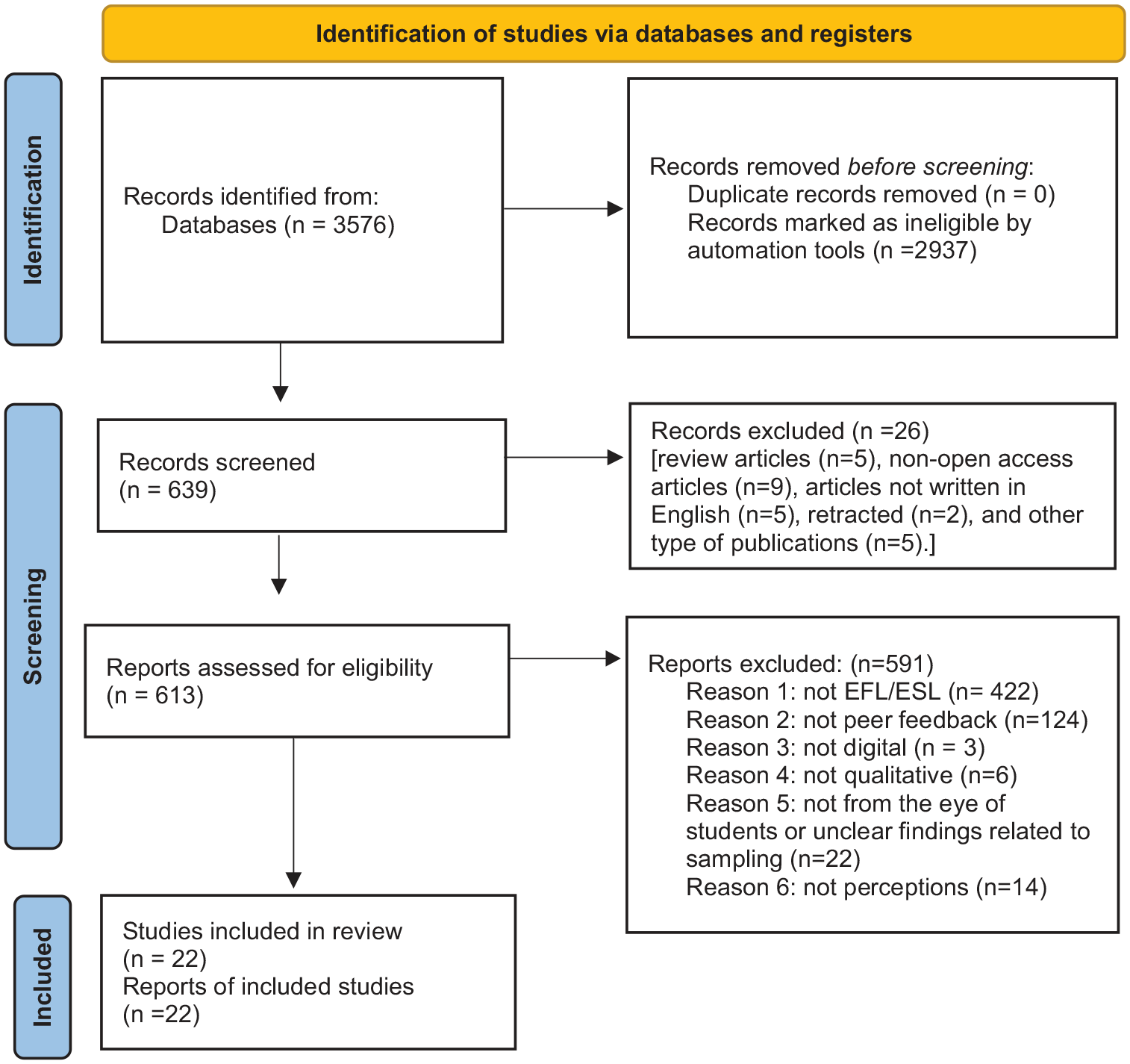
PRISMA flow diagram.
The researcher screened 613 articles, considering the exclusion criteria explained below.
- Studies on learning/teaching different languages (Chinese, Japanese, etc.) other than English
- Studies not specifically focused on peer feedback (Some studies utilized technology to explore its general impact on language learning, and found they were useful or not for peer feedback. It was expected that the main research question should be regarding to peer feedback. Additionally, some studies involved peer tutoring that extended beyond focused feedback.)
- Studies of which sampling does not consist of students/learners (for the ones consisting of both learners and teachers, the part related to students was included. Studies with unclear findings regarding their relevance to students versus teachers were omitted.)
- Studies not addressing perceptions/beliefs/opinions/attitudes
- Studies excluding technology in the peer feedback process
- Quantitative studies (the qualitative parts of articles using mixed methods were included)
Analysis
Thematic analysis was employed for data analysis. The process began with an initial, immersive reading of all included studies to gain a comprehensive understanding of their content and context. Following this, a coding scheme was developed. As stated in the introduction part, the model of Lui and Andrade (2022) was used as the coding framework so the internal mechanisms which were self-efficacy, goal orientation, mindset, task motivation, beliefs and conceptions about assessment, prior knowledge, emotions, interpretation, and decision making were the pre-determined codes of the analysis. Each article was carefully coded using this framework, and the codes were continually refined through an iterative process. To enhance the reliability of the analysis, the researcher reviewed and analyzed the data twice, with a 2-week interval between the sessions, ensuring high consistency and intra-reliability.
Findings
The findings were organized and presented in alignment with the research questions, supported by summary tables. While meta-synthesis primarily emphasizes interpretation across studies, selected illustrative quotes were included to enrich the thematic analysis and preserve the contextual depth of the original research.
General Characteristics of Studies
The general characteristics of the studies were examined under four main headings which were year, country, setting, and research topics/skills (see Table 1).
Included Articles.

An analysis of the researchers’ countries revealed that China was the most productive country (n = 7), followed by Vietnam (n = 3) and Saudi Arabia (n = 3), and Malaysia (n = 2). Brazil (n = 1), South Korea (n = 1), Iran (n = 1), Thailand (n = 1), South Africa (n = 1), and the UK (n = 1) were the other countries that produced research in line with the criteria of this research.
Table 1 indicates that the most researched EFL topic/field was writing (n = 16). Other topics included speaking (n = 3), pronunciation (n = 1), teacher education (n = 1), interaction (n = 1), oral production (n = 1), and learning strategy (n = 1). When the research setting was examined, it was revealed that all studies had been conducted in higher education.
Figure 3 shows that most of the examined articles were published in 2023 (n = 7), 2018 (n = 4) and 2022 (n = 4), and 2020 (n = 3). Finally, there was one research in 2010, 2021 and two research at the first quartile of 2024 which the scanning was conducted in.

Distribution of articles to the years.
The Preferred Digital Platforms/Tools Used for DPF
Since each platform has distinct features that can impact the DPF process, they were presented individually without any classification (See Table 2).
Digital Platforms. a

Studies were presented with the numbers given in Table 1.
Table 2 indicates that the platforms that were used for DPF showed several varieties. Nevertheless, Facebook was the most used platform (n = 4), followed by Google Docs (n = 3), Moodle (n = 3), Rain Classroom (n = 2), WhatsApp (n = 2), and WeChat (n = 2). Some studies preferred more than one platform and examined the overall effect (Xhafaj & Zaccaron, 2024; Xue et al., 2023; Zhang et al., 2022). Speechnotes, Google Meet, video, blog, MS Team, QQ, Danmaku, Vimba Voice Board, Turnitin, PeerCeptiv, Writer, and PeerEval were the other digital tools that were utilized by the researchers.
Initial States
To answer the third research question, the initial states addressed in the articles were examined and presented in Table 3. While goal orientation and self-efficacy were not observed in learners’ perceptions, beliefs and conceptions were commonly emphasized (see Table 3).
Initial States.

I used to be keen on the details, spending several seconds pondering over the ‘errors’ I have sensed. However, after a semester of providing and receiving feedback from the learning community, I am changing my mindset gradually. I think the overall quality prevails (Gong & Yan, 2023, p. 19)
Since PF provides learners with being aware of their strengths and weaknesses, they believed that they had the opportunity to think about these shortcomings and gained deeper insights and develop metacognitive abilities (Motlhaka, 2020; Murphy Odo, 2023). In contrast to these studies emphasizing the positive dimension of PF for mindset, Chinese doctoral students highlighted that Rain Classroom restricted deep thinking which was important for academic writing due to limited number of characters in Rain Classroom (Zhang et al., 2022).
Learners expressed several criticisms of DPF, leading to negative attitudes toward its use. These included: (a) the inability to adequately defend their opinions against received comments (Xue et al., 2023), (b) technical limitations, such as the small screen size of mobile devices (Murphy Odo, 2023; J. G. Wu & Miller, 2020), and (c) a lack of self-confidence in their own abilities (Vo & Nguyen, 2023), which also affected their trust in their peers’ competence (Gao & Wang, 2022; J. G. Wu & Miller, 2020). Unlike the authority and professionalism of teacher feedback, peer feedback often involves uncertainty as participants may doubt the accuracy of their peers’ suggestions, particularly regarding content or coherence, and may challenge feedback they perceive as stemming from misunderstandings (Gao & Wang, 2022).
Responses to the Feedback
The review showed that learners expressed mostly their emotions, and they also addressed how they interpreted feedback and what they would do with their peers’ comments (see Table 4).
Responses to the Feedback.

The use of emojis in online PF helped learners decrease the feeling of embarrassment, discouragement, and worry as learners used emojis such as smiley pleasure and cheer while giving harsh criticism (Xue et al., 2023; Zhang et al., 2022). The one–to–one conversation provided in online medium PF reduced face-threatening problems (Zhang et al., 2022). Similarly, audio-communication reduced the feelings of isolation (Yaneske & Oates, 2010). Learners felt easier and more comfortable if there was prior familiarity with their partners (Dao et al., 2023). Li and Hebert (2024) found that learners were “grateful,” “quite hopeful,” “delighted,” “more interested,” “inspired,” “highly inspired,” “glad,” “happy,” “very happy,” “really happy,” “being encouraged,” and “feel encouraged” in DPF process (p. 1565). The DPF was found to be enjoyable (Gao & Wang, 2022; Gong & Yan, 2023; Li & Hebert, 2024; Sun, 2023), less nervous (Sun, 2023), interested (Ekahitanond, 2018; Rezai, 2022), satisfied (Murphy Odo, 2023), and fun (Gong & Yan, 2023), and comfortable and not embarrassed (Alharbi & Al-Hoorie, 2020). DPF provided learners more empathy and resonance (Gao & Wang, 2022) as illustrated by one learner as follows: I think the primary feature of peer feedback is the empathy between the author and the reader. It seems that my peers know me and can understand my situations. This might be the generation gap issue. While instructors are more experienced, they sometimes fail to understand my generation or what we are most concerned with or interested in. For example, one example I shared in my writing is how young lovers in different cities suffered from miss ing each other in the pandemic time. Some peer reviewers were suffering from the same issue as mine when they read my writing. (Gao & Wang, 2022, p. 65).
DPF also helped reduce learners’ anxiety levels (Xhafaj & Zaccaron, 2024). However, Xue et al. (2023) identified three types of anxiety—English anxiety, smartphone anxiety, and communication anxiety—that arose during the e-feedback process. Learners felt burnout (Gong & Yan, 2023), boredom (Gong & Yan, 2023), awkward and reluctant (Astrid et al., 2021), and frustration due to the interface of the online platform (Alharbi & Al-Hoorie, 2020; Yaneske & Oates, 2010), and guilty for not viewing all messages on the online platform (Yaneske & Oates, 2010). Moreover, they felt shyness as indicated by a learner as follows: Even though, it was good to see my friends live on Facebook. I was uneasy and shy to be seen as well. (Ekahitanond, 2018, p. 690)
Learners who expressed their emotions during the PF process were also aware of the importance of their emotions. When a comparison between video-chat and text-chat feedback processes, they preferred video chat as “text-chat precluded learners from seeing and judging their partner’s emotions through facial expressions” which “consequently reduced the occurrence of peer feedback.” (Dao et al., 2023, pp. 1223–1224).
Some peers mentioned on QQ that I should provide more detailed content to make my essay clearer, but I did not know how to revise the support-related writing problems because they did not provide me with some specific suggestions (Li & Hebert, 2024, pp. 1559–1560).
To facilitate reader understanding, a succinct overview of the key findings has been provided in Table 5.
A Summary of Key Findings.

Discussion
The findings of this study reveal significant insights into productivity, research focus, settings, publication trends, and various aspects of peer feedback in EFL/ESL contexts. To begin with, most of the articles were published in 2023, which shows the currency of the topic and a growing interest in the DPF in the EFL/ESL research community. As technology evolves and introduces new features that educators can utilize, it is understandable that more studies have been published in recent years. This increase is influenced not only by technological advancements but also by the growing digital literacy among users. Tools such as WhatsApp, Facebook, and MS Teams, though not new, have become standard in the educational process. The absence of articles on newer technologies like Artificial Intelligence and Virtual/Augmented Reality highlights the association with digital literacy. While many studies in literature explore these advanced technologies in other dimensions of learning, using them for peer feedback is more challenging because all learners need the ability to use them, maybe at home, raising issues of accessibility and affordability.
It is noteworthy that all the reviewed studies were conducted in higher education, primarily focusing on developing learners’ writing skills. Peer feedback is often utilized in academic writing assignments within higher education (Huisman et al., 2019). This trend may be partly due to higher levels of digital literacy among young adults compared to children. Additionally, effective peer feedback requires a higher understanding of subjects and critical thinking skills. Children, who are still in the concrete operational stage, and high school students, who are just entering the formal operational stage, may struggle with giving and receiving feedback. Besides, they might be more vulnerable to harsh comments from their peers.
The studies were primarily conducted in Asian countries, with a focus on China, Vietnam, Saudi Arabi, and Malaysia. Only one study was conducted in the European context. This finding contradicts another review study (Wong & Shorey, 2022) finding that there is only one study carried out in Asia, while most of them were conducted in Western contexts. Nonetheless, the findings of this study should be interpreted with caution, as the qualitative nature of this study means the sample size is too small for generalization.
In this study, the internal mechanisms model of Lui and Andrade (2022) to understand the perceptions of learners was adopted. Thus, two main titles which are initial states (self-efficacy, motivation, goal-orientation, mindset, prior knowledge, beliefs and conceptions about assessment) and response to feedback (emotions, interpretations, and decision-making) were examined in the sampling articles. This examination has presented important findings. Firstly, the fact that learners provided limited explanations related to their self-efficacy was a noteworthy finding. However, they often preferred related constructs such as self-awareness and self-confidence. Another review study conducted by Cuocci et al. (2023) also found that DPF increased learners’ self-confidence. Kerman et al. (2024) also concluded that self-confidence was one of the factors addressed in the DPF literature. They also emphasized self-efficacy, which was addressed in only one of the reviewed articles in this study. One of the advantages of peer feedback is that it helps learners see their weaknesses and strengths, which is a good example of self-awareness. Thus, the notions of self-awareness and self-confidence should be added to internal mechanisms. Based on the findings of this study, my suggestion is using an umbrella term such as the “self” construct that would include all self-related terms. Thus, the initial steps can be rewritten as: (a) “self” constructs, (b) goal-orientation, (c) mindset, (d) task motivation/value, (e) beliefs and conceptions about assessment, and (f) prior knowledge. Although goal-orientation was not found in this study, a revision for this concept was not suggested as there may be several reasons of this finding such as the nature of the questions asked to the participants. When learners were interviewed, they responded to the specific questions posed to them. General questions, such as “How did you find digital peer feedback?” or “What were the advantages?” might not prompt thoughts about goal orientation in learners’ minds. It can be also associated with different conditions such as the goals of DPF were explicitly presented by teachers and they did not have intrinsic motivation which is closely related to goal orientation.
Since the inclusion criteria of this study consisted of studies on perceptions, it is not surprising that in each article we found results on beliefs and conceptions. “Beliefs and conceptions” is a comprehensive term so learners’ beliefs on the efficacy or usability of DPF were analyzed under it. Learners mostly regarded DPF as useful and effective specifically for writing which is the most researched area. Since technology has different features and individuals have different emotions and understanding of life, the perceptions showed variety. While some learners preferred text-based PF as they did not see their peers’ faces, other learners preferred channels such as video to see their peers’ faces. Moreover, some learners had some reliability concerns; they did not believe in their own and peers’ competence, so they preferred teacher feedback. Wong and Shorey (2022) also emphasized that learners were reluctant and skeptical about peer feedback as they doubted both their own ability and the validity of their peers’ comments. This result is associated with the nature of PF, meaning that it is not just a result of the use of technology for peer feedback. On the other hand, limitations such as small screen size are specific to DPF. The usage of chosen technologies can determine the success of implementing technology-supported peer feedback activities (Cuocci et al., 2023). Thus, trying to minimize the technological limitations by choosing the right digital platform can cause more positive attitudes toward DPF.
Motivation and mindset are critical factors that reflect learners’ perceptions of DPF, even though they were less emphasized compared to the beliefs and conceptions. Learners highlighted that DPF enhanced motivation as also found in Cao et al. (2022) and Cuocci et al. (2023), encouragement, and mental power. There were no reported negative perceptions of DPF in terms of motivation; however, some learners noted that DPF restricted deeper thinking. The mentioned DPF was Rain Classroom, and the study used three different platforms (Zhang et al., 2022). As Rain Classroom had a word limitation, learners had a problem in terms of deeper thinking. Thus, the importance of using the right technology becomes clearer again.
When learners were asked about their perceptions of DPF, they were more oriented to use emotions to explain their perceptions. Thus, it was revealed that emotions played a critical role in the DPF process among EFL/ESL learners. Emotional responses of learners influence their participation in peer assessment activity (Cheng et al., 2014). Learners regarded DPF as less face-threatening compared to face-to-face PF, which they felt could provoke instant and potentially uncomfortable reactions. This finding is parallel with Cao et al. (2022) who also found that learners regarded online peer feedback as less face-threatening and embarrassing. Technology has the opportunity of providing anonymity which may lower embarrassment and anxiety typically associated with in-person critiques. It also helps learners feel more secure especially when giving negative comments. From the findings, it was clear that learners were shyer in giving negative comments. Apart from the role of anonymity in decreasing this shyness, the use of emojis also relieved learners when giving harsh comments. As individuals differ in their personalities and needs naturally, some learners preferred face-to-face PF to see their peers’ comments. Hopefully, technology presents video and audio options that simulate the classroom setting, which was regarded as less face-threatening and a barrier to the feeling of isolation. The study found that DPF fostered a range of positive emotions; they felt grateful, hopeful, delighted, interested, encouraged, happy, enjoyed, satisfied, fun, bored, frustrated, more or less anxious, less nervous, and burnout. Previous studies (Ilies et al., 2010; Pekrun et al., 2007; Pekrun & Stephens, 2010; Rowe et al., 2015; White, 2013) resulted in similar findings stating that learners had enjoyment, hope, pride, gratitude, frustration, joy, anger, anxiety, shame, hopelessness, relief, satisfaction, excitement, depression, sadness, boredom, and interest in PF process. Unlike these studies, anger, pride, shame, depression, and sadness were not found in this study. The learners had more positive emotions compared to the negative ones. The previous studies examining peer feedback from the perspective of emotions did not use the technology for PF. As stated above, some features of technology such as emojis and anonymity are helpful in coping with some negative emotions. The findings imply that the emotional landscape of DPF is complex and multifaceted. Although DPF provides several benefits, such as minimizing face-threatening interactions, utilizing anonymity to reduce discomfort, and employing digital tools to enhance emotional expression, it also introduces challenges, including different forms of anxiety and platform-related frustrations. These findings indicate that although DPF can foster a supportive and engaging feedback environment, careful attention must be paid to the design and implementation of digital tools to address and alleviate the negative emotional impacts on learners.
Many advantages of DPF have been highlighted in different dimensions such as emotions and motivations, but it significantly falls behind face-to-face PF when the subject is interpretation of feedback. Comprehension of what the peers wish to explain is essential for an effective assessment process. Face-to-face PF is more beneficial in making the feedback meaningful. On the other hand, some students preferred text-based feedback instead of videos that were closer to face-to-face interaction, and some others preferred audio to the text-based one. This difference can be explained by two reasons which are individual differences and differences in preferred online platforms. For instance, the comparison of Moodle and WeChat indicated that WeChat was preferred for its clarity and elaboration in feedback. This suggests that the design and user interface of the platform play a significant role in the effectiveness of DPF. Besides, the diverse preferences of learners related to text, video, or audio feedback underscores the importance of considering the modality of feedback.
Another crucial aspect of receiving feedback is how learners can effectively utilize it. Among the 22 studies reviewed, in only four of them, learners had decisions on what to do with peer feedback. Learners would benefit from peer feedback to support and the creation of more workable plans for their next tasks and to adjust learning strategies. The recognition that feedback can be beneficial for adjusting learning strategies or plans suggests that learners view peer feedback as a valuable tool for personal and academic growth. However, this understanding is not consistently shared among all learners, indicating a need for guidance on how to effectively leverage peer feedback.
Overall, these findings underscore the diverse experiences and perceptions of EFL/ESL learners regarding DPF, highlighting the importance of considering various factors such as emotional responses, conceptions of assessment, motivation, interpretation of feedback, and the mode and quality of digital tools.
Conclusion
The study presents significant findings regarding the internal mechanisms of the DPF process, which should be considered alongside their pedagogical implications. It is undeniable that peer feedback holds great potential to support learners in their language learning journey. However, the quality of this process can significantly impact its effectiveness. Learners may sometimes doubt their own and peers’ abilities, leading them to underutilize the benefits of peer feedback. To address this, teachers can play a crucial role in motivating learners and educating them on how to give and receive feedback effectively, while also helping them build the necessary skills to interpret and apply feedback meaningfully. Since students often lack strategies for using feedback, incorporating metacognitive reflection and feedback literacy into instruction is essential. Moreover, learners’ emotional responses, shaped by factors like anonymity or feedback modality, should be considered when designing peer feedback tasks, as emotional comfort can influence participation and uptake. Since recognizing learners’ digital competence and psychological readiness is essential, practitioners should differentiate feedback activities based on learners’ prior knowledge, self-confidence, and preferences (e.g., video vs. text feedback) to foster more inclusive and effective participation. Finally, to move beyond sporadic use, it is suggested that DPF be systematically embedded into course design. This integration ensures sustained engagement and allows for longitudinal development of peer feedback skills across varied tasks (writing, speaking, etc.).
Technology has always been a double-edged sword. On one edge, it has brought numerous advancements to human life, while on the other, it presents certain disadvantages. However, it is neither logical nor realistic to abandon technology due to its limitations. Instead, efforts should focus on minimizing these drawbacks and risks, while maximizing the benefits of the many conveniences it offers. This study revealed that learners generally had positive perceptions of using technology in the peer feedback process. Nonetheless, challenges often stem from the specific characteristics of digital tools or platforms chosen. Therefore, educators should strive to identify and utilize the most suitable technologies with minimal limitations, matching them to learners’ digital skills and preferences. The choice of platform can affect the clarity, emotional tone, and interpretability of feedback, all of which are crucial for meaningful engagement. The responsibility for effectively integrating technology into peer interactions lies not only with teachers but also with other stakeholders in the education system, including administrators and researchers. There is a pressing need for more research, particularly review studies that synthesize existing literature to aid teachers in implementing DPF. A research synthesis is beneficial for uncovering profound insights from diverse literature to guide future research (Bangert-Drowns et al., 2004) so conducting these studies and sharing them with the other stakeholders of education will ease teachers and help learners. Moreover, empirical work grounded in motivational and emotional frameworks, as well as comparative studies of digital tools, would further strengthen the theoretical and practical foundations of this field. Finally, based on this study’s proposal to revise Lui and Andrade’s (2022) internal mechanism model—specifically by introducing a broader “self” construct—future research could develop and empirically validate a new or expanded framework that integrates self-efficacy, self-confidence, and self-awareness to better reflect the multifaceted learner experience.
While this study offers potential contributions to the field, it is not without limitations. One notable limitation is the exclusive reliance on a single database, Web of Science, which is although comprehensive and includes qualified studies, may not capture the full breadth of relevant literature available across other academic platforms. Additionally, the analysis was confined solely to peer-reviewed journal articles, excluding other potentially insightful sources such as book chapters, dissertations, theses, conference proceedings, and gray literature. The study also did not account for non-English publications, which could cause to overlook some significant contributions. Future studies could benefit from exploring additional databases and including diverse sources such as book chapters, theses, and conference proceedings.
Footnotes

Ethical Considerations
This article does not contain any studies with human or animal participants.
Funding
The author received no financial support for the research, authorship, and/or publication of this article.
Declaration of Conflicting Interests
The author declared no potential conflicts of interest with respect to the research, authorship, and/or publication of this article.
Data Availability Statement
The datasets used and/or analyzed during the current study are available from the corresponding author on reasonable request.