




Abstract
Technology leadership is being redesigned to accelerate technology integration in schools to develop and sustain the skills needed to produce skilled manpower. Previous studies showed that the factors that prevented leaders and teachers from integrating information and communication technologies (ICT) in schools are lack of ICT training, teacher ICT competency, and access to ICT resources. This shows that there is a gap in technology integration in schools. This study aims to identify the importance of technology leadership for technology integration based on gender and professional development. This is a quantitative study using cross-sectional design. A total of 90 respondents were selected by systematic random sampling from 190 national secondary schools. The importance and performance matrix analysis revealed that professional development had high performance and was an important variable in the prediction of teachers’ technology integration, but gender was not. Thus, school management should give priority to digital age learning culture and digital citizenship constructs to accelerate teachers’ technology integration in schools.
Keywords
Introduction
The rapid advancement of technology, especially in Industrial Revolution 4.0 (IR 4.0), is evidently influencing every aspect of our lives including leaderships and education settings across the world (Schwab & Davis, 2018). Advanced technologies in IR 4.0 like Artificial Intelligence and Internet of Things are changing the role of school leaderships, approaches to teaching, and remodeling of classrooms (Hinton, 2018). Over the past decade, rampant changes have been obvious in the way leaders administer and manage technology use in schools (Machado & Chung, 2015). The recent report from Training Industry Trends found that learners’ needs are changing, technology is evolving, skills are different, automation is altering processes, and globalization is expanding our reach (Harward & Taylor, 2014). However, Schrum et al. (2011) reported that as many as 92% of leader preparation courses do not involve the use of technology. Many states and institutions in the United States do not make educational technology compulsory in school leadership preparatory programs. Out of their initiative and commitment toward 21st-century education demands, leaders acquire latest technological knowledge by themselves and promote collaboration and technology vision among teachers. Key findings from the CoSN’s 2019 K-12 IT Leadership Survey Report (2019) showed that one of the top three challenges faced by technology leaders, which remained the same from 2017 to 2019, was insufficient professional development. Technology leaders reported lack of relevant training and the unavailability of professional training.
School leaders have the responsibility to encourage and support teachers to integrate technology in learning and to teach especially when the Internet of Things is rapidly making its way into classrooms in ways never before imagined. With Smart whiteboards and alternative interactive digital media being widely utilized during interactive learning in classrooms, school leaders have to keep abreast with the new technologies. Thus, school leadership preparatory training should include technology to produce future-ready school principals who can lead teachers and students, as learning experiences become virtual and ubiquitous (Aldowah et al., 2017; Esplin, 2017). Moreover, it is the ultimate goal of school technology leaders to propel learning and teaching forward toward student achievement.
Technology leaders are required to take advantage of technology to transform, impact learning, and create a shared vision for how technology can meet the needs of all learners (National Education Technology Plan Update, 2017). It is thus critical that school leaders envisage and facilitate the use of technology in this digital world ubiquitous to students who are now digital natives. However, according to a report by the World Economic Forum (2019), poor leadership could be the biggest barrier to a successful Fourth Industrial Revolution strategy.
The Malaysia Education Blueprint Report 2013–2025 shows that teacher’s teaching pattern is still disputed as it does not involve all students as well as practicing passive teaching methods (Ministry of Education, 2013). According to the Teaching and Learning International Survey (TALIS) report, only 50% of teachers said that the use of information and communication technologies (ICT) for teaching was actually included in their initial training, and many agreed that they still require more professional development to master advanced ICT skills (Organisation for Economic Co-operation and Development, 2019). Nevertheless, ICT integration in classroom teaching and learning is expected to produce student-centered learning in line with 21st-century learning, which is an essential element in Malaysia Education Blueprint Report (2013–2025) where teachers need to equip themselves with the latest creative and innovative pedagogy including ICT. According to Kannan (2013), a paradigm shift in the mind-set of school leaders to maximize the potential of ICT is required so that Malaysia’s education system grows in tandem with the rapid development of technology.
According to a 40-year study based on 25 meta-analyses, the use of computers in the classroom had a positive overall impact on student achievement (Tamim et al., 2011). However, it cannot be concluded that ICT would produce better results as there are other factors affecting student achievements, such as teacher training and ICT usage linkages with pedagogy (UNESCO-UIS, 2014). On the other hand, a study by Aesaert et al. (2015) confirmed that the lack of teacher competence in ICT can impact the achievement of students in school.
Studies showed that school leaders played an important role in technology development, especially in High Performance Schools (Hamzah et al., 2014). High Performance School is a prestigious title conferred to a group of schools in Malaysia that have ethos, character, and a unique identity to excel in all aspects of education. This initiative was part of the National Key Result Areas of Government Transformation Programme (GTP; PEMANDU, 2010). These schools were provided the best facilities and environment for conducive teaching and learning to improve student achievement. Although it is challenging to integrate ICT into teaching (Shieh et al., 2010), it is imperative for IT to be implemented by school leaders to improve student success and quality of education in schools as stated in the seventh shift of Malaysia Education Blueprint (2013–2025) (Ministry of Education, 2013).
The integration of technology by leaders and teachers was affected by inadequate training, incompetency in ICT, and limited access to ICT (Abdullah et al., 2015). It is evident that there is a gap in technology integration among teachers and school leaders who were not skilled to manage technology integration at schools, for example, many teachers in Malaysia faced challenges implementing Learning Management Systems like the Frog Virtual Learning Environment (Cheok &Wong, 2016).
Literature Review
Over the past decade, numerous scholars have conceptualized technology leadership as decisions made by organizations, policies or actions that facilitate the effective use of information technology in schools (Anderson & Dexter, 2000). Technology leadership is perhaps the key to the success of technology integration in education (Byrom & Bingham, 2001). However, researchers have reported research gaps in the topic of technology leadership (Albion, 2006; Davies, 2010; Kowch, 2005; McLeod & Richardson, 2011; O’Dwyer et al., 2004; J. Richardson, 2012). Studies on challenges faced by school technology leaders in Australia recommended that further research on professional development needs for leaders should be carried out (Albion, 2006). In the United States, limited studies have been carried out on technology leadership and its effect on technology integration among teachers (McLeod & Richardson, 2011). Furthermore, Davies (2010), Kowch (2009), and O’Dwyer et al. (2004) recommended that further research on guidelines and development programs for technology leadership should be carried out.
Previous research on technology leadership only used the National Education Technology Standards-Administrator (NETS-A), as a whole, to study technology integration (Alkrdem, 2014). Not many studies have analyzed the relationship between the five constructs of technology leadership (International Society for Technology in Education [ISTE], 2014) As well as the importance and performance of these constructs with technology integration in secondary schools (Chang, 2012; Hamzah et al., 2010, 2014; Machado & Chung, 2015; Raman & Mohamed, 2013). In addition, studies conducted by Seezink and Poell (2010), J. W. Richardson and McLeod (2011), Wang (2010), Badri et al. (2016), and Evers et al. (2016) suggested that professional development for technology leaders should be studied in depth.
According to Papa (2011), leadership theories in the past century found that technology leadership was not a separate theory but a development of leadership theories. Moreover, Chin (2010) found that technology leadership differed from traditional leadership theories because it does not focus on the leader’s features or actions but emphasized that leaders should develop, guide, manage, and apply technology in different organizational operations with the aim of improving the organization’s performance.
The ISTE (2014) encompasses a set of instructional roles for technology leaders in schools which are visionary leadership, digital age learning culture, excellence in professional practice, systemic improvement, and digital citizenship. These standards are the skills and knowledge that school administrators and leaders need to successfully integrate technology in schools (ISTE, 2014). The operational definitions for each construct are as follows:
Visionary leadership (KV): Educational administrators inspire and lead the development and implementation of technology integration (ISTE, 2014).
Digital age learning culture (BP): Educational administrators sustain a digital age learning culture that provides an engaging education for all students (ISTE, 2014).
Excellence in professional practice (KP): Educational administrators promote professional learning and innovation that empowers educators to enhance student learning through technologies and digital resources (ISTE, 2014).
Systemic improvement (PS): Educational administrators provide digital age leadership and management to continuously improve the organization through the effective use of information and technology resources (ISTE, 2014).
Digital citizenship (KD): Educational administrators model and facilitate understanding of social, ethical, and legal issues and responsibilities related to an evolving digital culture (ISTE, 2014).
The impact of gender on leadership styles has been debated over the last decade (Yukl, 2013). Role expectations which influence leader behavior can make it difficult to distinguish gender differences. Over the past decade, gender has become an important predictor of technology leadership (Leong et al., 2016). Moreover, previous research on gender with regard to leadership behavior was inconsistent (Eagly, 1995). A study by Alkrdem (2014) showed that the technological leadership behavior of “headteachers” did not differ with respect to their gender in Saudi Arabia; however, according to Banoglu (2011), female technology leaders were more effective compared with male technology leaders in Turkey. In addition to these findings, Waxman et al. (2013) stated that gender influences how leaders perceive the functions of technology in their schools in the United States. In Malaysia, previous research has shown that the gender of school leaders did not have significant influence on technology leadership (Hamzah et al., 2010).
Alkrdem (2014) studied school leaders’ behavior in 135 secondary schools in Saudi Arabia and discovered that the school leaders demonstrated high technology leadership. Leong et al. (2016) found that technology leadership practices correlated with teacher ICT competence and were supported by many leadership theories (Bass & Bass, 2008; Bush, 2011; Leithwood & Jantzi, 2006; Northouse, 2013; Robbin & Judge, 2013; Yukl, 2013). This finding is in line with Papa (2011) who postulated that only school technology leaders have the power to make instructional decisions related to technology and the implementation of technology programs. In addition, individual characteristics such as age, gender, and experience are theorized to moderate the relationship between technology leadership dimensions and technology integration. Based on previous research, this study analyzed the importance and performance of the five constructs of technology leadership, gender, and professional development on technology integration of teachers. Besides these, the influence of gender as a moderator on the relationship between principals’ technology leadership and teachers’ technology integration at secondary schools in Kedah, Malaysia will also be studied.
Hypothesis
Method
This was a quantitative study using cross-sectional design. Two different questionnaires were used. ISTE (2014) and Survey of Technology Experiences (Billheimer, 2007) were administered to school leaders; Learning with ICT: Measuring ICT Use in the Curriculum Instrument which is adopted and modified from Jamieson-Proctor et al. (2003, 2005, 2010) was used to measure teachers’ technology integration.
Analysis
Due to the nature of the problem and given the statistical requirements for performing a sound and precise analysis (Hair et al., 2010), partial least squares structural equation modeling (PLS-SEM) was considered as the main approach to analyze the data of this study. For this research, Smart PLS 3 (Ringle et al., 2012) software package was employed.
Sample
A total of 90 respondents were selected using systematic random sampling from 190 national secondary schools in Kedah. Also chosen were 645 teachers from a population of 12,088 teachers in Kedah (Krejcie & Morgan, 1970). All the teachers were chosen from the same schools as the principals so that the relationship between technology leadership of school principals and the integration of technology by the teachers could be measured.
Data Analysis
Assessment of the measurement model
The other term for assessment of the measurement model is assessment of the outer model. This assessment consists of examining individual item reliability, ascertaining internal consistency reliability, ascertaining convergent validity, and ascertaining discriminant validity (Hair et al., 2017; Imam & Hengky, 2015). Figure 1 demonstrates the measurement model in this study.
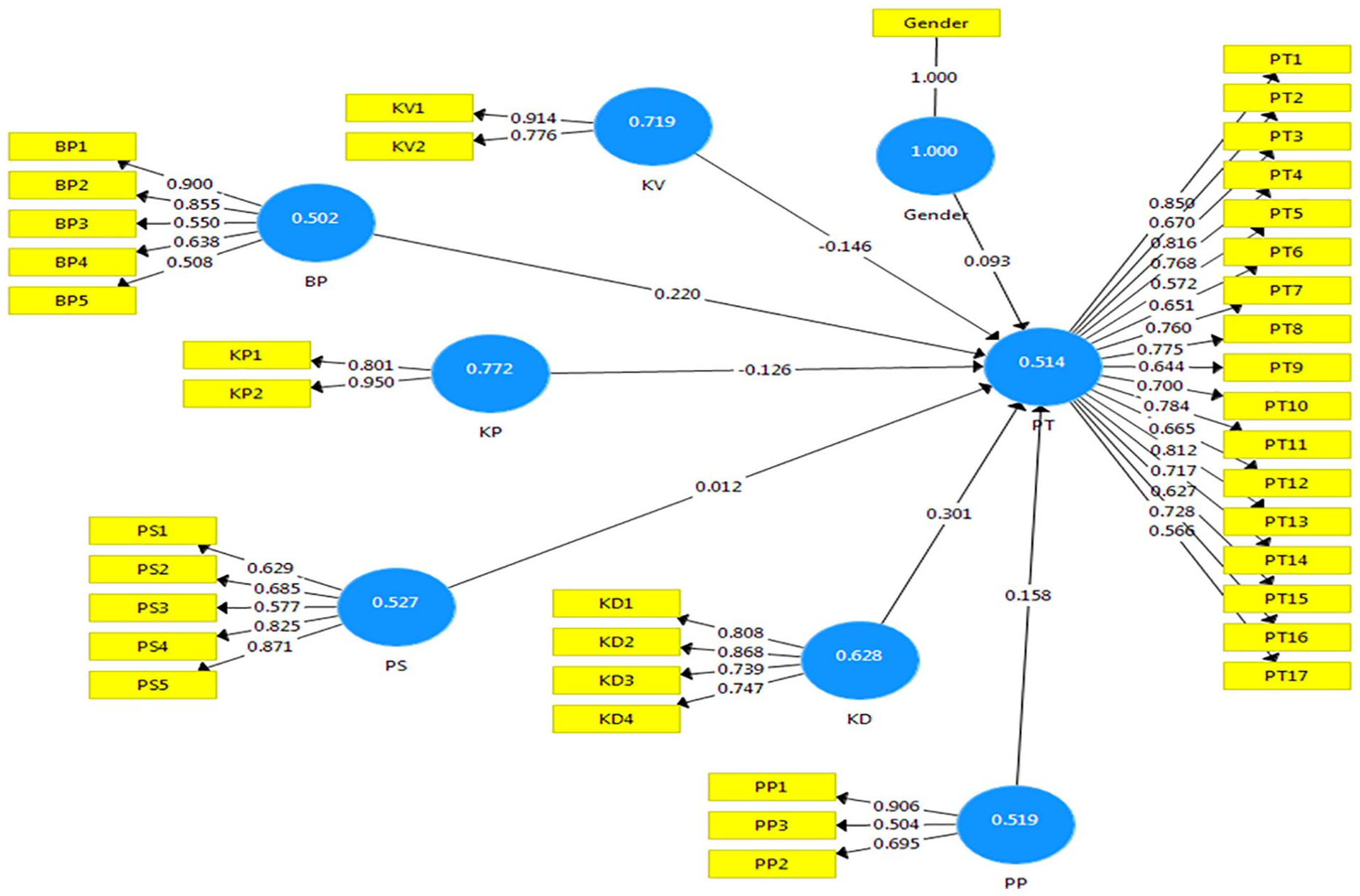
Measurement model.
Examining individual item reliability
In this study, the measurement model was measured by examining the individual item reliability (outer loading) of each construct (Duarte & Raposo, 2010; Hair et al., 2017; Imam & Hengky, 2015). The value of outer loading above 0.708 is very crucial because it will lead to average variance extracted (AVE) by 0.500 (0.7082 = close to 0.500); however, in the case of outer loadings’ value, the range of 0.400 to 0.700 is also considered accepted if the load contributed to the AVE value is more than 0.500 (Hair et al., 2017).
Ascertaining internal consistency reliability
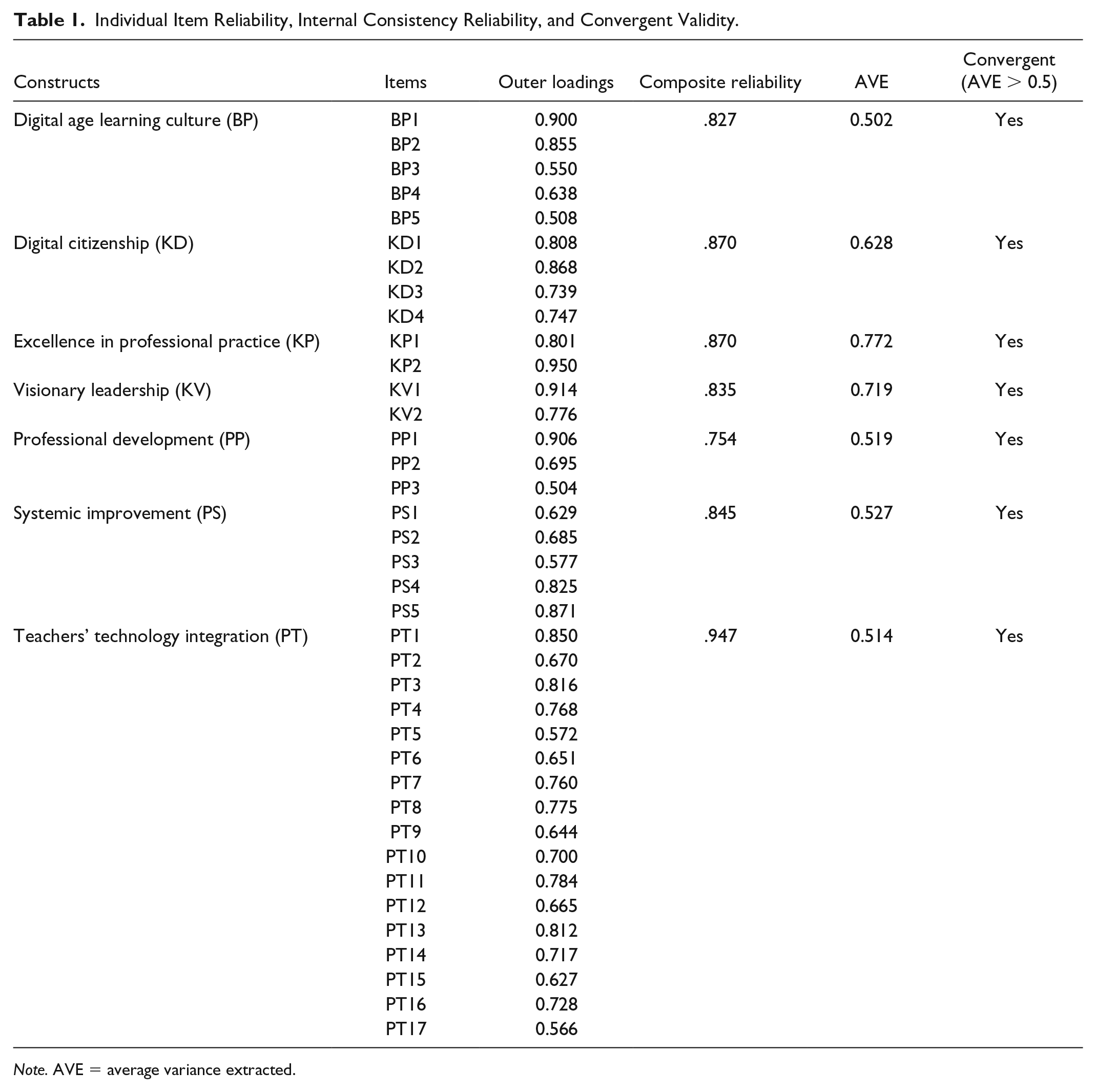
Internal consistency reliability outlines the degree that all items are measured on a precise parallel concept (Bijttebier et al., 2000; Sun et al., 2007). There are two types of internal consistency reliability measurement which are Cronbach’s alpha and composite reliability (Hair et al., 2017; Peterson & Kim, 2013). According to Hair et al. (2017), Cronbach’s alpha designates that all items are reliable, whereby all of the items have equal outer loadings on the construct. Meanwhile, PLS-SEM prioritizes the items according to their individual reliability. Therefore, Imam and Hengky (2015) suggested that composite reliability should be used to measure the internal consistency reliability. The composite reliability value of more than .70 is acceptable for confirmatory research (Hair et al., 2017; Imam & Hengky, 2015). In this measurement model, the composite reliability values were between .754 and .947 (see Table 1).
Individual Item Reliability, Internal Consistency Reliability, and Convergent Validity.
Note. AVE = average variance extracted.
Ascertaining convergent validity
The convergent validity has been evaluated by examining the outer loadings (item loadings) (Duarte & Raposo, 2010; Hair et al., 2017) and the AVE (Fornell & Larcker, 1981; Hair et al., 2017). The outer loading showed how much of the related indicator has in common and is captured by the construct. The higher the outer loading, the higher the indicator has in common with the construct (Hair et al., 2017). In this measurement model, the outer loadings were between 0.504 (PP3) and 0.950 (KP2). Therefore, indicators that have outer loadings between 0.50 and 0.70 should be considered to be retained if the composite reliability and AVE have met the required threshold values (Hair et al., 2017). This was agreed by Hair et al. (2010) and Nunnally (1978) who suggested that the items with the outer loading more than 0.50 can be accepted. In this case, all of the constructs had met the requirements of composite reliability. In addition, all of the constructs had also met the requirements of AVE which is above 0.50 (Barclay et al., 1995; Chin, 1998; Hair et al., 2017; Urbach & Ahlemann, 2010) (see Table 1).
Ascertaining discriminant validity
Discriminant validity recognizes that a certain construct is unlike the other constructs (Duarte & Raposo, 2010; Hair et al., 2017). Hence, discriminant validity analysis designates that a construct is exclusive, stands on its own, and does not characterize other constructs. In this study, discriminant validity was examined using Fornell–Larcker criterion as suggested by Fornell and Larcker (1981). The analysis can be achieved by comparing the squared correlation of the paired construct with the AVEs of each construct (Fornell and Larcker, 1981). The square root of the AVE should be greater than the correlations among the constructs (Hair et al., 2010, 2017), as shown in Table 2.
Discriminant Validity (Fornell–Larcker criterion).

Note. BP = digital age learning culture; KD = digital citizenship; KP = excellence in professional practice; KV = visionary leadership; PP = professional development; PS = systemic improvement; PT = teachers’ technology integration.
Assessment of the structural model
This study applied the partial least squares (PLS) standard bootstrapping procedure with a number of 5,000 subsamples, one-tailed test type, and .05 significance level to assess the significance of the path coefficients (Hair et al., 2017). Figure 2 depicts the estimates for the full structural model including the moderating effect.

Structural model with moderating effect (full model).
Structural model path coefficient (direct effect)
Table 3 presents the results of the structural model path coefficient (direct effect). The structural model path coefficient (direct effect) has been conducted to test the hypotheses as follows:
Structural Model Assessment (Direct Relationship).

Note. All the results are not significant at .05 (one tailed). The result displays that all the tested hypotheses were not significant and not supported. BP = digital age learning culture; PT = teachers’ technology integration; KD = digital citizenship; KP = excellence in professional practice; KV = visionary leadership; PP = professional development; PS = systemic improvement.
Assessment of variance in the dependent variable (R2)
In the PLS-SEM analysis, the model’s predictive power is measured by the R2 value (Hair et al., 2017). The R2 value is known as the coefficient of determination (Hair et al., 2017; Henseler et al., 2009). The coefficient of determination demonstrates the amount of variance in the endogenous construct that is clarified by all of the exogenous constructs (Elliott & Woodward, 2007; Hair et al., 2017).
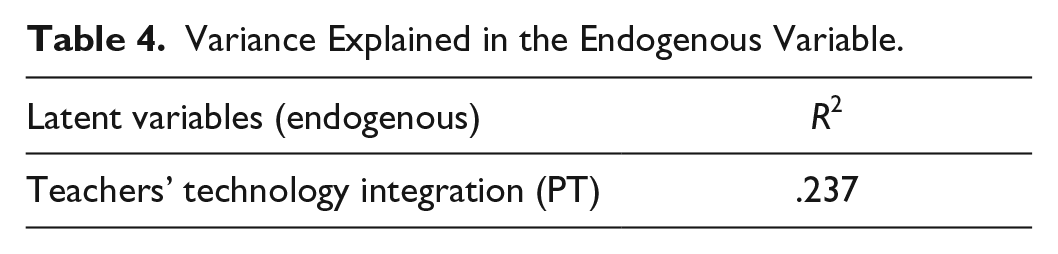
Falk and Miller (1992) suggested that the R2 value is .10 as a minimum value. In the meantime, Chin (1998) recommended that R2 is .67 (significant), .33 (moderate), and .25 (small). Besides that, Hair et al. (2017) suggest that R2 is .75 (strong), .50 (moderate), and .25 (weak). Table 4 shows the R2 values of the endogenous constructs in this research. As presented in Table 4, the research model explained 23.7% (small) of the total variance in the teachers’ technology integration (PT), which is a dependent variable.
Variance Explained in the Endogenous Variable.
Assessment of effect size (f2)
Chin (1998) and Wong (2016) stated that the role of effect size (f2) is used to estimate the effect of specific exogenous constructs that contribute to an endogenous construct by means of a change in R2 if it is deleted from the model. The rule of thumb for effect size is 0.02 (small), 0.15 (medium), and greater than 0.35 (large) (Cohen, 1988). Table 5 explains the result of the effect size of the exogenous latent variables on the endogenous latent variable.
Effect Size of Exogenous Variables.

Note. BP = digital age learning culture; PT = teachers’ technology integration; KD = digital citizenship; KP = excellence in professional practice; KV = visionary leadership; PP = professional development; PS = systemic improvement.
Assessment of predictive relevance (Q2)
This research examines Stone–Geisser’s Q2 value to test the predictive relevance of the research model (Geisser, 1974; Stone, 1974). According to Duarte and Raposo (2010), Stone–Geisser test of predictive relevance is used as an additional evaluation of goodness of fit in PLS-SEM. Q2 is a cross-validated redundancy measure and is obtained using the blindfolding procedure (Hair et al., 2017).
Sattler et al. (2010) clarified that the blindfolding procedure is only practical to endogenous latent variables that have a reflective measurement model. Thus, due to all the endogenous latent variables in this study being reflective, the blindfolding procedure was applied. Particularly, Q2 was applied to assess the predictive relevance of the research model (Chin, 2010; Ringle et al., 2012). A research model with Q2 greater than zero is considered to have predictive relevance (Henseler et al., 2009).
As presented in Table 6, the cross-validation redundancy measure Q2 values for endogenous latent variables were above zero, that is, 0.711. Therefore, the model had predictive relevance (Henseler et al., 2009).
Construct Cross-Validated Redundancy.

Note. SSO = total sum of squares; SSE = sum of squares due to error.
Testing the moderation effect
In this research, the moderating effects of gender are given by the hypotheses H2a to H2f. The moderating effect was analyzed using three procedures proposed by Hair et al. (2017). According to Hair et al. (2017), the three procedures comprise (a) the evaluation of the model without a moderating effect, (b) the evaluation of the model with the moderating effect, and (c) the evaluation of the change in R2.
The following are the hypotheses related to the moderating effect of gender in this study:
The findings of the structural model assessment (moderating effect) presented in Table 7 show that the hypotheses H12a to H12f were not supported. This means that gender does not have a moderating effect between all the five constructs of technology leadership and technology integration.
Structural Model Assessment (Moderating Effect).

Note. All the hypotheses tested are not significant at .05 (one tailed). BP = digital age learning culture; KD = digital citizenship; PT = teachers’ technology integration; KP = excellence in professional practice; KV = visionary leadership; PP = professional development; PS = systemic improvement.
Importance and performance matrix analysis
Importance and performance matrix analysis (IPMA) is useful in extending the findings of the basic PLS-SEM outcomes using latent variable scores (Hair et al., 2017). Figure 3 and Table 8 reveal the total effects (importance) and PT (performance) of the tested variables in this study.

The total effects (importance) and PT (performance).
IPMA Results.

Note. IPMA = importance and performance matrix analysis; BP = digital age learning culture; KD = digital citizenship; KP = excellence in professional practice; KV = visionary leadership; PP = professional development; PS = systemic improvement.
The IPMA of technology leadership revealed that professional development (PP) had high performance and was an essential variable in the prediction of teachers’ technology integration (PT). The other high-performance constructs were systemic improvement (PS), visionary leadership (KV), and excellence in professional practice (KP). However, those constructs were not really important in this study. Gender was predicted to be an important construct but did not show good performance. In this study, digital age learning culture (BP) and digital citizenship (KD) exhibited high performance and were, thus, very important constructs in this study. Thus, the school management should give more priority on digital age learning culture (BP) and digital citizenship (KD) to accelerate teachers’ technology integration (PT) in schools.
Discussion and Conclusion
This study found that there is no positive significant relationship between the five constructs of technology leadership (systemic improvement [PS], visionary leadership [KV], excellence in professional practice [KP], digital age learning culture [BP], and digital citizenship [KD]) and professional development (PP) with teachers’ technology integration. The insignificant finding of the relationship between the visionary leadership construct and teachers’ technology integration of this study was consistent with the studies conducted by Metcalf (2012) and Grey-Bowen (2010). Metcalf (2012) found that principals were less prepared in terms of visionary leadership. However, Metcalf (2012) found that principals who attended the Quality-Plus Leader Academy (QPLA) were more prepared to be technology leaders. Metcalf (2012) also suggested that technological leadership courses should be implemented in line with the principals’ preparatory program implemented at the university in accordance with ISTE standards. Principals who inspire school vision as well as effective technology integration and provide continuous professional development were found to be most effective in influencing teachers to integrate technology in the classroom (Kurland et al., 2010). Thus, this result of this study posits that leaders should be trained in digital age learning culture (BP) and digital citizenship (KD) as they showed the lowest performance index value.
As professional development was proven to be important and had a high-performance index value regarding technology leadership, more effective continuous professional development especially on ICT and leadership should be provided to school leaders. The Ministry of Education with the collaboration of institutions that provide training for school leaders should model sustainable program-wide educational technology courses rather than one-off preparatory programs. Through these trainings, technology should be utilized to innovate learning and teaching experiences in classrooms through teachers as mediators.
This study also proved that gender is not a moderating factor on the relationship between principals’ technology leadership and teachers’ technology integration. The finding of this study is in line with Hamzah et al. (2010) and Alkrdem (2014) that gender does not influence technology leadership. On the other hand, it contradicts the findings of Banoglu (2011) who postulated that female technology leaders are more effective, especially in the visionary leadership construct. This finding contradicts with the study carried out by Heafner (2014) who suggested that gender played a critical role in technology integration. The results of this study depicted a gradual closure of the gender gap among technology leaders as both male and female leaders are able to carry out the ISTE (2014) standards for technology leaders. Besides this, the findings of this study proved that gender was also not a moderating factor between professional development and technology integration. This study suggests that professional development on ICT can be carried without gender bias to both male and female leaders in line with future millennial generations to come.
The results of this study depicted a gradual closure of the gender gap among technology leaders as both male and female leaders are able to carry out the ISTE (2014) standards for technology leaders. It is therefore recommended that efforts directed toward bridging the gender gap should be vigorously and continuously pursued by all stakeholders of the Education Ministry. As not many studies have researched gender as a moderating variable between technology leadership and teachers’ technology integration, it is hoped that this study will pioneer more research on gender and other factors such as school location and school climate.
Previous studies have mostly been carried out in the United States, Australia, and the Middle East. It is suggested that this research is expanded to Asian and European countries. As this is a quantitative research, it is recommended that further research be carried out using dyadic analysis using qualitative data for an in-depth study on the effect of gender and professional development on the relationship between technology leadership and technology integration.
Footnotes
Declaration of Conflicting Interests
The author(s) declared no potential conflicts of interest with respect to the research, authorship, and/or publication of this article.
Funding
The author(s) received no financial support for the research, authorship, and/or publication of this article.
