




Abstract
This research explored the relationships between entrepreneurial orientation (EO), interaction orientation (IO), and innovation performance based on resource-based theory. We used two market approaches (market-driving and market-driven) to test our research model. We collected data from the responses of 209 corporations in China. Our findings indicated that both EO and IO positively affected knowledge combination capability (KCC), which contributed to innovation performance. The results indicated that organizational collectivism moderated the link between EO and KCC. It also moderated the mediation effect of EO on firm’s innovation performance by KCC. Interestingly, we found that organizational collectivism moderated the link between IO and KCC and also moderated the mediation of IO on innovation performance by KCC. Our research contributes to the field of strategic orientation and suggests that managers should pay attention to the two market approaches and organizational culture, which can improve innovation performance. Furthermore, this research offers theoretical and practical implications to firm’s innovation capability.
Keywords
Introduction
Prior research has emphasized on innovation performance because of its important contribution to a firm’s competitive advantage (Oke, Walumbwa, & Myers, 2012; Zenger & Lazzarini, 2004). Many scholars have explored the organizational factors that promote innovation performance, including strategy, resources, and entrepreneurial spirit (Oke et al., 2012). Recently, researchers have begun to investigate how a firm’s strategic orientation can affect its innovation performance (Liu & Chen, 2015; Tang, Chen, & Jin, 2015).
Most firms face customer diversity and heterogeneous demands and selecting an appropriate strategic orientation is crucial to adapt to the external environment and secure market opportunities (Chen, Li, & Evans, 2012). To reduce market stresses, firms must choose from two complementary market orientation approaches: market-driving and market-driven (Kumar, Scheer, & Kotler, 2000). The former focuses on shaping the market structure or market behavior, while the latter focuses on customer preferences in the existing market (Chen et al., 2012; Jaworski, Kohli, & Sahay, 2000; Schindehutte, Morris, & Kocak, 2008). Furthermore, the market-driven approach mainly reflects a marketing philosophy of listening and adapting to the customer’s voice, and then providing a satisfactory service to meet the customer’s needs (Hills & Sarin, 2003). This indicates that a market-driven approach emphasizes reactive business logic and meets customer’s needs (Mohr & Sarin, 2009). In contrast, the market-driving approach proactively shapes customer behaviors through discerning and exploring new opportunities that surpass the existing market preferences and market structure (Johnson, Lee, Saini, & Grohmann, 2003), which indicated that the goal of market-driving firms is to lead the evolution of their industry rather than respond positively to their customers’ needs (Beverland, Ewing, & Matanda, 2006). Both approaches can help companies to attain the competitive advantage (Tuominen, Rajala, & Möller, 2004).
A review of the literature shows that the market-driving approach represents an entrepreneurial orientation (EO), whereas the market-driven approach represents an interaction orientation (IO) (Chen et al., 2012). The market-driving approach leads firms to pursue new business chances and create new markets (Jaworski et al., 2000). An entrepreneurial mind-set is thus needed to explore the customer’s needs. In addition, EO can enhance a company’s ability to attain resources and market knowledge from the external environment and create new markets and value for their customers (Lumpkin & Dess, 1996). In contrast, the market-driven approach is customer-centric and the literature indicates that it creates value for the customers through service, which requires firms to interact positively with customers (Day, 2000; Vargo & Lusch, 2004). IO focuses on the existing market boundaries within which companies interact with their customers frequently and obtain information and market knowledge (Ramani & Kumar, 2008). Consequently, we combine the two strategic orientations to explore their effect on innovation performance. In the prior studies, some researchers have explored how EO can influence the corporate’s innovation performance (Tang et al., 2015). For instance, Bouncken, Plüschke, Pesch, and Kraus (2016) found that EO positively influenced joint product innovation. Meanwhile, Semrau, Ambos, and Kraus (2016) found that performance-based culture can significantly moderate the link between EO and corporate’s performance, whereas socially supportive culture has no moderation influence. And many researchers have investigated the effect of IO on firm’s performance (Ramani & Kumar, 2008). However, few studies have investigated the link between IO and innovation performance. Until now, there has been no attempt to link together these two orientations on innovation performance. Therefore, we explore the mechanism of these two orientations on innovation performance to provide a better understanding of how these two orientations promote the corporate’s innovation performance.
This research has several contributions to the existing literature. First, even if the fact that prior research has explored how EO affects innovation and corporate’s performance (Chen et al., 2012), there is no research to examine whether and how EO affects innovation performance from the perspective of knowledge combination capability (KCC). Second, although prior research has paid some attention to how IO affects a firm’s performance (Ramani & Kumar, 2008), no research has explored how IO affected innovation performance. Therefore, we fill this gap and identify the mechanism of IO on innovation performance. Finally, drawing on the resource-based view (RBV), strategic orientation influences organizational capability development that can improve the capability of organizational innovation, which affects innovation performance (Atuahene-Gima & Ko, 2001; Tang et al., 2015). However, few scholars have investigated the mechanism by which EO and IO together promote innovation performance. Thus, based on the RBV, we aim to explore how EO and IO affect innovation performance from the perspective of KCC. We also provide a theoretical elaboration of how organizational context factors affect the link between these two strategic orientations and innovation performance.
In summary, we combine the study streams of EO and IO and explore the mechanism of innovation performance. Based on the RBV and market orientation theory, we investigated whether EO and IO influence innovation through KCC and how EO and IO affect innovation performance when considering organizational collectivism. Figure 1 shows the research model.

The framework of this research.
Theoretical Development and Hypotheses
Based on the RBV, a corporate’s competitive advantage originates from its unique resources, and these resources are rare and valuable, and they are difficult for other firm to imitate (Barney, 1991). EO reflects a firm’ philosophy that promotes superior performance to gain competitive advantage (Tang et al., 2015; Zhou, Yim, & Tse, 2005). Therefore, EO is regarded as part of a company’s strategic resources, which can be used to identify innovation opportunities and potential markets, and eventually influence product innovation performance (Tang et al., 2015). Prior researchers have extensively investigated how EO influences organizational performance (Lumpkin & Dess, 1996).
We suggest that EO can positively affect innovation performance. First, EO is considered to be a market-driving approach, and it is used in various industries by firms to create business opportunities and markets (Chen et al., 2012). To satisfy customers’ needs and markets, entrepreneurially orientated firms focus on innovative processes and ideas that can enhance organizational innovation capability and facilitate innovation performance (Lee, Lee, & Pennings, 2001; Tang et al., 2015). In particular, when faced with a competitive external environment, firms should identify new opportunities and understand customers’ needs and interests. Consequently entrepreneurial firms should take proactive and aggressive actions to promote organizational innovation performance, such as creating new processes and products to serve their target markets. Therefore, through the lens of the RBV and market orientation theory, EO is a critical resource that can improve comprehension of the external environment and development of new process and products, to improve organizational innovation and this can promote innovation performance (Lumpkin & Dess, 1996; Tang et al., 2015). Therefore, we propose the following:
Prior research suggests that the market-driven approach emphasizes the customer-centric, but contemporary marketing indicates that firms should create value with customers (Vargo & Lusch, 2004). IO was defined as “reflects a firm’s ability to interact with its individual customers and to take advantage of information obtained from them through successive interactions to achieve profitable customer relationships” (Ramani & Kumar, 2008, p. 27). Consequently, IO is very important to a corporate’s ability to interface effectively with its customers. Therefore, many firms seek to obtain information from their customers to enhance the quality of their interaction, which can co-create value for the firm, which is regarded as a vital resource for the company to attain competitive advantage (Chen et al., 2012; Ramani & Kumar, 2008). In particular, a company that adopts a strong IO may be better served by allocating resources to attract valuable customers (Chen et al., 2012; Ramani & Kumar, 2008). Thus, IO is one of important types of strategy orientation that can improve a firm’s attainment of information and resource allocation.
Previous scholars have explored the link between IO and firm’s performance (Ramani & Kumar, 2008). However, few researchers have studied how IO influences innovation performance. In this regard, we believe that IO can positively affect innovation performance. First, corporations with high level of IO can make full use of valuable information, which they attain from their customers through their interactions (Chen et al., 2012; Ramani & Kumar, 2008). Information and knowledge can be exchanged with customers to co-create superior service delivery, which can promote new ideas and innovation capability to match customers’ needs; thus, IO can enhance firm innovation performance. Second, IO enables firms to develop dynamical shifts for their production. Firms have an intrinsic motivation to increase their innovation capability to create new production or service offerings to match customers’ needs, which can improve their innovation performance. Thus, IO can enhance firms’ capability to obtain information from customers and promote relevant long-term resource allocation, which can affect the firm’s innovation capability and finally affect firm’s innovation performance. Thus, we propose the hypothesis:
EO focuses on the pursuit of business opportunities through scanning and monitoring the external environment for market information, which can help a firm to achieve customer value and surpass its competitors (Chen et al., 2012). Prior researchers have found that firms with strategic planning have a greater capability to integrate market knowledge, which indicates that EO can enhance the acquisition and utilization of the market information (Chen et al., 2012; Keh, Nguyen, & Ng, 2007). Therefore, EO can lead firms to enhance their KCC through attaining and utilizing the market information. Especially, knowledge is considered to be a critical asset for generating a competitive advantage (Chen et al., 2012; Vargo & Lusch, 2004). Thus, it is important for a firm to achieve effective organizational ability by having a knowledge advantage as KCC plays an important role in acquiring and utilizing market information and knowledge, which can enhance organizational competitive capability (De Boer, Van Den Bosch, & Volberda, 1999).
The underlying concept of KCC refers to the integration of knowledge, rather than the knowledge itself (De Boer et al., 1999), which was the basis for achieving corporate’s competitive advantage. On the basis of prior research, we believe that KCC includes three kinds of combinative capabilities: systems capabilities, socialization capabilities, and coordination capabilities that can integrate component knowledge in the firm (De Boer et al., 1999). In this research, we believe that KCC positively affects innovation performance. First, systems capabilities can create new architectural knowledge by introducing formal systems, such as codes, plans, and procedures, which form the basis for integrating explicit knowledge (De Boer et al., 1999). Thus, individuals can attain and exchange explicit knowledge via formal exchange mechanism, such as formal languages, information systems, and codes, which enable the combination of organizational knowledge and enhance organizational innovation, thus improving innovation performance.
Second, coordination capabilities can promote knowledge integration between team members. In this context, knowledge integration can be produced by a specific cluster of relations in the group, which can accumulate knowledge in the firm (De Boer et al., 1999). In particular, a firm can improve its knowledge combination via training, job-rotation, and participation (De Boer et al., 1999). Through these methods, not only firms allow firms to attain indirect knowledge integration via hiring educated professional employees, professional workers can also improve their skills and knowledge through job-rotation (De Boer et al., 1999). Finally, employee participation in decision making can offer the knowledge integration needed to counteract differentiation (De Boer et al., 1999; Khandwalla, 1977). High levels of participation can improve information sharing, which results in a richer knowledge architecture. These methods can enhance organizational knowledge, which is the basis of innovation and can improve organizational performance.
Third, socialization capabilities depend on the company with a strong identity, which leads the organization to establish a common set of beliefs, language, values, and appropriate behavior (De Boer et al., 1999). Thus, employees are willing to show loyalty to their organization and strive to realize the organizational goals, which helps them to attain the firm’s trust for organizational interests. In this context, the firm has a shared belief to integrate knowledge (De Boer et al., 1999). Therefore, socialization capabilities can achieve knowledge integration that contributes to organizational innovation performance. Therefore, we suggest the hypothesis:
IO reflects a company’s capability to interact with its customers, which can enhance the firm’s ability to attain information and knowledge from its customers and build long-term customer relationships (Ramani & Kumar, 2008). Knowledge is particularly critical asset for achieving a competitive advantage (Chen et al., 2012; Lusch, Vargo, & O’Brien, 2007). To improve organizational capabilities and advantages, managers have realized that sufficient market information can enhance emerging business opportunities and promote new capability (Chen et al., 2012). In view of the market knowledge perspective, IO is an important method for making use of valuable market information from customers (Ramani & Kumar, 2008). Through a firm’s interaction with its customer, market information can be communicated and knowledge produced, which can be used to attain more effective market information from customer interactions (Chen et al., 2012). Therefore, the company will encourage its customers to share their views of the firm’s products and participate interactively in designing the firm’s products, and those knowledge and information can be combined through the exchange platform (De Boer et al., 1999; Ramani & Kumar, 2008), which will enhance the KCC. Furthermore, organization–customer interactions can promote active customer participation, information sharing, coproduction, and relational exchange (Chen et al., 2012; Payne, Storbacka, & Frow, 2008). IO can help firms to dynamically improve their product and further enhance their capability to predict customer’s response and allocate resources accordingly (Ramani & Kumar, 2008). During the interaction process, the firm uses trade systems that record their transactions with customers, which help the firm to identify and analyze the customer’s needs and preference, and this information can be integrated by using information processing systems (De Boer et al., 1999; Ramani & Kumar, 2008), which will facilitate KCC. On the basis of prior discussion, we hypothesize the following:
EO conceptualizes as the propensity for the firm’s top managers to take risks and demonstrates strategic proactiveness and be innovative (Covin & Slevin, 1989; Zhao, Li, Lee, & Chen, 2011). Thus, it is a psychological concept that reflects the intention of key managers toward entrepreneurial behaviors (Krauss, Frese, Friedrich, & Unger, 2005; Zhao et al., 2011). Scholars have already explored some of the constructs that moderate the EO performance (Tang et al., 2015). However, the influence of organizational contextual factors has received little attention in terms of the relationship between EO and KCC. In particular, we suggest that organizational collectivism is a critical factor that moderates the link between EO and KCC.
EO can enhance a firm’s utilization of market information, which improves their capability for attaining market opportunities (Chen et al., 2012; Keh et al., 2007). Therefore, EO can make the firms to promote their development of KCC to attain information from the market. Organizational collectivism plays a critical role in the process of acquiring knowledge from the market, in terms of the link between EO and KCC. Organizational collectivism enables knowledge sharing, employee cooperation, team harmony, concern for team welfare, and rivalry with non-team member (Morris, Avila, & Allen, 1993). A firm having a high level of organizational collectivism can strengthen the cooperation with employees, create a positive exchange climate, and enhance knowledge sharing (Collins & Smith, 2006). Therefore, EO can further improve the attainment of knowledge from the outside environment, and those knowledge can be shared and combined in the organization that promote KCC, which in turn facilitates innovation performance. Second, EO proactively seeks to comprehend potential changes in the environments to bear risk that result from chances related to new markets and technologies (Lumpkin & Dess, 1996). During the process of pursuing new opportunities and encountering obstacles, a high level of organizational collectivism can enhance the enthusiasm of organizational employees and help to overcome difficulties. Therefore, EO can further facilitate the integration of internal and external information and knowledge, which can improve KCC. This enables the enhancement of innovation performance. Third, a high level of organizational collectivism can enhance organizational harmony (Morris et al., 1993). In this situation, EO can be used to acquire the necessary resources and develop novel products and processes (Morris et al., 1993), which can improve KCC because EO places emphasis on a cooperative spirit and collective action. Therefore, we suggest the hypotheses:
IO can help a firm to use the valuable market information that is gathered from its interaction with its customer (Chen et al., 2012; Ramani & Kumar, 2008). In this way, information can be continually communicated and knowledge can be generated to create customers’ value (Chen et al., 2012; Ramani & Kumar, 2008). We believed that during a firm’s interactions with its customers and attainment of information and knowledge, organizational collectivism is critical in the link between IO and KCC, and this will enhance organizational innovation performance. First, organizational collectivism enables knowledge sharing and employee cooperation (Morris et al., 1993). Firms with a high level of organizational collectivism are better able to identify their customers’ needs, which can enable the firms to attain valuable market information from its interactions with customers (Chen et al., 2012). Consequently, IO can encourage information and knowledge acquired from the external environments to be shared within the organization, which will improve KCC and enhance organizational innovation performance. Second, customer–firms interactions promote the mutual sharing of information, coproduction, and relational exchange (Chen et al., 2012; Payne et al., 2008). When a corporate possesses a higher level of organizational collectivism, employees will prefer to cooperate to realize organizational value and they approve of information or knowledge sharing and the combination of external resources. Therefore, IO enables a firm to develop dynamic service offerings, which facilitate the planning of long-term resource allocation to meet the customer’s needs. Thus, IO can enable the firm to attain external and internal information and knowledge. Organizational cooperation can take full advantage of those resources and enhance KCC, which promotes organizational innovation performance. On the basis of prior discussion, we hypothesize the following:
Method
Sample
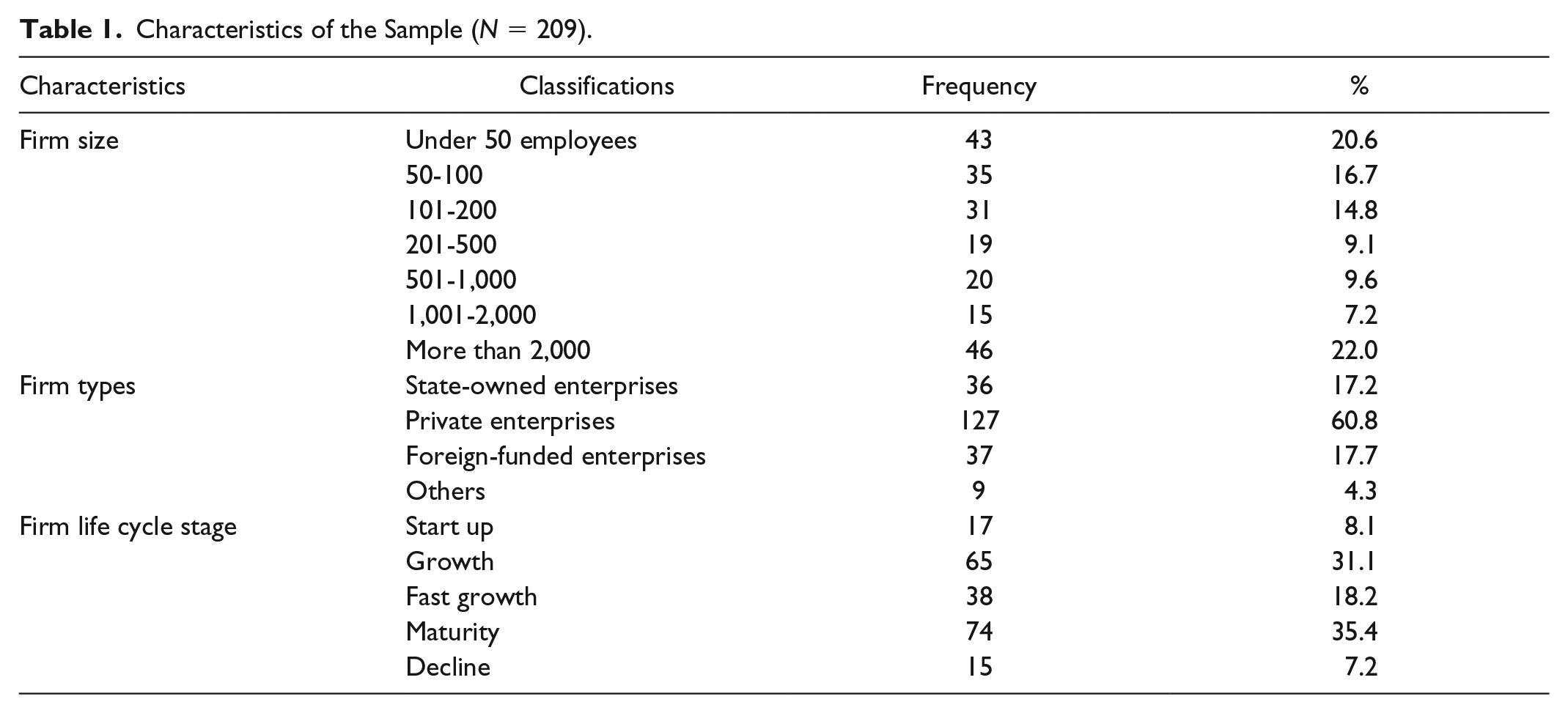
To test our hypotheses, the study adopted a questionnaire survey way to collect data. The questionnaire items included background information, EO, IO, KCC, organizational collectivism, and innovation performance. We distributed questionnaires to EMBA/MBA graduates from a university in China. Before we distributed our questionnaires, we had consulted the head of the MBA/EMBA program and reviewed the people who would be involved in this project. We know that all EMBAS and MBAs are middle-/high-level managers of the firms, and questionnaires were collected on site. The authors distributed 300 questionnaires and received 209 usable responses, with a response rate of 69.67%. The sample included firm size, types of firms, and life cycle stage of company, which are provided in Table 1. To assess the common method variance (CMV), we used Harman’s single-factor test (Podsakoff, MacKenzie, Lee, & Podsakoff, 2003), and the results showed that no single factor accounted for most of the variance, and the first factor captured only 28.33% of the variance. Therefore, we concluded that CMV is unlikely to influence our results.
Characteristics of the Sample (N = 209).
Measures
EO
The scale for EO comprises seven items developed by Hughes and Morgan (2007). Prior research has identified three dimensions of EO, which included risk taking, innovativeness, and proactiveness (Covin & Slevin, 1989; Lumpkin & Dess, 2001). We used the three dimensions of the EO scale to measure this concept. All the survey items were assessed on a 5-point Likert-type scale. Some example items follow: The term ‘risk taker’ is considered a positive attribute for people in our business”; “We actively introduce improvements and innovations in our business”; and “We initiate actions to which other organizations respond.” The Cronbach alpha for EO is .823. The confirmative factor analysis (CFA) indicated an acceptable range (χ2/df = 2.161, root mean square error of approximation [RMSEA] = .075, comparative fit index [CFI] = .975, incremental fit index [IFI] = .975, and Tucker–Lewis index [TLI] = .952).
IO
We used the four-dimensional IO with 13-item scale developed by Ramani and Kumar (2008) to assess the interactive behaviors of companies on customers. Items were measured on a 5-point Likert-type scale. Some example items follow: “This firm consciously seeks to identify and acquire new customers individually”; “This firm has systems in place that record each customer’s transactions”; “This firm encourages customers to share opinions of its products or services with the firm”; and “This firm has an excellent idea of what each individual customer has been contributing to its profits.” The Cronbach alpha for IO is .885. The CFA suggested a good fit (χ2/df = 2.262, RMSEA = .078, CFI = .935, IFI = .936, TLI = .917).
Organizational collectivism
Organizational collectivism includes the discernable dimensions of organizational culture (Robert & Wasti, 2002). The seven-item scale from Robert and Wasti (2002) was applied to evaluate organizational collectivism. Some example items follow: “Management and supervisors are protective of and generous to loyal workers”; “Employees are taken care of like members of a family”; and “Everyone shares responsibility for the organizations’ failures as well as success”. The Cronbach alpha for organizational collectivism is .853. The CFA indicates a good fit (χ2/df = 2.438, RMSEA = .083, CFI = .966, IFI = .967, TLI = .946).
KCC
We adopted three dimensions—systems capabilities, socialization capabilities, and coordination capabilities—to measure KCC with 13-item scale (De Boer et al., 1999).Some example items follow: “There are high levels of coordination among departments in the company”; “Employees carry out their work in accordance with established procedures in the company”; and “The willingness of employees to cooperate with others increases along with more training and job rotation.” The Cronbach alpha for KCC is .878. The CFA indicated an acceptable range (χ2/df = 1.509, RMSEA = .049, CFI = .969, IFI = .969, TLI = .961).
Innovation performance
Innovation performance was assessed with the five-item scale developed by Cordero (1990), which was used by Oke et al. (2012). In this study, we used the perception of organizational innovation performance, because the scholars in their previous research had measured the innovation performance by applying subjective innovation performance, which is one of the important methods to evaluate this conception. The items are as follows: “Compared with our competitors, our business tends to be better at developing new products to meet customers’ needs”; “Compared with our competitors, our business tends to be perceived by our customers to be more innovative”; “Compared with our competitors, our business tends to be more effective at capturing ideas and making them into new products”; “The number of innovation (new products) in our portfolio has been on an increase over the last 3 years”; “Compared with the industry average, the time taken between the conception of an innovation and introduction into the market place is significantly better.” The Cronbach alpha for innovation performance is .846. The CFA indicates an acceptable fit (χ2/df = 1.611, RMSEA = .054, CFI = .996, IFI = .996, TLI = .986).
Control variables
Prior researches have considered that firm size, ownership, and firm life stage affect firm performance (Lumpkin & Dess, 2001; Zhao et al., 2011). In this research, we control these variables. The firm size was evaluated using an ordinal scale. We also adopted an ordinal scale to assess the life stage of the corporate, where 1 = “start up,” 2 = “growth,” 3 = “fast growth,” 4 = “maturity,” 5 = “decline.” We further controlled for ownership (state-owned enterprises, private enterprises, foreign-funded enterprises, and others) of the company and using a dummy variable.
Results
The means, SD, and correlations of all of the constructs are presented in Table 2. EO and IO positively influence innovation performance (r = .437, p < .01; r = .445, p < .01, respectively). A positive correlation for the link between EO and KCC was also found (r = .500, p < .01). IO was positively related to KCC (r = .501, p < .01). KCC and innovation performance have a significant positive link (r = .414, p < .01). A positive link between organizational collectivism and innovation performance (r = .471, p < .01) was observed.
Means, SD, and Correlations.

Note. Internal consistency reliabilities are given in parentheses. EO = entrepreneurial orientation; IO = interaction orientation; KCC = knowledge combination capability.
p < .05. **p < .01. ***p < .001.
Hypothesis Testing
To assess our research hypotheses, we applied the method recommended by Baron and Kenny (1986). The results are presented in Table 3. In Step 1, the results suggest that EO and IO positively affect innovation performance (β = .260, p < .01; β = .283, p < .001), so Hypotheses 1 and 2 are supported. In Step 2, we analyzed the influence of the independent variable on the mediating variable. The findings indicate that EO and IO are positively associated with KCC (β = .355, p < .001; β = .323, p < .001). In Step 3, we analyzed the effects of EO and IO on innovation performance, when the mediation of KCC was considered. The results show that KCC positively affects innovation performance (β = .213, p < .01); from Step 1 to Step 3, we discovered that KCC mediates the link between EO and innovation performance and that between IO and innovation performance; thus, Hypotheses 3 and 4 are supported.
Regression Analysis for Mediation (N = 209).

Note. Standardized Betas are shown. Ownership1 = state-owned enterprises. Ownership2 = private enterprises. Ownership3 = foreign-funded enterprises; DV = dependent variable; IV = independent variable; Med = mediator.
p < .05. **p < .01. ***p < .001.
To evaluate the moderating effect of organizational collectivism, we used the hierarchical regression analysis to testify the hypotheses. First, all control variables were put into the equation. In Step 2, the control variables, EO, and organizational collectivism were entered as independent variables. Third, the interaction of EO and organizational collectivism was entered into the equation. To reduce multicollinearity, we used the mean-centered variables for interaction terms (Aiken, West, & Reno, 1991). We also evaluated the variance-inflation factors (VIFs) in the regression analysis, all VIFs were below the level of 5, which indicated that multicollinearity was not a concern. The results are presented in Table 4. In Model 2, EO and organizational collectivism significantly affected KCC (β = .358, p < .001; β = .378, p < .001). In Model 3, the results presented the moderating effect of organizational collectivism. The interaction between EO and organizational collectivism positively influenced KCC (β = .208, p < .001).
Moderating Effects of Organizational Collectivism on the Link Between EO and KCC.

Note. EO = entrepreneurial orientation; KCC = knowledge combination capability; IO = interaction orientation.
p < .05. **p < .01. ***p< .001.
We tested Hypothesis 5 using the simple slopes. The results are shown in Figure 2, which indicates the moderating effect of organizational collectivism on the link between EO and KCC. When organizational collectivism was high, EO was positively related to KCC, whereas when organizational collectivism was low, EO reduced KCC. Thus, Hypothesis 5 is supported.

Moderating effects of organizational collectivism on the link between EO and KCC.
We applied the same method to test the link between IO and KCC when considering the effect of organizational collectivism. The results are presented in Table 4. In Model 4, IO and organizational collectivism significantly influence KCC (β = .339, p < .001; β = .386, p < .001). In Model 5, the result presents the moderating effect of organizational collectivism. The interaction between IO and organizational collectivism positively affect KCC (β = .119, p<.05).
We used the simple slopes to test Hypotheses 7. Figure 3 presents the moderating role of organizational collectivism on the link between IO and KCC. When organizational collectivism was high, IO positively affects KCC, whereas when organizational collectivism was low, IO reduced KCC. Thus, Hypothesis 7 is supported.

Moderating effects of organizational collectivism on the link between IO and KCC.
To test the moderated mediation of organizational collectivism, we applied Preacher, Rucker, and Hayes’s (2007) method to assess the conditional indirect effect. Following their recommendation, we evaluated a high level of organizational collectivism (+1SD) and a low level of organizational collectivism (−1SD). Table 5 presents the results, which suggests a differential influence of organizational collectivism on the link wherein EO affected innovation performance via KCC. The indirect effect for low organizational collectivism was not significant (β = .061, p > .05, ns), whereas the effect for high organizational collectivism was significant (β = .184, p < .001); thus, Hypotheses 6 is supported.
The Conditional Indirect Effect of EO on Innovation Performance at Values of the Moderator.

Note. EO = entrepreneurial orientation.
To analyze the mediating role of KCC on the link between IO and innovation performance when considering the moderating effect of organizational collectivism, we used the same method to test Hypothesis 8. Table 6 presents the result. The findings indicated that organizational collectivism had a differential influence on the relationship wherein IO affected KCC and innovation performance. The indirect effects for low organizational collectivism (β = .082, p < .05) and high organizational collectivism (β = .159, p < .001) were both significant. However, although both indirect effects were significant, there was a stronger relationship for high organizational collectivism. Thus, Hypothesis 8 is supported.
The Conditional Indirect Effect of IO on Innovation Performance at Values of the Moderator.

Note. IO = interaction orientation.
Discussion
Our findings have critical theoretical contributions to the comprehensive mechanism of how EO and IO affect innovation performance when considering organizational collectivism. Our research has provided some interesting results that contribute to management practices.
Contributions to Theory
This study’s primary contribution is that EO positively affects innovation performance, and KCC mediates the link between EO and innovation performance. The findings indicated that entrepreneurially orientated firms positively affected KCC, which influenced the innovation performance. Prior researcher has shown that EO is an important factor that influences innovation (Hughes & Morgan, 2007; Lumpkin & Dess, 2001). Our findings indicate that EO positively affects innovation performance, and that KCC plays an important role in the link between EO and innovation performance. Therefore, the empirical results are consistent with the untested arguments regarding how firms utilize and integrate organizational knowledge resources, which contribute to innovation performance. Our research contributes to the recent research of how EO influences product innovation performance in Chinese manufacturing companies (Tang et al., 2015). This provides a new perspective for the firms that wish to enhance their innovation performance, which can be critical to their survival in a dynamic competitive environment (Kollmann & Stöckmann, 2014). Although prior researches have extensively tested the link between EO and firm’s performance (Lumpkin & Dess, 1996), our findings support their view that the answer is likely to be more intricate than a simple main-effect only. Researchers may also benefit from considering the mediating role of KCC, which can help us to understand managerial processes. This may also help a firm to utilize organizational knowledge to enhance innovation performance.
Second, our findings contribute to knowledge-based resource theory and knowledge management capability when considering organizational culture. We find that KCC plays a critical role in knowledge integration and using knowledge to improve organizational performance. Previous researchers have emphasized the effects of HR practices and relational capital, which positively influences KCC and affects organizational innovation and performance (Carmeli & Azeroual, 2009; Collins & Smith, 2006). Some researchers have investigated the link between EO and strategic learning (Sirén, Hakala, Wincent, & Grichnik, 2017), innovation speed (Shan, Song, & Ju, 2016), or antecedent variable, such as dynamic environments (van Doorn, Heyden, & Volberda, 2017). However, few scholars have explored the link between EO and KCC when considering the organizational context. In this research, we found that EO has a positive link with KCC. In particular, our findings indicate a more significant link between EO and KCC when companies have a high level of organizational collectivism. Given that recent studies have focused on EO in the global contexts (Wales, Gupta, Marino, & Shirokova, 2019), this article can help to better comprehend the effect of organizational culture on KCC. Organizational collectivism can improve organizational cooperation and harmony, which can enhance knowledge acquirement and knowledge sharing (Robert & Wasti, 2002).
The research also highlights the importance of understanding and applying IO theory. IO is an important strategic orientation that was recommended by Ramani and Kumar (2008). They have found that IO positively influences organizational performance (Ramani & Kumar, 2008). However, few studies have explored how IO affects innovation performance. Our empirical findings indicate that IO positively affects innovation performance. We also found that the link between IO and KCC is significant, which influences innovation performance. Organizational KCC can enable the use of a formal system to create and manage new architectural knowledge, which can improve knowledge sharing in an organization (De Boer et al., 1999).
Finally, our findings extend the link between IO and innovation performance when considering the moderating effects of organizational culture, which enable us to understand the mechanism of how organizational context affects the link between IO and KCC (De Boer et al., 1999; Ramani & Kumar, 2008). Our finding contributes to the research by showing that there is a positive link between EO and organizational performance in different culture contexts (Kantur, 2016; Semrau et al., 2016). Our findings also contribute to the different types of strategic orientation that positively influence innovation performance (Hilman & Kaliappen, 2014; Liu & Chen, 2015).
Contribution to Practice
Our findings offer managers a better understanding of how to attain innovation performance by adopting EO and IO. First, we explored the mechanism and boundary conditions between EO and innovation performance in China, and the findings have important implications for Chinese firms. They remind managers that to promote organizational innovation performance, firms must focus on EO and IO. Firms should enhance the entrepreneurial spirit and dare to take risk of facing failure to innovation, and thus the firms should focus on cultivating EO internally (Zhai et al., 2018). Furthermore, the firms with high level of IO can identify the customer’s requirements and improve innovation performance through proactive activities and interaction with customers.
Second, our results indicate that organizational collectivism can make EO and IO more effective in enhancing KCC. Prior research has suggested that organizational collectivism can improve cooperative behaviors (Robert & Wasti, 2002). EO and IO can enhance firm’s attainment of external resources, such as skills and information, and organizational collectivism can combine these resources, thus contributing to KCC. This reminds managers that to improve organizational innovation performance, they must pay more attention to organizational collectivism and develop this culture through practices.
Third, even if managers have recognized the importance of EO and IO, this is often ignored in practice. Our research indicates that managers should be highly aware of the importance of KCC. The managers need to cultivate their employees’ learning interest and ability, which can enhance employees’ use of new knowledge and skills, thus improving the firm’s innovation capability. In this situation, firms should also make more efforts to enhance KCC, such as building a knowledge sharing platform and creating innovation climate, which can improve organizational innovation performance.
Limitations and Future Study
This study had some limitations. First, this research is a cross-sectional survey, and it is not easy to conclude that the links established are casual. Thus, we recommend that future researchers should analyze the relationship between EO, IO, and innovation performance using a longitudinal research design. In addition, leadership is very important for implementing organizational strategy; thus, future research should study the interplay between EO and the personal attributes of CEOs to get a better overall picture of the outcomes of strategic orientation.
Second, all variables came from the same survey, which may lead to a potential issue to the CMV. Thus, we used Harmon’s one factor method to test whether the CMV was a serious problem. The results indicated that CMV is unlikely to have seriously influenced our results. Therefore, we suggest that scholars could use different sources to collect data, which will decrease the possibility of CMV.
Finally, this study collected empirical data in the Chinese cultural setting. Although the theory underlying this research may be applicable to Western societies, our sample limits the generalizability of our findings because of cultural differences. Prior study suggested that strategic planning and EO lead to high corporate’s performance when considering cultural contexts (Rigtering, Eggers, Kraus, & Chang, 2017). Thus, future research should investigate the Western cultural context and test the difference in the results.
Footnotes
Acknowledgements
We are grateful to editor and reviewer for their generous advices.
Declaration of Conflicting Interests
The author(s) declared no potential conflicts of interest with respect to the research, authorship, and/or publication of this article.
Funding
The author(s) disclosed receipt of the following financial support for the research, authorship, and/or publication of this article: This research was supported by the funding from the Ministry of Education of Humanities and Social Science project (No. 17YJC630126; No. 19YJA630058), the National Natural Science Foundation of China under Grant (No. 71402092; No. 71772183) and the National Social Science Fund of China (No. 19GBL115).
