




Abstract
The study examines the effect of business model innovation on SME firm performance in its direct and indirect relationship with entrepreneurial orientation and competitive advantages during the COVID-19 pandemic. This study used an analytical research design with a positivist philosophy. Structured equation modeling was used to analyze the survey-based structured data collected from 396 SME managers and owners after the second wave of the COVID-19 pandemic. The study revealed a significant positive association between business model innovation and SME performance. Further, the study established a serial mediation model incorporating entrepreneurial orientation and competitive advantage. The research findings add value in theoretical implications incorporating the serial mediation model. Further, the findings suggest practical implications for SMEs to focus on business model innovation to orient mindset of entrepreneurs and develop competitive advantages. This study also proposes recommendations to policymakers in developing business-friendly assistance to cope with crises. This paper is among the few empirical studies examining serial mediation models to predict firm performance in the SME sector, incorporating business model innovation, entrepreneurial orientation, and competitive advantages during the COVID-19 pandemic. This study fulfills the research gap and contributes to business model innovation.
Plain language summary
The research investigates how introducing new business models impacts the performance of small and medium-sized enterprises (SMEs) performance during the COVID-19 pandemic. It followed a positivist approach and structured equation modeling to analyze data survey data from 396 SME managers and owners following the second wave of the pandemic. The study suggests SMEs cultivate entrepreneurial intention and competitive advantages to enhance performance. Policymakers may also find value in this research when crafting strategies to support SMEs during crises. This research encourages the development of regulatory frameworks and incentives that encourage businesses to adopt innovative business models while ensuring fair competition and consumer protection to contribute to sustainable practices and social responsibility, aligning with the growing importance of environmental, social, and governance factors.
Keywords
Introduction
Achieving a competitive advantage for the sustainable performance of SMEs is crucial during a crisis like the COVID-19 pandemic. Innovation intensity (Arcuri et al., 2023) leads to growth of the firm developing competitiveness during the pandemic and in the new normal, though innovation in SMEs is challenging. This study postulates that SME’s innovative orientation throughout the business process proliferates production capacity to cope with the changing business atmosphere. SMEs adopting an integrated sustainable business plan and comprehensive strategy and integrated supply chain (Gautam & Gautam, 2023) for the practical business model innovation (BMI) create a competitive advantage (Latifi et al., 2021; Lindgardt et al., 2012; Porter, 1990; Schuler & MacMillan, 1984) only developing dynamic capabilities to adapt changing business complexities. However, limited literature is available investigating the influence of BMI on SMEs during the crisis based on a dynamic capability perspective.
SMEs are the central attraction of researchers as they represent 90% of business and contribute about 40% of the national economy, generating 7 out of 10 jobs in emerging nations (IBRD, 2023). However, SMEs competing with large-scale business organizations face extra challenges of high product development costs and the emergence of many counterfeit rivals (Trimi & Berbegal-Mirabent, 2012), and the chances of such malpractices remain high during and after the crisis. Innovation reinforces firms to compete with copycats (Y. Luo et al., 2011) and counterfeit rivals. In the crisis business environment, BMI is essential to getting a competitive advantage and entrepreneurial orientation for a desired level of firm performance (Bouwman et al., 2019; El Chaarani et al., 2022; Kim & Min, 2015; Mezger, 2014). BMI is the process of fundamental change in the firm’s business process comprising a holistic approach to creating competitive advantages. BMI offers positive consequences of increased performance and significant contributions not to be bankrupt (Latifi et al., 2021). Innovation is a decisive activity of the business firm to create competitive advantages (Sultan & Sultan, 2020). However, innovation within small and medium-sized enterprises (SMEs) relies heavily on having exceptionally skilled staff, accessing internal and external financial support, and obtaining valuable market insights (Albis Salas et al., 2023). However, SMEs face problems with financial excess (Yoshino & Taghizadeh-Hesary, 2016), quality workforce (Vinten, 1998), insufficient use of information technology (Yoshino & Taghizadeh-Hesary, 2016), and low supply chain efficiency to be innovative. Such a situation affects technology advancement, product differentiation, distribution effectiveness, and sustainable growth of SMEs. Only those SMEs that oriented their business activities toward reconfiguring value propositions, delivery mechanisms, and effective supply chain disruptions could develop their dynamic capabilities to sustain revenue streams by prompt responding to shifting consumer demands. Thus, it is essential to examine SMEs’ entrepreneurial orientation and innovation initiation to be resilient developing dynamic capabilities after the COVID-19 pandemic for sustainable growth.
The COVID-19 pandemic changed the business environment turbulent (Boso et al., 2013; Ciampi et al., 2021; Zhou & Wu, 2009), causing SMEs to fail to meet their targets despite their best customary efforts (Sultan & Sultan, 2020). During the COVID-19 pandemic, SMEs suffered more adversely than large and multinational organizations because of their unique characteristic of limited capital and other resources for BMI (Bouwman et al., 2019). It forced SMEs to be resilient and proactive in the competencies and value generation process; otherwise, they must accept the sudden death. They have a choice of innovation for organizational performance (Jiang et al., 2022) in terms of quality supplies, excelling technologies, and processes for competitive advantages through product innovation, development, and effective supply chain management. Firms with robust capabilities to utilize their resources optimally engage themselves in optimizing their business models to reduce the cost of production, supply, and promotion so that they gain competitive advantages through innovation (Tidd & Bessant, 2021) for sustainable firm performance. This connection is expected to strengthen during the crisis through practical business model innovation (BMI) as a strategic tool. However, the capacity of SMEs to tie their ability to sense emerging business opportunities and optimally utilize their resources would be significant.
BMI has been gaining the attention of researchers (Anwar, 2018; Clauss, 2017; Cosenz & Bivona, 2021; Nielsen & Aagaard, 2021; Velu & Stiles, 2013) considering it as one of the reliable sources of firm performance in global markets (Casadesus-Masanell & Zhu, 2013) though insufficient literature is found in SMEs, specially through the dynamic capability theoretical lens. Especially in developing and underdeveloped economies, the contribution of SMEs is significantly high. However, the advocacy for dynamic capability is still needed. We need to investigate whether SMEs engaged in business model innovation improved their business performance increasing competitive advantages. This research fills these gaps along with the mediating influence of entrepreneurial orientation (Anwar, 2018; Schneider & Spieth, 2013; Şimşek et al., 2022), enhancing the dynamic capability perspective. Grounded in the dynamic capability perspective, this study allows SMEs to leverage resources and deploy them for the effective development of new products and business processes to deploy necessary capabilities for effective adaptation and innovation, excelling in competitiveness.
Literature Review
Business Model Innovation (BMI)
This study is based on the dynamic capabilities theory (Teece et al., 1997), which advocates that firms that integrate, build, and reconfigure internal and external competencies to address rapidly changing environments through business model innovation, translating their resources into sustained competitive advantages and enhancing performance.
Business model innovation (BMI) is an underlying framework of how companies create, deliver, and capture consumer value (Geissdoerfer et al., 2018). However, there needs to be uniformity in the definition of BMI (Budler et al., 2021; Zott et al., 2011). Stewart and Zhao (2000) conceptualized how a firm creates value (Gambardella & McGahan, 2010) and defined a business model that grows in prevalence and carries novel implications to commercialize its investment. Similarly, Teece (2010) developed a business model as a critical tool for commercializing innovations. Schumpeter (2008) suggested five types of innovations: products, manufacturing methods, source supply, exploitation of new markets, and innovative business structures. Until now, the business model innovation encompasses all five innovations and has received the most research attention (Leiponen & Helfat, 2010; F. Zhang & Zhu, 2022; Zheng et al., 2021; Zhou & Wu, 2009).
For this study, BMI is the approach of business operation creating value through unique ideas and ways to produce value for its stakeholders (Cosenz & Bivona, 2021; Gambardella & McGahan, 2010; Kumarasinghe & Haleem, 2020; Zott & Amit, 2015) designing an ongoing development (Björkdahl et al., 2022) on the existing business system (Zott & Amit, 2007). BMI leads to structural improvements in essential elements of a business model (Latifi et al., 2021), which develops a competitive advantage and enhances firms’ performance (Anwar, 2018; Latifi et al., 2021; Ranjith, 2016; Zott & Amit, 2007) and profitability (Trapp et al., 2018). BMI establishes the firm’s innovative efforts from an internal and external perspective (Anwar, 2018; Schneider & Spieth, 2013). We included innovative and creative ideas used in the production process, supply chain innovation, pricing structure, and promotion strategies that significantly change how a business creates, delivers, and captures value, aiming to achieve strategic differentiation and competitive advantage in the BMI concept during the COVID-19 pandemic and in the new normal.
The COVID-19 pandemic created turbulent environments because of unprecedented human life loss and business consequences. BMI can be a critical strategy for SMEs to adapt quickly. Rapid BMI allows SMEs to experiment with new revenue streams, customer segments, or partnerships to survive and thrive amidst uncertainty. Such a dynamic capability of the firm creates unbeatable advantages over the competitors and hence helps improve the firm’s performance. As a result, it is asserted that BMI is an evolving idea that has drawn increasing scholarly attention (Ranjith, 2016; F. Zhang & Zhu, 2022) because of its increasing importance for generating and capturing value in business (X. Luo et al., 2022). Adapting the suggested model of Foss and Saebi (2017), this study stands on the promise that BMI is characterized by novelty and scope for the organizational capability to excel in innovativeness, creating competitive advantage and financial performance. To cope with resistance to change, this study is based on the theoretical underpinning that firms develop the emotional capability of the organizations to facilitate change (Huy, 1999), develop social interactions to identify problems, and accept change to solve them.
This study highlights a subtle distinction between innovation and entrepreneurship regarding their timelines. Innovation often does not lead to immediate commercial success, as its timeline includes extended phases of adoption and scaling, which can span several years, contributing to long-term competitive advantage by fostering unique value creation and adaptability over time. In contrast, the entrepreneurial timeline is directly tied to the execution and realization of a business idea that leverages these innovations to capture immediate market opportunities and establish a foothold in competitive environments. Entrepreneurs operate under stricter time constraints, striving to make their ventures viable quickly, as delays can lead to missed opportunities. In a crisis characterized by uncertainties and a volatile business environment, BMIs must focus on developing competitive advantages.
Business Model Innovation and Firm Performance
Porter (1990) defined firm performance that derives value from the customers, shareholders, and other stakeholders. SME performance can be measured with return on investment (ROI), return on asset (ROA), return on equity (ROE), return on sales (ROS), market price of stock (MPS), and production and market efficiency. Firms seeking higher productivity and efficient outcomes must constantly track and evaluate their performance (Taouab & Issor, 2019).
Firms adopting BMI have improved performance (Cucculelli & Bettinelli, 2015; Trapp et al., 2018). Companies are increasingly focusing their efforts on BMI rather than technological innovation (Remane et al., 2017), as an adequate BMI brings a higher level of performance and return to established enterprises than a standard model (Agostini & Nosella, 2021; Arnold et al., 2016). It supports the firm in enhancing return on equity and significantly contributes to the overall performance (Al-Nimer et al., 2021; Bouncken & Fredrich, 2016). BMI has become an integral aspect of improving the business performance of small business firms operating in an unstable environment (Ibarra et al., 2020; Latifi et al., 2021; Velu & Stiles, 2013) either by competition or by natural crises providing new potentials in new market appearances (Kraus et al., 2022). It is an essential predictor of sustainable competitive advantage (Bashir & Verma, 2019) and SME performance (Asemokha et al., 2019). Studies (e.g., Bashir & Verma, 2019; Latifi et al., 2021; Seo et al., 2021) have claimed that firms with a practical, innovative model perform up to four times better return than other firms in the market. Based on this empirical evidence, we developed the following hypothesis:
H1: Business model innovation has a positive influence on firm performance.
Business Model Innovation, Competitive Advantage, and Firm Performance
Competitive advantage refers to the ability of the firm to generate goods or services more effectively or affordably than its competitors (Porter, 1980). Firms follow differentiation and cost leadership initiatives as the strategic instruments as the sources of competitive advantage (Lechner & Gudmundsson, 2014). Product differentiation allows businesses to provide customers with distinctive and high-quality products in features, design, and structure (Porter, 1980). A cost leadership strategy is the focus on providing low-cost products to the customers by investing in new technological advancement, aggressively disposing of old assets, and keeping an eye out for reducing marketing, production, and management costs for the overall performance of SMEs (Leitner & Güldenberg, 2010; Porter, 1980). The primary emphasis of SMEs should be on gaining a competitive advantage by developing a novel BIM (Islami et al., 2020).
Competitive advantage is a significant element in SMEs’ improved performance for a firm (Anwar, 2018; Anwar et al., 2018; Batista et al., 2016). This core component directly contributes to creating and delivering value and sustainability for the firm (Yang et al., 2017). Firms facing intense challenges should have devotion to creating competitive advantages by introducing new products or product features (Cucculelli & Bettinelli, 2015; Kafetzopoulos & Gotzamani, 2021). Thus, BMI becomes an essential driver of competitive advantage (Lindgardt et al., 2012; Porter, 1990; Schuler & MacMillan, 1984). BMI proactive SMEs outperform maintaining competitive advantages in challenging and emerging markets (Bashir & Verma, 2019; Hacklin et al., 2018) as the BMI reduces the cost of production, enhances brand image, increases innovative capabilities, and develops sustainability (Anwar, 2018; Bashir & Verma, 2019; Beigi et al., 2022; Bocken & Geradts, 2020; Todeschini et al., 2017). Contrarily, firms with lower competitive advantage lose their attention to attaining better performance and are afraid of being unsuccessful in the market (Poirier, 1999). Similarly, many studies (e.g., Lechner & Gudmundsson, 2014; Meekaewkunchorn et al., 2021; Saeidi et al., 2015) determined a noteworthy association between competitive advantage and firm performance. Based on this empirical evidence, we formulated the following hypothesis: predicting the relationship between BMI and competitive advantages.
H2: Business model innovation has a significant favorable influence on competitive advantage.
H3: Competitive advantage has a significant favorable influence on firm performance.
H4: Competitive advantage has a significant mediation effect on the relationship between BMI and firm performance.
Business Model Innovation, Entrepreneurial Orientation, and Firm Performance
Entrepreneurial orientation (EO) is the business firm’s tendency to identify and pursue business opportunities through innovative ideas. The presence of inventiveness, proactivity, and risk-taking as essential distinguishing entrepreneurial orientation (EO) is a recurring theme among earlier conceptualizations (Rauch et al., 2009). Entrepreneurial orientation (Covin & Lumpkin, 2011) has become one of the most discussed issues in management research. BMI improves the capacity of firms for better choices during the establishment and management of businesses (Harms et al., 2007), that is, the mindset of entrepreneurs in a firm, which helps the firm achieve increased profitability (McGrath & MacMillan, 2000). BMI enables managers to foresee and achieve dynamic and competitive markets proactively, enhancing EO for superior firm performance (Knight, 2001; Schneider & Spieth, 2013). The more critical BMI leads to more excellent entrepreneurial orientation (Covin et al., 2006). Aggressive business model innovators and mature enterprises outperform their competitors (Lumpkin & Dess, 2001).
Entrepreneurial orientation (EO) is the mindset of entrepreneurs (Dess & Lumpkin, 2005; Krueger & Sussan, 2017) improving crucial firm-level performance in the existing competitive environment (Carree et al., 2002; Casillas et al., 2010; Rauch et al., 2009). EO does not only reflect the role of top management but also a strategic orientation of several organizational layers that encourages individual initiative and dispersed entrepreneurship within the firm (Ferreras-Méndez et al., 2021), leading entrepreneurial innovation for opportunities seeking, retorting changing environment, and initiating practical actions to improve firm performance (Kijkasiwat & Phuensane, 2020). Most entrepreneurial firms improve their financial performance by applying innovation within resource constraints and unstable environments (Foss & Saebi, 2018). In the face of resource constraints and a blurry future, managers could use BMI as a substitute for product and process improvements, providing a cutting-edge to apply new business concepts (Chesbrough, 2007; Foss & Saebi, 2018). Thus, to enhance performance, a firm should employ entrepreneurial orientation with new business model initiatives (Chesbrough, 2007; Zott & Amit, 2015). Previous studies (e.g., Anwar et al., 2022; Hina et al., 2021; Muttakin et al., 2012) consistently disclosed a direct association between entrepreneurial orientation and firm performance. White et al. (2021) contend that entrepreneurial orientation, described as top management risk-taking, product innovation, and a proactive competitive posture, favorably impacts the multivariate business performance index. EO is critical in BMI and financial performance to improve new product development and financial performance, with which innovative ideas, models, and designs are achieved (Ferreras-Méndez et al., 2021). Based on such evidence, we formulated the following hypothesis.
H5: Business model innovation has a significant positive influence on entrepreneurial orientation.
H6: Entrepreneurial orientation has a significant favorable influence on financial performance.
H7: Entrepreneurial orientation has a significant mediation influence in the association between BMI and firm performance.
Serial Mediation of Entrepreneurial Orientation and Competitive Advantage
Entrepreneurial orientation is the firm’s strategic posture toward entrepreneurship. EO represents firms’ extant entrepreneurial characteristics and behaviors in decision-making, resource allocation, and overall business approach. The higher EO of the firm reflects innovativeness, proactiveness, risk-taking, autonomy, and competitive aggressiveness. Such elements facilitate firms for innovation advantages, market leadership, brand differentiation, adaptability, and resource allocation, which ultimately provide competitive advantages. The competitive advantage of the firm leads to higher firm performance. This logic supports the development of a serial mediation effect of entrepreneurial orientation and competitive advantages in the association between business model innovation and firm performance. The serial mediation model has been used to examine the complex relationships among variables through a series of mediators. By unpacking and exploring the intricate pathways through which variables are linked, the model provides a more comprehensive understanding of the relationships among variables in their studies. The following hypotheses have been developed based on the logical connections between the variables.
H8: Entrepreneurial orientation significantly influences the competitive advantages.
H9: There is a significant serial mediation effect of entrepreneurial orientation and competitive advantage in the association between business model innovation and firm performance.
From the discussion, it is evident that the literature emphasizes the interdependence and crucial role of business model innovation, entrepreneurial orientation, and firm performance in achieving competitive advantage within the dynamic capability approach. Business model innovation allows firms to respond effectively to evolving market dynamics, harness emerging technologies, and develop distinctive value propositions. Entrepreneurial orientation, characterized by innovativeness, proactiveness, and risk-taking, is a driving force for recognizing and capitalizing on opportunities that boost firm performance. The interplay between these elements illustrates that entrepreneurial firms prioritizing innovation and strategic flexibility are better equipped to attain superior outcomes. Furthermore, integrating entrepreneurial orientation with business model innovation supports sustainable competitive advantage by enabling firms to excel in rapidly changing environments through a dynamic capability approach.
Methodology
Context of the Study
As classified by Nepal’s Industrial Enterprise Act 2020, SMEs in Nepal are business firms established with fixed capital between NPR 150 million and NRP 500 million (US $ 1 equaled about NPR 120.49 on December 2021). The SME sector contributes significantly to the national economy (Ministry of Finance [MoF], 2016) by creating employment for 1.7 million people and contributing 22% to the gross domestic product (GDP) just before the COVID-19 pandemic. The SME sector was Nepal’s most affected business sector as there was no financial support target for this sector, and it suffered from inadequate availability of resources (Kharel & Dhal, 2020). National Economic Census (NEC), as reported by the Central Bureau of Statistics (CBS, 2019), reported 104,058 manufacturing establishments in the year 2017/18 in Nepal, among which 98% fell under small units, and around 1.6% were medium-sized units. SMEs employed 66% of the total workforce engaged in the manufacturing sector. These vitals attracted the analysis of SMEs’ competitive advantages and entrepreneurial orientation for their effective performance through BMI during the pandemic crisis.
Research Design and Data Collection
This study employed an analytical research design to acquire and analyze the facts related to the research questions following the positivism philosophy. Positivist philosophy asserts that the truths about social worlds can be discovered through systematic observation and measurement. Most SMEs participate in business associations, that is, the Federation of Small and Medium Enterprises Nepal, for the membership benefits of collective support and communication. We requested the Federation’s email addresses and asked permission to distribute the questionnaires. We obtained 1,000 email addresses of SMEs manufacturers and distributed the questionnaires accordingly after 1 year of the new normal of the COVID-19 pandemic 2021. We administered responses from SME managers and owners with at least 10 employees and establishment experience of at least 10 years. The most important inclusion criteria were that the respondents were active business performers in the COVID-19 pandemic in the later stages of the first wave and initiated business recovery very immediately in the new normal. While collecting data, we monitored the responses every other day and sent reminder emails to those who had yet to respond. We received responses from 396 SME owner-managers who were actively involved in their business during and after the pandemic, accepting voluntary participation in the survey, resulting in a response rate of 39.60%. The written consent of respondents was collected along with the questionnaire. We ensured the confidentiality of individual and firm level data. Responses from 12 respondents who were either inactive during the pandemic or discontinued in different times of crisis were discarded in the survey. The sample size is adequate, with 95% confidence intervals and a 5% margin of error. The details of the sample characteristics are provided in Table 2. Table 1 shows the demographics of respondents.
Demographic Profiles.

Source. Researchers’ work based on survey.
This study used the analytical research design with positivist philosophy.
Among the respondents, the majority of them were male (66.2%). Academic qualification was another demographic variable; most of the respondents were at the undergraduate level (64.10%) compared to the respondents at 35.90% at the graduate level and above. Regarding the number of employees employed, most respondent SMEs have less than employees (49.20%). Based on the firm age, most respondent firms (62.60%) had 10 to 15 years of firm age. Regarding the firm performance, most SMEs (47.20%) had average sales of Nepalese Rupees 50 to 100 million annually.
Measurement Scale
We relied on self-reported and subjective data, including gross margin, profitability, and cash flow, to assess financial performance compared to competitors. As suggested by Hult et al. (2008) and Tajeddini and Mueller (2011), the self-reported subjective measures of firm performance are more reliable in SMEs as they are not mandatory to publish their financial performance publicly. Responses were recorded on seven items of a five-point scale ranging from “much less than our competitors” to “much more than our competitors.” The representative statements were, “overall performance of the new product development program has met our objectives,” and “the new business model has increased the return on investment.”, The remaining responses were on return on equity, return on assets, firm growth, and success rate of new products. As in firm performance, a five-point scale for measuring business model innovation was developed, ranging from “strongly disagree” to “strongly agree.” The representative items were “your organization regularly explored the source of information regarding consumers” demand during the pandemic” and “your organization regularly searched ways to reduce the cost of goods sold during the pandemic.” The remaining statements were concentrated on the supply chain, production process, product development, pricing structure, and promotion strategies. To measure entrepreneurial orientation, a nine-item questionnaire (three from each dimension: innovativeness, proactiveness, and risk-taking propensity) was prepared as suggested by Wiklund and Shepherd (2005), Semrau et al. (2016), and Cho and Lee (2018) in a five-point scale ranging from “not at all” to “very much.” The representative items among five of them were “your management is very interested in developing new products,” “your management thinks about what will be consumers’ interested in the future,” and “your management takes the risk of product development.” Finally, the measurement items for competitive advantages were developed in line with Anwar (2018). Five items of five-point scale ranging from “strongly disagree” to “strongly agree” with five statements. One of the representative statements was “our new products and service development offer more excellent benefits to customers.”
Kaiser Meyer-Olkin (KMO) was used to measure the sampling adequacy test and Bartlett’s test of sphericity presented in Table 2. It was executed to examine the appropriateness of sampling.
Sample Adequacy Test.

Source. Researchers’ work based on survey.
The KMO values of all four constructs are more than 0.50 and significant at the 1% level significance. It supports our study and provides evidence to proceed further for construct and discriminant validity employing confirmatory factor analysis as suggested by Field (2009) and Sürücü et al. (2024). The reliability and Average Variance Extracted (AVE) of the measurement model is presented in Table 3.
Summary Statistics.

Source. Researchers’ work based on survey.
Significant at the .01 level (two-tailed).
The factors were extracted using Principal Component Analysis, and the rotation method was employed based on Varimax. The factor loading of more than 0.50, a good rule of thumb, was selected to provide a base for further analysis (Hair et al., 2010). Some of the components related to financial performance, competitive advantage, and entrepreneurial orientation were eliminated when their cutoff values fell below 0.50. According to Chin (2010) and Hair et al. (2010), the threshold limit for AVEs and CRs are at 0.50 and 0.70; however, reliability between 0.60 and 0.70 may be acceptable. AVEs and CRs are on the threshold limit, indicating no issue of adequate convergence and internal consistency (Table 3).
Since the items used from previous studies (e.g., Anwar, 2018; Cho & Lee, 2018; Hult et al., 2008; Semrau et al., 2016; Trimi & Berbegal-Mirabent, 2012; Wiklund & Shepherd, 2005) were revised, it requires validation. To assess the validation, the study employed structural equation modeling. Besides, the model fulfills certain assumptions, such as more than 200 samples (Weston & Gore, 2006), data normality, and collinearity diagnostic with the required sample size to conduct AMOS.
The mean (SD) of Firm Performance, Business Model Innovation, Competitive Advantage, and Entrepreneurial Orientation are 3.86 (0.54), 3.60 (0.87), 3.62 (0.55), and 3.98 (0.51) respectively (in Table 3). The mean values >3 indicate that respondent firms have applied the BMI, are developing competitive advantage, and have sufficient entrepreneurial orientation. The Skewness and kurtosis values (Table 3) lie between ± 2, indicating that the data are typically distributed (George & Mallery, 2011). Table 3 also provides evidence for the discriminant validity, as Fornell and Larcker (1981) suggested. The bold diagonal elements are the square root of AVEs, and off-diagonal values are the inter-items correlations. As the square root values of AVEs were more significant than the correlation values (Hair et al., 2010), this implies no discriminant validity issues.
The positive and significant (p < .01) correlation coefficients between variables support the study’s central hypothesis. Moreover, the result shows that correlation values are less than 0.80, indicating no multicollinearity issue (Jalali et al., 2014). Based on this result, CA would show more discretionary behavior to increase the financial performance of the SMEs. It may be interpreted that firms maintaining competitive advantage achieve better financial performance. Table 4 provides the test of model fit indices to assess the structural validity of the measurement model.
Model Fit (MF) Indices.

Source. Researchers’ work based on survey.
The result shows that indices lie within the threshold range, that is, >0.90 (Hair et al., 2014). As indicated by Mishra et al., (2019), AGFI and NFI above 0.80 are acceptable. The RMSEA and RMR values (<0.05) provided evidence of a good model fit, as suggested by Hair et al. (2014).
Test of Hypotheses
Structural equation modeling was performed using AMOS to test hypotheses. The serial mediation model was used to test the joint mediation effect of entrepreneurial orientation and competitive advantages in predicting firm performance by BMI. The statistical coefficient’s direct result (Table 5) indicated that BMI positively affects firm performance, implying the evidence to support hypothesis H1. The result supported accepting hypotheses H1 (β = .15, p-value < .01), H2 (β = .65, p < .01), H3 (β = .43, p < .01), H5 (β = .62, p < .01), H6 (β = .21, p < .01), and H8 (β = .09, p < .01).
Results of Bootstrapping for Direct Effect.

Source. Researchers’ work based on survey.
Note. The table reports coefficient estimates from structural equation modeling for financial performance. The exogenous variables in the model are business model innovation (BMI), competitive advantage (CA), and entrepreneurial orientation (EO), while the endogenous variable is firm performance (FP).
Test of Mediation Analysis
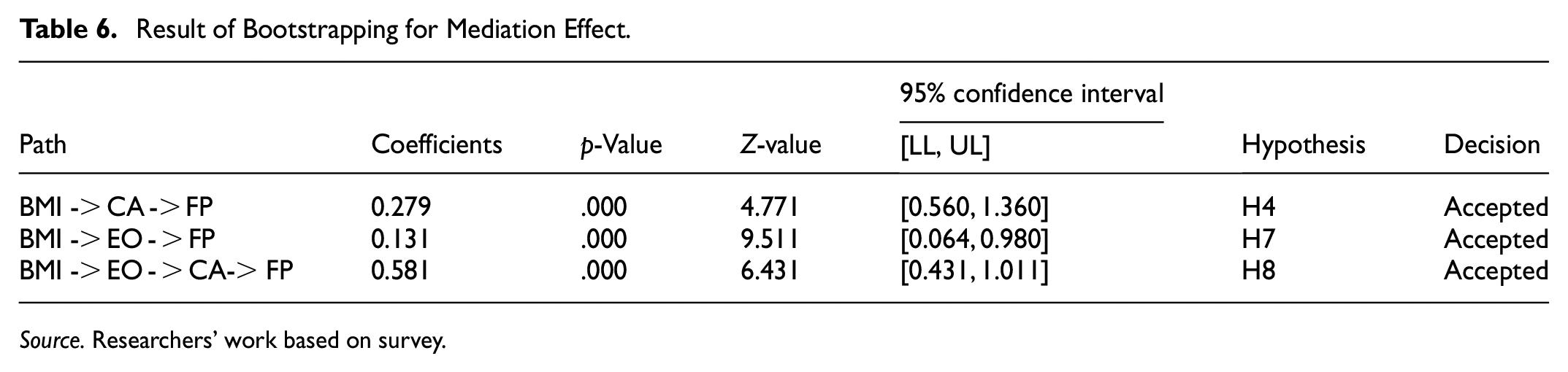
To assess the mediation effect of entrepreneurial orientation and competitive advantages in the relationship between BMI and firm performance, Structural Equation Modeling (SEM)-AMOS was used for the bootstrapping procedure with maximum likelihood estimation comparing three models (Table 6, Figure 1). The result revealed evidence to support hypotheses, that is, H4 and H7. It is found that the competitive advantage of the firm mediates the relationship between BMI and firm performance (β = .279, p < .01, z = 4.771, 95% CI [0.560, 1.36]), stating that the firms with higher competitive advantages increased firm performance through business model innovation. Likewise, the findings support the mediation effect of entrepreneurial intentions (β = .13, p < .01, z = 9.51, 95% CI [0.064, 0.980]) in the relationship between BMI and firm performance.
Result of Bootstrapping for Mediation Effect.
Source. Researchers’ work based on survey.

Research models.
As both direct and indirect effects from BMI to FP are statistically significant, it implies that partial mediation exists at a 5% significance level. Further, we examined the serial mediation effect incorporating both variables, that is, entrepreneurial orientation and competitive advantages (β = .581, p < .01, z = 9.51, 95% CI [0.431, 1.011]). Comparing the three models, the beta coefficient of model 3 (serial mediation model) is higher than model 1 and model 2, supporting the significance of the collective effect of entrepreneurial orientation and competitive advantages for predicting firm performance by business model innovation.
Discussion
This study examined a schematic model to fill the research gap of analyzing the direct and indirect effects of business model innovation, competitive advantage, and entrepreneurial orientation on firm performance in the SME sector during the COVID-19 pandemic. Examining the influence of business model innovation, this study highlighted the need for change in the existing business model to be resilient by integrating internal and external resources, especially during the crisis. Connecting the theory of dynamic capability, the study revealed a positive performance gap in BMI-focused SMEs as the BMI proactive SMEs attained competitive advantage and attained target performance during the pandemic, supporting the findings of previous studies (Bivona & Cruz, 2021; El Chaarani et al., 2022; Q. Liu et al., 2022; Schneider & Spieth, 2013; Schuler & MacMillan, 1984). Firms with proactive business models, that is, emphasizing opportunity sensing, seizing opportunities through strategic innovation, and reconfiguring the resources to cope with volatile business environments, generated more significant value than those with reactive business firms (Hacklin et al., 2018; Harms et al., 2007). Findings show a significant positive association between BMI and the firm performance, replicating that Nepalese SMEs used innovative business models during the COVID-19 pandemic. BMI-focused SMEs followed a comprehensive approach to enhance value through product development, improvised supply chain, adapting effective price structure, and influential promotional activities. It provides evidence to support the previous findings (e.g., Anwar, 2018; Casadesus-Masanell & Zhu, 2013; Y.-F. Liu et al., 2022; Teece, 2010) that to excel in the firm performance, firms need to be innovative throughout the business model. Further, SMEs adapting product innovation focused on developing new or improved products or services tailored to niche markets; while focusing on process innovation, they aligned on refinement of production, distribution process, and workflow optimization. SMEs engaged in BMIs also incorporated market innovation implementing novel promotional activities, branding approaches, and customer engagement techniques.
The findings demonstrate that BMI functioned as an essential dynamic capability for SMEs, enabling them to identify emerging opportunities, such as changes in consumer behavior, and capitalize on them through innovative business strategies. These firms adjusted their supply chains, adopted digital technologies, maintained flexible price structures, and realigned their resources to address evolving market needs. This proactive strategy highlights the core principles of dynamic capabilities, emphasizing their role in fostering resilience and adaptability for firms during periods of crisis.
Further, the study provides evidence that BMI contributes significantly to developing competitive advantage and enhances entrepreneurial orientation to the firm performance during the crisis which further validates the dynamic capability perspective. SMEs can be resilient and increase their productivity, profitability, and market coverage by applying BMI through incorporating a wide range of strategies (e.g., cost leadership, reforming supply chain, and use of strategic allies) to reduce the risk and significantly enhance brand image and firm reputation. Such strategies provide competitiveness over the competitors and keep them oriented toward entrepreneurship. Based on dynamic capability perspectives, proactive SMEs followed the quick response to the crisis through temporary BMI. They continued to the incremental BMI in the new normal which amplified long-term competitive advantages. More importantly, SMEs enhanced personal and business contact to leverage the BMI initiation and implementation as the findings of Clauss et al. (2022).
This study identified that the sustained SMEs with expected firm performance were attained by developing existing products to increase customer value. Likewise, BMI-focused SMEs have good practice of brainstorming consistently for new product ideas and promoting goods to enhance customer satisfaction. To reduce the cost of production and supply, BMI-focused SMEs followed innovative capabilities about sustainability, consistent with previous studies’ findings (e.g., Latifi et al., 2021; Trimi & Berbegal-Mirabent, 2012). Further, to adapt to BMI, during the COVID-19 pandemic, SMEs focused on cost structure and production system with frequent modification of different components of their business through the implication of digital technology supporting the fact that the use of technology can improve performance (Deng et al., 2023). SMEs continued the existing BMI and excelled in it, with a short-term focus on revenue stream, adapting the technology-based communication for creating demand. Further, the SMEs used local resources (both human and non-human) to capture short-term opportunities without weakening the existing firm’s core image and business value, as supported by Clauss et al. (2022).
The study revealed that the BMI should be the strategic alignment of SMEs to sustained firm performance, adapting advanced production systems, developing a new strategic development model for product development, and adapting comprehensive supply chains to address the customers’ changing needs so that SMEs can compete with large multinational companies. BMI-oriented firms that focus on increasing competitive advantages can further increase the firm performance. For increased competitive advantage through BMI, SMEs must be proactive in solving typical issues or problems with actions, focusing on research and development of technology-based leadership for short-term crisis management and long-term incremental change. The study revealed that SMEs bear calculative risk in innovation-based business projects with high returns. In addition, BMI, which assured goods and services to increase customer value and create brand value, remained more competitive during the crisis and in the new normal compared to other SMEs. These results validate the findings of Islami et al. (2020). In this way, the study validates the theory of competitive advantage for sustainable business growth through the dynamic capabilities, even during a crisis.
Besides, in this study, the significant mediation effect of entrepreneurial orientation validates the effect of strong entrepreneurial orientation predicting firm performance during the crisis. Entrepreneurial orientation further enhances the dynamic capabilities of firms, enabling them to better exploit BMI for financial and strategic gains in terms of the firm’s performance. During the COVID-19 pandemic, BMI-focused SMEs always thought about creating innovative opportunities for changing pricing models responding to the changing market situation and consumers’ changing behavior. For this purpose, SMEs adopted a bold, aggressive posture to maximize the chances of exploiting each probable opportunity. Adapting proactiveness and competitive aggressiveness, BMI-oriented SMEs produced higher financial performance, that is, increase in sales revenue, return on investment, return on assets, and sales growth during the COVID-19 pandemic.
The results of the mediating effect reveal that competitive advantage and entrepreneurial orientation partially mediate the relationship between BMI and firm performance. Further, the total effect of BMI incorporating the effect of competitive advantages is stronger than the total effect of BMI incorporating entrepreneurial orientation in the model. The results suggest that the BMI initiation enhances the firm’s competitive advantages and further increases financial performance. The firms with strong entrepreneurial orientation can further increase the effect of BMI on financial performance. In addition, the results suggest that the joint mediation influence of entrepreneurial orientation and competitive advantage makes the BMI a journey, that is, the incremental innovation and source for sustained growth of firms.
Conclusion
Sustainable business growth of SMEs is challenging and more challenging during crises like the COVID-19 pandemic. Complexity in the external business environment caused by the COVID-19 pandemic created a vulnerable situation for many SMEs, irrespective of business and geography. To be resilient in crises, SMEs need to focus on business model innovation to create customer value through a comprehensive business model through product design and production to supply chain management. Using digital technology in business models is vital for optimizing business models during a crisis.
SMEs should focus on BMI to continue the firm’s entrepreneurial orientation and take calculated risks in optimizing the business model. They must be proactive to cope with threats and uncertainties by improving resilience. Innovative thought processes and job autonomy are vital for innovation lead decision makers and operational level managers to be proactive for business model innovation. For the high level of firm performance, SMEs need to address competitive aggressiveness to generate competitive advantages. In a nutshell, SMEs emphasizing BMI with entrepreneurial orientation and competitive advantages significantly improved firm performance during the COVID-19 pandemic.
Implications of the Study
This study has two-fold implications—theoretical implication and managerial implication. This study enriches the dynamic capability perspective by highlighting the significance of combining BMI with competitive advantage and entrepreneurial orientation to maintain firm performance during crises. The mediating effects indicate that BMI achieves its greatest impact when integrated with overarching strategic objectives, such as enhancing market competitiveness and fostering entrepreneurial flexibility. This study proposed BMI as an exogenous driver for the significant impact on firm performance incorporating entrepreneurial orientation and competitive advantages. This study fulfills the research gap by examining single and serial mediation of entrepreneurial orientation and competitive advantage in predicting the relationship between BMI and firm performance. The critical driver of firm performance is BMI, which significantly contributes to competitive advantage and entrepreneurial orientation (Anwar et al., 2018; Trimi & Berbegal-Mirabent, 2012; Zheng et al., 2021) and this result enhances the gauge of knowledge and understanding the significance of the application of a comprehensive model for BMI to enhance firm performance—further, the comprehensive analysis of the study supports to the dynamic capabilities theory.
From a practical standpoint, SMEs should focus on implementing proactive BMI strategies, prioritizing agility and innovation in areas like supply chain operations, pricing models, and customer engagement. Additionally, cultivating an mindset of entrepreneurs within the organization can further enhance the effectiveness of BMI, enabling SMEs to build resilience and achieve sustainable growth. The pandemic has shown repetitive such as Spanish Influenza in 1918, Asian flu in 1957, Hong Kong flu in 1968, SARS in 2002, Bird flu in 2009, MERS in 2012, Ebola in 2013, and COVID-19 in 2019 (Baldwin & Weder di Mauro, 2020; Golubeva, 2021). SMEs need to stand and retain their business and struggle to survive. This research suggests that they are innovative throughout the business model. To enhance firm performance, SMEs should anticipate BMI to be competitive, maintaining a proactive entrepreneurial atmosphere, that is, creating bold ideas, competitive aggressiveness, investment in research development, open and creative organizational structure, and supportive business climate. SME managers and owners should develop and optimize the business model to boost entrepreneurial orientation and competitive advantage for superior firm performance. Thus, the conclusion of the study encourages SME managers to think out-of-the-box during any crisis to be resilient and grow continuously.
This study supports the argument that only investing in projects, technologies, and assets cannot eventually advance sustainable performance. BMI offers strategies to stay competitive and outlive rival organizations (Anwar et al., 2018). Owners and managers must investigate novel innovations connected to product diversification, development, supply channels and distribution, promotion, and efficient cost structures to stay intact, survive, and endure in a competitive market. Thus, the study justifies the need for BMI to excel in competitive advantages through temporary and incremental innovation. This study advises business owners and managers to analyze, update, and change their products regularly so that SMEs can focus on the scope of BMI for continuous growth even in a crisis.
Limitations and Scope for Future Research
First, the study used competitive advantage and entrepreneurial orientation as mediating variables. Future research can incorporate control variables such as customer capital, firm size, and investment in this model. Second, the same study can be extended in longitudinal design to examine the sustainability of BMI to minimize the effect of temporal dynamics. Third, the same study can be extended to different sector industries that are more dynamic and volatile, for example, technology, healthcare, or renewable energy within and cross-country. More importantly, the BMI focused research should integrate sustainability into BMI and entrepreneurial orientation for broader effect analysis how the comprehensive relationship benefit to the social goals. To enhance the validity of the findings, the same framework can be used with longitudinal research design.
Footnotes

Funding
The author(s) received no financial support for the research, authorship, and/or publication of this article.
Declaration of Conflicting Interests
The author(s) declared no potential conflicts of interest with respect to the research, authorship, and/or publication of this article.
Data Availability Statement
Data will be available in request.