




Abstract
Meat is considered an important nutrient of human’s life to gain energy. It accounts as a significant portion of the typical diet in the globe and provides vitamins, minerals, protein, and fats, which are important and have a beneficial effect on the well-being. The major aim of this article is to investigate and explore the association between beef, mutton, poultry meat production, and agricultural gross domestic product in Pakistan. An Augmented Dickey–Fuller unit root test was applied to check the variables’ stationarity, while an autoregressive distributed lag (ARDL) bounds testing approach to cointegration was used to investigate the association among the study variables. Furthermore, a forecasting technique was used to project the future production of beef, mutton, and poultry meat in Pakistan. Study results demonstrated the long-standing associations amid the variables. In the long-run analysis, the coefficient of beef production showed a positive effect on the agricultural gross domestic product, while the coefficients of mutton production and poultry meat production showed a nonsignificant association with the agricultural gross domestic product of Pakistan. By applying the ARDL bounds testing approach to cointegration that examines the association between agricultural gross domestic product, beef, mutton, and poultry meat production in Pakistan makes the present study distinctive.
Introduction
Meat is a consumable food that appears on the market in the various forms. In the traditional economy, meat of freshly slaughtered animals are not refrigerated or processed and can be sold in clothes, stripped, or cut on site and on demand (Brown, Longworth, & Waldron, 2002; Zhou, Xu, & Liu, 2010). The commercial meat production and diversification provides meat from certain indigenous species, which may be a valuable source of food (Hoffman & Cawthorn, 2013). Meat breeding programs around the world are focused on selecting fast-growing and high production yields; however, there is evidence that continued selection of higher lean meat production may adversely affect the quality of meat in other species (Miar et al., 2014; Swan, Pleasants, & Pethick, 2016).
In Pakistan, the livestock sector including beef, mutton, and poultry industry has rich contribution and share about 50% to the agricultural gross domestic product (AGDP). It has huge share in the agricultural sector because of its general involvement and also has a dynamic role to reduce poverty. In addition, it can grow rapidly in the country, as all necessary contributions for the sector are accessible in sufficient numbers. In 2015, the agricultural sector inclusive performance showed a growth of 2.9%. However, livestock growth rates were recorded at 4.1%, forestry at 3.3%, fishing at 5.8%, and crops at 1.0% (Government of Pakistan [GOP], 2015). The annual growth rate reached 3.7% during this period, and the overall gross domestic product of livestock accounted for about 13.4% (Burki, Khan, & Bari, 2005; GOP, 2008). The annual increase in the meat production from 2,515,000 to 3,232,000 tons shows a total increase of 4.8% in 2006-2012. In the poultry production, the ratio of growth was recorded at 10.5%, beef at 3.7%, and mutton at 2.3%. The supply and demand gap of meat in Pakistan has increased 4.1% annually (Bashir et al., 2015; GOP, 2013). Because due to the good taste of Pakistani meat, it is exported to many Middle East countries (Ayyub, Bilal, & Ahmed, 2011).
The massive majority of cattle are killed and culled for the meat production and also bred for an extensive range of food stuffs and the functions they deliver. As a result, the production of beef involves several varieties of supply chain and receipts the numerous procedures. Beef production discussion and livestock are often due to the deficiency of awareness of this enormous diversity in the production, services, goods, and especially in the context of interaction of environment and also for its improvement. The prevailing view of beef production is biased toward specialized plantations and practices that show a deficient portion of a sector which is dominated by domestic farmhouses (Ashurst & Dennis, 1996; Chaudhry, Ahmad, Chaudhry, & Quddus, 1999; Smith, 2015). About 25% breeds of the buffalo and cattle show the worlds 10,512 recorded breeds of mammalian, with comparable shares of goats, horses, sheep, and pigs; all together, these species contribute to about 12% to 14%. In contrast, only 3,505 species of birds were reported, of which chickens represents around 60% (Food and Agriculture Organization of the United Nations [FAO], 2007). Several studies have been conducted regarding meat and milk production scenario, livestock production, meat consumption diminution, meat quality, meat packaging and preservation, cultured meat to market, and agriculture (Alexander et al., 2017; Apostolidis & McLeay, 2016; Bosire et al., 2016; Brito et al., 2017; Rehman, Jingdong, Chandio, & Hussain, 2017; Stephens et al., 2018; Wang, Chen, Bai, & Lai, 2018). The major objective of this article is to investigate and explore the association between beef, mutton, and poultry meat production to AGDP in Pakistan. Time series data were used in this study, and the data were collected from the Economy Survey of Pakistan annual reports. An Augmented Dickey–Fuller (ADF) unit root test was applied to check the variables stationarity, while an autoregressive distributed lag (ARDL) bounds testing approach to cointegration was applied to check the association amid the variables. Besides the “Introduction” section, the remaining article is organized as follows: the “Literature Review” section show the existing review of literature. “Materials and Methods” section presents the data sources and empirical model specification. “Empirical Estimation Strategy” section shows the unit root test and cointegration with the ARDL model. “Results and Discussion” section shows the results of the descriptive statistics, ADF unit root test results, ARDL bounds test for cointegration and Johansen cointegration test results, results of the long-run and short-run analyses, diagnostic and stability test results, and future projection of beef, mutton, and poultry meat production in Pakistan up to 2030. “Conclusion and Recommendations” section revealed the conclusion of the study and policy recommendations.
Literature Review
Beef and mutton production has not been fully utilized due to its wide range of development opportunities and has grown slowly, and the beef production is cumulative worldwide has experienced one of the largest increase in the production over the past decade (FAO, 2009, 2013). However, beef production and its increasing demand and especially the premium beef as an exhaustive system for production have been developed. With this system, cattle feed and shelters have become concentrated; despite this, the proportion of such dense systems to total current beef production is less than 10% (Japan External Trade Organization, 2013). In the field of livestock production, beef has become the most raising product in terms of environmental impact. Globally, the beef supply chain is projected to produce approximately 2.9 tons of carbon dioxide and near 40% of livestock use the approach of life cycle (Gerber et al., 2013).
Given increasing consumer demand for balanced nutrition and food safety, mutton has become increasingly popular as it is a decent protein source by a lower fat content than beef and a reduced risk of contamination. The increases in demand in the consumer market ensure the high quality of the food that is supplied. This goal is reinforced by advanced nations, and different scientific institutions continually strive to pay attention to the quality of food (Du & Sun, 2006; Qiao, Ngadi, Wang, Gariépy, & Prasher, 2007). The scientific study increase in this area indicates that consumers are immediately affected by the superiority and kind of product they eat. Undoubtedly this detail has stimulated the scientific research, as scientists look for novel ways to efficiently appraise the food quality. Such research is particularly suitable for animal-derived foods, the most common of which are meat and mutton. Quality characteristics are distinct as issues affecting the taste and final market price of animal carcasses (Jackman et al., 2010; Sikora & Weber, 1995). The quality of meat is directly affected by its lipid composition. Meat is determined by the specific aromatics of its lipid fraction, and the proportion of saturated fatty acids in lamb is higher than in pork (Cramer, 1983; Wasserman & Spinelli, 1972).
Moreover, the consumption of meat has been gained the special focus and attention, and several studies concluded that mutton, beef, and pork are the dominant sources of animal protein in urban households. In this concern, we cannot ignore the contribution of fish, but recent studies revealed that these fauna do not make significant contribution for the protein consumption (Ervynck, Boudin, van den Brande, & Van Strydonck, 2014). The quality of food and safety for the consumers ensuring and upholding the laws related to the meat products and food is legitimate through a validated process with its description and label. Furthermore, meat legitimacy assessment will solve several problems including fraudulent meat replacement and a highly profitable worth with cheap meat of poor quality (Ashurst & Dennis, 2013), in addition to undeclared meat categories that are listed on the product label (Bottaro, Marchetti, Mottola, Shehu, & Di Pinto, 2014; Okuma & Hellberg, 2015) and accidentally labeled products of meat, even there is concern regarding mislabeling and effect of food safety to the public health and consumers will be deceived into trusting the product they want (D’Amato, Alechine, Cloete, Davison, & Corach, 2013). In some cases, these alternatives affect the public health as well as the economy (Galal-Khallaf, Ardura, Mohammed-Geba, Borrell, & Garcia-Vazquez, 2014; Premanandh, 2013).
As the global population continues to grow, the agriculture sector faces the most significant challenge to humankind’s prosperity: how to use limited resources to produce more food while reducing the agriculture impact on the environment. To meet this challenge, innovations and intensification are needed if the current consumption rate is to be preserved. Without increasing the efficiency of our food production system, more of our natural resources must be allocated to agriculture (Schneider et al., 2011). Continuous improvements in agriculture have been linked in particular to the livestock sector, as the environmental impacts of animal products are often higher than those of their plant-based alternatives; their effects continue to escalate as the global demand for meat continues to rise (Heller, Keoleian, & Willett, 2013; Opio et al., 2013). Poultry production is one of the most common in the world. It is an imperative part of smallholder livings and an instrument to reduce poverty (Dolberg, 2007; FAO, 2008; Sonaiya, 2007).
In the recent decades, a rapid growth has been seen in the demand for livestock products. To meet this demand, large-scale, intensive livestock units have emerged, especially for intensive poultry farms and pig farming. However, there are some serious issues regarding the intensive farming system and long-term sustainability (Cerutti et al., 2011; Lindsey, 2011; Tilman, Cassman, Matson, Naylor, & Polasky, 2002; Zhang, Song, & Chen, 2012). Livestock products demand will increase in the future, the demand for livestock products will increase at a fairly high rate due to population growth, increased demand for protein and calcium for health reasons, and a unit-income of milk and meat demand elasticity (Farooq, Young, & Iqbal, 1999; Sharif & Farooq, 2004).
Materials and Methods
Data Sources
Time series data were used in this study over the period 1982-2018, and the data were collected from the Economic Survey of Pakistan (GOP) annual reports. Table 1 illustrates the variables description.
Variables Description and Data Sources.

Note. GOP = Government of Pakistan.
Figure 1 illustrates the beef, mutton, and poultry meat production in Pakistan, and time series data were taken from the Economic Survey of Pakistan annual reports.

Beef, mutton, and poultry meat production in Pakistan from 1982 to 2018.
Empirical Model Specification
To check the association between AGDP, beef, mutton, and poultry meat production in Pakistan, this study employed a multivariate regression model specified as follows:

In Equation 1,

By using the natural logarithm to Equation 2, a log-linear model is as follows:

Equation 3 demonstrates the log-linear form of the variables.
Empirical Estimation Strategy
Unit Root Tests
The ARDL model requires no pre-testing to check the unit root test for the stationarity of variables. So, we used the ADF (Dickey & Fuller, 1979) unit root test, including trend and intercept, to determine that none of the variables are considered to be integrated in the order 2, because the ARDL bounds testing approach is invalidated in the cases where I(2) variables are used. The ADF unit root tests, therefore, can be specified as follows:

where Y represents the variables being tested for the unit root, T represents a linear trend, ∆ represents the first difference, t represents the time, μt is the error term, and m represents the achievement of white noise residuals.
Cointegration With the ARDL Model
To determine the long-run and short-run analyses between the study variables, this empirical study used an ARDL bounds testing approach developed by Pesaran and Shin (1998) and Pesaran, Shin, and Smith (2001), further extended by Narayan (2005). The cointegration testing method is appropriate regardless of the integration order and for the concerned variables, I(0) and/or I(1), except for the existence of I(2). The long-run and short-run analyses are examined in the ARDL by the representation of unrestricted error correction model (UECM). The long-run analysis between the variables can be specified by using Equation 3, as depicted in Equation 5:

where ∆ presents the difference operator and δ0 is the constant intercept. Y, T, R, and E demonstrate the lags order and µt is the error term. The long-run co-movement among the variables of interest is ascertained on the foundation of the projected F-Statistic. The hypothesis that long-run association is not present is rejected if a projected F-Statistic exceeds the upper bound critical values. Similarly, the short-run analysis between the study variables was determined using the ARDL approach with the error correction model (ECM) and specified as follows:
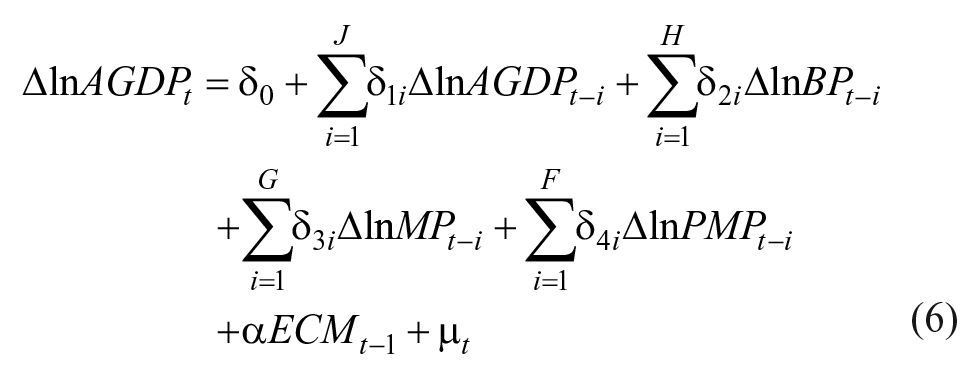
where J, H, G, and F show the order of lags in the equation.
Results and Discussion
Descriptive Statistics and ADF Unit Root Test Results
The results of the descriptive statistics and the ADF unit root test are reported in Tables 2 and 3.
Descriptive Statistics Results.

Augmented Dickey–Fuller (ADF) Unit Root Test Results (Trend and Intercept).

Note. ***, **The rejection of the null hypothesis of unit root at the 1% and 5% significant level, respectively.
ADF test results show that none of the variables integrated with the order I(2).
Cointegration Test
A cointegration test was used when the F- or W-Statistic is applied to the upper bound of the selected significant level. It is worth noting that the “F” test assumes there is no cointegration null hypothesis between the variables. The various statistics are described in Table 4.
ARDL Bounds Test for Cointegration Results.

Note. ARDL = autoregressive distributed lag.
The bounds tests shown in the table summarize the cointegration existence and connection between the study variables at 1%, 5%, and 10%. Furthermore, the results of the Johansen cointegration test (Johansen & Juselius, 1990) are reported in Table 5 with trace statistics and maximum eigenvalue.
Johansen Cointegration Test Results.

Note. Trace test indicates three cointegrating equation(s) at the .05 level.
MacKinnon–Haug–Michelis (1999) p values.
Rejection of the hypothesis at the .05 level.
Long-Run and Short-Run Analyses Results
The results of the long-run and short-run analyses are reported in Table 6. In the short-run analysis, the association between the variables and cointegration existence implies the approximation of the error correction model (ECM) to capture the dynamics of the short run.
Long-Run and Short-Run Analyses Results.

Note. ECM = error correction model.
The long-run analysis results revealed that beef production has a coefficient of 2.282195, which is positive and significant with a p value of .0017. This indicates a 1% increase in the beef production. Its explanatory power, 2.282, suggests an increase in the AGDP by 2.282%. While the coefficients of mutton production and poultry meat production illustrates a non-significant association with the AGDP of Pakistan with p values of .4755 and .1813. The demand of beef and mutton production increased with the ratio of 2 million tons and 6.89 million tons in 2015-2016 compared to 1.95 million tons and 6.71 million tons in 2013-2014 (Dawn News, 2016; Sadiq, 2004).
The short-run analysis between the study variables demonstrates that the R2 value is about 96%, which show 96% change in the dependent variable clarified by the independent. At the 1% level of significance, F-Statistic inveterate the combined significance for the independent variables. The statistical value of Durbin–Watson statistic is 1.955, which does not follow the standard value of the Durbin–Watson and causes the nonappearance of any autocorrelation. However, it is enough to expose the occurrence of autocorrelation. The short-run analysis indicates that the coefficients of beef production, mutton production, and poultry meat production showed a nonsignificant association with the AGDP of Pakistan.
Diagnostic and Stability Test
The diagnostic and stability test results are shown in Table 7.
Diagnostic and Stability tests.

Note. p values are given in the parenthesis. ARCH = autoregressive conditional heteroskedasticity; LM = Lagrange multiplier; RESET = Regression Equation Specification Error Test.
Table 7 results revealed that the p values of Breusch–Godfrey Serial Correlation, J-B Normality test, Heteroskedasticity Test, and Ramsey Reset Test are .9788, .2137, .8945, and .1706, respectively.
Similarly, the stability tests use CUSUM and CUSUM Square point in a directive to stable the parameters of the long run and short run. The graph of CUSUM test and CUSUM Square test is mentioned in Figures 2 and 3.
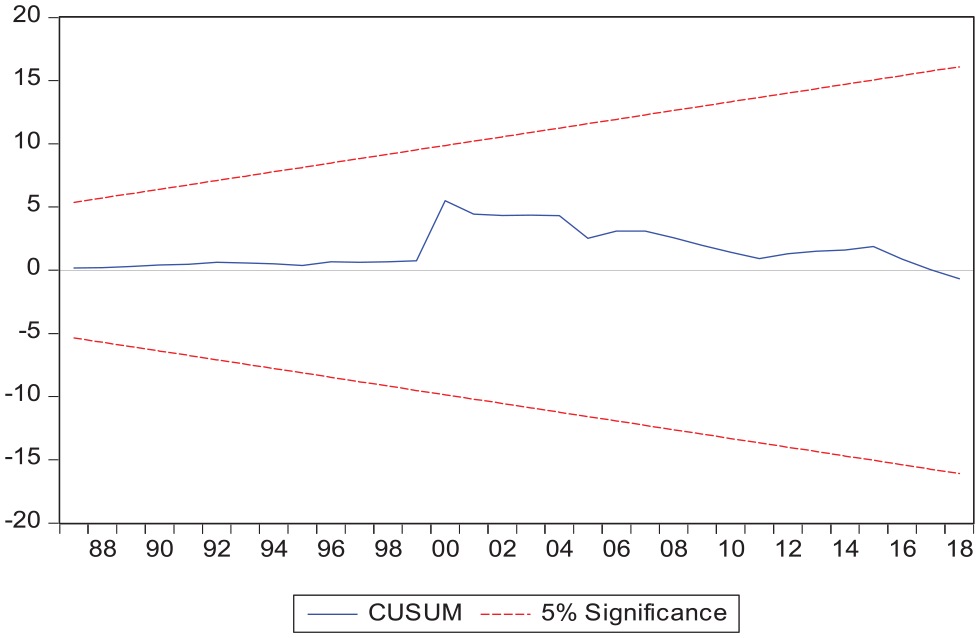
Plot of CUSUM.

Plot of CUSUM of squares.
Future Projection of Beef, Mutton, and Poultry Meat Production in Pakistan Up to 2030
The future projection of beef, mutton, and poultry meat production up to 2030 in Pakistan can be projected by following Rehman and Deyuan (2018) study and can be specified by using following method h + nx, where

Equation 7 can also be written as

In Equation 8, the variables x and m represent the sample means average (known_x’s) and average (known_m’s). Figures 4 to 6 show the projection of beef, mutton, and poultry meat production up to 2030 in the Pakistan.

Projected beef production in Pakistan up to 2030.

Projected mutton production in Pakistan up to 2030.

Projected poultry meat production in Pakistan up to 2030.
In Figures 4 to 6, which show the future projection of beef, mutton, and poultry meat production up to 2030, time series data were used, and the data were collected from the Economy Survey of Pakistan annual reports.
Conclusion and Recommendations
Meat is an important part of our diet to gain energy. Like other countries, the livestock sector in the Pakistan also has main role to get meat and also has rich contribution to the agriculture sector. In this study, an ADF unit root test was used to check the stationarity of the variables, while an ARDL bounds testing approach to cointegration was used to investigate the association amid the study variables. Long-run analysis results show that the beef production has a positive and significant effect on the AGDP, while the variables of mutton production and poultry meat production showed a nonsignificant association with the AGDP of Pakistan. According to the study findings, it recommends that the GOP should focus on livestock sector to increase the production of beef, mutton, and poultry meat in the country. Due to increasing demand of livestock production and meat, the prices continue to increase with the increased fluctuation. It is also necessary to provide financial support to enhance the production of livestock, and possible policies should be implemented on province level from the government to support this sector. It is essential to ensure that the livestock holders receive adequate rewards by confirming a fair share of consumer prices, not only inducing them to adopt the latest technologies but also rewarding their efforts. The livestock promotion services are particularly helpful in persuading farmers to adopt modern animal husbandry practices. To ensure fair prices for farmers for animal sales, on the basis of live weight, such as poultry, the livestock market should be encouraged.
Footnotes
Acknowledgements
The authors are grateful to the anonymous reviewers who helped to improve the content of this paper.
Declaration of Conflicting Interests
The author(s) declared no potential conflicts of interest with respect to the research, authorship, and/or publication of this article.
Funding
The author(s) received no financial support for the research, authorship, and/or publication of this article.
