




Abstract
Sound innovation capabilities help the nations not only to capture bigger market shares but also to sustain long-term economic growth. Innovation is of vital importance at all stages of a country’s development as it promotes productivity, value creation, employment, economic growth, and sustainability. Several factors can affect the innovation activities of a country. For example, peaceful and stable environment, effective macroeconomic designs, sound institutional quality, and efficient utilization of resources are of great significance for a country to nourish economic, business, and market activities. Applying the Auto Regressive Distributive Lag approach to cointegration, this study investigates the short- and long-run impacts of aid, political instability, and terrorism upon the innovation of a laggard economy, namely, Pakistan. Our findings reveal that aid, political instability, and terrorism all have adverse impacts on innovation. Results across robustness checks remain the same. This study is of strong policy implications for policymakers, governments and opposition parties, and security and intelligence agencies to develop sound macroeconomic designs and policies, bring harmony for political stability, and curb terrorism, respectively.
Keywords
Introduction
The capacity to continually innovate is a key source for the competitiveness of a country. There is an extensive support in the literature proving innovation is a major driver to sustain long-term economic growth (Anttila & Jussila, 2019; Maradana et al., 2017; Pradhan, Arvin, Nair, Bennett, & Hall, 2019). Innovation is vital for value creation, employment generation, economic growth, and national development (Gerguri & Ramadani, 2010; López & Figueroa, 2016; Pradhan et al., 2017; Silvestre & Ţîrcă, 2019). Innovation allows all the countries to stay relevant in the fast-changing competitive world, and the laggard economies need sound innovation capability more than ever. The crucial role of innovation has been discussed in the extant literature revealing innovation has a significant impact on the development of all countries, particularly of the laggard economies (Fagerberg et al., 2010; Ho et al., 2018; Pradhan, Hall, et al., 2019; Silvestre, 2015).
Terrorist activities create vulnerability, uncertainty, and panic in the overall environment of a country (Aslam & Kang, 2015; Asongu et al., 2018) and adversely affect the economy of a country by damaging essential infrastructure, causing financial instability, decreasing the confidence of investors and foreign direct investment (FDI) inflows, and increasing counter-terrorism costs (Aisha & Shehla, 2014; A. Ali, 2010; Bano et al., 2019; X. Hu et al., 2019). Terrorism-prone and economically weak economies often fail to develop sound economic policies, and heavily depend on aid to finance its economic activities. In this backdrop, such economies are believed incapable of managing and financing their economic activities due to unstable business environment and scarcity of financial resources. In such a situation, development aid 1 might be able to facilitate economic growth in such economies. Aid-dependent economies utilize development aid to reduce resources gap, foster domestic investment and boost industrial development, which could help such economies to takeoff into self-reliance growth (Rostow, 1990; Waterson, 1965). Political instability as another building block of the conceptual construct designed for this study is considered as the bottleneck to inhibit economic and innovation activities in many economies (Allard et al., 2012; Leydesdorff & Meyer, 2006; Varsakelis, 2006), especially in the laggard ones.
The relationship between aid and economic growth is inconclusive. The extant literature reports that the impact of aid on economic growth could be negative (Jia & Williamson, 2019; Khan & Ahmed, 2007), positive (Mekasha & Tarp, 2019), positive only on certain conditions (A. M. Ali & Isse, 2005), negative even after interactions between aid and policy (Rajan & Subramanian, 2008) or insignificant (Dreher & Langlotz, 2017). Some studies demonstrate adverse effects of political instability on economic growth (Alesina et al., 1996; Feng, 1997). Londregan and Poole (1989) reported that low economic growth increases the chances of political instability.
Despite the great significance of development aid and political stability, the empirical relationship between aid and innovation is scarcely explored in the literature; thus, it is an important research gap. Similarly, limited research attention has been paid to the impacts of political instability upon innovation at the macro level in the laggard economies. Besides, much of the innovation literature focused on developed and fast growing countries where the innovation system and policies are well developed (Nelson, 1993; Teixeira, 2013) and the laggard economies have received little research attention (Castellaci et al., 2005). Thus it is of great importance to probe into the reasons of poor innovation performance in laggard economies.
With the ARDL approach and several other econometric approaches to check the robustness, this study investigates the impacts of the mix of variables (aid, political instability, terrorism) in a single econometric model upon the innovation, in Pakistan, and discusses the possible reasons for its low innovation capability. The contributions of this research are as follows. First, the empirical relationship between aid and innovation remains unexplored in the existing literature and our results show that ineffective utilization of aid has adverse impacts on innovation in the short and long run. Second, the impact of political instability on innovation has been scarcely examined in the literature and our study reveals that the political instability adversely influence innovation both in the short and long run. The findings offer new insights to investigate the reasons of poor innovation performance in other laggard economies.
Pakistani Context
Despite a significant potential to grow, Pakistan lags behind other developing economies in terms of innovation capability and ranks low in several innovation benchmark indexes (World Economic Forum, 2019; Speakman et al., 2012). Several factors contribute to its poor innovation performance.
Terrorism is a problematic issue for Pakistan, which has been playing the role of a frontline state against terrorism since 2001 and suffering from massive financial, physical, and human capital and infrastructural losses (Pakistan Economic Survey, 2016). Specifically after the 9/11 period, Pakistan was in vulnerable situations due to intense terrorism waves, and its economic, financial, political situations were not encouraging. For example, Pakistan bears a loss of 123.13 billion U.S. dollars in wars against terrorism, a substantial amount for a laggard economy. Table A1 in Online Appendix shows the annual costs incurred in Pakistan due to war on terror. Similarly, Table A2 in Online Appendix summarizes the terrorist attacks, fatalities, and injuries in Pakistan during the sample period of this study. During the period from 1987 to 2001, there were 1,955 terrorist attacks in Pakistan, resulting in 3,611 fatalities and 7,026 injuries. However, there was a sudden hike in terrorist activities in Pakistan after the year 2001. For instance, during the period from 2002 to 2016, there were 11,702 terrorist attacks in Pakistan leading to 19,231 fatalities and 32,694 injuries. Figure A1 in Online Appendix displays its year-wise graphical representation of terrorism-related causalities.
Pakistan is a lower-middle-income developing country. Due to war on terror, a major chunk of its resources shifted toward military expenditure (Nasir & Shahbaz, 2015) and activities like counter-terrorism battles, military and intelligence-based operations, and rehabilitation of internally displaced persons (IDPs; Pakistan Economic Survey, 2016). Pakistan ranked the ninth in fragile states index in 2006 and such economies faced severe financial constraints (Fragile State Index, 2006; Saba & Ngepah, 2019). A country like Pakistan with a weak economic foundation and heavy anti-terrorism burdens has to turn to foreign aid to finance its economic activities. U. Shahzad et al. (2019) reported Pakistan as a major recipient of aid. For example, during sample period of this study, Pakistan received a total of 36.019 billion U.S. dollars as Official Development Assistance (ODA). Notably, the amount received during the period from 2002 to 2016 is more than double from the period of 1987 to 2001. For instance, during the period of 1987 to 2001, Pakistan received 17.045 billion U.S. dollars as development aid. These figures reveal that after the 9/11 attacks in United States, Pakistan (as a frontline state against war on terror) was severely affected by terrorism and pushed toward aid. According to the former High Commissioner of Pakistan in United Kingdom, who urged for Britain’s continued aid providing, I would say that they should be paying knowing well what sort of problems we have [been] put into by this 30-year-long war against terrorism in the region. . . We have spent $67bn (£44bn) since 2011 in this war against terror, our infrastructure has been destroyed, our education has been destroyed. (BBC, 2013)
Political instability is a grave concern in Pakistan, 2 which has experienced a lot of political turmoil since its independence in 1947. In 72 years since independence, only two democratic governments have completed a 5-year term of office in Pakistan. Unfortunately, only one democratically elected President finished his term of office in Pakistan, but not even a single Prime Minister successfully executed his 5-year term in office. The present study is essential in the Pakistani context to identify some possible causes of its underperformance in innovation capability.
Review of Literature and Hypothesis Development
Development Aid and Innovation
Aids develop infrastructure, improve human capital, provide valuable policy proposals and build productive capabilities in recipient countries and the impacts of aids can be medium or long term (Feeny & Fry, 2014). Scholars believed that marginal productivity increases when aid is utilized to finance complementary inputs such as human capital investment and infrastructural development (Selaya & Sunesen, 2012). Similarly, Govindaraju and Wong (2011) reported that Malaysia took substantial benefits from development aid by investing a considerable amount in R&D activities and achieved sound economic growth compared with its neighboring countries. Several studies revealed that the effectiveness of aid is mainly based on internal efforts and absorption capacity which is closely associated with National Innovation System (NIS; Berthélemy, 2006; Burnside & Dollar, 2000; Cohen & Levinthal, 1989; Fu et al., 2011; Haaparanta & Virta, 2006; Hansen & Tarp, 2001; Johnson et al., 2004; Lee & Lim, 2001; Radelet, 2006). According to Benarroch and Gaisford (2004), for countries where growth originates from the adaptation of advanced and latest technologies, the long-term effects of aid are more pronounced than the short-term ones. Temple and Van de Sijpe (2017) stated that the long-run effect of aid on investment could be much higher than the short run one if the aid is utilized to improve the investment climate in the country. In the same vein, if aid is utilized in consultancy services in donor countries, its short run effect will be zero, but later on the technical advice may be reflected in economic policies and consequently in macroeconomic ratios (Temple & Van de Sijpe, 2017). Researchers also found that the dynamic framework of aid is more appropriate than the static one, as the dynamic framework facilitates learning, trade, and transfer of technology (Benarroch & Gaisford, 2004; Husein, 2019), which may result in positive impacts on the overall innovation rate of a country.
Some scholars argued that aid compels the recipient countries to implement various vicious economic policies, which lead to economic stagnation in the long run (Zimmerman, 1993). Aid discourages the domestic savings and crowds out private investment when it comes only with capital transfer (Bandyopadhyay et al., 2015; Boone, 1996; Feeny & de Silva, 2012; Griffin, 1970). Large inflows of aid may lead to adverse macroeconomic consequences known as Dutch disease (Addison, Baliamoune-Lutz, 2017; Feeny & de Silva, 2012). Bandyopadhyay et al. (2015) found that aid can have detrimental impacts on the recipient country’ economy because of overvaluation of exchange rate and less competitiveness in the global market. Meanwhile, large inflows of aid may result in exchange rate appreciation in recipient countries and losses in export competitiveness (Heller, 2005).
From the perspective of development stages, studies have revealed that at the early stage of economic development, the recipient countries take benefits from aid but aid will weaken competitiveness of the recipient countries if they continue to receive aid without any efforts to absorb potential benefits of aid (Aitken & Harrison, 1999; A. G. Hu & Jefferson, 2002; Johansson & Pettersson, 2009; Martinez-Zarzoso, 2019). In the same way, if the NIS of the recipient country is vulnerable to socioeconomic and political problems, aid may not contribute positively and can act as obstacles in certain cases (Guillaumont & Chauvet, 2001; J. Kim et al., 2015; Radelet, 2006). Scholars reported that Vietnam experienced a tough time to achieve sound industrialization base due to low investment in R&D and fewer efforts to boost innovation by utilizing aid (Mori et al., 2009).
Trust in government, effective role and sound quality of institutions, healthy governance structure, and efficient property right systems all play a vital role in motivating the process of innovation and attaining technological progress (Dincer, 2018; DiRienzo & Das, 2015; Oluwatobi et al., 2015; Speakman et al., 2012; Varsakelis, 2006). Efficient institutional capacity attracts investment inflows by reframing good investment systems, providing ease of doing business and reducing businesses uncertainties and costs (Tun et al., 2012). Foreign firms and multinational enterprises are more interested in investing in countries where quality institutions are established and policies protecting intellectual property rights are well enforced (Aziz, 2018). Scholars reported bulk amount of aid brings adverse impacts on institutions and governance structure of a country (Busse & Gröning, 2009; Dijkstra, 2018; Jones & Tarp, 2016; Schlosky & Young, 2017; Schwalbenberg, 1998). For instance, Sarwar et al. (2015) revealed aid has a detrimental impact on political and economic institutions of Pakistan. Institutionally weak countries fail to protect property rights, increase business cost, and resultantly weaken the innovation-related activities (Dincer, 2018; Dunning, 2004; Wall et al., 2010). Aid may be associated with a higher level of corruption and rent-seeking activities (Svensson, 1999a), and corruption impedes a country’s innovation capability directly through raising transaction cost, misallocating economic resources, and eroding trust (DiRienzo & Das, 2015). Asongu and Nwachukwu (2017) concluded that development aid is like a policy whose outcomes depend on its implementation. Thus, the following hypothesis is proposed:
Political Instability and Innovation
Political instability, defined as extra-institutional/parliamentary threats to the government or existing political structure (Allard et al., 2012), creates unrest in the economic system and dampens the opportunities of sound economic growth. Alesina et al. (1996) stated political instability as the tendency of collapse of government may result from internal competitions between different stakeholders in government or from other conflicts. Scholars associated the political instability with weak institutional capacity, low economic growth, and small investment inflows (Bano et al., 2019; Khaldūn, 1958). Usually, political instability is connected with the perception of failed state (Mommsen, 1992). Alesina et al. (1996) studied the relationship between political instability and economic growth and observed low economic turnout in countries that are prone to political instability and government changes. Similarly, Feng (1997) reported adverse effects of political instability on economic growth. Contrastingly, Londregan and Poole (1989) found that political instability is not related to low economic growth but low economic growth increases the chances of political instability.
The effective role of political institutions is well acknowledged in development stages of any nation (Ho et al., 2018). According to the Global Innovation Index (2009), political stability, government policies, regulations, and institutions influence the trends of innovation over the long run. The quality of political institutions can develop a nation’s behavioral response to innovative activities (Bartholomew, 1997; Ho et al., 2018). Stable regulatory and political environment shows a better innovative tendency (Busenitz et al., 2000; Ho et al., 2018), and resultantly, the productivity of innovation through patents will be encouraged (Waguespack et al., 2005). Using patent data as a proxy to measure innovation, Waguespack et al. (2005) found the positive relationship between political stability and innovators tendency toward innovation. They further reported that national political conditions influence the innovative behavior of the individuals. Similarly, Varsakelis (2006) studied the relationship between political institutions and innovation activity in a sample of 29 countries and reported significant positive relationship between quality of country politics and innovation.
Political instability creates mistrust and uncertainty (Allard et al., 2012) and it is a barrier to innovation and technological development of a country (Amankwah & Amoah, 2019). Scholars found that mistrust and uncertainty generates lower trust within societies and individuals and leads toward lack of confidence in the triple helix model (essential unit of innovation) and that formal and informal institutions, and resultantly, the triple helix model (i.e., university–industry–government) cannot flourish in a country (Allard et al., 2012; Leydesdorff & Meyer, 2006).
Politically unstable countries may experience shocks of civil war, social unrest, and violence and people there are probable to see their government be overthrown through unconstitutional means (military takeovers). Such situations discourage the potential investors to make investment in such countries (Bano et al., 2019; Feng, 1997). The instability may result in lower FDI inflows and discourage business activities and human capital development (Globerman & Shapiro, 2003), which can adversely affect the innovation rates of such countries (Allard et al., 2012). Recent study by Salas et al. (2019) reported that political instability discourages innovation investment. Švarc (2006) studied the sociopolitical factors in Croatia and revealed its failure to achieve sound NIS. He argued that the legacy of former political government, suspicion of scientific progress, and obsolete management practices regarding R&D and innovation contributed toward underperformance and failure of Croatia. Similarly, Amankwah-Amoah (2016) reported that political instability leads to migration of highly skilled persons, including engineers, academics, and scientists. He further highlighted that such migrations can result in losses of trained professionals, and scientific knowledge and innovation. Hence, Hypothesis 2 is proposed in the following:
Terrorism and Innovation
Terrorism adversely influences almost every segment of the society and the economy has to pay the biggest price. Terrorist activities cause massive scales of destructions, which have caught the several economies on various fronts such as military, political, economic, and technological (Koh, 2007). Terrorism negatively affects financial markets due to economic and market uncertainties and brings undesirable consequences for terrorism-prone economies (Abadie & Gardeazabal, 2003; Bano et al., 2019; Nadeem, Liu, et al., 2020; Narayan et al., 2018).
On one hand, international economic activities such as FDI inflows are vital for catching-up economies to attain modern technologies and best practices for businesses (Bano et al., 2019; Gong & Keller, 2003; Koh, 2007). The most crucial aspect of FDI inflows is technology spillover in the host country which could facilitate the transfer of technologies, enhance total factor productivities (Coe & Helpman, 1995), fuel technological changes through adoption of foreign advanced technologies, skills and capital, and resultantly boost the level of productivity and innovation (Fedderke & Romm, 2006; Singhania & Gupta, 2011; Wu et al., 2017). Besides, FDI inflows can have a positive spillover impact on entrepreneurship and promote the overall innovation rate of a country (Hisrich et al., 2010; P. H. Kim & Li, 2014; Koh, 2007; Tabrizian, 2019).
On the other, international economic activities are inhibited by terrorist activities. For example, terrorism risks would make investors withdraw from financial markets of terrorism-prone countries, which adversely affects the economic activities of such countries (Koh, 2007). Terrorist activities increase economic uncertainties and country-specific risks. They compel the investors to withdraw investments from high-risk countries and invest in low-risk countries (S. J. Shahzad et al., 2016) and such an effect is known as the flight-to-safety effect (Frijns et al., 2012). The devastating consequences of terrorist activities lead a country into economic, business, and market isolation and restrict its access to the international market, latest technologies, and international research collaboration activities. Market failures and decreased FDI inflows slow down transfer of technologies and technological advancement and adversely affect innovation capability of a country (Koh, 2007; Speakman et al., 2012).
Practitioners report that FDI is an important source to transfer technology from one country to another (Fu et al., 2011). Pietrobelli (1996) stated that technology can be transferred through various other sources like international research collaborations, outward FDI, international trade, and travel and migration of skilled people, foreign education workers, and students. However, the terrorist activities damage all such sources. For example, Koh (2007) stated that terrorism-related concerns may hinder international trade and, resultantly, the innovation rate will slow down in such countries. Similarly, skilled labor force, engineers, scientists, and intellectuals may feel reluctant to visit and serve in terrorism-prone countries, which could adversely influence innovation rates of such countries. Multinational enterprises are considered essential driving forces for R&D activities around the world (Fu et al., 2011) and are expected to generate positive spillover effects in the recipient countries through transfer of latest technologies (Markusen, 2002). Similarly, the international joint venture portfolios may also give a competitive edge to laggard innovator economies to enhance their innovation capability. However, the desired results of R&D activities, technology transfer, international joint venture portfolios, and so on cannot be fruitful unless the technology-seeking countries remain stable and peaceful.
Terrorism also brings several undesired consequences for terrorism-prone economies. For example, terrorism-prone countries experience the shocks of migration (brain drain; Dreher et al., 2011), due to which a pool of scientists, IT (information technology) professionals, engineers, doctors, and so on permanently or temporarily leave such countries and inhibit their innovation rates. These skilled people serve the recipient countries and the results of Bosetti et al. (2015) showed that skilled migration has a positive impact on innovations in recipient countries, and that is why brain drain is also termed as innovation migration (Cuhls, 2007). Terrorist activities directly affect entrepreneurs and reduce their willingness to run businesses in terrorism-prone economies, which showed adverse impacts on innovation in such terrorism-prone economies (Brück et al., 2011; Koh, 2007).
The importance of infrastructural development cannot be denied for economic development of a country (Nadeem, Jiao, et al., 2020) as it helps a country to attract investors, modern industries, and entrepreneurs because sound infrastructural development facilitates to reduce cost of not only doing businesses but also the transportation and operational costs (Wekesa et al., 2016). Terrorist activities destroy essential properties and infrastructure and increases infrastructure losses in terrorism-prone countries (Aisha & Shehla, 2014; Bano et al., 2019), which could hinder market, business, economic, financial, and entrepreneurial activities in such countries. R&D investments are the core of the innovation process for experiments for novelty and explorations of new things (Pradhan, Arvin, Nair, & Bennett, 2019). Practitioners report that terrorism-related defense spending and counter-terrorism costs may crowd out R&D investment, resulting in lower rate of innovation in such countries (Desouza et al., 2007; Koh, 2007). Hence, the following hypothesis is proposed:
Data and Model
Data
The data from the period 2002Q1 to 2016Q4 of Pakistan were adopted for this study. To overcome the problem associated with the short sample size, the annual data were transformed into quarterly data via Econometric Views (version 10). Interpolation is a widely employed econometric approach (Shahbaz et al., 2014) found in several published studies for developing countries (Osundina, 2019; Shahbaz et al., 2014; S. J. Shahzad et al., 2016). 3
Patent data sets offer the best available output indicator for innovation activities (Freeman, 2004).
Like any other proxy, patents present both advantages and disadvantages, as discussed in the literature (Acs et al., 2002). Despite the latter, patents remain the best available source for assessing technological change and innovation as “nothing else comes close in quantity of available data, accessibility and the potential industrial organizational and technological details” (Griliches, 1990, p. 336). Patents is the only source of rich information on new technology, which is increasingly used to analyze innovation and the innovation process, and patent statistics are increasingly used as a measure of innovation (Nagaoka et al., 2010). The patents data were obtained from the World Intellectual Property Organization (WIPO) database. The data related to aid—the Net Official Development Assistance—high-tech exports and the gross domestic product (GDP) per capita were from the World Bank Development Indicators (WDI). The data of political instability were from the Worldwide Governance Indicators (WGI) of the World Bank. Finally, the data related to terrorism were from the Global Terrorism Database (GTD, 2017). Table 1 shows the measurement of variables and data sources.
Description of Variables.

Note. WIPO = World Intellectual Property Organization; WDI = World Bank Development Indicators; ODA = Official Development Assistance; DAC = Development Assistance Committee; WGI = Worldwide Governance Indicators; GTD = Global Terrorism Database; GDP = gross domestic product.
Model Specification and Methodology
Model specification
The general form of innovation function with aid, political instability, terrorism and GDP per capita as the main determinants is modeled as follows:

For the empirical purpose, all the variables are transformed into their logarithm forms except index (political instability; Bano et al., 2019). The relationship between aid, political instability, terrorism, GDP per capita, and innovation is expressed via Equation 2:

ln I, ln A, P, ln T, and ln G represent the patents, aid, political instability, terrorism and GDP per capita, respectively. Constant and error term are denoted as
Methodology
Unit root test
As for the Auto Regressive Distributive Lag (ARDL) approach, the first step is to ascertain the unit root properties of the series. Time series data may have a unit root and nonstationary series may violate the underlying assumptions in the econometric model. Therefore, it is imperative to establish integration order of each variable, that is, to check stationarity of the variables. Commonly used unit root tests are Dickey and Fuller (1979) and Phillips and Perron (1988). These tests are applied to ascertain whether stationarity exists at level I(0) or first difference I(1). The null hypothesis of these unit root tests is nonstationary against the alternative hypothesis of stationarity.
ARDL approach to cointegration
The ARDL approach to cointegration developed by Pesaran et al. (2001) has been a widely used econometric approach to investigate the long-run relationship between variables and boasts several advantages over such traditional approaches to cointegration as Engle and Granger (1987) and Johansen and Juselius (1990). For instance, traditional approaches to cointegration require that all the variables under consideration must be integrated at same order of integration, which makes these traditional cointegration approaches less prominent. However, the ARDL approach to cointegration can be applied even if the variables are not integrated at the same order of integration and when the variables are in the form of I(1)/I(1) or I(1)/I(0). Besides, it provides reliable results for both the short-run and the long-run periods. Furthermore, this econometric technique is suitable for small sample size (Nadeem, Jiao, et al., 2020) and separately calculates the short-run and long-run results. The ARDL methodology allows to produce empirical findings for an individual country and facilitates country-specific discussions and policy implications. Last but not least, endogeneity is likely to be a problem and the main sources of endogeneity are misspecification of model, simultaneity, and measurement error of the variables (Roberts & Whited, 2013). However, practitioners report that results calculated through ARDL are unbiased even when some of the regressors are endogenous (Odhiambo, 2009) as this approach can tackle endogeneity issues (if any) (Halicioglu, 2011).
Considering the advantages of the ARDL approach to cointegration, Equation 1 is transformed to the unconditional error correction model (UECM) in the form of Equation 3:

where ∆ and
Two steps are involved to perform ARDL approach to cointegration. The first step is to calculate the F-statistic and the long-run results. The null hypothesis of nonexistence of long-run relationship among variables is H0: π1 = π2 = π3 = π4 = 0. The alternative hypothesis is H1: π1 ≠ π2 ≠ π3 ≠ π4 ≠ 0. The asymptotic distributions of F-statistic are nonstandard. The first set is on the assumption that variables are integrated as I(0) and the second set assumes the variables are integrated as I(1), respectively, known as the lower critical bound (LCB) and the upper critical bound (UCB). Whether the cointegration exists or not is decided via the following rule. If the computed value of F-statistic is higher than the UCB, the null hypothesis with the assumption of no cointegration is rejected and it can be concluded that the dependent variable and its regressors cointegrated for a long-run relationship. If the computed value of F-statistic is less than the LCB, the null hypothesis with the assumption of no cointegration among variables cannot be rejected. It implies that no cointegration exists between variables. However, if the computed value of F-statistic falls between UCB and LCB, the cointegration among variables is undecided. In such a situation, scholars report that another way to establish cointegration is to test the significant negative lagged error correction term (ECT; Nadeem, Jiao, et al., 2020).
The second step is to investigate the short-run coefficient and ECT. In other words, after determining the long-run relationship between variables, the error correction model (ECM) is applicable to investigate the short-run relationships and ECT. ECM is expressed as follows in the form of Equation 4:

The constant and first difference operator are
Empirical Results and Discussion
The descriptive statistics of the variables are reported in Table 2. The unit root properties of the variables are investigated via Phillips and Pearson (PP) and augmented Dickey–Fuller (ADF) unit root tests and the results reported in Table 3 reveal that some of the variables are nonstationary at level 1(0) but become stationary at first difference 1(1). Findings in Table 3 demonstrate that there is a mixed order of integration. Thus, this research adopts the ARDL approach to cointegration to investigate long-run relationship among variables based on the results of unit root tests and the advantages of ARDL approach.
Descriptive Statistics.
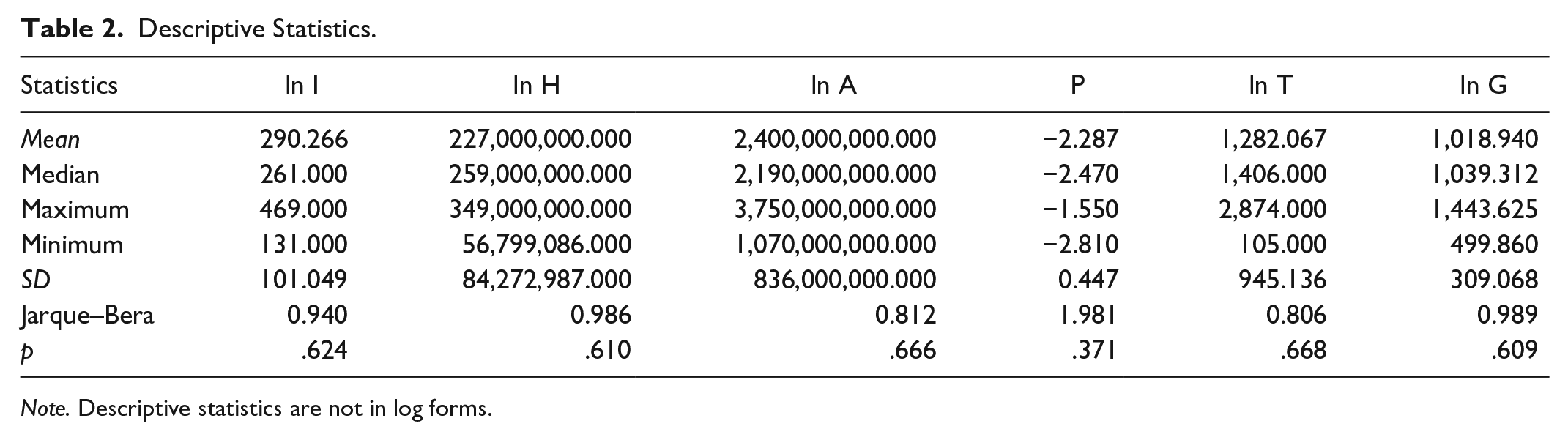
Note. Descriptive statistics are not in log forms.
PP and ADF Unit Root Test.

Note. PP = Phillips and Pearson; ADF = augmented Dickey–Fuller.
, ** and *** denote significance level at 10%, 5%, and 1%, respectively.
In time series analysis, the selection of an appropriate lag length is essential before the ARDL approach to integration. This study determined the lag length via the Akaike information criterion (AIC) and run the ARDL regression for aid, political instability, terrorism, GDP per capita, and innovation to examine the significance of F-statistic. Table 4 shows the computed value of F-statistics. The computed value of F-statistics (13.814) is higher than UCB (4.37) and statistically significant at 1% level. It implies a long-run relationship exists between innovation and its regressors.
Results of Bound Testing for ARDL Model.

Note. ARDL = Auto Regressive Distributive Lag.
Based on the bound tests, ln A, P, ln T, and ln G have impacts upon ln I. The ECT (Table 5) reveals the long-run association of the variables. The ECT for Equation 4 is φ = −0.27 and the significance level is at 1%. Thus, it shows a long-run relationship between ln I and its regressors, meaning that ln I and its regressors are moving in the same direction. The ECT coefficient (φ) implies a comparatively quick adjustment process to reinstate the equilibrium in the model following a disturbance. Likewise, the magnitude of ECT for Equation 4 shows 27% adjustment of deviation from the long-run equilibrium to the short run one in the sample period.
ARDL Short-Run and Long-Run Estimates.

Note. ARDL = Auto Regressive Distributive Lag; ECT = error correction term.
and *** denote significance level at 5% and 1%, respectively.
The short-run and long-run results reported in Table 5 reveal that aid has adverse impacts on innovation in both the long run and the short run. Scholars argues that aid is like a policy and its outcomes depends on its implementation (Asongu & Nwachukwu, 2017), and aid acts as an obstacle if the NIS of the recipient country (e.g., Pakistan) is vulnerable to political and socioeconomic problems (Guillaumont & Chauvet, 2001; J. Kim et al., 2015; Radelet, 2006). There are several plausible reasons for these results in Pakistan. For example, aid has been utilized in Pakistan for unproductive activities, rent-seeking, and corruption (MailOnline, 2016). Furthermore, aid in inefficient projects is associated with high kickbacks, and few efforts were carried out to make investment in development projects. Bad macroeconomic policies are identified as prime reasons of ineffectiveness of aid in Pakistan (Khan & Ahmed, 2007; Muhammad & Qayyum, 2011). Another possible reason of these results is the weak NIS and low absorptive capacity of Pakistan (Rehman, 2016; Speakman et al., 2012; Zaman, 2018) because scholars reported that weak NIS and absorptive capacity would lower the effectiveness of aid (Feeny & de Silva, 2012).
Past studies show that aid reduces quality and efficiency of political institutions (Busse & Gröning, 2009), decreases trade potential, weakens property rights system (Young & Sheehan, 2014), increases corruption (Banerjee & Rondinelli, 2003), and weakens the governance structure (Dijkstra, 2018). Aid weakens the institutional capacity in Pakistan. For example, taxation is vital for capital development projects (Mascagni, 2016); however, it is reported that aid reduced the efforts to collect tax in Pakistan (Franco-Rodriguez et al., 1998), which adversely affects the domestic savings and income of Pakistan. Scholars report that aid can contribute to economic development, but under the circumstances of financial liberalization, absorptive capacity, democracy, and sound trade, fiscal and monetary policies (Ang, 2010; Collier & Dollar, 2002; Santamaría et al., 2009; Svensson, 1999b; World Bank, 1998). Nevertheless, Pakistan experienced lousy governance structure, low trade potential, weak intellectual property right system, and low NIS and absorptive capacity. Thus, Pakistan failed to meet desired expectations regarding the effective utilization of aid because of outdated management practices and poor macroeconomic policies.
The coefficient of political instability reveals that political instability causes innovation to decrease in the short run and the long run. The results are consistent with the findings of Allard et al. (2012). Naqvi (2011) identified political instability as a key barrier to Pakistan’s path to innovation. Similarly, Government of Pakistan (2014) stated that, “If we preserve this hard earned political stability by respecting the mandates and tenures, there is no reason why Pakistan can’t move fast on the development path because political instability and development don’t go hand in hand.”
Strong institutional capacity is crucial to incentivize the process of innovation but Pakistan has weak institutional capacity. In Pakistan, there is a lack of coordination among provinces and between provinces and the central government. Poor macroeconomic policies, strong bureaucracy, and distrust between institutions and politicians characterize Pakistani politics. Military takeovers, confrontations between main state organs, walkout and boycotts of vigorous political debates, street politics, and lack of cooperations and constructive proposals from the opposition parties become the prime reasons of Pakistani political instability. All the above contribute to the political unrest in Pakistan, create uncertainties, lower the domestic and international investments, derail the businesses and markets, destroy confidence in the triple helix model, and thus ultimately impede the innovation-related activities and opportunities. Mauro (1995) argued that political instability slows down the diffusion of novel ideas and innovation in politically unstable countries. Allard et al. (2012) and Leydesdorff and Meyer (2006) reported that politically unstable economies (like Pakistan) generate uncertainty and lack of confidence in formal and informal institutions, and triple helix model and the triple helix model and innovation, resultantly, cannot flourish in such countries.
The coefficient of terrorism shows that increase in terrorism causes innovation to decrease in the short run and the long run. The results are in line with the findings of (Nadeem, Jiao, et al., 2020). The possible explanation of the findings are as follows. A major portion of Pakistani resources shifted toward unproductive costs and military expenditures to curb terrorism (Nasir & Shahbaz, 2015; Pakistan Economic Survey, 2016), which crowded out R&D investments in Pakistan. The limited role of R&D is reported as a major obstacle on Pakistan’s path to innovation (Naqvi, 2011). FDI inflows are found essential for Pakistani technological advancement (Bano et al., 2019). However, terrorism-associated risks reduce the flows of investment and investors are reluctant to invest in Pakistan (Bano et al., 2019; S. J. Shahzad et al., 2016) and the slowing down FDI inflows could decrease transfer of technologies and impede technological advancement (Koh, 2007). Finally, the results show that GDP per capita has a positive impact on innovation in the short- and long-run periods.
Table 6 reports the diagnostic tests, showing that the empirical model passed the required diagnostic tests. The stability of the model is examined through CUSUM and CUSUMq tests proposed by Brown et al. (1975) and the plotted stability is shown in Figures 1 and 2. The findings of CUSUM (Figure 1) indicate that the blue line stays within the two red lines at 5% level of significance, assuring the stability of the model. The results of CUSUM square in Figure 2 reveal that there is a shock from the period 2012 to 2013 and the model becomes stable again after that period. Therefore, the overall model stays reliable.
Model Statistics and Diagnostic Tests.

Note. P values are reported in parenthesis. DW = Durbin–Watson; LM = Lagrange multiplier; RESET = Regression Equation Specification Error Test; ARCH = autoregressive conditional heteroskedasticity.

CUSUM.

CUSUMq.
Robustness Checks
Dynamic ordinary least square (DOLS)
The DOLS method is applied to reaffirm the ARDL long-run results. Sadorsky (2012) reported that DOLS approach has the power to overcome the issue of endogeneity. The DOLS results in Table 7 show that all the coefficients retain their signs as the ARDL long-run results do. According to the findings together with the coefficients regarding t-statistics and significance, it is evident that aid, political instability, and terrorism have adverse impacts on innovation, and GDP per capita has a positive impact on innovation. To sum up, the DOLS results corroborate the ARDL long-run results.
DOLS Estimation Results.

Note. DOLS = dynamic ordinary least square.
and *** denote significance level at 10% and 1%, respectively.
Variance decomposition analysis (VDA)
The VDA is applied to examine the response of the dependent variable (innovation) to shocks stemming from independent variables (aid, political instability, terrorism, GDP per capita). Practitioners report that the VDA as an alternative technique of impulse response function provides better results (Shahbaz, 2013). The VDA employs the vector autoregressive system to investigate the relationship between aid, political instability, terrorism, GDP per capita, and innovation.
The VDA results in Table 8 reveal that innovation is explained 78.14% by its own innovative shocks while aid, political instability, terrorism, and GDP per capita, respectively, explain innovation by 11.20%, 4.10%, 2.76%, and 3.78% through their innovative shocks. Moreover, aid has a higher shock on innovation than political instability, GDP per capita, and terrorism.
Variance Decomposition Analysis.

Implications
The relationship between aid, political instability, and innovation was not adequately investigated in the existing body of literature, especially in laggard economies. This study contributes to the literature by probing into the relationship between aid, political instability, and innovation. Moreover, this research proves its uniqueness in terms of the variable mix, estimation econometric methodologies, and the sample period. In other words, it selects the essential variables in the Pakistani context, chooses the sample period after 9/11, and applies the econometric methodologies that have not been previously employed for the Pakistani studies. The main contributions are as follows. First, the relationship between aid and innovation was not adequately investigated in the past literature and this research showed the ineffective utilization of aid adversely affects innovation in laggard economies. Second, political instability is a troublesome reality for several laggard economies, and its impact on innovation is much less studied, especially in the domain of laggard economies. The findings of this study reveal that political instability is a hurdle in the path of innovation for laggard economies. The findings open new avenues for future research to further investigate reasons of low innovation capabilities in laggard economies.
The findings also provide valuable practical implications for Pakistan and other similar terrorism-prone, aid-dependent, and politically unstable countries, as well as their policymakers, think tanks, and law enforcement and intelligence agencies. The adverse impact of aid has several implications. It is recommended that government and policymakers should take appropriate and emergent steps to design long-term policies for effective and efficient utilization of aid. In this regard, strong macroeconomic, fiscal, and monetary policies and good governance in the country are expected for the effective utilization of aid. In periods of high aid inflows, there should be strong monetary and fiscal measures as suggested by Prati and Tressel (2006), which would help to offset the adverse effects of aid. Aid should be utilized and allocated to develop investment levels and fund development projects. Furthermore, absorptive capacity helps to absorb spillover effects of knowledge and technologies acquired through FDI inflows, trade openness and aid. Therefore, the absorptive capacity should be enhanced by investing in R&D, human capital development, physical infrastructure, and so on.
Increase in aid dependence generates several other adverse effects. For instance, large dependency on aid leads to underperformance of a country and resultantly a country might show fewer efforts to attain self-reliance. Therefore, another plausible reason for the underperformance of several developing countries (like Pakistan in this particular case) is their heavy reliance on aid, for these countries might show less commitment to promoting the investment activities when they heavily rely on aid. For instance, taxation is a vital source of development finance in the majority of countries (Mascagni, 2016), and in the case of Pakistan, Franco-Rodriguez et al. (1998) reported adverse impacts of aid on taxation. Aid-dependent economies like Pakistan make less effort to attract FDI inflows to enhance innovation and economic growth. This study suggests policymakers target such alternative sources as FDI, which can be attracted through development of well-functioning financial systems, strong macroeconomic policies, increased openness, developed infrastructure, and absorptive capacity. These efforts would help to enhance market, entrepreneurship, and innovation activities, which could lead to long-term economic growth. Instead of relying on aid, efforts should be initiated to enhance income and domestic savings through effective and efficient taxation mechanism by bringing maximum population under tax net. Finally, it is advised that too much dependency on aid over an extended period should not be a good solution to sustain economic growth. The slogan of “trade, not aid” should be promoted. To achieve the Sustainable Development Goals of sound economic growth as desired by the United Nations, this study proposes that the donor/recipient countries be expected to transfer/receive technical assistance and support instead of pure capital means for better long-term results.
Sustainable Development Goal No. 16 emphasizes the role of strong institutions. For capacity building at all levels, international efforts are much needed to strengthen institutions in laggard economies. Political instability and weak institutions are common characteristics of several laggard economies. For instance, the political instability in Pakistan is caused due to two main reasons: military takeovers and dissolution of assemblies resulting from confrontations between political parties and main organs of the state. This study holds that institutions should work in their defined constitutional limits and should not interfere with business rules. Political stability is vital for the economic development of any country that can be attained/revived by taking such vital steps as an independent election commission, the continuity of free and fair elections, and comprehensive judicial reforms. Opposition parties and other stakeholders should avoid boycotts, violences, protests, and street politics. Equally important, all the political parties should embrace cooperation and play their constructive role by taking part in effective legislations. The ruling government should treat criticism from opposition parties with open hearts and minds. Such positive initiatives would strengthen democracy and help to restrain the chances of martial laws, military take overs, and undue interventions. Speakman et al. (2012) highlighted the importance of effective and strong institutions to form sound triple helix model, which could promote innovation capacity in Pakistan. The continuity of government and policies could help to strengthen the institutions and build confidence in the system that will ultimately grow businesses, markets, and innovation activities.
Although terrorism is decreased in Pakistan compared with the preceding years, the awe of terrorism brings devastating consequences to the country in the long run, and thus terrorism should be firmly controlled. This study suggests that efforts should be initiated to control terrorism through focusing on social factors causing the people there to choose that undesired way, along with strong surveillance and coordination with national and international intelligence agencies.
Limitations and Future Research Directions
Regardless of its research significance, our study has some limitations that provide opportunities for future research. Future research can extend this work in the following directions. First, this study only investigated the situation in Pakistan so studies on other laggard economies are welcome. Second, due to the unavailability of data, this study was unable to measure innovation through research & development expenditures and researchers in research & development activities. 4 Future studies can go beyond this limitation by conducting research when the data of such indicators are available. Besides, future investigations can also consider trademarks, patent citations, and high-tech patents as proxies to measure innovation. Third, future research can consider terrorist attacks as a proxy to measure terrorism and can compare the results. In addition, terrorism can be measured via the impacts of transactional terrorism or domestic terrorism. Finally, although time series estimates provide efficient and reliable results and country-specific discussion and implications, the generalizability of such results is limited. Such researchers as Castellaci et al. (2005) reported that econometric models sought for more general results valid for a large sample of statistical units (firms/sectors/regions/countries) but the process behind each unit’s performance remained unexplained. Every econometric methodology has its own advantages and limitations. This study suggests future scholars probe into this phenomenon via panel data set to generalize the findings.
Conclusion
The aim of this study is to investigate the impacts of aid, political instability, and terrorism upon innovation in a laggard economy, that is, Pakistan. The short-run and long-run results were investigated via the ARDL approach to cointegration. The findings revealed that ineffective utilization of aid, political instability and terrorism, all have adverse effects on innovation.
This study proposes that Pakistani government should endeavor to trace out the root causes of terrorism and control them. Besides, terrorism must be handled through better surveillance and coordination among various intelligence agencies at national and international levels, and efficient execution of counter-terrorism policies. Pakistan and similar economies should reduce the chaos spreading from political instability. The chances of political instability should be minimized and government, opposition parties, and other stakeholders should work in the best interest of the country by playing their constructive roles because political stability brings continuity in policies and strengthens institutions and democracy, which ultimately facilitates the economic growth and development of the country. Finally, Pakistan demands effective utilization of aid through good economic design and implementation of sound macroeconomic policies. Ideally, efforts should be carried out to attain self-reliance and sustainable economic growth by improving business, market and R&D policies, governance structure, and quality of institutions. Last but not the least, this study proposes that direct capital aid must be discouraged and efforts must be initiated to support developing and laggard economies like Pakistan through technology transfer, technical support, and assistance to meet the sustainable development goals set by the United Nations.
Supplemental Material
Appendix – Supplemental material for Innovation and Sustainable Development: Does Aid and Political Instability Impede Innovation?
Supplemental material, Appendix for Innovation and Sustainable Development: Does Aid and Political Instability Impede Innovation? by Muhammad Athar Nadeem, Zhiying Liu, Haji Suleman Ali, Amna Younis, Muhammad Bilal and Yi Xu in SAGE Open
Footnotes
Acknowledgements
We are grateful to Editorial Board, Article Editor (Prof. Syed Jawad Hussain Shahzad), and three anonymous reviewers for their helpful comments and suggestions during the review process.
Declaration of Conflicting Interests
The author(s) declared no potential conflicts of interest with respect to the research, authorship, and/or publication of this article.
Funding
The author(s) disclosed receipt of the following financial support for the research, authorship, and/or publication of this article: This research is supported by the National Natural Science Foundation of China Project Nos. 72072167 and 72071193 and Project Fund No. WY2040150003.

Supplemental Material
Supplemental material for this article is available online.
Notes
References
Supplementary Material
Please find the following supplemental material available below.
For Open Access articles published under a Creative Commons License, all supplemental material carries the same license as the article it is associated with.
For non-Open Access articles published, all supplemental material carries a non-exclusive license, and permission requests for re-use of supplemental material or any part of supplemental material shall be sent directly to the copyright owner as specified in the copyright notice associated with the article.
