




Abstract
Indonesia, as a country with intensive skill positions, needs to pay attention to the management of colleges. Standardization and development are essential processes in higher education. These can be achieved through the implementation of total quality management (TQM). The initial steps to achieve TQM in higher education are the 5-S kaizen principles (Seiri/Sort, Seiton/Set in order, Seiso/Shine, Seiketsu/Standardize, dan Shitsuke/Sustain) and ISO 9000. There are many similarities between the requirements of the quality management system (QMS) standard of ISO 9001 and 5-S principles. Thus, the integration of both systems in higher education is very potential to be implemented. This research was conducted at college Diploma Program. The implementation of 5-S principle integrated with the requirements of ISO 9001 used Analytical Hierarchy Process, Cross-Tabulation Correlation, and Importance Performance Analysis. The results of this research show the priority degree of 5-S principles on ISO 9001 requirements. It is also found that there is a close relationship (correlation value) between each 5-S principle and ISO 9001 requirements, and the results of the performance evaluation of the implementation of the integration system in college.
Keywords
Introduction
The reality of recent globalization causes a number of implications on the competitiveness demands in various fields. Quality is still a vital component to gain competitiveness in globalization (Priede, 2012). Total quality management (TQM) is utilized by a number of organizations as a strategy to create effective, efficient, flexible, competitive, and comprehensive changes (Goetsch & Davis, 2002). The approach of TQM performance involves every process of all functional areas of organizations by improving competitiveness and continuous improvement of the products, services, human resources (HR), processes, and work environment (Juran & Godfrey, 2001).
The implementation of TQM is applicable in various manufacturing and service sectors, and it can also be applied to the educational institutions. Efforts to develop TQM excellence model especially in higher education can be conducted through 5-S principles (Seiri, Seiton, Seiso, Seiketsu, dan Shitsuke), ISO 9000, quality control in education and marketing, quality control circles, and total preventive maintenance (Ho & Wearn, 1995).
Indonesia, as a country with intensive skill positions, needs to pay attention to the management of colleges, especially vocational colleges (Wonggo, 2010). As stated by Bakar (2018), vocational school is educational institution that prepares graduates to enter the professional world in the application of specific skills to meet industry needs. The impact of ISO 9001 effectiveness on the performance of service companies has been reported by Psomas, Pantouvakis, and Kafetzopoulos (2013). The service performance is directly and significantly influenced by ISO 9001 effectiveness. Meanwhile, the implications of Implementation ISO 9001 standards in educational organization have been reported by Bevans-Gonzales and Nair (2004): The standards give significant improvement in educational organization especially for scope of leadership. The urgency of the implementation of quality management system (QMS) ISO 9001 at vocational colleges is due to the need of the standardization and development of the educational process, improvement of the quality of education, the involvement of all parties, operational efficiency, smooth operation of the day-to-day practice, and service quality improvement (Bakator & Cockalo, 2018; Gamboa & Melão, 2012).
The phenomenon of the problems that recently occur is even though a college has obtained the certificate of ISO 9001 QMS, the college has not fully implemented stratification management, functional management and system, maintenance, standardization, as well as habituation/discipline related to QMSs in educational organizations. Therefore, the implementation of TQM is needed. The initial steps to achieve TQM in higher education are 5-S principles of an ISO 9000 (Ho, Cicmil, & Fung, 1995).
The implementation of ISO 9001 standard at college is aimed at ensuring the effectiveness of the organization’s QMS, improvement strategies, procedures, and continuous educational services for students (Chaudhry & Ramay, 2011; Roszak, 2009; Sartika, 2013). In line with ISO 9001, 5-S principles in college are aimed at creating total quality environment (Ho & Wearn, 1995; Höök & Stehn, 2008). 5-S is a lean principle that is believed to help manage the workplace become more efficient, reduce waste, and optimize quality and productivity through the supervision of neat, clean, healthy, and comfortable working environment (Ghodrati & Zulkifli, 2013; Höök & Stehn, 2008; Rahman, Khamis, Zain, Deros, & Mahmood, 2010; Surya, Rosiawan, & Hadiyat, 2013).
5-S Principles include behavioral science, so it is believed that they can improve the process of thinking, reflect attitude, and form positive behavior for everyone (Osada, 2004). Therefore, the most important things are the determination and commitment of the top management and all employees to apply them in their daily work (Ho & Wearn, 1995; Osada, 2004).
In fact, until now, the implementation of ISO 9001 and 5-S principles seems to be separated and does not support each other. Yet according to Pheng (2001) and Ho (2014), actually once identified, there are many similarities between the requirements of ISO 9001 standard and the 5-S principles. ISO 9001 is aimed at ensuring the effectiveness of the organization’s QMS, while the 5-S principles are aimed at creating total quality environment and shaping employee’s behavior to be more positive. Furthermore, both of them have the same objective, that is, to achieve TQM in the organization (Ho, 2014). Thus, the integration of both systems in higher education is very potential to be implemented.
Based on the research gap, literature review, and case study on the implementation of 5-S principles integrated with ISO 9001 requirements at higher education level, it has not been yet known how much the priority degree of each 5-S attributes in the implementation of ISO 9001 requirements. In addition, the relationship between the two systems is also unknown. Therefore, it is important to conduct this research. Thus, the concordance level between the expected condition and the real performance of the implementation of 5-S principles integrated with ISO 9001 requirements at higher education can be measured.
Theory
TQM
TQM is an approach to run a business to try to maximize the competitiveness of the organization through continuous improvement of the products, services, people, processes, and environment. TQM also has relation with the innovation statistically (Antunes, Quirós, & Justino, 2017). Overall, TQM is a management system that elevates the quality as a business strategy and customer satisfaction-oriented by involving all members of the organization (Gapp, Fisher, & Kobayashi, 2008; Goetsch & Davis, 2002).
TQM emphasizes the focus of internal and external customer satisfaction (Juran & Godfrey, 2001), the high obsession to quality, disciplined methodology using a scientific approach to make decisions and solve problems, make continuous improvement, build teamwork, have a long-term commitment, build education and training, give freedom from control, and have a united purpose (Ho, 1999b). TQM is universal to be implemented in different types of organizations, including the educational institutions, especially in college (Ho & Fung, 1994; Ho & Wearn, 1995). Similar to Psomas and Jaca (2016), the implementation of TQM in service organization is concerned on quality practices of top management, employee quality management, employee knowledge and education, and customer focus.
QMS of ISO 9001 in the Field of Education System
Parties associated with the educational process, among others, are government, community, employers, students, parents, schools’ employees, shareholders, and suppliers. The accreditation process is a criterion that must be met by the college. Meanwhile, the certification of the QMS and audit activities become important elements in the development of the education system in colleges. They are aimed at creating a quality which is appropriate to the educational process. The increasing competition among universities leads to the urgency of ISO 9001 certification. ISO 9001 is an international standard for QMSs that are used to define the quality policy and quality objectives and its achievement (Gamboa & Melão, 2012; Pokorni, 2004; Roszak, 2009; Sârbu, Ilie, Enache, & Dumitriu, 2009; Van den Berghe, 1998). Although higher education institutions over the world have progressed in their QMS in recent years, there is a long way to go to achieve the best improvement (Eryilmaz, Kara, Aydogan, Bektas, & Erdur, 2016); therefore, the popular QMS approach as ISO 9001 standard has to combine to other standard to provide a better result.
IWA-2 (International Workshop Agreement) ISO (ISO, 2007), ISO 9001 (2009), and Roszak (2009) stated the agreement of IWA-2 about a guidance for educational organizations to implement an effective QMS based on ISO 9001. The purpose of the agreement is to ensure the overall effectiveness of the management system of the educational organization’s quality, information, and continuous improvement in educational services to students. The guidance consists of first clause until eighth clause as follows: scope, normative references, terms and definitions, QMS, management responsibility, resource management, realization of educational services, and measurement, analysis, and improvement.
5-S Principles
5-S Principle was initially introduced by the Japanese named Takashi Osada, as 5-S practices (Seiri, Seiton, Seiso, Seiketsu, dan Shitsuke; Ho, 1997, 1999a; Osada, 2004). 5-S is the first step as the foundation toward TQM and Business Excellence (Ho, 2007; Shil, 2009).
5-S Practices help all facets of life, including how to run a business. The benefit of 5-S practices is not only to improve the quality of the working environment physically but also to develop the thinking process of the workers to be more positive (Osada, 2004; Pheng & Khoo, 2001). 5-S Principles include stratification management, functional management and system, maintenance, standardization, as well as habituation/discipline (Pheng, 2001). As stated by Randhawa and Ahuja (2017), the total implementation of 5-S in the majority of organizations over the world has shown significant benefits such as improvement in overall organization, productivity, quality, safety, employee morale values, effective workspace utilization, and cost optimization.
5-S Principles represent Japanese words which are describing the steps of workplace in a process. In simple terms, 5-S methodology helps to remove items that are no longer needed (sort, in Japanese, is called seiri). 5-S Method also offers improvement of efficiencies and flow on the process (straighten, in Japanese, is called seiton). This method provides approach to clean the area of workplace to more easily find some problems (shine, in Japanese, is called seiso); 5-S is also introducing labeling system of the process or any items to stay consistent with other areas (standardize, in Japanese, is called seiketsu); and, last but not least, 5-S is giving approach to develop behaviors that keep the workplace organized for the long term (sustain, in Japanese, is called shitsuke).
Measurement and Scaling
Measurements were conducted toward the characteristics of an object, for example, through perception, behavior, elections, and other characteristics. Scaling means to quantify the subjective and abstract objects so that their similarities and differences can be seen. The primary measurement scale is nominal, ordinal, interval, and ratio. The Likert-type scale is related to a person’s attitude toward something, and the answer is shown in the scale, for example, the scale of five, seven, and nine. Research design uses survey methods; the instrument can be a questionnaire (Devore, 2012). In this study, measuring and scaling will be conducted by the respondents which are the expert in vocational college. The scale is constructed by a Likert-type scale approach, with a range between 1 and 9 scale.
The validity and reliability of the questionnaire instruments are required to be tested. The validity test is used to determine the feasibility of the question to define a variable. Reliability indicates the consistency of a measurement device to measure the same activity. Reliability is measurement stability and consistency of the respondents in answering questions.
Analytical Hierarchy Process (AHP)
AHP is a method of decision making in complex situations, unstructured, strategic, dynamic, and hierarchy arranged. The level of the importance of each variable is subjectively assessed by using a numerical value about the significance of a variable relatively compared with the other variables, using the paired comparison technique. Consistency ratio (CR) is a parameter used to examine whether the paired comparison has been conducted consequently or not. The ratio is considered good, that is, CR ≈ 0.1 (Marimin & Maghfiroh, 2011; Saaty, 1993).
Cross-Tabulation Correlation
Cross-tabulation correlation is used to find out the relationship among ordinal data variables. Spearman’s correlation and Pearson’s R are aimed at examining the relationship between variables and the level of association. The significance level (α) is 5%. If p > .05, the variable does not have a significant relationship, whereas if p < .05, the variable has a significant relationship. Correlation test is aimed at testing the relationship between two variables, not distinguishing the type of dependent and independent variables. Correlation test consists of Pearson, Spearman, and Kendall. This relationship is expressed in terms of the correlation coefficient (Devore, 2012; To, Lee, & Yu, 2012; Walpole, Myers, Myers, & Ye, 2012).
Importance Performance Analysis (IPA)
IPA methods or quadrant analysis was initially introduced by Martilla and James (1977). IPA is aimed at quantifying the relationship between consumer perceptions and priorities to improve the quality of products/services. IPA gives information about the factors that influence satisfaction and loyalty and the factors that need to be improved because of unsatisfactory factors. The factors are ranked and grouped into four quadrants (Ramadhan, Setyanto, & Efranto, 2013). Cartesian diagram IPA matrix can be seen in Figure 1.

Matrix IPA.
Method
This study focuses on investigating the correlation between 5-S principles and ISO 9001 requirement standards. This study also looked at the priority level of its correlation. This priority is expected to facilitate integration when implementing 5-S principles and ISO 9001 standard requirements. A vocational school has been chosen as a case study in this research. The integration of these standards in the scope of higher education is expected to improve the quality of educational services.
Questionnaire approaches are used in the first phase of this study to determine the level of importance of each attribute to either 5-S principles or ISO 9001 standard requirements. A statistical approach is the hybrid cross-tabulation—IPA is used to define the correlation between 5-S principles and ISO 9001 standard requirements. Then, AHP is used to figure the priority level of that correlation.
Research Instruments
The research instrument is a questionnaire, with quantitative data. The method used is a survey. The questionnaire is divided into two stages:
The first phase of the questionnaire is aimed at determining the level of importance of each attribute of 5-S principles toward the requirements of ISO 9001 QMS in colleges.
The second phase of the questionnaire is aimed at finding out the relationship as well as assessing the concordance between the expected condition and the actual performance of the attribute of 5-S principles integrated with the requirements of the ISO 9001 QMS in higher education.
Each variable in the questionnaire is related to the attributes of 5-S principles, which are Seiri, Seiton, Seiso, Seiketsu, dan Shitsuke, as well as the requirements of the ISO 9001 QMS particularly from the fourth clause to the eight clause, which are QMS, management responsibility, resource management, realization of educational services, and measurement, analysis, and improvement.
Characteristics of the Respondents
The respondents of this study are the parties involved and familiar with the issues to be assessed. Respondents also implement the function of college. This research was conducted at Vocational School of Bogor Agriculture University, Indonesia.
In mid-2017, there were no vocational schools in Indonesia that applied ISO 9001:2015 due to the implementation of ISO 9001:2015 was still in the transition year. Furthermore, this study used ISO 9001:2008 standard because the object of the study still used the 2008 standard in 2017.
The expert respondents assessing the priority degree of the attribute of 5-S principles toward the requirements of ISO 9001 QMS in colleges consist of four persons: they are top management, management representative, document controller, and internal auditor. Respondents assessing the relationship and the concordance between the expected condition and the actual performance of the attribute of 5-S principles integrated with the requirements of the ISO 9001 QMS in higher education are 30 internal auditors from college.
Results
The Result of Validity Test
Validity test uses Pearson product–moment correlation. The question in questioner is valid if the value of r is greater than the critical value in the table r (Pearson product–moment correlation) based on the degrees of freedom (df) and significance. The table value of the correlation coefficient “r” (Pearson product–moment correlation), with df = n – 2, then df = 0.361 (Devore, 2012; Walpole et al., 2012). The results of the validity test questionnaire state that all of the attributes have values rcount > rtable. Thus, each question in the questionnaire has eligibility in defining each variable.
The Result of Reliability Test
Reliability test is a measurement of the stability and consistency of the respondents in answering questions. The reliability test is quite good if the value of Cronbach’s alpha > .61 (Devore, 2012; Walpole et al., 2012).
The results of the reliability test requirements of ISO 9001 implementation at college is valued (Cronbach’s α = .928). The results of the reliability test of the implementation of the 5-S principles toward the ISO 9001 requirements based on ideal conditions/expectations at college is valued (Cronbach’s α = .995). The result of the reliability test of the implementation of 5-S principles toward ISO 9001 requirements based on the real performance in college is valued (Cronbach’s α = .978). Thus, this research questionnaire can be said quite good and reliable as a research measurement.
Data Processing With AHP
The assessment was conducted by more than one expert respondents. As a result, the consistency of some experts’ opinion needs to be checked one by one. The value of CR is considered good, that is, ≤0.1. Opinions, which are consistent, are then combined by using the geometric mean. These data were processed by using an Expert Choice 2000 software. The result of the expert respondents’ opinions after they are merged indicates the priority 5-S principles on the implementation of the requirements of ISO 9001 which can be seen in Table 1.
The Priority of 5-S Principles on the Implementation of ISO 9001 Requirements.

Note. QMS = quality management system; HR = human resources.
Although the result of the merging of the respondent’s opinions showed the presence of one of the priorities in the 5-S principles in the implementation of the requirements of ISO 9001, the overall 5-S principles need to be implemented simultaneously to all clauses (Ho, 2007, 2014; Osada, 2004; Pheng, 2001).
Data Processing With Cross-Tabulation Correlation
The hypothesis tests in this research are as follows:
The results of the hypothesis test showed that if p < .05 level of significant (α), then H0 is rejected and H1 is accepted. There is a real relationship between the 5-S principles (seiri, seiton, seiso, seiketsu, dan shitsuke) and the requirements of ISO 9001 in vocational school. The correlation of the two systems is positive.
The correlation value is grouped into very weak (.00-.20), weak (.21-.40), strong (.41-.70), very strong (.71-.90), highly strong (.91-.99), and perfect (1.00) correlation. The results of the cross-tabulation correlation on the implementation of 5-S principles integrated with ISO 9001 requirements in a vocational school where this study took place generate a weak, strong, and highly strong correlation value.
In Clause 4, the recording quality control still has a weak correlation with the 5-S principles. However, the actual commitment of the top management, the participation of all parties, communication, and business management and improvement of the recording quality are relatively good. However, some of the objects are still needed to be improved and trained especially activity classification, structuring, maintenance, and standardization of recording quality that really fits the 5-S principles.
In Clause 5, management commitment, quality objectives, responsibility and authority, internal communication, and management review, in general, have a strong correlation with the 5-S principles. However, there are some important things to be improved, that is,
maintenance (seiso) management commitment to education services;
management stratification (seiri) of every target of the education service quality, and management of functional/determination (seiton) of action plans of specific quality objectives as well as its authority;
standardization in internal communication as well as the provision of data/information;
the maintenance of results of the management review and the dissemination of the review to interested parties periodically.
In Clause 6, increasing competence, training and awareness of HR, infrastructure, and the working environment, generally, have a strong correlation with the 5-S principles. The activities of the resource provision still have a weak correlation with the 5-S principles. Thus, some important things to be improved are as follows:
each unit classifies resources according to the needs and planning period;
management sets a mechanism to provide resources systematically;
each unit maintains the availability of resources;
standardization of proposal mechanism and resource allocation needs;
evaluating and improving the system of resource management to ensure the provision of students’ satisfaction;
standardization in recruitment mechanisms of HR, education, and training based on their field of competence;
management evaluates, improves, and enhances the competence, training, and awareness of HR to ensure the students’ satisfaction.
In Clause 7, the realization of educational services, terms of education and learning, communication with students, and monitoring and measurement equipment, in general, have a strong correlation with 5-S principles. However, there are some important things to be improved, namely,
Each study program must have a clear and measurable standardization and performance in every form of education services and educational service requirement.
Each study program develops appropriate educational service requirement that fits into the development and review of learning requirements.
Classifying every information given to students based on the type of information, interest rate, information time period, objectives, and benefits.
Updating every information regularly so that there is no expired information for students.
In Clause 8, monitoring and measuring student’s satisfaction, control of inappropriate educational services, and analysis of the data have a strong correlation with the 5-S principles. Two things that need more attention are as follows:
classifying the measurements of the students’ satisfaction toward educational services;
maintaining every document and objective evidence of the students’ perceptions about satisfaction.
Internal audit activity has a very strong correlation with 5-S principles. Top management is discipline in reviewing internal audit activities, developing internal auditor competence, following up all information about the results of internal audits, and making corrections and any improvements and prevention.
Data Processing With IPA
The vocational college has been certified by ISO 9001 since 2009. All of the activities lead to action classification, structuring, maintenance, standardization, as well as habituation/discipline. Internal and external audits are conducted regularly as an effort to improve the QMS continuously.
During this time, the implementation of 5-S principles integrated with ISO 9001 requirements has not been evaluated. Such an evaluation is important to do to determine the factors that influence performance in college and the factors that need to be improved because they still do not provide significant contributions. The results of the analysis of the concordance between the expected condition and real performance using the IPA can be seen in Figure 2.
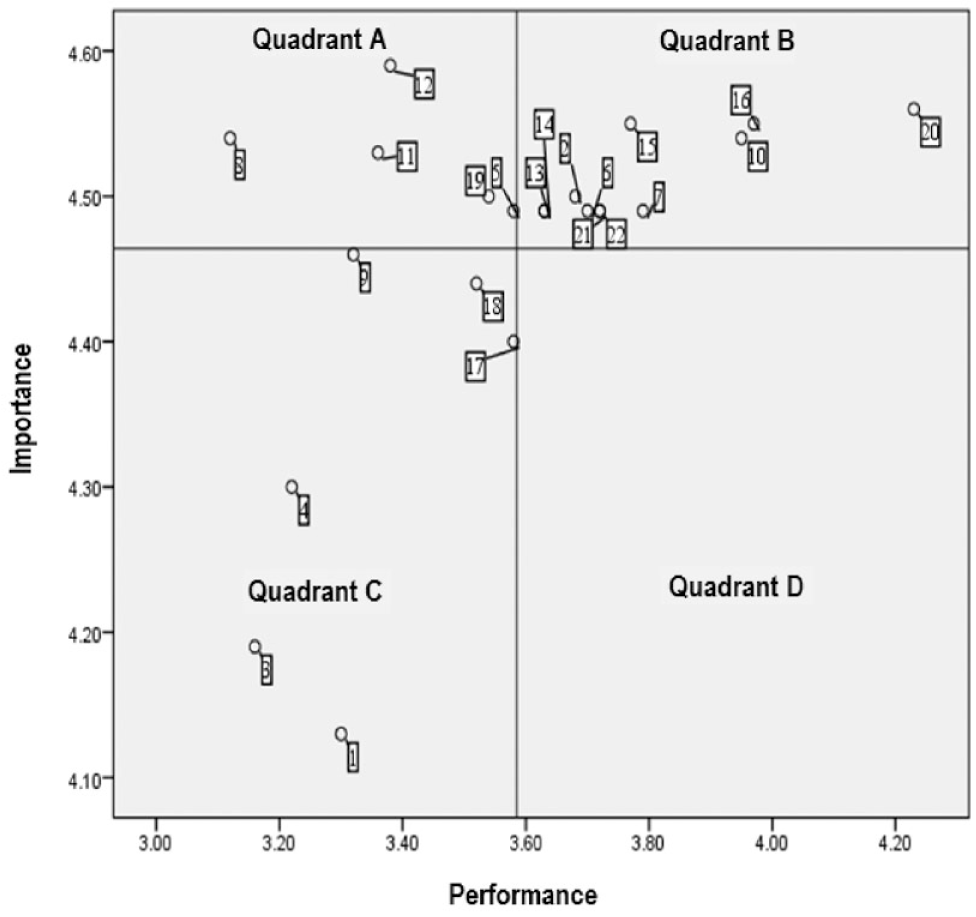
The matrix of IPA on the implementation of 5-S principles integrated with ISO 9001 requirements on higher education.
Quadrant A is the main priority (Concentrate here). This quadrant describes the ISO requirements which become the priority to be enhanced, because actual performance has not been satisfactory, namely, the discipline to control record quality; HR’s responsibilities and authorities; provision of resources; increasing competence, training, and awareness of HR; as well as the monitoring and measurement of students’ satisfaction.
Quadrant B is maintaining the achievement (keep up with the good work). This quadrant describes the requirements of ISO performance achievements that need to be maintained, that is, management commitment, quality objectives, management review, infrastructure, working environment, realization of educational services, requirements of educational services, internal audit, inappropriate control service, as well as data analysis and provision of information.
Quadrant C is a low priority. This quadrant describes the ISO requirements, the priority of which are still considered low by management, so the performance was low, namely, classification of the quality records, arrangement of the quality records, routine maintenance of the quality records, standardization of quality records, internal communications, communication with students, and control equipment, monitoring, and measurement.
Quadrant D is too much (possibly overkill). This quadrant describes the ISO requirements which are considered less important, but their implementation is excessive. In fact, none of the ISO requirements is in this quadrant.
Discussion
Big questions arise, after ISO 9001:2015 standard has been introduced in recent years, but why is this study still using ISO 9001:2008 approach. ISO 9001:2015 have improvements and innovations; however, most of the organizations still need to make much effort to implement the requirements (Rybski, Jochem, & Homma, 2017). Will this study be useless then? Of course, not. The basic principles of the quality assurance system in ISO 9001:2008 standard consist of Clause 4 (QMS); Clause 4.1, general requirements; Clause 4.2, document requirements; Clause 5, management responsibility; Clause 6, resources management; and Clause 7, product realization. Clause 8, measurement, analysis, and improvement, is still strongly connected with the seven main clauses listed in the ISO 9001:2015 standard. The connection between clause of ISO 9001:2008 and clause of ISO 9001:2015 is presented in Figure 3.

The correlation between clause of ISO 9001:2008 and clause of ISO 9001:2015.
The results of this study indicate that there is a priority degree of each attribute of 5-S (seiri, seiton, seiso, seiketsu, dan shitsuke) in implementing the ISO 9001 requirements in college. The priority of 5-S principles are put into quality record control; management commitment; quality objectives; HR’s responsibilities and authorities; internal communications; provision of resources; increasing competence, training, and awareness of HR; realization of educational services; requirements of educational services; communication with students; control equipment, monitoring, and measurement; monitoring and measurement of student’s satisfaction are discipline/habituation (shitsuke).
The priority of 5-S principles on the management review, inappropriate service control, as well as data analysis and information is standardization (seiketsu). The priority of 5-S on infrastructure and working environment is maintenance (seiso), whereas the 5-S main priority of the internal audit is the arrangement (seiton). However, in practice, all of the 5-S principles are still necessary to be implemented simultaneously to all clauses of ISO 9001 (Ho, 2007, 2014; Osada, 2004; Pheng, 2001).
The relationship between the two systems, 5-S principles and ISO 9001, can also be known. The correlation is positive. It means that the variables of the two systems are proportional to each other. This relationship can be supported by standard operating procedures adopted by the college (ISO, 2007). These results indicate that the correlation in the implementation of 5-S principles integrated with ISO 9001 requirements in vocational colleges is weak, strong, and very strong.
The internal audit has a very strong correlation with 5-S principles. In general, the ISO 9001 requirements which are examined have a strong correlation with 5-S principles. Nevertheless, in the implementation, there are some requirements, the performance of which is still needed to be improved. Meanwhile, the requirement which has a weak correlation with 5-S principles is the quality record control, especially classification, arrangement, maintenance, and standardization.
In line with the correlation value between the 5-S principles and ISO 9001, IPA matrix shows the evaluation results of the suitability of the implementation of the two systems integration (Ramadhan et al., 2013). This is reflected in Quadrants A, B, and C, respectively. It means that
there are implementations of the system integration which becomes a priority to be enhanced because the actual performance has not been satisfactory.
there are implementations of the system integration, the achievements of which are needed to be maintained because the actual performance has been good until now.
there are implementations of the system integration which are still considered low priority by management so that the performance is lower.
At Quadrant D, the attributes are considered less important, but their implementation is excessive. In fact, none of the implementations of the system integration is in this quadrant.
The focus of the improvement of ISO requirements should be based on the priority degree of 5-S principles.
Conclusion
This study has shown that four until eight clauses of ISO 9001 have a priority degree on each 5-S principle. Although there is a priority degree, the overall 5-S principles are still needed to be implemented in every clause.
The evidence shows that the correlation between the two variables is positive with the following correlation value: weak, strong, and very strong. It is expected that both systems can be correlated very strongly until it becomes perfect. This, of course, requires a strong commitment and effective collaboration from all levels of management in college.
Evaluation of the implementation of 5-S principles integrated with ISO 9001 requirements in the vocational college indicates that there are some attributes, the performance priority of which is necessary to be enhanced, and there is also an attribute that is still considered a low priority by management so that its performance is lower. This definitely becomes the duty of the management at the college to carefully trace the causes. Furthermore, the cause why there are attributes which are still considered low priority has to be identified, whereas if the attribute is reviewed, it is very important to be implemented. The actual performance of the attributes that have been good until now and in line with all parties’ expectations, it is necessary to maintain the achievement. It is expected that all attributes in Quadrants A and C increase to be Quadrant B.
Footnotes
Declaration of Conflicting Interests
The author(s) declared no potential conflicts of interest with respect to the research, authorship, and/or publication of this article.
Funding
The author(s) disclosed receipt of the following financial support for the research, authorship, and/or publication of this article: This paper was supported by the HIBAH PIT Q1Q2 under contract number NKB-0320/UN2.R3.1/HKP.05.00/2019.
