




Abstract
Attracting and enrolling international students have become the primary concern of marketing efforts of higher education institutions. For this purpose, understanding the decision-making process of students is vital. This study examines the information sources, requirements, and choice factors of international students who study their higher education in an emerging higher education destination. This study is conducted through a quantitative approach, based on both exploratory factor analysis (EFA) and the analytic hierarchy process (AHP). A survey was conducted with students who enrolled at a state university for the first time. University websites are identified as the most used sources of information. According to the study’s findings, job and scholarship opportunities are identified as the first and most crucial concern of international students. This study is of particular significance for higher education institutions in emerging higher education destinations to better understand students’ decision-making process.
Keywords
Introduction
The higher education environment has changed drastically over the past decade. In an increasingly globalized world, prospective university students look beyond national borders in their search for the ideal higher education experience. Thus, higher education institutions are experiencing increased student mobility. This trend resulted in changes relatively in the political, economic, and social forces of globalization. Attracting and recruiting international students has become a strategic issue for many higher education institutions (Alebeek & Wilson, 2019; Wilkins & Huisman, 2011). According to the statistics released by the Institute of International Education (2019), United States is a significant study destination that hosted more than one million international students during the years 2018–2019, followed by the United Kingdom, Australia, Russia, France, and Germany. While these countries have been the primary recipient of international students, countries such as Malaysia, Singapore, and the Middle East have been designing their policies to promote themselves as new emerging higher education destinations (Wilkins et al., 2012) and actively marketing themselves to attract more international students. This has further intensified the competition in the global higher education market.
On the contrary, based on the applicants’ perspective, deciding which university to attend and a course to study is a highly interactive, risky, and complex process (Briggs & Wilson, 2007; Moogan et al., 1999), partly due to the vast number of institutions and degree courses being offered. Due to the competitive environment and variety of alternatives available, identifying information requirements (IRs) and examining the sources of students, as well as the relative importance of the choice factors, is of extreme importance. Higher education institutions, in addition to concentrating on recruiting more students, also try to attract high-caliber learners, so it is crucial to provide information through the right channels and disseminate the correct content to meet potential students’ expectations. As suggested by Briggs (2006) and Briggs and Wilson (2007), the availability of adequate information is essential to make a well-informed decision. Marketing activities should avoid overloading students with information regarding certain specific issues that play minor role in their decisions whilst ensuring that sufficient information is provided on critical issues. Furthermore, marketing activities would be much more effective if such information is provided to the students from the right sources rather than sources that they do not rely on. Even though there are many studies investigating the factors that affect the university choices of international students, little is known about what information these students seek to obtain, the information sources (ISs) they make use of and choice factors in emerging higher education destinations. As Wilkins et al. (2012) point out, the majority of studies examined the movement of students to Western countries such as the United Kingdom, United States, and Australia.
North Cyprus is a newly emerging higher education destination in the Eastern Mediterranean. The higher education market in North Cyprus has become an influential sector that contributes to the growth of the economy since the 1990s. Katırcıoğlu (2010, 2014) found international tourism and the higher education sector as catalysts for the economic growth in North Cyprus. Recently, higher education institutions in North Cyprus have implemented various policies to increase the number of international students and to promote themselves as a knowledge and education hub in the Eastern Mediterranean Region. There are around 100,913 students studying in higher education institutions in North Cyprus, and around two-thirds of the overseas students are from Turkey while the remaining one-third are from other country markets (State Planning Organization, 2017). Internationally recognized and accredited higher education institutions and quality education in a safe, friendly environment at an affordable cost increased the demand for higher education in North Cyprus. However, in the case of North Cyprus as a higher education destination, there is little research on the students’ information needs, sources, and choice factors. To the author’s knowledge, little empirical research has focused explicitly on the decision-making process of students in North Cyprus. Previous studies on students studying in higher education institutions in North Cyprus have focused on the perceptions of service quality in higher education institutions (Nadiri, 2006; Nadiri et al., 2009). Through this study, we intend to contribute to the filling of this gap. Knowing about the different requirements of students, whose choice is made with various priorities in mind, is crucial for the provision of the right information to the right target. Considering the significant potential for higher education in this major, Mediterranean education destination with close ties to Europe and the surrounding regions, research on the information needs and the sources of students would provide a valuable contribution to the literature. Research results may support higher education institutions to design more effective communication and recruitment strategies and tailor promotional and marketing campaigns to better address overseas students’ information needs.
Accordingly, the main aims of this study are (a) to identify and examine sources that students use to find information about higher education institutions and to prioritize ISs and (b) to identify and examine IR factors and prioritizing factors that are considered important by students when making higher education destination decision.
The remaining part of the article progresses as follows: the following section is a review of the literature. Then the research design is presented, and the findings from the empirical study are described. Finally, conclusions and implications for future research are drawn.
Literature Review
Students’ IRs and Sources
The consumer decision-making process has formed the basis for research in consumer buying behavior. When making a purchase, consumers go through a series of stages for decision-making to purchase any goods or services. The basic five-stage buying decision process consists of need recognition, information search, evaluation of alternatives, purchase decision, and postpurchase behavior (Kotler & Armstrong, 2018). The buying process starts when a consumer recognizes a problem or a need and finishes with a purchase and the postpurchase behavior or evaluation. Once the consumer recognizes a problem or a need, they then move into the information search stage. This search may range from performing a simple memory scan to extensive search, during which a consumer collects a variety of information and consults a variety of sources (Solomon, 2018). In the evaluation of the alternatives stage, information is used to carefully evaluate alternatives to arrive at the overall best choice. Once the consumer makes a choice, a consumer engages in postpurchase behavior in which a consumer evaluates the performance of a product or service considering his or her own expectations.
This study’s literature review revealed that researchers have extensively examined the students’ decision-making behavior. Maringe (2006) identified program, price, place, and prominence as the most important factors in the students’ choice of university. In addition, Moogan et al. (1999) found that the course content, reputation, location, and social considerations were the most influential variables. Moogan and Baron (2003) examined students’ decision-making behavior and concluded that career development, self-motivation, and parents’ input were the most important variables in the problem-recognition phase; course content, reputation, and location were the key criteria in the information-search stage; and expectation of entry grades and social atmosphere were the core factors in the evaluation of alternatives stage. Simões and Soares (2010) determined that websites were the most important sources of information and that geographical proximity was the most important choice factor. Joseph and Joseph (1998) whereas identified the cost of education, location, and recreational facilities, academic, and program issues, and academic resources as the most important factors that influenced the students’ choices. Peer and family influences were not considered as important by the potential students studied. In another study, Joseph and Joseph (2000) analyzed the perceptions of Indonesian students regarding their choice criteria. They identified course and career information and physical aspects and facilities as the key factors in choosing an institution. Pimpa (2003) studied students’ choices of international education and the influencing factors of the family on those choices; selection of academic program was found to be the most important factor. In addition, contrary to the findings of Joseph and Joseph (1998) and Maringe (2006), the family influence was discovered to be multidimensional as it impacted the following choices: studying abroad, country, city, course, and the university itself. By contrast, another research conducted by Pimpa (2005) reported that family expectations had less influence on the students’ choice of university and course.
Mazzarol and Soutar (2002) concluded that quality and reputation of the institution, recognition of the institution’s qualifications in their own country, its international strategic alliances, and the quality of its staff, its alumni base as well as its existing international student population were the most important variables for international students. Eder et al. (2010) examined the motivational and constraining factors that influence students’ decision to study abroad and found that college issues and personal growth were the most important motivational factors and that visa issues were the key constraining problem. Eder et al. (2010) concluded that pull factors play an important role in students’ decision to study abroad. Alebeek and Wilson (2019) carried out a case study by integrating the Hossler and Gallagher’s (1987) three-stage model of college students’ choice with the push and pull factors to explore factors influencing international student’s college decision. The research findings revealed the significant influence of family, advisors, cost, environment, quality, prospects, programs of study, admission, and language on the international students’ choice decisions. A study by Calitz et al. (2020) focused on both local students and international students enrolled at a public university in South Africa. The study found that both local and international students considered safety and security on campus as the most important factors when deciding where to study. This is consistent with Gong and Huybers (2015), who reported that Chinese students’ higher education destination choices are affected by safety considerations. In another study, Perez-Encinas and Rodriguez-Pomeda (2018) examined the needs of international students and the particular services they require when they visit new countries. Their research identified five common topics: good university, sound teaching, living expenses, finances, and city offerings. The authors concluded that universities might attain stronger positions within the higher education global market if they include international students’ perceptions and their needs within their strategies. Whatley (2017) examined the influence of financial factors on the students’ decision to study abroad. The study revealed that grant funding has a positive impact on students’ study abroad decisions, whereas student loans have a negative impact. Soutar and Turner (2002) investigated the factors influencing high school leavers’ university preferences and the relative importance of these factors in their decision. Their study revealed that the course or program they want to attend, academic reputation, teaching quality, campus atmosphere, closeness to home, friends who attended the same university and family suggestions were the most influential factors, along with the course suitability and job prospects. Price et al. (2003) investigated the impact of facilities on the decision and concluded that higher quality environments do seem to have an impact on preference. Sojkin et al. (2015) found that courses offered, university reputation, the cost of studies, and the accessibility of financial aid were important factors. Elsewhere, the findings by Wiese et al. (2009) were that quality of teaching and employment prospects were the key determining variables. Finally, Sabir et al. (2013) found that higher education ranking, the reputation of the institution, and employment and career prospects were the central choice factors.
There have been very few published studies on the factors influencing the university selection process of Turkish students. In one of the studies, Yamamoto (2006) examined the effects of marketing communication tools on students’ decisions. University websites were identified as the most important source. Among the more traditional promotional tools, TV was found to be the most crucial. Employment after graduation, proximity to home, easy transportation, fees, posteducational benefits, and the quality of departments and campus were highlighted as the most important issues when selecting a university.
Past research has mainly focused on the decision-making process and the factors influencing students’ choices, with little attention paid to IRs and the importance of the type of information collected by students that affect their choice of a higher education institution (e.g., Bonnema & Van der Waldt, 2008; Veloutsou et al., 2004). Veloutsou et al. (2004) identified local infrastructure, local social life (SL), career prospects, university infrastructure and SL, business contacts, university reputation, courses studied, and campus as the information most commonly required by potential students. Among these factors, university reputation, courses, and campus were found to be the most important. Meanwhile, Bonnema and Van der Waldt (2008) identified key needs as information related to employment, course content, student experience, sports, and finance. Wong et al. (2018) examined the types of information students search for online on the higher education decision-making process. The authors reported four constructs that are perceived as important by students in their online search behavior: university reputation, eligibility and affordability, teaching and learning, and university tangibility. In a similar study, Le et al. (2019) analyzed online questions to explore information sought by prospective students during the decision-making process on the social media and found reputation, career prospects, learning, administration, and student life as significant dimensions.
When students decide to pursue higher education, they start searching for information. Goff et al. (2004) investigated the preferred ISs of high school students who planned to attend a college, categorizing them as media sources, social normative sources, and direct sources. The latter two types were identified as more important for students who planned to attend 4-year institutions, while media sources were defined as unimportant for both students who planned to attend 2-year courses and those who wished to study for 4 years. Bonnema and Van der Waldt (2008) studied the preferred ISs and the needs of high school students in South Africa regarding their higher education institution choices and found the same three categories of sources as Goff et al. (2004). Meanwhile, Wiese et al. (2009) determined that campus visits and open days were the most valuable sources of information. The study by Lehmann (2017) examined the influence of word-of-mouth during the search and choice phases of the decision-making process of students. Lehmann (2017) found word-of-mouth, college web sites, college planning/ranking websites, online reviews/comments, campus tours, and college e-mail more influential sources of information than social media on students’ college choice. In addition, the study reported that electronic word-of-mouth was a more influential source of information during the search stage. Lehmann (2017) concluded that traditional word-of-mouth had a greater perceived influence on the enrolment decisions of students than electronic word-of-mouth.
Methodology
Sample Design
This study consists of two sets of Questionnaires (A & B) and two sets of sample designs. Data for the survey, which is collected by Questionnaire A and explained below, gather data about ISs and requirements, including the first-year overseas students studying in a state university of North Cyprus. These students were targeted because they had the most recent experience of making the decision of which university to attend. The participants of the survey to identify IRs and sources were selected through the stratified sampling method, according to their area of study and nationality. Data for the survey was obtained through the distribution of questionnaires to 700 first-year students who were randomly chosen from each stratum. The response rate was 98%. The majority of respondents were male (59.8%), and the average age was 21.
In the next stage of the study, the target respondents for analytic hierarchy process (AHP) for prioritizing ISs and choice factors (IRs) were analyzed, which consisted of first-year state university overseas students. Data for prioritizing ISs and requirements, which is collected by Questionnaire B, is obtained from surveying 40 first-year undergraduate and postgraduate students. The respondents were selected through the judgmental sampling method. Judgmental sampling is a form of convenience sampling technique in which the units to be sampled are selected based on the researchers’ knowledge and judgment (Malhotra, 2010). Out of 40 questionnaires distributed to collect pairwise comparison data, 35 responses received, yielding a return rate of 87.5%. A small sample size is acceptable from the AHP methodology perspective (Cheng & Li, 2001). Consequently, the sample size of 35 respondents is considered to be appropriate for this research. The majority of the respondents was from undergraduate degree (72.5%), were male (62.9%), and the average age was 24.
Questionnaire Development
Two sets of questionnaires (A & B) were used in this study. Questionnaire A (which is used for exploratory factor analysis [EFA]) consisted of 57 items relating to IRs and 19 items relating to ISs. Focus group interviews with first-year students were carried out to design the survey instrument relating to IRs. The participants for the focus group study were selected by the convenience sampling method. Fifty first-year students attended each focus group interview. The size of each focus group interview was 10. To increase the validity of the questionnaire, before finalizing the survey instrument, a pilot study was carried out with 50 freshman students, an expert from the marketing department and two academicians in the relevant field. In the final instrument, 57 items developed from focus group interviews were measured on a 5-point Likert-type importance scale. The items relating to ISs were adapted from the survey conducted by Bonnema and Van der Waldt (2008) because it is a collection of few valuable research articles on students’ IS preferences. These items were updated to reflect local responses. These changes included “advertisements on social media,” “advice from private tutors,” “education fairs,” “liaison offices personnel,” “university presentations at high schools,” and “university presentations at tutor schools.” Nineteen items relating to ISs were measured on a 5-point Likert-type importance scale. In this study, Questionnaire A was used to identify the IRs of students and to identify the sources they obtain information from when making higher education destination decision.
Consequently, the standard AHP Questionnaire B was developed for organizing and quantifying the weights of decision criteria for the students’ choice of higher education destination. By implementing the factors of Questionnaire A, each of the respondents has to compare the relative importance between the two items at the same level of the model. As suggested by Saaty (1980), the questionnaire was designed on a 9 to 1 to 9 scale (Table 1). The respondents were asked to assess the relative importance of 13 IRs criteria and the related 51 subcriteria, in addition, to assess the relative importance of four ISs criteria and the related 19 subcriteria.
Saaty’s Scale of Measurement in Pairwise Comparison.

Source. Saaty (1980).
EFA
Factor analysis is a technique that is used to analyze correlations among a large number of variables and defines sets of variables that are highly intercorrelated, which are known as factors (Hair et al., 2010). The highly intercorrelated groups of variables are presumed to represent dimensions within the data. EFA has been carried out to identify IRs of students and to identify the sources they obtain information from when making higher education decision, to minimize and to classify data to a limited number of factors.
AHP
AHP is a multicriteria decision method that was developed by Saaty in the 1970s (Saaty, 1980). Since its invention, AHP received wider attention in various fields. Over the years, AHP has been implemented in different fields and widely used in various industry settings, though rarely in the field of higher education. Students’ higher education decision process is complex. Deciding which university to attend and which course to study is a hard and challenging task for most of the students. Students seek information to reduce the anxiety they are experiencing while choosing a higher education institute. They may gather a wide range of information from different sources. The importance of each factor will differ. AHP provides a prioritizing for the various elements in the hierarchy; thus, it helps to focus on the most important issues (Cheng & Li, 2001). It is a flexible and powerful tool that incorporates quantitative and qualitative research within a simple empirical inquiry (Cheng et al., 2002). The AHP has been successfully implemented and used in different fields because the results of this method are more accurate and more informative than the numeral assignment method (Cheng & Li, 2001; Tümer et al., 2019). Consequently, AHP is considered appropriate for this study owing to its suitability in evaluating multicriteria decision-making problems.
Data Analysis
To identify IRs and ISs, EFA has been carried out on the students’ responses obtained through a survey using SPSS 23.0. AHP is employed to determine the priority ratings of the IRs and sources dimensions’ factors. “Expert Choice” software was used to calculate weightings for each element and the consistency of individual responses. “Expert Choice” provided both global and local weights of each element of IRs and sources at each level of the hierarchy. Inconsistency ratios were generated for each matrix. According to Saaty (1980), if the value of the consistency ratio is smaller or equal to 0.10, the consistency is acceptable. The results indicated that all consistency ratios are 0.02 or lower; therefore, the inconsistency is acceptable.
Findings
ISs
EFA has been carried out to identify the sources students obtain information from when making higher education decision.
The ISs scale was subjected to the principal components of factor analysis. Based on the results, which are summarized in Table 2, the sampling adequacy must exceed 0.50, which is confirmed by Kaiser–Meyer–Oklin (KMO) value for ISs (0.84). A statistically significant Bartlett’s test of sphericity (sig. <0.05) indicates that sufficient correlations exist among the variables to proceed (Hair et al., 2010). In this study, four factors emerged with Eigenvalues greater than 1.0 following factor analysis, which shows a total variance explained of 64.28% relating to ISs, namely advertisements (AD), informal sources (IS), direct marketing (DM), and electronic and published sources (EPS). Cronbach’s coefficient alpha was used to measure the internal consistency of the scale, which showed the degree to which the items that made up the scale measured the same underlying construct (Pallant, 2001). Robinson et al. (1991) indicated that Cronbach’s alpha values, which are above 0.6 in exploratory research studies, are also acceptable (Hair et al., 2000, p. 137). A Cronbach’s coefficient alpha value of 0.6 or above indicates that the scale has internal consistency. Accordingly, in this study, alpha values above 0.6 or above were treated as acceptable. The Cronbach’s alpha value for ISs used by the students was 0.86.
Information Sources.

Note. Rotation Technique: Varimax. AD = Advertisements; IS = Informal sources; DM = Direct marketing; EPS = electronic and published sources.
IRs
The 57 items in the IRs were also subjected to the principal components of EFA. According to Table 3, the adequacy of sampling IRs, which is measured through KMO value (0.89), is greater than 0.50. A statistically significant Bartlett’s test of sphericity (sig. <0.05) shows that satisfactory correlations are amid the factors.
Information Requirements.

Note. Rotation Technique: Varimax. AP = Academic program issues; QL = Quality; AAS = Accommodation, access, and shopping facilities; OF = On-campus facilities; LL = Local life; GRI = General reputation of the institution; MTE = Medium of teaching and educational issues; JSO = Job and scholarship opportunities; SL = Social life; GEO = Graduates’ employment opportunities; ER = Entry requirements; SAI = Students’ and academics’ (faculty) interaction; IRI = Institution recognition and interaction.
The results supported the factorability of the correlation matrix. As shown in Table 3, 13 factors emerged from the analysis, with Eigen values exceeding 1.0 relating to IRs, which shows a total variance explained of 60.72%. Factor loadings greater than 0.40 were accepted as significant (Hair et al., 2000; Stevens, 1992). In this study, the overall reliability of the scale was satisfactory, as it had a Cronbach’s coefficient alpha value of 0.925 for the types of information students collect about universities which is greater than 0.6.
As shown in Table 3, the component factors for IRs were categorized as academic program issues (API), quality, accommodation, access, and shopping (AAS) facilities, on-campus facilities (OF), local life (LL), general reputation of the institution (GRI), medium of teaching and educational issues (MTE), job and scholarship opportunities (JSO), SL, graduates’ employment opportunities (GEO), entry requirements (ER), students’ and academics’ (faculty) interaction (SAI), and institution recognition and interaction (IRI).
Developing the Hierarchical Structure
Based on the EFA, ISs of students were classified under four major dimensions. These are namely EPSs, DM, IS, and AD. These dimensions have been further divided into 19 subdimensions (Table 2). A simple three-level hierarchical structure is constructed as shown in Figure 1.
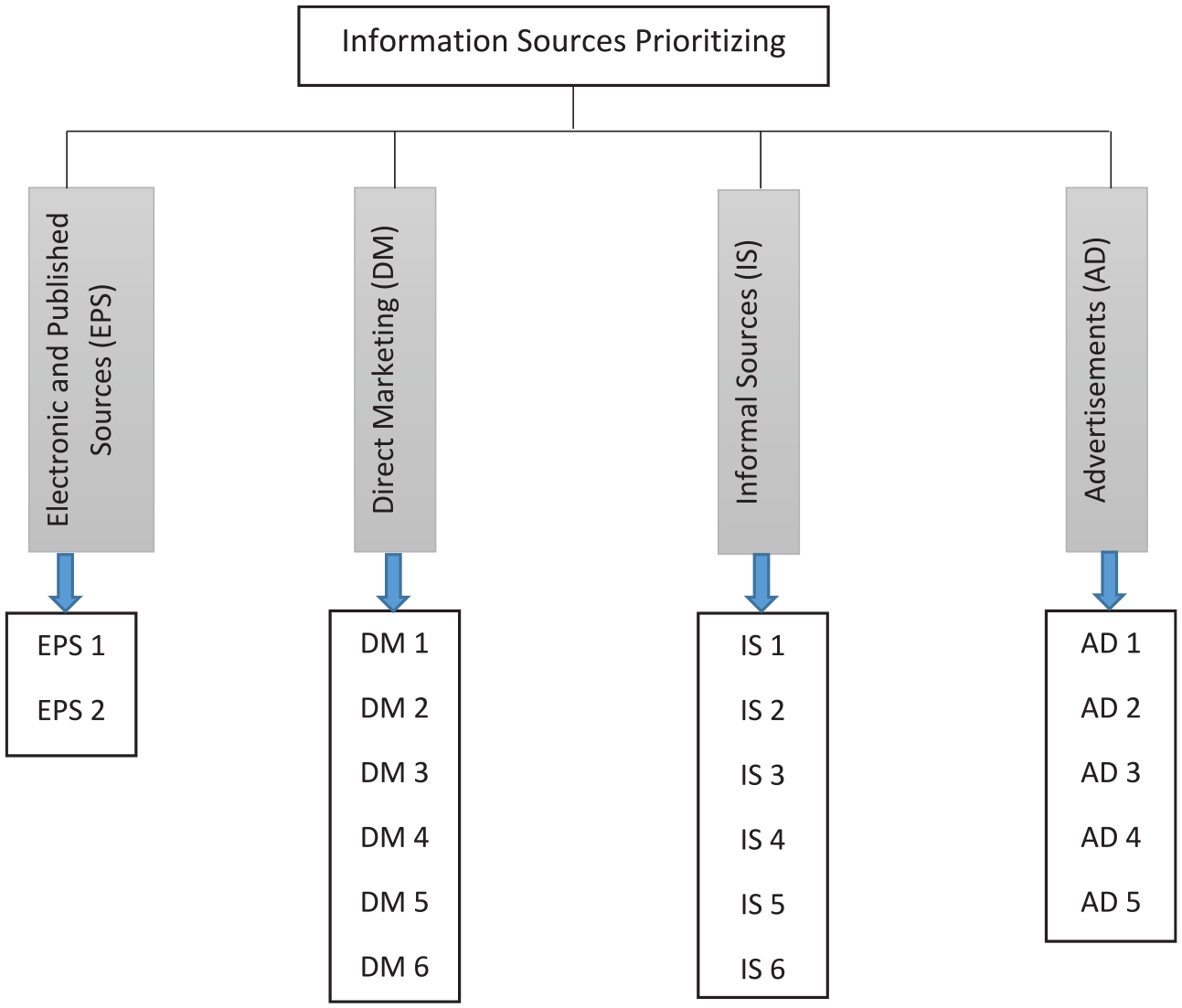
Analytic hierarchy process model for prioritizing students’ sources of information.
Based on the EFA, the IRs of students were classified under 13 major dimensions. These are API, Quality (QL), AAS Facilities, OF, LL, GRI, MTE, JSO, SL, GEO, ER, SAI, and IRI. These dimensions have been further divided into 51 subdimensions (Table 3). A simple three-level hierarchical structure is constructed (Figure 2).

Analytic hierarchy process model for prioritizing students’ information requirements.
AHP Results
Based on the computed weights of the four choice factors of the information sources AHP model (Figure 1), which are shown in the second column of Table 4, electronic and published sources (0.294) are considered as the most important source to obtain information about an institution followed by informal sources (0.242) and direct marketing sources (0.237), whereas advertisements are (0.226) considered as the least important source.
Element Weights to Determine Information Sources.

The fourth column of Table 4 shows the weight of each subfactor locally in its own cluster. To find out the importance of each subfactor among all items in the lowest level of information sources AHP model, the global weight of each subfactor is calculated by multiplication of its local weight into the weight of the relevant factor. Thus, the top three ranking information sources are identified as university web sites (.2058), which is under electronic and published sources, advertisements on social media (.0897), which is under advertisements, and information brochures/prospectuses (.0882), which is under electronic and published sources, whereas advice from private tutors (.0261), which is under informal sources, university presentations at tutor schools which is under direct marketing (.0201), and advertisements in the newspapers (.0072), which is under advertisements found as the least three important sources.
Based on the computed weights of the 13 choice factors of the information requirements AHP model (Figure 2), which are shown in the second column of Table 5, job and scholarship opportunities dimension (0.123) is considered as the most important issue influencing students’ choice of higher education followed by local life (0.109), entry requirements (0.104), accommodation (0.102), academic program issues (0.098), on-campus facilities (0.096), social life (0.075), institution recognition and interaction (0.065), medium of teaching and educational issues (0.062), quality (0.054), students’ and academics’ interaction (0.049), whereas 0.032) and graduates’ employment opportunities (0.032) are the least important issues for consideration.
Element Weights to Determine Information Requirements.

The fourth column of Table 5 also shows the weight of each subfactor locally in its own cluster. To find out the importance of each subfactor among all items in the lowest level of the information requirements of the AHP model, the global weight of each subfactor is calculated by multiplication of its local weight into the weight of the relevant factor. Thus, the highest three ranking factors are the availability of financial aid and the scholarships (0.0755), which is under job and scholarship dimension, entry requirements (0.0640) which is under entry requirements dimension, and the cost of living in the area (0.0557) which is under local life dimension, whereas alumni association (0.0055), years of service in higher education (0.0045), presence of international students at the university (0.0045), and the opinions of university alumni or current students (0.0037), which are under general reputation of the institution, are the lowest three ranking factors.
The key findings of the study are as follows: first, the results of this study indicated that electronic and published sources are the ones that students rely on the most to obtain information about an institution. This finding is in line with what Veloutsou et al. (2004) and Lehmann (2017) found in their study.
Second, as reported by other researchers (Cubillo et al., 2006; Mazzarol & Soutar, 2002), the findings of this study also revealed that not all the factors are equally important in influencing students’ choice of higher education.
Third, in this study, job and scholarship opportunities are considered as the most important factor influencing the choice of international students. The high importance put on this dimension is not surprising. As stated by Eder et al. (2010), spending a year outside the home country is much more expensive than spending a year at home. Higher education institutions in North Cyprus and the Turkish Republic of Northern Cyprus Ministry of Education award scholarships for international students studying in an undergraduate or graduate program. For instance, the Ministry of Education awards scholarships, including tuition, dormitory fees, plus allowance (pocket money). Financial aid or scholarships may overcome financial barriers by minimizing the impact of higher tuition fees. This may explain the rapid growth in the demand of international students choosing North Cyprus as an overseas study destination.
Fourth, entry requirements are also considered very important when deciding on a higher education institution. This finding is in line with Binsardi and Ekwulugo (2003), who found the ease of university entrance as a second reason for the selection of a destination country. Likewise, Maringe and Carter (2007) found an easy application process as a significant factor affecting their choices. Studies done by Pimpa (2005) and Bourke (2000) found entry requirements as one of the benchmarks for students to judge the quality of higher education institutions. Pimpa (2005) stated that decreasing entrance requirements might damage the reputation and weaken the quality of institutions in the eyes of students. Higher education institutions that want to recruit international students should emphasize the benefits to potential students, such as easy application process but also maintain and improve entry requirements.
Fifth, most of the students found local life as an important criterion that influenced their choice. This finding is in line with both Calitz et al. (2020) and Gong and Huybers (2015), who reported safety and security as the most important factor influencing international students’ decision when deciding where to study. North Cyprus is a safe and hospitable country to study where the petty crime rate is very low. North Cyprus might seem an appealing country to study, given that the island is a comfortable country in which international students can easily adjust their lifestyle.
Sixth, accommodation is another important influencing factor for the choice of higher education destination. This finding of the study supports those found in the literature. For example, Wilkins and Huisman (2011) found accommodation as one of the key factors influencing the choice of an institution. Similarly, studies done by Bodycott (2009) and Binsardi and Ekwulugo (2003) reported accommodation provided by the institutions as important. Soutar and Turner (2002) found attractiveness and campus atmosphere as one of determinants for selecting an institution.
Seventh, the academic program issues dimension is also considered very significant. This means that the curriculum of the programs and the variety of the courses offered by the institutions are other critical issues that should be considered by higher education institutions. As suggested by Joseph and Joseph (2000), institutions can strengthen their positions in the overseas markets by providing information about the variety of courses offered to potential overseas students through appropriate sources of information.
Finally, unlike prior studies, graduates’ employment opportunities are among the least important issue affecting the choice of students. This finding is in contrast with previous studies such as Bodycott (2009), Maringe and Carter (2007), Pimpa (2005), and Soutar and Turner (2002), in that employment opportunities after graduation identified as important.
Conclusion and Implications
The purpose of this study was to examine the information sources, information requirements, and choice factors of international students when making higher education destination decision. To specify the research steps, the initial questionnaire for information sources and information requirements are refined and grouped using Exploratory Factor Analysis. Then, according to the extant literature and previous significant studies, explored factors were labeled. However, due to the research purpose, which is prioritizing ISs and requirements criteria, the AHP was implemented. Based on the variables and the revealed factors from EFA, a hierarchical model was developed. At last, the AHP method has been applied to rank the choice criteria for information sources and information requirements.
Results reported in this article suggest electronic and published sources as the most important source to obtain information when making an enrolment decision. This finding is in line with Veloutsou et al. (2004), who reported that students mostly rely on information sources produced and distributed by the university. In regards to the information sources, websites ranked as the most important source used by students to obtain information about higher education institutions. This finding is in line with previous studies (Briggs & Wilson, 2007; Le et al., 2020; Lehmann, 2017; Yamamoto, 2006). The top five ranking choice factors (information requirements) are identified as job and scholarship opportunities, local life, entry requirements, accommodation, and API. Regarding the choice factors, JSO are identified as the most important factor influencing international students’ choice. Availability of financial aid and the scholarships, which is under the job and scholarship opportunities dimension, ranked as the most important choice factor. This finding is in line with findings of Le et al. (2020) study, who reported scholarship opportunities as the most commonly discussed choice factor in WOM information sources and also reported scholarships opportunities as a key factor considered when deciding whether to study domestically or abroad. Similarly, Drewes and Michael (2006) stated that students are attracted by scholarships, and Agrey and Lampadan (2014) reported scholarships provided by higher education institutions significantly impact students’ choice of a higher education institution. Contradicting to prior research, results of this study shows that general reputation of the institution (Ahmad & Hussain, 2017; Briggs, 2006; Briggs & Wilson, 2007; Mazzarol & Soutar, 2002; Simões & Soares, 2010; Sojkin et al., 2015; Veloutsou et al., 2004) and graduates’ employment opportunities (Bodycott, 2009; Le et al., 2020; Maringe & Carter, 2007; Pimpa, 2005; Soutar & Turner, 2002) were relatively unimportant.
This study complements the existing literature on the field of higher education by emphasizing the factors that affect the decision-making process of students in choosing higher education institution, particularly students’ choice factors and ISs. The higher education market in Eastern Mediterranean Region is growing, and this growth seems to continue. However, empirical studies investigating the experiences of overseas students in that region are limited. This study is the first study to investigate choice factors and ISs of overseas students studying in North Cyprus. This study used AHP analysis to investigate both choice factors and ISs. Previous studies on the decision-making process of students with AHP analysis have mainly focused on choice factors (Ahmad & Hussain, 2017; Lee, 2014). This study contributes to the body of knowledge by focusing on country-specific research of a group of overseas students studying in a small island state, North Cyprus. The experiences of students in this study may support other emerging higher education destinations, particularly in developing countries, to redesign their educational policies to attract more international students. This study can be deepened and supplement previous studies in this field of research, which will enable higher education institutions to effectively build and customize communication strategies for potential students.
The implications of the study findings are as follows: first, higher education institutions should know the information sources, information needs, and choice factors of international students to gain a better understanding of the decision-making process of students. Second, job and scholarship opportunities, local life, entry requirements academic program issues, accommodation, and dimensions should be the key elements when designing information strategies to inform potential students as these dimensions are considered most important. If institutions wish to recruit more and better students, they must attain good ratings on these dimensions. Third, when informing and recruiting students from international markets, the information should be made available on the website of universities, given that the websites of the universities are identified as the most used source to gather information. Accordingly, well-designed, user-friendly, and attractive webpages play a vital role. In addition, the information provided by the institutions should be clear, accurate, and informative. Fourth, increasing tuition fees and cost of living are great concern and challenge for most students when choosing an institution. This may explain why financial aid and scholarships were considered as the first and most important concern of international students. Accordingly, higher education institutions and policy-makers should provide detailed information on scholarships or any form of aids to address prospective students’ main concern. Fifth, given that the local life is considered as another important concern of international students, higher education institutions in North Cyprus should design promotional materials that emphasize attributes of North Cyprus such as its safe, secure, and friendly environment, comfortable climate, perceived cultural compatibility, and capability to meet diverse needs of students from different cultures. Institutions should aim toward strengthening their position in the international markets by providing information about local life in North Cyprus. Finally, student recruitment strategies should be customized according to the key concerns of international students and then implemented to address the main concerns. For example, as the findings of this study have identified job and scholarship opportunities, local life, entry requirement, accommodation, and academic program issues as the main concerns of the international students, these factors should be addressed by extensive promotional activities.
Limitations and Opportunities for Future Studies
Although the research has reached its aims, there were some unavoidable limitations. This research study was conducted in a state university in North Cyprus. In North Cyprus, there are 20 universities in total, containing around 100,913 students of more than 70 nationalities. As a result, it is not possible to generalize the results to fit all. Extension of this study should include students from other institutions that host a significant number of international students to verify that this study’s results are consistent. Second, this study has examined first-year undergraduate and postgraduate students’ responses to prioritize choice factors of ISs and requirements. However, choice factors of postgraduate students may differ, which could be the main emphasis of future research. Third, this study has examined and highlighted several influencing factors. However, there might be other factors that are under-researched or not found as significant that are influencing international students’ decision to study abroad, such as the influence of parents, visa, and immigration policies. As stated by Alebeek and Wilson (2019), Pimpa (2003), and Mazzarol and Soutar (2002), parents mainly influence students’ decision to study abroad. For the future studies, it is suggested that research on such topics will profoundly contribute to the existing literature and knowledge on the factors that influence the international students’ decision-making process. Fourth, this study could be extended in the future by prioritizing the choices of international students using the criteria of nationality and gender. Finally, methodologically, the study used classical AHP. Although this approach includes respondents’ thoughts and makes a multiple criteria assessment, it is not capable of reflecting human’s vague judgments. So, employing the fuzzy multicriteria decision-making techniques like fuzzy AHP or fuzzy TOPSIS makes the comparison process more flexible to explicate experts’ preferences and consequently, findings will be more reliable.
