




Abstract
Despite the considerable amount of research regarding trust as one of the most important characters and competitive advantages for an industrial cluster, few empirical studies have examined whether geographic proximity still leads to higher levels of trust in the current Internet era. This article explores this issue of trust from a network embeddedness perspective. Based on the data from Zhongshan gas appliance cluster, we employ structural equation modeling to examine the extent to which relational embeddedness, structural embeddedness, and positional embeddedness have any impact on trust-building in the cluster. Our findings reveal that high clique trust and low aggregate trust coexist in the cluster, showing that the effect of geographical proximity on trust has been weakened and is no longer a sufficient condition for trust-building. This study also gives some suggestions on how to improve the trust within a cluster through network governance.
Introduction
Industrial clusters have attracted worldwide attention because of their great contributions to regional economic development (Mudambi, Mudambi, Mukherjee, & Scalera, 2017; Porter, 1998), in which trust is considered as an important mechanism for overcoming various uncertainties and complex conflicts, and yielding benefits to all agents (Alvarez, Barney, & Bosse, 2003). Research indicates that trust within a cluster plays pivotal roles in driving continuous innovation; establishing and maintaining close, cooperative as well as fruitful relationships; and sharing implicit knowledge (Alvarez et al., 2003). As we know, the physical closeness of organizations in an industrial cluster makes it easy to establish various networks, and the behavior of each firm within networks is influenced by other agents in a cluster (He & Rayman-Bacchus, 2010).
However, the rapid development of internet technology has brought dramatic changes in persons’ daily lives and business models. Internet technology provides companies with new avenues to effectively support their business processes and helps to improve performance, in particular, the ways of communication, marketing as well as customer relationship management (Silva & Goncalves, 2016). Online many-to-many communication channels (e.g., virtual communities) greatly increase the connections among firms, consumers, and other participants. Based on advanced information technology, ranges of interconnected enterprises, suppliers, distributors, and related organizations consist of new forms of virtual clusters and platforms for achieving mutual and compatible goals (Le, Tuan, & Tuan, 2019; Salvador, Mariotti, & Conicella, 2013; Zhou, Leenders, & Cong, 2018). A number of businesses even within industrial clusters are conducted relying on network platforms rather than traditional physical channels such as face-to-face contact (Chandna & Salimath, 2018; Paurav & Judy, 2018). However, the frequent occurrences of fraud actions within virtual networks have made multiple actors lose a significant portion of their revenues (welfares) (Soomro, Ahmed, Shah, & Khoumbati, 2019). Thus, many actors in industrial clusters attempt to investigate effective measures to refrain from cheating (Carneiro, Figueira, & Costa, 2017). More open and efficient information exchange via the internet has also been regarded as a pre-requisite for establishing trust that acts as a crucial component in many e-commerce businesses (D. J. Kim, Ferrin, & Rao, 2009). Under the conditions of high level of flexibility and uncertainties in the Internet era, trust is still highlighted for its role in mitigating complexity (Moriuchi & Takahashi, 2018). An increasing number of dishonest behaviors in virtual environment make us pay more attention to trust-building within industrial clusters.
In spite of plenty of investigations concerning the importance of trust within industrial clusters, few studies have explored how the internet influences trust-building in an industrial cluster, that is, whether geographic proximity within a cluster is still critical for trust-building in the context of ubiquitous internet. In addition, although previous studies have seen trust as one of key elements for effective network governance (Khan, 2013), we find that few studies cope with how to improve the trust within a cluster through network governance, as the basis for implicit and open-ended contracts among related firms (Tobias & Micha, 2019). Thus in this article, we investigate whether and how internet technology affects traditional trust-building in a cluster, and also offer some implications for its network governance.
Drawing on a network embeddedness perspective (i.e., relational, structural, and positional embeddedness), this study explores the factors influencing trust-building within a cluster. Analyzing the data collected from the Zhongshan gas appliance cluster, our findings reveal the coexistence of high clique trust and low general trust within a cluster, implying that the effect of geographical proximity on trust has been weakened significantly and is no longer the sufficient condition for trust-building in the context of the internet economy. Meanwhile, we offer fresh insight into the combination of physical clusters (geography) and virtual clusters (Internet), and this insight changes the previous understanding of the role of geographical proximity in the industrial cluster context.
The rest of this research is organized as follows: The section “Theoretical Background and Hypotheses” reviews relevant literature and hypothesizes how network embeddedness affects trust-building in a cluster. The research methodology is presented in the “Method” section and the “Results” section reports on the results. The “Discussion” section is devoted to revealing the coexistence of high clique trust and low aggregate trust in the cluster and discusses the network governance implications. The “Conclusion” section presents conclusions and some suggestions for future research.
Theoretical Background and Hypotheses
Trust-Building Within Industrial Clusters
Trust has been conceptualized from different perspectives (Kharouf, Lund, & Sekhon, 2014; Pavlou & Fygenson, 2006; Yu & Pysarchik, 2018). Basically, trust is considered as a kind of expectation, assumption, and belief, thinking that another’s behavior is favorable, beneficial, and not detrimental (Kramer, 1999; McKnight, Cummings, & Chervany, 1998). Considering the high level of asymmetric information on the internet, trust plays an important role in lowering transaction costs and controlling opportunism (Moriuchi & Takahashi, 2018). Numerous investigations have shed light on the importance of trust within industrial clusters and there are some aspects worthy of emphasis (Alvarez et al., 2003; Banks, Lovatt, O’Connor, & Raffo, 2000). Previous study indicates that trust within industrial clusters contributes to driving continuous innovation, R&D, sharing implicit knowledge, and reducing the cost of adapting to the external environment (Davis, Schoorman, Mayer, & Tan, 2000). Acting as an important source of social capital derived from networks, trust can help clustered organizations secure resource complementarity (Putnam, 1993).
As trust tends to be combined with uncertainties and risk-sharing, its developing process is influenced by various factors such as mutual values, kindness, abilities, openness, interactive experiences, communications, familiarity, and personalities (Alarcon et al., 2018; Jones & Shah, 2016; Schoorman, Mayer, & Davis, 2007). In particular, Pavlou (2002) highlights organizational members’ collective assess based on their confident expectations in the process of inter-organizational trust-building. The predictability of one side’s expectation on an organization and its confidence of the organization’s goodwill can promote inter-organizational trust (Doney & Cannon, 1997). When pursuing the fulfillment of mutual expectations among partner companies, inter-organizational trust presents a collective orientation between organizations, which strengthens firms gradually and builds successful inter-firm relationships (McEvily, 2011).
Although the above ideas indicate the building process of trust, little research has drawn on network embeddedness to develop better understanding of the trust-building within industrial clusters in the Internet era. In addition, D. Y. Kim (2014) has further emphasized the value of a closer examination of trust-building within a cluster.
Network Embeddedness
From a network perspective, the impact of network embeddedness on economic and managerial activities has attracted scholars’ interests since Granovetter (1985) conceptualized network embeddedness, suggesting that all individual’s economic behavior is embedded in social networks. As Powell (1990) affirms, network embeddedness encourages two sides of a transaction to engage in self-monitoring and refrains from cheating to enhance mutual benefits. The social control generated by network embeddedness supports formal governance mechanisms and plays a complementary role in governance (H. M. Lin, Huang, Lin, & Hsu, 2012).
According to Dyer and Singh (1998), enterprises acquiring competitive advantage by means of network embeddedness exhibit the following characteristics: (a) Enterprises are able to generate relational assets for themselves and other organizations through network embeddedness; (b) network embeddedness effectively promotes learning and knowledge sharing; (c) complementary ability can be achieved via network embeddedness; and (d) transaction costs can be reduced through network embeddedness. As enterprises gain capital, information, technologies, and other strategic resources through different types of networks, we may better understand their behavior through employing a network embeddedness perspective. In line with Gulati (1998) and Gulati and Gargiulo (1999), in this study, network embeddedness is classified into three types, namely, relational, structural, and positional (embeddedness). In the following section, we will discuss relevant theory and hypothesize the relationships of trust-building within a cluster and network embeddedness, respectively, from relational, structural, and positional embeddedness.
Relational Embeddedness and Trust-Building
Some researchers deem relational embeddedness as a kind of asset including trust and obligation, which stems from social relationships (Granovetter, 1992; Tsai & Ghoshal, 1998). Others place emphases on the strength or quality of cohesive social interactions (Dhanaraj, Lyles, Steensma, & Tlhanyi, 2004; Ebers & Maurer, 2014; Gulati, Nohria, & Zaheer, 2000; J. L. Lin, Fang, & Tsai, 2009). In this article, we focus on the interpersonal relationship feature of relational embeddedness in social network structures.
Interpersonal relationships can enhance the understanding of each other’s capabilities, building a foundation for common norms, goals as well as mutual trust based on common experience and a history of interaction (Ruiz-Ortega, Garcia-Villaverde, & Parra-Requena, 2018). As Bai and Johanson (2018) declare, the relationships among business partners can enable mutual trust, and build a platform for coping with joint problems and information sharing. More generally, as an integral outcome of relational embeddedness, long-term business partnerships can develop trust (Stanko et al., 2007). Investigation of emerging small and medium-sized enterprises highlights relational embeddedness’s role in facilitating trust at inter-organizational level, supporting the positive effects on trust (Shahmehr, Khaksar, Zaefarian, & Talebi, 2015). Xu, Liu, Zhou, and Su (2012) provide evidence on the positive relationship between trust and some interpersonal relationships like marital, relative, and business relationship. For instance, the gradual evolution of trust can be ensured by partner selections through previous successful interpersonal interactions (Gomaa, 2019). That is, previous business collaborators can promote trust formation and create opportunities for problem solving (Anna, 2019; Nilsson & Mattes, 2015). Superior former performances also bring advantages and experiences in forming network ties and laying foundations for future trust-building (Martin, 2019). In this way, enterprises can maintain good relations with their collaborators, showing successful social interactions (Bai & Johanson, 2018). Therefore, we posit that
Structural Embeddedness and Trust-Building
Structural embeddedness lays stress on an enterprise’s position in its ego-network which is considered as a portion of a social network formed of the one (called ego) and others with whom the ego has a social relationship (called alters) (Arnaboldi, Conti, Gala, Passarella, & Pezzoni, 2016), and their linkages (Gulati & Westphal, 1999). This type of network embeddedness, which influences economic exchange through the configuration of linkages among actors and the architecture of networks, emphasizes network ties, network densities, and the scale of enterprise networks (Polidoro, Ahuja, & Mitchell, 2011; Ruiz-Ortega et al., 2018; Tang, Rai, & Wareham, 2011).
Serving as a channel to gain strategic resources from a network, structural embeddedness refers that enterprises occupying different positions in a network possess different information advantages. Information asymmetry obstructs the communication among enterprises, whereas good information communication can enhance an enterprise’s reputation, which is conducive to further cooperation. Therefore, effective communication is deemed as an essential condition for building trust and securing strong ties (Morgan & Hunt, 1994). Through communication and cooperation, enterprises have access to social capital including trust, reliability and information, which may facilitate governance and achieve better results among network partners (Poppo & Zenger, 2002).
Frequent transactions and repeated interactions also provide firms with opportunities to share information and learn more about each other, eventually strengthening collaborative relationships (Nair, Blome, Choi, & Lee, 2018; Ruiz-Ortega et al., 2018). It has been demonstrated that information sharing involves partners’ exchanges (Chang, 2011), cooperation and mutual values (Morgan & Hunt, 1994), and the scale of organizations’ (Doney & Cannon, 1997) as well as customers’ intentions. All these exert influence on trust relations between contracting parties. Such relationships generated by frequent transactions and repeated interactions tend to be predictable and promote the understanding of each other’s capabilities, implying the development of mutual trust and goodwill between customers and suppliers (Allameh, 2018; Stam, Arzlanian, & Elfring, 2014). In addition, some studies under the context of Chinese manufacturing industry show that structural embeddedness produces additional information, control, reputational benefits, and strong tie relationships (Brashears & Eric, 2018; Lyu, Liu, He, & Nie, 2017). Wu, Wu, and Si (2016) also point out that frequent social interactions create a favorable atmosphere that may reduce hazards and cultivate trust relationships. Based on the above theoretical results, we hypothesize that
Positional Embeddedness and Trust-Building
Positional embeddedness is concerned with an enterprise’ concentration and independence as well as influence and control within the entire cluster network (Gulati, 1998; Polidoro et al., 2011). The centrality of an organization, as an important feature of positional embeddedness, refers to how important a firm is in a network (Hsueh, Lin, & Li, 2010). Actors occupying central positions in a network possess informational and reputational benefits (Barnes, Kallberg, Pan, & Leung, 2016; Stefano & Montes-Sancho, 2018). These central positions that are highly visible usually send a signal to network participants about the quality as potential business partners (Whitmeyer & Wittek, 2010). From this point of view, positional embeddedness is a useful mechanism for mitigating business hazards and building trust relationships, particularly under the condition of uncertainties (Bothner, Kim, & Lee, 2015). The problems of trust, influence, and reputation vary with the centrality of organizations within networks (Provan, Huang, & Milward, 2009).
In the development process of an industrial cluster, there are some institutions that reflect regional features, such as regulations and common practices. These formal and informal institutions serve as guidelines for cooperative activities among network partners, providing sanctions and punishing behavior. Actors therefore consider the costs and benefits that failures or wrongdoings may bring about, including the potential loss of reputations and business partners (D. Y. Kim, 2014), and even exit from a network (Y. Q. Li, Wang, Huang, & Bai, 2013). That is, to some extent, enterprise’ strategies are influenced by regulations and sanctions, which in dense networks mean that firms are inclined to refrain from opportunism such as trustworthy (Meuleman & Wright, 2011). Hardin (1996), for example, points out that the network system has the capacity of strengthening reliability among enterprises and fostering trust relations. In consideration of these observations, we propose the following hypothesis:
Method
Research Setting
In this study, Zhongshan gas appliance cluster was chosen for several reasons. First, located in the Pearl River Delta economic zone, it is the first (since the end of 1980s), as well as the largest and one of the most competitive gas appliance industrial clusters in China. They account for more than 50% of China’s gas water heater firms, and a quarter of the country’s gas stove companies at different stages of development. Second, it has experienced more than 30 years’ development and has formed complex networks with many inter-firm ties. Third, numerous well-known gas appliance enterprises and some research institutions are located there, such as Huadi, Changqing, and Ouyi, whose presence is bound to influence cluster behavior, through, for example, encouraging inter-firm cooperation and sharing knowledge. Fourth, currently, the local government is seeking to take measures for improving the honesty atmosphere. It is facing much stricter regulation on gas appliances, and big challenges from the on-going changes. In summary, Zhongshan gas appliance cluster exhibits many of the characteristics including elements of network embeddedness (relational, structural, and positional), which, as has been proposed, is linked to trust-building.
Data Collection
A survey was carried out comprising both questionnaire and interviews. The initial questionnaire was tested by five companies. We first invited the CEOs or senior managers to answer the questionnaire and then interviewed them to examine the accuracy of each item as well as the accuracy of each variable being measured. Based on their feedback, the questionnaire was improved. The large-scale data collection was conducted in July 2017. A total of 281 questionnaires (one questionnaire for one company) were distributed by five investigators and we received a total of 214 valid questionnaires with nearly 76% response rate (accounting for about 40% of the total enterprises within the cluster). In this survey, local government played an important role, providing the telephone number of each firm as well as a sealed letter to show that the survey carried government support and hoped the firm would answer the questionnaire honestly. During this period, we also interviewed 10 CEOs or senior managers of gas appliance firms, the Secretary of the local industry association (Zhongshan gas water heater association), and two relevant government officers.
Measurement
Indicators of trust and network embeddedness were selected based on the previous literature. All these indicators were rated on a 7-point Likert-type scale varying from 1 (totally disagree) to 7 (totally agree).
Dependent variables
In this study, based on Sreckovic and Windsperger’s (2013) seven indictors, we selected four indicators of inter-organizational trust in a cluster, including (a) good relationships between enterprises in the cluster, (b) the atmosphere of openness and honesty between enterprise in the cluster, (c) enterprise’s willingness to achieve better cooperative relationships through negotiations, and (d) useful suggestions from other firms in the cluster.
Independent variables
The independent variables involve relational, structural, and positional embeddedness. In this study, relational embeddedness indictors include alumni and fellow-townsman, kinship, and other social personal relations (Andersson, Forsgren, & Holm, 2002; Gulati et al., 2000). Structural embeddedness was measured by linkages with up-and-down stream enterprises, informal groups, geographically near firms, and intermediary organizations in the cluster (Gulati, 1998; Gulati & Gargiulo, 1999). As for positional embeddedness, four indicators were used: (a) activities organized by trade associations in the cluster, (b) existence of relationships with all enterprises in the clusters, (c) the credit system hosted by the government, and (d) reports of firms from the Internet or media (Gulati, 1998; Gulati & Gargiulo, 1999).
Control variables
Firm’s age and size are control variables in this study. As Goldberg, Kieninger, Satzger and Fromm (2017) point out, an enterprise’s capability in terms of its scale and technology in particular fields has an impact on trust. Therefore, an enterprise’s age and size exert considerable influence on the trust relations with its partners (Nadler & Tushman, 1988).
Validity and Reliability
Before examining the hypotheses, validity and reliability should be tested to confirm the questionnaire’s effectiveness and accuracy. As shown in Table 1, the validity and reliability of the questionnaire are good (Hair, Black, Babin, & Anderson, 2010; H. Z. Li, 2004).
Validity and Reliability Test.

Note. KMO = Kaiser–Meyer–Olkin.
p < .01. ***p < .001.
Results
Structural equation modeling was used to test the hypotheses in this study. Compared with multiple methods for exploring casual relationships like conventional regression analysis and so on, structural equation modeling is the preferred method for this research because the variables proposed for testing in the theoretical model are latent variables that cannot be measured directly (Byrne, 2001; Ju & Sohn, 2014). As Heiko (2019) suggests, the structural equation modeling analysis contains two steps. The first step is to assess the fit of hypothesized measurement model through confirmatory factor analysis and then test the specified model with hypothesized relationships. Software AMOS 20.0 was adopted to conduct structural equation modeling analysis.
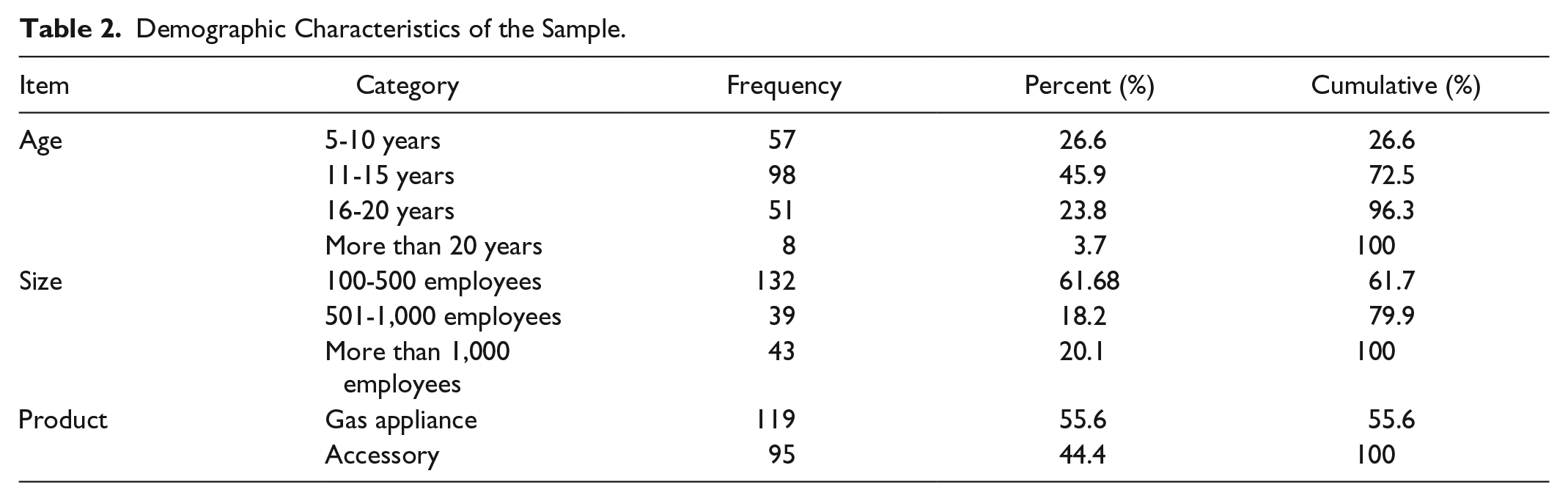
The profile of the sample is shown in Table 2. Almost half of the enterprises are between 11 and 15 years old and only 3.7% of the enterprises are older than 20 years; 20.1% of the sampled enterprises have more than 1,000 employees, and 61.7% of enterprises has employees between 100 and 500. Enterprises offering gas appliances and accessories account for 55.6% and 44.4%, respectively. From Table 3, we find that the latent variables can effectively explain the observed variables and the indices indicate a good fit between the structural model and the collected data (Hu & Bentler, 1999).
Demographic Characteristics of the Sample.
Model’s Fit Indicators.
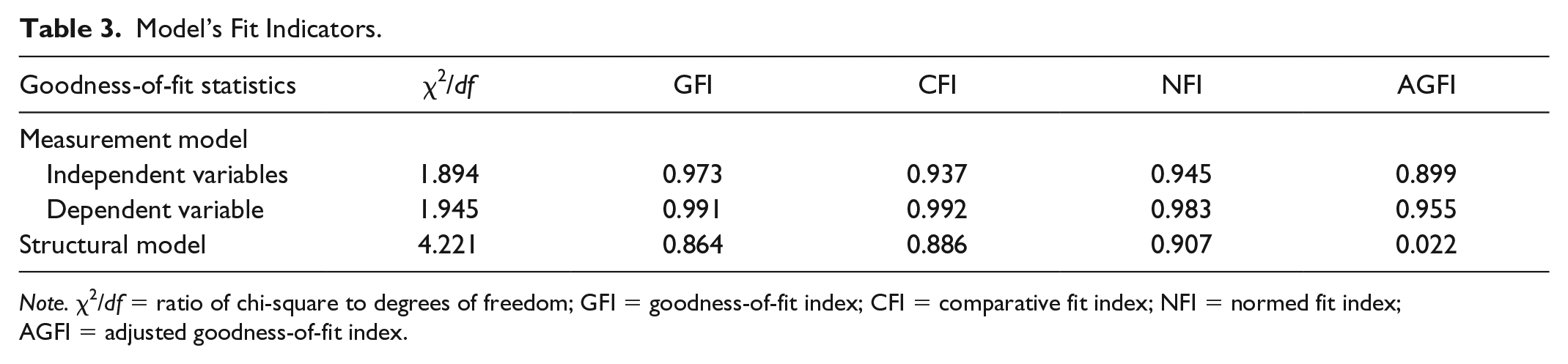
Note. χ2/df = ratio of chi-square to degrees of freedom; GFI = goodness-of-fit index; CFI = comparative fit index; NFI = normed fit index; AGFI = adjusted goodness-of-fit index.
The parameter estimates of the structural model are illustrated in Figure 1. The casual path results are reported in Table 4. The result shows that the effect of relational embeddedness on trust-building in the cluster is positive and significant (coefficient = 0.858, SE = 0.201, composite reliability (CR) = 2.693, p < .001), supporting H1. Structural embeddedness (coefficient = 0.816, SE = 0.173, CR = 2.339, p < .001) has significant impact on trust-building within the cluster, supporting H2. Positional embeddedness has no significant impact on trust-building within the cluster as t value = 0.671 (<1.96) and p > .001, and thus, H3 is not supported.

Parameter estimates of structural model.
Hypothesis Test Results.

p < .001.
Discussion
The Coexistence of High Local Trust and Low Aggregate Trust in an Industrial Cluster
From a social network perspective, the significant impact of relational and structural embeddedness can be viewed as strong ties as these relationships are always repeated or remain unchanged, and resembles local trust involving trust relations based on interpersonal relationships and ego-networks of firms in cliques. Interpersonal relationships play an important role in building trust, especially in Chinese context where guanxi (the role of favors and reciprocal obligations) underpins the social closeness among network members (Burt, Bian, & Opper, 2018; Guo, Rammal, Benson, Zhu, & Dowling, 2018). The relationship between relational embeddedness and trust-building in this research is consistent with some previous studies by Pan and Li (2008) and Xu et al. (2012). The positive relationship between structural embeddedness and trust confirms the works of Anderson, Narus, and Woute (2006) and Morgan and Hunt (1994).
In contrast with relational and structural embeddedness, positional embeddedness highlights a firm’s status and positions in the whole cluster network. Our results show that positional embeddedness has no significant impact on trust within the cluster. Moreover, although interviews also reveal that internet technology has dramatically changed the way of communication, geographic proximity among neighboring companies is still the most important channel for trust-building, implying a comparatively low aggregate trust within the cluster. As defined by Mesquita (2007), aggregate trust refers to “the net balance of trust and distrust across the several domains of a relationship” (p. 75) and the low aggregate trust in inter-firm relationships signifies a larger proportion of distrust vis-à-vis trust across the whole cluster.
Due to the emergence of internet technology, electronic communication has been playing an important role in information exchanges and has a profound effect on transaction costs, which carries clear cost advantages. Companies are therefore changing their traditional ways of conducting businesses and may have multiple relationships with others beyond physical clusters (Eng, 2004). This combination of physical clusters (geography) and virtual clusters (Internet) has become a tendency. For any individual firm, it is easy to build trust within its small group, but the lack of connections with other organizations within the cluster brings about low aggregate trust across the cluster. Currently, the coexistence of high local trust and low aggregate trust within the cluster is evident and the effect of geographical proximity on trust-building has been weakened, without following the previous conclusions provided by some scholars (Herrmann, Taks, & Moors, 2012).
Although internet technology has tremendously changed the ways of communication and business models, our interviews also reveal some problems. For instance, wrongdoings among business partners appear when inter-organizational trust is built via the internet. As a matter of fact, the information asymmetry and distortion accompanying communication through the internet make it difficult for enterprises to gain credible information only by relying on virtual networks. Therefore, we consider that the trust relations among enterprises cannot be fostered completely by only depending on the internet.
Implications to Network Governance
The virtual network may play a complementary role in trust-building, remaining a necessity to improve trust within industrial clusters to reduce transaction costs. According to the current situation of trust-building in the cluster, network governance is suggested as it tries to deal with challenges using social mechanisms instead of authorities and legal suits, which may conduct cooperation activities more effectively in the light of fragmentations and changes in the dynamic complexity of business environment (Saikku & Karjalainen, 2012).
For network governance, third-party organizations named network managers or organizations are critical to network building and consolidation, and should have no direct interests with the actors in a cluster, and thus enable the formation of pluralistic governance processes where all actors within a particular network are involved and prevent the concentration of social power in one specific entity (Provan & Kenis, 2007). Serving as facilitators for cultivating aggregate trust in a cluster, third-party organizations can be responsible for formulating rules, coordinating, and supervising all network actors.
Indeed, industrial associations, as non-government organizations (NGOs), may provide effective communication channels for enterprises and government to resolve conflicts, balance competing interests, and develop the atmosphere of openness and honesty (He & Rayman-Bacchus, 2010). They can facilitate enhancement of aggregate trust through collecting and sharing industry-related information, external and internal information, and integrating diversified resources for the benefit of the whole cluster. Meanwhile, our interviews find that as the cluster members are not spread out geographically, trade associations are expected to hold face-to-face activities frequently for cluster members to communicate such as exhibitions, symposiums, and consultation services.
While this governance mechanism is associated with a series of benefits, it also throws up a number of challenges. In particular, individual members may deviate from the collective interest of a network and pursue self-interest. This slows down the pace at which network goals are achieved and may further create distraction and friction within a network as self-interest conflicts with collective interest. Therefore, appropriate measures are needed to enable a network to achieve its full potential.
To support industry associations, local government should be involved in the construction of credit system in a cluster to promote an atmosphere of honesty and discourage dishonesty thoughts through trust rating, standardization of enterprises’ operations, and punishments. In addition, associations can publish firm-level credit ratings at fixed periods, encouraging self-discipline among enterprises and enhancing the impact of word-of-mouth effect on corporate image. Traditional media as well as spillover effects of a network are conducive to supervising enterprises’ activities and building relevant sanctions that play a key role in guiding honest behavior (Burt, 2000). Thus, the network approach seems to make the interaction between government and societies more effective.
Conclusion
This study is designed to explore whether geographic proximity still leads to high level of trust-building within an industrial cluster, especially in the Internet era. Three research constructs from a network embeddedness perspective (relational, structural, and positional) are used to explain to what extent inter-organization trust within a cluster is affected. The main contribution of this study elaborates the current situation of trust within the cluster in which high local trust and low aggregate trust coexist, and geographic proximity is less important for trust-building. The link between trust within clusters and network governance open up new avenues for fostering the trust especially in the Internet era.
In this study, the empirical results confirm that industrial clusters still matter to trust-building in the Internet era. Considering the current scenario of flexibility and uncertainties, we suggest that it is preferable to combine the virtual network with geographical proximity to establish trust relationships. Indeed, geographical agglomeration is obvious in China. In addition to manufacturing clusters, other industrial clusters like entrepreneurial clusters are also characterized by geographical proximity. Despite the fact that many businesses in service industry can be conducted online, numerous entrepreneurs and start-ups choose to settle in co-working spaces that are located in two or three floors and show as mini-clusters. The open-area physical design of shared workspaces attracts co-workers for the convenient face-to-face interactions (Parrino, 2015; Spinuzzi, Bodrožić, Scaratti, & Ivaldi, 2019). Entrepreneurs within a co-working space have more chances to observe the situations of other companies and assess better knowledge of each other, shortening mutual psychological distance of trust-building and business partner selections (Wang & Loo, 2017; Weijs-Perrée, Koevering, Appel-Meulenbroek, & Arentze, 2019). The phenomenon of geographical proximity in co-working spaces also affirms the results of this article that (a) interpersonal relationships are positively related to inter-organizational trust-building in an industrial cluster; (b) geographical proximity within a certain rage that actors can observe eath other is positively related to trust-building within an cluster.
There are several limitations, which may offer opportunities for future research. First, the factors of trust are complex constructs as trust can be classified into various categories in different disciplines. Further investigation is needed on understanding this complexity in different contexts. Second, the findings may be inapplicable to other regions. Studies of other industrial clusters should be carried out, contributing to improving the generalizability of the empirical results. Third, the combination of physical clusters (geography) and virtual clusters (Internet) has become a new business model, and future research should consider trust-building under this condition. In addition, as the participants are on an ongoing basis, shared governance is rather flexible and this form of governance may evolve over time (Provan & Keni, 2007). The evolution of network governance of the trust within clusters is worthy of great attention.
Footnotes
Declaration of Conflicting Interests
The author(s) declared no potential conflicts of interest with respect to the research, authorship, and/or publication of this article.
Funding
The author(s) disclosed receipt of the following financial support for the research, authorship, and/or publication of this article: This work was supported by the Social Science Planning Fund of Ministry of Education of China (Grant No. 18YJA630035).
