




Abstract
Trust is essential to understanding public reaction to innovative issues. This research focuses on trust in information sources by explicating the construct of trust and testing a comprehensive model on several information sources about genetically modified foods. Results from a survey of 369 participants reveal the significance of projecting competence and the role of the environment in which a target public receives information. Perceptions of regulatory, social, business, and technical environments affect how likely individuals are to follow advice from institutions like the Food and Drug Administration and the news media. Future research should incorporate knowledge levels and personal relevance as variables likely to influence trusting relationships.
Introduction
Trust has long been recognized as an essential element to exploring public reaction to complicated issues (Slovic, 1993), one that renders the uncertain future manageable (Luhmann, 1979). Some argue public reaction to communication efforts is shaped less by explanations of uncertainty than by trust in the parties involved (Johnson & Slovic, 1995). This essential role of trust—defined as a willingness to depend—meshes with findings that the public’s understanding of complex issues does not always result from data-driven understandings of experts in government, media, or industry (Allum, Sturgis, Tabourazi, & Brunton-Smith, 2008; Slovic, 1993).
Instead, lay citizens seek information from a range of sources, a complicated task in the age of mass and new media because the public often does not know whom to trust for reliable and valid information (Trettin & Musham, 2000), although public institutions are viewed as maintaining a key role in the general acceptance of complicated issues (Poortinga & Pidgeon, 2005). A thorough understanding of trust, then, becomes increasingly important as the public’s willingness to depend on information evolves with the increasing number of sources, amount of content, and options for interactivity that result from digital communication technology and the influence of professional communicators.
Genetically modified (GM) foods provide a unique context for an examination of trust in information sources as GM products remain a complicated issue with implications for consumers. While debated by scientists and environmentalists, the issue of GM foods has not engaged a majority of Americans in a polarized way (Priest, 2000; Shanahan, Scheufele, & Lee, 2001). Knowledge of GM foods, including potential risks, has remained low despite their introduction to the U.S. food market well before the millennium (Nucci & Kubey, 2007; The Mellman Group/Public Opinion Strategies, 2003). Low knowledge levels allow opportunity to examine a controversial topic without automatically sparking polarized attitudes.
The purpose of this research is to develop a nuanced understanding of the trust essential for communication professionals to discuss potentially difficult issues by explicating and testing an interdisciplinary model of trust on two information sources in the context of GM foods. This research aims to expand previous work that treats trust as a single component of a larger model or limits its conceptualization to discipline-based definitions. This study will test a multidimensional model of trust by translating the reach of work originally conducted in the organizational communication context (McKnight, Cummings, & Chervany, 1998). The trust model integrates relationships among the varying definitions of trust that exist across a broad range of social science disciplines and develops a typology for use by public relations professionals to select outreach methods, message designs, and relationship-development strategies. This article will first provide an overview of relevant trust and GM foods literature and then explicate the different types of trust conceptualized in the proposed model.
Trust in Mass Communication
The very importance of trust as a construct is one of the challenges of studying it as a variable (P. Kim, Dirks, & Cooper, 2009; Schoorman, Mayer, & Davis, 2007). While social scientists agree trust is central to a range of research outcomes, there are multiple approaches to its meaning and measurement (Earle, Siegrist, & Gutscher, 2010), with up to 36 unique definitions employed in the last 20 years (Castaldo, Premazzi, & Zerbini, 2010). Definitions include both discipline-specific views (Mayer, Davis, & Schoorman, 1995) as well as those focused on processing mechanisms, such as cognitive or affective evaluations (Schoorman et al., 2007). Trust is valuable across fields because it helps reduce the complexity and transaction costs of exchanges by bridging communication gaps. Trusting relationships allow stakeholders to better access and judge information needed to make decisions. Such relationships also let stakeholders evaluate situations based partly on others’ reactions as a strategy to manage potential responses (Ho et al., 2011). Ultimately, these predictable relationships with valued sources help make the future manageable by eliminating the possibility (or increasing the probability) of future events (Luhmann, 1979; Siegrist, 2000).
A lack of trusting relationships adds significant complexity to any communication transaction because it acts as a barrier between parties—scientists and the public, for example. Reduced willingness to depend on supplied information creates a gulf between professional assessment and public comprehension (Slovic, 1997). Such a gulf can hinder the accurate evaluation of a situation (Slovic, 1993), particularly when contemporary communication plans involve promoting interest in issues, improving public knowledge, and creating shared decision-making (Trettin & Musham, 2000).
Communication around complicated topics must be about developing a relationship (Fisher & Stanley, 2010; Renz, 1992) through an information exchange with the public that shows respect for others’ beliefs and opinions (Chess, Salomone, & Hance, 1995; Uslaner, 2002). Part of developing these relationships, of course, is fostering an environment of trust between parties that allows for reduced complexity in transactions (Luhmann, 1979) and eventually interactive behavior that achieves goals (Walker, Arnold, Miller-Day, & Webb, 2002).
Developing trusting relationships is no small task, however. Several important considerations stand out when working to create trust in a communication environment surrounding a controversial issue (Trettin & Musham, 2000). Among these considerations are reminders that one key function of trust is to reduce complexity (Barber, 1983), and that trust must be guarded because negative events can in some circumstances be more noticeable than positive ones (Eitzinger & Weidemann, 2008). Also, communication of complex topics takes place in an environment where trust in many relevant institutions is waning across society (MORI Social Research Institute, 2003; Weisberg, 1996). This includes a period where government outreach efforts in science-related communication grew in the United States, but public sentiment toward traditional institutions such as government and industry declined nonetheless (Peters, Covello, & McCallum, 1997).
The sentiment toward institutions is crucial because a trusting relationship with an organization is preferable and more effective than one based on advantage-seeking. Stakeholders in a contentious situation tend to focus on cooperation over trust as they adhere to “procedures” instead of considering the involvement of other stakeholders (Trettin & Musham, 2000). Communication becomes a tense game where each player uses whatever tactics possible to support individual goals (Leiss, 1995). Avoiding this situation requires effort on all parts so that both experts and the public have more and better opportunities to engage each other, creating a communication situation where information can be exchanged effectively (Fukuyama, 1995).
GM Food Context
Genetic modification is presented as the forefront of the next scientific revolution, but it is also the vanguard of controversy (Gaskell et al., 2004; Knight, Mather, Holdsworth, & Ermen, 2007; Priest, 2000; Sparks & Shepherd, 1994). Public debate surrounding food-related health risks has continued to grow (Rosati & Saba, 2004) as advocacy groups, governments, industry organizations, and farmers have all weighed in on the societal consequences of biotechnology.
Media coverage of GM foods remains extensive after decades of debate with news content found in leading sources, even if on a relatively infrequent basis in broadcast media (Botelho & Kurtz, 2008; Isserman, 2001; Nucci & Kubey, 2007; Stone, 2002). Health and other risks associated with GM foods are publicized by those opposed to the practice (Nelson, 2001; Reisner, 2001; Turning Point Project, 1999). Meanwhile, the food industry focuses on potential benefits of GM foods as medical, scientific, and governmental organizations contribute yet other perspectives. Despite all these communication undertakings, as Isserman (2001) writes, “[T]he scientists and technology corporations often seem singularly unable to understand the reaction and behavior of consumers, environmentalists, farmers, social movements and policy makers” (p. 1225). Making matters more complex, media outlets arrange their coverage so that scientific evidence is presented as agreed-on, objective fact even when little scientific consensus exists (Priest, 2001).
The parties rarely seem to be discussing the same topic: The international biotech industry pushes positive information, stressing the reduced food costs and chemical usage (Huffman, 2003), while environmental groups stress negative information about health and environmental hazards, claiming that only large companies benefit (Turning Point Project, 1999). Industry and environmental groups fail to communicate successfully, comprehend how consumers make decisions (Wansink & Kim, 2001), or account for nuanced reactions to biotechnology applications (Onyango & Nayga, 2004). The result is that interested consumers and producers must sort through a variety of positions.
The United States was a unique case in the international GM foods debate as the crops entered the U.S. food stream without much public outcry (Hoban, 1994; Nelson, 2001; Priest, 2000) and became a common element of the food supply (Geo-Pie, 2004) through their presence in most processed foods (Lang & Hallman, 2005). During this growth, GM foods maintained a generally positive public-opinion rating (Gaskell, Bauer, Durant, & Allum, 1999; World Public Opinion.org, 2003). While expressing a preference of the labeling of GM food (Levy & Derby, 2000), Americans discussed, read, and researched little about the topic (Hallman, Hebden, Aquino, Cuite, & Long, 2003), and reported a generally strong faith in the safety of the food supply (Moon & Balasubramanian, 2001; Stinson, Ghosh, Kinsey, & Degeneffe, 2008). European consumers, by comparison, encountered GM foods in a different environment influenced by regulatory procedures, press coverage, and scientific literacy (Gaskell et al., 1999). Various countries on that continent responded to consumer fear by imposing strict regulations on all GM crops (Grossman & Endres, 2000), aiming to keep engineered products out of the food supply (Nelson, 2001).
Trust, as previously discussed, is a key factor in communicating potential issues associated with GM foods (Siegrist, 2000), particularly because engaging in informed decision-making may require a certain level of scientific knowledge that forces lay community members to rely on other information sources for guidance (Lang & Hallman, 2005). Trust in the information source affects opinions about the information provided (Hunt & Frewer, 2001), partially explaining the EU initiative to develop a new government food safety organization as a fresh start. In countries with entrenched public debate about GM foods, the level of trust ascribed to government and media sources is quite low and unlikely to shift (Frewer, Howard, & Shepherd, 1997; Frewer, Scholderer, & Bredahl, 2003; Phillis, 2004; The Mellman Group/Public Opinion Strategies, 2003).
Literature Review
A Comprehensive Model of Trust
Recognizing the need to integrate the different conceptualizations and models of trust into an explicated paradigm, McKnight et al. (1998) constructed a model that was comprehensive enough to explain most daily uses of “trust,” concise enough to be functional, and capable of building on prior work. To measure trust as a “state comprising the intention to accept vulnerability based upon positive expectations of the intentions or behavior of another” (Rousseau, Sitkin, Burt, & Camerer, 1998, p. 395), the resulting comprehensive model constructed by McKnight, Cummings, and Chervany (1998; the MCC model) that was comprehensive enough to explain most daily uses draws from sociology, social psychology, psychology, economics, communication, as well as other social sciences, and has been tested across several studies (McKnight & Chervany, 2001; McKnight, Choudhury, & Kacmar, 2002; McKnight et al., 1998). Specifically, the model has been used across a range of communication-related issues, including e-commerce behaviors, information exchanges, employee–supervisor relationships, and the transition from offline to online commercial relationships (K. Lee, Kang, & McKnight, 2007; McKnight & Chervany, 2001; McKnight et al., 2002; Nicolaou & McKnight, 2006). Using trust literature from the last 50 years, these projects helped to develop a typology to categorize the most essential variables from differing interpretations of trust and add nuance to existing research viewing trust as influenced only by individual-level psychological factors or sociological external variables, for example. The typology examines relationships between these approaches and produces a four-part model, which includes disposition to trust, institution-based trust, trusting beliefs, and trusting intentions. The relationships are visualized in Figure 1.

MCC model.
Disposition to Trust
The initial model element, “disposition to trust,” refers to an individual’s general tendency to be willing to depend on others, which is not a psychological trait but a propensity to put oneself in a risky situation (McKnight & Chervany, 2001). It does not assume that one actually believes specific others are trustworthy; rather, it is a generalized perception influencing how one views people and situations, based largely on Mayer et al.’s (1995) work and with elements supported by the meta-analysis from Colquitt, Brent, and LePine (2007) as well as Lee’s (2010) longitudinal work. Some trust research has found that disposition to trust takes on increased precedence when an individual enters a new situation (Johnson-George & Swap, 1982; K. Kim & Kim, 2011). For example, if GM foods are novel for the respondent, disposition to trust can influence trust in a specific other (interpersonal trust) because the respondent is in a new situation, circumstances that may also increase media dependence because of lacking direct experiences (Zucker, 1978). Overall, disposition to trust will affect beliefs about the particular situation (e.g., GM foods) and comprises two subconstructs: faith in humanity and trusting stance (McKnight & Chervany, 2001).
When combined, faith in humanity and trusting stance constitute the general tendency to trust others. Faith in humanity refers to one’s belief that others are usually competent, benevolent, honest, and predictable. A prime illustration is Mayer et al.’s (1995) example of being in trouble while swimming. If you believe others would help save you from drowning, you have high faith in humanity because you most likely assume others would care enough to help; people with high faith in humanity are more patient with the mistakes of others and less judgmental of new acquaintances. The second subconstruct, trusting stance, involves dealing with others as though they were well-meaning and reliable, regardless of how one might actually view them (McKnight & Chervany, 2001). Coming from economics research, trusting stance is defined as trusting others until they give reasons not to (McKnight & Chervany, 2001). Anchored in this literature linking the general willingness to depend and trusting behaviors, it is predicted that disposition to trust will impact each component of the trust model such that,
Hypothesis 1: Disposition to trust will have a positive relationship with institution-based trust in media and the Food and Drug Administration (FDA).
Hypothesis 2: Disposition to trust will have a positive relationship with trusting beliefs in mass media and the FDA.
Hypothesis 3: Disposition to trust will have a positive relationship with trusting intentions (willingness to follow advice of media and the FDA).
Institution-Based Trust
Institution-based trust, the second element in the model, refers to the belief that specific contextual conditions are such that an individual can foresee success in a situation (Lewicki, McAllister, & Bies, 1998; Luhmann, 1979). Again, as with the Internet context used by McKnight and Chervany (2001), favorable conditions means the regulatory, social, business, and technical environment is perceived as a positive one because of factors such as in-place rules, similarities between actors, or financial incentives. As the sociology tradition predicts, structures, assigned social roles, or reputation lend credence to the belief that things will go well (Baier, 1989; Metzger, 2006) in part because predictable roles can ease connections between people (Putnam, 2000). The causal arrow from institution-based trust goes to trusting beliefs and trusting intentions because of the way environment affects the development of trust (McKnight & Chervany, 2001; see Figure 1). Thus, it is predicted that,
Hypothesis 4: Institution-based trust in the media and the FDA will have a positive relationship with trusting beliefs in media and the FDA.
Hypothesis 5: Institution-based trust in the media and the FDA will have a positive relationship with trusting intentions.
Trusting Beliefs
Trusting beliefs, the third element of the model, is a cognitive/affective dimension measuring an individual’s confidence that the other stakeholder possesses characteristics beneficial to oneself (McKnight & Chervany, 2001), a common element in trust definitions (Rempel, Holmes, & Zanna, 1985) and many aspects of which are covered as heuristic tools in Earle’s (2010) review. Information sources likely to inspire trusting beliefs demonstrate honesty, predictability, and a willingness to act in the individual’s best interest. For example, with respect to trust in mainstream media and the FDA regarding GM foods, it means fulfilling respective watchdog roles and looking out for the respondent’s best interests while being knowledgeable about the subject matter. Trusting beliefs are party-specific, as opposed to the situation-specific institution-based trust. As such, the final hypothesis predicts that,
Hypothesis 6: Trusting beliefs in the media and the FDA will have a positive relationship with trusting intentions.
Trusting Intentions
The fourth element and dependent variable, trusting intentions, refers to one’s willingness to depend on, or intent to depend on, another stakeholder, in spite of the fact that one cannot control that stakeholder (McKnight & Chervany, 2001). This combines three elements common to much trust literature: willingness to depend on another (Lewis & Weigert, 1985), focus on a specific stakeholder (Sitkin & Roth, 1993), and lack of control over the other stakeholder (Gambetta, 1988). With GM foods and many other health topics, the individual has little control and may incur serious consequences. Conceptually following the theory of reasoned action, trusting beliefs relates to trusting intentions because beliefs influence intentions (Fishbein & Azjen, 1975). It is thus appropriate that beliefs about the FDA and the mass media being competent, honest, predictable, and benevolent would lead to a willingness to follow advice from these sources.
Security and Risk
The conceptual definitions in the MCC model include two key aspects of trust not explicitly stated in each definition, perceived security and the presence of risk (McKnight & Chervany, 2001). Perceived security refers to an affective feeling of assuredness, comfort, and safety about depending on the trustee (Lewis & Weigert, 1985; Rempel et al., 1985). Also, the presence of risk is not explicitly stated because risk is inherent in any definition of trust and what makes trust concerning unfamiliar subjects an important topic (Gambetta, 1988). To understand issues surrounding GM foods, individuals must trust various sources, which puts them at risk for receiving questionable information.
Method
Six hypotheses based on the model were tested by administering surveys on two potential but different sources of information about GM foods, first with the mass media and second with the U.S. FDA. Data to test hypotheses were gathered from a paper-based survey administered to undergraduate students (N = 369) at a large midwestern university. Students took the survey as part of a multicondition, quasi-experimental project on GM food knowledge and implications. In total, 110 males, 245 females, and 14 no response completed each survey instrument. The mean age of the respondents was 19.6 years (SD = 3.4). Students were enrolled in basic communication courses and represented a range of majors from across campus.
All model constructs were measured with three-item scales. Wording for items was adapted from several studies that previously tested the MCC model (McKnight & Chervany, 2001; McKnight et al., 2002; Table 1). Questions were employed in conjunction with a broader project on GM foods that went on to examine knowledge, regulation, and health outcomes. Three total versions of the survey were used to minimize question-order effects. In a principal components analysis, all items loaded significantly on the constructs they were intended to measure. Internal consistency reliability estimates using Cronbach’s alpha ranged from .765 for trusting stance to .888 for institution-based trust. Reliabilities are listed in Table 2.
Measures and Constructs for the Food and Drug Administration Model.
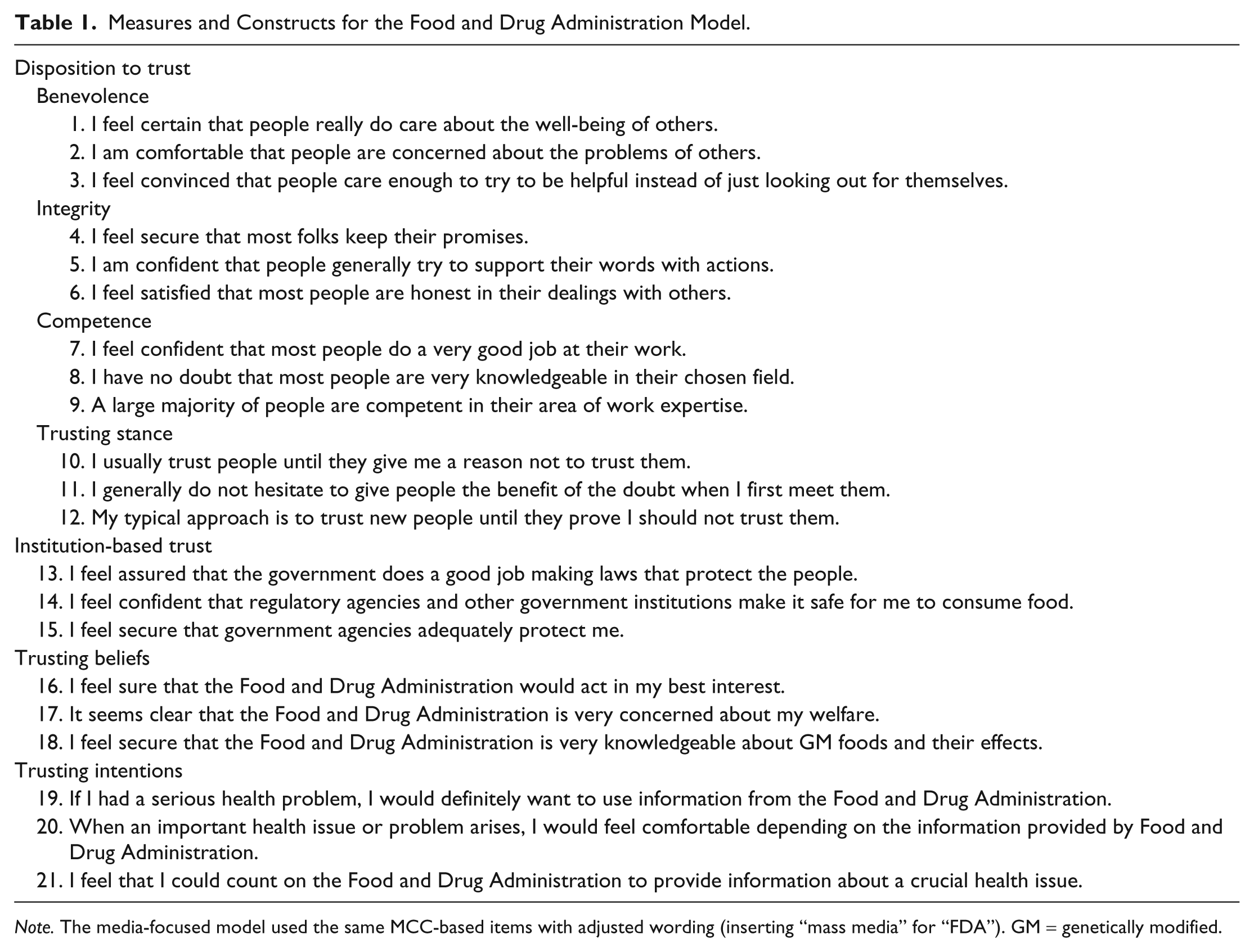
Note. The media-focused model used the same MCC-based items with adjusted wording (inserting “mass media” for “FDA”). GM = genetically modified.
Cronbach’s Alpha, Scale Means, and Standard Deviations for Model Constructs.

Note. FDA = Food and Drug Administration.
Results
Structural equation modeling (SEM) through AMOS (Version 5, Build 5138) was used to analyze the data’s fit with the general research model illustrated in Figure 2. As discussed earlier, the model was tested in two conditions, one investigating the relationship between trust constructs in the media and its coverage of GM foods, and the other focused on the relationship between trust constructs and trust in the FDA as it pertains to GM foods.

Research model and hypotheses.
Trust in Mainstream Media Coverage
First, this research examined how respondents’ trust in the media coverage of GM foods could be modeled using this typology of trust. Analysis of the data found three paths to be highly statistically significant: the path between the faith in humanity (competence) variable and institution-based trust, the path between influence-based trust and trusting beliefs, and the path between trusting beliefs and trusting intentions. The relationships were all significant at the p < .001 level.
These three relationships are additionally highlighted in Figure 3 with standardized regression weights imposed on the significant paths. Several other relationships just missed the statistical cutoff point of p < .05. Such a benchmark can make researchers miss relationships that still might have practical significance so two other relationships that merit consideration are the path between faith in humanity (benevolence) and trusting intentions (p = .053) as well as the path between institution-based trust and trusting intentions (p = .057). Again, these two relationships were not below the common cutoff of p < .05 but were close enough to merit mention. Future research should investigate these relationships further.

Media.
The model only explains a relatively small amount of the variance in institution-based trust (R 2 = .145) but explains much more of the variance in trusting beliefs (R 2 = .424) and the final outcome variable, trusting intentions (R 2 = .550). The relatively strong relationships with two of the variables, as well as highly significant relationships in the model, are reflected in reasonable model fit. Fit indices for this model were consistently in adequate ranges, with the normed fit index (NFI) = .89 and non-NFI (NNFI) = .90, both approaching the .90 standard, particularly considering NFI’s propensity to underestimate fit for small samples (Ullman, 2001). The root mean square error of approximation (RMSEA) is .065. It misses the preferable limit of .05 but falls well below the cutoff of .10.
Trust in FDA-Provided Information
A parallel model, investigating trust in the FDA’s handling of GM food information, was analyzed. This model fit better with these data, including six relationships achieving statistical significance. The relationship between faith in humanity (benevolence) and institution-based trust, faith in humanity (competence) and institution-based trust, as well as faith in humanity (competence) and trusting intentions were significant at the p < .01 level. The paths between institution-based trust and trusting beliefs, institution-based trust and trusting intentions, as well as trusting beliefs and trusting intentions were significant at the p < .001 level.
All of these relationships are highlighted in Figure 4, along with their standardized regression weights. Also, the relationship between faith in humanity (honesty) and trusting beliefs was close enough to statistical significance (p = .073) that practical significance might exist even though it does not qualify as statistical significance at the p < .05 level.

Food and Drug Administration.
This model explains more variance in the endogenous variables than the media model—institution-based trust (R 2 = .304), trusting beliefs (R 2 = .299)—and also more of the exogenous one, trusting intentions (R 2 = .607). This is not a surprise, given the greater number of statistically significant relationships in the model of trust in the FDA. This superior predictive power is also demonstrated by the model’s better fit with the data. The fit indices for this model were acceptable with NFI = .904, NNFI = .92, and RMSEA = .061. This model of trust is quite complex and results in a large number of hypotheses. Table 3 summarizes all of the hypotheses proposed by the model, along with which ones are supported in the respective media and FDA tests of the trust model.
Summary of Results.
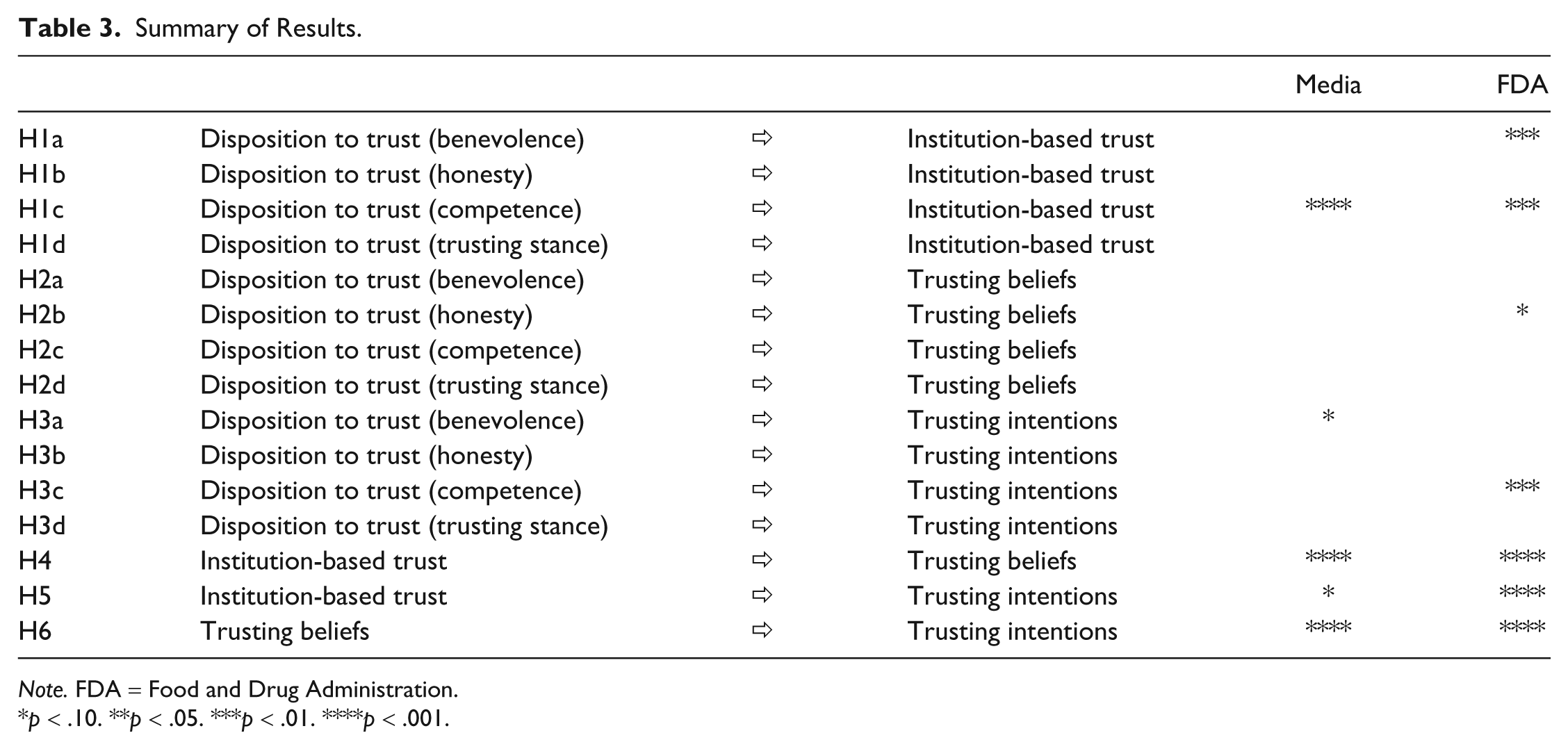
Note. FDA = Food and Drug Administration.
p < .10. **p < .05. ***p < .01. ****p < .001.
Discussion and Conclusion
The role of trust in communication merits continued attention as trust is fundamental to outreach efforts about complicated or controversial topics. Trust often seems assumed in communication of complex issues or considered as a covariate in research models, but broad examination of its nuances and role as a central element to communication strategy maintains much potential for growth. Employing a multidisciplinary perspective, the current study tests a novel model of trust that predicts intention to trust in both media and FDA institutions. GM foods, a science and health issue of concern for some, remains an issue that the majority of the U.S. lay public know little about. To better understand more about GM foods, the majority of lay individuals would need to seek information from experts and other specialist sources to understand the controversy underscoring the use of GM foods as a staple in the food supply of the United States. GM foods, thus, provided an interesting context to examine the role of trust as participants had little knowledge of the issue, yet are directly affected by the implications of the GM foods covering the shelves of U.S. supermarkets. Results of the research demonstrate that disposition to trust is relevant to institution-based trust, trusting beliefs, and trusting intentions. Model relationships will be discussed in terms of both their theoretical and practical implications.
The large-scale question of the suitability of this model of trust in communication environment was supported positively by the data, although there remains room for improvement; the model explained more than half of the variance in people’s intentions to trust the mainstream media to accurately report on GM foods as well as the FDA to provide adequate oversight regarding the development and sale of GM foods. The model used in this study, a direct translation of a model of trust that was originally designed for use in business risk contexts, already possesses explanatory power in another arena. This study’s findings are testament to the robust nature of the model, particularly considering this study was a first test.
Trust in Mainstream Media Coverage
Elements of the model strongly predict the trust people place in the mass media. Institution-based trust and trusting beliefs show noteworthy connections with people’s intentions to trust the mass media. First, the relationship between institution-based trust and trusting beliefs indicates that respondents believe existing structures or assigned social roles are in place to encourage media outlets to watch out for the public’s interest; in other words, respondents believe that existing professional mores push the mainstream media to act as a public watchdog, in line with how journalists represent their own roles (Himelboim & Limor, 2011).
From there, this institution-based trust (acknowledgment of existing structures that would benefit the public) acts through trusting beliefs (perception of beneficial characteristics such as honesty, predictability, and a willingness to act in the respondent’s best interest) to influence intentions to trust media sources for information. In short, respondent perceptions of journalistic practices influenced views of the media’s public watchdog performance, which affected intentions to trust the mainstream media regarding the topic at hand.
These findings stress a number of areas where media agencies responsible for communicating key health and science information on debated topics could focus attention to develop stronger trusting relationships with the public. For example, strategies should include efforts to proactively demonstrate honesty and benevolence as well as assurances to the public that structures within the media encourage positive characteristics such as the watchdog role and accurate, comprehensive information.
While the trust model explained much of the variance in intentions to trust the mass media, it was not entirely supported. For example, the disposition to trust construct did not perform as expected in relation to the mass media. Disposition to trust and its elements—faith in humanity and trusting stance—did not demonstrate a relationship with individuals’ intentions to trust the media. It is possible that faith in humanity and trusting stance might emerge in future work focusing on the use of new social media in news dissemination. Even if people may not be inclined to have a disposition to trust the mass media, they may exhibit significant trusting behaviors in the recommendation of a friend using social networking tools (e.g., Facebook or Twitter) to point people to an interesting news story. In such instances, the trust one individual places on a friend may then extend to the information provided by the digital mass media outlet. The same phenomenon may exist with recommendations from the general public where many unknown others pointing to a particular news story increases an individual’s disposition to trust that particular story (e.g., Digg).
Such user-based recommendation sites are of particular interest to professionals wishing to communicate health and science information to the general public, as one of the primary outlets for such communication is the mass media. The respondents’ low disposition to trust the media may be because respondents already possessed set views on the performance of the mass media and thus answered these items based on their overall conceptualization of the role of media in their lives. The lack of a relationship here between disposition to trust and trusting intentions may be the product of individuals not being willing to depend on the mass media because of prior experience, which would be compatible with Poortinga and Pidgeon’s (2004) findings about the importance of prior attitudes and trust. It is also likely that specific media channels are perceived as trusted sources as compared with overall mass media, a vague conceptualization that allows individuals to consider a wide range of media rather than a trusted channel preference.
Perhaps in part because of these developing media, a key challenge with this area of inquiry is that people may not view the mass media as an institution. It is possible that respondents do not conceptualize the media as an institution to trust in the same way they might place trust in the government or other more formalized institutions. It is also possible that respondents might be more apt to view individual news organizations as having institutional controls worthy of trust, and this—as well as people’s differing views of news organizations perceived as aligned or opposing their views—would be another fruitful avenue of research.
Trust in FDA-Provided Information
Elements of the model also strongly predict the trust people place in the FDA as an information source on GM foods. The FDA-focused model shows a relatively better fit than the media-focused one, perhaps in part due to the fairly clear boundaries around the FDA’s mission. Respondents’ disposition to trust influenced their trust in the FDA as an institution as predicted and also influenced respondents’ intentions to trust the FDA’s handling of the subject. Again as predicted, respondents’ trust in the FDA as an institution affected their beliefs that the FDA was acting as a watchdog and that the agency is capable of doing so. This finding supports previous research suggesting the public has great confidence in the safety of the U.S. food supply and the role of the FDA in protecting it. Finally, these beliefs in the structures of the FDA and its ability to serve as sentinel for respondents’ interests led to increased intentions to trust the FDA about GM foods.
However, several predicted relationships in the FDA model were not supported by the data. Individuals’ disposition to trust the FDA did not affect their beliefs that the professional and regulatory environment surrounding the FDA’s work on GM foods is a positive one. This demonstrates an opportunity to employ more effective public relations to better connect with consumers as well as explain the regulatory environment in which the FDA operates. Through two-way asymmetrical communication, the FDA could build relationships with consumers and demonstrate a positive, effective outlook related to protecting the consumer food supply (Werder, 2006).
Future Work on Trust in Information Providers
It would also be useful to examine other variables that may influence trusting intentions. Individual-level factors such as personal relevance or emotional engagement with the topic might influence how the constructs of the trust model relate to one another, such as the affective response examined by Poortinga and Pidgeon (2005) or the range of involvement types studied by Cho and Boster (2005); personal relevance, for example, could cause variation in the importance of the disposition to trust’s faith in the humanity element since an individual’s general tendency to depend on others could be affected by the personal relevance of a subject, as suggested by persuasion research in other contexts (Petty, Cacioppo, & Schumann, 1983). Similarly, personal values or identity issues related to the topic area or sources could also affect outcomes.
Knowledge about the topic as well as health literacy could also play a role, potentially making individuals rely more or less on institutions to serve their best interests. Future work could additionally consider the role of perceived knowledge—how an individual who may “know” information that is factually inaccurate evaluates the trustworthiness of media sources (e.g., that H1N1 flu comes from pigs).
Ongoing research in artificial intelligence, culture, and mental models of information processing are other areas that could further contribute to understanding how individuals come to depend on certain sources (Lount, 2010; Such, Espinosa, Garcia-Fornes, & Botti, 2011). Source-related factors such as credibility, relationship length between source and message recipient, and perceived source self-interest could offer additional insight (Avery, 2010; Ferguson et al., 2009; Torche & Valenzuela, 2011).
Testing the model with other samples could also offer avenues to understand reaction to complex topics and public willingness to depend on certain information sources, which would expand the knowledge base beyond what is generated in the current study. Samples of older adults, individuals in other geographic regions, or those in different economic or educational circumstances may offer a deeper understanding of what makes people willing to depend on others to comprehend nuanced or complicated subject areas.
In addition, further research could be expected to help improve measurement, variable relationships, and thus overall fit. Future analyses using other samples and more precise measurement could bring performance of the MCC model more in line with its prior uses. This research faces the general limitations of all survey research, primarily that it is dependent on the self-reports of those taking such a survey. Self-report measures can be error-prone, as the placement or wording of survey items can bias results. Steps were taken to alleviate this potential problem, though, with the use of three different versions of the survey. Future work could employ multiple reports over time to check for consistency or use a qualitative approach to follow up on why predicted relationships among constructs did not develop.
Understanding what processes lead to trust in institutions such as professional communicators, media outlets, and government agencies is an essential query. As Lang and Hallman (2005) point out in their work on trust, the public will develop trusting relationships with certain institutions just as surely as outside groups will attempt to influence those trusted institutions. Already challenging subjects become even more complex, an issue further complicated by the influence of public expectations and specific branding profiles of various institutions (Walls, Pidgeon, Weyman, & Horlick-Jones, 2004). The result will likely be public confusion unless the population possesses trusting relationships that allow them to cut through the clutter and external attempts at influence. If the public maintains a proactive, long-standing relationship with the FDA, for example, other attempts to sway public opinion with less accurate or biased information will become more challenging because of that established connection with that government watchdog agency.
Conclusion
Trust’s role in information delivery does not lack for complexity, but its essential nature merits the effort necessary to unravel the construct. Increasingly complex topics such as medical care policy or GM foods require trusted sources to aid the public in developing an understanding of new developments. Without trusted sources, stakeholders lose access to information and the ability to effectively judge nuanced situations. The model examined in this article works to clarify the complexity of these relationships by providing an organized way to examine trust in communication, conceptualizing trust as a coherent, measurable construct. Future research may do well to incorporate knowledge levels, personal relevance, and affect toward specific topics.
Footnotes
Declaration of Conflicting Interests
The author(s) declared no potential conflicts of interest with respect to the research, authorship, and/or publication of this article.
Funding
The author(s) received no financial support for the research and/or authorship of this article.
Author Biographies